
Monotropism describes a way of attending in which attention gathers deeply around a small number of interests at any one time (Murray et al., 2005). Polytropism describes attention that moves more readily between many things at once. Many Autistic people, ADHDers and AuDHDers are strongly monotropic, and yet most of the world has been built for polytropic attention. In this piece I look at what that mismatch costs us, how it can lead to burnout, and what it might look like to build spaces that value depth as much as breadth. It follows on from Monotropism vs Polytropism: ADHD, AuDHD & Autistic Attention on Autistic Realms.
Environmental Mismatch
Most schools, workplaces, and community spaces are designed with polytropic attentional needs in mind: environments where success depends on rapid task-switching, tracking multiple inputs at once, sustaining moderate attention across many topics, being “on call” for interruptions, and being able to filter out sensory stimuli to stay regulated, remain on task, and communicate and be sociable in expected ways.
For monotropic people, including many Autistic people, ADHDers, and AuDHDers, this is a mismatch at the most fundamental level. Our monotropic minds are naturally drawn into deep, sustained engagement with one or a few meaningful things at a time. When society’s polytropic environment constantly demands broad, rapid, reactive attention, it creates a steady drain on our sensory, cognitive and emotional resources and, over time, this can lead directly to burnout.
Impact of Being Monotropic in a Polytropic World
Hossain and Bain’s (2025) research with parents of ADHD students in UAE schools, while not written specifically about monotropism, describes patterns many monotropic people may recognise. Reading their four themes through a monotropic lens: as “assailable humans”, navigating systems that expect constant responsiveness makes us vulnerable to overwhelm. Under “behaviour as communication”, missed deadlines, withdrawal from social contact, or “switching off” can be signs of sensory or attentional overload, rather than laziness or avoidance. “The surrounding ecology” describes thriving in supportive, flexible settings and struggling in rigid, high-demand ones. And “collective assistance” captures the difficulty of keeping up when group work demands simultaneous attention to multiple threads.
From an enactive perspective, cognition does not happen only “in the head.” As Jurgens (2020) explains, our bodies and relationships shape us and our environments. For monotropic people, the challenges we face arise from a mismatch between our deep-focus attentional style and the way most environments are set up, rather than from personal weakness. Damian Milton’s double empathy problem (Milton, 2012) shows that misunderstandings between Autistic and non-Autistic people are mutual. Similarly, systems built around polytropic thinking and socialising often fail to recognise or value monotropic attentional styles in education, healthcare and workplace settings.
The cost of social and environmental mismatch is not experienced equally. How attentional differences are interpreted is shaped by race, gender, class, disability, and other intersecting identities. For example, an AuDHDer from a marginalised racial background may be labelled “defiant” for behaviours that are excused or accommodated in white peers. Women and gender-diverse people may have their struggles dismissed or misattributed to personality traits.
Without an intersectional lens, even well-intentioned neurodiversity initiatives risk reinforcing inequities, unintentionally leaving the most marginalised monotropic people without the understanding and support they need. Recognising monotropism is only the start; changes must be designed to ensure that everyone benefits, not only those already closest to privilege.
Monotropic Split and Flow
Building on the idea of environmental mismatch, Adkin (2022) describes the concept of monotropic split: in settings that align with our interests and allow for uninterrupted flow, monotropic people can appear highly capable, sometimes exceptional. However, our functioning can drop sharply when pulled into low-interest, multi-task-heavy situations. Splitting attention across multiple channels is exhausting in the moment and, over time, unsustainable, contributing to burnout.
Monotropism helps to describe how repeated disruptions to deep-focus states can cause attention fracture or monotropic split. The ability to immerse in an interest or task breaks down. Even activities we usually love can feel harder to start or sustain. Our sense of competence and identity can be shaken.
From the outside, this can look like inconsistency and may help explain the spiky profiles so often attributed to neurodivergent people, excelling one day and “struggling” the next. In reality, it reflects whether the environment enables or obstructs monotropic engagement. The variation emerges from the interplay between our deep-focus attentional style and the demands of the setting. I have discussed this more in my blogs Autistic Young People: Skills Regression, Burnout or a Shift in Monotropic Attentional Resources? and Unmasking: Reclaiming Our Monotropic Attentional Resources?
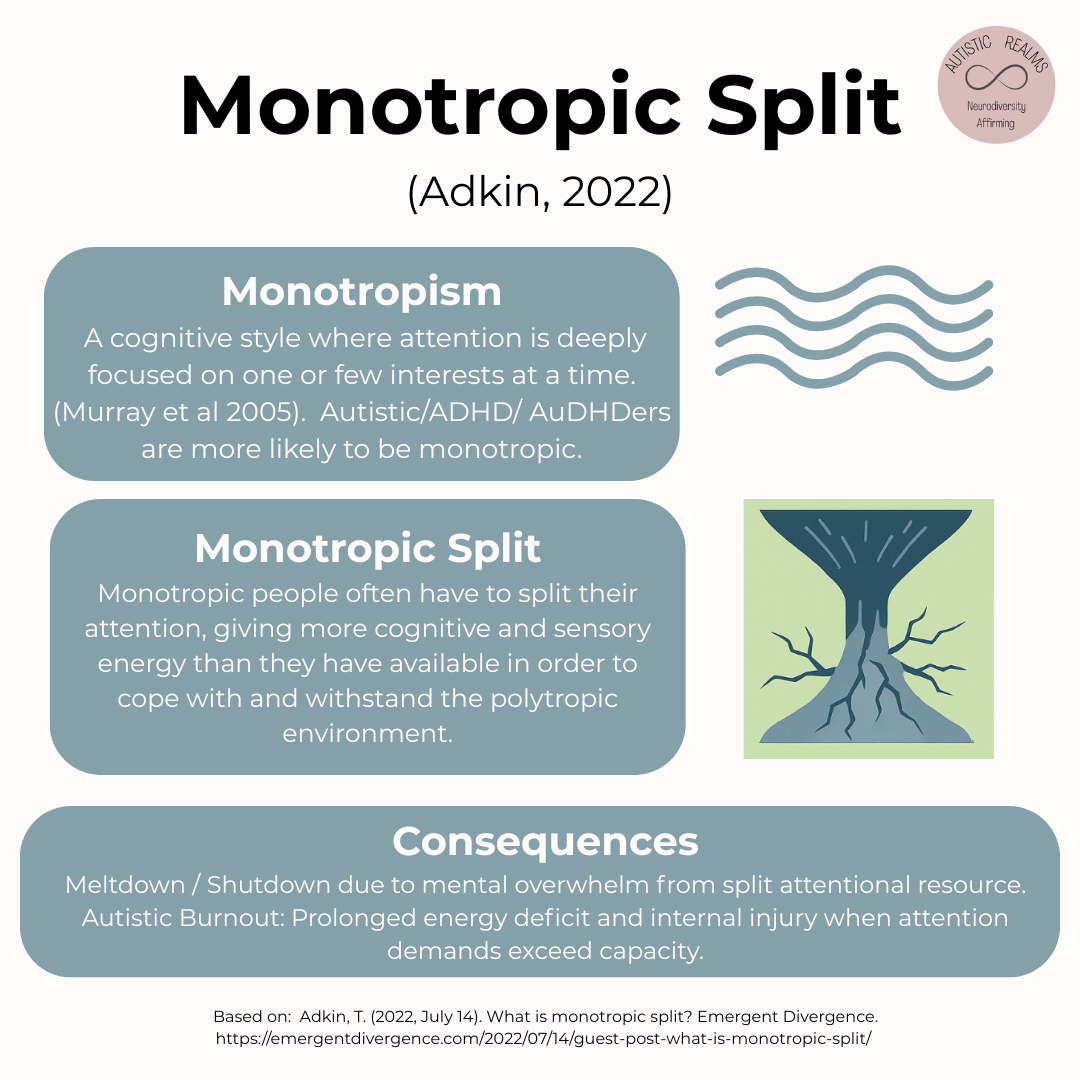
This split becomes clearer when we consider Heasman et al.’s (2024) observation that for Autistic and monotropic people, flow is never guaranteed; it depends on environmental affordances. Authentic engagement and productivity require conditions such as predictable and safe sensory environments, autonomy to follow meaningful interests, minimal unnecessary interruptions, and clear and manageable transitions.
When these conditions are absent, as they often are in polytropic systems like schools and workplaces, noise, unpredictability, and constant switching between tasks drain energy. Instead of channelling attention into the work, we spend most of our limited resources managing disruption. Over time, this erodes productivity and undermines confidence, self-esteem, and overall wellbeing.
The fragility of flow is also closely tied to how we experience time. Tolani and Venkatesan (2025) describe how hyperfocus is part of a nonlinear, present-oriented experience of time for ADHDers; hours can pass in what feels like minutes. Being pulled out of that state abruptly can be disorienting, even physically uncomfortable. Without sensory safety and predictable transitions, re-entering that depth of focus becomes much harder, and recovery often takes far longer than others realise. For monotropic people, “just picking up where you left off” is rarely realistic; it demands significant energy and effort. Over time, the constant strain of trying to fragment monotropic flow to meet the breadth-first demands of a polytropic world becomes exhausting, and for many of us, this is one of the pathways into burnout.
Burnout and Recovery for Monotropic People
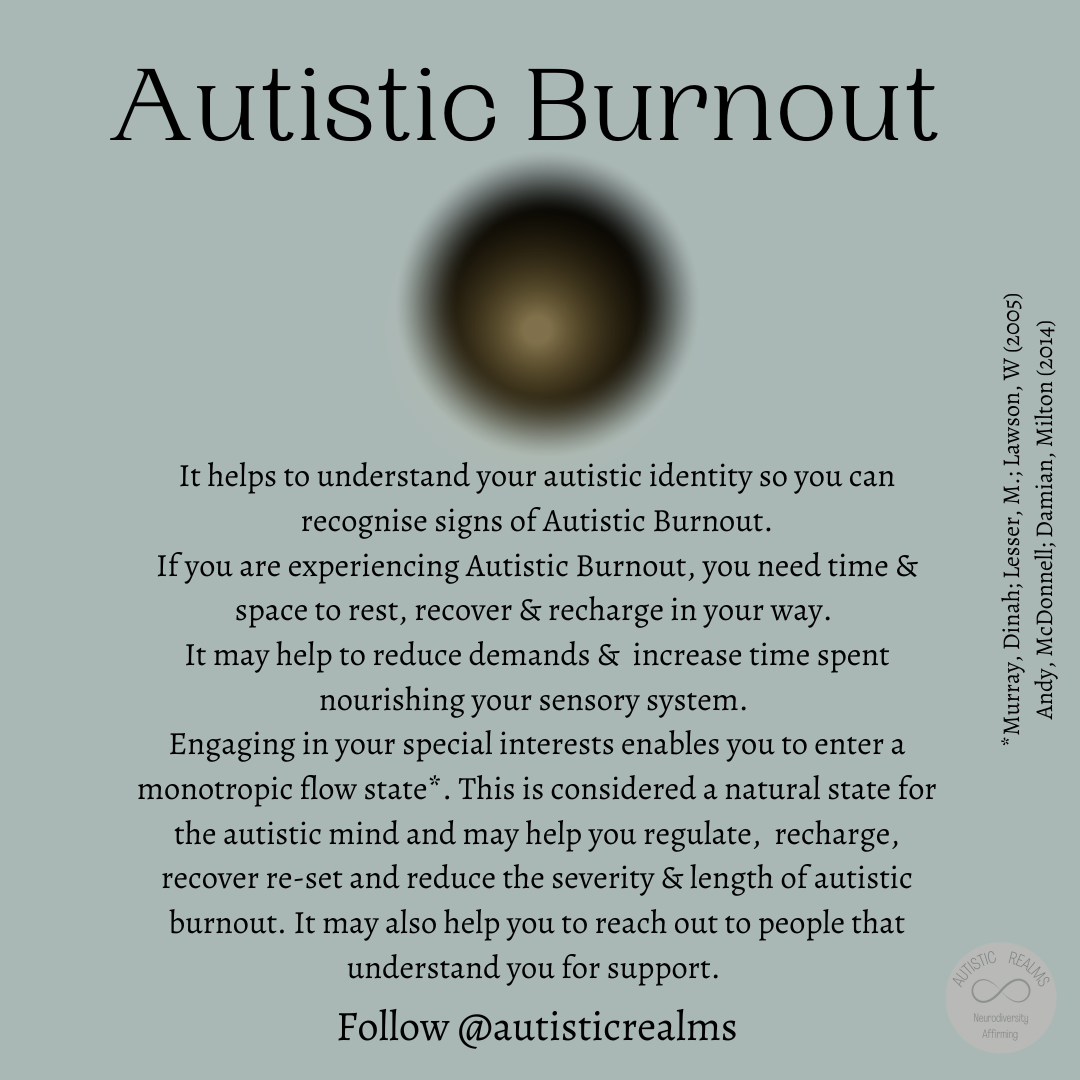
Burnout for Autistic people, ADHDers, and AuDHDers is about far more than “doing too much.” It is often the result of the cumulative stress of a sustained mismatch between how our monotropic attention naturally works and what polytropic environments demand (Buckle et al., 2021; Hossain & Bain, 2025; Raymaker et al., 2020).
When we are forced to operate in polytropic systems that demand constant task-switching, value neuronormative ways of communicating and socialising, ignore our sensory needs and what meaningful rest looks like, undervalue interest-based engagement, and interrupt flow repeatedly without recognising the impact of Autistic inertia (Buckle et al., 2021), our resources are steadily drained. Burnout is what happens when that drain goes on for too long without the chance to recover.
Monotropism and Wellbeing
Drawing from Fergus Murray’s (2023) keynote presentation on Monotropism and Wellbeing, McDonnell and Milton’s (2014) reframing of repetitive behaviours as flow activities, and Heasman et al.’s (2024) emphasis on environmental accommodations, the conditions that best support Autistic people (and likely all monotropic people) are things like protecting flow states, because uninterrupted engagement in meaningful activities supports regulation, learning, and joy; reducing unnecessary task-switching, because constant redirection erodes focus, increases anxiety, and lengthens recovery time; and honouring interest-based engagement, because working with genuine passions sustains motivation and restores energy. Creating predictable, sensory-safe environments may help attention shifts be less jarring (how these look and feel will depend on the individual). Allowing for recovery rhythms, with extended periods of low demand and room for meaningful, monotropically aligned rest and self-directed activity, helps rebuild capacity, energy and flow.
McDonnell and Milton (2014) explain that what is often called “repetitive behaviour” can be a way of self-regulating, helping us recover balance after stress. For monotropic people, these flow activities are essential for wellbeing, rather than a distraction from “real work”. Heasman et al. (2024) point out that flow depends on the right environment: having control over what we are doing, being safe from interruptions, and being in a space that values deep focus. Without this, recovery can stall. The Monotropism Questionnaire (Garau et al., 2023) reflects this too: its factors include the impact of the environment on the attention tunnel and losing track of other needs while focused, which suggests that supportive surroundings matter for getting back into focus, and that while deep engagement is valuable, we may also need gentle reminders to look after ourselves.
Recovery means protecting the conditions that help us go deep: enough time for interest-based activities, predictable and comfortable sensory settings, and fewer demands while easing back into work or study. Forcing ourselves to cope with constant switching or spreading our attention thin only makes things harder. Unless schools and workplaces stop expecting monotropic people to work like polytropic multitaskers, burnout will keep happening, and the blame will keep falling on neurodivergent individuals instead of the environment.
Building Monotropism-Affirming Spaces
When we design education, workplaces, and communities with only polytropic people’s needs in mind, we limit what monotropic people can bring to the world.
In Education
- Allow extended time for deep, interest-based projects rather than constant short tasks.
- Reduce unnecessary task-switching, and build in natural transitions between subjects or activities.
- Create sensory-predictable but flexible learning spaces.
- You could use the Monotropism Questionnaire (Garau et al., 2023) as a tool to understand learner needs. However, there is not yet a monotropism questionnaire for children or young people, so it is not validated for them and would likely need to be adapted.
In Workplaces
- Design roles around passions and interests for sustained focus and depth, rather than constant switching.
- Give advance notice of changes, deadlines, or meetings so focus shifts are less abrupt and multimodal communication needs are honoured.
- Provide quiet, low-distraction workspaces alongside collaborative areas.
- Value depth-based productivity as equally important as breadth-based multitasking.
When systems adapt to include monotropic attention styles, burnout reduces, and the creativity, problem-solving, and deep knowledge that monotropic people bring have room to grow. The aim is to shape systems so that both depth and breadth of attention are valued, and so that all of us have the conditions we need to thrive, whatever our attention style.
References
Adkin, T. (2022, July 14). Guest post: What is monotropic split? NeuroHub Connect. https://neurohubcommunity.org/2022/07/14/guest-post-what-is-monotropic-split/
Buckle, K. L., Leadbitter, K., Poliakoff, E., & Gowen, E. (2021). “No way out except from external intervention”: First-hand accounts of autistic inertia. Frontiers in Psychology, 12, Article 631596. https://doi.org/10.3389/fpsyg.2021.631596
Garau, V., Murray, A. L., Woods, R., Chown, N., Hallett, S., Murray, F., Wood, R., & Fletcher-Watson, S. (2023). Development and validation of a novel self-report measure of monotropism in autistic and non-autistic people: The Monotropism Questionnaire [Preprint]. OSF Preprints. https://doi.org/10.31219/osf.io/ft73y
Heasman, B., Williams, G., Charura, D., Hamilton, L. G., Milton, D., & Murray, F. (2024). Towards autistic flow theory: A non-pathologising conceptual approach. Journal for the Theory of Social Behaviour, 54(4), 469–497. https://doi.org/10.1111/jtsb.12427
Hossain, M., & Bain, J. (2025). Beyond behavior: Understanding ADHD burnout and the need for belonging in UAE schools. Psychology in the Schools, 62(10), 4265–4275. https://doi.org/10.1002/pits.70000
Jurgens, A. (2020). Neurodiversity in a neurotypical world: An enactive framework for investigating autism and social institutions. In H. Bertilsdotter Rosqvist, N. Chown, & A. Stenning (Eds.), Neurodiversity studies: A new critical paradigm (pp. 73–88). Routledge. https://doi.org/10.4324/9780429322297-8
McDonnell, A., & Milton, D. (2014). Going with the flow: Reconsidering “repetitive behaviour” through the concept of “flow states”. In G. Jones & E. Hurley (Eds.), Good autism practice: Autism, happiness and wellbeing (pp. 38–47). BILD. https://kar.kent.ac.uk/62647/
Milton, D. E. M. (2012). On the ontological status of autism: The “double empathy problem”. Disability & Society, 27(6), 883–887. https://doi.org/10.1080/09687599.2012.710008
Murray, D., Lesser, M., & Lawson, W. (2005). Attention, monotropism and the diagnostic criteria for autism. Autism, 9(2), 139–156. https://doi.org/10.1177/1362361305051398
Murray, F. (2023). Monotropism and wellbeing [Keynote presentation]. Scottish Autism Research Group Conference 2023. https://monotropism.org/wellbeing/
Raymaker, D. M., Teo, A. R., Steckler, N. A., Lentz, B., Scharer, M., Delos Santos, A., Kapp, S. K., Hunter, M., Joyce, A., & Nicolaidis, C. (2020). “Having all of your internal resources exhausted beyond measure and being left with no clean-up crew”: Defining autistic burnout. Autism in Adulthood, 2(2), 132–143. https://doi.org/10.1089/aut.2019.0079
Tolani, P., & Venkatesan, S. (2025). The time we see: ADHD, neuroqueer temporality, and graphic medicine. Perspectives in Biology and Medicine, 68(1), 117–138. https://doi.org/10.1353/pbm.2025.a953457