I spent the evening of sixth of August in Brigit McNeill’s Migration writing workshop with the Into the Woods writing group, in a session called The Living Page. We were invited to write from and with migration, as a movement to think inside of, inspired by Brigit’s own writing.
What follows is some of what I shared during the workshop and what I have been thinking about afterwards, threaded through with the ideas I keep returning to in my work on monotropism and neuroqueer theory.
Inner Compass
Birds cross oceans using a compass sense we still don’t fully understand. It may involve something in their eyes that responds to the Earth’s magnetic field, through a quantum mechanism that is still being worked out (Mouritsen, 2018). A bird doesn’t need a conventional map; it can orient by reading the world itself as a kind of felt knowledge.
As Brigit shared through her writing, salmon return to their birth rivers. Humpback whales cross hemispheres between calving and feeding grounds. Elephants can follow familiar routes across landscapes, including routes to water. Even a plant’s seed is carried by wind or on fur, migrating in its own way, landing on new ground.
The Inner Tug Of Migration
It’s easy to think of migration as recurring linear travel between fixed points — departure, journey, arrival and back again. The workshop pushed against that framing, and we discussed migration as a process of transformation across time, as much as displacement across distance.
I feel this is close to what Deleuze (1994) was exploring through the idea of ‘difference in repetition’. The idea that no repeated pattern is ever a true copy, that each turn carries its own small variation. Migration, read this way, isn’t a repetitive loop; it’s more of a spiral. With every movement, everything changes.
We discussed Brigit’s writing about what she calls the ‘tug’ of migration. It feels like there’s a bodily quality to how migration begins for all of us, whether crossing distance on the land as animals or in our human bodyminds. Before a bird sets off, something like a restlessness builds in its body. The pull comes from within, affected by seasons, seas, and time, and the sense of direction follows from that, in a very embodied, sensory tug.
I recognise that kind of tug or pull in my own way of being. Monotropism (Murray, Lesser, & Lawson, 2005) describes how Autistic attention tends to gather intensely around a small number of interests, rather than spreading more evenly across many. When an interest catches me, it feels closer to that restlessness in the birds, a tug like a magnet pulling me in and arriving before my actual cognition and thinking have caught up.
Following this tug or pull deep inside you, something opens up. Csikszentmihalyi (1990) described flow as the state that arises when attention and challenge align closely enough that the sense of separate effort disappears. It often comes with an undercurrent of wonder where the world briefly widens around whatever has caught you and opens up further into awe. I think that combination is close to what’s carrying migrating animals too: a sense of direction felt from the inside, trusted enough to move on and to see what will happen.
Following the inner pull and desire of flow, whether it is sensory or more cognitive, leads us to connect ideas, connect people, to move our bodyminds. Flow isn’t stillness; attention is moving, even when the body isn’t. It slowly transforms us: each new interest, each sensory experience, every connection with another being or environment shifts something inside us.
Many of us are taught early to override this feeling of going with the flow of what interests us and listening to our inner needs. We are conditioned to ignore our inner compass, to ignore our passions, our ideas, our sensory needs, especially if they fall outside of what is normally expected. We are taught to mask and suppress our flow and authentic migration.
Research on Autistic masking describes the suppression of natural Autistic ways of being in favour of alternatives judged safer and more acceptable by society (Pearson & Rose, 2021). The tug of monotropic passion and sensory feelings often gets read as being too much, having interests too narrow, and we learn to quieten ourselves or try to adapt to fit in. Over the years, we are moving further and further away from our own internal compass and needs until we may not even recognise our true self.
Trusting Our Inner Compass
Trusting our inner compass again isn’t easy, and there is definitely a certain amount of privilege involved in being able to unmask and be your real Autistic self with people. Neuronormativity, the assumption that more evenly distributed, easily legible attention is the ‘correct’ default way to be. It doesn’t just ask us to behave differently; it makes us distrust ourselves too. Neuroqueering (Walker, 2021) is an ongoing practice of subverting and resisting neuronormativity. It is not a final destination to become ‘neuroqueer’ or to have ‘neuroqueered’ your life — rather, I see it as an ongoing refusal to be ashamed of who you are.
This is where we need to re-learn to trust ourselves. Pernille Fraser’s poem “Can We Trust?” names this same rupture from the other direction: not what we lose faith in within ourselves, but what has to be earned from everyone and everything around us before that trust can return at all. The poem was written in 2019 and later shared through Stimpunks Foundation as part of our Neuroqueer Learning Spaces project. The poem repeats its central question across sensory load, pacing, correction, and the question of whether we’ll be believed and left to decide for ourselves, asking, “Can we trust the space you offer?” (Fraser, 2019/2024). The poem never resolves into an answer; it stays in the asking, leaving open questions of safety and possibility. The potential of trusting people in safe spaces to be ourselves, to keep moving and transforming.
That same question of trust doesn’t stop at ourselves. Once we’ve relearned to trust our own inner compass, we can start noticing that everyone and everything around us, human and otherwise, is following one too when we are able to feel safe.
Differences Of Being
If we stop assuming there is one right way for a human mind to move through the world, perhaps we can extend that generosity beyond humans too. Migration is only one expression of a much wider range of ways living things exist in and move through the world. Ethodiversity (Tarragnat, 2024) names the variability of behavioural and existential styles within and across species, developed to open neurodiversity beyond a purely human-centred and neurological framing. A bird’s compass, a salmon’s imprinting, a whale’s seasonal crossing, and a human’s monotropic pull aren’t the same mechanism in different bodies. They’re genuinely different ways of being, each one worth recognising on its own terms.
Difference here is already a form of connection. A migrating salmon doesn’t just pass through a river, its body becomes part of it. When Pacific salmon return to their home streams to spawn and die, their bodies carry marine-derived nutrients into freshwater and other ecosystems; they carry something from one world into another. Whales do something similar at an ocean scale: they help move nutrients such as nitrogen and iron back into sunlit waters, while their migrations redistribute nutrients across large distances. Neither salmon nor whale set out to feed a forest or an ocean, but each unique way of moving through the world is, at the same time, an act of shaping it, and being reshaped by it in turn.
That sits well alongside Milton’s (2012) double empathy problem, which invites us to notice that people communicate and experience the world differently from one another — and that no single way of being or relating needs to sit at the centre, with everyone else read against it. It sits well, too, alongside Barad’s (2007) idea of intra-action: that a self, or a species, or a migrating body doesn’t exist as a separate thing that then relates to its surroundings, but comes into being through the relating itself. There’s no “before” and “after” self on either side of a migration, only the shaping itself. The liminal space a migrating creature passes through isn’t a gap between two finished things. Self and field, self and current, self and interest, forming each other as they go.
Transformation and Trust
The workshop’s real gift was permission to stop treating change as the exception that needs explaining and to start treating it as the foundation through which everything else moves. Life doesn’t hold still and occasionally migrates; it is always in a constant state of flux and flow.
That reframing opens space for new stories to begin, not despite the shifting, but because of it. This sits alongside other threads I keep pulling on: the constellation-thinking in My Monotropic Galaxy on More Realms, and the Star Stuff work with Ryan Boren at Stimpunks, which starts from the same idea, that we are made of matter that has already migrated across unthinkable distances, reorganising itself into shape after shape after shape, connection by connection.
Migration, in that sense, isn’t a metaphor borrowed from birds and whales. It’s been true of us for longer than we’ve had words for, trusting our inner compass isn’t something any of us can do alone as people and may be especially as Autistic monotropic people.
Birds have the Earth’s magnetic field and the wider world around them to orient by. We need something a bit different: people and spaces willing to be trusted, willing to let us move, be, and communicate in our own way without demanding we prove it first.
Rediscovering our monotropic inner compass is only part of the migration. The rest is building spaces safe enough to trust it in, so we can shape and be shaped by the world around us, the way the salmon and the whale do, simply by being fully who we are.
Milton, D. E. M. (2012). On the ontological status of autism: The ‘double empathy problem.’ Disability & Society, 27(6), 883–887.
Mouritsen, H. (2018). Long-distance navigation and magnetoreception in migratory animals. Nature, 558(7708), 50–59.
Murray, D., Lesser, M., & Lawson, W. (2005). Attention, monotropism and the diagnostic criteria for autism. Autism, 9(2), 139–156.
Pearson, A., & Rose, K. (2021). A conceptual analysis of autistic masking: Understanding the narrative of stigma and the illusion of choice. Autism in Adulthood, 3(1), 52–60.
Tarragnat, O. (2024). Biodiversity, neurodiversity, ethodiversity: Towards a more-than-human and more-than-neurological turn in neurodiversity studies. TRACE: Journal for Human-Animal Studies.
Walker, N. (2021). Neuroqueer heresies: Notes on the neurodiversity paradigm, autistic empowerment, and postnormal possibilities. Autonomous Press.
Courses, books and resources
If you would like to take these ideas further, my courses, books and resources live on Autistic Realms. Everything in the shop is pay what you can, and many resources are free.
Autistic burnout, monotropism, and living in the in-between
Fergus Murray posted a link in the Monotropism Discord today about Flowing-Afterglow Mass Spectrometry. The title pulled me in, even though I struggled to understand the specifics of the actual chemistry. It made me think of my own internal energy as an Autistic ADHD monotropic person, and how this may relate to burnout.
I think I’m living in the afterglow right now — and I’m noticing it has two different kinds of ember.
I have been ebbing in and out of a perpetual burnout my whole life. It intensifies periodically, the last time was in 2020-2023 when I completely crashed in a mental health crisis, and it hit a new intensity again earlier this year. The embers of that burnout always linger longer than I expect, a low burn that takes my energy, under the surface, long after I’ve supposedly “recovered” or it looks like I’m doing “better.”
There’s a second ember in this afterglow too. Despite occasional bursts of energy like this now, just writing my thoughts about what I am interested in — which I find really rejuvenating — the full tunnel of my highly focused, energetic monotropic flow isn’t open to me at the moment, but I’m not completely empty or in crisis either. Something is still glowing, like a flicker of my attentional resources, which sparks connections and thoughts when something pulls me in, like the title of this article.
My bodymind is in what Tanya Adkin describes as meerkat mode — alert, scanning, half-aroused. I think this is that second ember, still seeking flow and connections, still searching for something to hook into, but I just don’t have the energy to do much with it in a very productive way outside of writing. My executive functioning has been impacted recently, I am forgetful, struggling with basic tasks and have very little energy to communicate. I have had to cut back on my work just to get through my day and continue in a survival state.
On the Wikipedia page about Flowing-afterglow mass spectrometry, it describes afterglow as the plasma that lingers after the initial energy source is switched off. Ions keep colliding; they keep drifting through the flow tube, slowly thermalising and settling towards an equilibrium rather than snapping into it and fully engaging. Reading all this without understanding the actual technical side of the chemistry, all I could do was interpret the article in my own way; it felt like reading a poem that described how I am at the moment.
I have written a lot about living in the liminal, in the in-between states – socially, cognitively and systemically. I am not in a full crisis, not in a complete shutdown, but I know I am not flowing the way I sometimes do when I have more energy.
Perhaps a good word to use is ‘thermalising’. Things are still trying to connect and fuse, slowly, bit by bit, in my liminal state, without my usual intensity. I am conserving my energy; my attentional resources are being reallocated and redirected into a kind of survival mode.
The article notes that as the cost of helium rises, some researchers now use interrupted helium flow “to conserve gas” rather than a continuous stream. Reading that felt like it summed up my burnout. Not broken, not failed, more the result of monotropic split — the exhaustion of a monotropic bodymind repeatedly stretched past its limits trying to meet demands built for a polytropic world — and constantly having my natural flow interrupted day after day, because I need to function, do shopping, clean the house, cook food, care for my family – none of that can stop, it is life.
I don’t fully understand the chemistry about flowing-afterglow mass spectrometry, and I don’t think I need to for this (although sciencey people may argue against that!).
As an Autistic monotropic person, I think I understand the afterglow as the residue of interest still moving through me, unhurried, unforced, finding its own quiet equilibrium until there’s fuel enough for the flame to flow and grow, when I can return to my work again.
… For now, I am flowing in the afterglow…..
Courses, books and resources
If you would like to take these ideas further, my courses, books and resources live on Autistic Realms. Everything in the shop is pay what you can, and many resources are free.
Helen Edgar — Autistic Realms | More Realms | June 2026
Spaces In-Between
I recently looked at the night sky, I was outside and cold, the sheer number of stars, the ones I could see and the knowledge of the ones I could not, shifted something in me that I did not have a word for at the time. It felt like an opening, a feeling of being very small and very connected at the same time, of the distance between me and the universe suddenly becoming less certain, of living in the in-between space. What I was experiencing is called awe, I also know, looking back, that awe may be one of the most distinctly Autistic experiences to feel.
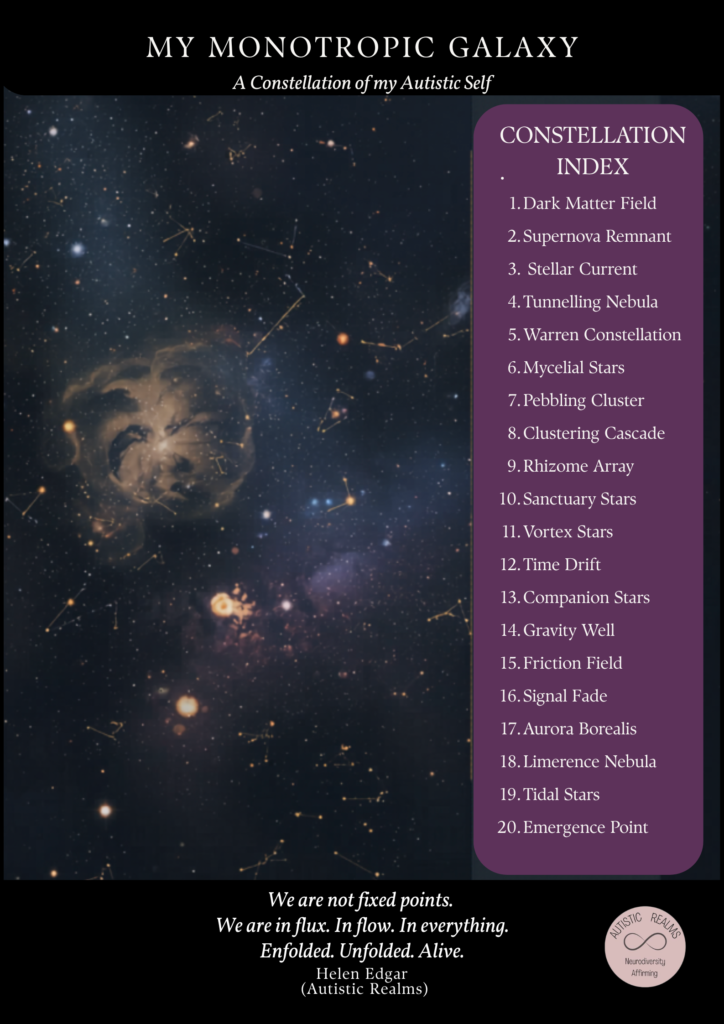
This piece is about feelings of awe and wonder, my own Autistic ADHD experiences, and about the map I have tried to represent of my inner life using the language of the cosmos. It is called My Monotropic Galaxy: A Constellation of My Autistic Self. It is a deep-field image of space, overlaid with constellation lines, accompanied by an index of 20 named features of some of my monotropic experiences. Some of these constellations I have lived in for decades, others I have only recently been able to name. All of them are in relationship with each other, always in motion, always becoming something the map and myself has not yet caught up with.
Before I guide you through my galaxy of monotropic experiences, I will explain a bit about the theory of monotropism and why I feel it is so important for my own sense of self-identity as an Autistic ADHD person.
What Is Monotropism?
Monotropism is an attentional theory of autism developed by Autistic researchers Dinah Murray, Mike Lesser, and Wenn Lawson (2005). It describes how many Autistic people tend to have their attention drawn more strongly to fewer things at any given time, going deep rather than wide, concentrating rather than spreading their focus. Rather than framing this as a deficit — an inability to multitask or shift attention — monotropism understands it as a distinct attentional style with its own strengths and difficulties.
Discovering the theory of monotropism for the first time felt like being handed a map of a place I had always lived in but had never been able to describe. I was identified as Autistic and ADHD in my forties, while my children were also going through their own assessments. What followed was a long process of re-sense-making, a re-storying that went back through my entire life, understanding finally why things had been the way they had been, and finally being able to begin to understand my own neurodivergent identity a little bit better.
Awe and Wonder as a Way of Knowing
Let me return to the night sky and think about what awe actually is and why it may be especially relevant for monotropic people. Helen De Cruz (2024), in her book Wonderstruck: How Wonder and Awe Shape the Way We Think, describes wonder as a form of epistemic opening, a way of relating to knowledge and how we have come to know things. The epistemic opening is the moment when the way we know expands; it is more than just a feeling. When we encounter something that is genuinely awe-inspiring, the usual categories we use to make sense of the world temporarily loosen. It is as if you are maybe seeing or sensing something for the first time; you may notice things you had previously learned to filter out. For De Cruz, wonder is not just a happy side effect of seeing something beautiful; it is a cognitive and moral orientation. It is how we stay genuinely curious about a world we might otherwise let ourselves assume we already understand, or are taught to ignore, as it doesn’t fit into how people expect us to perceive and respond.
When I read De Cruz’s book in 2024, something in me recognised what she was describing at a really deep level. It was the most inspiring book I have read for many years. I took part in a brilliant reading group hosted by The Philosopher 1923, where we explored Helen De Cruz’s work in depth. In the final week, we were lucky to be joined by Helen herself, and I remember discussing Nick Walker’s neuroqueer theory (2021) and the projects I was developing with Stimpunks, particularly the ways her ideas resonated with and helped shape our thinking. These conversations had a lasting impact, influencing our Neuroqueer Learning Spaces project, helping to evolve the vision behind Cavendish Space, and continuing to inform much of my current writing and emerging ideas around the theory of monotropism.
Awe and Flow
When I am pulled fully into something that has truly captured my attention, not just my mind, but my whole body and nervous system is immersed. What opens is not simply focus; it is that first-ness quality of perception De Cruz describes, the sense of seeing and feeling something for the first time, even if I have encountered it a hundred times before. New connections become visible, and the boundaries between things soften. It feels like my nervous system, so often braced against a world not designed for me, can finally exhale in the in-between spaces as new connections form and I feel literally awe-some.
Keltner and Haidt (2003) describe awe as arising when we encounter something vast that challenges our existing mental structures, something that does not fit the categories we already hold, and that invites us to expand our ways of being rather than retreat or fold inwards. Awe can be humbling and expansive at the same time; it opens up possibilities.
I feel this resonates with what it feels like for me to be in monotropic flow. My self does not disappear, nor does it become more rigid or narrow; instead, it feels as though I open up, my whole bodymind becomes more porous. The boundary between me and what I am attending to becomes less fixed; I am both in the flow, and the flow is in me. The distance between those two things collapses and unfolds in a way that feels like both loss and arrival, and it can feel deeply liberating and joyful (and sometimes deeply troubling and anxiety-provoking!).
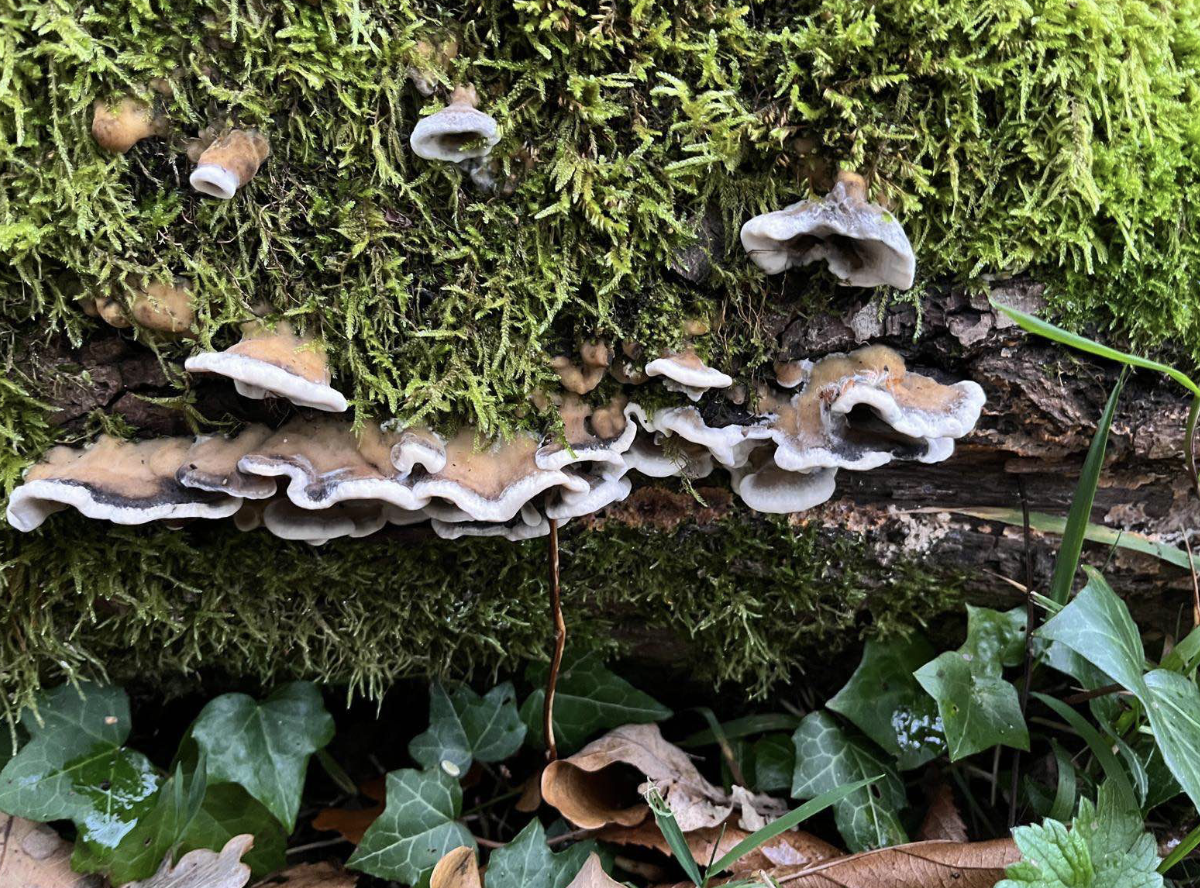
For many Autistic people, these experiences are undervalued, even stigmatised or shamed as we grow up. We are told to concentrate on what the teacher is saying, to focus on what our family and friends think really matters, and slowly, our own ways of perceiving the world are flattened as we learn to mask and stop trusting ourselves. The things we find awe-inspiring are treated as having no value: the joy of looking closely at a mushroom or an insect may be met with being told to hurry up and rejoin the group; the wonder of feeling the sea against your toes in the sand may be met with being told to just get in and swim and stop fussing.
This quality of experience, this awe and wonder, is represented by the Stellar Current at the heart of my galaxy: the deep flow state through which my whole system comes into coherence, and I move with the current of what matters most. It feels fitting that this current carries me toward a phrase that has become foundational to how I think about the Autistic community and a sense of belonging.
Love You Down to Your Star Stuff
The phrase Love You Down To Your Star Stuff grew out of collaborative work with Ryan Boren and Stimpunks Foundation (Boren & Stimpunks Foundation, 2026). It reaches back to something Carl Sagan observed: that the atoms in our bodies were forged in the interiors of stars that lived and died long before our sun existed. We are, quite literally, made of star stuff.
To love someone down to their star stuff is to locate love for their core way of being. Love is not conditional on performance, legibility, or being the kind of person the world finds easy to translate. Love should not be dependent on meeting neuronormative expectations, masking well enough or being productive enough or social enough. To love someone down to their star stuff is to love their way of being continuous with the universe and their authentic self.
Much of the lived experience of being Autistic for many people is weighed down by what I have called the Dark Matter Field in my galaxy. This is the heavy darkness of neuronormativity, reflected in the accumulated weight we carry around of a world that does not meet our needs, and does not love us down to our star stuff. The Dark Matter Field is everything that is harmful in our systems, behaviourism, ableism, racism and more. As Autistic people, we are constantly being measured against a map that was not ours.
The Double Empathy Problem (Milton, 2012) highlights the mutual misunderstanding between people with very different experiences, where the gap of this map is often framed as ours to close; this sits at the heart of the Dark Matter Field’s weight. Decades of masking, so thoroughly embedded in me that I genuinely did not know for most of my life where the mask ended and where I began, meant I was always accommodating others to try to meet expectations.
Love You Down to Your Star Stuff is a different orientation entirely. It is the foundation of what I believe the constellation of the neurodivergent community is reaching toward. The Mycelial Stars — underground networks of care and interdependence. The Rhizome Array — the non-hierarchical community that creates something together that none of us could make alone. The Companion Stars — those who do not need me to perform. The Sanctuary Stars — where I do not have to translate myself. All of these are expressions of what it means to love someone for who they actually are and are part of the galaxy that many neurodivergent people may recognise or relate to.
The Implicate Order and the Autistic Bodymind
A concept from quantum physics has really inspired my thinking recently, helping me articulate my inner self and conceptualise my Galaxy of Monotropic Experiences. Physicist David Bohm (1980) proposed that beneath the explicate order, the world of distinct objects and separate events we can see and measure, there exists a deeper dimension he called the implicate order. In the implicate order, nothing is truly separate; everything is enfolded into everything else. What appears distinct at the surface is always an unfolding of something that, at a deeper level, was always entangled.
I am thinking about the implicate order through the lens of monotropism and flow theory. The surface of a river looks like separate ripples and currents, each one seeming to rise, curl, and vanish on its own, but beneath the surface, the water is continuous; there is no ripple that exists apart from the river. What appears as individual movement is always part of a larger, deeper pattern, momentarily folding into visibility before folding back into the whole.
This is something of what monotropic flow feels like to me from the inside. The attention tunnel is the explicate order: a single ripple, distinct and absorbing, everything else falling away from view, but the depth beneath it, the coherence, the sense that this particular focus is connected to everything I have ever cared about, is the implicate order surfacing, slowly emerging and connecting with other thoughts. The interest that pulled me in is and was never really separate from the rest of me; it only looks that way from above the waterline or from what others may perceive. When I am in flow, I am not narrowing myself down to one thing and losing everything else; it is more like I am going deeper beneath the surface ripples to the place where it was all one current to begin with, to where I feel whole.
This may be part of why monotropic flow can feel like both loss and arrival at once; the “loss” is the disappearance of the surface separations of events and experiences outside the attention tunnel, the distinct sense of me here and the world being there. The “arrival” is perhaps the recognition of what was really underneath all along, the boundary was an explicate-order appearance, and the implicate order beneath it was entangled the whole time. When I am in flow, I can feel that oneness and vastness at the same time creating a sense of awe.
The world tends to perceive Autistic people through the explicate order, through what is behaviourally visible, measurable, categorisable. But what drives and shapes and sustains Autistic experience is largely implicate, the enfolded pattern of sensory processing, attentional depth, emotional layering, temporal fluidity, and relational intensity that does not show at the surface, or shows in ways that are consistently misread by others.
When I am in a deep monotropic flow, I am living in the implicate order. Thoughts do not arrive in sequence; they arrive already feeling more like a constellation, in relationship with each other, already folded into a larger pattern I can sense before I can articulate it. This is the Tunnelling Nebula in my galaxy — the way monotropic attention goes deep rather than wide, concentrating and transforming everything it connects to, always making more connections beneath the surface. It is around this Emergence Point that ideas and connections surface, when something is finally ready, arriving in its own time. It is at this Emergence Point that things finally start to make a bit more sense, at least to me and enable me to keep moving and keep becoming.
Bohm’s framework has also helped me understand burnout being the result of what I have called the Dark Matter Field. The Supernova Remnant in my galaxy is like a new way of becoming that emerges after burnout, remnants of my old self entangled in new ways of being.
Burnout is not simply tiredness; it is what happens when the implicate order is violently disrupted and when the continuous process of unfolding is interrupted by sustained demand to operate exclusively in the explicate: to spread thin rather than deepen, to switch and fragment and present surface after surface with no return to the enfolded whole – it is flooded with the Dark Matter Field. Each significant burnout has remade me into a new version of myself; something changes at my core, and it gives rise to new constellations. The supernova scatters what I was, how I thought and my previous ways of being; in a way, it reforms me into an ongoing cycle of becoming.
Rhizomes and the Non-Hierarchical Mind
Alongside Bohm, the philosopher Gilles Deleuze and the psychoanalyst Félix Guattari offered me another framework that helped me name something I had always experienced but could not clearly articulate in the past.
In A Thousand Plateaus (1987), they introduce the concept of the rhizome. A tree has a single trunk, its roots descend from a fixed point, and branches grow outward in a discernible hierarchy. Everything can be traced back to a central point; a rhizome is completely different. If we think of how grass spreads, or how mycelium moves through soil, more laterally, reaching out in every direction at once, with no fixed origin, no central authority, no privileged direction of growth, it may feel relatable to the experience of being Autistic. A rhizome connects with anything it encounters, it can be broken at any point and begin again from that node. It has no archive in the traditional sense, but it is dense with the traces of everything it has connected to and possibilities of what may form in the future.
This is pretty much how I feel my mind works. I have spent much of my life feeling different and not understanding my own thought processes, my non-linear associations, the omnidirectional leaps, the way a thought about a star might become a thought about mutual aid that might become a thought about penguins, and all of it feels necessary and connected, even if the connections are only fully felt inside me. It makes relationships hard, it makes communicating harder, always seeing that look of confusion on people’s faces as they think ‘what is she on about’ as there may be no obvious link to others, unless they know me really well!
The Rhizome Array in my galaxy represents the Autistic community itself. It is non-hierarchical, constantly connecting, forming new nodes, creating something together that none of us could make alone. As David Gray-Hammond and I have written about extensively there is no centre for the Autistic Rhizome and our community. There is no single way in; people can connect, join and communicate in their own way. The mycelial network metaphor runs alongside this: Mycelial Stars represent the underground networks of care that sustain us, growing toward each other in ways that do not follow a straight line or a hierarchy, representing the community of mutual aid that often sustains life for disabled and neurodivergent people.
Both frameworks, Bohm’s implicate order and Deleuze and Guattari’s rhizome, have helped me understand that the way my monotropic bodymind works has its own pattern, its own constellation, its own way of reaching toward others and toward the world and how the world works with me and in me.
The Constellation Index
What follows is an index of twenty constellations in my Monotropic Galaxy. These are not separate entries in a list; they are interdependent, entangled and always in relationship with each other and with everything around them. They are always in motion and always in flow.
Find what resonates with you from this, some of these constellations may feel immediately familiar, and others may not be part of your galaxy at all. This map is just my own constellation in a universe of infinite possible configurations of ways of Autistic being. You may find it sparks the beginnings of creating your own map or drawing your own constellation or galaxy.
1. Dark Matter Field is the weight of neuronormativity before I had words for it.
2. Supernova Remnant is burnout — the kind that arises when my monotropic attention is asked to spread attention thin, to split, to switch constantly and to mask. Each significant burnout has remade me and formed new constellations.
3. Stellar Current is the heart of my galaxy — the deep, flow states of being monotropic. When I am truly in flow, my whole bodymind system exhales and time dissolves. I am completely, wholly present, regulated and feel alive. I move with the current.
4. Tunnelling Nebula — monotropic attention goes deep rather than wide; it concentrates and transforms everything it connects to, always making more connections.
5. Warren Constellation are my rabbit holes of research. They reflect the joy of following a question, of feeling awe and wonder, and always expanding and reaching out.
6. Mycelial Stars represent the underground networks of connection that sustain the neurodivergent community of Autistic researchers, advocates, writers, families, and educators. It is our community network of care and interdependence, all growing toward each other in ways that don’t follow a straight line or a hierarchy. The foundation of mutual aid, care and well-being.
7. Pebbling Cluster is how I show love. Inspired by the way penguins offer pebbles to those they care for, this is my Neurodivergent Love Locution. Offering small glimmers, such as a twig I found or a meme or song I share as a way to say ‘I thought of you, I care’.
8. Clustering Cascade is my infodumping. The deep need to share my interests and passions, at considerable length and in detail, with those I feel safe with and to engage with others who want to share their joy.
9. Rhizome Array is the Autistic community itself — non-hierarchical, constantly connecting with other people and forming new communities and nodes. Creating something together that none of us could make alone.
10. Sanctuary Stars are the places, practices, and people where I do not have to translate myself or mask; it is where I feel safe and can simply be and know I will be accepted for who I am to regulate and communicate in my own ways.
11. Vortex Stars are the intensity of deep absorption I feel as a monotropic person. That pull into a single channel of interest that is so total it feels like a gravitational field.
12. Time Drift is my Autistic experience of time as non-linear, layered, fluid and felt. Where past and present merge into each other, and my lived time feels closer to superposition than sequence.
13. Companion Stars are the people who orbit close, who understand penguin pebbling, and the Neurodivergent Love Locutions. Those who don’t need me to perform and who just ‘get it’.
14. Gravity Well represents my monotropic looping and ruminating mind. Thoughts that circle and return, that find their way back to the same point regardless of how many times I try to leave them. It represents Autistic inertia and a feeling of being stuck.
15. Friction Field is the relentless exhaustion of having needs the world was not designed to meet, and of having to advocate for them, over and over, in systems not built with Autistic people in mind.
16. Signal Fade is the anxiety that rises when something or someone I care about moves outside my attention tunnel, the panic of object impermanence, the fear that what is out of sight may simply be gone.
17. Aurora Borealis is the joy and wonder of being Autistic — the profound aliveness that comes with deep engagement in sensory experiences. The way the world and my whole bodymind can suddenly blaze with meaning and feel beauty when I am fully with something that matters to me.
18. Limerence Nebula is the intensity of falling deeply into a connection with a person, a totality that can feel overwhelming and all-consuming.
19. Tidal Stars represent the porousness between myself, the environment I am in and the wider cosmos. The sense that my edges are less fixed than the world tends to assume. My pull towards nature, towards water, towards things that are ancient. A feeling of returning to something that was always within me.
20. Emergence Point is what surfaces from the liminal depths of my monotropic bodymind when something is finally ready to surface. It is the crest of an invisible process, trusted rather than forced, arriving in its own time, on its own terms. I am always being in a process of becoming.
Always Becoming
Our own Milky Way contains hundreds of billions of stars, and most have no name, only coordinates, or nothing at all. My own constellation feels similar, as some of my stars may dim; others may brighten, and they all have their own way of processing time. Some are still finding their way through the dark toward the light, still connecting with other stars, still discovering what they illuminate. The map I have created will never be finished, as it really only captures a moment in time, as it is always transforming, it is alive.
The Autistic rhizome keeps spreading, the implicate order keeps unfolding and the constellations keep reaching toward each other, forming new nodes, new patterns, new ways of knowing that none of us could arrive at alone. What lives beyond my twenty constellations is the infinity of Autistic ways of being, every way of knowing, sensing, connecting, and belonging that has not yet found its name, its language, its place in any map.
You may recognise some of these constellations as your own and others may not be part of your galaxy at all. We are each a unique configuration of matter, patterns and attention; we each have a particular way of being continuous with a cosmos that has been becoming itself for longer than we can even perceive.
We are not like the cosmos. We are continuous with it. In the infinite space beyond every map we have ever made, the phrase from our collaborative work at Stimpunks holds everything together: Love You Down to Your Star Stuff (Boren & Stimpunks Foundation, 2026). Every star belongs, every constellation has its place and every way of being Autistic is woven into the fabric of what this community is and is always becoming.
We are not fixed points.
We are in flux.
In flow.
In everything.
Enfolded.
Unfolded.
Alive.
References
Bohm, D. (1980). Wholeness and the implicate order. Routledge.
Murray, D., Lesser, M., & Lawson, W. (2005). Attention, monotropism and the diagnostic criteria for autism. Autism, 9(2), 139–156. https://journals.sagepub.com/doi/10.1177/1362361305051398
Walker, N. (2021). Neuroqueer heresies: Notes on the neurodiversity paradigm, autistic empowerment, and postnormal possibilities. Autonomous Press.
Invitation
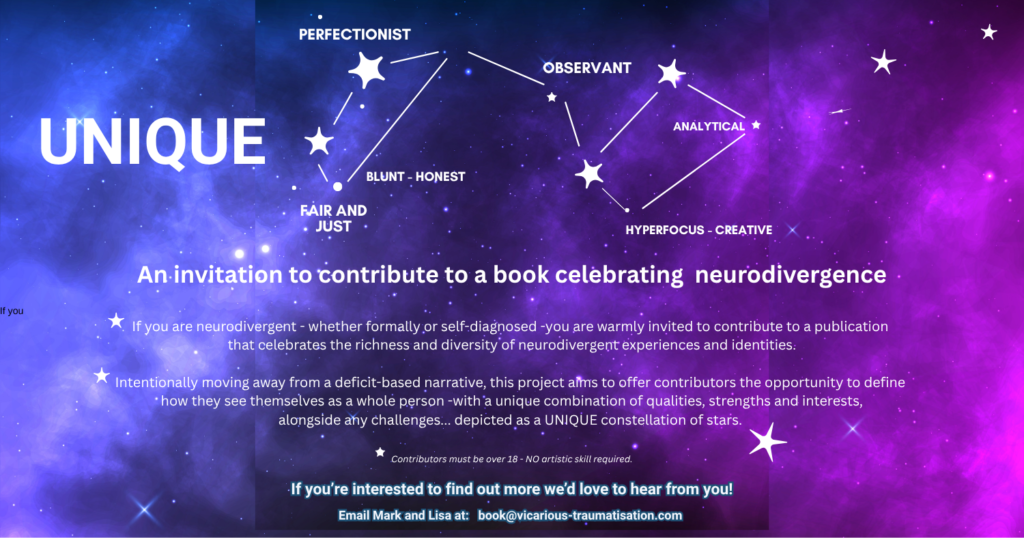
I am delighted to share that I have a chapter in an upcoming book called UNIQUE. UNIQUE invites neurodivergent contributors to map themselves: their qualities, strengths, struggles, deep interests, and challenges, all held together as a constellation.
My chapter centres on my Monotropic Galaxy — the constellation map of my Autistic self, and this blog is an edited and expanded version of my forthcoming chapter submission. My own constellation is a small offering among many in what I hope will be a rich, diverse, and deeply affirming collection of neurodivergent people’s inner worlds and experiences.
The book is still open for contributions.
If you are neurodivergent — whether formally diagnosed or self-identifying — you are warmly invited to contribute your own constellation. No artistic skill is needed. No particular way of writing. Just your own unique map of who you are. The project is intentionally moving away from deficit narratives and toward something that reflects the full richness of neurodivergent experience and identity.
Contributors need to be over 18. If you’re interested to find out more, Mark and Lisa would love to hear from you at book@vicarious-traumatisation.com.
Courses, books and resources
If you would like to take these ideas further, my courses, books and resources live on Autistic Realms. Everything in the shop is pay what you can, and many resources are free.
From More-Than Neurodiversity to Ethodiversity: Sensory Climates, Monotropic Flow and Watery-Becomings (an exploration!)
I have been thinking about what it means to live as an Autistic person with a bodymind in a world organised around neuronormativity, speed, noise, and constant transition in often overwhelming environments.
This article explores how Autistic burnout and regulation can be understood as relational ecological reorganisations of monotropic attention with the wider environment, rather than solely individual neurological difficulties.
Drawing on Nick Walker’s neuroqueer theory alongside Ombre Tarragnat’s concepts of Autistic weather-bodies and ethodiversity, Astrida Neimanis’s account of watery embodiment, and Deleuze and Guattari’s notion of the Body without Organs, this article reframes Autistic ways of being as forms of relational reorganisation rather than individual deficit.
This essay is exploratory and reflects an ongoing process of neuroqueering how my own attention, well-being, and belonging are understood. May be some of it will resonate with you?
Rethinking Neurodivergence in Neuronormative Societies
Autistic experience shows that well-being does not arise only from what happens within an individual. It develops through ongoing relationships between bodyminds, relationships, environments, and social expectations. Attention, sensory regulation, emotional rhythms, and energy flow are shaped through everyday encounters with the worlds we inhabit. When these relationships become strained or misaligned, experiences of burnout and fragmentation can occur.
Neuroqueer (Walker, 2021) and posthuman perspectives invite us to understand neurodivergence as shaped not only by individual neurology but also by sensory environments, social structures, technological systems, and political conditions.
A more-than-neurodiversity approach moves beyond helping individuals adapt to existing systems. Instead, it asks how those systems themselves might be re-organised to support diverse ways of sensing, attending, communicating, and relating.
These relational processes are not abstract. They are organised through school timetables, digital infrastructures of constant connectivity, and socio-political economic systems that prioritise speed and productivity. Such conditions shape how attention can move, how bodies regulate, and whose rhythms of participation are recognised as viable.
In societies organised around neuronormative values, difference only becomes visible through comparison with dominant norms. Neurodivergent individuals may therefore experience pressure to suppress sensory needs, split our natural monotropic attentional flow, or mask ways of being in order to remain socially legible. While these strategies can enable participation and may foster greater acceptance, the sustained effort required to maintain them can lead to exhaustion and burnout. Experiences such as meltdown, shutdown, and declining mental or physical health can be understood not just as individual difficulties, but as relational signals that our everyday environments and ways of being have become too intense, unpredictable, or unsustainable and that change is needed.
This article suggests that what Deleuze and Guattari call becoming a Body without Organs may help us understand Autistic experience as an ongoing neuroqueer ecological process. Through this lens, bodyminds are continually reorganising in response to changing relational climates. Drawing on Tarragnat’s ideas of Autistic weather-bodies and ethodiversity, Neimanis’s writing on watery embodiment, and Walker’s neuroqueer theory, I am reflecting on my own lived Autistic experience to explore how neurodivergent ways of sensing and relating can open new possibilities for ecological belonging and more liveable worlds.
Beyond the Brain: The Limits of “Neuro” Framing
While the language of neurodiversity has played a crucial role in reframing neurological variation as a natural and valuable aspect of human diversity, I think the growing emphasis on “neuro” as a primary explanatory framework also raises important questions. All humans have nervous systems and unique sensory and attentional patterns, all of which are shaped by our experiences and intersecting identities. When difference is understood mainly, or only through what are seen as brain-based (neurological) and diagnostic models, then understandings of divergence can become narrowed to recognised clinical categories, while the wider relational, cultural, political, and ecological conditions shaping experience remain less visible. This is not to deny the reality of neurological difference and being innately Autistic, but to argue that such difference is always lived through relational, cultural, and ecological conditions.
Neurodivergence may not always be a fixed identity or solely a neurological state of being. It can also emerge through different ways of sensing, relating, resisting, or reorganising participation in environments. For some, becoming neurodivergent becomes a conscious process of neuroqueering dominant expectations around productivity, communication, or emotional regulation. In this sense, divergence is not always bounded or stable, and it may not always be inherently positive. It can involve vulnerability, exclusion, uncertainty, and ongoing negotiation with social norms, the spaces we engage with, and the direction our neurodivergence leads us towards.
When divergence is measured primarily against socially constructed standards of independence, efficiency, social fluency, and normative regulation, important dimensions of human variation can be overlooked. Expanding the conversation beyond strictly neurological framings allows neurodivergence to be understood as emerging from interactions among the infinite experiences of different bodyminds shaped by intersectionality, environments, and also the systems of power we live within.
More-than-neurodiversity perspectives, including Ombre Tarragnat’s concept of ethodiversity (2025), further challenge hierarchical and human-centric assumptions about how difference is organised and valued. Instead of locating divergence solely within individual brains, these approaches understand embodiment as relational and ecological, a continual process of becoming shaped by sensory climates, technological infrastructures, social systems, and ecological conditions, it looks at our relations within a multi-species context, our way of being with the wider planet and all that it contains.
Exploring Autistic experience through ecological metaphors such as weather, water, and Deleuze and Guattari’s concept of the Body without Organs offers one way of shining a light on how our bodyminds may reorganise themselves in response to shifting relational environments. These frameworks help widen the discussion from individual adaptation to collective transformation, opening the possibility of reimagining more liveable relational worlds.
Autistic Weather-Bodies: Sensory Climates and Masking
Ombre Tarragnat’s (2024) idea of the Autistic weather-body helps us understand how our experiences are shaped by the climates we live within. They suggest that our bodyminds are always responding to a “total climate” , not only the physical weather around us, but also biodiverse, sensory environments, social expectations, technologies, and socio-political conditions we live within.
These relational climates are not only social or human-centred; they are multispecies and more-than-human. Living beings, ecological communities, and so-called non-living forces such as air quality, light, temperature fluctuations, water, and seasonal rhythms all shape how bodyminds feel, focus, regulate, and relate. These dynamic conditions also respond to our presence and actions. Together, they influence the ecological possibilities through which different forms of life — human and non-human — can endure, adapt, and flourish. From this perspective, neurodivergent experience emerges within more-than-human ecologies rather than solely within and between humans, everything and everyone is connected!
For many Autistic people, changes in atmosphere are felt very directly and intensely; our bodies are perhaps more porous. Lighting, noise, other sensory input, unpredictability, digital pressures, and interpersonal tension and relationships can all influence our attention, energy, and capacity to regulate, and we may not always have control over this.
These shifts are not always dramatic; sometimes they are more subtle, a rising sense of pressure and anxixety in a crowded room, a flicker of fluorescent light that begins to feel painful, or even the bodily awareness of a storm approaching. I know that for me, changes in the weather can trigger migraines before the rain even arrives. These experiences remind us that our bodyminds are not sealed off from the world; we are not just humans in the world. We are continually sensing, adjusting, responding, adapting and connecting with the world.
Thinking about Autistic bodyminds as weather-bodies moves my thinking away from asking how people need to become more ‘resilient’ to change, trauma and ruptures of flow states. Instead, it invites us to consider how the climates of our everyday lives might become more liveable and flow more steadily and smoothly. We can consider what schools would feel like if they were organised around sensory comfort and intrinsically motivated attention tunnels of engagement rather than speed and constant transition? How might workplaces change if regulation and recovery were understood as necessary rhythms rather than signs of weakness?
Tarragnat also writes about how we actually weather environments too. All humans try to adapt, this may be more intense for Autistic people and a trauma response to the very climate we live in. We may sometimes mask or suppress our sensory needs when having a meal out with friends, push through our exhaustion to meet a deadline at work, or fragment our attention in order to try to stay socially acceptable and communicate in a busy cafe. Over time, this kind of acclimatisation can erode our sense of coherence, identity and well-being. Burnout, meltdowns or shutdowns may follow, often with severe mental health implications as we try to survive and function, and this pressure accumulates. These experiences are not personal failures; they are signals that our current relational climates have become too difficult to inhabit.
Like water, our Autistic weather-bodies are also fluid; our experiences move and change like atmospheric patterns. To deepen this ecological way of thinking, I think it could be helpful and interesting to turn to the watery metaphors of embodiment such as that proposed by Neimanis (2017). If weather shapes how we feel and function and how we may be weather-bodies, water also helps us understand how well our bodyminds can actually manage attention, emotion, and energy flow. The air we breathe, the water we drink, the plants and biodiversity around us and the ecosystems that grow within our world are all vital to our well-being and deeply entangled in a connected flow.
Understanding Autistic experience through these ecological metaphors may help us recognise that wellbeing is always relational. It depends not only on what happens inside our bodyminds, but on the climates and currents we all move within.
Watery Bodies: Monotropic Attention and Relational Flow
Posthuman feminist thinker Astrida Neimanis (2017) describes human beings as bodies of water, shaped by the flows that move through and around us. Water is not only something we drink, cook with, or wash in. It circulates through our blood and tissues, regulates temperature through sweat and breath, and connects us to wider ecological systems such as weather patterns, infrastructures, rivers, oceans and cycles in nature.
From this perspective, embodiment is not sealed within the skin. Bodies are permeable, porous, sponge-like, relational, and continuously responding to the environments they inhabit. We are not separate from the oceanic and atmospheric systems that sustain life. In a very real material sense, we are entangled with them, shaped by their rhythms, movements, and transformations. Our sensory and nervous systems are always responding and adapting to maintain a stable flow amid the different currents and energies around us.
For many Autistic people, whose perception often foregrounds sensory detail and pattern, this account of embodiment may resonate with lived experiences of permeability, intensity, and environmental attunement.
Monotropic attention, characterised by deep engagement with particular interests or sensory environments (Murray et al., 2005), can be imagined as a current that gathers depth and direction over time. When attention can move steadily toward meaningful activity, it may support learning, regulation, creativity, and a sense of coherence within the wider flow and environment a person is within.
However, many relational environments are organised in ways that disrupt rather than support these attentional currents. Educational settings often require rapid transitions between subjects, noisy corridors, and constant social negotiation. Workplaces often demand multitasking, immediate responses to digital communication, and participation in unpredictable meetings. Everyday life may involve sensory overload from traffic, crowds, bright lighting, smells, or competing demands at home and with our own health. These conditions can create what might be described as turbulent relational climates, in which the flow of attention is repeatedly interrupted and ruptured, leaving us without a safe anchor.
These turbulent relational climates are often produced and intensified through socio-political, economic, and technological systems that fragment attention and accelerate temporal demands. For example, constant news alerts on your phone may create a background sense of urgency or threat, pulling your attention and flow away from embodied rhythms and present-moment regulation. Algorithm-driven social media feeds, rapid email expectations at work, and productivity-monitoring apps can pressure people to respond immediately, compressing time and narrowing opportunities for rest or deep flow with our passions.
Economic precarity, shift work, and unstable housing conditions can further disrupt sensory and emotional regulation by creating unpredictability in daily routines and environments. Public transport delays, overcrowded urban spaces, and exposure to noise or poor air quality may also contribute to cumulative sensory load. At a broader level, climate-related events such as heatwaves, flooding, or seasonal disruption can reshape how people move, gather, and feel safe, while also affecting multispecies habitats and ecological stability.
Together, these forces create relational climates that are not only socially produced but materially and technologically mediated, shaping how bodyminds attend, connect, recover, and sustain participation in everyday life – which may all be felt more acutely if you are Autistic. Understanding burnout in this way highlights how neurodivergent distress is frequently structured by socio-political and material conditions rather than individual deficit.
From a hydrological perspective, responses such as overwhelm, shutdown, or withdrawal can be understood as the body adjusting to this turbulence. Just as rivers alter course when encountering obstacles, drought, or flooding, Autistic individuals may narrow their focus, find cracks and crevices to retreat into quieter spaces, or seek familiar routines in order to restore coherence and regain a smoother less distressing flow state, so our systems don’t get flooded or caught up in a storm. These adjustments are often misinterpreted as avoidance, lack of resilience, or disengagement. Yet they can represent adaptive attempts to conserve energy and re-establish sustainable regulatory pathways and streams of flow.
This shift from individual responsibility toward relational transformation raises a deeper philosophical question: how do bodyminds reorganise when familiar structures of engagement become unsustainable? Rather than understanding burnout as a breakdown, they may be read as processes of reorganisation. To explore this possibility, I am turning to Deleuze and Guattari’s concept of the Body without Organs, which offers a way of thinking about how new patterns of regulation, relation, and participation can emerge.
Body without Organs: Autistic Becoming
I find Deleuze and Guattari’s idea of the Body without Organs (BwO) helpful for thinking about how Autistic bodyminds may reorganise when everyday demands become overwhelming or unsustainable. The BwO does not refer to a literal physical state (!). Instead, it describes shifts in how attention, sensory experience, movement, and participation are organised and can become re-organised.
From my own experience, these shifts often become most noticeable during periods of burnout or intense overwhelm. At these times, familiar ways of focusing, communicating, or keeping up with daily life can begin to break down. For example, I might find that replying to messages or emails — tasks that once felt manageable — suddenly requires an enormous amount of energy, or that following conversations in busy environments becomes confusing and exhausting. Even simple routines such as preparing meals, travelling on public transport, or switching between tasks can feel disorientating, as if my attention is no longer able to stretch in the ways it once did.
It can feel as though the usual pathways for engaging with the world are no longer available. However, these moments are not only about loss or collapse. There can also be times when new ways of regulating and relating start to emerge as attentional resources redistribute in order to survive. For instance, I may begin to rely more on sensory anchors such as quiet spaces, repetitive movement, or focused creative interests. Communication might shift toward slower, more intentional exchanges, or toward written rather than spoken interaction. Daily life can reorganise around fewer but more meaningful connections and activities, allowing energy to be conserved and gradually restored. In this way, burnout can sometimes open space for different rhythms of participation and new forms of relational attunement to develop.
Reorganisation does not only happen in moments of crisis. It often unfolds through small, everyday neuroqueer choices. This might look like staying with a deep interest long after others have moved on, pacing or rocking to steady sensory overwhelm, wearing noise-cancelling headphones in busy spaces, or choosing solitude after social interaction in order to recover. Some Autistic people reshape their days so that activities happen in a predictable sequence, or protect uninterrupted stretches of time where attention can settle and flow.
What Deleuze and Guattari call deterritorialisation can be felt here as a soft loosening of pressure, a step away from expectations to respond quickly, multitask constantly, or socialise in prescribed ways. As these pressures ease, different rhythms of living and participating can begin to take shape for others too and the ripples of change begin to take effect.
Many Autistic people recognise these processes in small but significant adjustments to how they move through the world. Erin Manning (2016) describes such shifts as “minor gestures” — subtle changes that reshape how we sense, focus, and relate within particular environments. This might involve rhythmic movement to steady sensory overwhelm, withdrawing into a meaningful interest after prolonged interaction, or becoming absorbed in creative or repetitive activity. These gestures can be understood as the mechanisms through which reorganisation happens. They are ways of actively redistributing sensory and emotional intensity, recalibrating attention, and gradually re-establishing a sense of coherence. Although often misunderstood as avoidance or dysfunction, such practices can help Autistic individuals re-climatise to demanding relational atmospheres and sustain participation over time.here.
As these processes are relational, they are shaped by the environments in which we live. Sensory-friendly spaces, predictable routines, flexible expectations, and collective care can make a significant difference. From this perspective, well-being is not something individuals achieve alone; it emerges collectively through interdependence with environments (beyond the human), that recognise and support diverse ways of focusing, recovering, and connecting.
For many Autistic people, reorganising routines and spaces becomes an intentional way of reducing neuronormative pressure. Creating sensory refuges, protecting uninterrupted time for deep focus, limiting unnecessary task-switching, or prioritising interest-led learning and creativity can support more sustainable engagement. These are not simply personal coping strategies. They are ways of experimenting with how attention, energy, and participation might be structured differently.
Neurodivergent becoming can therefore be understood as an ongoing neuroqueering process of adjustment and transformation, shaped by the continuous redistribution of attention, energy, and sensory intensity. Periods of immersion, withdrawal, or re-focusing are not simply signs that something has gone wrong. They may indicate that bodyminds are reorganising in response to pressures that exceed sustainable limits.
When these processes are recognised and supported, they can open pathways towards more liveable ways of being, not only for Autistic people, but within the wider relational ecologies we all share. In this sense, becoming a Body without Organs is not a final state but a dynamic practice: a way to loosen restrictive normative expectations, experiment with new rhythms of participation, and contribute to the gradual reshaping of environments so that diverse forms of attention, regulation, and connection can co-exist and keep transforming and flowing.
From Neurodiversity to Ethodiversity: Ecological Multiplicity
When Autistic reorganisations of attention and sensory When experiences of sensory intensity or overwhelm are understood as relational and ecological processes, rather than simply individual coping challenges, our perspective begins to widen. Instead of seeing regulation as something a person must manage alone, we can recognise how environments, relationships, technologies, and broader living systems all shape how attention, emotion, and energy flow.
From this viewpoint, neurodiversity is no longer only about differences between human brains. It becomes part of a wider story about how many forms of life sense, respond, adapt, and find ways to remain in the world. Ideas such as becoming a Body without Organs can be read as an invitation to notice these shifting patterns of connection and regulation, and to recognise the importance of ethodiversity (Tarragnat, 2025), or the diversity of ways living beings experience and engage with their environments.
Expanding neurodiversity toward the concept of ethodiversity strengthens this ecological understanding. Ombre Tarragnat (2025) uses this term to highlight how different perceptual styles, emotional intensities, and attention patterns contribute to the resilience of relational systems, including ecosystems and multispecies communities. For example, Autistic sensory attunement may make environmental pressures more noticeable such as persistent background noise, polluted air, or the stress of extreme weather changes.
Ethodiversity does not just build on neurodiversity by recognising additional forms of human difference. Instead, it draws attention to the diversity of ways living beings perceive, move, and participate in shared environments, as well as the impact of non-living things. From this perspective, neurodivergence can be understood as one expression of a wider ecological multiplicity of attentional rhythms, sensory attunements, and relational styles that help sustain more liveable worlds.
Understanding and embracing ethodiversity means creating relational systems that can support different rhythms of participation, perception, rest, and recovery. This includes recognising that people, other species, and environments do not all move, sense, or respond in the same ways or at the same pace. Designing spaces, communities, and policies with this diversity in mind becomes part of a wider ethics of planetary care.
When we value diverse forms of embodiment and ways of relating to the world, we also begin to recognise how closely human wellbeing is connected to ecological wellbeing. Sustaining multiplicity across cognitive, cultural, biological, and ecological domains is therefore not only a matter of social inclusion. It is also a condition for collective survival. For example, if water systems become polluted, this affects the health of entire ecosystems, and human communities are not separate from these impacts. In this way, caring for diversity in how life exists and adapts is part of caring for the future of the planet as a whole.
Cultivating Liveable Worlds: A Neuroqueer Ecological Future
Autistic experience highlights how wellbeing emerges through ongoing relationships between bodyminds, environments, and social expectations. Sensory overwhelm, burnout, fragmentation, and withdrawal can therefore be understood not simply as individual difficulties, but as signals that relational climates have become too intense, unpredictable, or unsustainable.
Thinking with concepts such as Autistic weather-bodies, watery embodiment, and the Body without Organs helps us recognise how bodyminds continually adapt and reorganise in response to these conditions. Practices of regulation such as retreating into focused flow, seeking quieter environments, experimenting with new rhythms of engagement, or stimming can be understood as efforts to restore coherence and sustain participation. Neuroqueering involves both resisting dominant expectations and actively reshaping environments to support different temporalities and sensory needs.
The concepts of Cavendish Space and Neuroqueer Learning Spaces, which I have been working on with Stimpunks, offer practical examples of how relational ecologies might be redesigned. By prioritising sensory accessibility, slower rhythms of participation, interest-led engagement, and collective care, these approaches shift the focus away from expecting Autistic individuals to adapt to rigid systems. Instead, they explore how environments themselves can become more responsive and sustaining.
Cultivating liveable relational worlds requires more than individual accommodation. It calls for collective transformation, reshaping educational, social, technological, and ecological systems so that diverse rhythms of sensing, regulating, and belonging can genuinely flourish. Supporting diverse modes of becoming is not only about inclusion within existing structures, but about reimagining those structures altogether.
Extending neurodiversity toward the broader horizon of ethodiversity invites recognition that multiplicity across perceptual styles, cultural practices, and environmental relationships contributes to more liveable shared futures. Practices that support sensory regulation, slower temporal rhythms, and sustainable participation may also align with wider movements toward ecological care and multispecies coexistence.
From this perspective, becoming what Deleuze and Guattari describe as a Body without Organs can be understood as an ongoing neuroqueer process of reorganisation. It involves loosening restrictive normative expectations, redistributing attention and energy, and experimenting with and queering new ways of participating and being in our relational worlds. Perhaps neuroqueering attention and sensory life is not only about Autistic survival, but about learning new ways of living together within the fragile ecologies we all share?
Deleuze, G., & Guattari, F. (1987). A thousand plateaus: Capitalism and schizophrenia. University of Minnesota Press.
Manning, E. (2016). The minor gesture. Duke University Press.
Murray, D., Lesser, M., & Lawson, W. (2005). Attention, monotropism and the diagnostic criteria for autism. Autism, 9(2), 139–156.
Neimanis, A. (2017). Bodies of water: Posthuman feminist phenomenology. Bloomsbury.
Tarragnat, O. (2024). The personal is climatic: Autistic weather-bodies and posthuman feminism between weathering and (dis)acclimatisation. Sextant: Revue de recherche interdisciplinaire sur le genre et la sexualité, (41).
Tarragnat, O. (2025). Biodiversity, neurodiversity, ethodiversity: Towards a more-than-human and more-than-neurological turn in neurodiversity studies. TRACE Journal for Human-Animal Studies.
Walker, N. (2021). Neuroqueer heresies. Autonomous Press.
Yergeau, M. (2018). Authoring autism: On rhetoric and neurological queerness. Duke University Press.
If you would like to take these ideas further, my courses, books and resources live on Autistic Realms. Everything in the shop is pay what you can, and many resources are free.
Exploring threshold consciousness, temporal ecology, and the porous boundaries between dreaming and waking through a neuroqueer lens.
Hypnagogic and hypnopompic experiences — vivid sensory and emotional states that occur at the boundaries of sleep — they may include visual, tactile and auditory hallucinations and are often described within biomedical models as temporary disruptions in wake-sleep and sleep–wake states. However, for many Autistic and neurodivergent people, particularly during periods of burnout, trauma-related stress, and prolonged systemic overload, these experiences may become more frequent and intense and deeply destabilising. This is something I personally experience: the deeper into burnout I move, the more the boundary between dreaming and waking can blur.
This article introduces the idea of neurodivergent temporal ecology as a way to help theorise this and explore how dream persistence between wake and sleep states and threshold consciousness may emerge from interactions among monotropic attention, neurodivergent temporal rhythms, trauma physiology, and the sensory and social environments we inhabit. Drawing on neuroqueer theory (Walker, 2021), philosophical accounts of temporality (Deleuze, 1994; Manning, 2013), Autistic burnout research (Raymaker et al., 2020), and sleep science (Ohayon et al., 1996; Mahowald & Schenck, 2005), this piece reframes hypnagogic and hypnopompic states as relational experiences rather than purely neurological anomalies.
Hypnopompic and hypnagogic experiences in Autistic burnout are not merely sleep disturbances. They can be expressions of neurodivergent temporal ecology — moments when attentional, sensory, trauma-related, and environmental pressures destabilise normative boundaries between dreaming and waking and where our flow states between wake and sleep merge.
By drawing on my lived experience, I am suggesting that these different sleep states and versions of reality can challenge assumptions that consciousness should always be linear, stable, and organised. I am inviting people to rethink how sleep, perception, rest and wellbeing are understood, and to consider how environments might be reshaped to support diverse rhythms of awareness and reality.
Living at the porous edge of waking
For some Autistic and neurodivergent people, sleep may not always feel like a clear shift from wakefulness into rest or from rest into wakefulness. Instead, it can feel like temporarily living in a liminal threshold, a shifting terrain where dreams, memories, sensations, and waking perception overlap. This can be confusing, disorienting, and at times frightening.
During burnout or crisis, when sensory, emotional, and social demands exceed available energy, if you are anything like me, these threshold experiences may intensify. You might wake and still perceive dream imagery in your room, perhaps see spiders moving across the wall, shadowy figures in the corner that reach out to touch you, or hear voices that seem present and very real. These experiences can feel entirely real in the moment and may be accompanied by sleep paralysis and a sense of being trapped between worlds. Reaching out to touch the spiders, only to find your hand moving through empty air as the image fades, it can be deeply unsettling. Gradually, environmental and sensory cues become clearer, the dream loosens its hold, and waking awareness returns, often leaving emotional residue and exhaustion before the day has even begun.
Sleep research refers to these as hypnopompic experiences, which occur when REM dream processes persist briefly into waking consciousness (Ohayon et al., 1996). Similar experiences while falling asleep are known as hypnagogic states and are associated with narcolepsy, stress, disrupted sleep, and other neurological vulnerabilities (Mahowald & Schenck, 2005).
From a neurodivergent temporal ecological perspective, these threshold states are not simply individual neurological problems; they may reflect complex relationships among attention, trauma, sensory environments, and cultural expectations about time, productivity, and even how our rest and sleep function. Learning to accept this has made it less frightening for me, and accept it as something that is just a part of my life between worlds that intensify the more stressed or burnt out I am, although this may not be everyone’s experience.
Neuroqueer time and threshold consciousness
Neuroqueer theory challenges deficit-based interpretations of neurological differences by questioning assumptions that perception must always be stable, rational, and temporally linear (Walker, 2021). Expanding on this, I am suggesting that diverse experiences of consciousness may represent meaningful responses to lived conditions rather than signs of dysfunction.
Hypnagogic and hypnopompic states are deeply liminal. For those of us already marginalised and living in the liminal spaces, it may be no surprise that our waking and dream worlds reflect this too?!
Hypnagogic and hypnopompic experiences occur before our conscious awareness has fully stabilised into the structured clarity expected in waking life. Meaning is often felt before it can be explained. I often feel suspended between dreaming and waking, between my inner imagery and the external reality. It can be scary and confusing, which is why I’ve been thinking about this a bit more and trying to work out why it may be happening.
Philosophers such as Deleuze and Guattari (1994) describe time as layered and shaped by intensity rather than simply progressing forward. Manning (2013) writes about how experience is something felt before it is cognitively organised. Sleep threshold states make these ideas tangible, revealing consciousness as fluid and relational, shaped through ongoing interactions between body, memory, the environments we live within and interact with, and social rhythms based on different intersectional identities and experiences.
Spiral time, rhizomatic memory, and dream flow
Many neurodivergent people experience memory and time in non-linear ways. Past events may re-emerge as sensory atmospheres or emotional presences, creating a sense that the past remains active within the present. This can feel like living within a spiral of time rather than along a straight timeline.
Within such temporal patterns, dreams may continue to influence waking perception. Recurring hypnagogic or hypnopompic experiences can involve familiar dream environments, emotional connections with dream figures, or confusion about whether an event occurred in a dream or in waking life. For me, these experiences often intensify during burnout, when attentional flexibility decreases and emotional processing becomes more difficult (Raymaker et al., 2020). It is like my mind is trying to anchor itself and regain a coherent flow.
Dream persistence that overlaps with reality feels like it is perhaps functioning as a survival mode. When the nervous system is overwhelmed, continuing internal processing during sleep it is may be an attempt to conserve energy or make sense of distressing experiences. Although this can result in anxiety or disorientation, it also reflects an adaptive effort to maintain coherence and flow.
I have found it helpful to think about Deleuze and Guattari’s concept of the rhizome (1994), which offers a way of understanding experience as emerging through non-linear connections rather than clear beginnings or endings. Autistic perception often seems to move in this relational way, linking memories, sensory impressions from waking life, and dream imagery into shifting constellations of meaning and attention tunnels. At times, it can feel as though I enter or leave dreams at unexpected points — already somewhere in the middle of experience — rather than transitioning neatly from one state of consciousness to another.
Monotropism, inertia, and attentional depth
Monotropism theory suggests that Autistic and ADHD attention often involves deep engagement within a limited number of attentional channels (Murray et al., 2005). This can support creativity and intense focus but I think for some, myself included, it may also make transitions, including waking from sleep more effortful.
During burnout, reduced flexibility in attention can combine with the experience of monotropic split, intensifying the persistence of dream imagery across sleep–wake thresholds. Monotropic split refers to the way attention is divided between competing demands, where part of the bodymind remains deeply immersed in an internal focus while another part attempts to respond to external expectations (Adkin, 2022). This can create a feeling of cognitive and sensory stretching or fragmentation, particularly when environmental pressures require rapid shifts in attention and we are expected to bounce out bed and go to work or begin parenting duties!
In such states, the nervous system may struggle to complete the transition between dreaming and waking. Our attention tunnels, the deeply focused channels through which monotropic cognition often operates, may begin to blur across states of consciousness. A person may feel suspended, as if floating between inner imagery and outer reality, experiencing a slowed, blurry awareness where perception has not yet fully stabilised. Dream environments, emotional tones, or sensory impressions can linger as waking demands begin to intrude into our attention tunnel and pull us back into reality.
Research on Autistic inertia may further help to explain this process. Autistic inertia describes difficulties initiating, stopping, or switching between activities or cognitive states (Buckle et al., 2021). When combined with ADHD-related fluctuations in attentional regulation, including oscillations between hyperfocus and exhaustion, these dynamics can contribute to what might be described as temporal momentum, a continuation of cognitive immersion beyond the usual boundaries of sleep and waking (Heasman et al., 2024).
Dream-like flow states between conscious and unconscious may not be just sleep disturbances but may be understood as an interaction among monotropic attentional depth, inertia-related challenges in shifting states, and the physiological effects of burnout. As our attentional energy resources diminish and re-accolate and distribute themselves, the bodymind may remain engaged in internal processing, trying to organise its patterns and regain a flow state that makes more sense as the body begins to wake or go to sleep. This can result in an almost layered experience of perception, uncertainty about what is real, and needs a gradual re-orientation to the external world rather than an abrupt transition. It is why waking up can be sooooo hard!
Understanding hypnagogic and hypnopompic experiences through the lens of monotropic split and Autistic interia may offer a more nuanced account of the threshold consciousness for neurodivergent people. It highlights how attentional styles, environmental demands, and states of exhaustion interact to shape the ways neurodivergent people move and flow between dreaming and waking, immersion and return.
Burnout, trauma, and ecological strain
Autistic burnout is increasingly recognised as a consequence of prolonged stress, masking, and environmental mismatch (Raymaker et al., 2020). Trauma can fragment sleep cycles and intensify emotional dream content (Mahowald & Schenck, 2005). Sleep deprivation has also been linked to perceptual disturbances and cognitive dysregulation (Ohayon et al., 1996).
Frameworks such as Gray-Hammond’s ecosystemic model (2026) highlight how burnout, altered perception, and sleep disruption or changes interact with environmental pressures. These perspectives suggest that psychiatry can sometimes individualise systemic strain, locating distress solely within the person rather than addressing the conditions that contribute to it.
Altered states of consciousness may therefore be better understood as ecological signals, indications that our nervous systems are adapting to environments shaped by expectations of neuronormativity, constant productivity (even in sleep and the ways we sleep and rest!) and sensory tolerance. Productivity-focused time demands can place particular strain on neurodivergent people whose rhythms of engagement, ways of resting and recovery differ from dominant norms, leading us to burnout and more unusual sleep patterns.
Ethodiversity and relational consciousness
Ecological neurodiversity introduces the concept of ethodiversity, recognising that multiple cognitive, sensory, and relational styles coexist within shared environments (Tarragnat, 2025). From a this perspective, consciousness is not simply produced within the individual brain but emerges through ongoing assemblages of body, memory, environment, culture, and time. These relational conditions shape how attention moves, how energy is resourced, and how safety is experienced.
Building on the idea of monotropic split, burnout can be understood as a state in which these ecological relationships become strained or fragmented. When attentional demands exceed available capacity, the nervous system may remain partially engaged in internal processing even during periods of rest. Hypnagogic and hypnopompic experiences can therefore be seen as threshold moments in which perception is reorganising across disrupted ecological conditions.
Sleep is More-Than biological restoration; it can also be a site of cognitive and sensory integration, where experiences are slowly being sorted, re-patterned, and re-assembled in an attempt to regain coherence and flow. Dream imagery may persist into waking awareness because the bodymind may still be trying to regain a safe flow state before waking. More time in nature and engaging in stimming and monotonous flow states with what interests you and what you are passionate about may help rebalance this…….
The gradual fading of dream imagery on waking may reflect a process of ecological realignment, a slow recalibration of our internal temporal rhythms. While these experiences may signal burnout and misattunement with surrounding ecosystems, they may also indicate an adaptive move toward recovery. For myself, being aware of my hypnopompic and hypnogogic states is a signal that I need deep rest, reduced overload, and environments that better support my own neurodivergent rhythms of monotropic attention and engagement. I need more time with my passions and interests, more time stimming and meeting my sensory needs in the dark, under my weighted blanket.
Dream Thresholds, Temporal Diversity, and Mingling with the Universe
Hypnagogic and hypnopompic experiences remind us that consciousness is not always clear-cut or neatly divided into sleeping and waking. There is no ‘right way’ to sleep, to dream or to wake up!
For many Autistic and neurodivergent people, especially during burnout, these threshold states can become intense, immersive, and emotionally charged. Dreams may seem to linger in the room as we wake. Sensations and images can feel real for a few moments before gradually fading. These experiences can be frightening, confusing, and exhausting. At the same time, they may also reveal something important about how neurodivergent minds move through time and perception and why dream worlds and reality may blur at times – perhaps even beyond hypnopompic and hypnagogic experiences and into the wider ways of daydreaming, immersing in fantasy and role play.
Recognising temporal diversity as part of neurodiversity means understanding that different nervous systems have different rhythms of rest, monotropic attention, and recovery. Productivity-driven expectations about how quickly we should fall asleep, wake up, or “return to normal” can place additional strain on already overwhelmed systems. When dream imagery continues into waking life — or when vivid sensory experiences arise as we fall asleep — it may be a signal that our bodymind is trying to process, integrate, and make sense of overwhelming experiences.
From a neuroqueer and ecological perspective, altered states of awareness can be understood as relational signals. They may point to our current environment as too demanding, to unsafe sensory landscapes, or to social pressures that require constant adaptation and masking. In this sense, hypnopompic and hypnogogic experiences could be seen as part of the nervous system’s survival response, continuing its work of sorting and patterning experience when there has been little time to rest while awake.
In my own writing on Autistic perception, I have described this as “mingling with the universe.” Sometimes neurodivergent awareness feels deeply interconnected with surroundings — sensory detail, memory, emotion, and environment all blending together in ways that are difficult to separate. Hypnagogic and hypnopompic states can intensify this feeling. Inner worlds and outer realities briefly overlap, reminding us that consciousness is not fixed or isolated but shaped through ongoing relationships with the spaces and systems we inhabit.
Understanding these experiences through a lens of Neurodivergent Temporal Ecology challenges narrow psychiatric interpretations that focus only on individual symptoms. Burnout, sleep disruption and differences, and perceptual instability often emerge within wider contexts — including sensory-hostile environments, pressures to conform to linear productivity time, and limited opportunities for genuine rest or recovery. Supporting neurodivergent wellbeing, therefore, requires more than medical responses. It calls for cultural and structural change: creating environments that recognise and support different rhythms of living, thinking, and sleeping.
Hypnagogic and hypnopompic experiences can be unsettling. Yet they can also offer insight into how neurodivergent minds adapt, survive, and find meaning. When dreams continue into waking life or merge as we fall asleep, it may be a sign that we have reached the limits of our energy, but it can also be an invitation to slow down, seek safety, and restore connection with ourselves and our environments.
Temporal Diversity
Recognising temporal diversity expands how we can understand neurodivergent sleep, mental health, rest, and care. It encourages us to move away from rigid ideas about what consciousness “should” feel like and toward more compassionate, flexible ways of supporting neurodivergent lives.
By understanding that our monotropic perception is always moving in relationship with sensory landscapes, memories, emotions, and social rhythms, we can begin to see reality itself as something fluid and negotiated rather than fixed. Sleep and waking become liminal crossings rather than fixed boundaries.
Hypnagogic and hypnopompic experiences are not just disruptions to sleep or sleep disorders, but perhaps signals about how well our environments are really supporting and making sense to us. I see them as part of my monotropic flow state that enables me to transition between waking and dream worlds – where both worlds are equally important. When we learn to listen to these signals, we can create the possibility of lives where different ways of sensing time and consciousness are recognised as meaningful and not pathologised. There is very little discussion about hypnopompic and hypnagogic experiences; it is still very much shrouded in the same stigma as psychotic hallucinations, and I have found people look wary when I talk about this.
Recognising and sharing stories about these experiences may help neurodivergent people feel less pressure to force themselves back into fast, “normal” rhythms of waking and productivity. Instead, moving between dreaming and waking, focus and rest, can be understood as part of the natural diversity of human perception. Allowing time for slower realignment, through rest, sensory grounding, and meaningful flow states can support the gradual return of energy and clarity.
By learning to listen to our own rhythms and to the flow states that move between dreaming and reality, sleep and wakefulness, rather than constantly resisting or trying to cure these experiences, the meanings and re-orientation of flow within liminal dream spaces can begin to unfold more gently. Growing awareness and understanding of neurodivergent patterns of monotropic attention, rest, and recovery is part of an ongoing process of re-energising, re-orienting, and discovering more sustainable ways of being so we begin to re-world our experiences, not only in waking life, but also within our dream worlds and the shifting spaces in-between.
Buckle, K. L., Leadbitter, K., Poliakoff, E., & Gowen, E. (2021). “No way out except from external intervention”: First-hand accounts of autistic inertia. Frontiers in Psychology, 12, 631596. https://doi.org/10.3389/fpsyg.2021.631596
Deleuze, G. (1994). Difference and repetition. Columbia University Press.
Deleuze, G., & Guattari, F. (2013). A thousand plateaus: Capitalism and schizophrenia. Bloomsbury Academic.
Heasman, B., Williams, G., Charura, D., Hamilton, L. G., Milton, D., & Murray, F. (2024). Towards autistic flow theory: A non-pathologising conceptual approach. Journal for the Theory of Social Behaviour, 54(4), 469–497. https://doi.org/10.1111/jtsb.12427
Mahowald, M. W., & Schenck, C. H. (2005). Insights from studying human sleep disorders. Nature, 437(7063), 1279–1285. https://doi.org/10.1038/nature04287
Manning, E. (2013). Always more than one: Individuation’s dance. Duke University Press.
Murray, D., Lesser, M., & Lawson, W. (2005). Attention, monotropism and the diagnostic criteria for autism. Autism, 9(2), 139–156. https://pubmed.ncbi.nlm.nih.gov/15857859/
Ohayon, M. M., Priest, R. G., Caulet, M., & Guilleminault, C. (1996). Hypnagogic and hypnopompic hallucinations: Pathological phenomena? British Journal of Psychiatry, 169(4), 459–467. https://pubmed.ncbi.nlm.nih.gov/8894197/
Raymaker, D. M., Teo, A. R., Steckler, N. A., Lentz, B., Scharer, M., Delos Santos, A., Kapp, S. K., Hunter, M., Joyce, A., & Nicolaidis, C. (2020). “Having all of your internal resources exhausted beyond measure and being left with no clean-up crew”: Defining autistic burnout. Autism in Adulthood, 2(2), 132–143. https://doi.org/10.1089/aut.2019.0079
Walker, N. (2021). Neuroqueer heresies: Notes on the neurodiversity paradigm, autistic empowerment, and postnormal possibilities. Autonomous Press.
If you would like to take these ideas further, my courses, books and resources live on Autistic Realms. Everything in the shop is pay what you can, and many resources are free.
In my previous blog, we explored how monotropic attention can create deep rhizomatic pathways of learning and belonging, and how mycelial networks of care help sustain neurodivergent lives.
But what happens when these pathways become blocked? What happens when the networks that once supported us begin to strain or collapse? Or we don’t have the support networks there to begin with?
Many Autistic people describe burnout not only as exhaustion, but as a more fundamental disruption, a loss of flow, safety, and connection, a seismic shift that transforms our entire way of being.
Burnout is not simply “doing too much.” It can feel like the ground of our known experience itself has shifted and fallen through the cracks.
Burnout as a fracture in relational life
Burnout often unfolds gradually, and the buildup may go unnoticed for some of us; we may suddenly find ourselves in the depths, drowning. Attention may become harder to sustain. Sensory tolerance may narrow, social interaction and communication may feel increasingly effortful. Activities that once brought joy may feel distant or even unreachable.
The body may signal distress through meltdowns, shutdowns, pain, disruptions in sleep and eating patterns, or even difficulty initiating movement beyond wanting to curl up under a weight blanket in bed.
Time can feel slowed, fragmented, or just utterly overwhelming and confusing as it isn’t lining up with the neuronormative expectations of the world around us. These experiences are not isolated symptoms. They are signs that the flow between body, attention, our relationships, and the wider environment is under strain.
Rather than viewing burnout as a personal deficit, it can be understood as a fracture within a wider relational ecology.
When environments demand constant masking, rapid task-switching, or sensory endurance, the deep attentional flows that support our ability to engage in life can begin to fracture.
The disruption of monotropic flow
For many Autistic/ ADHD people, interests are more than hobbies. They are passions that provide structure, regulation, identity, and meaning. Burnout may involve losing access to these sustaining pathways and flow states.
A person who once found comfort in researching Tudor history, coding, drawing, gaming, building collections, or walking familiar woodland routes may suddenly feel unable to engage. Attention slips away, motivation may feel brittle, and even small tasks can require more effort and capacity than we actually have available.
This disruption can feel frightening and disorientating. Without stable attentional anchors, the world may become unpredictable and difficult to navigate. Burnout is therefore not only physical or emotional fatigue. It can be experienced as a collapse in the ecology of attention. We need to re-map and re-world our lives to navigate through burnout.
Social and sensory worlds under pressure
Burnout is socio-political and also emerges within overwhelming sensory contexts of the very spaces we need to live in to exist – our homes, education and work place settings and even in healthcare, the very places that are meant to understand and support us.
Open-plan noisy offices, bright, busy classrooms, bureaucratic systems, and performance-driven cultures can create chronic friction with our neurdivergent monotropic flow states. Over time, the effort required to adapt may exceed our available energy.
Masking, consciously or unconsciously adjusting behaviour and communication to meet normative expectations, can intensify this strain.
The cost is often cumulative and can run deep.
Many people describe reaching a point where:
communication becomes difficult
noise, scents, lights, certain textures and even previously safe food may feel physically painful or overwhelming
decision-making may slow down in a fog
everyday routines and exectutive functioning tasks may feel too overwhelming
trust in our environments and relationships with others can begin to diminish
These are not signs of personal weakness. They are signals that the relational conditions and environments supporting us have become unsustainable. Things need to change for us to survive.
Neuroqueer politics of burnout
Understanding Autistic or neurodivergent burnout in ecological terms shifts responsibility away from individuals and toward systems.
Speed, productivity, and independence are often treated as neutral values. In reality, they reflect specific cultural priorities that privilege certain cognitive styles while marginalising others.
Neuroqueer perspectives invite us to question these assumptions. They ask:
Who defines what counts as functioning?
Who has the power to say what rest should look like?
Whose attentional rhythms are recognised as valid?
What forms of participation and engagement with the world are made possible or impossible?
Autistic burnout can be read as both a social, political, and personal phenomenon. It exposes the limits of environments organised around normativity.
Recognising this does not remove the pain of burnout, but it may help to reduce shame and open space for collective change.
Toward ecological re-assembly
If burnout represents fracture, our recovery is not just restoration of previous capacity; it is often a process of re-assembling life differently.
This may begin with small shifts:
lowering demands
re-establishing sensory safety
reconnecting with trusted people
returning gently to meaningful interests or finding new glimmer of joy
allowing time to move, communicate and experience the world at a slower pace
These changes can feel minor, yet they may help re-imagine and re-build the conditions and environments that allow attention and participation to re-emerge.
Recovery is rarely linear. It unfolds through experimentation, adaptation, and relational support.
In this sense, burnout can become a liminal threshold, not only of loss, but of potential transformation to new ways of being and relating.
If you would like to take these ideas further, my courses, books and resources live on Autistic Realms. Everything in the shop is pay what you can, and many resources are free.
With thanks to Nick Walker and Andrew Reichart for their recent conversations with me. This piece is independent of their work, and Nick has not read this blog prior to publication. My understanding of the neuronormative paradigm and its implications might differ from theirs. Andrew has helped me understand that the normative paradigm is what drives and enforces neuronormativity and systemic injustice. It is only by critiquing and dismantling this that we can expose the harm and move forward. Nick will write more about the neuronormative paradigm in their upcoming Neuroqueer Theory Anthology, in which I will have two chapters (one of which I co-authored with Ryan Boren, Stimpunks, who also kindly provided editing feedback for this blog).
In a recent webinar workshop Neurodiversity 101: You Are Not Broken (19th Sept, 2025), Andrew Reichart used a term conceptualised by Nick Walker that instantly resonated with me: the neuronormative paradigm. It was one of those lightbulb moments that brought immediate clarity; it gave a name to something I had felt and tried to articulate for years but had never had the words for. Through exploring the neuronormative paradigm, I hope to bring some clarity to why it matters to name the systems that harm, so we can start to see how deeply neuronormativity is woven through our schools, workplaces, healthcare settings, and even our shared ideas of what it means to be human.
Walker has been using the term neuronormative paradigm in their work since the publication of Neuroqueer Heresies (2021) as a replacement for the term pathology paradigm, which they have since said they “regret ever introducing, because it’s too easily misinterpreted and some of the misinterpretations have caused considerable harm”. With permission from Nick Walker (Walker, 2025, personal communication), I am exploring this concept and its relevance to understanding how society and systems define what is considered “normal”, especially here in the UK, US and other Western cultural landscapes.
The term neuronormative paradigm builds on and moves beyond Nick Walker’s earlier concept of the pathology paradigm. According to Walker (2021), “The pathology paradigm starts from the assumption that significant divergences from dominant sociocultural norms of cognition and embodiment represent some form of deficit, defect, or pathology. In other words, the pathology paradigm divides the spectrum of human cognitive/embodied performance into “normal” and “other than normal,” with “normal” implicitly privileged as the superior and desirable state..” It describes a view in which neurological differences, such as being Autistic, ADHD, or otherwise neurodivergent are medicalised and seen as deficits, disorders, or abnormalities that need to be corrected or cured. It locates the problem within the individual, assuming there is one “right” or “normal” kind of brain and behaviour.
The neuronormative paradigm, creates and enforces the social, cultural, and political systems that uphold the very ideas of normality. It sees neurodivergent people as broken or deficient. Us having the concept “the neuronormative paradigm, helps us name and challenge the power structures and systems that determine who is valued and who is pathologised. It enables us to challenge the foundations of a society that privileges certain ways of thinking, being, and communicating while marginalising others. This shift reframes the issue as the problem not being within neurodivergent people, but within the systems that define and uphold “normality” itself. By having a term for this, we can critique it, expose the harm, shift our thinking and move towards the neurodiversity paradigm.
The neuronormative and neurodiversity paradigms offer fundamentally different worldviews; one demands uniformity, while the other celebrates diversity. Language is powerful and can help make things visible. Until we can see how neuronormative domination has shaped our lives, we cannot dismantle the structures that bind us and move towards the neurodiversity paradigm, where all bodyminds (Dychtwald, K, 1977) are recognised as vital to the living ecology of human diversity.
What is the neuronormative paradigm?
The neuronormative paradigm creates and enforces the social, cultural, and political systems that assume there is one “right” way to be, one “correct” way to think, feel, sense, and move through the world. It privileges particular ways of learning, knowing, sensing, communicating and even resting and regulating while dismissing neurodivergent forms of being. Within this framework, neurodivergence is often treated as a problem to be corrected rather than as a meaningful expression of being human.
Neuronormativityrefers to the dominant system of norms and practices in society that not only define but also enforce how attention should function, how senses should be regulated, how emotions should be expressed, and how we should act within society. These hierarchies produce profound epistemic injustice, positioning neurodivergent people as unreliable narrators of our own lives. Its power intersects with systems of ageism, racism, classism, sexism, ableism, and colonialism, reinforcing structures that determine who is dismissed or erased. Within the neuronormative paradigm, value is measured through capitalist notions of productivity and conformity, while other ways of being and relating are devalued and pathologised, leaving us disabled by the very environments we live in.
By contrast, theneurodiversity paradigm views neurological differences as a natural and valuable form of human diversity, part of the broader spectrum of biodiversity and cultural diversity. It sees Autistic, ADHD, and otherwise neurodivergent ways of being as integral to the richness of human experience, not deviations from it. From the perspective of the neurodiversity paradigm, our value is reframed through an ecological and relational lens, one that honours dignity, identity, inter-dependence and embraces the richness of all ways of being rather than being valued purely for adhering to neuronormative expectations for capitalist gain. This shift also opens space for neuroqueering(Walker, 2021) and invites us to imagine new possibilities for how minds, bodies, and relationships can form, embracing the potential to be in a constant state of becoming and transformation, both personally and collectively, as we rebuild society.
Moving between paradigms
To move meaningfully towards the neurodiversity paradigm, we must first understand, critique, resist and dismantle the neuronormative paradigm. Until we do this, we risk remaining stuck, with many people speaking the neurodiversity-lite language of inclusion while reproducing the same hierarchies of neuronormativity that cause harm. Recognising the dominance of neuronormativity enables us to name the pressures of minority stress (Botha and Frost, 2018) not as personal failings, but as social injustices. Once we recognise this, we can begin to rebuild environments and systems where everyone can live in their wonderfully diverse ways, and we can all get the support we need to thrive.
Where Neuronormativity Shows Up: Examples of communication and attention
Within the framework of the neuronormative paradigm, spoken language, eye contact, and small talk are generally treated as the “right” and expected ways to connect and communicate. An Autistic person who communicates differently, those who use AAC, are nonspeaking, or express themselves differently, may be seen as lacking social skills, or even be seen as less competent and less intelligent than they really are.
“When the rights of abled people take precedence over those of disabled people, our great shame is evident, and we must not consider ourselves a modern, progressive society.”
Sabrina Guerra (2022)
Guerra’s words remind us that when society only favours certain forms of expression as valid language, it silences and can dehumanise those whose voices emerge differently. Her experiences of being presumed less capable, infantilised, and excluded expose the harm of the neuronormative paradigm in action.
When systems are built around verbal, cognitive, and behavioural conformity, it harms everyone. People with complex and higher support needs, or with profound and multiple learning disabilities, are too often left out of this picture altogether and even more deeply marginalised. They are often denied autonomy, agency, and meaningful participation in decisions about their own lives. For these individuals, the weight of neuronormative domination can fall even more heavily.
Neuronormativity doesn’t only dictate how we should communicate; it also defines how we are expected to pay attention, manage our sensory systems, regulate and use our bodies. Our ways of resting, recharging, stimming, and seeking sensory comfort are often misinterpreted as pointless or disruptive rather than recognised as natural forms of self-regulation that carry great meaning and support our wellbeing.
An Autistic or ADHD child who becomes deeply immersed in a single topic or sensory interest is often labelled as inattentive, obsessive, or even defiant. Within the neurodiversity paradigm, such focus could be recognised as a form ofmonotropic flow and could be better understood through the theory of Monotropism (Murray et al., 2005 & Heasman et al., 2024). These authentic ways of being are often pathologised within neuronormative systems. Instead, they need to be reframed and supported as valid ways of being, through neuro-affirming adjustments to both the environment and the ways our relationships are formed and evolve.
When we reframe neurodivergence within the neurodiversity paradigm, communication is understood as diverse, relational, and embodied. This perspective enables us to embrace authentically neurodivergent love locutions such as infodumping, penguin pebbling, and supportive relational strategies likebody doublingand parallel play. It validates Autistic and otherwise neurodivergent people’s natural ways of connecting, through shared interests, flow, repetition, sensory attunement, movement, silence and interdependence as authentic and deeply meaningful. However, even as we begin to recognise these authentic and relational forms of communication, they still continue to exist within systems governed and dominated by neuronormative standards and expectations.
Neuronormative Dominantion
Neuronormative dominationis the measure through which human competence, compliance, rest, productivity, and even belonging are judged. This doesn’t just shape how difference is perceived; it also determines who gets to belong and thrive and who gains access to care. Those whose bodyminds align most closely with neuronormative ideals are generally rewarded with social status, employment, and safety, while those who diverge are more likely to experience poverty, exclusion, institutional harm and also greater health concerns. Neuronormativity can be seen to be reinforcing the existing hierarchies of class, race, gender, and disability as it embeds inequality deep within our economic and social systems.
Schools reward those who can sit still and divide their attention to focus on work, often in busy and overwhelming environments. Workplaces generally value multitasking, tolerance of sensory overload, and social compliance. Healthcare systems privilege people who can articulate distress in what is deemed as acceptable and expected ways, often dismissing how alexithymia and interoception may affect neurodivergent people. They rarely consider the overlapping needs of those who are multiply neurodivergent and also have additional physical, health or learning needs.
For those of us whose bodyminds work differently, the systems we have are not neutral. They are constantly reminding us that we are too much, too little, too fast, too slow, too sensitive, too emotional, or not enough or sometimes just ‘not right’! It leaves us marginalised not because of how our bodyminds function, but because the world has been built around such a narrow idea of what a “functional” or “normal” person should be like. There is no room for different ways of being without the risk of being stigmatised or it affecting our well-being. This is why our neurodivergent community is so important, it provides that space and sense of belonging where we can feel safer with other people who just ‘get it’ (Botha, Dibbs & Frost, 2022).
Minority Stress and Systemic Harm
The minority stress model, extended to include Autistic people’s experiences by Botha & Frost (2018), helps explain why neurodivergent people experience disproportionately high rates of anxiety, depression, burnout and death by suicide (Moseley et al., 2025). Minority stress arises when people from marginalised groups face chronic prejudice, discrimination and a lack of safety. For Autistic and otherwise neurodivergent people, this stress is sustained by the systems that uphold neuronormativity itself.
As Milton (2012) describes in his concept of theDouble Empathy Problem, these challenges are not rooted in a lack of social or emotional understanding within Autistic people, but in a mutual misattunement between differently embodied communicative worlds and lived experiences. The problem lies in the cultural expectation that neuro-normative modes of relating and communicating are the best.
In my own work, I have argued that this problem isDEEP ( Double Empathy Extreme Problem; Dynamic, Embodied, Ecological, and Political) (Edgar, 2023). It operates through the power dynamics of whose communication counts, whose distress and ways of expressing joy is recognised (Wassell, 2025), and who is deemed acceptable. When neurodivergent people are constantly required to translate ourselves for neuronormative comfort, we carry a chronic social and sensory load that erodes our well-being and leaves us in burnout.
Living in a world that continually questions, corrects, or punishes our natural ways of thinking and sensing creates both external stressors (exclusion, stigma, systemic barriers) and internal ones (masking, self-doubt, hypervigilance). For multiply marginalised people, those who are also racialised, queer, economically excluded, or otherwise disabled, the value placed on neuronormativity compounds existing systems of oppression, further amplifying harm. Burnout, isolation, and masking are not intrinsic parts of being neurodivergent (Pearson and Rose, 2021); they happen when our ways of being come up against a neuronormative world that doesn’t understand or make space for our needs and constantly tries to ‘fix’ us, or worse just exclude us.
Empire of Normality
InEmpire of Normality: Neurodiversity and Capitalism (2023), Autistic philosopher and researcher Robert Chapman traces how the idea of a “normal” person emerged alongside industrial capitalism. Chapman argues that normality is not neutral; it’s a tool of economic and political control.
Under capitalism, the ideal person is someone who works predictably, productively, and efficiently. Education and healthcare settings, as well as workplaces, have always rewarded people who align with this model and marginalised those who don’t. Chapman demonstrates how this empire of normality continues to govern our institutions, where people prioritise compliance over creativity, speed over sustainability, and uniformity over humanity. As Chapman notes, normality serves as a biopolitical tool, disciplining populations to conform to capitalist ideals.
Neuronormative domination thrives in Capitalist societies; however, the consequences for many neurodivergent people mean we may be left trapped in “stuck states”, exhausted, feeling fragmented and in perpetual burnout. The effects of the neuronormative paradigm are costing lives. Sadly, Autistic people have been found to have up to an eightfold increased risk of death by suicide compared to non-Autistic people (Brown et al., 2024) and up to 66% have experienced suicidal thoughts. There are 2,025 Autistic people and people with a learning disability currently in mental health hospitals in England, and of these 72% are identified as Autistic. These should not be inevitable consequences of being different; it shows how the system is failing to meet our needs.
Dismantling the neuronormative paradigm: Enabling everyone to thrive
As awareness of neurodiversity grows, the language of neuro-affirming practice has become more common. Yet this shift can sometimes be superficial and many people and organisations may sound progressive whilst they are still operating within neuronormative frameworks that prioritise conformity over authenticity and compliance over genuine inclusion. It can be difficult to know who to trust when words of acceptance are used to mask practices that continue to pathologise or control. These “neurodiversity-lite” approaches soften deficit language and adopt inclusive terms without creating the structural change needed to support real neurodivergent flourishing.
Dismantling the neuronormative paradigm means recognising neurodiversity-lite and calling it out, resisting the deep cultural and political systems that define human worth and behaviourist practices that seek to control the ways we use our bodies and restrict our potential. We need to unlearn and restory the narrative that only values and rewards us through compliance, productivity, and proximity to a myth of normality. Actively rejecting the neuronormative paradigm means accepting that there is no single, universal norm, no one right way to be. We need to reimagine and redefine our notions of value, ability, and worth, as well as what it truly means to be human, beyond the confines of neuronormativity.
When we begin to unlearn these patterns, we can create space for a living ecology of bodyminds, an interdependent, intertwined web of diverse ways of communicating, sensing, moving, thinking, and relating that have always existed beyond the limits of a supposed normality. We need to build spaces where difference is not seen as a deviation but a vital part of a collective whole.
Dismantling the neuronormative paradigm and embracing the neurodiversity paradigm means moving from correction to connection, from conformity to reciprocity. It invites us to expand our bodyminds, to neuroqueer ourselves and our societies, to subvert the assumptions of normality and open new ways of being, knowing, and belonging. To neuroqueer is to live in ways that resist neuronormativity and enable us to reclaim autonomy, agency and creativity. It isn’t just about inclusion; it’s about liberation. It’s about cultivating a society where everyone can grow and flourish together.
By naming the systems that harm, we can embrace neurodiversity, transform our systems and rebuild our worlds so that everyone can thrive.
Heasman, B., Williams, G. L., Charura, D., Hamilton, L. G., Milton, D., & Murray, F. (2024). Towards autistic flow theory: A non-pathologising conceptual approach.Journal for the Theory of Social Behaviour, 54(4), 469-497. https://doi.org/10.1111/jtsb.12427
Murray D, Lesser M, Lawson W. Attention, monotropism and the diagnostic criteria for autism. Autism. 2005 May;9(2):139-56. doi: 10.1177/1362361305051398. PMID: 15857859. https://pubmed.ncbi.nlm.nih.gov/15857859/
Moseley RL, Hedley D, Gamble-Turner JM, Uljarević M, Bury SM, Shields GS, Trollor JN, Stokes MA, Slavich GM. Lifetime stressor exposure is related to suicidality in autistic adults: A multinational study. Autism. 2025 May;29(5):1184-1208. doi: 10.1177/13623613241299872. Epub 2024 Dec 10. PMID: 39655441; PMCID: PMC12038079. https://pubmed.ncbi.nlm.nih.gov/39655441/
Pearson A, Rose K. A Conceptual Analysis of Autistic Masking: Understanding the Narrative of Stigma and the Illusion of Choice. Autism Adulthood. 2021 Mar 1;3(1):52-60. doi: 10.1089/aut.2020.0043. Epub 2021 Mar 18. PMID: 36601266; PMCID: PMC8992880.https://pubmed.ncbi.nlm.nih.gov/36601266/Walker, N. (2014). Neurodiversity: Some basic terms & definitions. Neuroqueer. https://neuroqueer.com/neurodiversity-terms-and-definitions/
Walker, N. (2021). Neuroqueer heresies: Notes on the neurodiversity paradigm, autism, and cognitive liberty. Autonomous Press.
Walker, N. (19th Sept, 2025). Personal communication with Helen Edgar re: Neuronormative Paradigm.
Jacobsen, K. (2025). “I had this fear that as an autistic person, they would take me less seriously”: Trans autistic experiences of epistemic (in)justice in gender-affirming care. International Journal of Transgender Health, 1–18. https://doi.org/10.1080/26895269.2025.2566190
Catala, A., Faucher, L. & Poirier, P. Autism, epistemic injustice, and epistemic disablement: a relational account of epistemic agency. Synthese199, 9013–9039 (2021). https://doi.org/10.1007/s11229-021-03192-7
Zaks, Z. (2025). Moving to a neurodiversity-affirming paradigm in the support system: Autistic professionals As paradigm change. Neurodiversity, 3. https://doi.org/10.1177/27546330241294138 (Original work published 2025)
Annamma, S. A., Connor, D., & Ferri, B. (2012). Dis/ability critical race studies (DisCrit): theorizing at the intersections of race and dis/ability. Race Ethnicity and Education, 16(1), 1–31. https://doi.org/10.1080/13613324.2012.730511
Marya, R., & Patel, R. (2022). Inflamed: Deep Medicine and the Anatomy of Injustice. Penguin Press.
Bruno, G., Lindblom, A., Tupou, J., Kewene, F., Waisman, T., & Magiati, I. (2025). Decolonizing autism research: Integrating Indigenous ways of knowing, being, and doing. Autism, 29(11), 2637-2643. https://doi.org/10.1177/13623613251382398 (Original work published 2025)
Bruno, G. (2024). Decolonizing Autism: An Exploration into the Experiences of First Nations People in Canada. In University of Alberta Library. https://doi.org/10.7939/r3-k592-zc85
Bruno, G. (2023) Indigenous Perspective On Building Inclusive Autism Practices (presentation)
oJhansson, Anna M. (2025) “The Intersectionality of Indigenous and Neurodivergent Identities in American Indian Education,” Access*: Interdisciplinary Journal of Student Research and Scholarship: Vol. 9: Iss. 1, Article 7. Available at: https://digitalcommons.tacoma.uw.edu/access/vol9/iss1/7
If you would like to take these ideas further, my courses, books and resources live on Autistic Realms. Everything in the shop is pay what you can, and many resources are free.
Burnout can creep into our lives as a type of deep exhaustion that won’t lift, no matter how much sleep you have. It can leave you feeling lost, disconnected from joy and leaving you with no energy or capacity to keep pushing through. For many neurodivergent people, the demands of conforming to normative expectations around work, rest, and productivity make us especially vulnerable to burnout. Healing from burnout is not just about stopping everything, when you are ready it is also about reconnecting with ourselves and resting in meaningful ways that work for us, not against us. One of the most powerful ways to do that for some people may be through creative flow.
Create by Betsy Selvam Image of two hands on deep red background cupping a bright pink flow with symmetrical flourish of cream flowers and botanicals growing from within
Flow as Restorative Resistance
In her presentation on Art as a Therapeutic Tool, Betsy Selvam spoke about the transformative power of creative expression in healing. Betsy said creative practices and, “art opens up space for healing and a way of reclaiming your own narrative.” This idea resonated deeply with me, using art, writing and creative practice to connect with others in the community can help rewrite the stories written for us by systems that have never understood us as Autistic people.
Letting go of how we should rest or should work opens up a pathway towards restorative flow. When we’re in flow, when we are completely absorbed and immersed in our monotropic interests and passions, may be in a creative activity, something shifts. Engaging with your interests if you are Autistic is about more than simply having a hobby, it is a core part of being monotropic, it enables us to be present, to feel, to flow and liberate ourselves from other demands. Finding time and pockets of flow is essential for everyone’s well being to help prevent, and also heal from burnout.
Burnout Recovery Through Creative Practice
Engaging in creative flow, whether through art, writing, dancing, crafting, or other joyful sensory activities, can be really cathartic.
Flow helps by:
Offering a soothing rhythm for overwhelmed sensory and nervous systems
Supporting regulation and reconnection with our bodily needs
Fostering a sense of purpose and empowerment outside capitalist demands of neuronormative expectations of productivity
Reignites curiosity, imagination, and playfulness and can bring joy!
Creates connections with others and opens up opportunities for collaboration.
Burnout recovery isn’t about returning back to “normal”, I think it’s about creating a new rhythm of being that honours your flow, your natural fluctuations of energy, your attention, and your authentic story. Creative practice provides one of the few spaces where this is possible, it enables a space where you can be present with yourself without judgment or pressure . You don’t have to be good at art, craft, writing or dancing, it is the process that is important, the taking part and joining in rather than the end product.
Reclaiming Rest
In the dominant neuronormative culture, rest is often framed as a reward for hard work or as a pause before getting “back on track.” For neurodivergent people, especially Autistic and ADHD people, rest needs to be understood differently. Rest isn’t just a break, it’s re-balancing. Engaging in flow states can be deeply restorative and energising and help with resting in a meaningful way that replenishes energy.
I have explored ways of reclaiming rest and affirming flow states and energy cycles in my article here – Reclaiming Rest.
Collective Flow
While individual creative practices are powerful, shared flow can be just as healing and even more transformative for some people. When we come together in collective flow and creativity by body doubling, co-writing, co-making and co-creating without pressure it is at these times we can build community and strengthen our connections. Shared flow can help remind us that we’re not alone in our experiences, they allow us to share regulation, joy, and foster interdependence where people can co-create meaning together and create a shared sense of belonging. Collective flow allows for a shared rhythm where when one person’s flow may be slow and they’re finding things difficult, another person’s flow can support them and relieve some of the pressure. Flexible, neurodivergent friendly approaches to work and creativity are helpful for this – things like body doubling and asynchronous working have transformed my life and enabled more room for creativity at times that work for me.
Reclaim Your Narrative
A common barrier to engaging in creative flow is the belief that you have to be ‘good’ at it. Healing through creativity isn’t about skill, I think it is more about presence, it’s about expression and letting go of expectations. You can scribble, collage, sew, move, doodle, dance or journal as a way of discovering more about yourself, there’s no wrong way to create.
As Betsy reminded us, art and creative practices can help you reclaim your narrative. It’s not about being productive; it’s about connecting and reconnecting with yourself, giving yourself permission to explore and to be creative in ways that work for you, finding ways of rewriting your narrative and constructing your own ways of being. Giving your self permission to try new things, experiment and explore.
Engaging in flow, letting go of expectations of how we ‘should’ rest and ‘should’ be working, can be really cathartic. It can help you cope, help prevent burnout and also support the recovery journey.
If you would like to take these ideas further, my courses, books and resources live on Autistic Realms. Everything in the shop is pay what you can, and many resources are free.
Rest can become a radical act in a world that often equates our worth with productivity, especially for Autistic or otherwise neurodivergent people navigating the tides of burnout, where even our ways of resting may look different. I have been really inspired by Tricia Hersey’s wonderful writing and their recent book, We Will Rest! The Art of Escape from Nap Ministry (2024).
The Tides of Burnout and Monotropism
Following on from my blog Tides of burnout and being monotropic I believe Autistic burnout is more than exhaustion; it’s a profound depletion of mental, emotional, physical and sensory resources. Burnout is often caused by prolonged masking, sensory overload, and the relentless demand to conform to neuronormative standards.
From my own experience of Autistic burnout, I think the theory of monotropismis key to helping us understand why and how burnout happens and can also support better ways for us to move on through burnout. Monotropism is a theory developed by Autistic people in the late 1990s and resulted in the paper Attention, monotropism and the diagnostic criteria for autism (2005) by Dinah MurrayMike Lesser, Wenn Lawson. Monotropism is a neuroaffirming theory of Autism (and many ADHD people resonate with it too!) where a person’s attentional resources are focused deeply on a limited number of interests/ events or experiences at any one time. While this deep focus and flow can enrich our experiences, things like shifting attention can be really challenging, especially when external demands pull us away from our areas of interest.
The dynamics between the theory of monotropism and societal expectations can create a cycle for Autistic people. Intense focus can lead to overexertion, and difficulties with interoception may mean you aren’t even aware of when you need a rest or when you are tired, and it may mean you miss some of the signs of reaching a burnout crisis. The immersive, joyful feeling of being in deep flow can mean that you want to carry on and on as time passes quickly, 5 hours may feel like 15 minutes, and you may not have eaten, drunk or moved. Alternatively, not being able to engage in flow and battling systems and trying to fit in to your place of work can be utterly draining, even if you enjoy your job! Often being around other people, having multiple demands at any time, and having to socialise and communicate in ways that fit into other people’s frameworks can leave us feeling more than depleted at the end of the day.
When you are in a flow state, external demands can feel painful, they take even more energy, and may leave you in a state of inertia, unable to do anything and feeling paralysed. Balancing the needs of wanting to immerse yourself in your interests and things that bring you joy, and the demands of work and family that may pull against your inner needs, means you may have even less capacity and even less energy to even know what you need to rest in a meaningful way. The feelings of needing to mask to fit in and juggle and balance your innate inner Autistic monotropic needs with the demands of neuronormative expectations can feel like you are trying to swim upstream; it is exhausting. Meltdowns, shutdowns, or reduced responsiveness can be a form of enforced rest when your body and mind are overwhelmed. Meltdowns and shutdowns are your body and mind in survival mode; they are a sign you need deep, authentic, meaningful rest.
Rest as Resistance
Tricia Hersey, founder of The Nap Ministry, advocates that rest is not a luxury but a form of resistance against oppressive systems that devalue our well-being. She asserts, “Rest is a form of resistance because it disrupts and pushes back against capitalism and white supremacy.”
For Autistic individuals, embracing our authentic ways of resting challenges the internalised narratives that equate our self-worth with neuronormative ideals.
Reframing Rest
Rest isn’t solely about sleep, yoga or other mindfulness-type activities; it’s about creating spaces, creating physical and emotional spaces, and meeting our sensory needs so we can exist without the pressure of performing to society’s expectations and suppressing ourselves. For monotropic people (Autistic/ ADHD), this might involve engaging deeply with our special interests, spending more time stimming, spending more time in your sensory den or simply allowing yourself more moments to be yourself without judgment.
How Autistic & Monotropic Rest May Look Different
The most restful spaces are often those where we don’t have to mask or justify our needs and where we feel safe.
Deep focus on special interests and passions
Society may see this as “work” or “obsession,” but for many monotropic people, being immersed in your flow state with something you are passionate about can be regulating and restorative.
Stimming
Stim vocalising and stim movement, such as rocking, tapping, flapping, or pacing or dancing may seem active, but they are often soothing and regulating, helping to release stress and maintain flow. Stim listening and stim watching can make you feel cosy and safe. They bring predictability and comfort, especially when the world feels chaotic. Resting in motion and stimming can give you back energy and give you more capacity to manage.
Solitude
Rest might mean being completely alone or managing to do your work by using body doubling strategies to help you focus your energy resources more easily and effectively, without the pressures of socialising or working in more conventional ways.
Monotasking (doing one thing deeply)
While multitasking is often celebrated, sustained single focus is how many of us find flow and peace, even if that feels more like a constellation type of thinking, with your mind diving in a million directions as you connect so many things together and doesn’t feel very ‘mono’ at all !
Spending time in dark, quiet, or low-stimulation environments
This sensory rest is vital for decompressing from overload, even if it looks like “doing nothing.” Using this like weighted blankets, ear defenders, and fidget tools are often essential for flow states, not optional extras as they can help you feel safe, regulated and rested.
These are not distractions but often meaningful ways to self-regulate and can be a great way to embrace flow independently or alongside or with others.
Delaying or avoiding communication (texts, calls, emails)when you can
Social expectations can be draining; rest might mean letting people know you prefer to text rather than speak verbally, or you can manage an online meeting instead of in-person.
Non-traditional sleep-wake cycles
Monotropic focus may shift sleep patterns; rest might come at unconventional hours, and that’s okay if you have supportive people who understand you. Find out more about monotropic time in my recent blogs.
Withdrawing from roles, routines, or expectations temporarily
Stepping back from responsibilities may look like avoidance, but it can be intentional self-preservation and help reduce the severity of a burnout crisis.
Talk therapy may not feel restorative.
Many Autistic people find traditional therapy approaches overly verbal, which can further drain energy. Many Autistic people need extra time and space to process thoughts or emotions by ourselves, outside of the demands of conversation and social expectations. Restorative therapy care might look more like body-based, creative, or activities with less emphasis on verbal support (e.g. art, or nature-based therapy may help).
“Going out with friends” may be socially draining, not restful
Socialising, even with people we love, can sometimes increase stress and add to burnout. Rest might mean not attending and connecting in quiet, low-demand ways instead.
Unstructured time without expectation
Just having a safe space where nothing is expected of you can be deeply restful, even if it “looks” unproductive. Rest means breaking free from the pressure to always say yes, even when you’re running on empty.
Rest is More Than a Nap: Reclaiming Rest as Autistic Liberation
Rest, as Tricia Hersey of The Nap Ministry reminds us, is about more than naps. It is a radical, embodied act of refusal. Rest is a disruption of neuronormative grind culture, capitalism, and all the systems that treat human beings as machines. Hersey reminds us that:
“Rest pushes back and disrupts a system that views human bodies as a tool for production and labor. We know that we are not machines.” — Tricia Hersey, Rest is Resistance
For many Autistic people, especially those of us navigating burnout, masking, and a world that often misunderstands our rhythms of being, means that our ways of resting are often misunderstood, denied and even stigmatised. We have been taught to ignore our bodies, to push through overload and to meet neurotypical expectations at the cost of our well-being.
Rest is often more than sleep. It’s more than self-care routines or sensory tools marketed as solutions. Rest is anything that reconnects us with ourselves.Anything that brings our monotropic attention gently back to flow, safety, stillness, or regulation.
Rest for Autistic people might look like silence, repetition, solitude, immersion in a special interest, and a withdrawal from speaking and other expectations. Although society may not recognise these forms of rest as valid, I think they are deeply necessary. They are a reclamation of our authentic Autistic monotropic selves from systems that expect us to perform, conform, and endure.
When we begin to honour our need for rest, not just to “recover” from burnout but to resist the conditions that cause burnout, we can begin to move. Rest becomes liberation. Rest becomes connection. Rest becomes our right.
As Tricia Hersey urges:
“Find ways to connect back to your body and mind. Find ways to intentionally slow down… It is your divine and human right to do so. WE WILL REST.”
Tricia Hersey gives us permission to slow down and let go of shame. She urges us to create community. When you are in safe spaces with people who ‘get you’ and allow you to be your true self, rest comes easier. It can feel like a mutual collective flow that is validating and empowering.
“Create community. Build community. Be community. Community care can seem impossible when you are exhausted. It is possible. Community is anywhere two or more are gathered……don’t rush to do anything alone. To be an escape artist is to. being the collective. Supported in rest, care, and love. Demand the collective as a source of inspiration and change. Real change comes from the people” Hersey, T. (2024). We will rest!: The Art of Escape. Little, Brown Spark. Pg 35
Let us rest.
Let us resist.
Let us reclaim our unique ways of being Autistic.
Some things to reflect on….
1. What does rest mean to you beyond sleep?
How do you define rest in your own life?
Are there certain activities or sensory experiences that help you feel rested?
2. How does being monotropic influence your need for rest (or those you support)?
In what ways does deep focus on specific interests affect energy levels?
Can engaging with your passions serve as a form of rest? Do you feel it helps restore your energy? Can you find ways to make more time for activities and experience that enable you to engage in flow more often?
3. What societal expectations make it challenging for you to rest?
Are there pressures to be constantly productive or social that impact your ability to rest in ways that feel meaningful for you?
How do these expectations conflict with your personal needs for real, authentic Autistic rest?
4. In what ways can rest be an act of resistance for you?
How does choosing to rest and embrace your monotropic ways of being challenge societal norms or expectations?
Can you view rest as a form of self-advocacy or empowerment?
Do you think positions of power and privilege and intersectional issues also affect your ability to rest in meaningful ways?
Murray, D., Lesser, M., & Lawson, W. (2005a). Attention, monotropism and the diagnostic criteria for autism. Autism, 9(2), 139–156. https://doi.org/10.1177/1362361305051398
If you would like to take these ideas further, my courses, books and resources live on Autistic Realms. Everything in the shop is pay what you can, and many resources are free.
When Autistic people are in burnout, we’re often told to “rest”, to slow down, take time off and pull back from pressure.
These suggestions don’t work for me as rest doesn’t feel restful when it’s a demand and disconnected from how I naturally think, feel, and process the world as a monotropic person. When I am in burnout I tend to go deep, I worm hole into Deleuzean philosophical podcasts, I read texts that I actually don’t always understand, I dive even deeper to try and make connections and sense. It is a way of regulating, it helps me feel good, I feel immersed and restored, it gives back energy when other things feel like they strip my spoons away. In former years I may have gone on long runs, very long runs, pushing my body and not my mind to it’s limits but my body is now tired…… Ways of resting like this are often shamed. We may be told we are a work-a-holic, indulging in pointless activities and disconnecting with ‘real life’.
For many Autistic people the type of rest that helps us isn’t about switching off, or trying to re-align with other people’s expectations of what rest ‘should’ look like. It’s about going deeper, into the things that hold meaning for us, into the flow of our interests, into the tunnels that carry us back to our temporal monotropic home. Our rest may be more sensory or related to art, crafts, lego, gaming, making slime, splashing in puddles, rearranging collections, or something else, but it is all valid how ever it looks, deep diving into things that we are passionate about helps regulate flow and can bring some joyful glimmers into a life that often feels VERY hard!
Why “rest” doesn’t always feel like rest
Burnout for Autistic people is real, complex, and often invisible due to things like interoception differences, until it hits, intensely. It can come from sensory overload, constant masking, everyday demands that chip away at our energy, and the pressure to keep up with expectations that were never designed with us in mind. When we reach burnout, when we have no more energy or spoons left to mask or push through anymore, well meaning friends often tells us to ‘rest’ and take time off work, but resting isn’t always as simple as stopping. If I can’t do the things that are pulling my attention at that time I am left really dysregulated and it prolongs and intensifies burnout.
Unstructured time can feel disorienting, especially when usual routines fall away, being told to “just relax” or “do something gentle” can feel like more pressure and another demand to mask, especially if those things don’t match how we truly regulate. Sometimes the hardest thing is figuring out how to rest in a way that actually helps you regulate your monotropic flow and needs.
Structure inside unstructured time
In burnout, we often can’t tolerate external demands, but we still need something to hold on to, a sense of structure and a rhythm that gives us coherence when everything feels scattered and chaotic. For myself, that structure often doesn’t come from schedules or to-do lists, it comes from deep immersion.
Many Autistic (and ADHD) people are monotropic, meaning our attention naturally flows toward a small number of interests at a time. When we follow those interests, we’re not just focusing, we’re making sense of the world, finding comfort, and reconnecting with who we are and our authentic needs. It can be rejuvenating and restorative spending time with your passions and leaning into sensory experiences, activities and interests that help you feel good.
In burnout, these interests can become even more important, they give us a place to go when everything else feels too much. They give us structure insidethe unstructured and can help make life a bit more manageable.
Tunnelling
It can be easy to misunderstand what this looks like from the outside. When we tunnel into something , watching the same video on repeat, reading long philosophical texts, researching something niche for hours, people might think we’re avoiding life, or that we’re shutting down. Instead of seeing this as a disconnection with the world and feeling shame, I am trying to reframe it as a way of re-connecting.
Monotropic tunnelling can be a way to feel safe, to make sense of our experience, to process what’s happened in a way that feels manageable. It can be a way of caring for ourselves without needing to explain or perform. It’s a way of resting through depth, we aren’t switching off, we’re switching into something meaningful that holds space for us.
Monotropic time
Time doesn’t always move in straight lines for Autistic people. We don’t all experience time as linear or predictable. It loops, it spirals, it stretches and contracts depending on our energy, our environment, and our focus.
In burnout, time can feel strange, my days blur together, some moments drag endlessly and others disappear quickly. Trying to rest by the clock is hard and stressful. Leaning into monotropic spiral time opens up something different, it gives us permission to return to the same place again and again, to revisit, re-watch, re-read, re-iterate our thoughts and activities. It allows meaning to emerge slowly, even if it doesn’t look productive to others and you may not feel like you are making progress yourself you likely will be. We need to look at wider time frames, look back on weeks ago, years ago and it is then we may be able to see the difference in our repetition.
Reclaiming rest
For some of us, rest comes in the form of lying still, wrapped in silence under weighted blankets with fairy lights and candles burning. For others, rest may be movement, of our bodies, of thoughts, patterns, language, sounds. For many we may combine all of this and fluctuate between various states trying to get all the points on our spiky profiles aligned .
Regulation doesn’t always mean quietness or disengagement from work or traditional mindfulness activities that are so often suggested by therapists. Here are a few examples of how rest might look different for Autistic/ ADHD/ Monotropic people:
Immersing in a deep interest or sensory experience
Stim-watching or stim- listening to something familiar over and over
Revisiting a thoughts, questions, wanderings and half done projects
Researching a niche topic until the world feels more coherent and you feel that ‘just right’ sensation
Stimming and letting the rhythm bring calm and regulate flow
These aren’t distractions from rest or healing, they are rest and can help us heal, especially when they’re done on our own terms, at our own pace. Rest doesn’t have to mean stepping away from everything that matters to us. It can mean stepping more fully into it. It can mean honouring what actually restores us, even if it looks different from what others expect.
We can rest by allowing ourselves to spiral, to tunnel, to be nonlinear. To return to what we love without guilt, to make space for our bodyminds to move the way they want to move. We shouldn’t need to explain why something feels regulating, if it works, it works, and if flow feels good then embrace it!
We need to reclaim neurodivergent ways of resting from a system that doesn’t understand our rhythms. We need to create spaces where rest isn’t something separate from who we are, it’s something woven into the way we live through our in -person and on-line communities in practices such as body doubling, co-regulation and interdependent ways of being.
Embracing deep flow
Burnout can feel like everything is falling apart, but it could also be seen as a threshold , a place where we can pause, listen, and reconfigure, not to become someone else or mask to fit in, but to return to ourselves. We may need to stay in our monotropic flowy attention tunnels even longer than others expect, we may need to go deeper. We may need to let go of timelines, checklists, and expectations that don’t fit.
If you’re in burnout and feeling like conventional neuronormative based advice doesn’t work for you, you’re not failing, you’re not broken, you’re moving with a different rhythm, one that makes sense to your body, your mind, your way of being and that is valid.
Sometimes rest isn’t about pulling away, it’s about going deeper in and embracing our monotropic flow.
Courses, books and resources
If you would like to take these ideas further, my courses, books and resources live on Autistic Realms. Everything in the shop is pay what you can, and many resources are free.
I am autistic and monotropic, and I am interested in exploring Helen Mirra’s theory of holotropism (2023) and how this may impact flow states and regulation. Holotropism synthesises the theory of monotropism (Murray, 2005) with deep ecology and holistic anatomy. Holotropism is a:
“multi-dimensional, spacious, edgeless terrain under the monotropism map…To be holotropic is to have wide open sensory gates. To participate in/as the immense world without becoming overwhelmed, we holotropes have two central methods: in, by hyperfocusing our attention on one sensory or cognitive path, and as, through synthesising our experience into coherence. A sense of wholeness occurs through these processes — less consciously in hyperfocus, more consciously in coherence.” (Mirra, 2023)
Flow & Monotropism
“Monotropism is a neurodiversity-affirming theory of autism (Murray et al. 2005). Autistic /ADHD/ AuDHD people are more likely to be monotropic (Garau et al., 2023). Monotropic people have an interest-based nervous system. This means they focus more of their attention resources on fewer things at any one time compared to other people who may be polytropic. Things outside an attention tunnel may get missed and moving between attention tunnels can be difficult and take a lot of energy. Monotropism can have a positive and negative impact on sensory, social and communication needs depending on the environment, support provided and how a person manages their mind and body.” (Edgar, 2024). Flow states are an intrinsic part of a monotropic person’s experience when engaged in their passions and deeply immersed in their interests.
Csikszentmihalyi was interested in finding out about flow states and intrinsically rewarding ways of being. He was interested in how and why people became engaged, not for external rewards, “not as compensation for past desires, not as preparation for future needs, but as an ongoing process which provides rewarding experiences in the present.” His research concludes that happiness is an internal state of being that can be achieved through flow.
He suggests one of the main elements of flow is the merging of action and awareness. For flow to be maintained, he says, “one cannot reflect on the act of awareness itself. When awareness becomes split so that one perceives the activity from ‘outside,’ flow is interrupted… These interruptions occur when questions flash through the actor’s mind: ‘Am I doing well?” What am I doing here?’ … When one is in a flow episode … these questions simply do not come to mind.”
Being in flow can be a joyful, happy state, but you can’t will yourself into a flow; there has to be a desire and interest that leads you there, perhaps a sense of wonder that draws you into a space you are comfortable with to explore your passions further. For Autistic/ ADHD people who are monotropic, it may be that they find it easier to enter a deep flow state when engaged in their monotropic interests; it may feel more satisfying and intense, all-consuming as more energy and attention resources are processed into fewer channels than for polytropic people. In a sensory deprivation tank, with no external stimuli, you are left with your bodymind and following the desire lines of your thoughts into unknown spaces, spaces that perhaps can’t be accessed otherwise. A deep flow state emerges from a sensory deprivation experience that leaves an openness for uninterrupted thoughts and sensations of just being in the moment and an expansion of the mind. A sense of freedom and weightless-ness not just of the body floating but of the mind too.
Flow states may be more intense for monotropic people; this can be positive and negative. It can be highly regulating when the flow is positive but also dysregulating when it latches onto something negative. Being monotropic it may enable easier access into a flow state as there are fewer attention channels to compete with resources and input. Being in a flow state can be a way of self-regulating, but it may also be the reason why other things are more difficult, such as switching attention to new tasks. Being in a deep flow may leave people in a state of inertia, immersed in cycles of looping concerns (Hallett, 2021) and feeling ‘stuck, with no way out’ (Buckle, 2021).
Floatation and Flow
Hutchinson and Perry (2003) explored Csikszentmihalyi’s flow theory through the experience of floatation tanks (also known as sensory deprivation tanks). They suggest that the unique experience of a floatation tank is a “specific and reliable creation tool. On the whole, floaters seem to experience flow every time they enter the tank. Even better, they experience that most elusive and pleasurable thing: long periods of pure, uninterrupted flow. One reason the tank has this unique effect is that it is both experience and environment.”
If you are monotropic, life is likely to feel very intense due to the way you process everything from sensory stimuli and social interaction and the ways you navigate the demands of everyday life, always needing to divide attention and tear yourself away from the pull of your monotropic passions, the pull likely feeling very strong at times due to the feeling of flow it may create. When you are in a floatation tank, there are no other demands; there is no sound, no discernable scent, and no other desire or stimuli to spark interest. As the salt water is body temperature, the physical body seems almost to dissolve or melt away as it becomes one with the water. With no other stimuli, it may feel like the body and mind become a pure bodymind, a oneness with the water and environment. As Hutchinson says (2003, p111), “When you are floating, there is nothing in the tank that happens that is not you.”
Hutchinson draws on Csikszentmihalyi’s work by discussing “narrowing the field of consciousness. Floatation tanks are perfect environments for consciousness to expand, enabling one to be purely in the moment. For autistic/ADHD people, noise, lights, scents, people, demands and any external stimuli can overwhelming at times; with all this eliminated, you are left to just be. You close the lid, and there is a nothingness around you, waiting to be filled with thoughts or to absorb you in deep rest.
The saltwater is at body temperature, so once you are floating, there may be no definable awareness of where your body starts or ends. It may feel like it is dissolving into the space around you. This may invoke a hyper-awareness of the physical self; with no other stimuli, all you can focus on is breathing and the sensation of every muscle movement you may not have noticed before when not floating. After a time, even the feeling of having a body may dissolve as the mind expands and fills the space, or it may feel like the nothing-ness is filling you, enabling deep profound regulation, restoration and rest.
Profound Rest and Regulation
With no external input, there is an opportunity for an increased awareness and coherence of everything happening within your bodymind at a much deeper level; a sense of wholeness may be achieved as you are no longer splitting attention and fragmenting. It may feel safer as the environment is predictable, and all external unexpected lights, sounds, movements and social interactions are eliminated for the duration of the float; it can feel liberating. Time itself seems to expand as there is nothing except the self and breathing to impact or give reference to the passing of time. An hour in a floatation tank could feel like anywhere between 10 minutes to 10 hours, depending on the experience. It can be the most deeply restful state to be in, free from everything, it allows a sense of autonomy and a chance to gain control of thoughts without anything external impacting or distracting you. Mirra suggests that;
“If hyperfocus is flow, coherence is profound rest…If we are only cycling between hyperfocus and disruption of hyperfocus, our bodies as whole systems are neglected. Regular periods of coherence are, therefore, mandatory for our well-being. As we practice with coherence, over time, we may choose more time in coherence and less in hyperfocus. (De-centrating rather than concentrating.)” (Mirra, 2023)
Csikszentmihalyi observes that a person can only achieve flow when the environment is right and they feel in control and safe. For a monotropic person, life may feel intensely overwhelming; constantly having to divide limited attention resources to manage the multiple demands of life is utterly exhausting. Floatation experiences may help to give moments of control and help with regulation and rest, the effects often ripple through the bodymind for days afterwards, feeling revived and having a better balance.
When a person is floating, it can enable a natural flow state. It may feel completely liberating for some autistic monotropic people with no external demands and no sensory stimuli competing for attention resources. It allows the bodymind to return to a natural way of being and to expand enabling new thoughts and possibilities to emerge. The expansion of the body and mind creates a space for recovery and regulation to take place in ways that are not possible in real life when not floating. Floatation experiences may allow monotropic, holotropic people to safely enter “multi-dimensional, spacious, edgeless terrains under the monotropism map” (Mirra, 2023), this could allow the sensory gates to open further without becoming overwhelmed and enable much-needed profound rest from what can be a very overwhelming world.
References
Csikszentmihalyi, M., & Csikszentmihalyi, I. S. (1992). Optimal experience: Psychological Studies of Flow in Consciousness. Cambridge University Press.
Hutchison, M., & Perry, L. (2003). The Book of Floating: Exploring the Private Sea.
Murray, D., Lesser, M., & Lawson, W. (2005). Attention, monotropism and the diagnostic criteria for autism. Autism (London), 9(2), 139–156. https://doi.org/10.1177/1362361305051398
Courses, books and resources
If you would like to take these ideas further, my courses, books and resources live on Autistic Realms. Everything in the shop is pay what you can, and many resources are free.
“Intentionally liberating oneself from the culturally ingrained and enforced performance of neuronormativity can be thought of as neuroqueering” (Walker, 2021).
More Realms has always been a space for me to push the boundaries of Autistic Realms and explore other ideas, theories, and possibilities of learning in different contexts by drawing on more diverse materials, including art, literature, and philosophy. Inspired by Stimpunks’ idea for Cavendish Learning Spaces, I invited Ryan Boren (Co-Founder and Creative Director of Stimpunks) to join me on a path to explore Neuroqueer Learning Spaces as a way of transforming education away from the enforced ideas of normality. This is forming part of my neuroqueering journey and to potentially form part of a chapter submission for Nick Walker’s upcoming Neuroqueer Theory and Practice Anthology.
This feels like a natural evolution and a bridging of Autistic Realms, More Realms and finding possibilities in the gap, the ‘ma’ that I began this blog series with. Often, within the gaps, the caverns, pleats and folds of spaces, we can shapeshift and find other meanings; connections can be formed. A collective flow can bring new possibilities, open up potential and allow us to find the ‘magic’ (Walker, ITAKOM Presentation, 2023).
Once again, I have started the beginning of this project in the middle of everything else! We dived in deep and realised our project had been underway for many years, but neither of us had the vocabulary of ‘neuroqueer’ and ‘neuroqueering’ (Nick Walker, 2021) to describe our thoughts and help us understand our journey. Now we have that vocabulary; it has opened up another world within a world. It enables us to connect and learn from others who are also interested in the neurodiversity paradigm and postnormal possibilities. It is carving out a pathway for us to expand our community networks and help facilitate a shift in the way education is currently structured. It is helping us move towards what Kay and Dan Aldred (2023) describe as an Embodied Education, which could be seen to be the golden thread that runs through Neuroqueer Learning Spaces.
We know the vocabulary surrounding new concepts like this can be tricky to wrap your head around. It has taken us some time to unlearn and relearn, and we are still learning! We have created a brief summary (below) of some of our main concepts that may not be familiar to everyone. A more in-depth version of this is available on Stimpunks’ website, with further references and ideas to open up discussion.
Embodied education is a concept we will return to and weave through our work alongside other emergent ideas about being a ‘space holder’ to allow the freedom of creative learning to take place. We believe, ‘There is no learning without the body.’ Aldred (2023). To deepen our understanding of this, we will collaborate with different communities to discover what an embodied, neuroqueer education and learning space may mean for those facilitating education and how it could support young people and what it means for the young people and families.
Drawing on the work of Octavia Butler and Adrienne Maree Brown, “The idea of interdependence is that we can meet each other’s needs in a variety of ways, that we can truly lean on others, and they can lean on us. It means we have to decentralise our idea of where solutions and decisions happen and where ideas come from. We have to embrace our complexity. We are complex.” (Adrienne Marie Brown, 2017.
Within an educational context, this means decentralising education, or at least making attempts within our own lives to change the way learning spaces are set up and used, moving away from the hierarchical model of ‘Master’ and ‘Student’. As (Audre Lorde, 1979) says, “The master’s tools will never dismantle the master’s house.”
We need safe spaces tobe witheach other in embodied, meaningful, collaborative, and responsive ways. Our children deserve to feel cared for, understood and safe to explore. We believe we needradical inclusivity to prevent the continuation of the severe mental health crisis our young people are experiencing today.
Over the past few years, I have discussed the current education and mental health crisis in the UK that has led to so many children experiencing burnout and living with the impact that the barriers of our UK education have created. This education crisis is also echoed in other countries, including America, where Stimpunks is based. Many of the issues are highlighted in Gray-Hammond’s (2024) CAMHS in Crisis, which I recommend for further insight into these problems.
It feels like we have reached a point where no one is happy or benefiting from our current education system. Fisher’s (2023) ‘Changing our Minds’ work highlights this from the perspective of teachers, students, and parents/carers. It has made me question our educational aims and what our schools are trying to achieve; it feels like we have lost our way. We no longer need workers for factory production lines; children are becoming more ‘disembodied’ as time passes, and teachers and students have even less autonomy than ever.
We are teaching children to be proud of what they know yet also ashamed of not knowing, teaching children that there is somehow a ‘right’ way to learn through reward charts and positive behaviour support programmes and revising for prescriptive exam criteria. However, it is by having a sense of wonder, curiosity, and unknowing that real learning takes place. This is why we chose the white rabbit symbol for our project. Our white rabbit (also known as Space Bunny) symbolises playfulness, curiosity, wonder, hope and the possibility of expanding learning potential. We use this as a symbol for people to follow us on our Neuroqueering Learning Spaces adventures. We are starting off down the rabbit hole, learning about the three Primordial Learning Spaces as theorised by Thornburg (2013).
Cavendish Learning Spaces are Neuroqueer Learning Spaces
Lorde (1979) declared, “Revolution is not a one-time event. It is becoming always vigilant for the smallest opportunity to make a genuine change in established, outgrown responses…” Ourtriskelionmotif reflects this, with the golden thread of embodiment (being with yourself and being with others) weaving between the three primordial learning spaces. We will be exploring this in more detail as the project evolves. This allows children the opportunity to flow between their cave, watering hole and campfire spaces as needed and be in a perpetually evolving spiral of new learning possibilities by revisiting and expanding on thoughts, ideas and play processes to keep building on connections.
Without information and training, many teachers are likely unaware of the different paths and the need to DE-SCHOOL their learning spaces, UN-LEARN their training and embrace radical inclusivity. A quote often credited to Maya Angelou reads, “Do the best you can until you know better. Then when you know better, do better.” We hope this project will allow people to learn from others so we can all ‘do better together’. Teachers can not take that ‘small opportunity’ if they don’t know where to look for it or even understand why it is needed.
When I was working in class as a teacher, I was often far too busy with the day-to-day planning to think too far outside of my next lesson. Only now, with the privilege of time and hindsight, I have discovered new possibilities by connecting with other communities. Likewise, families also need time to explore and space to connect, validate experiences and learn together. Time is often something many families do not have; family life is generally busy! However, everyone deserves the opportunity to access practical information about different educational pathways and support for their children and to be able to advocate for their needs. Education does not and should not only happen inside a school building between 9 am-3 pm sat behind a desk. We are passionate about expanding learning opportunities and neuroqueer spaces for learning to take place and giving families and educators some ideas and resources to be able to do this.
We want to create a campfire experience by bringing community networks together; we want to share stories, knowledge and create connections to be with each other. We want to provide a space that brings agency and autonomy back to families and school staff. Educational settings and families need freedom for niche construction so children can move seamlessly and weave between different learning spaces. For families opting for alternative learning routes, these pathways need to be made more accessible, and the journey and support need to be much smoother and more empowering for families.
We aim to provide practical resources for professionals and families to support them. For families this may include resources to support them in being able to advocate for their child (such as template letters and signposting to research). For educational settings this will include practical ideas to launch their neuroqueer learning spaces in their own setting.
Caves:Space for quiet reflection, introspection and self-directed learning. A private space to transform learning from external knowledge to internal belief. Home of reflective construction.
Campfires: Space for learning with a storyteller. Education facilitators need to actively subvert neuronormativity. They need to embark on their transformative neuroqueer journey so their re-storying can inspire neuro-cosmopolitanism.
Watering holes: Space for being with peers and social learning. Community enables thoughts and ideas to expand rhizomatically. Embracing unique strengths expands creativity into new horizons and a collective flow full of potential.
A radical change to learning spaces is needed to enable children to be embodied, feel safe and feel liberated enough to explore and be curious about the world around them. We can work and learn in infinitely creative ways, but we need to be embodied in order to do that and connected within ourselves and with the world and people around us. To feel embodied, you need feelings of safety; people need to value strengths, validate difficulties, and provide support where needed. The neurodiversity-affirming work by McGreevey et al.(2023) based on the Life World Model by Todres et al. (2009) applies equally to health care and education. It offers a humanising framework for everyone, not just autistic people. Everyone deserves to feel a sense of togetherness and have their journeys make sense so they have agency and autonomy over their learning journeys.
We have created alilypadto launch our project by inviting discussion around the following ideas:
“Cavendish Spaces” are based on flexibility, interaction, movement, and the role of embodied responsive experiences. They reject the boundaries of traditional classroom settings and examine how they restrict embodied experiences and lead to disembodied experiences and harm. Our project is multidimensional, non-linear and de-hierarchical. We need to deconstruct, dismantle and un-learn as part of the neuroqueering process to lift the burden of neuronormativity that is weighing our children down. We are exploring the idea of an embodied education. We are exploring how learning spaces may impact neuroqueer learning potential and radical cognitive and somatic liberty. Inspired by Ira Socol who suggestsZero-Based Design as part of this process which means children will be no longer be trapped in your past. It will enable us to:
“Reimagine the Learner Experience. Reimagine the Learning Spaces. Reimagine How Professionals Learn”. (Ira Socol)
We are looking at neuroqueering from all angles across the community. We are looking at ways to give agency and autonomy back to families and support those working in educational settings that facilitate and guide learning experiences. Importantly, we want to offer children timeless learning and neuroqueer space to be with others, be themselves and ‘become’ and ‘become what they are’ (Watts, 1955).
The path to escape the box of a sick society involves rediscovering timeless and minimalistic principles for coordinating creative collaboration.
NeurodiVentures are a concrete example of an emerging cultural species that provides safe and nurturing environments for divergent thinking, creativity, exploration, and collaborative niche construction. NeurodiVentures are built on timeless and minimalistic principles for coordinating trusted collaboration that predate the emergence of civilisation.
“The global mono-cult pretends that all aspects of life can be categorised and understood in terms of normality — by the hump of the bell curve. But the living planet does not conform to anthropocentric normality; it is chaotic, but it is beautifully and awesomely diverse.” Bettin (AutCollab, 2024)
We are documenting the neuroqueering process of our journey as a live- stream across Stimpunks website as the project unfolds. It is a reflection of the kaleidoscopic rhizome of Stimpunks, which is a beautifully awesome and diverse learning space in itself.
Our project shows an example of a neuroqueering workflow transformation, which we will expand on in future blogs. Stimpunks is a virtual space holder for my personal neuroqueering process and the community joining us. As a space holder they provide safety to explore, try out new ideas and work collaboratively towards a mutual goal without fear of judgment.
To neuroqueer, you have to un-learn. I visualise my neuroqueering as being like fractals in a kaleidoscope. It is a process of turning, changing and becoming by un-learning and re-learning and time-less learning from others in a campfire space, having time for self-reflection and self-directed learning in a cave space, joining in with and alongside others and celebrating diversity in a watering hole space. We are not perfect, and the project may be chaotic and messy in places. However, we feel passionate that we are heading in the right direction and want to celebrate the ‘beautifully and awesomely diverse’ potential of neuroqueer learning spaces with you.
Created Serendipity
“Seemingly serendipitous events are also based on our willingness to create connections and be in the space, and to put in the effort in the first place. I often tell people that if you start connecting with others in online spaces, you won’t just find great ideas, but the great ideas will find you.” (George Couros)
Created Serendipity is a beautiful thing. We would love for you to join us and expand the potential of neuroqueer learning spaces!
We’re requesting community writing and art about neuroqueering education, play, and learning spaces. “Cavendish Space” is the first piece in our “Neuroqueer Learning Spaces” project. It’s also our explainer for the project. The campfires in the “Cave, Campfires, and Watering Holes” concept introduced in “Cavendish Space” are places for storytelling. They are places for elders and experts to pass along knowledge. We want to weave campfire wisdom into community storytelling. Community storytelling is part of our neuroqueer journeying and becoming.
For each section of the “Cavendish Space” piece, we’d like to have a “Campfire Wisdom” (working title) callout box featuring submitted writing and art. We want to highlight the wisdom of experts and elders in our community and associate it with the campfire primordial learning space and the storytelling and cultural transmission it facilitates. We’ll integrate submitted writing and art into “Cavendish Space” and other pieces created by this project. The writing might be included in a chapter we’re working on for a neuroqueer anthology. We’ll also publish standalone pieces of your work. Anything of any length is welcome. A poem, a paragraph, a painting, a plea, a blog or any other inspiration you may have for Neuroqueering Learning Spaces.
“…human nature is to nurture and be nurtured” Immordino-Yang (2023)
All submissions will be attributed and linked to you whenever used. We plan on writing up this project and submitting a chapter for Nick Walker’s new Neuroqueer anthology.
If you would like to take these ideas further, my courses, books and resources live on Autistic Realms. Everything in the shop is pay what you can, and many resources are free.
“The growing cracks in the thin veneer of our “civilised” economic and social operating model are impossible to ignore”, Jorn Bettin (2020).
As a late-diagnosed autistic person, I feel a massive disconnect with the world around me. I am living in the ‘gap’ between so many spaces but also feel the potential of neuroqueering and transforming what could be voids into ‘Ma’, a space for neuroqueer potential. I have lived through cycles of autistic burnout caused by systemic unmet needs and seen the effects of an education system that is not meeting the needs of my children and the many children of the many families I support as an education professional. (I will expand on the terms Ma and neuroqueering throughout this blog).
Neuroqueer has a verb form, unlike neurodivergent or neurodiversity. Nick Walker (2021) defines neuroqueering as “intentionally liberating oneself from the culturally ingrained and enforced performance of neuronormativity ”. Neuroqueering has helped me navigate and transition through a difficult period of my life and given me hope for myself, my family, and also those I support. ‘Anyone can neuroqueer. Neurodivergent or neurotypical. Gay or straight. Anyone can neuroqueer and be neuroqueer” (Ryan Boren, Stimpunks 2024). Neuroqueering is a form of embodied shapeshifting; it is an internal process that helps you discover potential in the spaces in between in Ma.
Ma: The Inbetween
I love this description of Ma from Ghibliosophy as it captures everything I am trying to convey within the context of neuroqueering, a journey which I began almost 25 years ago before I had the vocabulary of neuroqueering or even knew I was autistic; I have recently revisited these themes in my blogs in Middle Entrance and Caverns, Pleats and Folds:
“Ma’ is a captivating Japanese philosophy that finds beauty in the spaces between — the pauses, the silence, the emptiness. It’s like the breath between words, giving rhythm and depth to our experiences. Embracing Ma is not just about appreciating the void; it’s about understanding its potential. It invites us to pause, breathe, and find richness in moments of stillness. By integrating Ma into our daily lives, we open ourselves to a world of mindfulness and creativity, where every pause is an opportunity for growth and a deeper connection with the world around us. In the art of Ma, we learn that sometimes, what we don’t do or say can be as powerful as what we do.”
I have felt the burden of trying to be linear when my mind and body are anything but. Trying to conform and fit into the rigid boundaries of neuronormative society for so long has left me feeling shattered. I have taken a lot from Yunkaporta’s Sand Talk (2020). He has helped me realise why things have felt so hard and why I have felt so heavy and weighed down. Re-storying my own life through the lens of monotropism (Murray et al, 2005) and the neurodiversity paradigm has helped explain repeated cycles of burnout cycles to the point where I crashed entirely and would likely still be crashing if I had not found support and ways to move on through the neurodivergent community over the past few years.
Yunkaporta (2020, pg. 97) has drawn a symbol with two circles adjacent to each other and another line joins them to form a circle, this is enclosed within a hexagon shape. Yunkaporta suggests that the left-hand circle represents the abstract world of mind and spirit, and the right represents the concrete world of land, relationships and activity. The lines above and below, joining the circles, represent communication. Below is my reinterpretation of this image, with the flow of embodiment between the circles in Ma, where neuroqueering can happen and evolve and keep expanding and evolving and connecting with other spaces.
Yunkaporta explains the importance of metaphors being the ‘language of the spirit’, the language of ritual and magic. Transformative processes can create change in people. One way is through sharing stories and building connections, comparing stories and developing ever greater understanding as more connections and stories are shared and the story rhizome expands. As Yunkporta says (2020, pg 114), “We don’t want our stories to be used at bedtime to put children to sleep; we need an exchange of stories to be awake and grow.” I think the lines Yunkapoeta draws in the sand (see image above) could also be seen to representing the importance of embodied relationships, the flow of connections between people and their surroundings, the transformative process that enables people to continuously unfold and reform, to be creative and find joy in between neuroqueer theory and practice, in Ma.
Meaning in Ma and Connections
I have recently read The Hidden Life of Trees by Peter Wohlleben (2017) and Sand Talk by Tyson Yunkaporta (2020). These are two texts, one about trees and one about Indigenous cultures questioning how contemporary life diverges from the pattern of creation and how we may be able to do things differently. I enjoy reading, but I often find more joy in discovering meaning in my thoughts that appear between texts. The shared message between these books is that we need to be more in tune with the world around us, make meaningful connections, and support our communities and stories from those around us and our elders from the past. We need to create time and space to be with each other in a more embodied way; we can find meaning in the spaces and the gaps in the inbetween-ness of Interaction as described in my previous blog, ‘Being With’ and within and between the Cavendish Spaces of our Neuroqueer Learning Spaces.
“People today will mostly focus on the points of connection, the nodes of interest like stars in the sky. But the real understanding comes in the spaces in between, in the relational forces that connect and move the points”. (Tyson Yunkaporta, Sand Talk, 2020)
People, like trees, need each other; we need to focus on the ‘points of connection, the nodes of interest’. as mentioned in the above quote by Yunkaporta (2020). I find it valuable to be a part of an online community; it is currently one of the few spaces I can access where I can connect with people. The connections I am making are essential and allow me safe spaces to explore conversations with others, mostly about monotropism, the neurodiversity paradigm and neuroqueer potential, as described in Connections and Becoming. However, communities can be formed in many different ways. Just as trees can form woodlands and forests and protect each other, people also need to create more caring communities that work with the flow of people’s needs and interests and not against them, which can liberate them so they can thrive.
There is an ever-expanding network of online spaces that are evolving and branching out like a rhizome and connecting with other networks where more nodes and connections form and spiral out again and again from each point; this is repeated endlessly, and we have just added another with our Discord Server to explore Neuroqueering Learning Spaces. A rhizome, as conceptualised by Deleuze and Guattari (1987) and studied in my previous blog, ‘Middle Entrance,’ is a network with no central point of origin. It also has no dependency on other networks and can keep evolving and expanding.
Rhizomatic Potential
David Gray-Hammond and I discussed the concept of the Autistic Rhizome last year. The rhizomatic potential of online spaces enables people to explore different topics and interests, including neuroqueering learning spaces, a community project by Autistic Realms and Stimpunks, which we hope will transform future learning spaces. As more people show an interest and more connections are formed, the online rhizome keeps expanding, adding new potential and even more possibilities. Katie Munday came up with the concept ‘Neuro-Anarchy” and with David Gray-Hammond they co-wrote the blog “Neuroqueer neuro-anarchy and the chaotic self (2023). They suggest that most people are arriving in these spaces ‘by existing on the fringes of their communities and challenging the politics within them’. This appears to be the case for the majority at the moment, but also a significant proportion of the people who have been in contact with us via Stimpunks are parents and professionals who do not identify as neurodivergent themselves but are advocating for their children or those families they support professionally, they want a safe neuro-inclusive space so they feel less alone and more connected with others that hold the same ideals and beliefs.
It has been shown that single trees planted alone often grow less well and live shorter lives than those amongst other trees in a community. Trees connect through a nourishing network deep in the soil. They use this network deep underground to communicate and care for each other. Wohlleben shares how he discovered that trees could communicate by scent, share food, and nourish other trees struggling or in danger. We can learn much from forests and trees and what Simard et al.(1997) called the ‘wood wide web’ in our human communities and within the rhizomatic online networks of the emerging community exploring neuroqueering. Gray-Hammond (2024) reminded me that “we are not all trees”. Humanity is rich and diverse, and we all have our ecosystems that need to coexist and grow.
Gray-Hammond (2024), in response to my first draft of this article, wrote;
“Our mind can be thought of as rhizomatic. Each neuron is connected to the others through intricate paths. Each experience and thought is linked to the others. Each point is like the atoms of the wave. My human life takes form. Neuroqueering allows me to change the behaviour of that rhizomatic thought structure, moving freely between solid, liquid, gas, Earth, water, and air.”
This builds on the quote from Yunkaporta (2020) and emphasises that the only restrictions on neuroqeer potential are our minds; we are all human, but what that means for each individual is unique and can be transformed. Buddhist Teacher Daisaku Ikeda suggests that we could imagine life as a wave. A wave takes form within the ocean, follows its path, and eventually crashes into the shore before returning to the ocean. To neuroqueer is to consider what we may need to do to change the wave’s trajectory within us; this may mean going deeper within ourselves and allowing our bodyminds to expand further. Online spaces offer opportunities to make connections, form friendships and be with people in ways that will enable freedom to be and communicate in ways that work for them and in ways that fit into their day and lifestyle, with no demands and no expectations — other than to be accepting of differences and be kind.
The concept of creating primordial Cavendish Caves spaces, which we are exploring in our Neuroqueer Learning Spaces project, are spaces of quiet contemplation. They offer a chance to reflect and recover; for some people, this may involve listening to music, watching TV programmes on repeat or online gaming. For others, the Cave space may provide an opportunity to embrace the sound of silence. For me, it is within this silence that neuroqueer potential may be found, the bodymind replenished and new ideas created. It is within a silent space filled with Ma that I can breathe in safety and comfort and breathe out and expand ideas, to shapeshift and transform myself and my thoughts,
I see ‘Being With’ as a process of coming together. Deleuze’s (1987) concept of the line of flight allows us to explore meaning between created spaces and through our connections with people. It is a way of moving beyond and between the gaps of the often preconceived ideas of what ‘being with’ people may mean and what our roles as educators and care facilitators may be. ‘Being With’ creates an opportunity for an embodied sense of belonging and wonderful, meaningful shared experiences. ‘Being With’ is a process of coming together and being full of potential. ‘Being with’ means being willing to explore the unknown and benefit from Cavendish Learning Spaces (cave, campfire, and watering hole), as we have described in our previous blogs.
Yunkaporta (2020) suggests that we must diversify, connect, interact, and adapt. “Diversity is not about tolerating differences or treating others equally and without prejudice. The diversification principle compels you to maintain your differences…you must interact with other systems beyond your own, keeping your system open and sustainable.” I think this is important for neuroqueering; we need to seek out differences, work with diversity and connect with others to benefit from the potential that can bring for people in their learning spaces and those facilitating learning spaces.
According to Yunkaporta (2020), “Interaction is the principle that provides the energy and spirit of communication to power the system. This principle facilitates the flow of living knowledge. You must transfer knowledge (and energy and resources) with as many other agents as possible, rather than trying to store it individually.” The final guideline they suggest for sustainable communities is adaptation; within a neuroqueering context, this is not about adapting to the society that we already have that is breaking so many people; it is not about adding more accommodations into children’s care plans. There has to be a point where if a child needs so many accommodations, people should start to question whether the setting or provision is even suitable; nobody wants to feel different and like a burden. If there is no defined ‘normal’, there will be no need for accommodation, everyone will be different, and everyone’s needs will be met.
Instead, I feel Yunkaporta’s idea for adaptation is more about adapting ourselves, allowing ourselves to change and transform. For this, we need safe spaces online and in the community. Yunkaporta describes this as taking on the role of a “strange attractor’ to “facilitate chain reactions of creative events within the system” In my mind, this all has excellent neuroqueer potential to explore further and ties in beautifully with Bettin’s (2021) work where he suggests that we need to “Grow competency networks and catalysts rather than leadership and leaders — to get things done and distribute decision making to where the knowledge resides.”
Collective Flow
Connections create communities, and as described in my previous blogs, communities can generate a collective flow and potential for people to ‘become’ and for society to be shaped by us for our future. For flow to happen, there has to be intent, and people have to want their intention to lead somewhere positive, even if that endpoint is the unknown, in Ma. Knowing and feeling the energy and potential of others who also want to explore neuroqueer learning spaces is exciting. Not having an exact end destination or prescribed route to get there is still more exciting. We will all have to neuroqueer ourselves to begin reimagining education and consider neuroqueer learning spaces.
Looping back to Yunkaporta’s (2020) Sand Talk and connecting this with Walker’s Neuroqueer Heresies, we can learn a lot from focusing on the things people usually ignore and being able to discover the unknown potential in learning spaces. We need to neuroqueer ourselves from within to have an effect and even begin neuroqueering learning spaces.
In Neuroqueer Heresies, Nick Walker describes what it means to embrace neuroqueering as a verb. In learning spaces, we need to reinterpret, rethink, redefine, and reimagine what those spaces may look like and the journey required to facilitate them. I am considering if we can use Nick Walker’s template for designing autism courses as a template for designing neuroqueer learning spaces. It has made me think of the differences between being neurodiversity affirming and having everyone’s needs met and then neuroqueering those spaces to enable unknown potential to bloom; once you are free from the reigns of neuronormativity, cognitive and somatic liberty and learning potential are endless.
Yunkaporta talks about being a ‘strange attractor’ (2020, pg82), which feels to me as if it is in line with neuroqueer ideology. To be a strange attractor in education means taking a risk and creating chaos. There is enormous negativity around words such as anarchy and chaos, but as Yunkaporta reminds us, chaos means no structure, like a rhizome, and anarchy means ‘no boss’. He asked if we could have a structure without a boss or management. If the current education system is causing so much harm, we must move away from it and create something new. We need to make something where words like average, typical, and even divergent become irrelevant, as everyone will be diverging to and from each other, constantly evolving and expanding.
Walker (2021) posed a question that I think we need to consider for our learning spaces:
“What if both the education of youth and adults and the training of educators included the explicit understanding that no neurocognitive style is more “correct” or “normal” than any other and that the work of mutual accommodation is both an essential part of a proper education and an essential preparation for being a participating citizen in a civilised society?”
Family is important, but not everyone has a loving family that they can depend on, and even if you have a loving family (for which I am grateful), then found or chosen extended family and friends can still play a hugely important role in life. Whānauis a Maori term for an extended family group, as written by Jorn Bettin & Ulku Mazlum(2022). “Whānau is much more than the Western notion of “family”. It is a deep connection, a bond that you are born into that no one can take away from you.”
There is so much we can learn from other cultures. Adults and children need time and space to co-create Whānau in our neuroqueer learning spaces. As Bettin (2021) reminds us, “In many indigenous cultures, children with unique qualities are recognised, are given adult mentors with similarly unique qualities, and grow up to fulfil unique roles in their local community, connected to others with unique knowledge and insights, perhaps even in other communities. If we are embedded in an ecology of care, we can thrive and share the pain and the joy of life.” (Bettin, 2021)
The Magic Is Open
The magic of neuroqueering is open to everyone; it embraces the neurodiversity paradigm and celebrates the endless variation and potential of unique body-minds in our society and beyond as we learn from other Indigenous cultures. To neuroqueer is to become neurodivergent and to expand, unfold, create and recreate continuously. To neuroqueer is to explore the magic between spaces and discover possibilities that can emerge from Ma and be transformed into new spaces. We hope that by providing some ideas for neuroqueer learning spaces and opening up conversations about what neuroqueer learning spaces may be like, we will continue to expand the community rhizome. We are adding another node to the rhizome by opening up conversations for others to contribute so we can create more possibilities.
Murray, D., Lesser, M., & Lawson, W. (2005). Attention, monotropism and the diagnostic criteria for autism. Autism (London), 9(2), 139–156. https://doi.org/10.1177/1362361305051398
Simard, S. W., Perry, D. A., Jones, M. D., Myrold, D. D., Durall, D. M., & Molina, R. (1997). Net transfer of carbon between ectomycorrhizal tree species in the field.Nature, 388(6642), 579–582. https://doi.org/10.1038/41557
Walker, N. (2021). Neuroqueer heresies: Notes on the Neurodiversity Paradigm, Autistic Empowerment, and Postnormal Possibilities.Autonomous Press.
Wohlleben, P. (2017). The hidden life of trees: What They Feel, How They Communicate — Discoveries from a Secret World. William Collins.
Yunkaporta, T. (2020). Sand talk: How Indigenous Thinking Can Save the World. HarperCollins.
Courses, books and resources
If you would like to take these ideas further, my courses, books and resources live on Autistic Realms. Everything in the shop is pay what you can, and many resources are free.
In Milan Kundera’s novel, ‘The Unbearable Lightness of Being’ (1981), he described the heaviness of life, the restrictive oppression and boundaries that can tie us all down, yet there is freedom in the possibilities the mind can bring and in the choices we can make. We can subvert the restrictions of neuronormative society; we can, to some extent, choose our line of flight and see the potential in the folds of our thoughts. This potential may be expressed through art, literature, science, music, movement, conversations and joining in collective flow states as a community and also through neuroqueering as discussed by Nick Walker in my previous writing.
This article is continuing my exploration of the philosophy of Deleuze and Guattari in relation to the creation of concepts and theories, such as monotropism. I am interested in the inner experience of flow states and also the flow states within society as I have noticed that a new collective flow state is gaining momentum within the neurodivergent community. Talk about the theory of Monotropism (Murray, Lesser, Lawson, 2005) and The Monotropism Questionnaire (Garau et al., 2023) is flooding some social media channels, and many people (especially those who are Autistic/ ADHD) are sharing their experiences and resonating with this theory and the potential for a new way of framing their own experiences.
Monotropism Questionnaire
The Monotropism Questionnaire (Garau et al., 2023) research article has been shared millions of times across various social media platforms over the past few weeks. There are likely many reasons why the Monotropism Questionnaire has been taken so many times and has been so popular. However, I believe one of them is the feeling of validation it brings to autistic/ADHD people. It seems to be helping to create a sense of connection and understanding, a sense of safety and reassurance from other people that ‘get it’.
Neurodiversity Affirming Flow
There is a new energy and strong flow behind neurodiversity-affirming work, especially within education and mental health organisations. There is a variable weight to flow states and momentum created behind all the research; it is interesting to consider how and why this particular piece of research has moved so fast, especially across social media platforms. For example, Dr.’ Joey’s post on TikTok about the Monotropism Questionnaire now has over 3.5 million views, a staggeringly high statistic for any topic.
Validation
There is a deep yearning for people to feel understood, for their strengths to be celebrated and for their difficulties to be acknowledged. There seems to be a growing number of neurodivergent people seeking support and a growing number of neurodiversity-affirming, neurodivergent-led charities, organisations, and groups emerging to help people who have previously been marginalised and left feeling alone.
Many of the new organisations, groups and online spaces that are evolving are proving to be a wonderful coming together of different minds, a collective response to the long-standing unmet needs of neurodivergent people. They are an example of the internal experiences of neurodivergent people being acknowledged and represented in the community with shared experiences, empathy and understanding. This coming together and uniting through shared experiences and theories such as monotropism could be seen as being like a collective flow state; a combined energy of mutual understanding created by accepting and validating each other’s similarities and also differences.
Collective Flow
Deleuze and Guattari are philosophers, and they explored aspects of a broader interpretation of flow, a collective flow state in society. In A Thousand Plateaus (1980), Deleuze and Guattari specifically talk about society’s economic and social flows; this is a broader interpretation of flow compared to the internal channelling of attention resources described by Monotropism Theory (Murray et al., 2005) or the flow states described by Csikszentmihalyi (1990).
Deleuze describes the bigger picture, the flowing river of a community and society. However, the flow in society could not happen without the diversity of all different minds sharing their passions, skills and knowledge, all working together. The world is in a constant state of flux, and society is in a continuous state of movement. The world and its collective flow states are multidimensional; we live in a world of differences, and neurodiversity is that difference and where the creative potential lies.
Double Empathy
The Monotropism Questionnaire may be popular with Autistic /ADHD people as it reflects their experiences beyond a purely cognitive understanding and resonates with people’s inner states of being. Many people are taking the questionnaire and only then asking, ‘What actually is monotropism?’
A lightbulb moment is often felt, a moment of clarity and relief of being heard and feeling understood; this is reflected in all the likes and excited reshares across social media.
If you have constantly felt on the outside of spaces, there is often a deep yearning to be understood and to feel a part of ‘something’. By taking the Monotropism Questionnaire, there is a feeling of connection with others; there is no double empathy problem (Milton, 2012). Instead, there is a wonderful mutual understanding which reflects so many aspects of life, the positives and the challenges, and there is value in sharing these experiences.
Todd May suggests that the question Deleuze & Guatarri are asking about philosophy is, ‘How might we live?’ rather than, ‘How should we live?’This quote feels particularly relevant for the neurodivergent community and could be a way of reframing our understanding of autism and thinking about what it means to be Autistic/ADHD. Work led by neurodivergent people researching for their community is proving valuable, resonating deeply and is slowly flowing into other research. (I collated a Summary of Monotropism Research for Summer 2023, which can be found on Monotropism.org).
Monotropism is not a new theory, but the collective flow of the online community may have been what was needed for the current to gather this strong momentum and create such an exciting amount of energy. It has quickly moved out of purely academic circles into spaces where people are now sharing their own experiences of monotropism. People are sharing some of the struggles in their lives as they have tried to live up to the expectations of how they felt they “should be” against the norms of the neuromajority. People have been coming together to share ideas of how to manage being monotropic and sharing ways to try and balance energy.
Monotropism and Inner Experiences
Monotropism could be considered the most accurate reflection of autistic/ADHD experiences that we currently have. I feel it reflects a deep inner experience and way of processing that impacts every aspect of life, from cognition, attention, communication and socialising to sensory experiences and mental well-being.
Diving into your monotropic flow state can create a feeling of joy and safety. Immersing yourself in familiar topics and interests in an overwhelming and chaotic world is reassuring and can provide comfort. The theory of monotropism is helping some people understand and find ways of managing their energy and attention resources to support them in their day-to-day lives. It offers explanations for other difficulties people may have with focusing, switching tasks, concentration, attention, communication, interactions, socialising and also physical and sensory processing. Realising that others relate to this theory and struggle with more challenging aspects of monotropism is drawing people together across social media which can only be a positive outcome.
Creative Potential
Deleuze draws on the idea that philosophy is a process of creation, a process of possibilities and the art of concept creation. As a concept, monotropism absolutely works for me. I can apply it to every aspect of my life. Monotropism helps me understand myself and relation to others and the world around me, it is helping to bring some sense into what can feel like quite a chaotic world. There is potential in the theory on both a personal level and in the wider implications for supporting people in education and other settings and family life.
Rhizomatic Flow
Our collective flow from within the neurodivergent community is rhizomatically evolving and starting to branch outside the autistic community. Interest is growing that was not here even six months ago; webinars and training sessions are popping up over the internet, and new writing is being shared all the time.
I believe we need to embrace this flow and channel it into productive research and enable the inner experiences of neurodivergent people to drive the research so it is more meaningful for everyone. Neurodiversity is where potential and possibilities lie. Everyone has an integral and equally important role in creating and contributing to our community flow state and in the possibilities that may bring.
Celebrating Differences
The Monotropism Questionnaire has possibly gained significant momentum because there is a collective need for a shared neurodiversity affirmative understanding from within the neurodivergent community. Everyone deserves to flourish and live their best life; having your inner experiences validated is intensely valuable and has the potential to create new possibilities and better outcomes for autistic/ADHD people.
If we accept and celebrate differences, we can all work together to shape the course of our collective flow. More research into monotropism and inner Autistic ADHD experiences will help support and benefit everyone.
Deleuze and Guattari suggest:
‘Lodge yourself on a stratum, experiment with the opportunities it offers, find an advantageous place on it, find potential movements of deterritorialisation, possible lines of flight, experience them, produce flow conjunctions here and there, try out continuums of intensities segment by segment, have a small plot of land at all times.’
(A Thousand Plateaus (2013), Chapter 6, How do you make yourself a Body Without Organs?, pg. 187)
More Realms is a part of my Autistic Realms platform, advocating for a better understanding of autism and mental health in education.
Courses, books and resources
If you would like to take these ideas further, my courses, books and resources live on Autistic Realms. Everything in the shop is pay what you can, and many resources are free.
The quote, “Attention without feeling, is only a report.” from Mary Oliver — Upstream: Selected Essays (2016) resonates with me as a deeply monotropic person. It summarises what happens whenever I find myself pulled into a moment so fully and immersively that the boundary between noticing and becoming begins to dissolve, and time melts away. These moments will be different for everyone, they happen when our monotropic bodyminds are pulled towards something, it returns when I am in woodlands and when I see moss, fungi, flowing water.
There’s something about moss, it’s soft resilience, its quiet deep greenness of a million shades, the way it persists and thrives on forgotten land and inbetween stones, on forest floors and brings old things back to a new life. Moss doesn’t demand to be seen, but when we do look, really look, really feel, and really give ourselves time to sense and be with moss, it offers a different kind of presence and an almost different kind of knowing and connecting and Autistic Joy.
I am exploring the idea of moss as an invitation to consider monotropism, ethodiversity, and neuroqueering our spaces as a way of creating belonging. Drawing from the work of Popova, M. (2023). The Magic of Moss and what it teaches us about the art of attentiveness to life at all scales, Robin Wall Kimmerer, Mary Oliver, Anna Lowenhaupt Tsing and others, alongside my emerging neuroqueer and holographic ideas, I am considering if moss (like mushrooms and water which I have written about before!), could offer not only a symbol and metaphor for neurodivergent thriving but a methodology to reclaim creative practice and ways of being that resists the fast, extractive modes of dominant neuronormative culture.
Monotropism (Murray et al, 2005) is a neuro-affirming theory of Autistic experiences. It describes a tendency to enter flow states of deeply focused attention, to move inward towards just one or a few connected interests, sensations, or patterns at anyone time and to dwell there. This is not just a cognitive style; for myself being monotropic it is a whole-bodymind sensory way of being. For many Autistic/ADHD people, monotropism underpins and helps to make sense of our sensory experiences, ways of learning, communication styles, and creativity. If you are Autistic / ADHD the theory of monotropism may resonate and help explain how you process and relate to the world.
In environments dominated by neuronormativity ,which are structured around multitasking, high demands, quick-switching of attention tunnels, and surface level engagement, monotropic people can be often misread as being obsessive, inflexible, or disengaged. If we reframe this deep-focus not as deficit, but as capacity and energy, it offers a more affirming lens of Autistic experiences as being a form of attunement with attentional resources, a way of giving attention feelingly and holistically.
For me, Robin Wall Kimmerer’s Gathering Moss(2003) exemplifies monotropic attentional ecology. Her writing spirals and notices what others may overlook such as the micro-patterns of bryophytes (group name for any non vascular, rootless plants like moss) , the webs that cover forest floors and emerge through cracks and over sleeping objects. Kimmerer just doesn’t describe moss she enters into relationship with nature, her science and writing is guided by care, her noticing is lived, it feels very monotropic much like Merlin Sheldrake’s Entangled Life (2023).
To attend like this, monotropically, with feeling and deep attention is not just to extract facts, but to stay present with complexity, multiplicity and connect with nature and our environment rhizomatically, completely and become deeply absorbed in greenness and texture. As Mary Oliver reminds us, “without feeling, attention becomes mere reporting“. For some monotropic people their perception may offer a different kind of report / blog writing/ creative experience, one filled with sensory details and emotional resonance, there are no barriers between the body and the environment, the moss, nature.
Nature Positivity: We Are Not Outside the Ecosystem
Nature positivitywas a term only recently introduced to me on Barbara Melville’s writing course. It made me think about how as a neurodivergent person I am not disconnected from nature but often deeply and almost painfully attuned to it, inseparable, we are a part of nature. We do not need to be brought back into the natural world; we need to be recognised as already being part of it. Our sensory experiences, our flows of attention, our non-normative experience of time, memories and rhythms, aren’t deviations from a natural or ‘normative’ baseline, they can be seen to be part of biodiversity and our wider ethodivergent ways of being (Tarragnat, 2025).
Ethodiversity is a term developed by Ombre Tarragnat (2025) to describe the variability of behavioural and existential styles within and across species. Ethodiversity invites us to move beyond a purely neurological model of divergence and into a more-than-human framework of difference. It reminds us that there are many ways to live, relate, and thrive not only for humans, but for all living things.
Moss embodies ethodiverse wisdom. It rejects hierarchy and human time, it forms webs, it’s value is in its interconnectedness and the spaces inbetween. We can learn from all non-human beings and living things, we are all interconnected and if we give our selves more time to tune in to the natural world we could perhaps can expand our ways of thinking, not just as humans for humans, but as part of nature. We can help to recreate a world where every living thing can thrive (non-human and human). It creates a space to think about our relationship with the wider planet we are in, the importance of environmental sustainability, not just focusing on our human-centric needs (Solarpunk ideas).
In this sense, moss, like many other aspects of nature, becomes a kind of kin, we are interdependent. I think lots of us are trying to survive from the edges, in the liminal spaces, trying to grow in shade and darkness through cycles of burnout. I live in the dark-mode, underground settings of Discord servers, it is where I feel at home, inbetween the reality of life outside my front door and where I really feel safe and a sense of belonging. Moss grows across ruins, rooftops, gravestones and inbetween the places and objects people normally tread over or overlook. It softens hard spaces and it survives and thrives on it’s own terms, in it’s own way much like our online community spaces.
Mushrooms and fungi, like moss, offer a metaphor of hope and an opportunity to think about how we can create a life from capitalist ruins which invalidates and overlooks neurodivergent needs and potential. Anna Tsing’s The Mushroom at the End of the Worldreminds us that life persists in the ruins of Capitalism, not in spite of disruption, but through it and can flourish through adversity. Like matsutake mushrooms thriving in disturbed forests, neurodivergent people often live in the edges of systems, through adversity, in fractured spiral time, outside of centralised blueprints and neuronormativity, however hard these systems try to contain us and pressure us to mask. This resonates deeply with monotropic ways of being, our ability to create our own Autistic rhizomes and communities, how our senses sometimes form unlikely but radically resilient connections in overlooked spaces.
Tsing’s emphasis on precarity, interdependence, and multi-species assemblages mirrors the sintered ways neurodivergent communities form: not through uniformity, but through shared friction and feeling. Our creative practices become more than self-expression, they are part of what Tsing calls the “arts of noticing,” where we document life not for control or mastery, but as a way of staying with complexity and multiplicity and to create shared meaning. It is a way to honour our entangled, emergent, sensory ways of being as ecologically vital. It reminds us that even in fragmented systems and broken ground, we can reclaim ourselves, find connection, and grow into something whole, be together and create something new.
Sintering
In Sintering: Neurodivergent Community Building(2025), I explored the metaphor of sintering. Sintering is the process through which individual snow grains gradually begin to bond. Tiny necks form between them, bridging the gaps, making the snowpack stronger, more resilient, and more resistant to collapse.
In Theory of Water: Nishnaabe Maps to the Times Ahead(2025), Leanne Betasamosake Simpson offers this as a metaphor for collective becoming. “Sintering is a joining,” she writes, “It is a communal transformation that creates a fabric of former snowflakes bonded to each other… Sintering is bonding, it’s building coalitions with your neighbours” (p. 18).
This analogy resonates deeply with my own experiences of the neurodivergent community and the Autistic rhizome. Many of us begin our journeys alone trying to discover our real identity under the layers of masking and internalised ableism, realising we are caught in systems not made for us and that is why life has felt SO hard! Discovering I was Autistic was life changing for me. In my 40’s I suddenly had access to a whole world of new vocabulary to describe my experiences. It has been through connecting with other neurodivergent people through various online communities and sharing stories that my life has begun to make more sense. When we find each other across difference, across shared experiences, we can start to build bridges, rhizomes. Through conversation, care, and solidarity, we can begin to sinter.
Neuroqueering from the Liminal
InNeuroqueering Liminal Spaces (2024), I wrote about the spaces where categorisation breaks down between identities, between disciplines, between states of being. Neurodivergent people often find ourselves in these thresholds, not quite fitting in, living in the margins, I am suggesting that liminality can be a fertile and exciting place to neuroqueer and evolve from.
Moss is liminal, it exists between. It mediates, connects and holds and brings things together. In many ways it could be seen to reflect what neuroqueer creative practice can be, something that isn’t fixed, something that moves away from dominant frameworks, it is textured and radically relational and multidimensional.
To write from moss is to write from the in-between spaces, attune to our environment, to feel safe and at home. It is to resist linearity, binary ways, hierarchy and to embrace multiplicity, to value the process of becoming and connecting.
Moss offers a model for neurodivergent thriving, one that honours attention with feeling, presence without performance and growth without urgency. It teaches us to notice differently, to value slowness, to dwell in the cracks and embrace neuroqueering,monotropic felt time.
Our creative practice can be moss-like, it can be sintered through our shared stories and experiences. To attend with feeling and lean into monotropic time can be a lifeline for many people who are experiencing burnout. It is a way of reclaiming our authentic ways of resting and being.
Monotropic attention, a different ecology
In the Writing the Dawnworkshop I took part in this week, Barb Melville encouraged us to begin our writing with a nature-positive message. She asked us, not just what we notice, but why it matters. For me, moss represents a kind of quiet kinship, it is soft, slow and often overlooked and fills me with sensory joy. As a neurodivergent person, I see myself reflected in its persistence, its texture, its need for quiet, shaded places to thrive. In protecting nature and moss we are also protecting our sensory environments, the liminal spaces, and the overlooked ecologies that support neurodivergent ways of being and feeling safe.
This reflection can become call to action which Barbara invited us to think about. It enables us to think about reimagining ways of connecting, not just with nature but in the way we create our communities, educational spaces and care settings. We need to design practices that honour differences, not pathologise. Like moss, neurodivergent people thrive with more time and space, gentleness and connection in spaces like our Neuroqueer Learning Spaces.
My home is in the mossy, liminal spaces that we create together, in our reaching toward one another. Our strength is in radical resilience and sintering, our refusal to face the world alone, valuing interdependence and not conforming to harmful systems based only on neuronormative values.
Radical resilience does not come from hardness or conformity, but from mossy softness, it comes from flow and fungi like rhizomatic community networks and the cumulative strength of many unique connections forming bonds to offer support to each other. As Bruno Lataur summarised, “Learning to live in the ruins of capitalism means learning to do without the notion of projects and, finally, moving on to an attentive description of situations that cannot easily change scale…..With her dog Cayenne, Donna Haraway had proved how far one could take analysis of relations between species. With her matsutake (mushroom), Anna Tsing proves that we can go still further, modifying not only the landscape to be described but what we should expect of meticulous description.”
Mossy, messy, monotropic ways
Nature-positive writing what ever the focus – mushrooms, moss, trees, water can be a radical act of reclamation, helping us grow cultures and communities that are ecologically aware. Neurodivergent spaces are rhizomatic, soft, mossy, fluid, flowy, webby and spirally and entangled. They allow space for dwelling, noticing, interdependence and omnidirectional growth.
‘To walk attentively through a forest, even a damaged one, is to be caught by the abundance of life: ancient and new; underfoot and reaching into light.’ pg 155 (Tsing)
Let’s keep growing spaces that honour slowness, texture, and sensory ways of knowing and feeling, where monotropic ways of being are not just accepted, but celebrated. Spaces where infodumping, deep focus, stimming, and sensory richness are recognised as meaningful ways of connecting and building interdependence between humans, non-human beings and our wider environments.
Monotropism lets us sink into and experience the world with our full-bodymind presence, not just noticing, but flowing and feeling with the world in ways that bring resonance, validation, and a sense of belonging. Mary Oliver wrote “Attention without feeling, is only a report.”, for monotropic people how we use our attentional resources helps to explain everything, it is how we experience life in all it’s joyful mossy, messy ways.
“Next time the bus is late, take those waiting minutes to look around for signs of life….. amidst the noise and fumes and elbowing crowds, there is some small reasurance in the moss between the cracks.” (Kimmerer, Gathering Moss, pg 105)
References & Further Reading
Kimmerer, R. W. (2003). Gathering Moss: A Natural and Cultural History of Mosses. Oregon State University Press.
Oliver, M. (2016). Upstream: Selected Essays. Penguin Press.
Tarragnat, O. (2024). Biodiversity, Neurodiversity, Ethodiversity: Towards a More-Than-Human and More-Than-Neurological Turn in Neurodiversity Studies. TRACE: Journal for Human-Animal Studies. https://trace.journal.fi/article/view/144936
Murray, D., Lesser, M., & Lawson, W. (2005a). Attention, monotropism and the diagnostic criteria for autism. Autism, 9(2), 139–156. https://doi.org/10.1177/1362361305051398
Tsing, A. L. (2021). The mushroom at the end of the world: On the Possibility of Life in Capitalist Ruins. Princeton University Press.
Haraway, D. (2007). A Cyborg Manifesto: Science, Technology, and Socialist-Feminism in the Late 20th Century. In Springer eBooks (pp. 117–158). https://doi.org/10.1007/978-1-4020-3803-7_4
Walker, N. (2021). Neuroqueer heresies: Notes on the Neurodiversity Paradigm, Autistic Empowerment, and Postnormal Possibilities. Autonomous Press.
Courses, books and resources
If you would like to take these ideas further, my courses, books and resources live on Autistic Realms. Everything in the shop is pay what you can, and many resources are free.
In my previous blogs, Monotropic Time and Neuroqueering Temporalities (2025) and Quantum Neuro-Holographic Thoughts from a Liminal Space (2024), I explored how Autistic and other neurodivergent experiences often unfold outside of neuronormative frameworks. I am AuDHD and deeply resonate with the theory of monotropism. Through the lens of monotropism, I experience time as a multidimensional holographic spiral, immersive, shaped by deeply focused attention tunnels and being engaged in fluctuating states of flow. I am considering if our sense of time perception as monotropic people is different as we find ourselves on the edges or in the in-between liminal spaces of society, trying to fit into neuronormative time frames, which go against our innate, authentic ways of perceiving time.
I am on the edge of a new monotropic interest (time perception) and want to loop back to some of the thoughts I have been exploring over the past 2 years about the neuroqueering potential of Deleuzean philosophy and bring in some of the main concepts from the philosophy of Henri Bergson who I am just beginning to explore. Both thinkers profoundly reimagined what time is. Rather than seeing time as an objective, linear sequence of moments, like many neurotypical people may perceive time using conventional clock-time and calendar time, both Bergson and Deleuze highlight that time is not linear; it is experiential, fluid, and heterogeneous in nature. Both of their concepts of time seem to fit into how many neurodivergent people experience time and my own experience of time.
I can only write about my own experience of time as an AuDHD, monotropic person. My time is not linear; it stretches, loops, pulses, collapses, and dilates in tune with my fluctuating energy, capacity and attentional resources, depending on my environment and access to flow states. My time is measured in sensory experiences, moments and patterns rather than calendar events. I find it really hard to recall specific memories and events unless I have a photo to ground something. I have only recently begun to realise that the theory of monotropism may also help to explain how my recall and memories may be different from those of other people who are not Autistic/ ADHD due to a more fluid sense of time. I find memories really hard to pinpoint as my memories are often not based on time but on sensory experiences and patterns of thoughts, events and situations. It can make joining in conversations hard with others who don’t experience this, and I am only just beginning to understand why that may be, for me at least!
“Crip time is time travel. Disability and illness have the power to extract us from linear, progressive time with its normative life stages and cast us into a wormhole of backward and forward acceleration, jerky stops and starts, tedious intervals and abrupt endings. Some of us contend with the impairments of old age while still young; some of us are treated like children no matter how old we get.” ― Alice Wong, Disability Visibility: First-Person Stories from the Twenty-first Century
Post-Human Theory and Being Part of the Environment
I resonate with Ombre Tarragnat’s post-human theory, where they discuss Subverting the autistic bubble metaphor (I): the Umwelt Theory (2025). Autistic people are not in a bubble where we can’t be reached and can’t reach out. Jakob von Uexküll’s (2010) concept, the Autistic Umwelt, has traditionally been described as Autistic people being bounded, bubble-like, and even sealed off from the world; unapproachable or unable to be a part of the ‘real’ functioning world where neuronormativity rules. This view is painfully inaccurate and really harmful.
I like and need my time alone, in my cave space, but what may seem like an Umwelt for me is more like a porous, shimmering neuro-holographic bubble, shaped not only by perception but by constant affective, sensory, and cognitive entanglement with my environment. I am not an ‘other’ in my own bubble, separate from real life. I feel I am deeply entangled and part of the environment, not separate from it, but living in it. I am in a constant process of folding and unfolding from the liminal in between spaces of my bodymind, trying to navigate the reality of society’s expectations for how I should be and my day-to-day life as a mum, trying to juggle family needs, work needs, and manage my own Autistic ways of being.
As Autistic/ADHD people, we may be, as Tarragnat suggests, practising “worldmaking where the boundaries between the subject and the world dissolve”. In many ways, we have to create our own spaces and live in our own timeframes to survive (and hopefully thrive)! I think it was James Baldwin who said, ‘The place we need does not exist, we must create it’. Tarragnat, in their blog, From the Autistic Umwelt to Autistic Worldings, drew my attention to the work of Stacy Alaimo (2016), who, in line with post-human feminists, suggests that Autistic people are not ‘in the world…. but we are of the world’. We need safe spaces to be our authentic selves and be of the world and accepted.
My relationship with my environment is fluid, porous, and deeply relational. This profoundly shapes how I live, perceive, and manage my time. I connect strongly with the theory of monotropism, yet I also see value in layering a post-human and neuroqueer lens to help frame my temporal experience.
As an Autistic person, subverting neuronormative time often feels essential for my survival, even more so now after repeated cycles of burnout. I need to find ways to help prevent another burnout cycle or at least lessen the impact, if I can. I feel I need more space to honour my own monotropic rhythms and energies, more space to go with my flow, rather than against it, as described in my recent blog about my Map of Monotropic Experiences, Stuck States vs Flow States.
I believe this kind of release from the grip of neuronormative and capitalist time isn’t just for neurodivergent people; it could benefit everyone. By neuroqueering ourselves and time, anyone and everyone can break free from the neuronormative time structures that bind us all to capitalism and restrict our lives in so many ways. Instead, we may be able to live more attuned to our own temporalities and more at one with our environment and those around us.
Bergson’s Durée and Monotropic Time
Dinah Murray, Wenn Lawson, and Mike Lesser developed the theory of monotropism in the late 1990s. It is typically described as a neuro-affirming theory of Autism, but I think it is also a temporal mode. I am considering whether being monotropic is not just about using attentional resources differently but could also about experiencing time differently due to how we use our attentional resources, and this impacts us.
If you’re monotropic you may notice that:
Time is immersive and fluid.
How you use your attentional resources may feel like being in a tunnel, and the world outside of that tunnel may feel like it is melting away or completely disappearing.
Temporal markers (like deadlines, calendars or clocks) may lose meaning or become really stressful and cause intense dysregulation.
Transitions may feel disruptive because they pull us out of durational temporal coherence and flow.
I think this may be why neurotypical expectations around punctuality, deadlines or “moving on” often feel unnatural and sometimes even painful for monotropic bodyminds. I am suggesting these aren’t signs of being too rigid or an innate dysfunction; instead, they may reveal a mismatch between temporal systems, different ways of perceiving time.
Monotropic people may innately value and resonate more deeply with continuity and internal flow. Neuronormative time, which the majority of the population live by, values and prioritises a more fragmented, externally governed time (that of the clock) that fits into workplace demands much more easily. This conflict of time perception can cause a lot of pain and is a constant tug-of-war and hard balancing act to maintain.
It dawned on me whilst listening to Absurd Being today that this mismatch of experiencing the world is not just a communication gap and difference, as described in the Double Empathy Problem (Milton 2012) it’s also a Double Temporality Problem. Perhaps the world and the majority of people run on neuronormative time (temps), but monotropic people live and experience life more in felt time (durée) – in fluctuating flow states, a different internal rhythm that is unique to each person.
The philosopher Henri Bergson (1859–1941) distinguished between two kinds of time:
Durée: lived, qualitative, and immersive duration. This is the rhythm of consciousness itself and FELT experiences.
Temps divides time into identical units, i.e., seconds, minutes, and hours. Durée is felt time. It is how we experience time from the inside, and for Autistic/ADHD people, that may be more sensory and dependent upon the environment and how safe we feel. Bergson saw durée not as a subjective illusion but as the real nature of time, with clock-time being the abstraction.
Clock-time has been constructed by society. It is what Freeman (2010) in their book Time Binds: Queer Temporalities, Queer Histories, called chrononormative time. Chronomormative time is an understanding of time set up by society for the purpose of production. It makes an ideal framework for capitalist society to thrive, but potentially goes against the natural rhythm of many neurodivergent people and causes harm and stress, and can lead to burnout, as I described in my last blog, Monotropic Time.
For many Autistic people, durée may actually feel more like our authentic way of being than temps. This duality of time may help explain some of the difficulties we experience (feeling of always rushing, being overly early or ending up late to events, stressed with deadlines, juggling diaries and executive functioning tasks – ending up either late or early to events!). Autistic/ ADHD people’s difficulties with time may be due to our internal sense of time not being innately aligned with external clocks and calendar time. In many ways, neuronormative time goes against the natural flow of monotropic time perception. Monotropism is defined by having an intense focus on a limited number of interests. I think this generates a different temporal experience, one that often resists fragmentation as it breaks up flow.
Fragmenting time into minutes, hours, and days is needed to physically function in the world today, but it can also cause many problems for monotropic people and needs to be carefully managed. It takes huge amounts of energy to navigate my way through every day. I have to set many alarms, I have reminders up everywhere, and task manager apps to keep myself on task and to ensure my work and family life functions, but this also has its downsides. It can be highly dysregulating to have my monotropic flow and time upset by alarms, unexpected events and interruptions, as all I want to do is live in my monotropic time and deep dive and remain in a flow state (often by myself or with intermittent parallel play/body doubling way of working and existing)! It is when I am experiencing monotropic time and completely engaged and absorbed that several hours can pass by unnoticed and feel like minutes. Alternatively, when in states of overwhelm, every minute can feel stretched and unbearable, and it feels like it is lasting hours.
Rather than living by the ticking of a clock, I feel I do better and feel better when I am living my life in monotropic time, it supports my natural way of being, but real life demands – family, work, household chores make that hard at times, really hard! Monotropic time is deep and rhizomatic; it doesn’t flow easily across a calendar of events, it is almost as if it is multidimensional or neuro-holographic. A monotropic way of being is not measurable by using a 24-hour clock or regular calendar and is unique to each individual. It is shaped by emotional salience, sensory flow, and what I could describe as interest gravity (the weight and pull of attentional resources towards certain things that draw us into flow states), not by ticking hands or digital countdowns.
Flow States: Restorative Time for Monotropic BodyMinds
Flow is the psychological state of full immersion in a task or activity. This concept is not limited to neurodivergent people; everyone benefits from flow. I think flow is deeply aligned with both durée and monotropism. Coined by Mihaly Csikszentmihalyi (1990), flow involves things like:
Intense focus,
A distorted sense of time,
A merging of self and action,
And deep emotional reward.
Monotropic people often enter positive flow states with ease, especially when we’re able to follow our interests without interruption and when we are in neuro-affirmative supportive environments. This is when we thrive as monotropic people. Flow is not just about work and productivity, it is about sensory experiences. Flow can be joyful, rejuvenating, restorative and balance the bodymind (it can of course have it’s flipside though, especially for those experiencing OCD as discussed in my blog Monotropism, Autism and OCD (2024).
For myself, monotropic flow isn’t just a productive state, it’s a healing one. It brings regulation, coherence, and balance. However, when I am forced into chrononormative routines, my access to flow is often denied. Flow, for my monotropic mind is like a temporal home, it is my basecamp. Being outside of flow and battling with neuronormative time has significantly contributed towards my repeating cycles of burnout.
Deleuze, Becoming, and Neuroqueer Temporalities
From my limited understanding of the philosophy of Deleuze and Bergson’s thinking, I see Deleuze as having expanded Bergson’s concept of time a bit further. As I have previously written, I feel that Deleuzean concepts fit Neuroqueer theory really nicely, as described by Nick Walker in their book Neuroqueer Heresies, (2021). Deleuze in his book The Fold (2006), describes time as being folded, and nonlinear. I explored this in more detail in my writing about Caverns, Pleats and Folds (2023).
It is in these folds and liminal spaces that perhaps monotropic people can find flow, as the spaces outside of the liminal are so hard to fit into. If we lean into the folds and gaps in society, we can create our own spaces and ways of being that really meet our needs, so we don’t need to mask, reduce or suppress ourselves to fit into society’s expected ways of being, including fitting into neuronormative time. In Difference and Repetition (1968), Deleuze proposed that time is not simply a container for events, but an active process of becoming, it is a ceaseless unfolding where past, present, and future interweave. It is in these in-between spaces that we can unfold and be our authentic selves and be expansive.
It is perhaps when we find our safe people and safe spaces that we can engage in flow, live in monotropic time and neuroqueer time, further opening up more possibilities for ways of being and ways of living. An example of this is how my sleep has always been seen as dysregulated and somehow ‘wrong’. I have naturally always been awake more in the early hours of the day and late hours of the night, even as a young child – maybe because the world is quieter then and I can just be myself in flow. No amount of sleep training advice or medication over almost 50 years has ever really had an impact. Battling against this to live and work in neuronormative time has been hard and led to burnout and mental health difficulties. Now that I am no longer working as a teacher and restricted to set hours, I have more flexibility with time. I am able to plan my day around my own attention tunnels and children’s needs to enable a smoother flow that is more in line with my monotropic perception of time. I carve out pockets in my day for monotropic time and flow as I juggle against the reality of needing to keep to appointments and other work commitments, and meet my children’s needs. It is a bit of a balancing act, but being aware of this helped enormously.
Deleuze wrote of time being “out of joint,” embracing it as a space for new potentialities. Many neurodivergent people live in this “out-of-jointness”: in liminal, quantum, speculative time. We are not delayed or broken; rather, we may be differently temporal. Understanding this and having a more flexible approach to time and managing flow could be really helpful and support the well-being of many Autistic/ ADHD people.
Neuro-Holographic Time: Folding Time and Memory
In Quantum Neuro-Holographic Thoughts from a Liminal Space, I explored how my Autistic perception often feels layered, recursive, and multidimensional, like a hologram where each part contains the whole and is deeply entangled and resonating with the space around me.
I think this matches Bergson’s view of memory as something durational, not stored data but rather a living resonance. A smell can collapse decades, a sensory pattern can echo across timelines and dimensions of time (neuronormative time and monotropic time). Many Autistic people may not live in a rigid timeline but instead live more in a temporal field, one that is sensitive, porous, and entangled and could be described as being neuro-holographic.
Neuro-holographic time is not fragmented; it’s folded and can be unfolded and expanded. Time may be experienced differently within a fold. Folds hold memory, emotion, and sensory perception as simultaneous experiences. In this folded time, our sense of identity itself becomes fluid, unfolding in nonlinear rhizomatic omnidirectional ways. We are not fixed selves on a schedule; we are more like events in motion resonating with our environment.
Neuroqueering Time: Time Travelling
To neuroqueer time is to resist the assumption that there is one correct way to be on time, or one right way to live, to grow, to succeed. Chrononormativity (Freeman, 2010) is the cultural pressure to conform to timelines of productivity, milestones, and life stages. But for many Autistic/ ADHD people, these timelines feel alien and can cause stress and lead to burnout as neuronormative time goes against monotropic people’s natural flow and use of monotropic attentional resources. It can feel like we are maybe time travellers going between neuronormative time and monotropic time, time travelling is exhausting (and misunderstood!)
By embracing felt time or monotropic time (durée ), we can engage in flowy, spiraly time, embrace the intensity, and find restoration and rejuvenation in the liminal spaces where we can be our authentic selves. We can begin to liberate ourselves from neuronormative time constraints and structures. When we stop forcing ourselves to match neuronormative ideals, time frames and rhythms that exhaust us can be liberated. We can reclaim our own unique sense of time, a different way of resting, a different way of working and managing our days. I didn’t choose to be measured by neuronormative time frames, it has actually caused me harm. I am starting to lean more into my authentic monotropic ways of being, which includes a more spirally, expansive, flowy perception of time too, which is supporting my well-being.
By neuroqueering ourselves and neuroqueering time, anyone and everyone can break free from the neuronormative time structures that bind us all to capitalism and restrict and cause harm to lives in so many ways. We may be able to live more attuned to our own temporalities and more at one with our environment and those around us if we liberate ourselves from the ticking hands of the clock and find more flexible ways to manage our flow and our own time.
Like Bergson’s idea of duree, monotropic time is FELT. It is immersive, expansive, flowy, omnidirectional and deeply rhizomatic. Let’s dwell in our natural flow and rhythms, actively resist neuronormative time, find spaces to neuroqueer time further in the liminal spaces and embrace our own unique rhythms and monotropic time.
References
Alaimo, Stacy. 2010. Bodily Natures: Science, Environment, and the Material Self. Bloomington & Indianapolis: Indiana University Press.
Bergson, H. (1889). Time and Free Will: An Essay on the Immediate Data of Consciousness.
Bergson, H. (2022). Creative Evolution. Routledge.
Freeman, E. (2010). Time binds: Queer Temporalities, Queer Histories. Duke University Press.
Murray, D., Lesser, M., & Lawson, W. (2005). Attention, monotropism and the diagnostic criteria for autism. Autism, 9(2), 139–156. https://doi.org/10.1177/1362361305051398
Walker, N. (2021). Neuroqueer heresies: Notes on the Neurodiversity Paradigm, Autistic Empowerment, and Postnormal Possibilities. Autonomous Press.
Yergeau, M. R. (2018). Authoring Autism: On Rhetoric and Neurological Queerness. Duke University Press Books.
Courses, books and resources
If you would like to take these ideas further, my courses, books and resources live on Autistic Realms. Everything in the shop is pay what you can, and many resources are free.
Dwelling in Resonance: Monotropism, Monotropic Time, Spirals & Neuroqueer Temporalities
“Lodged in all is a set metronome” –
(W. H. Auden, 1969 – from the poem In Due Season)
Consider if you’re Autistic/ ADHD/ Monotropic and what happens if your internal metronome beats to a different rhythm to other people?
For many of us who are Autistic, ADHD, or AuDHD, time is not a straight line. It spirals, loops, expands, contracts. It may feel like you have your own rhythm or internal metronome that others may not be quite in synch with, or like you are singing a song that others cannot hear the beat of. I will briefly explore the theory of monotropism (the tendency towards deep, focused attention where more of your attentional resources are used on fewer interests at any one time) in relation to my experience of time as an AuDHD monotropic person and offer am emerging neuroqueering perspective of the fluidity of time.
(This is a shortened and edited version of my much longer blog about Monotropic Time (2025), which evolved from my series of Medium blogs, where I have been exploring some Deleuzean concepts within a framework of Neuroqueering Liminal In-Between Spaces (2023) ………amongst other random ideas!)
Neuronormative Time
Elizabeth Freeman’s concept of “chrononormativity” is introduced in her book Time Binds (2010). She explains how we learn to use our bodies through normative time—schedules, deadlines, and life stages—all governed by the logic of productivity. According to Freeman, chrononormativity encompasses the socially reinforced expectations and norms of how we spend our time – it makes us question what governs ‘productive’ time and what we see as ‘rest’ time.
In a world dominated by chrononormativity or what I will call (neuronormative time), the capitalist, clock-driven expectation is to be productive, punctual, and linear, neurodivergent ways of moving through time are often pathologized. If you are Autistic/ ADHD/ AuDHD you may find you are often stigmatised for being “late,” “chaotic,” or “disorganised,” when in fact, you may simply be existing on a different temporal wavelength. As Tolani and Venkatesan write in The Time We See (2025), time isn’t neutral. It’s structured by ableism, productivity demands, and neurotypical developmental milestones. If you fall outside this invisible scrip, if your time bends, stretches, and spirals, you’re often thought of as disordered or somehow needing fixing or interventions. Perhaps the differences in the way we experience time can be explained by the theory of monotropism? Perhaps it is an ontology?
Monotropic Time
I think the theory of monotropism (Murray et al. 2005) could offer us a lens to reframe time for Autistic/ ADHD/ AuDHers who are more likely to be monotropic (Garau et al. 2023). If you use more of your attentional resources on fewer areas of interest than others, then perhaps your experience of time will narrow too in some ways and expand in others? Just like our monotropic experiences when zooming into our passions and perhaps deep diving into a rabbit hole of research and creating ever-expanding constellations of rhizomorpheous connections or being so immersed in a sensory experience of looking at light reflecting on water or onto your wall that you feel you have may be almost become the tiny fragments of light (or may be that is just me?!) ?
Having a different perception of time could also help explain a large part of the Double Empathy Problems (Milton 2012), especially between monotropic and polytropic people. If you’re like me and monotropic, hours can feel like minutes when you’re in a deep attention tunnel and fully engaged in a flow state; outside demands may feel like they literally melt away or dissolve. It is perhaps not that we’re “losing time”; but rather, we can reframe it that we are dwelling within time, immersed in a resonant spiral of attention that is tunnelling ever deeper the longer we are engaged and the deeper into a flow state we go. It may feel like pure Autistic joy if you are engaged with something positive (alternatively, it could end up feeling like an eternal loop of hell and ruminating anxiety-filled, all-consuming thoughts if your attention has hooked into something less joyful).
When in flow, the concept of “now/not now” becomes irrelevant. You are simply in flow, it can feel like the the world outside of your attention tunnel filled with neuronormative demands and expectations is literally melting away. This could be seen to be monotropic temporality. If you are monotropic, you may feel more attuned to your environment; everything may be felt more intensely, thoughts and time itself is not linear, and everything from the core of your being may be more interconnected. Time itself may be felt differently as we experience the world differently. If you are monotropic, you may feel that time is spirally and rhizomatic and flowy, just like your thoughts, sensory system and interests or passions!
The Riverbanks of Monotropic Flow
In my Map of Monotropic Experiences, I describe monotropic time as being like a flowing river. When we’re in the right environment and are able to follow our passions and immerse ourselves freely in sensory experiences, we may be able to swim easily within the natural smooth current and flow of our bodyminds. However, when we’re pulled out of our attention tunnel and flow state by unexpected events, transitions, and external expectations and demands, the river can turn turbulent.
It takes more energy resources to fight against external demands and neuronormativity; it can feel like you are swimming upstream; are using all of your energy but not getting very far and never reaching where you want to be. This is only sustainable for so long before people end up spiralling into what I have visualised as burnout whirlpools. Monotropic people are may be more likely to get stuck in states of inertia, loops of anxiety and ruminating thoughts, not because they’re broken, but because the majority of the world refuses to flow with us and we are swimming against our natural tides. You can only swim upstream against your natural flow for so long before you are likely to hit burnout and start to struggle.
Monotropic time is nonlinear, rhizomatic, and relational. It’s shaped by sensory experiences and a deep embodiment of the environment and relationships around us. If you are monotropic, you may have a different temporal ecology that needs support, not correction. Without the right accommodations, support, and safe spaces to be your authentic self, the waters of neuronormativity can be dangerous and lead to burnout and mental health difficulties.
Neuroqueering Time: A Temporal Liberation
“Crip time is time travel. Disability and illness have the power to extract us from linear, progressive time with its normative life stages and cast us into a wormhole of backward and forward acceleration, jerky stops and starts, tedious intervals and abrupt endings. Some of us contend with the impairments of old age while still young; some of us are treated like children no matter how old we get.” ― Alice Wong, Disability Visibility: First-Person Stories from the Twenty-first Century
To neuroqueer time is to resist the tyranny of the capitalist clock and neuronormativity. It is to refuse productivity as a measure of worth and instead honour attunement, resonance, flow states, connections and meaningful relationships with people and with our environment. As Nick Walker writes in their book Neuroqueer Heresies (2021), neuroqueering is not just about identity, it’s a practice of creative survival. Neuroqueer temporality isn’t just for Autistic people or ADHDers, it’s also an invitation for everyone to find their own rhythm and dimension of time that works for them.
From Merleau-Ponty’s notion of embodied perception to Deleuze and Guattari’s lines of flight that I wrote about in my blog Middle Entrance (2023), some ideas are slowly starting to make a bit more sense for me and are beginning to connect in new ways. I began my Medium blog (which is now hosted on Autistic Realms) by exploring Lefebvre’s ideas around the concept of space being alive. I feel space (like my own Autistic/ ADHD identity and energy) is fluid. Space constantly changes and depends on the interactions of those around us and objects within other spaces. I have been exploring ways of finding meaning in the spaces within what could be considered ‘ma’ to enable thoughts to develop and create connections with others from as I explored in my neuroqueering from the liminal in-between spaces blog(2023).
Embracing monotropic time could be seen as a form of neuroqueering as defined in Nick Walker’s (2021) book Neuroqueer Heresies. I have been considering if the energy created by these connections can lead to even more new spaces, ideas, and possibilities by subverting the expectations of the normativity of relationships and communication in my blogs about neuroqueering from the in-between and liminal spaces. I am now looping some of these thoughts back around and centering them on the theory of monotropism and my different way of experiencing time.
If we embrace our natural monotropic flow states and monotropic spiral time, we can maybe begin to understand time not as a schedule or governed by a ticking clock or by timetables set out by neuronormative expectations. Instead, we can explore how, as Autistic/ ADHD people we may experience living in monotropic time more as a form of relational, moment-to-moment negotiation between our environment and ourselves. From a neuroqueering perspective, if we embrace monotropic time, it can enable us to expand and defy time set out by neuronormative ideals and be liberated from the ticking clock of capitalism.
A World Beyond the Clock
Whether we call it spiral time, neuro-holographic time, or monotropic time, what matters is that we validate these different temporal realities. Because for many of us, time is not measured in minutes but in meaning. Monotropic time is like a portal, whereas neuronormative time may feel more like a prison at times, or at least like we are trying to swim upstream and going against the very essence of our natural monotropic flow and rhythm.
In 1943, T.S. Eliot’s collection of four poems were collated to form Four Quartets. The final poem in this series Little Gidding (1942), continues Eliot’s exploration of time and our connections with each other through generations and current society.
“What we call the beginning is often the end. And to make an end is to make a beginning. The end is where we start from.”
This quote seems particularly relevant to my deep interest in evolving spirals and finding meaning in gaps and spaces and an experience of monotropic time that I am continuing to explore and loop back to Eliot’s poetry.
I visualise time, relationships and ways of being as constantly evolving spirals that spin in and out in multidimensional ways. Different connections and experiences add to and contribute to a wider, deeper, fluid rhizomatic network of potential that is always in a constant state of flux, perhaps more so if you are monotropic. This idea of an evolving spiral and returning to a new beginning in the middle is beautifully reflected in Eliot’s poem Little Gidding:
“We shall not cease from exploration And the end of all our exploring Will be to arrive where we started And know the place for the first time. Through the unknown, remembered gate When the last of earth left to discover Is that which was the beginning; At the source of the longest river The voice of the hidden waterfall And the children in the apple-tree Not known, because not looked for But heard, half-heard, in the stillness Between two waves of the sea”.
— T.S. Eliot, from “Little Gidding,” Four Quartets (Gardners Books; Main edition, April 30, 2001) Originally published 1943.
To support monotropic people, perhaps we need to bend or unfold neuronormative time. As Autistic/ ADHD/ AuDHD people, we likely need more space and flexibility to thrive in a world dominated by neuronormative demands and governed by neuronormative time. We need to create room for flow, for stillness, for neurodivergent ways of resting, regulating and rejuvenating, for our monotropic deep dives and immersive sensory experiences and for our nonlinear rhythms. We need to let go of the myth of “normal” time and start dwelling in resonance, which may enable us to be more at one with the natural flow of our bodyminds and our environment.
We all have our own internal metronomes that are responsive to the environment around us. As monotropic people, we may need more flexibility and a softer, more supple understanding and acceptance of our different perceptions of time from people around us. As Tolani, P., & Venkatesan, S. (2025) summarise their paper published last week The Time We See: ADHD, Neuroqueer Temporality, and Graphic Medicine, “It is crucial to recognize that time perception is not universal but varies across neurotypes, suggesting a broader and more inclusive view of temporal experiences.”
To support monotropic people, we need to create safe, spacious environments where time is allowed to stretch, spiral, and soften. Monotropic time must be honoured not as a deviation but as a valid, expansive and different rhythm and way of living.
When we make room for fluidity and loosen the grip of rigid schedules, tight timetables and linear binary expectations, we can then enable space for monotropic time perception to unfurl, unfold and expand rhizomatically so we are not just surviving and trying to swim upstream but can immerse ourselves in flow and thrive to be our authentic monotropic selves.
Neuroqueer temporality isn’t just for Autistic people or ADHDers. It is an open invitation for everyone to discover their own rhythm, their own flow, their own temporal dimension that feels right. Each person moves through time differently, shaped by their neurology, bodymind, and personal lived experience for some it may be they experience time more neuro-holographically.
To honour neurodiversity, we need to slow down, soften, and make space for each other, and for ourselves. When we allow time to bend, spiral, expand and breathe and when we embrace flexibility and presence over pressure, demands and neuronormative expectations we can create environments where everyone can flourish in ways that are more meaningful to them and everyone has the potential to thrive.
Heasman, B., Williams, G., Charura, D., Hamilton, L. G., Milton, D., & Murray, F. (2024c). Towards autistic flow theory: A non‐pathologising conceptual approach. Journal for the Theory of Social Behaviour. https://doi.org/10.1111/jtsb.12427
Murray, D., Lesser, M., & Lawson, W. (2005a). Attention, monotropism and the diagnostic criteria for autism. Autism, 9(2), 139–156. https://doi.org/10.1177/1362361305051398
Rapaport, H., Clapham, H., Adams, J., Lawson, W., Porayska-Pomsta, K., & Pellicano, E. (2023). ‘I live in extremes’: A qualitative investigation of Autistic adults’ experiences of inertial rest and motion. Autism, 28(5), 1305–1315. https://doi.org/10.1177/13623613231198916
Tolani, P., & Venkatesan, S. (2025). The time we see: ADHD, neuroqueer temporality, and graphic medicine. Perspectives in Biology and Medicine, 68(1), 117–138. https://doi.org/10.1353/pbm.2025.a953457
If you would like to take these ideas further, my courses, books and resources live on Autistic Realms. Everything in the shop is pay what you can, and many resources are free.
I experience and interpret ‘Being With’ as a process of be-coming together. Deleuze’s concept of the line of flight allows us to explore and follow meaning together. This article will explore these ideas in a bit more detail.
This post is a pulling together of several discussions I have had online over the past few weeks that were initially inspired by Joanna Grace and her team of researchers (all of whom have profound and multiple learning disabilities). Joanna Grace has been sharing the progress of their PhD project across social media, exploring the idea of ‘Being with and Identity’.
The 3-minute YouTube video of ‘Being With’ was part of The Research Methods e Festival (an online event organised by NCRM) looking at identity and ‘Being With’. There are two videos I’d like to share that I feel capture the wonderful potential and essence of what I believe should be at the heart of care and educational experiences for everyone celebrating the potential of:
*togetherness
*sense of embodied belonging
*shared experiences
* safe spaces
Video 1
Video 2
Bridging a Gap
Up until now, people with profound and multiple learning disabilities have been the “missing voices of inclusive research” (Walmsely, J). They have been the people others have researched on or for but not with (Nind, M. (2017),Practical Wisdom of Inclusive Research). This new research is helping to bridge that gap, not just by finding the voices of those with profound and multiple intellectual and learning disabilities but by providing space for them to share their way of being collaboratively. By being with people, we can create a space of shared experiences; there is potential and possibilities for a more enriching time together. This may be felt as an experience, a shared engagement rather than an event that can be easily captured in words or put into a lesson plan in school. It involves trust, not only between the people involved but within a school setting it also involves trust within the education system that those facilitating learning know the people they are working with.
Creating a Space of Being
Joanna Grace’s research team includes a girl called Felicity. In the video below, Joanna Grace talks about ‘creating a space of being with Felicity so that space can become a research encounter. This is an intended becoming of togetherness and enables a creative shared meaning that can only be experienced in a space of safety which is built up over time.
Giving time and ‘being with’ enables a deep connection to grow. I am familiar with intensive interaction and think it’s a truly wonderful approach. However, at the same time, having something called an approach can be a way of ‘othering’ those we are trying to include. This new research builds on intensive interaction in many ways, but I also resonate with this perspective shift and the simple potential of ‘being with’. These videos are only a glimpse of the wonderfulness that can happen when people are with each other in an embodied way, tuned in, sharing a flow state and rhythm together. To truly understand it, you have to ‘be with’.
“The concept of ‘being with’ is linked to finding the rhythm of the children but also attention to the ‘rhythm’ of colleagues, materials and ideas.” (Clark, A. (2023), Slow Knowledge and the Unhurried Child).
Felicity-ness
By creating space and time to be together, Joanna describes how it “enabled the Felicity-ness” of her “dancing fingers” so they could “dance together!”. I love the phrase ‘Felicty-ness’ as it sums up what can only be experienced in person with a unique individual. It is a feeling created between two people that may occur through dancing fingers, a vocalisation, an eye movement, or a different body movement. It is a moment that only happens in response to each other’s presence, a togetherness. The Felicity-ness of Felicity was able to shine through the space in what could have been missed in a busy classroom or by being preoccupied with everything else going on in life.
Working with children with profound and multiple learning and intellectual disabilities felt like my happy place to be. We shared and created sensory experiences together. Within the structures of a school setting, I aimed to ensure the children led our time together as much as possible and I tried to work as a facilitator to help enrich and develop those experiences in some way as a ‘teacher’ along with the class team. Sometimes things worked well, and other times less well. It was always a learning curve for me, too.
Tuning in and Togetherness
My Autistic Realms work is advocating to ensure learning environments are as neurodiversity-affirming as possible. I am not just talking about being inclusive practically or functionally and providing access to educational resources and differentiated meaningful learning opportunities; this should be a given. We need to be inclusive in our bodies and minds to be with each other. Being a teacher in the often stressful environment of a UK school system where everyone has targets to meet, and teachers are accountable for ‘progress’, I feel we are sometimes missing the essence of what ‘being with’ people is about in our role as teachers. If we focus more on ‘being with’ people, that narrative shifts slightly; there is less hierarchy and more equal opportunity to learn together.
To ‘be with’, you need to slow down and have time to tune in to a togetherness. It is very much in line with some of the core concepts of what has been described as ‘Slow Pedagogy’, an understanding of the need to value the present moment, the sensory needs and the pace and flow of the person you are with.
Line of Flight
Deleuze and Guattari (1980) explore the concept of the ‘line of flight’ in their work One Thousand Plateaus. Their work is helping me understand the neurodiversity paradigm and very fixed ideas we often have of people’s identities, systems in society and ways of being. Deleuze opposes the ideas of fixed identities, ‘normality’ and offers a way of embracing the differences and ways of being for everyone. I am still reading through much of their work, (definitely no expert on this) but I feel there is a strong connection between Deleuze and the neurodiversity movement and the process of ‘becoming’.
If we make spaces to be with people, we can follow a line of flight and have an embodied connection of ‘dancing fingers’ together. This could lead to a whole new, wonderful sense of belonging and a more meaningful connection and communication between people that can grow and ‘become’.
Being together allows people to join in a collective flow state, a line of flight, which can lead to new possibilities for individuals but also impact rhizomatically within a classroom and lead to more learning opportunities. However, I would argue that actually ‘being with’ is not necessarily about learning ‘more’ in the traditional sense of the next steps of a curriculum and mastering skills. Instead, transcending those preconceived ideas of what being a teacher means, what being a student is, and what being a person with profound and multiple learning disabilities may mean is a way of also reframing of identities. For me, ‘being with’ is about going deeper into the folds between people, embracing the shared feeling of belonging, being understood in the moment, and seeing where that takes you together.
Being-with and Be-coming
Deleuze’s concept of the line of flight allows us to explore meaning between created spaces and through our connections with people. It is a way of moving beyond and between the gaps of the often preconceived ideas of what ‘being with’ people may mean, what our roles as teachers educators, care facilitators may be.
‘Being with’ creates an opportunity for an embodied sense of belonging and wonderful, meaningful shared experiences. ‘Being with’ is a process of be-coming together and full of potential.
Thank you to Joanna Grace and research team, including Felicity and Senen (in videos above).
If you would like to take these ideas further, my courses, books and resources live on Autistic Realms. Everything in the shop is pay what you can, and many resources are free.