A collaboration between Helen Edgar of Autistic Realms and the Stimpunks Foundation: Ryan Boren, Norah Hobbs and Chelsea Adams
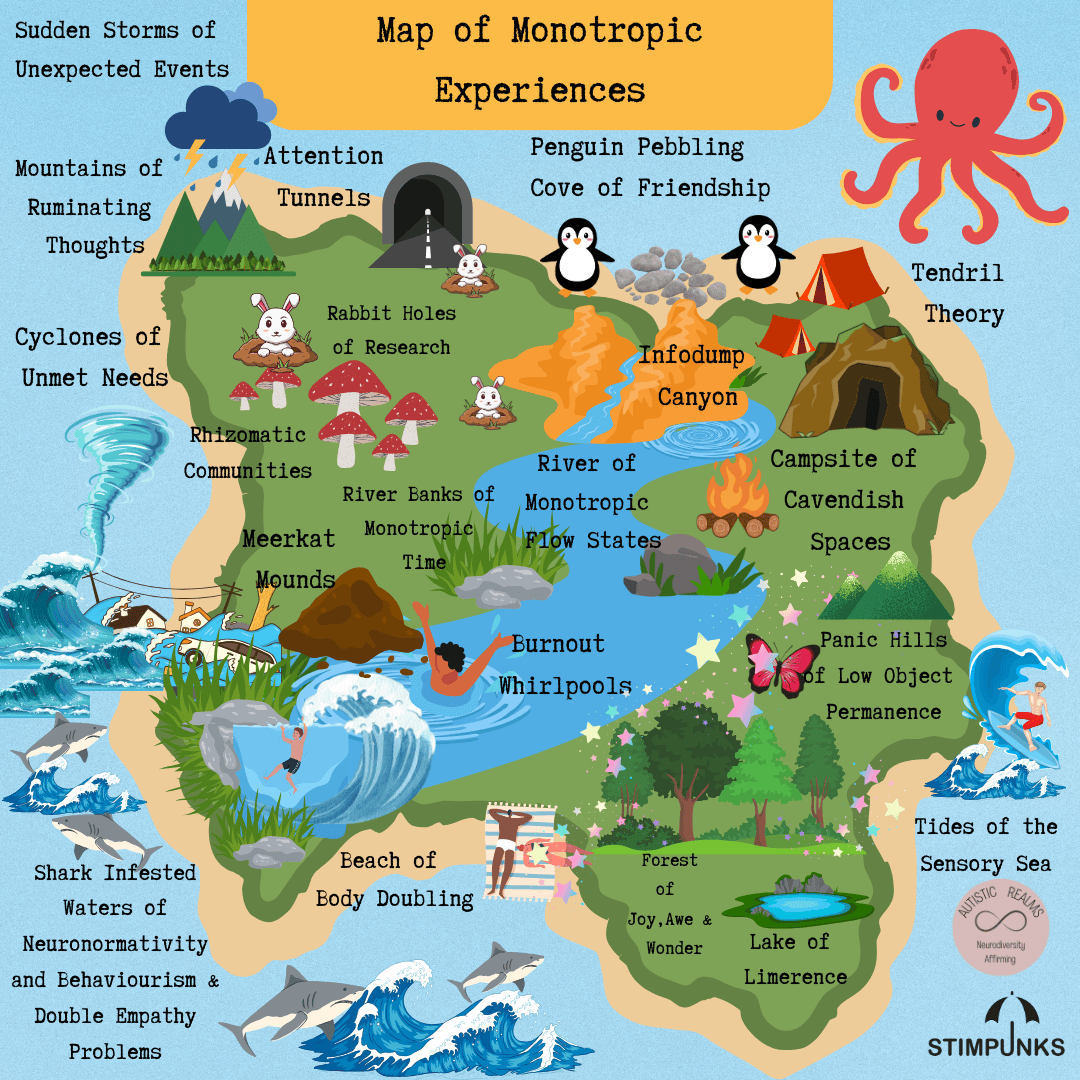
I first drew the Map of Monotropic Experiences in 2024, as a way of showing the places my own Autistic and ADHD bodymind moves through. It became an illustrated island in a blue sea, with twenty named places on and around it, from the Attention Tunnels and the River of Monotropic Flow States to Infodump Canyon, the Lake of Limerence and the Tides of the Sensory Sea. I made it as a map of me, and I have been deeply moved by how many people have told me they found themselves on it too.
Monotropicmap.org is the map’s new home, built together with Ryan, Norah and Chelsea at Stimpunks. Each of the twenty areas now has a page of its own, and every numbered marker on the map opens that area. You can also wander the areas by the kind of place they are: places of flow, places of connection, stuck states and places of pressure. It is a map to find yourself on, so there are no scores, types or results, and no accounts, analytics or tracking either.
Did you know?
Monotropism is a neurodiversity-affirming theory of autism developed by Autistic people, first by Dinah Murray and Wenn Lawson with Mike Lesser (Murray et al., 2005). It describes minds that pull attention strongly towards a small number of interests at any one time, leaving fewer resources for everything else. Things outside the attention tunnel can be missed, and moving between tunnels takes real energy. Autistic, ADHD and AuDHD people are more likely to be monotropic (Garau et al., 2023), and the home of the theory is monotropism.org, looked after by Fergus Murray.
Almost every area on the map was named by somebody, and the site credits each of them and links to their own words. Erin Human gave us tendril theory, Fergus Murray gave us attention tunnels and flow, and Damian Milton gave us the double empathy problem (Milton, 2012). Tanya Adkin and David Gray-Hammond named meerkat mode, Dora Raymaker and colleagues defined Autistic burnout (Raymaker et al., 2020), and Wenn Lawson wrote about object permanence. Penguin pebbling, monotropic time and the Autistic rhizome are mine, and Cavendish Space is Ryan’s.
The water it all sits in
It would be easy to read the map as a portrait of one person and their struggles. Some of its roughest waters, though, such as the Burnout Whirlpools and the Shark Infested Waters of Neuronormativity and Behaviourism, are made by schools, workplaces and clinics built around the idea that there is one correct way to have a mind. So the site also holds a second map, the frame, which looks at who makes that weather in the first place.
Where would you like to go today?
There is no right place to start. You might land in a rabbit hole of research this morning and wash up on the Beach of Body Doubling by the afternoon, and every part of the island is there when you need it.
- 🏝️ The twenty areas: every place on the island, each with its own page, its originator credited and links to further reading.
- 🌊 The frame: the second map, about neuronormative domination and who makes the weather.
- 🎓 Free training: open-source training of about forty-five minutes, for schools, workplaces, health settings and community groups.
- ✏️ Your map: mark the places you find yourself on your own map and share it with the community story project, or draw a new map of your own.
- 🐧 Places that grew their own sites: the Penguin Pebbling Cove became the Penguin Pebbling card game Ryan and I made, the Campsite became the Cavendish Cards, and the Rhizomatic Communities and the Forest of Joy, Awe and Wonder live on at Star Stuff.
The map and everything built from it are shared under a CC BY-SA 4.0 licence, so you are welcome to share it and adapt it, as long as you keep the credit and the licence with it. If you would like to explore your own attention style further, the site links to the Monotropism Questionnaire by Garau et al. (2023).
References
Garau, V., Murray, A. L., Woods, R., Chown, N., Hallett, S., Murray, F., Wood, R., & Fletcher-Watson, S. (2023). Development and validation of a novel self-report measure of monotropism in autistic and non-autistic people: The Monotropism Questionnaire [Preprint]. OSF. https://osf.io/ft73y/
Milton, D. E. M. (2012). On the ontological status of autism: The ‘double empathy problem’. Disability & Society, 27(6), 883–887. https://doi.org/10.1080/09687599.2012.710008
Murray, D., Lesser, M., & Lawson, W. (2005). Attention, monotropism and the diagnostic criteria for autism. Autism, 9(2), 139–156. https://doi.org/10.1177/1362361305051398
Raymaker, D. M., Teo, A. R., Steckler, N. A., Lentz, B., Scharer, M., Delos Santos, A., Kapp, S. K., Hunter, M., Joyce, A., & Nicolaidis, C. (2020). “Having all of your internal resources exhausted beyond measure and being left with no clean-up crew”: Defining autistic burnout. Autism in Adulthood, 2(2), 132–143. https://doi.org/10.1089/aut.2019.0079