An Autistic-led video course and workbook, co-authored and created by Helen Edgar of Autistic Realms and David Gray-Hammond of NeuroHub Community
Why we made it
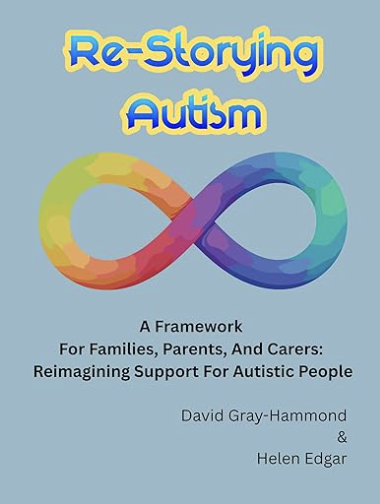
Re-Storying Autism began as a framework for families, parents and carers, and it has grown into a full online course with a workbook of more than 350 pages. David and I made it because so much of what families are handed after a diagnosis is written about Autistic people rather than by us, and it tends to steer everyone towards managing behaviour, pushing for “independence” and fixing whatever looks like a problem.
Re-storying asks something gentler and more accurate of us. It means making sense of how a nervous system learned to survive, how environments shape distress, and how the conditions for dignity, agency and wellbeing can be rebuilt between people rather than inside one person.
What the course covers
The course has seven modules and 63 lessons, with about four and a half hours of video alongside the full workbook text. Together they explore:
- 🧠 Autistic attention and monotropism (Murray et al., 2005), and the double empathy problem (Milton, 2012)
- 🪞 Identity, language and disability models
- 🌈 The eight-sense bodymind and the emotional landscape
- 🧸 Autistic play and ways of learning
- 🔋 Burnout as a crisis of connection (Raymaker et al., 2020)
- 🛡️ Trauma, safety and the emotional environment
- 🤝 What we can all learn from Autistic community
Who it is for
It is written for parents, carers and family members, and for Autistic people who are diagnosed, self-identified or still wondering. It is not for anyone hoping to change, cure or normalise an Autistic person.
Learning at your own pace
You can follow the lessons step by step or dip into whichever ones matter most right now. Reflections save privately as you go, there are no deadlines, streaks or scores, and the reading options include fonts, text size, dark mode and a calm mode. A free preview lesson and a set of free guides are there if you would like to see how it feels first.
A sister course
David and I also created Building a Positive Autistic Identity, a gamified, self-paced course written for Autistic people themselves. You can find both courses together on NeuroHub Horizons.
References
Milton, D. E. M. (2012). On the ontological status of autism: The ‘double empathy problem’. Disability & Society, 27(6), 883–887. https://doi.org/10.1080/09687599.2012.710008
Murray, D., Lesser, M., & Lawson, W. (2005). Attention, monotropism and the diagnostic criteria for autism. Autism, 9(2), 139–156. https://doi.org/10.1177/1362361305051398
Raymaker, D. M., Teo, A. R., Steckler, N. A., Lentz, B., Scharer, M., Delos Santos, A., Kapp, S. K., Hunter, M., Joyce, A., & Nicolaidis, C. (2020). “Having all of your internal resources exhausted beyond measure and being left with no clean-up crew”: Defining autistic burnout. Autism in Adulthood, 2(2), 132–143. https://doi.org/10.1089/aut.2019.0079