Why Autistic community grows from flight and becoming rather than structure, and why that makes it a critical act
By Helen Edgar and David Gray-Hammond. An expanded version of a post first published on The Wider Existence, 15 November 2026.
In 2023 we began writing about something we called the Autistic Rhizome (Gray-Hammond, 2023; Edgar, 2023). We described it as a network of communities linked to other communities. None of them depended on another, and there was no beginning and no end. We still believe that what we were pointing at was real. We no longer think we described it properly.
The problem was the picture in our heads. When most of us imagine a network, we imagine dots joined by lines: nodes and connections. However flat it looks, a network of nodes is still a map of fixed positions. It asks where you are, who you are connected to, and how many steps you are from the centre. It is the organisational chart turned on its side.
Ian Buchanan (2007) argues that the rhizome is often misread in this way. He also argues that well-meaning uses of it, especially those that treat new technologies as rhizomatic, end up propping up the status quo rather than challenging it. Helen sensed the problem early. In 2024 she was still using the language of nodes, but she argued that the real understanding lives in the spaces between them, in the flow of connection. She drew on Tyson Yunkaporta’s (2020) Sand Talk and on the Japanese idea of Ma, the meaningful space between things (Edgar, 2024). That thread matters to both of us. The Autistic Rhizome owes as much to those ways of knowing as it does to Paris, and Deleuze and Guattari’s own borrowings from other cultures have rightly been questioned (Miller, 1993).
Deleuze and Guattari were clearer than we were. In the opening plateau of A Thousand Plateaus they insist that “there are no points or positions in a rhizome… There are only lines” (Deleuze & Guattari, 1987, p. 8). Later in the book they describe a line of becoming as one that is not defined by the points it connects; it “passes between points” and comes up through the middle (p. 293). The rhizome is a multiplicity of movements rather than a network of things.
So what follows is both a correction and a development. The Autistic Rhizome is not a network of nodes. It is a tangle of intersecting lines of flight and lines of becoming. It is also something our first version left out: a neuroqueer practice. Nick Walker (2021) describes neuroqueering as the practice of subverting neuronormativity, together with the heteronormativity tangled up in it, and of becoming something other than what we were shaped to be. If the rhizome is about becoming, neuroqueering is one of the ways Autistic people already live it.
Trees and rhizomes
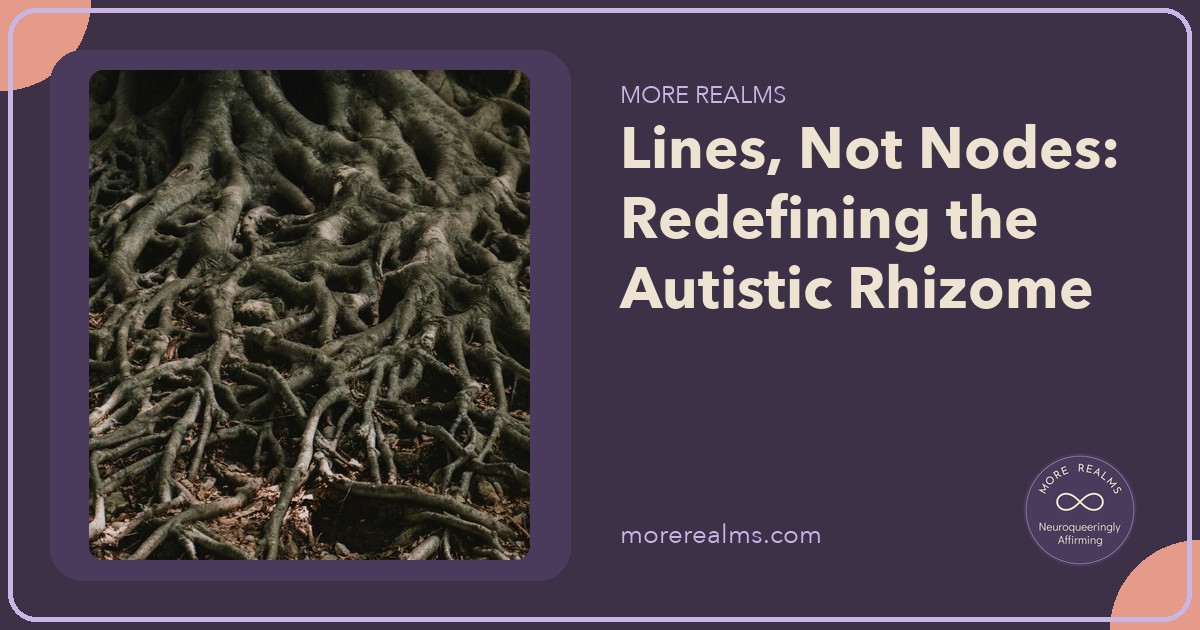
Deleuze and Guattari call the dominant logic of Western thought arborescent, meaning tree-like. A tree has a root, a trunk and branches. Every part gets its meaning from where it sits in relation to the centre. Arborescent thinking runs on hierarchy, lineage and binary division: this or that, higher or lower, closer to the trunk or further out on the branches.
Mainstream society organises Autistic life this way. The diagnostic manual is the trunk, and “levels” and “functioning” labels are the branches. Education offers pathways and eligibility criteria. Services have thresholds. The charity model lets parents, professionals and organisations speak from the trunk, while Autistic people sit somewhere out on the twigs. To be Autistic within the tree is to be given a position.
Before the diagnostic manual, the trunk was psychoanalysis, which for decades looked for the cause of Autistic children in their mothers. Deleuze and Guattari’s first book together, Anti-Oedipus (1983), attacked exactly that Oedipal tree. Buchanan (2021) argues that the clinical and political project they called schizoanalysis is still unfinished.
The rhizome works differently. It grows sideways. Any part can connect to any other part. Break it, and it regrows from wherever it was broken. It has no centre and no origin; it is always in the middle.
One caveat matters for everything that follows. Deleuze and Guattari do not present tree and rhizome as evil and good. Trees have rhizomes running through them, and rhizomes form knots of arborescence (Deleuze & Guattari, 1987, p. 20). The question is never which one we are. It is which way we are moving.
Lines of flight and lines of becoming
A territory, in Deleuzo-Guattarian terms, is the arrangement of habits, roles, expectations and meanings that holds a life in place. Territorialisation is the process of being held. Deterritorialisation is coming loose. A line of flight is the path along which something escapes the territory that held it.
Flight here does not mean running away. For Deleuze and Guattari, flight is creative; it is how new things come into the world. It is also a matter of desire. In Anti-Oedipus, desire produces rather than lacks (Deleuze & Guattari, 1983). That means Autistic joy belongs in any account of our lines: the pleasure of a stim, the delight of a passion, the relief of an info-dump that lands.
Autistic life is full of lines of flight. There is the late-identified adult whose old story (“lazy”, “difficult”, “too much”) suddenly stops holding, and the unmasking that follows. There is the questioning of gender and sexuality that so often comes alongside it; Autistic people are more likely than others to be transgender and gender-diverse (Warrier et al., 2020). There is the refusal of compliance-based therapy, the stim performed openly in a public place, and the monotropic interest that pulls a child sideways out of the curriculum and into a world the curriculum never imagined.
Not every line needs to be an escape, though. Deleuze and Guattari separate being a minority, which is a fixed state that can be counted, from becoming-minoritarian, which is a process anyone can be caught up in (1987, pp. 291–293). Lines of becoming can be drawn without leaving the room. This is where neuroqueering lives. Walker (2021) holds neuroqueer as both an identity and a verb, and the verb is a becoming: undoing neuronormative habits from inside the places we already are.
The open stim shows how this works. Deleuze and Guattari describe a child in the dark who comforts themselves by humming under their breath, making a small territory against chaos (1987, p. 311). They call this a refrain. A stim is often a refrain. It makes a home in the body first, and from that home it can open outward into sound, rhythm, joy and other people. The same movement steadies and frees. Erin Manning (2016) shows how Autistic perception works through gestures like this, which shift a situation from within without announcing themselves as resistance.
Monotropism (Murray et al., 2005) helps here. If Autistic attention gathers into deep, intense channels, then an Autistic life is drawn along lines of intensity rather than spread across a grid of expectations. We would not call this linear in the everyday sense of narrow or single-track. Intensive is the better word, and the more Deleuzian one. Helen describes monotropic attention as constellations of interconnected tunnels of intensity (Edgar, 2026), and that image is closer to lived experience than a straight line.
We want to be careful about one thing. We have said that individuals deterritorialise, and in a practical sense they do. But in our work on existential diversity, we have argued that our existence is not contained within the bodymind (Edgar & Gray-Hammond, 2026a; Dychtwald, 1977). It spreads through the space and time around us, during our lives and beyond them. A line of flight does not stop at the skin. It carries on in what we write and make, and in the people we have touched, long after the moment of escape. Together we have since named this connected, extended bodymind symphrenia (Edgar & Gray-Hammond, 2026b). The individual is where a line becomes visible, not where it begins or ends.
Where lines cross
Community forms where lines intersect. It is a crossing, which is different from membership or a position on a map. Two people’s escapes from neuronormativity meet in a 3am forum thread about bus timetables, in a shared stim, or in a moment of being recognised without having to explain.
The double empathy problem (Milton, 2012) tells us that mutual understanding comes more easily between people who share ways of being. An intersection of Autistic lines is a place where the double empathy gap narrows. It may be the first place some of us have ever been understood without translation.
Sara Ahmed (2006) offers a queer phenomenology of lines that we find useful here. She describes how bodies are oriented by the straight lines laid down before them, and how stepping off those lines is felt as disorientation before it can be understood as anything else. She also writes about desire lines: paths worn into the grass by people walking off the official route, until they become paths in their own right. Autistic community is full of desire lines. Nobody planned the vocabulary we use for ourselves or the spaces where we gather; we wore them in by walking. Ahmed also warns that the lines we follow can straighten into new norms, and we will come back to that.
But an intersection risks becoming a point. If community is simply “where lines meet”, we have quietly rebuilt the nodes we set out to dismantle. So we want to borrow another of Deleuze and Guattari’s words: plateau. They take it from Gregory Bateson, and they use it for a continuous region of intensity, held at a level rather than building towards a climax (Deleuze & Guattari, 1987, p. 22).
An Autistic community is a plateau where lines run alongside each other for a while. They braid and strengthen each other, then separate. People come and go. This is not a community failing. It is the rhizome breathing.
We need to be honest about where many of these crossings happen. That 3am forum thread usually sits on a corporate platform with central servers and algorithms that decide who gets seen. These are trees dressed as rhizomes, and Buchanan (2007) would want us to notice. Some of the hierarchies we describe below grow from the platforms as much as from us.
The mycelial ecology
Lines of flight are not safe by default. Deleuze and Guattari are blunt about this. A line of flight can turn into a line of destruction, and tearing yourself loose from every structure at once can end in collapse rather than freedom. They place this danger inside the line of flight itself, rather than simply in having nowhere to land (Deleuze & Guattari, 1987, pp. 227–231). They advise working with “a very fine file” rather than a sledgehammer (p. 160).
Every Autistic person who has unmasked too fast, with nowhere to land, knows this. Deterritorialisation with nowhere to go leads to burnout rather than liberation. Buchanan (2021) adds a harder point: from the inside, the healthy line and the harmful one can look very much alike at first (p. 52).
This is where the mycelium comes in. We use it as a metaphor rather than as natural history; fungi do not owe us a politics, and some popular claims about forest fungal networks have been overstated (Karst et al., 2023). Plateaus do not stand alone. They are connected through a living substrate of shared knowledge, language, resources and mutual aid:
- the vocabulary Autistic people have built for ourselves: monotropism, double empathy, Autistic shielding, neuroqueering
- the infodumps, the peer support and the quiet direct messages
- the survival knowledge passed between communities, such as how to get through a benefits assessment or what to say to a GP
Deleuze and Guattari have more precise names for parts of this. The shared vocabulary is what they call a collective assemblage of enunciation, the side of an assemblage made of words and signs, as opposed to bodies and things (Deleuze & Guattari, 1987, p. 88; Buchanan, 2020). The whole substrate of shared intensity comes close to what they call the plane of consistency, where many loosened bodies can meet and compose with one another. Symphrenia lives on that plane. It names how bodyminds think and feel through each other (Edgar & Gray-Hammond, 2026b).
The mycelium feeds lines of flight rather than creating them. It also has to help us tell nourishment from harm, since we cannot always see that from inside our own line. Noticing when someone is draining away, saying gently that it might be time to pause, and making it possible to step back and still be welcomed are all part of what it carries. A line that would otherwise burn out finds nourishment, and it can reterritorialise, settling into a functional community. That community is a new territory, chosen and built from the inside, rather than a return to the old one.
Reterritorialisation is not always chosen, though. In Deleuze and Guattari’s account, capitalism is the great reterritorialiser, and the neurodiversity movement is already being folded into neurodiversity hiring, Autistic content markets and branded acceptance (Chapman, 2023). A new territory has to keep asking who it is being built for.
This is an ecology of communities rather than a single community. No plateau has to do everything. The Ecosystemic Model of Distress and Wellbeing, which David developed with Tanya Adkin (Gray-Hammond, 2025), holds that distress and wellbeing come from ecosystems rather than from individuals. The same is true of community. The health of the whole ecology, not of any one group, is what keeps lines of flight alive.
Neuroanarchy as culture
Katie Munday coined the term neuroanarchy to describe the subversion of neuronormativity: dismantling hierarchy and treating every neurotype as equally valid (Munday, 2023; Gray-Hammond & Munday, 2023). For Autistic people, this also means subverting what Munday calls auti-normativity, the norms we build among ourselves.
Rhizomatic ecology is what allows neuroanarchy to become a culture rather than a personal stance. One person refusing hierarchy is a line. Many lines crossing on plateaus, fed by a shared substrate, make a culture that no longer needs the tree’s permission to exist.
This is what we mean by Autistic culture detaching from arborescent structures. We need to be precise here. Most of us remain materially dependent on the tree: on healthcare, benefits, employment and the diagnostic gate itself. We may need the diagnostic manual to get a prescription. We do not need it to tell us who we are. The detachment is cultural. Meaning, identity and value stop flowing down the trunk and start flowing sideways, between us.
There is a tension in that last sentence that we should name. We write Autistic with a capital A, as an identity, while arguing that we are lines rather than positions. We do not think we have to choose. Jasbir Puar (2012) argues that identity and assemblage need each other: identity names the grids that capture us, and assemblage names what moves beyond them. Melanie Yergeau (2018) shows how neurological queerness refuses the either/or. Deleuze and Guattari themselves advise that we “lodge” ourselves on a stratum and experiment from there (1987, p. 161). We have come to hold Autistic identity in that way, as shared ground we stand on deliberately, so that we can experiment from it without mistaking it for a fixed essence.
Munday’s inclusion of auti-normativity is the part we most often forget. Autistic communities grow their own trees. We gatekeep who is “Autistic enough” and build hierarchies around influencers and advocates. We hold up an acceptable kind of Autistic person: speaking, articulate, academically fluent, often white and cisgender, without psychiatric labels. We practise lateral ableism. Every plateau risks hardening into a root, and every desire line risks being paved.
The rhizome is the ongoing practice of not becoming a tree, never a place we have arrived at.
Who gets to fly?
Lines of flight need room to move. Many Autistic people have their lines captured before they can be drawn:
- people held in inpatient units, residential placements and secure settings
- people subjected to restraint and seclusion
- non-speaking people denied access to communication
- people with Profound Intellectual and Multiple Disabilities, whose ways of communicating are too often unseen or dismissed
We also need to correct our own framing. Flight, as we have described it, sounds like a choice made by someone able to choose and to explain. Lines are drawn inside enclosure too, often without a deliberate, speaking subject behind them: a turn towards light, a sound, a refusal, a moment of shared attention. Yergeau (2018) writes about the rhetoric of involuntary bodies, and Manning (2016) about minor gestures that change a situation without anyone intending them. Helen’s two decades of work alongside people with Profound Intellectual and Multiple Disabilities have shown us both that these lines are real and that they are constantly missed. An ecology that only recognises lines drawn by people who can intend and explain them has rebuilt auti-normativity under another name.
An ecology that only nourishes those who have already escaped is just a nicer tree with a higher entry fee.
If the mycelium is to mean anything, it has to grow into enclosed spaces: through advocacy, visiting, campaigning, and knowledge passed through the walls. It also has to listen to the lines already being drawn in those spaces, instead of only carrying ours in. Guattari tried a version of this at the La Borde clinic, through what he called transversality: building sideways relations through an institution’s hierarchy (Guattari, 1984). It was imperfect, and La Borde was still an institution, but it shows that this work has a history. The ecology is measured by how far it reaches, not by how good it feels for those already inside it.
A critical cultural endeavour
We call the rhizomatic growth of Autistic community a critical cultural endeavour, and we mean the word in both of its senses.
It is critical in the sense of critique. It challenges the arborescent order mainly by existing rather than by argument. Every functioning Autistic plateau disproves the tree’s central claim: that we need to be organised from above, interpreted by others, and placed on its branches in order to have a coherent life. For Deleuze, critique and creation are never separate, and building something different is the sharpest critique there is. Neuroqueering is one name for that building.
It is critical in the sense of crucial, because the alternative is to stay positioned. We would remain plotted, measured and assigned.
So we want to replace the questions we used to ask. Don’t ask where you sit in the network. Ask which way you are moving, what you are becoming, whose lines you are crossing, and what you are feeding.
We are not points to be plotted. We are lines, and we are still being drawn.
References
Ahmed, S. (2006). Queer phenomenology: Orientations, objects, others. Duke University Press.
Buchanan, I. (2007). Deleuze and the internet. Australian Humanities Review, 43, 1–19. https://australianhumanitiesreview.org/2008/12/20/deleuze-and-the-internet/
Buchanan, I. (2020). Assemblage theory and method: An introduction and guide. Bloomsbury Academic.
Buchanan, I. (2021). The incomplete project of schizoanalysis. Edinburgh University Press.
Chapman, R. (2023). Empire of normality: Neurodiversity and capitalism. Pluto Press.
Deleuze, G., & Guattari, F. (1983). Anti-Oedipus: Capitalism and schizophrenia (R. Hurley, M. Seem, & H. R. Lane, Trans.). University of Minnesota Press. (Original work published 1972)
Deleuze, G., & Guattari, F. (1987). A thousand plateaus: Capitalism and schizophrenia (B. Massumi, Trans.). University of Minnesota Press. (Original work published 1980)
Dychtwald, K. (1977). Bodymind. Pantheon Books.
Edgar, H. (2023, April 22). Autistic rhizome. Stimpunks Foundation. https://stimpunks.org/glossary/autistic-rhizome/
Edgar, H. (2024, April 12). Neuroqueering from the inbetween. Stimpunks Foundation. https://stimpunks.org/2024/04/12/neuroqueering-from-the-inbetween/
Edgar, H. (2026, March 21). Neuroqueering Deleuze: Rhizomes of becoming. More Realms. https://morerealms.com/neuroqueering-deleuze-rhizomes-of-becoming/
Edgar, H., & Gray-Hammond, D. (2026a, October 25). Existential diversity, the symphrenic bodymind and wider existence. The Wider Existence. https://www.thewiderexistence.co.uk/p/existential-diversity-the-symphrenic
Edgar, H., & Gray-Hammond, D. (2026b, October 7). Symphrenia. The Wider Existence. https://www.thewiderexistence.co.uk/p/symphrenia
Gray-Hammond, D. (2023, April 21). Neuro-anarchy and the rise of the Autistic Rhizome. NeuroHub Connect. https://neurohubcommunity.org/2023/04/21/neuro-anarchy-and-the-rise-of-the-autistic-rhizome/
Gray-Hammond, D. (2025, December 21). The ecosystemic model of distress. NeuroHub Connect. https://neurohubcommunity.org/2025/12/21/mental-health-ecosystemic-model/
Gray-Hammond, D., & Munday, K. (2023). Neuroqueer: Neuro-anarchy and the chaotic self. Emergent Divergence.
Guattari, F. (1984). Molecular revolution: Psychiatry and politics (R. Sheed, Trans.). Penguin.
Karst, J., Jones, M. D., & Hoeksema, J. D. (2023). Positive citation bias and overinterpreted results lead to misinformation on common mycorrhizal networks in forests. Nature Ecology & Evolution, 7(4), 501–511. https://doi.org/10.1038/s41559-023-01986-1
Manning, E. (2016). The minor gesture. Duke University Press.
Miller, C. L. (1993). The postidentitarian predicament in the footnotes of A Thousand Plateaus: Nomadology, anthropology, and authority. Diacritics, 23(3), 6–35. https://doi.org/10.2307/465398
Milton, D. (2012). On the ontological status of autism: The “double empathy problem”. Disability & Society, 27(6), 883–887. https://doi.org/10.1080/09687599.2012.710008
Munday, K. (2023). Definitions for Autistic shielding and neuro-anarchy. Autistic and Living the Dream.
Murray, D., Lesser, M., & Lawson, W. (2005). Attention, monotropism and the diagnostic criteria for autism. Autism, 9(2), 139–156. https://doi.org/10.1177/1362361305051398
Puar, J. K. (2012). “I would rather be a cyborg than a goddess”: Becoming-intersectional in assemblage theory. philoSOPHIA, 2(1), 49–66. https://doi.org/10.1353/phi.2012.a486621
Walker, N. (2021). Neuroqueer heresies: Notes on the neurodiversity paradigm, Autistic empowerment, and postnormal possibilities. Autonomous Press.
Warrier, V., Greenberg, D. M., Weir, E., Buckingham, C., Smith, P., Lai, M.-C., Allison, C., & Baron-Cohen, S. (2020). Elevated rates of autism, other neurodevelopmental and psychiatric diagnoses, and autistic traits in transgender and gender-diverse individuals. Nature Communications, 11, 3959. https://doi.org/10.1038/s41467-020-17794-1
Yergeau, M. (2018). Authoring autism: On rhetoric and neurological queerness. Duke University Press.
Yunkaporta, T. (2020). Sand talk: How Indigenous thinking can save the world. HarperCollins.