What do you do when you feel broken, when you feel such disconnect with the world, when you feel the double empathy problem (Milton, 2012) as a DEEP searing pain?
Being Autistic and monotropic in a world that honours and puts the needs of the neuromajority polytropic population first is exhausting. Being late identified Autistic has made me reflect back and realise how much of my life has been misunderstood; mental health issues exacerbated by masking and trying to fit into expectations of neuronormative ideals, leading to cycles of what I now know are burnout.
As I learn more about myself, I feel a greater attunement with the natural world around me, so much so that I can no longer clearly differentiate where my bodymind starts and ends. Being monotropic means everything is felt either really intensely or perhaps sometimes not at all; I have few in-between responses despite feeling like I am stuck between everything all the time. Re-storying my own life since realising I am Autistic has led me to re-open my imagination too and embrace the neurodiversity paradigm and neuroqueering possibilities.
Where the Edges Blur
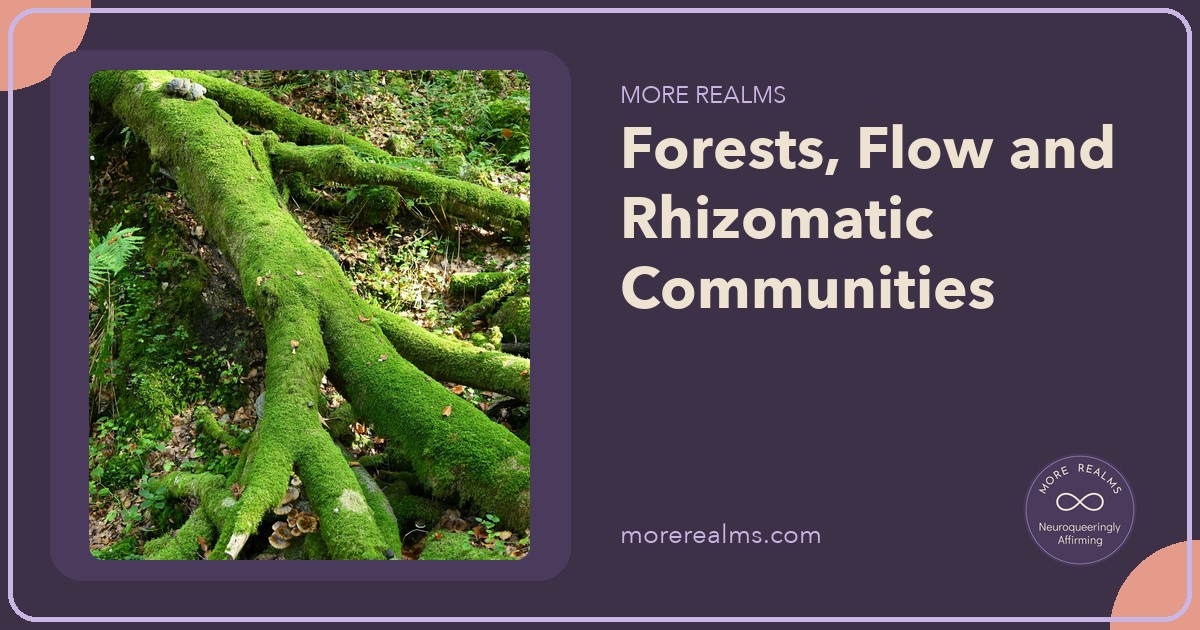
That blurring of where my bodymind starts and ends feels strongest when I am outside, in the natural world. The light through leaves, the smell of damp earth and the texture of bark don’t feel like things that are separate from me; they feel like part of the same breathing, the same living web that I am part of too.
I think monotropism helps to explain some of this. Murray, Lesser and Lawson (2005) describe monotropic attention as gathering deeply around a small number of things at a time. In busy, noisy human spaces that intensity can so quickly tip into overwhelm, but in a forest it has somewhere to go. Attention can settle on a patch of moss, a fungus on a fallen branch or the pattern of roots across a path, and stay there for as long as it needs to, without anyone pulling you out of your flow. Forests reward slow, DEEP attention; the longer you look, the more there is to see.
Alienation and Entanglement
In The Mushroom at the End of the World, the anthropologist Anna Tsing (2015) writes about the matsutake mushroom, which can only grow in relationship with particular trees, often in landscapes that have been disturbed and damaged by human activity. She argues that so much of modern economic life depends on alienation, treating things, places and people as separate, standalone resources, and one line from her book really stays with me: “alienation obviates living-space entanglement” (Tsing, 2015, p. 5). Alienation erases the very relationships that make life possible.
When I read that line I think straight away about masking and neuronormativity. So many of us learn to experience ourselves as separate, bounded units that have to function alone, performing for others and cut off from our own bodies and from the living world. A forest works the other way. Trees share water and nutrients through underground fungal networks (Simard, 2021), seedlings grow in the shelter of older trees, and fallen wood becomes home and food for countless other lives. Nothing in a forest exists alone.
Bringing Back Curiosity
We need to bring back curiosity. Tsing (2015) calls for what she describes as arts of noticing, a renewed attention to the entangled and unpredictable ways that life carries on, even in damaged places. Robin Wall Kimmerer (2013) writes about attention to the living world as a form of reciprocity, a way of giving something back for everything the earth gives us. For monotropic people, deep noticing often comes so naturally, and yet it is too often trained out of us at school and at work. Reclaiming it can feel like coming home.
Rhizomatic Communities
Deleuze and Guattari (1987) contrast the tree, with its single trunk and hierarchy of branches, with the rhizome, which spreads sideways, connects at any point and has no centre. I love that it is a slightly ironic image to bring to a forest, because the more we learn about forests, the more rhizomatic they look: beneath the trunks and the canopy lies a vast, decentralised web of roots and mycelium, quietly linking everything together.
Autistic and neurodivergent community can grow in exactly the same way, with no centre and no single way in. We find each other through shared interests and small offerings, and connections form sideways across distance and difference. I have written more about this in “The Autistic Rhizome” on Autistic Realms, and in “Mycelium & Rhizome: Ecological Metaphors” and “Expanding the Mycelial Network of Care” here on More Realms.
Opening Up Our Imaginations
Embracing the neurodiversity paradigm, and the neuroqueering possibilities that Nick Walker (2021) describes, has opened up my imagination. Our intensity, our need for depth and our porous edges stop being faults that need fixing, and become ways of being in relationship with the world.
I don’t want to romanticise nature as a cure. Access to green space is unequal, shaped by class, disability, race and where we happen to live, and many neurodivergent people find their own forests in a garden, a houseplant, a city park, a stretch of canal or a single tree on the way to school. What matters is the feeling of being held within a web of relationships, rather than standing alone against the world.
If you feel broken by a world that was not built for you, it may help to remember that you are entangled, with the living world and with others like you. The feeling of brokenness is so often what being cut off from those relationships feels like, rather than a truth about who you are.
References
Deleuze, G., & Guattari, F. (1987). A thousand plateaus: Capitalism and schizophrenia (B. Massumi, Trans.). University of Minnesota Press.
Kimmerer, R. W. (2013). Braiding sweetgrass: Indigenous wisdom, scientific knowledge and the teachings of plants. Milkweed Editions.
Milton, D. E. M. (2012). On the ontological status of autism: The “double empathy problem”. Disability & Society, 27(6), 883–887. https://doi.org/10.1080/09687599.2012.710008
Murray, D., Lesser, M., & Lawson, W. (2005). Attention, monotropism and the diagnostic criteria for autism. Autism, 9(2), 139–156. https://doi.org/10.1177/1362361305051398
Simard, S. (2021). Finding the mother tree: Discovering the wisdom of the forest. Knopf.
Tsing, A. L. (2015). The mushroom at the end of the world: On the possibility of life in capitalist ruins. Princeton University Press.
Walker, N. (2021). Neuroqueer heresies: Notes on the neurodiversity paradigm, autistic empowerment, and postnormal possibilities. Autonomous Press.