Inspired by our collaborative Stimpunks work, and my own neuroqueering Deleuze project, I’ve been thinking about the connections in-between — physics, philosophy and my own life as an Autistic ADHD person. This is me following that thread.
2. I’m not a fixed thing
A little while back I wrote about something called relational quantum mechanics — a way of thinking about physics where tiny particles don’t have fixed qualities all on their own. They only become something in relation to whatever’s around them (Rovelli, 1996). I’m not a physicist — it’s one idea among several, and physicists argue about it.
As a multiply neurodivergent person, that’s always been closer to how I experience myself — not as a fixed, separate being moving through the world, but as something that shows up through my relationships and encounters with everything around me (Edgar, 2026a). I’m still working through what that means.
Physics, philosophy, and my own life keep circling the same ideas about being interconnected, unfixed, always transforming.
3. My Monotropic Galaxy
The oldest light we can see is called the cosmic microwave background — it’s the afterglow of the Big Bang, and it’s almost perfectly smooth. It only varies by about one part in 100,000 across the whole sky — almost uniform, but only almost.
Those tiny variations — slightly denser here, slightly thinner there — were the beginning of everything. Gravity pulled the denser bits together, and over billions of years they became stars, galaxies, planets, you, me, all of it.
If the universe really had been perfectly uniform, it would have stayed a flat, empty fog forever. Nothing to see, no one to see it. Structure only exists because that near-sameness broke.
That’s the same shape I recognise in my own monotropic attention — energy pulled gravitationally into a few bright points, rather than spread out in an even, undifferentiated glow. And yet it’s exactly that unevenness, that refusal to flatten, that so many of us — anyone who’s ever been called too much, not enough, or too different — have been measured against.
4. Measured Against Neuronormative Time
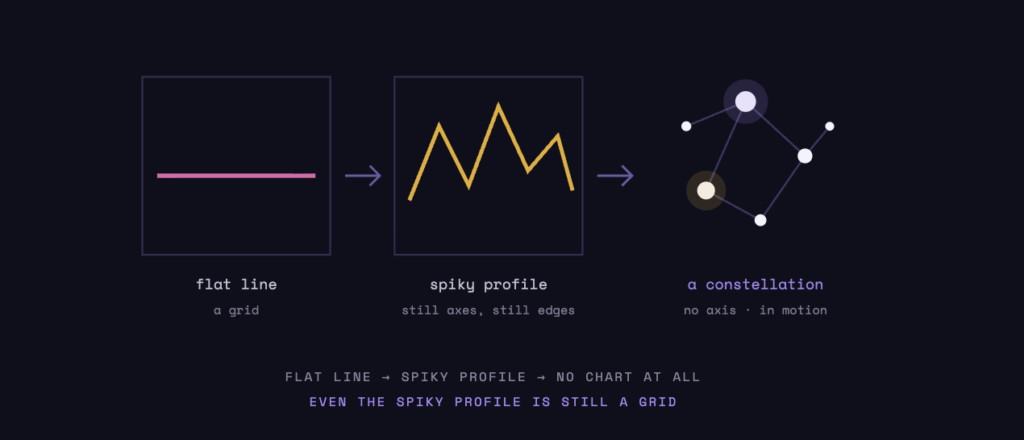
I’ve spent a lot of my life being measured against a flat line. Nobody always said it in those words, but that’s what was happening — a standard chart, a “typical” way of communicating or paying attention or experiencing the world, treated as the baseline everyone should be smoothed toward. I was positioned as the deviation that needed explaining, or fixing, or at least accounting for.
That flat line was never just about behaviour — it was also about time: a single approved tempo, a single approved rhythm, everyone expected to arrive and finish and transition together, in step with a clock that was never actually neutral.
So there’s something that genuinely steadies me in learning that the universe itself never once managed that.
What was already there, moving
The “typical” baseline
You = “deviation”
A straight line, laid over what was already moving
The grid comes after the field, not before,
Uniformity was never the achievement. It’s the thing that would have stopped everything before it even started.
5. There Is No Normal or Baseline
Gilles Deleuze, working with Félix Guattari, made a version of this same argument. Deleuze noticed that a lot of Western thinking treats difference as secondary — judged by how much it resembles some ideal, some average, some “normal” category. All of that quietly assumes the baseline came first, and difference is just a deviation from it.
The baseline is the thing that got built. The idea of normality is what has shaped our capitalist society (Chapman, 2023) and is what we are judged against (Deleuze, 1994). Difference is what’s actually there, first — and identity is what eventually forms out of it, temporarily and locally, the way a crystal settles out of a solution along the gaps and spaces in between — the places where those of us most marginalised live, and where we build our own networks, our own solidarity.
This is where Deleuze and Guattari’s idea of smooth space becomes useful (Deleuze & Guattari, 1987). Smooth space is full of local, variable difference — it hasn’t had a fixed grid laid over it yet. Striated space is what happens when that grid arrives: when a field gets measured, divided, standardised. Difference doesn’t get smoothed into existence by that process. Smoothing is what a system does afterward, only if it insists on it — striation laid over what was already smooth.
Nothing gets smoothed into existence. Smoothing is what happens to something afterward — only if a system insists on it.
6. Smooth doesn’t mean flat
Smooth space isn’t empty of movement — it’s just ungridded. It cuts against how regulation usually gets talked about, as though it means being still, quiet, zen: a flat line of its own. But smooth space is defined by what it lacks — a grid — not by what it’s doing. It can be full of movement and still be smooth — which is closer to how neurodivergent regulation actually works: through stimming, through bodily autonomy, through movement rather than stillness.
That’s closer to what I recognise when I try to describe my own attention — my porousness to my environment, the way my sensory system stays open to everything around it, the way time folds back on itself instead of running in a straight line. Not flat. Not gridded. Full of shape that never quite resolves into one measurable thing.
7. What ethodiversity means
This is where Ombre Tarragnat’s work on ethodiversity has become important to me. Ethodiversity is the variety of ways of being and behaving, across humans and other animals — and Tarragnat is precise about where it actually lives: not inside any one person, but as a property of the relationships between us, the way biodiversity belongs to a whole ecosystem, not to any single creature in it (Tarragnat, 2025).
Ethonormativity, in their framing, is the unwritten rule about which ways of being are allowed to count as normal in a given room. Put next to Deleuze, I don’t think it’s a stretch to say ethonormativity simply is that grid — applied to how we’re allowed to behave. A fixed grid laid over a field that was already full of variation before the grid ever showed up.
Ethonormativity reaches further than neuronormativity, though. Neuronormativity is about which neurotypes get treated as the default — Autistic brains judged against non-Autistic ones, for instance. Ethonormativity is the wider grid underneath that: it governs which ways of being and behaving, across every species, get to count as acceptable at all. It holds neuronormativity inside it, but it isn’t limited to brains, or even to humans (Tarragnat, 2025).
Ethonormativity simply is that grid — a fixed grid laid over a field that was already full of variation before the grid ever showed up.
8. A constellation of intensities
I recognise that grid in every space I’ve ever masked in — education, the workplace, wherever something that was moving gets asked to hold still long enough to be measured. And I recognise its absence, with real gratitude, in the spaces I’m part of — NeuroHub Community with David Gray-Hammond, Stimpunks: an Autistic rhizome, a mycelial network of care, non-hierarchical, no fixed centre, connecting wherever it meets (Deleuze & Guattari, 1987).
I used to think the shape of my own mind was something like a spiky profile — a way of picturing uneven ability across different areas, real peaks and real troughs, instead of one flat line running across the whole of who you are. At least it’s truer than a flat line. However, a profile still measures. It still needs axes, still has edges — and that’s exactly where I want to push further, past even the spiky profile. What I actually recognise, when I try to map myself, isn’t a chart at all. It’s a constellation of intensities: a galaxy, always in relationship with itself, always in motion, never finished (Edgar, 2026b).
A profile still measures. It still needs axes, still has edges. What I actually recognise, when I try to map myself, isn’t a chart at all; it is an interconnected, interdependent galaxy.
9. The Universe Doesn’t Do Flat Lines
I still don’t have these ideas fully settled or finished. Every time I follow this thread — from the sky, down through physics and philosophy, into the actual shape of my own galaxy of monotropic attention — I end up some where different but with the over arching throughts that:
The universe doesn’t do flat lines.
It never really tried to.
It went straight from near-uniform fog to unrepeatable structure, without ever pausing at sameness for its own sake.
I think that’s worth remembering, gently — the next time any of us are asked to explain why we don’t match the line of neuronormativity. We are all star dust. We are neuroqueering the spiky profile: no edges, limitless ways of being.
10. L★S
Zine No. 11 · Guest author
Written by Helen Edgar. First published on Autistic Realms: More Realms, and shared with Star Stuff.
Chapman, R. (2023). Empire of normality: Neurodiversity and capitalism. Pluto Press.
Deleuze, G. (1994). Difference and repetition (P. Patton, Trans.). Columbia University Press. (Original work published 1968)
Deleuze, G., & Guattari, F. (1987). A thousand plateaus: Capitalism and schizophrenia (B. Massumi, Trans.). University of Minnesota Press. (Original work published 1980)
Edgar, H. (2026a, June 7). We are made of relations: Quantum physics and what it means to be Autistic. More Realms.
Edgar, H. (2026b, June 16). My monotropic galaxy: A constellation of my Autistic self. More Realms.
Rovelli, C. (1996). Relational quantum mechanics. International Journal of Theoretical Physics, 35, 1637–1678.
A guest zine in the Stimpunks Star Stuff series. Where The Universe Runs on Difference (No. 8) is about breadth — variety over monoculture — this one is about difference coming first: the baseline is what gets built. The physics-and-philosophy sourcing, and how it sits beside Nos. 8 and 9, is gathered in The Difference-First Frame.
Helen Edgar — Autistic Realms | More Realms | June 2026
Spaces In-Between
I recently looked at the night sky, I was outside and cold, the sheer number of stars, the ones I could see and the knowledge of the ones I could not, shifted something in me that I did not have a word for at the time. It felt like an opening, a feeling of being very small and very connected at the same time, of the distance between me and the universe suddenly becoming less certain, of living in the in-between space. What I was experiencing is called awe, I also know, looking back, that awe may be one of the most distinctly Autistic experiences to feel.
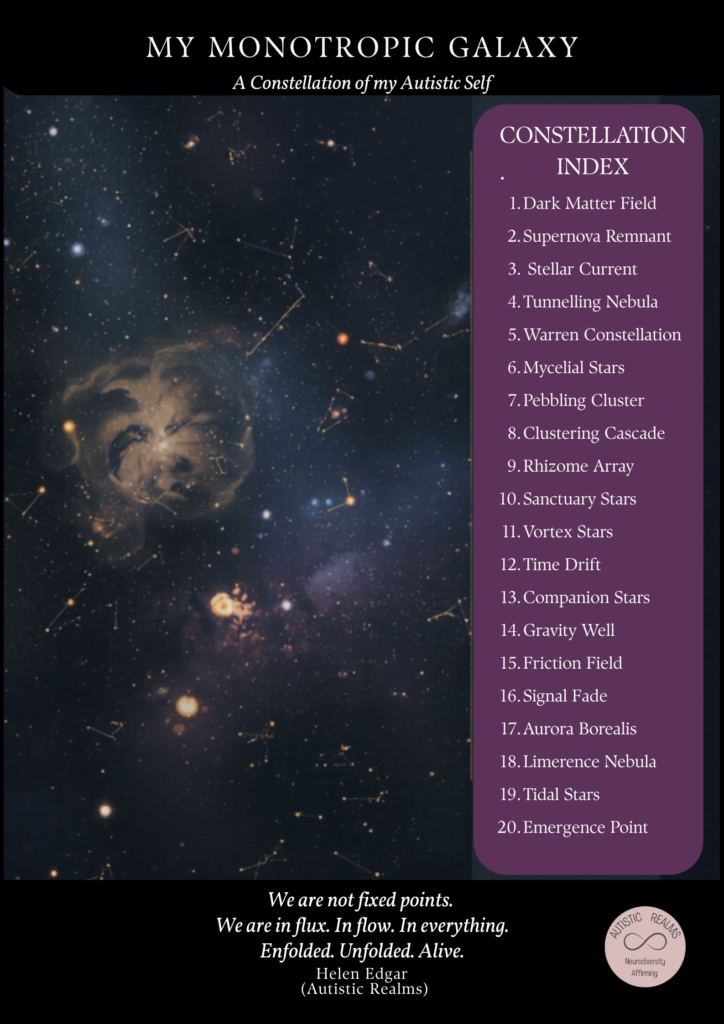
This piece is about feelings of awe and wonder, my own Autistic ADHD experiences, and about the map I have tried to represent of my inner life using the language of the cosmos. It is called My Monotropic Galaxy: A Constellation of My Autistic Self. It is a deep-field image of space, overlaid with constellation lines, accompanied by an index of 20 named features of some of my monotropic experiences. Some of these constellations I have lived in for decades, others I have only recently been able to name. All of them are in relationship with each other, always in motion, always becoming something the map and myself has not yet caught up with.
Before I guide you through my galaxy of monotropic experiences, I will explain a bit about the theory of monotropism and why I feel it is so important for my own sense of self-identity as an Autistic ADHD person.
What Is Monotropism?
Monotropism is an attentional theory of autism developed by Autistic researchers Dinah Murray, Mike Lesser, and Wenn Lawson (2005). It describes how many Autistic people tend to have their attention drawn more strongly to fewer things at any given time, going deep rather than wide, concentrating rather than spreading their focus. Rather than framing this as a deficit — an inability to multitask or shift attention — monotropism understands it as a distinct attentional style with its own strengths and difficulties.
Discovering the theory of monotropism for the first time felt like being handed a map of a place I had always lived in but had never been able to describe. I was identified as Autistic and ADHD in my forties, while my children were also going through their own assessments. What followed was a long process of re-sense-making, a re-storying that went back through my entire life, understanding finally why things had been the way they had been, and finally being able to begin to understand my own neurodivergent identity a little bit better.
Awe and Wonder as a Way of Knowing
Let me return to the night sky and think about what awe actually is and why it may be especially relevant for monotropic people. Helen De Cruz (2024), in her book Wonderstruck: How Wonder and Awe Shape the Way We Think, describes wonder as a form of epistemic opening, a way of relating to knowledge and how we have come to know things. The epistemic opening is the moment when the way we know expands; it is more than just a feeling. When we encounter something that is genuinely awe-inspiring, the usual categories we use to make sense of the world temporarily loosen. It is as if you are maybe seeing or sensing something for the first time; you may notice things you had previously learned to filter out. For De Cruz, wonder is not just a happy side effect of seeing something beautiful; it is a cognitive and moral orientation. It is how we stay genuinely curious about a world we might otherwise let ourselves assume we already understand, or are taught to ignore, as it doesn’t fit into how people expect us to perceive and respond.
When I read De Cruz’s book in 2024, something in me recognised what she was describing at a really deep level. It was the most inspiring book I have read for many years. I took part in a brilliant reading group hosted by The Philosopher 1923, where we explored Helen De Cruz’s work in depth. In the final week, we were lucky to be joined by Helen herself, and I remember discussing Nick Walker’s neuroqueer theory (2021) and the projects I was developing with Stimpunks, particularly the ways her ideas resonated with and helped shape our thinking. These conversations had a lasting impact, influencing our Neuroqueer Learning Spaces project, helping to evolve the vision behind Cavendish Space, and continuing to inform much of my current writing and emerging ideas around the theory of monotropism.
Awe and Flow
When I am pulled fully into something that has truly captured my attention, not just my mind, but my whole body and nervous system is immersed. What opens is not simply focus; it is that first-ness quality of perception De Cruz describes, the sense of seeing and feeling something for the first time, even if I have encountered it a hundred times before. New connections become visible, and the boundaries between things soften. It feels like my nervous system, so often braced against a world not designed for me, can finally exhale in the in-between spaces as new connections form and I feel literally awe-some.
Keltner and Haidt (2003) describe awe as arising when we encounter something vast that challenges our existing mental structures, something that does not fit the categories we already hold, and that invites us to expand our ways of being rather than retreat or fold inwards. Awe can be humbling and expansive at the same time; it opens up possibilities.
I feel this resonates with what it feels like for me to be in monotropic flow. My self does not disappear, nor does it become more rigid or narrow; instead, it feels as though I open up, my whole bodymind becomes more porous. The boundary between me and what I am attending to becomes less fixed; I am both in the flow, and the flow is in me. The distance between those two things collapses and unfolds in a way that feels like both loss and arrival, and it can feel deeply liberating and joyful (and sometimes deeply troubling and anxiety-provoking!).
For many Autistic people, these experiences are undervalued, even stigmatised or shamed as we grow up. We are told to concentrate on what the teacher is saying, to focus on what our family and friends think really matters, and slowly, our own ways of perceiving the world are flattened as we learn to mask and stop trusting ourselves. The things we find awe-inspiring are treated as having no value: the joy of looking closely at a mushroom or an insect may be met with being told to hurry up and rejoin the group; the wonder of feeling the sea against your toes in the sand may be met with being told to just get in and swim and stop fussing.
This quality of experience, this awe and wonder, is represented by the Stellar Current at the heart of my galaxy: the deep flow state through which my whole system comes into coherence, and I move with the current of what matters most. It feels fitting that this current carries me toward a phrase that has become foundational to how I think about the Autistic community and a sense of belonging.
Love You Down to Your Star Stuff
The phrase Love You Down To Your Star Stuff grew out of collaborative work with Ryan Boren and Stimpunks Foundation (Boren & Stimpunks Foundation, 2026). It reaches back to something Carl Sagan observed: that the atoms in our bodies were forged in the interiors of stars that lived and died long before our sun existed. We are, quite literally, made of star stuff.
To love someone down to their star stuff is to locate love for their core way of being. Love is not conditional on performance, legibility, or being the kind of person the world finds easy to translate. Love should not be dependent on meeting neuronormative expectations, masking well enough or being productive enough or social enough. To love someone down to their star stuff is to love their way of being continuous with the universe and their authentic self.
Much of the lived experience of being Autistic for many people is weighed down by what I have called the Dark Matter Field in my galaxy. This is the heavy darkness of neuronormativity, reflected in the accumulated weight we carry around of a world that does not meet our needs, and does not love us down to our star stuff. The Dark Matter Field is everything that is harmful in our systems, behaviourism, ableism, racism and more. As Autistic people, we are constantly being measured against a map that was not ours.
The Double Empathy Problem (Milton, 2012) highlights the mutual misunderstanding between people with very different experiences, where the gap of this map is often framed as ours to close; this sits at the heart of the Dark Matter Field’s weight. Decades of masking, so thoroughly embedded in me that I genuinely did not know for most of my life where the mask ended and where I began, meant I was always accommodating others to try to meet expectations.
Love You Down to Your Star Stuff is a different orientation entirely. It is the foundation of what I believe the constellation of the neurodivergent community is reaching toward. The Mycelial Stars — underground networks of care and interdependence. The Rhizome Array — the non-hierarchical community that creates something together that none of us could make alone. The Companion Stars — those who do not need me to perform. The Sanctuary Stars — where I do not have to translate myself. All of these are expressions of what it means to love someone for who they actually are and are part of the galaxy that many neurodivergent people may recognise or relate to.
The Implicate Order and the Autistic Bodymind
A concept from quantum physics has really inspired my thinking recently, helping me articulate my inner self and conceptualise my Galaxy of Monotropic Experiences. Physicist David Bohm (1980) proposed that beneath the explicate order, the world of distinct objects and separate events we can see and measure, there exists a deeper dimension he called the implicate order. In the implicate order, nothing is truly separate; everything is enfolded into everything else. What appears distinct at the surface is always an unfolding of something that, at a deeper level, was always entangled.
I am thinking about the implicate order through the lens of monotropism and flow theory. The surface of a river looks like separate ripples and currents, each one seeming to rise, curl, and vanish on its own, but beneath the surface, the water is continuous; there is no ripple that exists apart from the river. What appears as individual movement is always part of a larger, deeper pattern, momentarily folding into visibility before folding back into the whole.
This is something of what monotropic flow feels like to me from the inside. The attention tunnel is the explicate order: a single ripple, distinct and absorbing, everything else falling away from view, but the depth beneath it, the coherence, the sense that this particular focus is connected to everything I have ever cared about, is the implicate order surfacing, slowly emerging and connecting with other thoughts. The interest that pulled me in is and was never really separate from the rest of me; it only looks that way from above the waterline or from what others may perceive. When I am in flow, I am not narrowing myself down to one thing and losing everything else; it is more like I am going deeper beneath the surface ripples to the place where it was all one current to begin with, to where I feel whole.
This may be part of why monotropic flow can feel like both loss and arrival at once; the “loss” is the disappearance of the surface separations of events and experiences outside the attention tunnel, the distinct sense of me here and the world being there. The “arrival” is perhaps the recognition of what was really underneath all along, the boundary was an explicate-order appearance, and the implicate order beneath it was entangled the whole time. When I am in flow, I can feel that oneness and vastness at the same time creating a sense of awe.
The world tends to perceive Autistic people through the explicate order, through what is behaviourally visible, measurable, categorisable. But what drives and shapes and sustains Autistic experience is largely implicate, the enfolded pattern of sensory processing, attentional depth, emotional layering, temporal fluidity, and relational intensity that does not show at the surface, or shows in ways that are consistently misread by others.
When I am in a deep monotropic flow, I am living in the implicate order. Thoughts do not arrive in sequence; they arrive already feeling more like a constellation, in relationship with each other, already folded into a larger pattern I can sense before I can articulate it. This is the Tunnelling Nebula in my galaxy — the way monotropic attention goes deep rather than wide, concentrating and transforming everything it connects to, always making more connections beneath the surface. It is around this Emergence Point that ideas and connections surface, when something is finally ready, arriving in its own time. It is at this Emergence Point that things finally start to make a bit more sense, at least to me and enable me to keep moving and keep becoming.
Bohm’s framework has also helped me understand burnout being the result of what I have called the Dark Matter Field. The Supernova Remnant in my galaxy is like a new way of becoming that emerges after burnout, remnants of my old self entangled in new ways of being.
Burnout is not simply tiredness; it is what happens when the implicate order is violently disrupted and when the continuous process of unfolding is interrupted by sustained demand to operate exclusively in the explicate: to spread thin rather than deepen, to switch and fragment and present surface after surface with no return to the enfolded whole – it is flooded with the Dark Matter Field. Each significant burnout has remade me into a new version of myself; something changes at my core, and it gives rise to new constellations. The supernova scatters what I was, how I thought and my previous ways of being; in a way, it reforms me into an ongoing cycle of becoming.
Rhizomes and the Non-Hierarchical Mind
Alongside Bohm, the philosopher Gilles Deleuze and the psychoanalyst Félix Guattari offered me another framework that helped me name something I had always experienced but could not clearly articulate in the past.
In A Thousand Plateaus (1987), they introduce the concept of the rhizome. A tree has a single trunk, its roots descend from a fixed point, and branches grow outward in a discernible hierarchy. Everything can be traced back to a central point; a rhizome is completely different. If we think of how grass spreads, or how mycelium moves through soil, more laterally, reaching out in every direction at once, with no fixed origin, no central authority, no privileged direction of growth, it may feel relatable to the experience of being Autistic. A rhizome connects with anything it encounters, it can be broken at any point and begin again from that node. It has no archive in the traditional sense, but it is dense with the traces of everything it has connected to and possibilities of what may form in the future.
This is pretty much how I feel my mind works. I have spent much of my life feeling different and not understanding my own thought processes, my non-linear associations, the omnidirectional leaps, the way a thought about a star might become a thought about mutual aid that might become a thought about penguins, and all of it feels necessary and connected, even if the connections are only fully felt inside me. It makes relationships hard, it makes communicating harder, always seeing that look of confusion on people’s faces as they think ‘what is she on about’ as there may be no obvious link to others, unless they know me really well!
The Rhizome Array in my galaxy represents the Autistic community itself. It is non-hierarchical, constantly connecting, forming new nodes, creating something together that none of us could make alone. As David Gray-Hammond and I have written about extensively there is no centre for the Autistic Rhizome and our community. There is no single way in; people can connect, join and communicate in their own way. The mycelial network metaphor runs alongside this: Mycelial Stars represent the underground networks of care that sustain us, growing toward each other in ways that do not follow a straight line or a hierarchy, representing the community of mutual aid that often sustains life for disabled and neurodivergent people.
Both frameworks, Bohm’s implicate order and Deleuze and Guattari’s rhizome, have helped me understand that the way my monotropic bodymind works has its own pattern, its own constellation, its own way of reaching toward others and toward the world and how the world works with me and in me.
The Constellation Index
What follows is an index of twenty constellations in my Monotropic Galaxy. These are not separate entries in a list; they are interdependent, entangled and always in relationship with each other and with everything around them. They are always in motion and always in flow.
Find what resonates with you from this, some of these constellations may feel immediately familiar, and others may not be part of your galaxy at all. This map is just my own constellation in a universe of infinite possible configurations of ways of Autistic being. You may find it sparks the beginnings of creating your own map or drawing your own constellation or galaxy.
1. Dark Matter Field is the weight of neuronormativity before I had words for it.
2. Supernova Remnant is burnout — the kind that arises when my monotropic attention is asked to spread attention thin, to split, to switch constantly and to mask. Each significant burnout has remade me and formed new constellations.
3. Stellar Current is the heart of my galaxy — the deep, flow states of being monotropic. When I am truly in flow, my whole bodymind system exhales and time dissolves. I am completely, wholly present, regulated and feel alive. I move with the current.
4. Tunnelling Nebula — monotropic attention goes deep rather than wide; it concentrates and transforms everything it connects to, always making more connections.
5. Warren Constellation are my rabbit holes of research. They reflect the joy of following a question, of feeling awe and wonder, and always expanding and reaching out.
6. Mycelial Stars represent the underground networks of connection that sustain the neurodivergent community of Autistic researchers, advocates, writers, families, and educators. It is our community network of care and interdependence, all growing toward each other in ways that don’t follow a straight line or a hierarchy. The foundation of mutual aid, care and well-being.
7. Pebbling Cluster is how I show love. Inspired by the way penguins offer pebbles to those they care for, this is my Neurodivergent Love Locution. Offering small glimmers, such as a twig I found or a meme or song I share as a way to say ‘I thought of you, I care’.
8. Clustering Cascade is my infodumping. The deep need to share my interests and passions, at considerable length and in detail, with those I feel safe with and to engage with others who want to share their joy.
9. Rhizome Array is the Autistic community itself — non-hierarchical, constantly connecting with other people and forming new communities and nodes. Creating something together that none of us could make alone.
10. Sanctuary Stars are the places, practices, and people where I do not have to translate myself or mask; it is where I feel safe and can simply be and know I will be accepted for who I am to regulate and communicate in my own ways.
11. Vortex Stars are the intensity of deep absorption I feel as a monotropic person. That pull into a single channel of interest that is so total it feels like a gravitational field.
12. Time Drift is my Autistic experience of time as non-linear, layered, fluid and felt. Where past and present merge into each other, and my lived time feels closer to superposition than sequence.
13. Companion Stars are the people who orbit close, who understand penguin pebbling, and the Neurodivergent Love Locutions. Those who don’t need me to perform and who just ‘get it’.
14. Gravity Well represents my monotropic looping and ruminating mind. Thoughts that circle and return, that find their way back to the same point regardless of how many times I try to leave them. It represents Autistic inertia and a feeling of being stuck.
15. Friction Field is the relentless exhaustion of having needs the world was not designed to meet, and of having to advocate for them, over and over, in systems not built with Autistic people in mind.
16. Signal Fade is the anxiety that rises when something or someone I care about moves outside my attention tunnel, the panic of object impermanence, the fear that what is out of sight may simply be gone.
17. Aurora Borealis is the joy and wonder of being Autistic — the profound aliveness that comes with deep engagement in sensory experiences. The way the world and my whole bodymind can suddenly blaze with meaning and feel beauty when I am fully with something that matters to me.
18. Limerence Nebula is the intensity of falling deeply into a connection with a person, a totality that can feel overwhelming and all-consuming.
19. Tidal Stars represent the porousness between myself, the environment I am in and the wider cosmos. The sense that my edges are less fixed than the world tends to assume. My pull towards nature, towards water, towards things that are ancient. A feeling of returning to something that was always within me.
20. Emergence Point is what surfaces from the liminal depths of my monotropic bodymind when something is finally ready to surface. It is the crest of an invisible process, trusted rather than forced, arriving in its own time, on its own terms. I am always being in a process of becoming.
Always Becoming
Our own Milky Way contains hundreds of billions of stars, and most have no name, only coordinates, or nothing at all. My own constellation feels similar, as some of my stars may dim; others may brighten, and they all have their own way of processing time. Some are still finding their way through the dark toward the light, still connecting with other stars, still discovering what they illuminate. The map I have created will never be finished, as it really only captures a moment in time, as it is always transforming, it is alive.
The Autistic rhizome keeps spreading, the implicate order keeps unfolding and the constellations keep reaching toward each other, forming new nodes, new patterns, new ways of knowing that none of us could arrive at alone. What lives beyond my twenty constellations is the infinity of Autistic ways of being, every way of knowing, sensing, connecting, and belonging that has not yet found its name, its language, its place in any map.
You may recognise some of these constellations as your own and others may not be part of your galaxy at all. We are each a unique configuration of matter, patterns and attention; we each have a particular way of being continuous with a cosmos that has been becoming itself for longer than we can even perceive.
We are not like the cosmos. We are continuous with it. In the infinite space beyond every map we have ever made, the phrase from our collaborative work at Stimpunks holds everything together: Love You Down to Your Star Stuff (Boren & Stimpunks Foundation, 2026). Every star belongs, every constellation has its place and every way of being Autistic is woven into the fabric of what this community is and is always becoming.
We are not fixed points.
We are in flux.
In flow.
In everything.
Enfolded.
Unfolded.
Alive.
References
Bohm, D. (1980). Wholeness and the implicate order. Routledge.
Murray, D., Lesser, M., & Lawson, W. (2005). Attention, monotropism and the diagnostic criteria for autism. Autism, 9(2), 139–156. https://journals.sagepub.com/doi/10.1177/1362361305051398
Walker, N. (2021). Neuroqueer heresies: Notes on the neurodiversity paradigm, autistic empowerment, and postnormal possibilities. Autonomous Press.
Invitation
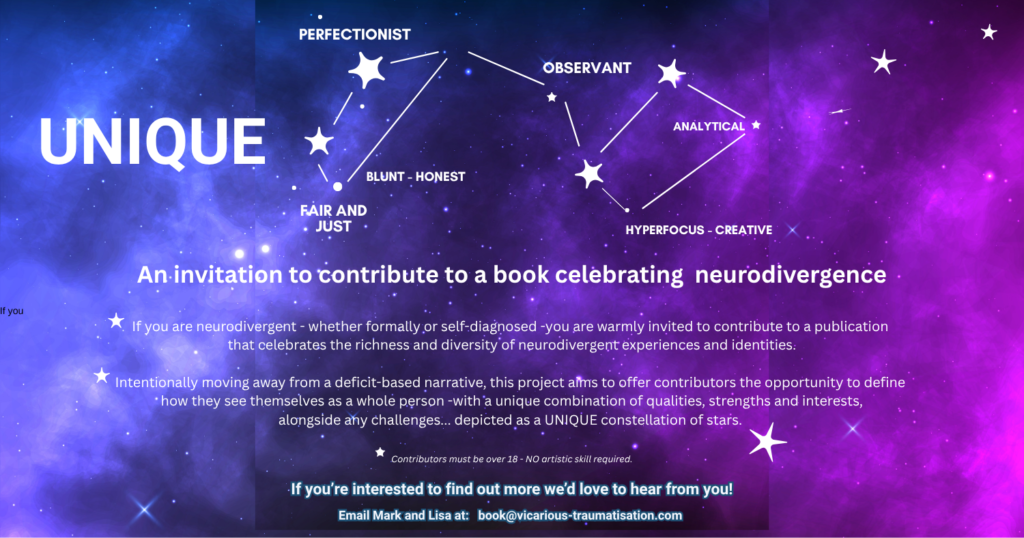
I am delighted to share that I have a chapter in an upcoming book called UNIQUE. UNIQUE invites neurodivergent contributors to map themselves: their qualities, strengths, struggles, deep interests, and challenges, all held together as a constellation.
My chapter centres on my Monotropic Galaxy — the constellation map of my Autistic self, and this blog is an edited and expanded version of my forthcoming chapter submission. My own constellation is a small offering among many in what I hope will be a rich, diverse, and deeply affirming collection of neurodivergent people’s inner worlds and experiences.
The book is still open for contributions.
If you are neurodivergent — whether formally diagnosed or self-identifying — you are warmly invited to contribute your own constellation. No artistic skill is needed. No particular way of writing. Just your own unique map of who you are. The project is intentionally moving away from deficit narratives and toward something that reflects the full richness of neurodivergent experience and identity.
Contributors need to be over 18. If you’re interested to find out more, Mark and Lisa would love to hear from you at book@vicarious-traumatisation.com.
We introduce NeuroHub Community’s ecological approach to community and wellbeing through philosophical concepts grounded in practical application.
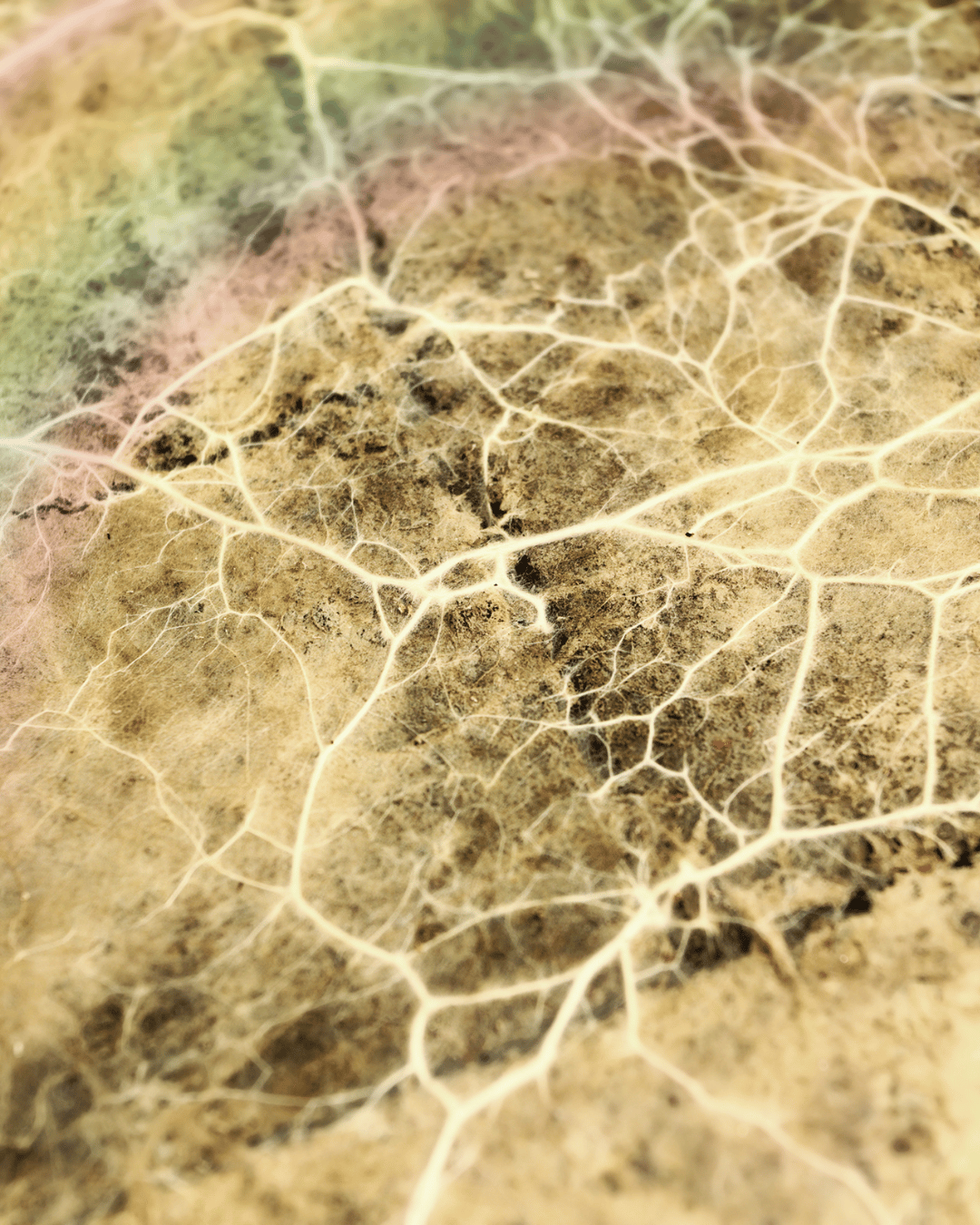
When I first started thinking about ecological metaphors for neurodivergent experience, I kept returning to two thoughts: the underground fungal web of mycelium, and the sideways-spreading, rootless rhizome.
At first glance they can seem interchangeable as they both resist hierarchy, they both spread without a centre and they both connect things that might appear separate on the surface.
The more time I spent with these thoughts and through discussions with Neurohub Community and Stimpunks, the more I realised they are doing quite different things, and that difference matters for how we understand Autistic and neurodivergent life, community, and identity.
Mycelium helps us understand how care flows and survival becomes possible.
Rhizome helps us understand how a person grows, learns, and becomes.
Mycelium: A Network of Care and Mutual Sustenance
Mycelium is the vast underground fungal web that connects trees and plants across a forest ecosystem. It’s sometimes called the “wood wide web” and what makes it such a valuable metaphor for care is not just how it looks, but how it actually functions.
Mycelial networks redistribute resources — carbon, water, nutrients — from stronger nodes toward more vulnerable ones (Simard, 2021). Older, established trees send sugars through the network to seedlings growing in shade, where they cannot yet photosynthesize enough to sustain themselves. The network actively compensates for inequality of access, it notices where something is struggling and it responds.
There is no central command, there is no king or ruling tree that rules all the others and send out orders, no hierarchy issuing instructions about who receives what. Care flows through relationships and proximity, quietly and continuously, largely beneath the surface.
I think this maps powerfully onto disability justice frameworks and neurodiversity communities. Mia Mingus’s concept of interdependence and access intimacy (2022) is about the understanding that we all need care and we all have something to offer, it resonates deeply with mycelial logic. Care, in this framing, is not charity flowing downward from those who have the power to those who lack power. It is a web of mutual interdependent sustenance in which everyone is both receiver and contributor at different times and in different ways.
For Autistic community specifically, the mycelium metaphor holds to me because it values depth of connection over breadth. It recognises that the health of the whole of our community depends on the health of each node, each person — including, and perhaps especially, the most vulnerable. It is a model of community that does not ask anyone to need less, perform more, or earn their place in the network, everyone is accepted as they are.
Distress and burnout, from this perspective, are not signs of individual failure. They are signals moving through a system — signs that the network needs to respond, that resources need to be redistributed, that care needs to flow more evenly.
Rhizome: Person-Centred Becoming and Non-Linear Growth
Where mycelium is a metaphor for community and care, I am now moving towards the idea of the rhizome being more of a metaphor for personhood and becoming.
Deleuze and Guattari (1987) introduced the rhizome as a philosophical concept in their work One Thousand Plateaus — drawn from plants like ginger or couch grass that grow horizontally, without a single root or trunk, branching in multiple directions simultaneously, without a fixed origin or a predetermined destination.
This stands in contrast to what they called the arborescent, or tree-like, model that David Gray-Hammond discusses in our podcast — the familiar image of a trunk (a normative baseline) from which branches spread outward (deviations, differences, deficits measured against that centre). The tree model underpins so much of how neurodivergent people have been previously and in many ways are still understood — as branching away from a correct developmental path, as requiring intervention to redirect growth back toward the trunk. The rhizome refuses this entirely.
The rhizome has no correct path and no normal sequence, there is no centre from which deviation is measured. You can enter it at any point and it connects anything to anything. It is about multiplicity and becoming rather than arriving at a fixed, finished identity – which all resonate with me and reflect how our online neurodivergent communities evolve and support each other.
Thinking of the Autistic rhizome in this way does not position any person as a deficient version of something else. Walker’s neuroqueer framework (Walker, 2021) draws on this kind of thinking, that neurodivergent people are not branching away from normal; we are differently rooted, growing differently, becoming differently, and that difference is not a problem to be corrected.
For monotropic people, where your attention flows deeply into fewer, more absorbing channels (Murray, Lesser & Lawson, 2005), the rhizome maps onto how interests and understanding and interdependent flow actually develop. It doesn’t develop through a linear framework moving from step to step, but through deep lateral (often omnidirectional) connections: one fascination, interest, shared story or struggle opening unexpectedly into another, knowledge spiralling and looping, meaning accumulating in ways that don’t follow prescribed paths.
Rhizomatic becoming may look like chaos but it is a different kind of order and reflects the Chaotic Self David Gray-Hammond has written about extensively.
The mycelium describes our community: how we hold and sustain each other across difference, how care flows laterally rather than downward, how no one person’s thriving is separate from everyone else’s.
The rhizome describes the person: that each individual body and mind is not a deficient version of a normative type, but a genuine multiplicity in process of becoming — with its own valid logic, its own valid direction, its ownvalid pace.
Neither metaphor asks anyone to be fixed or cured, nor positions difference as a deficit and both resist the idea that there is one correct form that life, learning, or identity should take.
Through our onoging discussions I think they are useful to point us towards a different kind of world, it enables a reworlding that isn’t built not on compliance and normalisation, but on care, curiosity, and the recognition that neurodivergent ways of being are not deviations from life, but expressions of it.
Rhizomatic pathways open new worlds by allowing divergence.
Mycelial infrastructures sustain those worlds by enabling care.
Murray, D., Lesser, M., & Lawson, W. (2005). Attention, monotropism and the diagnostic criteria for autism. Autism, 9(2), 139–156. https://pubmed.ncbi.nlm.nih.gov/15857859/
Autistic community can function as a living ecology of support, growing rhizomes and mycelium networks of care through shared recognition, co-regulation and mutual understanding. Within education, healthcare and labour systems that often disrupt neurodivergent flow and safety, these relational networks help sustain belonging, support burnout recovery and create new possibilities for engagement and participation. Drawing on monotropism, masking research and neurodivergent design approaches developed through Stimpunks, this article explores how our collective Autistic spaces nurture survival, resistance and transformative futures.
The Autistic Rhizome
The Autistic community is often spoken about as a source of friendship and peer support – a place to find people who just ‘get it’ and accept us for who we really are in all of our weird and wonderful ways of being. Yet for myself and perhaps others, it also functions as something far more foundational, a relational ecology that enables actual survival within systems not designed for our ways of thinking, sensing, and being.
Deleuze and Guattari’s (1987) concept of the rhizome offers a powerful lens for understanding this. Rhizomes grow laterally rather than hierarchically. They form networks of connection that adapt to changing environments and they persist even after rupture. In many ways, the Autistic community develops in similar ways, through shared flow states, shared recognition, and collective resistance to structures that fragment our attention and belonging.
This matters because our dominant systems, particularly education, healthcare, and capitalist labour structures, often operate through neuronormative assumptions about productivity, communication, and independence and ways of being which leads many of us into chronic burnout.
Education, Attention, and the Cost of Neuroconformity
Educational systems frequently prioritise standardised pacing, neuroconformity, and measurable outcomes over relational safety and cognitive and sensory diversity. For monotropic people (Murray et al., 2005), such environments can be profoundly destabilising. Constant transitions, sensory overload, and social performance demands can disrupt flow and contribute to experiences of masking, suppressing our need for sensory regulation, increasing anxiety and often leading to disengagement or exclusion.
Research on Autistic inertia highlights how difficulties with task initiation or switching are often misunderstood as defiance or lack of motivation (Buckle et al., 2021) rather than a redistribution of monotropic attentional resources. When these misunderstandings are embedded within institutions and systems, people may internalise deficit narratives or experience harmful interventions in order to try and fix or shape Autistic people into fitting into the neuronormative world. Trauma then accumulates over time, shaping later experiences of participation and safety and can lead to burnout and mental health difficulties.
Autistic community spaces (online and in person) can provide alternative ecologies for learning and care. where the neurodivergent love languages and the importance of interest-led exploration, flexible pacing, and co-regulation allow attention to stabilise and flow more evenly and a sense of belonging can emerge where we can be our authentic selves.
Healthcare, Misattunement, and Epistemic Injustice
Healthcare systems also frequently struggle to recognise Autistic communication styles, sensory realities, and embodied knowledge. The double empathy problem (Milton, 2012) highlights how misunderstandings between neurotypes can shape diagnostic processes, treatment decisions, and therapeutic relationships. Autistic people may find their experiences dismissed, pathologised, or translated into frameworks that prioritise normalisation over wellbeing.
Such interactions can contribute to epistemic injustice — the marginalisation of individuals as credible knowers of their own lives. When healthcare encounters become sites of misattunement rather than support, relational safety is undermined. This may delay help-seeking or intensify distress.
Within Autistic community, shared narratives can restore legitimacy to lived experience. Collective knowledge and sharing stories offer alternative pathways for understanding burnout, coping, sensory regulation, and recovery.
Capitalism, Masking, and Burnout
Our labour structures and workplaces often reward speed, multitasking, social performance, and uninterrupted productivity. For many Autistic people, sustaining participation in such environments requires masking — suppressing natural behaviours or attentional rhythms to meet normative expectations (Hull et al., 2020; Mantzalas et al., 2022).
Over time, sustained masking combined with environmental mismatch can contribute to Autistic burnout (Raymaker et al., 2020). Burnout may involve loss of functional capacity, withdrawal from work or education, and profound exhaustion as all of our monotropic attentional resources go into survival mode. Framing these outcomes solely as failures of individual resilience obscures their structural roots. – it is a socio-political and ecosystemic problem.
Autistic community can act as a counter-space to these pressures. Rhizomatic networks of mutual aid, shared stories, advocacy, and shared pacing enable individuals to explore alternative participation models. Some may pursue interest-led work, flexible schedules, or collaborative creative projects. These movements can be understood as Deleuzian lines of flight — pathways through which individuals move away from restrictive assemblages and experiment with new ways of living (Deleuze & Guattari, 1987).
Safety as Relational Infrastructure
Across education, healthcare, and employment, a common thread seems to emerge that safety is not only physical or psychological. It is sensory, attentional, relational, and political.
Safety involves being able to focus without constant interruption. It involves communicating without fear of misinterpretation. It involves participating without masking core aspects of identity.
The Autistic community often provides conditions for such safety through shared norms, slower rhythms, and recognition of diverse sensory and regulatory needs. Co-regulation and inter-dependence become possible when individuals do not need to defend their ways of being. Over time, these relational environments within the rhizome can support recovery from burnout and trauma.
From Resistance to Re-Designing Mycelial Networks of Care
Through collaborative work with Stimpunks, I have been involved in developing pattern language resources that articulate recurring neurodivergent experiences and their environmental contexts (Stimpunks, 2026a). These patterns form the basis for practical design “recipes” aimed at reshaping institutions and systems to support diverse cognitive and sensory ways of being (Stimpunks, 2026b, 2026c).
This work signals a move beyond simple neuro-affirming accommodation toward deeper neuroqueer transformation. It suggests a shift from approaches that seek only to make existing neuronormative systems slightly more tolerable, toward practices that fundamentally question how those systems are organised and whose ways of being they prioritise. Neuro-affirming accommodation can be important and often necessary in the short term, helping to reduce immediate barriers or harms. However, when accommodation is framed as the endpoint rather than part of a broader process of change, it risks leaving intact the underlying assumptions about productivity, communication, independence, and pacing that continue to destabilise Autistic attention, sensory regulation, and relational safety.
Neuroqueer transformation invites a more expansive reimagining. It asks what might happen if environments were not simply adjusted around the margins, but re-designed from the ground up to recognise diverse cognitive rhythms, sensory experiences, and ways of participating. This involves moving from reactive support toward proactive design, creating spaces where deep focus, flexible transitions, alternative communication styles, and interdependence are not treated as deviations to be managed, but as integral aspects of collective life. In this sense, neurodivergent design becomes both a practical and a political project: a process of reshaping institutions so that they can accommodate multiple modes of attention, embodiment, and relationality without requiring individuals to mask or fragment themselves to belong.
Rather than asking Autistic individuals to constantly adjust to environments that disrupt attention, safety, and well-being, neurodivergent design aims to reshape systems to support different ways of sensing, communicating, and participating. The knowledge that grows within rhizomatic Autistic communities plays an important role in this work. Through shared recognition, mutual aid, and collaborative experimentation, these communities generate situated understandings of burnout, regulation, pacing, and connection. Such knowledge does not remain purely theoretical; it informs new educational practices, healthcare approaches, creative collaborations, and models of participation that are more equitable and sustainable.
In this way, neuroqueer transformation is not only about resisting harmful structures, but also about cultivating alternative futures. It emerges through the gradual expansion of relational networks that support belonging, creativity, and recovery. As these rhizomatic forms of community continue to grow and adapt, they contribute to the ongoing redesign of social worlds, opening possibilities for ways of living together that honour neurodivergent difference as generative rather than problematic.
Expanding the Mycelial Network of Care: Rhizomatic Belonging and Collective Futures
Understanding Autistic community as rhizomatic reveals that belonging is not a fixed destination but an ongoing relational process. It emerges through shared attention, mutual recognition, and the gradual weaving of safer spaces within systems that often disrupt flow and participation. In this sense, community is not simply something we find; it is something we can actually grow together and shape for our diverse needs.
When burnout, trauma, or systemic exclusion make participation difficult, networks of care within Autistic communities can help us find new ways to stay connected and sustain ourselves. We re-root together, supporting one another and forming new points and nodes of connection within the wider rhizome. These journeys are rarely straightforward; they often involve slowing down, adjusting communication, and experimenting with ways of living that move beyond neuronormative expectations.
Deleuze and Guattari (1987) describe this kind of movement as creating lines of flight, moments when people begin to move toward new possibilities and build different forms of support, creativity, and meaning. In many ways, this is what we are doing through spaces such as Neurohub Community and through collaborative work with Stimpunks: actively creating and living within alternative networks of belonging.
Expanding the mycelial network of care therefore becomes both a personal and collective practice. Each conversation that validates lived experience, each redesign of an educational space, each act of co-regulation within community contributes to strengthening these underground systems of connection. Through collaborative work such as the development of neurodivergent pattern languages and design approaches (Stimpunks, 2026), Autistic people are actively reshaping the environments and structures that have always required us to adapt or “fit in.” This work reflects an ongoing process of transformation. Neuroqueering our ways of being, and our relationships with others and with the environments we inhabit. This becomes a continual practice of reimagining participation, safety, and belonging.
These networks enable forms of engagement and participation grounded in safety rather than performance, in interdependence rather than isolation. They support new imaginaries of play, work, rest, learning, and socialising where our diverse ways of being are not merely accommodated but genuinely recognised as generative and transformational. Rhizomatic community creates a sense of belonging that becomes a form of re-world-building — expanding the possibilities for how our Autistic or otherwise neurodivergent lives can unfold.
Like mycelium sustaining forest ecosystems, these relational infrastructures often remain unseen by dominant neuronormative systems and are dismissed as meaningless. Yet they continue to grow, adapt, and nourish. We continue to grow as a community, even after rupture, new connections emerge. Through expanding networks of care, Autistic communities are not only surviving within existing structures but we are also gradually transforming them.
Autistic Rhizomes and Mycelial Infrastructures of Collective Care: How the Autistic Community Is Already Changing the World
The Autistic rhizome does not stop at the boundaries of the present and the here and now. It continues to grow through expanding mycelium networks of care, relational systems that spread quietly yet persistently beneath the surface of dominant neuronormative structures. These networks are not only symbolic of future possibility; they are already being lived, practiced, and cultivated in some community spaces today. Through shared recognition, co-regulation, mutual aid, and collaborative creativity and solidarity sessions, Autistic people are actively generating new conditions for safety, participation, and belonging.
This transformation is not in some distant horizon or unattainable future. It is unfolding now within spaces such as Neurohub Community and Stimpunks, where neurodivergent design approaches, pattern language resources, and collective learning, story sharing and support are reshaping how we understand care and what participation and engagement really look like. Within these rhizomatic spaces, knowledge and care move laterally rather than hierarchically. People reconnect after rupture, re-root after burnout, and experiment with new rhythms of engagement that honour our diverse communication, attentional and sensory needs.
Autistic mycelium networks of care function as living infrastructures of change. They nourish us while simultaneously influencing wider systems, always creating new nodes on the rhizome, new points to engage or disengage, demonstrating that alternative ways of organising education, healthcare, work, and community life are both necessary and possible. By growing together through shared experience and relational trust, these networks challenge deficit and neuronormative-dominated narratives and open pathways toward more equitable and sustainable neuroqueer futures.
The Autistic rhizome reaches forward and outwards, not only through imagination, but through action. Each moment of co-regulation, each redesign of an environment, each collaborative act of resistance, and each shared story, meme, or gif can contribute to an ongoing process of collective re-world-building.
I feel deeply grateful to be part of this transformation alongside communities such as Stimpunks and David Gray-Hammond’s Neurohub Community — spaces where the expansion of Autistic rhizomes and mycelium networks of care is not just envisioned, but really lived and enabling me to survive….. may be beginning to thrive……
References
Botha, M., Dibb, B., & Frost, D. M. (2022). Autism is me: An investigation of how autistic individuals make sense of autism and stigma. Disability & Society. https://doi.org/10.1080/09687599.2022.2031829
Buckle, K. L., Leadbitter, K., Buckle, C., Ellis, C., & Dekker, M. (2021). “No way out except from external intervention”: First-hand accounts of autistic inertia. Autism, 25(8), 2473–2484. https://doi.org/10.1177/13623613211018185
Deleuze, G., & Guattari, F. (1987). A thousand plateaus: Capitalism and schizophrenia. University of Minnesota Press.
Hull, L., Petrides, K. V., Allison, C., Smith, P., Baron-Cohen, S., Lai, M.-C., & Mandy, W. (2020). “Putting on my best normal”: Social camouflaging in adults with autism spectrum conditions. Journal of Autism and Developmental Disorders, 50, 2519–2534. https://doi.org/10.1007/s10803-019-03934-5
Mantzalas, J., Richdale, A. L., Adikari, A., Lowe, J., & Dissanayake, C. (2022). What is autistic burnout? A thematic analysis. Autism in Adulthood, 4(1), 52–63. https://doi.org/10.1089/aut.2021.0021
Murray, D., Lesser, M., & Lawson, W. (2005). Attention, monotropism and the diagnostic criteria for autism. Autism, 9(2), 139–156. https://doi.org/10.1177/1362361305051398
Pearson, A., & Rose, K. (2021). A conceptual analysis of autistic masking: Understanding the narrative of stigma and the illusion of choice. Autism in Adulthood, 3(1), 52–60. https://doi.org/10.1089/aut.2020.0043
Raymaker, D. M., Teo, A. R., Steckler, N. A., Lentz, B., Scharer, M., Delos Santos, A., Kapp, S. K., Hunter, M., Joyce, A., & Nicolaidis, C. (2020). “Having all of your internal resources exhausted beyond measure”: Defining autistic burnout. Autism in Adulthood, 2(2), 132–143. https://doi.org/10.1089/aut.2019.0079
The quote, “Attention without feeling, is only a report.” from Mary Oliver — Upstream: Selected Essays (2016) resonates with me as a deeply monotropic person. It summarises what happens whenever I find myself pulled into a moment so fully and immersively that the boundary between noticing and becoming begins to dissolve, and time melts away. These moments will be different for everyone, they happen when our monotropic bodyminds are pulled towards something, it returns when I am in woodlands and when I see moss, fungi, flowing water.
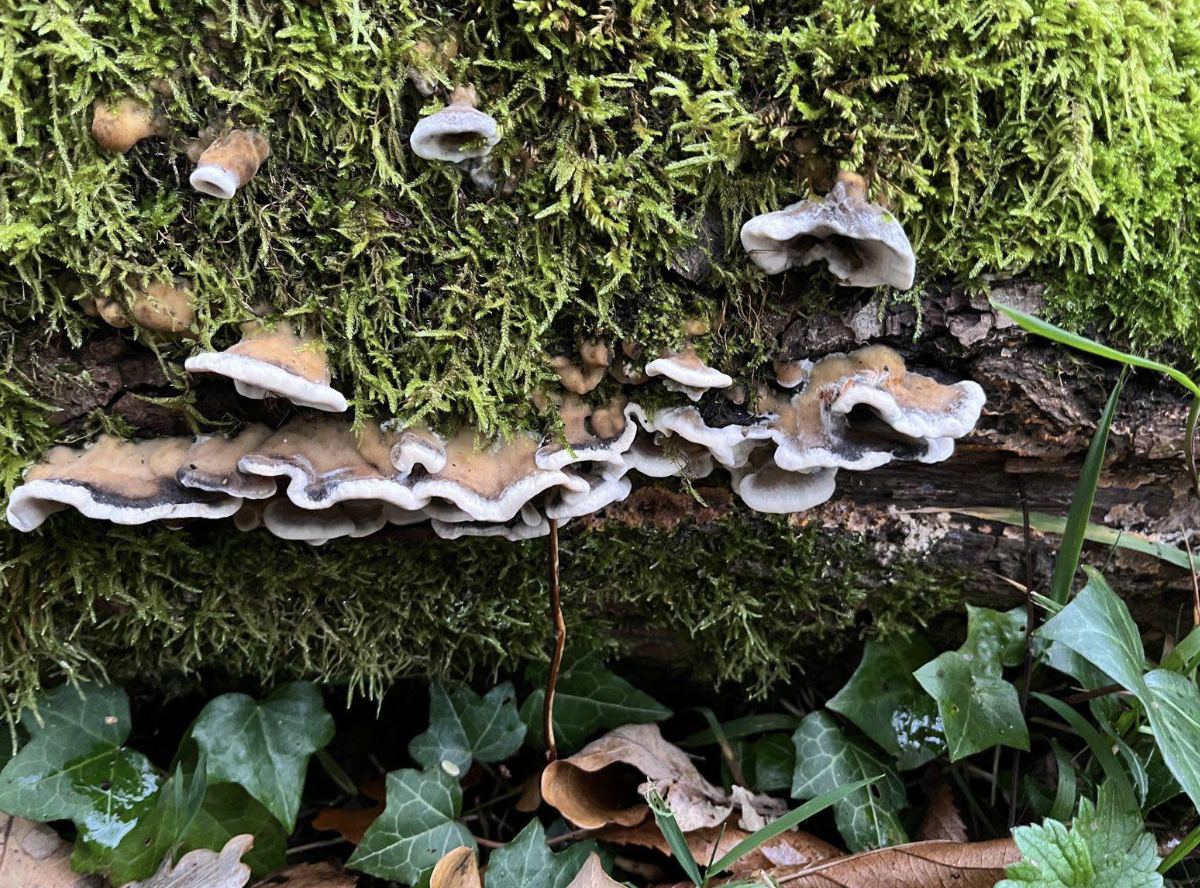
There’s something about moss, it’s soft resilience, its quiet deep greenness of a million shades, the way it persists and thrives on forgotten land and inbetween stones, on forest floors and brings old things back to a new life. Moss doesn’t demand to be seen, but when we do look, really look, really feel, and really give ourselves time to sense and be with moss, it offers a different kind of presence and an almost different kind of knowing and connecting and Autistic Joy.
I am exploring the idea of moss as an invitation to consider monotropism, ethodiversity, and neuroqueering our spaces as a way of creating belonging. Drawing from the work of Popova, M. (2023). The Magic of Moss and what it teaches us about the art of attentiveness to life at all scales, Robin Wall Kimmerer, Mary Oliver, Anna Lowenhaupt Tsing and others, alongside my emerging neuroqueer and holographic ideas, I am considering if moss (like mushrooms and water which I have written about before!), could offer not only a symbol and metaphor for neurodivergent thriving but a methodology to reclaim creative practice and ways of being that resists the fast, extractive modes of dominant neuronormative culture.
Monotropism (Murray et al, 2005) is a neuro-affirming theory of Autistic experiences. It describes a tendency to enter flow states of deeply focused attention, to move inward towards just one or a few connected interests, sensations, or patterns at anyone time and to dwell there. This is not just a cognitive style; for myself being monotropic it is a whole-bodymind sensory way of being. For many Autistic/ADHD people, monotropism underpins and helps to make sense of our sensory experiences, ways of learning, communication styles, and creativity. If you are Autistic / ADHD the theory of monotropism may resonate and help explain how you process and relate to the world.
In environments dominated by neuronormativity ,which are structured around multitasking, high demands, quick-switching of attention tunnels, and surface level engagement, monotropic people can be often misread as being obsessive, inflexible, or disengaged. If we reframe this deep-focus not as deficit, but as capacity and energy, it offers a more affirming lens of Autistic experiences as being a form of attunement with attentional resources, a way of giving attention feelingly and holistically.
For me, Robin Wall Kimmerer’s Gathering Moss(2003) exemplifies monotropic attentional ecology. Her writing spirals and notices what others may overlook such as the micro-patterns of bryophytes (group name for any non vascular, rootless plants like moss) , the webs that cover forest floors and emerge through cracks and over sleeping objects. Kimmerer just doesn’t describe moss she enters into relationship with nature, her science and writing is guided by care, her noticing is lived, it feels very monotropic much like Merlin Sheldrake’s Entangled Life (2023).
To attend like this, monotropically, with feeling and deep attention is not just to extract facts, but to stay present with complexity, multiplicity and connect with nature and our environment rhizomatically, completely and become deeply absorbed in greenness and texture. As Mary Oliver reminds us, “without feeling, attention becomes mere reporting“. For some monotropic people their perception may offer a different kind of report / blog writing/ creative experience, one filled with sensory details and emotional resonance, there are no barriers between the body and the environment, the moss, nature.
Nature Positivity: We Are Not Outside the Ecosystem
Nature positivitywas a term only recently introduced to me on Barbara Melville’s writing course. It made me think about how as a neurodivergent person I am not disconnected from nature but often deeply and almost painfully attuned to it, inseparable, we are a part of nature. We do not need to be brought back into the natural world; we need to be recognised as already being part of it. Our sensory experiences, our flows of attention, our non-normative experience of time, memories and rhythms, aren’t deviations from a natural or ‘normative’ baseline, they can be seen to be part of biodiversity and our wider ethodivergent ways of being (Tarragnat, 2025).
Ethodiversity is a term developed by Ombre Tarragnat (2025) to describe the variability of behavioural and existential styles within and across species. Ethodiversity invites us to move beyond a purely neurological model of divergence and into a more-than-human framework of difference. It reminds us that there are many ways to live, relate, and thrive not only for humans, but for all living things.
Moss embodies ethodiverse wisdom. It rejects hierarchy and human time, it forms webs, it’s value is in its interconnectedness and the spaces inbetween. We can learn from all non-human beings and living things, we are all interconnected and if we give our selves more time to tune in to the natural world we could perhaps can expand our ways of thinking, not just as humans for humans, but as part of nature. We can help to recreate a world where every living thing can thrive (non-human and human). It creates a space to think about our relationship with the wider planet we are in, the importance of environmental sustainability, not just focusing on our human-centric needs (Solarpunk ideas).
In this sense, moss, like many other aspects of nature, becomes a kind of kin, we are interdependent. I think lots of us are trying to survive from the edges, in the liminal spaces, trying to grow in shade and darkness through cycles of burnout. I live in the dark-mode, underground settings of Discord servers, it is where I feel at home, inbetween the reality of life outside my front door and where I really feel safe and a sense of belonging. Moss grows across ruins, rooftops, gravestones and inbetween the places and objects people normally tread over or overlook. It softens hard spaces and it survives and thrives on it’s own terms, in it’s own way much like our online community spaces.
Mushrooms and fungi, like moss, offer a metaphor of hope and an opportunity to think about how we can create a life from capitalist ruins which invalidates and overlooks neurodivergent needs and potential. Anna Tsing’s The Mushroom at the End of the Worldreminds us that life persists in the ruins of Capitalism, not in spite of disruption, but through it and can flourish through adversity. Like matsutake mushrooms thriving in disturbed forests, neurodivergent people often live in the edges of systems, through adversity, in fractured spiral time, outside of centralised blueprints and neuronormativity, however hard these systems try to contain us and pressure us to mask. This resonates deeply with monotropic ways of being, our ability to create our own Autistic rhizomes and communities, how our senses sometimes form unlikely but radically resilient connections in overlooked spaces.
Tsing’s emphasis on precarity, interdependence, and multi-species assemblages mirrors the sintered ways neurodivergent communities form: not through uniformity, but through shared friction and feeling. Our creative practices become more than self-expression, they are part of what Tsing calls the “arts of noticing,” where we document life not for control or mastery, but as a way of staying with complexity and multiplicity and to create shared meaning. It is a way to honour our entangled, emergent, sensory ways of being as ecologically vital. It reminds us that even in fragmented systems and broken ground, we can reclaim ourselves, find connection, and grow into something whole, be together and create something new.
Sintering
In Sintering: Neurodivergent Community Building(2025), I explored the metaphor of sintering. Sintering is the process through which individual snow grains gradually begin to bond. Tiny necks form between them, bridging the gaps, making the snowpack stronger, more resilient, and more resistant to collapse.
In Theory of Water: Nishnaabe Maps to the Times Ahead(2025), Leanne Betasamosake Simpson offers this as a metaphor for collective becoming. “Sintering is a joining,” she writes, “It is a communal transformation that creates a fabric of former snowflakes bonded to each other… Sintering is bonding, it’s building coalitions with your neighbours” (p. 18).
This analogy resonates deeply with my own experiences of the neurodivergent community and the Autistic rhizome. Many of us begin our journeys alone trying to discover our real identity under the layers of masking and internalised ableism, realising we are caught in systems not made for us and that is why life has felt SO hard! Discovering I was Autistic was life changing for me. In my 40’s I suddenly had access to a whole world of new vocabulary to describe my experiences. It has been through connecting with other neurodivergent people through various online communities and sharing stories that my life has begun to make more sense. When we find each other across difference, across shared experiences, we can start to build bridges, rhizomes. Through conversation, care, and solidarity, we can begin to sinter.
Neuroqueering from the Liminal
InNeuroqueering Liminal Spaces (2024), I wrote about the spaces where categorisation breaks down between identities, between disciplines, between states of being. Neurodivergent people often find ourselves in these thresholds, not quite fitting in, living in the margins, I am suggesting that liminality can be a fertile and exciting place to neuroqueer and evolve from.
Moss is liminal, it exists between. It mediates, connects and holds and brings things together. In many ways it could be seen to reflect what neuroqueer creative practice can be, something that isn’t fixed, something that moves away from dominant frameworks, it is textured and radically relational and multidimensional.
To write from moss is to write from the in-between spaces, attune to our environment, to feel safe and at home. It is to resist linearity, binary ways, hierarchy and to embrace multiplicity, to value the process of becoming and connecting.
Moss offers a model for neurodivergent thriving, one that honours attention with feeling, presence without performance and growth without urgency. It teaches us to notice differently, to value slowness, to dwell in the cracks and embrace neuroqueering,monotropic felt time.
Our creative practice can be moss-like, it can be sintered through our shared stories and experiences. To attend with feeling and lean into monotropic time can be a lifeline for many people who are experiencing burnout. It is a way of reclaiming our authentic ways of resting and being.
Monotropic attention, a different ecology
In the Writing the Dawnworkshop I took part in this week, Barb Melville encouraged us to begin our writing with a nature-positive message. She asked us, not just what we notice, but why it matters. For me, moss represents a kind of quiet kinship, it is soft, slow and often overlooked and fills me with sensory joy. As a neurodivergent person, I see myself reflected in its persistence, its texture, its need for quiet, shaded places to thrive. In protecting nature and moss we are also protecting our sensory environments, the liminal spaces, and the overlooked ecologies that support neurodivergent ways of being and feeling safe.
This reflection can become call to action which Barbara invited us to think about. It enables us to think about reimagining ways of connecting, not just with nature but in the way we create our communities, educational spaces and care settings. We need to design practices that honour differences, not pathologise. Like moss, neurodivergent people thrive with more time and space, gentleness and connection in spaces like our Neuroqueer Learning Spaces.
My home is in the mossy, liminal spaces that we create together, in our reaching toward one another. Our strength is in radical resilience and sintering, our refusal to face the world alone, valuing interdependence and not conforming to harmful systems based only on neuronormative values.
Radical resilience does not come from hardness or conformity, but from mossy softness, it comes from flow and fungi like rhizomatic community networks and the cumulative strength of many unique connections forming bonds to offer support to each other. As Bruno Lataur summarised, “Learning to live in the ruins of capitalism means learning to do without the notion of projects and, finally, moving on to an attentive description of situations that cannot easily change scale…..With her dog Cayenne, Donna Haraway had proved how far one could take analysis of relations between species. With her matsutake (mushroom), Anna Tsing proves that we can go still further, modifying not only the landscape to be described but what we should expect of meticulous description.”
Mossy, messy, monotropic ways
Nature-positive writing what ever the focus – mushrooms, moss, trees, water can be a radical act of reclamation, helping us grow cultures and communities that are ecologically aware. Neurodivergent spaces are rhizomatic, soft, mossy, fluid, flowy, webby and spirally and entangled. They allow space for dwelling, noticing, interdependence and omnidirectional growth.
‘To walk attentively through a forest, even a damaged one, is to be caught by the abundance of life: ancient and new; underfoot and reaching into light.’ pg 155 (Tsing)
Let’s keep growing spaces that honour slowness, texture, and sensory ways of knowing and feeling, where monotropic ways of being are not just accepted, but celebrated. Spaces where infodumping, deep focus, stimming, and sensory richness are recognised as meaningful ways of connecting and building interdependence between humans, non-human beings and our wider environments.
Monotropism lets us sink into and experience the world with our full-bodymind presence, not just noticing, but flowing and feeling with the world in ways that bring resonance, validation, and a sense of belonging. Mary Oliver wrote “Attention without feeling, is only a report.”, for monotropic people how we use our attentional resources helps to explain everything, it is how we experience life in all it’s joyful mossy, messy ways.
“Next time the bus is late, take those waiting minutes to look around for signs of life….. amidst the noise and fumes and elbowing crowds, there is some small reasurance in the moss between the cracks.” (Kimmerer, Gathering Moss, pg 105)
References & Further Reading
Kimmerer, R. W. (2003). Gathering Moss: A Natural and Cultural History of Mosses. Oregon State University Press.
Oliver, M. (2016). Upstream: Selected Essays. Penguin Press.
Tarragnat, O. (2024). Biodiversity, Neurodiversity, Ethodiversity: Towards a More-Than-Human and More-Than-Neurological Turn in Neurodiversity Studies. TRACE: Journal for Human-Animal Studies. https://trace.journal.fi/article/view/144936
Murray, D., Lesser, M., & Lawson, W. (2005a). Attention, monotropism and the diagnostic criteria for autism. Autism, 9(2), 139–156. https://doi.org/10.1177/1362361305051398
Tsing, A. L. (2021). The mushroom at the end of the world: On the Possibility of Life in Capitalist Ruins. Princeton University Press.
Haraway, D. (2007). A Cyborg Manifesto: Science, Technology, and Socialist-Feminism in the Late 20th Century. In Springer eBooks (pp. 117–158). https://doi.org/10.1007/978-1-4020-3803-7_4
*“Memories scatter like shards of seaglass along a fractured spiral, the centre always slipping just beyond my grasp. Hazy images and sensations drift in and out of the fog, sometimes offering sharp glimpses, but rarely staying long enough for me to hold. Most pass by shrouded in a soft mist, like half-formed echoes trapped within a labyrinth. Sounds, images, smells, and feelings blur and merge, tangling into an ever-expanding rhizome, sprawling in all directions, folding in on themselves. Memories come more as felt impressions than as concrete events. Remembering isn’t straightforward for me; it’s less recall and more a process of re-navigation. I have to trace uncertain paths, try and find a thread to hook into to regain my flow, often sensing that what I’m reaching for is just out of reach if trying to recall a specific event, but my sensory memories are more clear and vivid as they are felt sensations – which is hard to explain to people who may not experience their memories in this way. ”
I am currently on a Neuroqueering Your Creative Practice course led by KR Moorhead, Marta Rose and Meg Max. This week we were exploring time and memories, which felt very apt given my recent monotropic outpourings about time. In this week’s session I wrote the above piece about how I experience memories.
Memory may not be linear for neurodivergent people. It may feel like a spiral of felt sensations. Being monotropic shapes how I re-sense moments, navigating echoes and threads of sensory experiences rather than always recalling events. I felt validated that some other people seemed to relate and share similar experiences of their time not being linear and also being quite hazy recalling specific events but having really vivid recollections of more sensory experiences.
Monotropism and Memories
Monotropism is a theory of Autism (Murray et al 20025) that describes a way of focusing attention that tends toward deep but fewer channels. For those of us who experience the world monotropically, attention locks in and tunnels can form like portals. These attention tunnels can lead to intense engagement and immersive sensory experiences, but they may also shape how we encode, retrieve, and relate to our memories.
Memory for me is not a fixed archive of past events filed neatly on shelves. It is alive, constructed in the present, woven from threads of past focus, emotion, embodiment, and attention. For monotropic people, those threads may be less linear and deeply context-bound in our sensory experiences. We may not remember when something happened in conventional, sequential neuronormative time but we may vividly feel how we experienced something, we may recall the sensory landscape, the tone, the rhythm of presence or absence.
Spiral Time and Felt Time
I’ve written previously about monotropic experiences of time as being like ever expanding rhizomatic spirals like rather than a linear A-B or 9am to 10pm of time as lived by the clock and conventional calendar. I think this also shapes how memory functions, rather than stretching out along a clear chronological line, time for me feels like it folds back in on itself and experiences and memories happen and are stored within the folds (a concept from Deleuze that I have written about at length). A moment from years ago might feel right now, while a conversation from yesterday may feel distant or unretrievable unless there is something to hook me in and brings it back into focus so I can retrieve the thread and follow the flow.
In monotropic spiral time, memories don’t behave like neurotypical people may expect or how we may have been brought up to understand how memory works. My memories don’t line up neatly, they tangle, twist, merge and drift like mist through a forest. Sometimes I feel I’m not remembering in the traditional sense at all, but kind of re-sensing, like I am trying to feel my way through a fog of echoes and impressions, a texture, a tone of voice, the way the light fell. It makes my memories of concrete events feel hazy and fuzzy but my experiences feel vivid and it can be quite confusing and frustrating at times.
Labyrinths and the Rhizomes
For monotropic people our minds and memories may feel less like walking through an album of neatly arranged photos and more like navigating a vast, living labyrinth. I can’t easily “go back” and retrieve a memory, it feels like I have to wander, I have to reach out and try and sense where the thread of recall might catch and hook onto something, what I often find is not a single event but a tangle, a rhizome of multisensory experiences that I have to unravel.
This rhizomatic quality of navigating time means my memories don’t live in isolation, they’re not strictly filed under “birthday, age 9” or “Monday morning, March 3rd.” Instead, they seem to connect through shared emotions and sensory patterns. One feeling or sensory experience might loop me back to three seemingly unrelated moments, a smell might pull on threads across decades and I don’t always know why. This can be disorienting in a world that expects time and memory to be neat and logical but it’s also a kind of richness, a depth of connection that linear systems seem to often miss. It can make conversations with friends and family hard as it seems like I am not interested enough in people to have created a core memory like in the Disney film Inside Out, my memory of real life events feels like a sieve where things happen then disapear but they are all there, it is just perhaps that they are stored differently.
It brings me back to my first blog I wrote on More Realms (2023), Middle Entrance. In 1943, T.S. Eliot’s collection of four poems were collated to form Four Quartets. The final poem in this series Little Gidding (1942), continues Eliot’s exploration of time and our connections with each other through generations and current society.
“What we call the beginning is often the end. And to make an end is to make a beginning. The end is where we start from.”
My memories, relationships and ways of being are like constantly evolving spirals that spin in and out in multidimensional ways. Different connections and experiences add to and contribute to a wider, deeper fluid rhizomatic network of potential that is always in a constant state of flux. This idea of an evolving spiral, hooking onto a node of the rhizome and returning to a new beginning in the middle, liminal spaces, within the folds is how I experience memory. I need time to process, time to rlect and for memories to and beautifully reflected in Eliot’s poem Little Gidding:
“We shall not cease from exploration And the end of all our exploring Will be to arrive where we started And know the place for the first time. Through the unknown, remembered gate When the last of earth left to discover Is that which was the beginning; At the source of the longest river The voice of the hidden waterfall And the children in the apple-tree Not known, because not looked for But heard, half-heard, in the stillness Between two waves of the sea”.
— T.S. Eliot, from “Little Gidding,” Four Quartets (Gardners Books; Main edition, April 30, 2001) Originally published 1943.”
Navigating Memories
Memory for me feels less like recall, I am not able to press a button and retrieve a file (unless it is related to my own special interest about Autism research or teaching in which case my filing cabinet seems to ping open!). It is more like a re-navigation, I have to find the right entry point and node of the rhizome, I need to feel for the thread, follow it gently and try not to tug too hard in case it disappears back into the fog. I often know I know something, but I can’t get to it directly. I need the right conditions or sensory cue to draw it out and that takes time and and can make me appear distant or uninterested when the opposite is true.
This is why questions like “What did you do last weekend?” can feel like demands rather than simple curiosity. It’s not that I wasn’t paying attention, it’s that the question doesn’t align with how my memory map works or how I perceive time. If you ask me what the light looked through my window like as I sat reading in bed, or how the air felt when we stepped outside I might have a more instant response but I probably won’t be able to recall the chronological sequence or events and relate things in an easy to understand order, it is like that gets lost in the spiral. It can be frustrating at times just to have fleeting impressions of memories that I know mean a lot to me but I can’t easily retrieve.
Understanding and Support
Understanding memory through a monotropic lens may helps us honour our different ways of knowing, recalling, and connecting with events and people. For those supporting Autistic individuals, whether as educators, therapists, or family members this means shifting assumptions and instead of assuming memory is absent or deficient it may be better to consider asking things like:
How do memories show up for you?
What helps you reconnect with something you felt or experienced?
Is there a sensory or emotional thread that brings it back?
This may also be empowering for those of us who live and experience life monotropically. It validates the experience of having a different bodymind, of perhaps remembering more through attention tunnels of sensation rather than facts or dates. It recognises that memory is not a failure when it doesn’t fit neurotypical expectations it’s perhaps just a different kind of map that we have to navigate.
“What we call the beginning is often the end. And to make an end is to make a beginning. The end is where we start from.”