My physical body is your physical body, and just as the sun and stars are present in you, they are also present in me. […] we are all made of stars.
Vietnamese Buddhist monk: Thich Nhat Hanh
I find it genuinely awe-inspiring to know that the atoms that make up your body, the oxygen in your lungs, the calcium in your bones, the iron in your blood were forged inside stars that died before our planet even existed. Not metaphorically, we are actually, literally, made of stars!
A 2017 survey of 150,000 stars confirmed that humans and our galaxy share around 97% of the same kinds of atoms, and that the six elements essential to life — carbon, hydrogen, nitrogen, oxygen, phosphorus, and sulphur — are woven right through the Milky Way (Howell, 2017). We are a living part of the cosmos.
I have been thinking about this a lot, and what it may mean to us as Autistic people, and it is something that is evolving in conversations within the CASY Autistic Physics group and my recent collaborative work with Stimpunks. There is something about being made of stardust that resonates far deeper than a scientific fact for me.
As an Autistic person, I have always felt that the boundaries between myself and the world are more porous than I was told they should be. Everything feels entangled, I am deeply influenced by my environment in ways that go beyond what neuronormative frameworks tend to account for. Time, my past and present merge and move together; my pull towards moss and mushrooms, and my interest in water, are more than a ‘like’ or form of regulation or sensory relief, they feel like I am becoming more attuned to something deeper and more essential, something I can only describe as parts of my soul recognising what they actually belong to.
The elements in your body right now came into being through some of the most violent events in the universe. The iron in your blood, the calcium in your bones, the oxygen in every breath, were forged in the cores of massive stars and released in supernovae: entire stars compressing their whole lives into a single catastrophic release. In that rupture, what had been locked inside was scattered outward, making things possible that could never have existed before.
Many of us, as neurodivergent people and from marginalised communities, may know something about transformation through rupture, about how the most difficult passages of burnout and exclusion can forge something that simply could not have existed any other way. As I have written, these periods of burnout seem to change me at my core. I never fully recover; the deepest burnouts feel like a seismic shift has taken place. My whole sensory system and way of relating to the world transforms.
For Autistic people, the idea of a fixed, bounded, separate self may sit uneasily, we are always in flow, always fluid and always responsive to everything around us. The theory of Monotropism developed by Murray, Lesser, and Lawson (2005) may help explain this. It describes the way Autistic (and may be ADHD/ AuDHD) attention tends to move in deep, singular currents rather than spreading across many channels at once. It is a different way of connecting: like matter drawn into a stellar core, our attention concentrates and transforms, and, like the star, what forms in that depth eventually moves outward and can expand, making new connections and new ways of being.
Ethodiversity is a concept that feels important here. Originally coined by Cordero-Rivera (2017) in ecology and evolutionary science, and developed by Tarragnat (2025) into a framework for thinking about human and nonhuman life together, it refers to the full range of behavioural and existential ways of being across species, not just neurological difference, but the diversity of how living beings sense, connect, relate, move through, and respond to the world. As Autistic people, our particular way of being is shaped by, and in turn shapes, everything around us, perhaps more intensely for some than others. We are not separate from the wider pattern of the cosmos; we are very much a part of how the pattern moves, interdependent on each other and everything around us.
For many Autistic people, this deep attunement to the world, to its textures, its moods, its patterns may be felt intensely. However, it is so often misread, pathologised, or masked out of our existence simply to fit into spaces that were not built for us. When we are in environments where we feel genuinely safe, something can shift. We are able to be our full selves, more open, more present to what the world is actually offering us —the things that bring us comfort, joy, and we can meet them on our own terms. That is what a real connection actually feels like, and we deserve spaces where it’s possible.
That sense of belonging and connection can ripple outwards. adrienne maree brown writes in Emergent Strategy (2017) that small patterns replicate into large ones, that the local and the cosmic are always doing the same thing at different scales. She centres the people that dominant systems have tried to cast as anomalies, Black, disabled, neurodivergent, queer, poor and names what many of us may already sense: that what looks like deviation is often a more honest expression of how complex living systems actually work. Emergence doesn’t need conformity; it needs difference. A universe that could only produce one kind of star would not have produced us or our world as we know it.
We are all made of stardust, and our entanglement, our porousness, our deep attunement to the world and cosmos around us are things we should all embrace, regardless of any labels or diagnoses we may or may not have.
Stimpunks, whose work on star stuff has been part of the thinking woven through this piece and through our collaborative work sums it up nicely:
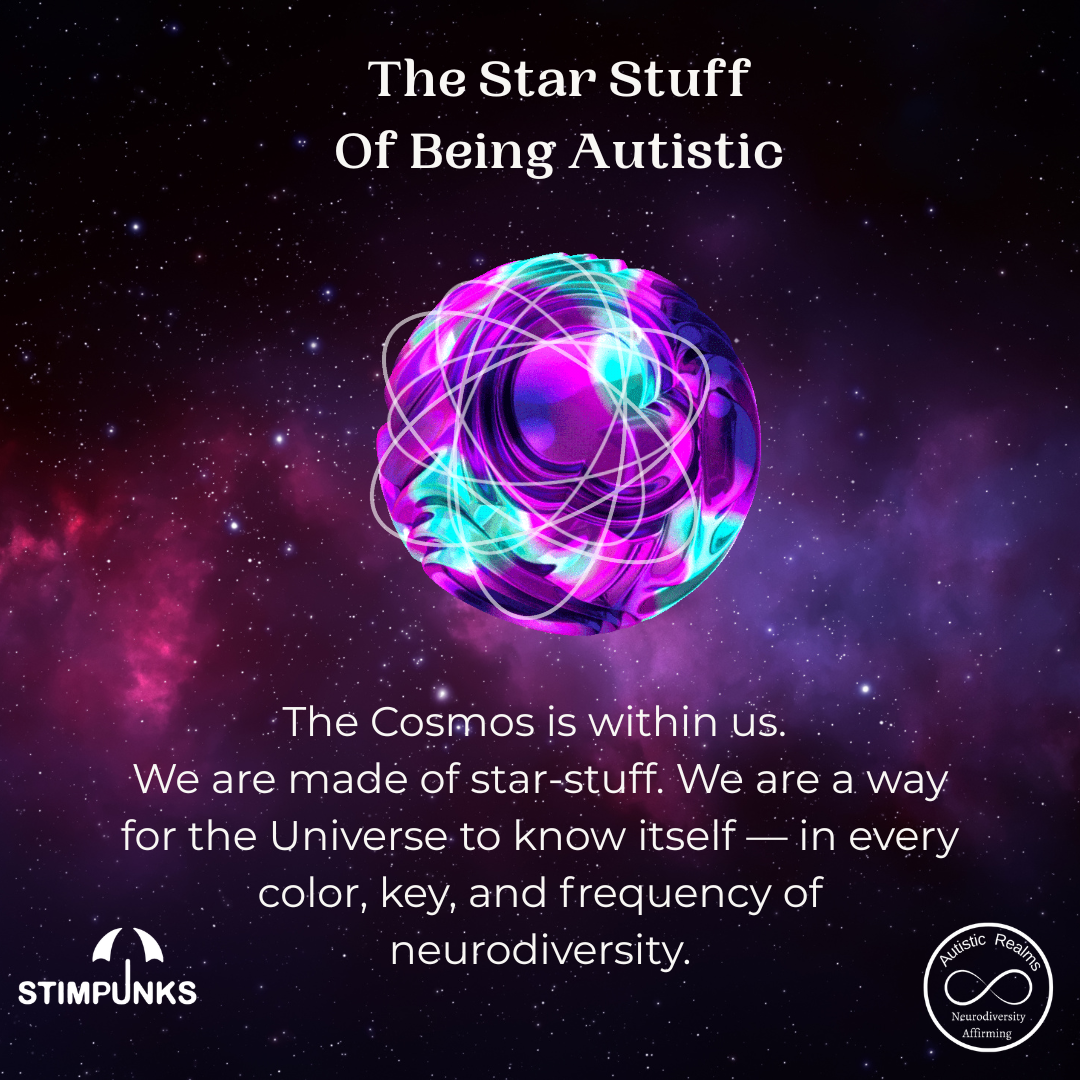
The cosmos is within us, and we are a way for the universe to know itself — in every colour, key, and frequency of neurodiversity
LYSS: https://stimpunks.org/star-stuff/
“What more do you want?
The ingredients in our bodies have been assembled in the hearts of long-dead stars over billions of years and have assembled themselves into temporary structures that can think and explore…”
Brian Cox
References
American Museum of Natural History. (n.d.). We are stardust. https://www.amnh.org/exhibitions/permanent/the-universe/stars/a-spectacular-stellar-finale/we-are-stardust
Boren, R. Stimpunks Foundation. (2026). Love you down to your star stuff. https://stimpunks.org/star-stuff/
brown, a. m. (2017). Emergent strategy: Shaping change, changing worlds. AK Press.
Cordero-Rivera, A. (2017). Behavioral diversity (ethodiversity): A neglected level in the study of biodiversity. Frontiers in Ecology and Evolution, 5, Article 7. https://doi.org/10.3389/fevo.2017.00007
Howell, E. (2017, January 10). Humans really are made of stardust, and a new study proves it. Space.com. https://www.space.com/35276-humans-made-of-stardust-galaxy-life-elements.html
Murray, D., Lesser, M., & Lawson, W. (2005). Attention, monotropism and the diagnostic criteria for autism. Autism, 9(2), 139–156. https://doi.org/10.1177/1362361305051398
Tarragnat, O. (2025, February 25). What is ethodiversity? https://ombretarragnat.com/2025/02/25/what-is-ethodiversity/

