Tag: Double Empathy Problem

  • Forests, Flow and Rhizomatic Communities

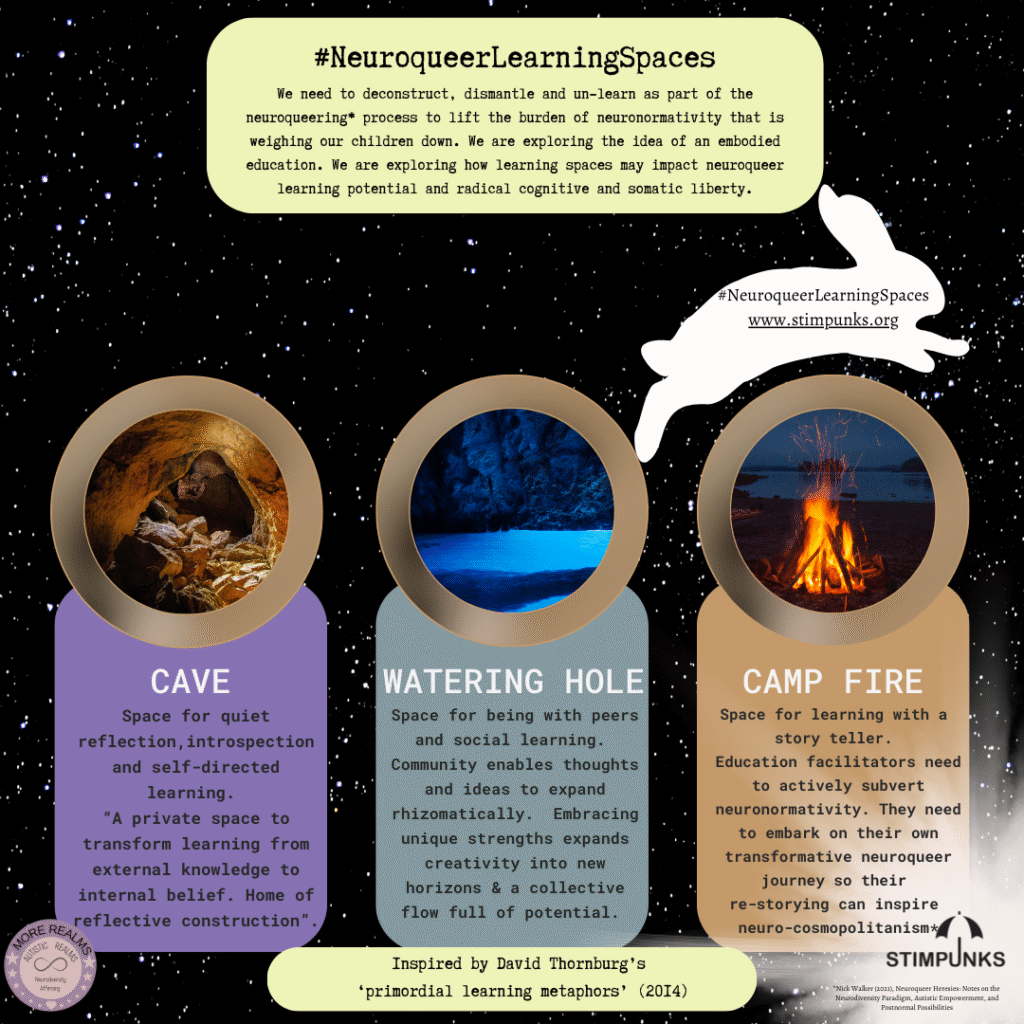
    Forests, Flow and Rhizomatic Communities

    What do you do when you feel broken, when you feel such disconnect with the world, when you feel the double empathy problem (Milton, 2012) as a DEEP searing pain?

    Being Autistic and monotropic in a world that honours and puts the needs of the neuromajority polytropic population first is exhausting. Being late identified Autistic has made me reflect back and realise how much of my life has been misunderstood; mental health issues exacerbated by masking and trying to fit into expectations of neuronormative ideals, leading to cycles of what I now know are burnout.

    As I learn more about myself, I feel a greater attunement with the natural world around me, so much so that I can no longer clearly differentiate where my bodymind starts and ends. Being monotropic means everything is felt either really intensely or perhaps sometimes not at all; I have few in-between responses despite feeling like I am stuck between everything all the time. Re-storying my own life since realising I am Autistic has led me to re-open my imagination too and embrace the neurodiversity paradigm and neuroqueering possibilities.

    Where the Edges Blur

    That blurring of where my bodymind starts and ends feels strongest when I am outside, in the natural world. The light through leaves, the smell of damp earth and the texture of bark don’t feel like things that are separate from me; they feel like part of the same breathing, the same living web that I am part of too.

    I think monotropism helps to explain some of this. Murray, Lesser and Lawson (2005) describe monotropic attention as gathering deeply around a small number of things at a time. In busy, noisy human spaces that intensity can so quickly tip into overwhelm, but in a forest it has somewhere to go. Attention can settle on a patch of moss, a fungus on a fallen branch or the pattern of roots across a path, and stay there for as long as it needs to, without anyone pulling you out of your flow. Forests reward slow, DEEP attention; the longer you look, the more there is to see.

    Alienation and Entanglement

    In The Mushroom at the End of the World, the anthropologist Anna Tsing (2015) writes about the matsutake mushroom, which can only grow in relationship with particular trees, often in landscapes that have been disturbed and damaged by human activity. She argues that so much of modern economic life depends on alienation, treating things, places and people as separate, standalone resources, and one line from her book really stays with me: “alienation obviates living-space entanglement” (Tsing, 2015, p. 5). Alienation erases the very relationships that make life possible.

    When I read that line I think straight away about masking and neuronormativity. So many of us learn to experience ourselves as separate, bounded units that have to function alone, performing for others and cut off from our own bodies and from the living world. A forest works the other way. Trees share water and nutrients through underground fungal networks (Simard, 2021), seedlings grow in the shelter of older trees, and fallen wood becomes home and food for countless other lives. Nothing in a forest exists alone.

    Bringing Back Curiosity

    We need to bring back curiosity. Tsing (2015) calls for what she describes as arts of noticing, a renewed attention to the entangled and unpredictable ways that life carries on, even in damaged places. Robin Wall Kimmerer (2013) writes about attention to the living world as a form of reciprocity, a way of giving something back for everything the earth gives us. For monotropic people, deep noticing often comes so naturally, and yet it is too often trained out of us at school and at work. Reclaiming it can feel like coming home.

    Rhizomatic Communities

    Deleuze and Guattari (1987) contrast the tree, with its single trunk and hierarchy of branches, with the rhizome, which spreads sideways, connects at any point and has no centre. I love that it is a slightly ironic image to bring to a forest, because the more we learn about forests, the more rhizomatic they look: beneath the trunks and the canopy lies a vast, decentralised web of roots and mycelium, quietly linking everything together.

    Autistic and neurodivergent community can grow in exactly the same way, with no centre and no single way in. We find each other through shared interests and small offerings, and connections form sideways across distance and difference. I have written more about this in “The Autistic Rhizome” on Autistic Realms, and in “Mycelium & Rhizome: Ecological Metaphors” and “Expanding the Mycelial Network of Care” here on More Realms.

    Opening Up Our Imaginations

    Embracing the neurodiversity paradigm, and the neuroqueering possibilities that Nick Walker (2021) describes, has opened up my imagination. Our intensity, our need for depth and our porous edges stop being faults that need fixing, and become ways of being in relationship with the world.

    I don’t want to romanticise nature as a cure. Access to green space is unequal, shaped by class, disability, race and where we happen to live, and many neurodivergent people find their own forests in a garden, a houseplant, a city park, a stretch of canal or a single tree on the way to school. What matters is the feeling of being held within a web of relationships, rather than standing alone against the world.

    If you feel broken by a world that was not built for you, it may help to remember that you are entangled, with the living world and with others like you. The feeling of brokenness is so often what being cut off from those relationships feels like, rather than a truth about who you are.

    References

    Deleuze, G., & Guattari, F. (1987). A thousand plateaus: Capitalism and schizophrenia (B. Massumi, Trans.). University of Minnesota Press.

    Kimmerer, R. W. (2013). Braiding sweetgrass: Indigenous wisdom, scientific knowledge and the teachings of plants. Milkweed Editions.

    Milton, D. E. M. (2012). On the ontological status of autism: The “double empathy problem”. Disability & Society, 27(6), 883–887. https://doi.org/10.1080/09687599.2012.710008

    Murray, D., Lesser, M., & Lawson, W. (2005). Attention, monotropism and the diagnostic criteria for autism. Autism, 9(2), 139–156. https://doi.org/10.1177/1362361305051398

    Simard, S. (2021). Finding the mother tree: Discovering the wisdom of the forest. Knopf.

    Tsing, A. L. (2015). The mushroom at the end of the world: On the possibility of life in capitalist ruins. Princeton University Press.

    Walker, N. (2021). Neuroqueer heresies: Notes on the neurodiversity paradigm, autistic empowerment, and postnormal possibilities. Autonomous Press.

  • Lines, Not Nodes: Redefining the Autistic Rhizome

    Lines, Not Nodes: Redefining the Autistic Rhizome

    Why Autistic community grows from flight and becoming rather than structure, and why that makes it a critical act

    By Helen Edgar and David Gray-Hammond. An expanded version of a post first published on The Wider Existence, 15 November 2026.

    In 2023 we began writing about something we called the Autistic Rhizome (Gray-Hammond, 2023; Edgar, 2023). We described it as a network of communities linked to other communities. None of them depended on another, and there was no beginning and no end. We still believe that what we were pointing at was real. We no longer think we described it properly.

    The problem was the picture in our heads. When most of us imagine a network, we imagine dots joined by lines: nodes and connections. However flat it looks, a network of nodes is still a map of fixed positions. It asks where you are, who you are connected to, and how many steps you are from the centre. It is the organisational chart turned on its side.

    Ian Buchanan (2007) argues that the rhizome is often misread in this way. He also argues that well-meaning uses of it, especially those that treat new technologies as rhizomatic, end up propping up the status quo rather than challenging it. Helen sensed the problem early. In 2024 she was still using the language of nodes, but she argued that the real understanding lives in the spaces between them, in the flow of connection. She drew on Tyson Yunkaporta’s (2020) Sand Talk and on the Japanese idea of Ma, the meaningful space between things (Edgar, 2024). That thread matters to both of us. The Autistic Rhizome owes as much to those ways of knowing as it does to Paris, and Deleuze and Guattari’s own borrowings from other cultures have rightly been questioned (Miller, 1993).

    Deleuze and Guattari were clearer than we were. In the opening plateau of A Thousand Plateaus they insist that “there are no points or positions in a rhizome… There are only lines” (Deleuze & Guattari, 1987, p. 8). Later in the book they describe a line of becoming as one that is not defined by the points it connects; it “passes between points” and comes up through the middle (p. 293). The rhizome is a multiplicity of movements rather than a network of things.

    So what follows is both a correction and a development. The Autistic Rhizome is not a network of nodes. It is a tangle of intersecting lines of flight and lines of becoming. It is also something our first version left out: a neuroqueer practice. Nick Walker (2021) describes neuroqueering as the practice of subverting neuronormativity, together with the heteronormativity tangled up in it, and of becoming something other than what we were shaped to be. If the rhizome is about becoming, neuroqueering is one of the ways Autistic people already live it.

    Trees and rhizomes

    Deleuze and Guattari call the dominant logic of Western thought arborescent, meaning tree-like. A tree has a root, a trunk and branches. Every part gets its meaning from where it sits in relation to the centre. Arborescent thinking runs on hierarchy, lineage and binary division: this or that, higher or lower, closer to the trunk or further out on the branches.

    Mainstream society organises Autistic life this way. The diagnostic manual is the trunk, and “levels” and “functioning” labels are the branches. Education offers pathways and eligibility criteria. Services have thresholds. The charity model lets parents, professionals and organisations speak from the trunk, while Autistic people sit somewhere out on the twigs. To be Autistic within the tree is to be given a position.

    Before the diagnostic manual, the trunk was psychoanalysis, which for decades looked for the cause of Autistic children in their mothers. Deleuze and Guattari’s first book together, Anti-Oedipus (1983), attacked exactly that Oedipal tree. Buchanan (2021) argues that the clinical and political project they called schizoanalysis is still unfinished.

    The rhizome works differently. It grows sideways. Any part can connect to any other part. Break it, and it regrows from wherever it was broken. It has no centre and no origin; it is always in the middle.

    One caveat matters for everything that follows. Deleuze and Guattari do not present tree and rhizome as evil and good. Trees have rhizomes running through them, and rhizomes form knots of arborescence (Deleuze & Guattari, 1987, p. 20). The question is never which one we are. It is which way we are moving.

    Lines of flight and lines of becoming

    A territory, in Deleuzo-Guattarian terms, is the arrangement of habits, roles, expectations and meanings that holds a life in place. Territorialisation is the process of being held. Deterritorialisation is coming loose. A line of flight is the path along which something escapes the territory that held it.

    Flight here does not mean running away. For Deleuze and Guattari, flight is creative; it is how new things come into the world. It is also a matter of desire. In Anti-Oedipus, desire produces rather than lacks (Deleuze & Guattari, 1983). That means Autistic joy belongs in any account of our lines: the pleasure of a stim, the delight of a passion, the relief of an info-dump that lands.

    Autistic life is full of lines of flight. There is the late-identified adult whose old story (“lazy”, “difficult”, “too much”) suddenly stops holding, and the unmasking that follows. There is the questioning of gender and sexuality that so often comes alongside it; Autistic people are more likely than others to be transgender and gender-diverse (Warrier et al., 2020). There is the refusal of compliance-based therapy, the stim performed openly in a public place, and the monotropic interest that pulls a child sideways out of the curriculum and into a world the curriculum never imagined.

    Not every line needs to be an escape, though. Deleuze and Guattari separate being a minority, which is a fixed state that can be counted, from becoming-minoritarian, which is a process anyone can be caught up in (1987, pp. 291–293). Lines of becoming can be drawn without leaving the room. This is where neuroqueering lives. Walker (2021) holds neuroqueer as both an identity and a verb, and the verb is a becoming: undoing neuronormative habits from inside the places we already are.

    The open stim shows how this works. Deleuze and Guattari describe a child in the dark who comforts themselves by humming under their breath, making a small territory against chaos (1987, p. 311). They call this a refrain. A stim is often a refrain. It makes a home in the body first, and from that home it can open outward into sound, rhythm, joy and other people. The same movement steadies and frees. Erin Manning (2016) shows how Autistic perception works through gestures like this, which shift a situation from within without announcing themselves as resistance.

    Monotropism (Murray et al., 2005) helps here. If Autistic attention gathers into deep, intense channels, then an Autistic life is drawn along lines of intensity rather than spread across a grid of expectations. We would not call this linear in the everyday sense of narrow or single-track. Intensive is the better word, and the more Deleuzian one. Helen describes monotropic attention as constellations of interconnected tunnels of intensity (Edgar, 2026), and that image is closer to lived experience than a straight line.

    We want to be careful about one thing. We have said that individuals deterritorialise, and in a practical sense they do. But in our work on existential diversity, we have argued that our existence is not contained within the bodymind (Edgar & Gray-Hammond, 2026a; Dychtwald, 1977). It spreads through the space and time around us, during our lives and beyond them. A line of flight does not stop at the skin. It carries on in what we write and make, and in the people we have touched, long after the moment of escape. Together we have since named this connected, extended bodymind symphrenia (Edgar & Gray-Hammond, 2026b). The individual is where a line becomes visible, not where it begins or ends.

    Where lines cross

    Community forms where lines intersect. It is a crossing, which is different from membership or a position on a map. Two people’s escapes from neuronormativity meet in a 3am forum thread about bus timetables, in a shared stim, or in a moment of being recognised without having to explain.

    The double empathy problem (Milton, 2012) tells us that mutual understanding comes more easily between people who share ways of being. An intersection of Autistic lines is a place where the double empathy gap narrows. It may be the first place some of us have ever been understood without translation.

    Sara Ahmed (2006) offers a queer phenomenology of lines that we find useful here. She describes how bodies are oriented by the straight lines laid down before them, and how stepping off those lines is felt as disorientation before it can be understood as anything else. She also writes about desire lines: paths worn into the grass by people walking off the official route, until they become paths in their own right. Autistic community is full of desire lines. Nobody planned the vocabulary we use for ourselves or the spaces where we gather; we wore them in by walking. Ahmed also warns that the lines we follow can straighten into new norms, and we will come back to that.

    But an intersection risks becoming a point. If community is simply “where lines meet”, we have quietly rebuilt the nodes we set out to dismantle. So we want to borrow another of Deleuze and Guattari’s words: plateau. They take it from Gregory Bateson, and they use it for a continuous region of intensity, held at a level rather than building towards a climax (Deleuze & Guattari, 1987, p. 22).

    An Autistic community is a plateau where lines run alongside each other for a while. They braid and strengthen each other, then separate. People come and go. This is not a community failing. It is the rhizome breathing.

    We need to be honest about where many of these crossings happen. That 3am forum thread usually sits on a corporate platform with central servers and algorithms that decide who gets seen. These are trees dressed as rhizomes, and Buchanan (2007) would want us to notice. Some of the hierarchies we describe below grow from the platforms as much as from us.

    The mycelial ecology

    Lines of flight are not safe by default. Deleuze and Guattari are blunt about this. A line of flight can turn into a line of destruction, and tearing yourself loose from every structure at once can end in collapse rather than freedom. They place this danger inside the line of flight itself, rather than simply in having nowhere to land (Deleuze & Guattari, 1987, pp. 227–231). They advise working with “a very fine file” rather than a sledgehammer (p. 160).

    Every Autistic person who has unmasked too fast, with nowhere to land, knows this. Deterritorialisation with nowhere to go leads to burnout rather than liberation. Buchanan (2021) adds a harder point: from the inside, the healthy line and the harmful one can look very much alike at first (p. 52).

    This is where the mycelium comes in. We use it as a metaphor rather than as natural history; fungi do not owe us a politics, and some popular claims about forest fungal networks have been overstated (Karst et al., 2023). Plateaus do not stand alone. They are connected through a living substrate of shared knowledge, language, resources and mutual aid:

    • the vocabulary Autistic people have built for ourselves: monotropism, double empathy, Autistic shielding, neuroqueering
    • the infodumps, the peer support and the quiet direct messages
    • the survival knowledge passed between communities, such as how to get through a benefits assessment or what to say to a GP

    Deleuze and Guattari have more precise names for parts of this. The shared vocabulary is what they call a collective assemblage of enunciation, the side of an assemblage made of words and signs, as opposed to bodies and things (Deleuze & Guattari, 1987, p. 88; Buchanan, 2020). The whole substrate of shared intensity comes close to what they call the plane of consistency, where many loosened bodies can meet and compose with one another. Symphrenia lives on that plane. It names how bodyminds think and feel through each other (Edgar & Gray-Hammond, 2026b).

    The mycelium feeds lines of flight rather than creating them. It also has to help us tell nourishment from harm, since we cannot always see that from inside our own line. Noticing when someone is draining away, saying gently that it might be time to pause, and making it possible to step back and still be welcomed are all part of what it carries. A line that would otherwise burn out finds nourishment, and it can reterritorialise, settling into a functional community. That community is a new territory, chosen and built from the inside, rather than a return to the old one.

    Reterritorialisation is not always chosen, though. In Deleuze and Guattari’s account, capitalism is the great reterritorialiser, and the neurodiversity movement is already being folded into neurodiversity hiring, Autistic content markets and branded acceptance (Chapman, 2023). A new territory has to keep asking who it is being built for.

    This is an ecology of communities rather than a single community. No plateau has to do everything. The Ecosystemic Model of Distress and Wellbeing, which David developed with Tanya Adkin (Gray-Hammond, 2025), holds that distress and wellbeing come from ecosystems rather than from individuals. The same is true of community. The health of the whole ecology, not of any one group, is what keeps lines of flight alive.

    Neuroanarchy as culture

    Katie Munday coined the term neuroanarchy to describe the subversion of neuronormativity: dismantling hierarchy and treating every neurotype as equally valid (Munday, 2023; Gray-Hammond & Munday, 2023). For Autistic people, this also means subverting what Munday calls auti-normativity, the norms we build among ourselves.

    Rhizomatic ecology is what allows neuroanarchy to become a culture rather than a personal stance. One person refusing hierarchy is a line. Many lines crossing on plateaus, fed by a shared substrate, make a culture that no longer needs the tree’s permission to exist.

    This is what we mean by Autistic culture detaching from arborescent structures. We need to be precise here. Most of us remain materially dependent on the tree: on healthcare, benefits, employment and the diagnostic gate itself. We may need the diagnostic manual to get a prescription. We do not need it to tell us who we are. The detachment is cultural. Meaning, identity and value stop flowing down the trunk and start flowing sideways, between us.

    There is a tension in that last sentence that we should name. We write Autistic with a capital A, as an identity, while arguing that we are lines rather than positions. We do not think we have to choose. Jasbir Puar (2012) argues that identity and assemblage need each other: identity names the grids that capture us, and assemblage names what moves beyond them. Melanie Yergeau (2018) shows how neurological queerness refuses the either/or. Deleuze and Guattari themselves advise that we “lodge” ourselves on a stratum and experiment from there (1987, p. 161). We have come to hold Autistic identity in that way, as shared ground we stand on deliberately, so that we can experiment from it without mistaking it for a fixed essence.

    Munday’s inclusion of auti-normativity is the part we most often forget. Autistic communities grow their own trees. We gatekeep who is “Autistic enough” and build hierarchies around influencers and advocates. We hold up an acceptable kind of Autistic person: speaking, articulate, academically fluent, often white and cisgender, without psychiatric labels. We practise lateral ableism. Every plateau risks hardening into a root, and every desire line risks being paved.

    The rhizome is the ongoing practice of not becoming a tree, never a place we have arrived at.

    Who gets to fly?

    Lines of flight need room to move. Many Autistic people have their lines captured before they can be drawn:

    • people held in inpatient units, residential placements and secure settings
    • people subjected to restraint and seclusion
    • non-speaking people denied access to communication
    • people with Profound Intellectual and Multiple Disabilities, whose ways of communicating are too often unseen or dismissed

    We also need to correct our own framing. Flight, as we have described it, sounds like a choice made by someone able to choose and to explain. Lines are drawn inside enclosure too, often without a deliberate, speaking subject behind them: a turn towards light, a sound, a refusal, a moment of shared attention. Yergeau (2018) writes about the rhetoric of involuntary bodies, and Manning (2016) about minor gestures that change a situation without anyone intending them. Helen’s two decades of work alongside people with Profound Intellectual and Multiple Disabilities have shown us both that these lines are real and that they are constantly missed. An ecology that only recognises lines drawn by people who can intend and explain them has rebuilt auti-normativity under another name.

    An ecology that only nourishes those who have already escaped is just a nicer tree with a higher entry fee.

    If the mycelium is to mean anything, it has to grow into enclosed spaces: through advocacy, visiting, campaigning, and knowledge passed through the walls. It also has to listen to the lines already being drawn in those spaces, instead of only carrying ours in. Guattari tried a version of this at the La Borde clinic, through what he called transversality: building sideways relations through an institution’s hierarchy (Guattari, 1984). It was imperfect, and La Borde was still an institution, but it shows that this work has a history. The ecology is measured by how far it reaches, not by how good it feels for those already inside it.

    A critical cultural endeavour

    We call the rhizomatic growth of Autistic community a critical cultural endeavour, and we mean the word in both of its senses.

    It is critical in the sense of critique. It challenges the arborescent order mainly by existing rather than by argument. Every functioning Autistic plateau disproves the tree’s central claim: that we need to be organised from above, interpreted by others, and placed on its branches in order to have a coherent life. For Deleuze, critique and creation are never separate, and building something different is the sharpest critique there is. Neuroqueering is one name for that building.

    It is critical in the sense of crucial, because the alternative is to stay positioned. We would remain plotted, measured and assigned.

    So we want to replace the questions we used to ask. Don’t ask where you sit in the network. Ask which way you are moving, what you are becoming, whose lines you are crossing, and what you are feeding.

    We are not points to be plotted. We are lines, and we are still being drawn.

    References

    Ahmed, S. (2006). Queer phenomenology: Orientations, objects, others. Duke University Press.

    Buchanan, I. (2007). Deleuze and the internet. Australian Humanities Review, 43, 1–19. https://australianhumanitiesreview.org/2008/12/20/deleuze-and-the-internet/

    Buchanan, I. (2020). Assemblage theory and method: An introduction and guide. Bloomsbury Academic.

    Buchanan, I. (2021). The incomplete project of schizoanalysis. Edinburgh University Press.

    Chapman, R. (2023). Empire of normality: Neurodiversity and capitalism. Pluto Press.

    Deleuze, G., & Guattari, F. (1983). Anti-Oedipus: Capitalism and schizophrenia (R. Hurley, M. Seem, & H. R. Lane, Trans.). University of Minnesota Press. (Original work published 1972)

    Deleuze, G., & Guattari, F. (1987). A thousand plateaus: Capitalism and schizophrenia (B. Massumi, Trans.). University of Minnesota Press. (Original work published 1980)

    Dychtwald, K. (1977). Bodymind. Pantheon Books.

    Edgar, H. (2023, April 22). Autistic rhizome. Stimpunks Foundation. https://stimpunks.org/glossary/autistic-rhizome/

    Edgar, H. (2024, April 12). Neuroqueering from the inbetween. Stimpunks Foundation. https://stimpunks.org/2024/04/12/neuroqueering-from-the-inbetween/

    Edgar, H. (2026, March 21). Neuroqueering Deleuze: Rhizomes of becoming. More Realms. https://morerealms.com/neuroqueering-deleuze-rhizomes-of-becoming/

    Edgar, H., & Gray-Hammond, D. (2026a, October 25). Existential diversity, the symphrenic bodymind and wider existence. The Wider Existence. https://www.thewiderexistence.co.uk/p/existential-diversity-the-symphrenic

    Edgar, H., & Gray-Hammond, D. (2026b, October 7). Symphrenia. The Wider Existence. https://www.thewiderexistence.co.uk/p/symphrenia

    Gray-Hammond, D. (2023, April 21). Neuro-anarchy and the rise of the Autistic Rhizome. NeuroHub Connect. https://neurohubcommunity.org/2023/04/21/neuro-anarchy-and-the-rise-of-the-autistic-rhizome/

    Gray-Hammond, D. (2025, December 21). The ecosystemic model of distress. NeuroHub Connect. https://neurohubcommunity.org/2025/12/21/mental-health-ecosystemic-model/

    Gray-Hammond, D., & Munday, K. (2023). Neuroqueer: Neuro-anarchy and the chaotic self. Emergent Divergence.

    Guattari, F. (1984). Molecular revolution: Psychiatry and politics (R. Sheed, Trans.). Penguin.

    Karst, J., Jones, M. D., & Hoeksema, J. D. (2023). Positive citation bias and overinterpreted results lead to misinformation on common mycorrhizal networks in forests. Nature Ecology & Evolution, 7(4), 501–511. https://doi.org/10.1038/s41559-023-01986-1

    Manning, E. (2016). The minor gesture. Duke University Press.

    Miller, C. L. (1993). The postidentitarian predicament in the footnotes of A Thousand Plateaus: Nomadology, anthropology, and authority. Diacritics, 23(3), 6–35. https://doi.org/10.2307/465398

    Milton, D. (2012). On the ontological status of autism: The “double empathy problem”. Disability & Society, 27(6), 883–887. https://doi.org/10.1080/09687599.2012.710008

    Munday, K. (2023). Definitions for Autistic shielding and neuro-anarchy. Autistic and Living the Dream.

    Murray, D., Lesser, M., & Lawson, W. (2005). Attention, monotropism and the diagnostic criteria for autism. Autism, 9(2), 139–156. https://doi.org/10.1177/1362361305051398

    Puar, J. K. (2012). “I would rather be a cyborg than a goddess”: Becoming-intersectional in assemblage theory. philoSOPHIA, 2(1), 49–66. https://doi.org/10.1353/phi.2012.a486621

    Walker, N. (2021). Neuroqueer heresies: Notes on the neurodiversity paradigm, Autistic empowerment, and postnormal possibilities. Autonomous Press.

    Warrier, V., Greenberg, D. M., Weir, E., Buckingham, C., Smith, P., Lai, M.-C., Allison, C., & Baron-Cohen, S. (2020). Elevated rates of autism, other neurodevelopmental and psychiatric diagnoses, and autistic traits in transgender and gender-diverse individuals. Nature Communications, 11, 3959. https://doi.org/10.1038/s41467-020-17794-1

    Yergeau, M. (2018). Authoring autism: On rhetoric and neurological queerness. Duke University Press.

    Yunkaporta, T. (2020). Sand talk: How Indigenous thinking can save the world. HarperCollins.
  • Monotropic People in a Polytropic World

    Monotropic People in a Polytropic World

    Monotropism describes a way of attending in which attention gathers deeply around a small number of interests at any one time (Murray et al., 2005). Polytropism describes attention that moves more readily between many things at once. Many Autistic people, ADHDers and AuDHDers are strongly monotropic, and yet most of the world has been built for polytropic attention. In this piece I look at what that mismatch costs us, how it can lead to burnout, and what it might look like to build spaces that value depth as much as breadth. It follows on from Monotropism vs Polytropism: ADHD, AuDHD & Autistic Attention on Autistic Realms.

    Environmental Mismatch

    Most schools, workplaces, and community spaces are designed with polytropic attentional needs in mind: environments where success depends on rapid task-switching, tracking multiple inputs at once, sustaining moderate attention across many topics, being “on call” for interruptions, and being able to filter out sensory stimuli to stay regulated, remain on task, and communicate and be sociable in expected ways.

    For monotropic people, including many Autistic people, ADHDers, and AuDHDers, this is a mismatch at the most fundamental level. Our monotropic minds are naturally drawn into deep, sustained engagement with one or a few meaningful things at a time. When society’s polytropic environment constantly demands broad, rapid, reactive attention, it creates a steady drain on our sensory, cognitive and emotional resources and, over time, this can lead directly to burnout.

    Impact of Being Monotropic in a Polytropic World

    Hossain and Bain’s (2025) research with parents of ADHD students in UAE schools, while not written specifically about monotropism, describes patterns many monotropic people may recognise. Reading their four themes through a monotropic lens: as “assailable humans”, navigating systems that expect constant responsiveness makes us vulnerable to overwhelm. Under “behaviour as communication”, missed deadlines, withdrawal from social contact, or “switching off” can be signs of sensory or attentional overload, rather than laziness or avoidance. “The surrounding ecology” describes thriving in supportive, flexible settings and struggling in rigid, high-demand ones. And “collective assistance” captures the difficulty of keeping up when group work demands simultaneous attention to multiple threads.

    From an enactive perspective, cognition does not happen only “in the head.” As Jurgens (2020) explains, our bodies and relationships shape us and our environments. For monotropic people, the challenges we face arise from a mismatch between our deep-focus attentional style and the way most environments are set up, rather than from personal weakness. Damian Milton’s double empathy problem (Milton, 2012) shows that misunderstandings between Autistic and non-Autistic people are mutual. Similarly, systems built around polytropic thinking and socialising often fail to recognise or value monotropic attentional styles in education, healthcare and workplace settings.

    The cost of social and environmental mismatch is not experienced equally. How attentional differences are interpreted is shaped by race, gender, class, disability, and other intersecting identities. For example, an AuDHDer from a marginalised racial background may be labelled “defiant” for behaviours that are excused or accommodated in white peers. Women and gender-diverse people may have their struggles dismissed or misattributed to personality traits.

    Without an intersectional lens, even well-intentioned neurodiversity initiatives risk reinforcing inequities, unintentionally leaving the most marginalised monotropic people without the understanding and support they need. Recognising monotropism is only the start; changes must be designed to ensure that everyone benefits, not only those already closest to privilege.

    Monotropic Split and Flow

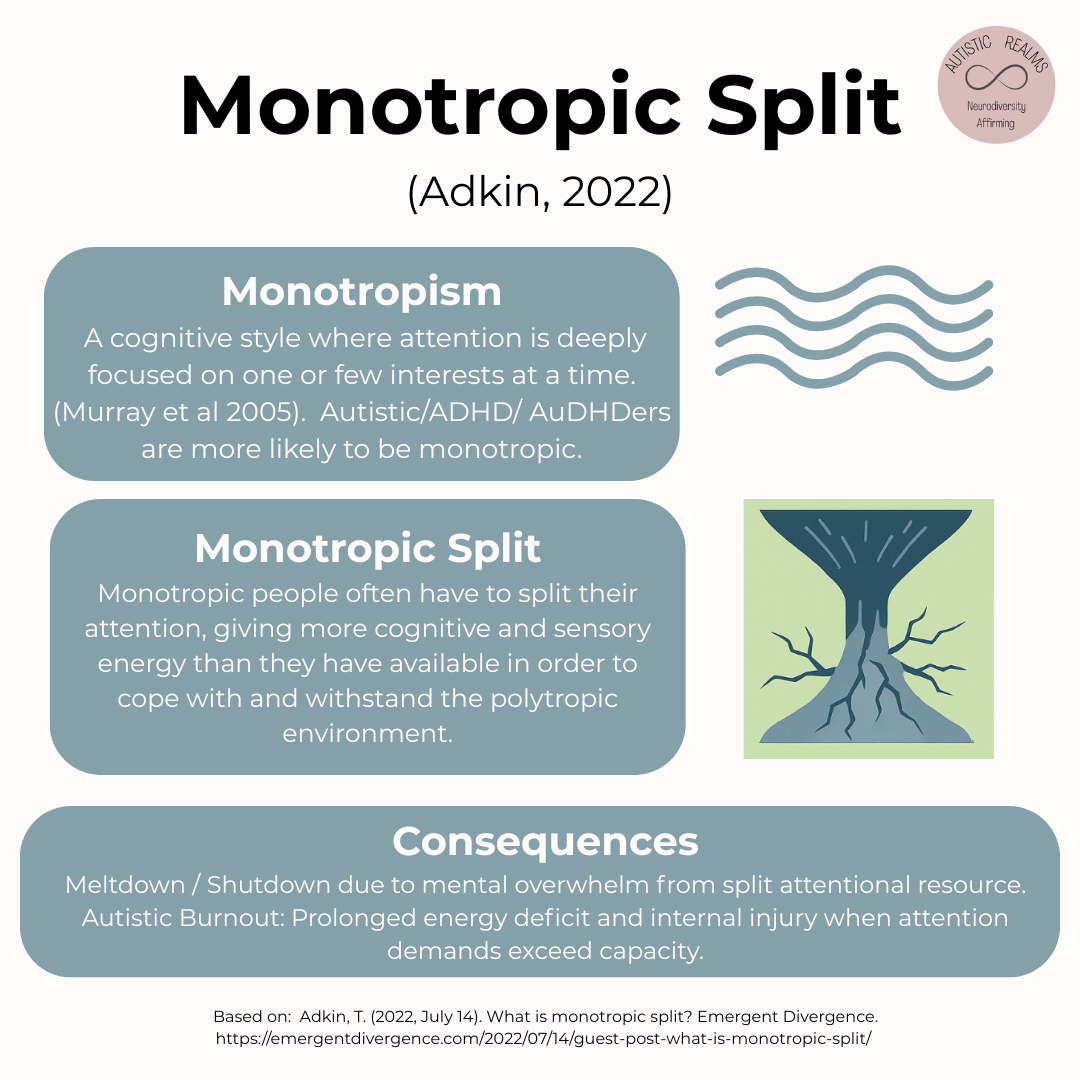
    Building on the idea of environmental mismatch, Adkin (2022) describes the concept of monotropic split: in settings that align with our interests and allow for uninterrupted flow, monotropic people can appear highly capable, sometimes exceptional. However, our functioning can drop sharply when pulled into low-interest, multi-task-heavy situations. Splitting attention across multiple channels is exhausting in the moment and, over time, unsustainable, contributing to burnout.
    Monotropism helps to describe how repeated disruptions to deep-focus states can cause attention fracture or monotropic split. The ability to immerse in an interest or task breaks down. Even activities we usually love can feel harder to start or sustain. Our sense of competence and identity can be shaken.

    From the outside, this can look like inconsistency and may help explain the spiky profiles so often attributed to neurodivergent people, excelling one day and “struggling” the next. In reality, it reflects whether the environment enables or obstructs monotropic engagement. The variation emerges from the interplay between our deep-focus attentional style and the demands of the setting. I have discussed this more in my blogs Autistic Young People: Skills Regression, Burnout or a Shift in Monotropic Attentional Resources? and Unmasking: Reclaiming Our Monotropic Attentional Resources?

    Infographic with pale green background titled “Monotropic Split – Tanya Adkin (2022).” Left side shows a dark blue attention funnel splitting into multiple cracked streams, symbolising fragmented focus. Sections explain that monotropic people focus deeply on few interests (Murray et al., 2005) but may be forced to split attention across multiple demands, causing overload, trauma, and burnout. Causes include multitasking expectations and non-affirming environments; consequences include meltdowns, burnout, and mental health crises. A boxed statement reads: “Monotropic people often have to split their attention, giving more cognitive and sensory energy than they have available in order to cope with the environment.” Footer shows full APA reference for Adkin’s 2022 article.

    This split becomes clearer when we consider Heasman et al.’s (2024) observation that for Autistic and monotropic people, flow is never guaranteed; it depends on environmental affordances. Authentic engagement and productivity require conditions such as predictable and safe sensory environments, autonomy to follow meaningful interests, minimal unnecessary interruptions, and clear and manageable transitions.

    When these conditions are absent, as they often are in polytropic systems like schools and workplaces, noise, unpredictability, and constant switching between tasks drain energy. Instead of channelling attention into the work, we spend most of our limited resources managing disruption. Over time, this erodes productivity and undermines confidence, self-esteem, and overall wellbeing.

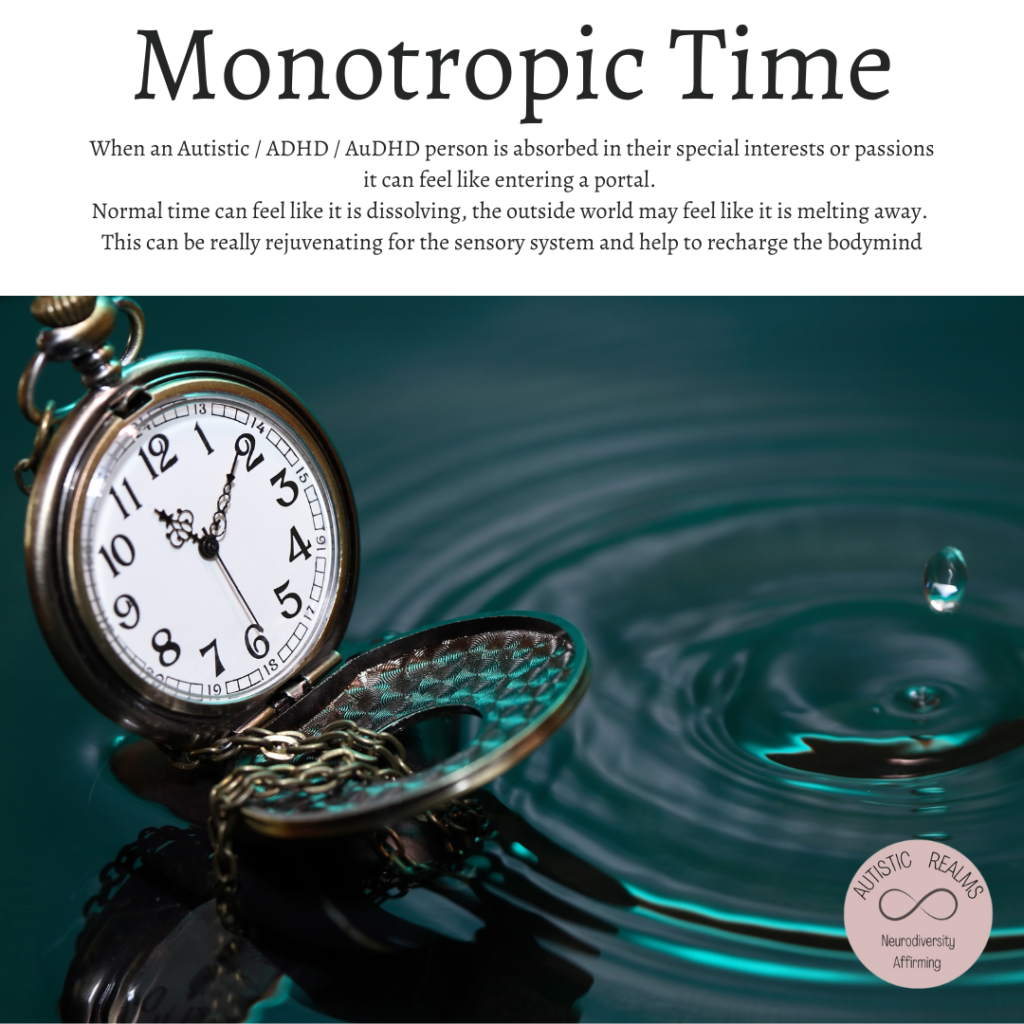
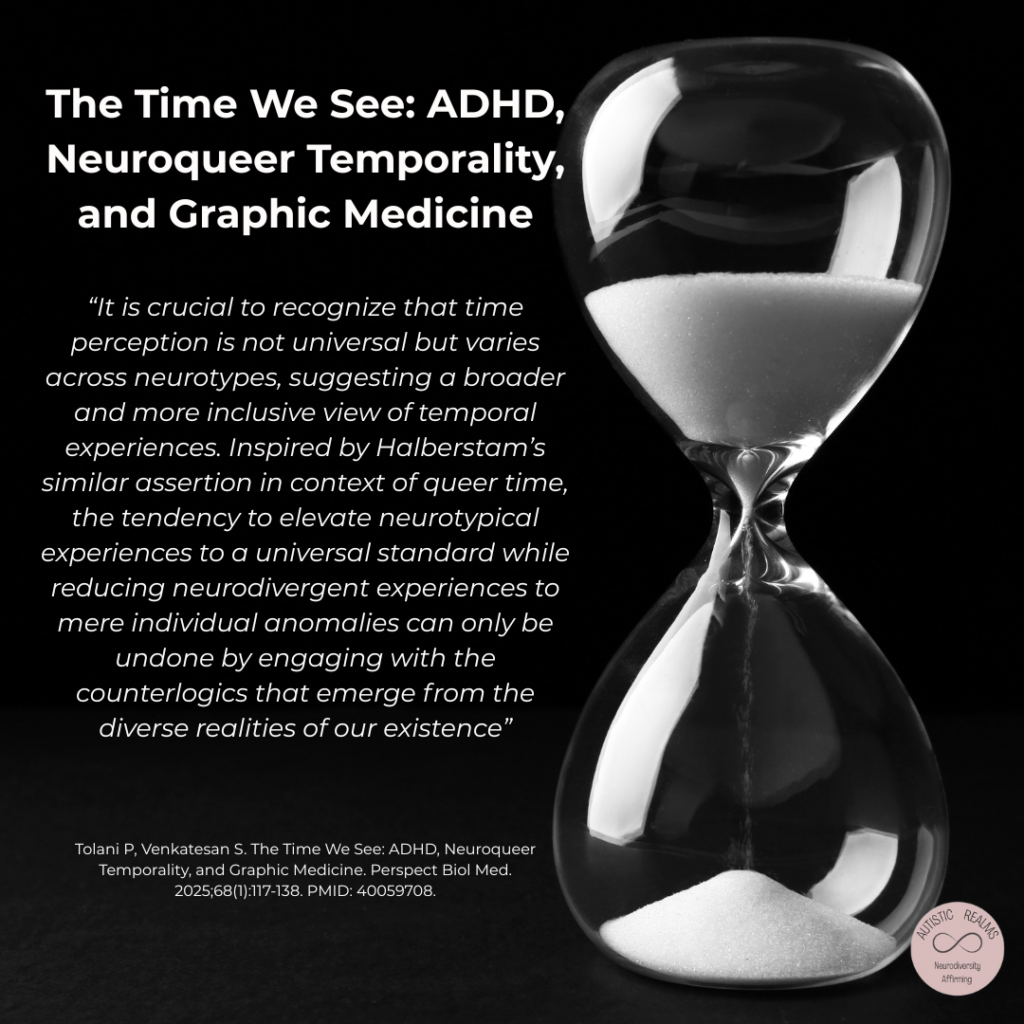
    The fragility of flow is also closely tied to how we experience time. Tolani and Venkatesan (2025) describe how hyperfocus is part of a nonlinear, present-oriented experience of time for ADHDers; hours can pass in what feels like minutes. Being pulled out of that state abruptly can be disorienting, even physically uncomfortable. Without sensory safety and predictable transitions, re-entering that depth of focus becomes much harder, and recovery often takes far longer than others realise. For monotropic people, “just picking up where you left off” is rarely realistic; it demands significant energy and effort. Over time, the constant strain of trying to fragment monotropic flow to meet the breadth-first demands of a polytropic world becomes exhausting, and for many of us, this is one of the pathways into burnout.

    Burnout and Recovery for Monotropic People

    Burnout for Autistic people, ADHDers, and AuDHDers is about far more than “doing too much.” It is often the result of the cumulative stress of a sustained mismatch between how our monotropic attention naturally works and what polytropic environments demand (Buckle et al., 2021; Hossain & Bain, 2025; Raymaker et al., 2020).

    When we are forced to operate in polytropic systems that demand constant task-switching, value neuronormative ways of communicating and socialising, ignore our sensory needs and what meaningful rest looks like, undervalue interest-based engagement, and interrupt flow repeatedly without recognising the impact of Autistic inertia (Buckle et al., 2021), our resources are steadily drained. Burnout is what happens when that drain goes on for too long without the chance to recover.

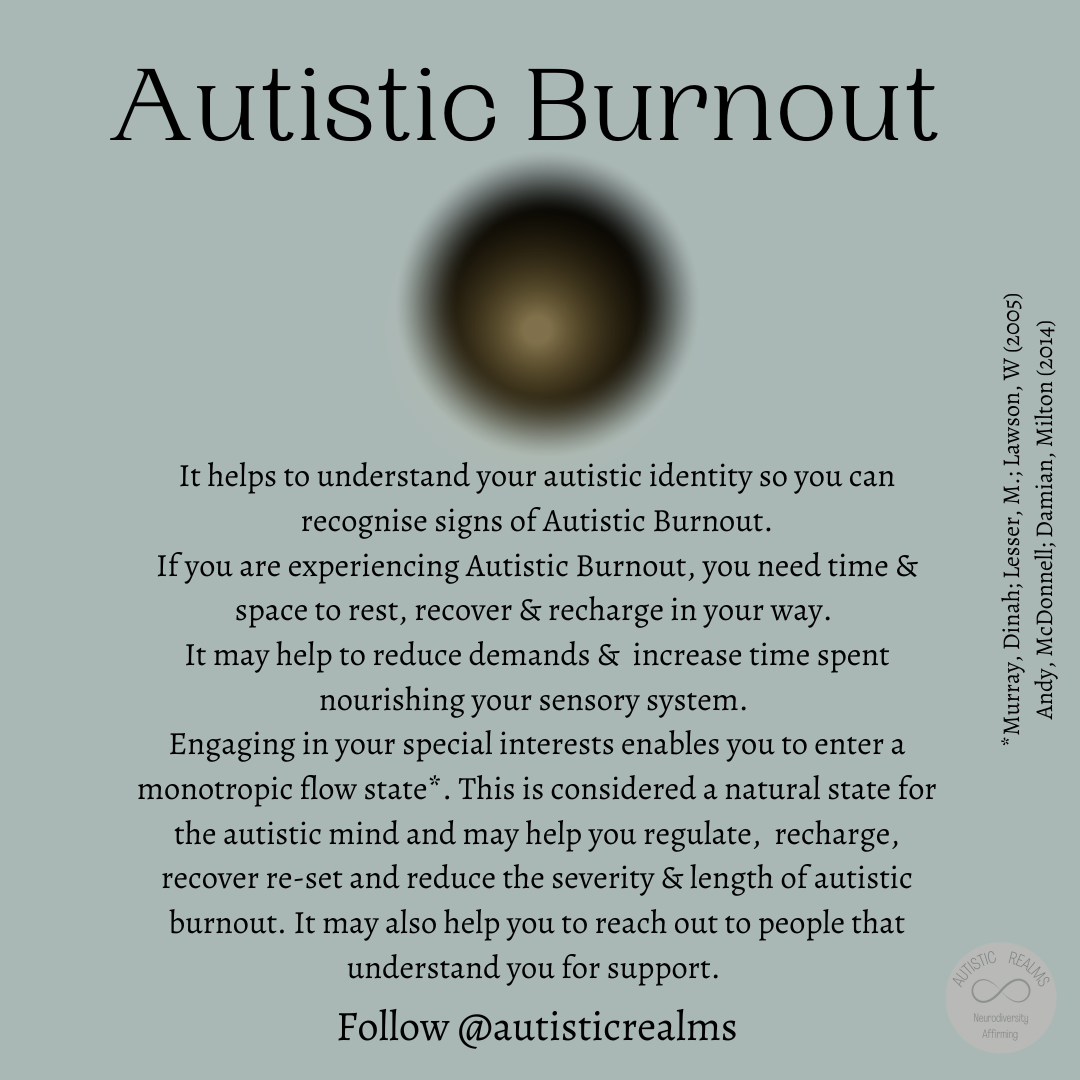
    Image of hazy black dot. Text: It helps to understand your Autistic identity so you can recognise signs of Autistic Burnout. If you are experiencing Autistic Burnout, you need time and space to rest, recover and recharge in your way. It may help to reduce demands and increase time spent nourishing your sensory system. Engaging in your special interests enables you to enter a monotropic flow state. This is considered a natural state for the Autistic mind and may help you regulate, recharge, recover, re-set and reduce the severity and length of Autistic burnout. It may also help you to reach out to people that understand you for support. Follow @autisticrealms. Autistic Burnout. Murray, Lesser and Lawson (2005); McDonnell and Milton (2014).

    Monotropism and Wellbeing

    Drawing from Fergus Murray’s (2023) keynote presentation on Monotropism and Wellbeing, McDonnell and Milton’s (2014) reframing of repetitive behaviours as flow activities, and Heasman et al.’s (2024) emphasis on environmental accommodations, the conditions that best support Autistic people (and likely all monotropic people) are things like protecting flow states, because uninterrupted engagement in meaningful activities supports regulation, learning, and joy; reducing unnecessary task-switching, because constant redirection erodes focus, increases anxiety, and lengthens recovery time; and honouring interest-based engagement, because working with genuine passions sustains motivation and restores energy. Creating predictable, sensory-safe environments may help attention shifts be less jarring (how these look and feel will depend on the individual). Allowing for recovery rhythms, with extended periods of low demand and room for meaningful, monotropically aligned rest and self-directed activity, helps rebuild capacity, energy and flow.

    McDonnell and Milton (2014) explain that what is often called “repetitive behaviour” can be a way of self-regulating, helping us recover balance after stress. For monotropic people, these flow activities are essential for wellbeing, rather than a distraction from “real work”. Heasman et al. (2024) point out that flow depends on the right environment: having control over what we are doing, being safe from interruptions, and being in a space that values deep focus. Without this, recovery can stall. The Monotropism Questionnaire (Garau et al., 2023) reflects this too: its factors include the impact of the environment on the attention tunnel and losing track of other needs while focused, which suggests that supportive surroundings matter for getting back into focus, and that while deep engagement is valuable, we may also need gentle reminders to look after ourselves.

    Recovery means protecting the conditions that help us go deep: enough time for interest-based activities, predictable and comfortable sensory settings, and fewer demands while easing back into work or study. Forcing ourselves to cope with constant switching or spreading our attention thin only makes things harder. Unless schools and workplaces stop expecting monotropic people to work like polytropic multitaskers, burnout will keep happening, and the blame will keep falling on neurodivergent individuals instead of the environment.

    Building Monotropism-Affirming Spaces

    When we design education, workplaces, and communities with only polytropic people’s needs in mind, we limit what monotropic people can bring to the world.

    In Education

    • Allow extended time for deep, interest-based projects rather than constant short tasks.
    • Reduce unnecessary task-switching, and build in natural transitions between subjects or activities.
    • Create sensory-predictable but flexible learning spaces.
    • You could use the Monotropism Questionnaire (Garau et al., 2023) as a tool to understand learner needs. However, there is not yet a monotropism questionnaire for children or young people, so it is not validated for them and would likely need to be adapted.

    In Workplaces

    • Design roles around passions and interests for sustained focus and depth, rather than constant switching.
    • Give advance notice of changes, deadlines, or meetings so focus shifts are less abrupt and multimodal communication needs are honoured.
    • Provide quiet, low-distraction workspaces alongside collaborative areas.
    • Value depth-based productivity as equally important as breadth-based multitasking.

    When systems adapt to include monotropic attention styles, burnout reduces, and the creativity, problem-solving, and deep knowledge that monotropic people bring have room to grow. The aim is to shape systems so that both depth and breadth of attention are valued, and so that all of us have the conditions we need to thrive, whatever our attention style.

    References

    Adkin, T. (2022, July 14). Guest post: What is monotropic split? NeuroHub Connect. https://neurohubcommunity.org/2022/07/14/guest-post-what-is-monotropic-split/

    Buckle, K. L., Leadbitter, K., Poliakoff, E., & Gowen, E. (2021). “No way out except from external intervention”: First-hand accounts of autistic inertia. Frontiers in Psychology, 12, Article 631596. https://doi.org/10.3389/fpsyg.2021.631596

    Garau, V., Murray, A. L., Woods, R., Chown, N., Hallett, S., Murray, F., Wood, R., & Fletcher-Watson, S. (2023). Development and validation of a novel self-report measure of monotropism in autistic and non-autistic people: The Monotropism Questionnaire [Preprint]. OSF Preprints. https://doi.org/10.31219/osf.io/ft73y

    Heasman, B., Williams, G., Charura, D., Hamilton, L. G., Milton, D., & Murray, F. (2024). Towards autistic flow theory: A non-pathologising conceptual approach. Journal for the Theory of Social Behaviour, 54(4), 469–497. https://doi.org/10.1111/jtsb.12427

    Hossain, M., & Bain, J. (2025). Beyond behavior: Understanding ADHD burnout and the need for belonging in UAE schools. Psychology in the Schools, 62(10), 4265–4275. https://doi.org/10.1002/pits.70000

    Jurgens, A. (2020). Neurodiversity in a neurotypical world: An enactive framework for investigating autism and social institutions. In H. Bertilsdotter Rosqvist, N. Chown, & A. Stenning (Eds.), Neurodiversity studies: A new critical paradigm (pp. 73–88). Routledge. https://doi.org/10.4324/9780429322297-8

    McDonnell, A., & Milton, D. (2014). Going with the flow: Reconsidering “repetitive behaviour” through the concept of “flow states”. In G. Jones & E. Hurley (Eds.), Good autism practice: Autism, happiness and wellbeing (pp. 38–47). BILD. https://kar.kent.ac.uk/62647/

    Milton, D. E. M. (2012). On the ontological status of autism: The “double empathy problem”. Disability & Society, 27(6), 883–887. https://doi.org/10.1080/09687599.2012.710008

    Murray, D., Lesser, M., & Lawson, W. (2005). Attention, monotropism and the diagnostic criteria for autism. Autism, 9(2), 139–156. https://doi.org/10.1177/1362361305051398

    Murray, F. (2023). Monotropism and wellbeing [Keynote presentation]. Scottish Autism Research Group Conference 2023. https://monotropism.org/wellbeing/

    Raymaker, D. M., Teo, A. R., Steckler, N. A., Lentz, B., Scharer, M., Delos Santos, A., Kapp, S. K., Hunter, M., Joyce, A., & Nicolaidis, C. (2020). “Having all of your internal resources exhausted beyond measure and being left with no clean-up crew”: Defining autistic burnout. Autism in Adulthood, 2(2), 132–143. https://doi.org/10.1089/aut.2019.0079

    Tolani, P., & Venkatesan, S. (2025). The time we see: ADHD, neuroqueer temporality, and graphic medicine. Perspectives in Biology and Medicine, 68(1), 117–138. https://doi.org/10.1353/pbm.2025.a953457

  • The Room Behind the Relationship: An Ecological Ethics from the Perspective of a Trainee Counsellor

    The Room Behind the Relationship: An Ecological Ethics from the Perspective of a Trainee Counsellor

    There is a question I keep returning to as I train in the counselling professions, and it has very little to do with technique. It is this: when something goes wrong between a practitioner and the person in front of them, where does the fault actually live? Professional ethics codes tend to answer that question by looking at exactly two people. One is trusted with power, the other is owed care, and the code exists to hold the first accountable to the second. It is a good frame as far as it goes. But I have started to wonder what it leaves out, and what gets quietly absorbed by the client when it does.

    What Ethics Asks Of Us

    Ethics, in the simplest sense, are the moral principles that guide right and wrong conduct (Bond, 2015). In the helping professions they exist because there is rarely one correct answer to a difficult situation, only a considered judgement, reached in the open rather than alone. The British Association for Counselling and Psychotherapy’s new Ethical Framework, which becomes mandatory for members in November 2026, names twelve principles that practitioners hold together rather than apply one at a time: confidentiality, honesty, transparency, doing no harm, acting in the client’s best interest, respect, fairness, anti-oppression, trust, collaboration, compassion and integrity (BACP, 2026). Read as a set, they describe a good relationship more than a checklist: attention to power, to truthfulness, to a client’s own right to decide, and, in anti-oppression, an explicit instruction to stay aware of the power moving between people in a room.

    What strikes me about the framework is its shift towards relationships and responsibilities, and away from rules alone. That feels ecological to me: ethics as something that happens between people, cultures and systems, rather than inside one person. It says explicitly that ethical practice is something built between two people who are both changed by the encounter, rather than a fixed code applied to a passive client.

    And yet even a framework this relational still assumes the relationship is the whole story. It asks what passed between the practitioner and the person who came to them. It does not ask, in any sustained way, what else was in the room.

    Assemblage, Not Character

    When I sit with a dilemma from practice, the question that actually helps me is rarely “what is wrong with this person?” It is closer to asking what assemblage of people, spaces, training and systems produced the difficulty in front of me. An assemblage, in Deleuze and Guattari’s (1987) sense, is a temporary gathering of unlike things, bodies and buildings and timetables and funding streams, that arrange themselves into an outcome nobody alone chose. Difficulty is rarely produced by one person’s character. It is produced by an arrangement, and arrangements can be redesigned in a way that a person’s character cannot be legislated into changing.

    I think of this as closer to a rhizome than a rulebook, with small connections such as supervision, honesty and reflection growing sideways rather than descending from a single root of correct conduct (Deleuze & Guattari, 1987). Consent becomes an ongoing relation rather than a form signed once. A sudden ending becomes a network of care that keeps growing new connections even when one node has to leave, rather than a single failure to be blamed on the person who could not stay. None of this excuses harm. It relocates where we go looking for its cause, and it asks us to keep looking somewhere other than inward, at the client, when things go wrong.

    The Room We Forgot

    This is where a piece I have been building with Ryan Boren for Star Stuff, our joint project between Stimpunks Foundation and More Realms, has been doing real work in my thinking. In “Six Principles and a Room” (Star Stuff, 2026), we looked closely at how little vocabulary professional ethics codes actually have for the material world a client walks in from. Fluorescent lighting, chaotic transitions, a waiting list, a funding incentive that shapes how long a session can run: none of these can be struck off a professional register, so none of them appear in a code built for exactly two parties. When the only parties to an ethic are two people, everything that is not one of those two people has to be recorded somewhere else, and the only somewhere else on offer is inside the person who came in. Distress produced by an unaccommodating environment gets written up as though it originated in the individual, which quietly reinforces the very deficit thinking the helping professions say they want to move away from.

    Félix Guattari’s framework of three ecologies gives this a useful shape: the mental ecology of how we relate to ourselves, the social ecology of how we relate to each other, and the environmental ecology of the material conditions that enable or constrain those relations in the first place (Guattari, 2000). A two-person ethic, however carefully it is written, only ever reaches the first ecology and, at its most relational, gestures toward the second. The third, the room itself, tends to enter the code only as a reason a practitioner could not do the ethical thing, a line to write in a file explaining an exemption, rather than something the profession takes responsibility for shaping.

    Star Stuff (2026) also draws on Ombre Tarragnat’s concept of ethodiversity, which extends the logic of neurodiversity to the many ways of sensing, moving, attending and relating that exist across people and systems (Tarragnat, 2025), and on Mia Mingus’s idea of access intimacy, the felt sense of not having to explain your access needs because the space was already built with you in mind (Mingus, 2011). Put together, they describe a practice I think of as ethodivergent hearth building: making spaces that sustain difference through sensory consideration, co-regulation, bodily autonomy and relational consent, rather than spaces that merely tolerate difference once it has already caused someone distress (Star Stuff, 2026). None of this dissolves accountability into vague talk of systems. Star Stuff is careful on this point: there is exactly one disqualifier at the door, and it is harm rather than difference (Star Stuff, 2026). Widening the ethic beyond two people does not soften who is answerable. It names more of the people who actually are.

    Whose Voice Counts as a Voice

    The twelve principles do real work around respect, fairness and anti-oppression, but they are still written for one default mode of exchange: two people, speaking, usually face to face. Intersectionality is useful here because it names exactly the move the framework has not yet made. Oppression and access needs do not stack neatly on top of each other but multiply through the specific person in front of you, so that race, gender, disability, class and language are never separable strands but a single lived position (Crenshaw, 1989, 1991). A framework that reaches anti-oppression as an abstract principle while staying silent on how someone communicates has, in practice, still built its ethics around whoever can most easily fit the existing room.

    Neurodivergence sharpens this further. The double empathy problem reframes communication difficulty between Autistic and non-Autistic people as a mutual, two-way mismatch rather than a deficit sitting inside the Autistic person alone (Milton, 2012). Carried into a counselling relationship, a practitioner’s discomfort with an unfamiliar way of communicating is data about a mismatch the practitioner is also inside of, rather than neutral information about the client. Fairness, as currently written, asks for equal treatment. It does not yet ask what equal treatment requires when the two people in the room do not share a communication register to begin with.

    Non-speaking and AAC-using clients make the gap concrete. A framework that never once names communication modality has, by omission, defaulted to spoken language as the medium ethics happens in. Presuming competence, offering AAC-compatible options, and building in the time unhurried communication needs are part of ethical practice itself, rather than accommodations added on afterwards. They are what respect and best interest actually require once a client’s voice does not arrive by mouth, and once the device, board or spelling method carrying that voice is understood as part of the relationship rather than a workaround for it, closer to Barad’s sense of mattering, where the tool and the meaning it carries are entangled rather than separable (Barad, 2007).

    The same logic extends to modality more broadly. Online and text-based counselling is sometimes framed as a lesser substitute for real, in-person work, but for an Autistic client who processes written language more easily than live speech, or for anyone whom travel or a shared physical room puts out of reach, that access is the condition under which the relationship becomes possible at all. Access intimacy names the difference precisely: the felt sense of not having to explain, translate or justify an access need because the space was already built with it in mind (Mingus, 2011). A framework silent on modality leaves every client who does not fit the speaking, in-person default doing that explaining themselves, session after session.

    None of this dissolves into anything goes. It sits inside the same floor the whole piece keeps returning to, that the one disqualifier is harm rather than difference (Star Stuff, 2026). Widening what counts as a voice, and what counts as a room built to receive it, does not lower the standard of care. It is what meeting that standard actually looks like once “the client” stops meaning one default kind of person.

    Toward an Ecology of Practice

    What would it mean to bring the room into the helping professions’ own account of ethics, rather than leaving it as a private reflection practitioners do off the record? Supervision starts to look less like a confessional, where a practitioner discloses a personal limit or bias to be corrected, and more like an ecological practice, a place where the whole arrangement (the person, the room, the training, the referral pathway, the funding) can be examined together. Self-awareness stops being only about a practitioner’s own reactions and becomes a habit of asking what conditions produced this reaction in this room, on this day, with this level of support available. Transparency extends outward from “here is what I can offer you” to something closer to “here is the arrangement you have walked into, and here is what in it was not built with you in mind.”

    I do not think this replaces the relational focus the profession has been moving toward. I think it completes it. A practitioner and a client are never only two people in a room. They are two people inside a room, and the room has already been doing quite a lot of the talking before either of them says a word.

    Reflection

    Maybe the pattern I am reaching for is something closer to a rhizome than a rulebook, or to star stuff scattered and slowly finding each other again: small connections such as supervision, honesty and a willingness to name the room, growing sideways into a practice that stays answerable to each new relationship as it forms, rather than one that keeps quietly finding the fault in the person who walked in already carrying enough.

    Appendix: The Core Responsibilities

    Alongside the twelve principles, the framework sets out core responsibilities: the practical duties without which no professional service can be considered safe, trustworthy or respectful (BACP, 2026). They are organised under four headings.

    1. Build appropriate relationships. 1.1 Treat people with respect. 1.2 Give people the information they need to make choices about their work with us. 1.3 Establish and maintain appropriate professional and personal boundaries. 1.4 Work collaboratively to resolve ethical dilemmas or challenges.

    2. Keep ourselves, colleagues and those using our services safe. 2.1 Take account of our own personal safety and the safety of those we work with. 2.2 Be honest and transparent with those who use our services about anything that has not gone to plan in our work together. 2.3 Maintain our health and wellbeing. 2.4 Act appropriately to protect people from harm.

    3. Understand and act on our legal and professional responsibilities. 3.1 Protect the confidentiality and privacy of those accessing our services. 3.2 Keep appropriate records. 3.3 Act on our responsibilities in reporting serious crime and safeguarding concerns. 3.4 Be financially responsible.

    4. Deliver services to high professional standards. 4.1 We must be competent to deliver the services we offer. 4.2 Have adequate insurance. 4.3 Have adequate supervision that enables us to reflect in depth about all aspects of our practice. 4.4 Treat people fairly. 4.5 Manage breaks, endings in ways that minimise the impact for clients and service users.

    Read this way, the four headings already reach further than a two-person frame, even before Star Stuff’s critique is laid alongside them. Building relationships, staying safe, meeting legal responsibilities and delivering to a standard are not things one person does alone in a room with another. They depend on supervision existing and being resourced, on records systems that protect privacy, and on insurance and financial structures that hold a practice up at all. The room a two-person ethic forgets is, in a sense, already named here, just named as context for individual duty rather than as something the profession takes responsibility for building well.

    References

    Barad, K. (2007). Meeting the universe halfway: Quantum physics and the entanglement of matter and meaning. Duke University Press.

    Bond, T. (2015). Standards and ethics for counselling in action (4th ed.). Sage.

    British Association for Counselling and Psychotherapy. (2026). Ethical framework for the counselling professions. BACP. https://www.bacp.co.uk/events-and-resources/ethics-and-standards/ethical-framework-for-the-counselling-professions/

    Crenshaw, K. (1989). Demarginalizing the intersection of race and sex: A Black feminist critique of antidiscrimination doctrine, feminist theory and antiracist politics. University of Chicago Legal Forum, 1989(1), 139–167.

    Crenshaw, K. (1991). Mapping the margins: Intersectionality, identity politics, and violence against women of color. Stanford Law Review, 43(6), 1241–1299.

    Deleuze, G., & Guattari, F. (1987). A thousand plateaus: Capitalism and schizophrenia (B. Massumi, Trans.). University of Minnesota Press. (Original work published 1980)

    Guattari, F. (2000). The three ecologies (I. Pindar & P. Sutton, Trans.). Athlone Press. (Original work published 1989)

    Milton, D. E. M. (2012). On the ontological status of autism: The “double empathy problem”. Disability & Society, 27(6), 883–887. https://doi.org/10.1080/09687599.2012.710008

    Mingus, M. (2011, May 5). Access intimacy: The missing link. Leaving Evidence. https://leavingevidence.wordpress.com/2011/05/05/access-intimacy-the-missing-link/

    Star Stuff. (2026). Six principles and a room. Stimpunks Foundation × More Realms. https://starstuff.earth/six-principles-and-a-room.html

    Tarragnat, O. (2025, February 25). What is ethodiversity? https://ombretarragnat.com/2025/02/25/what-is-ethodiversity/

  • Symphrenia: Joining the Stars in My Monotropic Galaxy

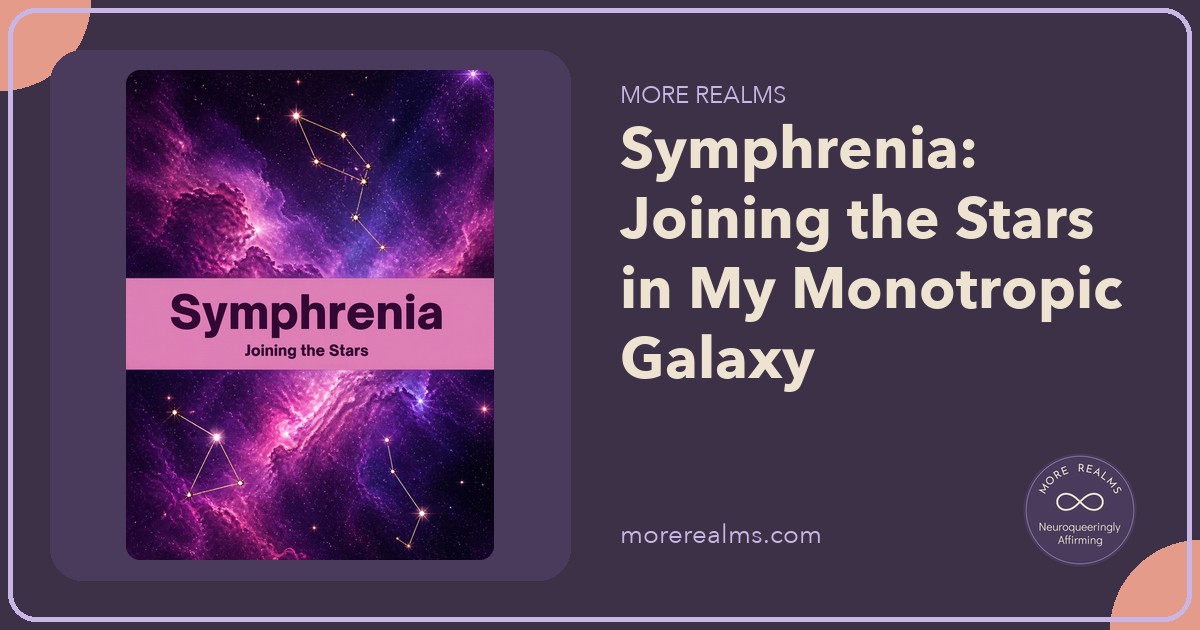
    Symphrenia: Joining the Stars in My Monotropic Galaxy

    By Helen Edgar, with thoughts from David Gray-Hammond. Part of Neuroqueering Deleuze: Rhizomes of Becoming.

    Lines Between Stars

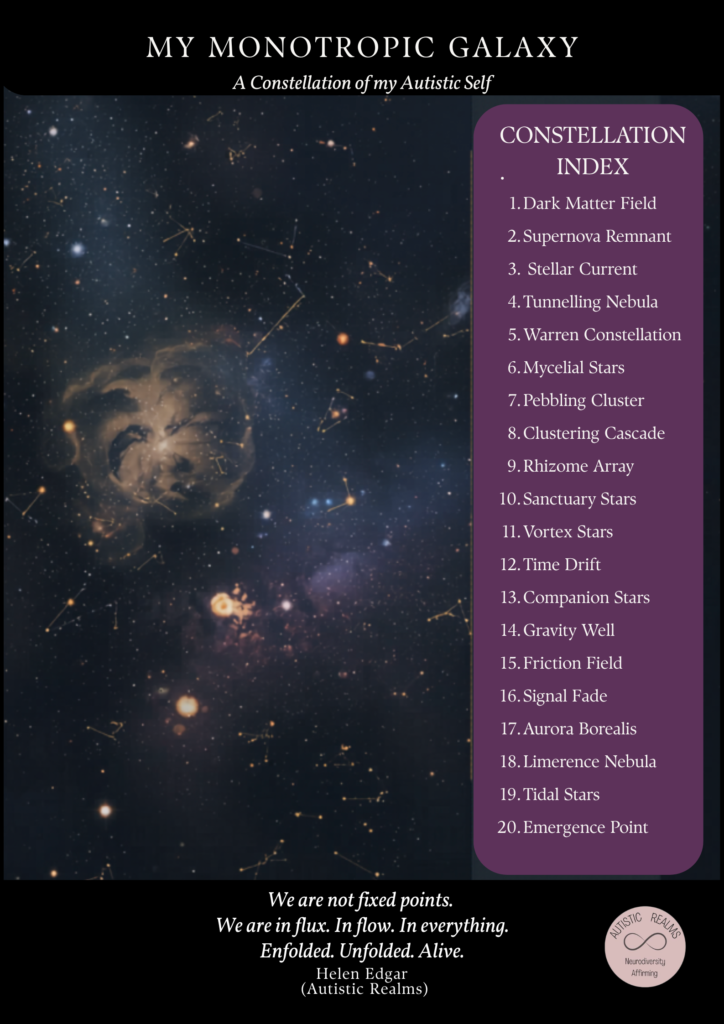
    When I created My Monotropic Galaxy (Edgar, 2026a), I drew thin gold lines between stars that have no relationship to one another except the one I connected. Some of those stars sit hundreds of light years apart. Joined on the page, they became the Stellar Current, the Gravity Well and the Tidal Stars, a map of an Autistic ADHD inner life that finally made sense to me. People have been drawing these lines for thousands of years. Every culture has looked up at the same scattered light and found its own hunters, animals, rivers and ploughs, and in that sense constellations may be our oldest act of pattern-making.

    Psychiatry has a word for the tendency to perceive meaningful connections between unrelated things: apophenia. The word was coined by the German psychiatrist Klaus Conrad in 1958 in his study of the onset of schizophrenia, describing an “unmotivated seeing of connections” accompanied by a feeling of abnormal meaningfulness (Conrad, 1958, as cited in Mishara, 2010). Pattern-seeing is something every human bodymind does, yet the word was created to mark the moment when someone’s meaning-making had supposedly crossed a line into something pathological. It is the same neuronormative gaze I have written about so many times, and I think it is important to ask who gets to decide which patterns count as insight and which get called symptoms of something that needs a cure or fixing.

    This post is part of Neuroqueering Deleuze: Rhizomes of Becoming (Edgar, 2026b), a slow, collaborative community project exploring the philosophy of Gilles Deleuze and Félix Guattari through neurodivergent lived experience. The project began with my own search for language during cycles of Autistic burnout, and it has become a way of understanding neurodivergence as movement, transformation and ongoing becoming. This piece is one more node in that rhizome. It follows a line of curiosity from apophenia to the stars, and towards a word I want to offer for the connected, porous quality of my bodymind: symphrenia.

    Whose Patterns Count

    My mind works rhizomatically, moving in every direction from a star to mutual aid to penguin pebbling (Deleuze & Guattari, 1987), and those connections often feel necessary from the inside long before I can explain them to anyone else. Monotropic attention tends to go deep into a single channel of interest instead of spreading widely across many (Murray et al., 2005), and in that depth, links surface that others may not see or understand. This may help explain why many AuDHD people are so often misunderstood, and why our conversations can appear to jump randomly from topic to topic. For me, it feels like a million connections are happening at once, with no time to explain them all, so I share my end point, the node where my thoughts gathered and came to rest. I am often met with confused looks and strange smiles, because the topic seems to have changed so abruptly, when for me every connection has been made and it makes total sense.

    When they are met with curiosity, the liminal spaces of my thoughts, the spaces in between conversations and sentences, can become places where journaling, writing, research and art emerge. When they are met with confusion or a clinical label, they become one more sign that my perception is somehow wrong. The double empathy problem reminds us that a gap in understanding belongs to both people in an interaction (Milton, 2012), yet the burden of being “unreadable” usually falls on the Autistic person. We are the ones asked to fill in the gaps and explain ourselves, when a conversation that seems to have jumped a million miles off topic is deeply connected at the root, in the rhizome of thought running under and around it.

    The Ecology of Distress

    I work closely with David Gray-Hammond and NeuroHub Connect, and David’s ecosystemic model has shaped my thinking significantly over the past year or so. David’s model holds that Autistic distress is ecosystemic. It does not arise solely from within the bodymind, but from the whole web of relationships, environments, systems and pressures a person lives within (Gray-Hammond, 2025). Through this lens, burnout and psychosis can be understood as relational and environmental responses to chronic neuronormative pressure, rather than as faults located inside an individual.

    In my galaxy, that pressure is the Dark Matter Field and the Friction Field, the accumulated weight of a neuronormative world. I keep thinking about how the same porous, pattern-seeking bodymind can experience two very different things depending on the sky around it. Among the Sanctuary Stars, with Companion Stars close by, noticing hidden connections feels like awe, which De Cruz (2024) describes as an epistemic opening, the moment our ways of knowing expand. Under the Dark Matter Field, with no rest, no safety and no one who understands, that same openness can tip into overwhelm, fear and a sense of meaning closing in. Diagnosis tends to examine a single star. An ecosystemic view asks us to look at the whole sky.

    Stephen Porges (2004) offers a word for how this happens in the body: neuroception, the nervous system’s subconscious scanning for safety or threat. Porges has described some of these responses as “faulty”, but an ecosystemic lens invites a different reading. When an Autistic nervous system neuroceives danger in a world built around neuronormative expectations, it may be reading that environment with painful accuracy. Polyvagal theory, from which neuroception emerged, remains debated within physiology (Grossman, 2023), but as a lens it helps me think about how meaning travels through the body. I have come to understand that movement as a kind of bridge. Interoception lets some neuroceived signals be felt within the body (Craig, 2002), and intuition carries those somatic cues into awareness, turning them into heart-led guidance and meaning. For many Autistic people, each part of this bridge works in its own way and at its own pace, and our intuitions have often been dismissed because they do not arrive in the expected form.

    Finding a Word: Symphrenia

    The roots I keep returning to are Greek. Syn means with or together, and becomes sym before a “ph” sound, as in symphony and sympathy. Phrēn is usually translated as mind, but in Homeric Greek it also meant the midriff or diaphragm, the breathing chest where thought and feeling were believed to live. That older meaning matters, because so much has been lost since. In 1641, René Descartes divided the self into a thinking mind and an extended body (Descartes, 1641/1996), and much of Western thought, medicine and psychiatry followed that line. Damasio (1994) later called this Descartes’ error, showing how bodily feeling is woven into reasoning itself, and the word bodymind, first offered by Ken Dychtwald (1977) and later taken up across disability studies, refuses the split altogether. Long before Descartes, and long before psychiatry narrowed it into a suffix for diagnoses, phrēn was already a bodymind word.

    So we want to offer symphrenia (sim-FREE-nee-uh): the felt sense of a bodymind that thinks and feels with the world rather than apart from it, a porous kinship with people, creatures, places and things, both living and non-living.

    That last part matters to me. Many Autistic people describe feeling for objects as well as beings, and research suggests Autistic adults report object personification more often than non-Autistic adults (White & Remington, 2019). Kimmerer (2013) writes of a grammar of animacy that treats the more-than-human world as kin. My Tidal Stars have always held this sense that my edges are less fixed than the world assumes, and that I am drawn towards water, stone and ancient things as if returning to something already within me. Whether that porousness unfolds as kinship or as overwhelm may depend on whether my body neuroceives safety.

    Becoming-With: Intra-Action and the Posthuman

    Deleuze and Guattari (1987) describe the self as an assemblage, a shifting composition of bodies, intensities, places and relations, always in the process of becoming. Their thinking draws on Spinoza, for whom a body is understood by its capacity to affect and be affected (Deleuze, 1988). Symphrenia feels like a way of naming what this is like from the inside: the felt sense of being composed with the world.

    The physicist and philosopher Karen Barad (2007) deepens this through agential realism. For Barad, things do not exist first and then enter into relationships; they emerge through intra-action, coming into being through their entanglements with one another. My bodymind, the river and the star are continually becoming through each other, which echoes the implicate order I explored in My Monotropic Galaxy (Edgar, 2026a). Haraway (2016) offers the word sympoiesis, “making-with” (p. 58), for the way no living being makes itself alone, and Tarragnat’s ethodiversity recognises diverse ways of perceiving and relating as part of the wider patterns of life beyond the human (Tarragnat, 2025). Read alongside these thinkers, symphrenia begins to feel like more than a private feeling. It may echo what they describe about how all of us, human and more-than-human, are already entangled.

    Speaking Back to a Divided Mind

    Eugen Bleuler (1911) named schizophrenia from the Greek for a split or divided mind. Symphrenia speaks back to that naming, though I do not want to frame it as a simple opposite. Some people who experience psychosis describe an intense, overwhelming connectedness, a world suddenly charged with meaning, which clinical writing has described as aberrant salience (Kapur, 2003). Deleuze and Guattari’s (1983) schizoanalysis reimagined schizophrenia as a process of flows and connections, though their use of the figure of “the schizo” has been critiqued for romanticising experiences that can involve real suffering. What I am reaching for is a shared porousness running through many neurodivergent and Mad experiences, one that can feel like wonder in a nourishing ecosystem and like distress in a hostile one. If that is true, our work lies in tending the ecology around a person instead of trying to correct the person within it. This word also cannot belong only to me. Anything that touches the experience of psychosis needs to be shaped alongside the people who live it, and I hope symphrenia can grow through those conversations.

    Existential Diversity and the Cosmic Glitch

    The concept of existential diversity David and I have been developing widens the frame again. We describe existence as something that extends beyond the bodymind, reaching across space and time (Edgar & Gray-Hammond, 2026). Who we are reaches past the edges of our skin, into our relationships, the places that hold us, and the stories carried by those who came before us and those who will come after. Symphrenia and existential diversity meet here for me. If my bodymind thinks and feels with the world, then my existence is also spread through that world. It returns me to star stuff, the knowledge that the atoms in our bodies were forged in stars long before our sun existed, and to love someone down to their star stuff is to love the whole of that existence (Boren & Stimpunks Foundation, 2026).

    Within that vastness, Autistic and Mad ways of being are so often treated as glitches, errors in the code of how a person is supposed to perceive, think and relate. Legacy Russell (2020), in Glitch Feminism, reclaims the glitch as a refusal of systems built to exclude, in a chapter titled “Glitch Is Cosmic”. I have come to think of us as cosmic glitches in that sense. A glitch interrupts the smooth running of a system, and in doing so reveals how that system was built and whose bodyminds it was built for. When my pattern-seeing is labelled apophenia, or my nervous system’s alarm is called faulty neuroception, the glitch is located in me. Seen ecosystemically, the glitch shows where the neuronormative code breaks down. Like a sudden aurora across a dark sky, it can be a moment of rupture and illumination at once, where something new becomes visible.

    A Twenty-First Constellation

    My galaxy map was always meant to keep changing. Perhaps symphrenia is a new constellation forming at its edge, a thin gold line joining me to the people, creatures, places and things I love. Some will look at those lines and see only scattered points of light, and that is alright. The connections were always there in the dark, waiting for someone to draw them. Perhaps every glitch is a star we have not yet learned to name.

    #NeuroqueeringDeleuze #RhizomesOfBecoming #NeuroqueerPhilosophy #Symphrenia

    References

    Barad, K. (2007). Meeting the universe halfway: Quantum physics and the entanglement of matter and meaning. Duke University Press.

    Bleuler, E. (1911). Dementia praecox oder Gruppe der Schizophrenien [Dementia praecox or the group of schizophrenias]. Deuticke.

    Boren, R., & Stimpunks Foundation. (2026). Love you down to your star stuff. https://stimpunks.org/star-stuff/

    Conrad, K. (1958). Die beginnende Schizophrenie: Versuch einer Gestaltanalyse des Wahns [The onset of schizophrenia: An attempt to form a Gestalt analysis of delusion]. Georg Thieme Verlag.

    Craig, A. D. (2002). How do you feel? Interoception: The sense of the physiological condition of the body. Nature Reviews Neuroscience, 3(8), 655–666. https://doi.org/10.1038/nrn894

    Damasio, A. R. (1994). Descartes’ error: Emotion, reason, and the human brain. Putnam.

    De Cruz, H. (2024). Wonderstruck: How wonder and awe shape the way we think. Princeton University Press.

    Deleuze, G. (1988). Spinoza: Practical philosophy (R. Hurley, Trans.). City Lights Books.

    Deleuze, G., & Guattari, F. (1983). Anti-Oedipus: Capitalism and schizophrenia (R. Hurley, M. Seem, & H. R. Lane, Trans.). University of Minnesota Press.

    Deleuze, G., & Guattari, F. (1987). A thousand plateaus: Capitalism and schizophrenia (B. Massumi, Trans.). University of Minnesota Press.

    Descartes, R. (1996). Meditations on first philosophy (J. Cottingham, Trans.). Cambridge University Press. (Original work published 1641)

    Dychtwald, K. (1977). Bodymind. Pantheon Books.

    Edgar, H. (2026a, June 16). My monotropic galaxy: A constellation of my Autistic self. More Realms. https://morerealms.com/my-monotropic-galaxy-a-constellation-of-my-autistic-self/

    Edgar, H. (2026b, March 21). Neuroqueering Deleuze: Rhizomes of becoming. More Realms. https://morerealms.com/neuroqueering-deleuze-rhizomes-of-becoming/

    Edgar, H., & Gray-Hammond, D. (2026, October 25). Existential diversity, the symphrenic bodymind and wider existence. The Wider Existence. https://www.thewiderexistence.co.uk/p/existential-diversity-the-symphrenic

    Gray-Hammond, D. (2025, December 21). The ecosystemic model of distress explained. NeuroHub Connect. https://neurohubcommunity.org/2025/12/21/mental-health-ecosystemic-model

    Grossman, P. (2023). Fundamental challenges and likely refutations of the five basic premises of the polyvagal theory. Biological Psychology, 180, Article 108589. https://doi.org/10.1016/j.biopsycho.2023.108589

    Haraway, D. J. (2016). Staying with the trouble: Making kin in the Chthulucene. Duke University Press.

    Kapur, S. (2003). Psychosis as a state of aberrant salience: A framework linking biology, phenomenology, and pharmacology in schizophrenia. American Journal of Psychiatry, 160(1), 13–23. https://doi.org/10.1176/appi.ajp.160.1.13

    Kimmerer, R. W. (2013). Braiding sweetgrass: Indigenous wisdom, scientific knowledge and the teachings of plants. Milkweed Editions.

    Milton, D. E. M. (2012). On the ontological status of autism: The “double empathy problem”. Disability & Society, 27(6), 883–887. https://doi.org/10.1080/09687599.2012.710008

    Mishara, A. L. (2010). Klaus Conrad (1905–1961): Delusional mood, psychosis, and beginning schizophrenia. Schizophrenia Bulletin, 36(1), 9–13. https://doi.org/10.1093/schbul/sbp144

    Murray, D., Lesser, M., & Lawson, W. (2005). Attention, monotropism and the diagnostic criteria for autism. Autism, 9(2), 139–156. https://doi.org/10.1177/1362361305051398

    Porges, S. W. (2004). Neuroception: A subconscious system for detecting threats and safety. Zero to Three, 24(5), 19–24.

    Russell, L. (2020). Glitch feminism: A manifesto. Verso.

    Tarragnat, O. (2025, February 25). What is ethodiversity? https://ombretarragnat.com/2025/02/25/what-is-ethodiversity/

    White, R. C., & Remington, A. (2019). Object personification in autism: This paper will be very sad if you don’t read it. Autism, 23(4), 1042–1045. https://doi.org/10.1177/1362361318793408

  • Migration & Trusting Our Inner Monotropic Compass

    Migration & Trusting Our Inner Monotropic Compass

    Inspired by Brigit Anna McNeill’s “The Living Page” Migration writing workshop, Into the Woods Writing Group, 6 August 2026.

    I spent the evening of sixth of August in Brigit McNeill’s Migration writing workshop with the Into the Woods writing group, in a session called The Living Page. We were invited to write from and with migration, as a movement to think inside of, inspired by Brigit’s own writing.

    What follows is some of what I shared during the workshop and what I have been thinking about afterwards, threaded through with the ideas I keep returning to in my work on monotropism and neuroqueer theory.

    Inner Compass

    Birds cross oceans using a compass sense we still don’t fully understand. It may involve something in their eyes that responds to the Earth’s magnetic field, through a quantum mechanism that is still being worked out (Mouritsen, 2018). A bird doesn’t need a conventional map; it can orient by reading the world itself as a kind of felt knowledge.

    As Brigit shared through her writing, salmon return to their birth rivers. Humpback whales cross hemispheres between calving and feeding grounds. Elephants can follow familiar routes across landscapes, including routes to water. Even a plant’s seed is carried by wind or on fur, migrating in its own way, landing on new ground.

    The Inner Tug Of Migration

    It’s easy to think of migration as recurring linear travel between fixed points — departure, journey, arrival and back again. The workshop pushed against that framing, and we discussed migration as a process of transformation across time, as much as displacement across distance.

    I feel this is close to what Deleuze (1994) was exploring through the idea of ‘difference in repetition’. The idea that no repeated pattern is ever a true copy, that each turn carries its own small variation. Migration, read this way, isn’t a repetitive loop; it’s more of a spiral. With every movement, everything changes.

    We discussed Brigit’s writing about what she calls the ‘tug’ of migration. It feels like there’s a bodily quality to how migration begins for all of us, whether crossing distance on the land as animals or in our human bodyminds. Before a bird sets off, something like a restlessness builds in its body. The pull comes from within, affected by seasons, seas, and time, and the sense of direction follows from that, in a very embodied, sensory tug.

    I recognise that kind of tug or pull in my own way of being. Monotropism (Murray, Lesser, & Lawson, 2005) describes how Autistic attention tends to gather intensely around a small number of interests, rather than spreading more evenly across many. When an interest catches me, it feels closer to that restlessness in the birds, a tug like a magnet pulling me in and arriving before my actual cognition and thinking have caught up.

    Following this tug or pull deep inside you, something opens up. Csikszentmihalyi (1990) described flow as the state that arises when attention and challenge align closely enough that the sense of separate effort disappears. It often comes with an undercurrent of wonder where the world briefly widens around whatever has caught you and opens up further into awe. I think that combination is close to what’s carrying migrating animals too: a sense of direction felt from the inside, trusted enough to move on and to see what will happen.

    Following the inner pull and desire of flow, whether it is sensory or more cognitive, leads us to connect ideas, connect people, to move our bodyminds. Flow isn’t stillness; attention is moving, even when the body isn’t. It slowly transforms us: each new interest, each sensory experience, every connection with another being or environment shifts something inside us.

    Many of us are taught early to override this feeling of going with the flow of what interests us and listening to our inner needs. We are conditioned to ignore our inner compass, to ignore our passions, our ideas, our sensory needs, especially if they fall outside of what is normally expected. We are taught to mask and suppress our flow and authentic migration.

    Research on Autistic masking describes the suppression of natural Autistic ways of being in favour of alternatives judged safer and more acceptable by society (Pearson & Rose, 2021). The tug of monotropic passion and sensory feelings often gets read as being too much, having interests too narrow, and we learn to quieten ourselves or try to adapt to fit in. Over the years, we are moving further and further away from our own internal compass and needs until we may not even recognise our true self.

    Trusting Our Inner Compass

    Trusting our inner compass again isn’t easy, and there is definitely a certain amount of privilege involved in being able to unmask and be your real Autistic self with people. Neuronormativity, the assumption that more evenly distributed, easily legible attention is the ‘correct’ default way to be. It doesn’t just ask us to behave differently; it makes us distrust ourselves too. Neuroqueering (Walker, 2021) is an ongoing practice of subverting and resisting neuronormativity. It is not a final destination to become ‘neuroqueer’ or to have ‘neuroqueered’ your life — rather, I see it as an ongoing refusal to be ashamed of who you are.

    This is where we need to re-learn to trust ourselves. Pernille Fraser’s poem “Can We Trust?” names this same rupture from the other direction: not what we lose faith in within ourselves, but what has to be earned from everyone and everything around us before that trust can return at all. The poem was written in 2019 and later shared through Stimpunks Foundation as part of our Neuroqueer Learning Spaces project. The poem repeats its central question across sensory load, pacing, correction, and the question of whether we’ll be believed and left to decide for ourselves, asking, “Can we trust the space you offer?” (Fraser, 2019/2024). The poem never resolves into an answer; it stays in the asking, leaving open questions of safety and possibility. The potential of trusting people in safe spaces to be ourselves, to keep moving and transforming.

    That same question of trust doesn’t stop at ourselves. Once we’ve relearned to trust our own inner compass, we can start noticing that everyone and everything around us, human and otherwise, is following one too when we are able to feel safe.

    Differences Of Being

    If we stop assuming there is one right way for a human mind to move through the world, perhaps we can extend that generosity beyond humans too. Migration is only one expression of a much wider range of ways living things exist in and move through the world. Ethodiversity (Tarragnat, 2025) names the variability of behavioural and existential styles within and across species, developed to open neurodiversity beyond a purely human-centred and neurological framing. A bird’s compass, a salmon’s imprinting, a whale’s seasonal crossing, and a human’s monotropic pull aren’t the same mechanism in different bodies. They’re genuinely different ways of being, each one worth recognising on its own terms.

    Difference here is already a form of connection. A migrating salmon doesn’t just pass through a river, its body becomes part of it. When Pacific salmon return to their home streams to spawn and die, their bodies carry marine-derived nutrients into freshwater and other ecosystems; they carry something from one world into another. Whales do something similar at an ocean scale: they help move nutrients such as nitrogen and iron back into sunlit waters, while their migrations redistribute nutrients across large distances. Neither salmon nor whale set out to feed a forest or an ocean, but each unique way of moving through the world is, at the same time, an act of shaping it, and being reshaped by it in turn.

    That sits well alongside Milton’s (2012) double empathy problem, which invites us to notice that people communicate and experience the world differently from one another — and that no single way of being or relating needs to sit at the centre, with everyone else read against it. It sits well, too, alongside Barad’s (2007) idea of intra-action: that a self, or a species, or a migrating body doesn’t exist as a separate thing that then relates to its surroundings, but comes into being through the relating itself. There’s no “before” and “after” self on either side of a migration, only the shaping itself. The liminal space a migrating creature passes through isn’t a gap between two finished things. Self and field, self and current, self and interest, forming each other as they go.

    Transformation and Trust

    The workshop’s real gift was permission to stop treating change as the exception that needs explaining and to start treating it as the foundation through which everything else moves. Life doesn’t hold still and occasionally migrates; it is always in a constant state of flux and flow.

    That reframing opens space for new stories to begin, not despite the shifting, but because of it. This sits alongside other threads I keep pulling on: the constellation-thinking in My Monotropic Galaxy on More Realms, and the Star Stuff work with Ryan Boren at Stimpunks, which starts from the same idea, that we are made of matter that has already migrated across unthinkable distances, reorganising itself into shape after shape after shape, connection by connection.

    Migration, in that sense, isn’t a metaphor borrowed from birds and whales. It’s been true of us for longer than we’ve had words for, trusting our inner compass isn’t something any of us can do alone as people and may be especially as Autistic monotropic people.

    Birds have the Earth’s magnetic field and the wider world around them to orient by. We need something a bit different: people and spaces willing to be trusted, willing to let us move, be, and communicate in our own way without demanding we prove it first.

    Rediscovering our monotropic inner compass is only part of the migration. The rest is building spaces safe enough to trust it in, so we can shape and be shaped by the world around us, the way the salmon and the whale do, simply by being fully who we are.


    Explore more in my Cosmic Connections collaborative project with Ryan Boren Stimpunks: Star Stuff Earth.

    A Field Guide to the Ways of Migrating

    Always Migrating Zine


    References

    Barad, K. (2007). Meeting the universe halfway: Quantum physics and the entanglement of matter and meaning. Duke University Press.

    Csikszentmihalyi, M. (1990). Flow: The psychology of optimal experience. Harper & Row.

    Deleuze, G. (1994). Difference and repetition (P. Patton, Trans.). Columbia University Press.

    Fraser, P. (2019/2024). Can we trust? [Poem]. Stimpunks Foundation. https://stimpunks.org/2024/04/27/can-we-trust/

    McNeill, B. (2026, August 2). Links to lovely things [The Living Page: Migration]. Into the Woods with Brigit Anna McNeill (Substack). https://brigitannamcneill.substack.com/p/links-to-lovely-things

    Milton, D. E. M. (2012). On the ontological status of autism: The ‘double empathy problem.’ Disability & Society, 27(6), 883–887.

    Mouritsen, H. (2018). Long-distance navigation and magnetoreception in migratory animals. Nature, 558(7708), 50–59.

    Murray, D., Lesser, M., & Lawson, W. (2005). Attention, monotropism and the diagnostic criteria for autism. Autism, 9(2), 139–156.

    Pearson, A., & Rose, K. (2021). A conceptual analysis of autistic masking: Understanding the narrative of stigma and the illusion of choice. Autism in Adulthood, 3(1), 52–60.

    Tarragnat, O. (2025). Biodiversity, neurodiversity, ethodiversity: Towards a more-than-human and more-than-neurological turn in neurodiversity studies. TRACE: Journal for Human-Animal Studies, 11.

    Walker, N. (2021). Neuroqueer heresies: Notes on the neurodiversity paradigm, autistic empowerment, and postnormal possibilities. Autonomous Press.

    Discover more

    Courses, books and resources

    If you would like to take these ideas further, my courses, books and resources live on Autistic Realms. Everything in the shop is pay what you can, and many resources are free.

  • It’s Complicated: Polytropos, Odysseus, and Homer’s Odyssey

    It’s Complicated: Polytropos, Odysseus, and Homer’s Odyssey


    What if the thing that made Odysseus remarkable wasn’t his many turns, but the one thing that never turned? A personal, AuDHD read on Homer’s Odyssey and the words polytropos and monotropos.

    Watching Christopher Nolan’s The Odyssey (2026) left me thinking about the Greek word that opens Homer’s poem: πολύτροπος (polytropos). At first glance, one possible translation of polytropos, “many-turned,” seems almost the opposite of monotropism, the theory that Autistic attention is often organised around fewer, deeply engaging interests rather than being broadly distributed across many competing demands (Murray, Lesser, & Lawson, 2005; Murray, 2022). Yet Odysseus suggests that these ideas may not be simple opposites: a person can adapt in many ways while remaining profoundly oriented towards one enduring purpose.

    Polytropos and monotropos share a root. Both come from tropos, “a turn, a way of being,” joined to a different first element: poly- (“many”) against mono- (“one”). Where polytropos described someone of many turns — Homer’s word for Odysseus’s resourcefulness and adaptability — monotropos described someone of a single turn.

    The relationship is therefore suggestive rather than equivalent. Polytropos describes a quality attributed to Odysseus’s character, while monotropism describes a theory of attentional organisation. The shared root offers a useful point of reflection, not a claim that the two concepts describe the same or different things.

    What strikes me most isn’t Odysseus’s many twists and turns. It is the one thing that never diverted his attention or devotion from Penelope and his family. Against everything thrown at him, the gods, the sea, monsters, temptation, and years away from home, Odysseus never loses sight of returning to Penelope and his family. His deepest orientation never shifted. His methods changed constantly, but they remained organised around one enduring purpose.

    Polytropos is the very first adjective Homer uses to describe Odysseus. Translators have wrestled with that single adjective (polytropos / πολύτροπον) for centuries. Richmond Lattimore famously rendered it as “the man of many ways” (Homer, 1965). Robert Fagles gave us “the man of twists and turns” (Homer, 1996). Emily Wilson’s 2018 translation, which Nolan appears to draw on heavily, opens instead: “Tell me about a complicated man” (Homer, 2018).

    Each translation highlights something slightly different. Lattimore foregrounds versatility; Fagles emphasises movement and perhaps unpredictability; Wilson stresses the complexity of Odysseus’s character, encompassing his suffering, his deceptions, and his long wanderings, rather than presenting him as a straightforward hero.

    Wilson has written about this choice in her blog “On Complicated…” (Wilson, 2024). She ruled out coining an artificial word like “much-turny,” since polytropos is “a real, legitimate Greek word,” and she wanted an equally English word rather than an invented one. Wilson’s “complicated” captures the layered nature of Odysseus: his suffering, deception, adaptability, and contradictions. She also notes that in later Greek the word travelled beyond Odysseus himself: Thucydides used it of “manifold circumstances,” and it was later applied to changeable diseases and even to the notorious turncoat Alcibiades, so a purely negative or purely positive rendering never seemed quite adequate to her either.

    Interestingly, the word polytropos is itself a bahuvrihi compound: poly (“many”) and tropos (“turn,” “way,” or “manner”). Rather than naming an action, it describes someone by a characteristic they possess. In Homer, Odysseus is someone who adapts and turns to his many changing circumstances.

    However, these translations all leave another aspect of Odysseus’s character slightly less visible: every one of those turns serves a single, enduring purpose. His adaptability is not aimless; every turn is complicated and organised around one unwavering direction of attention, that of returning home to Penelope, his family, and Ithaca.

    Before watching the film, I came across a Bluesky post by Fergus Murray that pointed me towards an interesting connection between the word polytropos and the later Greek word monotropos. That led me to the work of the classicist P. A. Meijer, who discusses the philosopher Antisthenes’ interpretation of polytropos (Meijer, 2017).

    Antisthenes argued Odysseus earned the word polytropos because he knew how to deal with all kinds of people, shifting his approach depending on who he was talking to and what the moment called for. His many “turns” weren’t deceptive tricks; they could be seen as different ways of meeting different situations and different people.

    The word monotropos does not appear in Homer’s Odyssey itself although it shares the same linguistic root as polytropos (tropos, meaning a way or mode of turning). The theory of monotropism uses that root to describe a characteristic style of attention in which cognitive resources are concentrated into a smaller number of intensely focused interests, rather than spread broadly across many competing demands — a pattern many Autistic and ADHD people recognise strongly in their own experiences (Murray, Lesser, & Lawson, 2005).

    I’m not suggesting that Odysseus was Autistic, and I don’t think it’s relevant to speculate about how a Bronze Age literary character might score on the monotropism questionnaire. That’s definitely not the point of this blog. What interests me is how these different but related words invite us to think about attention and ways of being.

    Polytropos has generally been used in various differently worded translations of Homer’s Odyssey to describe Odysseus as a man capable of many approaches. Monotropism describes the way a person’s attention is deeply organised around a limited number of concerns at any one time. Together, these words may help to illuminate human behaviour, how we respond to the world around us, and how our attention is organised, what drives and motivates us.

    Antisthenes’ interpretation of polytropos, as discussed by Meijer, suggests that someone who cannot vary their approach to different people may appear limited or one-sided. Read through a contemporary lens, it’s easy to hear echoes of the deficit-based accounts that have shaped autism research for decades.

    One of the most influential examples is the theory of mind hypothesis, which came to be interpreted as suggesting that Autistic people lacked the capacity to understand that other people have different thoughts, beliefs, and perspectives from their own (Baron-Cohen, Leslie, & Frith, 1985). It contributed to a broader, hugely problematic narrative that framed Autistic social differences primarily as deficits.

    More recently, Damian Milton’s Double Empathy Problem has challenged that assumption. Rather than suggesting communication difficulties and responsibilities lie solely with Autistic people, Milton argues that misunderstandings arise because people with different ways of experiencing and interpreting the world often struggle to understand one another. Communication is relational; the difficulty lies in the mismatch between different perspectives, not necessarily in a deficit on one side (Milton, 2012).

    I think this shift is important because it changes how we think about adaptability, attention, and flexibility. Someone who does not naturally change their communication style from person to person may certainly experience friction in predominantly neuronormative environments, but whether that should be understood as a personal deficiency or as a difference between communicative styles is a very different question, and one where the responsibility should be mutual.

    It proposes that Autistic attention tends to be organised around fewer, more deeply engaged interests, with cognitive resources concentrated rather than widely distributed (Murray, Lesser, & Lawson, 2005). It is an account of how attention is allocated, not a judgement about its value.

    Watching Nolan’s film of The Odyssey, what struck me wasn’t Odysseus’s versatility alone as a “man of many twists and turns”. Every disguise and every adaptation seemed to serve the same enduring goal: to reunite with Penelope and return to Ithaca. His attention never wandered, his methods changed constantly, but his purpose didn’t; he remained focused, fully absorbed in his quest.

    Odysseus lies when necessary, disguises himself, negotiates, fights, flatters, persuades, and endures. He changes his approach as each new situation and context demands. Yet inwardly, he seems quite monotropically focused; every turn ultimately points towards Ithaca. His many ways are all organised around one unwavering orientation.

    Perhaps this is why polytropos has proved so difficult to translate. Another point Wilson shares that feels worth ending on is that tropos itself doesn’t just mean “turn.” It also carries the sense of a way of life, a custom, a habit, a guise, a manner, a character (Wilson, 2024).

    Odysseus’s many turns, in that light, were the many guises, habits, and ways he had to adapt to survive. He was, in every sense of the word, a complicated man. I like Wilson’s choice of translation, and after all this thought, it feels right and truly captures him. She chose a word that evokes the imagery of folding and layering, that lands with the same weight and pace of the original poem. It carries an immediate meaning that everyone can relate to, while still opening onto something more, a hint of truths still to come (Wilson, 2024).

    Underneath every guise, one thing never changed. Odysseus’s complicated greatness lies less in how many ways he can turn than in what all those turns were for. For all his disguises and transformations, he remains profoundly oriented towards home. His complicatedness makes sense because it also expresses the complexity of his one enduring commitment, to finally return home to Penelope, his family, and Ithaca.

    Blog header for 'It's Complicated: Polytropos, Odysseus, and Homer's Odyssey.' Below the title, a 1983 Greek postage stamp (32 drachma, ΕΛΛΗΝΙΚΗ ΔΗΜΟΚΡΑΤΙΑ) shows a replica of an ancient Greek vase painting: Odysseus bound to the mast of his ship while sirens fly overhead and his crew row past. The Autistic Realms neurodiversity-affirming logo appears at the bottom.

    References

    Baron-Cohen, S., Leslie, A. M., & Frith, U. (1985). Does the autistic child have a “theory of mind”? Cognition, 21(1), 37–46. https://pubmed.ncbi.nlm.nih.gov/2934210/

    Homer. (1965). The Odyssey of Homer (R. Lattimore, Trans.). Harper & Row.

    Homer. (1996). The Odyssey (R. Fagles, Trans.). Viking.

    Homer. (2018). The Odyssey (E. Wilson, Trans.). W. W. Norton.

    Meijer, P. A. (2017). A new perspective on Antisthenes: Logos, predicate and ethics in his philosophy. Amsterdam University Press.

    Milton, D. E. M. (2012). On the ontological status of autism: The “double empathy problem”. Disability & Society, 27(6), 883–887. https://www.tandfonline.com/doi/abs/10.1080/09687599.2012.710008

    Murray, D., Lesser, M., & Lawson, W. (2005). Attention, monotropism and the diagnostic criteria for autism. Autism, 9(2), 139–156. https://pubmed.ncbi.nlm.nih.gov/15857859/

    Murray, F. (2022). Monotropism.org. https://monotropism.org/

    Murray, F. [@oolong.co.uk]. (2025, March 25). Just discovered that monotropos and polytropos appear in Homer! [Post]. Bluesky. https://bsky.app/profile/oolong.co.uk/post/3ll7nqaacsk2l

    Wilson, E. (2024, September 16). On complicated… [Blog post]. EMILY’s Substack. https://emily613.substack.com/p/on-complicated

    Discover more

    Courses, books and resources

    If you would like to take these ideas further, my courses, books and resources live on Autistic Realms. Everything in the shop is pay what you can, and many resources are free.

  • Empathy, Becoming, and Belonging: On what it really means to be met across difference

    Empathy, Becoming, and Belonging: On what it really means to be met across difference

    Helen Edgar – Autistic Realms / More Realms June 2026

    “The curious paradox is that when I accept myself just as I am, then I can change.”

    — Carl Rogers, On Becoming a Person (1961)

    “Becoming is not imitating or identifying with something. It is producing a zone of proximity, of indiscernibility.”

    — Deleuze & Guattari, A Thousand Plateaus (1987)

    You may know the feeling of being in a room and not being truly seen. You may be present, being spoken to by people who seem genuinely friendly towards you, yet you feel you are not truly being met. It is like the person next to you or across from you is responding to their idea of who they think you are rather than to who you actually are. There are norms and social conventions that people may feel they have to keep, and that can impact genuine presence and connection.

    For many Autistic and neurodivergent people, this is not an occasional frustration but an often felt, sustained condition of our daily life. Over time, this teaches us that it is not safe to bring our whole authentic self into the room. You may suppress stimming, be hyper-aware of your body language and even how you communicate. You may find that you are constantly translating yourself into someone you hope will be more legible, more palatable, more aligned with the norms that were never designed around your experience. Masking, in this sense, is not a choice so much as a trauma response, a learned adaptation to a world that has made authenticity costly.

    This piece draws together three threads of my recent thinking that I have been exploring: the humanistic psychology of Carl Rogers, the philosophy of Gilles Deleuze, and Damian Milton’s Double Empathy Problem — extended through my own Double Empathy Extreme Problem  (DEEP) – Dynamic, Embodied, Ecological, and Political framework. I am also drawing on a recent paper by philosopher Kris Goffin (2026) that reframes the question of Autistic injustice in ways I find really helpful. Together, I think they can help us explore what the conditions for genuine belonging might actually be, so we can be supported in environments that value a process of ongoing becoming and neuroqueering.

    Conditions of worth

    Rogers began from a radical premise in the 1950’s: that people are not fundamentally broken, deficient, or in need of correction, but that they carry within them an innate drive toward growth and becoming more fully themselves. This is what he called the actualising tendency (Rogers, 1957). He thought of it as something like a seed’s instinct toward light: persistent, directional and always pressing toward expression. Growth cannot be destroyed, but it can be buried, become distorted and hard to surface.

    What buries or distorts growth are what Rogers named conditions of worth (1959). These are the internalised messages, absorbed most powerfully in childhood, that love and acceptance are contingent on meeting certain conditions: being quieter, being less intense, doing whatever it takes to be accepted. These messages don’t usually come from a place of cruelty; they often come from concern, from guidance, from the reasonable expectations of people who themselves learned to perform belonging within the same system, such as parents, carers and teachers. However well-meant, their cumulative effect is to redirect the energy of genuine growth into the labour of self-management, into performing a version of the self that will be found acceptable, rather than becoming the self that is actually there. For neurodivergent people, this is not incidental but structural. The conditions placed on us are shaped by a world that measures worth against neuronormative standards from the outset.

    "The Mask is a living, breathing projection of self, a double consciousness, an acceptable closet, a stigma driven suppression of the authentic you, that both controls and envelopes you, that both keeps you safe and harms you, that grows and develops over a life-span forcing you to dissociate from it."

Kieran Rose The Autistic Advocate

    For Autistic and AuDHD people, conditions of worth are not only relational but cultural and systemic. They are embedded in our education systems, healthcare settings, and workplaces; in every context that measures human value against the standards of neuronormativity. The message neurodivergent people often face in therapy or counselling is that the authentic self requires editing before it can be brought into a relationship with others, even when that therapy may be classed as person-centred as we are still living in the system that causes us harm.

    Rogers believed that three relational conditions could begin to dismantle those blocks. The first is empathy, which he defined as the capacity “to sense the client’s private world as if it were your own, but without ever losing the ‘as if’ quality” (Rogers, 1957, p. 99) — presence without projection, attunement without merger. The second is congruence: authentic presence rather than performed warmth, which matters because many of us with heightened sensitivity to interpersonal nuance can sense the gap between what is presented and what is real, often more acutely than others might expect. The third is unconditional positive regard, which Rogers described as meaning “there are no conditions of acceptance, no feeling of ‘I like you only if you are thus and so’” (1957, p. 98) — being valued as you are, now, without needing to perform or justify yourself first.

    When these conditions are genuinely present, something can shift. The energy previously devoted to self-protection becomes available for something else. The actualising tendency can begin to move again, and that movement can be quietly transformative.

    However, I am wondering whether Rogers’ theory has a limit when it comes to meeting the needs of neurodivergent people in a world still dominated by neuronormativity. Rogers himself acknowledged that the therapeutic relationship is not a special case, but rather “a heightening of the constructive qualities which often exist in part in other relationships, and an extension through time of qualities which in other relationships tend at best to be momentary” (1957, p. 101). In other words, Rogers understood his practice as working within the existing relational world, extending and deepening what is already there. When the session ends, the person returns to the same schools, workplaces, and social structures that created the conditions of worth in the first place that led them to counselling. Rogers offers healing within the system, but he does not provide tools to examine or dismantle the systems that cause harm.

    This is where I find myself reaching towards Erin Manning (2016), who offers a different register of thinking about relation and difference that attends to what she calls the “minor gesture.” The minor gesture, although it may pass almost unperceived, transforms the field of relations. For Manning, the minor is a force that challenges received wisdom and common sense — what she calls “the major” — by offering potentially unlimited experiential variations that suggest alternative forms of being, knowing, and doing. Crucially, this framework directly challenges the ways in which the neuronormative image of being human devalues alternative ways of being moved by and moving through the world which may be especially relevant to Autistic people who perceive the world differently.

    Rogers asks what conditions within a relationship might allow a person to grow, Manning extends this by asking what small, acts and orientations might begin to shift the normative field itself. These are not competing frameworks so much as operating at different scales. Rogers is working at the depth of the relational encounter, and Manning is also attending to the texture and politics of the world in which the encounter is embedded. Together, they suggest that healing and belonging are not only interior processes, but are also shaped by whether the world around us leaves room for us to exist in our difference.

    If a person leaves the therapy room and returns to a school that still rewards masking, a workplace that still pathologises their way of communicating, a healthcare system that still measures them against a neurotypical body, then Rogers’ conditions of worth are simply regenerated. Becoming, within Rogers’ framework, remains possible only within the structures that already exist; there is only growth in the space the system allows.

    This is where Manning (2016) may become a useful companion to Rogers. Where Rogers works at the depth of the relational encounter, Manning attends to the texture of the world that the encounter is embedded within. The minor gesture, although it may pass almost unperceived, transforms the field of relations, and it is in those small acts that some of the most important work can happen. For example, a teacher may restructure a task so that a student does not have to make eye contact to demonstrate understanding. A colleague who names in a team meeting that there are multiple valid ways of communicating, such as written or verbal, without making it about any one person. These are not grand systemic interventions; they do not dismantle the neuronormative ableist school or workplace, but the minor gesture introduces variation and genuine inclusion into experiences that would otherwise remain fixed or captured by norms, and that variation, however small, can be the difference between a person being able to remain themselves or once again contracting into a version of their self that the system will accept which can have severe impacts upon wellbeing.

    Rogers gives us the conditions for healing within a relationship, whereas Manning reminds us that a relationship is never only between two people, it is always also between a person and the world they live in and must return to as well.

    Creating New Maps

    This is where the work of philosophers Gilles Deleuze, Félix Guattari, and Autistic scholar Nick Walker’s neuroqueer theory can expand this discussion, as they point toward something Rogers’ framework doesn’t quite reach. Their works lead us not just to a space where you are allowed to become who you already are, but one that holds becoming itself as ongoing, never a fixed destination to arrive at. Where Rogers offers room to grow within existing conditions, in line with Manning, both Deleuze and Walker ask what it might mean to stop treating any version of the self as final, and what it could mean to build spaces that hold change itself as safe, rather than safety as something found only once change is finished.

    For Deleuze and Guattari (1987), social structures operate by carving grooves into the world and into us. I am using “grooves” as my own (hopefully!) accessible way into their concept of striated space: space that is measured, ordered, and directional, like the fixed threads of a woven fabric or the furrows of a ploughed field.

    The word “grooves” feels important to me because it captures something embodied and cumulative, the sense that these structures do not only organise the world around us but wear pathways into us over time. What Walker (2021) calls neuronormativity is precisely this kind of deep striation, a system of assumptions often insisting there is one correct “normal” way to think, feel, communicate, and inhabit a human life. The problem, Deleuze and Guattari understood, is not just that the grooves constrain our movement, it is that the grooves are presented as natural, as simply the shape of reality and how society is, rather than as a constructed map that serves only particular interests, privileges some people over others, and erases the rest of us, with those most marginalised often left with no voice or support at the edges of society.

    Rogers’ conditions of worth are themselves a kind of striation, grooves handed down to us before we were old enough to question them. From infancy, many of us were rewarded for playing, eating, talking, and moving in the expected ways, and those rewards became internalised as if we had drawn the lines ourselves. This is how ableism enters so quietly: not always as a rule imposed from outside, but as a shape we learn to become, often unaware that we have been masking throughout our lives — until burnout or a mental health crisis arrives and we can no longer sustain it. Rogers’ answer is to offer warmer, more accepting conditions, but still within that same tracing. It is perhaps a kinder version of the same map, rather than a genuinely different one.

    Deleuze asks for something more radical, not a gentler, warmer copy of an existing outline, but a different map entirely, made in movement, drawn from where you actually are rather than where the tracing says you should be. This is not an abstract philosophical point; I think it is a deeply political one. The poet and theorist Audre Lorde reached a parallel conclusion, that the tools a structure provides can only ever renovate it from within, never dismantle it. In her essay “The Master’s Tools Will Never Dismantle the Master’s House” (Lorde, 1984), she argued that real belonging cannot be built from the instruments of the very structure it is trying to escape. It needs new tools, and a new starting point that never belonged to that structure in the first place.

    Walker’s neuroqueer theory draws on Lorde’s insight, queer theory, and disability studies to make a related point: that the rules around what counts as “normal” thinking and those around what counts as “normal” gender are intertwined at the root. Walker goes further than simply critiquing the system. Inspired by Lorde, Walker does not call for destruction but for transformation, as David Gray-Hammond and I explored in our Neuroqueer Learning Spaces webinar with Stimpunks (Edgar, 2024), Walker’s position is that we should “queer the system, queer the tools and create new tools” (Walker, cited in Edgar, 2024).

    Neuroqueering is not a tearing down; as I noted in that same webinar, “to neuroqueer is to transform, not destroy”. This feels important in a therapeutic context, too. The goal is not to abandon everything Rogers offered, but to queer it: to ask what new tools, what new language, what new relational conditions might be possible if we start from neurodivergent experience rather than mapping it onto frameworks built without us in mind.

    Deleuze called this kind of departure a line of flight: a movement toward something that does not yet have a name within the existing system, because that system was never built to describe it. Rogers helps us become our best selves within the system we already have. Deleuze, Manning, Walker, and Lorde, arriving from very different places, all point toward something more: that we can find our way forward together, building our own ways of becoming, with our own language to describe what we actually experience. And it is then, perhaps, that we can become our true selves, and finally feel a sense of belonging.

    The Gaps Between Us

    This is where Damian Milton’s Double Empathy Problem (2012) becomes important. For a long time, the difficulty Autistic people experience in social interaction was located inside us, framed as deficit, as a failure of empathy, as something in need of fixing. However, Milton’s work reframes this entirely. Misunderstanding between everyone, including Autistic and non-Autistic people, goes both ways: each finds it genuinely difficult to read the other, because each is experiencing and communicating from a fundamentally different starting point. The problem is never inside one person; it lives in the gap between two people, and I think that changes everything about how we think about connection, belonging, and what good, affirming support actually looks like.

    I have built on Milton’s theory with my own framework, DEEP — the Dynamic, Embodied, Ecological, and Political model of the Double Empathy Problem (Edgar, 2024). The gap Milton identifies isn’t just a one-off communication mix-up. It is felt throughout the whole bodymind, shaped by our nervous systems and sensory differences, and by the layered weight of intersectional difference. It is ecological too, shaped by the environments and communities around us, and it is political as it is tied to ableism and to every system that treats neuronormativity as the default, measuring everyone else against it and finding them lacking.

    That gap wears people down; it leaves us chronically misread, exhausted from the constant work of translating ourselves, and slowly eroded from a steady sense of who we are. It is a significant factor in Autistic burnout, and it cannot be fixed by individual effort alone; it needs something structural. We need a change in the systems themselves, not just in us.

    Affective Injustice

    Philosopher Kris Goffin’s (2026) recent paper, “Autistic injustice as affective injustice: the double empathy problem is not about empathy,” pushes this further. Even framing the Double Empathy Problem as a two-way empathy gap, still locates the problem within individual psychology. Goffin argues that the real injustice is structural, and resonates to the political dimension of my DEEP framework.

    What Goffin calls the emotional regime is a set of unspoken rules about how emotions should be expressed, which feelings count as appropriate, and whose emotional experience is taken seriously. Autistic ways of being — stimming, directness, sensory overwhelm, intensity — are routinely measured against these rules and found wanting: treated as irrational, excessive, or in need of suppression. This is not a failure of empathy on anyone’s part, it is the structural sidelining of Autistic emotional life by a culture that has never had to question its own assumptions, because those with power and privilege have always set the bar, without Autistic people having a voice.

    Goffin names this affective injustice; it shifts the conversation from what is wrong with us as neurodivergent people to what is wrong with the system doing the measuring. Once we see the system as the problem, we can begin to make changes and queer the system. The emotional regime Goffin describes is not a neutral backdrop, it is actively constructed, historically maintained, and capable of being challenged.

    Robert Chapman’s (2023) Empire of Normality helps us understand how we got here, Chapman traces how the very concept of the “normal” brain is not a natural fact but a product of capitalism, a system that transformed human minds and bodies into units of productivity, and measured everything that deviated from that standard as a deficit. The emotional regime Goffin identifies did not emerge from nowhere; it was built, and built to serve particular interests: to privilege those whose minds and bodies fitted the productivity model, and to pathologise, silence, and render invisible those of us who did not. Which means the question is no longer just about how we can help neurodivergent people cope better, but something more fundamental. We can start to consider who gets to decide what counts as normal in the first place, and what it would mean to dismantle that power and redistribute it.

    To create real belonging, we need to sit with that question and ask whether normality is even a coherent concept, or simply a reflection of whose experience has historically been centred and whose has been erased. That question needs to be asked in classrooms, workplaces, therapy rooms, and healthcare settings alike. Autistic emotional life should not be something managed or judged against neuronormative standards.

    Empathy, understood this way, is not simply a psychological capacity or a therapeutic skill. It is also a political commitment — the active refusal to allow one group’s emotional norms to function as the invisible, unquestioned measure of what it means to be fully human. And that, perhaps, is where Rogers’ vision and the neurodivergent rights movement meet: in the shared insistence that every person deserves to be met as they actually are, not as the system wishes they were.

    A Space for Becoming and Belonging

    This blog began with a question folded inside its title: what does it really mean to be met across difference — in our empathy, in our becoming, in our belonging? Rogers gave us a language for that meeting. Deleuze, Manning, Walker, Lorde, Milton, Goffin, and Chapman showed us why that meeting so rarely happens, and what it would take to make it possible not just in a therapy room, but in the world itself and for the infinite ways we can become and keep becoming.

    So what would it actually take to build a space where that is possible?

    Real change happens at multiple levels simultaneously, in the therapy room, in the classroom, in the workplace, in our families, in policy, in research, in the language we use, and in the minor gestures and choices about whose comfort we centre and whose we ask to wait. It is slow, often exhausting work, particularly for those of us who are neurodivergent and doing that work while also living inside the systems we are trying to change.

    However, within the Stimpunks community, we are already queering the map, already building the spaces, the language, and the relational conditions that the thinkers in this blog have pointed toward. Cavendish Space, developed collaboratively by myself, Ryan Boren, and the Stimpunks Foundation team as part of our Neuroqueer Learning Spaces project, is a living example of what becoming and belonging can look like when they are built from neurodivergent experience outward.

    Cavendish Space is a framework for designing environments around three kinds of space rooted in how human beings have always learned and connected.

    The cave offers solitude, deep rest, and self-directed focus — space to go inward without apology.
    The campfire holds intimate shared meaning, storytelling, and connection in smaller, safer circles.
    The watering hole opens into energised, open community — the kind of space where ideas move freely and unexpected connections happen.


    These are not accommodations bolted onto the edges of a space built for someone else. They are the space’s whole reason for being, shaped from the start around how neurodivergent people actually move, rest, connect, regulate, and think.

    In Cavendish Space, every way of being belongs. The cave is held as carefully as the campfire. Stimming, directness, sensory sensitivity, the deep pull of monotropic focus, these are not quirks to be managed at the margins or quietly discouraged when others find them uncomfortable. They are exactly what the space was built to welcome. This is what Rogers’ unconditional positive regard looks like when it stops being confined to a single therapeutic hour and becomes the architecture of a whole environment and a new way of being for an entire community, when empathy, becoming, and belonging are no longer aspirations but the actual shape of the space itself.

    Structural injustice, affective injustice, and the empire of normality Chapman describes require political change at a scale that no single framework can deliver alone. However, Cavendish Space offers something valuable that large-scale theory sometimes cannot: proof at a human scale that something different is already possible. Lorde told us that the master’s tools will never dismantle the master’s house, and so we have built new ones.

    Our small community of neurodivergent, disabled, and multiply marginalised people, holding between us many intersecting experiences of being othered, misread, and pushed to the edges, has created tools, languages, and spaces that were never handed to us, because they could not have been. They had to be built from the inside, from our own experience, in community with each other. When spaces are built from those experiences outward, people do not have to shrink themselves to belong. They arrive, and they are already home. This is not a utopian dream waiting for the right political conditions; we are already a living space, supported by interdependence and mutual aid, showing that it is possible to build something genuinely new, starting not from the centre of what has always been considered normal, but from the rich, complex, irreplaceable edges.

    We began with the feeling of being in a room, not truly seen. A world where empathy is practised as a political commitment, where becoming is understood as a collective right, and where belonging is built from the edges inward, from our experiences, our languages, our tools, and our communities. Not a kinder version of the old world. The beginning of a genuinely different one. As the Cavendish Space framework reminds us, most environments are not built for us; schools, workplaces, and public spaces are designed for a norm that excludes neurodivergent and disabled people by default.

    Cavendish Space is our offering; it names what we need and gives us a framework for building it, wherever we are, with whatever we have. Where you can walk into the room and feel, perhaps for the first time, that you belong here — and that from that belonging, your own possibilities and your own ways of becoming can begin to unfold.

    You can explore our Cavendish Space framework at stimpunks.org/cavendish

    REFERENCES

    Boren, R., & Edgar, H. (2024). Cavendish Space. Stimpunks Foundation. https://stimpunks.org/space/cavendish/

    Chapman, R. (2023). Empire of normality: Neurodiversity and capitalism. Pluto Press.

    Deleuze, G., & Guattari, F. (1987). A thousand plateaus: Capitalism and schizophrenia. University of Minnesota Press.

    Edgar, H. (2024). The double empathy problem is DEEP. Autistic Realms. https://autisticrealms.com/the-double-empathy-problem-is-deep/

    Edgar, H. (2024). Neuroqueer learning spaces webinar: A summary and reflection. Autistic Realms. https://autisticrealms.com/neuroqueer-learning-spaces-webinar-a-summary-and-reflection-6th-may-2024/

    Goffin, K. (2026). Autistic injustice as affective injustice: The double empathy problem is not about empathy. Philosophical Psychology. https://doi.org/10.1080/09515089.2026.2651512

    Lorde, A. (1984). Sister outsider: Essays and speeches. Crossing Press.

    Manning, E. (2016). The minor gesture. Duke University Press.

    Milton, D. E. M. (2012). On the ontological status of autism: The double empathy problem. Disability & Society, 27(6), 883–887.

    Rogers, C. R. (1957). The necessary and sufficient conditions of therapeutic personality change. Journal of Consulting Psychology, 21(2), 95–103.

    Rogers, C. R. (1959). A theory of therapy, personality, and interpersonal relationships. In S. Koch (Ed.), Psychology: A study of a science (Vol. 3, pp. 184–256). McGraw-Hill.

    Rogers, C. R. (1961). On becoming a person: A therapist’s view of psychotherapy. Houghton Mifflin.

    Walker, N. (2021). Neuroqueer heresies: Notes on the neurodiversity paradigm, Autistic empowerment, and postnormal possibilities. Autonomous Press.

    Yergeau, M. R. (2018). Authoring autism: On rhetoric and neurological queerness. Duke University Press.

    Discover more

    Courses, books and resources

    If you would like to take these ideas further, my courses, books and resources live on Autistic Realms. Everything in the shop is pay what you can, and many resources are free.

  • My Monotropic Galaxy: A Constellation of My Autistic Self

    My Monotropic Galaxy: A Constellation of My Autistic Self

    A black-bordered portrait poster. At the top, the title "MY MONOTROPIC GALAXY" appears in large white serif capitals, with the subtitle "A Constellation of my Autistic Self" in italic script below, followed by the author credit "Helen Edgar." The central image is a deep-space nebula photograph in warm gold, rust, and navy tones, dense with stars, with thin gold lines drawn between selected stars to form unlabelled constellation shapes scattered across the field. To the right of the image, a rounded plum-purple panel is headed "Constellation Index" in white serif capitals, listing twenty numbered constellation names: 1. Dark Matter Field, 2. Supernova Remnant, 3. Stellar Current, 4. Tunnelling Nebula, 5. Warren Constellation, 6. Mycelial Stars, 7. Pebbling Cluster, 8. Clustering Cascade, 9. Rhizome Array, 10. Sanctuary Stars, 11. Vortex Stars, 12. Time Drift, 13. Companion Stars, 14. Gravity Well, 15. Friction Field, 16. Signal Fade, 17. Aurora Borealis, 18. Limerence Nebula, 19. Tidal Stars, 20. Emergence Point. Beneath the main image, italic white text reads "We are not fixed points. We are in flux. In flow. In everything. Enfolded. Unfolded. Alive." followed by the attribution "Helen Edgar (Autistic Realms)." In the bottom right corner is a small circular logo reading "Autistic Realms" with an infinity symbol and the tagline "Neurodiversity Affirming."

    Helen Edgar — Autistic Realms | More Realms | June 2026


    Spaces In-Between


    I recently looked at the night sky, I was outside and cold, the sheer number of stars, the ones I could see and the knowledge of the ones I could not, shifted something in me that I did not have a word for at the time. It felt like an opening, a feeling of being very small and very connected at the same time, of the distance between me and the universe suddenly becoming less certain, of living in the in-between space. What I was experiencing is called awe, I also know, looking back, that awe may be one of the most distinctly Autistic experiences to feel. 

    This piece is about feelings of awe and wonder, my own Autistic ADHD experiences, and about the map I have tried to represent of my inner life using the language of the cosmos. It is called My Monotropic Galaxy: A Constellation of My Autistic Self. It is a deep-field image of space, overlaid with constellation lines, accompanied by an index of 20 named features of some of my monotropic experiences. Some of these constellations I have lived in for decades, others I have only recently been able to name. All of them are in relationship with each other, always in motion, always becoming something the map and myself has not yet caught up with.

    Before I guide you through my galaxy of monotropic experiences, I will explain a bit about the theory of monotropism and why I feel it is so important for my own sense of self-identity as an Autistic ADHD person.

    What Is Monotropism?

    Monotropism is an attentional theory of autism developed by Autistic researchers Dinah Murray, Mike Lesser, and Wenn Lawson (2005). It describes how many Autistic people tend to have their attention drawn more strongly to fewer things at any given time, going deep rather than wide, concentrating rather than spreading their focus. Rather than framing this as a deficit — an inability to multitask or shift attention — monotropism understands it as a distinct attentional style with its own strengths and difficulties.

    Discovering the theory of monotropism for the first time felt like being handed a map of a place I had always lived in but had never been able to describe. I was identified as Autistic and ADHD in my forties, while my children were also going through their own assessments. What followed was a long process of re-sense-making, a re-storying that went back through my entire life, understanding finally why things had been the way they had been, and finally being able to begin to understand my own neurodivergent identity a little bit better.

    Awe and Wonder as a Way of Knowing

    Let me return to the night sky and think about what awe actually is and why it may be especially relevant for monotropic people.  Helen De Cruz (2024), in her book Wonderstruck: How Wonder and Awe Shape the Way We Think, describes wonder as a form of epistemic opening, a way of relating to knowledge and how we have come to know things. The epistemic opening is the moment when the way we know expands; it is more than just a feeling. When we encounter something that is genuinely awe-inspiring, the usual categories we use to make sense of the world temporarily loosen. It is as if you are maybe seeing or sensing something for the first time; you may notice things you had previously learned to filter out. For De Cruz, wonder is not just a happy side effect of seeing something beautiful; it is a cognitive and moral orientation. It is how we stay genuinely curious about a world we might otherwise let ourselves assume we already understand, or are taught to ignore, as it doesn’t fit into how people expect us to perceive and respond. 

    When I read De Cruz’s book in 2024, something in me recognised what she was describing at a really deep level. It was the most inspiring book I have read for many years. I took part in a brilliant reading group hosted by The Philosopher 1923, where we explored Helen De Cruz’s work in depth. In the final week, we were lucky to be joined by Helen herself, and I remember discussing Nick Walker’s neuroqueer theory (2021) and the projects I was developing with Stimpunks, particularly the ways her ideas resonated with and helped shape our thinking. These conversations had a lasting impact, influencing our Neuroqueer Learning Spaces project, helping to evolve the vision behind Cavendish Space, and continuing to inform much of my current writing and emerging ideas around the theory of monotropism.

    Awe and Flow 

    When I am pulled fully into something that has truly captured my attention, not just my mind, but my whole body and nervous system is immersed. What opens is not simply focus; it is that first-ness quality of perception De Cruz describes, the sense of seeing and feeling something for the first time, even if I have encountered it a hundred times before. New connections become visible, and the boundaries between things soften. It feels like my nervous system, so often braced against a world not designed for me, can finally exhale in the in-between spaces as new connections form and I feel literally awe-some.

    Keltner and Haidt (2003) describe awe as arising when we encounter something vast that challenges our existing mental structures, something that does not fit the categories we already hold, and that invites us to expand our ways of being rather than retreat or fold inwards. Awe can be humbling and expansive at the same time; it opens up possibilities. 

    I feel this resonates with what it feels like for me to be in monotropic flow. My self does not disappear, nor does it become more rigid or narrow; instead, it feels as though I open up, my whole bodymind becomes more porous. The boundary between me and what I am attending to becomes less fixed; I am both in the flow, and the flow is in me. The distance between those two things collapses and unfolds in a way that feels like both loss and arrival, and it can feel deeply liberating and joyful (and sometimes deeply troubling and anxiety-provoking!).

    For many Autistic people, these experiences are undervalued, even stigmatised or shamed as we grow up. We are told to concentrate on what the teacher is saying, to focus on what our family and friends think really matters, and slowly, our own ways of perceiving the world are flattened as we learn to mask and stop trusting ourselves. The things we find awe-inspiring are treated as having no value: the joy of looking closely at a mushroom or an insect may be met with being told to hurry up and rejoin the group; the wonder of feeling the sea against your toes in the sand may be met with being told to just get in and swim and stop fussing.

    This quality of experience, this awe and wonder, is represented by the Stellar Current at the heart of my galaxy: the deep flow state through which my whole system comes into coherence, and I move with the current of what matters most. It feels fitting that this current carries me toward a phrase that has become foundational to how I think about the Autistic community and a sense of belonging.

    Love You Down to Your Star Stuff

    The phrase Love You Down To Your Star Stuff grew out of collaborative work with Ryan Boren and Stimpunks Foundation (Boren & Stimpunks Foundation, 2026). It reaches back to something Carl Sagan observed: that the atoms in our bodies were forged in the interiors of stars that lived and died long before our sun existed. We are, quite literally, made of star stuff. 

    To love someone down to their star stuff is to locate love for their core way of being. Love is not conditional on performance, legibility, or being the kind of person the world finds easy to translate. Love should not be dependent on meeting neuronormative expectations, masking well enough or being productive enough or social enough. To love someone down to their star stuff is to love their way of being continuous with the universe and their authentic self.

    Much of the lived experience of being Autistic for many people is weighed down by what I have called the Dark Matter Field in my galaxy. This is the heavy darkness of neuronormativity, reflected in the accumulated weight we carry around of a world that does not meet our needs, and does not love us down to our star stuff. The Dark Matter Field is everything that is harmful in our systems, behaviourism, ableism, racism and more. As Autistic people, we are constantly being measured against a map that was not ours.

    The Double Empathy Problem (Milton, 2012) highlights the mutual misunderstanding between people with very different experiences, where the gap of this map is often framed as ours to close; this sits at the heart of the Dark Matter Field’s weight. Decades of masking, so thoroughly embedded in me that I genuinely did not know for most of my life where the mask ended and where I began, meant I was always accommodating others to try to meet expectations. 

    Love You Down to Your Star Stuff is a different orientation entirely. It is the foundation of what I believe the constellation of the neurodivergent community is reaching toward. The Mycelial Stars — underground networks of care and interdependence. The Rhizome Array — the non-hierarchical community that creates something together that none of us could make alone. The Companion Stars — those who do not need me to perform. The Sanctuary Stars — where I do not have to translate myself. All of these are expressions of what it means to love someone for who they actually are and are part of the galaxy that many neurodivergent people may recognise or relate to.

    The Implicate Order and the Autistic Bodymind

    A concept from quantum physics has really inspired my thinking recently, helping me articulate my inner self and conceptualise my Galaxy of Monotropic Experiences. Physicist David Bohm (1980) proposed that beneath the explicate order, the world of distinct objects and separate events we can see and measure, there exists a deeper dimension he called the implicate order. In the implicate order, nothing is truly separate; everything is enfolded into everything else. What appears distinct at the surface is always an unfolding of something that, at a deeper level, was always entangled.

    I am thinking about the implicate order through the lens of monotropism and flow theory. The surface of a river looks like separate ripples and currents, each one seeming to rise, curl, and vanish on its own, but beneath the surface, the water is continuous; there is no ripple that exists apart from the river. What appears as individual movement is always part of a larger, deeper pattern, momentarily folding into visibility before folding back into the whole.

    This is something of what monotropic flow feels like to me from the inside. The attention tunnel is the explicate order: a single ripple, distinct and absorbing, everything else falling away from view, but the depth beneath it, the coherence, the sense that this particular focus is connected to everything I have ever cared about, is the implicate order surfacing, slowly emerging and connecting with other thoughts. The interest that pulled me in is and was never really separate from the rest of me; it only looks that way from above the waterline or from what others may perceive. When I am in flow, I am not narrowing myself down to one thing and losing everything else; it is more like I am going deeper beneath the surface ripples to the place where it was all one current to begin with, to where I feel whole.

    This may be part of why monotropic flow can feel like both loss and arrival at once; the “loss” is the disappearance of the surface separations of events and experiences outside the attention tunnel, the distinct sense of me here and the world being there. The “arrival” is perhaps the recognition of what was really underneath all along, the boundary was an explicate-order appearance, and the implicate order beneath it was entangled the whole time. When I am in flow, I can feel that oneness and vastness at the same time creating a sense of awe.

    The world tends to perceive Autistic people through the explicate order, through what is behaviourally visible, measurable, categorisable. But what drives and shapes and sustains Autistic experience is largely implicate, the enfolded pattern of sensory processing, attentional depth, emotional layering, temporal fluidity, and relational intensity that does not show at the surface, or shows in ways that are consistently misread by others.

    When I am in a deep monotropic flow, I am living in the implicate order. Thoughts do not arrive in sequence; they arrive already feeling more like a constellation, in relationship with each other, already folded into a larger pattern I can sense before I can articulate it. This is the Tunnelling Nebula in my galaxy — the way monotropic attention goes deep rather than wide, concentrating and transforming everything it connects to, always making more connections beneath the surface. It is around this Emergence Point that ideas and connections surface, when something is finally ready, arriving in its own time. It is at this Emergence Point that things finally start to make a bit more sense, at least to me and enable me to keep moving and keep becoming.

    Bohm’s framework has also helped me understand burnout being the result of what I have called the Dark Matter Field. The Supernova Remnant in my galaxy is like a new way of becoming that emerges after burnout, remnants of my old self entangled in new ways of being.

    Burnout is not simply tiredness; it is what happens when the implicate order is violently disrupted and when the continuous process of unfolding is interrupted by sustained demand to operate exclusively in the explicate: to spread thin rather than deepen, to switch and fragment and present surface after surface with no return to the enfolded whole – it is flooded with the Dark Matter Field. Each significant burnout has remade me into a new version of myself; something changes at my core, and it gives rise to new constellations. The supernova scatters what I was, how I thought and my previous ways of being; in a way, it reforms me into an ongoing cycle of becoming. 

    Rhizomes and the Non-Hierarchical Mind

    Alongside Bohm, the philosopher Gilles Deleuze and the psychoanalyst Félix Guattari offered me another framework that helped me name something I had always experienced but could not clearly articulate in the past.

    In A Thousand Plateaus (1987), they introduce the concept of the rhizome. A tree has a single trunk, its roots descend from a fixed point, and branches grow outward in a discernible hierarchy. Everything can be traced back to a central point; a rhizome is completely different. If we think of how grass spreads, or how mycelium moves through soil, more laterally, reaching out in every direction at once, with no fixed origin, no central authority, no privileged direction of growth, it may feel relatable to the experience of being Autistic. A rhizome connects with anything it encounters, it can be broken at any point and begin again from that node. It has no archive in the traditional sense, but it is dense with the traces of everything it has connected to and possibilities of what may form in the future. 

    This is pretty much how I feel my mind works. I have spent much of my life feeling different and not understanding my own thought processes, my non-linear associations, the omnidirectional leaps, the way a thought about a star might become a thought about mutual aid that might become a thought about penguins, and all of it feels necessary and connected, even if the connections are only fully felt inside me. It makes relationships hard, it makes communicating harder, always seeing that look of confusion on people’s faces as they think ‘what is she on about’ as there may be no obvious link to others, unless they know me really well! 

    The Rhizome Array in my galaxy represents the Autistic community itself. It is non-hierarchical, constantly connecting, forming new nodes, creating something together that none of us could make alone. As David Gray-Hammond and I have written about extensively there is no centre for the Autistic Rhizome and our community. There is no single way in; people can connect, join and communicate in their own way. The mycelial network metaphor runs alongside this: Mycelial Stars represent the underground networks of care that sustain us, growing toward each other in ways that do not follow a straight line or a hierarchy, representing the community of mutual aid that often sustains life for disabled and neurodivergent people. 

    Both frameworks, Bohm’s implicate order and Deleuze and Guattari’s rhizome, have helped me understand that the way my monotropic bodymind works has its own pattern, its own constellation, its own way of reaching toward others and toward the world and how the world works with me and in me.

    The Constellation Index

    What follows is an index of twenty constellations in my Monotropic Galaxy. These are not separate entries in a list; they are interdependent, entangled and always in relationship with each other and with everything around them. They are always in motion and always in flow. 

    Find what resonates with you from this, some of these constellations may feel immediately familiar, and others may not be part of your galaxy at all. This map is just my own constellation in a universe of infinite possible configurations of ways of Autistic being. You may find it sparks the beginnings of creating your own map or drawing your own constellation or galaxy. 

    1. Dark Matter Field is the weight of neuronormativity before I had words for it.

    2. Supernova Remnant is burnout — the kind that arises when my monotropic attention is asked to spread attention thin, to split, to switch constantly and to mask. Each significant burnout has remade me and formed new constellations.

    3. Stellar Current is the heart of my galaxy — the deep, flow states of being monotropic. When I am truly in flow, my whole bodymind system exhales and time dissolves. I am completely, wholly present, regulated and feel alive. I move with the current.

    4. Tunnelling Nebula — monotropic attention goes deep rather than wide; it concentrates and transforms everything it connects to, always making more connections.

    5. Warren Constellation are my rabbit holes of research. They reflect the joy of following a question, of feeling awe and wonder, and always expanding and reaching out.

    6. Mycelial Stars represent the underground networks of connection that sustain the neurodivergent community of Autistic researchers, advocates, writers, families, and educators. It is our community network of care and interdependence, all growing toward each other in ways that don’t follow a straight line or a hierarchy. The foundation of mutual aid, care and well-being.

    7. Pebbling Cluster is how I show love. Inspired by the way penguins offer pebbles to those they care for, this is my Neurodivergent Love Locution. Offering small glimmers, such as a twig I found or a meme or song I share as a way to say ‘I thought of you, I care’.

    8. Clustering Cascade is my infodumping. The deep need to share my interests and passions, at considerable length and in detail, with those I feel safe with and to engage with others who want to share their joy.

    9. Rhizome Array is the Autistic community itself — non-hierarchical, constantly connecting with other people and forming new communities and nodes. Creating something together that none of us could make alone.

    10. Sanctuary Stars are the places, practices, and people where I do not have to translate myself or mask; it is where I feel safe and can simply be and know I will be accepted for who I am to regulate and communicate in my own ways.

    11. Vortex Stars are the intensity of deep absorption I feel as a monotropic person. That pull into a single channel of interest that is so total it feels like a gravitational field.

    12. Time Drift is my Autistic experience of time as non-linear, layered, fluid and felt. Where past and present merge into each other, and my lived time feels closer to superposition than sequence.

    13. Companion Stars are the people who orbit close, who understand penguin pebbling, and the Neurodivergent Love Locutions. Those who don’t need me to perform and who just ‘get it’.

    14. Gravity Well represents my monotropic looping and ruminating mind. Thoughts that circle and return, that find their way back to the same point regardless of how many times I try to leave them. It represents Autistic inertia and a feeling of being stuck.

    15. Friction Field is the relentless exhaustion of having needs the world was not designed to meet, and of having to advocate for them, over and over, in systems not built with Autistic people in mind.

    16. Signal Fade is the anxiety that rises when something or someone I care about moves outside my attention tunnel, the panic of object impermanence, the fear that what is out of sight may simply be gone.

    17. Aurora Borealis is the joy and wonder of being Autistic — the profound aliveness that comes with deep engagement in sensory experiences. The way the world and my whole bodymind can suddenly blaze with meaning and feel beauty when I am fully with something that matters to me.

    18. Limerence Nebula is the intensity of falling deeply into a connection with a person, a totality that can feel overwhelming and all-consuming.

    19. Tidal Stars represent the porousness between myself, the environment I am in and the wider cosmos. The sense that my edges are less fixed than the world tends to assume. My pull towards nature, towards water, towards things that are ancient. A feeling of returning to something that was always within me.

    20. Emergence Point is what surfaces from the liminal depths of my monotropic bodymind when something is finally ready to surface. It is the crest of an invisible process, trusted rather than forced, arriving in its own time, on its own terms. I am always being in a process of becoming.

    Always Becoming

    Our own Milky Way contains hundreds of billions of stars, and most have no name, only coordinates, or nothing at all. My own constellation feels similar, as some of my stars may dim; others may brighten, and they all have their own way of processing time. Some are still finding their way through the dark toward the light, still connecting with other stars, still discovering what they illuminate. The map I have created will never be finished, as it really only captures a moment in time, as it is always transforming, it is alive.

    The Autistic rhizome keeps spreading, the implicate order keeps unfolding and the constellations keep reaching toward each other, forming new nodes, new patterns, new ways of knowing that none of us could arrive at alone. What lives beyond my twenty constellations is the infinity of Autistic ways of being, every way of knowing, sensing, connecting, and belonging that has not yet found its name, its language, its place in any map.

    You may recognise some of these constellations as your own and others may not be part of your galaxy at all. We are each a unique configuration of matter, patterns and attention; we each have a particular way of being continuous with a cosmos that has been becoming itself for longer than we can even perceive. 

    We are not like the cosmos. We are continuous with it. In the infinite space beyond every map we have ever made, the phrase from our collaborative work at Stimpunks holds everything together: Love You Down to Your Star Stuff (Boren & Stimpunks Foundation, 2026). Every star belongs, every constellation has its place and every way of being Autistic is woven into the fabric of what this community is and is always becoming.

    We are not fixed points.

    We are in flux.

    In flow.

    In everything.

    Enfolded.

    Unfolded.

    Alive.

    References

    Bohm, D. (1980). Wholeness and the implicate order. Routledge.

    Boren, R., & Stimpunks Foundation. (2026). Love you down to your star stuff. https://stimpunks.org/star-stuff/

    De Cruz, H. (2024). Wonderstruck: How wonder and awe shape the way we think. Princeton University Press.

    Deleuze, G., & Guattari, F. (1987). A thousand plateaus: Capitalism and schizophrenia (B. Massumi, Trans.). University of Minnesota Press.

    Keltner, D., & Haidt, J. (2003). Approaching awe, a moral, spiritual, and aesthetic emotion. Cognition and Emotion, 17(2), 297–314. https://www.tandfonline.com/doi/abs/10.1080/02699930302297

    Milton, D. E. M. (2012). On the ontological status of autism: The ‘double empathy problem.’ Disability & Society, 27(6), 883–887. https://www.tandfonline.com/doi/abs/10.1080/09687599.2012.710008

    Murray, D., Lesser, M., & Lawson, W. (2005). Attention, monotropism and the diagnostic criteria for autism. Autism, 9(2), 139–156. https://journals.sagepub.com/doi/10.1177/1362361305051398

    Walker, N. (2021). Neuroqueer heresies: Notes on the neurodiversity paradigm, autistic empowerment, and postnormal possibilities. Autonomous Press.


    Invitation


    I am delighted to share that I have a chapter in an upcoming book called UNIQUE. UNIQUE invites neurodivergent contributors to map themselves: their qualities, strengths, struggles, deep interests, and challenges, all held together as a constellation.

    My chapter centres on my Monotropic Galaxy — the constellation map of my Autistic self, and this blog is an edited and expanded version of my forthcoming chapter submission. My own constellation is a small offering among many in what I hope will be a rich, diverse, and deeply affirming collection of neurodivergent people’s inner worlds and experiences.

    The book is still open for contributions.

    If you are neurodivergent — whether formally diagnosed or self-identifying — you are warmly invited to contribute your own constellation. No artistic skill is needed. No particular way of writing. Just your own unique map of who you are. The project is intentionally moving away from deficit narratives and toward something that reflects the full richness of neurodivergent experience and identity.

    Contributors need to be over 18. If you’re interested to find out more, Mark and Lisa would love to hear from you at book@vicarious-traumatisation.com.

    A square social media graphic on a deep space background of navy, blue, and purple nebulae scattered with stars. The title "UNIQUE" appears at the top left in large bold white capitals. Two hand-drawn white constellation diagrams sit above the text: one connecting stars labelled Perfectionist, Blunt – Honest, and Fair and Just; the other connecting stars labelled Observant, Analytical, and Hyperfocus – Creative. Below, bold white text reads "An invitation to contribute to a book celebrating neurodivergence," followed by an invitation for neurodivergent people to contribute their own constellation, and a note that contributors must be over 18 with no artistic skill required. A teal footer reads "If you're interested to find out more we'd love to hear from you! Email Mark and Lisa at: book@vicarious-traumatisation.com."
    Discover more

    Courses, books and resources

    If you would like to take these ideas further, my courses, books and resources live on Autistic Realms. Everything in the shop is pay what you can, and many resources are free.

  • We Are Made of Relations: Quantum Physics and What It Means to Be Autistic

    We Are Made of Relations: Quantum Physics and What It Means to Be Autistic

    Helen Edgar | Autistic Realms | More Realms

    I was reading a philosophy article this weekend, one of those pieces that sits at the edge of physics and metaphysics, the kind of territory I find myself drawn into more and more, especially since joining the CASY Autistic Physics Group and working on Love You Down To Your Star Stuff with Stimpunks where I volunteer as Co-Creative Director alongside Ryan Boren. The article, ‘The quantum world reveals reality is made of relations, not objects: Deleuze’s metaphysics can make sense of quantum weirdness‘ was by George Webster, published in February 2026 in IAI News, and it was about quantum mechanics and the nature of reality. Specifically, about what is actually real at the most fundamental level of the universe.

    I came across this line:

    “Objects do not come first and then differ; rather, objects emerge out of more fundamental processes of differentiation.”

    This feels like a statement about identity, about what we actually are. It felt, in a way I am still working through, like a description of something I have always known from the inside, without ever quite having the language for it. It helps explain how I feel that I am not a fixed, bounded thing moving through the world, but that I emerge, in and through my relationships and encounters with everything around me.

    This piece is my attempt to think that through. As always, this is exploratory, I am definitely not a physicist, and I am not making literal claims about quantum mechanics applying directly to human experience, as I really don’t know enough! However, I do think physics can offer us resonant frameworks, ways of thinking that help us articulate things that neuronormative language has never quite been able to hold, and it may help understand and explain some ways of being Autistic or otherwise neurodivergent.


    What quantum physics may be actually saying

    Webster’s article draws on the work of physicist Carlo Rovelli, who developed what is called Relational Quantum Mechanics (RQM). The basic idea is that at the quantum level, particles do not have fixed, independent properties. A particle’s properties only become real in relation to another system. There is no such thing as an absolute, standalone description of a quantum object that holds true for all observers in all contexts. In other words, what something is depends on what it is in relation to.

    Rovelli explains that the world of quantum mechanics is not a world of objects, it is a world of events, and events are always interactions between systems. Reality, at its most fundamental, is not a collection of separate things with built-in properties, it is a vast, shimmering web of relations.

    Webster goes even further, drawing on the philosopher Gilles Deleuze to argue that this is not just a strange quirk of the quantum scale, it is actually how reality works at every level. Deleuze argued that difference and relation come first. The apparently stable, separate things we perceive — objects, individuals, identities — emerge out of relational processes, not the other way around. As Webster puts it: “Objects do not come first and then differ; rather, objects emerge out of more fundamental processes of differentiation.” Deleuze saw this as a model for how reality works at every level — not objects first, then relations, but relations first, and then eventually what we recognise as objects.

    In my ongoing reading of Deleuze and Guattari over the past few years, it feels like things are starting to connect in a strange way……something is starting to make a bit more sense, folds unfolding and nodes of the rhizome and constellations are beginning to connect a bit more in relation to my Autistic identity and relations with others……


    Alt text: A deep cosmic image showing a sweeping galaxy nebula in teal, gold, purple and violet against a dark navy background. Luminous constellation points are connected by fine glowing lines, suggesting a web of relations. Bold white text in the upper left reads: We Are Made of Relations: Quantum Physics and Autistic Experience. Below in lighter weight: Explore the connections within all of us. The Autistic Realms neurodiversity affirming logo appears in the lower right corner. The website address www.morerealms.com is shown at the bottom left.

    Why this matters for how Autistic people have been understood

    One of the things Webster observes is that even our philosophical and logical language cannot easily hold a relational worldview. Our logic is built to describe objects and their properties. If relations come first, that language actively gets in the way, so we need different frameworks, different vocabularies, to say what is actually true and also how we feel.

    Many of us, as Autistic people, may recognise this difficulty as the neuronormative-dominated language and society we have all grown up in, with its emphasis on fixed traits, stable categories, and measurable deficits has never quite been able to hold what our experience actually is or feels like. As I explored in Living in Layers, my reality is layered, non-linear, and sensorily permeable in ways that the majority of the world seems to fail to recognise or understand. It feels like the language we have is so limited, and just keeps breaking up against us.

    This is why I am so passionate about our Stimpunks glossary, created by the neurodivergent and disabled community — we have to create our own vocabulary to survive, as it just isn’t there in the world we currently live in. As Audre Lorde’s and bell hooks’ work reinforces, language is a vital tool for survival, self-revelation, and political action – ‘language is a place of struggle‘.

    The frameworks built to describe and assess Autistic people are rooted in exactly the kind of object-thinking that Webster is critiquing. They ask people, what properties does this person contain? What is inside this individual that differs from the norm? How do we measure, categorise, and if possible remediate, fix or change the object so they fit into society?

    Damian Milton’s (2012) Double Empathy Problem helped my understanding of this gap of difference over a decade ago. The double empathy problem helps explain that the misunderstanding so often attributed to Autistic people is not located inside one person, it lives between people, in the quality and texture of the encounter, the shared or unshared frameworks two people bring into contact with each other through their lived experiences. In my longer piece The Double Empathy Problem is DEEP (Double Empathy Extreme Problem – Dynamic, Embodied, Ecological, and Political), I explore how this operates not just between individuals but at social, cultural, and structural systemic levels.

    The “problem,” in other words, is a relational property. It is not something carried in the Autistic person’s neurology like a stone in a pocket. It emerges, as all relations do, in the encounter itself, in the liminal spaces. In the gap between two different ways of sensing the world, two different attentional rhythms, two different histories of what communication has felt like and meant.

    I have spent a long time feeling like the problem, as I think many of us may have as Autistic people. I find something genuinely moving in the idea that physics is pointing towards the same conclusion that disabled activists and Autistic-led researchers have been making for decades. The difficulties we encounter are ecological as David Gray-Hammond has been writing about in their Ecosystemic Model, which we have expanded on in our Re-Storying Autism course and book.

    What needs to change is not the person but the conditions of relation. Rovelli might put it a little differently, saying that properties only become real in relation to another system. There is no absolute, observer-independent description of a person that tells the whole truth about themselves. What we are is always, in part, a function of what and who we are in relation to each other and our environment.

    This connects to the work of Ombre Tarragnat (2025) on ethodiversity. Ethodiversity (short for ethological diversity), is a concept that moves neurodiversity thinking beyond the brain and into the wider ecological and relational field. Rather than focusing only on neurological difference, ethodiversity attends to the full range of behavioural and existential styles: the different ways that humans and other animals move through, sense, and inhabit their worlds. Tarragnat describes it as encompassing not just biology but inter- and intraspecific relationality, the ways our differences are always already entangled with the environments and relationships we are embedded in.

    What I find so useful here is that ethodiversity frames difference as fundamentally ecological and relational rather than as a property contained within an individual. The parallel Tarragnat draws with biodiversity makes sense to me as just like biodiversity is a property of an ecosystem, (something that emerges from how species relate to each other and their habitat), ethodiversity is a property of a relational field. You cannot understand anything by studying one organism in isolation.

    Tarragnat also introduces the concept of ethonormativity, the often unspoken rules that govern which ways of being, behaving, and relating are acceptable or expected in a given context. Ethonormativity, like neuronormativity, is not located inside the person. It is a property of the relational and social environment, a set of conditions that certain bodyminds move through with ease, and that others may find exhausting, painful, or simply impossible to meet. When we think of diversity in this way, the difficulty and barriers Autistic, otherwise neurodivergent or disabled people face are not their personal divergence, it is the narrowness of what the relational field is prepared to hold.


    A Pause……

    This piece is pretty wordy, and I am aware that when we talk about Autistic and neurodivergent experience in these kinds of registers, we can end up — without meaning to — centring the voices that the world already knows how to value. I want to gently push back against that, including in my own writing.

    The ideas here belong to all of us, and relation has to come first. These are not ideas that matter more or less depending on how someone communicates, moves, or exists in the world. I have been thinking and writing a lot lately about how neuro-affirming practice is not a framework or a checklist — it is a way of being. It is about being genuinely present with people, as they are, in the relational field we share. That means all of us, including, and I would say especially, people with profound and multiple learning and intellectual disabilities, whose ways of being in relation are so often the most misread, the most unseen, and the most undervalued by the systems built around them.

    I spent twenty years as a SEND teacher, and some of the richest, most meaningful things I have come to understand about what genuine relation looks and feels like, what it means to truly be with someone, came from my time in class. Relation and safety was the foundation of everything. A shift in breathing, a change in muscle tone, a turn toward a familiar voice or a sound. These weren’t lesser forms of connection, just different ones, asking something different of the people around them to connect with them. Asking us to slow down, to pay attention differently, to stop waiting for communication that looks like ours before we decide someone is worth relating to. This is the embodied DEEP dimension of the Double Empathy Problem — Dynamic, Embodied, Ecological, and Political — the reminder that relation happens in and through bodies, breath, and shared presence, long before it happens in words. It is a way of being with each other, across the full and beautiful range of how we all exist with one another and with our environment.

    Tarragnat’s ideas about ethonormativity does its most violent work on those whose ways of being are furthest from what any normative system recognises as meaningful communication or social participation. The relational field that needs to change is not only the one around verbally articulate Autistic people, but it is also every environment that has decided in advance what counts as a person worth relating to, with those most marginalised always being pushed further away instead of centring them.

    This is why, if we return to Rovelli, the question is never just about asking “what is this person like?”, it is also always about “what kind of relational field are we creating together, and whose ways of being does that field make possible?”

    Philosopher and physicist Karen Barad (2007) calls this intra-action, which is a bit different from inter-action. Interaction assumes two separate, already-formed things that then come into contact. Intra-action suggests something more radical, that the things themselves, the identities, the properties, the selves, are produced through the meeting. We do not arrive fully formed and then enter into relation, we are, in part, constituted by the relations we are held within and have always been a part of. Barad also draws on quantum physics to make this argument, which is why it sits so naturally alongside Rovelli’s, as both point toward a world where relation is everything.

    Erin Manning (2016) develops something similar when she writes about Autistic experience and what she calls the minor gesture, the ways of moving, attending, and relating that do not register within dominant frameworks, but that are doing real, significant, world-making work nonetheless. For Manning, Autistic ways of being are not failed attempts at neurotypical relation, they are different modes of intrarelation, of being constituted in and through a world that is always already more-than-individual.*

    This is why I find the word intradependent useful alongside the more familiar interdependent. Interdependence acknowledges that we need each other and intradependence goes further as it suggests that we are, in some fundamental sense, made of each other, that the boundaries between self and relation, between individual and environment, are more porous and more dynamic than the frameworks built around us have ever allowed us to embrace.


    What becomes possible when we think relationally

    We are all interdependent and intradependent and Webster helps highlight that this is precisely why Deleuze matters. Deleuze offers what Webster calls “the metaphysics science needs”, a different conceptual vocabulary, one built for difference, flow, and becoming rather than for fixed objects and their properties. I think this may also be part of the metaphysics that neurodiversity needs, an ever-expanding neuroqueer framework that begins with relation rather than with the individual as an isolated, assessable unit.

    If identity emerges from relations rather than residing inside individuals, then support cannot be about fixing a person in isolation. It has to be about transforming the relational conditions — the environment, the encounter, the quality and structure of connection itself. The sensory climate of a space, the pacing, the temporality and texture of relating and forming connections and relationships. Whether a community can hold someone’s particular way of attending to the world without requiring them to translate themselves into something more legible, more manageable, more like the expected norm, and whether the people building those spaces are genuinely asking whose ways of being they are designed around, and whose they are still leaving out.

    This is what I see at work in the best neurodiversity-affirming spaces I am fortunate to be part of — the CASY group, the Stimpunks community, NeuroHub Connect and Thriving Autistic. These aren’t spaces that take a person as an object to be supported, assessed, and adjusted, but co-created spaces that understand themselves as relational fields. They are communities that consider what those fields need to become, so that different kinds of bodyminds can genuinely flourish within them. Spaces that hold the full range of experiences, from the most academically articulate to those whose presence, joy, pain and relation express themselves entirely outside of neuronormative language as sensory beings. Everyone has equal worth and we are all dependent on each other to not only survive, but thrive and create meaningful lives together.

    In We Are Star Stuff, which I am continuing to develop collaboratively with Ryan Boren at Stimpunks, we wrote about being literally made of elements forged in dying stars: about the deep, physical reality of our connection to the cosmos and to each other. Relational quantum mechanics takes this even further, not just that we are made of the same stuff, but that what we are, at the most fundamental level of reality, is constituted by our relations with each other and our environments. There is no isolated self beneath the web of connection, there is only what emerges in, through and in the spaces between every encounter.

    We are not broken objects. We are relations, all of us still becoming. And I think (and I hope) that sitting with some of these thoughts might help change everything about how we understand, support, and truly be with each other.


    This piece is part of a growing constellation of writing. You might also enjoy We Are Star Stuff (with Ryan Boren, Stimpunks), Living in Layers, Neuroqueering Relational Ecologies and The Double Empathy Problem is DEEP.


    References

    Barad, K. (2007). Meeting the universe halfway: Quantum physics and the entanglement of matter and meaning. Duke University Press.

    bell hooks (2014). “Yearning: Race, Gender, and Cultural Politics”, p.160, Routledge.

    Cordero-Rivera, A. (2017). Behavioral diversity (ethodiversity): A neglected level in the study of biodiversity. Frontiers in Ecology and Evolution, 5, art. 7. https://doi.org/10.3389/fevo.2017.00007

    Deleuze, G. (1994). Difference and repetition (P. Patton, Trans.). Columbia University Press. (Original work published 1968)

    Deleuze, G., & Guattari, F. (1987). A thousand plateaus: Capitalism and schizophrenia (B. Massumi, Trans.). University of Minnesota Press. (Original work published 1980)

    Edgar, H., & Boren, R. (2026). We are star stuff. Stimpunks Foundation. https://stimpunks.org/star-stuff/

    Edgar, H., & Gray-Hammond, D. (2026). Weird Pride in a Hostile World. Presented at Neurodiversity is More Than, Institute for Medical Humanities, Durham University.
    https://autisticrealms.com/weird-pride-in-a-hostile-world/

    Gray-Hammond, D. (2026, January 2). Autism ecosystemic model. NeuroHub Connect. https://neurohubcommunity.org/2026/01/02/autism-ecosystemic-model/?v=7885444af42e

    Gray-Hammond, D., & Edgar, H. (2026). Re-Storying Autism. Amazon.
    https://amzn.eu/d/0aJIhxZB

    Gray-Hammond, D., & Edgar, H. (2026). Re-Storying Autism [Video course]. NeuroHub Connect. https://neurohubcommunity.org/course/re-storying-autism-video-course/?v=7885444af42e

    Manning, E. (2016). The minor gesture. Duke University Press.

    Milton, D. (2012). On the ontological status of autism. Disability & Society, 27(6), 883–887.

    Rovelli, C. (1996). Relational quantum mechanics. International Journal of Theoretical Physics, 35, 1637–1678.

    Tarragnat, O. (2025, February 25). What is ethodiversity? https://ombretarragnat.com/2025/02/25/what-is-ethodiversity/

    Walker, N. (2021). Neuroqueer heresies. Autonomous Press.

    Webster, G. (2024). The metaphysics science needs: Deleuze’s naturalism. European Journal of Philosophy, 32(3), 820–846. https://doi.org/10.1111/ejop.12909

    Webster, G. (2026, February 19). The quantum world reveals reality is made of relations, not objects. IAI TV. https://iai.tv/articles/the-quantum-world-reveals-reality-is-made-of-relations-not-objects-auid-3501s-not-objects-auid-3501

    Discover more

    Courses, books and resources

    If you would like to take these ideas further, my courses, books and resources live on Autistic Realms. Everything in the shop is pay what you can, and many resources are free.

  • “I cannot live without my soul”:  An Autistic Exploration of Wuthering Heights

    “I cannot live without my soul”: An Autistic Exploration of Wuthering Heights

    I re-read Wuthering Heights last year and just watched the new 2026 film adaptation. This isn’t a blog about gothic romance, or a critique of the film. It is more of a personal reflection on Cathy and Heathcliff’s relationship that is beginning to make more sense to me as I re-read and re-watch various adaptations of one of my favourite books ever. I am rethinking their relationship through a new lens as I learn more about my own Autistic identity.

    When Catherine Earnshaw says “I am Heathcliff,” it really resonates with me. It captures a connection to an inner world so intense it loses all sense of boundaries. For me, it captures my Autistic way of being where I can feel myself becoming part of someone or something else entirely. An all-consuming, whole-bodymind way of experiencing life. That deep monotropic pull of being totally immersed in whoever or whatever my attention is drawn towards.

    There’s a theory of Autistic attention called monotropism — developed by Murray, Lesser, and Lawson (2005) that I have written about extensively. It describes how many Autistic and ADHD people organise their attentional resources. Instead of spreading attention broadly across many things at once, monotropic people tend to go deep, very deep. We tend to pour everything we have into fewer channels, whatever is inside our tunnel of attention gets the full experience: full focus, full feeling, full presence.

    A small, weathered house sits alone on a grassy hillside beneath a dramatic sky filled with dark, heavy storm clouds, with a single tree nearby and soft light breaking through in the distance.

    I think Cathy and Heathcliff’s all-consuming love can be reimagined and perhaps better understood through the lens of monotropism. Being monotropic is not just about cognitive resources, it is everything! It is about how people move, sense, perceive, and relate to each other. In their case, they are the centre of each other’s attentional worlds; they are completely entangled, even after years apart, their souls are still looped and hooked into each other. The wild Yorkshire moors aren’t just a backdrop to their relationship; they’re an important part of the environment and the shared language and memories they have created together since childhood.

    Everything else sits outside of their relationship and the moors; Edgar Linton, Nelly, the drawing rooms, in fact, the whole performance of social respectability and ways of being in the world at that time, is all at odds with Cathy and Heathcliff’s relationship.

    Life demands that Cathy split herself. In her attempt to try and make her marriage work with Edgar Linton, she tries to focus on her new life without Heathcliff, but it is impossible. The idea of monotropic split conceptualised by Tanya Adkin helps explain how hard dividing attention is for Autistic people. We don’t know whether Catherine or Heathcliff would now be identified as Autistic or otherwise neurodivergent, but my own personal resonance with their characters makes sense.

    Catherine has to divide her attention between the competing loyalties of Healthcliff and Linton and maintain a respectable status in the society she is in. She tries to mask and fit in, she tries for years to manage how much she feels, how much she shows, how much intensity is acceptable in polite company. The neuronormative demands, the pressure on people whose minds and bodies work differently as they try to reshape themselves into a form the dominant social world can accommodate is exhausting. The cost of that reshaping runs through Cathy’s entire life. It isn’t just social pressure; it slowly begins to unravel her from the inside.

    Her famous declaration — “I am Heathcliff” — makes complete sense to me. It describes exactly what it feels like when my deepest attention and my sense of who I am become genuinely inseparable, when another person or event that isn’t just important to me, it is my everything that is woven into the fabric of how I experience myself and life. Something some may be able to relate to. When that person or interest is gone, you are not just bereft. The loss goes all the way down, into the core of the self, until the flow that once held your life together may feel utterly broken.

    One of the things that strikes me most, reading the novel this way, is who actually understands either of them. Edgar doesn’t understand Cathy, and Nelly doesn’t understand Heathcliff. The people around them consistently misread them, misjudge them, interpret their intensity as threat or instability. Milton’s double empathy problem (2012) describes exactly this—the way that people with genuinely different experiences can find mutual comprehension difficult, not because either person is deficient, but because the gap between their ways of experiencing the world is so great. Cathy and Heathcliff are, for each other, the only exception to that. They are the only two people in the novel who experience each other from the inside. Their connection and their relationship is the only place either of them is fully legible and are able to be their true selves.

    This makes what happens at her deathbed almost unbearable to read. Heathcliff doesn’t grieve quietly; he demands she haunt him, he asks her to stay in any form — just not to leave him in the void where he cannot reach her. He says he cannot live without his life. He cannot live without his soul. He can not live without Cathy.


    And I pray one prayer – I repeat it till my tongue stiffens – Catherine Earnshaw, may you not rest, as long as I am living! You said I killed you – haunt me then! The murdered do haunt their murderers. I believe – I know that ghosts have wandered on earth. Be with me always – take any form – drive me mad! only do not leave me in this abyss, where I cannot find you! Oh God! it is unutterable! I cannot live without my life! I cannot live without my soul!’ He dashed his head against the knotted trunk; and, lifting up his eyes, howled, not like a man, but like a savage beast getting goaded to death with knives and spears.

    Chapter 16

    Where the words of human experiences run out to describe the intensity, Brontë turns back to nature, to the knotted tree trunk Heathcliff dashed his head against. The sound Brontë describes Heathcliff as exclaiming is something beyond the human, “not like a man, but like a savage beast”.

    Brontë wasn’t writing a story about Autistic people and neurodivergent lives. She didn’t have this framework in 1847; it may be a leap to suggest that any of this is related to anyone else’s experience as a neurodivergent person but my own. However, she was writing about something she felt deeply, she is writing about what it looks like when a person cannot do things by halves. When people love the way they attend to everything: completely, in depth, with the whole of themselves, in a world that keeps asking them to be less.

    When we read Wuthering Heights through the lens of monotropism, the double empathy problem, and neuroqueer theory, something can shift. Cathy and Heathcliff’s love is devastating, but it is also the most real thing in the novel — the only place either of them is ever fully known. The world Brontë placed them in was never built to hold their intensity and passion. Many of us may in some ways share and resonate with their world and perhaps find ourselves reflected in Cathy and Heathcliff — in the depth, the pull, the all-consuming way of loving, the trying to fit in and adapt.

    What Cathy and Heathcliff never had, and what so many of us are still learning we deserve, is the safety to be fully known, and the freedom to stop pretending to be less than we are.

    References

    Adkin, T. (2022). What is monotropic split? NeuroHub Connect.
    https://neurohubcommunity.org/2022/07/14/guest-post-what-is-monotropic-split/

    Brontë, E. Wuthering Heights. Penguin Classics. (Original work published 1847).

    Garau, V., Woods, R., Chown, N., Hallett, S., Murray, F., Wood, R., Murray, A. & Fletcher-Watson, S. (2023). The Monotropism Questionnaire, Open Science Framework. DOI:10.31219/osf.io/ft73y

    Milton, D. (2012). On the ontological status of autism: The ‘double empathy problem.’ Disability & Society, 27(6), 883–887. https://doi.org/10.1080/09687599.2012.710008

    Murray, D., Lesser, M., & Lawson, W. (2005). Attention, monotropism and the diagnostic criteria for autism. Autism, 9(2), 139–156. https://doi.org/10.1177/1362361305051398

    Walker, N. (2021). Neuroqueer heresies: Notes on the neurodiversity paradigm, autistic empowerment, and postnormal possibilities. Autonomous Press.

    Discover more

    Courses, books and resources

    If you would like to take these ideas further, my courses, books and resources live on Autistic Realms. Everything in the shop is pay what you can, and many resources are free.

  • Expanding the Mycelial Network of Care: Autistic Community, Safety, and Rhizomatic Futures

    Expanding the Mycelial Network of Care: Autistic Community, Safety, and Rhizomatic Futures

    Autistic community can function as a living ecology of support, growing rhizomes and mycelium networks of care through shared recognition, co-regulation and mutual understanding. Within education, healthcare and labour systems that often disrupt neurodivergent flow and safety, these relational networks help sustain belonging, support burnout recovery and create new possibilities for engagement and participation. Drawing on monotropism, masking research and neurodivergent design approaches developed through Stimpunks, this article explores how our collective Autistic spaces nurture survival, resistance and transformative futures.

    The Autistic Rhizome

    The Autistic community is often spoken about as a source of friendship and peer support – a place to find people who just ‘get it’ and accept us for who we really are in all of our weird and wonderful ways of being. Yet for myself and perhaps others, it also functions as something far more foundational, a relational ecology that enables actual survival within systems not designed for our ways of thinking, sensing, and being.

    Deleuze and Guattari’s (1987) concept of the rhizome offers a powerful lens for understanding this. Rhizomes grow laterally rather than hierarchically. They form networks of connection that adapt to changing environments and they persist even after rupture. In many ways, the Autistic community develops in similar ways, through shared flow states, shared recognition, and collective resistance to structures that fragment our attention and belonging.

    This matters because our dominant systems, particularly education, healthcare, and capitalist labour structures, often operate through neuronormative assumptions about productivity, communication, and independence and ways of being which leads many of us into chronic burnout.


    Education, Attention, and the Cost of Neuroconformity

    Educational systems frequently prioritise standardised pacing, neuroconformity, and measurable outcomes over relational safety and cognitive and sensory diversity. For monotropic people (Murray et al., 2005), such environments can be profoundly destabilising. Constant transitions, sensory overload, and social performance demands can disrupt flow and contribute to experiences of masking, suppressing our need for sensory regulation, increasing anxiety and often leading to disengagement or exclusion.

    Research on Autistic inertia highlights how difficulties with task initiation or switching are often misunderstood as defiance or lack of motivation (Buckle et al., 2021) rather than a redistribution of monotropic attentional resources. When these misunderstandings are embedded within institutions and systems, people may internalise deficit narratives or experience harmful interventions in order to try and fix or shape Autistic people into fitting into the neuronormative world. Trauma then accumulates over time, shaping later experiences of participation and safety and can lead to burnout and mental health difficulties.

    Autistic community spaces (online and in person) can provide alternative ecologies for learning and care. where the neurodivergent love languages and the importance of interest-led exploration, flexible pacing, and co-regulation allow attention to stabilise and flow more evenly and a sense of belonging can emerge where we can be our authentic selves.


    Healthcare, Misattunement, and Epistemic Injustice

    Healthcare systems also frequently struggle to recognise Autistic communication styles, sensory realities, and embodied knowledge. The double empathy problem (Milton, 2012) highlights how misunderstandings between neurotypes can shape diagnostic processes, treatment decisions, and therapeutic relationships. Autistic people may find their experiences dismissed, pathologised, or translated into frameworks that prioritise normalisation over wellbeing.

    Such interactions can contribute to epistemic injustice — the marginalisation of individuals as credible knowers of their own lives. When healthcare encounters become sites of misattunement rather than support, relational safety is undermined. This may delay help-seeking or intensify distress.

    Within Autistic community, shared narratives can restore legitimacy to lived experience. Collective knowledge and sharing stories offer alternative pathways for understanding burnout, coping, sensory regulation, and recovery.


    Capitalism, Masking, and Burnout

    Our labour structures and workplaces often reward speed, multitasking, social performance, and uninterrupted productivity. For many Autistic people, sustaining participation in such environments requires masking — suppressing natural behaviours or attentional rhythms to meet normative expectations (Hull et al., 2017; Mantzalas et al., 2022).

    Over time, sustained masking combined with environmental mismatch can contribute to Autistic burnout (Raymaker et al., 2020). Burnout may involve loss of functional capacity, withdrawal from work or education, and profound exhaustion as all of our monotropic attentional resources go into survival mode. Framing these outcomes solely as failures of individual resilience obscures their structural roots. – it is a socio-political and ecosystemic problem.

    Autistic community can act as a counter-space to these pressures. Rhizomatic networks of mutual aid, shared stories, advocacy, and shared pacing enable individuals to explore alternative participation models. Some may pursue interest-led work, flexible schedules, or collaborative creative projects. These movements can be understood as Deleuzian lines of flight — pathways through which individuals move away from restrictive assemblages and experiment with new ways of living (Deleuze & Guattari, 1987).


    Safety as Relational Infrastructure

    Across education, healthcare, and employment, a common thread seems to emerge that safety is not only physical or psychological. It is sensory, attentional, relational, and political.

    Safety involves being able to focus without constant interruption.
    It involves communicating without fear of misinterpretation.
    It involves participating without masking core aspects of identity.

    The Autistic community often provides conditions for such safety through shared norms, slower rhythms, and recognition of diverse sensory and regulatory needs. Co-regulation and inter-dependence become possible when individuals do not need to defend their ways of being. Over time, these relational environments within the rhizome can support recovery from burnout and trauma.


    From Resistance to Re-Designing Mycelial Networks of Care

    Through collaborative work with Stimpunks, I have been involved in developing pattern language resources that articulate recurring neurodivergent experiences and their environmental contexts (Stimpunks, 2026a). These patterns form the basis for practical design “recipes” aimed at reshaping institutions and systems to support diverse cognitive and sensory ways of being (Stimpunks, 2026b, 2026c).

    This work signals a move beyond simple neuro-affirming accommodation toward deeper neuroqueer transformation. It suggests a shift from approaches that seek only to make existing neuronormative systems slightly more tolerable, toward practices that fundamentally question how those systems are organised and whose ways of being they prioritise. Neuro-affirming accommodation can be important and often necessary in the short term, helping to reduce immediate barriers or harms. However, when accommodation is framed as the endpoint rather than part of a broader process of change, it risks leaving intact the underlying assumptions about productivity, communication, independence, and pacing that continue to destabilise Autistic attention, sensory regulation, and relational safety.

    Neuroqueer transformation invites a more expansive reimagining. It asks what might happen if environments were not simply adjusted around the margins, but re-designed from the ground up to recognise diverse cognitive rhythms, sensory experiences, and ways of participating. This involves moving from reactive support toward proactive design, creating spaces where deep focus, flexible transitions, alternative communication styles, and interdependence are not treated as deviations to be managed, but as integral aspects of collective life. In this sense, neurodivergent design becomes both a practical and a political project: a process of reshaping institutions so that they can accommodate multiple modes of attention, embodiment, and relationality without requiring individuals to mask or fragment themselves to belong.

    Rather than asking Autistic individuals to constantly adjust to environments that disrupt attention, safety, and well-being, neurodivergent design aims to reshape systems to support different ways of sensing, communicating, and participating. The knowledge that grows within rhizomatic Autistic communities plays an important role in this work. Through shared recognition, mutual aid, and collaborative experimentation, these communities generate situated understandings of burnout, regulation, pacing, and connection. Such knowledge does not remain purely theoretical; it informs new educational practices, healthcare approaches, creative collaborations, and models of participation that are more equitable and sustainable.

    In this way, neuroqueer transformation is not only about resisting harmful structures, but also about cultivating alternative futures. It emerges through the gradual expansion of relational networks that support belonging, creativity, and recovery. As these rhizomatic forms of community continue to grow and adapt, they contribute to the ongoing redesign of social worlds, opening possibilities for ways of living together that honour neurodivergent difference as generative rather than problematic.


    Expanding the Mycelial Network of Care: Rhizomatic Belonging and Collective Futures

    Understanding Autistic community as rhizomatic reveals that belonging is not a fixed destination but an ongoing relational process. It emerges through shared attention, mutual recognition, and the gradual weaving of safer spaces within systems that often disrupt flow and participation. In this sense, community is not simply something we find; it is something we can actually grow together and shape for our diverse needs.

    When burnout, trauma, or systemic exclusion make participation difficult, networks of care within Autistic communities can help us find new ways to stay connected and sustain ourselves. We re-root together, supporting one another and forming new points and nodes of connection within the wider rhizome. These journeys are rarely straightforward; they often involve slowing down, adjusting communication, and experimenting with ways of living that move beyond neuronormative expectations.

    Deleuze and Guattari (1987) describe this kind of movement as creating lines of flight, moments when people begin to move toward new possibilities and build different forms of support, creativity, and meaning. In many ways, this is what we are doing through spaces such as NeuroHub Connect and through collaborative work with Stimpunks: actively creating and living within alternative networks of belonging.

    Expanding the mycelial network of care therefore becomes both a personal and collective practice. Each conversation that validates lived experience, each redesign of an educational space, each act of co-regulation within community contributes to strengthening these underground systems of connection. Through collaborative work such as the development of neurodivergent pattern languages and design approaches (Stimpunks, 2026), Autistic people are actively reshaping the environments and structures that have always required us to adapt or “fit in.” This work reflects an ongoing process of transformation. Neuroqueering our ways of being, and our relationships with others and with the environments we inhabit. This becomes a continual practice of reimagining participation, safety, and belonging.

    These networks enable forms of engagement and participation grounded in safety rather than performance, in interdependence rather than isolation. They support new imaginaries of play, work, rest, learning, and socialising where our diverse ways of being are not merely accommodated but genuinely recognised as generative and transformational. Rhizomatic community creates a sense of belonging that becomes a form of re-world-building — expanding the possibilities for how our Autistic or otherwise neurodivergent lives can unfold.

    Like mycelium sustaining forest ecosystems, these relational infrastructures often remain unseen by dominant neuronormative systems and are dismissed as meaningless. Yet they continue to grow, adapt, and nourish. We continue to grow as a community, even after rupture, new connections emerge. Through expanding networks of care, Autistic communities are not only surviving within existing structures but we are also gradually transforming them.

    Autistic Rhizomes and Mycelial Infrastructures of Collective Care: How the Autistic Community Is Already Changing the World

    The Autistic rhizome does not stop at the boundaries of the present and the here and now. It continues to grow through expanding mycelium networks of care, relational systems that spread quietly yet persistently beneath the surface of dominant neuronormative structures. These networks are not only symbolic of future possibility; they are already being lived, practiced, and cultivated in some community spaces today. Through shared recognition, co-regulation, mutual aid, and collaborative creativity and solidarity sessions, Autistic people are actively generating new conditions for safety, participation, and belonging.

    This transformation is not in some distant horizon or unattainable future. It is unfolding now within spaces such as NeuroHub Connect and Stimpunks, where neurodivergent design approaches, pattern language resources, and collective learning, story sharing and support are reshaping how we understand care and what participation and engagement really look like. Within these rhizomatic spaces, knowledge and care move laterally rather than hierarchically. People reconnect after rupture, re-root after burnout, and experiment with new rhythms of engagement that honour our diverse communication, attentional and sensory needs.

    Autistic mycelium networks of care function as living infrastructures of change. They nourish us while simultaneously influencing wider systems, always creating new nodes on the rhizome, new points to engage or disengage, demonstrating that alternative ways of organising education, healthcare, work, and community life are both necessary and possible. By growing together through shared experience and relational trust, these networks challenge deficit and neuronormative-dominated narratives and open pathways toward more equitable and sustainable neuroqueer futures.

    The Autistic rhizome reaches forward and outwards, not only through imagination, but through action. Each moment of co-regulation, each redesign of an environment, each collaborative act of resistance, and each shared story, meme, or gif can contribute to an ongoing process of collective re-world-building.

    I feel deeply grateful to be part of this transformation alongside communities such as Stimpunks and David Gray-Hammond’s NeuroHub Connect — spaces where the expansion of Autistic rhizomes and mycelium networks of care is not just envisioned, but really lived and enabling me to survive….. may be beginning to thrive……

    References

    Botha, M., Dibb, B., & Frost, D. M. (2022). Autism is me: An investigation of how autistic individuals make sense of autism and stigma. Disability & Society. https://doi.org/10.1080/09687599.2022.2031829

    Buckle, K. L., Leadbitter, K., Buckle, C., Ellis, C., & Dekker, M. (2021). “No way out except from external intervention”: First-hand accounts of autistic inertia. Autism, 25(8), 2473–2484. https://doi.org/10.1177/13623613211018185

    Deleuze, G., & Guattari, F. (1987). A thousand plateaus: Capitalism and schizophrenia. University of Minnesota Press.

    Hull, L., Petrides, K. V., Allison, C., Smith, P., Baron-Cohen, S., Lai, M.-C., & Mandy, W. (2017). “Putting on my best normal”: Social camouflaging in adults with autism spectrum conditions. Journal of Autism and Developmental Disorders, 50, 2519–2534. https://doi.org/10.1007/s10803-019-03934-5

    Mantzalas, J., Richdale, A. L., Adikari, A., Lowe, J., & Dissanayake, C. (2022). What is autistic burnout? A thematic analysis. Autism in Adulthood, 4(1), 52–63. https://doi.org/10.1089/aut.2021.0021

    Milton, D. (2012). On the ontological status of autism: The double empathy problem. Disability & Society, 27(6), 883–887. https://doi.org/10.1080/09687599.2012.710008

    Murray, D., Lesser, M., & Lawson, W. (2005). Attention, monotropism and the diagnostic criteria for autism. Autism, 9(2), 139–156. https://doi.org/10.1177/1362361305051398

    Pearson, A., & Rose, K. (2021). A conceptual analysis of autistic masking: Understanding the narrative of stigma and the illusion of choice. Autism in Adulthood, 3(1), 52–60. https://doi.org/10.1089/aut.2020.0043

    Raymaker, D. M., Teo, A. R., Steckler, N. A., Lentz, B., Scharer, M., Delos Santos, A., Kapp, S. K., Hunter, M., Joyce, A., & Nicolaidis, C. (2020). “Having all of your internal resources exhausted beyond measure”: Defining autistic burnout. Autism in Adulthood, 2(2), 132–143. https://doi.org/10.1089/aut.2019.0079

    Stimpunks. (2023). Rhizome and mycelium. https://stimpunks.org/rhizome-mycelium/

    Stimpunks. (2026a). Pattern language. https://stimpunks.org/patterns/

    Stimpunks. (2026b). Pattern recipes. https://stimpunks.org/patterns/recipes/

    Stimpunks. (2026c). Neurodivergent design field guide. https://stimpunks.org/design/

    Discover more

    Courses, books and resources

    If you would like to take these ideas further, my courses, books and resources live on Autistic Realms. Everything in the shop is pay what you can, and many resources are free.

  • The Neuronormative Paradigm: Naming The Systems That Harm

    The Neuronormative Paradigm: Naming The Systems That Harm

    Helen Edgar (Autistic Realms) November 2025

    With thanks to Nick Walker and Andrew Reichart for their recent conversations with me. This piece is independent of their work, and Nick has not read this blog prior to publication. My understanding of the neuronormative paradigm and its implications might differ from theirs. Andrew has helped me understand that the normative paradigm is what drives and enforces neuronormativity and systemic injustice. It is only by critiquing and dismantling this that we can expose the harm and move forward.
    Nick will write more about the neuronormative paradigm in their upcoming Neuroqueer Theory Anthology, in which I will have two chapters (one of which I co-authored with Ryan Boren, Stimpunks, who also kindly provided editing feedback for this blog). 


    In a recent webinar workshop Neurodiversity 101: You Are Not Broken (19th Sept, 2025), Andrew Reichart used a term conceptualised by Nick Walker that instantly resonated with me: the neuronormative paradigm.  It was one of those lightbulb moments that brought immediate clarity; it gave a name to something I had felt and tried to articulate for years but had never had the words for. Through exploring the neuronormative paradigm, I hope to bring some clarity to why it matters to name the systems that harm, so we can start to see how deeply neuronormativity is woven through our schools, workplaces, healthcare settings, and even our shared ideas of what it means to be human.


    Walker has been using the term neuronormative paradigm in their work since the publication of Neuroqueer Heresies (2021) as a replacement for the term pathology paradigm, which they have since said they “regret ever introducing, because it’s too easily misinterpreted and some of the misinterpretations have caused considerable harm”. With permission from Nick Walker (Walker, 2025, personal communication), I am exploring this concept and its relevance to understanding how society and systems define what is considered “normal”, especially here in the UK, US and other Western cultural landscapes.

    The term neuronormative paradigm builds on and moves beyond Nick Walker’s earlier concept of the pathology paradigm. According to Walker (2021), “The pathology paradigm starts from the assumption that significant divergences from dominant sociocultural norms of cognition and embodiment represent some form of deficit, defect, or pathology. In other words, the pathology paradigm divides the spectrum of human cognitive/embodied performance into “normal” and “other than normal,” with “normal” implicitly privileged as the superior and desirable state..” It describes a view in which neurological differences, such as being Autistic, ADHD, or otherwise neurodivergent are medicalised and seen as deficits, disorders, or abnormalities that need to be corrected or cured. It locates the problem within the individual, assuming there is one “right” or “normal” kind of brain and behaviour.

    The neuronormative paradigm, creates and enforces the social, cultural, and political systems that uphold the very ideas of normality. It sees neurodivergent people as broken or deficient. Us having the concept “the neuronormative paradigm, helps us name and challenge the power structures and systems that determine who is valued and who is pathologised. It enables us to challenge the foundations of a society that privileges certain ways of thinking, being, and communicating while marginalising others. This shift reframes the issue as the problem not being within neurodivergent people, but within the systems that define and uphold “normality” itself. By having a term for this, we can critique it, expose the harm, shift our thinking and move towards the neurodiversity paradigm.

    The neuronormative and neurodiversity paradigms offer fundamentally different worldviews; one demands uniformity, while the other celebrates diversity. Language is powerful and can help make things visible. Until we can see how neuronormative domination has shaped our lives, we cannot dismantle the structures that bind us and move towards the neurodiversity paradigm, where all bodyminds (Dychtwald, K, 1977) are recognised as vital to the living ecology of human diversity. 

    What is the neuronormative paradigm?

    The neuronormative paradigm creates and enforces the social, cultural, and political systems that assume there is one “right” way to be, one “correct” way to think, feel, sense, and move through the world. It privileges particular ways of learning, knowing, sensing, communicating and even resting and regulating while dismissing neurodivergent forms of being. Within this framework, neurodivergence is often treated as a problem to be corrected rather than as a meaningful expression of being human.

    Neuronormativity refers to the dominant system of norms and practices in society that not only define but also enforce how attention should function, how senses should be regulated, how emotions should be expressed, and how we should act within society. These hierarchies produce profound epistemic injustice, positioning neurodivergent people as unreliable narrators of our own lives. Its power intersects with systems of ageism, racism, classism, sexism, ableism, and colonialism, reinforcing structures that determine who is dismissed or erased. Within the neuronormative paradigm, value is measured through capitalist notions of productivity and conformity, while other ways of being and relating are devalued and pathologised, leaving us disabled by the very environments we live in.

    By contrast, the neurodiversity paradigm views neurological differences as a natural and valuable form of human diversity, part of the broader spectrum of biodiversity and cultural diversity. It sees Autistic, ADHD, and otherwise neurodivergent ways of being as integral to the richness of human experience, not deviations from it. From the perspective of the neurodiversity paradigm, our value is reframed through an ecological and relational lens, one that honours dignity, identity, inter-dependence and embraces the richness of all ways of being rather than being valued purely for adhering to neuronormative expectations for capitalist gain. This shift also opens space for neuroqueering (Walker, 2021) and invites us to imagine new possibilities for how minds, bodies, and relationships can form, embracing the potential to be in a constant state of becoming and transformation, both personally and collectively, as we rebuild society.

    Moving between paradigms


    To move meaningfully towards the neurodiversity paradigm, we must first understand, critique, resist and dismantle the neuronormative paradigm. Until we do this, we risk remaining stuck, with many people speaking the neurodiversity-lite language of inclusion while reproducing the same hierarchies of neuronormativity that cause harm. Recognising the dominance of neuronormativity enables us to name the pressures of minority stress (Botha and Frost, 2020) not as personal failings, but as social injustices. Once we recognise this, we can begin to rebuild environments and systems where everyone can live in their wonderfully diverse ways, and we can all get the support we need to thrive.

    Where Neuronormativity Shows Up: Examples of communication and attention

    Within the framework of the neuronormative paradigm, spoken language, eye contact, and small talk are generally treated as the “right” and expected ways to connect and communicate. An Autistic person who communicates differently, those who use AAC, are nonspeaking, or express themselves differently, may be seen as lacking social skills, or even be seen as less competent and less intelligent than they really are. 

    In the article Arresting Ableism: Insight and Experiences of a Nonspeaking Autistic (NeuroClastic, 2022), non-speaking Autistic writer Sabrina Guerra captures this injustice:

    “When the rights of abled people take precedence over those of disabled people, our great shame is evident, and we must not consider ourselves a modern, progressive society.”

    Sabrina Guerra (2022)

    Guerra’s words remind us that when society only favours certain forms of expression as valid language, it silences and can dehumanise those whose voices emerge differently. Her experiences of being presumed less capable, infantilised, and excluded expose the harm of the neuronormative paradigm in action. 

    When systems are built around verbal, cognitive, and behavioural conformity, it harms everyone. People with complex and higher support needs, or with profound and multiple learning disabilities, are too often left out of this picture altogether and even more deeply marginalised. They are often denied autonomy, agency, and meaningful participation in decisions about their own lives. For these individuals, the weight of neuronormative domination can fall even more heavily.

    Neuronormativity doesn’t only dictate how we should communicate; it also defines how we are expected to pay attention, manage our sensory systems, regulate and use our bodies. Our ways of resting, recharging, stimming, and seeking sensory comfort are often misinterpreted as pointless or disruptive rather than recognised as natural forms of self-regulation that carry great meaning and support our wellbeing.

    An Autistic or ADHD child who becomes deeply immersed in a single topic or sensory interest is often labelled as inattentive, obsessive, or even defiant. Within the neurodiversity paradigm, such focus could be recognised as a form of monotropic flow and could be better understood through the theory of Monotropism (Murray et al., 2005 & Heasman et al., 2024).  These authentic ways of being are often pathologised within neuronormative systems. Instead, they need to be reframed and supported as valid ways of being, through neuro-affirming adjustments to both the environment and the ways our relationships are formed and evolve.

    When we reframe neurodivergence within the neurodiversity paradigm, communication is understood as diverse, relational, and embodied. This perspective enables us to embrace authentically neurodivergent love locutions such as infodumping, penguin pebbling, and supportive relational strategies like body doubling and parallel play. It validates Autistic and otherwise neurodivergent people’s natural ways of connecting, through shared interests, flow, repetition, sensory attunement, movement, silence and interdependence as authentic and deeply meaningful. However, even as we begin to recognise these authentic and relational forms of communication, they still continue to exist within systems governed and dominated by neuronormative standards and expectations. 

    Neuronormative Dominantion

    Neuronormative domination is the measure through which human competence, compliance, rest, productivity, and even belonging are judged. This doesn’t just shape how difference is perceived; it also determines who gets to belong and thrive and who gains access to care. Those whose bodyminds align most closely with neuronormative ideals are generally rewarded with social status, employment, and safety, while those who diverge are more likely to experience poverty, exclusion, institutional harm and also greater health concerns. Neuronormativity can be seen to be reinforcing the existing hierarchies of class, race, gender, and disability as it embeds inequality deep within our economic and social systems.

    Schools reward those who can sit still and divide their attention to focus on work, often in busy and overwhelming environments. Workplaces generally value multitasking, tolerance of sensory overload, and social compliance. Healthcare systems privilege people who can articulate distress in what is deemed as acceptable and expected ways, often dismissing how alexithymia and interoception may affect neurodivergent people. They rarely consider the overlapping needs of those who are multiply neurodivergent and also have additional physical, health or learning needs.

    For those of us whose bodyminds work differently, the systems we have are not neutral. They are constantly reminding us that we are too much, too little, too fast, too slow, too sensitive, too emotional, or not enough or sometimes just ‘not right’! It leaves us marginalised not because of how our bodyminds function, but because the world has been built around such a narrow idea of what a “functional” or “normal” person should be like. There is no room for different ways of being without the risk of being stigmatised or it affecting our well-being. This is why our neurodivergent community is so important, it provides that space and sense of belonging where we can feel safer with other people who just ‘get it’ (Botha, Dibbs & Frost, 2022). 

    Minority Stress and Systemic Harm

    The minority stress model, extended to include Autistic people’s experiences by Botha & Frost (2020), helps explain why neurodivergent people experience disproportionately high rates of anxiety, depression, burnout and death by suicide (Moseley et al., 2025). Minority stress arises when people from marginalised groups face chronic prejudice, discrimination and a lack of safety. For Autistic and otherwise neurodivergent people, this stress is sustained by the systems that uphold neuronormativity itself.

    As Milton (2012) describes in his concept of the Double Empathy Problem, these challenges are not rooted in a lack of social or emotional understanding within Autistic people, but in a mutual misattunement between differently embodied communicative worlds and lived experiences. The problem lies in the cultural expectation that neuro-normative modes of relating and communicating are the best.

    In my own work, I have argued that this problem is DEEP ( Double Empathy Extreme Problem; Dynamic, Embodied, Ecological, and Political) (Edgar, 2023). It operates through the power dynamics of whose communication counts, whose distress and ways of expressing joy is recognised (Wassell, 2025), and who is deemed acceptable. When neurodivergent people are constantly required to translate ourselves for neuronormative comfort, we carry a chronic social and sensory load that erodes our well-being and leaves us in burnout. 

    Living in a world that continually questions, corrects, or punishes our natural ways of thinking and sensing creates both external stressors (exclusion, stigma, systemic barriers) and internal ones (masking, self-doubt, hypervigilance). For multiply marginalised people, those who are also racialised, queer, economically excluded, or otherwise disabled, the value placed on neuronormativity compounds existing systems of oppression, further amplifying harm. Burnout, isolation, and masking are not intrinsic parts of being neurodivergent (Pearson and Rose, 2021); they happen when our ways of being come up against a neuronormative world that doesn’t understand or make space for our needs and constantly tries to ‘fix’ us, or worse just exclude us.

    Empire of Normality

    In Empire of Normality: Neurodiversity and Capitalism (2023), Autistic philosopher and researcher Robert Chapman traces how the idea of a “normal” person emerged alongside industrial capitalism. Chapman argues that normality is not neutral; it’s a tool of economic and political control.

    Under capitalism, the ideal person is someone who works predictably, productively, and efficiently. Education and healthcare settings, as well as workplaces, have always rewarded people who align with this model and marginalised those who don’t. Chapman demonstrates how this empire of normality continues to govern our institutions, where people prioritise compliance over creativity, speed over sustainability, and uniformity over humanity. As Chapman notes, normality serves as a biopolitical tool, disciplining populations to conform to capitalist ideals.

    Neuronormative domination thrives in Capitalist societies; however, the consequences for many neurodivergent people mean we may be left trapped in “stuck states”, exhausted, feeling fragmented and in perpetual burnout. The effects of the neuronormative paradigm are costing lives. Sadly, Autistic people have been found to have up to an eightfold increased risk of death by suicide compared to non-Autistic people (Brown et al., 2024) and up to 66% have experienced suicidal thoughts. There are 2,025 Autistic people and people with a learning disability currently in mental health hospitals in England, and of these 72% are identified as Autistic. These should not be inevitable consequences of being different; it shows how the system is failing to meet our needs. 

    Dismantling the neuronormative paradigm: Enabling everyone to thrive

    As awareness of neurodiversity grows, the language of neuro-affirming practice has become more common. Yet this shift can sometimes be superficial and many people and organisations may sound progressive whilst they are still operating within neuronormative frameworks that prioritise conformity over authenticity and compliance over genuine inclusion. It can be difficult to know who to trust when words of acceptance are used to mask practices that continue to pathologise or control. These “neurodiversity-lite” approaches soften deficit language and adopt inclusive terms without creating the structural change needed to support real neurodivergent flourishing.

    Dismantling the neuronormative paradigm means recognising neurodiversity-lite and calling it out, resisting the deep cultural and political systems that define human worth and behaviourist practices that seek to control the ways we use our bodies and restrict our potential. We need to unlearn and restory the narrative that only values and rewards us through compliance, productivity, and proximity to a myth of normality. Actively rejecting the neuronormative paradigm means accepting that there is no single, universal norm, no one right way to be. We need to reimagine and redefine our notions of value, ability, and worth, as well as what it truly means to be human, beyond the confines of neuronormativity.

    When we begin to unlearn these patterns, we can create space for a living ecology of bodyminds, an interdependent, intertwined web of diverse ways of communicating, sensing, moving, thinking, and relating that have always existed beyond the limits of a supposed normality. We need to build spaces where difference is not seen as a deviation but a vital part of a collective whole.

    Dismantling the neuronormative paradigm and embracing the neurodiversity paradigm means moving from correction to connection, from conformity to reciprocity. It invites us to expand our bodyminds, to neuroqueer ourselves and our societies, to subvert the assumptions of normality and open new ways of being, knowing, and belonging. To neuroqueer is to live in ways that resist neuronormativity and enable us to reclaim autonomy, agency and creativity. It isn’t just about inclusion; it’s about liberation. It’s about cultivating a society where everyone can grow and flourish together.

    By naming the systems that harm, we can embrace neurodiversity, transform our systems and rebuild our worlds so that everyone can thrive.

    References

    Botha, M. & Frost, D. (2020). Extending the Minority Stress Model to Understand Mental Health Problems Experienced by the Autistic Population. Society and Mental Health. 10. 10.1177/2156869318804297.
    https://www.researchgate.net/publication/328074306_Extending_the_Minority_Stress_Model_to_Understand_Mental_Health_Problems_Experienced_by_the_Autistic_Population

    Botha, M., Dibb, B., & Frost, D. M. (2022). ‘It’s being a part of a grand tradition, a grand counter-culture which involves communities’: A qualitative investigation of autistic community connectedness. Autism, 26(8), 2151–2164.
    https://doi.org/10.1177/13623613221080248

    Boren, R. (2022). The five neurodivergent love locutions. Stimpunks Foundation. https://stimpunks.org/2022/01/22/the-five-neurodivergent-love-languages-2/Chapman, R. (2023). Empire of normality: Neurodiversity and capitalism. Pluto Press.
    https://www.plutobooks.com/product/empire-of-normality/

    Dychtwald, K. (1977). Bodymind. Pantheon Books.

    Edgar, H. (2024, June 25). Why PBS is harmful for Autistic and neurodivergent young people (Part 1). Neurodiverse Connection UK.
    https://ndconnection.co.uk/blog/why-pbs-harmful-part1


    Edgar, H., Boren, R., Adams, C., & Hobbs, N. (2025, February 15). Autism & the map of neuronormative domination: Stuck states vs flow states. Autistic Realms. https://autisticrealms.com/autism-the-map-of-neuronormative-domination-stuck-states-vs-flow-states/

    Edgar, H. (2024, June). The double empathy problem is DEEP. Autistic Realms. https://autisticrealms.com/the-double-empathy-problem-is-deep

    Edgar, H. (2024, March). Beyond “Neurodiversity Lite”: Why Neurodiversity-Affirming Practice Matters: Why neurodiversity-affirming practice matters. Autistic Realms. https://autisticrealms.com/authentic-neurodiversity-affirming-practice-matters/

    Edgar, H. (2025, August). Autistic mental health: Beyond the pathology paradigm. Autistic Realms. https://autisticrealms.com/autistic-mental-health-beyond-the-pathology-paradigm/autisticrealms.com

    Edgar, H. (2025, June 3). Autistic Pride: Restorying & Unknowing Autism. Autistic Realms. https://autisticrealms.com/autistic-pride-restorying-unknowing-autism/


    Guerra, S. (2022, March 10). Arresting ableism: Insight and experiences of a nonspeaking autistic. NeuroClastic. https://neuroclastic.com/arresting-ableism-insight-and-experiences-of-a-nonspeaking-autistic/

    Heasman, B., Williams, G. L., Charura, D., Hamilton, L. G., Milton, D., & Murray, F. (2024). Towards autistic flow theory: A non-pathologising conceptual approach. Journal for the Theory of Social Behaviour, 54(4), 469-497. https://doi.org/10.1111/jtsb.12427

    Milton, D. E. M. (2012). On the ontological status of autism: the ‘double empathy problem.’ Disability & Society, 27(6), 883–887. https://doi.org/10.1080/09687599.2012.710008


    Murray D, Lesser M, Lawson W. Attention, monotropism and the diagnostic criteria for autism. Autism. 2005 May;9(2):139-56. doi: 10.1177/1362361305051398. PMID: 15857859.
    https://pubmed.ncbi.nlm.nih.gov/15857859/

    Moseley RL, Hedley D, Gamble-Turner JM, Uljarević M, Bury SM, Shields GS, Trollor JN, Stokes MA, Slavich GM. Lifetime stressor exposure is related to suicidality in autistic adults: A multinational study. Autism. 2025 May;29(5):1184-1208. doi: 10.1177/13623613241299872. Epub 2024 Dec 10. PMID: 39655441; PMCID: PMC12038079.
    https://pubmed.ncbi.nlm.nih.gov/39655441/

    Pearson A, Rose K. A Conceptual Analysis of Autistic Masking: Understanding the Narrative of Stigma and the Illusion of Choice. Autism Adulthood. 2021 Mar 1;3(1):52-60. doi: 10.1089/aut.2020.0043. Epub 2021 Mar 18. PMID: 36601266; PMCID: PMC8992880.https://pubmed.ncbi.nlm.nih.gov/36601266/Walker, N. (2014). Neurodiversity: Some basic terms & definitions. Neuroqueer.
    https://neuroqueer.com/neurodiversity-terms-and-definitions/

    Walker, N. (2021). Neuroqueer heresies: Notes on the neurodiversity paradigm, autism, and cognitive liberty. Autonomous Press.

    Walker, N. (19th Sept, 2025). Personal communication with Helen Edgar re: Neuronormative Paradigm.

    Wassell, E. (2025). Experiences of autistic joy. Disability & Society, 1–26. https://doi.org/10.1080/09687599.2025.2498417

    Further Reading

    (The list below follows a post by Sonny Jane Wise in Autistic Researchers Researching Autism (ARRA) group 12th Nov 2025 related to neuronormativity and neuronormative domination – not yet alphabetical or in any order!)

    Tarragnat, O. (2025, November 3). What is pathology-lite? Ombre Tarragnat. https://ombretarragnat.com/2025/11/03/what-is-pathology-lite/

    Nic Rios, Accounting For Neuronormativity In Transgender Medicine, Social Science & Medicine, Volume 367, 2025, 117802, Issn 0277-9536, Https://Doi.Org/10.1016/J.Socscimed.2025.117802.

    Jacobsen, K. (2025). “I had this fear that as an autistic person, they would take me less seriously”: Trans autistic experiences of epistemic (in)justice in gender-affirming care. International Journal of Transgender Health, 1–18. https://doi.org/10.1080/26895269.2025.2566190

    Catala, A., Faucher, L. & Poirier, P. Autism, epistemic injustice, and epistemic disablement: a relational account of epistemic agency. Synthese 199, 9013–9039 (2021). https://doi.org/10.1007/s11229-021-03192-7

    Hillary, A. (2020). Neurodiversity and cross-cultural communication in Neurodiversity studies, pg 91-107, Routledge
    https://files.znu.edu.ua/files/Bibliobooks/Inshi71/0051276.pdf#page=106

    Zaks, Z. (2025). Moving to a neurodiversity-affirming paradigm in the support system: Autistic professionals As paradigm change. Neurodiversity, 3. https://doi.org/10.1177/27546330241294138 (Original work published 2025)


    Santinele Martino, A., Fudge Schormans, A., (2020) Theoretical developments Queer theory meets crip theory in The Routledge Handbook of Disability. and Sexuality. Routledge

    Nair, V. K., Farah, W., & Boveda, M. (2024). Is neurodiversity a Global Northern White paradigm? Autism, 0(0). https://doi.org/10.1177/13623613241280835

    Annamma, S. A., Connor, D., & Ferri, B. (2012). Dis/ability critical race studies (DisCrit): theorizing at the intersections of race and dis/ability. Race Ethnicity and Education, 16(1), 1–31. https://doi.org/10.1080/13613324.2012.730511

    Marya, R., & Patel, R. (2022). Inflamed: Deep Medicine and the Anatomy of Injustice. Penguin Press.

    Bruno, G., Lindblom, A., Tupou, J., Kewene, F., Waisman, T., & Magiati, I. (2025). Decolonizing autism research: Integrating Indigenous ways of knowing, being, and doing. Autism, 29(11), 2637-2643. https://doi.org/10.1177/13623613251382398 (Original work published 2025)

    Bruno, G. (2024). Decolonizing Autism: An Exploration into the Experiences of First Nations People in Canada. In University of Alberta Library. https://doi.org/10.7939/r3-k592-zc85

    Bruno, G. (2023) Indigenous Perspective On Building Inclusive Autism Practices (presentation)

    oJhansson, Anna M. (2025) “The Intersectionality of Indigenous and Neurodivergent Identities in American Indian Education,” Access*: Interdisciplinary Journal of Student Research and Scholarship: Vol. 9: Iss. 1, Article 7. Available at: https://digitalcommons.tacoma.uw.edu/access/vol9/iss1/7

    Linklater, R. (2014). Decolonizing trauma work: Indigenous Stories and Strategies. Fernwood Publishing

    Hoover A, Jeffries I, Thomas M, Leston J. Health Care Access and Lived Experience of American Indian/Alaska Native Two Spirit and LGBTQ+ Participants in the Pride and Connectedness Survey, 2020. Public Health Rep. 2023 Sep-Oct;138(2_suppl):48S-55S. doi: 10.1177/00333549231151650. Epub 2023 Feb 3. PMID: 36734193; PMCID: PMC10515980.

    Lewis, C. J., & Arday, J. (2025). We See Things They’ll Never See: Love, Hope, and Neurodiversity. Princeton University Press.

    Snow, Ishah Sarah et al (2025) Autism in America: One Woman’s Search for Healing: (A Trauma-Informed Guide to Systemic Oppression) . SpiroLateral.org Trauma-Informed Systems Series.

    Discover more

    Courses, books and resources

    If you would like to take these ideas further, my courses, books and resources live on Autistic Realms. Everything in the shop is pay what you can, and many resources are free.

  • Neuroqueering Monotropic Time: A short summary

    Neuroqueering Monotropic Time: A short summary

    Autistic/ADHD people are more likely to be monotropic and resonate with the theory of monotropism. Dinah Murray, Wenn Lawson, and Mike Lesser developed the theory of monotropism in the late 1990s. It is typically described as a neuro-affirming theory of Autism, but I think it is also a temporal mode.

    I am considering whether being monotropic is not just about using attentional resources differently, but could also be about experiencing time differently due to how we use our attentional resources.

    If you’re monotropic you may notice that:

    Time is immersive and fluid.

    Transitions may feel disruptive because they pull us out of durational temporal coherence and flow.

    How you use your attentional resources may feel like being in a tunnel, and the world outside of that tunnel may feel like it is melting away or completely disappearing.

    Temporal markers (like deadlines, calendars or clocks) may lose meaning or become really stressful and cause intense dysregulation.

    Transitions may feel disruptive because they pull us out of durational temporal coherence and flow.

    Autistic people often have to mask to fit in, we may struggle to be understood due to differences in our lived experience with other people. This mismatch of ways of experiencing the world is not just a communication gap and difference, as described in the Double Empathy Problem (Milton 2012) it may also be a Double Temporality Problem. Perhaps the world and the majority of people run on neuronormative time (temps), but monotropic people live and experience life more in felt experiences (durée) – in fluctuating flow states, a different internal rhythm that is unique to each person.

    The philosopher Henri Bergson (1859–1941) distinguished between two kinds of time:

    Temps: spatialized, quantitative, clock-measured time.

    Durée: lived, qualitative, and immersive duration. This is the rhythm of consciousness itself and FELT experiences.

    Temps divides time into identical units, i.e., seconds, minutes, and hours. Durée is felt time. It is how we experience time from the inside, and for Autistic/ADHD people, that may be more sensory and dependent upon the environment and how safe we feel. Bergson saw durée not as a subjective illusion but as the real nature of time, with clock-time being the abstraction.

    Monotropic time is FELT. It is immersive, expansive, flowy, omnidirectional and deeply rhizomatic. Monotropic time is like a temporal home.


    I believe we need to release ourselves from the grip of neuronormative time. To neuroqueer time is to subvert expectations of how you think you should be living according to the unwritten rule book of society’s norms set out by the majority of the population. Neuroqueering time isn’t just for neurodivergent people; it could benefit everyone. 

    By neuroqueering ourselves and neuroqueering time, anyone and everyone can break free from the neuronormative time structures that bind us all to capitalism and restrict and cause harm to lives in so many ways. We may be able to live more attuned to our own temporalities and more at one with our environment and those around us if we liberate ourselves from the ticking hands of the clock and find more flexible ways to manage our flow and our own time.

    Let’s dwell in our natural flow and rhythms, actively resist neuronormative time, find spaces to neuroqueer time further in the liminal spaces and embrace our own unique rhythms and monotropic time.

    Further reading and a more in-depth exploration can be found in my blog:

    Bergson, H. (1889). Time and Free Will: An Essay on the Immediate Data of Consciousness.

    Bergson, H. (2022). Creative Evolution. Routledge.

    Edgar, H. (2025, April 21). Neuroqueering Time: Bergson, Deleuze, and Monotropism (an exploration). Autistic Realms. https://autisticrealms.com/neuroqueering-time-bergson-deleuze-and-monotropism-an-exploration/

    Edgar, H. (2024). Quantum Neuro-Holographic Thoughts from a Liminal Space. Autistic Realms. https://autisticrealms.com/quantum-neuro-holographic-thoughts-from-a-liminal-space/

    Milton, D. E. (2012). On the ontological status of autism: the ‘double empathy problem.’ Disability & Society, 27(6), 883–887. https://doi.org/10.1080/09687599.2012.710008

    Murray, D., Lesser, M., & Lawson, W. (2005). Attention, monotropism and the diagnostic criteria for autism. Autism, 9(2), 139–156. https://doi.org/10.1177/1362361305051398

    Walker, N. (2021). Neuroqueer heresies: Notes on the Neurodiversity Paradigm, Autistic Empowerment, and Postnormal Possibilities. Autonomous Press.


    Discover more

    Courses, books and resources

    If you would like to take these ideas further, my courses, books and resources live on Autistic Realms. Everything in the shop is pay what you can, and many resources are free.

  • Neuroqueering Time: Bergson, Deleuze, and Monotropism (an exploration)

    Neuroqueering Time: Bergson, Deleuze, and Monotropism (an exploration)

    By Helen Edgar – Autistic Realms

    In my previous blogs, Monotropic Time and Neuroqueering Temporalities (2025) and Quantum Neuro-Holographic Thoughts from a Liminal Space (2024), I explored how Autistic and other neurodivergent experiences often unfold outside of neuronormative frameworks. I am AuDHD and deeply resonate with the theory of monotropism. Through the lens of monotropism, I experience time as a multidimensional holographic spiral, immersive, shaped by deeply focused attention tunnels and being engaged in fluctuating states of flow. I am considering if our sense of time perception as monotropic people is different as we find ourselves on the edges or in the in-between liminal spaces of society, trying to fit into neuronormative time frames, which go against our innate, authentic ways of perceiving time.

    I am on the edge of a new monotropic interest (time perception) and want to loop back to some of the thoughts I have been exploring over the past 2 years about the neuroqueering potential of Deleuzean philosophy and bring in some of the main concepts from the philosophy of Henri Bergson who I am just beginning to explore. Both thinkers profoundly reimagined what time is. Rather than seeing time as an objective, linear sequence of moments, like many neurotypical people may perceive time using conventional clock-time and calendar time, both Bergson and Deleuze highlight that time is not linear; it is experiential, fluid, and heterogeneous in nature. Both of their concepts of time seem to fit into how many neurodivergent people experience time and my own experience of time.

    I can only write about my own experience of time as an AuDHD, monotropic person. My time is not linear; it stretches, loops, pulses, collapses, and dilates in tune with my fluctuating energy, capacity and attentional resources, depending on my environment and access to flow states. My time is measured in sensory experiences, moments and patterns rather than calendar events. I find it really hard to recall specific memories and events unless I have a photo to ground something. I have only recently begun to realise that the theory of monotropism may also help to explain how my recall and memories may be different from those of other people who are not Autistic/ ADHD due to a more fluid sense of time. I find memories really hard to pinpoint as my memories are often not based on time but on sensory experiences and patterns of thoughts, events and situations. It can make joining in conversations hard with others who don’t experience this, and I am only just beginning to understand why that may be, for me at least!

    “Crip time is time travel. Disability and illness have the power to extract us from linear, progressive time with its normative life stages and cast us into a wormhole of backward and forward acceleration, jerky stops and starts, tedious intervals and abrupt endings. Some of us contend with the impairments of old age while still young; some of us are treated like children no matter how old we get.”
    ― Alice Wong, Disability Visibility: First-Person Stories from the Twenty-first Century

    Post-Human Theory and Being Part of the Environment


    I resonate with Ombre Tarragnat’s post-human theory, where they discuss Subverting the autistic bubble metaphor (I): the Umwelt Theory (2025). Autistic people are not in a bubble where we can’t be reached and can’t reach out. Jakob von Uexküll’s (2010) concept, the Autistic Umwelt, has traditionally been described as Autistic people being bounded, bubble-like, and even sealed off from the world; unapproachable or unable to be a part of the ‘real’ functioning world where neuronormativity rules. This view is painfully inaccurate and really harmful.

    I like and need my time alone, in my cave space, but what may seem like an Umwelt for me is more like a porous, shimmering neuro-holographic bubble, shaped not only by perception but by constant affective, sensory, and cognitive entanglement with my environment. I am not an ‘other’ in my own bubble, separate from real life. I feel I am deeply entangled and part of the environment, not separate from it, but living in it. I am in a constant process of folding and unfolding from the liminal in between spaces of my bodymind, trying to navigate the reality of society’s expectations for how I should be and my day-to-day life as a mum, trying to juggle family needs, work needs, and manage my own Autistic ways of being.

    As Autistic/ADHD people, we may be, as Tarragnat suggests, practising “worldmaking where the boundaries between the subject and the world dissolve”. In many ways, we have to create our own spaces and live in our own timeframes to survive (and hopefully thrive)! I think it was James Baldwin who said, ‘The place we need does not exist, we must create it’. Tarragnat, in their blog,  From the Autistic Umwelt to Autistic Worldings, drew my attention to the work of Stacy Alaimo (2016), who, in line with post-human feminists, suggests that Autistic people are not   ‘in the world…. but we are of the world’. We need safe spaces to be our authentic selves and be of the world and accepted.

    My relationship with my environment is fluid, porous, and deeply relational. This profoundly shapes how I live, perceive, and manage my time. I connect strongly with the theory of monotropism, yet I also see value in layering a post-human and neuroqueer lens to help frame my temporal experience.

    As an Autistic person, subverting neuronormative time often feels essential for my survival, even more so now after repeated cycles of burnout. I need to find ways to help prevent another burnout cycle or at least lessen the impact, if I can. I feel I need more space to honour my own monotropic rhythms and energies, more space to go with my flow, rather than against it, as described in my recent blog about my Map of Monotropic Experiences, Stuck States vs Flow States.

    I believe this kind of release from the grip of neuronormative and capitalist time isn’t just for neurodivergent people; it could benefit everyone. By neuroqueering ourselves and time, anyone and everyone can break free from the neuronormative time structures that bind us all to capitalism and restrict our lives in so many ways. Instead, we may be able to live more attuned to our own temporalities and more at one with our environment and those around us.


    Bergson’s Durée and Monotropic Time

    Dinah Murray, Wenn Lawson, and Mike Lesser developed the theory of monotropism in the late 1990s. It is typically described as a neuro-affirming theory of Autism, but I think it is also a temporal mode. I am considering whether being monotropic is not just about using attentional resources differently but could also about experiencing time differently due to how we use our attentional resources, and this impacts us.

    If you’re monotropic you may notice that:

    • Time is immersive and fluid.
    • How you use your attentional resources may feel like being in a tunnel, and the world outside of that tunnel may feel like it is melting away or completely disappearing.
    • Temporal markers (like deadlines, calendars or clocks) may lose meaning or become really stressful and cause intense dysregulation.
    • Transitions may feel disruptive because they pull us out of durational temporal coherence and flow.

    I think this may be why neurotypical expectations around punctuality, deadlines or “moving on” often feel unnatural and sometimes even painful for monotropic bodyminds. I am suggesting these aren’t signs of being too rigid or an innate dysfunction; instead, they may reveal a mismatch between temporal systems, different ways of perceiving time.

    Monotropic people may innately value and resonate more deeply with continuity and internal flow. Neuronormative time, which the majority of the population live by, values and prioritises a more fragmented, externally governed time (that of the clock) that fits into workplace demands much more easily. This conflict of time perception can cause a lot of pain and is a constant tug-of-war and hard balancing act to maintain.

    It dawned on me whilst listening to Absurd Being today that this mismatch of experiencing the world is not just a communication gap and difference, as described in the Double Empathy Problem (Milton 2012) it’s also a Double Temporality Problem. Perhaps the world and the majority of people run on neuronormative time (temps), but monotropic people live and experience life more in felt time (durée) – in fluctuating flow states, a different internal rhythm that is unique to each person.


    The philosopher Henri Bergson (1859–1941) distinguished between two kinds of time:

    • Temps: spatialized, quantitative, clock-measured time.
    • Durée: lived, qualitative, and immersive duration. This is the rhythm of consciousness itself and FELT experiences.

    Temps divides time into identical units, i.e., seconds, minutes, and hours. Durée is felt time. It is how we experience time from the inside, and for Autistic/ADHD people, that may be more sensory and dependent upon the environment and how safe we feel. Bergson saw durée not as a subjective illusion but as the real nature of time, with clock-time being the abstraction.

    Clock-time has been constructed by society. It is what Freeman (2010) in their book Time Binds: Queer Temporalities, Queer Histories, called chrononormative time. Chronomormative time is an understanding of time set up by society for the purpose of production. It makes an ideal framework for capitalist society to thrive, but potentially goes against the natural rhythm of many neurodivergent people and causes harm and stress, and can lead to burnout, as I described in my last blog, Monotropic Time.

    For many Autistic people, durée may actually feel more like our authentic way of being than temps. This duality of time may help explain some of the difficulties we experience (feeling of always rushing, being overly early or ending up late to events, stressed with deadlines, juggling diaries and executive functioning tasks – ending up either late or early to events!). Autistic/ ADHD people’s difficulties with time may be due to our internal sense of time not being innately aligned with external clocks and calendar time. In many ways, neuronormative time goes against the natural flow of monotropic time perception. Monotropism is defined by having an intense focus on a limited number of interests. I think this generates a different temporal experience, one that often resists fragmentation as it breaks up flow.

    Fragmenting time into minutes, hours, and days is needed to physically function in the world today, but it can also cause many problems for monotropic people and needs to be carefully managed. It takes huge amounts of energy to navigate my way through every day. I have to set many alarms, I have reminders up everywhere, and task manager apps to keep myself on task and to ensure my work and family life functions, but this also has its downsides. It can be highly dysregulating to have my monotropic flow and time upset by alarms, unexpected events and interruptions, as all I want to do is live in my monotropic time and deep dive and remain in a flow state (often by myself or with intermittent parallel play/body doubling way of working and existing)! It is when I am experiencing monotropic time and completely engaged and absorbed that several hours can pass by unnoticed and feel like minutes. Alternatively, when in states of overwhelm, every minute can feel stretched and unbearable, and it feels like it is lasting hours.

    Rather than living by the ticking of a clock, I feel I do better and feel better when I am living my life in monotropic time, it supports my natural way of being, but real life demands – family, work, household chores make that hard at times, really hard! Monotropic time is deep and rhizomatic; it doesn’t flow easily across a calendar of events, it is almost as if it is multidimensional or neuro-holographic. A monotropic way of being is not measurable by using a 24-hour clock or regular calendar and is unique to each individual. It is shaped by emotional salience, sensory flow, and what I could describe as interest gravity (the weight and pull of attentional resources towards certain things that draw us into flow states), not by ticking hands or digital countdowns.


    Flow States: Restorative Time for Monotropic BodyMinds

    Flow is the psychological state of full immersion in a task or activity. This concept is not limited to neurodivergent people; everyone benefits from flow. I think flow is deeply aligned with both durée and monotropism. Coined by Mihaly Csikszentmihalyi (1990), flow involves things like:

    • Intense focus,
    • A distorted sense of time,
    • A merging of self and action,
    • And deep emotional reward.

    Monotropic people often enter positive flow states with ease, especially when we’re able to follow our interests without interruption and when we are in neuro-affirmative supportive environments. This is when we thrive as monotropic people. Flow is not just about work and productivity, it is about sensory experiences. Flow can be joyful, rejuvenating, restorative and balance the bodymind (it can of course have it’s flipside though, especially for those experiencing OCD as discussed in my blog Monotropism, Autism and OCD (2024).

    For myself, monotropic flow isn’t just a productive state, it’s a healing one. It brings regulation, coherence, and balance. However, when I am forced into chrononormative routines, my access to flow is often denied. Flow, for my monotropic mind is like a temporal home, it is my basecamp. Being outside of flow and battling with neuronormative time has significantly contributed towards my repeating cycles of burnout.


    Deleuze, Becoming, and Neuroqueer Temporalities

    From my limited understanding of the philosophy of Deleuze and Bergson’s thinking, I see Deleuze as having expanded Bergson’s concept of time a bit further. As I have previously written, I feel that Deleuzean concepts fit Neuroqueer theory really nicely, as described by Nick Walker in their book Neuroqueer Heresies, (2021). Deleuze in his book The Fold (2006), describes time as being folded, and nonlinear. I explored this in more detail in my writing about Caverns, Pleats and Folds (2023).

    It is in these folds and liminal spaces that perhaps monotropic people can find flow, as the spaces outside of the liminal are so hard to fit into. If we lean into the folds and gaps in society, we can create our own spaces and ways of being that really meet our needs, so we don’t need to mask, reduce or suppress ourselves to fit into society’s expected ways of being, including fitting into neuronormative time. In Difference and Repetition (1968), Deleuze proposed that time is not simply a container for events, but an active process of becoming, it is a ceaseless unfolding where past, present, and future interweave. It is in these in-between spaces that we can unfold and be our authentic selves and be expansive.

    It is perhaps when we find our safe people and safe spaces that we can engage in flow, live in monotropic time and neuroqueer time, further opening up more possibilities for ways of being and ways of living. An example of this is how my sleep has always been seen as dysregulated and somehow ‘wrong’. I have naturally always been awake more in the early hours of the day and late hours of the night, even as a young child – maybe because the world is quieter then and I can just be myself in flow. No amount of sleep training advice or medication over almost 50 years has ever really had an impact. Battling against this to live and work in neuronormative time has been hard and led to burnout and mental health difficulties. Now that I am no longer working as a teacher and restricted to set hours, I have more flexibility with time. I am able to plan my day around my own attention tunnels and children’s needs to enable a smoother flow that is more in line with my monotropic perception of time. I carve out pockets in my day for monotropic time and flow as I juggle against the reality of needing to keep to appointments and other work commitments, and meet my children’s needs. It is a bit of a balancing act, but being aware of this helped enormously.

    Deleuze wrote of time being “out of joint,” embracing it as a space for new potentialities. Many neurodivergent people live in this “out-of-jointness”: in liminal, quantum, speculative time. We are not delayed or broken; rather, we may be differently temporal. Understanding this and having a more flexible approach to time and managing flow could be really helpful and support the well-being of many Autistic/ ADHD people.


    Neuro-Holographic Time: Folding Time and Memory

    In Quantum Neuro-Holographic Thoughts from a Liminal Space, I explored how my Autistic perception often feels layered, recursive, and multidimensional, like a hologram where each part contains the whole and is deeply entangled and resonating with the space around me.

    I think this matches Bergson’s view of memory as something durational, not stored data but rather a living resonance. A smell can collapse decades, a sensory pattern can echo across timelines and dimensions of time (neuronormative time and monotropic time). Many Autistic people may not live in a rigid timeline but instead live more in a temporal field, one that is sensitive, porous, and entangled and could be described as being neuro-holographic.

    Neuro-holographic time is not fragmented; it’s folded and can be unfolded and expanded. Time may be experienced differently within a fold. Folds hold memory, emotion, and sensory perception as simultaneous experiences. In this folded time, our sense of identity itself becomes fluid, unfolding in nonlinear rhizomatic omnidirectional ways. We are not fixed selves on a schedule; we are more like events in motion resonating with our environment.


    Neuroqueering Time: Time Travelling

    To neuroqueer time is to resist the assumption that there is one correct way to be on time, or one right way to live, to grow, to succeed. Chrononormativity (Freeman, 2010) is the cultural pressure to conform to timelines of productivity, milestones, and life stages. But for many Autistic/ ADHD people, these timelines feel alien and can cause stress and lead to burnout as neuronormative time goes against monotropic people’s natural flow and use of monotropic attentional resources. It can feel like we are maybe time travellers going between neuronormative time and monotropic time, time travelling is exhausting (and misunderstood!)

    By embracing felt time or monotropic time (durée ), we can engage in flowy, spiraly time, embrace the intensity, and find restoration and rejuvenation in the liminal spaces where we can be our authentic selves. We can begin to liberate ourselves from neuronormative time constraints and structures. When we stop forcing ourselves to match neuronormative ideals, time frames and rhythms that exhaust us can be liberated. We can reclaim our own unique sense of time, a different way of resting, a different way of working and managing our days. I didn’t choose to be measured by neuronormative time frames, it has actually caused me harm. I am starting to lean more into my authentic monotropic ways of being, which includes a more spirally, expansive, flowy perception of time too, which is supporting my well-being.


    By neuroqueering ourselves and neuroqueering time, anyone and everyone can break free from the neuronormative time structures that bind us all to capitalism and restrict and cause harm to lives in so many ways. We may be able to live more attuned to our own temporalities and more at one with our environment and those around us if we liberate ourselves from the ticking hands of the clock and find more flexible ways to manage our flow and our own time.

    Like Bergson’s idea of duree, monotropic time is FELT. It is immersive, expansive, flowy, omnidirectional and deeply rhizomatic. Let’s dwell in our natural flow and rhythms, actively resist neuronormative time, find spaces to neuroqueer time further in the liminal spaces and embrace our own unique rhythms and monotropic time.


    👉 Read next on Autistic Realms: Monotropism, Limerence and Autistic ADHD Experiences

    References

    Discover more

    Courses, books and resources

    If you would like to take these ideas further, my courses, books and resources live on Autistic Realms. Everything in the shop is pay what you can, and many resources are free.

  • Monotropic Time & Neuroqueering Temporalities

    Monotropic Time & Neuroqueering Temporalities

    Dwelling in Resonance: Monotropism, Monotropic Time, Spirals & Neuroqueer Temporalities

    “Lodged in all is a set metronome” –


    (W. H. Auden, 1969 – from the poem In Due Season)


    Consider if you’re Autistic/ ADHD/ Monotropic and what happens if your internal metronome beats to a different rhythm to other people?


    For many of us who are Autistic, ADHD, or AuDHD, time is not a straight line. It spirals, loops, expands, contracts. It may feel like you have your own rhythm or internal metronome that others may not be quite in synch with, or like you are singing a song that others cannot hear the beat of. I will briefly explore the theory of monotropism (the tendency towards deep, focused attention where more of your attentional resources are used on fewer interests at any one time) in relation to my experience of time as an AuDHD monotropic person and offer am emerging neuroqueering perspective of the fluidity of time.

    (This is a shortened and edited version of my much longer blog about Monotropic Time (2025), which evolved from my series of Medium blogs, where I have been exploring some Deleuzean concepts within a framework of Neuroqueering Liminal In-Between Spaces (2023) ………amongst other random ideas!)


    Neuronormative Time

    Elizabeth Freeman’s concept of “chrononormativity” is introduced in her book Time Binds (2010). She explains how we learn to use our bodies through normative time—schedules, deadlines, and life stages—all governed by the logic of productivity. According to Freeman, chrononormativity encompasses the socially reinforced expectations and norms of how we spend our time – it makes us question what governs ‘productive’ time and what we see as ‘rest’ time.

    In a world dominated by chrononormativity or what I will call (neuronormative time), the capitalist, clock-driven expectation is to be productive, punctual, and linear, neurodivergent ways of moving through time are often pathologized. If you are Autistic/ ADHD/ AuDHD you may find you are often stigmatised for being “late,” “chaotic,” or “disorganised,” when in fact, you may simply be existing on a different temporal wavelength. As Tolani and Venkatesan write in The Time We See (2025), time isn’t neutral. It’s structured by ableism, productivity demands, and neurotypical developmental milestones. If you fall outside this invisible scrip, if your time bends, stretches, and spirals, you’re often thought of as disordered or somehow needing fixing or interventions. Perhaps the differences in the way we experience time can be explained by the theory of monotropism? Perhaps it is an ontology?


    Monotropic Time

    I think the theory of monotropism (Murray et al. 2005) could offer us a lens to reframe time for Autistic/ ADHD/ AuDHers who are more likely to be monotropic (Garau et al. 2023). If you use more of your attentional resources on fewer areas of interest than others, then perhaps your experience of time will narrow too in some ways and expand in others? Just like our monotropic experiences when zooming into our passions and perhaps deep diving into a rabbit hole of research and creating ever-expanding constellations of rhizomorpheous connections or being so immersed in a sensory experience of looking at light reflecting on water or onto your wall that you feel you have may be almost become the tiny fragments of light (or may be that is just me?!) ?

    Having a different perception of time could also help explain a large part of the Double Empathy Problems (Milton 2012), especially between monotropic and polytropic people. If you’re like me and monotropic, hours can feel like minutes when you’re in a deep attention tunnel and fully engaged in a flow state; outside demands may feel like they literally melt away or dissolve. It is perhaps not that we’re “losing time”; but rather, we can reframe it that we are dwelling within time, immersed in a resonant spiral of attention that is tunnelling ever deeper the longer we are engaged and the deeper into a flow state we go. It may feel like pure Autistic joy if you are engaged with something positive (alternatively, it could end up feeling like an eternal loop of hell and ruminating anxiety-filled, all-consuming thoughts if your attention has hooked into something less joyful).

    When in flow, the concept of “now/not now” becomes irrelevant. You are simply in flow, it can feel like the the world outside of your attention tunnel filled with neuronormative demands and expectations is literally melting away. This could be seen to be monotropic temporality. If you are monotropic, you may feel more attuned to your environment; everything may be felt more intensely, thoughts and time itself is not linear, and everything from the core of your being may be more interconnected. Time itself may be felt differently as we experience the world differently. If you are monotropic, you may feel that time is spirally and rhizomatic and flowy, just like your thoughts, sensory system and interests or passions!


    The Riverbanks of Monotropic Flow

    In my Map of Monotropic Experiences, I describe monotropic time as being like a flowing river. When we’re in the right environment and are able to follow our passions and immerse ourselves freely in sensory experiences, we may be able to swim easily within the natural smooth current and flow of our bodyminds. However, when we’re pulled out of our attention tunnel and flow state by unexpected events, transitions, and external expectations and demands, the river can turn turbulent.

    It takes more energy resources to fight against external demands and neuronormativity; it can feel like you are swimming upstream; are using all of your energy but not getting very far and never reaching where you want to be. This is only sustainable for so long before people end up spiralling into what I have visualised as burnout whirlpools. Monotropic people are may be more likely to get stuck in states of inertia, loops of anxiety and ruminating thoughts, not because they’re broken, but because the majority of the world refuses to flow with us and we are swimming against our natural tides. You can only swim upstream against your natural flow for so long before you are likely to hit burnout and start to struggle.

    Monotropic time is nonlinear, rhizomatic, and relational. It’s shaped by sensory experiences and a deep embodiment of the environment and relationships around us. If you are monotropic, you may have a different temporal ecology that needs support, not correction. Without the right accommodations, support, and safe spaces to be your authentic self, the waters of neuronormativity can be dangerous and lead to burnout and mental health difficulties.

    Map of Monotropic Experiences Map of an island with the areas: Attention Tunneling Penguin Pebbling Cove of Friendship Tendril Theory (@EisforErin) Mountains of Ruminating Thoughts Cyclones of Unmet Needs Rabbit Holes of Research Infodump Canyon Rhizomatic Communities River of Monotropic Flow States Campsite of Cavendish Spaces Meerkat Mounds (Gray-Hammond & Adkin) Riverbanks of Monotropic Time Shark Infested Waters of Neuronormativity, Behaviourism & Double Empathy Problems (Milton, 2012) Beach of Body Doubling Burnout Whirlpools Panic Hills of Low-Object Permanence Forest of Joy Awe and Wonder Lake of Limerence Tides of the Sensory Sea Sudden Storms of Unexpected Events


    Neuroqueering Time: A Temporal Liberation

    “Crip time is time travel. Disability and illness have the power to extract us from linear, progressive time with its normative life stages and cast us into a wormhole of backward and forward acceleration, jerky stops and starts, tedious intervals and abrupt endings. Some of us contend with the impairments of old age while still young; some of us are treated like children no matter how old we get.”
    ― Alice Wong, Disability Visibility: First-Person Stories from the Twenty-first Century

    To neuroqueer time is to resist the tyranny of the capitalist clock and neuronormativity. It is to refuse productivity as a measure of worth and instead honour attunement, resonance, flow states, connections and meaningful relationships with people and with our environment. As Nick Walker writes in their book Neuroqueer Heresies (2021), neuroqueering is not just about identity, it’s a practice of creative survival. Neuroqueer temporality isn’t just for Autistic people or ADHDers, it’s also an invitation for everyone to find their own rhythm and dimension of time that works for them.

    From Merleau-Ponty’s notion of embodied perception to Deleuze and Guattari’s lines of flight that I wrote about in my blog Middle Entrance (2023), some ideas are slowly starting to make a bit more sense for me and are beginning to connect in new ways. I began my Medium blog (which is now hosted on Autistic Realms) by exploring Lefebvre’s ideas around the concept of space being alive. I feel space (like my own Autistic/ ADHD identity and energy) is fluid. Space constantly changes and depends on the interactions of those around us and objects within other spaces. I have been exploring ways of finding meaning in the spaces within what could be considered ‘ma’ to enable thoughts to develop and create connections with others from as I explored in my neuroqueering from the liminal in-between spaces blog(2023).

    Embracing monotropic time could be seen as a form of neuroqueering as defined in Nick Walker’s (2021) book Neuroqueer Heresies. I have been considering if the energy created by these connections can lead to even more new spaces, ideas, and possibilities by subverting the expectations of the normativity of relationships and communication in my blogs about neuroqueering from the in-between and liminal spaces. I am now looping some of these thoughts back around and centering them on the theory of monotropism and my different way of experiencing time.

    If we embrace our natural monotropic flow states and monotropic spiral time, we can maybe begin to understand time not as a schedule or governed by a ticking clock or by timetables set out by neuronormative expectations. Instead, we can explore how, as Autistic/ ADHD people we may experience living in monotropic time more as a form of relational, moment-to-moment negotiation between our environment and ourselves. From a neuroqueering perspective, if we embrace monotropic time, it can enable us to expand and defy time set out by neuronormative ideals and be liberated from the ticking clock of capitalism.

    Image of pocket watch in water. TExt reads: Monotropic Time
When an Autistic / ADHD / AuDHD person is absorbed in their special interests or passions
it can feel like entering a portal.
Normal time can feel like it is dissolving, the outside world may feel like it is melting away. This can be really rejuvenating for the sensory system and help to recharge the bodymind

    A World Beyond the Clock

    Whether we call it spiral time, neuro-holographic time, or monotropic time, what matters is that we validate these different temporal realities. Because for many of us, time is not measured in minutes but in meaning. Monotropic time is like a portal, whereas neuronormative time may feel more like a prison at times, or at least like we are trying to swim upstream and going against the very essence of our natural monotropic flow and rhythm.

    In 1943, T.S. Eliot’s collection of four poems were collated to form Four Quartets. The final poem in this series Little Gidding (1942), continues Eliot’s exploration of time and our connections with each other through generations and current society.

    “What we call the beginning is often the end. And to make an end is to make a beginning. The end is where we start from.”

    This quote seems particularly relevant to my deep interest in evolving spirals and finding meaning in gaps and spaces and an experience of monotropic time that I am continuing to explore and loop back to Eliot’s poetry.

    I visualise time, relationships and ways of being as constantly evolving spirals that spin in and out in multidimensional ways. Different connections and experiences add to and contribute to a wider, deeper, fluid rhizomatic network of potential that is always in a constant state of flux, perhaps more so if you are monotropic. This idea of an evolving spiral and returning to a new beginning in the middle is beautifully reflected in Eliot’s poem Little Gidding:

    “We shall not cease from exploration
    And the end of all our exploring
    Will be to arrive where we started
    And know the place for the first time.
    Through the unknown, remembered gate
    When the last of earth left to discover
    Is that which was the beginning;
    At the source of the longest river
    The voice of the hidden waterfall
    And the children in the apple-tree
    Not known, because not looked for
    But heard, half-heard, in the stillness
    Between two waves of the sea”
    .

    — T.S. Eliot, from “Little Gidding,” Four Quartets (Gardners Books; Main edition, April 30, 2001) Originally published 1943.

    To support monotropic people, perhaps we need to bend or unfold neuronormative time. As Autistic/ ADHD/ AuDHD people, we likely need more space and flexibility to thrive in a world dominated by neuronormative demands and governed by neuronormative time. We need to create room for flow, for stillness, for neurodivergent ways of resting, regulating and rejuvenating, for our monotropic deep dives and immersive sensory experiences and for our nonlinear rhythms. We need to let go of the myth of “normal” time and start dwelling in resonance, which may enable us to be more at one with the natural flow of our bodyminds and our environment.

    We all have our own internal metronomes that are responsive to the environment around us. As monotropic people, we may need more flexibility and a softer, more supple understanding and acceptance of our different perceptions of time from people around us. As Tolani, P., & Venkatesan, S. (2025) summarise their paper published last week The Time We See: ADHD, Neuroqueer Temporality, and Graphic Medicine, “It is crucial to recognize that time perception is not universal but varies across neurotypes, suggesting a broader and more inclusive view of temporal experiences.”

    To support monotropic people, we need to create safe, spacious environments where time is allowed to stretch, spiral, and soften. Monotropic time must be honoured not as a deviation but as a valid, expansive and different rhythm and way of living.

    When we make room for fluidity and loosen the grip of rigid schedules, tight timetables and linear binary expectations, we can then enable space for monotropic time perception to unfurl, unfold and expand rhizomatically so we are not just surviving and trying to swim upstream but can immerse ourselves in flow and thrive to be our authentic monotropic selves.

    Neuroqueer temporality isn’t just for Autistic people or ADHDers. It is an open invitation for everyone to discover their own rhythm, their own flow, their own temporal dimension that feels right. Each person moves through time differently, shaped by their neurology, bodymind, and personal lived experience for some it may be they experience time more neuro-holographically.

    To honour neurodiversity, we need to slow down, soften, and make space for each other, and for ourselves. When we allow time to bend, spiral, expand and breathe and when we embrace flexibility and presence over pressure, demands and neuronormative expectations we can create environments where everyone can flourish in ways that are more meaningful to them and everyone has the potential to thrive.

    Black and white image of sand timer. Text reads: The Time We See: ADHD,

Neuroqueer Temporality,
and Graphic Medicine

"It is crucial to recognize that time
perception is not universal but varies
across neurotypes, suggesting a broader
and more inclusive view of temporal
experiences. Inspired by Halberstam's
similar assertion in context of queer time,
the tendency to elevate neurotypical
experiences to a universal standard while
reducing neurodivergent experiences to
mere individual anomalies can only be
undone by engaging with the
counterlogics that emerge from the
diverse realities of our existence"

Tolani P, Venkatesan S. The Time We See: ADHD, Neuroqueer Temporality, and Graphic Medicine. Perspect Biol Med.
2025;68 (1):117-138. PMID: 40059708.


    References and further relevant reading


    Chapman, R. (2023b). Empire of normality: Neurodiversity and Capitalism. Pluto Press (UK).

    Csikszentmihalyi, Mihaly. (1990). Flow: The Psychology of Optimal Experience.
    Freeman, E. (2010). Time binds. https://doi.org/10.2307/j.ctv1198v7z

    Edgar, H. (2024. Neuroqueering from the Inbetween. Stimpunks Foundation. https://stimpunks.org/2024/04/12/neuroqueering-from-the-inbetween/

    Edgar, H. (2025). Autism & The Map of Neuronormative Domination: Stuck States vs Flow States. Autistic Realms. https://autisticrealms.com/autism-the-map-of-neuronormative-domination-stuck-states-vs-flow-states/


    Edgar, H. (2024). Monotropic interests and looping thoughts. Autistic Realms. https://autisticrealms.com/monotropic-interests-and-looping-thoughts/

    Edgar, H. (2023). Middle entrance. Autistic Realms. https://autisticrealms.com/middle-entrance/
    Edgar, H. (2024). Monotropism, autism & OCD. Autistic Realms. https://autisticrealms.com/monotropism-autism-ocd/

    Edgar, H. (2024). Quantum Neuro-Holographic Thoughts from a Liminal Space. Autistic Realms. https://autisticrealms.com/quantum-neuro-holographic-thoughts-from-a-liminal-space/

    Eliot, T. S. (1943). Four quartets. Houghton Mifflin Harcourt.

    Fisher, M. (2022). Capitalist realism: Is There No Alternative? Zero Books.

    Fox, K. (2024). Bigger on the inside. Smokestack Books.

    Freeman, E. (2010). Time binds. https://doi.org/10.2307/j.ctv1198v7z

    Garau, Valeria & Murray, Aja & Woods, Richard & Chown, Nick & Hallett, Sonny & Murray, Fergus & Wood, Rebecca & Fletcher-Watson, Sue. (2023). Development and Validation of a Novel Self-Report Measure of Monotropism in Autistic and Non-Autistic People: The Monotropism Questionnaire. 10.31219/osf.io/ft73y.

    Gray-Hammond, D., (2023c, April 21). Neuro-anarchy and the rise of the Autistic Rhizome – Emergent Divergence. Emergent Divergence. https://emergentdivergence.com/2023/04/21/neuro-anarchy-and-the-rise-of-the-autistic-rhizome/

    Heasman, B., Williams, G., Charura, D., Hamilton, L. G., Milton, D., & Murray, F. (2024c). Towards autistic flow theory: A non‐pathologising conceptual approach. Journal for the Theory of Social Behaviour. https://doi.org/10.1111/jtsb.12427

    Irion, J. (2024, September 9). Autistic Chronophobia Theory – Jim Irion – Medium. Medium. https://jimirion.medium.com/autistic-chronophobia-theory-a1225434edd1

    Merleau-Ponty, M. (2012). Phenomenology of perception. Routledge.

    Milton, D. E. (2012c). On the ontological status of autism: the ‘double empathy problem.’ Disability & Society, 27(6), 883–887. https://doi.org/10.1080/09687599.2012.710008

    Murray, D., Lesser, M., & Lawson, W. (2005a). Attention, monotropism and the diagnostic criteria for autism. Autism, 9(2), 139–156. https://doi.org/10.1177/1362361305051398

    Rapaport, H., Clapham, H., Adams, J., Lawson, W., Porayska-Pomsta, K., & Pellicano, E. (2023). ‘I live in extremes’: A qualitative investigation of Autistic adults’ experiences of inertial rest and motion. Autism, 28(5), 1305–1315. https://doi.org/10.1177/13623613231198916

    Tolani, P., & Venkatesan, S. (2025). The time we see: ADHD, neuroqueer temporality, and graphic medicine. Perspectives in Biology and Medicine, 68(1), 117–138. https://doi.org/10.1353/pbm.2025.a953457

    Walker, N. (2021a). Neuroqueer heresies: Notes on the Neurodiversity Paradigm, Autistic Empowerment, and Postnormal Possibilities. Autonomous Press.

    Discover more

    Courses, books and resources

    If you would like to take these ideas further, my courses, books and resources live on Autistic Realms. Everything in the shop is pay what you can, and many resources are free.

  • Autistic Pride: Restorying & Unknowing Autism

    Autistic Pride: Restorying & Unknowing Autism

    From Pathology to Possibility: Reclaiming Our Stories


    Autistic people have been spoken about, written over, and pathologised for far too long. Our lives have been turned into case studies, symptoms, behaviours, and ‘outcomes’. We have been flattened, squashed into diagnostic criteria, and dissected through checklists and things like social skills programmes built around what we are perceived as lacking. These narratives have been written about us, but not for us in a helpful way, and certainly not with or by us.

    The Practice of Unknowing: Reimagine Knowledge

    It is Autistic Pride month, and I have been inspired by the idea of ‘unknowing’ in David Jackson-Perry’s new paper, which was released last week, ‘Unknowing in Practice: The Promise of Discomfort, Failure and Uncertainty in Neurodiversity Studies’ (2025). Jackson-Perry writes, ‘The practice of unknowing I am thinking of is not a state or a thing, not a noun, like ignorance, but decidedly a verb, an orientation, an ambition to stay with the discomfort, to re-imagine and embrace failure as holding creative potential, to sit with uncertainty‘. Academics and professionals need to ask, ‘How might we put the verb ‘to unknow’ into practice?’.

    To feel proud as Autistic people, we need academia and systems to create space for neurodivergent community voices to be heard, recognised and valued so our stories can be validated. We need more accessible resources so non-academic people can weave in and benefit from the good neuro-affirmative research that is out there. We need different modes of communication and storying to be accessible and taken seriously.

    Community Concepts and Crediting Lived Experience


    Research is only of benefit if it helps those it is intended for and is put into practice (such as discovering the value of the Double Empathy Problem (Milton, 2012) and the theory of monotropism (Murray et al., 2005). A good example is Crompton et al.’s (2025) recent research about information transfer within and between autistic and non-autistic people, where various formats were provided to make their work more accessible by creating a short video. We need more space for neurodivergent researchers to work and for non-academic theories and ideas that have been evolved by advocates and through communities to be taken seriously and credited, for example, Tanya Adkin’s concept of AuDHD burnout and Meerkat Mode (2023).

    Restorying is about listening, believing and creating new and openly accessible ways to share information and experiences. It is about unlearning the old stories written about us without our consent and voices. It is about refusing the scripts that reduce our sensory worlds to dysfunction, our deep monotropic interests to obsessions and invalidating our ways of communicating differently. Restorying is about rejecting frameworks that only see Autistic people through what we are not, how we lack, what we should be and instead it allows our community language and different ways of expressing ideas to be valued and validated.

    Restorying as Resistance

    To restory is to reorient towards our authentic selves, our communities, our ways of experiencing, sensing, knowing and sharing. Restorying is a political and embodied act of resistance and can be seen as a way of neuroqueering (Walker, 2021) and resisting neuronormative domination. As Jackson-Perry writes, “looking outside the academy to engage with and cite work produced by neurodivergent lay-people, advocates and scholars publishing outside academic journals holds considerable potential to unknow, or to re-story, with advantages to both ethics and knowledge production.”

    I am not in academia; I am a former early years and primary school teacher based in the UK. I am a late-identified monotropic AuDHDer with a multiply neurodivergent family. I set up Autistic Realms as a way to advocate for neurodivergent children who are so often misunderstood and experiencing barriers to education and burnout. As a former SEND teacher with my training rooted in behaviourism, I have had to unlearn everything I knew about Autism, I have had to sit in the unknowing and am still trying to find ways to relearn and rewrite my own personal and professional narrative. 

    I am slowly rewriting my story and making sense of years of misunderstandings, mislabeling and the consequential layers of internalised ableism due to the suppression of my authentic needs and masking. I have had to battle through repeated burnouts and have got stuck in the scary unknown space of trying to work out my identity and what being Autistic may mean for me. With the support of the communities I am now part of through sharing stories with others, I am beginning to find comfort and validation and slowly starting to make sense of things and reconnect.

    Jackson-Perry’s paper explores how embracing unknowing, discomfort, perceived failure, and uncertainty can radically reshape neurodiversity studies and academia, giving space for non-academics to have a voice and reshape the narrative. I don’t think this is limited to academia; embracing ‘unknowing’ is a much-needed practice in education, health care, and workplace settings, as well as for individuals to reflect upon in their own lives. We all need to unlearn how Autism has been told to us, we need to allow time and space for unknowing to happen and learn from each other.

    Reorienting Towards Authentic Autistic Ways of Knowing

    Everyone has a story worth listening to, Jackson-Perry argues that ethical engagement with neurodivergent experience requires a shift toward humility, relationality, and co-produced knowledge. We are all interdependent and part of the broader ecology of life. To have one story placed on a higher pedestal than another makes no sense and reinforces ableism and hierarchy. It further silences so many neurodivergent and disabled people who do not have the privilege to enter academia; it continues the cycle of Autism research being done ‘on’ and ‘about’ people and not with people and very rarely by Autistic people, although it does feel like things are really starting to change for the better – hurrah!

    As Grace, Nind, de Haas, and Hope (2024) argue inExpanding Possibilities for Inclusive Research, we must radically rethink what actually counts as knowledge and what counts as a valuable story or piece of research. Their work, which centers on the experiences of people with profound intellectual and multiple disabilities, demonstrates that genuine inclusion requires not just inviting marginalised people into pre-existing research frameworks but transformingthose frameworks entirely. Their paper calls for a decolonisation of research, a move away from hierarchical, ‘expert-driven’ knowledge production towards collaborative, sensory, and relational forms of doing research WITH people. We need to create more space for Autistic people to carry out research. For those with PMLD we need to be involving them in our research and working with them as researchers too. There is opportunity for everyone to play a part in the restorying of Autism and research, but to do that we need to really tune in and listen to ourselves and those we are with, not just to words, but to responses and felt experiences, however they may be expressed. We need to lean into the unknown space of ‘what if’, ‘may be’, ‘perhaps’ and explore together. 

    Restorying Through Community and Connection

    Restorying is not just about reclaiming the narrative; it is about reclaiming the conditions under which knowledge is made and valued, going beyond academia and university based research. It means refusing research that extracts from us while treating us as unknowable and unworthy. We need to honour Autistic knowledge as it exists in our community, such as in online chat forums and in ways expressed outside of verbal language—in art, music and bodily responses, especially for those with profound and multiple disabilities and those from other marginalised intersections of community and the non-speaking community.

    Jackson-Perry and Grace et al. (2024) collectively urge a reorientation from knowing about people to being with people, from capturing data to cultivating relationships, from seeking certainty to sitting with ambiguity and uncertainty and possibilities, this needs trust. This is the epistemic ground of neurodiversity justice, and it happens when we trust each other as co-authors to create and share moments of Autistic joy, infodumping and penguin pebbling. It happens in the making of new resources such as the Map of Monotropic Experiences which I have created with Stimpunks community; it emerges in the care we extend through slowness, body doubling and parallel play. It happens in the nonverbal attunements we practice as we stim and co-regulate, it happens in the neuro-affirming ways we can give time and space for each other, especially in online communities, our basecamps. Humans are interdependent and neurodivergent people and our communities are deep and rhizomatic, our stories need to reflect that.

    Central to the work of both Jackson-Perry and Grace et al. is a call to resist extractive research practices and instead foster shared, embodied, and situated ways of knowing and unknowing. The academic world and our education system still cling tightly to its authority over what counts as ‘real knowledge’. Even in fields like Critical Autism Studies, where Autistic concepts and research such as the Theory of Monotropism and the Double Empathy Problem are increasingly acknowledged, the structures and practices to adopt this meaningfully in real life settings such as our schools and health care system are still often defaulted to gate keeping. 

    Autistic ways of knowing, rooted in sensory attunement, pattern making, connection, and deep, often nonlinear ways of processing, are frequently dismissed or, at best, absorbed into more palatable forms that meet institutional standards in a very neurodiversity-lite way. Community spaces such as Stimpunks and Thriving Autistic are helping to bridge these gaps, enabling space for communities and professionals to come together. They are spaces that support the unknowing and unlearning we need to go through personally and collectively. They are affirmative spaces where people can come together to discover more about their identity and support each other in the restorying process, whilst also adding to the wider network of knowledge being shared, created and validated.

    Decolonising Research and Knowledge: Relationality, and Inclusion

    Neurodivergent community knowledge has always existed beyond words on paper through campfire storytelling and yarns such, as those which Yunkaporta describes in SandTalk. Knowledge and stories are alive in blogs, Facebook threads, Discord chats, community workshops, zines, mutual aid groups, and conversations in our homes. Knowledge also happens in shared moments of attunement and in the sensory experiences we may have, however small and fleeting. Knowledge lives in how we hold space for each other when one of us is spiralling and another is helping to co-regulate; it happens through interdependence, not hierarchy and it happens when we connect with each other, feel safe and feel a sense of belonging. It is in the metaphors we create together to explain our inner experiences, such as those in the Map of Monotropic Experiences,. Knowledge emerges in the care practices we have to build to survive in a world that rarely meets us halfway, even under weighted blankets, fairy lights and stimmy sensory tools.

    However, this knowledge has historically been treated as anecdotal, unreliable, messy, and even more so for those with profound and multiple learning disabilities, those who are non-speaking and those who do not use the written word. Generations of voices have been deemed invalid as they have not been translated into academia’s (and educational and workplace) formal, disembodied language. When attempts have been made, it often presumes our experiences and forces normative values on us in an attempt to ‘fix’ us.

    From Knowing About to Being With

    Restorying is about protecting the soul and felt experiences of our knowledge; it is about recognising that our stories do not have to meet academic conventions or certain educational standards to matter and be included and valued. Our ways of making meaning through metaphor, art, music and sensory resonance are legitimate. They are part of a different epistemology, one that is emergent, embodied, and relational and needs to be honoured in academia and within our educational system from Early Years and beyond. We need space to be with each other and for Autistic experiences to be validated for what they are, not as a means to know more about Autism to make us fit in, but to find out about Autistic people so we can create environments for us to thrive and be ourselves.

    When we restory and share art, music, photos, memes, blogs, comics, podcasts and YouTube videos and messages together on line we are creating new frameworks, we are building new maps from the liminal spaces and edges where we have been left stuck and unheard. Community-led restorying does not need to ask for permission as it is rooted in collective care in our Discord servers and spaces, such as Stimpunk’s weekly Solidarity Sessions and Thriving Autistic’s monthly meetups and Discovery sessions. 

    Community-led restorying is in every Facebook, Bluesky and X thread you may join in and contribute towards. Adding to a story can be as simple as giving a single emoji thumbs up response to a post, every message we respond to can help add to the narrative and re-shape the future and make it a bit easier for others. By joining these communities, we are coming together and enabling a space to heal and restore together, to share and unite in a commitment to justice to be heard and seen. Community stories don’t just happen through published books and journals, they happen in multiple forms and through multiple spaces including in events such as Autscape, organisations such as AMASE and neurodivergent-led mentoring, and educational provision such as GROVE (all of whom I know and support/ work with).


    Many Voices, Many Ways of Knowing

    Restorying and embracing the practice of unknowing can inform how we advocate and support each other to co-create a more accessible future for everyone. It means building tools and resources that emerge from our reality and differences, not what service providers think we may or should need. 

    Restorying also means rewriting neurodiversity affirmative assessment guidance by adopting approaches such as those set out by The Neurodiversity Affirmative Child Autism Assessment Handbook (2025) by Dr Maeve Kavanagh, Dr Anna Day, Davida Hartman, Tara O’Donnell-Killen and Jessica K Doyle. In addition we also need to create new therapy resources and educational materials led by Autistic people, shaped by our values, in formats that feel intuitive to our minds and bodies and that are accessible.

    Restorying means refusing the binary between ‘academic’ / ‘professional’ and ‘lived’ experience, as many of us (like myself) also exist in the blurry space in between. By restorying involves including many different voices, in many different ways we can co-create knowledge that is decentralised, rhizomatic and truly honours the most marginalised people in society. 

    Autistic Pride: Restorying as Healing and Resistance

    The deficit model of Autism is not just outdated; it is harmful. It erases our strengths, flattens our complexity, and narrows our futures. Restorying is how we can keep on undoing the harm that deficit-based research has caused Autistic people. Sharing our real lived experiences stories in whatever way we feel comfortable is a way of reclaiming our pasts, healing, reimagining our present, and expanding co-creating futures rooted in dignity, interdependence, and neurodivergent flourishing.

    We all have a voice, no matter how that sounds or may be expressed. We need to keep telling our stories. Restorying is how we can reclaim our Autistic voices, honour our ways of knowing, and build futures rooted in connection, not correction. 

    Join community spaces, share your blogs, art, music, videos, creative projects, info dump about your passions, and join body-doubling groups and solidarity sessions for support. Let’s cite each other across social media, reply to each others posts, share each others work and stories. This will help to build archives of collective knowledge and create even more spaces for our voices to be heard. 

    We all have a voice and a story to tell and as Jackson-Perry said, there is ‘considerable potential to unknow, or to re-story, with advantages to both ethics and knowledge production‘. Autistic Pride Month is a great time to share, come together, rewrite the narrative and be heard.


    References

    Adkin, T., (2023, June 7). What is meerkat mode and how does it relate to AuDHD? – Emergent Divergence. Emergent Divergence. https://emergentdivergence.com/2023/06/06/what-is-meerkat-mode-and-how-does-it-relate-to-audhd/

    Grace, Joanna, Nind, Melanie, de Haas, Catherine and Hope, Joanna (2024) Expanding possibilities for inclusive research: learning from people with profound intellectual and multiple disabilities and decolonising research. Social Sciences, 13 (1), [37]. (doi:10.3390/socsci13010037).


    Jackson-Perry, D. (2025). Unknowing in practice: the promise of discomfort, failure and uncertainty in neurodiversity studies. Neurodiversity, 3. https://doi.org/10.1177/27546330251348083

    Kavanagh, Day, A., Day, Kavanagh, M., Hartman, D., O’Donnell-Killen, T., & Doyle, J. K. (2025). The Neurodiversity Affirmative Child Autism Assessment Handbook. Jessica Kingsley Publishers.

    Milton, D. E. (2012). On the ontological status of autism: the ‘double empathy problem.’ Disability & Society, 27(6), 883–887. https://doi.org/10.1080/09687599.2012.710008

    Murray, D., Lesser, M., & Lawson, W. (2005b). Attention, monotropism and the diagnostic criteria for autism. Autism, 9(2), 139–156. https://doi.org/10.1177/1362361305051398

    Walker, N. (2021). Neuroqueer heresies: Notes on the Neurodiversity Paradigm, Autistic Empowerment, and Postnormal Possibilities. Autonomous Press.

    Yunkaporta, T. (2020). Sand talk: How Indigenous Thinking Can Save the World. HarperOne.

    Discover more

    Courses, books and resources

    If you would like to take these ideas further, my courses, books and resources live on Autistic Realms. Everything in the shop is pay what you can, and many resources are free.

  • Autistic Burnout, Bodymind and Soul

    Autistic Burnout, Bodymind and Soul

    Kieran Rose (2018) describes autistic burnout as a ‘crash where you keep on crashing’. This resonates deeply.

    I have experienced cycles of burnout throughout my life due to systemic unmet needs living as an autistic person in a world primarily designed for non-autistic people. The double empathy problem (Milton, 2012) is real, and as explained in my previous blogs, it is extreme and DEEP (Edgar, 2024). The Double Empathy Extreme Problem arises from feelings of disconnect; not only from cultural, sexual, political, religious, neurodivergent, or any other cross-section of differences but also through embodiment, or lack thereof.

    I have been reflecting on my persistent cycles of burnout and why my body and mind never feel fully recovered, rested and restored no matter how much sleep I get or what I try. I have always had a busy family life and career as a teacher, but as an autistic person, I do not see or feel a boundary between myself and my environment; I feel a deep attunement to the space around me. However, I also feel a deep disconnect with the majority of society and the pressures of feeling I need to conform to dominant social norms that have always left me on the edge, feeling separate and, in many ways, disembodied and shattered into millions of fractals, it has left my soul feeling burnt-out.

    Neurodivergent Rest is Different

    Autistic and neurodivergent rest is different from neurotypical rest. The recommended recovery strategies for the majority of neurotypical people who are in burnout (and often also experiencing depression) are to try to engage more with others, to try and do more exercise, have a better diet, to try and join in more with the group activities and to generally be more active and engaged in society. This doesn’t work if you are autistic. Such strategies have left me with less capacity and a feeling that I am falling deeper and deeper into a void and becoming even more disembodied and disconnected, it has left me with even less energy to function and get through life.

    Autistic ways of recovering typically involve giving yourself time and space to be yourself, to stim more, to engage in your monotropic interests, and to create more flexibility in your life so you can embrace your own autistic way of communicating and socialising rather than trying to ‘fit in’ to others’ expectations. Research led by neurodivergent teams is especially valuable in exploring ways to support those experiencing burnout. Research led by people who are also autistic or otherwise neurodivergent adds to the narrative of recognising and validating the inner experience of autistic people.

    If you are experiencing burnout, a deeper understanding of autism and learning to embrace your own authentic autistic identity can provide ways to help give your body and mind authentic and meaningful ways to rest, recharge and recover. Learning more about theories such as monotropism (Murray, 2005), discovering more about the sensory system and how an understanding of the interoception system works is vital and can help enormously; it can bring a much-needed sense of meaning to life.

    Research demonstrates how a better understanding of autistic identity can support wellbeing. It can help the healing journey for those in burnout and provide ways to help prevent cycles of burnout. It is valuable research, but it is not enough. If your soul feels burnt out, it will need more than this.

    Burnout and Souls

    I have realised what is missing from all the literature I have read about autistic burnout is how burnout affects our soul.

    What do you do when your soul feels burnt out, broken into a thousand fractals, heavy and exhausted?

    How can we help our souls recover from living in a prolonged state of persistent burnout?

    I am describing the type of burnout and life circumstances where you can’t ever get the solitude you know you need and that you crave so you can heal. I am talking about the type of burnout and life circumstances where you don’t have the freedom to be yourself, unmask, stim, and embrace your monotropic interests for extended periods of time that you know you really need.

    What do you do when you have family, work, other health difficulties and commitments that impact you?

    What do you do when you can’t always get the prolonged flowy time that you know your body, mind, and soul need to really rest and recover?

    Autistic Collaboration

    The recent research carried out by Jorn Bettin and the Autistic Collaboration team shares devastating statistics of the inner experiences of autistic and marginalised people trying to survive in the world today:

    Our individually unique nervous systems and sensitivities develop and evolve over the course of our lives. 85% of neurodivergent adults often or always feel overwhelmed and misunderstood, and over 60% often or always feel disrespected and unsafe. Our overall sense of wellbeing is determined by alignment between our sensitivity profiles and the ecology of care we are embedded in (or not).

    For the experience in workplace environments, our global survey results show that non-marginalised employees experience the culture in typical workplace settings as “normal”. In contrast, employees from marginalised population segments feel much less safe and welcome at work.

    Over 40% of employees are often or always afraid to be their authentic self when interacting with “superiors”, and over 25% of employees are often or always afraid to be their authentic self when interacting with peers.

    Amongst employees who identify as neurodivergent, 70% are often or always afraid to be their authentic self when interacting with “superiors”, and over 40% are often or always afraid to be their authentic self when interacting with peers.

    The experience of being at the receiving end of internalised ableism starts at a young age in powered-up family structures and education environments.

    Amongst neurodivergent children, 90% are often or always afraid to be their authentic self at school, and close to 70% are often or always afraid to be their authentic self within their families. Furthermore, over 90% of neurodivergent children often or always feel overwhelmed and misunderstood, over 80% often or always feel disrespected, and over 70% often or always feel unsafe.

    (Jorn Bettin, Autistic Collaboration, August 2024)

    Burnout Recovery for the Soul

    It is not always easy or even practical for many people to completely ‘opt out’ of what Bettin describes as the hypernormative and traumatising life path of “modern civilisation”. Feeling trapped can make life even more difficult, suffocating and isolating, it can feel like there will never be a way out from a full burnout. It can feel scary to think you will always be living in survival mode.

    There are many people living in this situation, we have to try and hope so we can keep moving onwards. There may never be an opportunity for the deep, extended rest we know we need, and there may never be enough safe spaces to unmask and truly be our authentic selves, so we have to find other ways to somehow carry on, we have to look for the little glimmers in life, reconnect with nature find comfort in the elements around us in whatever ways we can, in whatever small moments of time we can capture between everything else life throws at us.

    Connecting with others who share similar experiences is one way of validating the depth of this type of burnout. The autistic, disabled and neurodivergent community provides connections that offer a healthy ecology of care through shared lived experiences with others who ‘get it’ this is invaluable. The disabled and neurodivergent community is more than a community of activists; it provides a lifeline for those who are living in perpetual survival mode and offers solidarity, empathy and a feeling of belonging. The neurodivergent community offer a safe space where the DEEP double empathy problem is dissolved and where love and friendship can flourish.

    As Bettin (2024) summarises:

    Recognising that cognitive and emotional limits are just as real, immutable, and relevant for our survival as the laws of physics may allow us to embark on a path of intersectional solidarity and healing on the margins of society.

    It is only within nurturing, small ecologies of care beyond the human, that we can (re)discover our faith in humanity, and our faith in the healing powers of the big cycle of life, which is far beyond human comprehensibility.

    Reconnecting with nature and taking little moments to recognise the glimmers of joy in life, even when it is REALLY hard, can provide nourishment in small ways to help keep you going from moment to moment. Connecting with others and trying to find ways to explore the expansion of our bodyminds may help some people (neuroqueering / neuro-holographic ways of being) may provide some breathing room and give hope. Carrying on in survival mode for so long is not sustainable. We have to find other ways to keep moving and nourish our souls before the bodymind can even begin to heal. We need love and friendship, radical acceptance and inclusion, and deep empathy to restore our souls.

    References

    Bettin, J. (2024, August 4). Neurodivergent nervous systems and sensitivity profiles. Autistic Collaboration. https://autcollab.org/2024/08/04/neurodivergent-nervous-systems-and-sensitivity-profiles

    Edgar, H. (2024, June 15). The Double Empathy Problem is DEEP — MoreRealms — Medium. Medium. https://medium.com/@helenrealms/the-double-empathy-problem-is-deep-2364b3412c39

    Milton, D. E. (2012). On the ontological status of autism: the ‘double empathy problem.’ Disability & Society, 27(6), 883–887. https://doi.org/10.1080/09687599.2012.710008

    Murray, D., Lesser, M., & Lawson, W. (2005b). Attention, monotropism and the diagnostic criteria for autism. Autism, 9(2), 139–156. https://doi.org/10.1177/1362361305051398

    Rose, K. (2018, May 21). An autistic burnout. The Autistic Advocate. https://theautisticadvocate.com/an-autistic-burnout/

    Discover more

    Courses, books and resources

    If you would like to take these ideas further, my courses, books and resources live on Autistic Realms. Everything in the shop is pay what you can, and many resources are free.

  • Quantum Neuro-Holographic Thoughts from a Liminal Space

    Quantum Neuro-Holographic Thoughts from a Liminal Space

    Quantumness tends to prosper in very cold systems that are carefully isolated rather than part of a tepid soup awash with other activity.” (Lewton, T. 2024)

    This may be a weird take, but … I think we could use the idea of quantumness and reframe it around an interpretation of marginalised groups living on the edges of society, in the liminal zones. Those who are feeling deeply disconnected, isolated and frozen in a system that is not designed for us or meeting needs. This is highlighted by AutCollab’s recent research where they shared:

    Our individually unique nervous systems and sensitivities develop and evolve over the course of our lives. 85% of neurodivergent adults often or always feel overwhelmed and misunderstood, and over 60% often or always feel disrespected and unsafe. Our overall sense of wellbeing is determined by alignment between our sensitivity profiles and the ecology of care we are embedded in (or not). (Jorn Bettin, Aut Collab 2024)

    Collectively, our isolation can transform into something positive by our neuro-holographic energy coming together to enable neuroqueer transformations at a personal and also mass cultural level.

    Disconnect at DEEP Levels in Liminal Spaces

    As an autistic person, I do not see or feel a boundary between myself and my environment; I feel a deep attunement to the space around me. However, I also feel a deep disconnect with the majority of society and the pressures of feeling I need to conform to dominant social norms that have always left me on the edge; feeling separate and in many ways disembodied and shattered into millions of fractals. I experience the Double Empathy Gap (Milton, 2012) at an extremely deep level of intensity. The double empathy problem creates a gap of disconnect experienced between people due to misunderstood shared lived experiences. It is “a breakdown in reciprocity and mutual understanding that can happen between people with very differing ways of experiencing the world.”

    I feel that as a society, those already marginalised are at risk of becoming even more disembodied, the double empathy gap is growing. In many ways, we are losing our primordial affinity with nature and drifting further from coherence, harmony, and the humanised ecology of care that we need. The double empathy problem feels extreme, it feels deep; it is what I have been describing as DEEP (Double Empathy Extreme Problem (Edgar, 2024).

    The DEEP (Double Empathy Extreme Problem ) arises from feelings of disconnect, not only from cultural, sexual, political, religious, neurodivergent, or any other cross-section of differences but also through embodiment, or lack thereof. The double empathy gap is non-linear; it is deep, multidimensional, rhizomatic, and holographic (Mirra, 2024). DEEP could be a huge contributing factor that leads to burnout, ill health and is pushing people further out so they feel they are living on a knife edge just to survive. The DEEP gap can break people at their core, leaving them fragmented, disconnected, disoriented and disembodied, feeling like they’re falling into the void between spaces.

    The DEEP problem may be intensified by being monotropic (Murray et al., 2005) and using most of my energy resources to zoom into these feelings and ways of being. This enables me to not only see the details, the harm, and the injustice but also to feel it in multidimensional synesthetic ways in how I see, feel, hear, move, and connect. All of these experiences merge and entwine in holographic ways.

    I have been chatting to Dawn Prince-Hughes who is a lead in the CASY (Cultural Autism Studies at Yale) team, they describe similar thoughts and elaborate;

    Because our [autistic] sensing mechanisms are super sensitive and often synesthetic (cross-sensing — for example, tasting colors or seeing sound) we often feel a part of the things around us. We don’t tend to see in hierarchies, but rather in “holograms,” as described. Always looking for connecting patterns in an overwhelming ocean of sensory, emotional, and energetic information, our relational culture focuses on how things go together and function.
    (Dawn Prince-Hughes, 2024)

    Neuro-Holographic Communities

    “Autistic culture is a unique phenomenon; it is constantly in the process of exploring itself, defining itself, and generating itself. Unlike holistic (non-autistic) culture, it is deeply relational. For many autistic people there is no strict boundary between self and environment, or self and other. We tend not to see things in hierarchies, but in relational ways that are in constant flux. “Neuro-Holographic” is an emergent idea that our group has embraced. Neuro-Holographic, as a concept here, refers to the idea that every small bit of energy and information, whether an atom or the universe, reflects every other part of itself in a seamless and meaningful way.” (Dawn Prince-Hughes, 2024)

    In my previous blog, I intentionally used a hyphen between the words neuro and holographic to represent the in-between of neurology and holographic ways of being and experiencing the world, a pause for tuning in, an embodiment, a space of Ma. I have resisted using the word “neuro-holographism as that could imply another new theory or concept. Neuro-holographic is not a concept; rather, I feel like it IS the plane of immanence on which neuroqueer theory breathes and lives; it is the ‘wave that rolls and unrolls’ other concepts (Deleuze & Guattari, What is Philosophy, 1994, p36). To resonate with the term neuro-holographic is to resonate with each other as human souls, to be embodied with your core self, perhaps with your spirit, and to be open to holographic connections with others.

    Quantum Entanglement

    Nerve fibres in the brain could produce pairs of particles linked by quantum entanglement. If backed by experimental observations, this phenomenon could explain how millions of cells in the brain synchronise their activity to make it function.

    “When a brain is active, millions of neurons fire simultaneously,” says Yong-Cong Chen at Shanghai University in China. Doing so requires even distant cells to coordinate their timing, which has led some researchers to wonder if this coordination could be due to what Einstein called “spooky action at a distance” — the instantaneous communication that occurs between particles linked by quantum entanglement. “If the power of evolution was looking for handy action over a distance, quantum entanglement would be [an] ideal candidate for this role,” Chen says.

    ……Once the brain creates entangled photons, the property of entanglement could be passed onto other parts of neurons, like the protein pores that play a role in electrical signalling across the brain, says Chen. When any two objects are quantum entangled, changes in one immediately cause changes in the other — so if different parts of the brain were entangled, they could synchronise much more quickly than through any other type of connection.

    (Padavic-Callaghan, K. (2024, August 1)

    Being on the edge and living in the liminal means you have a different perspective than the majority, and your bodymind will resonate differently. Your nervous system will be different and have evolved differently due to many factors highlighted by Jorn Bettin and AutCollab’s team (2024) such as:
    1. traumatising experiences in earlier generations.
    2. internalised ableism we encounter in our social environment
    3. cultural mainstream we are immersed in

    All of these factors mean that autistic people’s interoception system and exteroception system will entangle and respond differently too. Neuro-holographic people have strong open sensory gates. In our communities, we are finding neuro-holographic people are being drawn together; their holotropic energy fields seem to align with others of a similar frequency, fusing together and creating connections in all different spaces across the globe in weird and beautiful ways both online and in person. People are being led by their heart, their soul, their inner true intrinsic self and way of being and discovering that they are not alone, weirdness is ok and can be embraced.

    Annie Murphy Paul in The Extended Mind: The Power of Thinking outside the Brainshows that bodily knowledge (interoception) can be more accurate, for instance in the work of day traders who must juggle huge amounts of information very rapidly, than conscious analysis of explicit data. “The heart, and not the head, leads the way,” she concludes.11 Leslie Shelton puts it bluntly: “Emotion is the master over cognition.” (Blum, S. D. 2024)

    Beautiful Holographic Potential and Created Serendipity

    The online community favors and enables this unique energy and connections to synchronise, entangle, fuse, form and reform and enables potential to expand rhizomatically, holographically. People and communities that are embodied and intune with each other can create serendipity. The more connected and embodied you are, the more connections form and the stronger the hologram and holographic community becomes. Each node of the hologram is a community where collective energy is created and multiplied, it enables increasingly expansive new serendipity and possibilities to emerge. It allows us to lean into and embrace neuroqueer theory (Walker, 2021) and neuroqueering possibilities.

    When people feel validated, they can validate the experience of others; a sense of safety is created between people where there is trust and mutual understanding. This enables stronger connections to form in community clusters, at the nodes, which works to strengthen the rhizomatic neuroqueer network. People are in a better safer place to unravel, de-mask, and dearmour themselves from the restraints of trying to live up to neuronormative ideas when they feel they can trust and connect with those around them. Safe spaces enable radical inclusive ways for people to be themselves, so they can explore their own ways of being without stigma and without fear of prejudice. Perhaps it is only through enduring a life living in the liminal and on the edges that we can truly embrace or feel the potential of Walker’s neuroqueer theory and value the potential neuroqueering?

    After years of isolation and existing in survival mode on the side lines of the liminal parts of society some people are naturally finding their energy is gravitating towards certain people and spaces. Like myself, they are connecting with others who resonate with them in small community groups which are all connecting rhizomatically. Community provides a sense of meaning to life and validates what may previously have felt like a very disconnected, disembodied, chaotic existence. “Our overall sense of wellbeing is determined by the health of the ecology of care we are embedded in, by our sensitivity profiles, and our (in)ability to resolve cognitive dissonance.” (Jorn Bettin, AutCollab, 2024)

    Persistent positive experiences (over months, years, decades) in the social and ecological environment beyond the human that allow us to feel understood and loved, i.e. experiences with non-judgemental animals and people with compatible sensitivity profiles — such positive experiences allow us to incrementally let go of internalised ableism, and they teach us how to nurture trustworthy de-powered (non-coercive) caring relationships with other living beings. (Jorn Bettin, AutCollab, 2024)

    At a human scale, some ideas of quantum biology and quantum physics resonate with neuro-holographic concepts and ways of being. The beauty lies in the fact that the word neuro-holographic can only be felt or experienced in an undefinable, iridescent way as we are talking about energy, tiny particles of ourselves that can’t be seen or observed but are alive and seeking connections. Holographic energy is full of light and vibrations that can expand and ripple far beyond our own bodyminds to connect with others who are vibrating at a similar frequency. The fusion of this collective energy creates multiplicity and is ever-expanding, entwining, and merging with others, expanding each individual’s potential to challenge and subvert harmful systems and ways of being and discovering neuroqueer ways of embracing life in multidimensional ways. It brings people together to create ecologies of care, communities based on deep understanding, love and acceptance.

    When people experience deep emotionally engaged thinking about complex issues, they are literally playing out that thinking process, our data would suggest and now many other sources of data would suggest, on the substrate of the cortisone cortical regions that literally also are feeling your guts.

    Poets have had it right all along. (Immordino-Yang, 2024)

    Connecting with others and following your intuition and your internal vibes or gut feelings in safe spaces enables people to explore emerging thoughts, to be open to explore the ‘perhaps’, the ‘may be’, the ‘could be’ and possibilities that ‘might happen’ if we truly embraced the neurodiversity paradigm and neuroqueer theory in creative ways, it enables awe and wonder and feelings of belonging. It enables our community rhizomes to expand into spaces full of radical, inclusive neuroqueer possibilities.

    Opening up discussions and sharing lived experiences helps to bridge the deep double empathy gap. “A de-powered and less materialistic life is beneficial for our physical wellbeing, and that a socially de-powered life at human scale is essential for our mental wellbeing”(Bettin, 2024). We need to embrace the potential of quantum entanglement and it’s outcomes, it enables us to create new planes and plateaus to live together in our own authentic ways so we can keep holographically neuroqueering ourselves and the spaces we are in to create radically inclusive communities together.

    References

    Bell, J. A. (2016). Deleuze and Guattari’s What is Philosophy? In Edinburgh University Press eBooks. https://doi.org/10.1515/9780748692545

    Bettin, J. (2024c, August 4). Neurodivergent nervous systems and sensitivity profiles. Autistic Collaboration. https://autcollab.org/2024/08/04/neurodivergent-nervous-systems-and-sensitivity-profiles/

    Blum, S. D. (2024). Schoolishness: Alienated Education and the Quest for Authentic, Joyful Learning.

    Edgar, H. (2024, June 25). Neuro-Holographic Thoughts — MoreRealms — Medium. Medium. https://medium.com/@helenrealms/neuro-holographic-thoughts-7544f6bcae70

    Edgar, H. (2024, June 15). The Double Empathy Problem is DEEP — MoreRealms — Medium. Medium. https://medium.com/@helenrealms/the-double-empathy-problem-is-deep-2364b3412c39

    Human Restoration Project. (2024, August 2). Keynote: Dr. Mary Helen Immordino-Yang | Solving the Frankenstein Problem[Video]. YouTube. https://www.youtube.com/watch?v=FUG_ATjjiw4

    Lewton, T. (2024, May 24). Quantum biology: New clues on how life might make use of weird physics. New Scientist. https://www.newscientist.com/article/mg26234921-300-quantum-biology-new-clues-on-how-life-might-make-use-of-weird-physics/

    Milton, D. (2012). On the ontological status of autism: the ‘double empathy problem.’ Disability & Society, 27(6), 883–887. https://doi.org/10.1080/09687599.2012.710008

    Mirra, H. H. (2024b, April 27). Holotropism: a multi-dimensional, spacious, edgeless terrain. Medium. https://hmirra.medium.com/holotropism-1cdf99c00b74

    Murray, D., Lesser, M., & Lawson, W. (2005a). Attention, monotropism and the diagnostic criteria for autism. Autism (London), 9(2), 139–156. https://doi.org/10.1177/1362361305051398

    Padavic-Callaghan, K. (2024, August 1). Nerve fibres in the brain could generate quantum entanglement. New Scientist. https://www.newscientist.com/article/2441936-nerve-fibres-in-the-brain-could-generate-quantum-entanglement/

    Prince-Hughes, D. (2024). Cultural Autism Studies at Yale — A meeting place for those interested in the exploration, identification, generation and preservation of autistic culture. https://culturalautismstudiesatyale.space/

    Walker, N. (2021). Neuroqueer heresies: Notes on the Neurodiversity Paradigm, Autistic Empowerment, and Postnormal Possibilities.

    Discover more

    Courses, books and resources

    If you would like to take these ideas further, my courses, books and resources live on Autistic Realms. Everything in the shop is pay what you can, and many resources are free.

  • The Double Empathy Problem is DEEP

    The Double Empathy Problem is DEEP

    “The growing cracks in the thin veneer of our “civilised” economic and social operating model are impossible to ignore”, Jorn Bettin (2020).

    The double empathy problem (Milton, 2012) creates a gap of disconnect experienced between people due to misunderstood shared lived experiences. It is “a breakdown in reciprocity and mutual understanding that can happen between people with very differing ways of experiencing the world.”

    Milton (2012) defines the double empathy problem as follows:

    “A disjuncture in reciprocity between two differently disposed social actors which becomes more marked the wider the disjuncture in dispositional perceptions of the lifeworld — perceived as a breach in the ‘natural attitude’ of what constitutes ‘social reality’ for ‘neuro-typical’ people and yet an everyday and often traumatic experience for ‘autistic people’.”

    I feel we are moving further away from embodied connections with each other; we are losing our primordial affinity with nature and drifting further from coherence, harmony, and the humanised ecology of care that we need (Bettin). The double empathy problem feels extreme, it feels deep; it is what I have been describing with my peers as DEEP (Double Empathy Extreme Problem).

    The DEEP (DOUBLE EMPATHY EXTREME PROBLEM) arises from feelings of disconnect; not only from cultural, sexual, political, religious, neurodivergent, or any other cross-section of differences but also through embodiment, or lack thereof. The double empathy gap is non-linear; it is deep, multidimensional, rhizomatic, and holographic (Mirra, 2024). DEEP could be a huge contributing factor that leads to burnout and ill health. The DEEP gap can break people at their core, leaving them fragmented, disconnected, disoriented and disembodied, feeling like they’re in a void space.

    Bodyminds is a term used to challenge the idea the body and mind are experienced separately (Descartes). Walker (2021) expands on this idea by explaining:

    “Mind is an embodied phenomenon. The mind is encoded in the brain as ever-changing webs of neural connectivity. The brain is part of the body, interconnected with the rest of the body by a vast network of nerves. The activity of the mind and body creates changes in the brain; changes in the brain affect both mind and embodiment. Mind, brain, and embodiment are intricately entwined in a single complex system. We’re not minds riding around in bodies, we’re bodyminds.”

    Phenomenologists believe that embodied attunement is an essential, core aspect of our experience of and in the world. Through embodiment, we are able to navigate the maps, the caverns, pleats, and folds (Edgar, 2023) of our lives and perhaps, create new maps in more meaningful ways.

    “In phenomenology, embodied attunement refers to how individuals experience the world through their embodied interactions with the environment. This includes the physical, sensory, and emotional aspects of our interactions with the environment. Embodied attunement involves a reciprocal relationship between the body and the environment, where the body is attuned to the environment and the environment is attuned to the body (Merleau-Ponty, 1962; Varela, Thompson and Rosch, 2017; Gallagher and Zahavi, 2020; Gallagher, 2022)”.(cited in: Hipólito‬, I. & White, B., 2023)

    There is a gap between those who are intune with their own bodyminds and the bodyminds of those they are with and people who are dis-embodied, (regardless of any intersectionality and other empathy gap that may be present). As Walker (2021) says;

    “Mind is inextricably entwined with brain, and brain with body; thus, mind is inextricably entwined with body in a single complex system and in a continuous dance of mutual shaping.We’re not minds riding around in vehicles of flesh and bone; we’re bodyminds, bodies that think and perceive. Experience, awareness, sense of self, psychological development, and capacities for feeling, knowing, cognition, connection, and action are all entwined with — and shape, and are shaped by — habits of bodily usage, including habits of movement, posture, breath, contact, consumption, tension and relaxation, gaze, gesture, and expression.”

    I am learning to be more embodied through somatic practice and connecting with other people exploring these ideas across various communities. The work of Kay & Dan Aldred (2023) about Embodied Education demonstrates how embodiment is essential for individuals to thrive, we need somatic practice embedded into the ways our education and healthcare systems operate and evolve, we need people to be deeply intune with others, embodied, so they can transform and work more meaningfully.

    We need to carve out time to embody ourselves in the world around us, reorient ourselves, realign ourselves, our past, connect with nature, embrace the rhythms and cycles in water, on earth and in the air and sky around us to fire and energize our bodyminds. We need to take moments to breathe so we can recharge and gather the force we need to move, to transform and to neuroqueer ourselves and our spaces.

    Neuroqueering is a verb; it is an act of doing and transforming intentionally through the bodymind. To neuroqueer is to seek out the gaps, the in-between liminal spaces where disconnect lingers. We need to look for opportunities within the cracks of broken systems and broken relationships so we can transform. I am finding these spaces within various online communities in the Dark Forests (Boren, 2024) of the Autistic Rhizome (Gray-Hammond, 2023), where perhaps there is a natural gravitation towards exploring these ideas due to people feeling marginalised, disconnected, and disembodied from society because of the DEEP double empathy gap caused by neuronormative society, prejudice and ableist systems.

    I am trying to find spaces of Ma (pauses of potential inbetween people, objects, places and experiences) to find creative ways to liberate my bodymind from neuronormativity, I am seeking potential in the spaces in between to make positive, radically inclusive change through my work with Ryan Boren (Stimpunks, 2024) as part of our Neuroqueer Learning Spaces Project. It feels like ripples are happening, slow change is occurring, conversations are opening up, serendipity is flowing, and the potential of a neuroqueer-embodied future is beginning to transform more spaces.

    References:

    Aldred, K. L., & Aldred, D. (2023a). Embodied education Creating safe space for learning, facilitating and sharing.

    Bettin, J. (2020, October 12). Nurturing ecologies of care. Jorn Bettin. https://jornbettin.com/2020/10/12/nurturing-ecologies-of-care/

    Boren, R. (2024d, June 9). Campfires in dark Forests: Community brings safety to the serendipity. Stimpunks Foundation. https://stimpunks.org/2024/05/16/campfires-in-dark-forests-community-brings-safety-to-the-serendipity/

    Edgar, H. (2023, July 1). Caverns, Pleats and Folds — MoreRealms — Medium. Medium. https://medium.com/@helenrealms/caverns-pleats-and-folds-912cc93cb950

    Gray-Hammond, D. (2023). Autistic rhizome — emergent divergence. Emergent Divergence. https://emergentdivergence.com/category/autism/autistic-community/autistic-rhizome

    Hipólito‬, I. & White, B. (2023, July 3). Smart Environments for Diverse Cognitive Styles: the Case of Autism. https://doi.org/10.31234/osf.io/eb48n

    Milton, D. E. (2012). On the ontological status of autism: the ‘double empathy problem.’ Disability & Society, 27(6), 883–887. https://doi.org/10.1080/09687599.2012.710008

    Mirra, H. H. (2024d, April 27). Holotropism: a multi-dimensional, spacious, edgeless terrain. Medium. https://hmirra.medium.com/holotropism-1cdf99c00b74

    Walker, N., & Raymaker, D. M. (2021). Toward a Neuroqueer Future: An Interview with Nick Walker. Autism in Adulthood, 3(1), 5–10. https://doi.org/10.1089/aut.2020.29014.njw

    Walker, N. (2021). Neuroqueer heresies: Notes on the Neurodiversity Paradigm, Autistic Empowerment, and Postnormal Possibilities.

    Discover more

    Courses, books and resources

    If you would like to take these ideas further, my courses, books and resources live on Autistic Realms. Everything in the shop is pay what you can, and many resources are free.

  • Monotropism & Collective Flow

    Monotropism & Collective Flow

    In Milan Kundera’s novel, ‘The Unbearable Lightness of Being’ (1981), he described the heaviness of life, the restrictive oppression and boundaries that can tie us all down, yet there is freedom in the possibilities the mind can bring and in the choices we can make. We can subvert the restrictions of neuronormative society; we can, to some extent, choose our line of flight and see the potential in the folds of our thoughts. This potential may be expressed through art, literature, science, music, movement, conversations and joining in collective flow states as a community and also through neuroqueering as discussed by Nick Walker in my previous writing.

    This article is continuing my exploration of the philosophy of Deleuze and Guattari in relation to the creation of concepts and theories, such as monotropism. I am interested in the inner experience of flow states and also the flow states within society as I have noticed that a new collective flow state is gaining momentum within the neurodivergent community. Talk about the theory of Monotropism (Murray, Lesser, Lawson, 2005) and The Monotropism Questionnaire (Garau et al., 2023) is flooding some social media channels, and many people (especially those who are Autistic/ ADHD) are sharing their experiences and resonating with this theory and the potential for a new way of framing their own experiences.

    Monotropism Questionnaire

    The Monotropism Questionnaire (Garau et al., 2023) research article has been shared millions of times across various social media platforms over the past few weeks. There are likely many reasons why the Monotropism Questionnaire has been taken so many times and has been so popular. However, I believe one of them is the feeling of validation it brings to autistic/ADHD people. It seems to be helping to create a sense of connection and understanding, a sense of safety and reassurance from other people that ‘get it’.

    Neurodiversity Affirming Flow

    There is a new energy and strong flow behind neurodiversity-affirming work, especially within education and mental health organisations. There is a variable weight to flow states and momentum created behind all the research; it is interesting to consider how and why this particular piece of research has moved so fast, especially across social media platforms. For example, Dr.’ Joey’s post on TikTok about the Monotropism Questionnaire now has over 3.5 million views, a staggeringly high statistic for any topic.

    Validation

    There is a deep yearning for people to feel understood, for their strengths to be celebrated and for their difficulties to be acknowledged. There seems to be a growing number of neurodivergent people seeking support and a growing number of neurodiversity-affirming, neurodivergent-led charities, organisations, and groups emerging to help people who have previously been marginalised and left feeling alone.

    Many of the new organisations, groups and online spaces that are evolving are proving to be a wonderful coming together of different minds, a collective response to the long-standing unmet needs of neurodivergent people. They are an example of the internal experiences of neurodivergent people being acknowledged and represented in the community with shared experiences, empathy and understanding. This coming together and uniting through shared experiences and theories such as monotropism could be seen as being like a collective flow state; a combined energy of mutual understanding created by accepting and validating each other’s similarities and also differences.

    Collective Flow

    Deleuze and Guattari are philosophers, and they explored aspects of a broader interpretation of flow, a collective flow state in society. In A Thousand Plateaus (1980), Deleuze and Guattari specifically talk about society’s economic and social flows; this is a broader interpretation of flow compared to the internal channelling of attention resources described by Monotropism Theory (Murray et al., 2005) or the flow states described by Csikszentmihalyi (1990).

    Deleuze describes the bigger picture, the flowing river of a community and society. However, the flow in society could not happen without the diversity of all different minds sharing their passions, skills and knowledge, all working together. The world is in a constant state of flux, and society is in a continuous state of movement. The world and its collective flow states are multidimensional; we live in a world of differences, and neurodiversity is that difference and where the creative potential lies.

    Double Empathy

    The Monotropism Questionnaire may be popular with Autistic /ADHD people as it reflects their experiences beyond a purely cognitive understanding and resonates with people’s inner states of being. Many people are taking the questionnaire and only then asking, ‘What actually is monotropism?’

    A lightbulb moment is often felt, a moment of clarity and relief of being heard and feeling understood; this is reflected in all the likes and excited reshares across social media.

    If you have constantly felt on the outside of spaces, there is often a deep yearning to be understood and to feel a part of ‘something’. By taking the Monotropism Questionnaire, there is a feeling of connection with others; there is no double empathy problem (Milton, 2012). Instead, there is a wonderful mutual understanding which reflects so many aspects of life, the positives and the challenges, and there is value in sharing these experiences.

    Todd May suggests that the question Deleuze & Guatarri are asking about philosophy is, ‘How might we live?’ rather than, ‘How should we live?’ This quote feels particularly relevant for the neurodivergent community and could be a way of reframing our understanding of autism and thinking about what it means to be Autistic/ADHD. Work led by neurodivergent people researching for their community is proving valuable, resonating deeply and is slowly flowing into other research. (I collated a Summary of Monotropism Research for Summer 2023, which can be found on Monotropism.org).

    Monotropism is not a new theory, but the collective flow of the online community may have been what was needed for the current to gather this strong momentum and create such an exciting amount of energy. It has quickly moved out of purely academic circles into spaces where people are now sharing their own experiences of monotropism. People are sharing some of the struggles in their lives as they have tried to live up to the expectations of how they felt they “should be” against the norms of the neuromajority. People have been coming together to share ideas of how to manage being monotropic and sharing ways to try and balance energy.

    Monotropism and Inner Experiences

    Monotropism could be considered the most accurate reflection of autistic/ADHD experiences that we currently have. I feel it reflects a deep inner experience and way of processing that impacts every aspect of life, from cognition, attention, communication and socialising to sensory experiences and mental well-being.

    Diving into your monotropic flow state can create a feeling of joy and safety. Immersing yourself in familiar topics and interests in an overwhelming and chaotic world is reassuring and can provide comfort. The theory of monotropism is helping some people understand and find ways of managing their energy and attention resources to support them in their day-to-day lives. It offers explanations for other difficulties people may have with focusing, switching tasks, concentration, attention, communication, interactions, socialising and also physical and sensory processing. Realising that others relate to this theory and struggle with more challenging aspects of monotropism is drawing people together across social media which can only be a positive outcome.

    Creative Potential

    Deleuze draws on the idea that philosophy is a process of creation, a process of possibilities and the art of concept creation. As a concept, monotropism absolutely works for me. I can apply it to every aspect of my life. Monotropism helps me understand myself and relation to others and the world around me, it is helping to bring some sense into what can feel like quite a chaotic world. There is potential in the theory on both a personal level and in the wider implications for supporting people in education and other settings and family life.

    Rhizomatic Flow

    Our collective flow from within the neurodivergent community is rhizomatically evolving and starting to branch outside the autistic community. Interest is growing that was not here even six months ago; webinars and training sessions are popping up over the internet, and new writing is being shared all the time.

    I believe we need to embrace this flow and channel it into productive research and enable the inner experiences of neurodivergent people to drive the research so it is more meaningful for everyone. Neurodiversity is where potential and possibilities lie. Everyone has an integral and equally important role in creating and contributing to our community flow state and in the possibilities that may bring.

    Celebrating Differences

    The Monotropism Questionnaire has possibly gained significant momentum because there is a collective need for a shared neurodiversity affirmative understanding from within the neurodivergent community. Everyone deserves to flourish and live their best life; having your inner experiences validated is intensely valuable and has the potential to create new possibilities and better outcomes for autistic/ADHD people.

    If we accept and celebrate differences, we can all work together to shape the course of our collective flow. More research into monotropism and inner Autistic ADHD experiences will help support and benefit everyone.

    Deleuze and Guattari suggest:

    ‘Lodge yourself on a stratum, experiment with the opportunities it offers, find an advantageous place on it, find potential movements of deterritorialisation, possible lines of flight, experience them, produce flow conjunctions here and there, try out continuums of intensities segment by segment, have a small plot of land at all times.’

    (A Thousand Plateaus (2013), Chapter 6, How do you make yourself a Body Without Organs?, pg. 187)

    Article inspired by @philosophizethispodcast Episode 126 Deleuze Stephen West, Philosophize This! Episodes 125–129

    More information about monotropism can be found here on Fergus Murray’s website:

    monotropism.org

    and also

    Monotropism (stimpunks.org)

    Further articles I have written about monotropism can be found here: –

    Monotropism Questionnaire & Inner Autistic/ADHD Experiences (autisticrealms.com)

    Monotropism, Autism & OCD (autisticrealms.com)

    Monotropism and Experiences of Being Monotropic (autisticrealms.com)

    Monotropism = A Happy Flow State (autisticrealms.com)

    Autism is Fluid

    (autisticrealms.com)

    Monotropism and The Monotropism Questionnaire — Neurodiverse Connection (ndconnection.co.uk)

    Embracing Autistic Children’s Monotropic Flow States — Neurodiverse Connection (ndconnection.co.uk)

    End of Summer Round up of Monotropism 2023

    (Monotropism.org)

    Supporting your young person through Autistic Burnout

    (Thinking Person’s Guide to Autism)

    More Realms is a part of my Autistic Realms platform, advocating for a better understanding of autism and mental health in education.

    Discover more

    Courses, books and resources

    If you would like to take these ideas further, my courses, books and resources live on Autistic Realms. Everything in the shop is pay what you can, and many resources are free.

  • Neuro-Holographic Thoughts

    Neuro-Holographic Thoughts

    I believe that the DEEP (Double Empathy Extreme Problem) is at the heart of all the systemic ableist issues we have in our education, social and healthcare systems. The lack of an embodied presence and connection between people being together as humans is causing harm. It is leaving marginalised people further on the edges and at an even further disadvantage socially, financially, politically, and in every other dimension possible.

    (Original blog written August 2024, edited March 2025)

    DEEP Disconnect

    The disconnect, lack of understanding and gaping hole where a sense of belonging should be is creating huge mental health problems, especially for our neurodivergent young people who are the focus of my Autistic Realms work. Many young people are now left with no accessible education; they are slipping through the cracks of a broken education and mental health system and getting stuck between systems that value neuronormativity and ignore or misunderstand neurodivergent needs.

    We don’t want people to be ‘falling through the net’, feeling like they are ‘treading water in unchartered seas’, feeling adrift’ and ‘weathered like sea glass’ (Shepherd et al., 2024). As Gray-Hammond (2024) has highlighted, this impact stretches far beyond the young person; it can break family and professional relationships in multidimensional ways, and it is painful. Helen Mirra (conceptual artist) responded to my last post about DEEP with her insightful thoughts:

    “I almost sense a space of opportunity being described — that while being in double empathy tangles unaware can be disorienting, that an awareness of the double empathy problem could rather have a potential for orientation — with a consciousness that Double Empathy needs to be recognised and acknowledged — maybe something like DEAP — Double Empathy Awareness Potential? Practice?”

    Queer Liminal Spaces

    As David Gray-Hammond said in their latest blog Reclaiming Neurofuturism: The Liminal as a Space of Queer Potential (2024);

    “Queer space is the liberation of human kind.”

    I love trying to harvest something positive, to try and find potential in the in-between of things, the shattered systems, and our fragmented relationships. I feel eternally optimistic that things can change for the better; we can work towards radical inclusivity and embrace neuroqueer theory to find a space to breathe, re-connect, deconstruct and reimagine new possibilities. If we are embodied, tuned in, and have wide-open sensory gates, we can acknowledge the empathy gap and create a new plateau, a new space to rise above the disconnect. “Queer space is a space of somatic and cognitive discovery, made possible by the space between. It is through that discovery that we make connection with others possible” (Gray-Hammond, 2024).

    Monocultures

    I have had a few amazing and inspiring meetings this week, one with Jorn Bettin (AutCollab) and another with Dawn Prince-Hughes (CASY), both alongside Ryan Boren (Stimpunks). We all feel the DEEP gap of disconnect due to the domination of neuronormativity. Jorn has captured this within his writing about monocultures. Dawn is exploring similar avenues with the groundbreaking work being carried out by the Cultural Autism Studies Programme at Yale (CASY). Dawn has described this as people being;

    Unable to see shades of lived nuance and constitutionally lacking organs of exquisite sensitivity, the truncated, neurotypical gaze rakes over the bodies of (neuro-holographic) life — whether designated autistic, animal, any other undesirable caste, or nature itself — they assess them only in terms of cost, threats, or utility. They can’t or won’t see them.

    Modern, connectively truncated influence has driven an obsession with homogeneity and increasingly raised a maniacal rejection of inward and outward difference to a hellish art form. The lives (and deaths) of sentient, (neuro-holograhpic) beings is foundational to daily life and underscores the danger of using gifts evolutionarily tooled for a better, more compassionate future are pressed into service for the structure we were put here to change.
    (Dawn Prince Hughes, 2023)
    *neuro-holographic = my edits.

    Ecology of Care and Transforming Spaces

    Jorn Bettin (2024) wrote about Life in the compost heap of industrialised monoculture. He echoes my experience of burnout caused by systemic unmet needs. Jorn agrees that neurodivergent and other marginalised groups are often left out, alienated, and at the bottom of the compost heap. However, we can help people thrive; we can change our personal and institutional landscapes. Jorn, through their work with AutCollab, suggests that we need to embrace an ecology of care.

    The emergence of ecologies of care is the emergence of a beautiful diversity of human scale cultural species and organisms in the cultural compost heap of the industrialised mono-cult. (Jorn Bettin, 2024)

    Dawn suggests;

    We can start a new, inclusive movement by leading the way back to the primal awareness, the connective wisdom, we were born with, because we are first and foremost, in all ways that matter, neuroexpansive minds. (Dawn Prince Hughes, 2023)

    Through our discussions this week, we realised our vision and aims for Neuroqueer Learning Spaces (Boren and Edgar, 2024), reach far beyond education and the small communities we are already involved with. There is an energy-driving created serendipity that is dancing between our shared spaces and bringing like-minded people together. We all have our own stories and history, and for many neurodivergent people, we all have layers of trauma that live within our bodies, spreading back over generations and impacting our sensory way of being in the present and impacting our ways of moving forward. As David highlighted by drawing upon Nick Walker’s (2021) work;

    The master’s house represents a dominant paradigm. In the context of neuroqueer theory, this would be the pathology paradigm. A paradigm within which deviation from normative embodiment is seen as disordered. The liminal represents a space outside of the paradigm. It is a pinnacle of queer space in that its potential is one of unbounded queening; in the liminal, the very meaning of being human may be called into question. (Gray-Hammond, 2024)

    Helen Mirra (2024) expands on this idea of human potential in her concept of holotropism, which I have explored in my previous blogs. She writes;

    “To be holotropic is to have wide open sensory gates. To participate in/as the immense world without becoming overwhelmed, we holotropes have two central methods: in, by hyperfocusing our attention on one sensory or cognitive path, and as, through synthesising our experience into coherence. A sense of wholeness occurs through both of these processes — less consciously in hyperfocus, more consciously in coherence”. (Helen Mirra, 2024)

    David Gray-Hammond is bringing the conversation further forward and exploring my original idea of the potential of Neuroqueering in the In-between. He shares that;

    The queer liminal space allows for connection and expansion because there is no axis to follow. There is no map to trace. The pathology paradigm seeks to arborify rhizomes, reducing them to roots and radicles. In liminal space, lack of structure allows for the organic development and joining up of rhizomes. It is in the liminal where minority silos come together. To the master’s house, it is an existential threat. To the oppressed minority, it is a place where what we were taught to be impossible becomes not only possible but probable. With infinite liminal space and infinite time, queer improbability becomes queer realisation. That which we are told can not happen is subverted into existence. (Gray-Hammond, 2024)

    Neuro-Holographic

    When people connect at a deeper level, going beyond any social, cultural, racial or gender differences, meaning can be found where words are not needed; we can be with each other as human souls. To have ‘wide open sensory gates’ is to be innately hyper-sensitive and hyper-empathetic. However, I do think everyone can work towards this regardless of differences in neurology. We can all become more embodied through somatic practices and having a willingness to open your sensory gates, to de-armour, un-mask and by being prepared to be vulnerable when it is safe to do so. Being embodied enables deeper more meaningful connections to form, it creates resonance and vibrations, vibrations are pregnant with energy, and energy is transformative, it has neuroqueering potential.

    The word neuro-holographic has emerged from within the neurodivergent community, “a buried treasure of our culture that used many hands to lift up into the light”. As Dawn suggested, ‘We belong to the term, rather than the term belonging to us’.


    So, what does neuro-holographic mean?


    Dawn helped draw some light on what neuro-holographic means in the CASY Facebook Group (March 2025) and wrote, “So many autistic people are aware of, and affected by, the reality that there is no division between them and their environment — whether it is the person next to them, the dog running in the park, the plant in the windowsill, or the star at the edge of the universe.” Dawn shared a quote from Brian M Sabourin, which helps to explain the link between neuro-holographic thoughts and Autistic Physics a bit further:

    “According to quantum physics a particle vibrating due to your sound when you speak can affect a molecule inside a star at the edge of the Universe instantly. This phenomenon is known as quantum entanglement. The greatest illusion of this Universe is the illusion of separation.” (Brian M Sabourin, Jan 2025)


    When Dawn, Ryan and I discussed the term neuro-holographic, there was an instant shared resonance and affinity with the word, we were all on the same plane, the same plateau. We all experienced and felt validation from a shared understanding of quantum entanglement through our experiences of being Autistic and a different sensory system, feeling tuned into a wider energy with the environment around us. We shared a rhythm and way of being as neurokin, and the double empathy problem that persists in so many other spaces was somewhat dissolved – an experience echoed by many within the thriving CASY community group and within our online events, too. There is a sense of togetherness, belonging, and a shared intention to work against harmful neuronormative practices and instead to work together towards transformative neuroqueer possibilities.

    To embrace being neuro-holographic is to embrace opening up spaces within our souls so we can work together and transform society and support each other.

    Bodies Without Organs and The Plane of Immanence

    In their work, One Thousand Plateaus (1987), Deleuze and Guattari discuss the idea of a body without organs. The body without organs is not a hollow body; rather, I see and feel that it is the plane where dwelling and possibility are, a kind of “liquid matrix” (Theoretical Puppets, 2021); it is primordial, a place where you aren’t restricted by your organs (literally your body in real terms, i.e. freedom of movement) or the organs (machines) of society. Deleuze and Guattari suggest that networks and connections are made possible through the body without organs as it liberates you from Capitalism and the knots of neuronormativity. It allows people to be free from control, free to follow our desire lines, free to be affected (experience affects).

    To use the analogy in the webinar delivered by Theory & Philosophy (2020), to be a body without organs could be interpreted as us being similar to an unfertilised field. If no seeds are planted, if there’s no relational pull or movement, then the field will likely remain a field; it will never transform, it will never produce an outcome beyond itself, and there will be no crops. This could be positive or negative for a field, but when we talk about people, we don’t want people to remain static, unchanged or stuck or to stagnate, and we don’t want other people and systems to be deciding our use and destiny without our consent or input.

    We need people to have agency, autonomy, and control over their own lives, enabling them to keep on transforming and being responsive, organically moving with the seasons and inviting natural processes. We need an attunement with nature so we can all morph in time and space organically, embodied, and as whole beings.

    Returning to our primordial ways of being and being intune with the natural rhythms of the world around us allows people’s sensory gates to expand, it enables created serendipity to form further connections, adding luminescent nodes to the autistic rhizome. When connections develop in shared holographic space/time, it also creates deeper (perhaps, holographic?) connections of shared meaning, the potential for safe unmasking and bodily liberty; it enables neuroqueering potential and ideas to form more creatively.

    In our meeting, Dawn, Ryan and all perceived and felt the word neuro-holographic at a deep inner level, in our core, it was a ‘felt’ understanding more than a cognitive or intellectual resonance. I am considering if using Deleuze and Guartari’s idea of being “bodies without organs” could help people understand the experience of being neuro-holographic. Neuro-holographic is a felt perception, an open ‘One-All’ that is perhaps more likely to be experienced when people are not tied down by neuronormativity and they have unravelled themselves and lived wholly in the in-between spaces.


    To become a body without organs you need to have safe spaces and time to explore, you need to want to actively seek and find alternative ways, new paths, new plateaus and horizons and to change yourself and the wider systems, planes and spaces around you. There is definitely an element of privilege in finding safe spaces and communities to be able to do this and also to have the time to explore. If I hadn’t resigned from my teaching career, I would very likely have not had capacity to even dip my toe into reading about all this, I would have likely been left feeling very stuck. Exploring takes time, and it also takes time to neuroqueer your bodymind, My neuroqueering journey has been rhizomatic, chaotic but I have also found coherence as I connect with others on the plane of immanence as human souls all trying to find meaning in places where perhaps words and concepts are not even needed or relevant and cease to make sense.

    The Plane of Immanence, as discussed by Deleuze and Guattari (1994), discusses philosophical concepts as “fragmentary wholes that are not aligned with one another”. They continue to explain;

    They are not pieces of a jigsaw puzzle but rather the outcome of throws of the dice. They resonate nonetheless, and the ways introduces a powerful Whole aining open, is not fragmented; an unlimited One all….it is a plateau, it is a plane of immanence of concepts’ (they also stress that the plane of immanence is not a concept). (Deleuze and Guattari, 1994, p35)

    On the plane of immanence, there are rhizomatic networks or connections, becomings and energy. In their book One Thousand Plateaus (1980), Deleuze and Guattari explain that on the plane of immanence;

    “There are only relations of movement and rest, speed and slowness between unformed elements, or at least between elements that are relatively unformed, molecules, and particles of all kinds. There are only haecceities, affects, subjectless individuations that constitute collective assemblages. … We call this plane, which knows only longitudes and latitudes, speeds and haecceities, the plane of consistency or composition (as opposed to a plan(e) of organization or development).”

    I have intentionally used a hyphen between the words neuro and holographic to represent the in-between of neurology and holographic ways of being and experiencing the world, a pause for tuning in, an embodiment, a space of Ma. I have resisted using the word “neuro-holographism as that could imply another new theory or concept. Neuro-holographic is not a concept; rather, I feel like it IS the plane of immanence on which neuroqueer theory breathes and lives; it is the ‘wave that rolls and unrolls’ other concepts (Deleuze & Guattari, What is Philosophy, 1994, p36). To resonate with the term neuro-holographic is to resonate as souls, with your core self, perhaps with your spirit.

    To be part of society is to be part of a community and to live meaningfully. It means connecting as human souls and having a sense of belonging and a sense of togetherness with others. For many neurodivergent and marginalised people, this lack of connection and shared meaning is where disconnect and further stigmatisation often hits and breaks people. For a radically inclusive neuroqueer future, we need radical acceptance and to embrace liminal spaces, the plateaus, the sometimes painful caves, pleats, and caverns where we may become stuck in our lives. As David suggests,

    The liminal space, then, is not a place of stagnation, but one of growth and evolution. It is the site of plasticity in the world’s communities. All communities exist within liminal spaces, much as planets exist in empty space. A community was once a nothing that became a something, liminality provided the potential to become.

    Being Neuroholographic and Embracing Liminal Space to Neuroqueer

    To be neuro-holograpic, to resonate with holotropism and embrace neuroqueer theory means that the weight of neuronormativity may be felt so painfully that it feels like it is piercing through the bodymind. This light can flow, it can move between the smallest of spaces and opening and shines through liminal spaces to offer some hope in previously dark void spaces. It allows light to enter Ma, a space where we can pause and breathe and act upon neuroqueer thoughts that can transform our bodyminds. It can enable new nodes on the rhizome to form from within our communities as we connect with others and transport us to new planes, new spaces to become and keep on becoming. Once DEEP is dissolved or there is a bridge or line of flight to rise above and support understanding of the differences between people, it allows for responsiveness without imposing on each other to change into something we aren’t (we don’t go from a barren field to a crop field ). We can transform within ourselves and create our own destinies by creating new paths. The impact of our inner transformation can lead to even more connections and so further expand the rhizome towards other bodies without organs to keep evolving, transforming and becoming.

    Once we grasp and intentionally embrace the plateaus of liminal spaces, the smooth spaces, then the DEEP gap can dissolve and melt away, rising above the liminal disconnect. We can take a breath, be responsive to our environment and our relationships, and (in theory) ‘become bodies without organs’ to transform further. We can become neuroqueer in a phenomenological sense. Instead of the machines of capitalist society filling the spaces, if we embrace neuroqueer theory through the perspective of Deleuze and Guattari’s body without organs idea, then we can actively choose to subvert and queer the direction we travel in and neuroqueer ourselves and the spaces and relations around us, neuro-holographically.

    Holographic Bodyminds

    Dawn, Ryan and I tried to define the word and experience of being neuro-holographic, but we couldn’t; we just shared excited nods and stimmy responses of mutual agreement and joy at our connection. Perhaps the beauty lies in the way that the word neuro-holographic can only be felt or experienced in a luminescent, undefinable iridescent way, which creates a holographic energy of light and vibration that expands and ripples beyond our singular bodyminds to connect with other bodyminds, it creates multiplicity from the friction between us as humans. Connecting with others enables an expansion of our community rhizomes in exciting ways full of radical inclusive neuroqueer possibilities.

    Dawn Prince Hughes works with Dr. Roger Jou, who founded CASY (Community Autism Socials at Yale) in 2014. This has now transformed into CASY (CULTURAL AUTISM STUDIES AT YALE). CASY offers a new way forward for Autism studies; they are a community that is truly pushing beyond the boundaries of normative hegemony but also stretches the potential of Neuroqueer Theory. CASY is based on a completely egalitarian and neuro-holographic model that stretches worldwide and involves many languages and cultures! If you’d like to find out more, please check out the links below:

    Meet up: https://www.meetup.com/ProjectCASY/

    Facebook: https://www.facebook.com/DrRogerJou

    Email: SPARKforAutism@yale.edu

    References

    Bettin, J. (2024) Ecologies of care. Autistic Collaboration. https://autcollab.org/knowledge-repository/ecologies-of-care/

    Bettin, J. (2024a, January 17). Life in the compost heap of the industrialised mono-cult. NeuroClastic. https://neuroclastic.com/life-in-the-compost-heap-of-the-industrialised-mono-cult/

    Boren, R. & Edgar, H. (2024b, March 23). Neuroqueering Learning Spaces: an Exploration. Stimpunks Foundation. https://stimpunks.org/2024/03/23/neuroqueering-learning-spaces-an-exploration/

    Deleuze, G., & Guattari, F. (1994). What is Philosophy? Verso.

    Deleuze, G. & Guattari, F. (1987). A Thousand Plateaus: Capitalism and Schizophrenia. U of Minnesota Press.

    Edgar, H. (2024b, June 15). The Double Empathy Problem is DEEP — MoreRealms — Medium. Medium. https://medium.com/@helenrealms/the-double-empathy-problem-is-deep-2364b3412c39

    Edgar, H. (2024a, May 28). Neuroqueering from the Inbetween — MoreRealms — Medium. Medium. https://medium.com/@helenrealms/neuroqueering-from-the-inbetween-4ec0c12fd0e5

    Edgar, H. (2023b, November 20). Being With — MoreRealms — medium. Medium. https://medium.com/@helenrealms/being-with-1751dba19743

    Edgar, H. (2023b, July 1). Caverns, Pleats and Folds — MoreRealms — Medium. Medium. https://medium.com/@helenrealms/caverns-pleats-and-folds-912cc93cb950

    Gray-Hammond, D. (2024, June 19). Emergent divergence. Emergent Divergence. https://emergentdivergence.com/?s=parent+burnout+

    Gray-Hammond, D. (2024c, June 22). Reclaiming Neurofuturism: The Liminal as a space of Queer potential. Emergent Divergence. https://emergentdivergence.com/2024/06/22/reclaiming-neurofuturism-the-liminal-as-a-space-of-queer-potential/

    Mirra, H. H. (2024b, April 27). Holotropism: a multi-dimensional, spacious, edgeless terrain. Medium. https://hmirra.medium.com/holotropism-1cdf99c00b74

    Prince Hughes, D. (2023b, February 22). The unique responsibility of neuroexpansive minds for cultural inclusion. Autism Spectrum News. https://autismspectrumnews.org/the-unique-responsibility-of-neuroexpansive-minds-for-cultural-inclusion/

    Shepherd, J., Sutton, B., Smith, S., & Szlenkier, M. (2024e). ‘Sea‐glass survivors’: Autistic testimonies about education experiences. British Journal of Special Education. https://doi.org/10.1111/1467-8578.12506

    Stimpunks Foundation. (2024b, August 3). Neuro-Holographic – Stimpunks Foundation. https://stimpunks.org/glossary/neuro-holographic/?fbclid=IwY2xjawIl7FBleHRuA2FlbQIxMAABHbs6Oss-N3KZn-3ufdKjiXHl0qBWYAt8WttUb3_S29nrKumlBUK8pliH7g_aem_7G1NR1rcAvKDhoiLE15E-Q

    Theoretical Puppets. (2021, March 28). Gilles Deleuze on Gilbert Simondon, Synesthesia, and The Body Without Organs [Video]. YouTube. https://www.youtube.com/watch?v=k2yyW3ml6nM

    Theory & Philosophy. (2020b, August 4). What is the Body Without Organs? | Gilles Deleuze and Félix Guattari | Keyword[Video]. YouTube. https://www.youtube.com/watch?v=irrNcRPGr8Q

    Walker, N. (2021). Neuroqueer heresies: Notes on the Neurodiversity Paradigm, Autistic Empowerment, and Postnormal Possibilities. Autonomous Press

    Discover more

    Courses, books and resources

    If you would like to take these ideas further, my courses, books and resources live on Autistic Realms. Everything in the shop is pay what you can, and many resources are free.

  • Neuroqueering in the Liminal Spaces

    Neuroqueering in the Liminal Spaces

    Neuroqueering in Liminal Spaces

    “By silencing our bodyminds, they (neurotypical society) have halted the growth of a chaotic self. We are no longer able to move fluidly through our experience, instead frozen like ice on an arctic tundra” (Gray-Hammond, 2023)

    David Gray-Hammond (Emergent Divergence) and I are responding to each other’s blogs to help expand the Autistic Rhizome. We are adding nodules to the webs of discussions happening in the Dark Forests (Boren, 2024) of the online communities and creating an open-source bank of writing to carve a path for community discussion about neuroqueering.

    David is continuing his ‘Reclaiming Neurofuturism’ series and has responded to my post The Double Empathy Problem is DEEP. He explored the litigious nature of disabled embodiment and questioned the intentional creation of minority silos via the double empathy divide (Milton, 2012). In support of my own thinking, David also suggests that we need to embrace the healing power of liminal spaces.

    I am writing extensively about the in-between, liminal spaces and Ma as a potential chapter for Nick Walker’s new Neuroqueer Anthology (struggling to write it coherently so that it may make sense to others, but it is slowly forming!). Liminality has been a long term passion of mine, tunnelling back over 30 years. As an autistic person, I feel I have lived my entire life in the liminal. I have always been in-between or on the edges of social groups, always struggling with an internal battle due to the effects masking has on my sensory system. Being monotropic has meant the in-between is felt intensely; it has led to cycles of burnout and impacts my mental, physical and sensory health.

    I am still living in the liminal, on the edges, often in spaces filled with anxiety and uncertainty. However, I have gone through a huge and difficult process of unlearning and relearning over the past few years since I realised I was autistic, rejecting the deficit ways of thinking about neurodivergence and dismantling my own ableist thought patterns. Patterns that have been reinforced over decades by the weight of neuronormativity. I am grateful for the autistic communities I am part of for supporting me and providing cushioning to help me navigate my way through this messy process whilst trying to prevent myself heading into a deeper burnout cycle. However, I still feel like I am living on the edges, even within the most caring and supportive neurodivergent communities.

    The years of masking, the impact of living in a neuronormative ableist-driven society and going through cycles of burnout has, in many ways resulted in my bodymind being ‘silenced’, getting stuck. David echoed this feeling as he explained;

    “By silencing our bodyminds, they (neurotypical society) have halted the growth of a Chaotic Self . We are no longer able to move fluidly through our experience, instead frozen like ice on an arctic tundra.”

    Tundras are cold and harsh environments, but biodiversity adapts to the landscape and the short growing seasons, plants and animals transform their ways of being to survive. Tundras offer some hope that life can exist even in the cruellest of environments.

    However, we don’t want people feeling frozen, stuck on an arctic tundra, trapped in endless freeze/thaw/burnout cycles. People deserve more than a life in survival mode where they are constantly on high alert for danger and in looping patterns of sensory regulation-seeking behaviour, living in Meerkat Mode (Adkin, 2023). In Walker’s inspiring presentation, ‘Expanding the Creative Potentials of Human Neurodiversity’ at ITAKOM (It Takes All Kinds of Minds Conference, March 2023), she explored how we need to work together so we can flourish so that the;

    ‘creative synergy, the chemistry that is between and among different minds’ can emerge…so the magic happens’.

    We need our beautifully different bodyminds to work together; we need to develop a common language and be open to different ways of thinking, more accepting and inclusive. Radical inclusivity is a concept Ryan Boren (Stimpunks) and I have been exploring as part of our Neuroqueer Learning Spaces Project. There is no single path to radical inclusivity; it begins with being embodied, of being open to connecting with yourself and others, it is cultivated by ongoing neuroqueering efforts to meet needs, it is a confrontation with normativity. Radical inclusivity is more than accommodating needs; it is about fostering cognitive and somatic liberty to enable the potential of neuroqueering to open up new, as yet unknown possibilities.

    Radical Inclusive spaces would benefit everyone. They are embodied spaces of deep connection and safety where people can tune in and be responsive to the needs of others. They offer a deeper connection, and they close the DEEP double empathy gap that I feel is at the root of so much hurt, pain, disconnect and disorientation. For radical inclusion, we need to work together. We need connections, a shared deep understanding, an embodied presence, a sense of meaning, and a sense of belonging. We need community, love and kindness to expand the rhizome.

    Deleuze and Guattari’s One Thousand Plateaus (1980) explores the concepts of the rhizome and also the importance of plateaus being transforming spaces that resist the linear hierarchy of neuronormativity and embrace the potential of the multiplicity of rhizomatic connections. The possibility to use these concepts to explore neuroqueer theory shines through One Thousand Plateaus, it is like a sunbeam bringing hope in Ma, inbetween the doorways of the liminal spaces that so many of us may feel we are living in.

    Rhizomes are open-ended; they have no middle, they have no start and there is no end. (Much like this series of blogs between David and I, I am again beginning in the Middle Entrance, again. You are joining conversations that have been evolving over the past two years in David’s Emergence Divergence Discord server, a node of the autistic rhizome, Open invite to join us there!).

    In summary:

    Rhizomes are interconnected networks of shared ideas and experiences filled with potential. Much like neuroqueer theory, rhizomes have multiple entry points, they are non-heirarchical. Anyone can neuroqueer, and anyone can enter a rhizome at any point, at any time, if the desire and intent are inside them to want to transform and explore neuroqueering.

    Smooth Spaces challenge the idea of traditional hierarchy. They are continuous spaces where the theories of Monotropism (Murray et al., 2005) and Flow Theory (Heasman et al., 2024) can flourish and open up creative neuroqueer potential, an emerging way of being. I experience smooth spaces as the spaces in the gaps of the rhizome; they are the liminal spaces.

    Plateaus are spaces of stability; they offer balance and equilibrium, equity, potential for awe and wonder and further expansion and transformation.

    Liminal Spaces provide smooth, open plateaus, spaces to connect, transform, and neuroqueer from the safety of our rhizomatic communities.

    This new series of blogs will provide a plateau for discussion, a space where the intensity you may feel of being stuck at or between a node point of the rhizome can gain some stability and grounding. We are seeking to expand our bodyminds as we write and connect with others, exploring the dynamics and discord of the DEEP Double Empathy Extreme Problem. As Walker (2019, pg 283) suggested in her thesis;

    “we need to “look beyond social cues to the deeper dynamics of interacting bodies, exceptional tactile and kinesthetic sensitivity, and affinity for what I’ve termed the aesthetics of emergence”

    We are opening discussions to explore the endless possibilities of an awe-inspiring neuroqueer future, to help bridge the DEEP empathy gap so many people are experiencing and to work towards a radically inclusive society.

    “To recognise our responsibility to each other lies in our power to create better futures for each other. Connection is the striking surface of a hammer on the walls of the masters house.” (Gray-Hammond, 2024)

    **These blogs will also form part of the discussions and feed into the Neuroqueer Learning Spaces Project I am developing with Ryan Boren (Stimpunks)**

    References

    Adkin, T., & Gray-Hammond, D. (2023). Meerkatting — Emergent Divergence. Emergent Divergence. https://emergentdivergence.com/tag/meerkatting/

    Boren, R. (2024, June 9). Campfires in dark Forests: Community brings safety to the serendipity. Stimpunks Foundation. https://stimpunks.org/2024/05/16/campfires-in-dark-forests-community-brings-safety-to-the-serendipity/

    Edgar, H. (2024, June 15) The Double Empathy Problem is DEEP — MoreRealms — Medium. Medium. https://medium.com/@helenrealms/the-double-empathy-problem-is-deep-2364b3412c39

    Edgar, H. (2023, June 27). Middle entrance — MoreRealms — Medium. Medium. https://medium.com/@helenrealms/middle-entrance-973dc06920b0

    Gray-Hammond, D. (2023). Reclaiming Neurofuturism: Rhizomatic Communities and the Chaotic Self. Emergent Divergence. https://emergentdivergence.com/2023/04/30/reclaiming-neurofuturism-rhizomatic-communities-and-the-chaotic-self/

    Gray-Hammond, D. (2023). Autistic rhizome — emergent divergence. Emergent Divergence. https://neurohubcommunity.org/tag/autistic-rhizome/

    Gray-Hammond, D., & Gray-Hammond, D. (2024, June 15). Reclaiming Neurofuturism: Responding to “The Double Empathy Problem is DEEP” by Edgar, 2024. Emergent Divergence. https://emergentdivergence.com/2024/06/16/reclaiming-neurofuturism-responding-to-the-double-empathy-problem-is-deep-by-edgar-2024/

    Heasman, B. et al., Towards autistic flow theory: A non-pathologising conceptual approach. Journal for Theory of Social Behaviour, https://doi.org/10.1111/jtsb.12427

    Milton, D. E. (2012). On the ontological status of autism: the ‘double empathy problem.’ Disability & Society, 27(6), 883–887. https://doi.org/10.1080/09687599.2012.710008

    Murray, D., Lesser, M., & Lawson, W. (2005c). Attention, monotropism and the diagnostic criteria for autism. Autism, 9(2), 139–156. https://doi.org/10.1177/1362361305051398

    Nick Walker. (2023, March 19). Dr Nick Walker • Expanding the Creative Potentials of Human Neurodiversity • ITAKOM Conference 2023 [Video]. YouTube. https://www.youtube.com/watch?v=AOITXkj5bqM

    Walker, N. (2019). Transformative Somatic Practices and Autistic Potentials: An Autoethnographic Exploration. California Institute of Integral Studies ProQuest Dissertations & Theses, 2019. 27665905.

    Discover more

    Courses, books and resources

    If you would like to take these ideas further, my courses, books and resources live on Autistic Realms. Everything in the shop is pay what you can, and many resources are free.