Tag: adhd

  • Limerence, Monotropism and Neuroqueer Time

    Limerence, Monotropism and Neuroqueer Time

    Footfalls echo in the memory
    Down the passage which we did not take

    T. S. Eliot, “Burnt Norton” (1936), Four Quartets (1943)

    When Attention, Desire, Memory and Worlds Entangle

    On the Map of Monotropic Experiences that I developed with Stimpunks, there is a space marked as the lake of limerence. For many Autistic people, this “lake” can feel vast and deep, with a shoreline that keeps shifting, and you may often feel like you are drowning in it. What looks like a small feature on a map often becomes an entire inner landscape of longing, memory, and relational intensity, full of “what if” possibilities.

    I have also written about this in Monotropism, Limerence and Autistic ADHD Experiences on Autistic Realms; this piece goes further into time, desire and care.

    Limerence is rarely discussed in relation to autism. In dominant psychological and cultural narratives, it is most often framed as an intense crush, an immature fixation, or a transient phase that should naturally fade with time. Dorothy Tennov (1979), who first named and theorised limerence, described it as an involuntary state of emotional attachment, marked by intrusive thoughts, heightened sensitivity to another person’s responses, emotional dependency, and a powerful desire for reciprocation. Tennov emphasised that limerence does not respond reliably to insight, logic, or willpower. People do not simply decide to become limerent, nor can they easily decide to stop.

    Reflecting on Tennov’s work, Popova (2021) highlights her point that limerence can override a person’s own wellbeing and resist rational self-regulation, even when individuals recognise that a situation is painful, unequal, or unlikely to develop. For many Autistic people, this description may resonate. Limerence is rarely a superficial attachment that can be managed away through distraction or self-discipline. It often reorganises our inner lives, shaping how attention, memory, imagination, and emotion are patterned over time.

    Rather than treating this intensity as immaturity, excess, or personal failure, I am thinking about starting from a different perspective: could limerence be framed around the theory of monotropism, and how some Autistic and ADHD people attend, remember, and inhabit time and their relationships?

    Murray, Lesser, and Lawson (2005) describe monotropism as a tendency for Autistic attention to flow into a small number of deeply immersive channels at any one time, prioritising persistence, continuity, sustained engagement and flow states. Fergus Murray (2018) further develops this as a unified account of autism, in which immersion is a central organising feature of Autistic cognition and emotion. When attention settles, it builds continuity and constellations rhizomatically. It lays down pathways, and when those attentional pathways form around a person, the feelings that gather there often become deep.

    Many Autistic people experience time in layered, recursive, and emotionally dense ways. Memories can return with their original intensity, and meanings are often reworked and reformed. Old connections and previous relationships may remain accessible long after external circumstances have changed. In this sense, limerence is rarely about wanting someone in the present alone. It often involves living inside an ongoing constellation of memory, imagined futures, and relational “almosts” or “what could have beens”.

    I think the poet T. S. Eliot gives language to this experience in Four Quartets, in the lines from “Burnt Norton” at the top of this piece (Eliot, 1943), about footfalls echoing down a passage we did not take. These lines evoke how past experiences, unchosen paths, and unrealised possibilities remain emotionally present. For many monotropic people such echoes are close and alive rather than distant or abstract. Past relationships, unspoken conversations, and imagined futures continue to shape how feeling, memory, and hope are organised in the present too.

    For neurodivergent people memory is affective and relational as well as archival. When attention has once flowed deeply into a person or connection, that experience becomes part of their inner geography. It does not fade easily; it remains available for return, reinterpretation, and reactivation, something you can easily loop back into. This is what I have described as neuroqueer time (Edgar, 2025): a mode of temporality characterised by recursion, layering, and emotional continuity rather than linear progression and closure, continuously living in between past, present and future.

    Seen in this way, limerence is about much more than being “stuck.” It reflects a mode of relational depth shaped by sustained attention, embodied memory, and non-linear temporality. Attachment endures because it has been built through repetition, meaning-making, and emotional investment, perhaps also because a lack of safety and a fear of rejection, of never being quite ‘right’ or of being ‘too different’, make it feel too risky to be hurt or to hurt another person. You can’t just let go of limerent feelings by an act of willpower; it’s your entire attentional and emotional landscape, just looped into a person rather than any other interest.

    This piece brings together four interconnected lenses to help understand limerence more clearly through a neuro-affirming monotropic lens that may resonate with Autistic or otherwise neurodivergent people. First, it draws on limerence as a named psychological and relational experience (Tennov, 1979). Second, it situates limerence within monotropic attention, where depth and flow are central features (Murray et al., 2005). Third, it frames attachment within neuroqueer experiences of time, where emotional meaning unfolds through return, layering, reconfiguration and transformation. Finally, it attends to wider relational ecologies: the digital and systemic infrastructures that hold feeling in place, and the social conditions that shape vulnerability, belonging, and power.

    The aim is not to romanticise suffering. Limerence can be destabilising, exhausting, and painful, particularly when reciprocity is unclear or absent. Yet intensity is not the same as defect. Writing reflectively on limerence, Ljanta (2025) suggests that it can sometimes work as an emotional anchor, doing important regulatory and relational work, even when it hurts. Often, limerence points toward unmet needs for safety, recognition, reciprocity, and emotional attunement.

    This writing offers an invitation to restory our feelings without shame, and without reducing support to “just move on.” This reframing does not erase the difficulty of limerence; it changes the story of how it has been framed in the past through a neuronormative lens, and I hope it will begin to open ethical and practical possibilities for living with depth rather than being overwhelmed by it.

    What Is Limerence?

    Limerence is often described as “having a crush,” “being obsessed,” or “getting stuck” on someone. These framings tend to minimise both its intensity and its complexity. They suggest that limerence is immature, excessive, or something that should naturally fade with time. For many Autistic people, however, these descriptions may not reflect our lived reality. Limerence is rarely fleeting; it is often immersive, enduring, and deeply intertwined with identity, memory, and meaning.

    Dorothy Tennov’s (1979) original work remains foundational because she did not frame limerence as a moral failing or a sign of poor character. Importantly, Tennov emphasised that limerence does not respond reliably to rational control. People do not “choose” to be limerent, and insight alone is rarely enough to dissolve attachment. You likely know when you are limerent, but you may just feel helpless or stuck. For monotropic people, this gap between understanding and emotional release can be particularly pronounced and painful.

    Once monotropic attention has flowed into a channel, it tends to remain there, reinforced through repetition, imagination, and emotional investment (Murray et al., 2005). When a person becomes the focus of such attention, the relationship, whether mutual, ambiguous, or largely imagined, can become structurally central to inner life. Conversations are replayed, messages reread, small gestures analysed, possible futures rehearsed internally, and memories continually reinterpreted. Over time, these practices create a dense attentional and emotional environment that is returned to again and again.

    This helps explain why limerence often feels “sticky.” It is about how meaning is built and sustained, as well as about attraction: each return to a memory, each reinterpretation of an interaction, each imagined future reinforces the relational tunnel that has formed. Limerence is often amplified by uncertainty, distance, and lack of clarity. When access to connection feels fragile, attention may tighten and everything may be felt more strongly. Ambiguity leaves space for imagination to fill in gaps, and mixed signals sustain hope, all of which can keep the loop going and intensify the depth of the limerent tunnel.

    Neuronormative psychological narratives frequently interpret this difficulty as emotional immaturity, poor regulation, or excessive dependency. Within deficit-based frameworks, intense attachment is framed as something that should be managed away. For Autistic people, whose emotional lives are already subject to misunderstanding and scrutiny, this framing can deepen shame and self-doubt. Experiences that are deeply embodied and meaningful become recast as personal flaws, leaving a person even more marginalised and disconnected, only to likely deepen the need for monotropic attachment to someone or something to regain a sense of flow and meaning.

    A monotropic and neuro-affirming perspective offers a different interpretation. Rather than asking why Autistic people feel “too much,” it asks how attention, memory, and meaning are structured.

    Monotropism, Relational Tunnelling, and Meaning-Making

    Monotropism is often discussed in relation to learning, interests, and work. It is associated with deep focus, sustained engagement, and the capacity to immerse fully in what feels meaningful. Yet its relational implications are just as significant. When attention is structured around depth rather than dispersion, relationships are rarely experienced lightly. They are entered into with emotional, cognitive, and imaginative investment.

    When this pathway forms around a person, it becomes what might be described as a relational tunnel. The relationship becomes embedded in thought patterns, emotional rhythms, bodily sensations, and identity narratives, as well as existing in external interaction. The person becomes a reference point through which experiences are interpreted and organised. Encounters are remembered in detail, emotional shifts are tracked closely, and small moments acquire great significance.

    For many Autistic people, limerence is “world-shaping.” It goes far beyond liking or admiring someone or having a crush on them. Their presence can reorganise your whole inner landscape. Daily life may begin to orient around them, and mood may fluctuate in response to perceived closeness or distance. A person’s whole life and self-understanding can become entangled and centred around the limerent relationship.

    From a monotropic perspective, this depth is our Autistic attention doing what it does best: building continuity, coherence, and significance around what matters. Just as monotropic attention can support interest-led learning and creative processes, it can also be the foundation for relational investment. In this sense, limerence may be understood as an “intense interest in human form”: a deeply relational way of making sense of the world, one that deserves structural support rather than moral judgement.

    Looping as Anchoring: Regulation, Rehearsal, and Emotional Survival

    Looping thoughts and getting stuck in an attention tunnel may be a familiar experience for many Autistic people. What is often labelled “rumination,” “fixation,” or “obsession” is typically interpreted through deficit-based frameworks that frame repetition as dysfunction. Within monotropic experiences, however, looping frequently serves important regulatory and organisational functions.

    Ljanta (2025) suggests that limerence often works as an emotional anchor: something the mind holds onto when life feels fragmented or unsafe. Looping is often an attempt to stabilise experience, maintain coherence, and regulate emotional states in environments that feel unpredictable, overwhelming, or overstimulating.

    For many Autistic people, our everyday social worlds are cognitively and emotionally demanding. Communication norms are implicit, expectations shift without warning, sensory environments can be exhausting, and masking requires constant self-monitoring. Over time, this creates chronic load on attentional and regulatory systems and can lead to burnout. Focusing intensely on one emotionally resonant relationship can offer temporary relief. It may provide a stable reference point in an otherwise unstable world and be deeply comforting, even if it is sometimes difficult and painful.

    Looping can function as a type of emotional scaffolding. By repeatedly returning to a familiar relational narrative, the mind maintains continuity and flow. Meaning is rehearsed, feelings are processed gradually, and uncertainty is contained within a known framework. This does not make the experience painless, but it can make it manageable.

    Limerence also often functions as a rehearsal space for intimacy. Imagined conversations, internal dialogues, and carefully replayed memories allow closeness to be explored with reduced risk. For individuals who have learned that vulnerability frequently leads to misunderstanding, rejection, or harm, this internal rehearsal may provide temporary safety by enabling relational learning in situations where an actual reciprocated relationship may feel unsafe.

    Ljanta’s (2025) writing aligns with broader trauma-informed understandings of how chronic stress reshapes attention, memory, and emotional regulation. When connection has repeatedly felt precarious, the nervous system may respond to perceived safety with amplified intensity, and attachment becomes a site of protection as well as longing. Within this context, limerence can be understood as an embodied survival strategy. When someone feels emotionally attuned, affirming, or stabilising, attention may attempt to preserve that experience as tightly as possible. The attachment is intensified precisely because safety has been scarce. What appears externally as “overinvestment” often reflects a nervous system responding rationally to historical uncertainty.

    This helps explain why limerence is frequently both comforting and distressing. It can offer warmth, hope, and imagined belonging, while also generating anxiety, self-doubt, and exhaustion. The same loop that provides stability can become constricting. The anchor that prevents drifting can also restrict movement, and stop people being able to move on from their limerent feelings towards another person.

    Instead of asking why we cannot “just let go,” we can begin to ask what our attention has been trying to protect. Regulation is about expanding the conditions under which feeling can move more freely, rather than suppressing feelings. Supportive relationships, sensory regulation, creative practices, rest, and community belonging all increase nervous system safety. As safety increases, attention gains flexibility, and loops loosen through increased capacity rather than force. When relational and environmental supports expand, attention no longer needs to remain tightly anchored in one painful place, with one person.

    Limerence as Assemblage and Emotional Ecologies

    Deleuze and Guattari (1987) describe subjectivity as something that forms through shifting networks of human and nonhuman relations. Desire and attachment do not reside neatly inside individual minds. They circulate through systems that include technologies, cultural scripts, physical environments, and material traces. Applied to limerence, this perspective invites us to see intense attachment as something co-produced by relational ecologies, as well as something that happens “in the head.”

    A message thread becomes an archive, a screenshot an emotional keepsake, and a playlist a container for longing, while cafés, bedrooms, bus routes, and park benches become saturated with relational meaning. Digital platforms resurface old interactions through “memories,” notifications, and algorithmic prompts, so that photos appear unexpectedly, names re-enter timelines, and past conversations are never fully buried.

    In contemporary life, much of limerence unfolds through mediated environments. Texting, social media, shared documents, voice notes, and video calls all shape how attachment is experienced and sustained. Ambiguity is amplified through delayed responses, partial visibility, and curated self-presentation, and absence becomes quantifiable through “last seen” indicators and read receipts. For monotropic minds, these fragmented traces can become powerful anchors. A single message may be reread dozens of times, or a photograph studied for subtle cues. These material and digital objects participate actively in sustaining affective loops, and what appears as an “internal struggle” is often supported and intensified by external systems designed to maximise engagement and emotional salience.

    This posthuman framing helps explain why “letting go” is often so difficult. It is a material process as well as a psychological one. Disengagement requires disentangling from infrastructures that continually reactivate attachment. It may involve muting threads, deleting archives, rearranging physical spaces, changing routines, or creating new associations. These are real forms of emotional labour.

    At the same time, these assemblages are not only constraining. For many Autistic people, digital environments provide essential relational access. Text-based communication allows time for processing, online communities offer belonging where local contexts do not, and shared digital practices can sustain intimacy across distance, disability, and difference. Technologies can shelter as well as haunt. Objects and spaces can also function as emotional regulators. Familiar rooms, sensory tools, creative materials, and personal archives can support grounding and self-understanding. When used intentionally, they can help redistribute attention rather than concentrating it painfully in one place.

    Understanding limerence through relational ecologies shows that emotional persistence is shaped by infrastructures that hold, repeat, and amplify feeling, and not simply by personal willpower. Care, therefore, must be environmental as well as internal. Learning to live well with depth involves asking which places, practices, and platforms support safety and reciprocity, and which quietly sustain imbalance.

    Neuroqueer Time, Memory, and the Persistence of Feeling

    For many Autistic people, experience does not unfold along neat, linear timelines. Relationships are layered into ongoing life, remaining available for return and reinterpretation, rather than simply being entered, lived, and left behind. Cultural expectations of “moving on,” closure, and emotional resolution often assume that past experiences can be concluded and set aside. For many monotropic minds, this assumption does not reflect lived reality.

    Within neurodivergent experience, memory is an active emotional presence. Past conversations, moments of connection, and relational turning points remain accessible, often with striking sensory and affective vividness. A song, image, phrase, or place can reopen an entire relational landscape in an instant, so that feeling is re-entered rather than recalled.

    This temporal quality is closely connected to monotropism. When attention has once flowed deeply into a person, relationship, or moment, the resulting pathway rarely disappears. The tunnel remains part of inner geography. Even after external circumstances change, it can be re-entered and still feel emotionally alive. New experiences may reshape it, but they do not erase it.

    Neuroqueer time names this recursive mode of living. Rather than replacing old experiences with new ones, emotional life accumulates. Meanings settle in layers, past attachments coexist with present realities, and possible futures continue to echo alongside lived histories. Change takes the form of reconfiguration rather than erasure.

    This helps explain why closure is often elusive. Closure assumes that experiences can be concluded and placed safely behind us. For many Autistic people, experiences are integrated rather than concluded. They continue to shape perception, expectation, and emotional orientation, and letting go involves gradual reweaving rather than decisive severance. Mainstream therapeutic and cultural models frequently interpret this persistence as pathological attachment or failure to regulate emotion. From a neuroqueer perspective, it reflects a different organisation of time, memory, and meaning.

    This continuity has both protective and risky dimensions. On one hand, it supports loyalty, depth of learning, ethical commitment, and long-term relational care. On the other, it increases vulnerability when relationships are unstable, exploitative, or unreciprocated. Emotional echoes can sustain hope long after external conditions have changed.

    Supportive change, within this framework, does not require erasing the past. It involves building new layers of meaning, connection, and safety that gradually redistribute attention, so that old tunnels widen, new pathways form, and landscapes evolve without being wiped clean. It requires recognising that healing often takes the form of slow reconfiguration rather than dramatic resolution.

    Power, Vulnerability, and Ethics of Care

    Limerence is shaped by social, economic, and cultural conditions that distribute safety, recognition, and belonging unevenly, as well as by individual psychology and personal history. For many Autistic, neurodivergent, disabled, and marginalised people, access to stable and affirming relationships is constrained by ableism, social exclusion, and chronic misunderstanding. Employment precarity, housing insecurity, barriers to healthcare, and limited social support reduce opportunities for relational safety. When connection feels rare, it becomes precious; when affirmation is inconsistent, it becomes amplified; and when belonging is conditional, it becomes anxiously guarded. Under these conditions, attachment is shaped by scarcity.

    Digital and online environments therefore play a vital relational role. For many neurodivergent and disabled people, online communication offers greater accessibility, predictability, and control than face-to-face interaction, allowing time for processing, reducing sensory overload, and enabling participation across distance and fluctuating capacity. Autistic-led networks, disability spaces, queer and trans communities, and peer-support forums frequently emerge online because mainstream institutions have failed to offer safety and recognition, and within these spaces many people encounter their first experiences of being understood and affirmed. Mediated intimacy is a real and often life-sustaining form of connection; for many marginalised people, it is a lifeline.

    At the same time, digital environments are shaped by platform economies that prioritise engagement, visibility, and emotional investment. Algorithms reward repeated checking, heightened affect, and sustained attention. As a result, the same systems that enable connection can also intensify attachment and amplify vulnerability, particularly when relationships are ambiguous or unequal.

    Within unequal social fields, limerence often becomes entangled with power asymmetries. Differences in status, institutional authority, economic security, social capital, or neurotypical privilege shape how attachment unfolds. Ambiguity may be sustained because it provides emotional labour without reciprocal commitment. For Autistic people, whose communication styles may be more literal and trusting, these dynamics can be especially destabilising. Recognising these constraints does not erase agency: many Autistic people actively cultivate boundaries, mutual support, and collective care within limited conditions.

    Approaching limerence with compassion does not mean suspending ethical reflection. Understanding intense attachment as meaningful and adaptive does not require ignoring questions of reciprocity, consent, and responsibility. On the contrary, ethical engagement becomes more important when emotional intensity is high.

    A neuroqueer ethics of care recognises vulnerability without normalising harm. It honours depth while insisting on mutuality, and treats boundaries as conditions for sustainable connection. Care is understood as a collective practice shaped by relational cultures, community norms, and institutional supports. When attachment is asymmetrical, responsibility is asymmetrical. Those with greater social, institutional, or relational power carry greater ethical obligation to act transparently and to avoid sustaining ambiguity that benefits them at another’s expense. Emotional intensity does not excuse exploitation.

    At the same time, this approach resists punitive moralism. It does not divide people into “healthy” and “unhealthy” attachers. Instead, it treats limerence as something that can be named, negotiated, and supported, creating space for honesty without humiliation and for growth without shame.

    Conclusion: Learning to Live With Our Depth

    When limerence is approached through the lenses of monotropism, neuroqueer temporality, relational ecologies, and structural vulnerability, a different story begins to emerge. Intense attachment becomes recognisable as a meaningful expression of how many Autistic minds and bodies attend, connect, and make sense of the world.

    Recognising these conditions matters. When limerence is framed as pathology, Autistic people are encouraged to mistrust their own emotional lives, to manage away their depth and to apologise for their vulnerability. When limerence is understood as relational, embodied, and contextual, it becomes possible to approach it with curiosity rather than fear.

    This does not mean romanticising suffering. Limerence can be exhausting, destabilising, and painful. It can expose people to disappointment, exploitation, and loss. But difficulty does not mean defect. Often, intense attachment signals unmet needs for safety, reciprocity, recognition, and emotional continuity. It is attention pointing insistently toward what matters.

    For monotropic people, flourishing does not require flattening feeling or closing down attentional tunnels. It requires widening the landscapes around them: cultivating multiple sources of meaning, care, creativity, and belonging, and building relational and digital environments where depth is understood, supported, and protected. Healing does not require forgetting, and growth does not require emotional amnesia; intensity can be carried within networks of care rather than in isolation.

    In this way, limerence becomes part of a wider Autistic ecology of connection: imaginative, vulnerable, persistent, and sincere. It is a form of relational intelligence shaped by time, attention, and care, and one that deserves to be understood, protected, and shared.

    References

    Deleuze, G., & Guattari, F. (1987). A thousand plateaus: Capitalism and schizophrenia (B. Massumi, Trans.). University of Minnesota Press. (Original work published 1980)

    Edgar, H. (2025, April 11). Monotropic time & neuroqueering temporalities. More Realms. https://morerealms.com/monotropic-time-neuroqueering-temporalities/

    Eliot, T. S. (1943). Four quartets. Harcourt, Brace and Company.

    Ljanta, A. (2025, August 18). The hidden purpose of limerence. Substack. https://anissaljanta.substack.com/p/the-hidden-purpose-of-limerence

    Murray, D., Lesser, M., & Lawson, W. (2005). Attention, monotropism and the diagnostic criteria for autism. Autism, 9(2), 139–156. https://doi.org/10.1177/1362361305051398

    Murray, F. (2018, November 30). Me and monotropism: A unified theory of autism. The Psychologist. https://bps.org.uk/psychologist/me-and-monotropism-unified-theory-autism

    Popova, M. (2021, November 25). Love and limerence: The forgotten psychologist Dorothy Tennov’s revelatory research into the confusions of bonding. The Marginalian. https://www.themarginalian.org/2021/11/25/love-and-limerence-dorothy-tennov/

    Tennov, D. (1979). Love and limerence: The experience of being in love. Stein and Day.

  • Monotropic People in a Polytropic World

    Monotropic People in a Polytropic World

    Monotropism describes a way of attending in which attention gathers deeply around a small number of interests at any one time (Murray et al., 2005). Polytropism describes attention that moves more readily between many things at once. Many Autistic people, ADHDers and AuDHDers are strongly monotropic, and yet most of the world has been built for polytropic attention. In this piece I look at what that mismatch costs us, how it can lead to burnout, and what it might look like to build spaces that value depth as much as breadth. It follows on from Monotropism vs Polytropism: ADHD, AuDHD & Autistic Attention on Autistic Realms.

    Environmental Mismatch

    Most schools, workplaces, and community spaces are designed with polytropic attentional needs in mind: environments where success depends on rapid task-switching, tracking multiple inputs at once, sustaining moderate attention across many topics, being “on call” for interruptions, and being able to filter out sensory stimuli to stay regulated, remain on task, and communicate and be sociable in expected ways.

    For monotropic people, including many Autistic people, ADHDers, and AuDHDers, this is a mismatch at the most fundamental level. Our monotropic minds are naturally drawn into deep, sustained engagement with one or a few meaningful things at a time. When society’s polytropic environment constantly demands broad, rapid, reactive attention, it creates a steady drain on our sensory, cognitive and emotional resources and, over time, this can lead directly to burnout.

    Impact of Being Monotropic in a Polytropic World

    Hossain and Bain’s (2025) research with parents of ADHD students in UAE schools, while not written specifically about monotropism, describes patterns many monotropic people may recognise. Reading their four themes through a monotropic lens: as “assailable humans”, navigating systems that expect constant responsiveness makes us vulnerable to overwhelm. Under “behaviour as communication”, missed deadlines, withdrawal from social contact, or “switching off” can be signs of sensory or attentional overload, rather than laziness or avoidance. “The surrounding ecology” describes thriving in supportive, flexible settings and struggling in rigid, high-demand ones. And “collective assistance” captures the difficulty of keeping up when group work demands simultaneous attention to multiple threads.

    From an enactive perspective, cognition does not happen only “in the head.” As Jurgens (2020) explains, our bodies and relationships shape us and our environments. For monotropic people, the challenges we face arise from a mismatch between our deep-focus attentional style and the way most environments are set up, rather than from personal weakness. Damian Milton’s double empathy problem (Milton, 2012) shows that misunderstandings between Autistic and non-Autistic people are mutual. Similarly, systems built around polytropic thinking and socialising often fail to recognise or value monotropic attentional styles in education, healthcare and workplace settings.

    The cost of social and environmental mismatch is not experienced equally. How attentional differences are interpreted is shaped by race, gender, class, disability, and other intersecting identities. For example, an AuDHDer from a marginalised racial background may be labelled “defiant” for behaviours that are excused or accommodated in white peers. Women and gender-diverse people may have their struggles dismissed or misattributed to personality traits.

    Without an intersectional lens, even well-intentioned neurodiversity initiatives risk reinforcing inequities, unintentionally leaving the most marginalised monotropic people without the understanding and support they need. Recognising monotropism is only the start; changes must be designed to ensure that everyone benefits, not only those already closest to privilege.

    Monotropic Split and Flow

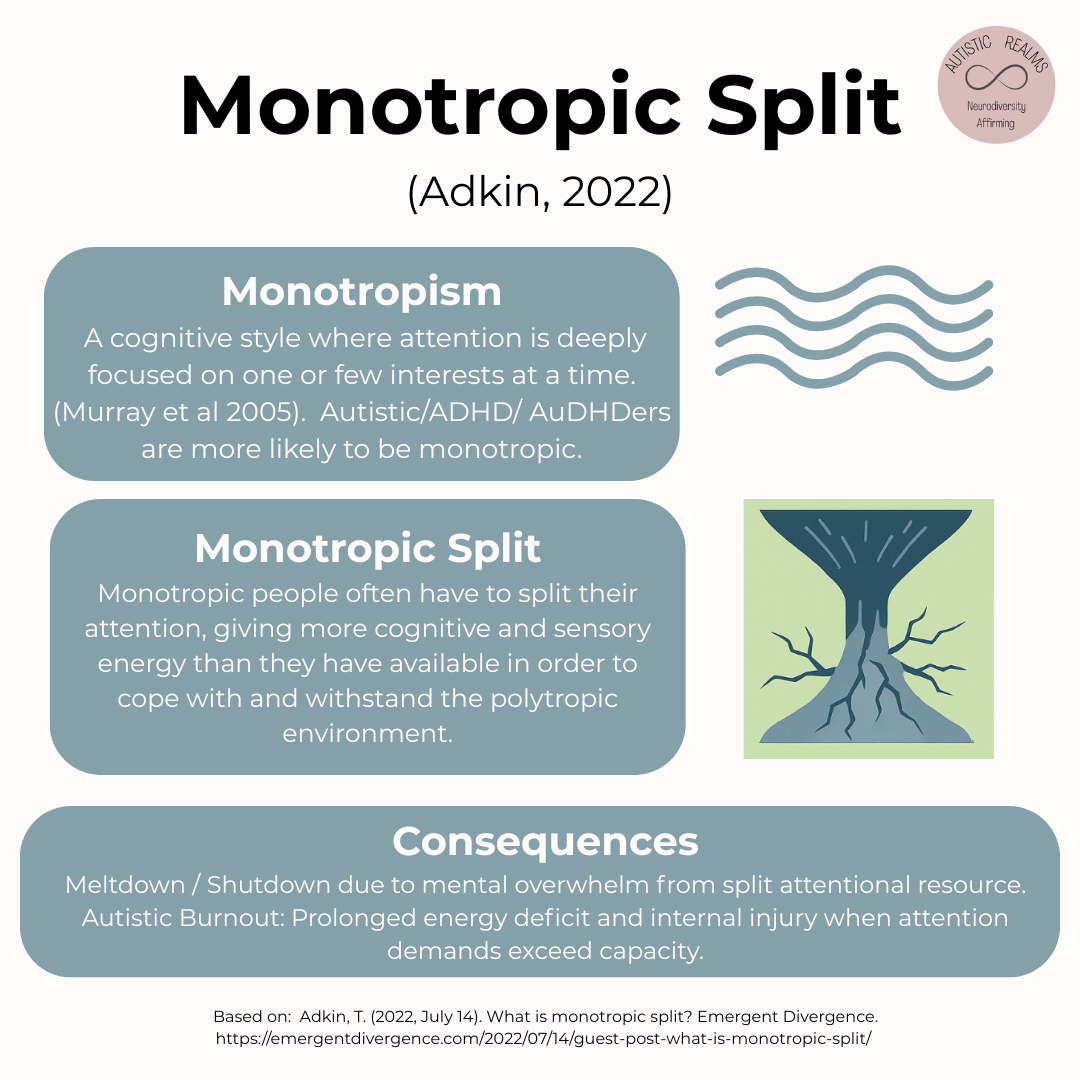
    Building on the idea of environmental mismatch, Adkin (2022) describes the concept of monotropic split: in settings that align with our interests and allow for uninterrupted flow, monotropic people can appear highly capable, sometimes exceptional. However, our functioning can drop sharply when pulled into low-interest, multi-task-heavy situations. Splitting attention across multiple channels is exhausting in the moment and, over time, unsustainable, contributing to burnout.

    Monotropism helps to describe how repeated disruptions to deep-focus states can cause attention fracture or monotropic split. The ability to immerse in an interest or task breaks down. Even activities we usually love can feel harder to start or sustain. Our sense of competence and identity can be shaken.

    From the outside, this can look like inconsistency and may help explain the spiky profiles so often attributed to neurodivergent people, excelling one day and “struggling” the next. In reality, it reflects whether the environment enables or obstructs monotropic engagement. The variation emerges from the interplay between our deep-focus attentional style and the demands of the setting. I have discussed this more in my blogs Autistic Young People: Skills Regression, Burnout or a Shift in Monotropic Attentional Resources? and Unmasking: Reclaiming Our Monotropic Attentional Resources?

    Infographic with pale green background titled “Monotropic Split – Tanya Adkin (2022).” Left side shows a dark blue attention funnel splitting into multiple cracked streams, symbolising fragmented focus. Sections explain that monotropic people focus deeply on few interests (Murray et al., 2005) but may be forced to split attention across multiple demands, causing overload, trauma, and burnout. Causes include multitasking expectations and non-affirming environments; consequences include meltdowns, burnout, and mental health crises. A boxed statement reads: “Monotropic people often have to split their attention, giving more cognitive and sensory energy than they have available in order to cope with the environment.” Footer shows full APA reference for Adkin’s 2022 article.

    This split becomes clearer when we consider Heasman et al.’s (2024) observation that for Autistic and monotropic people, flow is never guaranteed; it depends on environmental affordances. Authentic engagement and productivity require conditions such as predictable and safe sensory environments, autonomy to follow meaningful interests, minimal unnecessary interruptions, and clear and manageable transitions.

    When these conditions are absent, as they often are in polytropic systems like schools and workplaces, noise, unpredictability, and constant switching between tasks drain energy. Instead of channelling attention into the work, we spend most of our limited resources managing disruption. Over time, this erodes productivity and undermines confidence, self-esteem, and overall wellbeing.

    The fragility of flow is also closely tied to how we experience time. Tolani and Venkatesan (2025) describe how hyperfocus is part of a nonlinear, present-oriented experience of time for ADHDers; hours can pass in what feels like minutes. Being pulled out of that state abruptly can be disorienting, even physically uncomfortable. Without sensory safety and predictable transitions, re-entering that depth of focus becomes much harder, and recovery often takes far longer than others realise. For monotropic people, “just picking up where you left off” is rarely realistic; it demands significant energy and effort. Over time, the constant strain of trying to fragment monotropic flow to meet the breadth-first demands of a polytropic world becomes exhausting, and for many of us, this is one of the pathways into burnout.

    Burnout and Recovery for Monotropic People

    Burnout for Autistic people, ADHDers, and AuDHDers is about far more than “doing too much.” It is often the result of the cumulative stress of a sustained mismatch between how our monotropic attention naturally works and what polytropic environments demand (Buckle et al., 2021; Hossain & Bain, 2025; Raymaker et al., 2020).

    When we are forced to operate in polytropic systems that demand constant task-switching, value neuronormative ways of communicating and socialising, ignore our sensory needs and what meaningful rest looks like, undervalue interest-based engagement, and interrupt flow repeatedly without recognising the impact of Autistic inertia (Buckle et al., 2021), our resources are steadily drained. Burnout is what happens when that drain goes on for too long without the chance to recover.

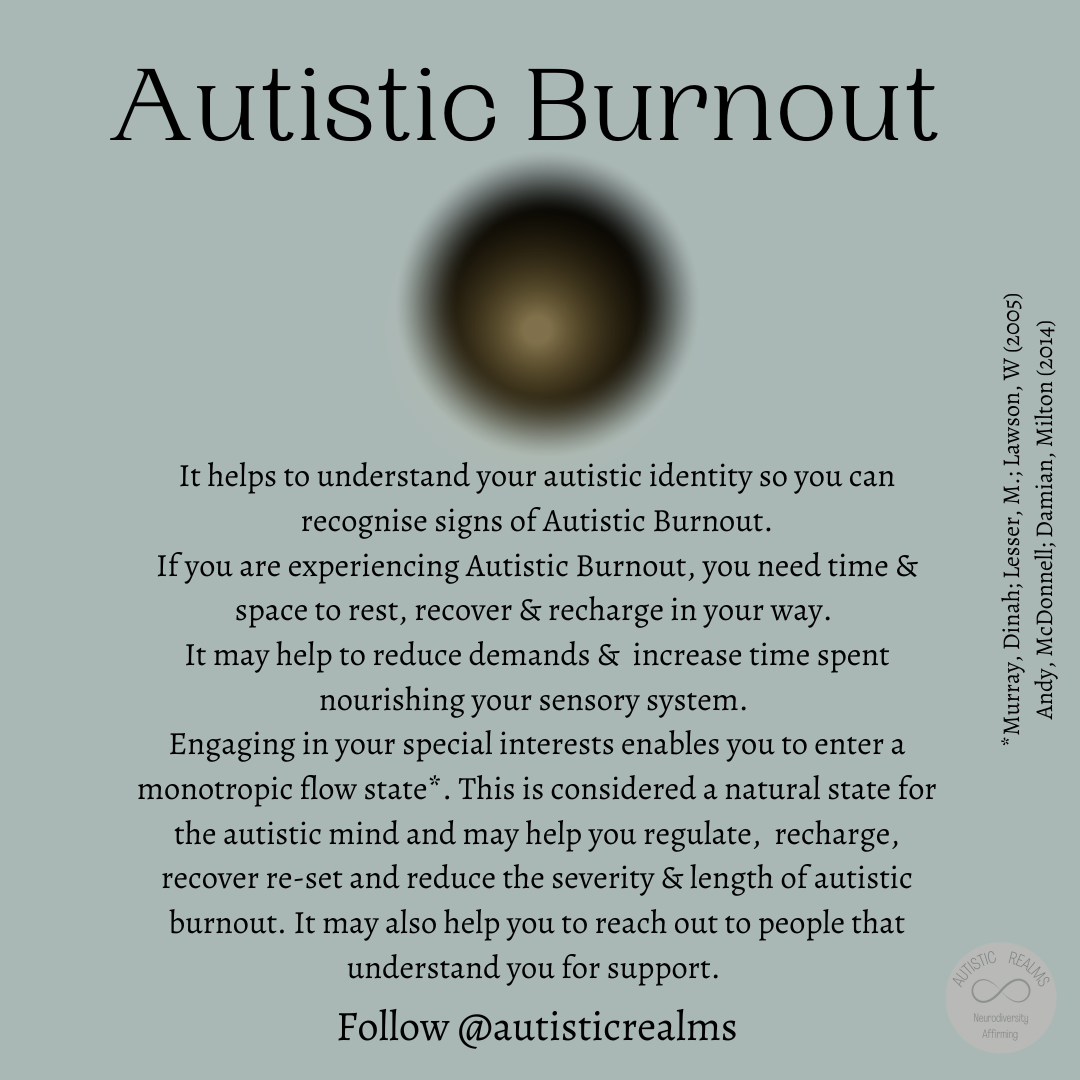
    Image of hazy black dot. Text: It helps to understand your Autistic identity so you can recognise signs of Autistic Burnout. If you are experiencing Autistic Burnout, you need time and space to rest, recover and recharge in your way. It may help to reduce demands and increase time spent nourishing your sensory system. Engaging in your special interests enables you to enter a monotropic flow state. This is considered a natural state for the Autistic mind and may help you regulate, recharge, recover, re-set and reduce the severity and length of Autistic burnout. It may also help you to reach out to people that understand you for support. Follow @autisticrealms. Autistic Burnout. Murray, Lesser and Lawson (2005); McDonnell and Milton (2014).

    Monotropism and Wellbeing

    Drawing from Fergus Murray’s (2023) keynote presentation on Monotropism and Wellbeing, McDonnell and Milton’s (2014) reframing of repetitive behaviours as flow activities, and Heasman et al.’s (2024) emphasis on environmental accommodations, the conditions that best support Autistic people (and likely all monotropic people) are things like protecting flow states, because uninterrupted engagement in meaningful activities supports regulation, learning, and joy; reducing unnecessary task-switching, because constant redirection erodes focus, increases anxiety, and lengthens recovery time; and honouring interest-based engagement, because working with genuine passions sustains motivation and restores energy. Creating predictable, sensory-safe environments may help attention shifts be less jarring (how these look and feel will depend on the individual). Allowing for recovery rhythms, with extended periods of low demand and room for meaningful, monotropically aligned rest and self-directed activity, helps rebuild capacity, energy and flow.

    McDonnell and Milton (2014) explain that what is often called “repetitive behaviour” can be a way of self-regulating, helping us recover balance after stress. For monotropic people, these flow activities are essential for wellbeing, rather than a distraction from “real work”. Heasman et al. (2024) point out that flow depends on the right environment: having control over what we are doing, being safe from interruptions, and being in a space that values deep focus. Without this, recovery can stall. The Monotropism Questionnaire (Garau et al., 2023) reflects this too: its factors include the impact of the environment on the attention tunnel and losing track of other needs while focused, which suggests that supportive surroundings matter for getting back into focus, and that while deep engagement is valuable, we may also need gentle reminders to look after ourselves.

    Recovery means protecting the conditions that help us go deep: enough time for interest-based activities, predictable and comfortable sensory settings, and fewer demands while easing back into work or study. Forcing ourselves to cope with constant switching or spreading our attention thin only makes things harder. Unless schools and workplaces stop expecting monotropic people to work like polytropic multitaskers, burnout will keep happening, and the blame will keep falling on neurodivergent individuals instead of the environment.

    Building Monotropism-Affirming Spaces

    When we design education, workplaces, and communities with only polytropic people’s needs in mind, we limit what monotropic people can bring to the world.

    In Education

    • Allow extended time for deep, interest-based projects rather than constant short tasks.
    • Reduce unnecessary task-switching, and build in natural transitions between subjects or activities.
    • Create sensory-predictable but flexible learning spaces.
    • You could use the Monotropism Questionnaire (Garau et al., 2023) as a tool to understand learner needs. However, there is not yet a monotropism questionnaire for children or young people, so it is not validated for them and would likely need to be adapted.

    In Workplaces

    • Design roles around passions and interests for sustained focus and depth, rather than constant switching.
    • Give advance notice of changes, deadlines, or meetings so focus shifts are less abrupt and multimodal communication needs are honoured.
    • Provide quiet, low-distraction workspaces alongside collaborative areas.
    • Value depth-based productivity as equally important as breadth-based multitasking.

    When systems adapt to include monotropic attention styles, burnout reduces, and the creativity, problem-solving, and deep knowledge that monotropic people bring have room to grow. The aim is to shape systems so that both depth and breadth of attention are valued, and so that all of us have the conditions we need to thrive, whatever our attention style.

    References

    Adkin, T. (2022, July 14). Guest post: What is monotropic split? NeuroHub Connect. https://neurohubcommunity.org/2022/07/14/guest-post-what-is-monotropic-split/

    Buckle, K. L., Leadbitter, K., Poliakoff, E., & Gowen, E. (2021). “No way out except from external intervention”: First-hand accounts of autistic inertia. Frontiers in Psychology, 12, Article 631596. https://doi.org/10.3389/fpsyg.2021.631596

    Garau, V., Murray, A. L., Woods, R., Chown, N., Hallett, S., Murray, F., Wood, R., & Fletcher-Watson, S. (2023). Development and validation of a novel self-report measure of monotropism in autistic and non-autistic people: The Monotropism Questionnaire [Preprint]. OSF Preprints. https://doi.org/10.31219/osf.io/ft73y

    Heasman, B., Williams, G., Charura, D., Hamilton, L. G., Milton, D., & Murray, F. (2024). Towards autistic flow theory: A non-pathologising conceptual approach. Journal for the Theory of Social Behaviour, 54(4), 469–497. https://doi.org/10.1111/jtsb.12427

    Hossain, M., & Bain, J. (2025). Beyond behavior: Understanding ADHD burnout and the need for belonging in UAE schools. Psychology in the Schools, 62(10), 4265–4275. https://doi.org/10.1002/pits.70000

    Jurgens, A. (2020). Neurodiversity in a neurotypical world: An enactive framework for investigating autism and social institutions. In H. Bertilsdotter Rosqvist, N. Chown, & A. Stenning (Eds.), Neurodiversity studies: A new critical paradigm (pp. 73–88). Routledge. https://doi.org/10.4324/9780429322297-8

    McDonnell, A., & Milton, D. (2014). Going with the flow: Reconsidering “repetitive behaviour” through the concept of “flow states”. In G. Jones & E. Hurley (Eds.), Good autism practice: Autism, happiness and wellbeing (pp. 38–47). BILD. https://kar.kent.ac.uk/62647/

    Milton, D. E. M. (2012). On the ontological status of autism: The “double empathy problem”. Disability & Society, 27(6), 883–887. https://doi.org/10.1080/09687599.2012.710008

    Murray, D., Lesser, M., & Lawson, W. (2005). Attention, monotropism and the diagnostic criteria for autism. Autism, 9(2), 139–156. https://doi.org/10.1177/1362361305051398

    Murray, F. (2023). Monotropism and wellbeing [Keynote presentation]. Scottish Autism Research Group Conference 2023. https://monotropism.org/wellbeing/

    Raymaker, D. M., Teo, A. R., Steckler, N. A., Lentz, B., Scharer, M., Delos Santos, A., Kapp, S. K., Hunter, M., Joyce, A., & Nicolaidis, C. (2020). “Having all of your internal resources exhausted beyond measure and being left with no clean-up crew”: Defining autistic burnout. Autism in Adulthood, 2(2), 132–143. https://doi.org/10.1089/aut.2019.0079

    Tolani, P., & Venkatesan, S. (2025). The time we see: ADHD, neuroqueer temporality, and graphic medicine. Perspectives in Biology and Medicine, 68(1), 117–138. https://doi.org/10.1353/pbm.2025.a953457

  • Young Autistic and ADHD People and Monotropic Time

    Young Autistic and ADHD People and Monotropic Time

    Autistic/AuDHD Experiences & Time

    Time is often assumed to be neutral, constant, and universally experienced. But for Autistic, ADHD, and AuDHD people, time rarely feels linear or neutral. Drawing from The Time We See (Tolani & Venkatesan, 2025) and my Map of Monotropic Experiences (Edgar, 2024), I will explore how time can be subjective, embodied, fluid, and experienced differently through the lens of monotropism. By changing how we see and use time, we may be able to provide more neuro-affirmative support for Autistic/ADHD young people at home and in educational settings. (For more on the theory, see my posts “Monotropic Time” and “Monotropic Time & Neuroqueering Temporalities“.)

    In Time Binds, Elizabeth Freeman (2010) introduced the term “chrononormativity.” Chrononormativity is society’s expectation that we must live by linear, productive time. This means meeting developmental and educational milestones, and later following the seemingly invisible path to have relationships at set times of life and to achieve certain career goals: a path that many of us are expected to travel regardless of neurotype, disability or any other aspect of intersectionality that may affect that path.

    Monotropism: A Neuro-Affirmative Theory

    Monotropism is a neuro-affirmative theory of autism which was originally developed by Dinah Murray, Wenn Lawson, and Mike Lesser (Murray et al., 2005). The theory of monotropism describes a cognitive tendency to focus deeply on fewer interests. Many ADHD and AuDHD people also resonate with the theory of monotropism, and the Monotropism Questionnaire (Garau et al., 2023) has given researchers a way to measure it.

    Monotropism affects how we use our attentional resources and explains lots of things, from different ways of communicating, playing, working and socialising to how our sensory systems may respond differently if you are monotropic. I think the theory of monotropism could also play a part in how time is perceived, even though there is not yet much research about this. When engaged in passions and things that pull in our attentional resources, monotropic people enter a “flow state” where time may feel more expansive or even irrelevant.

    Problems with Neuronormative Time

    We need to consider what happens when people diverge from the rhythm and patterns of neuronormative time and expectations, by being neurodivergent rather than by choice. Many Autistic and ADHD people experience burnout from masking and trying to align with neurotypical time. We’re often labelled as “late,” “disorganised,” or “chaotic,” and these labels can carry shame and add to stigma.

    Tolani and Venkatesan (2025) highlight that ADHDers naturally diverge from “normal” (neurotypical) time. Neuronormative time is an invisible standard that privileges punctuality, developmental, educational, and life milestones, and productivity. Falling out of sync with this time frame is often seen as pathological, something that needs ‘fixing’ for Autistic/ADHD people, rather than as merely inconvenient.

    Schools reinforce neuronormative time; in many ways they have to, but there are ways they could be more flexible. Schools have to function for staff and families. They need to have some kind of start and end times, and they have to abide by curriculums and timetables that are set up to ensure each child has access to full-time provision and can meet set goals. Parents and carers have to work, so having fixed start and end times is essential so families can plan and businesses can run. Things like breakfast clubs and after-school clubs are now as much of an essential part of school life for many families as the 9 to 3.30 school day itself.

    However, the problem is often how time is used and the expectations around time. From very early on in life, children are expected to meet various developmental milestones, such as learning to be ‘school ready’. Some guidance around typical developmental milestones can be really helpful. It can signal difficulties for parents and professionals when a child isn’t meeting certain milestones, but developmental milestones are just a guide. If a child is neurodivergent then their developmental path may not be so linear; they may have a more spiky profile, and this is rarely taken into account.

    Various trusts and charities have called on the government to support the new Starting Reception definition of school readiness (Tes, 2025). It includes four categories, each with linked skills. Growing independence covers things like putting on a coat and shoes, using the toilet, getting dressed, using cutlery, spending time away from parents, and taking part in imaginative play and creative activities. Building relationships and communicating covers sharing and taking turns, talking about feelings, singing, speaking clearly to ask for help, paying attention for short periods, and following simple instructions. Physical development includes getting moving for at least three hours a day, climbing, catching a large ball, and doing puzzles and crafts. Healthy routines include brushing teeth twice a day, going to bed at the same time each night, limiting screen time, and eating a healthy diet and trying new foods.

    If you read down this list and you have an Autistic child, you will likely see some of the difficulties with school readiness campaigns! Your Autistic child may be doing really well and progressing exactly in their own time and in their own way, but may not be meeting these milestones, with or without any additional learning disabilities, just because they are developing in a different way.

    Behaviourist approaches that are used in many schools often penalise students who can’t keep up with the rapid transitions of the school day or fast-paced lessons, and they often fail to account for differences in monotropic processing. A more flexible, fluid approach to how time is used in educational settings could help Autistic/ADHD/monotropic (and many other!) people flourish within their own temporal rhythms.

    Different Experiences of Time

    Just as there is no one-size-fits-all curriculum and no one-size-fits-all guide for school readiness, there isn’t a one-size-fits-all dimension of time. Considering how monotropic people experience and use time may provide better ways to provide support.

    When an Autistic, ADHD or AuDHD (monotropic) person is absorbed in their special interests or passions, it may feel like the outside world is melting away or time is dissolving. They may be fully absorbed in a project or engaged in something of specific interest to them for hours at a time, unaware of their surroundings. This immersive attention tunnel is both rejuvenating and essential for Autistic/ADHD wellbeing, and it can feel really painful to be pulled out of this flow state. Navigating back into neuronormative time can feel really jarring and be highly dysregulating, especially if someone else suddenly interrupts or is trying to force you out of your attention tunnel.

    The River of Monotropic Time

    My Map of Monotropic Experiences visualises this: a river of flow states buffered by the “Riverbanks of Monotropic Time,” surrounded by forests of joy, mountains of ruminating thoughts and burnout whirlpools. Inside the river is where monotropic people thrive: in flow, immersed, safe. Outside it lie the “Shark Infested Waters of Neuronormativity,” with their rigid demands and expectations.

    In flow, there’s no anxious “now/not now” binary or sense of inertia. But outside it, especially when stuck between interests or pulled out of flow states and attention tunnels prematurely, life can feel disorienting. As I’ve written about in Monotropism, Autism & OCD (Edgar, 2023), this “frozen flow” can become a stuck state that is often pathologised, but it may be a symptom of mismatched experiences of time. Mihaly Csikszentmihalyi’s flow theory (1990) tells us that flow is an optimal state for everyone. For Autistic/AuDHD people, these states are often pathologised as “restricted and repetitive interests.” If we reframed them as monotropic passions and being in a flow state, we’d maybe see just how crucial monotropic time is to our wellbeing.

    When we understand monotropic time as natural and valid, life becomes smoother. We need to go with our inner monotropic flow and tides, rather than constantly feeling like we are battling against them upstream.

    Temporal Embodiment and Neuroqueer Time

    Time is also bodily. Maurice Merleau-Ponty (1962) reminds us that perception, including of time, is always embodied. Buckle et al. (2021) describe Autistic inertia as a state where movement, motivation, or action feels impossible until something shifts. Barbara Adam (1995) writes about how bodily rhythms (circadian, emotional, hormonal) intertwine with social time. When these don’t align, the mismatch causes guilt, disconnection, and misunderstanding. Time perception might also be subject to the double empathy problem (Milton, 2012), where misunderstandings between neurotypical and neurodivergent people reflect different temporal logics, a two-way gap rather than a one-sided Autistic “deficit”.

    Nick Walker’s Neuroqueer Heresies (2021) reframes neurodivergence as a different, creative mode of being. Neuroqueering time, then, is about resisting capitalist demands and tuning into your internal rhythms. It is, as Tolani and Venkatesan (2025) describe, a move toward temporal plurality: a recognition that time perception is not universal, and that our different realities give rise to different ways of living in time. The Autistic rhizome, as David Gray-Hammond and I have explored (Gray-Hammond, 2023; Edgar, 2026), offers a metaphor for neuroqueer time: non-linear, relational, emergent, and expansive. It’s time that flows in spirals, connects in webs, and exists across time zones as communities form online 24/7.

    From Disordered Time to Different Time

    Robert Chapman’s Empire of Normality (2023) shows how pathologising autism and ADHD is a political act. Classifying these experiences as “disordered” upholds a capitalist logic that favours productivity and conformity over authentic experience.

    By sharing our lived experiences, through blogs, art, infodumps, or maps, we can begin to “re-story” time itself. Whether we name it monotropic time, neuro-holographic time, spiral time, or something else entirely, we are reclaiming our narratives and reframing how time can work with us.

    Towards a Temporally Inclusive World

    To make space for monotropic time, we need to reimagine our institutions and environments: quiet waiting rooms, flexible appointments, emails instead of calls, and space for body doubling, authentic connection, and collective flow. Small changes, like those we explore in our Neuroqueer Learning Spaces with Stimpunks, can foster inclusion and affirm different ways of being, and show what’s possible when we support monotropic flow rather than interrupt it. The goal goes beyond accommodating Autistic people; it is to neuroqueer society for the benefit of everyone.

    Time does not need to be a prison; it can instead become a portal into deeper flow states and a more embodied, authentic way of being. When we share time with neurokin, our experiences align. The anxiety melts. The masking lifts. It feels just right. Like home.

    Whether through the melting clocks of surrealism, the riverbanks of monotropic flow, or the relational rhythms of neurokin, there are endless ways to experience and honour time. Let’s stop trying to squeeze everyone, especially our children, into one rigid clock. There is no single right way to live, be, or feel time.

    Share Your Story of Monotropic Time

    We are gathering stories of monotropic experience (art, blogs, essays, poetry, music) in collaboration with Stimpunks, through the Call for Submissions: Share Your Experiences of Being Monotropic. Come and share your time portals with us, and let’s collectively rewrite the story of time, one portal at a time.

    References

    Adam, B. (1995). Timewatch: The social analysis of time. Polity Press.

    Buckle, K. L., Leadbitter, K., Poliakoff, E., & Gowen, E. (2021). “No way out except from external intervention”: First-hand accounts of autistic inertia. Frontiers in Psychology, 12, Article 631596. https://doi.org/10.3389/fpsyg.2021.631596

    Chapman, R. (2023). Empire of normality: Neurodiversity and capitalism. Pluto Press.

    Csikszentmihalyi, M. (1990). Flow: The psychology of optimal experience. Harper & Row.

    Edgar, H. (2023, August 16). Monotropism, autism & OCD. Autistic Realms. https://autisticrealms.com/monotropism-autism-ocd/

    Edgar, H. (2024, December 7). Map of monotropic experiences. Autistic Realms. https://autisticrealms.com/map-of-monotropic-experiences/

    Edgar, H. (2026, February 22). The Autistic rhizome: Community, liminal spaces & belonging. Autistic Realms. https://autisticrealms.com/the-autistic-rhizome-community-liminal-spaces-belonging/

    Freeman, E. (2010). Time binds: Queer temporalities, queer histories. Duke University Press.

    Garau, V., Murray, A. L., Woods, R., Chown, N., Hallett, S., Murray, F., Wood, R., & Fletcher-Watson, S. (2023). Development and validation of a novel self-report measure of monotropism in autistic and non-autistic people: The Monotropism Questionnaire [Preprint]. OSF Preprints. https://doi.org/10.31219/osf.io/ft73y

    Gray-Hammond, D. (2023, April 21). Neuro-anarchy and the rise of the Autistic rhizome. NeuroHub Connect. https://neurohubcommunity.org/2023/04/21/neuro-anarchy-and-the-rise-of-the-autistic-rhizome/

    Merleau-Ponty, M. (1962). Phenomenology of perception (C. Smith, Trans.). Routledge & Kegan Paul.

    Milton, D. E. M. (2012). On the ontological status of autism: The “double empathy problem”. Disability & Society, 27(6), 883–887. https://doi.org/10.1080/09687599.2012.710008

    Murray, D., Lesser, M., & Lawson, W. (2005). Attention, monotropism and the diagnostic criteria for autism. Autism, 9(2), 139–156. https://doi.org/10.1177/1362361305051398

    Tes. (2025, March 11). EYFS: Call for an agreed definition of school readiness. https://www.tes.com/magazine/news/early-years/29-signs-school-readiness

    Tolani, P., & Venkatesan, S. (2025). The time we see: ADHD, neuroqueer temporality, and graphic medicine. Perspectives in Biology and Medicine, 68(1), 117–138. https://doi.org/10.1353/pbm.2025.a953457

    Walker, N. (2021). Neuroqueer heresies: Notes on the neurodiversity paradigm, autistic empowerment, and postnormal possibilities. Autonomous Press.

  • Mingling with the universe: Autistic Perception

    Mingling with the universe: Autistic Perception

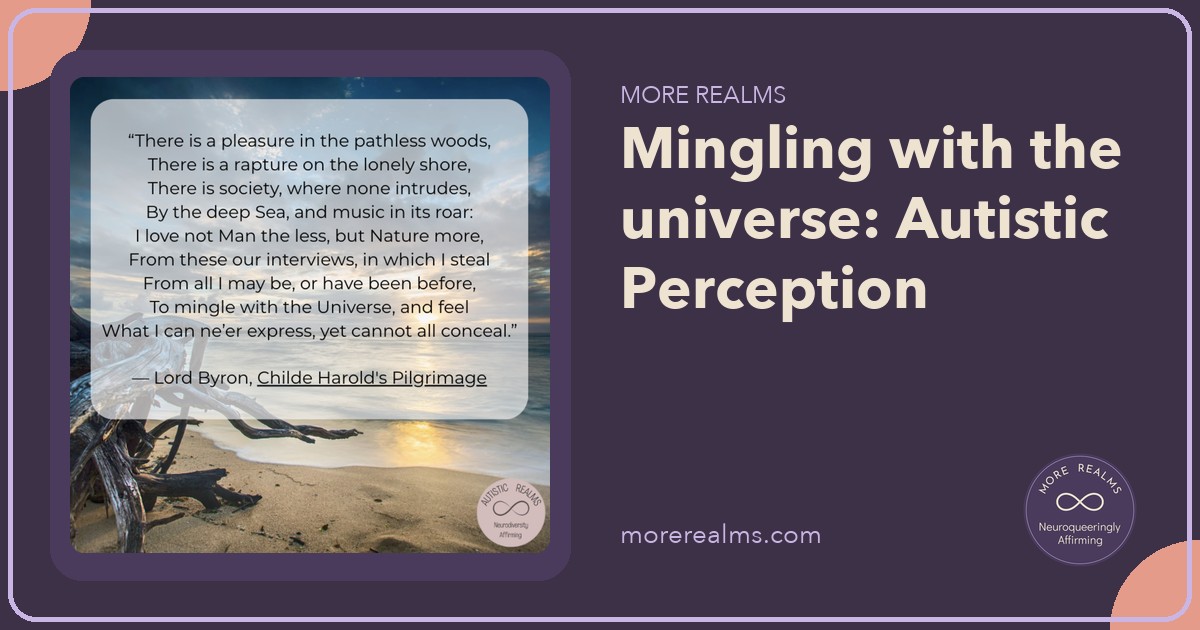
    This section of the poem from Lord Byron, Childe Harold’s Pilgrimage, speaks to me deeply and resonates with my Autistic experience of meaning as something felt, sensed, and lived through, especially in solitude, sensory immersion, and more-than-human connection.


    There is a pleasure in the pathless woods,
    There is a rapture on the lonely shore,
    There is society where none intrudes,
    By the deep Sea, and music in its roar:
    I love not Man the less, but Nature more,
    From these our interviews, in which I steal
    From all I may be, or have been before,
    To mingle with the Universe, and feel
    What I can ne’er express, yet cannot all conceal.


    Lord Byron, Childe Harold’s Pilgrimage, canto iv


    Autistic meaning-making is not abstract, but an embodied attunement, a “mingling with the Universe” that resists neuronormative expression yet pulses with emotional and sensory intensity.

    As Erin Manning wrote, “Autistics…are hypersensorial, alive not only to the presence of the other, but more importantly, to the absence of category. They live the differential, feeling into the world’s quality of emergence. Bodying, for them, is worlding.”

    Autistic experience often resists the default social scripts and expected ways of making sense of things, our thoughts are less linear, more constellation-y and rhizomatic. They may appear chaotic and not always make sense to others as the connections are happening deep inside us.

    Meaning for me, often arises between things, in the liminal spaces, in the felt sensory and emotional moments, a subtle change of a sound, the shifting pattern of sunlight on leaves and my relationship with living things that don’t speak in human words, and also a more natural attunement to people who also can’t or prefer not to speak verbally.

    Like Lord Byron’s “rapture on the lonely shore,” the Autistic sense of meaning-making may emerge most powerfully in the absence of human intrusion, words and voices, not from isolation, but from a deep, open presence with what is. It is why we may crave time alone, in our dens, out in nature, fully immersed in stimming activities and other forms of communication and connecting online. Alone time is so often stigmatised as being antisocial, but it is a different kind of sociality, and may be more meaningful for many Autistic people and is something to value and allow ourselves the time to lean into in what ever way we want and helps us feel good. It may be less about escaping and more about finding belonging in other ways and belonging otherwise.

    Autistic people often experience a heightened resonance and connection with our environment, this may not always be with people, but with animals, objects, places, atmospheres and sensory experiences. This is not a deficit of sociality, but perhaps a re-routing of relational (monotropic) attention toward the more-than-human, an ethodivergent way of being. (Ombre Tarragnat, 2025)

    I have written extensively about liminality, the in-between spaces where many Autistic people feel they may be stuck, but I think it is in these liminal spaces and states, where our bodyminds “mingles with the Universe,” that we can find a quiet calm that helps regulate, bring comfort and a meaning that allows us to emerge from the liminal or delight in the dwelling moments of the unspoken between realms. It is in liminality that Autistic perception becomes a kind of aesthetic felt knowing. It may not be easily verbalised or put into human words, “what I can ne’er express” but it is real, it emerges and can be captured in art, poetry and nature, in our online community spaces and is valid.

    “There is society where none intrudes”.

    “There is pleasure in the pathless woods” when we diverge from neuronormative expectations and follow our inner compasses.

    Allowing ourselves to feel, wholly and completely and merge with our environment is a way of creating our own language, a bodymind way of being that doesn’t rely on human words and can be felt and understood in other ways………we need to create our own worlds, reworld, neuroqueer – so we can survive together in a world dominated by neuronormativity and find our own place of belonging.

    Image of frozen droplet of water in snow Text: "HAD I NOT CREATED MY WHOLE WORLD. I WOULD CERTAINLY HAVE DIED IN OTHER PEOPLE'S" ANAIS NIN

    Sharing early morning thoughts after having read more of Erin Manning‘s beautiful work last night ‘A Feel for Others Feeling You‘ (2025), about challenging normative orientations around the concept of mirror-touch synaesthesia and touch (inspired by the DeafBlind Protactile community and work of John Lee Clark).

    “To feel the touch of the world is to feel the difference the world brings to all it comes into contact with, and this contact cannot be separated from all that worlds. To be a body is to be in contact. To touch is to feel the differential.”
    (Erin Manning, 2025)

    Thoughts welcome – I am hoping to set up an alternative space to explore through Autistic Realms into More Realms to share, discuss and collaborate on things like this with anyone who is interested alongside CASY Cultural Autism Studies at Yale and Stimpunks communities.

    Ocean Waves


    Listen to Ocean Waves by Adriel Jeremiah Wool:

    “Ocean Waves by Adriel J Wool” is a meditation in ambient flow states. Introduced with a special tuning that allows the brain to touch and feel more true pythagorean intervals of musicality.

    The flows and textures of nature follow patterns that resonate with the human body through its ability to hear sound.

    The nervous system is a microcosm, however it relates in scale to the power of nature, and is comforted within her crests.

    To breathe more slowly and more deeply. The sound spectrum is given in the powerful release of deep sound energy, very much like the Earth’s beautiful shores.”

    “Ocean Waves by Adriel J. Wool isn’t a recording of the ocean, it’s a fractal composition of the nature of the ocean. Modulated into swells, the rhythm evokes the massive release of great ocean waves and the more humble release of the human breath“.
    Ryan Boren (Stimpunks)


    Discover more

    Courses, books and resources

    If you would like to take these ideas further, my courses, books and resources live on Autistic Realms. Everything in the shop is pay what you can, and many resources are free.