Category: Monotropism

  • Migration & Trusting Our Inner Monotropic Compass

    Migration & Trusting Our Inner Monotropic Compass

    Inspired by Brigit Anna McNeill’s “The Living Page” Migration writing workshop, Into the Woods Writing Group, 6 August 2026.

    I spent the evening of sixth of August in Brigit McNeill’s Migration writing workshop with the Into the Woods writing group, in a session called The Living Page. We were invited to write from and with migration, as a movement to think inside of, inspired by Brigit’s own writing.

    What follows is some of what I shared during the workshop and what I have been thinking about afterwards, threaded through with the ideas I keep returning to in my work on monotropism and neuroqueer theory.

    Inner Compass

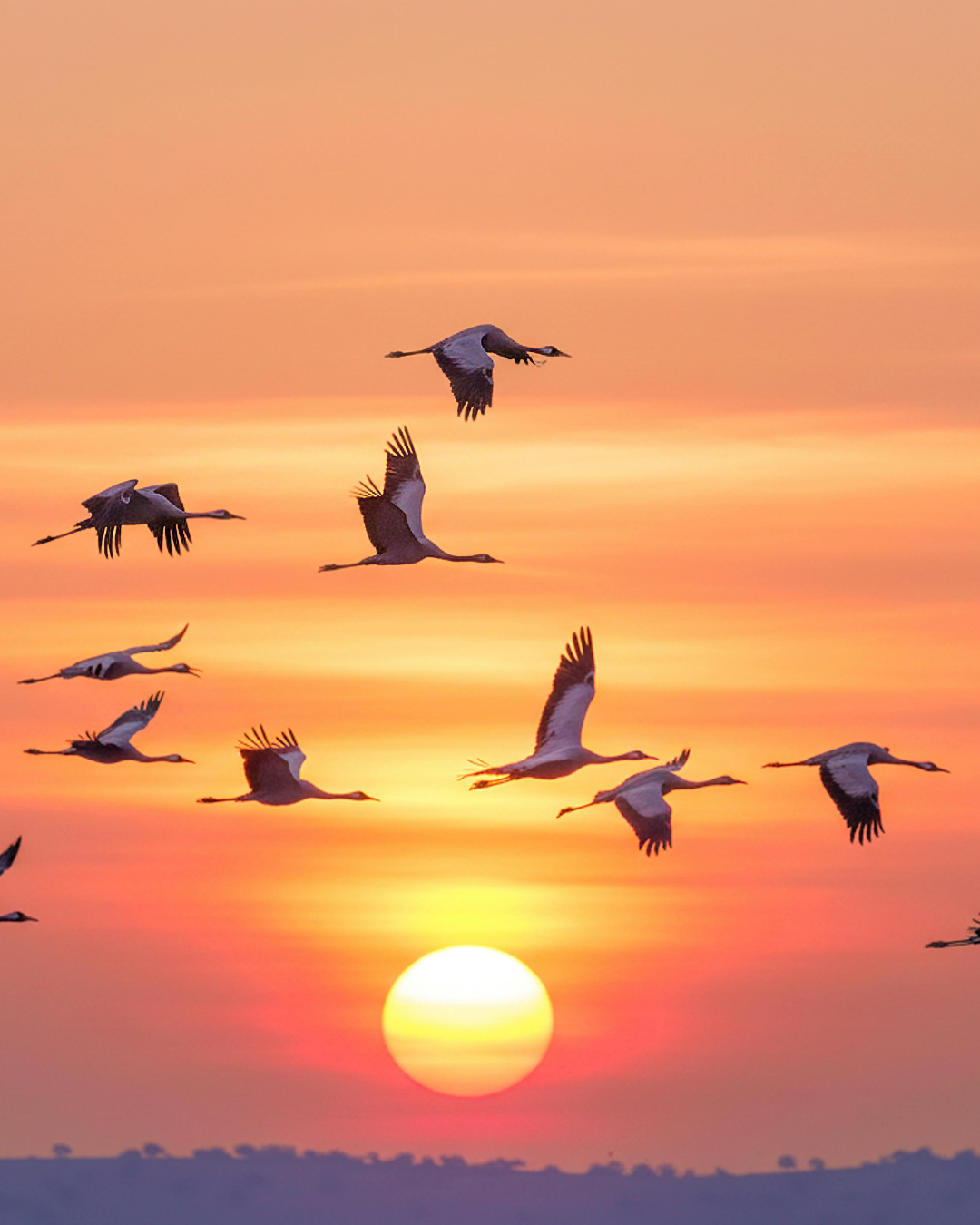
    Birds cross oceans using a compass sense we still don’t fully understand. It may involve something in their eyes that responds to the Earth’s magnetic field, through a quantum mechanism that is still being worked out (Mouritsen, 2018). A bird doesn’t need a conventional map; it can orient by reading the world itself as a kind of felt knowledge.

    As Brigit shared through her writing, salmon return to their birth rivers. Humpback whales cross hemispheres between calving and feeding grounds. Elephants can follow familiar routes across landscapes, including routes to water. Even a plant’s seed is carried by wind or on fur, migrating in its own way, landing on new ground.

    The Inner Tug Of Migration

    It’s easy to think of migration as recurring linear travel between fixed points — departure, journey, arrival and back again. The workshop pushed against that framing, and we discussed migration as a process of transformation across time, as much as displacement across distance.

    I feel this is close to what Deleuze (1994) was exploring through the idea of ‘difference in repetition’. The idea that no repeated pattern is ever a true copy, that each turn carries its own small variation. Migration, read this way, isn’t a repetitive loop; it’s more of a spiral. With every movement, everything changes.

    We discussed Brigit’s writing about what she calls the ‘tug’ of migration. It feels like there’s a bodily quality to how migration begins for all of us, whether crossing distance on the land as animals or in our human bodyminds. Before a bird sets off, something like a restlessness builds in its body. The pull comes from within, affected by seasons, seas, and time, and the sense of direction follows from that, in a very embodied, sensory tug.

    I recognise that kind of tug or pull in my own way of being. Monotropism (Murray, Lesser, & Lawson, 2005) describes how Autistic attention tends to gather intensely around a small number of interests, rather than spreading more evenly across many. When an interest catches me, it feels closer to that restlessness in the birds, a tug like a magnet pulling me in and arriving before my actual cognition and thinking have caught up.

    Following this tug or pull deep inside you, something opens up. Csikszentmihalyi (1990) described flow as the state that arises when attention and challenge align closely enough that the sense of separate effort disappears. It often comes with an undercurrent of wonder where the world briefly widens around whatever has caught you and opens up further into awe. I think that combination is close to what’s carrying migrating animals too: a sense of direction felt from the inside, trusted enough to move on and to see what will happen.

    Following the inner pull and desire of flow, whether it is sensory or more cognitive, leads us to connect ideas, connect people, to move our bodyminds. Flow isn’t stillness; attention is moving, even when the body isn’t. It slowly transforms us: each new interest, each sensory experience, every connection with another being or environment shifts something inside us.

    Many of us are taught early to override this feeling of going with the flow of what interests us and listening to our inner needs. We are conditioned to ignore our inner compass, to ignore our passions, our ideas, our sensory needs, especially if they fall outside of what is normally expected. We are taught to mask and suppress our flow and authentic migration.

    Research on Autistic masking describes the suppression of natural Autistic ways of being in favour of alternatives judged safer and more acceptable by society (Pearson & Rose, 2021). The tug of monotropic passion and sensory feelings often gets read as being too much, having interests too narrow, and we learn to quieten ourselves or try to adapt to fit in. Over the years, we are moving further and further away from our own internal compass and needs until we may not even recognise our true self.

    Trusting Our Inner Compass

    Trusting our inner compass again isn’t easy, and there is definitely a certain amount of privilege involved in being able to unmask and be your real Autistic self with people. Neuronormativity, the assumption that more evenly distributed, easily legible attention is the ‘correct’ default way to be. It doesn’t just ask us to behave differently; it makes us distrust ourselves too. Neuroqueering (Walker, 2021) is an ongoing practice of subverting and resisting neuronormativity. It is not a final destination to become ‘neuroqueer’ or to have ‘neuroqueered’ your life — rather, I see it as an ongoing refusal to be ashamed of who you are.

    This is where we need to re-learn to trust ourselves. Pernille Fraser’s poem “Can We Trust?” names this same rupture from the other direction: not what we lose faith in within ourselves, but what has to be earned from everyone and everything around us before that trust can return at all. The poem was written in 2019 and later shared through Stimpunks Foundation as part of our Neuroqueer Learning Spaces project. The poem repeats its central question across sensory load, pacing, correction, and the question of whether we’ll be believed and left to decide for ourselves, asking, “Can we trust the space you offer?” (Fraser, 2019/2024). The poem never resolves into an answer; it stays in the asking, leaving open questions of safety and possibility. The potential of trusting people in safe spaces to be ourselves, to keep moving and transforming.

    That same question of trust doesn’t stop at ourselves. Once we’ve relearned to trust our own inner compass, we can start noticing that everyone and everything around us, human and otherwise, is following one too when we are able to feel safe.

    Differences Of Being

    If we stop assuming there is one right way for a human mind to move through the world, perhaps we can extend that generosity beyond humans too. Migration is only one expression of a much wider range of ways living things exist in and move through the world. Ethodiversity (Tarragnat, 2024) names the variability of behavioural and existential styles within and across species, developed to open neurodiversity beyond a purely human-centred and neurological framing. A bird’s compass, a salmon’s imprinting, a whale’s seasonal crossing, and a human’s monotropic pull aren’t the same mechanism in different bodies. They’re genuinely different ways of being, each one worth recognising on its own terms.

    Difference here is already a form of connection. A migrating salmon doesn’t just pass through a river, its body becomes part of it. When Pacific salmon return to their home streams to spawn and die, their bodies carry marine-derived nutrients into freshwater and other ecosystems; they carry something from one world into another. Whales do something similar at an ocean scale: they help move nutrients such as nitrogen and iron back into sunlit waters, while their migrations redistribute nutrients across large distances. Neither salmon nor whale set out to feed a forest or an ocean, but each unique way of moving through the world is, at the same time, an act of shaping it, and being reshaped by it in turn.

    That sits well alongside Milton’s (2012) double empathy problem, which invites us to notice that people communicate and experience the world differently from one another — and that no single way of being or relating needs to sit at the centre, with everyone else read against it. It sits well, too, alongside Barad’s (2007) idea of intra-action: that a self, or a species, or a migrating body doesn’t exist as a separate thing that then relates to its surroundings, but comes into being through the relating itself. There’s no “before” and “after” self on either side of a migration, only the shaping itself. The liminal space a migrating creature passes through isn’t a gap between two finished things. Self and field, self and current, self and interest, forming each other as they go.

    Transformation and Trust

    The workshop’s real gift was permission to stop treating change as the exception that needs explaining and to start treating it as the foundation through which everything else moves. Life doesn’t hold still and occasionally migrates; it is always in a constant state of flux and flow.

    That reframing opens space for new stories to begin, not despite the shifting, but because of it. This sits alongside other threads I keep pulling on: the constellation-thinking in My Monotropic Galaxy on More Realms, and the Star Stuff work with Ryan Boren at Stimpunks, which starts from the same idea, that we are made of matter that has already migrated across unthinkable distances, reorganising itself into shape after shape after shape, connection by connection.

    Migration, in that sense, isn’t a metaphor borrowed from birds and whales. It’s been true of us for longer than we’ve had words for, trusting our inner compass isn’t something any of us can do alone as people and may be especially as Autistic monotropic people.

    Birds have the Earth’s magnetic field and the wider world around them to orient by. We need something a bit different: people and spaces willing to be trusted, willing to let us move, be, and communicate in our own way without demanding we prove it first.

    Rediscovering our monotropic inner compass is only part of the migration. The rest is building spaces safe enough to trust it in, so we can shape and be shaped by the world around us, the way the salmon and the whale do, simply by being fully who we are.


    Explore more in my Cosmic Connections collaborative project with Ryan Boren Stimpunks: Star Stuff Earth.

    A Field Guide to the Ways of Migrating

    Always Migrating Zine


    References

    Barad, K. (2007). Meeting the universe halfway: Quantum physics and the entanglement of matter and meaning. Duke University Press.

    Csikszentmihalyi, M. (1990). Flow: The psychology of optimal experience. Harper & Row.

    Deleuze, G. (1994). Difference and repetition (P. Patton, Trans.). Columbia University Press.

    Fraser, P. (2019/2024). Can we trust? [Poem]. Stimpunks Foundation. https://stimpunks.org/2024/04/27/can-we-trust/

    McNeill, B. (2026, August 2). Links to lovely things [The Living Page: Migration]. Into the Woods with Brigit Anna McNeill (Substack). https://brigitannamcneill.substack.com/p/links-to-lovely-things

    Milton, D. E. M. (2012). On the ontological status of autism: The ‘double empathy problem.’ Disability & Society, 27(6), 883–887.

    Mouritsen, H. (2018). Long-distance navigation and magnetoreception in migratory animals. Nature, 558(7708), 50–59.

    Murray, D., Lesser, M., & Lawson, W. (2005). Attention, monotropism and the diagnostic criteria for autism. Autism, 9(2), 139–156.

    Pearson, A., & Rose, K. (2021). A conceptual analysis of autistic masking: Understanding the narrative of stigma and the illusion of choice. Autism in Adulthood, 3(1), 52–60.

    Tarragnat, O. (2024). Biodiversity, neurodiversity, ethodiversity: Towards a more-than-human and more-than-neurological turn in neurodiversity studies. TRACE: Journal for Human-Animal Studies.

    Walker, N. (2021). Neuroqueer heresies: Notes on the neurodiversity paradigm, autistic empowerment, and postnormal possibilities. Autonomous Press.
  • It’s Complicated: Polytropos, Odysseus, and Homer’s Odyssey

    It’s Complicated: Polytropos, Odysseus, and Homer’s Odyssey


    What if the thing that made Odysseus remarkable wasn’t his many turns, but the one thing that never turned? A personal, AuDHD read on Homer’s Odyssey and the words polytropos and monotropos.

    Watching Christopher Nolan’s The Odyssey (2026) left me thinking about the Greek word that opens Homer’s poem: πολύτροπος (polytropos). At first glance, one possible translation of polytropos, “many-turned,” seems almost the opposite of monotropism, the theory that Autistic attention is often organised around fewer, deeply engaging interests rather than being broadly distributed across many competing demands (Murray, Lesser, & Lawson, 2005; Murray, 2022). Yet Odysseus suggests that these ideas may not be simple opposites: a person can adapt in many ways while remaining profoundly oriented towards one enduring purpose.

    Polytropos and monotropos share a root. Both come from tropos, “a turn, a way of being,” joined to a different first element: poly- (“many”) against mono- (“one”). Where polytropos described someone of many turns — Homer’s word for Odysseus’s resourcefulness and adaptability — monotropos described someone of a single turn.

    The relationship is therefore suggestive rather than equivalent. Polytropos describes a quality attributed to Odysseus’s character, while monotropism describes a theory of attentional organisation. The shared root offers a useful point of reflection, not a claim that the two concepts describe the same or different things.

    What strikes me most isn’t Odysseus’s many twists and turns. It is the one thing that never diverted his attention or devotion from Penelope and his family. Against everything thrown at him, the gods, the sea, monsters, temptation, and years away from home, Odysseus never loses sight of returning to Penelope and his family. His deepest orientation never shifted. His methods changed constantly, but they remained organised around one enduring purpose.

    Polytropos is the very first adjective Homer uses to describe Odysseus. Translators have wrestled with that single adjective (polytropos / πολύτροπον) for centuries. Richmond Lattimore famously rendered it as “the man of many ways” (Homer, 1965). Robert Fagles gave us “the man of twists and turns” (Homer, 1996). Emily Wilson’s 2018 translation, which Nolan appears to draw on heavily, opens instead: “Tell me about a complicated man” (Homer, 2018).

    Each translation highlights something slightly different. Lattimore foregrounds versatility; Fagles emphasises movement and perhaps unpredictability; Wilson stresses the complexity of Odysseus’s character, encompassing his suffering, his deceptions, and his long wanderings, rather than presenting him as a straightforward hero.

    Wilson has written about this choice in her blog “On Complicated…” (Wilson, 2024). She ruled out coining an artificial word like “much-turny,” since polytropos is “a real, legitimate Greek word,” and she wanted an equally English word rather than an invented one. Wilson’s “complicated” captures the layered nature of Odysseus: his suffering, deception, adaptability, and contradictions. She also notes that in later Greek the word travelled beyond Odysseus himself: Thucydides used it of “manifold circumstances,” and it was later applied to changeable diseases and even to the notorious turncoat Alcibiades, so a purely negative or purely positive rendering never seemed quite adequate to her either.

    Interestingly, the word polytropos is itself a bahuvrihi compound: poly (“many”) and tropos (“turn,” “way,” or “manner”). Rather than naming an action, it describes someone by a characteristic they possess. In Homer, Odysseus is someone who adapts and turns to his many changing circumstances.

    However, these translations all leave another aspect of Odysseus’s character slightly less visible: every one of those turns serves a single, enduring purpose. His adaptability is not aimless; every turn is complicated and organised around one unwavering direction of attention, that of returning home to Penelope, his family, and Ithaca.

    Before watching the film, I came across a Bluesky post by Fergus Murray that pointed me towards an interesting connection between the word polytropos and the later Greek word monotropos. That led me to the work of the classicist P. A. Meijer, who discusses the philosopher Antisthenes’ interpretation of polytropos (Meijer, 2017).

    Antisthenes argued Odysseus earned the word polytropos because he knew how to deal with all kinds of people, shifting his approach depending on who he was talking to and what the moment called for. His many “turns” weren’t deceptive tricks; they could be seen as different ways of meeting different situations and different people.

    The word monotropos does not appear in Homer’s Odyssey itself although it shares the same linguistic root as polytropos (tropos, meaning a way or mode of turning). The theory of monotropism uses that root to describe a characteristic style of attention in which cognitive resources are concentrated into a smaller number of intensely focused interests, rather than spread broadly across many competing demands — a pattern many Autistic and ADHD people recognise strongly in their own experiences (Murray, Lesser, & Lawson, 2005).

    I’m not suggesting that Odysseus was Autistic, and I don’t think it’s relevant to speculate about how a Bronze Age literary character might score on the monotropism questionnaire. That’s definitely not the point of this blog. What interests me is how these different but related words invite us to think about attention and ways of being.

    Polytropos has generally been used in various differently worded translations of Homer’s Odyssey to describe Odysseus as a man capable of many approaches. Monotropism describes the way a person’s attention is deeply organised around a limited number of concerns at any one time. Together, these words may help to illuminate human behaviour, how we respond to the world around us, and how our attention is organised, what drives and motivates us.

    Antisthenes’ interpretation of polytropos, as discussed by Meijer, suggests that someone who cannot vary their approach to different people may appear limited or one-sided. Read through a contemporary lens, it’s easy to hear echoes of the deficit-based accounts that have shaped autism research for decades.

    One of the most influential examples is the theory of mind hypothesis, which came to be interpreted as suggesting that Autistic people lacked the capacity to understand that other people have different thoughts, beliefs, and perspectives from their own (Baron-Cohen, Leslie, & Frith, 1985). It contributed to a broader, hugely problematic narrative that framed Autistic social differences primarily as deficits.

    More recently, Damian Milton’s Double Empathy Problem has challenged that assumption. Rather than suggesting communication difficulties and responsibilities lie solely with Autistic people, Milton argues that misunderstandings arise because people with different ways of experiencing and interpreting the world often struggle to understand one another. Communication is relational; the difficulty lies in the mismatch between different perspectives, not necessarily in a deficit on one side (Milton, 2012).

    I think this shift is important because it changes how we think about adaptability, attention, and flexibility. Someone who does not naturally change their communication style from person to person may certainly experience friction in predominantly neuronormative environments, but whether that should be understood as a personal deficiency or as a difference between communicative styles is a very different question, and one where the responsibility should be mutual.

    It proposes that Autistic attention tends to be organised around fewer, more deeply engaged interests, with cognitive resources concentrated rather than widely distributed (Murray, Lesser, & Lawson, 2005). It is an account of how attention is allocated, not a judgement about its value.

    Watching Nolan’s film of The Odyssey, what struck me wasn’t Odysseus’s versatility alone as a “man of many twists and turns”. Every disguise and every adaptation seemed to serve the same enduring goal: to reunite with Penelope and return to Ithaca. His attention never wandered, his methods changed constantly, but his purpose didn’t; he remained focused, fully absorbed in his quest.

    Odysseus lies when necessary, disguises himself, negotiates, fights, flatters, persuades, and endures. He changes his approach as each new situation and context demands. Yet inwardly, he seems quite monotropically focused; every turn ultimately points towards Ithaca. His many ways are all organised around one unwavering orientation.

    Perhaps this is why polytropos has proved so difficult to translate. Another point Wilson shares that feels worth ending on is that tropos itself doesn’t just mean “turn.” It also carries the sense of a way of life, a custom, a habit, a guise, a manner, a character (Wilson, 2024).

    Odysseus’s many turns, in that light, were the many guises, habits, and ways he had to adapt to survive. He was, in every sense of the word, a complicated man. I like Wilson’s choice of translation, and after all this thought, it feels right and truly captures him. She chose a word that evokes the imagery of folding and layering, that lands with the same weight and pace of the original poem. It carries an immediate meaning that everyone can relate to, while still opening onto something more, a hint of truths still to come (Wilson, 2024).

    Underneath every guise, one thing never changed. Odysseus’s complicated greatness lies less in how many ways he can turn than in what all those turns were for. For all his disguises and transformations, he remains profoundly oriented towards home. His complicatedness makes sense because it also expresses the complexity of his one enduring commitment, to finally return home to Penelope, his family, and Ithaca.

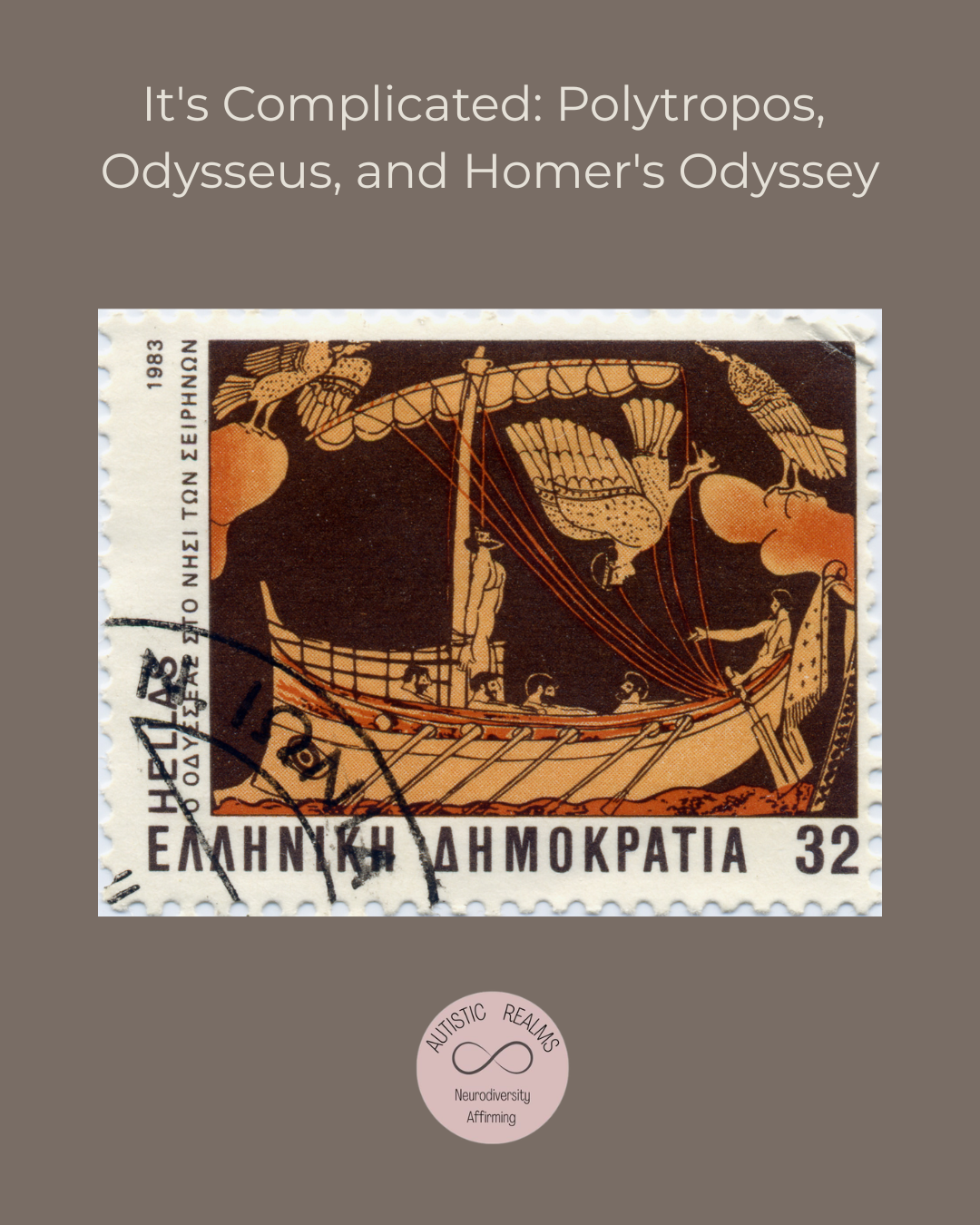
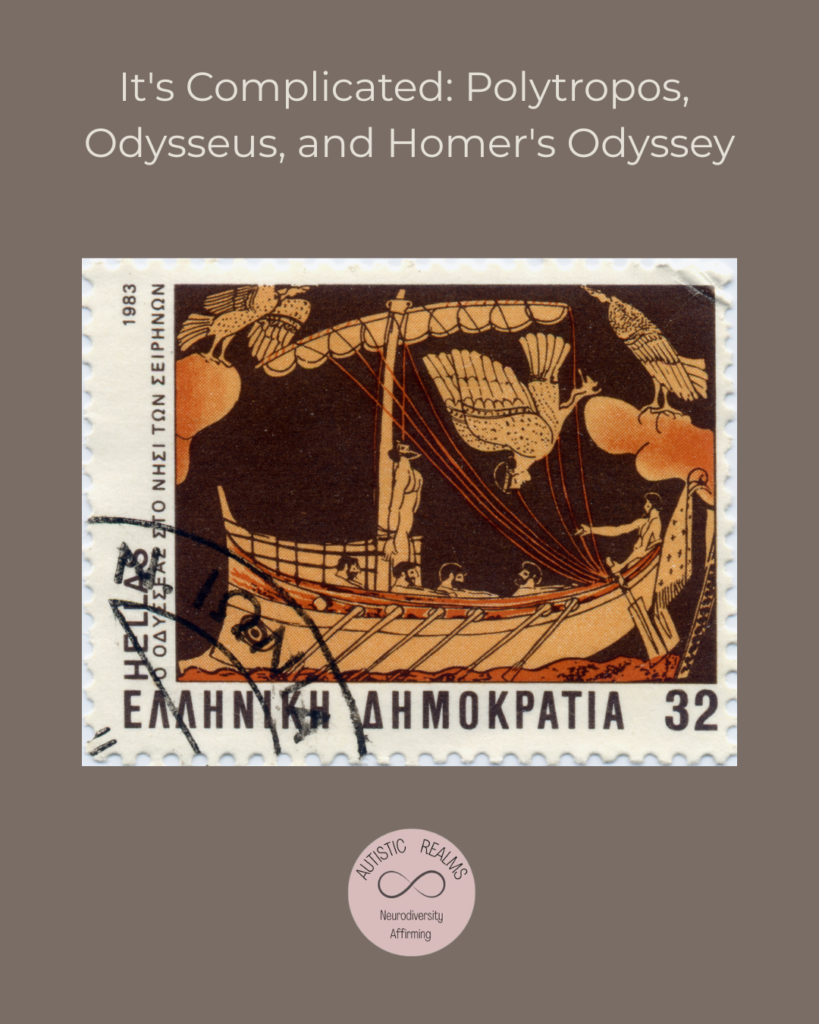
    Blog header for 'It's Complicated: Polytropos, Odysseus, and Homer's Odyssey.' Below the title, a 1983 Greek postage stamp (32 drachma, ΕΛΛΗΝΙΚΗ ΔΗΜΟΚΡΑΤΙΑ) shows a replica of an ancient Greek vase painting: Odysseus bound to the mast of his ship while sirens fly overhead and his crew row past. The Autistic Realms neurodiversity-affirming logo appears at the bottom.

    References

    Baron-Cohen, S., Leslie, A. M., & Frith, U. (1985). Does the autistic child have a “theory of mind”? Cognition, 21(1), 37–46. https://pubmed.ncbi.nlm.nih.gov/2934210/

    Homer. (1965). The Odyssey of Homer (R. Lattimore, Trans.). Harper & Row.

    Homer. (1996). The Odyssey (R. Fagles, Trans.). Viking.

    Homer. (2018). The Odyssey (E. Wilson, Trans.). W. W. Norton.

    Meijer, P. A. (2017). A new perspective on Antisthenes: Logos, predicate and ethics in his philosophy. Amsterdam University Press.

    Milton, D. E. M. (2012). On the ontological status of autism: The “double empathy problem”. Disability & Society, 27(6), 883–887. https://www.tandfonline.com/doi/abs/10.1080/09687599.2012.710008

    Murray, D., Lesser, M., & Lawson, W. (2005). Attention, monotropism and the diagnostic criteria for autism. Autism, 9(2), 139–156. https://pubmed.ncbi.nlm.nih.gov/15857859/

    Murray, F. (2022). Monotropism.org. https://monotropism.org/

    Murray, F. [@oolong.co.uk]. (2025, March 25). Just discovered that monotropos and polytropos appear in Homer! [Post]. Bluesky. https://bsky.app/profile/oolong.co.uk/post/3ll7nqaacsk2l

    Wilson, E. (2024, September 16). On complicated… [Blog post]. EMILY’s Substack. https://emily613.substack.com/p/on-complicated

  • Monotropa Uniflora and Monotropism

    Monotropa Uniflora and Monotropism

    In memory of Dr Dinah Murray, 27 May 1946 – 7 July 2021.

    Today marks five years since Dinah Murray died. Dinah was the Autistic researcher who, alongside her neighbour Jeanette Buirski, coined the term monotropism. Dinah Murray went on to write the original paper Attention, monotropism and the diagnostic criteria for autism (2005) with Mike Lesser and Wenn Lawson.

    Through my wonderful conversations with her son, Fergus Murray, and my work on monotropism.org with them, I have discovered we have lots of shared interests and passions – not only about autism advocacy and human rights, but Dinah also loved nature, especially mushrooms, and she was a keen photographer.

    In her final years, living in Dalgety Bay, Scotland, she spent her days studying lichens and mushrooms, finding endless fascination in the quiet, often overlooked textures of the natural world (Guardian, 2021). It feels fitting that this piece begins and ends with her, and with a plant that lives its whole life through exactly the kind of fungal network she loved to dive into and photograph. It felt right, too, to weave in the theory of monotropism that she helped bring into the world. The theory of monotropism continues to transform so many lives, giving people a better sense of who they are, and it keeps growing through the community research constantly being undertaken and shared which we collate on monotropism.org.

    The theory of monotropism is connected to something at the very core of who I am, and of how I understand everyone and everything around me. I identify as a deeply monotropic person. She has profoundly transformed my understanding of my own life and given me words I never had for all my monotropic ways of being and experiencing the world, and her work continues to transform our communities and wider networks.

    “Attention without feeling is only a report.”

    — Mary Oliver, Upstream (2016)


    Monotropa Uniflora

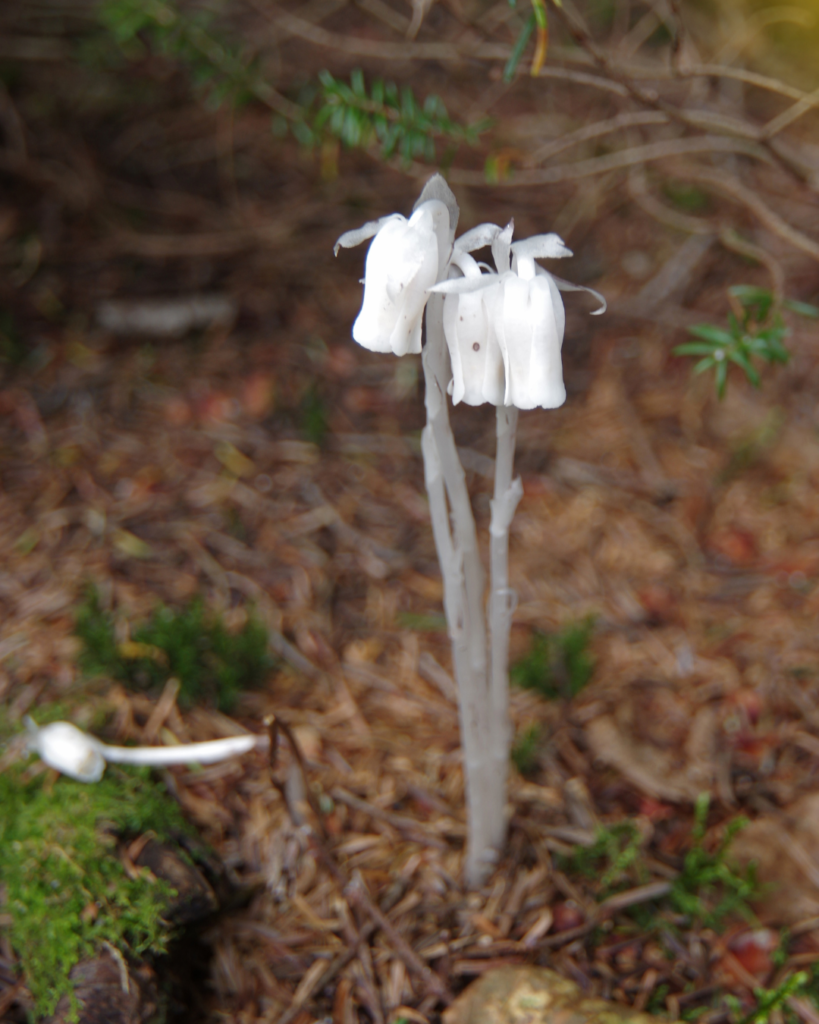
    There is a plant that grows only in the deepest, darkest parts of the moist forests throughout North America, Latin America, and East Asia. It emerges after rain, ghostlike, from the leaf litter, pale and translucent, white as bone, carrying no green at all. It does not reach toward the light, and it cannot photosynthesise; instead, it draws everything it needs from the hidden mycelial networks of fungi threading through the soil beneath the trees, nourishing itself entirely from connections that are invisible to us above the ground (Foster, 2024).

    Its name is Monotropa uniflora.

    In Latin and Greek: one turn, one flower.

    The same root as monotropism.

    The same tropos.

    Carl Linnaeus classified the plant as Monotropa uniflora in 1753. “Monotropa” is Greek for “one turn,” and it is a reference to the arched stem that supports the flower, and “uniflora” means “one-flowered” in Latin. It doesn’t need light to grow; it thrives in depth and in shadow, in the quiet, overlooked, in-between places of the forest floor. People have called it the Ghost Plant and the Ghost Pipe because of its appearance and its ability to thrive where other plants cannot. It resonates with me in both its strength and its weirdness as an Autistic person, qualities that might also have resonated with the poet Emily Dickinson, who called it her “preferred flower of life“.

    Delicate Monotropa uniflora, Ghost Pipe (Indian pipe) flowers in full bloom — pale, translucent white, bell-shaped blooms nodding on leafless white stems, rising from brown pine needle litter and green moss on the forest floor. Photo by Frank Shirley, Getty Images with CAVNVA Pro

    Dickinson and the Ghost Pipe

    It is reported that Emily Dickinson first encountered Monotropa uniflora as a child, pulling it from the forest floor in Amherst. She was an amateur botanist who studied plants at Amherst Academy and Mount Holyoke Female Seminary, assembling more than 400 plant specimens in books that now reside in Harvard’s Houghton Library, including Monotropa uniflora (Foster, 2024). She attended to each specimen with the deep, sustained, joyful attention that many monotropic people will recognise, one of total absorption, with great care, and a sense of wonder and awe that never diminished, no matter how much she studied (Popova, 2023).

    In the autumn of 1882, Dickinson received a surprise painting of the Ghost Pipe (Monotropa uniflora), from her friend Mabel Loomis Todd. Dickinson wrote back immediately:

    “That without suspecting it you should send me the preferred flower of life, seems almost supernatural, and the sweet glee that I felt at meeting it, I could confide to none — I still cherish the clutch with which I bore it from the ground when a wondering child, an unearthly booty, and maturity only enhances the mystery, never decreases it.” (Emily Dickinson Museum, 1882)


    (I am not sure of copyright to embed the image in this blog, but please take a look here in the Emily Dickinson Museum ).

    Eight years later, when Todd edited and published the first posthumous collection of Dickinson’s poems, she placed the same painting of the Ghost Pipe on the cover.

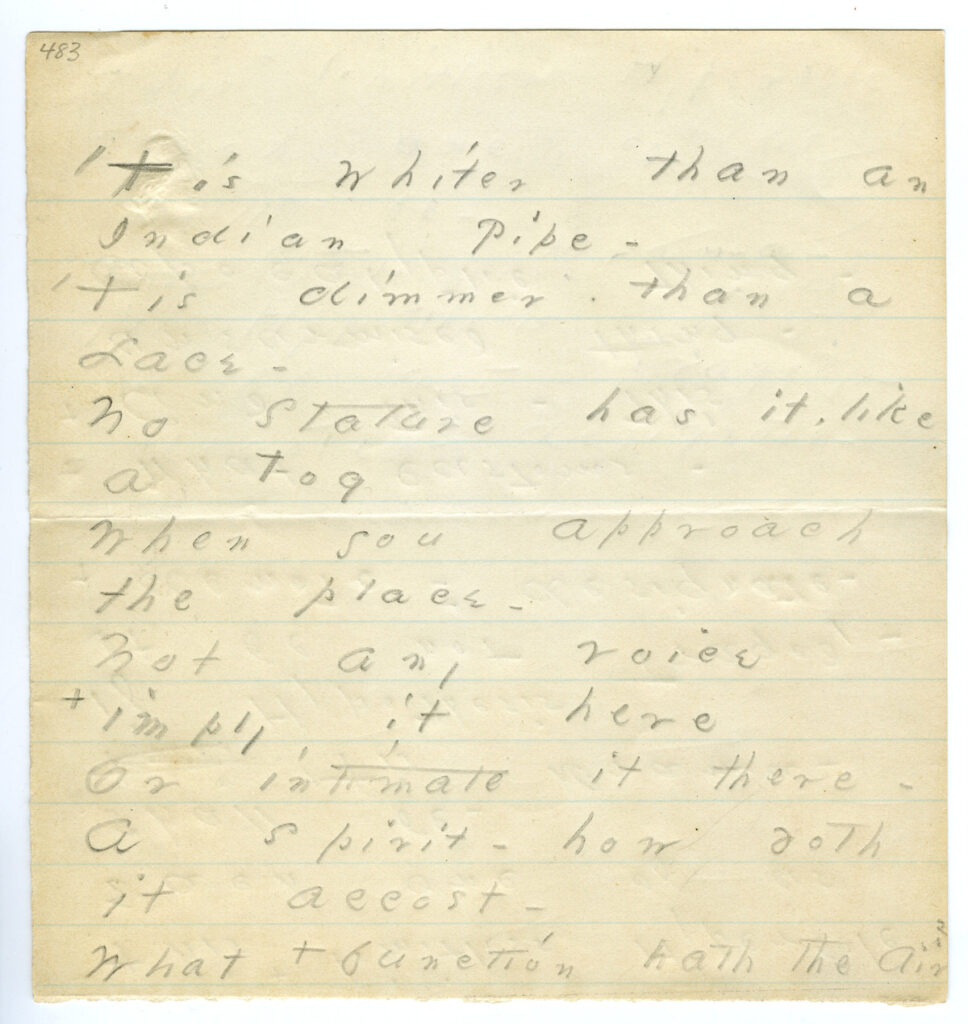
    Three years before that letter, in 1879, Dickinson had already written a poem about the plant (Emily Dickinson Archives):

    ‘Tis whiter than an Indian Pipe –
    ‘Tis dimmer than a Lace –
    No stature has it, like a Fog
    When you approach the place –
    Not any voice imply it here –
    Or intimate it there –
    A spirit – how doth it accost –
    What function hath the Air?
    This limitless Hyperbole
    Each one of us shall be –
    ‘Tis Drama – if Hypothesis
    It be not Tragedy –

    ’Tis whiter than an Indian Pipe –
    Poem, ca. 1879
    Amherst College Archives & Special Collections

    Emily Dickinson

    Manuscript of poem from Credits
Amherst College, Amherst MA
https://acdc.amherst.edu/view/asc:10742
Amherst Manuscript # 483
Amherst - Amherst Manuscript # 483 - Tis whiter than an Indian pipe - asc:10742 - p. 1

Publication History
Poems (1896), 156, as three quatrains, with the alternatives for lines 5 and 8 adopted. Poems (1955), 1024-25; CP (1960), 625-26. (J1482). Franklin Variorum 1998 (F1513A).
 -History from Franklin Variorum 1998

Emily Dickinson Archive
http://www.edickinson.org
Copyright & Terms of Use:
CC BY-NC-ND 3.0
http://www.edickinson.org/terms
    Credits: Amherst College, Amherst MA https://acdc.amherst.edu/view/asc:10742 Amherst Manuscript # 483 Amherst – Amherst Manuscript # 483 – Tis whiter than an Indian pipe – asc:10742 – p. 1 Publication History Poems (1896), 156, as three quatrains, with the alternatives for lines 5 and 8 adopted. Poems (1955), 1024-25; CP (1960), 625-26. (J1482). Franklin Variorum 1998 (F1513A). -History from Franklin Variorum 1998 Emily Dickinson Archive http://www.edickinson.org Copyright & Terms of Use: CC BY-NC-ND 3.0 http://www.edickinson.org/terms


    People continue to debate what the “it” in the poem refers to, is it spirit, death, life itself, or all of it? Perhaps it is something many of us as Autistic people recognise, the thing that is deeply present, real, and nourishing, yet invisible to those who do not know how to look for it or how to relate to it. The quality of presence that the world persistently mistakes for absence, the inner life that runs deeper than it appears from the outside?

    The way the Monotropa uniflora blackens and wilts, dissolving back into the earth, the moment it is touched all feels very relatable to me and how I am at times, just wanting to hide in the dark and be left alone but also thriving in often unexpected ways. Or maybe it’s just me who relates in this way? Either way, the Monotropa uniflora is not a tragedy, and neither are we as Autistic people. We can thrive when the environment meets our needs, even if that environment may not be what people expect it to be!

    A Monotropic Life

    It feels to me that Emily Dickinson lived her life somewhat monotropically, though she never had that word back then. She spent most of her adult life within her family home, rarely venturing out, conducting her richest relationships through letters, attending to her interests with an intensity that those around her often found excessive, weird or strange, perhaps also relatable for many of us?! Her attention tunnelled, her focus pooled as she moved through the world, pulled in by her interests, with her whole self given over to what she was attending to, which I feel is evident through all her work and my own sensory way of being.

    We shouldn’t claim that Dickinson was Autistic, but her way of being in the world resonates deeply for me, much like that of Virginia Woolf and Sylvia Plath, writers often seen as different, as not fitting in, whose work seems to capture something of what it is to be Autistic before they had the term and certainly before women were identified as Autistic. They speak of the isolation that so often comes with not being really understood, and also the joy of being able to immerse yourself fully in your passions and sensory self as a way to sustain life, to survive. They write about a deep presence and connection with the world around them, feeling everything sensorily, intensely, and being deeply empathetic.

    Woolf herself wrote of a mind she called androgynous, the mind most “resonant and porous… naturally creative, incandescent and undivided” (Woolf, 1929, as cited in Popova, 2021). That porousness, that undivided quality, is something many Autistic people may recognise too, not a mind guarded and compartmentalised, but something more fluid, always connecting, seeking patterns, transforming, morphing and adapting.

    Many people call Monotropa uniflora a perfect flower, it holds both stamen and pistil, both what has been called “male” and “female,” in the one bloom, needing no other to complete it, which feels like more than coincidence (Popova, 2021). It is a plant that refuses to be binary at the root of its being, in the same way it refuses to draw its nourishment from sunlight, the way other plants are expected to. It is non-binary, and yet still deeply, richly connected and interdependent with everything around it through the hidden web of nourishment from beneath the ground. For those of us who are Autistic, otherwise neurodivergent or disabled, those who may also be queer, trans, or non-binary in how we understand our own identity, this may feel like a plant that was never trying to fit in to start with, it thrives in its difference, weirdness and uniqueness, a bit like us.

    From the outside, Emily Dickinson’s life may have looked reclusive and withdrawn, but from the letters, the poems, and the extensive herbarium with its 400 pressed plants, each attended to with such care, I think it was extraordinarily full, in a way that held meaning for her and brought great joy. This perhaps gives some validity to the way many people may feel and experience their lives still today, especially if you are Autistic/ AuDHD and monotropic and are able to get into those lovely monotropic flow states.

    Dinah Murray, Monotropism & Monotropa Uniflora

    Sadly, Dinah Murray died in 7th July 2021, 5 years to the day I am writing this. The poet Kate Fox, who had interviewed Dinah in her flat in Dalgety Bay just a month before she died, wrote a poem to read at her memorial service and titled it Monotropa Uniflora (Fox, 2021).

    “The first two lines were from a poem Dinah wrote as a girl. The title is a type of fungus (ish) species that her friend Joan McDonald said at the memorial service she was delighted to discover existed, given her pioneering work on the monotropic theory of autism” (Fox, 2021).

    In their interview, Dinah described her life not as a career but as a mission:

    “About justice and fairness and living in a fair world. I haven’t really ever had a career, I’ve had a mission. And I think I’ve accomplished my mission basically.”

    (Dinah Murray quoted in Fox, 2021)

    Like Monotropa uniflora, Dinah Murray’s work continues to nourish us through mycelial-like networks of care: through the people she supported, the papers she wrote, the theory of monotropism she brought into the world, and the community she helped build.

    The Mycelial Network of Care

    The secret of the Monotropa uniflora’s survival is almost magical: its roots entwine with underground fungal networks, mycorrhizal hyphae from fungi in the Russulaceae family, that are themselves connected to the root systems of nearby trees. The Monotropa uniflora takes sugar and nutrients from this fungal web, thriving through a form of nourishment that is hidden, indirect, and entirely dependent on the richness of the network beneath the surface (Foster, 2024; Popova, 2023).

    In my Mossy Minds and Monotropism (2025) piece, I was thinking about the monotropic bodymind as porous and mycelial-like, deeply interconnected, and often thriving in the margins and liminal spaces. This is where my DEEP framework (Dynamic, Embodied, Ecological, Political), inspired by Damian Milton’s work on the Double Empathy Problem (2012), feels most relevant here from an Autistic perspective, as it also resonates with my own way of being.

    The Monotropa uniflora is Dynamic, changing form and behaviour depending on what the network around it provides, rather than following one single fixed way of being. It is Embodied, entirely dependent on its relationship with soil, fungus, and roots sustaining it. It is Ecological, existing only because of its place within a wider mycelial web of mutual inter-dependence, and it could also be thought of as Political, because a world that only values what performs visibly in the light, what photosynthesises and produces on demand, is often misread and has been called weird or spooky.

    The Monotropa uniflora feels like one of the most perfect botanical expressions of being monotropic for me. It prefers the dark; it goes deep, and it is held by the mycelial network of care, which, for me, being part of our Autistic community, I am certain I could not survive otherwise.

    Like Monotropa uniflora, many Autistic people have learned to adapt and morph to survive; we have had to find ways to nourish ourselves through mutual aid networks and grass roots projects as society just isn’t meeting our needs. I thrive in the deep shade of my forest-themed den with my blackout blinds drawn day and night. My mycelial network is online, on the World Wide Web rather than the Wood Wide Web. I live amongst the many neurodivergent spaces I am so grateful to be a part of, that keep me nourished and sustain me across the Autistic Rhizome.

    “Energy is only transformed, never gone”

    “Attention without feeling is only a report,” Mary Oliver wrote (2016). When Dickinson called the Ghost Pipe (Monotropa uniflora) “the preferred flower of life,” I don’t think she was only naming a plant she’d loved since childhood. I think she was naming a way of loving, a way of embracing the kind of monotropic attention that finds its nourishment not in what is easily seen, but in what is deeply felt. Something that, for many of us, may also reflect our Autistic ways of being, at least, it does for me.

    On this anniversary of her death, five years on, I want to close with the words the poet Kate Fox wrote for Dinah’s memorial, in a poem she titled after the Monotropa uniflora

    Your interests carry like spores

    through the air

    in fragments, in buds,

    via mycelia-like networks

    they are still there.


    But you also knew

    energy is only transformed, never gone

    so when we remember your words

    or act as you might do,

    you, in all your power and passion

    live on.


    (Fox, 2021)

    Energy, as Kate’s poem tells us, is only transformed, never gone. May Dinah’s legacy keep flowing, monotropically, through the communities of care she helped shape.

    References

    Edgar, H. (2025). Mossy Minds and Monotropism. More Realms.
    https://morerealms.com/mossy-minds-monotropism/

    Emily Dickinson Museum. (1882). Letter to Mabel Loomis Todd. emilydickinsonmuseum.org

    Foster, N. (2024). Ghost of the forest: Monotropa uniflora. JSTOR Daily. https://daily.jstor.org/ghost-of-the-forest-monotropa-uniflora/

    Fox, K. (2021). Monotropa Uniflora [Memorial poem for Dinah Murray].
    https://katefoxwriter.wordpress.com/2021/08/16/tribute-to-dinah-murray/

    Guardian. (2021, July 25). Dinah Murray obituary. The Guardian. https://www.theguardian.com/society/2021/jul/25/dinah-murray-obituary

    Kimmerer, R. W. (2003). Gathering moss: A natural and cultural history of mosses. Oregon State University Press.

    Murray, D., Lesser, M., & Lawson, W. (2005). Attention, monotropism and the diagnostic criteria for autism. Autism, 9(2), 139–156.
    https://journals.sagepub.com/doi/10.1177/1362361305051398

    Oliver, M. (2016). Upstream: Selected essays. Penguin Press.

    Popova, M. (2021, July 2). Perfect flowers: Adventures in nature’s nonbinary botany, with a side of Emily Dickinson. The Marginalian. https://www.themarginalian.org/2021/07/02/perfect-flowers-emily-dickison/

    Popova, M. (2023). The ghost pipe: A visionary meditation on love, loss, and the shape of grief. The Marginalian. https://www.themarginalian.org/2023/08/23/ghost-pipe/

    The Morgan Library. (2023). Emily Dickinson: Poems. themorgan.org

    Woolf, V. (1929). A room of one’s own. Hogarth Press.ins. Princeton University Press.