This piece continues a reflection I first shared on Wider Existence, the Substack I write with David Gray-Hammond: Real, Unreal, and Everything In Between. If you haven’t read it yet, you might like to start there.
Where we began
In that first piece, I wrote about coming home from Professor Brian Cox’s live show, Emergence, with my head full of nothing and EVERYTHING. I drew on Anil Seth’s (2021) idea that ordinary perception is a kind of “controlled hallucination,” built from the brain’s best guesses and kept in check by the senses, so that seeing and hallucinating sit on a spectrum rather than either side of a wall. I wrote about starlight that left its source long ago, and about relativity’s lesson that one universe can be lawfully described from many vantage points (Cox & Cohen, 2011; Cox & Forshaw, 2009). I then turned to the Autistic experience of perceiving real things, such as the hum of electrics or the flicker of a light, and being told they are not there, which Fricker (2007) would name as testimonial injustice. I also explored bereavement experiences (Rees, 1971), the Hearing Voices Movement (Romme & Escher, 1989) and cultural differences in how voices are lived with (Luhrmann et al., 2015). I ended with the hope that reality might be something that emerges between us, a meeting place for many bodyminds (Dychtwald, 1977).
Since then I have been reading Johannes Kepler’s little book on the snowflake, the very story with which Cox opened his show, and I want to follow that thread a little further here.
A gift of almost nothing
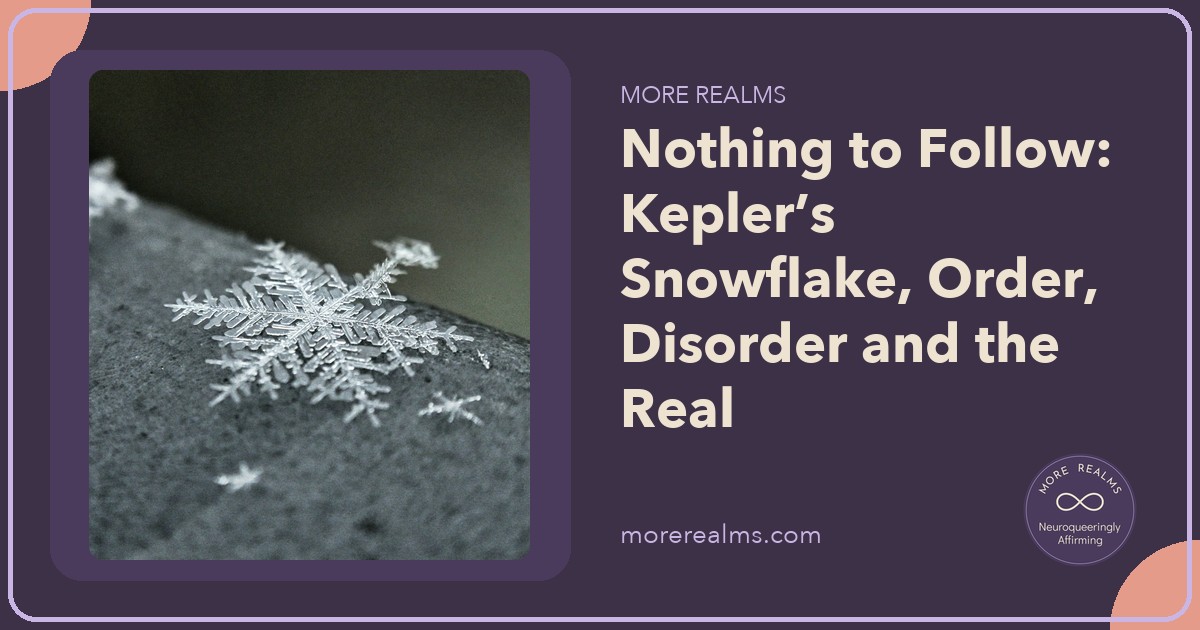
In the winter of 1610, Kepler was crossing the Charles Bridge in Prague, worrying that he had no New Year’s present for his patron, Johann Matthäus Wacker von Wackenfels. Wacker was, as Kepler teasingly put it, a lover of Nothing, so the ideal gift would be as close to nothing as possible. Kepler considered and rejected dust, sparks, a drop of water and even the tiniest of animals. Then a few flakes of snow landed on his coat, each one with six feathered points. Here was something smaller than a drop and yet it carried a pattern. Kepler even made a pun of it: the Latin for snow, nix, sounded like the colloquial German for nothing (Kepler, 1611/1966).
The essay that followed, A New Year’s Gift, or On the Six-Cornered Snowflake, is playful, digressive and full of jokes, yet it asks a serious question: why six? Why not five, or seven? Kepler wanders through honeycombs, pomegranate seeds, the stacking of cannonball-like spheres and the shapes of flowers. Along the way he became the first to publish ideas about the close-packing of spheres that would later prove fundamental to crystallography (Mason, 1966). In the end he could not answer his own question. He handed the problem on to the chemists and closed his essay with the words “Nothing to follow.”
I love this ending. It feels deeply honest. Kepler shows his thinking in motion, follows ideas that turn out to be wrong, and marks one of his own theories in the margin as an opinion of no value. Partway through writing, it began to snow again, and after looking more carefully at the falling flakes he realised he had been mistaken about their structure and changed his mind on the page (Kepler, 1611/1966). There is something very Autistic, to my mind, about this kind of thinking: following a fascination wherever it leads, attending to fine detail, and staying with a question long past the point where others would have moved on.
The formative faculty
Kepler’s eventual explanation was what he called the facultas formatrix, a formative faculty in the body of the Earth, a living, shaping capacity that brings forth crystals, plants and snowflakes alike (Kepler, 1611/1966). Lancelot Law Whyte (1966) traces this idea back through Galen’s “formative faculty” in embryology, and shows how Kepler stood at a threshold between an older, animate cosmos and the new mathematical physics.
What strikes me most is Kepler’s answer to an imagined objection. If the snowflake’s shape serves no obvious purpose, why would nature bother to make it so beautiful? Kepler replies that the formative faculty does not act only for a purpose. It also acts to adorn, and it plays with the passing moment (Kepler, 1611/1966). Nature, in his view, plays.
I find this a quietly radical idea, and one that speaks to how neurodivergent ways of being are so often judged. Stimming, deep interests, repetitive patterns and ways of moving are routinely assessed by whether they are “functional.” Kepler’s snowflake suggests another possibility: that form can arise for adornment, for play, for the sheer joy of pattern, and that this too belongs to the order of the world.
Order and disorder
Modern science has answered part of Kepler’s question. The hexagonal symmetry of a snowflake reflects the arrangement of water molecules in ice, held together by hydrogen bonds into a lattice with six-fold symmetry (Mason, 1966). Yet the exact shape each crystal takes, whether a plate, a needle, a column or a feathered star, depends on the temperature and humidity it meets as it grows and falls. Mason (1966) describes how a change of just a degree or two can completely transform a crystal’s form, and how difficult it is to find two crystals identical in their fine structure. Each snowflake carries the record of its own journey through the air.
This is where Kepler’s story meets the ecosystemic thinking that David and I keep returning to. A snowflake’s form is never produced by its inner structure alone. It emerges from a continual relationship between what it is made of and the conditions it moves through. In the same way, Autistic experience, including distress, cannot be understood by looking only inside a person. It takes shape within environments, relationships and histories. I would also want to name the Autistic Rhizome here (Gray-Hammond, 2023; Edgar, 2026), as the snowflake offers a frozen, branching image of the same relational growth.
Whyte (1966) adds a further twist that I find genuinely moving. Physics had shown that while the oxygen atoms in ice sit in a stable lattice, the hydrogen atoms are irregularly distributed, so that the apparently perfect hexagon depends on a hidden irregularity. As Whyte puts it, the starlet is “the progeny of a union of order and disorder.” Irregularity, in his account, is no mere flaw in the perfect form. It plays an essential role in making form possible at all. Kepler, Whyte suggests, would have hated this, because he believed in a universe of divine simplicity and perfection.
I cannot read this without thinking of the word “disorder” as it appears in diagnostic language. Autistic people are defined, in clinical terms, by disorder, as though order were the natural state of a mind and difference a deviation from it. Whyte’s snowflake offers a different picture. The beautiful, symmetrical form we recognise as a snowflake would not exist without irregularity woven through it. Disorder here is part of how the world becomes, rather than an error to be corrected.
Back to the real and the unreal
So how does Kepler’s snowflake return us to the question of hallucination and the real?
First, Kepler’s essay is a record of a mind willing to imagine, to test, to be wrong and to look again. He treated his own perceptions with curiosity rather than certainty, and allowed the falling snow to correct him. That seems to me a far healthier model of the relationship between perception and reality than one in which some people’s perceptions are trusted by default and others are dismissed.
Second, the snowflake reminds us that what appears simple and perfect is often complex and partly hidden. We see the hexagon, and miss the restless hydrogen atoms. We see the agreed version of reality, and miss the many perceptions that shaped it or were left out of it. What we call real may always be, in Whyte’s terms, a union of order and disorder.
Third, Kepler’s formative faculty, however outdated as physics, carries something that many Indigenous, Mad and neurodivergent ways of knowing have never lost: a sense of the Earth as alive, generative and playful. Donna Haraway (2016) describes this as sympoiesis, a making-with, where nothing makes itself alone. A snowflake is made with the air, the cold, the dust at its centre and the long fall to the ground. David and I have been exploring similar ideas through symphrenia, our name for a connected, relational bodymind, and the snowflake seems to me a lovely small image of it.
Kepler wanted to give his friend almost nothing, and ended up giving him almost the whole universe. Perhaps that is the gift of snowflakes, starlight and perceptions that others cannot share. They look small and easily dismissed, and yet they hold the shape of everything that made them.
A small note: I am not a physicist or a historian of science, and these are my own reflections, sparked by a night at Brian Cox’s Emergence and a slim blue book about snow. I warmly welcome corrections and conversations from those who know more.
References
Cox, B., & Cohen, A. (2011). Wonders of the universe. HarperCollins.
Cox, B., & Forshaw, J. (2009). Why does E=mc²? (And why should we care?). Da Capo Press.
Dychtwald, K. (1977). Bodymind. Pantheon Books.
Edgar, H. (2026, February 22). The Autistic rhizome: Community, liminal spaces & belonging. Autistic Realms. https://autisticrealms.com/the-autistic-rhizome-community-liminal-spaces-belonging/
Fricker, M. (2007). Epistemic injustice: Power and the ethics of knowing. Oxford University Press.
Gray-Hammond, D. (2023, April 21). Neuro-anarchy and the rise of the Autistic rhizome. NeuroHub Connect. https://neurohubcommunity.org/2023/04/21/neuro-anarchy-and-the-rise-of-the-autistic-rhizome/
Haraway, D. J. (2016). Staying with the trouble: Making kin in the Chthulucene. Duke University Press.
Kepler, J. (1966). The six-cornered snowflake (C. Hardie, Trans.). Clarendon Press. (Original work published 1611)
Luhrmann, T. M., Padmavati, R., Tharoor, H., & Osei, A. (2015). Differences in voice-hearing experiences of people with psychosis in the USA, India and Ghana: Interview-based study. British Journal of Psychiatry, 206(1), 41–44. https://doi.org/10.1192/bjp.bp.113.139048
Mason, B. J. (1966). On the shapes of snow crystals. In J. Kepler, The six-cornered snowflake (C. Hardie, Trans., pp. 47–56). Clarendon Press.
Rees, W. D. (1971). The hallucinations of widowhood. British Medical Journal, 4(5778), 37–41. https://doi.org/10.1136/bmj.4.5778.37
Romme, M., & Escher, S. (1989). Hearing voices. Schizophrenia Bulletin, 15(2), 209–216. https://doi.org/10.1093/schbul/15.2.209
Seth, A. (2021). Being you: A new science of consciousness. Faber & Faber.
Whyte, L. L. (1966). Kepler’s unsolved problem and the facultas formatrix. In J. Kepler, The six-cornered snowflake (C. Hardie, Trans., pp. 57–63). Clarendon Press.