Professor Arday’s work, and the work of everyone the Clarion Call stood in solidarity for, deserves more than grief. It deserves honouring. Honouring means resisting and calling out the harm. Resisting and calling out ableism, sexism, racism, classism and the neuronormative bias that shaped all the narratives around him and the recent uprising against neurodivergent people. We need to continue to share the good work so many people have given so much of themselves to.
It’s easy, in the middle of all this, to feel like all hope is gone and we are in a never ending dark night, shouting into the void, still unseen. But there is hope.
Together we are a community, a constellation network made up of all our unique ways and differences, and everyone has something to contribute.
Hope can transform a moment, a mood, a day, a whole life.
We live on a planet where mushrooms glow in the dark. Where trees share resources with each other through mycelial networks. Where some of the water in your glass may be older than the sun itself. Where whales sing songs that travel for miles, and dolphins call each other by name. Where sea otters hold each other while they sleep, so the current doesn’t carry them apart. Where axolotls can regrow a limb or even part of their own heart. Where lightning can turn sand to glass, where horses can read our feelings on our faces, and where rain has a smell before it even arrives.
We are a community where Autistic, neurodivergent, disabled, otherwise marginalised groups and our allies are creating networks of care for each other and sustaining each other. We are coming together resisting and shining stronger despite the darkness we may feel.
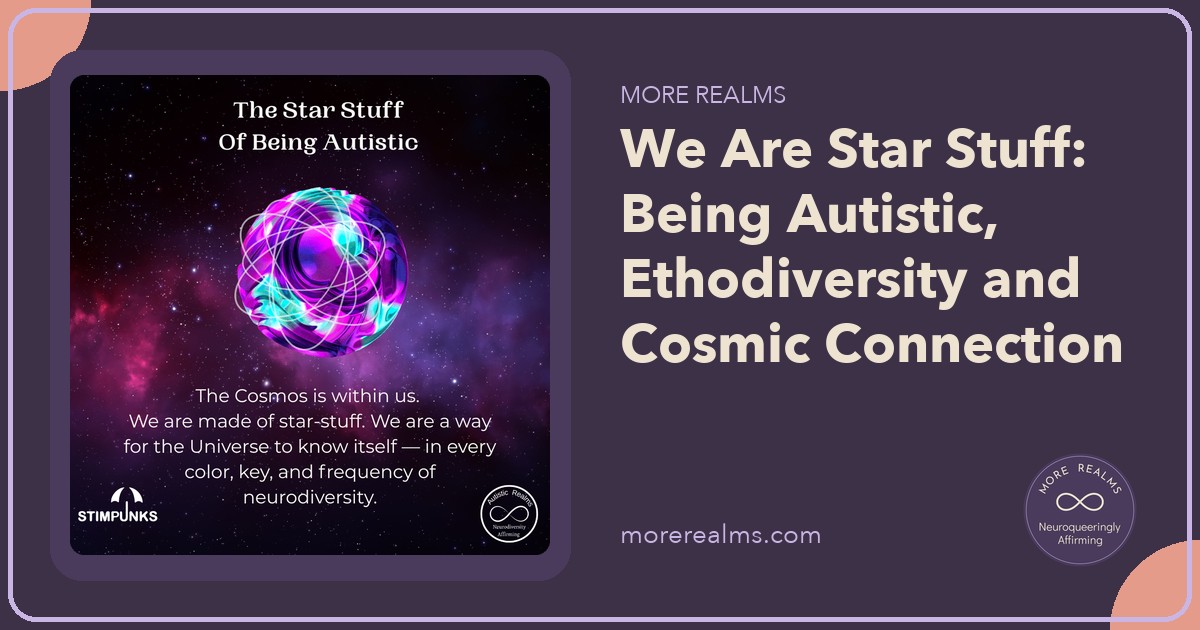
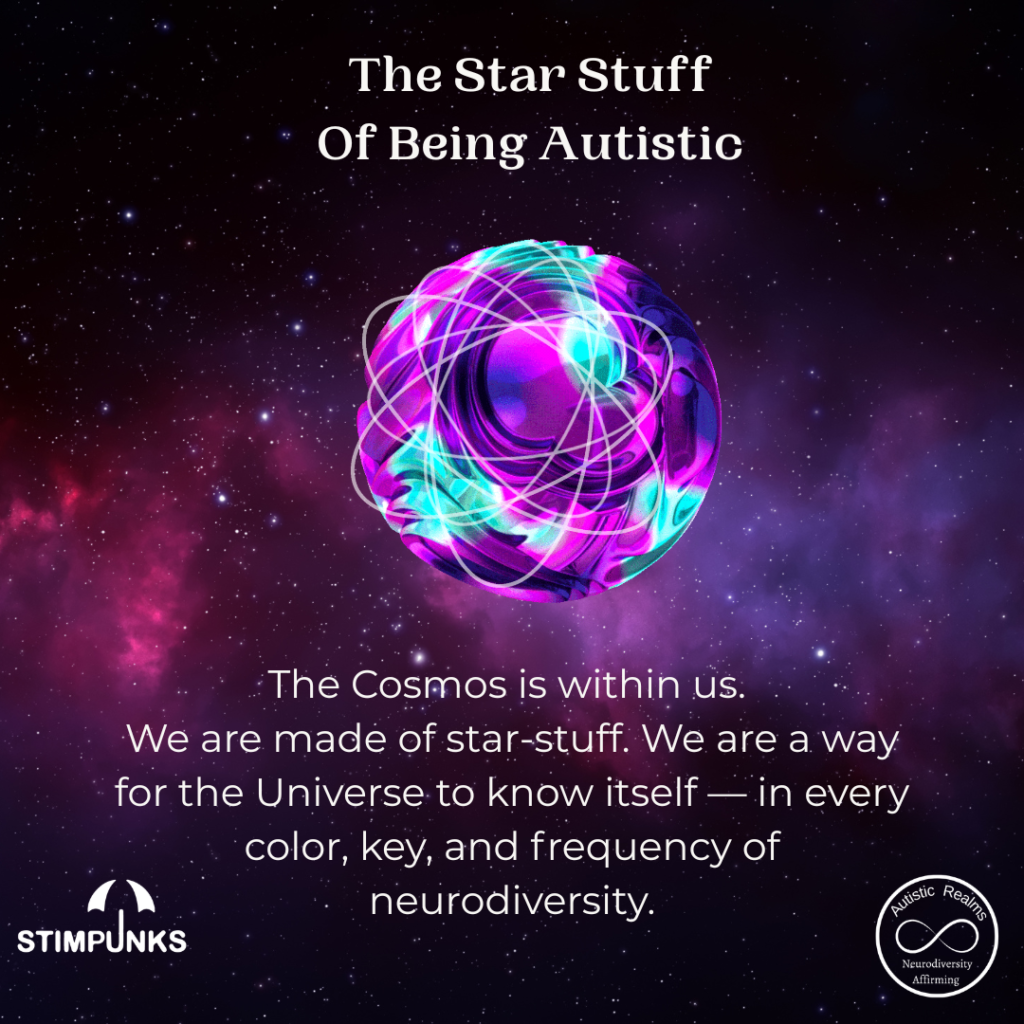
Every atom in your body heavier than hydrogen or helium was forged inside a star. Made in its fusion, or scattered by its death, long before our Sun ever existed. As Carl Sagan said in Cosmos (1980): “We are made of star stuff“.
Posthumanism asks why we ever decided “human” belonged in a separate category from everything else: animal, plant, technological, planetary (Braidotti, 2013). Donna Haraway (2016) talks about “making kin,” being in relation with the world. I think about my own Autistic ways of sensing, being and relating in the same way: there is no one “correct” way to sense, be, or relate to the world, human or otherwise, and our differences are what make kinship and solidarity possible in the first place.
I’ve been working with Ryan Boren from Stimpunks on our StarStuff.Earth zines all year. It’s been a real passion project and pure joy, diving into everything weird, wonderful and awe-inspiring.
It’s a bit of a side quest that we’ve not really shared yet, folded in between everything else we’re doing at Stimpunks and Autistic Realms. Star Stuff holds some of the ideas closest to my heart: neuroqueering, more-than-human, expansive thoughts that help ground us and reclaim a love that reaches past any category of race, gender, sex, label or diagnosis, all the way down to your star stuff.
“It’s not one person that changes the world, its everyone that is present with them. In the same way, its not one star that lights the night, its all of them shining together.” (Leo Starrs-Cunningham)
We are a community, a constellation made up of all our unique ways of being. It may feel like we are weighed down by darkness, but even fallen light glows. We can strengthen our networks of care & constellations of love. We shine brighter together.
In the last year of his life Pablo Neruda wrote a short untitled poem. It opens by saying that if each day falls inside each night, there is a well “where clarity is imprisoned.” Then it tells you what to do about that:
We need to sit on the rim of the well of darkness and fish for fallen light with patience.
Pablo Neruda, untitled, El mar y las campanas (1973) · translated by William O’Daly, The Sea and the Bells (Copper Canyon Press, 1988), pp. 94–95
If you would like to take these ideas further, my courses, books and resources live on Autistic Realms. Everything in the shop is pay what you can, and many resources are free.
I spent the evening of sixth of August in Brigit McNeill’s Migration writing workshop with the Into the Woods writing group, in a session called The Living Page. We were invited to write from and with migration, as a movement to think inside of, inspired by Brigit’s own writing.
What follows is some of what I shared during the workshop and what I have been thinking about afterwards, threaded through with the ideas I keep returning to in my work on monotropism and neuroqueer theory.
Inner Compass
Birds cross oceans using a compass sense we still don’t fully understand. It may involve something in their eyes that responds to the Earth’s magnetic field, through a quantum mechanism that is still being worked out (Mouritsen, 2018). A bird doesn’t need a conventional map; it can orient by reading the world itself as a kind of felt knowledge.
As Brigit shared through her writing, salmon return to their birth rivers. Humpback whales cross hemispheres between calving and feeding grounds. Elephants can follow familiar routes across landscapes, including routes to water. Even a plant’s seed is carried by wind or on fur, migrating in its own way, landing on new ground.
The Inner Tug Of Migration
It’s easy to think of migration as recurring linear travel between fixed points — departure, journey, arrival and back again. The workshop pushed against that framing, and we discussed migration as a process of transformation across time, as much as displacement across distance.
I feel this is close to what Deleuze (1994) was exploring through the idea of ‘difference in repetition’. The idea that no repeated pattern is ever a true copy, that each turn carries its own small variation. Migration, read this way, isn’t a repetitive loop; it’s more of a spiral. With every movement, everything changes.
We discussed Brigit’s writing about what she calls the ‘tug’ of migration. It feels like there’s a bodily quality to how migration begins for all of us, whether crossing distance on the land as animals or in our human bodyminds. Before a bird sets off, something like a restlessness builds in its body. The pull comes from within, affected by seasons, seas, and time, and the sense of direction follows from that, in a very embodied, sensory tug.
I recognise that kind of tug or pull in my own way of being. Monotropism (Murray, Lesser, & Lawson, 2005) describes how Autistic attention tends to gather intensely around a small number of interests, rather than spreading more evenly across many. When an interest catches me, it feels closer to that restlessness in the birds, a tug like a magnet pulling me in and arriving before my actual cognition and thinking have caught up.
Following this tug or pull deep inside you, something opens up. Csikszentmihalyi (1990) described flow as the state that arises when attention and challenge align closely enough that the sense of separate effort disappears. It often comes with an undercurrent of wonder where the world briefly widens around whatever has caught you and opens up further into awe. I think that combination is close to what’s carrying migrating animals too: a sense of direction felt from the inside, trusted enough to move on and to see what will happen.
Following the inner pull and desire of flow, whether it is sensory or more cognitive, leads us to connect ideas, connect people, to move our bodyminds. Flow isn’t stillness; attention is moving, even when the body isn’t. It slowly transforms us: each new interest, each sensory experience, every connection with another being or environment shifts something inside us.
Many of us are taught early to override this feeling of going with the flow of what interests us and listening to our inner needs. We are conditioned to ignore our inner compass, to ignore our passions, our ideas, our sensory needs, especially if they fall outside of what is normally expected. We are taught to mask and suppress our flow and authentic migration.
Research on Autistic masking describes the suppression of natural Autistic ways of being in favour of alternatives judged safer and more acceptable by society (Pearson & Rose, 2021). The tug of monotropic passion and sensory feelings often gets read as being too much, having interests too narrow, and we learn to quieten ourselves or try to adapt to fit in. Over the years, we are moving further and further away from our own internal compass and needs until we may not even recognise our true self.
Trusting Our Inner Compass
Trusting our inner compass again isn’t easy, and there is definitely a certain amount of privilege involved in being able to unmask and be your real Autistic self with people. Neuronormativity, the assumption that more evenly distributed, easily legible attention is the ‘correct’ default way to be. It doesn’t just ask us to behave differently; it makes us distrust ourselves too. Neuroqueering (Walker, 2021) is an ongoing practice of subverting and resisting neuronormativity. It is not a final destination to become ‘neuroqueer’ or to have ‘neuroqueered’ your life — rather, I see it as an ongoing refusal to be ashamed of who you are.
This is where we need to re-learn to trust ourselves. Pernille Fraser’s poem “Can We Trust?” names this same rupture from the other direction: not what we lose faith in within ourselves, but what has to be earned from everyone and everything around us before that trust can return at all. The poem was written in 2019 and later shared through Stimpunks Foundation as part of our Neuroqueer Learning Spaces project. The poem repeats its central question across sensory load, pacing, correction, and the question of whether we’ll be believed and left to decide for ourselves, asking, “Can we trust the space you offer?” (Fraser, 2019/2024). The poem never resolves into an answer; it stays in the asking, leaving open questions of safety and possibility. The potential of trusting people in safe spaces to be ourselves, to keep moving and transforming.
That same question of trust doesn’t stop at ourselves. Once we’ve relearned to trust our own inner compass, we can start noticing that everyone and everything around us, human and otherwise, is following one too when we are able to feel safe.
Differences Of Being
If we stop assuming there is one right way for a human mind to move through the world, perhaps we can extend that generosity beyond humans too. Migration is only one expression of a much wider range of ways living things exist in and move through the world. Ethodiversity (Tarragnat, 2024) names the variability of behavioural and existential styles within and across species, developed to open neurodiversity beyond a purely human-centred and neurological framing. A bird’s compass, a salmon’s imprinting, a whale’s seasonal crossing, and a human’s monotropic pull aren’t the same mechanism in different bodies. They’re genuinely different ways of being, each one worth recognising on its own terms.
Difference here is already a form of connection. A migrating salmon doesn’t just pass through a river, its body becomes part of it. When Pacific salmon return to their home streams to spawn and die, their bodies carry marine-derived nutrients into freshwater and other ecosystems; they carry something from one world into another. Whales do something similar at an ocean scale: they help move nutrients such as nitrogen and iron back into sunlit waters, while their migrations redistribute nutrients across large distances. Neither salmon nor whale set out to feed a forest or an ocean, but each unique way of moving through the world is, at the same time, an act of shaping it, and being reshaped by it in turn.
That sits well alongside Milton’s (2012) double empathy problem, which invites us to notice that people communicate and experience the world differently from one another — and that no single way of being or relating needs to sit at the centre, with everyone else read against it. It sits well, too, alongside Barad’s (2007) idea of intra-action: that a self, or a species, or a migrating body doesn’t exist as a separate thing that then relates to its surroundings, but comes into being through the relating itself. There’s no “before” and “after” self on either side of a migration, only the shaping itself. The liminal space a migrating creature passes through isn’t a gap between two finished things. Self and field, self and current, self and interest, forming each other as they go.
Transformation and Trust
The workshop’s real gift was permission to stop treating change as the exception that needs explaining and to start treating it as the foundation through which everything else moves. Life doesn’t hold still and occasionally migrates; it is always in a constant state of flux and flow.
That reframing opens space for new stories to begin, not despite the shifting, but because of it. This sits alongside other threads I keep pulling on: the constellation-thinking in My Monotropic Galaxy on More Realms, and the Star Stuff work with Ryan Boren at Stimpunks, which starts from the same idea, that we are made of matter that has already migrated across unthinkable distances, reorganising itself into shape after shape after shape, connection by connection.
Migration, in that sense, isn’t a metaphor borrowed from birds and whales. It’s been true of us for longer than we’ve had words for, trusting our inner compass isn’t something any of us can do alone as people and may be especially as Autistic monotropic people.
Birds have the Earth’s magnetic field and the wider world around them to orient by. We need something a bit different: people and spaces willing to be trusted, willing to let us move, be, and communicate in our own way without demanding we prove it first.
Rediscovering our monotropic inner compass is only part of the migration. The rest is building spaces safe enough to trust it in, so we can shape and be shaped by the world around us, the way the salmon and the whale do, simply by being fully who we are.
Milton, D. E. M. (2012). On the ontological status of autism: The ‘double empathy problem.’ Disability & Society, 27(6), 883–887.
Mouritsen, H. (2018). Long-distance navigation and magnetoreception in migratory animals. Nature, 558(7708), 50–59.
Murray, D., Lesser, M., & Lawson, W. (2005). Attention, monotropism and the diagnostic criteria for autism. Autism, 9(2), 139–156.
Pearson, A., & Rose, K. (2021). A conceptual analysis of autistic masking: Understanding the narrative of stigma and the illusion of choice. Autism in Adulthood, 3(1), 52–60.
Tarragnat, O. (2024). Biodiversity, neurodiversity, ethodiversity: Towards a more-than-human and more-than-neurological turn in neurodiversity studies. TRACE: Journal for Human-Animal Studies.
Walker, N. (2021). Neuroqueer heresies: Notes on the neurodiversity paradigm, autistic empowerment, and postnormal possibilities. Autonomous Press.
Courses, books and resources
If you would like to take these ideas further, my courses, books and resources live on Autistic Realms. Everything in the shop is pay what you can, and many resources are free.
Inspired by our collaborative Stimpunks work, and my own neuroqueering Deleuze project, I’ve been thinking about the connections in-between — physics, philosophy and my own life as an Autistic ADHD person. This is me following that thread.
2. I’m not a fixed thing
A little while back I wrote about something called relational quantum mechanics — a way of thinking about physics where tiny particles don’t have fixed qualities all on their own. They only become something in relation to whatever’s around them (Rovelli, 1996). I’m not a physicist — it’s one idea among several, and physicists argue about it.
As a multiply neurodivergent person, that’s always been closer to how I experience myself — not as a fixed, separate being moving through the world, but as something that shows up through my relationships and encounters with everything around me (Edgar, 2026a). I’m still working through what that means.
Physics, philosophy, and my own life keep circling the same ideas about being interconnected, unfixed, always transforming.
3. My Monotropic Galaxy
The oldest light we can see is called the cosmic microwave background — it’s the afterglow of the Big Bang, and it’s almost perfectly smooth. It only varies by about one part in 100,000 across the whole sky — almost uniform, but only almost.
Those tiny variations — slightly denser here, slightly thinner there — were the beginning of everything. Gravity pulled the denser bits together, and over billions of years they became stars, galaxies, planets, you, me, all of it.
If the universe really had been perfectly uniform, it would have stayed a flat, empty fog forever. Nothing to see, no one to see it. Structure only exists because that near-sameness broke.
That’s the same shape I recognise in my own monotropic attention — energy pulled gravitationally into a few bright points, rather than spread out in an even, undifferentiated glow. And yet it’s exactly that unevenness, that refusal to flatten, that so many of us — anyone who’s ever been called too much, not enough, or too different — have been measured against.
4. Measured Against Neuronormative Time
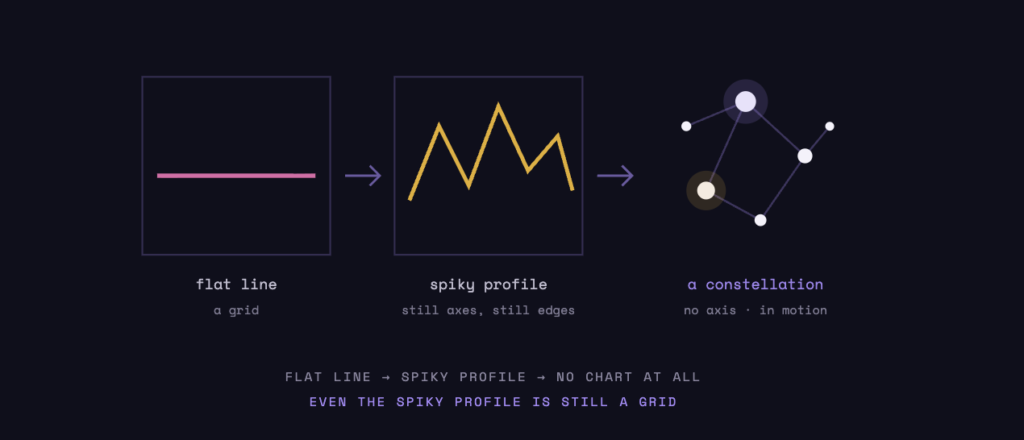
I’ve spent a lot of my life being measured against a flat line. Nobody always said it in those words, but that’s what was happening — a standard chart, a “typical” way of communicating or paying attention or experiencing the world, treated as the baseline everyone should be smoothed toward. I was positioned as the deviation that needed explaining, or fixing, or at least accounting for.
That flat line was never just about behaviour — it was also about time: a single approved tempo, a single approved rhythm, everyone expected to arrive and finish and transition together, in step with a clock that was never actually neutral.
So there’s something that genuinely steadies me in learning that the universe itself never once managed that.
What was already there, moving
The “typical” baseline
You = “deviation”
A straight line, laid over what was already moving
The grid comes after the field, not before,
Uniformity was never the achievement. It’s the thing that would have stopped everything before it even started.
5. There Is No Normal or Baseline
Gilles Deleuze, working with Félix Guattari, made a version of this same argument. Deleuze noticed that a lot of Western thinking treats difference as secondary — judged by how much it resembles some ideal, some average, some “normal” category. All of that quietly assumes the baseline came first, and difference is just a deviation from it.
The baseline is the thing that got built. The idea of normality is what has shaped our capitalist society (Chapman, 2023) and is what we are judged against (Deleuze, 1994). Difference is what’s actually there, first — and identity is what eventually forms out of it, temporarily and locally, the way a crystal settles out of a solution along the gaps and spaces in between — the places where those of us most marginalised live, and where we build our own networks, our own solidarity.
This is where Deleuze and Guattari’s idea of smooth space becomes useful (Deleuze & Guattari, 1987). Smooth space is full of local, variable difference — it hasn’t had a fixed grid laid over it yet. Striated space is what happens when that grid arrives: when a field gets measured, divided, standardised. Difference doesn’t get smoothed into existence by that process. Smoothing is what a system does afterward, only if it insists on it — striation laid over what was already smooth.
Nothing gets smoothed into existence. Smoothing is what happens to something afterward — only if a system insists on it.
6. Smooth doesn’t mean flat
Smooth space isn’t empty of movement — it’s just ungridded. It cuts against how regulation usually gets talked about, as though it means being still, quiet, zen: a flat line of its own. But smooth space is defined by what it lacks — a grid — not by what it’s doing. It can be full of movement and still be smooth — which is closer to how neurodivergent regulation actually works: through stimming, through bodily autonomy, through movement rather than stillness.
That’s closer to what I recognise when I try to describe my own attention — my porousness to my environment, the way my sensory system stays open to everything around it, the way time folds back on itself instead of running in a straight line. Not flat. Not gridded. Full of shape that never quite resolves into one measurable thing.
7. What ethodiversity means
This is where Ombre Tarragnat’s work on ethodiversity has become important to me. Ethodiversity is the variety of ways of being and behaving, across humans and other animals — and Tarragnat is precise about where it actually lives: not inside any one person, but as a property of the relationships between us, the way biodiversity belongs to a whole ecosystem, not to any single creature in it (Tarragnat, 2025).
Ethonormativity, in their framing, is the unwritten rule about which ways of being are allowed to count as normal in a given room. Put next to Deleuze, I don’t think it’s a stretch to say ethonormativity simply is that grid — applied to how we’re allowed to behave. A fixed grid laid over a field that was already full of variation before the grid ever showed up.
Ethonormativity reaches further than neuronormativity, though. Neuronormativity is about which neurotypes get treated as the default — Autistic brains judged against non-Autistic ones, for instance. Ethonormativity is the wider grid underneath that: it governs which ways of being and behaving, across every species, get to count as acceptable at all. It holds neuronormativity inside it, but it isn’t limited to brains, or even to humans (Tarragnat, 2025).
Ethonormativity simply is that grid — a fixed grid laid over a field that was already full of variation before the grid ever showed up.
8. A constellation of intensities
I recognise that grid in every space I’ve ever masked in — education, the workplace, wherever something that was moving gets asked to hold still long enough to be measured. And I recognise its absence, with real gratitude, in the spaces I’m part of — NeuroHub Community with David Gray-Hammond, Stimpunks: an Autistic rhizome, a mycelial network of care, non-hierarchical, no fixed centre, connecting wherever it meets (Deleuze & Guattari, 1987).
I used to think the shape of my own mind was something like a spiky profile — a way of picturing uneven ability across different areas, real peaks and real troughs, instead of one flat line running across the whole of who you are. At least it’s truer than a flat line. However, a profile still measures. It still needs axes, still has edges — and that’s exactly where I want to push further, past even the spiky profile. What I actually recognise, when I try to map myself, isn’t a chart at all. It’s a constellation of intensities: a galaxy, always in relationship with itself, always in motion, never finished (Edgar, 2026b).
A profile still measures. It still needs axes, still has edges. What I actually recognise, when I try to map myself, isn’t a chart at all; it is an interconnected, interdependent galaxy.
9. The Universe Doesn’t Do Flat Lines
I still don’t have these ideas fully settled or finished. Every time I follow this thread — from the sky, down through physics and philosophy, into the actual shape of my own galaxy of monotropic attention — I end up some where different but with the over arching throughts that:
The universe doesn’t do flat lines.
It never really tried to.
It went straight from near-uniform fog to unrepeatable structure, without ever pausing at sameness for its own sake.
I think that’s worth remembering, gently — the next time any of us are asked to explain why we don’t match the line of neuronormativity. We are all star dust. We are neuroqueering the spiky profile: no edges, limitless ways of being.
10. L★S
Zine No. 11 · Guest author
Written by Helen Edgar. First published on Autistic Realms: More Realms, and shared with Star Stuff.
Chapman, R. (2023). Empire of normality: Neurodiversity and capitalism. Pluto Press.
Deleuze, G. (1994). Difference and repetition (P. Patton, Trans.). Columbia University Press. (Original work published 1968)
Deleuze, G., & Guattari, F. (1987). A thousand plateaus: Capitalism and schizophrenia (B. Massumi, Trans.). University of Minnesota Press. (Original work published 1980)
Edgar, H. (2026a, June 7). We are made of relations: Quantum physics and what it means to be Autistic. More Realms.
Edgar, H. (2026b, June 16). My monotropic galaxy: A constellation of my Autistic self. More Realms.
Rovelli, C. (1996). Relational quantum mechanics. International Journal of Theoretical Physics, 35, 1637–1678.
A guest zine in the Stimpunks Star Stuff series. Where The Universe Runs on Difference (No. 8) is about breadth — variety over monoculture — this one is about difference coming first: the baseline is what gets built. The physics-and-philosophy sourcing, and how it sits beside Nos. 8 and 9, is gathered in The Difference-First Frame.
If you would like to take these ideas further, my courses, books and resources live on Autistic Realms. Everything in the shop is pay what you can, and many resources are free.
Helen Edgar — Autistic Realms | More Realms | June 2026
Spaces In-Between
I recently looked at the night sky, I was outside and cold, the sheer number of stars, the ones I could see and the knowledge of the ones I could not, shifted something in me that I did not have a word for at the time. It felt like an opening, a feeling of being very small and very connected at the same time, of the distance between me and the universe suddenly becoming less certain, of living in the in-between space. What I was experiencing is called awe, I also know, looking back, that awe may be one of the most distinctly Autistic experiences to feel.
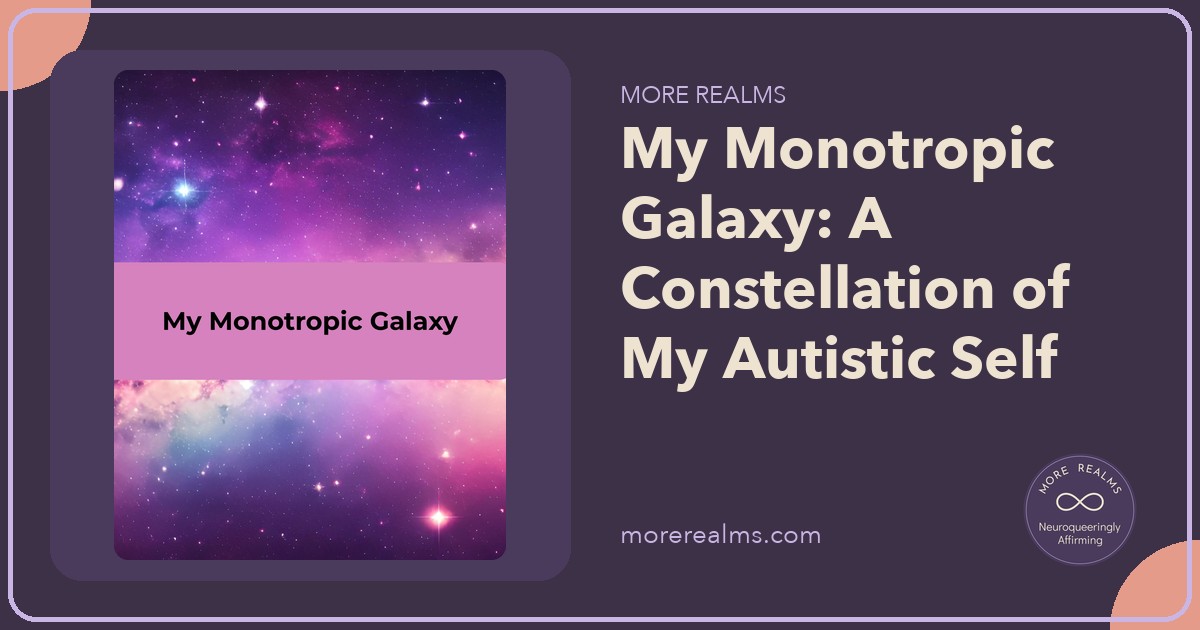
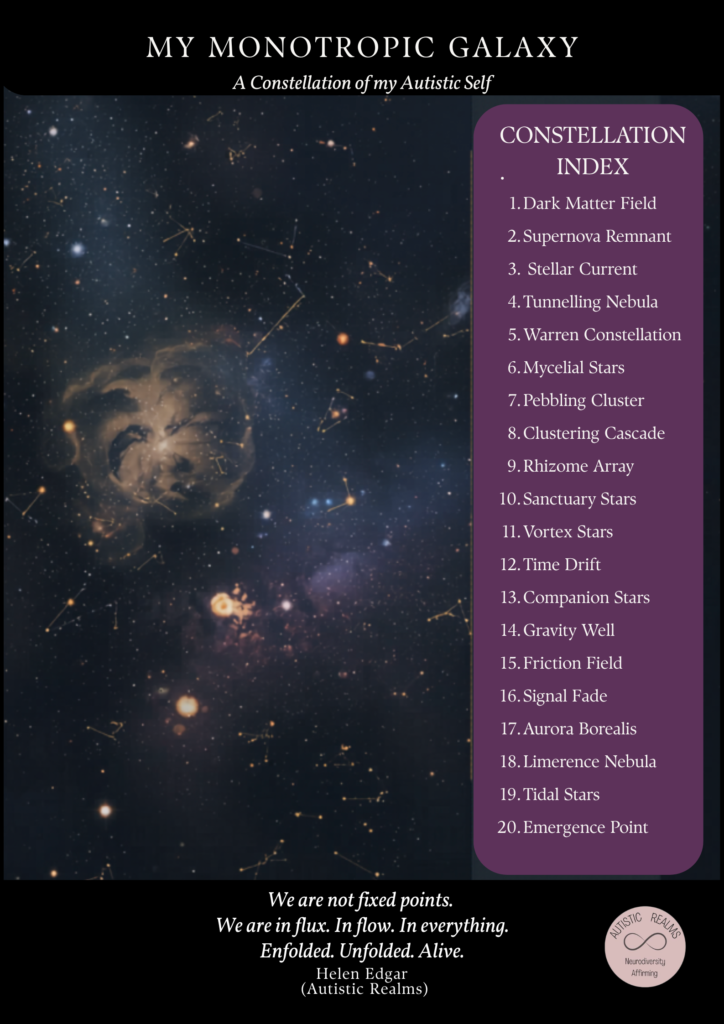
This piece is about feelings of awe and wonder, my own Autistic ADHD experiences, and about the map I have tried to represent of my inner life using the language of the cosmos. It is called My Monotropic Galaxy: A Constellation of My Autistic Self. It is a deep-field image of space, overlaid with constellation lines, accompanied by an index of 20 named features of some of my monotropic experiences. Some of these constellations I have lived in for decades, others I have only recently been able to name. All of them are in relationship with each other, always in motion, always becoming something the map and myself has not yet caught up with.
Before I guide you through my galaxy of monotropic experiences, I will explain a bit about the theory of monotropism and why I feel it is so important for my own sense of self-identity as an Autistic ADHD person.
What Is Monotropism?
Monotropism is an attentional theory of autism developed by Autistic researchers Dinah Murray, Mike Lesser, and Wenn Lawson (2005). It describes how many Autistic people tend to have their attention drawn more strongly to fewer things at any given time, going deep rather than wide, concentrating rather than spreading their focus. Rather than framing this as a deficit — an inability to multitask or shift attention — monotropism understands it as a distinct attentional style with its own strengths and difficulties.
Discovering the theory of monotropism for the first time felt like being handed a map of a place I had always lived in but had never been able to describe. I was identified as Autistic and ADHD in my forties, while my children were also going through their own assessments. What followed was a long process of re-sense-making, a re-storying that went back through my entire life, understanding finally why things had been the way they had been, and finally being able to begin to understand my own neurodivergent identity a little bit better.
Awe and Wonder as a Way of Knowing
Let me return to the night sky and think about what awe actually is and why it may be especially relevant for monotropic people. Helen De Cruz (2024), in her book Wonderstruck: How Wonder and Awe Shape the Way We Think, describes wonder as a form of epistemic opening, a way of relating to knowledge and how we have come to know things. The epistemic opening is the moment when the way we know expands; it is more than just a feeling. When we encounter something that is genuinely awe-inspiring, the usual categories we use to make sense of the world temporarily loosen. It is as if you are maybe seeing or sensing something for the first time; you may notice things you had previously learned to filter out. For De Cruz, wonder is not just a happy side effect of seeing something beautiful; it is a cognitive and moral orientation. It is how we stay genuinely curious about a world we might otherwise let ourselves assume we already understand, or are taught to ignore, as it doesn’t fit into how people expect us to perceive and respond.
When I read De Cruz’s book in 2024, something in me recognised what she was describing at a really deep level. It was the most inspiring book I have read for many years. I took part in a brilliant reading group hosted by The Philosopher 1923, where we explored Helen De Cruz’s work in depth. In the final week, we were lucky to be joined by Helen herself, and I remember discussing Nick Walker’s neuroqueer theory (2021) and the projects I was developing with Stimpunks, particularly the ways her ideas resonated with and helped shape our thinking. These conversations had a lasting impact, influencing our Neuroqueer Learning Spaces project, helping to evolve the vision behind Cavendish Space, and continuing to inform much of my current writing and emerging ideas around the theory of monotropism.
Awe and Flow
When I am pulled fully into something that has truly captured my attention, not just my mind, but my whole body and nervous system is immersed. What opens is not simply focus; it is that first-ness quality of perception De Cruz describes, the sense of seeing and feeling something for the first time, even if I have encountered it a hundred times before. New connections become visible, and the boundaries between things soften. It feels like my nervous system, so often braced against a world not designed for me, can finally exhale in the in-between spaces as new connections form and I feel literally awe-some.
Keltner and Haidt (2003) describe awe as arising when we encounter something vast that challenges our existing mental structures, something that does not fit the categories we already hold, and that invites us to expand our ways of being rather than retreat or fold inwards. Awe can be humbling and expansive at the same time; it opens up possibilities.
I feel this resonates with what it feels like for me to be in monotropic flow. My self does not disappear, nor does it become more rigid or narrow; instead, it feels as though I open up, my whole bodymind becomes more porous. The boundary between me and what I am attending to becomes less fixed; I am both in the flow, and the flow is in me. The distance between those two things collapses and unfolds in a way that feels like both loss and arrival, and it can feel deeply liberating and joyful (and sometimes deeply troubling and anxiety-provoking!).
For many Autistic people, these experiences are undervalued, even stigmatised or shamed as we grow up. We are told to concentrate on what the teacher is saying, to focus on what our family and friends think really matters, and slowly, our own ways of perceiving the world are flattened as we learn to mask and stop trusting ourselves. The things we find awe-inspiring are treated as having no value: the joy of looking closely at a mushroom or an insect may be met with being told to hurry up and rejoin the group; the wonder of feeling the sea against your toes in the sand may be met with being told to just get in and swim and stop fussing.
This quality of experience, this awe and wonder, is represented by the Stellar Current at the heart of my galaxy: the deep flow state through which my whole system comes into coherence, and I move with the current of what matters most. It feels fitting that this current carries me toward a phrase that has become foundational to how I think about the Autistic community and a sense of belonging.
Love You Down to Your Star Stuff
The phrase Love You Down To Your Star Stuff grew out of collaborative work with Ryan Boren and Stimpunks Foundation (Boren & Stimpunks Foundation, 2026). It reaches back to something Carl Sagan observed: that the atoms in our bodies were forged in the interiors of stars that lived and died long before our sun existed. We are, quite literally, made of star stuff.
To love someone down to their star stuff is to locate love for their core way of being. Love is not conditional on performance, legibility, or being the kind of person the world finds easy to translate. Love should not be dependent on meeting neuronormative expectations, masking well enough or being productive enough or social enough. To love someone down to their star stuff is to love their way of being continuous with the universe and their authentic self.
Much of the lived experience of being Autistic for many people is weighed down by what I have called the Dark Matter Field in my galaxy. This is the heavy darkness of neuronormativity, reflected in the accumulated weight we carry around of a world that does not meet our needs, and does not love us down to our star stuff. The Dark Matter Field is everything that is harmful in our systems, behaviourism, ableism, racism and more. As Autistic people, we are constantly being measured against a map that was not ours.
The Double Empathy Problem (Milton, 2012) highlights the mutual misunderstanding between people with very different experiences, where the gap of this map is often framed as ours to close; this sits at the heart of the Dark Matter Field’s weight. Decades of masking, so thoroughly embedded in me that I genuinely did not know for most of my life where the mask ended and where I began, meant I was always accommodating others to try to meet expectations.
Love You Down to Your Star Stuff is a different orientation entirely. It is the foundation of what I believe the constellation of the neurodivergent community is reaching toward. The Mycelial Stars — underground networks of care and interdependence. The Rhizome Array — the non-hierarchical community that creates something together that none of us could make alone. The Companion Stars — those who do not need me to perform. The Sanctuary Stars — where I do not have to translate myself. All of these are expressions of what it means to love someone for who they actually are and are part of the galaxy that many neurodivergent people may recognise or relate to.
The Implicate Order and the Autistic Bodymind
A concept from quantum physics has really inspired my thinking recently, helping me articulate my inner self and conceptualise my Galaxy of Monotropic Experiences. Physicist David Bohm (1980) proposed that beneath the explicate order, the world of distinct objects and separate events we can see and measure, there exists a deeper dimension he called the implicate order. In the implicate order, nothing is truly separate; everything is enfolded into everything else. What appears distinct at the surface is always an unfolding of something that, at a deeper level, was always entangled.
I am thinking about the implicate order through the lens of monotropism and flow theory. The surface of a river looks like separate ripples and currents, each one seeming to rise, curl, and vanish on its own, but beneath the surface, the water is continuous; there is no ripple that exists apart from the river. What appears as individual movement is always part of a larger, deeper pattern, momentarily folding into visibility before folding back into the whole.
This is something of what monotropic flow feels like to me from the inside. The attention tunnel is the explicate order: a single ripple, distinct and absorbing, everything else falling away from view, but the depth beneath it, the coherence, the sense that this particular focus is connected to everything I have ever cared about, is the implicate order surfacing, slowly emerging and connecting with other thoughts. The interest that pulled me in is and was never really separate from the rest of me; it only looks that way from above the waterline or from what others may perceive. When I am in flow, I am not narrowing myself down to one thing and losing everything else; it is more like I am going deeper beneath the surface ripples to the place where it was all one current to begin with, to where I feel whole.
This may be part of why monotropic flow can feel like both loss and arrival at once; the “loss” is the disappearance of the surface separations of events and experiences outside the attention tunnel, the distinct sense of me here and the world being there. The “arrival” is perhaps the recognition of what was really underneath all along, the boundary was an explicate-order appearance, and the implicate order beneath it was entangled the whole time. When I am in flow, I can feel that oneness and vastness at the same time creating a sense of awe.
The world tends to perceive Autistic people through the explicate order, through what is behaviourally visible, measurable, categorisable. But what drives and shapes and sustains Autistic experience is largely implicate, the enfolded pattern of sensory processing, attentional depth, emotional layering, temporal fluidity, and relational intensity that does not show at the surface, or shows in ways that are consistently misread by others.
When I am in a deep monotropic flow, I am living in the implicate order. Thoughts do not arrive in sequence; they arrive already feeling more like a constellation, in relationship with each other, already folded into a larger pattern I can sense before I can articulate it. This is the Tunnelling Nebula in my galaxy — the way monotropic attention goes deep rather than wide, concentrating and transforming everything it connects to, always making more connections beneath the surface. It is around this Emergence Point that ideas and connections surface, when something is finally ready, arriving in its own time. It is at this Emergence Point that things finally start to make a bit more sense, at least to me and enable me to keep moving and keep becoming.
Bohm’s framework has also helped me understand burnout being the result of what I have called the Dark Matter Field. The Supernova Remnant in my galaxy is like a new way of becoming that emerges after burnout, remnants of my old self entangled in new ways of being.
Burnout is not simply tiredness; it is what happens when the implicate order is violently disrupted and when the continuous process of unfolding is interrupted by sustained demand to operate exclusively in the explicate: to spread thin rather than deepen, to switch and fragment and present surface after surface with no return to the enfolded whole – it is flooded with the Dark Matter Field. Each significant burnout has remade me into a new version of myself; something changes at my core, and it gives rise to new constellations. The supernova scatters what I was, how I thought and my previous ways of being; in a way, it reforms me into an ongoing cycle of becoming.
Rhizomes and the Non-Hierarchical Mind
Alongside Bohm, the philosopher Gilles Deleuze and the psychoanalyst Félix Guattari offered me another framework that helped me name something I had always experienced but could not clearly articulate in the past.
In A Thousand Plateaus (1987), they introduce the concept of the rhizome. A tree has a single trunk, its roots descend from a fixed point, and branches grow outward in a discernible hierarchy. Everything can be traced back to a central point; a rhizome is completely different. If we think of how grass spreads, or how mycelium moves through soil, more laterally, reaching out in every direction at once, with no fixed origin, no central authority, no privileged direction of growth, it may feel relatable to the experience of being Autistic. A rhizome connects with anything it encounters, it can be broken at any point and begin again from that node. It has no archive in the traditional sense, but it is dense with the traces of everything it has connected to and possibilities of what may form in the future.
This is pretty much how I feel my mind works. I have spent much of my life feeling different and not understanding my own thought processes, my non-linear associations, the omnidirectional leaps, the way a thought about a star might become a thought about mutual aid that might become a thought about penguins, and all of it feels necessary and connected, even if the connections are only fully felt inside me. It makes relationships hard, it makes communicating harder, always seeing that look of confusion on people’s faces as they think ‘what is she on about’ as there may be no obvious link to others, unless they know me really well!
The Rhizome Array in my galaxy represents the Autistic community itself. It is non-hierarchical, constantly connecting, forming new nodes, creating something together that none of us could make alone. As David Gray-Hammond and I have written about extensively there is no centre for the Autistic Rhizome and our community. There is no single way in; people can connect, join and communicate in their own way. The mycelial network metaphor runs alongside this: Mycelial Stars represent the underground networks of care that sustain us, growing toward each other in ways that do not follow a straight line or a hierarchy, representing the community of mutual aid that often sustains life for disabled and neurodivergent people.
Both frameworks, Bohm’s implicate order and Deleuze and Guattari’s rhizome, have helped me understand that the way my monotropic bodymind works has its own pattern, its own constellation, its own way of reaching toward others and toward the world and how the world works with me and in me.
The Constellation Index
What follows is an index of twenty constellations in my Monotropic Galaxy. These are not separate entries in a list; they are interdependent, entangled and always in relationship with each other and with everything around them. They are always in motion and always in flow.
Find what resonates with you from this, some of these constellations may feel immediately familiar, and others may not be part of your galaxy at all. This map is just my own constellation in a universe of infinite possible configurations of ways of Autistic being. You may find it sparks the beginnings of creating your own map or drawing your own constellation or galaxy.
1. Dark Matter Field is the weight of neuronormativity before I had words for it.
2. Supernova Remnant is burnout — the kind that arises when my monotropic attention is asked to spread attention thin, to split, to switch constantly and to mask. Each significant burnout has remade me and formed new constellations.
3. Stellar Current is the heart of my galaxy — the deep, flow states of being monotropic. When I am truly in flow, my whole bodymind system exhales and time dissolves. I am completely, wholly present, regulated and feel alive. I move with the current.
4. Tunnelling Nebula — monotropic attention goes deep rather than wide; it concentrates and transforms everything it connects to, always making more connections.
5. Warren Constellation are my rabbit holes of research. They reflect the joy of following a question, of feeling awe and wonder, and always expanding and reaching out.
6. Mycelial Stars represent the underground networks of connection that sustain the neurodivergent community of Autistic researchers, advocates, writers, families, and educators. It is our community network of care and interdependence, all growing toward each other in ways that don’t follow a straight line or a hierarchy. The foundation of mutual aid, care and well-being.
7. Pebbling Cluster is how I show love. Inspired by the way penguins offer pebbles to those they care for, this is my Neurodivergent Love Locution. Offering small glimmers, such as a twig I found or a meme or song I share as a way to say ‘I thought of you, I care’.
8. Clustering Cascade is my infodumping. The deep need to share my interests and passions, at considerable length and in detail, with those I feel safe with and to engage with others who want to share their joy.
9. Rhizome Array is the Autistic community itself — non-hierarchical, constantly connecting with other people and forming new communities and nodes. Creating something together that none of us could make alone.
10. Sanctuary Stars are the places, practices, and people where I do not have to translate myself or mask; it is where I feel safe and can simply be and know I will be accepted for who I am to regulate and communicate in my own ways.
11. Vortex Stars are the intensity of deep absorption I feel as a monotropic person. That pull into a single channel of interest that is so total it feels like a gravitational field.
12. Time Drift is my Autistic experience of time as non-linear, layered, fluid and felt. Where past and present merge into each other, and my lived time feels closer to superposition than sequence.
13. Companion Stars are the people who orbit close, who understand penguin pebbling, and the Neurodivergent Love Locutions. Those who don’t need me to perform and who just ‘get it’.
14. Gravity Well represents my monotropic looping and ruminating mind. Thoughts that circle and return, that find their way back to the same point regardless of how many times I try to leave them. It represents Autistic inertia and a feeling of being stuck.
15. Friction Field is the relentless exhaustion of having needs the world was not designed to meet, and of having to advocate for them, over and over, in systems not built with Autistic people in mind.
16. Signal Fade is the anxiety that rises when something or someone I care about moves outside my attention tunnel, the panic of object impermanence, the fear that what is out of sight may simply be gone.
17. Aurora Borealis is the joy and wonder of being Autistic — the profound aliveness that comes with deep engagement in sensory experiences. The way the world and my whole bodymind can suddenly blaze with meaning and feel beauty when I am fully with something that matters to me.
18. Limerence Nebula is the intensity of falling deeply into a connection with a person, a totality that can feel overwhelming and all-consuming.
19. Tidal Stars represent the porousness between myself, the environment I am in and the wider cosmos. The sense that my edges are less fixed than the world tends to assume. My pull towards nature, towards water, towards things that are ancient. A feeling of returning to something that was always within me.
20. Emergence Point is what surfaces from the liminal depths of my monotropic bodymind when something is finally ready to surface. It is the crest of an invisible process, trusted rather than forced, arriving in its own time, on its own terms. I am always being in a process of becoming.
Always Becoming
Our own Milky Way contains hundreds of billions of stars, and most have no name, only coordinates, or nothing at all. My own constellation feels similar, as some of my stars may dim; others may brighten, and they all have their own way of processing time. Some are still finding their way through the dark toward the light, still connecting with other stars, still discovering what they illuminate. The map I have created will never be finished, as it really only captures a moment in time, as it is always transforming, it is alive.
The Autistic rhizome keeps spreading, the implicate order keeps unfolding and the constellations keep reaching toward each other, forming new nodes, new patterns, new ways of knowing that none of us could arrive at alone. What lives beyond my twenty constellations is the infinity of Autistic ways of being, every way of knowing, sensing, connecting, and belonging that has not yet found its name, its language, its place in any map.
You may recognise some of these constellations as your own and others may not be part of your galaxy at all. We are each a unique configuration of matter, patterns and attention; we each have a particular way of being continuous with a cosmos that has been becoming itself for longer than we can even perceive.
We are not like the cosmos. We are continuous with it. In the infinite space beyond every map we have ever made, the phrase from our collaborative work at Stimpunks holds everything together: Love You Down to Your Star Stuff (Boren & Stimpunks Foundation, 2026). Every star belongs, every constellation has its place and every way of being Autistic is woven into the fabric of what this community is and is always becoming.
We are not fixed points.
We are in flux.
In flow.
In everything.
Enfolded.
Unfolded.
Alive.
References
Bohm, D. (1980). Wholeness and the implicate order. Routledge.
Murray, D., Lesser, M., & Lawson, W. (2005). Attention, monotropism and the diagnostic criteria for autism. Autism, 9(2), 139–156. https://journals.sagepub.com/doi/10.1177/1362361305051398
Walker, N. (2021). Neuroqueer heresies: Notes on the neurodiversity paradigm, autistic empowerment, and postnormal possibilities. Autonomous Press.
Invitation
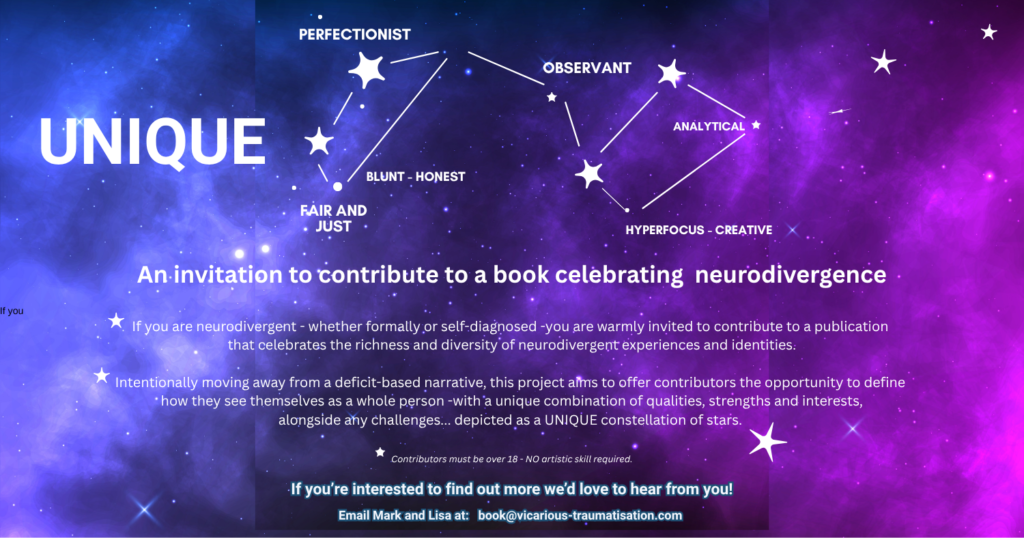
I am delighted to share that I have a chapter in an upcoming book called UNIQUE. UNIQUE invites neurodivergent contributors to map themselves: their qualities, strengths, struggles, deep interests, and challenges, all held together as a constellation.
My chapter centres on my Monotropic Galaxy — the constellation map of my Autistic self, and this blog is an edited and expanded version of my forthcoming chapter submission. My own constellation is a small offering among many in what I hope will be a rich, diverse, and deeply affirming collection of neurodivergent people’s inner worlds and experiences.
The book is still open for contributions.
If you are neurodivergent — whether formally diagnosed or self-identifying — you are warmly invited to contribute your own constellation. No artistic skill is needed. No particular way of writing. Just your own unique map of who you are. The project is intentionally moving away from deficit narratives and toward something that reflects the full richness of neurodivergent experience and identity.
Contributors need to be over 18. If you’re interested to find out more, Mark and Lisa would love to hear from you at book@vicarious-traumatisation.com.
Courses, books and resources
If you would like to take these ideas further, my courses, books and resources live on Autistic Realms. Everything in the shop is pay what you can, and many resources are free.
“Objects do not come first and then differ; rather, objects emerge out of more fundamental processes of differentiation.”
This feels like a statement about identity, about what we actually are. It felt, in a way I am still working through, like a description of something I have always known from the inside, without ever quite having the language for it. It helps explain how I feel that I am not a fixed, bounded thing moving through the world, but that I emerge, in and through my relationships and encounters with everything around me.
This piece is my attempt to think that through. As always, this is exploratory, I am definitely not a physicist, and I am not making literal claims about quantum mechanics applying directly to human experience, as I really don’t know enough! However, I do think physics can offer us resonant frameworks, ways of thinking that help us articulate things that neuronormative language has never quite been able to hold, and it may help understand and explain some ways of being Autistic or otherwise neurodivergent.
What quantum physics may be actually saying
Webster’s article draws on the work of physicist Carlo Rovelli, who developed what is called Relational Quantum Mechanics (RQM). The basic idea is that at the quantum level, particles do not have fixed, independent properties. A particle’s properties only become real in relation to another system. There is no such thing as an absolute, standalone description of a quantum object that holds true for all observers in all contexts. In other words, what something is depends on what it is in relation to.
Rovelli explains that the world of quantum mechanics is not a world of objects, it is a world of events, and events are always interactions between systems. Reality, at its most fundamental, is not a collection of separate things with built-in properties, it is a vast, shimmering web of relations.
Webster goes even further, drawing on the philosopher Gilles Deleuze to argue that this is not just a strange quirk of the quantum scale, it is actually how reality works at every level. Deleuze argued that difference and relation come first. The apparently stable, separate things we perceive — objects, individuals, identities — emerge out of relational processes, not the other way around. As Webster puts it: “Objects do not come first and then differ; rather, objects emerge out of more fundamental processes of differentiation.” Deleuze saw this as a model for how reality works at every level — not objects first, then relations, but relations first, and then eventually what we recognise as objects.
In my ongoing reading of Deleuze and Guattari over the past few years, it feels like things are starting to connect in a strange way……something is starting to make a bit more sense, folds unfolding and nodes of the rhizome and constellations are beginning to connect a bit more in relation to my Autistic identity and relations with others……
Why this matters for how Autistic people have been understood
One of the things Webster observes is that even our philosophical and logical language cannot easily hold a relational worldview. Our logic is built to describe objects and their properties. If relations come first, that language actively gets in the way, so we need different frameworks, different vocabularies, to say what is actually true and also how we feel.
Many of us, as Autistic people, may recognise this difficulty as the neuronormative-dominated language and society we have all grown up in, with its emphasis on fixed traits, stable categories, and measurable deficits has never quite been able to hold what our experience actually is or feels like. As I explored in Living in Layers, my reality is layered, non-linear, and sensorily permeable in ways that the majority of the world seems to fail to recognise or understand. It feels like the language we have is so limited, and just keeps breaking up against us.
This is why I am so passionate about our Stimpunks glossary, created by the neurodivergent and disabled community — we have to create our own vocabulary to survive, as it just isn’t there in the world we currently live in. As Audre Lorde’s and bell hooks’ work reinforces, language is a vital tool for survival, self-revelation, and political action – ‘language is a place of struggle‘.
The frameworks built to describe and assess Autistic people are rooted in exactly the kind of object-thinking that Webster is critiquing. They ask people, what properties does this person contain? What is inside this individual that differs from the norm? How do we measure, categorise, and if possible remediate, fix or change the object so they fit into society?
Damian Milton’s (2012) Double Empathy Problem helped my understanding of this gap of difference over a decade ago. The double empathy problem helps explain that the misunderstanding so often attributed to Autistic people is not located inside one person, it lives between people, in the quality and texture of the encounter, the shared or unshared frameworks two people bring into contact with each other through their lived experiences. In my longer piece The Double Empathy Problem is DEEP (Double Empathy Extreme Problem – Dynamic, Embodied, Ecological, and Political), I explore how this operates not just between individuals but at social, cultural, and structural systemic levels.
The “problem,” in other words, is a relational property. It is not something carried in the Autistic person’s neurology like a stone in a pocket. It emerges, as all relations do, in the encounter itself, in the liminal spaces. In the gap between two different ways of sensing the world, two different attentional rhythms, two different histories of what communication has felt like and meant.
I have spent a long time feeling like the problem, as I think many of us may have as Autistic people. I find something genuinely moving in the idea that physics is pointing towards the same conclusion that disabled activists and Autistic-led researchers have been making for decades. The difficulties we encounter are ecological as David Gray-Hammond has been writing about in their Ecosystemic Model, which we have expanded on in our Re-Storying Autism course and book.
What needs to change is not the person but the conditions of relation. Rovelli might put it a little differently, saying that properties only become real in relation to another system. There is no absolute, observer-independent description of a person that tells the whole truth about themselves. What we are is always, in part, a function of what and who we are in relation to each other and our environment.
This connects to the work of Ombre Tarragnat (2025) on ethodiversity. Ethodiversity (short for ethological diversity), is a concept that moves neurodiversity thinking beyond the brain and into the wider ecological and relational field. Rather than focusing only on neurological difference, ethodiversity attends to the full range of behavioural and existential styles: the different ways that humans and other animals move through, sense, and inhabit their worlds. Tarragnat describes it as encompassing not just biology but inter- and intraspecific relationality, the ways our differences are always already entangled with the environments and relationships we are embedded in.
What I find so useful here is that ethodiversity frames difference as fundamentally ecological and relational rather than as a property contained within an individual. The parallel Tarragnat draws with biodiversity makes sense to me as just like biodiversity is a property of an ecosystem, (something that emerges from how species relate to each other and their habitat), ethodiversity is a property of a relational field. You cannot understand anything by studying one organism in isolation.
Tarragnat also introduces the concept of ethonormativity, the often unspoken rules that govern which ways of being, behaving, and relating are acceptable or expected in a given context. Ethonormativity, like neuronormativity, is not located inside the person. It is a property of the relational and social environment, a set of conditions that certain bodyminds move through with ease, and that others may find exhausting, painful, or simply impossible to meet. When we think of diversity in this way, the difficulty and barriers Autistic, otherwise neurodivergent or disabled people face are not their personal divergence, it is the narrowness of what the relational field is prepared to hold.
A Pause……
This piece is pretty wordy, and I am aware that when we talk about Autistic and neurodivergent experience in these kinds of registers, we can end up — without meaning to — centring the voices that the world already knows how to value. I want to gently push back against that, including in my own writing.
The ideas here belong to all of us, and relation has to come first. These are not ideas that matter more or less depending on how someone communicates, moves, or exists in the world. I have been thinking and writing a lot lately about how neuro-affirming practice is not a framework or a checklist — it is a way of being. It is about being genuinely present with people, as they are, in the relational field we share. That means all of us, including, and I would say especially, people with profound and multiple learning and intellectual disabilities, whose ways of being in relation are so often the most misread, the most unseen, and the most undervalued by the systems built around them.
I spent twenty years as a SEND teacher, and some of the richest, most meaningful things I have come to understand about what genuine relation looks and feels like, what it means to truly be with someone, came from my time in class. Relation and safety was the foundation of everything. A shift in breathing, a change in muscle tone, a turn toward a familiar voice or a sound. These weren’t lesser forms of connection, just different ones, asking something different of the people around them to connect with them. Asking us to slow down, to pay attention differently, to stop waiting for communication that looks like ours before we decide someone is worth relating to. This is the embodied DEEP dimension of the Double Empathy Problem — Dynamic, Embodied, Ecological, and Political — the reminder that relation happens in and through bodies, breath, and shared presence, long before it happens in words. It is a way of being with each other, across the full and beautiful range of how we all exist with one another and with our environment.
Tarragnat’s ideas about ethonormativity does its most violent work on those whose ways of being are furthest from what any normative system recognises as meaningful communication or social participation. The relational field that needs to change is not only the one around verbally articulate Autistic people, but it is also every environment that has decided in advance what counts as a person worth relating to, with those most marginalised always being pushed further away instead of centring them.
This is why, if we return to Rovelli, the question is never just about asking “what is this person like?”, it is also always about “what kind of relational field are we creating together, and whose ways of being does that field make possible?”
Philosopher and physicist Karen Barad (2007) calls this intra-action, which is a bit different from inter-action. Interaction assumes two separate, already-formed things that then come into contact. Intra-action suggests something more radical, that the things themselves, the identities, the properties, the selves, are produced through the meeting. We do not arrive fully formed and then enter into relation, we are, in part, constituted by the relations we are held within and have always been a part of. Barad also draws on quantum physics to make this argument, which is why it sits so naturally alongside Rovelli’s, as both point toward a world where relation is everything.
Erin Manning (2016) develops something similar when she writes about Autistic experience and what she calls the minor gesture, the ways of moving, attending, and relating that do not register within dominant frameworks, but that are doing real, significant, world-making work nonetheless. For Manning, Autistic ways of being are not failed attempts at neurotypical relation, they are different modes of intrarelation, of being constituted in and through a world that is always already more-than-individual.*
This is why I find the word intradependent useful alongside the more familiar interdependent. Interdependence acknowledges that we need each other and intradependence goes further as it suggests that we are, in some fundamental sense, made of each other, that the boundaries between self and relation, between individual and environment, are more porous and more dynamic than the frameworks built around us have ever allowed us to embrace.
What becomes possible when we think relationally
We are all interdependent and intradependent and Webster helps highlight that this is precisely why Deleuze matters. Deleuze offers what Webster calls “the metaphysics science needs”, a different conceptual vocabulary, one built for difference, flow, and becoming rather than for fixed objects and their properties. I think this may also be part of the metaphysics that neurodiversity needs, an ever-expanding neuroqueer framework that begins with relation rather than with the individual as an isolated, assessable unit.
If identity emerges from relations rather than residing inside individuals, then support cannot be about fixing a person in isolation. It has to be about transforming the relational conditions — the environment, the encounter, the quality and structure of connection itself. The sensory climate of a space, the pacing, the temporality and texture of relating and forming connections and relationships. Whether a community can hold someone’s particular way of attending to the world without requiring them to translate themselves into something more legible, more manageable, more like the expected norm, and whether the people building those spaces are genuinely asking whose ways of being they are designed around, and whose they are still leaving out.
This is what I see at work in the best neurodiversity-affirming spaces I am fortunate to be part of — the CASY group, the Stimpunks community, NeuroHub Community and Thriving Autistic. These aren’t spaces that take a person as an object to be supported, assessed, and adjusted, but co-created spaces that understand themselves as relational fields. They are communities that consider what those fields need to become, so that different kinds of bodyminds can genuinely flourish within them. Spaces that hold the full range of experiences, from the most academically articulate to those whose presence, joy, pain and relation express themselves entirely outside of neuronormative language as sensory beings. Everyone has equal worth and we are all dependent on each other to not only survive, but thrive and create meaningful lives together.
In We Are Star Stuff, which I am continuing to develop collaboratively with Ryan Boren at Stimpunks, we wrote about being literally made of elements forged in dying stars: about the deep, physical reality of our connection to the cosmos and to each other. Relational quantum mechanics takes this even further, not just that we are made of the same stuff, but that what we are, at the most fundamental level of reality, is constituted by our relations with each other and our environments. There is no isolated self beneath the web of connection, there is only what emerges in, through and in the spaces between every encounter.
We are not broken objects. We are relations, all of us still becoming. And I think (and I hope) that sitting with some of these thoughts might help change everything about how we understand, support, and truly be with each other.
Cordero-Rivera, A. (2017). Behavioral diversity (ethodiversity): A neglected level in the study of biodiversity. Frontiers in Ecology and Evolution, 5, art. 7. https://doi.org/10.3389/fevo.2017.00007
Deleuze, G. (1994). Difference and repetition (P. Patton, Trans.). Columbia University Press. (Original work published 1968)
Deleuze, G., & Guattari, F. (1987). A thousand plateaus: Capitalism and schizophrenia (B. Massumi, Trans.). University of Minnesota Press. (Original work published 1980)
Walker, N. (2021). Neuroqueer heresies. Autonomous Press.
Webster, G. (2024). The metaphysics science needs: Deleuze’s naturalism. European Journal of Philosophy, 32(3), 820–846. https://doi.org/10.1111/ejop.12909
If you would like to take these ideas further, my courses, books and resources live on Autistic Realms. Everything in the shop is pay what you can, and many resources are free.
I find it genuinely awe-inspiring to know that the atoms that make up your body, the oxygen in your lungs, the calcium in your bones, the iron in your blood were forged inside stars that died before our planet even existed. Not metaphorically, we are actually, literally, made of stars!
A 2017 survey of 150,000 stars confirmed that humans and our galaxy share around 97% of the same kinds of atoms, and that the six elements essential to life — carbon, hydrogen, nitrogen, oxygen, phosphorus, and sulphur — are woven right through the Milky Way (Howell, 2017). We are a living part of the cosmos.
I have been thinking about this a lot, and what it may mean to us as Autistic people, and it is something that is evolving in conversations within the CASY Autistic Physics group and my recent collaborative work with Stimpunks. There is something about being made of stardust that resonates far deeper than a scientific fact for me.
As an Autistic person, I have always felt that the boundaries between myself and the world are more porous than I was told they should be. Everything feels entangled, I am deeply influenced by my environment in ways that go beyond what neuronormative frameworks tend to account for. Time, my past and present merge and move together; my pull towards moss and mushrooms, and my interest in water, are more than a ‘like’ or form of regulation or sensory relief, they feel like I am becoming more attuned to something deeper and more essential, something I can only describe as parts of my soul recognising what they actually belong to.
The elements in your body right now came into being through some of the most violent events in the universe. The iron in your blood, the calcium in your bones, the oxygen in every breath, were forged in the cores of massive stars and released in supernovae: entire stars compressing their whole lives into a single catastrophic release. In that rupture, what had been locked inside was scattered outward, making things possible that could never have existed before.
Many of us, as neurodivergent people and from marginalised communities, may know something about transformation through rupture, about how the most difficult passages of burnout and exclusion can forge something that simply could not have existed any other way. As I have written, these periods of burnout seem to change me at my core. I never fully recover; the deepest burnouts feel like a seismic shift has taken place. My whole sensory system and way of relating to the world transforms.
For Autistic people, the idea of a fixed, bounded, separate self may sit uneasily, we are always in flow, always fluid and always responsive to everything around us. The theory of Monotropism developed by Murray, Lesser, and Lawson (2005) may help explain this. It describes the way Autistic (and may be ADHD/ AuDHD) attention tends to move in deep, singular currents rather than spreading across many channels at once. It is a different way of connecting: like matter drawn into a stellar core, our attention concentrates and transforms, and, like the star, what forms in that depth eventually moves outward and can expand, making new connections and new ways of being.
Ethodiversity is a concept that feels important here. Originally coined by Cordero-Rivera (2017) in ecology and evolutionary science, and developed by Tarragnat (2025) into a framework for thinking about human and nonhuman life together, it refers to the full range of behavioural and existential ways of being across species, not just neurological difference, but the diversity of how living beings sense, connect, relate, move through, and respond to the world. As Autistic people, our particular way of being is shaped by, and in turn shapes, everything around us, perhaps more intensely for some than others. We are not separate from the wider pattern of the cosmos; we are very much a part of how the pattern moves, interdependent on each other and everything around us.
For many Autistic people, this deep attunement to the world, to its textures, its moods, its patterns may be felt intensely. However, it is so often misread, pathologised, or masked out of our existence simply to fit into spaces that were not built for us. When we are in environments where we feel genuinely safe, something can shift. We are able to be our full selves, more open, more present to what the world is actually offering us —the things that bring us comfort, joy, and we can meet them on our own terms. That is what a real connection actually feels like, and we deserve spaces where it’s possible.
That sense of belonging and connection can ripple outwards. adrienne maree brown writes in Emergent Strategy (2017) that small patterns replicate into large ones, that the local and the cosmic are always doing the same thing at different scales. She centres the people that dominant systems have tried to cast as anomalies, Black, disabled, neurodivergent, queer, poor and names what many of us may already sense: that what looks like deviation is often a more honest expression of how complex living systems actually work. Emergence doesn’t need conformity; it needs difference. A universe that could only produce one kind of star would not have produced us or our world as we know it.
We are all made of stardust, and our entanglement, our porousness, our deep attunement to the world and cosmos around us are things we should all embrace, regardless of any labels or diagnoses we may or may not have.
Stimpunks, whose work on star stuff has been part of the thinking woven through this piece and through our collaborative work sums it up nicely:
The cosmos is within us, and we are a way for the universe to know itself — in every colour, key, and frequency of neurodiversity
“What more do you want? The ingredients in our bodies have been assembled in the hearts of long-dead stars over billions of years and have assembled themselves into temporary structures that can think and explore…” Brian Cox
brown, a. m. (2017). Emergent strategy: Shaping change, changing worlds. AK Press.
Cordero-Rivera, A. (2017). Behavioral diversity (ethodiversity): A neglected level in the study of biodiversity. Frontiers in Ecology and Evolution, 5, Article 7. https://doi.org/10.3389/fevo.2017.00007
Murray, D., Lesser, M., & Lawson, W. (2005). Attention, monotropism and the diagnostic criteria for autism. Autism, 9(2), 139–156. https://doi.org/10.1177/1362361305051398
If you would like to take these ideas further, my courses, books and resources live on Autistic Realms. Everything in the shop is pay what you can, and many resources are free.
Today is World Quantum Day. The date itself carries meaning: April 14th is a reference to 4.14, the rounded first digits of Planck’s constant, a precise measure of energy and time that governs how reality behaves at its most fundamental level. Quantum physics tells us that particles can exist in multiple states at once, that reality at its most fundamental level is not fixed, singular, or predictable in the ways we were taught to expect.
I am not a physicist by any means (!), but I have spent my whole life as an Autistic ADHD person living something that feels, may be able to be better explained by quantum physics than any textbook or psychology book about Autism. What follows is my attempt to use the language of physics as metaphor and resonance – not a literal claim, to describe what neuronormative frameworks about Autistic experiences have never quite been able to hold for me.
I have never experienced life as a single, stable or consistent reality. People talk about “being present” as though there is one shared world everyone occupies in the same way, with the same attentional depth, the same clarity, the same sensory experiences, and the same time perception. For me, my presence has never been singular; my reality is layered, permeable, and sensorily multidimensional. Memories, dreams, and the present moment all overlap and bleed into one another. ( I wrote more about dreams and exploring threshold consciousness, temporal ecology, and the porous boundaries between dreaming and waking in my blog about hypnagogic and hypnagogic experiences.)
I am realising I am constantly navigating worlds that coexist rather than worlds that take turns or operate in any linear, easily explained way that even the most neuro-affirming of Autistic spaces seem not to quite get all the time.
There are thin surface layers where language, rules, and social expectations dominate, brittle spaces that take enormous effort for me to maintain, even more so as I’ve grown older and more aware of my own needs. This is more than just masking at a surface social level to fit in, it goes far deeper and is more expansive. I have spent most of my life translating myself into legible, acceptable versions, until I found spaces like the CASY Physics Group, where other people seem to just get it too, where I do not have to translate at all and where all these weird experiences are beginning to make a bit more sense as I learn from and listen to others.
Beneath that surface of masking is what I can only describe as caverns and rivers of thought, ideas, and feelings, flowing like underground water, finding their own paths. Sometimes that current sweeps me into deep burnout, sometimes I can ride it, working prolifically, losing track of sleep entirely, pulled into a tunnel of meaning that feels more real than anything on the surface.
In quantum terms, this feels like it is may be closer to superposition, a holding of multiple states, multiple layers of reality being simultaneously open. The problem I have begun to realise is not just being neurodivergent, it is being in a world calibrated to expect only one state at a time – often based on neuronormative values and perceptions.
Holotropism and Neuroholographic Ways of Being
My understanding of these experiences became clearer when I encountered two ideas that finally gave me the language to describe my ways of being. The first is monotropism, the theory that many Autistic and ADHD people channel attention deeply into a single tunnel of interest at a time (Murray et al., 2005). I recognise this in myself and have written about monotropism extensively on my Autistic Realms website and also support Fergus Murray with Monotropism.org. However, Hendl H Mirra’s (2023) concept of holotropism expanded this considerably, describing something that feels closer to the actual space and time I live in.
Holotropism describes a way of being in which sensory gates are wide open, where self and world do not have sharp edges, and where experience is not additive — this thing, then that thing — but multiplicative: intensely rich, layered, and sometimes overwhelming all at once. In this framing, monotropism is not the root of our being but a salve, a way the holotropic mind protects itself, flooding one pathway to quiet the noise of all the others. I often find myself entering or seeking deep flow when the fullness of my openness becomes too much, as a way to help balance my bodymind. Being holotropic is not something I switch into occasionally, it is who I am, when I am safe enough to be myself.
“Neuro-Holographic” is an emergent idea that our group has embraced. Neuro-Holographic, as a concept here, refers to the idea that every small bit of energy and information, whether an atom or the universe, reflects every other part of itself in a seamless and meaningful way.
This has led to the awareness that, despite common misconceptions, we are very much empathetically connected to the things around us. Because our sensing mechanisms are super sensitive and often synesthetic (cross-sensing — for example, tasting colors or seeing sound) we often feel a part of the things around us. We don’t tend to see in hierarchies, but rather in “holograms,” as described. Always looking for connecting patterns in an overwhelming ocean of sensory, emotional, and energetic information, our relational culture focuses on how things go together and function. Because of these innate talents, insights, and a tendency toward invention, out of the box thinking, and an enthusiasm for combining patterns, autistic/Neuro-Holographic people have been responsible for many important developments in the larger cultures in which they find themselves. Being extraordinarily sensitive and seeing things in new ways is foundational to autistic culture.
The hologram draws on David Bohm’s implicate order, the idea that beneath observable reality lies a deeper enfolded order from which visible patterns emerge (Bohm, 1980). This is contested within some physics discussions and is not mainstream quantum theory. I am not claiming that quantum mechanics literally explains Autistic cognition, I am suggesting that this language describes my lived experience in ways that other frameworks never have. For those of us whose bodyminds work this way, finding that language is not a small thing; it can be life-changing and an opportunity to connect with others.
A hologram has a remarkable property: if you break it into pieces, each fragment still contains the whole image, not a portion of it, but the entire picture, seen from a different angle. The smaller the fragment, the less resolution it holds, but the whole is still there. This is how I feel my mind works, where a single sensation, such as a tone of voice, a shift in relational energy, or the light through my window, can activate entire networks of memory, imagery, emotion, and meaning simultaneously. When my thinking seems to wander off in all directions, it is not getting lost, even if that is how it can appear to others, it is doing what a hologram does, where every fragment still holds the whole picture and every thought connects back to everything else, to a greater or lesser degree. It can be exhausting to live like this at times, but it is also where my most creative ideas and sensory experiences happen, with connections and ideas spiralling up that surprise even me, that don’t make immediate sense until I have had time to sit with them and let them settle into something new.
Quantum Physics and Being Autistic
In quantum physics, a particle in superposition holds multiple possibilities at once — fluid, open, unforced — until something forces it to collapse into a single fixed state. When I first encountered this idea, something in me recognised it, not as a scientific concept I was learning (although I have tried!), but more as a description of something I had been living my whole life without having the words for.
When I am safe, I feel I am in superposition, and I am able to move between two natural rhythms: deep absorption and flow, that bright tunnel where the world narrows to what matters most and a quieter open awareness, where everything settles and connects without effort.
Collapse happens when the world demands linearity: one pace, one channel, one way of being, when I am always on someone else’s time and terms and expectations. When collapse is sustained long enough, it becomes burnout, which is not just exhaustion in the neuronormative sense, but something closer to what I would describe as a dimensional compression, where I am being forced into a single layer until all the others become inaccessible.
Recovery from burnout, for me, is not just about rest; it is about having enough unstructured time for flow and safety to slowly unfold back into the full dimensionality of who I am and find my bearings in whatever new configuration of self and world has emerged in the meantime. It is kind of like being a living portal where the door just closes off sometimes, and I need to find ways to re-open the door to discover whatever new ways of being await.
CASY Autistic Physics Community
Things have begun to shift since I found the CASY Community, where our Autistic ways of knowing and being are all unconditionally accepted. Dawn Prince-Hughes has described CASY gatherings as places “where dense, three-dimensional planes mesh with synesthetic and holographic perceptions”. It felt like Dawn and others were finally naming my internal geography. Our CASY Declaration states that, “there is no separation of mind in a conscious, holographic system — that the Autistic universe is more than the sum of its parts”.
This is what we and other member of CASY are calling Autistic Physics: the understanding that Autistic ways of being is not a broken version of neuronormativity but an entirely different relationship with reality. Liam McDermott’s research names this structurally, arguing that neuronormativity silently governs what counts as scientific knowledge, and that the rigidity of neurotypical-normative learning actively disables those of us who create knowledge non-normatively (McDermott, 2023).
Embracing Neuroholographic Ways of Being
World Quantum Day celebrates the fact that reality, at its most fundamental level, does not behave the way we may have been taught to expect. Particles hold multiple truths simultaneously, and connection happens across distances and time frames that conventional and neuronormative logic would say should make it impossible.
In the CASY Physics group, we have been sitting with these ideas in our online community, and we are finding that when we as Autistic and neurodivergent people share how we actually experience the world, through conversation, writing, art, and all the layered, neuroholographic ways we naturally think and express ourselves, something becomes visible that no outside account of us could ever quite reach. We share synchronicities, different temporalities, and so many experiences that many people find hard to empathise with or understand.
Living in layers has always been how I move through the world, holographically, relationally, in ways that neuronormative frameworks were never built to hold. What I have found in the CASY Physics group is that I am far from alone in this. When people who experience reality in many different and unique ways come together and share their experiences in their own language (through words, text or other creative media), on their own terms, something opens up that no outside account of Autistic people can ever quite reach. The universe, it turns out, works in ways that may feel rather familiar to those of us who have always lived this way, and finding each other, it turns out, is part of how the picture becomes whole and make a bit more sense.
Author’s note: This piece is written from my own Autistic experience. Autistic lives span an enormous range, this is just my perspective.
Murray D, Lesser M, Lawson W. Attention, monotropism and the diagnostic criteria for autism. Autism. 2005 May;9(2):139-56. doi: 10.1177/1362361305051398. PMID: 15857859. https://pubmed.ncbi.nlm.nih.gov/15857859/
If you would like to take these ideas further, my courses, books and resources live on Autistic Realms. Everything in the shop is pay what you can, and many resources are free.
Quantumness tends to prosper in very cold systems that are carefully isolated rather than part of a tepid soup awash with other activity.” (Lewton, T. 2024)
This may be a weird take, but … I think we could use the idea of quantumness and reframe it around an interpretation of marginalised groups living on the edges of society, in the liminal zones. Those who are feeling deeply disconnected, isolated and frozen in a system that is not designed for us or meeting needs. This is highlighted by AutCollab’s recent research where they shared:
Our individually unique nervous systems and sensitivities develop and evolve over the course of our lives. 85% of neurodivergent adults often or always feel overwhelmed and misunderstood, and over 60% often or always feel disrespected and unsafe. Our overall sense of wellbeing is determined by alignment between our sensitivity profiles and the ecology of care we are embedded in (or not). (Jorn Bettin, Aut Collab 2024)
Collectively, our isolation can transform into something positive by our neuro-holographic energy coming together to enable neuroqueer transformations at a personal and also mass cultural level.
Disconnect at DEEP Levels in Liminal Spaces
As an autistic person, I do not see or feel a boundary between myself and my environment; I feel a deep attunement to the space around me. However, I also feel a deep disconnect with the majority of society and the pressures of feeling I need to conform to dominant social norms that have always left me on the edge; feeling separate and in many ways disembodied and shattered into millions of fractals. I experience the Double Empathy Gap (Milton, 2012) at an extremely deep level of intensity. The double empathy problem creates a gap of disconnect experienced between people due to misunderstood shared lived experiences. It is “a breakdown in reciprocity and mutual understanding that can happen between people with very differing ways of experiencing the world.”
I feel that as a society, those already marginalised are at risk of becoming even more disembodied, the double empathy gap is growing. In many ways, we are losing our primordial affinity with nature and drifting further from coherence, harmony, and the humanised ecology of care that we need. The double empathy problem feels extreme, it feels deep; it is what I have been describing as DEEP (Double Empathy Extreme Problem (Edgar, 2024).
The DEEP (Double Empathy Extreme Problem ) arises from feelings of disconnect, not only from cultural, sexual, political, religious, neurodivergent, or any other cross-section of differences but also through embodiment, or lack thereof. The double empathy gap is non-linear; it is deep, multidimensional, rhizomatic, and holographic (Mirra, 2023). DEEP could be a huge contributing factor that leads to burnout, ill health and is pushing people further out so they feel they are living on a knife edge just to survive. The DEEP gap can break people at their core, leaving them fragmented, disconnected, disoriented and disembodied, feeling like they’re falling into the void between spaces.
The DEEP problem may be intensified by being monotropic (Murray et al., 2005) and using most of my energy resources to zoom into these feelings and ways of being. This enables me to not only see the details, the harm, and the injustice but also to feel it in multidimensional synesthetic ways in how I see, feel, hear, move, and connect. All of these experiences merge and entwine in holographic ways.
I have been chatting to Dawn Prince-Hughes who is a lead in the CASY (Cultural Autism Studies at Yale) team, they describe similar thoughts and elaborate;
Because our [autistic] sensing mechanisms are super sensitive and often synesthetic (cross-sensing — for example, tasting colors or seeing sound) we often feel a part of the things around us. We don’t tend to see in hierarchies, but rather in “holograms,” as described. Always looking for connecting patterns in an overwhelming ocean of sensory, emotional, and energetic information, our relational culture focuses on how things go together and function. (Dawn Prince-Hughes, 2024)
Neuro-Holographic Communities
“Autistic culture is a unique phenomenon; it is constantly in the process of exploring itself, defining itself, and generating itself. Unlike holistic (non-autistic) culture, it is deeply relational. For many autistic people there is no strict boundary between self and environment, or self and other. We tend not to see things in hierarchies, but in relational ways that are in constant flux. “Neuro-Holographic” is an emergent idea that our group has embraced. Neuro-Holographic, as a concept here, refers to the idea that every small bit of energy and information, whether an atom or the universe, reflects every other part of itself in a seamless and meaningful way.” (Dawn Prince-Hughes, 2024)
In my previous blog, I intentionally used a hyphen between the words neuro and holographic to represent the in-between of neurology and holographic ways of being and experiencing the world, a pause for tuning in, an embodiment, a space of Ma. I have resisted using the word “neuro-holographism as that could imply another new theory or concept. Neuro-holographic is not a concept; rather, I feel like it IS the plane of immanence on which neuroqueer theory breathes and lives; it is the ‘wave that rolls and unrolls’ other concepts (Deleuze & Guattari, What is Philosophy, 1994, p36). To resonate with the term neuro-holographic is to resonate with each other as human souls, to be embodied with your core self, perhaps with your spirit, and to be open to holographic connections with others.
Quantum Entanglement
Nerve fibres in the brain could produce pairs of particles linked by quantum entanglement. If backed by experimental observations, this phenomenon could explain how millions of cells in the brain synchronise their activity to make it function.
“When a brain is active, millions of neurons fire simultaneously,” says Yong-Cong Chen at Shanghai University in China. Doing so requires even distant cells to coordinate their timing, which has led some researchers to wonder if this coordination could be due to what Einstein called “spooky action at a distance” — the instantaneous communication that occurs between particles linked by quantum entanglement. “If the power of evolution was looking for handy action over a distance, quantum entanglement would be [an] ideal candidate for this role,” Chen says.
……Once the brain creates entangled photons, the property of entanglement could be passed onto other parts of neurons, like the protein pores that play a role in electrical signalling across the brain, says Chen. When any two objects are quantum entangled, changes in one immediately cause changes in the other — so if different parts of the brain were entangled, they could synchronise much more quickly than through any other type of connection.
All of these factors mean that autistic people’s interoception system and exteroception system will entangle and respond differently too. Neuro-holographic people have strong open sensory gates. In our communities, we are finding neuro-holographic people are being drawn together; their holotropic energy fields seem to align with others of a similar frequency, fusing together and creating connections in all different spaces across the globe in weird and beautiful ways both online and in person. People are being led by their heart, their soul, their inner true intrinsic self and way of being and discovering that they are not alone, weirdness is ok and can be embraced.
Annie Murphy Paul in The Extended Mind: The Power of Thinking outside the Brainshows that bodily knowledge (interoception) can be more accurate, for instance in the work of day traders who must juggle huge amounts of information very rapidly, than conscious analysis of explicit data. “The heart, and not the head, leads the way,” she concludes.11 Leslie Shelton puts it bluntly: “Emotion is the master over cognition.” (Blum, S. D. 2024)
Beautiful Holographic Potential and Created Serendipity
The online community favors and enables this unique energy and connections to synchronise, entangle, fuse, form and reform and enables potential to expand rhizomatically, holographically. People and communities that are embodied and intune with each other can create serendipity. The more connected and embodied you are, the more connections form and the stronger the hologram and holographic community becomes. Each node of the hologram is a community where collective energy is created and multiplied, it enables increasingly expansive new serendipity and possibilities to emerge. It allows us to lean into and embrace neuroqueer theory (Walker, 2021) and neuroqueering possibilities.
When people feel validated, they can validate the experience of others; a sense of safety is created between people where there is trust and mutual understanding. This enables stronger connections to form in community clusters, at the nodes, which works to strengthen the rhizomatic neuroqueer network. People are in a better safer place to unravel, de-mask, and dearmour themselves from the restraints of trying to live up to neuronormative ideas when they feel they can trust and connect with those around them. Safe spaces enable radical inclusive ways for people to be themselves, so they can explore their own ways of being without stigma and without fear of prejudice. Perhaps it is only through enduring a life living in the liminal and on the edges that we can truly embrace or feel the potential of Walker’s neuroqueer theory and value the potential neuroqueering?
After years of isolation and existing in survival mode on the side lines of the liminal parts of society some people are naturally finding their energy is gravitating towards certain people and spaces. Like myself, they are connecting with others who resonate with them in small community groups which are all connecting rhizomatically. Community provides a sense of meaning to life and validates what may previously have felt like a very disconnected, disembodied, chaotic existence. “Our overall sense of wellbeing is determined by the health of the ecology of care we are embedded in, by our sensitivity profiles, and our (in)ability to resolve cognitive dissonance.” (Jorn Bettin, AutCollab, 2024)
Persistent positive experiences (over months, years, decades) in the social and ecological environment beyond the human that allow us to feel understood and loved, i.e. experiences with non-judgemental animals and people with compatible sensitivity profiles — such positive experiences allow us to incrementally let go of internalised ableism, and they teach us how to nurture trustworthy de-powered (non-coercive) caring relationships with other living beings. (Jorn Bettin, AutCollab, 2024)
At a human scale, some ideas of quantum biology and quantum physics resonate with neuro-holographic concepts and ways of being. The beauty lies in the fact that the word neuro-holographic can only be felt or experienced in an undefinable, iridescent way as we are talking about energy, tiny particles of ourselves that can’t be seen or observed but are alive and seeking connections. Holographic energy is full of light and vibrations that can expand and ripple far beyond our own bodyminds to connect with others who are vibrating at a similar frequency. The fusion of this collective energy creates multiplicity and is ever-expanding, entwining, and merging with others, expanding each individual’s potential to challenge and subvert harmful systems and ways of being and discovering neuroqueer ways of embracing life in multidimensional ways. It brings people together to create ecologies of care, communities based on deep understanding, love and acceptance.
When people experience deep emotionally engaged thinking about complex issues, they are literally playing out that thinking process, our data would suggest and now many other sources of data would suggest, on the substrate of the cortisone cortical regions that literally also are feeling your guts.
Poets have had it right all along. (Immordino-Yang, 2024)
Connecting with others and following your intuition and your internal vibes or gut feelings in safe spaces enables people to explore emerging thoughts, to be open to explore the ‘perhaps’, the ‘may be’, the ‘could be’ and possibilities that ‘might happen’ if we truly embraced the neurodiversity paradigm and neuroqueer theory in creative ways, it enables awe and wonder and feelings of belonging. It enables our community rhizomes to expand into spaces full of radical, inclusive neuroqueer possibilities.
Opening up discussions and sharing lived experiences helps to bridge the deep double empathy gap. “A de-powered and less materialistic life is beneficial for our physical wellbeing, and that a socially de-powered life at human scale is essential for our mental wellbeing”(Bettin, 2024). We need to embrace the potential of quantum entanglement and it’s outcomes, it enables us to create new planes and plateaus to live together in our own authentic ways so we can keep holographically neuroqueering ourselves and the spaces we are in to create radically inclusive communities together.
Human Restoration Project. (2024, August 2). Keynote: Dr. Mary Helen Immordino-Yang | Solving the Frankenstein Problem[Video]. YouTube. https://www.youtube.com/watch?v=FUG_ATjjiw4
Murray, D., Lesser, M., & Lawson, W. (2005a). Attention, monotropism and the diagnostic criteria for autism. Autism (London), 9(2), 139–156. https://doi.org/10.1177/1362361305051398
Prince-Hughes, D. (2024). Cultural Autism Studies at Yale — A meeting place for those interested in the exploration, identification, generation and preservation of autistic culture.https://culturalautismstudiesatyale.space/
Walker, N. (2021). Neuroqueer heresies: Notes on the Neurodiversity Paradigm, Autistic Empowerment, and Postnormal Possibilities.
Courses, books and resources
If you would like to take these ideas further, my courses, books and resources live on Autistic Realms. Everything in the shop is pay what you can, and many resources are free.
In my previous blogs, Monotropic Time and Neuroqueering Temporalities (2025) and Quantum Neuro-Holographic Thoughts from a Liminal Space (2024), I explored how Autistic and other neurodivergent experiences often unfold outside of neuronormative frameworks. I am AuDHD and deeply resonate with the theory of monotropism. Through the lens of monotropism, I experience time as a multidimensional holographic spiral, immersive, shaped by deeply focused attention tunnels and being engaged in fluctuating states of flow. I am considering if our sense of time perception as monotropic people is different as we find ourselves on the edges or in the in-between liminal spaces of society, trying to fit into neuronormative time frames, which go against our innate, authentic ways of perceiving time.
I am on the edge of a new monotropic interest (time perception) and want to loop back to some of the thoughts I have been exploring over the past 2 years about the neuroqueering potential of Deleuzean philosophy and bring in some of the main concepts from the philosophy of Henri Bergson who I am just beginning to explore. Both thinkers profoundly reimagined what time is. Rather than seeing time as an objective, linear sequence of moments, like many neurotypical people may perceive time using conventional clock-time and calendar time, both Bergson and Deleuze highlight that time is not linear; it is experiential, fluid, and heterogeneous in nature. Both of their concepts of time seem to fit into how many neurodivergent people experience time and my own experience of time.
I can only write about my own experience of time as an AuDHD, monotropic person. My time is not linear; it stretches, loops, pulses, collapses, and dilates in tune with my fluctuating energy, capacity and attentional resources, depending on my environment and access to flow states. My time is measured in sensory experiences, moments and patterns rather than calendar events. I find it really hard to recall specific memories and events unless I have a photo to ground something. I have only recently begun to realise that the theory of monotropism may also help to explain how my recall and memories may be different from those of other people who are not Autistic/ ADHD due to a more fluid sense of time. I find memories really hard to pinpoint as my memories are often not based on time but on sensory experiences and patterns of thoughts, events and situations. It can make joining in conversations hard with others who don’t experience this, and I am only just beginning to understand why that may be, for me at least!
“Crip time is time travel. Disability and illness have the power to extract us from linear, progressive time with its normative life stages and cast us into a wormhole of backward and forward acceleration, jerky stops and starts, tedious intervals and abrupt endings. Some of us contend with the impairments of old age while still young; some of us are treated like children no matter how old we get.” ― Alice Wong, Disability Visibility: First-Person Stories from the Twenty-first Century
Post-Human Theory and Being Part of the Environment
I resonate with Ombre Tarragnat’s post-human theory, where they discuss Subverting the autistic bubble metaphor (I): the Umwelt Theory (2025). Autistic people are not in a bubble where we can’t be reached and can’t reach out. Jakob von Uexküll’s (2010) concept, the Autistic Umwelt, has traditionally been described as Autistic people being bounded, bubble-like, and even sealed off from the world; unapproachable or unable to be a part of the ‘real’ functioning world where neuronormativity rules. This view is painfully inaccurate and really harmful.
I like and need my time alone, in my cave space, but what may seem like an Umwelt for me is more like a porous, shimmering neuro-holographic bubble, shaped not only by perception but by constant affective, sensory, and cognitive entanglement with my environment. I am not an ‘other’ in my own bubble, separate from real life. I feel I am deeply entangled and part of the environment, not separate from it, but living in it. I am in a constant process of folding and unfolding from the liminal in between spaces of my bodymind, trying to navigate the reality of society’s expectations for how I should be and my day-to-day life as a mum, trying to juggle family needs, work needs, and manage my own Autistic ways of being.
As Autistic/ADHD people, we may be, as Tarragnat suggests, practising “worldmaking where the boundaries between the subject and the world dissolve”. In many ways, we have to create our own spaces and live in our own timeframes to survive (and hopefully thrive)! I think it was James Baldwin who said, ‘The place we need does not exist, we must create it’. Tarragnat, in their blog, From the Autistic Umwelt to Autistic Worldings, drew my attention to the work of Stacy Alaimo (2016), who, in line with post-human feminists, suggests that Autistic people are not ‘in the world…. but we are of the world’. We need safe spaces to be our authentic selves and be of the world and accepted.
My relationship with my environment is fluid, porous, and deeply relational. This profoundly shapes how I live, perceive, and manage my time. I connect strongly with the theory of monotropism, yet I also see value in layering a post-human and neuroqueer lens to help frame my temporal experience.
As an Autistic person, subverting neuronormative time often feels essential for my survival, even more so now after repeated cycles of burnout. I need to find ways to help prevent another burnout cycle or at least lessen the impact, if I can. I feel I need more space to honour my own monotropic rhythms and energies, more space to go with my flow, rather than against it, as described in my recent blog about my Map of Monotropic Experiences, Stuck States vs Flow States.
I believe this kind of release from the grip of neuronormative and capitalist time isn’t just for neurodivergent people; it could benefit everyone. By neuroqueering ourselves and time, anyone and everyone can break free from the neuronormative time structures that bind us all to capitalism and restrict our lives in so many ways. Instead, we may be able to live more attuned to our own temporalities and more at one with our environment and those around us.
Bergson’s Durée and Monotropic Time
Dinah Murray, Wenn Lawson, and Mike Lesser developed the theory of monotropism in the late 1990s. It is typically described as a neuro-affirming theory of Autism, but I think it is also a temporal mode. I am considering whether being monotropic is not just about using attentional resources differently but could also about experiencing time differently due to how we use our attentional resources, and this impacts us.
If you’re monotropic you may notice that:
Time is immersive and fluid.
How you use your attentional resources may feel like being in a tunnel, and the world outside of that tunnel may feel like it is melting away or completely disappearing.
Temporal markers (like deadlines, calendars or clocks) may lose meaning or become really stressful and cause intense dysregulation.
Transitions may feel disruptive because they pull us out of durational temporal coherence and flow.
I think this may be why neurotypical expectations around punctuality, deadlines or “moving on” often feel unnatural and sometimes even painful for monotropic bodyminds. I am suggesting these aren’t signs of being too rigid or an innate dysfunction; instead, they may reveal a mismatch between temporal systems, different ways of perceiving time.
Monotropic people may innately value and resonate more deeply with continuity and internal flow. Neuronormative time, which the majority of the population live by, values and prioritises a more fragmented, externally governed time (that of the clock) that fits into workplace demands much more easily. This conflict of time perception can cause a lot of pain and is a constant tug-of-war and hard balancing act to maintain.
It dawned on me whilst listening to Absurd Being today that this mismatch of experiencing the world is not just a communication gap and difference, as described in the Double Empathy Problem (Milton 2012) it’s also a Double Temporality Problem. Perhaps the world and the majority of people run on neuronormative time (temps), but monotropic people live and experience life more in felt time (durée) – in fluctuating flow states, a different internal rhythm that is unique to each person.
The philosopher Henri Bergson (1859–1941) distinguished between two kinds of time:
Durée: lived, qualitative, and immersive duration. This is the rhythm of consciousness itself and FELT experiences.
Temps divides time into identical units, i.e., seconds, minutes, and hours. Durée is felt time. It is how we experience time from the inside, and for Autistic/ADHD people, that may be more sensory and dependent upon the environment and how safe we feel. Bergson saw durée not as a subjective illusion but as the real nature of time, with clock-time being the abstraction.
Clock-time has been constructed by society. It is what Freeman (2010) in their book Time Binds: Queer Temporalities, Queer Histories, called chrononormative time. Chronomormative time is an understanding of time set up by society for the purpose of production. It makes an ideal framework for capitalist society to thrive, but potentially goes against the natural rhythm of many neurodivergent people and causes harm and stress, and can lead to burnout, as I described in my last blog, Monotropic Time.
For many Autistic people, durée may actually feel more like our authentic way of being than temps. This duality of time may help explain some of the difficulties we experience (feeling of always rushing, being overly early or ending up late to events, stressed with deadlines, juggling diaries and executive functioning tasks – ending up either late or early to events!). Autistic/ ADHD people’s difficulties with time may be due to our internal sense of time not being innately aligned with external clocks and calendar time. In many ways, neuronormative time goes against the natural flow of monotropic time perception. Monotropism is defined by having an intense focus on a limited number of interests. I think this generates a different temporal experience, one that often resists fragmentation as it breaks up flow.
Fragmenting time into minutes, hours, and days is needed to physically function in the world today, but it can also cause many problems for monotropic people and needs to be carefully managed. It takes huge amounts of energy to navigate my way through every day. I have to set many alarms, I have reminders up everywhere, and task manager apps to keep myself on task and to ensure my work and family life functions, but this also has its downsides. It can be highly dysregulating to have my monotropic flow and time upset by alarms, unexpected events and interruptions, as all I want to do is live in my monotropic time and deep dive and remain in a flow state (often by myself or with intermittent parallel play/body doubling way of working and existing)! It is when I am experiencing monotropic time and completely engaged and absorbed that several hours can pass by unnoticed and feel like minutes. Alternatively, when in states of overwhelm, every minute can feel stretched and unbearable, and it feels like it is lasting hours.
Rather than living by the ticking of a clock, I feel I do better and feel better when I am living my life in monotropic time, it supports my natural way of being, but real life demands – family, work, household chores make that hard at times, really hard! Monotropic time is deep and rhizomatic; it doesn’t flow easily across a calendar of events, it is almost as if it is multidimensional or neuro-holographic. A monotropic way of being is not measurable by using a 24-hour clock or regular calendar and is unique to each individual. It is shaped by emotional salience, sensory flow, and what I could describe as interest gravity (the weight and pull of attentional resources towards certain things that draw us into flow states), not by ticking hands or digital countdowns.
Flow States: Restorative Time for Monotropic BodyMinds
Flow is the psychological state of full immersion in a task or activity. This concept is not limited to neurodivergent people; everyone benefits from flow. I think flow is deeply aligned with both durée and monotropism. Coined by Mihaly Csikszentmihalyi (1990), flow involves things like:
Intense focus,
A distorted sense of time,
A merging of self and action,
And deep emotional reward.
Monotropic people often enter positive flow states with ease, especially when we’re able to follow our interests without interruption and when we are in neuro-affirmative supportive environments. This is when we thrive as monotropic people. Flow is not just about work and productivity, it is about sensory experiences. Flow can be joyful, rejuvenating, restorative and balance the bodymind (it can of course have it’s flipside though, especially for those experiencing OCD as discussed in my blog Monotropism, Autism and OCD (2024).
For myself, monotropic flow isn’t just a productive state, it’s a healing one. It brings regulation, coherence, and balance. However, when I am forced into chrononormative routines, my access to flow is often denied. Flow, for my monotropic mind is like a temporal home, it is my basecamp. Being outside of flow and battling with neuronormative time has significantly contributed towards my repeating cycles of burnout.
Deleuze, Becoming, and Neuroqueer Temporalities
From my limited understanding of the philosophy of Deleuze and Bergson’s thinking, I see Deleuze as having expanded Bergson’s concept of time a bit further. As I have previously written, I feel that Deleuzean concepts fit Neuroqueer theory really nicely, as described by Nick Walker in their book Neuroqueer Heresies, (2021). Deleuze in his book The Fold (2006), describes time as being folded, and nonlinear. I explored this in more detail in my writing about Caverns, Pleats and Folds (2023).
It is in these folds and liminal spaces that perhaps monotropic people can find flow, as the spaces outside of the liminal are so hard to fit into. If we lean into the folds and gaps in society, we can create our own spaces and ways of being that really meet our needs, so we don’t need to mask, reduce or suppress ourselves to fit into society’s expected ways of being, including fitting into neuronormative time. In Difference and Repetition (1968), Deleuze proposed that time is not simply a container for events, but an active process of becoming, it is a ceaseless unfolding where past, present, and future interweave. It is in these in-between spaces that we can unfold and be our authentic selves and be expansive.
It is perhaps when we find our safe people and safe spaces that we can engage in flow, live in monotropic time and neuroqueer time, further opening up more possibilities for ways of being and ways of living. An example of this is how my sleep has always been seen as dysregulated and somehow ‘wrong’. I have naturally always been awake more in the early hours of the day and late hours of the night, even as a young child – maybe because the world is quieter then and I can just be myself in flow. No amount of sleep training advice or medication over almost 50 years has ever really had an impact. Battling against this to live and work in neuronormative time has been hard and led to burnout and mental health difficulties. Now that I am no longer working as a teacher and restricted to set hours, I have more flexibility with time. I am able to plan my day around my own attention tunnels and children’s needs to enable a smoother flow that is more in line with my monotropic perception of time. I carve out pockets in my day for monotropic time and flow as I juggle against the reality of needing to keep to appointments and other work commitments, and meet my children’s needs. It is a bit of a balancing act, but being aware of this helped enormously.
Deleuze wrote of time being “out of joint,” embracing it as a space for new potentialities. Many neurodivergent people live in this “out-of-jointness”: in liminal, quantum, speculative time. We are not delayed or broken; rather, we may be differently temporal. Understanding this and having a more flexible approach to time and managing flow could be really helpful and support the well-being of many Autistic/ ADHD people.
Neuro-Holographic Time: Folding Time and Memory
In Quantum Neuro-Holographic Thoughts from a Liminal Space, I explored how my Autistic perception often feels layered, recursive, and multidimensional, like a hologram where each part contains the whole and is deeply entangled and resonating with the space around me.
I think this matches Bergson’s view of memory as something durational, not stored data but rather a living resonance. A smell can collapse decades, a sensory pattern can echo across timelines and dimensions of time (neuronormative time and monotropic time). Many Autistic people may not live in a rigid timeline but instead live more in a temporal field, one that is sensitive, porous, and entangled and could be described as being neuro-holographic.
Neuro-holographic time is not fragmented; it’s folded and can be unfolded and expanded. Time may be experienced differently within a fold. Folds hold memory, emotion, and sensory perception as simultaneous experiences. In this folded time, our sense of identity itself becomes fluid, unfolding in nonlinear rhizomatic omnidirectional ways. We are not fixed selves on a schedule; we are more like events in motion resonating with our environment.
Neuroqueering Time: Time Travelling
To neuroqueer time is to resist the assumption that there is one correct way to be on time, or one right way to live, to grow, to succeed. Chrononormativity (Freeman, 2010) is the cultural pressure to conform to timelines of productivity, milestones, and life stages. But for many Autistic/ ADHD people, these timelines feel alien and can cause stress and lead to burnout as neuronormative time goes against monotropic people’s natural flow and use of monotropic attentional resources. It can feel like we are maybe time travellers going between neuronormative time and monotropic time, time travelling is exhausting (and misunderstood!)
By embracing felt time or monotropic time (durée ), we can engage in flowy, spiraly time, embrace the intensity, and find restoration and rejuvenation in the liminal spaces where we can be our authentic selves. We can begin to liberate ourselves from neuronormative time constraints and structures. When we stop forcing ourselves to match neuronormative ideals, time frames and rhythms that exhaust us can be liberated. We can reclaim our own unique sense of time, a different way of resting, a different way of working and managing our days. I didn’t choose to be measured by neuronormative time frames, it has actually caused me harm. I am starting to lean more into my authentic monotropic ways of being, which includes a more spirally, expansive, flowy perception of time too, which is supporting my well-being.
By neuroqueering ourselves and neuroqueering time, anyone and everyone can break free from the neuronormative time structures that bind us all to capitalism and restrict and cause harm to lives in so many ways. We may be able to live more attuned to our own temporalities and more at one with our environment and those around us if we liberate ourselves from the ticking hands of the clock and find more flexible ways to manage our flow and our own time.
Like Bergson’s idea of duree, monotropic time is FELT. It is immersive, expansive, flowy, omnidirectional and deeply rhizomatic. Let’s dwell in our natural flow and rhythms, actively resist neuronormative time, find spaces to neuroqueer time further in the liminal spaces and embrace our own unique rhythms and monotropic time.
References
Alaimo, Stacy. 2010. Bodily Natures: Science, Environment, and the Material Self. Bloomington & Indianapolis: Indiana University Press.
Bergson, H. (1889). Time and Free Will: An Essay on the Immediate Data of Consciousness.
Bergson, H. (2022). Creative Evolution. Routledge.
Freeman, E. (2010). Time binds: Queer Temporalities, Queer Histories. Duke University Press.
Murray, D., Lesser, M., & Lawson, W. (2005). Attention, monotropism and the diagnostic criteria for autism. Autism, 9(2), 139–156. https://doi.org/10.1177/1362361305051398
Walker, N. (2021). Neuroqueer heresies: Notes on the Neurodiversity Paradigm, Autistic Empowerment, and Postnormal Possibilities. Autonomous Press.
Yergeau, M. R. (2018). Authoring Autism: On Rhetoric and Neurological Queerness. Duke University Press Books.
Courses, books and resources
If you would like to take these ideas further, my courses, books and resources live on Autistic Realms. Everything in the shop is pay what you can, and many resources are free.
I believe that the DEEP (Double Empathy Extreme Problem) is at the heart of all the systemic ableist issues we have in our education, social and healthcare systems. The lack of an embodied presence and connection between people being together as humans is causing harm. It is leaving marginalised people further on the edges and at an even further disadvantage socially, financially, politically, and in every other dimension possible.
(Original blog written August 2024, edited March 2025)
DEEP Disconnect
The disconnect, lack of understanding and gaping hole where a sense of belonging should be is creating huge mental health problems, especially for our neurodivergent young people who are the focus of my Autistic Realms work. Many young people are now left with no accessible education; they are slipping through the cracks of a broken education and mental health system and getting stuck between systems that value neuronormativity and ignore or misunderstand neurodivergent needs.
We don’t want people to be ‘falling through the net’, feeling like they are ‘treading water in unchartered seas’, feeling adrift’ and ‘weathered like sea glass’ (Shepherd et al., 2024). As Gray-Hammond (2024) has highlighted, this impact stretches far beyond the young person; it can break family and professional relationships in multidimensional ways, and it is painful. Helen Mirra (conceptual artist) responded to my last post about DEEP with her insightful thoughts:
“I almost sense a space of opportunity being described — that while being in double empathy tangles unaware can be disorienting, that an awareness of the double empathy problem could rather have a potential for orientation — with a consciousness that Double Empathy needs to be recognised and acknowledged — maybe something like DEAP — Double Empathy Awareness Potential? Practice?”
I love trying to harvest something positive, to try and find potential in the in-between of things, the shattered systems, and our fragmented relationships. I feel eternally optimistic that things can change for the better; we can work towards radical inclusivity and embrace neuroqueer theory to find a space to breathe, re-connect, deconstruct and reimagine new possibilities. If we are embodied, tuned in, and have wide-open sensory gates, we can acknowledge the empathy gap and create a new plateau, a new space to rise above the disconnect. “Queer space is a space of somatic and cognitive discovery, made possible by the space between. It is through that discovery that we make connection with others possible” (Gray-Hammond, 2024).
Monocultures
I have had a few amazing and inspiring meetings this week, one with Jorn Bettin (AutCollab) and another with Dawn Prince-Hughes (CASY), both alongside Ryan Boren (Stimpunks). We all feel the DEEP gap of disconnect due to the domination of neuronormativity. Jorn has captured this within his writing about monocultures. Dawn is exploring similar avenues with the groundbreaking work being carried out by the Cultural Autism Studies Programme at Yale (CASY). Dawn has described this as people being;
Unable to see shades of lived nuance and constitutionally lacking organs of exquisite sensitivity, the truncated, neurotypical gaze rakes over the bodies of (neuro-holographic) life — whether designated autistic, animal, any other undesirable caste, or nature itself — they assess them only in terms of cost, threats, or utility. They can’t or won’t see them.
Modern, connectively truncated influence has driven an obsession with homogeneity and increasingly raised a maniacal rejection of inward and outward difference to a hellish art form. The lives (and deaths) of sentient, (neuro-holograhpic) beings is foundational to daily life and underscores the danger of using gifts evolutionarily tooled for a better, more compassionate future are pressed into service for the structure we were put here to change. (Dawn Prince Hughes, 2023) *neuro-holographic = my edits.
Ecology of Care and Transforming Spaces
Jorn Bettin (2024) wrote about Life in the compost heap of industrialised monoculture. He echoes my experience of burnout caused by systemic unmet needs. Jorn agrees that neurodivergent and other marginalised groups are often left out, alienated, and at the bottom of the compost heap. However, we can help people thrive; we can change our personal and institutional landscapes. Jorn, through their work with AutCollab, suggests that we need to embrace an ecology of care.
The emergence of ecologies of care is the emergence of a beautiful diversity of human scale cultural species and organisms in the cultural compost heap of the industrialised mono-cult. (Jorn Bettin, 2024)
Dawn suggests;
We can start a new, inclusive movement by leading the way back to the primal awareness, the connective wisdom, we were born with, because we are first and foremost, in all ways that matter, neuroexpansive minds. (Dawn Prince Hughes, 2023)
Through our discussions this week, we realised our vision and aims for Neuroqueer Learning Spaces (Boren and Edgar, 2024), reach far beyond education and the small communities we are already involved with. There is an energy-driving created serendipity that is dancing between our shared spaces and bringing like-minded people together. We all have our own stories and history, and for many neurodivergent people, we all have layers of trauma that live within our bodies, spreading back over generations and impacting our sensory way of being in the present and impacting our ways of moving forward. As David highlighted by drawing upon Nick Walker’s (2021) work;
The master’s house represents a dominant paradigm. In the context of neuroqueer theory, this would be the pathology paradigm. A paradigm within which deviation from normative embodiment is seen as disordered. The liminal represents a space outside of the paradigm. It is a pinnacle of queer space in that its potential is one of unbounded queening; in the liminal, the very meaning of being human may be called into question. (Gray-Hammond, 2024)
Helen Mirra (2023) expands on this idea of human potential in her concept of holotropism, which I have explored in my previous blogs. She writes;
“To be holotropic is to have wide open sensory gates. To participate in/as the immense world without becoming overwhelmed, we holotropes have two central methods: in, by hyperfocusing our attention on one sensory or cognitive path, and as, through synthesising our experience into coherence. A sense of wholeness occurs through both of these processes — less consciously in hyperfocus, more consciously in coherence”. (Helen Mirra, 2023)
David Gray-Hammond is bringing the conversation further forward and exploring my original idea of the potential of Neuroqueering in the In-between. He shares that;
The queer liminal space allows for connection and expansion because there is no axis to follow. There is no map to trace. The pathology paradigm seeks to arborify rhizomes, reducing them to roots and radicles. In liminal space, lack of structure allows for the organic development and joining up of rhizomes. It is in the liminal where minority silos come together. To the master’s house, it is an existential threat. To the oppressed minority, it is a place where what we were taught to be impossible becomes not only possible but probable. With infinite liminal space and infinite time, queer improbability becomes queer realisation. That which we are told can not happen is subverted into existence. (Gray-Hammond, 2024)
Neuro-Holographic
When people connect at a deeper level, going beyond any social, cultural, racial or gender differences, meaning can be found where words are not needed; we can be with each other as human souls. To have ‘wide open sensory gates’ is to be innately hyper-sensitive and hyper-empathetic. However, I do think everyone can work towards this regardless of differences in neurology. We can all become more embodied through somatic practices and having a willingness to open your sensory gates, to de-armour, un-mask and by being prepared to be vulnerable when it is safe to do so. Being embodied enables deeper more meaningful connections to form, it creates resonance and vibrations, vibrations are pregnant with energy, and energy is transformative, it has neuroqueering potential.
The word neuro-holographic has emerged from within the neurodivergent community, “a buried treasure of our culture that used many hands to lift up into the light”. As Dawn suggested, ‘We belong to the term, rather than the term belonging to us’.
So, what does neuro-holographic mean?
Dawn helped draw some light on what neuro-holographic means in the CASY Facebook Group (March 2025) and wrote, “So many autistic people are aware of, and affected by, the reality that there is no division between them and their environment — whether it is the person next to them, the dog running in the park, the plant in the windowsill, or the star at the edge of the universe.” Dawn shared a quote from Brian M Sabourin, which helps to explain the link between neuro-holographic thoughts and Autistic Physics a bit further:
“According to quantum physics a particle vibrating due to your sound when you speak can affect a molecule inside a star at the edge of the Universe instantly. This phenomenon is known as quantum entanglement. The greatest illusion of this Universe is the illusion of separation.” (Brian M Sabourin, Jan 2025)
When Dawn, Ryan and I discussed the term neuro-holographic, there was an instant shared resonance and affinity with the word, we were all on the same plane, the same plateau. We all experienced and felt validation from a shared understanding of quantum entanglement through our experiences of being Autistic and a different sensory system, feeling tuned into a wider energy with the environment around us. We shared a rhythm and way of being as neurokin, and the double empathy problem that persists in so many other spaces was somewhat dissolved – an experience echoed by many within the thriving CASY community group and within our online events, too. There is a sense of togetherness, belonging, and a shared intention to work against harmful neuronormative practices and instead to work together towards transformative neuroqueer possibilities.
To embrace being neuro-holographic is to embrace opening up spaces within our souls so we can work together and transform society and support each other.
Bodies Without Organs and The Plane of Immanence
In their work, One Thousand Plateaus (1987), Deleuze and Guattari discuss the idea of a body without organs. The body without organs is not a hollow body; rather, I see and feel that it is the plane where dwelling and possibility are, a kind of “liquid matrix” (Theoretical Puppets, 2021); it is primordial, a place where you aren’t restricted by your organs (literally your body in real terms, i.e. freedom of movement) or the organs (machines) of society. Deleuze and Guattari suggest that networks and connections are made possible through the body without organs as it liberates you from Capitalism and the knots of neuronormativity. It allows people to be free from control, free to follow our desire lines, free to be affected (experience affects).
To use the analogy in the webinar delivered by Theory & Philosophy (2020), to be a body without organs could be interpreted as us being similar to an unfertilised field. If no seeds are planted, if there’s no relational pull or movement, then the field will likely remain a field; it will never transform, it will never produce an outcome beyond itself, and there will be no crops. This could be positive or negative for a field, but when we talk about people, we don’t want people to remain static, unchanged or stuck or to stagnate, and we don’t want other people and systems to be deciding our use and destiny without our consent or input.
We need people to have agency, autonomy, and control over their own lives, enabling them to keep on transforming and being responsive, organically moving with the seasons and inviting natural processes. We need an attunement with nature so we can all morph in time and space organically, embodied, and as whole beings.
Returning to our primordial ways of being and being intune with the natural rhythms of the world around us allows people’s sensory gates to expand, it enables created serendipity to form further connections, adding luminescent nodes to the autistic rhizome. When connections develop in shared holographic space/time, it also creates deeper (perhaps, holographic?) connections of shared meaning, the potential for safe unmasking and bodily liberty; it enables neuroqueering potential and ideas to form more creatively.
In our meeting, Dawn, Ryan and all perceived and felt the word neuro-holographic at a deep inner level, in our core, it was a ‘felt’ understanding more than a cognitive or intellectual resonance. I am considering if using Deleuze and Guartari’s idea of being “bodies without organs” could help people understand the experience of being neuro-holographic. Neuro-holographic is a felt perception, an open ‘One-All’ that is perhaps more likely to be experienced when people are not tied down by neuronormativity and they have unravelled themselves and lived wholly in the in-between spaces.
To become a body without organs you need to have safe spaces and time to explore, you need to want to actively seek and find alternative ways, new paths, new plateaus and horizons and to change yourself and the wider systems, planes and spaces around you. There is definitely an element of privilege in finding safe spaces and communities to be able to do this and also to have the time to explore. If I hadn’t resigned from my teaching career, I would very likely have not had capacity to even dip my toe into reading about all this, I would have likely been left feeling very stuck. Exploring takes time, and it also takes time to neuroqueer your bodymind, My neuroqueering journey has been rhizomatic, chaotic but I have also found coherence as I connect with others on the plane of immanence as human souls all trying to find meaning in places where perhaps words and concepts are not even needed or relevant and cease to make sense.
The Plane of Immanence, as discussed by Deleuze and Guattari (1994), discusses philosophical concepts as “fragmentary wholes that are not aligned with one another”. They continue to explain;
They are not pieces of a jigsaw puzzle but rather the outcome of throws of the dice. They resonate nonetheless, and the ways introduces a powerful Whole aining open, is not fragmented; an unlimited One all….it is a plateau, it is a plane of immanence of concepts’ (they also stress that the plane of immanence is not a concept). (Deleuze and Guattari, 1994, p35)
On the plane of immanence, there are rhizomatic networks or connections, becomings and energy. In their book One Thousand Plateaus (1980), Deleuze and Guattari explain that on the plane of immanence;
“There are only relations of movement and rest, speed and slowness between unformed elements, or at least between elements that are relatively unformed, molecules, and particles of all kinds. There are only haecceities, affects, subjectless individuations that constitute collective assemblages. … We call this plane, which knows only longitudes and latitudes, speeds and haecceities, the plane of consistency or composition (as opposed to a plan(e) of organization or development).”
I have intentionally used a hyphen between the words neuro and holographic to represent the in-between of neurology and holographic ways of being and experiencing the world, a pause for tuning in, an embodiment, a space of Ma. I have resisted using the word “neuro-holographism as that could imply another new theory or concept. Neuro-holographic is not a concept; rather, I feel like it IS the plane of immanence on which neuroqueer theory breathes and lives; it is the ‘wave that rolls and unrolls’ other concepts (Deleuze & Guattari, What is Philosophy, 1994, p36). To resonate with the term neuro-holographic is to resonate as souls, with your core self, perhaps with your spirit.
To be part of society is to be part of a community and to live meaningfully. It means connecting as human souls and having a sense of belonging and a sense of togetherness with others. For many neurodivergent and marginalised people, this lack of connection and shared meaning is where disconnect and further stigmatisation often hits and breaks people. For a radically inclusive neuroqueer future, we need radical acceptance and to embrace liminal spaces, the plateaus, the sometimes painful caves, pleats, and caverns where we may become stuck in our lives. As David suggests,
The liminal space, then, is not a place of stagnation, but one of growth and evolution. It is the site of plasticity in the world’s communities. All communities exist within liminal spaces, much as planets exist in empty space. A community was once a nothing that became a something, liminality provided the potential to become.
Being Neuroholographic and Embracing Liminal Space to Neuroqueer
To be neuro-holograpic, to resonate with holotropism and embrace neuroqueer theory means that the weight of neuronormativity may be felt so painfully that it feels like it is piercing through the bodymind. This light can flow, it can move between the smallest of spaces and opening and shines through liminal spaces to offer some hope in previously dark void spaces. It allows light to enter Ma, a space where we can pause and breathe and act upon neuroqueer thoughts that can transform our bodyminds. It can enable new nodes on the rhizome to form from within our communities as we connect with others and transport us to new planes, new spaces to become and keep on becoming. Once DEEP is dissolved or there is a bridge or line of flight to rise above and support understanding of the differences between people, it allows for responsiveness without imposing on each other to change into something we aren’t (we don’t go from a barren field to a crop field ). We can transform within ourselves and create our own destinies by creating new paths. The impact of our inner transformation can lead to even more connections and so further expand the rhizome towards other bodies without organs to keep evolving, transforming and becoming.
Once we grasp and intentionally embrace the plateaus of liminal spaces, the smooth spaces, then the DEEP gap can dissolve and melt away, rising above the liminal disconnect. We can take a breath, be responsive to our environment and our relationships, and (in theory) ‘become bodies without organs’ to transform further. We can become neuroqueer in a phenomenological sense. Instead of the machines of capitalist society filling the spaces, if we embrace neuroqueer theory through the perspective of Deleuze and Guattari’s body without organs idea, then we can actively choose to subvert and queer the direction we travel in and neuroqueer ourselves and the spaces and relations around us, neuro-holographically.
Holographic Bodyminds
Dawn, Ryan and I tried to define the word and experience of being neuro-holographic, but we couldn’t; we just shared excited nods and stimmy responses of mutual agreement and joy at our connection. Perhaps the beauty lies in the way that the word neuro-holographic can only be felt or experienced in a luminescent, undefinable iridescent way, which creates a holographic energy of light and vibration that expands and ripples beyond our singular bodyminds to connect with other bodyminds, it creates multiplicity from the friction between us as humans. Connecting with others enables an expansion of our community rhizomes in exciting ways full of radical inclusive neuroqueer possibilities.
Dawn Prince Hughes works with Dr. Roger Jou, who founded CASY (Community Autism Socials at Yale) in 2014. This has now transformed into CASY (CULTURAL AUTISM STUDIES AT YALE). CASY offers a new way forward for Autism studies; they are a community that is truly pushing beyond the boundaries of normative hegemony but also stretches the potential of Neuroqueer Theory. CASY is based on a completely egalitarian and neuro-holographic model that stretches worldwide and involves many languages and cultures! If you’d like to find out more, please check out the links below:
Shepherd, J., Sutton, B., Smith, S., & Szlenkier, M. (2024e). ‘Sea‐glass survivors’: Autistic testimonies about education experiences. British Journal of Special Education. https://doi.org/10.1111/1467-8578.12506
Theoretical Puppets. (2021, March 28). Gilles Deleuze on Gilbert Simondon, Synesthesia, and The Body Without Organs [Video]. YouTube. https://www.youtube.com/watch?v=k2yyW3ml6nM
Theory & Philosophy. (2020b, August 4). What is the Body Without Organs? | Gilles Deleuze and Félix Guattari | Keyword[Video]. YouTube. https://www.youtube.com/watch?v=irrNcRPGr8Q
Walker, N. (2021). Neuroqueer heresies: Notes on the Neurodiversity Paradigm, Autistic Empowerment, and Postnormal Possibilities. Autonomous Press
Courses, books and resources
If you would like to take these ideas further, my courses, books and resources live on Autistic Realms. Everything in the shop is pay what you can, and many resources are free.