Tag: Mad Pride

  • Nothing to Follow: Kepler’s Snowflake, Order, Disorder and the Real

    Nothing to Follow: Kepler’s Snowflake, Order, Disorder and the Real

    This piece continues a reflection I first shared on Wider Existence, the Substack I write with David Gray-Hammond: Real, Unreal, and Everything In Between. If you haven’t read it yet, you might like to start there.

    Where we began

    In that first piece, I wrote about coming home from Professor Brian Cox’s live show, Emergence, with my head full of nothing and EVERYTHING. I drew on Anil Seth’s (2021) idea that ordinary perception is a kind of “controlled hallucination,” built from the brain’s best guesses and kept in check by the senses, so that seeing and hallucinating sit on a spectrum rather than either side of a wall. I wrote about starlight that left its source long ago, and about relativity’s lesson that one universe can be lawfully described from many vantage points (Cox & Cohen, 2011; Cox & Forshaw, 2009). I then turned to the Autistic experience of perceiving real things, such as the hum of electrics or the flicker of a light, and being told they are not there, which Fricker (2007) would name as testimonial injustice. I also explored bereavement experiences (Rees, 1971), the Hearing Voices Movement (Romme & Escher, 1989) and cultural differences in how voices are lived with (Luhrmann et al., 2015). I ended with the hope that reality might be something that emerges between us, a meeting place for many bodyminds (Dychtwald, 1977).

    Since then I have been reading Johannes Kepler’s little book on the snowflake, the very story with which Cox opened his show, and I want to follow that thread a little further here.

    A gift of almost nothing

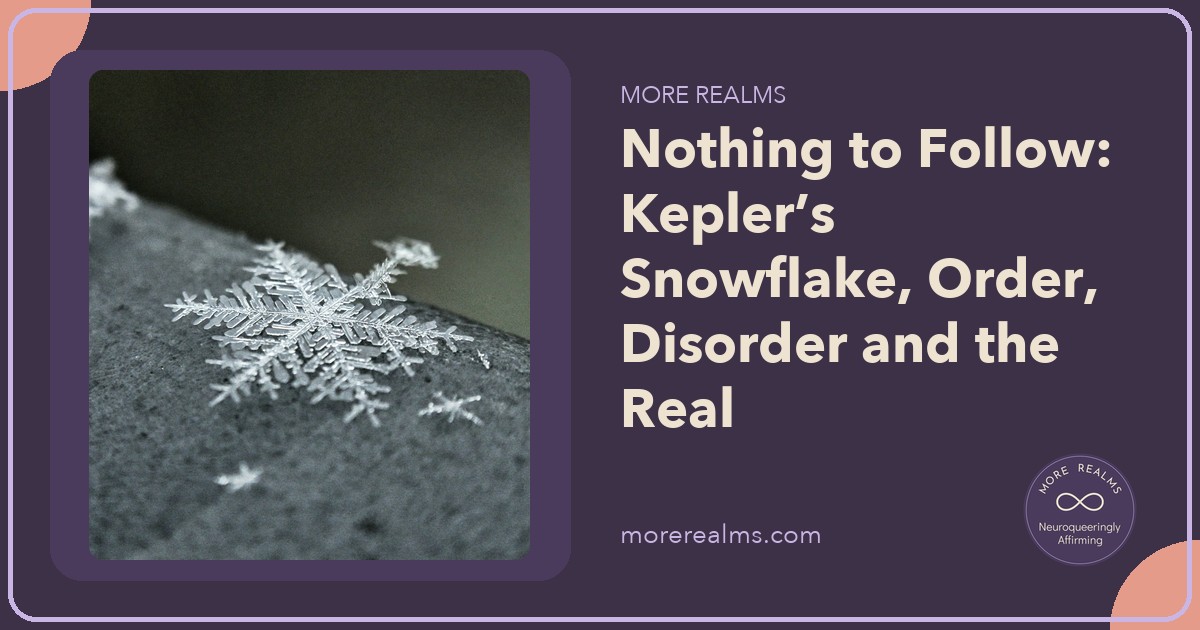
    In the winter of 1610, Kepler was crossing the Charles Bridge in Prague, worrying that he had no New Year’s present for his patron, Johann Matthäus Wacker von Wackenfels. Wacker was, as Kepler teasingly put it, a lover of Nothing, so the ideal gift would be as close to nothing as possible. Kepler considered and rejected dust, sparks, a drop of water and even the tiniest of animals. Then a few flakes of snow landed on his coat, each one with six feathered points. Here was something smaller than a drop and yet it carried a pattern. Kepler even made a pun of it: the Latin for snow, nix, sounded like the colloquial German for nothing (Kepler, 1611/1966).

    The essay that followed, A New Year’s Gift, or On the Six-Cornered Snowflake, is playful, digressive and full of jokes, yet it asks a serious question: why six? Why not five, or seven? Kepler wanders through honeycombs, pomegranate seeds, the stacking of cannonball-like spheres and the shapes of flowers. Along the way he became the first to publish ideas about the close-packing of spheres that would later prove fundamental to crystallography (Mason, 1966). In the end he could not answer his own question. He handed the problem on to the chemists and closed his essay with the words “Nothing to follow.”

    I love this ending. It feels deeply honest. Kepler shows his thinking in motion, follows ideas that turn out to be wrong, and marks one of his own theories in the margin as an opinion of no value. Partway through writing, it began to snow again, and after looking more carefully at the falling flakes he realised he had been mistaken about their structure and changed his mind on the page (Kepler, 1611/1966). There is something very Autistic, to my mind, about this kind of thinking: following a fascination wherever it leads, attending to fine detail, and staying with a question long past the point where others would have moved on.

    The formative faculty

    Kepler’s eventual explanation was what he called the facultas formatrix, a formative faculty in the body of the Earth, a living, shaping capacity that brings forth crystals, plants and snowflakes alike (Kepler, 1611/1966). Lancelot Law Whyte (1966) traces this idea back through Galen’s “formative faculty” in embryology, and shows how Kepler stood at a threshold between an older, animate cosmos and the new mathematical physics.

    What strikes me most is Kepler’s answer to an imagined objection. If the snowflake’s shape serves no obvious purpose, why would nature bother to make it so beautiful? Kepler replies that the formative faculty does not act only for a purpose. It also acts to adorn, and it plays with the passing moment (Kepler, 1611/1966). Nature, in his view, plays.

    I find this a quietly radical idea, and one that speaks to how neurodivergent ways of being are so often judged. Stimming, deep interests, repetitive patterns and ways of moving are routinely assessed by whether they are “functional.” Kepler’s snowflake suggests another possibility: that form can arise for adornment, for play, for the sheer joy of pattern, and that this too belongs to the order of the world.

    Order and disorder

    Modern science has answered part of Kepler’s question. The hexagonal symmetry of a snowflake reflects the arrangement of water molecules in ice, held together by hydrogen bonds into a lattice with six-fold symmetry (Mason, 1966). Yet the exact shape each crystal takes, whether a plate, a needle, a column or a feathered star, depends on the temperature and humidity it meets as it grows and falls. Mason (1966) describes how a change of just a degree or two can completely transform a crystal’s form, and how difficult it is to find two crystals identical in their fine structure. Each snowflake carries the record of its own journey through the air.

    This is where Kepler’s story meets the ecosystemic thinking that David and I keep returning to. A snowflake’s form is never produced by its inner structure alone. It emerges from a continual relationship between what it is made of and the conditions it moves through. In the same way, Autistic experience, including distress, cannot be understood by looking only inside a person. It takes shape within environments, relationships and histories. I would also want to name the Autistic Rhizome here (Gray-Hammond, 2023; Edgar, 2026), as the snowflake offers a frozen, branching image of the same relational growth.

    Whyte (1966) adds a further twist that I find genuinely moving. Physics had shown that while the oxygen atoms in ice sit in a stable lattice, the hydrogen atoms are irregularly distributed, so that the apparently perfect hexagon depends on a hidden irregularity. As Whyte puts it, the starlet is “the progeny of a union of order and disorder.” Irregularity, in his account, is no mere flaw in the perfect form. It plays an essential role in making form possible at all. Kepler, Whyte suggests, would have hated this, because he believed in a universe of divine simplicity and perfection.

    I cannot read this without thinking of the word “disorder” as it appears in diagnostic language. Autistic people are defined, in clinical terms, by disorder, as though order were the natural state of a mind and difference a deviation from it. Whyte’s snowflake offers a different picture. The beautiful, symmetrical form we recognise as a snowflake would not exist without irregularity woven through it. Disorder here is part of how the world becomes, rather than an error to be corrected.

    Back to the real and the unreal

    So how does Kepler’s snowflake return us to the question of hallucination and the real?

    First, Kepler’s essay is a record of a mind willing to imagine, to test, to be wrong and to look again. He treated his own perceptions with curiosity rather than certainty, and allowed the falling snow to correct him. That seems to me a far healthier model of the relationship between perception and reality than one in which some people’s perceptions are trusted by default and others are dismissed.

    Second, the snowflake reminds us that what appears simple and perfect is often complex and partly hidden. We see the hexagon, and miss the restless hydrogen atoms. We see the agreed version of reality, and miss the many perceptions that shaped it or were left out of it. What we call real may always be, in Whyte’s terms, a union of order and disorder.

    Third, Kepler’s formative faculty, however outdated as physics, carries something that many Indigenous, Mad and neurodivergent ways of knowing have never lost: a sense of the Earth as alive, generative and playful. Donna Haraway (2016) describes this as sympoiesis, a making-with, where nothing makes itself alone. A snowflake is made with the air, the cold, the dust at its centre and the long fall to the ground. David and I have been exploring similar ideas through symphrenia, our name for a connected, relational bodymind, and the snowflake seems to me a lovely small image of it.

    Kepler wanted to give his friend almost nothing, and ended up giving him almost the whole universe. Perhaps that is the gift of snowflakes, starlight and perceptions that others cannot share. They look small and easily dismissed, and yet they hold the shape of everything that made them.

    A small note: I am not a physicist or a historian of science, and these are my own reflections, sparked by a night at Brian Cox’s Emergence and a slim blue book about snow. I warmly welcome corrections and conversations from those who know more.

    References

    Cox, B., & Cohen, A. (2011). Wonders of the universe. HarperCollins.

    Cox, B., & Forshaw, J. (2009). Why does E=mc²? (And why should we care?). Da Capo Press.

    Dychtwald, K. (1977). Bodymind. Pantheon Books.

    Edgar, H. (2026, February 22). The Autistic rhizome: Community, liminal spaces & belonging. Autistic Realms. https://autisticrealms.com/the-autistic-rhizome-community-liminal-spaces-belonging/

    Fricker, M. (2007). Epistemic injustice: Power and the ethics of knowing. Oxford University Press.

    Gray-Hammond, D. (2023, April 21). Neuro-anarchy and the rise of the Autistic rhizome. NeuroHub Connect. https://neurohubcommunity.org/2023/04/21/neuro-anarchy-and-the-rise-of-the-autistic-rhizome/

    Haraway, D. J. (2016). Staying with the trouble: Making kin in the Chthulucene. Duke University Press.

    Kepler, J. (1966). The six-cornered snowflake (C. Hardie, Trans.). Clarendon Press. (Original work published 1611)

    Luhrmann, T. M., Padmavati, R., Tharoor, H., & Osei, A. (2015). Differences in voice-hearing experiences of people with psychosis in the USA, India and Ghana: Interview-based study. British Journal of Psychiatry, 206(1), 41–44. https://doi.org/10.1192/bjp.bp.113.139048

    Mason, B. J. (1966). On the shapes of snow crystals. In J. Kepler, The six-cornered snowflake (C. Hardie, Trans., pp. 47–56). Clarendon Press.

    Rees, W. D. (1971). The hallucinations of widowhood. British Medical Journal, 4(5778), 37–41. https://doi.org/10.1136/bmj.4.5778.37

    Romme, M., & Escher, S. (1989). Hearing voices. Schizophrenia Bulletin, 15(2), 209–216. https://doi.org/10.1093/schbul/15.2.209

    Seth, A. (2021). Being you: A new science of consciousness. Faber & Faber.

    Whyte, L. L. (1966). Kepler’s unsolved problem and the facultas formatrix. In J. Kepler, The six-cornered snowflake (C. Hardie, Trans., pp. 57–63). Clarendon Press.
  • Sylvia Plath and the Violence of Normativity

    Sylvia Plath and the Violence of Normativity

    Content note: this piece discusses suicide, psychiatric treatment including electroconvulsive therapy, and mental distress. If you are struggling, please reach out. In the UK and Ireland you can contact Samaritans any time on 116 123.

    A neuro-affirming, Mad Pride reading of The Bell Jar

    I have been reading Sylvia Plath since I was a teenager. Long before I had the language of monotropism, and long before I knew I was Autistic, Plath was already there, at the centre of one of those all-consuming interests that I didn’t yet understand. I have ring binders full of articles printed on that dot-matrix paper with the holes along the sides, three shelves of books, and decades of returning to the same pages. I couldn’t have told you then why I needed her so completely, but I think I can now. She was writing about what it feels like to be a mind that doesn’t fit the shape the world expects it to take, and about the quiet, everyday violence of being pressed into that shape anyway. That pressure, the violence of normativity, is what this piece is about.

    I want to be clear from the start that this is a reading of Esther Greenwood, and of my own recognition of her, rather than an attempt to diagnose Sylvia Plath. Plath was a real person who cannot speak for herself here, and the novel, although it draws closely on her own experiences in 1953, is still a novel. What I can do is read Esther through the frameworks that have helped me understand my own life, and notice what they open up.

    The Bell Jar was first published in January 1963 under the pseudonym Victoria Lucas (Plath, 1963). A month later, Plath died by suicide. The novel itself follows Esther through a breakdown, a suicide attempt and her time in psychiatric hospitals, and any honest reading has to hold that weight. It is usually framed as a story about mental illness, and Plath herself is so often framed as tragic, a cautionary tale about a brilliant woman destroyed by her own mind. From a Mad Pride perspective I find that framing uncomfortable. It places all of the suffering inside the person and very little of it in the world that refused to make room for her, and I think it also makes it harder to see how much of Esther’s despair is a response to the life she is being asked to fit into.

    Mad Studies and Mad Pride hold that distress is real, and that it can be devastating, while also refusing to treat madness only as something broken inside an individual (LeFrançois et al., 2013). That matters here, because there is a trap in neurodivergent readings of Esther. It would be easy to say that she was “really” Autistic and therefore not mad, as though being mad were the worse thing to be, and that kind of rescue quietly repeats the sanism Mad Pride pushes against. I don’t want to rescue Esther from madness. I want to read her as possibly neurodivergent and Mad, and to ask, with Nick Walker’s (2021) neuroqueer theory, what happens to a mind like hers when it is expected to perform neurotypicality, femininity and productivity all at once, without any language or community to help it understand itself.

    The fig tree and the monotropic mind

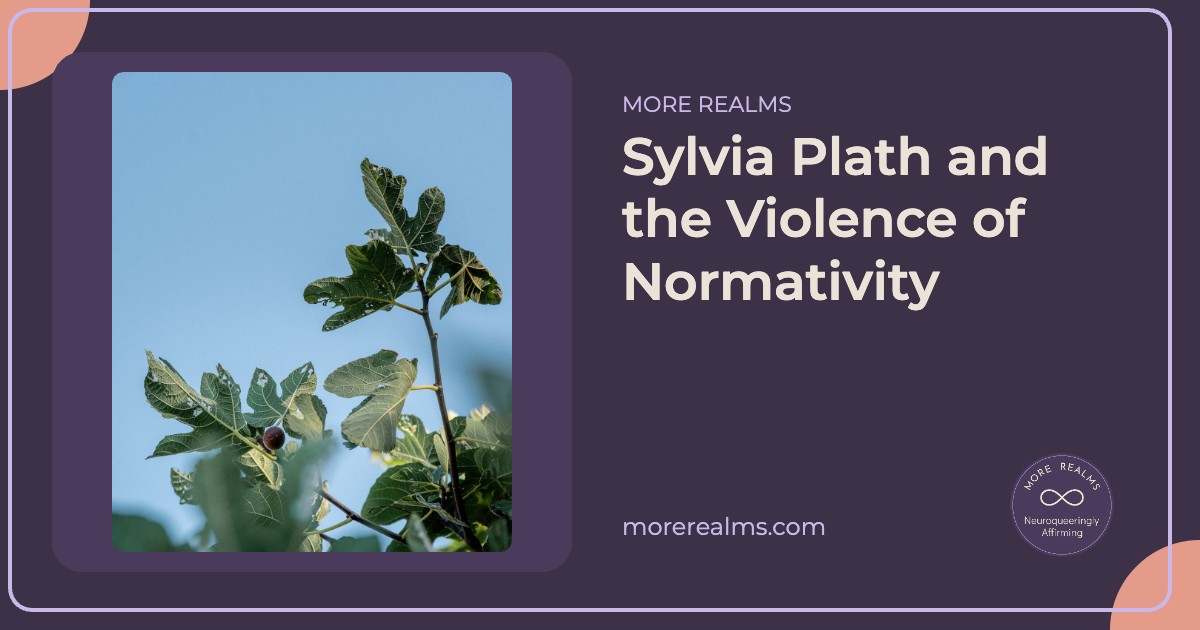
    One of the most famous passages in The Bell Jar is the fig tree. Esther imagines her life branching out in front of her, each fig a different future, a husband and children, a famous poet, a brilliant professor, an editor, travels abroad, and she pictures herself sitting in the crotch of the tree, “starving to death, just because I couldn’t make up my mind” (Plath, 1963, Chapter 7), while the figs wrinkle and fall. The passage is usually read as depression, ambivalence or the narrow choices offered to women in the 1950s, and it is all of those things. When I read it through monotropism, though, I see something more.

    Monotropism, the theory developed by Dinah Murray, Mike Lesser and Wenn Lawson (Murray et al., 2005), and carried forward today through the work of Fergus Murray and the wider community, describes how many Autistic people tend to concentrate their attention in a small number of deep, intense channels rather than spreading it lightly across many things at once. Tanya Adkin’s (2022) idea of monotropic split describes what happens when a monotropic person is pulled between competing demands and has to divide attention that naturally wants to flow in one direction, and how exhausting and destabilising that can be.

    I wrote about monotropic split in my reading of Wuthering Heights, where Cathy is torn between Heathcliff and Edgar Linton, and I see something similar in Esther. Each fig is not a light option to be weighed and set aside. Each one is a whole life, real and total and consuming, and to choose one means tearing attention away from all the others. Esther’s paralysis reads to me less like a lack of will and more like a monotropic mind meeting a decision structure built for a different kind of mind, and then being judged as failing when she cannot show the expected flexibility. I recognised that feeling at fifteen without having any name for it, and I have the name for it now.

    The body under pressure

    Troberg (2025), in a neuroqueer close reading written as a degree project, finds signs of Autistic traits throughout Esther’s narration, as well as traces of what she describes as an Autistic writing style. Reading alongside her, I notice Esther’s intense sensory responses to the city, her complicated relationship with food, her constant effort to perform the version of herself that others expect, and the way her capacity gradually collapses until she can no longer sleep, read or write. To me, that collapse reads very much like the Autistic burnout so many of us know, where the things that once came easily simply stop being possible.

    The image at the heart of the novel captures this too. Esther feels that wherever she went she would be “sitting under the same glass bell jar, stewing in my own sour air” (Plath, 1963, Chapter 15). Being sealed off and watching life through glass is something I hear Autistic people describe again and again in our community spaces, and it is something I recognise in my own experience of burnout. Khatun (2026) brings crip theory and neurodiversity to the same text and argues that Esther’s distress is a response to a society built around narrow ideas of normality, not a biological defect. Drawing on Robert McRuer’s idea of compulsory able-bodiedness, she shows how the demand that Esther be emotionally stable, productive, academically exceptional and appropriately feminine pushes her towards breakdown. In this reading, the glass of the bell jar is made, at least in part, of other people’s expectations.

    The erasure of women

    The novel is set in 1953. At that time autism was understood, where it was understood at all, as a rare childhood condition, closely tied to ideas of childhood schizophrenia, and the categories open to a distressed young woman like Esther were depression, schizophrenia and the long, gendered history of the “female malady” (Showalter, 1985). As I wrote in my piece on Grunya Sukhareva, Sukhareva had already described Autistic girls in 1927, yet that knowledge never reached the people deciding what was wrong with women like Esther. For decades afterwards, women whose traits we might now recognise as Autistic or ADHD were more likely to be diagnosed with depression, personality disorders, bipolar disorder or eating disorders (Hendrickx, 2015; Troberg, 2025). The pattern continues today. A recent Dutch study found that one in three Autistic women reported at least one earlier psychiatric diagnosis that they felt was a misdiagnosis, compared with around one in six Autistic men (Kentrou et al., 2024).

    I think intersectionality sits at the heart of Esther’s story. Being a woman, being neurodivergent and being non-normative in your emotional, sensory and social life do not simply add together as separate difficulties. They compound each other and make each other harder to see. The psychiatric system Esther meets has one story available to it, breakdown, treatment, recovery and compliance, and it applies that story to a brilliant, non-conforming young woman who may be masking neurodivergence, resisting the gender roles offered to her and living with real sensory and processing differences all at the same time. This is why the neuroqueer frame feels so important to me. Walker (2021) refuses to separate the politics of gender, sexuality and neurodivergence, because they are entangled systems of normalisation, and pushing against one always involves the others. I have explored where those systems come from in Wyrd, Weird, and the Invention of Normal and The Neuronormative Paradigm.

    Psychiatric power and the meaning of recovery

    Esther’s first electroconvulsive therapy, given by Dr Gordon after only the briefest conversation with her and with her mother, is one of the most disturbing scenes I have ever read, and Esther experiences it as a punishment. Later, under the care of Dr Nolan, who listens to her and treats her with far more warmth and honesty, the treatment is presented very differently, and Esther feels the bell jar lift (Khatun, 2026; Plath, 1963). I want to hold that complexity honestly, because the novel does not offer a simple story about psychiatry, and for some people psychiatric care is part of how they stay alive. Even so, from a Mad Pride perspective, I notice how much of Esther’s treatment is aimed at making her legible and manageable again, able to function within the social order without disturbing it, rather than helping her to flourish as the person she actually is.

    Recovery in the dominant psychiatric model so often means a return to productivity and social conformity, and for a neurodivergent person that can mean returning to the very conditions that caused the crisis. Esther’s recovery at the end of the novel is uncertain. She is functioning again, but she wonders how she can know that someday “the bell jar, with its stifling distortions, wouldn’t descend again” (Plath, 1963, Chapter 20). Knowing what happened to Plath only weeks after the book was published, I find that line almost unbearable to read. To me it sounds less like the language of cure and more like the voice of someone who has learned to survive a world that was not built for her, while nothing about that world has changed.

    Testimony and recognition

    I read The Bell Jar as testimony, a record of what it costs to be a particular kind of person in a particular kind of world. When Autistic and Mad people, in online spaces, in academic readings and in the quiet recognition of those of us who have read Plath since our teens, find ourselves in her work, I think what we are doing is closer to recognition than to romanticising. For so many of us, finding ourselves in fiction is how we first begin to understand who we are. Before diagnosis, before community and before language, there can be the strange shock of reading your own inner life in someone else’s words. Before I knew I was AuDHD I knew I was the person who couldn’t choose between the figs.

    Mad Pride asks us to hold two things together: the very real suffering that comes from living in a world not built for your mind, and the refusal to locate the whole problem in the mind itself. For me, Esther Greenwood shows what happens when a neurodivergent and Mad young woman is offered no supportive framework, no community and no accommodation, only the demand to perform normality and the consequences when she cannot. That is the violence of normativity. I have come to think that the bell jar was never only Esther’s. It is also the neurotypical, patriarchal social order, sealed and airless, that so many of us have spent our lives pressing our hands against from the inside, and I hope that naming it together makes the glass a little thinner so we can breathe a bit more.

    If this piece has stirred up difficult feelings, please be gentle with yourself and reach out to someone you trust. In the UK and Ireland, Samaritans are available any time on 116 123 or at samaritans.org.

    References

    Adkin, T. (2022, July 14). What is monotropic split? NeuroHub Connect. https://neurohubcommunity.org/2022/07/14/guest-post-what-is-monotropic-split/

    Hendrickx, S. (2015). Women and girls with autism spectrum disorder: Understanding life experiences from early childhood to old age. Jessica Kingsley Publishers.

    Kentrou, V., Livingston, L. A., Grove, R., Hoekstra, R. A., & Begeer, S. (2024). Perceived misdiagnosis of psychiatric conditions in autistic adults. eClinicalMedicine, 71, Article 102586. https://doi.org/10.1016/j.eclinm.2024.102586

    Khatun, F. (2026). Ableism and psychic distress: Rethinking neurodiversity and disability in The Bell Jar. Literariness Journal, 1(2), 1622–1632. https://literarinessjournal.org/wp-content/uploads/2026/04/Khatun-Farhina-Ableism-and-Psychic-Distress-Rethinking-Neurodiversity-and-Disability-in-The-Bell-Jar.pdf

    LeFrançois, B. A., Menzies, R., & Reaume, G. (Eds.). (2013). Mad matters: A critical reader in Canadian mad studies. Canadian Scholars’ Press.

    Murray, D., Lesser, M., & Lawson, W. (2005). Attention, monotropism and the diagnostic criteria for autism. Autism, 9(2), 139–156. https://doi.org/10.1177/1362361305051398

    Plath, S. [Lucas, V.]. (1963). The bell jar. Heinemann.

    Showalter, E. (1985). The female malady: Women, madness, and English culture, 1830–1980. Pantheon Books.

    Troberg, G. (2025). Not a madwoman: A neuroqueer reading of Sylvia Plath’s The Bell Jar [Bachelor’s thesis, University of Gothenburg]. GUPEA. https://hdl.handle.net/2077/88399

    Walker, N. (2021). Neuroqueer heresies: Notes on the neurodiversity paradigm, autistic empowerment, and postnormal possibilities. Autonomous Press.

  • Neuroqueer Revolutions: Difference, Becoming, and the Politics of Refusal

    Neuroqueer Revolutions: Difference, Becoming, and the Politics of Refusal

    This piece brings together four strands of thought: I have been hugely inspired by David Gray-Hammond’s recent writings about the metaphysics of neurodivergence, Robert Chapman’s historical and mad studies framing, Nick Walker’s neuroqueer theory as transformative praxis, and Gilles Deleuze’s philosophy of difference. Each offers a potential lens for us to reconsider what it actually means to be neurodivergent, how our identity is shaped and recognised, and how it might be reimagined beyond fixed categories and labels.

    David Gray-Hammond’s Beyond Definition: A Metaphysical Inquiry into Neurodivergence (2025) asks what makes someone neurodivergent in the first place. He identifies three intersecting dimensions:

    1. Neurological difference from the statistical norm: in structure, function, or developmental pattern.

    2. Lived cognitive difference: a phenomenological divergence in perception, attention, or reasoning.

    3. Social positioning as “different”: the recognition of these differences by ourselves or others, often in ways that create barriers or stigma.


    This proposes that neurodivergence is neither purely biological nor purely social, but emerges in the interplay of embodiment and environment. Tracing through history, Robert Chapman’s Mad Pride in Revolutionary England: The Ranters as Mad Activism (2025) deepens this understanding by focusing on the Ranters in the 1640’s to show how categories of difference, from “mad” to recent terms such as “neurodivergent”, are shaped by power, capitalism, and state control. Labelling is never neutral; it has been used to regulate, exclude, and also to organise resistance throughout history and continues to do so, causing so much harm to marginalised people and anyone who is different.

    Where Chapman maps the long shadows of how difference has been policed, Walker turns us towards neuroqueering acts that stretch those boundaries and enables cognitive, psycholgical and somatic liberty for everyone. Nick Walker’s Neuroqueer Heresies (2021), frames the act of neuroqueering as both a deliberate refusal of neuronormative conditioning and an emergent process that unfolds in everyday life, which has the potential to create radical systemic change to benefit the whole of society. 

    This is in parallel to a Deleuzian perspective, which sees identity as never being static but built from many connections, relationships, and processes. Neurodivergence is not a fixed thing, but a living mix of our fluid bodyminds entangled with our environment, constantly shaped by the social, political, and ecological worlds we move through and the relationships we have.

    The Metaphysics of Neurodivergence


    Neurodivergence is often treated as a fact, decided by a medical diagnosis or by self-identification. Neurological variation without lived difference might go unnoticed; lived difference without social recognition might remain unlabelled or misattributed. It is the interaction with norms, expectations, and power structures that creates and solidifies the socially constructed category of neurodivergence, even for those of us who are innately different from birth.

    Gray-Hammond suggests the idea of neurodivergence rests on three intertwined dimensions. None alone fully defines it, but together, they create its lived reality, of these, being positioned as “different” or “weird” often shapes daily life most directly and affects our wellbeing and how well we can function and thrive. This raises their deeper question: Is neurodivergence defined by the way it is lived and experienced, or by an underlying difference that exists whether or not it is recognised?

    From a Deleuzian perspective, differences are not static traits but elements of a shifting assemblage. Neurodivergence is not a fixed essence but an ongoing process of becoming, shaped by sensory and cognitive patterns, environments, and cultural narratives, all filtered through intersectional privilege and oppression. Difference is generative, producing new perceptions, movements of thought, and ways of living, even if it is temporarily somewhat stabilised or held through labels such as being Autistic or ADHD.

    Gray-Hammond distinguishes between essential properties, those without which neurodivergence would not be what it means today and accidental properties, which can change without altering the underlying being. Essential properties might include monotropic attentional flow, sensory processing patterns, physical disabilities, or other health differences. Accidental properties might include diagnostic labels, learned coping strategies, or outward behaviours. This matters because it undermines claims that compliance-based behavioural interventions “cure” neurodivergence, it suggests that outward behaviour can be suppressed or reshaped, but our essential cognitive and sensory architecture often remains split, fractured by trauma and masking, leading to burnout and mental health crises.

    In Empire of Normality (2023), Chapman reminds us that the notion of “normal” is not an objective truth but a social construct, shaped by cultural and historical contexts. Over time what is seen as  “normal” and what is deemed as  “pathological” have shifted, not because humans have changed dramatically, but because society’s priorities and systems have. These boundaries have often been drawn to serve industry, capitalism, and the institutions that sustain them, rewarding some ways of thinking and being while excluding or penalising others. A clear example is the behaviourist approach entrenched in the US & UK school systems, where reward charts and social stories enforce neuronormative behaviours, harming Autistic children and pushing them to deny their needs expecting them to fit in at all costs.

    In this light, Gray-Hammond’s question, ‘who counts as neurodivergent, and under what conditions?’ is not only personal or diagnostic, but it is political. It invites us to question the shifting line between “different” and “acceptable,” “normal” and “abnormal,” and to consider whether this line can be moved, reshaped, challenged, or even erased.

    Walker’s neuroqueer theory builds on this idea, framing neurodivergence not only as a site of vulnerability for stigma and oppression, but as a space of creative potential. Neuroqueering resists the idea that support or education should aim to make neurodivergent people “normal”. Instead, it treats difference as a strength, a way to stretch the boundaries of what is possible, to reimagine living, thinking, and relating. It holds space for diverging even further from the norm, for exploring new ways of being and learning, and for the radical possibility that anyone can become neurodivergent through the act of neuroqueering and by choosing to move away from normativity.

    When we see neurodivergence as dynamic, shaped by relationships, environments, and histories rather than as a fixed list of traits, we can step beyond the rigid binary of “neurotypical” vs “neurodivergent.” This opens neuroqueering possibilities for a more fluid and liberating society, one that values diversity not as a box to tick but as a living, evolving force. It is an invitation to embrace difference, explore transformative ways of becoming, and continually reinvent ourselves, our work and the worlds we share. However, even as we reimagine neurodivergence in more fluid and relational ways, the language we use and the labels we inherit carry the weight of the histories that have shaped how difference is seen and treated.

    Hidden History of Neurodivergent Labels

    The words and language we use to describe people have never been neutral. They are shaped by politics, history, and power. Robert Chapman’s historical account of Mad Pride shows how labels for cognitive difference often come from systems built to manage and control people. In the 1640s, for example, radical groups like the Ranters challenged the strict religious and social rules of their time. They refused to conform, rejected rules imposed from above, and gathered in ways that disrupted the status quo. They didn’t use today’s words as being neurodivergent but they clearly didn’t fit into the expected norms of the time. Their defiance and solidarity can be seen as early acts of Mad Activism resisting the idea that there is only one “right” way to think, feel, or live.

    Neurodivergent people have often been denied the right to name and define our own realities. For most of history, “official” knowledge about us has come from deficit-based medical models, shaped by institutions and used to serve those in power.

    As I shared in my blog ‘Autistic Mental Health: Beyond the Pathology Paradigm‘ (Aug, 2025), research suggests that as many as 8 in 10 Autistic people have a mental health condition. Sadly, Autistic people have been found to have up to an eightfold increased risk of death by suicide compared to non-Autistic people (Brown et al., 2024). For Autistic children, the risk of thinking about or attempting suicide is 28 times higher than for their non-Autistic peers. These are not just numbers, they are lives cut short by systems that fail to meet our needs.

    The latest Assuring Transformation NHS Digital data (April 2025) paints an equally troubling picture:

    • 2,025 Autistic people and people with a learning disability are in mental health hospitals in England. Of these, 1,455 (72%) are Autistic.
    • 240 under-18s are in inpatient units. Of these, 230 (96%) are Autistic.
    • The number of Autistic people without a learning disability detained in mental health hospitals has increased by 141% since 2015.
    • In 2015, Autistic people made up 38% of the total in hospital. Now it is 72%(National Autistic Society, 2025).

    These statistics are not personal failings, they are systemic failures of education, healthcare, mental health services, and broader society to support Autistic people and those of us who are different in ways that affirm our needs, identities, and ways of being. This is epistemic injustice, as the people most affected are excluded from the conversation, and the words we need to describe our lives are often missing, invalidated or treated as problems. A clear example of this is neurodivergent experiences of burnout.

    When a community lacks language for its own experience or our experiences aren’t believed, it is easier to cause harm. It’s not just about being misunderstood; it’s about blocking self-understanding, choice, and autonomy. Every label we inherit, from being “Autistic” or “weird,” “defiant’ or “disordered”, carries a built-in set of assumptions about how we should be seen and treated. Labelling can trap us in someone else’s story…..or it can be reclaimed and re-storyed to tell our own narratives.

    The power to name and label, and use certain language shapes who is recognised as being fully human and “right” who is pushed to the margins. The meaning of labels is always shifting; institutions try to lock differences into fixed categories, diagnoses, risk labels, and lists of “deficits.” In response some communities are pushing back, reclaiming words like “Crip”, “Autistic” or “Mad” and filling them with their own values, histories, and pride. But changing words alone is not enough, real change needs systemic transformation, and neuroqueer theory offers ways to put that into practice.

    Refusing Normal: The Practice of Neuroqueering

    Neuroqueering can happen on many levels and in many different ways; from the small, everyday choices we make in how we use our bodyminds to the larger work of changing systems. On a personal level, it can mean moving, speaking, or sensing in ways that feel natural to us, even if they go against social expectations. On a collective level, it involves challenging and dismantling the systems that enforce able-bodiedness, demand constant productivity, and dictate narrow, “acceptable” ways of socialising and communicating.

    However, living neuroqueerly by stimming openly, rejecting therapies aimed at making us “normal,” choosing to play, learn, work, or rest in our own ways can still lead to exclusion, discrimination. It is a risk without being in a safe environment with people who understand and accept your authentic self and ways of becoming.

    Neuroqueer theory recognises that neurodivergence doesn’t stand apart from other forms of oppression. The same bodymind that pushes back against neuronormativity is also navigating intersectionality, racism, sexism, homophobia, transphobia, class inequality, and the impacts of colonialism. True freedom for neurodivergent people means breaking down ableism and these other systems together. Deleuze, like Walker and Gray-Hammond, sees this refusal to “fit in” not only as resistance but as something full of creative potential. Embracing difference isn’t just about stepping away from the norm; it’s where new ways of living, relating, and imagining can begin and transformations can emerge.

    Neurodivergence isn’t something that lives inside an individual’s brain; it takes shape in our bodyminds, who we are is inseparable from the rhizomatic networks of meaning and care, or their absence, that surround us and our environments. Liberation needs to be a collective flow: changing life for one means changing it for all of us. It needs to be co-created through the ways we think, feel, and act, shaped by how others respond to us, and vice versa.

    Neuroqueer praxis is both personal and social, it is the daily choice to resist being pulled into the norm, while building community solidarity to challenge the systems that enforce neuronormativity. It’s about creating and sharing new ways of knowing, and about changing the very conditions that limit who we can be, moving beyond labels and expectations, so we can live as our authentic selves and build supportive, meaningful communities.

    A neuroqueer politics of difference does not seek permission or validation from systems that marginalise. It works to build worlds where many ways of being are not only accepted but recognised as essential to our shared survival and joy. To live fully as ourselves is not just inclusion, it is the ongoing work of reworlding.


    References

    Chapman, R. (2023). Empire of Normality, Neurodiversity and Capitalism. Pluto Press.

    Chapman, R. (2025). Mad Pride in Revolutionary England: The Ranters as Mad Activism. [Manuscript in preparation]. Deleuze, G. (1994). Difference and Repetition (P. Patton, Trans.). Columbia University Press. (Original work published 1968)

    Deleuze, G., & Guattari, F. (1994). What is philosophy? (H. Tomlinson & G. Burchell, Trans.). Columbia University Press. (Original work published 1991)

    Gray-Hammond, D. (2024, March 21). The metaphysics of neurodivergence. Emergent Divergence.
    https://emergentdivergence.com/2024/03/21/the-metaphysics-of-neurodivergence/

    Walker, N. (2019). Transformative Somatic Practices And Autistic Potentials: An Autoethnographic Exploration. (Doctoral dissertation). California Institute of Integral Studies.

    Walker, N. (2021). Neuroqueer heresies: Notes on the Neurodiversity Paradigm, Autistic Empowerment, and Postnormal Possibilities. Autonomous Press.

    Discover more

    Courses, books and resources

    If you would like to take these ideas further, my courses, books and resources live on Autistic Realms. Everything in the shop is pay what you can, and many resources are free.