Star Stuff Zine No. 11 — Helen Edgar written for Stimpunks: Star Stuff Earth, July 2026
1. Why Difference Comes First
Inspired by our collaborative Stimpunks work, and my own neuroqueering Deleuze project, I’ve been thinking about the connections in-between — physics, philosophy and my own life as an Autistic ADHD person. This is me following that thread.
2. I’m not a fixed thing
A little while back I wrote about something called relational quantum mechanics — a way of thinking about physics where tiny particles don’t have fixed qualities all on their own. They only become something in relation to whatever’s around them (Rovelli, 1996). I’m not a physicist — it’s one idea among several, and physicists argue about it.
As a multiply neurodivergent person, that’s always been closer to how I experience myself — not as a fixed, separate being moving through the world, but as something that shows up through my relationships and encounters with everything around me (Edgar, 2026a). I’m still working through what that means.
Physics, philosophy, and my own life keep circling the same ideas about being interconnected, unfixed, always transforming.
3. My Monotropic Galaxy
The oldest light we can see is called the cosmic microwave background — it’s the afterglow of the Big Bang, and it’s almost perfectly smooth. It only varies by about one part in 100,000 across the whole sky — almost uniform, but only almost.
Those tiny variations — slightly denser here, slightly thinner there — were the beginning of everything. Gravity pulled the denser bits together, and over billions of years they became stars, galaxies, planets, you, me, all of it.
If the universe really had been perfectly uniform, it would have stayed a flat, empty fog forever. Nothing to see, no one to see it. Structure only exists because that near-sameness broke.
That’s the same shape I recognise in my own monotropic attention — energy pulled gravitationally into a few bright points, rather than spread out in an even, undifferentiated glow. And yet it’s exactly that unevenness, that refusal to flatten, that so many of us — anyone who’s ever been called too much, not enough, or too different — have been measured against.
4. Measured Against Neuronormative Time
I’ve spent a lot of my life being measured against a flat line. Nobody always said it in those words, but that’s what was happening — a standard chart, a “typical” way of communicating or paying attention or experiencing the world, treated as the baseline everyone should be smoothed toward. I was positioned as the deviation that needed explaining, or fixing, or at least accounting for.
That flat line was never just about behaviour — it was also about time: a single approved tempo, a single approved rhythm, everyone expected to arrive and finish and transition together, in step with a clock that was never actually neutral.
So there’s something that genuinely steadies me in learning that the universe itself never once managed that.
What was already there, moving
The “typical” baseline
You = “deviation”
A straight line, laid over what was already moving
The grid comes after the field, not before,
Uniformity was never the achievement. It’s the thing that would have stopped everything before it even started.
5. There Is No Normal or Baseline
Gilles Deleuze, working with Félix Guattari, made a version of this same argument. Deleuze noticed that a lot of Western thinking treats difference as secondary — judged by how much it resembles some ideal, some average, some “normal” category. All of that quietly assumes the baseline came first, and difference is just a deviation from it.
The baseline is the thing that got built. The idea of normality is what has shaped our capitalist society (Chapman, 2023) and is what we are judged against (Deleuze, 1994). Difference is what’s actually there, first — and identity is what eventually forms out of it, temporarily and locally, the way a crystal settles out of a solution along the gaps and spaces in between — the places where those of us most marginalised live, and where we build our own networks, our own solidarity.
This is where Deleuze and Guattari’s idea of smooth space becomes useful (Deleuze & Guattari, 1987). Smooth space is full of local, variable difference — it hasn’t had a fixed grid laid over it yet. Striated space is what happens when that grid arrives: when a field gets measured, divided, standardised. Difference doesn’t get smoothed into existence by that process. Smoothing is what a system does afterward, only if it insists on it — striation laid over what was already smooth.
Nothing gets smoothed into existence. Smoothing is what happens to something afterward — only if a system insists on it.
6. Smooth doesn’t mean flat
Smooth space isn’t empty of movement — it’s just ungridded. It cuts against how regulation usually gets talked about, as though it means being still, quiet, zen: a flat line of its own. But smooth space is defined by what it lacks — a grid — not by what it’s doing. It can be full of movement and still be smooth — which is closer to how neurodivergent regulation actually works: through stimming, through bodily autonomy, through movement rather than stillness.
That’s closer to what I recognise when I try to describe my own attention — my porousness to my environment, the way my sensory system stays open to everything around it, the way time folds back on itself instead of running in a straight line. Not flat. Not gridded. Full of shape that never quite resolves into one measurable thing.
7. What ethodiversity means
This is where Ombre Tarragnat’s work on ethodiversity has become important to me. Ethodiversity is the variety of ways of being and behaving, across humans and other animals — and Tarragnat is precise about where it actually lives: not inside any one person, but as a property of the relationships between us, the way biodiversity belongs to a whole ecosystem, not to any single creature in it (Tarragnat, 2025).
Ethonormativity, in their framing, is the unwritten rule about which ways of being are allowed to count as normal in a given room. Put next to Deleuze, I don’t think it’s a stretch to say ethonormativity simply is that grid — applied to how we’re allowed to behave. A fixed grid laid over a field that was already full of variation before the grid ever showed up.
Ethonormativity reaches further than neuronormativity, though. Neuronormativity is about which neurotypes get treated as the default — Autistic brains judged against non-Autistic ones, for instance. Ethonormativity is the wider grid underneath that: it governs which ways of being and behaving, across every species, get to count as acceptable at all. It holds neuronormativity inside it, but it isn’t limited to brains, or even to humans (Tarragnat, 2025).
Ethonormativity simply is that grid — a fixed grid laid over a field that was already full of variation before the grid ever showed up.
8. A constellation of intensities
I recognise that grid in every space I’ve ever masked in — education, the workplace, wherever something that was moving gets asked to hold still long enough to be measured. And I recognise its absence, with real gratitude, in the spaces I’m part of — NeuroHub Community with David Gray-Hammond, Stimpunks: an Autistic rhizome, a mycelial network of care, non-hierarchical, no fixed centre, connecting wherever it meets (Deleuze & Guattari, 1987).
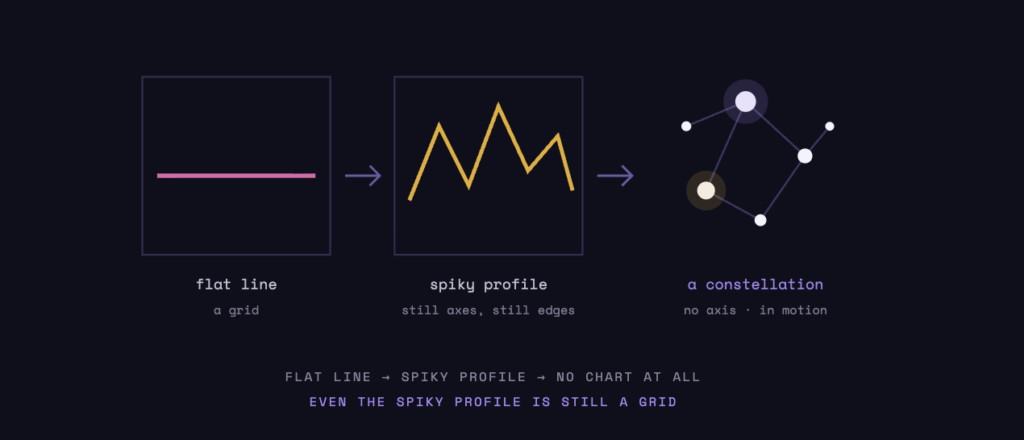
I used to think the shape of my own mind was something like a spiky profile — a way of picturing uneven ability across different areas, real peaks and real troughs, instead of one flat line running across the whole of who you are. At least it’s truer than a flat line. However, a profile still measures. It still needs axes, still has edges — and that’s exactly where I want to push further, past even the spiky profile. What I actually recognise, when I try to map myself, isn’t a chart at all. It’s a constellation of intensities: a galaxy, always in relationship with itself, always in motion, never finished (Edgar, 2026b).
A profile still measures. It still needs axes, still has edges. What I actually recognise, when I try to map myself, isn’t a chart at all; it is an interconnected, interdependent galaxy.
9. The Universe Doesn’t Do Flat Lines
I still don’t have these ideas fully settled or finished. Every time I follow this thread — from the sky, down through physics and philosophy, into the actual shape of my own galaxy of monotropic attention — I end up some where different but with the over arching throughts that:
The universe doesn’t do flat lines.
It never really tried to.
It went straight from near-uniform fog to unrepeatable structure, without ever pausing at sameness for its own sake.
I think that’s worth remembering, gently — the next time any of us are asked to explain why we don’t match the line of neuronormativity.
We are all star dust.
We are neuroqueering the spiky profile: no edges, limitless ways of being.
10. L★S
Zine No. 11 · Guest author
Written by Helen Edgar. First published on Autistic Realms: More Realms, and shared with Star Stuff.
Read More
We Are Made of Relations: Quantum Physics and What It Means to Be Autistic (Edgar, 2026a, More Realms)
My Monotropic Galaxy: A Constellation of My Autistic Self (Edgar, 2026b, More Realms)
Mycelium & Rhizome: Ecological Metaphors for Autistic, Neurodivergent & Disabled Lives (More Realms)
References
Chapman, R. (2023). Empire of normality: Neurodiversity and capitalism. Pluto Press.
Deleuze, G. (1994). Difference and repetition (P. Patton, Trans.). Columbia University Press. (Original work published 1968)
Deleuze, G., & Guattari, F. (1987). A thousand plateaus: Capitalism and schizophrenia (B. Massumi, Trans.). University of Minnesota Press. (Original work published 1980)
Edgar, H. (2026a, June 7). We are made of relations: Quantum physics and what it means to be Autistic. More Realms.
Edgar, H. (2026b, June 16). My monotropic galaxy: A constellation of my Autistic self. More Realms.
Rovelli, C. (1996). Relational quantum mechanics. International Journal of Theoretical Physics, 35, 1637–1678.
Tarragnat, O. (2025, February 25). What is ethodiversity? ombretarragnat.com
A guest zine in the Stimpunks Star Stuff series. Where The Universe Runs on Difference (No. 8) is about breadth — variety over monoculture — this one is about difference coming first: the baseline is what gets built. The physics-and-philosophy sourcing, and how it sits beside Nos. 8 and 9, is gathered in The Difference-First Frame.
No. 8 — The Universe Runs on Difference
No. 9 — The Lines We Drew
No. 10 — The Dead Stars Still Reach Us
No. 11 — Why Difference Comes First — ← you are here
We are all made of stardust. LYDTYSS

Courses, books and resources
If you would like to take these ideas further, my courses, books and resources live on Autistic Realms. Everything in the shop is pay what you can, and many resources are free.
- Re-Storying Autism course: a video course and workbook with David Gray-Hammond.
- Building a Positive Autistic Identity: a gentle, self-paced course written for Autistic people.
- Embracing Monotropism: my book on monotropism and preventing Autistic burnout.
- Re-Storying Autism (book): co-written with David Gray-Hammond.
- An Introduction to the Theory of Monotropism: a free e-book.
- The Autistic Realms shop: over 380 resources, pay what you can and many free.