
Helen Edgar – Autistic Realms / More Realms June 2026
“The curious paradox is that when I accept myself just as I am, then I can change.”
— Carl Rogers, On Becoming a Person (1961)
“Becoming is not imitating or identifying with something. It is producing a zone of proximity, of indiscernibility.”
— Deleuze & Guattari, A Thousand Plateaus (1987)
You may know the feeling of being in a room and not being truly seen. You may be present, being spoken to by people who seem genuinely friendly towards you, yet you feel you are not truly being met. It is like the person next to you or across from you is responding to their idea of who they think you are rather than to who you actually are. There are norms and social conventions that people may feel they have to keep, and that can impact genuine presence and connection.
For many Autistic and neurodivergent people, this is not an occasional frustration but an often felt, sustained condition of our daily life. Over time, this teaches us that it is not safe to bring our whole authentic self into the room. You may suppress stimming, be hyper-aware of your body language and even how you communicate. You may find that you are constantly translating yourself into someone you hope will be more legible, more palatable, more aligned with the norms that were never designed around your experience. Masking, in this sense, is not a choice so much as a trauma response, a learned adaptation to a world that has made authenticity costly.
This piece draws together three threads of my recent thinking that I have been exploring: the humanistic psychology of Carl Rogers, the philosophy of Gilles Deleuze, and Damian Milton’s Double Empathy Problem — extended through my own Double Empathy Extreme Problem (DEEP) – Dynamic, Embodied, Ecological, and Political framework. I am also drawing on a recent paper by philosopher Kris Goffin (2026) that reframes the question of Autistic injustice in ways I find really helpful. Together, I think they can help us explore what the conditions for genuine belonging might actually be, so we can be supported in environments that value a process of ongoing becoming and neuroqueering.
Conditions of worth
Rogers began from a radical premise in the 1950’s: that people are not fundamentally broken, deficient, or in need of correction, but that they carry within them an innate drive toward growth and becoming more fully themselves. This is what he called the actualising tendency (Rogers, 1957). He thought of it as something like a seed’s instinct toward light: persistent, directional and always pressing toward expression. Growth cannot be destroyed, but it can be buried, become distorted and hard to surface.
What buries or distorts growth are what Rogers named conditions of worth (1959). These are the internalised messages, absorbed most powerfully in childhood, that love and acceptance are contingent on meeting certain conditions: being quieter, being less intense, doing whatever it takes to be accepted. These messages don’t usually come from a place of cruelty; they often come from concern, from guidance, from the reasonable expectations of people who themselves learned to perform belonging within the same system, such as parents, carers and teachers. However well-meant, their cumulative effect is to redirect the energy of genuine growth into the labour of self-management, into performing a version of the self that will be found acceptable, rather than becoming the self that is actually there. For neurodivergent people, this is not incidental but structural. The conditions placed on us are shaped by a world that measures worth against neuronormative standards from the outset.
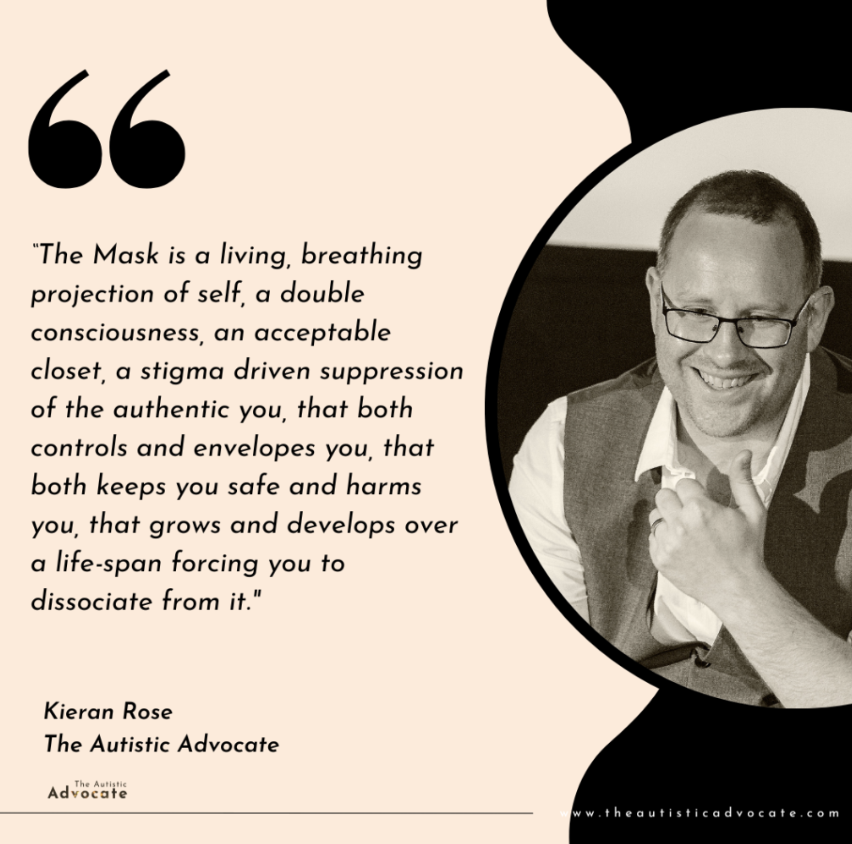
For Autistic and AuDHD people, conditions of worth are not only relational but cultural and systemic. They are embedded in our education systems, healthcare settings, and workplaces; in every context that measures human value against the standards of neuronormativity. The message neurodivergent people often face in therapy or counselling is that the authentic self requires editing before it can be brought into a relationship with others, even when that therapy may be classed as person-centred as we are still living in the system that causes us harm.
Rogers believed that three relational conditions could begin to dismantle those blocks. The first is empathy, which he defined as the capacity “to sense the client’s private world as if it were your own, but without ever losing the ‘as if’ quality” (Rogers, 1957, p. 99) — presence without projection, attunement without merger. The second is congruence: authentic presence rather than performed warmth, which matters because many of us with heightened sensitivity to interpersonal nuance can sense the gap between what is presented and what is real, often more acutely than others might expect. The third is unconditional positive regard, which Rogers described as meaning “there are no conditions of acceptance, no feeling of ‘I like you only if you are thus and so’” (1957, p. 98) — being valued as you are, now, without needing to perform or justify yourself first.
When these conditions are genuinely present, something can shift. The energy previously devoted to self-protection becomes available for something else. The actualising tendency can begin to move again, and that movement can be quietly transformative.
However, I am wondering whether Rogers’ theory has a limit when it comes to meeting the needs of neurodivergent people in a world still dominated by neuronormativity. Rogers himself acknowledged that the therapeutic relationship is not a special case, but rather “a heightening of the constructive qualities which often exist in part in other relationships, and an extension through time of qualities which in other relationships tend at best to be momentary” (1957, p. 101). In other words, Rogers understood his practice as working within the existing relational world, extending and deepening what is already there. When the session ends, the person returns to the same schools, workplaces, and social structures that created the conditions of worth in the first place that led them to counselling. Rogers offers healing within the system, but he does not provide tools to examine or dismantle the systems that cause harm.
This is where I find myself reaching towards Erin Manning (2016), who offers a different register of thinking about relation and difference that attends to what she calls the “minor gesture.” The minor gesture, although it may pass almost unperceived, transforms the field of relations. For Manning, the minor is a force that challenges received wisdom and common sense — what she calls “the major” — by offering potentially unlimited experiential variations that suggest alternative forms of being, knowing, and doing. Crucially, this framework directly challenges the ways in which the neuronormative image of being human devalues alternative ways of being moved by and moving through the world which may be especially relevant to Autistic people who perceive the world differently.
Rogers asks what conditions within a relationship might allow a person to grow, Manning extends this by asking what small, acts and orientations might begin to shift the normative field itself. These are not competing frameworks so much as operating at different scales. Rogers is working at the depth of the relational encounter, and Manning is also attending to the texture and politics of the world in which the encounter is embedded. Together, they suggest that healing and belonging are not only interior processes, but are also shaped by whether the world around us leaves room for us to exist in our difference.
If a person leaves the therapy room and returns to a school that still rewards masking, a workplace that still pathologises their way of communicating, a healthcare system that still measures them against a neurotypical body, then Rogers’ conditions of worth are simply regenerated. Becoming, within Rogers’ framework, remains possible only within the structures that already exist; there is only growth in the space the system allows.
This is where Manning (2016) may become a useful companion to Rogers. Where Rogers works at the depth of the relational encounter, Manning attends to the texture of the world that the encounter is embedded within. The minor gesture, although it may pass almost unperceived, transforms the field of relations, and it is in those small acts that some of the most important work can happen. For example, a teacher may restructure a task so that a student does not have to make eye contact to demonstrate understanding. A colleague who names in a team meeting that there are multiple valid ways of communicating, such as written or verbal, without making it about any one person. These are not grand systemic interventions; they do not dismantle the neuronormative ableist school or workplace, but the minor gesture introduces variation and genuine inclusion into experiences that would otherwise remain fixed or captured by norms, and that variation, however small, can be the difference between a person being able to remain themselves or once again contracting into a version of their self that the system will accept which can have severe impacts upon wellbeing.
Rogers gives us the conditions for healing within a relationship, whereas Manning reminds us that a relationship is never only between two people, it is always also between a person and the world they live in and must return to as well.
Creating New Maps
This is where the work of philosophers Gilles Deleuze, Félix Guattari, and Autistic scholar Nick Walker’s neuroqueer theory can expand this discussion, as they point toward something Rogers’ framework doesn’t quite reach. Their works lead us not just to a space where you are allowed to become who you already are, but one that holds becoming itself as ongoing, never a fixed destination to arrive at. Where Rogers offers room to grow within existing conditions, in line with Manning, both Deleuze and Walker ask what it might mean to stop treating any version of the self as final, and what it could mean to build spaces that hold change itself as safe, rather than safety as something found only once change is finished.
For Deleuze and Guattari (1987), social structures operate by carving grooves into the world and into us. I am using “grooves” as my own (hopefully!) accessible way into their concept of striated space: space that is measured, ordered, and directional, like the fixed threads of a woven fabric or the furrows of a ploughed field.
The word “grooves” feels important to me because it captures something embodied and cumulative, the sense that these structures do not only organise the world around us but wear pathways into us over time. What Walker (2021) calls neuronormativity is precisely this kind of deep striation, a system of assumptions often insisting there is one correct “normal” way to think, feel, communicate, and inhabit a human life. The problem, Deleuze and Guattari understood, is not just that the grooves constrain our movement, it is that the grooves are presented as natural, as simply the shape of reality and how society is, rather than as a constructed map that serves only particular interests, privileges some people over others, and erases the rest of us, with those most marginalised often left with no voice or support at the edges of society.
Rogers’ conditions of worth are themselves a kind of striation, grooves handed down to us before we were old enough to question them. From infancy, many of us were rewarded for playing, eating, talking, and moving in the expected ways, and those rewards became internalised as if we had drawn the lines ourselves. This is how ableism enters so quietly: not always as a rule imposed from outside, but as a shape we learn to become, often unaware that we have been masking throughout our lives — until burnout or a mental health crisis arrives and we can no longer sustain it. Rogers’ answer is to offer warmer, more accepting conditions, but still within that same tracing. It is perhaps a kinder version of the same map, rather than a genuinely different one.
Deleuze asks for something more radical, not a gentler, warmer copy of an existing outline, but a different map entirely, made in movement, drawn from where you actually are rather than where the tracing says you should be. This is not an abstract philosophical point; I think it is a deeply political one. The poet and theorist Audre Lorde reached a parallel conclusion, that the tools a structure provides can only ever renovate it from within, never dismantle it. In her essay “The Master’s Tools Will Never Dismantle the Master’s House” (Lorde, 1984), she argued that real belonging cannot be built from the instruments of the very structure it is trying to escape. It needs new tools, and a new starting point that never belonged to that structure in the first place.
Walker’s neuroqueer theory draws on Lorde’s insight, queer theory, and disability studies to make a related point: that the rules around what counts as “normal” thinking and those around what counts as “normal” gender are intertwined at the root. Walker goes further than simply critiquing the system. Inspired by Lorde, Walker does not call for destruction but for transformation, as David Gray-Hammond and I explored in our Neuroqueer Learning Spaces webinar with Stimpunks (Edgar, 2024), Walker’s position is that we should “queer the system, queer the tools and create new tools” (Walker, cited in Edgar, 2024).
Neuroqueering is not a tearing down; as I noted in that same webinar, “to neuroqueer is to transform, not destroy”. This feels important in a therapeutic context, too. The goal is not to abandon everything Rogers offered, but to queer it: to ask what new tools, what new language, what new relational conditions might be possible if we start from neurodivergent experience rather than mapping it onto frameworks built without us in mind.
Deleuze called this kind of departure a line of flight: a movement toward something that does not yet have a name within the existing system, because that system was never built to describe it. Rogers helps us become our best selves within the system we already have. Deleuze, Manning, Walker, and Lorde, arriving from very different places, all point toward something more: that we can find our way forward together, building our own ways of becoming, with our own language to describe what we actually experience. And it is then, perhaps, that we can become our true selves, and finally feel a sense of belonging.
The Gaps Between Us
This is where Damian Milton’s Double Empathy Problem (2012) becomes important. For a long time, the difficulty Autistic people experience in social interaction was located inside us, framed as deficit, as a failure of empathy, as something in need of fixing. However, Milton’s work reframes this entirely. Misunderstanding between everyone, including Autistic and non-Autistic people, goes both ways: each finds it genuinely difficult to read the other, because each is experiencing and communicating from a fundamentally different starting point. The problem is never inside one person; it lives in the gap between two people, and I think that changes everything about how we think about connection, belonging, and what good, affirming support actually looks like.
I have built on Milton’s theory with my own framework, DEEP — the Dynamic, Embodied, Ecological, and Political model of the Double Empathy Problem (Edgar, 2024). The gap Milton identifies isn’t just a one-off communication mix-up. It is felt throughout the whole bodymind, shaped by our nervous systems and sensory differences, and by the layered weight of intersectional difference. It is ecological too, shaped by the environments and communities around us, and it is political as it is tied to ableism and to every system that treats neuronormativity as the default, measuring everyone else against it and finding them lacking.
That gap wears people down; it leaves us chronically misread, exhausted from the constant work of translating ourselves, and slowly eroded from a steady sense of who we are. It is a significant factor in Autistic burnout, and it cannot be fixed by individual effort alone; it needs something structural. We need a change in the systems themselves, not just in us.
Affective Injustice
Philosopher Kris Goffin’s (2026) recent paper, “Autistic injustice as affective injustice: the double empathy problem is not about empathy,” pushes this further. Even framing the Double Empathy Problem as a two-way empathy gap, still locates the problem within individual psychology. Goffin argues that the real injustice is structural, and resonates to the political dimension of my DEEP framework.
What Goffin calls the emotional regime is a set of unspoken rules about how emotions should be expressed, which feelings count as appropriate, and whose emotional experience is taken seriously. Autistic ways of being — stimming, directness, sensory overwhelm, intensity — are routinely measured against these rules and found wanting: treated as irrational, excessive, or in need of suppression. This is not a failure of empathy on anyone’s part, it is the structural sidelining of Autistic emotional life by a culture that has never had to question its own assumptions, because those with power and privilege have always set the bar, without Autistic people having a voice.
Goffin names this affective injustice; it shifts the conversation from what is wrong with us as neurodivergent people to what is wrong with the system doing the measuring. Once we see the system as the problem, we can begin to make changes and queer the system. The emotional regime Goffin describes is not a neutral backdrop, it is actively constructed, historically maintained, and capable of being challenged.
Robert Chapman’s (2023) Empire of Normality helps us understand how we got here, Chapman traces how the very concept of the “normal” brain is not a natural fact but a product of capitalism, a system that transformed human minds and bodies into units of productivity, and measured everything that deviated from that standard as a deficit. The emotional regime Goffin identifies did not emerge from nowhere; it was built, and built to serve particular interests: to privilege those whose minds and bodies fitted the productivity model, and to pathologise, silence, and render invisible those of us who did not. Which means the question is no longer just about how we can help neurodivergent people cope better, but something more fundamental. We can start to consider who gets to decide what counts as normal in the first place, and what it would mean to dismantle that power and redistribute it.
To create real belonging, we need to sit with that question and ask whether normality is even a coherent concept, or simply a reflection of whose experience has historically been centred and whose has been erased. That question needs to be asked in classrooms, workplaces, therapy rooms, and healthcare settings alike. Autistic emotional life should not be something managed or judged against neuronormative standards.
Empathy, understood this way, is not simply a psychological capacity or a therapeutic skill. It is also a political commitment — the active refusal to allow one group’s emotional norms to function as the invisible, unquestioned measure of what it means to be fully human. And that, perhaps, is where Rogers’ vision and the neurodivergent rights movement meet: in the shared insistence that every person deserves to be met as they actually are, not as the system wishes they were.
A Space for Becoming and Belonging
This blog began with a question folded inside its title: what does it really mean to be met across difference — in our empathy, in our becoming, in our belonging? Rogers gave us a language for that meeting. Deleuze, Manning, Walker, Lorde, Milton, Goffin, and Chapman showed us why that meeting so rarely happens, and what it would take to make it possible not just in a therapy room, but in the world itself and for the infinite ways we can become and keep becoming.
So what would it actually take to build a space where that is possible?
Real change happens at multiple levels simultaneously, in the therapy room, in the classroom, in the workplace, in our families, in policy, in research, in the language we use, and in the minor gestures and choices about whose comfort we centre and whose we ask to wait. It is slow, often exhausting work, particularly for those of us who are neurodivergent and doing that work while also living inside the systems we are trying to change.
However, within the Stimpunks community, we are already queering the map, already building the spaces, the language, and the relational conditions that the thinkers in this blog have pointed toward. Cavendish Space, developed collaboratively by myself, Ryan Boren, and the Stimpunks Foundation team as part of our Neuroqueer Learning Spaces project, is a living example of what becoming and belonging can look like when they are built from neurodivergent experience outward.
Cavendish Space is a framework for designing environments around three kinds of space rooted in how human beings have always learned and connected.
The cave offers solitude, deep rest, and self-directed focus — space to go inward without apology.
The campfire holds intimate shared meaning, storytelling, and connection in smaller, safer circles.
The watering hole opens into energised, open community — the kind of space where ideas move freely and unexpected connections happen.
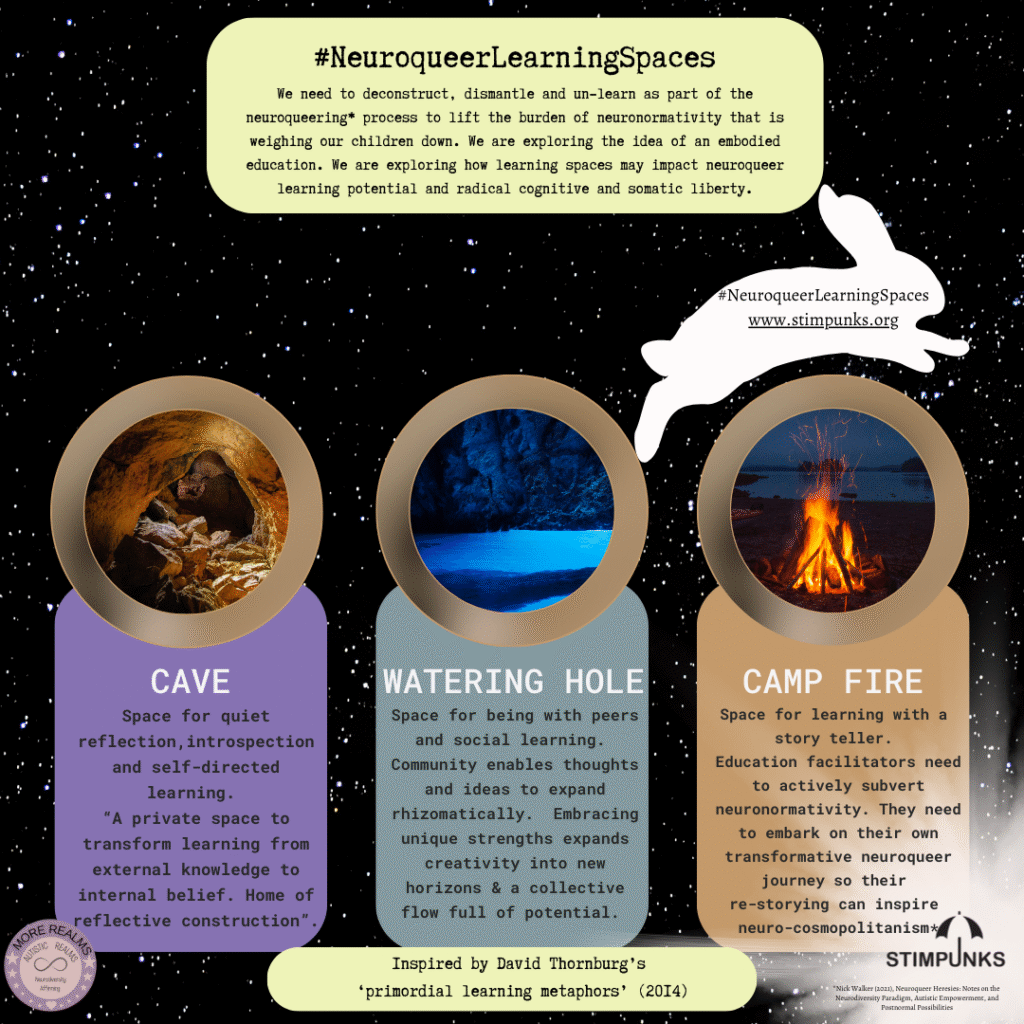
These are not accommodations bolted onto the edges of a space built for someone else. They are the space’s whole reason for being, shaped from the start around how neurodivergent people actually move, rest, connect, regulate, and think.
In Cavendish Space, every way of being belongs. The cave is held as carefully as the campfire. Stimming, directness, sensory sensitivity, the deep pull of monotropic focus, these are not quirks to be managed at the margins or quietly discouraged when others find them uncomfortable. They are exactly what the space was built to welcome. This is what Rogers’ unconditional positive regard looks like when it stops being confined to a single therapeutic hour and becomes the architecture of a whole environment and a new way of being for an entire community, when empathy, becoming, and belonging are no longer aspirations but the actual shape of the space itself.
Structural injustice, affective injustice, and the empire of normality Chapman describes require political change at a scale that no single framework can deliver alone. However, Cavendish Space offers something valuable that large-scale theory sometimes cannot: proof at a human scale that something different is already possible. Lorde told us that the master’s tools will never dismantle the master’s house, and so we have built new ones.
Our small community of neurodivergent, disabled, and multiply marginalised people, holding between us many intersecting experiences of being othered, misread, and pushed to the edges, has created tools, languages, and spaces that were never handed to us, because they could not have been. They had to be built from the inside, from our own experience, in community with each other. When spaces are built from those experiences outward, people do not have to shrink themselves to belong. They arrive, and they are already home. This is not a utopian dream waiting for the right political conditions; we are already a living space, supported by interdependence and mutual aid, showing that it is possible to build something genuinely new, starting not from the centre of what has always been considered normal, but from the rich, complex, irreplaceable edges.
We began with the feeling of being in a room, not truly seen. A world where empathy is practised as a political commitment, where becoming is understood as a collective right, and where belonging is built from the edges inward, from our experiences, our languages, our tools, and our communities. Not a kinder version of the old world. The beginning of a genuinely different one. As the Cavendish Space framework reminds us, most environments are not built for us; schools, workplaces, and public spaces are designed for a norm that excludes neurodivergent and disabled people by default.
Cavendish Space is our offering; it names what we need and gives us a framework for building it, wherever we are, with whatever we have. Where you can walk into the room and feel, perhaps for the first time, that you belong here — and that from that belonging, your own possibilities and your own ways of becoming can begin to unfold.
You can explore our Cavendish Space framework at stimpunks.org/cavendish
REFERENCES
Boren, R., & Edgar, H. (2024). Cavendish Space. Stimpunks Foundation. https://stimpunks.org/space/cavendish/
Chapman, R. (2023). Empire of normality: Neurodiversity and capitalism. Pluto Press.
Deleuze, G., & Guattari, F. (1987). A thousand plateaus: Capitalism and schizophrenia. University of Minnesota Press.
Edgar, H. (2024). The double empathy problem is DEEP. Autistic Realms. https://autisticrealms.com/the-double-empathy-problem-is-deep/
Edgar, H. (2024). Neuroqueer learning spaces webinar: A summary and reflection. Autistic Realms. https://autisticrealms.com/neuroqueer-learning-spaces-webinar-a-summary-and-reflection-6th-may-2024/
Goffin, K. (2026). Autistic injustice as affective injustice: The double empathy problem is not about empathy. Philosophical Psychology. https://doi.org/10.1080/09515089.2026.2651512
Lorde, A. (1984). Sister outsider: Essays and speeches. Crossing Press.
Manning, E. (2016). The minor gesture. Duke University Press.
Milton, D. E. M. (2012). On the ontological status of autism: The double empathy problem. Disability & Society, 27(6), 883–887.
Rogers, C. R. (1957). The necessary and sufficient conditions of therapeutic personality change. Journal of Consulting Psychology, 21(2), 95–103.
Rogers, C. R. (1959). A theory of therapy, personality, and interpersonal relationships. In S. Koch (Ed.), Psychology: A study of a science (Vol. 3, pp. 184–256). McGraw-Hill.
Rogers, C. R. (1961). On becoming a person: A therapist’s view of psychotherapy. Houghton Mifflin.
Walker, N. (2021). Neuroqueer heresies: Notes on the neurodiversity paradigm, Autistic empowerment, and postnormal possibilities. Autonomous Press.
Yergeau, M. R. (2018). Authoring autism: On rhetoric and neurological queerness. Duke University Press.
