
Helen Edgar · More Realms · November 2026
Written as part of my Neuroqueering Deleuze: Rhizomes of Becoming series, a slow, community-based project reading Deleuze and Guattari through neurodivergent lived experience, and as a follow-on from the Wider Existence blogs and podcast I make with David Gray-Hammond. I come to Deleuze as an Autistic ADHD reader and writer, not as a Deleuzian scholar, and I write in the spirit of the series: experimenting, connecting, inviting others in and staying curious as always! Feedback is welcome, as I am eager to keep learning and understand better.
Why “A Thousand Plateaus”?
The title of A Thousand Plateaus (1980), by Gilles Deleuze and Félix Guattari, points to the book’s central philosophical idea. Reality, thought and society are made up of many interconnected plateaus, and none of them is heading towards a single centre or a final conclusion.
1. What is a plateau?
Deleuze and Guattari borrow the term from the anthropologist Gregory Bateson. Writing about Balinese culture, Bateson described a “plateau” of intensity: a continuous state that holds steady instead of building towards a climax and resolution (Bateson, 1972). Music gives a feel for this, in a sustained drone or a passage that stays at one intensity without ever resolving. For Deleuze and Guattari, a plateau is an in-between space of sustained activity, intensity, experimentation and connection. They describe it as any multiplicity linked to others underground, so that together they form or extend a rhizome (Deleuze & Guattari, 1980/1987).
2. Why a thousand?
The number isn’t meant literally. It expresses multiplicity. Deleuze and Guattari reject the idea that everything can be explained through one underlying principle, origin, structure or organising idea. Instead there are countless ways of connecting things, for example:
- Biology connects with politics.
- Language connects with power.
- Desire connects with economics.
- Art connects with philosophy.
- Individuals connect with social and technological systems, and with our wider natural world and the cosmos.
There is no single centre from which all these connections emerge, and the thousand plateaus stand for this multiplicity.
3. Why organise the book into plateaus?
I think the book is deliberately structured according to the philosophy it argues for. You can feel the rhizome and the non-linearity as you read. You can dip in and out, start in the middle and go anywhere. Deleuze and Guattari say as much in their author’s note: the plateaus can be read independently of one another, apart from the conclusion, which they ask us to save for the end (Deleuze & Guattari, 1980/1987). Each chapter explores a different plateau and carries its own date in its title, and you make connections between them as you go. I find this non-linear way of reading, so different from going front to back, very liberating.
4. The rhizome
The book opens with the rhizome. A rhizome is a root system that spreads horizontally, producing connections in many directions, unlike a tree that grows from one central trunk or taproot. A rhizome has:
- No single beginning.
- No privileged centre.
- Multiple points of connection.
- The capacity to break apart and reconnect elsewhere.
I see the plateaus as regions within this rhizomatic network. For me, the title rejects the idea that humans, philosophy, history, psychology or society must be understood through one overarching explanation. Deleuze and Guattari invite us to explore the many ways things connect, interact and produce new possibilities, along with all the in-between states and ways of becoming. David Gray-Hammond and I have carried this concept into community as the Autistic Rhizome, a metaphor for the way individuals and communities connect and support each other through a mycelial network of care (Gray-Hammond, 2023; Edgar, 2023).
What is a Body without Organs?
The phrase “Body without Organs” comes from the poet and playwright Antonin Artaud. In his 1947 radio work To Have Done with the Judgment of God, written after years in psychiatric asylums, Artaud imagined that making a body without organs would free a person from their automatic reactions and give them back their freedom (Artaud, 1947/1976). Deleuze first took up the phrase in The Logic of Sense (Deleuze, 1969/1990), later developed it with Guattari in Anti-Oedipus, and then gave it a whole plateau in A Thousand Plateaus! That plateau is titled with the date of Artaud’s recording, “November 28, 1947: How Do You Make Yourself a Body without Organs?” The title frames it as a practical question about how someone can turn themselves into such a body, and whether it is even safe to do so (Deleuze & Guattari, 1972/1983, 1980/1987).
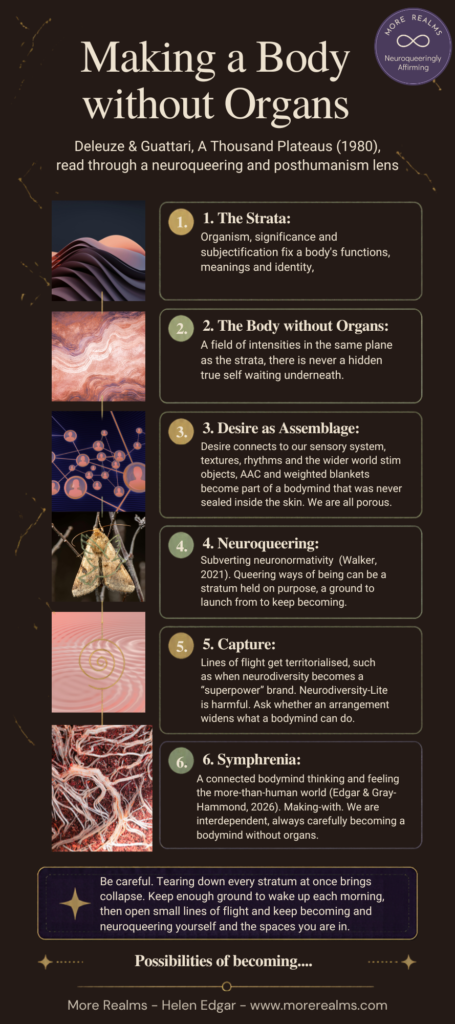
We obviously can’t literally be bodies without organs. Our hearts and lungs need to stay where they are or we would die! Deleuze and Guattari set the Body without Organs against the organism. By the organism they mean the particular organisation of organs that assigns each part a job, ranks those jobs and decides which uses of a body count as real and important. They are clear that the problem lies in that organisation (Deleuze & Guattari, 1980/1987). They call these organising layers strata: the organism, which fixes the body’s functions; signifiance, which fixes what our expressions are taken to mean; and subjectification, which fixes who we are allowed to be (Deleuze & Guattari, 1980/1987).
The body as an egg
Their most helpful image is that of the egg. Before an embryo develops fixed organs, it is a field of gradients, thresholds and zones of intensity, where what each region will become is still open to endless factors. Deleuze and Guattari describe the Body without Organs as being like an egg: a body understood through its intensities and potentials before they are sorted into fixed functions (Deleuze & Guattari, 1980/1987). We never leave the “egg” behind in childhood. It stays with us alongside the adult organism, as a reservoir of everything a body and mind could still possibly do, if free.
A plane of immanence
It may be tempting to picture the Body without Organs as a truer, authentic self hidden underneath, waiting to be uncovered once everything imposed on us is peeled away, a bit like masking and unmasking. I think that picture misses the point, because there is no authentic self waiting there to start with. In What Is Philosophy? Deleuze and Guattari describe a plane of immanence, a field where nothing sits above or outside the flows that cross it (Deleuze & Guattari, 1991/1994). Perhaps the Body without Organs works as this kind of plane for desire. There is no hidden essence of identity beneath it and no organising authority above it all. There are only intensities, connections and multiple ways of becoming, much like some of the thinking in neuroqueer theory, which I will move on to later (Walker, 2021).
A field of intensities
On a Body without Organs, a body is known by what it can feel and do and by what it can connect with: speeds and slownesses, heat, pressure, rhythm, pleasure and pain (Deleuze & Guattari, 1980/1987). A hand can be an organ for grasping and writing, and it can also become a flapping, sensing, rhythmic thing that joins with air, light and texture. In that moment it has slipped out of its assigned job and entered a different arrangement. Stimming, sensory seeking and the long absorption of monotropic flow and deep interest (Murray et al., 2005) can, in my view, all be read as small, everyday ways of making a Body without Organs.
Erin Manning (2016) offers a name for this kind of movement in the minor gesture. For Manning, the major is the structure that sets the norms for what counts, and the minor gesture is a force that moves through it, shifting its rhythms from within, often too quietly to be noticed. She is careful to say that the minor gesture does not belong to an individual as an act of will. It arises in the event, in the relation between the body, the environment and our attention. Manning draws directly on Autistic writers such as Mel Baggs and Tito Rajarshi Mukhopadhyay, and on what she calls autistic perception: experiencing the world as texture and relation before it is chunked into separate objects (Manning, 2013; Manning & Massumi, 2014). Read this way, a stim is a minor gesture. It is a small variation that loosens the organism’s claim on the hand, opens the body onto its wider field and disrupts what society may be expecting and wanting from us.
A practice, a limit and something we already have
Deleuze and Guattari say we each already have a Body without Organs, or even several, and that it works as a limit we keep approaching without ever arriving at a conclusion (Deleuze & Guattari, 1980/1987). This is much like neuroqueering, which Walker (2021) describes as a verb, a practice we can keep on working with. There is no end destination, and that is the point. It makes the Body without Organs something we can practise with care, and Deleuze and Guattari’s advice is to lodge ourselves on a stratum and experiment with the opportunities it offers.
A practical example might look like an Autistic teacher (me) who has spent years masking through staff meetings: sitting still, holding eye contact, saying the expected things in the expected order and fitting in, all at a huge cost to wellbeing. The job was my stratum, and it mattered, because it paid the bills, enabled me to support my students in class and my own family, and gave my life meaning too. Tearing it all down at once, by suddenly resigning to experiment with being a Body without Organs or by unmasking completely in a staff meeting, would not have been safe. It risked the collapse Deleuze and Guattari warn against, as I could have harmed myself and my relationships with others, and lost the job I needed to pay the mortgage and eat.
One way of slowly becoming a Body without Organs could be to engage in minor gestures. I could bring a fidget to the next meeting and let my hands move under the table. I could ask for the agenda in advance and send my thoughts in writing afterwards, instead of having follow-up meetings in person as expected. If I took this slowly and felt safe, I imagine my body would begin to feel better and my mind would be less stressed. The meeting would cost me less, I might be able to pay attention better and feel more settled, and a colleague might see this, ask to borrow a sensory tool and find it helps them too. Each of these is a small line of flight, a patch of new ground. Some of this new ground may feel shaky and uneven to start with and may need to be drawn back, and some may get steadier over time, opening even wider ways for my bodymind (Dychtwald, 1978) to explore being in meetings. Over time the meeting itself would begin to shift. Verbal and written contributions might both become the norm, and others might start to move and stim more openly too. The organism of the staff meeting would loosen a little, and a fuller Body without Organs would be made, both in my own bodymind and in the staff room itself.
Full, empty and cancerous bodies
This is where safety comes in. Deleuze and Guattari distinguish three kinds of Body without Organs. A full Body without Organs is one where intensities circulate and new connections become possible. An empty one has been hollowed out so fast that nothing can pass through it any more; some of their examples are drugged and masochistic bodies. A cancerous one is where a single stratum swells and replicates itself, which they connect to fascism (Deleuze & Guattari, 1980/1987). They are very honest that many attempts at this are dangerous if you try to go all the way into creating a Body without Organs.
In the opening post of my series on Neuroqueering Deleuze, I described Autistic burnout as a kind of deterritorialisation that can also open new possibilities, because you can never return to who or where you were. The idea of the Body without Organs has helped me understand burnout, which can feel like an emptied body, where my usual constellation of intensities struggles even more and it becomes harder and harder to balance and replenish my energy. Recovery from burnout, read this way, is a careful remaking and reworlding. It means finding a stratum to rest on, letting small flows of energy and interest return, and building a fuller Body without Organs at a pace the bodymind can bear. It is no good going back to being the same organism in the same system, as we are likely to re-enter burnout cycles again. Something has to shift. Creating a Body without Organs, for me, is about loosening the limits imposed upon us that lead to burnout, and stretching our possibilities in as many directions as we can, so we can thrive, feel more joy, engage in monotropic flow with our passions and interests, and connect with others. If we do this carefully and safely, alongside others in our community spaces, we can hold each other and look out for each other as we explore, and find other ways of being that don’t lead back into burnout.
Neuroqueering as making a Body without Organs
I have already borrowed Nick Walker’s concept of neuroqueering as a verb. Within the neurodiversity paradigm, Walker (2021) treats neurocognitive variation as a natural and valuable part of human diversity, and treats the pathology paradigm as a social and political arrangement that can be questioned and changed. Neuroqueering, in Walker’s account, is the practice of subverting neuronormative and heteronormative performance while cultivating our own divergences, and carrying that work out into culture and community. When I read this beside Deleuze and Guattari’s work, neuroqueering looks to me like a practice of carefully making a Body without Organs, and knowing when and where to stop safely. It means noticing where the organism has fixed what a bodymind is allowed to do, and then gently, and often playfully, experimenting with what else might be possible.
Identity as ground to stand on?
Deleuze and Guattari describe the majority as a standard, an imagined norm (adult, white, male, and I would add neuronormative), and they describe becoming as always minoritarian, a movement away from that standard with no fixed endpoint (Deleuze & Guattari, 1980/1987). From that angle, identity-first language and the capitalised Autistic could look like one more fixed position. I read Autistic identity differently, as a stratum held on purpose. For me it is shared ground that our communities need for rights, recognition and survival, and a place from which lines of becoming can safely launch. In staff meetings, knowing I am Autistic now gives me permission to self-advocate, and it has supported my resilience. I also know that being Autistic is no fixed “thing”; it is woven into our ways of becoming too.
Who gets to experiment?
My staff room example depends on some safety: a role I knew and was confident in, colleagues who might respond with curiosity and kindness, and enough security to risk a small change. Many people do not have that privilege, and unmasking even a little in a hostile setting can cost someone their safety, their income, or their family and friends. Black, trans, disabled and economically disadvantaged neurodivergent people face far heavier policing of their bodyminds, so the room to loosen a stratum is always unevenly shared, as I have discussed in my blog No Space is Neutral (Edgar, 2026). Making a Body without Organs is socio-political as well as personal, and those of us with more safety and privilege need to carry some responsibility for widening the possibilities for others too.
Making it together: existential diversity, the Autistic Rhizome and symphrenia
A Body without Organs is never made alone. We are not independent beings; we are all interdependent huMAn-Becomings (see Ecologies of Belonging; Gray-Hammond & Edgar, 2026). Deleuze and Guattari describe the Body without Organs as something produced in assemblage, through the connections a body enters into. Posthuman disability studies reads disabled lives in a similar way, as assemblages of bodies, technologies, people and environments, where an AAC device or a weighted blanket becomes part of who we are and how we move through the world (Goodley et al., 2014; Shildrick, 2009). If the organism stands for one sanctioned way of existing, the Body without Organs opens a plane where many can coexist, interdependent with living and non-living entities too. David and I have been thinking of this as existential diversity: variety in how beings (bodyminds) sense time, relate, communicate, rest and make meaning and difference with all living and non-living entities, and how that works both ways. We all share this planet and need to work together.
“The idea is that in the Planetocene, the well-being of the planet would be in the center and everything would be organized according to that.” Sohvi Kangasluoma (as cited in Hansen, 2025)
This is where the Autistic Rhizome comes back in, as the mycelial network of care through which our communities hold and support each other (Gray-Hammond, 2023; Edgar, 2023). Symphrenia, which David Gray-Hammond and I developed together, names a connected bodymind that thinks and feels with others, including trees, water, animals and the wider more-than-human and non-human world (Edgar & Gray-Hammond, 2026). Haraway’s (2016) sympoiesis, or making-with, sits close to all of this too, since nothing makes itself and every living system is composed by many. When an Autistic person stims beside a river or in a staff meeting, the river or the staff meeting also takes part in the assemblage, and everything is affected a little by something else. When a colleague in the staff room borrows a sensory tool from someone, a small rhizome can begin to grow between them, and the Body without Organs being made there becomes part of both people and of the staff room itself.
Possibilities of becoming
Much humanist thinking frames freedom as discovering and expressing a true self. The sixth plateau asks instead what else a body might become, and how to experiment without falling apart (Deleuze & Guattari, 1980/1987). Neuroqueering carries that question into our institutions. Schools, clinics, workplaces and services each run their own organism, a set of functions and hierarchies deciding which bodyminds belong. Queering and neuroqueering society means loosening those arrangements safely, and judging each new arrangement by what it lets bodies, human and more-than-human, do together.
Spinoza’s proposition that ‘we do not know what a body can do’ (Deleuze, 1981/1988, p. 17) challenges assumptions about the limits of bodily capacity and the relationship between mind and body. This remains one of the most hopeful propositions in this philosophy. Autistic and neurodivergent lives, through countless minor gestures of resistance, adaptation and invention, continue to demonstrate its possibilities. Perhaps the task is not to discover who we truly are, but to remain open to what we might become. To stay curious, to sit with unknowing, and to experiment gently with the possibilities of living otherwise. The body is never finished and neither is the rhizome. Let’s keep connecting and creating together in all our wonderful ways of becoming.
References
Artaud, A. (1976). To have done with the judgment of God (H. Weaver, Trans.). In S. Sontag (Ed.), Antonin Artaud: Selected writings. Farrar, Straus and Giroux. (Original work published 1947)
Bateson, G. (1972). Steps to an ecology of mind. Chandler Publishing Company.
Deleuze, G. (1988). Spinoza: Practical philosophy (R. Hurley, Trans.). City Lights Books. (Original work published 1981)
Deleuze, G. (1990). The logic of sense (C. V. Boundas, Ed.; M. Lester with C. Stivale, Trans.). Columbia University Press. (Original work published 1969)
Deleuze, G., & Guattari, F. (1983). Anti-Oedipus: Capitalism and schizophrenia (R. Hurley, M. Seem, & H. R. Lane, Trans.). University of Minnesota Press. (Original work published 1972)
Deleuze, G., & Guattari, F. (1987). A thousand plateaus: Capitalism and schizophrenia (B. Massumi, Trans.). University of Minnesota Press. (Original work published 1980)
Deleuze, G., & Guattari, F. (1994). What is philosophy? (H. Tomlinson & G. Burchell, Trans.). Columbia University Press. (Original work published 1991)
Dychtwald, K. (1978). Bodymind. Jove.
Edgar, H. (2023). Autistic Rhizome. Stimpunks Foundation. https://stimpunks.org/glossary/autistic-rhizome/
Edgar, H. (2026). No space is neutral: Safe spaces, imagined neutrality and the work of belonging. Autistic Realms. https://autisticrealms.com/no-space-is-neutral-safe-spaces-imagined-neutrality-and-the-work-of-belonging/
Edgar, H., & Gray-Hammond, D. (2026, October). Symphrenia. The Wider Existence. https://thewiderexistence.co.uk/p/symphrenia
Goodley, D., Lawthom, R., & Runswick-Cole, K. (2014). Posthuman disability studies. Subjectivity, 7(4), 342–361.
Gray-Hammond, D. (2023, April 21). Neuro-anarchy and the rise of the Autistic Rhizome. DGH Neurodivergent Consultancy. https://dghneurodivergentconsultancy.co.uk/2023/04/21/neuro-anarchy-and-the-rise-of-the-autistic-rhizome/
Gray-Hammond, D., & Edgar, H. (2026, November 1). Ecologies of belonging: Star stuff, kinship and becoming community. The Wider Existence. https://www.thewiderexistence.co.uk/p/ecologies-of-belonging
Hansen, B. A. (2025, April 25). Sohvi (34) overwinters in the Greenlandic ice: “The sea ice has agency of its own”. High North News. https://en.highnorthnews.com/science/sohvi-34-overwinters-in-the-greenlandic-ice-the-sea-ice-has-agency-of-its-own/153307
Haraway, D. J. (2016). Staying with the trouble: Making kin in the Chthulucene. Duke University Press.
Manning, E. (2013). Always more than one: Individuation’s dance. Duke University Press.
Manning, E. (2016). The minor gesture. Duke University Press.
Manning, E., & Massumi, B. (2014). Thought in the act: Passages in the ecology of experience. University of Minnesota Press.
Murray, D., Lesser, M., & Lawson, W. (2005). Attention, monotropism and the diagnostic criteria for autism. Autism, 9(2), 139–156.
Shildrick, M. (2009). Dangerous discourses of disability, subjectivity and sexuality. Palgrave Macmillan.
Walker, N. (2021). Neuroqueer heresies: Notes on the neurodiversity paradigm, autistic empowerment, and postnormal possibilities. Autonomous Press.