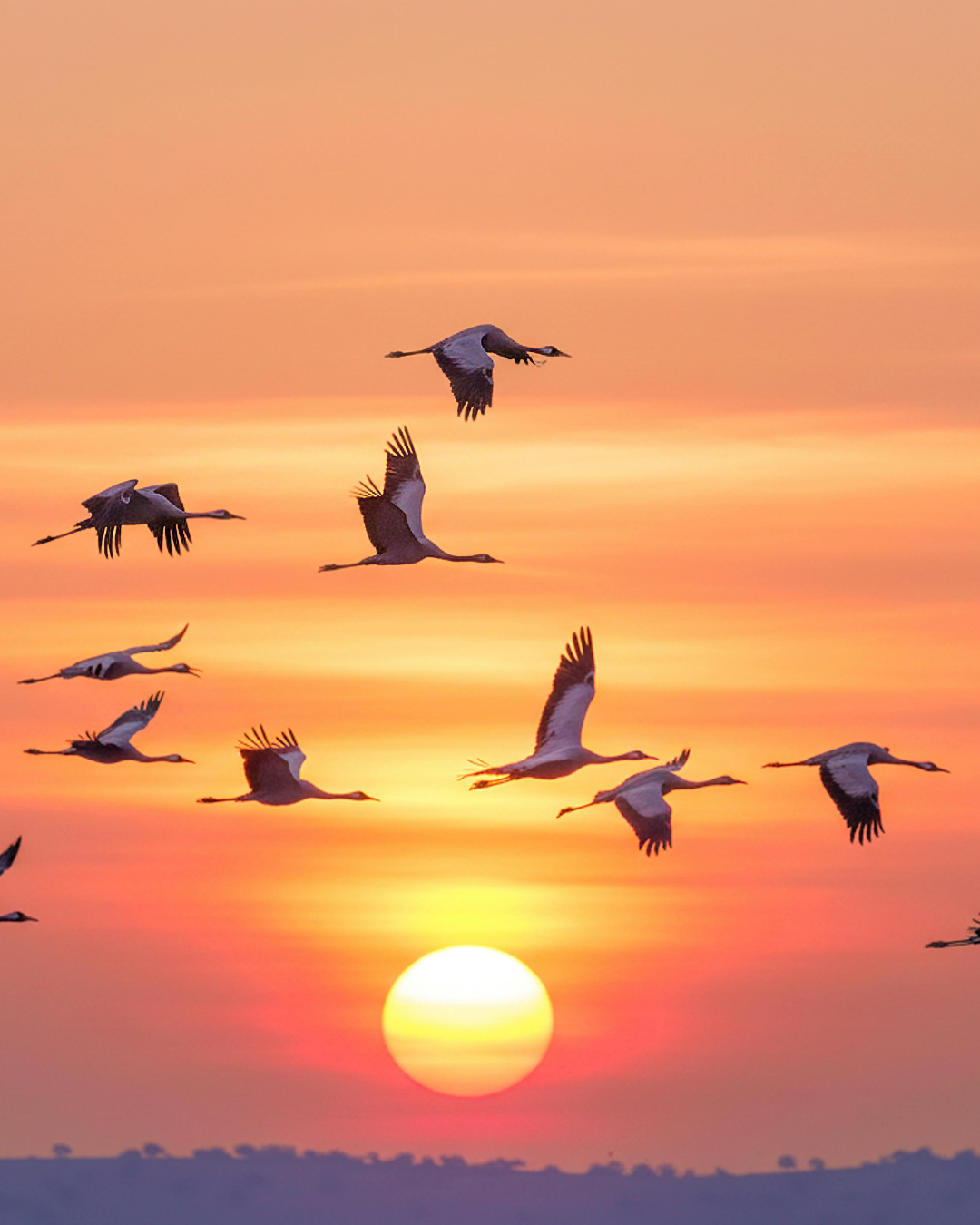
Inspired by Brigit Anna McNeill’s “The Living Page” Migration writing workshop, Into the Woods Writing Group, 6 August 2026.
I spent the evening of sixth of August in Brigit McNeill’s Migration writing workshop with the Into the Woods writing group, in a session called The Living Page. We were invited to write from and with migration, as a movement to think inside of, inspired by Brigit’s own writing.
What follows is some of what I shared during the workshop and what I have been thinking about afterwards, threaded through with the ideas I keep returning to in my work on monotropism and neuroqueer theory.
Inner Compass
Birds cross oceans using a compass sense we still don’t fully understand. It may involve something in their eyes that responds to the Earth’s magnetic field, through a quantum mechanism that is still being worked out (Mouritsen, 2018). A bird doesn’t need a conventional map; it can orient by reading the world itself as a kind of felt knowledge.
As Brigit shared through her writing, salmon return to their birth rivers. Humpback whales cross hemispheres between calving and feeding grounds. Elephants can follow familiar routes across landscapes, including routes to water. Even a plant’s seed is carried by wind or on fur, migrating in its own way, landing on new ground.
The Inner Tug Of Migration
It’s easy to think of migration as recurring linear travel between fixed points — departure, journey, arrival and back again. The workshop pushed against that framing, and we discussed migration as a process of transformation across time, as much as displacement across distance.
I feel this is close to what Deleuze (1994) was exploring through the idea of ‘difference in repetition’. The idea that no repeated pattern is ever a true copy, that each turn carries its own small variation. Migration, read this way, isn’t a repetitive loop; it’s more of a spiral. With every movement, everything changes.
We discussed Brigit’s writing about what she calls the ‘tug’ of migration. It feels like there’s a bodily quality to how migration begins for all of us, whether crossing distance on the land as animals or in our human bodyminds. Before a bird sets off, something like a restlessness builds in its body. The pull comes from within, affected by seasons, seas, and time, and the sense of direction follows from that, in a very embodied, sensory tug.
I recognise that kind of tug or pull in my own way of being. Monotropism (Murray, Lesser, & Lawson, 2005) describes how Autistic attention tends to gather intensely around a small number of interests, rather than spreading more evenly across many. When an interest catches me, it feels closer to that restlessness in the birds, a tug like a magnet pulling me in and arriving before my actual cognition and thinking have caught up.
Following this tug or pull deep inside you, something opens up. Csikszentmihalyi (1990) described flow as the state that arises when attention and challenge align closely enough that the sense of separate effort disappears. It often comes with an undercurrent of wonder where the world briefly widens around whatever has caught you and opens up further into awe. I think that combination is close to what’s carrying migrating animals too: a sense of direction felt from the inside, trusted enough to move on and to see what will happen.
Following the inner pull and desire of flow, whether it is sensory or more cognitive, leads us to connect ideas, connect people, to move our bodyminds. Flow isn’t stillness; attention is moving, even when the body isn’t. It slowly transforms us: each new interest, each sensory experience, every connection with another being or environment shifts something inside us.
Many of us are taught early to override this feeling of going with the flow of what interests us and listening to our inner needs. We are conditioned to ignore our inner compass, to ignore our passions, our ideas, our sensory needs, especially if they fall outside of what is normally expected. We are taught to mask and suppress our flow and authentic migration.
Research on Autistic masking describes the suppression of natural Autistic ways of being in favour of alternatives judged safer and more acceptable by society (Pearson & Rose, 2021). The tug of monotropic passion and sensory feelings often gets read as being too much, having interests too narrow, and we learn to quieten ourselves or try to adapt to fit in. Over the years, we are moving further and further away from our own internal compass and needs until we may not even recognise our true self.
Trusting Our Inner Compass
Trusting our inner compass again isn’t easy, and there is definitely a certain amount of privilege involved in being able to unmask and be your real Autistic self with people. Neuronormativity, the assumption that more evenly distributed, easily legible attention is the ‘correct’ default way to be. It doesn’t just ask us to behave differently; it makes us distrust ourselves too. Neuroqueering (Walker, 2021) is an ongoing practice of subverting and resisting neuronormativity. It is not a final destination to become ‘neuroqueer’ or to have ‘neuroqueered’ your life — rather, I see it as an ongoing refusal to be ashamed of who you are.
This is where we need to re-learn to trust ourselves. Pernille Fraser’s poem “Can We Trust?” names this same rupture from the other direction: not what we lose faith in within ourselves, but what has to be earned from everyone and everything around us before that trust can return at all. The poem was written in 2019 and later shared through Stimpunks Foundation as part of our Neuroqueer Learning Spaces project. The poem repeats its central question across sensory load, pacing, correction, and the question of whether we’ll be believed and left to decide for ourselves, asking, “Can we trust the space you offer?” (Fraser, 2019/2024). The poem never resolves into an answer; it stays in the asking, leaving open questions of safety and possibility. The potential of trusting people in safe spaces to be ourselves, to keep moving and transforming.
That same question of trust doesn’t stop at ourselves. Once we’ve relearned to trust our own inner compass, we can start noticing that everyone and everything around us, human and otherwise, is following one too when we are able to feel safe.
Differences Of Being
If we stop assuming there is one right way for a human mind to move through the world, perhaps we can extend that generosity beyond humans too. Migration is only one expression of a much wider range of ways living things exist in and move through the world. Ethodiversity (Tarragnat, 2024) names the variability of behavioural and existential styles within and across species, developed to open neurodiversity beyond a purely human-centred and neurological framing. A bird’s compass, a salmon’s imprinting, a whale’s seasonal crossing, and a human’s monotropic pull aren’t the same mechanism in different bodies. They’re genuinely different ways of being, each one worth recognising on its own terms.
Difference here is already a form of connection. A migrating salmon doesn’t just pass through a river, its body becomes part of it. When Pacific salmon return to their home streams to spawn and die, their bodies carry marine-derived nutrients into freshwater and other ecosystems; they carry something from one world into another. Whales do something similar at an ocean scale: they help move nutrients such as nitrogen and iron back into sunlit waters, while their migrations redistribute nutrients across large distances. Neither salmon nor whale set out to feed a forest or an ocean, but each unique way of moving through the world is, at the same time, an act of shaping it, and being reshaped by it in turn.
That sits well alongside Milton’s (2012) double empathy problem, which invites us to notice that people communicate and experience the world differently from one another — and that no single way of being or relating needs to sit at the centre, with everyone else read against it. It sits well, too, alongside Barad’s (2007) idea of intra-action: that a self, or a species, or a migrating body doesn’t exist as a separate thing that then relates to its surroundings, but comes into being through the relating itself. There’s no “before” and “after” self on either side of a migration, only the shaping itself. The liminal space a migrating creature passes through isn’t a gap between two finished things. Self and field, self and current, self and interest, forming each other as they go.
Transformation and Trust
The workshop’s real gift was permission to stop treating change as the exception that needs explaining and to start treating it as the foundation through which everything else moves. Life doesn’t hold still and occasionally migrates; it is always in a constant state of flux and flow.
That reframing opens space for new stories to begin, not despite the shifting, but because of it. This sits alongside other threads I keep pulling on: the constellation-thinking in My Monotropic Galaxy on More Realms, and the Star Stuff work with Ryan Boren at Stimpunks, which starts from the same idea, that we are made of matter that has already migrated across unthinkable distances, reorganising itself into shape after shape after shape, connection by connection.
Migration, in that sense, isn’t a metaphor borrowed from birds and whales. It’s been true of us for longer than we’ve had words for, trusting our inner compass isn’t something any of us can do alone as people and may be especially as Autistic monotropic people.
Birds have the Earth’s magnetic field and the wider world around them to orient by. We need something a bit different: people and spaces willing to be trusted, willing to let us move, be, and communicate in our own way without demanding we prove it first.
Rediscovering our monotropic inner compass is only part of the migration. The rest is building spaces safe enough to trust it in, so we can shape and be shaped by the world around us, the way the salmon and the whale do, simply by being fully who we are.
Explore more in my Cosmic Connections collaborative project with Ryan Boren Stimpunks: Star Stuff Earth.
A Field Guide to the Ways of Migrating
Always Migrating Zine
References
Barad, K. (2007). Meeting the universe halfway: Quantum physics and the entanglement of matter and meaning. Duke University Press.
Csikszentmihalyi, M. (1990). Flow: The psychology of optimal experience. Harper & Row.
Deleuze, G. (1994). Difference and repetition (P. Patton, Trans.). Columbia University Press.
Fraser, P. (2019/2024). Can we trust? [Poem]. Stimpunks Foundation. https://stimpunks.org/2024/04/27/can-we-trust/
McNeill, B. (2026, August 2). Links to lovely things [The Living Page: Migration]. Into the Woods with Brigit Anna McNeill (Substack). https://brigitannamcneill.substack.com/p/links-to-lovely-things
Milton, D. E. M. (2012). On the ontological status of autism: The ‘double empathy problem.’ Disability & Society, 27(6), 883–887.
Mouritsen, H. (2018). Long-distance navigation and magnetoreception in migratory animals. Nature, 558(7708), 50–59.
Murray, D., Lesser, M., & Lawson, W. (2005). Attention, monotropism and the diagnostic criteria for autism. Autism, 9(2), 139–156.
Pearson, A., & Rose, K. (2021). A conceptual analysis of autistic masking: Understanding the narrative of stigma and the illusion of choice. Autism in Adulthood, 3(1), 52–60.
Tarragnat, O. (2024). Biodiversity, neurodiversity, ethodiversity: Towards a more-than-human and more-than-neurological turn in neurodiversity studies. TRACE: Journal for Human-Animal Studies.
Walker, N. (2021). Neuroqueer heresies: Notes on the neurodiversity paradigm, autistic empowerment, and postnormal possibilities. Autonomous Press.