
Tag: Literature

  • From the Edge of the Gyre: Yeats, Symphrenia and the Centre that Cannot Hold

    From the Edge of the Gyre: Yeats, Symphrenia and the Centre that Cannot Hold

    Yeats, symphrenia and the centre that cannot hold

    Helen Edgar, October 2026

    Content note: brief mention of psychosis, psychiatric labelling and eugenics.

    Key words

    Autistic rhizome: Autistic community imagined as a rhizome, a root system with no centre that spreads in every direction, where any point can connect to any other (Gray-Hammond & Edgar, inspired by Deleuze & Guattari, 1987).

    Ethodiverse: from ethodiversity, short for “ethological diversity”. The natural variation in behavioural and existential styles within and across species, in human and non-human animals alike. It includes neurodiversity but reaches beyond the brain and beyond the human (Tarragnat, 2025).

    Existential diversity: the idea that people differ in how they experience existence itself, and that these differences are natural variation, not distance from a “normal” centre (Gray-Hammond & Edgar, forthcoming).

    Mycelial network of care: care modelled on fungal mycelium, the underground threads that connect plants and share resources between them (Sheldrake, 2020 & Edgar, 2026a). Support that flows through many connections rather than from one central source.

    Monotropism: a theory of attention in which attention pools into fewer channels at a time and runs deep and intense in them, rather than spreading thinly across many (Murray et al., 2005).

    Neuronormative: treating one typical way of thinking, perceiving and relating as the standard everyone is measured against (Walker, 2021).

    Symphrenia: “connected bodymind”. A way of experiencing the world in which connections are felt with unusual monotropic depth and intensity, sometimes more than a person can hold. Symphrenic is an identity people can only choose for themselves (Gray-Hammond & Edgar, 2026).


    W. B. Yeats wrote “The Second Coming” in January 1919, as the world seemed to be falling apart: the First World War was barely over, revolution was sweeping Russia, Ireland was edging towards war, and his wife, George, was pregnant and seriously ill with influenza. The poem draws on his theory of “gyres”, spirals of history turning in two-thousand-year cycles, and imagines one age ending as a “rough beast” slouches towards Bethlehem (Yeats, 1920/1989).

    For Yeats, a centre that cannot hold means catastrophe: order fails and “mere anarchy” follows. I want to read the line against that grain, through my own personal experience of burnout and madness.

    The widening gyre

    The poem begins: Turning and turning in the widening gyre / The falcon cannot hear the falconer. Yeats hears loss of control, I feel something familiar connected to my mental health. Symphrenia describes perception that spirals outward, taking in connections others do not perceive, sometimes more than a person can hold (Gray-Hammond & Edgar, 2026). From the centre, a falcon that far out looks lost, but it is still flying, listening to the wind, to other birds, to currents the falconer cannot feel. So I wonder: who is the falconer? Why should the falcon only ever hear one voice, and why should the human voice be the one that matters?

    Whose centre?

    In mental health spaces in our society, the centre defaults to neuronormative expectations: which connections count as reasonable, and whose accounts are believed. Fricker (2007) calls the lack of shared language to make your own experience intelligible hermeneutical injustice. Existential diversity, a concept David Gray-Hammond and I are exploring in our Wider Existence series, treats differences in how people experience existence as ethodiverse variation rather than distance from a fixed point (Gray-Hammond & Edgar, forthcoming; Tarragnat, 2025). Read this way, a centre that cannot hold is not only collapse, a centre too narrow for the range of human and non-human existence is always going to give way, we need a wider way of existing together.

    Who gets pushed to the edges and liminal spaces is not random it is governed by power and privelege. Yeats spent decades seeking connections beyond the visible: séances, symbols, a Spiritus Mundi of shared images, a cosmology built from automatic writing. As a celebrated Protestant Anglo-Irish man, he was read as a visionary. Similar experiences, described by a poor woman, a colonised person, or a Black man in a mid-century American psychiatric ward, were far more likely to be read as symptoms (Crenshaw, 1989; Metzl, 2009). I cannot call Yeats symphrenic; only a person can claim that for themselves, but his poem shows how much depends on who is speaking, who is believed, and why and intersectionality and social privilege shapes all of this especially maybe in Western developed countries.

    Perhaps as a way to control the ever-widening gyre, Yeats’s fear of disorder later drew him towards authoritarian politics and eugenic ideas (Yeats, 1939). It may have been a longing for the centre to hold him, to accept him. He longed for a society to control whoever does not fit it, which could arguably have included people like himself.

    The rough beast

    When the centre gives way inside me, the ground seems to fall away, literally fall, like I am spiralling down beyond the human world. It often feels as though I can’t quite hold on and reality is slipping away yet I am always some how held on by a few threads enabling me to work and function like this in some capacity. Unlike David, I have never had a full on psychotic episode, yet I am always feeling between worlds, seeing, hearing and perceiving things others say are not real or that I am just imagining. I have had to find new ways of grounding and regulating. For me, what helps has never been a firmer centre. It has not been the neuronormative route of social skills programmes, or learning to reason my thoughts and visions and voices away. Some people find those approaches helpful, and that is their choice to make, but my thoughts and visions don’t go away, they are a part of me and they also bring me joy and creative ways of being that I love.

    So I am learning to lean in. I now centre myself in a community with no centre, what David and I call the Autistic rhizome (2025). It is an ever-shifting space of kinship, rest and sensory safety. It holds people who can embrace chaotic, Mad, symphrenic ways of being without judging, stigmatising or trying to change us, while still supporting the hard reality of living this way.

    Perhaps Yeats’s rough beast is not the monster after all, perhaps it is what a centre calls monstrous when it meets something it cannot hold. We do not need the centre to hold. We need something that holds without one: a rhizomatic web, a mycelial network of care rather than a wheel.

    References

    Crenshaw, K. (1989). Demarginalizing the intersection of race and sex. University of Chicago Legal Forum, 1989(1), 139–167.

    Deleuze, G., & Guattari, F. (1987). A thousand plateaus: Capitalism and schizophrenia (B. Massumi, Trans.). University of Minnesota Press.

    Fricker, M. (2007). Epistemic injustice: Power and the ethics of knowing. Oxford University Press.

    Edgar, H. (2026a, February 22). The Autistic rhizome: Community, liminal spaces and belonging. Autistic Realms. https://autisticrealms.com/the-autistic-rhizome-community-liminal-spaces-belonging/

    Edgar, H. (2026b, March 15). Expanding the mycelial network of care: Autistic community, safety, and rhizomatic futures. More Realms. https://morerealms.com/expanding-the-mycelial-network-of-care-autistic-community-safety-and-rhizomatic-futures/

    Gray-Hammond, D., & Edgar, H. (2026, October 7). Symphrenia. The Wider Existence. https://www.thewiderexistence.co.uk/p/symphrenia

    Gray-Hammond, D., & Edgar, H. (forthcoming). Existential diversity.

    Gray-Hammond, D. (2025, June 29). The Autistic rhizome: Reclaiming knowledge, rewriting reality. https://www.davidgrayhammond.co.uk/p/the-autistic-rhizome-reclaiming-knowledge

    Metzl, J. M. (2009). The protest psychosis: How schizophrenia became a Black disease. Beacon Press.

    Murray, D., Lesser, M., & Lawson, W. (2005). Attention, monotropism and the diagnostic criteria for autism. Autism, 9(2), 139–156. https://doi.org/10.1177/1362361305051398

    Sheldrake, M. (2020). Entangled life: How fungi make our worlds, change our minds and shape our futures. The Bodley Head.

    Walker, N. (2021). Neuroqueer heresies. Autonomous Press.

    Yeats, W. B. (1939). On the boiler. Cuala Press.

    Yeats, W. B. (1989). The second coming. In R. J. Finneran (Ed.), The collected poems of W. B. Yeats. Macmillan. (Original work published 1920)

    Find out more:

    Read more at The Wider Existence

    This post is part of an ongoing exploration of symphrenia and existential diversity with David Gray-Hammond. To read our first essay, Symphrenia, and follow the series as it grows, visit The Wider Existence: https://www.thewiderexistence.co.uk/. If something here speaks to you, or misses something important, we would be glad to hear from you there.

    Discover more

    Courses, books and resources

    If you would like to take these ideas further, my courses, books and resources live on Autistic Realms. Everything in the shop is pay what you can, and many resources are free.

  • Migration & Trusting Our Inner Monotropic Compass

    Migration & Trusting Our Inner Monotropic Compass

    Inspired by Brigit Anna McNeill’s “The Living Page” Migration writing workshop, Into the Woods Writing Group, 6 August 2026.

    I spent the evening of sixth of August in Brigit McNeill’s Migration writing workshop with the Into the Woods writing group, in a session called The Living Page. We were invited to write from and with migration, as a movement to think inside of, inspired by Brigit’s own writing.

    What follows is some of what I shared during the workshop and what I have been thinking about afterwards, threaded through with the ideas I keep returning to in my work on monotropism and neuroqueer theory.

    Inner Compass

    Birds cross oceans using a compass sense we still don’t fully understand. It may involve something in their eyes that responds to the Earth’s magnetic field, through a quantum mechanism that is still being worked out (Mouritsen, 2018). A bird doesn’t need a conventional map; it can orient by reading the world itself as a kind of felt knowledge.

    As Brigit shared through her writing, salmon return to their birth rivers. Humpback whales cross hemispheres between calving and feeding grounds. Elephants can follow familiar routes across landscapes, including routes to water. Even a plant’s seed is carried by wind or on fur, migrating in its own way, landing on new ground.

    The Inner Tug Of Migration

    It’s easy to think of migration as recurring linear travel between fixed points — departure, journey, arrival and back again. The workshop pushed against that framing, and we discussed migration as a process of transformation across time, as much as displacement across distance.

    I feel this is close to what Deleuze (1994) was exploring through the idea of ‘difference in repetition’. The idea that no repeated pattern is ever a true copy, that each turn carries its own small variation. Migration, read this way, isn’t a repetitive loop; it’s more of a spiral. With every movement, everything changes.

    We discussed Brigit’s writing about what she calls the ‘tug’ of migration. It feels like there’s a bodily quality to how migration begins for all of us, whether crossing distance on the land as animals or in our human bodyminds. Before a bird sets off, something like a restlessness builds in its body. The pull comes from within, affected by seasons, seas, and time, and the sense of direction follows from that, in a very embodied, sensory tug.

    I recognise that kind of tug or pull in my own way of being. Monotropism (Murray, Lesser, & Lawson, 2005) describes how Autistic attention tends to gather intensely around a small number of interests, rather than spreading more evenly across many. When an interest catches me, it feels closer to that restlessness in the birds, a tug like a magnet pulling me in and arriving before my actual cognition and thinking have caught up.

    Following this tug or pull deep inside you, something opens up. Csikszentmihalyi (1990) described flow as the state that arises when attention and challenge align closely enough that the sense of separate effort disappears. It often comes with an undercurrent of wonder where the world briefly widens around whatever has caught you and opens up further into awe. I think that combination is close to what’s carrying migrating animals too: a sense of direction felt from the inside, trusted enough to move on and to see what will happen.

    Following the inner pull and desire of flow, whether it is sensory or more cognitive, leads us to connect ideas, connect people, to move our bodyminds. Flow isn’t stillness; attention is moving, even when the body isn’t. It slowly transforms us: each new interest, each sensory experience, every connection with another being or environment shifts something inside us.

    Many of us are taught early to override this feeling of going with the flow of what interests us and listening to our inner needs. We are conditioned to ignore our inner compass, to ignore our passions, our ideas, our sensory needs, especially if they fall outside of what is normally expected. We are taught to mask and suppress our flow and authentic migration.

    Research on Autistic masking describes the suppression of natural Autistic ways of being in favour of alternatives judged safer and more acceptable by society (Pearson & Rose, 2021). The tug of monotropic passion and sensory feelings often gets read as being too much, having interests too narrow, and we learn to quieten ourselves or try to adapt to fit in. Over the years, we are moving further and further away from our own internal compass and needs until we may not even recognise our true self.

    Trusting Our Inner Compass

    Trusting our inner compass again isn’t easy, and there is definitely a certain amount of privilege involved in being able to unmask and be your real Autistic self with people. Neuronormativity, the assumption that more evenly distributed, easily legible attention is the ‘correct’ default way to be. It doesn’t just ask us to behave differently; it makes us distrust ourselves too. Neuroqueering (Walker, 2021) is an ongoing practice of subverting and resisting neuronormativity. It is not a final destination to become ‘neuroqueer’ or to have ‘neuroqueered’ your life — rather, I see it as an ongoing refusal to be ashamed of who you are.

    This is where we need to re-learn to trust ourselves. Pernille Fraser’s poem “Can We Trust?” names this same rupture from the other direction: not what we lose faith in within ourselves, but what has to be earned from everyone and everything around us before that trust can return at all. The poem was written in 2019 and later shared through Stimpunks Foundation as part of our Neuroqueer Learning Spaces project. The poem repeats its central question across sensory load, pacing, correction, and the question of whether we’ll be believed and left to decide for ourselves, asking, “Can we trust the space you offer?” (Fraser, 2019/2024). The poem never resolves into an answer; it stays in the asking, leaving open questions of safety and possibility. The potential of trusting people in safe spaces to be ourselves, to keep moving and transforming.

    That same question of trust doesn’t stop at ourselves. Once we’ve relearned to trust our own inner compass, we can start noticing that everyone and everything around us, human and otherwise, is following one too when we are able to feel safe.

    Differences Of Being

    If we stop assuming there is one right way for a human mind to move through the world, perhaps we can extend that generosity beyond humans too. Migration is only one expression of a much wider range of ways living things exist in and move through the world. Ethodiversity (Tarragnat, 2024) names the variability of behavioural and existential styles within and across species, developed to open neurodiversity beyond a purely human-centred and neurological framing. A bird’s compass, a salmon’s imprinting, a whale’s seasonal crossing, and a human’s monotropic pull aren’t the same mechanism in different bodies. They’re genuinely different ways of being, each one worth recognising on its own terms.

    Difference here is already a form of connection. A migrating salmon doesn’t just pass through a river, its body becomes part of it. When Pacific salmon return to their home streams to spawn and die, their bodies carry marine-derived nutrients into freshwater and other ecosystems; they carry something from one world into another. Whales do something similar at an ocean scale: they help move nutrients such as nitrogen and iron back into sunlit waters, while their migrations redistribute nutrients across large distances. Neither salmon nor whale set out to feed a forest or an ocean, but each unique way of moving through the world is, at the same time, an act of shaping it, and being reshaped by it in turn.

    That sits well alongside Milton’s (2012) double empathy problem, which invites us to notice that people communicate and experience the world differently from one another — and that no single way of being or relating needs to sit at the centre, with everyone else read against it. It sits well, too, alongside Barad’s (2007) idea of intra-action: that a self, or a species, or a migrating body doesn’t exist as a separate thing that then relates to its surroundings, but comes into being through the relating itself. There’s no “before” and “after” self on either side of a migration, only the shaping itself. The liminal space a migrating creature passes through isn’t a gap between two finished things. Self and field, self and current, self and interest, forming each other as they go.

    Transformation and Trust

    The workshop’s real gift was permission to stop treating change as the exception that needs explaining and to start treating it as the foundation through which everything else moves. Life doesn’t hold still and occasionally migrates; it is always in a constant state of flux and flow.

    That reframing opens space for new stories to begin, not despite the shifting, but because of it. This sits alongside other threads I keep pulling on: the constellation-thinking in My Monotropic Galaxy on More Realms, and the Star Stuff work with Ryan Boren at Stimpunks, which starts from the same idea, that we are made of matter that has already migrated across unthinkable distances, reorganising itself into shape after shape after shape, connection by connection.

    Migration, in that sense, isn’t a metaphor borrowed from birds and whales. It’s been true of us for longer than we’ve had words for, trusting our inner compass isn’t something any of us can do alone as people and may be especially as Autistic monotropic people.

    Birds have the Earth’s magnetic field and the wider world around them to orient by. We need something a bit different: people and spaces willing to be trusted, willing to let us move, be, and communicate in our own way without demanding we prove it first.

    Rediscovering our monotropic inner compass is only part of the migration. The rest is building spaces safe enough to trust it in, so we can shape and be shaped by the world around us, the way the salmon and the whale do, simply by being fully who we are.


    Explore more in my Cosmic Connections collaborative project with Ryan Boren Stimpunks: Star Stuff Earth.

    A Field Guide to the Ways of Migrating

    Always Migrating Zine


    References

    Barad, K. (2007). Meeting the universe halfway: Quantum physics and the entanglement of matter and meaning. Duke University Press.

    Csikszentmihalyi, M. (1990). Flow: The psychology of optimal experience. Harper & Row.

    Deleuze, G. (1994). Difference and repetition (P. Patton, Trans.). Columbia University Press.

    Fraser, P. (2019/2024). Can we trust? [Poem]. Stimpunks Foundation. https://stimpunks.org/2024/04/27/can-we-trust/

    McNeill, B. (2026, August 2). Links to lovely things [The Living Page: Migration]. Into the Woods with Brigit Anna McNeill (Substack). https://brigitannamcneill.substack.com/p/links-to-lovely-things

    Milton, D. E. M. (2012). On the ontological status of autism: The ‘double empathy problem.’ Disability & Society, 27(6), 883–887.

    Mouritsen, H. (2018). Long-distance navigation and magnetoreception in migratory animals. Nature, 558(7708), 50–59.

    Murray, D., Lesser, M., & Lawson, W. (2005). Attention, monotropism and the diagnostic criteria for autism. Autism, 9(2), 139–156.

    Pearson, A., & Rose, K. (2021). A conceptual analysis of autistic masking: Understanding the narrative of stigma and the illusion of choice. Autism in Adulthood, 3(1), 52–60.

    Tarragnat, O. (2024). Biodiversity, neurodiversity, ethodiversity: Towards a more-than-human and more-than-neurological turn in neurodiversity studies. TRACE: Journal for Human-Animal Studies.

    Walker, N. (2021). Neuroqueer heresies: Notes on the neurodiversity paradigm, autistic empowerment, and postnormal possibilities. Autonomous Press.

    Discover more

    Courses, books and resources

    If you would like to take these ideas further, my courses, books and resources live on Autistic Realms. Everything in the shop is pay what you can, and many resources are free.

  • It’s Complicated: Polytropos, Odysseus, and Homer’s Odyssey

    It’s Complicated: Polytropos, Odysseus, and Homer’s Odyssey


    What if the thing that made Odysseus remarkable wasn’t his many turns, but the one thing that never turned? A personal, AuDHD read on Homer’s Odyssey and the words polytropos and monotropos.

    Watching Christopher Nolan’s The Odyssey (2026) left me thinking about the Greek word that opens Homer’s poem: πολύτροπος (polytropos). At first glance, one possible translation of polytropos, “many-turned,” seems almost the opposite of monotropism, the theory that Autistic attention is often organised around fewer, deeply engaging interests rather than being broadly distributed across many competing demands (Murray, Lesser, & Lawson, 2005; Murray, 2022). Yet Odysseus suggests that these ideas may not be simple opposites: a person can adapt in many ways while remaining profoundly oriented towards one enduring purpose.

    Polytropos and monotropos share a root. Both come from tropos, “a turn, a way of being,” joined to a different first element: poly- (“many”) against mono- (“one”). Where polytropos described someone of many turns — Homer’s word for Odysseus’s resourcefulness and adaptability — monotropos described someone of a single turn.

    The relationship is therefore suggestive rather than equivalent. Polytropos describes a quality attributed to Odysseus’s character, while monotropism describes a theory of attentional organisation. The shared root offers a useful point of reflection, not a claim that the two concepts describe the same or different things.

    What strikes me most isn’t Odysseus’s many twists and turns. It is the one thing that never diverted his attention or devotion from Penelope and his family. Against everything thrown at him, the gods, the sea, monsters, temptation, and years away from home, Odysseus never loses sight of returning to Penelope and his family. His deepest orientation never shifted. His methods changed constantly, but they remained organised around one enduring purpose.

    Polytropos is the very first adjective Homer uses to describe Odysseus. Translators have wrestled with that single adjective (polytropos / πολύτροπον) for centuries. Richmond Lattimore famously rendered it as “the man of many ways” (Homer, 1965). Robert Fagles gave us “the man of twists and turns” (Homer, 1996). Emily Wilson’s 2018 translation, which Nolan appears to draw on heavily, opens instead: “Tell me about a complicated man” (Homer, 2018).

    Each translation highlights something slightly different. Lattimore foregrounds versatility; Fagles emphasises movement and perhaps unpredictability; Wilson stresses the complexity of Odysseus’s character, encompassing his suffering, his deceptions, and his long wanderings, rather than presenting him as a straightforward hero.

    Wilson has written about this choice in her blog “On Complicated…” (Wilson, 2024). She ruled out coining an artificial word like “much-turny,” since polytropos is “a real, legitimate Greek word,” and she wanted an equally English word rather than an invented one. Wilson’s “complicated” captures the layered nature of Odysseus: his suffering, deception, adaptability, and contradictions. She also notes that in later Greek the word travelled beyond Odysseus himself: Thucydides used it of “manifold circumstances,” and it was later applied to changeable diseases and even to the notorious turncoat Alcibiades, so a purely negative or purely positive rendering never seemed quite adequate to her either.

    Interestingly, the word polytropos is itself a bahuvrihi compound: poly (“many”) and tropos (“turn,” “way,” or “manner”). Rather than naming an action, it describes someone by a characteristic they possess. In Homer, Odysseus is someone who adapts and turns to his many changing circumstances.

    However, these translations all leave another aspect of Odysseus’s character slightly less visible: every one of those turns serves a single, enduring purpose. His adaptability is not aimless; every turn is complicated and organised around one unwavering direction of attention, that of returning home to Penelope, his family, and Ithaca.

    Before watching the film, I came across a Bluesky post by Fergus Murray that pointed me towards an interesting connection between the word polytropos and the later Greek word monotropos. That led me to the work of the classicist P. A. Meijer, who discusses the philosopher Antisthenes’ interpretation of polytropos (Meijer, 2017).

    Antisthenes argued Odysseus earned the word polytropos because he knew how to deal with all kinds of people, shifting his approach depending on who he was talking to and what the moment called for. His many “turns” weren’t deceptive tricks; they could be seen as different ways of meeting different situations and different people.

    The word monotropos does not appear in Homer’s Odyssey itself although it shares the same linguistic root as polytropos (tropos, meaning a way or mode of turning). The theory of monotropism uses that root to describe a characteristic style of attention in which cognitive resources are concentrated into a smaller number of intensely focused interests, rather than spread broadly across many competing demands — a pattern many Autistic and ADHD people recognise strongly in their own experiences (Murray, Lesser, & Lawson, 2005).

    I’m not suggesting that Odysseus was Autistic, and I don’t think it’s relevant to speculate about how a Bronze Age literary character might score on the monotropism questionnaire. That’s definitely not the point of this blog. What interests me is how these different but related words invite us to think about attention and ways of being.

    Polytropos has generally been used in various differently worded translations of Homer’s Odyssey to describe Odysseus as a man capable of many approaches. Monotropism describes the way a person’s attention is deeply organised around a limited number of concerns at any one time. Together, these words may help to illuminate human behaviour, how we respond to the world around us, and how our attention is organised, what drives and motivates us.

    Antisthenes’ interpretation of polytropos, as discussed by Meijer, suggests that someone who cannot vary their approach to different people may appear limited or one-sided. Read through a contemporary lens, it’s easy to hear echoes of the deficit-based accounts that have shaped autism research for decades.

    One of the most influential examples is the theory of mind hypothesis, which came to be interpreted as suggesting that Autistic people lacked the capacity to understand that other people have different thoughts, beliefs, and perspectives from their own (Baron-Cohen, Leslie, & Frith, 1985). It contributed to a broader, hugely problematic narrative that framed Autistic social differences primarily as deficits.

    More recently, Damian Milton’s Double Empathy Problem has challenged that assumption. Rather than suggesting communication difficulties and responsibilities lie solely with Autistic people, Milton argues that misunderstandings arise because people with different ways of experiencing and interpreting the world often struggle to understand one another. Communication is relational; the difficulty lies in the mismatch between different perspectives, not necessarily in a deficit on one side (Milton, 2012).

    I think this shift is important because it changes how we think about adaptability, attention, and flexibility. Someone who does not naturally change their communication style from person to person may certainly experience friction in predominantly neuronormative environments, but whether that should be understood as a personal deficiency or as a difference between communicative styles is a very different question, and one where the responsibility should be mutual.

    It proposes that Autistic attention tends to be organised around fewer, more deeply engaged interests, with cognitive resources concentrated rather than widely distributed (Murray, Lesser, & Lawson, 2005). It is an account of how attention is allocated, not a judgement about its value.

    Watching Nolan’s film of The Odyssey, what struck me wasn’t Odysseus’s versatility alone as a “man of many twists and turns”. Every disguise and every adaptation seemed to serve the same enduring goal: to reunite with Penelope and return to Ithaca. His attention never wandered, his methods changed constantly, but his purpose didn’t; he remained focused, fully absorbed in his quest.

    Odysseus lies when necessary, disguises himself, negotiates, fights, flatters, persuades, and endures. He changes his approach as each new situation and context demands. Yet inwardly, he seems quite monotropically focused; every turn ultimately points towards Ithaca. His many ways are all organised around one unwavering orientation.

    Perhaps this is why polytropos has proved so difficult to translate. Another point Wilson shares that feels worth ending on is that tropos itself doesn’t just mean “turn.” It also carries the sense of a way of life, a custom, a habit, a guise, a manner, a character (Wilson, 2024).

    Odysseus’s many turns, in that light, were the many guises, habits, and ways he had to adapt to survive. He was, in every sense of the word, a complicated man. I like Wilson’s choice of translation, and after all this thought, it feels right and truly captures him. She chose a word that evokes the imagery of folding and layering, that lands with the same weight and pace of the original poem. It carries an immediate meaning that everyone can relate to, while still opening onto something more, a hint of truths still to come (Wilson, 2024).

    Underneath every guise, one thing never changed. Odysseus’s complicated greatness lies less in how many ways he can turn than in what all those turns were for. For all his disguises and transformations, he remains profoundly oriented towards home. His complicatedness makes sense because it also expresses the complexity of his one enduring commitment, to finally return home to Penelope, his family, and Ithaca.

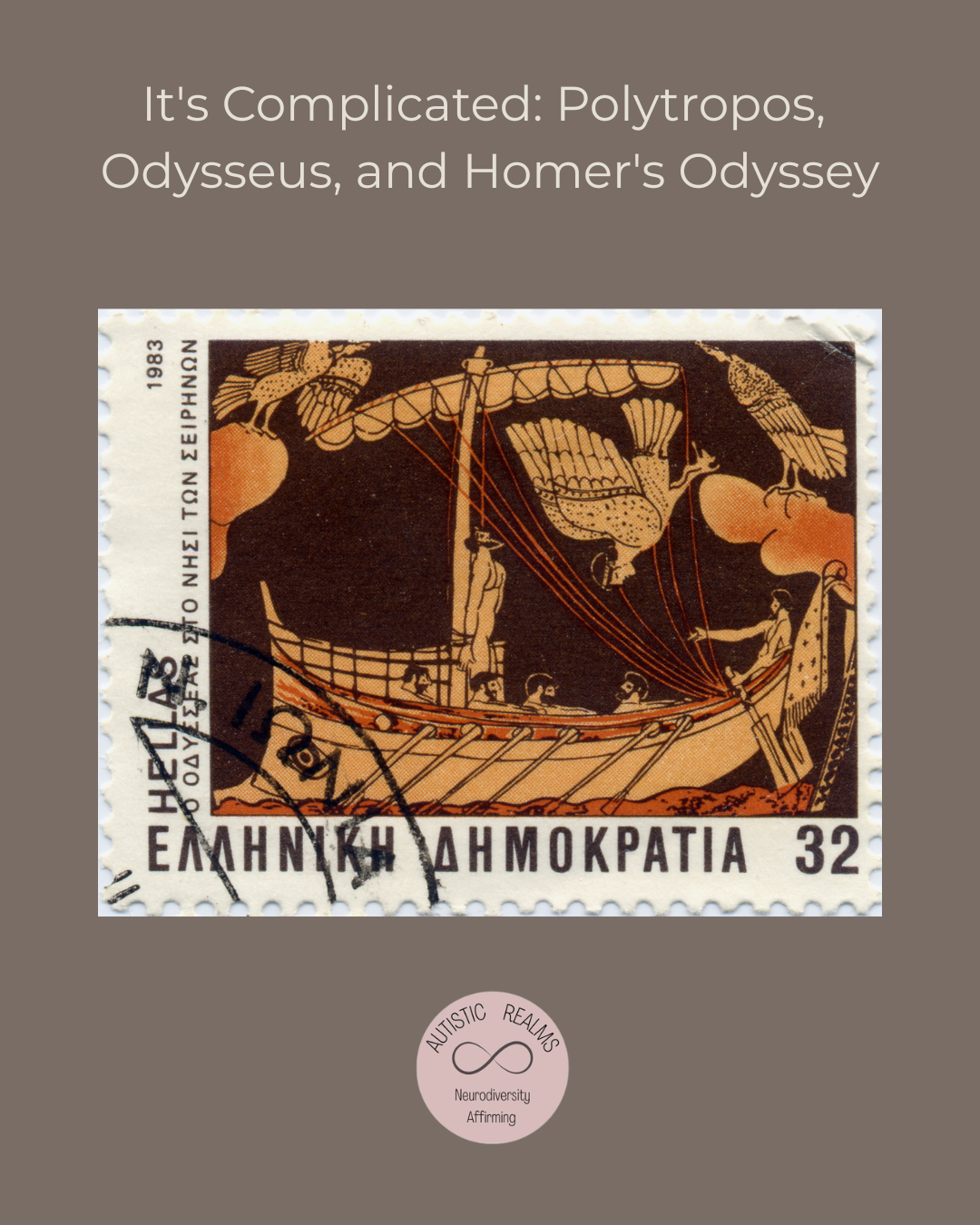
    Blog header for 'It's Complicated: Polytropos, Odysseus, and Homer's Odyssey.' Below the title, a 1983 Greek postage stamp (32 drachma, ΕΛΛΗΝΙΚΗ ΔΗΜΟΚΡΑΤΙΑ) shows a replica of an ancient Greek vase painting: Odysseus bound to the mast of his ship while sirens fly overhead and his crew row past. The Autistic Realms neurodiversity-affirming logo appears at the bottom.

    References

    Baron-Cohen, S., Leslie, A. M., & Frith, U. (1985). Does the autistic child have a “theory of mind”? Cognition, 21(1), 37–46. https://pubmed.ncbi.nlm.nih.gov/2934210/

    Homer. (1965). The Odyssey of Homer (R. Lattimore, Trans.). Harper & Row.

    Homer. (1996). The Odyssey (R. Fagles, Trans.). Viking.

    Homer. (2018). The Odyssey (E. Wilson, Trans.). W. W. Norton.

    Meijer, P. A. (2017). A new perspective on Antisthenes: Logos, predicate and ethics in his philosophy. Amsterdam University Press.

    Milton, D. E. M. (2012). On the ontological status of autism: The “double empathy problem”. Disability & Society, 27(6), 883–887. https://www.tandfonline.com/doi/abs/10.1080/09687599.2012.710008

    Murray, D., Lesser, M., & Lawson, W. (2005). Attention, monotropism and the diagnostic criteria for autism. Autism, 9(2), 139–156. https://pubmed.ncbi.nlm.nih.gov/15857859/

    Murray, F. (2022). Monotropism.org. https://monotropism.org/

    Murray, F. [@oolong.co.uk]. (2025, March 25). Just discovered that monotropos and polytropos appear in Homer! [Post]. Bluesky. https://bsky.app/profile/oolong.co.uk/post/3ll7nqaacsk2l

    Wilson, E. (2024, September 16). On complicated… [Blog post]. EMILY’s Substack. https://emily613.substack.com/p/on-complicated

    Discover more

    Courses, books and resources

    If you would like to take these ideas further, my courses, books and resources live on Autistic Realms. Everything in the shop is pay what you can, and many resources are free.

  • Monotropa Uniflora and Monotropism

    Monotropa Uniflora and Monotropism

    In memory of Dr Dinah Murray, 27 May 1946 – 7 July 2021.

    Today marks five years since Dinah Murray died. Dinah was the Autistic researcher who, alongside her neighbour Jeanette Buirski, coined the term monotropism. Dinah Murray went on to write the original paper Attention, monotropism and the diagnostic criteria for autism (2005) with Mike Lesser and Wenn Lawson.

    Through my wonderful conversations with her son, Fergus Murray, and my work on monotropism.org with them, I have discovered we have lots of shared interests and passions – not only about autism advocacy and human rights, but Dinah also loved nature, especially mushrooms, and she was a keen photographer.

    In her final years, living in Dalgety Bay, Scotland, she spent her days studying lichens and mushrooms, finding endless fascination in the quiet, often overlooked textures of the natural world (Guardian, 2021). It feels fitting that this piece begins and ends with her, and with a plant that lives its whole life through exactly the kind of fungal network she loved to dive into and photograph. It felt right, too, to weave in the theory of monotropism that she helped bring into the world. The theory of monotropism continues to transform so many lives, giving people a better sense of who they are, and it keeps growing through the community research constantly being undertaken and shared which we collate on monotropism.org.

    The theory of monotropism is connected to something at the very core of who I am, and of how I understand everyone and everything around me. I identify as a deeply monotropic person. She has profoundly transformed my understanding of my own life and given me words I never had for all my monotropic ways of being and experiencing the world, and her work continues to transform our communities and wider networks.

    “Attention without feeling is only a report.”

    — Mary Oliver, Upstream (2016)


    Monotropa Uniflora

    There is a plant that grows only in the deepest, darkest parts of the moist forests throughout North America, Latin America, and East Asia. It emerges after rain, ghostlike, from the leaf litter, pale and translucent, white as bone, carrying no green at all. It does not reach toward the light, and it cannot photosynthesise; instead, it draws everything it needs from the hidden mycelial networks of fungi threading through the soil beneath the trees, nourishing itself entirely from connections that are invisible to us above the ground (Foster, 2024).

    Its name is Monotropa uniflora.

    In Latin and Greek: one turn, one flower.

    The same root as monotropism.

    The same tropos.

    Carl Linnaeus classified the plant as Monotropa uniflora in 1753. “Monotropa” is Greek for “one turn,” and it is a reference to the arched stem that supports the flower, and “uniflora” means “one-flowered” in Latin. It doesn’t need light to grow; it thrives in depth and in shadow, in the quiet, overlooked, in-between places of the forest floor. People have called it the Ghost Plant and the Ghost Pipe because of its appearance and its ability to thrive where other plants cannot. It resonates with me in both its strength and its weirdness as an Autistic person, qualities that might also have resonated with the poet Emily Dickinson, who called it her “preferred flower of life“.

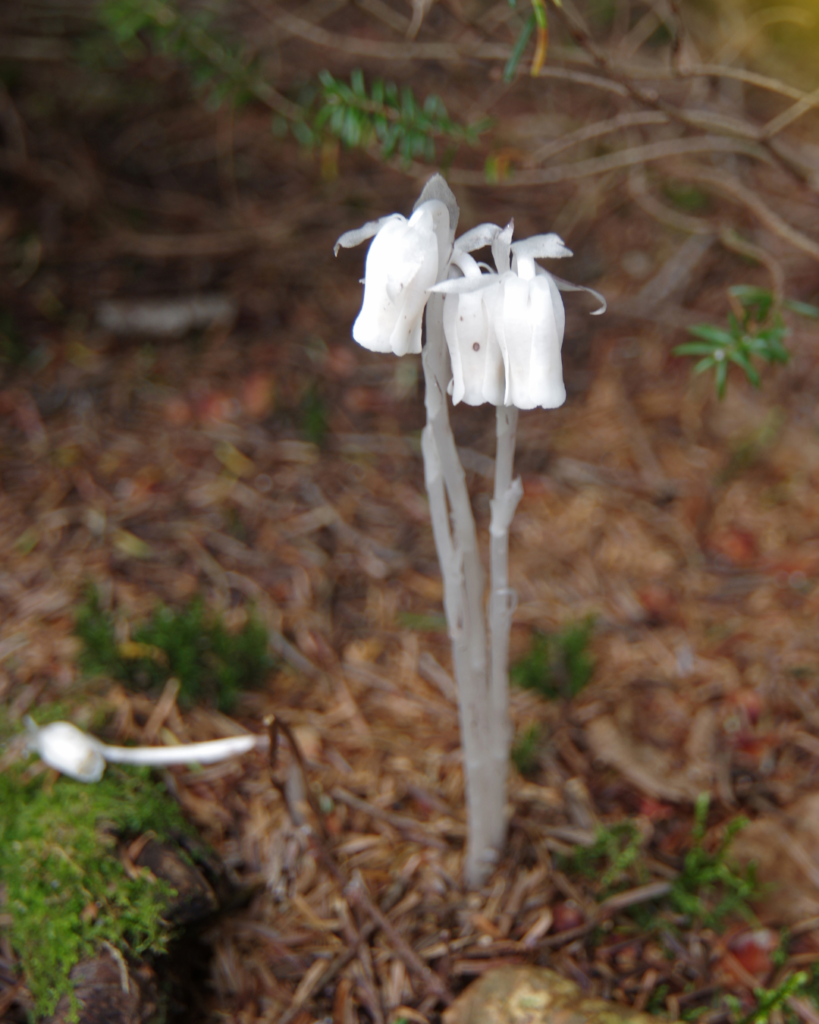
    Delicate Monotropa uniflora, Ghost Pipe (Indian pipe) flowers in full bloom — pale, translucent white, bell-shaped blooms nodding on leafless white stems, rising from brown pine needle litter and green moss on the forest floor. Photo by Frank Shirley, Getty Images with CAVNVA Pro

    Dickinson and the Ghost Pipe

    It is reported that Emily Dickinson first encountered Monotropa uniflora as a child, pulling it from the forest floor in Amherst. She was an amateur botanist who studied plants at Amherst Academy and Mount Holyoke Female Seminary, assembling more than 400 plant specimens in books that now reside in Harvard’s Houghton Library, including Monotropa uniflora (Foster, 2024). She attended to each specimen with the deep, sustained, joyful attention that many monotropic people will recognise, one of total absorption, with great care, and a sense of wonder and awe that never diminished, no matter how much she studied (Popova, 2023).

    In the autumn of 1882, Dickinson received a surprise painting of the Ghost Pipe (Monotropa uniflora), from her friend Mabel Loomis Todd. Dickinson wrote back immediately:

    “That without suspecting it you should send me the preferred flower of life, seems almost supernatural, and the sweet glee that I felt at meeting it, I could confide to none — I still cherish the clutch with which I bore it from the ground when a wondering child, an unearthly booty, and maturity only enhances the mystery, never decreases it.” (Emily Dickinson Museum, 1882)


    (I am not sure of copyright to embed the image in this blog, but please take a look here in the Emily Dickinson Museum ).

    Eight years later, when Todd edited and published the first posthumous collection of Dickinson’s poems, she placed the same painting of the Ghost Pipe on the cover.

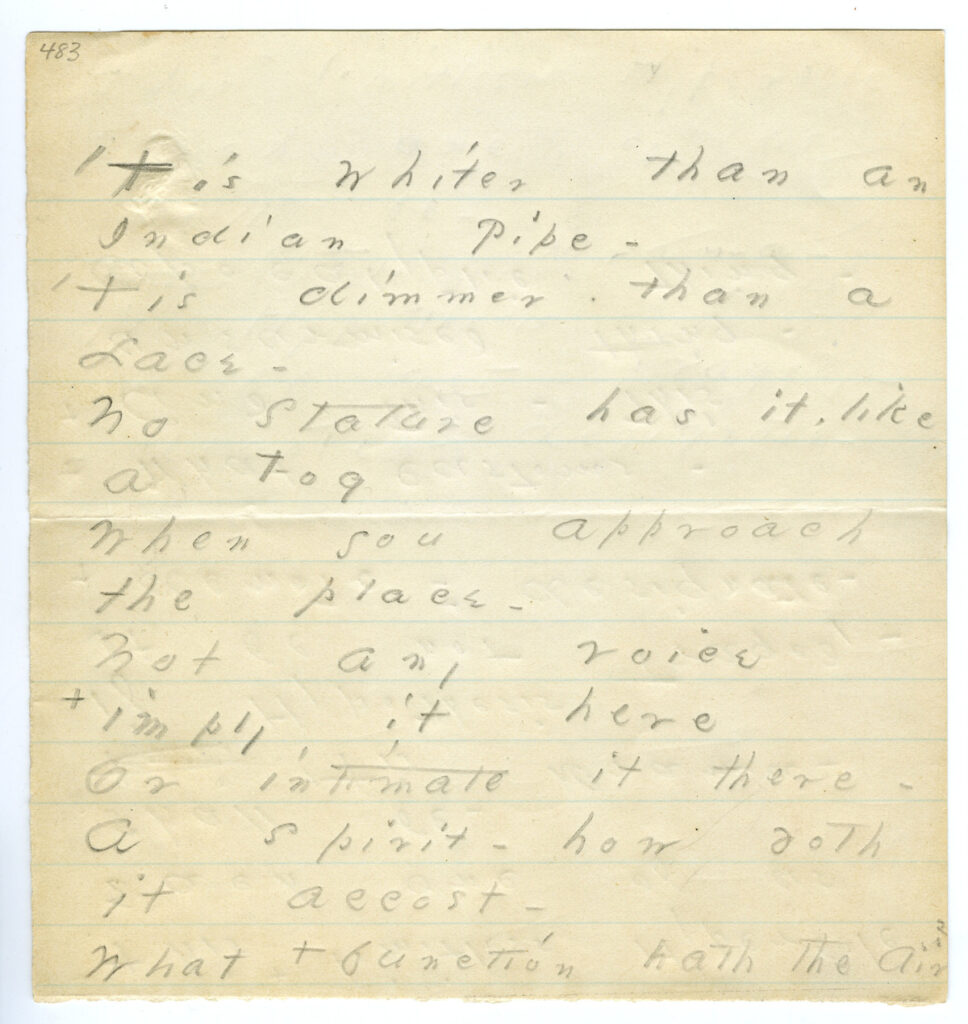
    Three years before that letter, in 1879, Dickinson had already written a poem about the plant (Emily Dickinson Archives):

    ‘Tis whiter than an Indian Pipe –
    ‘Tis dimmer than a Lace –
    No stature has it, like a Fog
    When you approach the place –
    Not any voice imply it here –
    Or intimate it there –
    A spirit – how doth it accost –
    What function hath the Air?
    This limitless Hyperbole
    Each one of us shall be –
    ‘Tis Drama – if Hypothesis
    It be not Tragedy –

    ’Tis whiter than an Indian Pipe –
    Poem, ca. 1879
    Amherst College Archives & Special Collections

    Emily Dickinson

    Manuscript of poem from Credits
Amherst College, Amherst MA
https://acdc.amherst.edu/view/asc:10742
Amherst Manuscript # 483
Amherst - Amherst Manuscript # 483 - Tis whiter than an Indian pipe - asc:10742 - p. 1

Publication History
Poems (1896), 156, as three quatrains, with the alternatives for lines 5 and 8 adopted. Poems (1955), 1024-25; CP (1960), 625-26. (J1482). Franklin Variorum 1998 (F1513A).
 -History from Franklin Variorum 1998

Emily Dickinson Archive
http://www.edickinson.org
Copyright & Terms of Use:
CC BY-NC-ND 3.0
http://www.edickinson.org/terms
    Credits: Amherst College, Amherst MA https://acdc.amherst.edu/view/asc:10742 Amherst Manuscript # 483 Amherst – Amherst Manuscript # 483 – Tis whiter than an Indian pipe – asc:10742 – p. 1 Publication History Poems (1896), 156, as three quatrains, with the alternatives for lines 5 and 8 adopted. Poems (1955), 1024-25; CP (1960), 625-26. (J1482). Franklin Variorum 1998 (F1513A). -History from Franklin Variorum 1998 Emily Dickinson Archive http://www.edickinson.org Copyright & Terms of Use: CC BY-NC-ND 3.0 http://www.edickinson.org/terms


    People continue to debate what the “it” in the poem refers to, is it spirit, death, life itself, or all of it? Perhaps it is something many of us as Autistic people recognise, the thing that is deeply present, real, and nourishing, yet invisible to those who do not know how to look for it or how to relate to it. The quality of presence that the world persistently mistakes for absence, the inner life that runs deeper than it appears from the outside?

    The way the Monotropa uniflora blackens and wilts, dissolving back into the earth, the moment it is touched all feels very relatable to me and how I am at times, just wanting to hide in the dark and be left alone but also thriving in often unexpected ways. Or maybe it’s just me who relates in this way? Either way, the Monotropa uniflora is not a tragedy, and neither are we as Autistic people. We can thrive when the environment meets our needs, even if that environment may not be what people expect it to be!

    A Monotropic Life

    It feels to me that Emily Dickinson lived her life somewhat monotropically, though she never had that word back then. She spent most of her adult life within her family home, rarely venturing out, conducting her richest relationships through letters, attending to her interests with an intensity that those around her often found excessive, weird or strange, perhaps also relatable for many of us?! Her attention tunnelled, her focus pooled as she moved through the world, pulled in by her interests, with her whole self given over to what she was attending to, which I feel is evident through all her work and my own sensory way of being.

    We shouldn’t claim that Dickinson was Autistic, but her way of being in the world resonates deeply for me, much like that of Virginia Woolf and Sylvia Plath, writers often seen as different, as not fitting in, whose work seems to capture something of what it is to be Autistic before they had the term and certainly before women were identified as Autistic. They speak of the isolation that so often comes with not being really understood, and also the joy of being able to immerse yourself fully in your passions and sensory self as a way to sustain life, to survive. They write about a deep presence and connection with the world around them, feeling everything sensorily, intensely, and being deeply empathetic.

    Woolf herself wrote of a mind she called androgynous, the mind most “resonant and porous… naturally creative, incandescent and undivided” (Woolf, 1929, as cited in Popova, 2021). That porousness, that undivided quality, is something many Autistic people may recognise too, not a mind guarded and compartmentalised, but something more fluid, always connecting, seeking patterns, transforming, morphing and adapting.

    Many people call Monotropa uniflora a perfect flower, it holds both stamen and pistil, both what has been called “male” and “female,” in the one bloom, needing no other to complete it, which feels like more than coincidence (Popova, 2021). It is a plant that refuses to be binary at the root of its being, in the same way it refuses to draw its nourishment from sunlight, the way other plants are expected to. It is non-binary, and yet still deeply, richly connected and interdependent with everything around it through the hidden web of nourishment from beneath the ground. For those of us who are Autistic, otherwise neurodivergent or disabled, those who may also be queer, trans, or non-binary in how we understand our own identity, this may feel like a plant that was never trying to fit in to start with, it thrives in its difference, weirdness and uniqueness, a bit like us.

    From the outside, Emily Dickinson’s life may have looked reclusive and withdrawn, but from the letters, the poems, and the extensive herbarium with its 400 pressed plants, each attended to with such care, I think it was extraordinarily full, in a way that held meaning for her and brought great joy. This perhaps gives some validity to the way many people may feel and experience their lives still today, especially if you are Autistic/ AuDHD and monotropic and are able to get into those lovely monotropic flow states.

    Dinah Murray, Monotropism & Monotropa Uniflora

    Sadly, Dinah Murray died in 7th July 2021, 5 years to the day I am writing this. The poet Kate Fox, who had interviewed Dinah in her flat in Dalgety Bay just a month before she died, wrote a poem to read at her memorial service and titled it Monotropa Uniflora (Fox, 2021).

    “The first two lines were from a poem Dinah wrote as a girl. The title is a type of fungus (ish) species that her friend Joan McDonald said at the memorial service she was delighted to discover existed, given her pioneering work on the monotropic theory of autism” (Fox, 2021).

    In their interview, Dinah described her life not as a career but as a mission:

    “About justice and fairness and living in a fair world. I haven’t really ever had a career, I’ve had a mission. And I think I’ve accomplished my mission basically.”

    (Dinah Murray quoted in Fox, 2021)

    Like Monotropa uniflora, Dinah Murray’s work continues to nourish us through mycelial-like networks of care: through the people she supported, the papers she wrote, the theory of monotropism she brought into the world, and the community she helped build.

    The Mycelial Network of Care

    The secret of the Monotropa uniflora’s survival is almost magical: its roots entwine with underground fungal networks, mycorrhizal hyphae from fungi in the Russulaceae family, that are themselves connected to the root systems of nearby trees. The Monotropa uniflora takes sugar and nutrients from this fungal web, thriving through a form of nourishment that is hidden, indirect, and entirely dependent on the richness of the network beneath the surface (Foster, 2024; Popova, 2023).

    In my Mossy Minds and Monotropism (2025) piece, I was thinking about the monotropic bodymind as porous and mycelial-like, deeply interconnected, and often thriving in the margins and liminal spaces. This is where my DEEP framework (Dynamic, Embodied, Ecological, Political), inspired by Damian Milton’s work on the Double Empathy Problem (2012), feels most relevant here from an Autistic perspective, as it also resonates with my own way of being.

    The Monotropa uniflora is Dynamic, changing form and behaviour depending on what the network around it provides, rather than following one single fixed way of being. It is Embodied, entirely dependent on its relationship with soil, fungus, and roots sustaining it. It is Ecological, existing only because of its place within a wider mycelial web of mutual inter-dependence, and it could also be thought of as Political, because a world that only values what performs visibly in the light, what photosynthesises and produces on demand, is often misread and has been called weird or spooky.

    The Monotropa uniflora feels like one of the most perfect botanical expressions of being monotropic for me. It prefers the dark; it goes deep, and it is held by the mycelial network of care, which, for me, being part of our Autistic community, I am certain I could not survive otherwise.

    Like Monotropa uniflora, many Autistic people have learned to adapt and morph to survive; we have had to find ways to nourish ourselves through mutual aid networks and grass roots projects as society just isn’t meeting our needs. I thrive in the deep shade of my forest-themed den with my blackout blinds drawn day and night. My mycelial network is online, on the World Wide Web rather than the Wood Wide Web. I live amongst the many neurodivergent spaces I am so grateful to be a part of, that keep me nourished and sustain me across the Autistic Rhizome.

    “Energy is only transformed, never gone”

    “Attention without feeling is only a report,” Mary Oliver wrote (2016). When Dickinson called the Ghost Pipe (Monotropa uniflora) “the preferred flower of life,” I don’t think she was only naming a plant she’d loved since childhood. I think she was naming a way of loving, a way of embracing the kind of monotropic attention that finds its nourishment not in what is easily seen, but in what is deeply felt. Something that, for many of us, may also reflect our Autistic ways of being, at least, it does for me.

    On this anniversary of her death, five years on, I want to close with the words the poet Kate Fox wrote for Dinah’s memorial, in a poem she titled after the Monotropa uniflora

    Your interests carry like spores

    through the air

    in fragments, in buds,

    via mycelia-like networks

    they are still there.


    But you also knew

    energy is only transformed, never gone

    so when we remember your words

    or act as you might do,

    you, in all your power and passion

    live on.


    (Fox, 2021)

    Energy, as Kate’s poem tells us, is only transformed, never gone. May Dinah’s legacy keep flowing, monotropically, through the communities of care she helped shape.

    References

    Edgar, H. (2025). Mossy Minds and Monotropism. More Realms.
    https://morerealms.com/mossy-minds-monotropism/

    Emily Dickinson Museum. (1882). Letter to Mabel Loomis Todd. emilydickinsonmuseum.org

    Foster, N. (2024). Ghost of the forest: Monotropa uniflora. JSTOR Daily. https://daily.jstor.org/ghost-of-the-forest-monotropa-uniflora/

    Fox, K. (2021). Monotropa Uniflora [Memorial poem for Dinah Murray].
    https://katefoxwriter.wordpress.com/2021/08/16/tribute-to-dinah-murray/

    Guardian. (2021, July 25). Dinah Murray obituary. The Guardian. https://www.theguardian.com/society/2021/jul/25/dinah-murray-obituary

    Kimmerer, R. W. (2003). Gathering moss: A natural and cultural history of mosses. Oregon State University Press.

    Murray, D., Lesser, M., & Lawson, W. (2005). Attention, monotropism and the diagnostic criteria for autism. Autism, 9(2), 139–156.
    https://journals.sagepub.com/doi/10.1177/1362361305051398

    Oliver, M. (2016). Upstream: Selected essays. Penguin Press.

    Popova, M. (2021, July 2). Perfect flowers: Adventures in nature’s nonbinary botany, with a side of Emily Dickinson. The Marginalian. https://www.themarginalian.org/2021/07/02/perfect-flowers-emily-dickison/

    Popova, M. (2023). The ghost pipe: A visionary meditation on love, loss, and the shape of grief. The Marginalian. https://www.themarginalian.org/2023/08/23/ghost-pipe/

    The Morgan Library. (2023). Emily Dickinson: Poems. themorgan.org

    Woolf, V. (1929). A room of one’s own. Hogarth Press.ins. Princeton University Press.

    Discover more

    Courses, books and resources

    If you would like to take these ideas further, my courses, books and resources live on Autistic Realms. Everything in the shop is pay what you can, and many resources are free.

  • “I cannot live without my soul”:  An Autistic Exploration of Wuthering Heights

    “I cannot live without my soul”: An Autistic Exploration of Wuthering Heights

    I re-read Wuthering Heights last year and just watched the new 2026 film adaptation. This isn’t a blog about gothic romance, or a critique of the film. It is more of a personal reflection on Cathy and Heathcliff’s relationship that is beginning to make more sense to me as I re-read and re-watch various adaptations of one of my favourite books ever. I am rethinking their relationship through a new lens as I learn more about my own Autistic identity.

    When Catherine Earnshaw says “I am Heathcliff,” it really resonates with me. It captures a connection to an inner world so intense it loses all sense of boundaries. For me, it captures my Autistic way of being where I can feel myself becoming part of someone or something else entirely. An all-consuming, whole-bodymind way of experiencing life. That deep monotropic pull of being totally immersed in whoever or whatever my attention is drawn towards.

    There’s a theory of Autistic attention called monotropism — developed by Murray, Lesser, and Lawson (2005) that I have written about extensively. It describes how many Autistic and ADHD people organise their attentional resources. Instead of spreading attention broadly across many things at once, monotropic people tend to go deep, very deep. We tend to pour everything we have into fewer channels, whatever is inside our tunnel of attention gets the full experience: full focus, full feeling, full presence.

    A small, weathered house sits alone on a grassy hillside beneath a dramatic sky filled with dark, heavy storm clouds, with a single tree nearby and soft light breaking through in the distance.

    I think Cathy and Heathcliff’s all-consuming love can be reimagined and perhaps better understood through the lens of monotropism. Being monotropic is not just about cognitive resources, it is everything! It is about how people move, sense, perceive, and relate to each other. In their case, they are the centre of each other’s attentional worlds; they are completely entangled, even after years apart, their souls are still looped and hooked into each other. The wild Yorkshire moors aren’t just a backdrop to their relationship; they’re an important part of the environment and the shared language and memories they have created together since childhood.

    Everything else sits outside of their relationship and the moors; Edgar Linton, Nelly, the drawing rooms, in fact, the whole performance of social respectability and ways of being in the world at that time, is all at odds with Cathy and Heathcliff’s relationship.

    Life demands that Cathy split herself. In her attempt to try and make her marriage work with Edgar Linton, she tries to focus on her new life without Heathcliff, but it is impossible. The idea of monotropic split conceptualised by Tanya Adkin helps explain how hard dividing attention is for Autistic people. We don’t know whether Catherine or Heathcliff would now be identified as Autistic or otherwise neurodivergent, but my own personal resonance with their characters makes sense.

    Catherine has to divide her attention between the competing loyalties of Healthcliff and Linton and maintain a respectable status in the society she is in. She tries to mask and fit in, she tries for years to manage how much she feels, how much she shows, how much intensity is acceptable in polite company. The neuronormative demands, the pressure on people whose minds and bodies work differently as they try to reshape themselves into a form the dominant social world can accommodate is exhausting. The cost of that reshaping runs through Cathy’s entire life. It isn’t just social pressure; it slowly begins to unravel her from the inside.

    Her famous declaration — “I am Heathcliff” — makes complete sense to me. It describes exactly what it feels like when my deepest attention and my sense of who I am become genuinely inseparable, when another person or event that isn’t just important to me, it is my everything that is woven into the fabric of how I experience myself and life. Something some may be able to relate to. When that person or interest is gone, you are not just bereft. The loss goes all the way down, into the core of the self, until the flow that once held your life together may feel utterly broken.

    One of the things that strikes me most, reading the novel this way, is who actually understands either of them. Edgar doesn’t understand Cathy, and Nelly doesn’t understand Heathcliff. The people around them consistently misread them, misjudge them, interpret their intensity as threat or instability. Milton’s double empathy problem (2012) describes exactly this—the way that people with genuinely different experiences can find mutual comprehension difficult, not because either person is deficient, but because the gap between their ways of experiencing the world is so great. Cathy and Heathcliff are, for each other, the only exception to that. They are the only two people in the novel who experience each other from the inside. Their connection and their relationship is the only place either of them is fully legible and are able to be their true selves.

    This makes what happens at her deathbed almost unbearable to read. Heathcliff doesn’t grieve quietly; he demands she haunt him, he asks her to stay in any form — just not to leave him in the void where he cannot reach her. He says he cannot live without his life. He cannot live without his soul. He can not live without Cathy.


    And I pray one prayer – I repeat it till my tongue stiffens – Catherine Earnshaw, may you not rest, as long as I am living! You said I killed you – haunt me then! The murdered do haunt their murderers. I believe – I know that ghosts have wandered on earth. Be with me always – take any form – drive me mad! only do not leave me in this abyss, where I cannot find you! Oh God! it is unutterable! I cannot live without my life! I cannot live without my soul!’ He dashed his head against the knotted trunk; and, lifting up his eyes, howled, not like a man, but like a savage beast getting goaded to death with knives and spears.

    Chapter 16

    Where the words of human experiences run out to describe the intensity, Brontë turns back to nature, to the knotted tree trunk Heathcliff dashed his head against. The sound Brontë describes Heathcliff as exclaiming is something beyond the human, “not like a man, but like a savage beast”.

    Brontë wasn’t writing a story about Autistic people and neurodivergent lives. She didn’t have this framework in 1847; it may be a leap to suggest that any of this is related to anyone else’s experience as a neurodivergent person but my own. However, she was writing about something she felt deeply, she is writing about what it looks like when a person cannot do things by halves. When people love the way they attend to everything: completely, in depth, with the whole of themselves, in a world that keeps asking them to be less.

    When we read Wuthering Heights through the lens of monotropism, the double empathy problem, and neuroqueer theory, something can shift. Cathy and Heathcliff’s love is devastating, but it is also the most real thing in the novel — the only place either of them is ever fully known. The world Brontë placed them in was never built to hold their intensity and passion. Many of us may in some ways share and resonate with their world and perhaps find ourselves reflected in Cathy and Heathcliff — in the depth, the pull, the all-consuming way of loving, the trying to fit in and adapt.

    What Cathy and Heathcliff never had, and what so many of us are still learning we deserve, is the safety to be fully known, and the freedom to stop pretending to be less than we are.

    References

    Adkin, T. (2022). What is monotropic split? NeuroHub Community.
    https://neurohubcommunity.org/2022/07/14/guest-post-what-is-monotropic-split/

    Brontë, E. Wuthering Heights. Penguin Classics. (Original work published 1847).

    Garau, V., Woods, R., Chown, N., Hallett, S., Murray, F., Wood, R., Murray, A. & Fletcher-Watson, S. (2023). The Monotropism Questionnaire, Open Science Framework. DOI:10.31219/osf.io/ft73y

    Milton, D. (2012). On the ontological status of autism: The ‘double empathy problem.’ Disability & Society, 27(6), 883–887. https://doi.org/10.1080/09687599.2012.710008

    Murray, D., Lesser, M., & Lawson, W. (2005). Attention, monotropism and the diagnostic criteria for autism. Autism, 9(2), 139–156. https://doi.org/10.1177/1362361305051398

    Walker, N. (2021). Neuroqueer heresies: Notes on the neurodiversity paradigm, autistic empowerment, and postnormal possibilities. Autonomous Press.

    Discover more

    Courses, books and resources

    If you would like to take these ideas further, my courses, books and resources live on Autistic Realms. Everything in the shop is pay what you can, and many resources are free.

  • Monotropism, Spiral Time, and the Rhizome of Memories

    Monotropism, Spiral Time, and the Rhizome of Memories


    *“Memories scatter like shards of seaglass along a fractured spiral, the centre always slipping just beyond my grasp. Hazy images and sensations drift in and out of the fog, sometimes offering sharp glimpses, but rarely staying long enough for me to hold. Most pass by shrouded in a soft mist, like half-formed echoes trapped within a labyrinth. Sounds, images, smells, and feelings blur and merge, tangling into an ever-expanding rhizome, sprawling in all directions, folding in on themselves. Memories come more as felt impressions than as concrete events. Remembering isn’t straightforward for me; it’s less recall and more a process of re-navigation. I have to trace uncertain paths, try and find a thread to hook into to regain my flow, often sensing that what I’m reaching for is just out of reach if trying to recall a specific event, but my sensory memories are more clear and vivid as they are felt sensations – which is hard to explain to people who may not experience their memories in this way. ”

    I am currently on a Neuroqueering Your Creative Practice course led by KR Moorhead, Marta Rose and Meg Max. This week we were exploring time and memories, which felt very apt given my recent monotropic outpourings about time. In this week’s session I wrote the above piece about how I experience memories.

    Memory may not be linear for neurodivergent people. It may feel like a spiral of felt sensations. Being monotropic shapes how I re-sense moments, navigating echoes and threads of sensory experiences rather than always recalling events. I felt validated that some other people seemed to relate and share similar experiences of their time not being linear and also being quite hazy recalling specific events but having really vivid recollections of more sensory experiences.


    Monotropism and Memories

    Monotropism is a theory of Autism (Murray et al 20025) that describes a way of focusing attention that tends toward deep but fewer channels. For those of us who experience the world monotropically, attention locks in and tunnels can form like portals. These attention tunnels can lead to intense engagement and immersive sensory experiences, but they may also shape how we encode, retrieve, and relate to our memories.

    Memory for me is not a fixed archive of past events filed neatly on shelves. It is alive, constructed in the present, woven from threads of past focus, emotion, embodiment, and attention. For monotropic people, those threads may be less linear and deeply context-bound in our sensory experiences. We may not remember when something happened in conventional, sequential neuronormative time but we may vividly feel how we experienced something, we may recall the sensory landscape, the tone, the rhythm of presence or absence.


    Spiral Time and Felt Time

    I’ve written previously about monotropic experiences of time as being like ever expanding rhizomatic spirals like rather than a linear A-B or 9am to 10pm of time as lived by the clock and conventional calendar. I think this also shapes how memory functions, rather than stretching out along a clear chronological line, time for me feels like it folds back in on itself and experiences and memories happen and are stored within the folds (a concept from Deleuze that I have written about at length). A moment from years ago might feel right now, while a conversation from yesterday may feel distant or unretrievable unless there is something to hook me in and brings it back into focus so I can retrieve the thread and follow the flow.

    In monotropic spiral time, memories don’t behave like neurotypical people may expect or how we may have been brought up to understand how memory works. My memories don’t line up neatly, they tangle, twist, merge and drift like mist through a forest. Sometimes I feel I’m not remembering in the traditional sense at all, but kind of re-sensing, like I am trying to feel my way through a fog of echoes and impressions, a texture, a tone of voice, the way the light fell. It makes my memories of concrete events feel hazy and fuzzy but my experiences feel vivid and it can be quite confusing and frustrating at times.


    Labyrinths and the Rhizomes

    For monotropic people our minds and memories may feel less like walking through an album of neatly arranged photos and more like navigating a vast, living labyrinth. I can’t easily “go back” and retrieve a memory, it feels like I have to wander, I have to reach out and try and sense where the thread of recall might catch and hook onto something, what I often find is not a single event but a tangle, a rhizome of multisensory experiences that I have to unravel.

    This rhizomatic quality of navigating time means my memories don’t live in isolation, they’re not strictly filed under “birthday, age 9” or “Monday morning, March 3rd.” Instead, they seem to connect through shared emotions and sensory patterns. One feeling or sensory experience might loop me back to three seemingly unrelated moments, a smell might pull on threads across decades and I don’t always know why. This can be disorienting in a world that expects time and memory to be neat and logical but it’s also a kind of richness, a depth of connection that linear systems seem to often miss. It can make conversations with friends and family hard as it seems like I am not interested enough in people to have created a core memory like in the Disney film Inside Out, my memory of real life events feels like a sieve where things happen then disapear but they are all there, it is just perhaps that they are stored differently.

    It brings me back to my first blog I wrote on More Realms (2023), Middle Entrance. In 1943, T.S. Eliot’s collection of four poems were collated to form Four Quartets. The final poem in this series Little Gidding (1942), continues Eliot’s exploration of time and our connections with each other through generations and current society.

    “What we call the beginning is often the end. And to make an end is to make a beginning. The end is where we start from.”

    My memories, relationships and ways of being are like constantly evolving spirals that spin in and out in multidimensional ways. Different connections and experiences add to and contribute to a wider, deeper fluid rhizomatic network of potential that is always in a constant state of flux. This idea of an evolving spiral, hooking onto a node of the rhizome and returning to a new beginning in the middle, liminal spaces, within the folds is how I experience memory. I need time to process, time to rlect and for memories to and beautifully reflected in Eliot’s poem Little Gidding:

    “We shall not cease from exploration
    And the end of all our exploring
    Will be to arrive where we started
    And know the place for the first time.
    Through the unknown, remembered gate
    When the last of earth left to discover
    Is that which was the beginning;
    At the source of the longest river
    The voice of the hidden waterfall
    And the children in the apple-tree
    Not known, because not looked for
    But heard, half-heard, in the stillness
    Between two waves of the sea”
    .

    — T.S. Eliot, from “Little Gidding,” Four Quartets (Gardners Books; Main edition, April 30, 2001) Originally published 1943.”


    Navigating Memories

    Memory for me feels less like recall, I am not able to press a button and retrieve a file (unless it is related to my own special interest about Autism research or teaching in which case my filing cabinet seems to ping open!). It is more like a re-navigation, I have to find the right entry point and node of the rhizome, I need to feel for the thread, follow it gently and try not to tug too hard in case it disappears back into the fog. I often know I know something, but I can’t get to it directly. I need the right conditions or sensory cue to draw it out and that takes time and and can make me appear distant or uninterested when the opposite is true.

    This is why questions like “What did you do last weekend?” can feel like demands rather than simple curiosity. It’s not that I wasn’t paying attention, it’s that the question doesn’t align with how my memory map works or how I perceive time. If you ask me what the light looked through my window like as I sat reading in bed, or how the air felt when we stepped outside I might have a more instant response but I probably won’t be able to recall the chronological sequence or events and relate things in an easy to understand order, it is like that gets lost in the spiral. It can be frustrating at times just to have fleeting impressions of memories that I know mean a lot to me but I can’t easily retrieve.


    Understanding and Support

    Understanding memory through a monotropic lens may helps us honour our different ways of knowing, recalling, and connecting with events and people. For those supporting Autistic individuals, whether as educators, therapists, or family members this means shifting assumptions and instead of assuming memory is absent or deficient it may be better to consider asking things like:

    • How do memories show up for you?
    • What helps you reconnect with something you felt or experienced?
    • Is there a sensory or emotional thread that brings it back?

    This may also be empowering for those of us who live and experience life monotropically. It validates the experience of having a different bodymind, of perhaps remembering more through attention tunnels of sensation rather than facts or dates. It recognises that memory is not a failure when it doesn’t fit neurotypical expectations it’s perhaps just a different kind of map that we have to navigate.

    “What we call the beginning is often the end. And to make an end is to make a beginning. The end is where we start from.”


    Discover more

    Courses, books and resources

    If you would like to take these ideas further, my courses, books and resources live on Autistic Realms. Everything in the shop is pay what you can, and many resources are free.

  • Monotropic Time & Neuroqueering Temporalities

    Monotropic Time & Neuroqueering Temporalities

    Dwelling in Resonance: Monotropism, Monotropic Time, Spirals & Neuroqueer Temporalities

    “Lodged in all is a set metronome” –


    (W. H. Auden, 1969 – from the poem In Due Season)


    Consider if you’re Autistic/ ADHD/ Monotropic and what happens if your internal metronome beats to a different rhythm to other people?


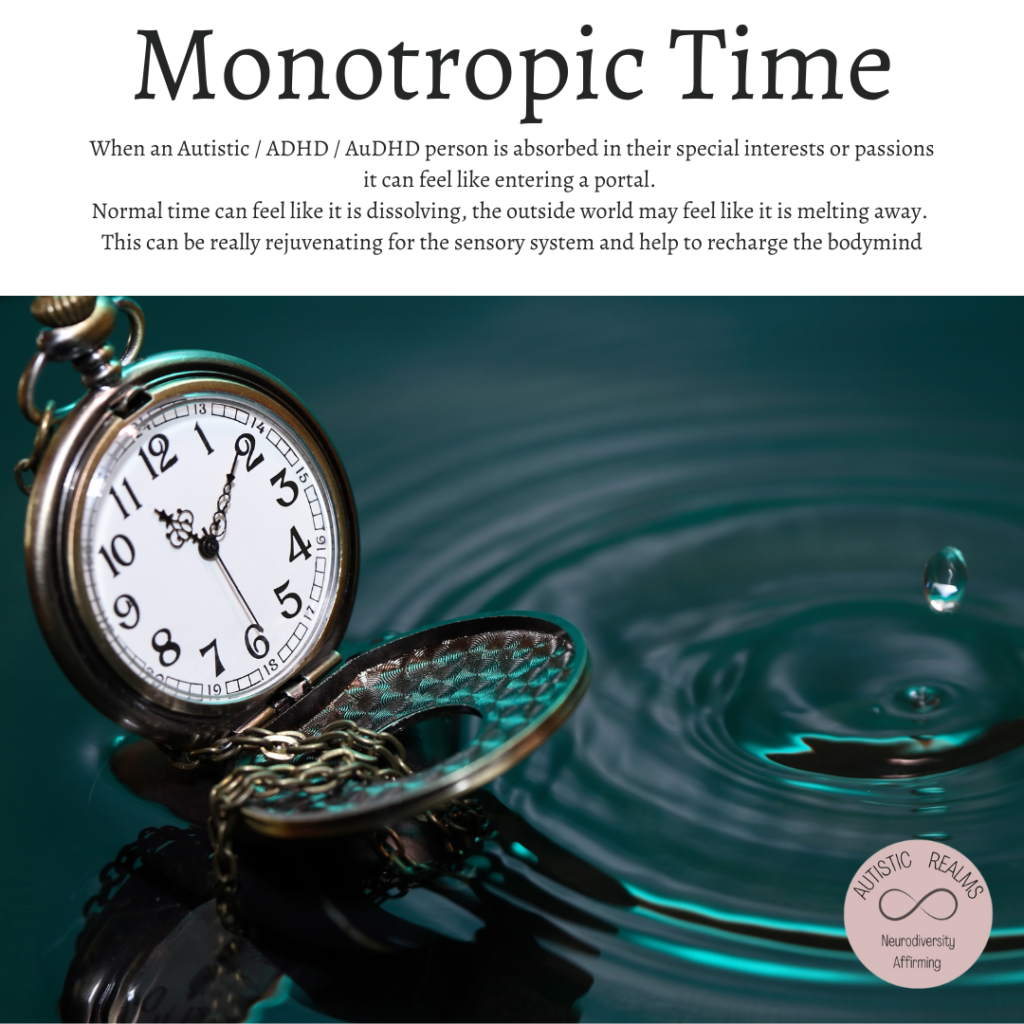
    For many of us who are Autistic, ADHD, or AuDHD, time is not a straight line. It spirals, loops, expands, contracts. It may feel like you have your own rhythm or internal metronome that others may not be quite in synch with, or like you are singing a song that others cannot hear the beat of. I will briefly explore the theory of monotropism (the tendency towards deep, focused attention where more of your attentional resources are used on fewer interests at any one time) in relation to my experience of time as an AuDHD monotropic person and offer am emerging neuroqueering perspective of the fluidity of time.

    (This is a shortened and edited version of my much longer blog about Monotropic Time (2025), which evolved from my series of Medium blogs, where I have been exploring some Deleuzean concepts within a framework of Neuroqueering Liminal In-Between Spaces (2023) ………amongst other random ideas!)


    Neuronormative Time

    Elizabeth Freeman’s concept of “chrononormativity” is introduced in her book Time Binds (2010). She explains how we learn to use our bodies through normative time—schedules, deadlines, and life stages—all governed by the logic of productivity. According to Freeman, chrononormativity encompasses the socially reinforced expectations and norms of how we spend our time – it makes us question what governs ‘productive’ time and what we see as ‘rest’ time.

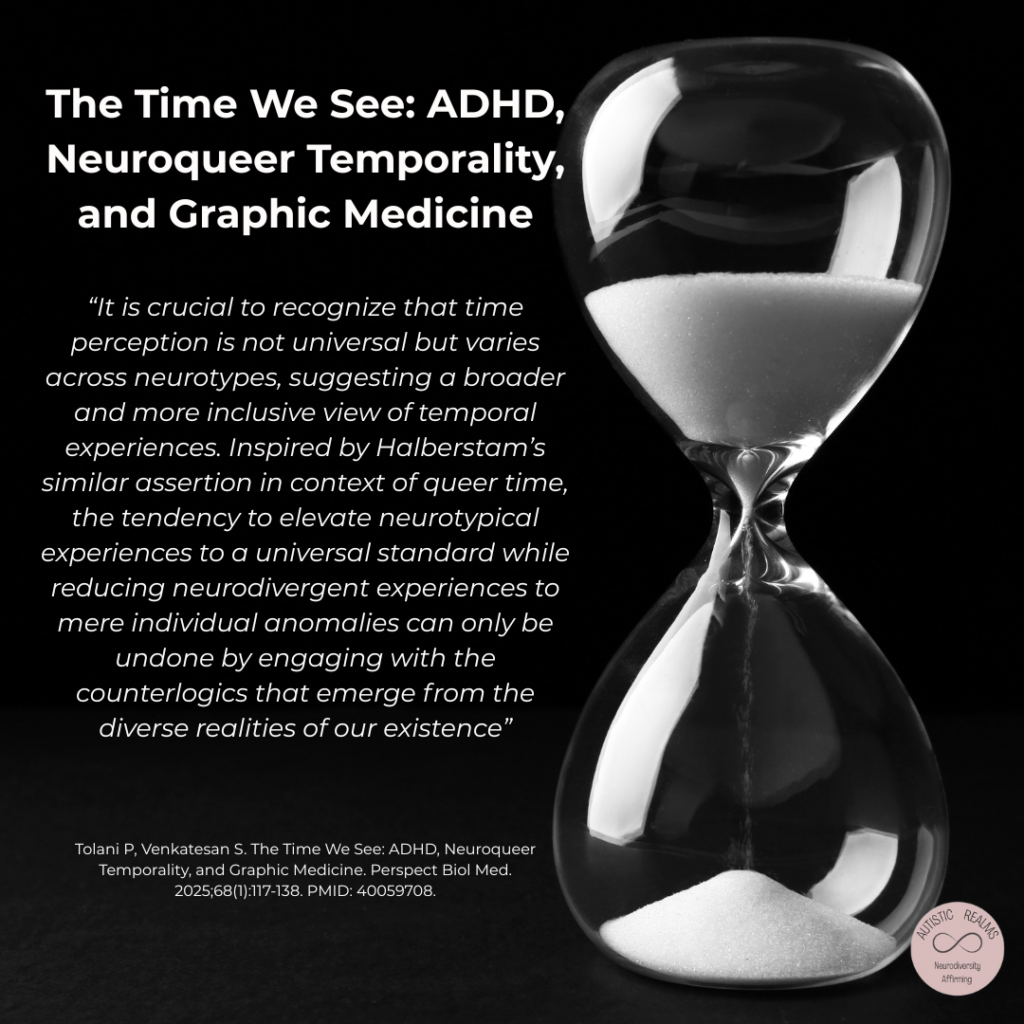
    In a world dominated by chrononormativity or what I will call (neuronormative time), the capitalist, clock-driven expectation is to be productive, punctual, and linear, neurodivergent ways of moving through time are often pathologized. If you are Autistic/ ADHD/ AuDHD you may find you are often stigmatised for being “late,” “chaotic,” or “disorganised,” when in fact, you may simply be existing on a different temporal wavelength. As Tolani and Venkatesan write in The Time We See (2025), time isn’t neutral. It’s structured by ableism, productivity demands, and neurotypical developmental milestones. If you fall outside this invisible scrip, if your time bends, stretches, and spirals, you’re often thought of as disordered or somehow needing fixing or interventions. Perhaps the differences in the way we experience time can be explained by the theory of monotropism? Perhaps it is an ontology?


    Monotropic Time

    I think the theory of monotropism (Murray et al. 2005) could offer us a lens to reframe time for Autistic/ ADHD/ AuDHers who are more likely to be monotropic (Garau et al. 2023). If you use more of your attentional resources on fewer areas of interest than others, then perhaps your experience of time will narrow too in some ways and expand in others? Just like our monotropic experiences when zooming into our passions and perhaps deep diving into a rabbit hole of research and creating ever-expanding constellations of rhizomorpheous connections or being so immersed in a sensory experience of looking at light reflecting on water or onto your wall that you feel you have may be almost become the tiny fragments of light (or may be that is just me?!) ?

    Having a different perception of time could also help explain a large part of the Double Empathy Problems (Milton 2012), especially between monotropic and polytropic people. If you’re like me and monotropic, hours can feel like minutes when you’re in a deep attention tunnel and fully engaged in a flow state; outside demands may feel like they literally melt away or dissolve. It is perhaps not that we’re “losing time”; but rather, we can reframe it that we are dwelling within time, immersed in a resonant spiral of attention that is tunnelling ever deeper the longer we are engaged and the deeper into a flow state we go. It may feel like pure Autistic joy if you are engaged with something positive (alternatively, it could end up feeling like an eternal loop of hell and ruminating anxiety-filled, all-consuming thoughts if your attention has hooked into something less joyful).

    When in flow, the concept of “now/not now” becomes irrelevant. You are simply in flow, it can feel like the the world outside of your attention tunnel filled with neuronormative demands and expectations is literally melting away. This could be seen to be monotropic temporality. If you are monotropic, you may feel more attuned to your environment; everything may be felt more intensely, thoughts and time itself is not linear, and everything from the core of your being may be more interconnected. Time itself may be felt differently as we experience the world differently. If you are monotropic, you may feel that time is spirally and rhizomatic and flowy, just like your thoughts, sensory system and interests or passions!


    The Riverbanks of Monotropic Flow

    In my Map of Monotropic Experiences, I describe monotropic time as being like a flowing river. When we’re in the right environment and are able to follow our passions and immerse ourselves freely in sensory experiences, we may be able to swim easily within the natural smooth current and flow of our bodyminds. However, when we’re pulled out of our attention tunnel and flow state by unexpected events, transitions, and external expectations and demands, the river can turn turbulent.

    It takes more energy resources to fight against external demands and neuronormativity; it can feel like you are swimming upstream; are using all of your energy but not getting very far and never reaching where you want to be. This is only sustainable for so long before people end up spiralling into what I have visualised as burnout whirlpools. Monotropic people are may be more likely to get stuck in states of inertia, loops of anxiety and ruminating thoughts, not because they’re broken, but because the majority of the world refuses to flow with us and we are swimming against our natural tides. You can only swim upstream against your natural flow for so long before you are likely to hit burnout and start to struggle.

    Monotropic time is nonlinear, rhizomatic, and relational. It’s shaped by sensory experiences and a deep embodiment of the environment and relationships around us. If you are monotropic, you may have a different temporal ecology that needs support, not correction. Without the right accommodations, support, and safe spaces to be your authentic self, the waters of neuronormativity can be dangerous and lead to burnout and mental health difficulties.

    Map of Monotropic Experiences Map of an island with the areas: Attention Tunneling Penguin Pebbling Cove of Friendship Tendril Theory (@EisforErin) Mountains of Ruminating Thoughts Cyclones of Unmet Needs Rabbit Holes of Research Infodump Canyon Rhizomatic Communities River of Monotropic Flow States Campsite of Cavendish Spaces Meerkat Mounds (Gray-Hammond & Adkin) Riverbanks of Monotropic Time Shark Infested Waters of Neuronormativity, Behaviourism & Double Empathy Problems (Milton, 2012) Beach of Body Doubling Burnout Whirlpools Panic Hills of Low-Object Permanence Forest of Joy Awe and Wonder Lake of Limerence Tides of the Sensory Sea Sudden Storms of Unexpected Events


    Neuroqueering Time: A Temporal Liberation

    “Crip time is time travel. Disability and illness have the power to extract us from linear, progressive time with its normative life stages and cast us into a wormhole of backward and forward acceleration, jerky stops and starts, tedious intervals and abrupt endings. Some of us contend with the impairments of old age while still young; some of us are treated like children no matter how old we get.”
    ― Alice Wong, Disability Visibility: First-Person Stories from the Twenty-first Century

    To neuroqueer time is to resist the tyranny of the capitalist clock and neuronormativity. It is to refuse productivity as a measure of worth and instead honour attunement, resonance, flow states, connections and meaningful relationships with people and with our environment. As Nick Walker writes in their book Neuroqueer Heresies (2021), neuroqueering is not just about identity, it’s a practice of creative survival. Neuroqueer temporality isn’t just for Autistic people or ADHDers, it’s also an invitation for everyone to find their own rhythm and dimension of time that works for them.

    From Merleau-Ponty’s notion of embodied perception to Deleuze and Guattari’s lines of flight that I wrote about in my blog Middle Entrance (2023), some ideas are slowly starting to make a bit more sense for me and are beginning to connect in new ways. I began my Medium blog (which is now hosted on Autistic Realms) by exploring Lefebvre’s ideas around the concept of space being alive. I feel space (like my own Autistic/ ADHD identity and energy) is fluid. Space constantly changes and depends on the interactions of those around us and objects within other spaces. I have been exploring ways of finding meaning in the spaces within what could be considered ‘ma’ to enable thoughts to develop and create connections with others from as I explored in my neuroqueering from the liminal in-between spaces blog(2023).

    Embracing monotropic time could be seen as a form of neuroqueering as defined in Nick Walker’s (2021) book Neuroqueer Heresies. I have been considering if the energy created by these connections can lead to even more new spaces, ideas, and possibilities by subverting the expectations of the normativity of relationships and communication in my blogs about neuroqueering from the in-between and liminal spaces. I am now looping some of these thoughts back around and centering them on the theory of monotropism and my different way of experiencing time.

    If we embrace our natural monotropic flow states and monotropic spiral time, we can maybe begin to understand time not as a schedule or governed by a ticking clock or by timetables set out by neuronormative expectations. Instead, we can explore how, as Autistic/ ADHD people we may experience living in monotropic time more as a form of relational, moment-to-moment negotiation between our environment and ourselves. From a neuroqueering perspective, if we embrace monotropic time, it can enable us to expand and defy time set out by neuronormative ideals and be liberated from the ticking clock of capitalism.

    Image of pocket watch in water. TExt reads: Monotropic Time
When an Autistic / ADHD / AuDHD person is absorbed in their special interests or passions
it can feel like entering a portal.
Normal time can feel like it is dissolving, the outside world may feel like it is melting away. This can be really rejuvenating for the sensory system and help to recharge the bodymind

    A World Beyond the Clock

    Whether we call it spiral time, neuro-holographic time, or monotropic time, what matters is that we validate these different temporal realities. Because for many of us, time is not measured in minutes but in meaning. Monotropic time is like a portal, whereas neuronormative time may feel more like a prison at times, or at least like we are trying to swim upstream and going against the very essence of our natural monotropic flow and rhythm.

    In 1943, T.S. Eliot’s collection of four poems were collated to form Four Quartets. The final poem in this series Little Gidding (1942), continues Eliot’s exploration of time and our connections with each other through generations and current society.

    “What we call the beginning is often the end. And to make an end is to make a beginning. The end is where we start from.”

    This quote seems particularly relevant to my deep interest in evolving spirals and finding meaning in gaps and spaces and an experience of monotropic time that I am continuing to explore and loop back to Eliot’s poetry.

    I visualise time, relationships and ways of being as constantly evolving spirals that spin in and out in multidimensional ways. Different connections and experiences add to and contribute to a wider, deeper, fluid rhizomatic network of potential that is always in a constant state of flux, perhaps more so if you are monotropic. This idea of an evolving spiral and returning to a new beginning in the middle is beautifully reflected in Eliot’s poem Little Gidding:

    “We shall not cease from exploration
    And the end of all our exploring
    Will be to arrive where we started
    And know the place for the first time.
    Through the unknown, remembered gate
    When the last of earth left to discover
    Is that which was the beginning;
    At the source of the longest river
    The voice of the hidden waterfall
    And the children in the apple-tree
    Not known, because not looked for
    But heard, half-heard, in the stillness
    Between two waves of the sea”
    .

    — T.S. Eliot, from “Little Gidding,” Four Quartets (Gardners Books; Main edition, April 30, 2001) Originally published 1943.

    To support monotropic people, perhaps we need to bend or unfold neuronormative time. As Autistic/ ADHD/ AuDHD people, we likely need more space and flexibility to thrive in a world dominated by neuronormative demands and governed by neuronormative time. We need to create room for flow, for stillness, for neurodivergent ways of resting, regulating and rejuvenating, for our monotropic deep dives and immersive sensory experiences and for our nonlinear rhythms. We need to let go of the myth of “normal” time and start dwelling in resonance, which may enable us to be more at one with the natural flow of our bodyminds and our environment.

    We all have our own internal metronomes that are responsive to the environment around us. As monotropic people, we may need more flexibility and a softer, more supple understanding and acceptance of our different perceptions of time from people around us. As Tolani, P., & Venkatesan, S. (2025) summarise their paper published last week The Time We See: ADHD, Neuroqueer Temporality, and Graphic Medicine, “It is crucial to recognize that time perception is not universal but varies across neurotypes, suggesting a broader and more inclusive view of temporal experiences.”

    To support monotropic people, we need to create safe, spacious environments where time is allowed to stretch, spiral, and soften. Monotropic time must be honoured not as a deviation but as a valid, expansive and different rhythm and way of living.

    When we make room for fluidity and loosen the grip of rigid schedules, tight timetables and linear binary expectations, we can then enable space for monotropic time perception to unfurl, unfold and expand rhizomatically so we are not just surviving and trying to swim upstream but can immerse ourselves in flow and thrive to be our authentic monotropic selves.

    Neuroqueer temporality isn’t just for Autistic people or ADHDers. It is an open invitation for everyone to discover their own rhythm, their own flow, their own temporal dimension that feels right. Each person moves through time differently, shaped by their neurology, bodymind, and personal lived experience for some it may be they experience time more neuro-holographically.

    To honour neurodiversity, we need to slow down, soften, and make space for each other, and for ourselves. When we allow time to bend, spiral, expand and breathe and when we embrace flexibility and presence over pressure, demands and neuronormative expectations we can create environments where everyone can flourish in ways that are more meaningful to them and everyone has the potential to thrive.

    Black and white image of sand timer. Text reads: The Time We See: ADHD,

Neuroqueer Temporality,
and Graphic Medicine

"It is crucial to recognize that time
perception is not universal but varies
across neurotypes, suggesting a broader
and more inclusive view of temporal
experiences. Inspired by Halberstam's
similar assertion in context of queer time,
the tendency to elevate neurotypical
experiences to a universal standard while
reducing neurodivergent experiences to
mere individual anomalies can only be
undone by engaging with the
counterlogics that emerge from the
diverse realities of our existence"

Tolani P, Venkatesan S. The Time We See: ADHD, Neuroqueer Temporality, and Graphic Medicine. Perspect Biol Med.
2025;68 (1):117-138. PMID: 40059708.


    References and further relevant reading


    Chapman, R. (2023b). Empire of normality: Neurodiversity and Capitalism. Pluto Press (UK).

    Csikszentmihalyi, Mihaly. (1990). Flow: The Psychology of Optimal Experience.
    Freeman, E. (2010). Time binds. https://doi.org/10.2307/j.ctv1198v7z

    Edgar, H. (2024. Neuroqueering from the Inbetween. Stimpunks Foundation. https://stimpunks.org/2024/04/12/neuroqueering-from-the-inbetween/

    Edgar, H. (2025). Autism & The Map of Neuronormative Domination: Stuck States vs Flow States. Autistic Realms. https://autisticrealms.com/autism-the-map-of-neuronormative-domination-stuck-states-vs-flow-states/


    Edgar, H. (2024). Monotropic interests and looping thoughts. Autistic Realms. https://autisticrealms.com/monotropic-interests-and-looping-thoughts/

    Edgar, H. (2023). Middle entrance. Autistic Realms. https://autisticrealms.com/middle-entrance/
    Edgar, H. (2024). Monotropism, autism & OCD. Autistic Realms. https://autisticrealms.com/monotropism-autism-ocd/

    Edgar, H. (2025i, February 22). Quantum Neuro-Holographic Thoughts from a Liminal Space. Autistic Realms. https://autisticrealms.com/quantum-neuro-holographic-thoughts-from-a-liminal-space/

    Eliot, T. S. (1943). Four quartets. Houghton Mifflin Harcourt.

    Fisher, M. (2022). Capitalist realism: Is There No Alternative? Zero Books.

    Fox, K. (2024). Bigger on the inside. Smokestack Books.

    Freeman, E. (2010). Time binds. https://doi.org/10.2307/j.ctv1198v7z

    Garau, Valeria & Murray, Aja & Woods, Richard & Chown, Nick & Hallett, Sonny & Murray, Fergus & Wood, Rebecca & Fletcher-Watson, Sue. (2023). Development and Validation of a Novel Self-Report Measure of Monotropism in Autistic and Non-Autistic People: The Monotropism Questionnaire. 10.31219/osf.io/ft73y.

    Gray-Hammond, D., (2023c, April 21). Neuro-anarchy and the rise of the Autistic Rhizome – Emergent Divergence. Emergent Divergence. https://emergentdivergence.com/2023/04/21/neuro-anarchy-and-the-rise-of-the-autistic-rhizome/

    Heasman, B., Williams, G., Charura, D., Hamilton, L. G., Milton, D., & Murray, F. (2024c). Towards autistic flow theory: A non‐pathologising conceptual approach. Journal for the Theory of Social Behaviour. https://doi.org/10.1111/jtsb.12427

    Irion, J. (2024, September 9). Autistic Chronophobia Theory – Jim Irion – Medium. Medium. https://jimirion.medium.com/autistic-chronophobia-theory-a1225434edd1

    Merleau-Ponty, M. (2012). Phenomenology of perception. Routledge.

    Milton, D. E. (2012c). On the ontological status of autism: the ‘double empathy problem.’ Disability & Society, 27(6), 883–887. https://doi.org/10.1080/09687599.2012.710008

    Murray, D., Lesser, M., & Lawson, W. (2005a). Attention, monotropism and the diagnostic criteria for autism. Autism, 9(2), 139–156. https://doi.org/10.1177/1362361305051398

    Rapaport, H., Clapham, H., Adams, J., Lawson, W., Porayska-Pomsta, K., & Pellicano, E. (2023). ‘I live in extremes’: A qualitative investigation of Autistic adults’ experiences of inertial rest and motion. Autism, 28(5), 1305–1315. https://doi.org/10.1177/13623613231198916

    Tolani, P., & Venkatesan, S. (2025). The time we see: ADHD, neuroqueer temporality, and graphic medicine. Perspectives in Biology and Medicine, 68(1), 117–138. https://doi.org/10.1353/pbm.2025.a953457

    Walker, N. (2021a). Neuroqueer heresies: Notes on the Neurodiversity Paradigm, Autistic Empowerment, and Postnormal Possibilities. Autonomous Press.

    Discover more

    Courses, books and resources

    If you would like to take these ideas further, my courses, books and resources live on Autistic Realms. Everything in the shop is pay what you can, and many resources are free.

  • Middle Entrance

    Middle Entrance

    I am starting my new blog in the middle. I am in the middle of what is known as ‘midlife’ as I am forty-five; I am also mid-career, having resigned from teaching and not yet working in any other defined role. I also live much of my life in and between the online (primarily neurodivergent) communities.

    These spaces have become my places of safety, support, and escapism and are a wonderful opportunity to develop connections. Henri Lefebvre (1991), in his work The Production of Space, explores the concept of space being a ‘living space’. Lefebvre wrote, “Nothing disappears completely… In space, what came earlier continues to underpin what follows… Pre-existing space underpins not only durable spatial arrangements but also representational spaces and their attendant imagery and mythic narratives.”

    Lefebvre’s ideas support my thoughts around the concept of space being alive; I feel space (like our own identity and energy) is fluid. Space constantly changes and depends on the interactions of those around us and objects within other spaces. I am exploring ways of finding meaning in the spaces within what could be considered ‘ma’ to enable thoughts to develop and create connections with others. I believe this could be seen as a form of neuroqueering as defined in Nick Walker’s (2021) book Neuroqueer Heresies. I am considering if the energy created by these connections can lead to even more new spaces, ideas, and possibilities by subverting the expectations of the normativity of relationships and communication.

    ‘Ma’ is a Japanese concept and has no English equivalent but can be loosely translated as the space between things or a pause between events. Fletcher (2001), in The Art of Looking Sideways, quotes Isaac Stern as describing music as “that little bit between each note — silences which give the form”. In their book A Thousand Plateaus, Deleuze and Guattari (1980) explore the concept of a ‘rhizomatic’ model of thought and ‘shifting bodies’. I have been thinking about how ‘ma’ relates Deleuze and Guattari’s philosophy and neuroqueering by enabling the physical space between people to create the potential for energy to grow.

    In our everyday lives, at this very moment, people are joining online communities for information, to seek understanding, and connecting with others. The general themes of this blog series will include an exploration of; the philosophy of Deleuze, the history of art (specifically the minimalist movement), the connections between language and the forming of relationships and an exploration of Nick Walker’s (2021) theory of neuroqueering. I aim to demonstrate how we can find a space to nourish and support mental well-being at some intersection between these concepts and topics for those interested and open to exploring these ideas.

    I can already feel a deep flow weaving between these topics, even though that is currently happening in a slow, fuzzy, hazy way. My own thoughts will inevitably be shaped by the interactions and discussions I have with others about these subjects. I aim to create a singular, more coherent chapter which will contribute towards a larger anthology of work from within the community interested in neuroqueer theory. I want to be transparent about my aim with anyone who engages in shared stories and conversations with me on this journey. I value connections and collaboration and hope this will draw various people and communities together that are interested and resonate with some of these ideas.

    In 1943, T.S. Eliot’s collection of four poems were collated to form Four Quartets. The final poem in this series Little Gidding (1942), continues Eliot’s exploration of time and our connections with each other through generations and current society.

    “What we call the beginning is often the end. And to make an end is to make a beginning. The end is where we start from.”

    This quote seems particularly relevant to my deep interest in evolving spirals and finding meaning in gaps and spaces. I am returning to themes I started exploring almost 25–30 years ago from the new perspective and understanding of my autistic identity and, more recently, through an exploration of neuroqueering.

    I visualise relationships and ways of being as constantly evolving spirals that spin in and out in a multidimensional way. Different connections and experiences add to and contribute to a wider, deeper fluid rhizomatic network of potential that is always in a constant state of flux. This idea of an evolving spiral and returning to a new beginning in the middle is beautifully reflected in Eliot’s poem Little Gidding:

    “We shall not cease from exploration
    And the end of all our exploring
    Will be to arrive where we started
    And know the place for the first time.
    Through the unknown, remembered gate
    When the last of earth left to discover
    Is that which was the beginning;
    At the source of the longest river
    The voice of the hidden waterfall
    And the children in the apple-tree
    Not known, because not looked for
    But heard, half-heard, in the stillness
    Between two waves of the sea”
    .

    — T.S. Eliot, from “Little Gidding,” Four Quartets (Gardners Books; Main edition, April 30, 2001) Originally published 1943.”

    I have struggled to start this blog as I believe there is no definitive way to start anything; finding a specific point of anything is impossible as there will always be multiple folds, pleats and deeper intersections, which could be classed as a ‘start’. I see this as trying to find a space ‘between two waves of the sea’ as Eliot wrote. There will always be something preceding and will always be another connection and intersection. However, if we can open our bodyminds, we can find moments of stillness, a pause, and meaning can grow from within the spaces between objects and others; this is where creativity and potential evolves.

    In The Fold (1988), Deleuze explores this idea in his first chapter, ‘The Pleats of Matter’ by drawing on the work of Leibniz and Monadology (1714) in a beautiful description which summarises the infinite amount of folds and pleats that can occur within origami where, the ‘a fold is always folded within a fold, like a cavern in a cavern’. This concept of the monad further explores the folds of time and space as a continuous process of ‘becoming.’ This is something I will be returning to.

    Throughout my following few blogs, I aim to ‘unfold’ and explore The Fold and other writing more deeply. I see these folds as a fluid state rather than a defined line, and it is within this fluidity that neuroqueering ideas can be further explored too. I visualise this being similar to the autistic experience of monotropism. This concept evolved from the work of Murray, Lawson and Lesser (2005), which I will also return to in a future blog; I see this as a way of identifying and understanding my experiences and how I relate to others.

    Deleuze’s idea of folds and pleats fits into my interpretation of neuroqueering, which allows infinite possibilities to be created by subverting expectations and exploring how far your bodymind can go. Deleuze writes, “Unfolding is not the contrary of folding, but follows the fold up to the following fold. Particles are ‘turned into folds’ that a ‘contrary effort changes over and again’. It is a chance for infinite possibilities and potential for everyone and a way to embrace neurodiversity in the purest sense of the word, meaning everyone has potential.

    Nick Walker (2023), at the ITAKOM conference, shared some of her ideas in her talk titled, ‘Expanding the Creative Potentials of Human Neurodiversity’. In this talk, she described the potential of neuroqueering to enable infinite possibilities through a collective synergy. It is through connecting with others that the ‘magic happens’. This suggests that the magic happens in the gaps and the spaces where the potential is within ‘ma’. I want to explore the ways that challenge our need to rely on language and words to allow us to discover the possibilities and endless interpretations of neurodiversity, where we can just ‘be’.

    The concept of ‘ma’ represents a space of potentiality, a space that is open to the emergence of new ideas and experiences. Through the context of Deleuze and Guattari’s philosophical writings, minimalist art and neuroqueer theory, I would like to explore and develop a deeper understanding of how embracing the concept of ‘ma’ offers a way of creating connections and understanding the relationships that exist between people, things, and ideas.

    My next blog will build on starting in the ‘middle space’, and I will explore Deleuze & Guattari’s philosophical term ‘rhizome’ as discussed in their work, A Thousand Plateaus. I am going to relate this non-hierarchical concept to the neurodivergent community and neuroqueer theory as I explore the idea that there is ‘no definable entrance or exit point or centre’ and there are ‘multiple ways in and out’ of experiences and our connections with others.

    Helen Edgar (25.06.2023)
    © MoreRealms

    Discover more

    Courses, books and resources

    If you would like to take these ideas further, my courses, books and resources live on Autistic Realms. Everything in the shop is pay what you can, and many resources are free.