Helen Edgar — Autistic Realms | More Realms | June 2026
Spaces In-Between
I recently looked at the night sky, I was outside and cold, the sheer number of stars, the ones I could see and the knowledge of the ones I could not, shifted something in me that I did not have a word for at the time. It felt like an opening, a feeling of being very small and very connected at the same time, of the distance between me and the universe suddenly becoming less certain, of living in the in-between space. What I was experiencing is called awe, I also know, looking back, that awe may be one of the most distinctly Autistic experiences to feel.
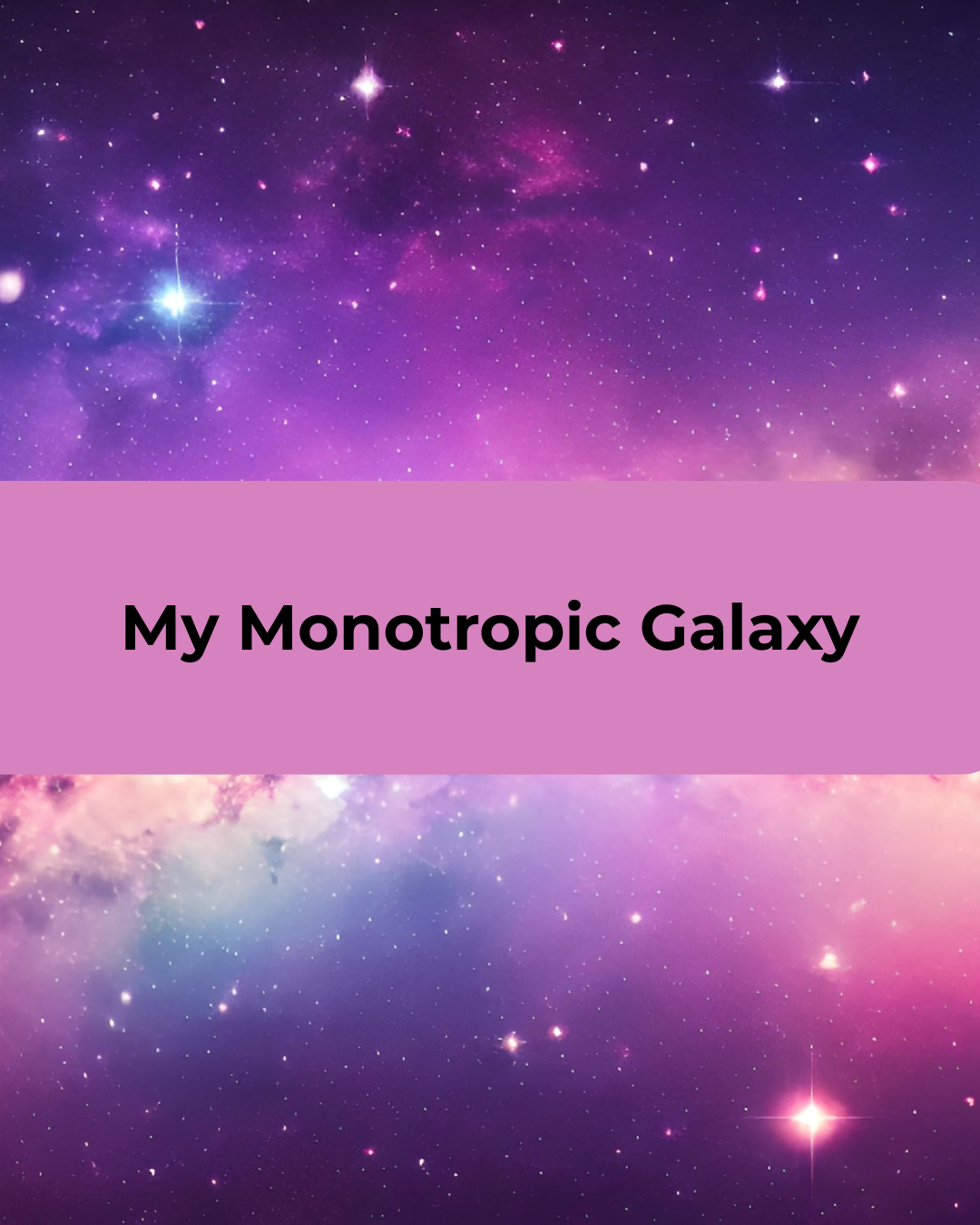
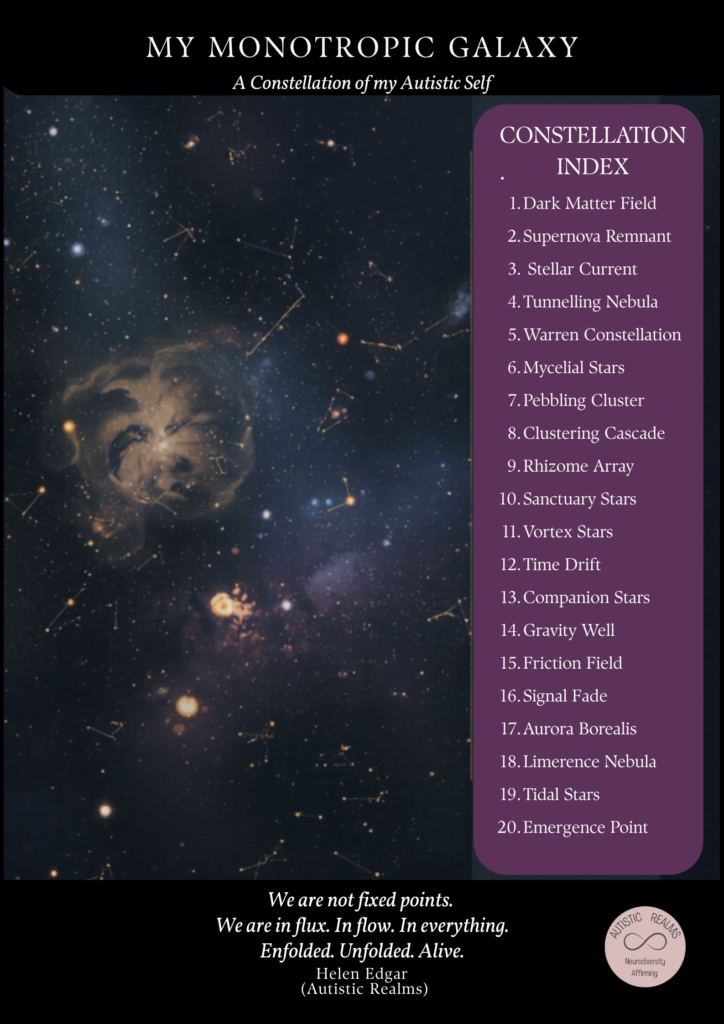
This piece is about feelings of awe and wonder, my own Autistic ADHD experiences, and about the map I have tried to represent of my inner life using the language of the cosmos. It is called My Monotropic Galaxy: A Constellation of My Autistic Self. It is a deep-field image of space, overlaid with constellation lines, accompanied by an index of 20 named features of some of my monotropic experiences. Some of these constellations I have lived in for decades, others I have only recently been able to name. All of them are in relationship with each other, always in motion, always becoming something the map and myself has not yet caught up with.
Before I guide you through my galaxy of monotropic experiences, I will explain a bit about the theory of monotropism and why I feel it is so important for my own sense of self-identity as an Autistic ADHD person.
What Is Monotropism?
Monotropism is an attentional theory of autism developed by Autistic researchers Dinah Murray, Mike Lesser, and Wenn Lawson (2005). It describes how many Autistic people tend to have their attention drawn more strongly to fewer things at any given time, going deep rather than wide, concentrating rather than spreading their focus. Rather than framing this as a deficit — an inability to multitask or shift attention — monotropism understands it as a distinct attentional style with its own strengths and difficulties.
Discovering the theory of monotropism for the first time felt like being handed a map of a place I had always lived in but had never been able to describe. I was identified as Autistic and ADHD in my forties, while my children were also going through their own assessments. What followed was a long process of re-sense-making, a re-storying that went back through my entire life, understanding finally why things had been the way they had been, and finally being able to begin to understand my own neurodivergent identity a little bit better.
Awe and Wonder as a Way of Knowing
Let me return to the night sky and think about what awe actually is and why it may be especially relevant for monotropic people. Helen De Cruz (2024), in her book Wonderstruck: How Wonder and Awe Shape the Way We Think, describes wonder as a form of epistemic opening, a way of relating to knowledge and how we have come to know things. The epistemic opening is the moment when the way we know expands; it is more than just a feeling. When we encounter something that is genuinely awe-inspiring, the usual categories we use to make sense of the world temporarily loosen. It is as if you are maybe seeing or sensing something for the first time; you may notice things you had previously learned to filter out. For De Cruz, wonder is not just a happy side effect of seeing something beautiful; it is a cognitive and moral orientation. It is how we stay genuinely curious about a world we might otherwise let ourselves assume we already understand, or are taught to ignore, as it doesn’t fit into how people expect us to perceive and respond.
When I read De Cruz’s book in 2024, something in me recognised what she was describing at a really deep level. It was the most inspiring book I have read for many years. I took part in a brilliant reading group hosted by The Philosopher 1923, where we explored Helen De Cruz’s work in depth. In the final week, we were lucky to be joined by Helen herself, and I remember discussing Nick Walker’s neuroqueer theory (2021) and the projects I was developing with Stimpunks, particularly the ways her ideas resonated with and helped shape our thinking. These conversations had a lasting impact, influencing our Neuroqueer Learning Spaces project, helping to evolve the vision behind Cavendish Space, and continuing to inform much of my current writing and emerging ideas around the theory of monotropism.
Awe and Flow
When I am pulled fully into something that has truly captured my attention, not just my mind, but my whole body and nervous system is immersed. What opens is not simply focus; it is that first-ness quality of perception De Cruz describes, the sense of seeing and feeling something for the first time, even if I have encountered it a hundred times before. New connections become visible, and the boundaries between things soften. It feels like my nervous system, so often braced against a world not designed for me, can finally exhale in the in-between spaces as new connections form and I feel literally awe-some.
Keltner and Haidt (2003) describe awe as arising when we encounter something vast that challenges our existing mental structures, something that does not fit the categories we already hold, and that invites us to expand our ways of being rather than retreat or fold inwards. Awe can be humbling and expansive at the same time; it opens up possibilities.
I feel this resonates with what it feels like for me to be in monotropic flow. My self does not disappear, nor does it become more rigid or narrow; instead, it feels as though I open up, my whole bodymind becomes more porous. The boundary between me and what I am attending to becomes less fixed; I am both in the flow, and the flow is in me. The distance between those two things collapses and unfolds in a way that feels like both loss and arrival, and it can feel deeply liberating and joyful (and sometimes deeply troubling and anxiety-provoking!).
For many Autistic people, these experiences are undervalued, even stigmatised or shamed as we grow up. We are told to concentrate on what the teacher is saying, to focus on what our family and friends think really matters, and slowly, our own ways of perceiving the world are flattened as we learn to mask and stop trusting ourselves. The things we find awe-inspiring are treated as having no value: the joy of looking closely at a mushroom or an insect may be met with being told to hurry up and rejoin the group; the wonder of feeling the sea against your toes in the sand may be met with being told to just get in and swim and stop fussing.
This quality of experience, this awe and wonder, is represented by the Stellar Current at the heart of my galaxy: the deep flow state through which my whole system comes into coherence, and I move with the current of what matters most. It feels fitting that this current carries me toward a phrase that has become foundational to how I think about the Autistic community and a sense of belonging.
Love You Down to Your Star Stuff
The phrase Love You Down To Your Star Stuff grew out of collaborative work with Ryan Boren and Stimpunks Foundation (Boren & Stimpunks Foundation, 2026). It reaches back to something Carl Sagan observed: that the atoms in our bodies were forged in the interiors of stars that lived and died long before our sun existed. We are, quite literally, made of star stuff.
To love someone down to their star stuff is to locate love for their core way of being. Love is not conditional on performance, legibility, or being the kind of person the world finds easy to translate. Love should not be dependent on meeting neuronormative expectations, masking well enough or being productive enough or social enough. To love someone down to their star stuff is to love their way of being continuous with the universe and their authentic self.
Much of the lived experience of being Autistic for many people is weighed down by what I have called the Dark Matter Field in my galaxy. This is the heavy darkness of neuronormativity, reflected in the accumulated weight we carry around of a world that does not meet our needs, and does not love us down to our star stuff. The Dark Matter Field is everything that is harmful in our systems, behaviourism, ableism, racism and more. As Autistic people, we are constantly being measured against a map that was not ours.
The Double Empathy Problem (Milton, 2012) highlights the mutual misunderstanding between people with very different experiences, where the gap of this map is often framed as ours to close; this sits at the heart of the Dark Matter Field’s weight. Decades of masking, so thoroughly embedded in me that I genuinely did not know for most of my life where the mask ended and where I began, meant I was always accommodating others to try to meet expectations.
Love You Down to Your Star Stuff is a different orientation entirely. It is the foundation of what I believe the constellation of the neurodivergent community is reaching toward. The Mycelial Stars — underground networks of care and interdependence. The Rhizome Array — the non-hierarchical community that creates something together that none of us could make alone. The Companion Stars — those who do not need me to perform. The Sanctuary Stars — where I do not have to translate myself. All of these are expressions of what it means to love someone for who they actually are and are part of the galaxy that many neurodivergent people may recognise or relate to.
The Implicate Order and the Autistic Bodymind
A concept from quantum physics has really inspired my thinking recently, helping me articulate my inner self and conceptualise my Galaxy of Monotropic Experiences. Physicist David Bohm (1980) proposed that beneath the explicate order, the world of distinct objects and separate events we can see and measure, there exists a deeper dimension he called the implicate order. In the implicate order, nothing is truly separate; everything is enfolded into everything else. What appears distinct at the surface is always an unfolding of something that, at a deeper level, was always entangled.
I am thinking about the implicate order through the lens of monotropism and flow theory. The surface of a river looks like separate ripples and currents, each one seeming to rise, curl, and vanish on its own, but beneath the surface, the water is continuous; there is no ripple that exists apart from the river. What appears as individual movement is always part of a larger, deeper pattern, momentarily folding into visibility before folding back into the whole.
This is something of what monotropic flow feels like to me from the inside. The attention tunnel is the explicate order: a single ripple, distinct and absorbing, everything else falling away from view, but the depth beneath it, the coherence, the sense that this particular focus is connected to everything I have ever cared about, is the implicate order surfacing, slowly emerging and connecting with other thoughts. The interest that pulled me in is and was never really separate from the rest of me; it only looks that way from above the waterline or from what others may perceive. When I am in flow, I am not narrowing myself down to one thing and losing everything else; it is more like I am going deeper beneath the surface ripples to the place where it was all one current to begin with, to where I feel whole.
This may be part of why monotropic flow can feel like both loss and arrival at once; the “loss” is the disappearance of the surface separations of events and experiences outside the attention tunnel, the distinct sense of me here and the world being there. The “arrival” is perhaps the recognition of what was really underneath all along, the boundary was an explicate-order appearance, and the implicate order beneath it was entangled the whole time. When I am in flow, I can feel that oneness and vastness at the same time creating a sense of awe.
The world tends to perceive Autistic people through the explicate order, through what is behaviourally visible, measurable, categorisable. But what drives and shapes and sustains Autistic experience is largely implicate, the enfolded pattern of sensory processing, attentional depth, emotional layering, temporal fluidity, and relational intensity that does not show at the surface, or shows in ways that are consistently misread by others.
When I am in a deep monotropic flow, I am living in the implicate order. Thoughts do not arrive in sequence; they arrive already feeling more like a constellation, in relationship with each other, already folded into a larger pattern I can sense before I can articulate it. This is the Tunnelling Nebula in my galaxy — the way monotropic attention goes deep rather than wide, concentrating and transforming everything it connects to, always making more connections beneath the surface. It is around this Emergence Point that ideas and connections surface, when something is finally ready, arriving in its own time. It is at this Emergence Point that things finally start to make a bit more sense, at least to me and enable me to keep moving and keep becoming.
Bohm’s framework has also helped me understand burnout being the result of what I have called the Dark Matter Field. The Supernova Remnant in my galaxy is like a new way of becoming that emerges after burnout, remnants of my old self entangled in new ways of being.
Burnout is not simply tiredness; it is what happens when the implicate order is violently disrupted and when the continuous process of unfolding is interrupted by sustained demand to operate exclusively in the explicate: to spread thin rather than deepen, to switch and fragment and present surface after surface with no return to the enfolded whole – it is flooded with the Dark Matter Field. Each significant burnout has remade me into a new version of myself; something changes at my core, and it gives rise to new constellations. The supernova scatters what I was, how I thought and my previous ways of being; in a way, it reforms me into an ongoing cycle of becoming.
Rhizomes and the Non-Hierarchical Mind
Alongside Bohm, the philosopher Gilles Deleuze and the psychoanalyst Félix Guattari offered me another framework that helped me name something I had always experienced but could not clearly articulate in the past.
In A Thousand Plateaus (1987), they introduce the concept of the rhizome. A tree has a single trunk, its roots descend from a fixed point, and branches grow outward in a discernible hierarchy. Everything can be traced back to a central point; a rhizome is completely different. If we think of how grass spreads, or how mycelium moves through soil, more laterally, reaching out in every direction at once, with no fixed origin, no central authority, no privileged direction of growth, it may feel relatable to the experience of being Autistic. A rhizome connects with anything it encounters, it can be broken at any point and begin again from that node. It has no archive in the traditional sense, but it is dense with the traces of everything it has connected to and possibilities of what may form in the future.
This is pretty much how I feel my mind works. I have spent much of my life feeling different and not understanding my own thought processes, my non-linear associations, the omnidirectional leaps, the way a thought about a star might become a thought about mutual aid that might become a thought about penguins, and all of it feels necessary and connected, even if the connections are only fully felt inside me. It makes relationships hard, it makes communicating harder, always seeing that look of confusion on people’s faces as they think ‘what is she on about’ as there may be no obvious link to others, unless they know me really well!
The Rhizome Array in my galaxy represents the Autistic community itself. It is non-hierarchical, constantly connecting, forming new nodes, creating something together that none of us could make alone. As David Gray-Hammond and I have written about extensively there is no centre for the Autistic Rhizome and our community. There is no single way in; people can connect, join and communicate in their own way. The mycelial network metaphor runs alongside this: Mycelial Stars represent the underground networks of care that sustain us, growing toward each other in ways that do not follow a straight line or a hierarchy, representing the community of mutual aid that often sustains life for disabled and neurodivergent people.
Both frameworks, Bohm’s implicate order and Deleuze and Guattari’s rhizome, have helped me understand that the way my monotropic bodymind works has its own pattern, its own constellation, its own way of reaching toward others and toward the world and how the world works with me and in me.
The Constellation Index
What follows is an index of twenty constellations in my Monotropic Galaxy. These are not separate entries in a list; they are interdependent, entangled and always in relationship with each other and with everything around them. They are always in motion and always in flow.
Find what resonates with you from this, some of these constellations may feel immediately familiar, and others may not be part of your galaxy at all. This map is just my own constellation in a universe of infinite possible configurations of ways of Autistic being. You may find it sparks the beginnings of creating your own map or drawing your own constellation or galaxy.
1. Dark Matter Field is the weight of neuronormativity before I had words for it.
2. Supernova Remnant is burnout — the kind that arises when my monotropic attention is asked to spread attention thin, to split, to switch constantly and to mask. Each significant burnout has remade me and formed new constellations.
3. Stellar Current is the heart of my galaxy — the deep, flow states of being monotropic. When I am truly in flow, my whole bodymind system exhales and time dissolves. I am completely, wholly present, regulated and feel alive. I move with the current.
4. Tunnelling Nebula — monotropic attention goes deep rather than wide; it concentrates and transforms everything it connects to, always making more connections.
5. Warren Constellation are my rabbit holes of research. They reflect the joy of following a question, of feeling awe and wonder, and always expanding and reaching out.
6. Mycelial Stars represent the underground networks of connection that sustain the neurodivergent community of Autistic researchers, advocates, writers, families, and educators. It is our community network of care and interdependence, all growing toward each other in ways that don’t follow a straight line or a hierarchy. The foundation of mutual aid, care and well-being.
7. Pebbling Cluster is how I show love. Inspired by the way penguins offer pebbles to those they care for, this is my Neurodivergent Love Locution. Offering small glimmers, such as a twig I found or a meme or song I share as a way to say ‘I thought of you, I care’.
8. Clustering Cascade is my infodumping. The deep need to share my interests and passions, at considerable length and in detail, with those I feel safe with and to engage with others who want to share their joy.
9. Rhizome Array is the Autistic community itself — non-hierarchical, constantly connecting with other people and forming new communities and nodes. Creating something together that none of us could make alone.
10. Sanctuary Stars are the places, practices, and people where I do not have to translate myself or mask; it is where I feel safe and can simply be and know I will be accepted for who I am to regulate and communicate in my own ways.
11. Vortex Stars are the intensity of deep absorption I feel as a monotropic person. That pull into a single channel of interest that is so total it feels like a gravitational field.
12. Time Drift is my Autistic experience of time as non-linear, layered, fluid and felt. Where past and present merge into each other, and my lived time feels closer to superposition than sequence.
13. Companion Stars are the people who orbit close, who understand penguin pebbling, and the Neurodivergent Love Locutions. Those who don’t need me to perform and who just ‘get it’.
14. Gravity Well represents my monotropic looping and ruminating mind. Thoughts that circle and return, that find their way back to the same point regardless of how many times I try to leave them. It represents Autistic inertia and a feeling of being stuck.
15. Friction Field is the relentless exhaustion of having needs the world was not designed to meet, and of having to advocate for them, over and over, in systems not built with Autistic people in mind.
16. Signal Fade is the anxiety that rises when something or someone I care about moves outside my attention tunnel, the panic of object impermanence, the fear that what is out of sight may simply be gone.
17. Aurora Borealis is the joy and wonder of being Autistic — the profound aliveness that comes with deep engagement in sensory experiences. The way the world and my whole bodymind can suddenly blaze with meaning and feel beauty when I am fully with something that matters to me.
18. Limerence Nebula is the intensity of falling deeply into a connection with a person, a totality that can feel overwhelming and all-consuming.
19. Tidal Stars represent the porousness between myself, the environment I am in and the wider cosmos. The sense that my edges are less fixed than the world tends to assume. My pull towards nature, towards water, towards things that are ancient. A feeling of returning to something that was always within me.
20. Emergence Point is what surfaces from the liminal depths of my monotropic bodymind when something is finally ready to surface. It is the crest of an invisible process, trusted rather than forced, arriving in its own time, on its own terms. I am always being in a process of becoming.
Always Becoming
Our own Milky Way contains hundreds of billions of stars, and most have no name, only coordinates, or nothing at all. My own constellation feels similar, as some of my stars may dim; others may brighten, and they all have their own way of processing time. Some are still finding their way through the dark toward the light, still connecting with other stars, still discovering what they illuminate. The map I have created will never be finished, as it really only captures a moment in time, as it is always transforming, it is alive.
The Autistic rhizome keeps spreading, the implicate order keeps unfolding and the constellations keep reaching toward each other, forming new nodes, new patterns, new ways of knowing that none of us could arrive at alone. What lives beyond my twenty constellations is the infinity of Autistic ways of being, every way of knowing, sensing, connecting, and belonging that has not yet found its name, its language, its place in any map.
You may recognise some of these constellations as your own and others may not be part of your galaxy at all. We are each a unique configuration of matter, patterns and attention; we each have a particular way of being continuous with a cosmos that has been becoming itself for longer than we can even perceive.
We are not like the cosmos. We are continuous with it. In the infinite space beyond every map we have ever made, the phrase from our collaborative work at Stimpunks holds everything together: Love You Down to Your Star Stuff (Boren & Stimpunks Foundation, 2026). Every star belongs, every constellation has its place and every way of being Autistic is woven into the fabric of what this community is and is always becoming.
We are not fixed points.
We are in flux.
In flow.
In everything.
Enfolded.
Unfolded.
Alive.
References
Bohm, D. (1980). Wholeness and the implicate order. Routledge.
Boren, R., & Stimpunks Foundation. (2026). Love you down to your star stuff. https://stimpunks.org/star-stuff/
De Cruz, H. (2024). Wonderstruck: How wonder and awe shape the way we think. Princeton University Press.
Deleuze, G., & Guattari, F. (1987). A thousand plateaus: Capitalism and schizophrenia (B. Massumi, Trans.). University of Minnesota Press.
Keltner, D., & Haidt, J. (2003). Approaching awe, a moral, spiritual, and aesthetic emotion. Cognition and Emotion, 17(2), 297–314. https://www.tandfonline.com/doi/abs/10.1080/02699930302297
Milton, D. E. M. (2012). On the ontological status of autism: The ‘double empathy problem.’ Disability & Society, 27(6), 883–887. https://www.tandfonline.com/doi/abs/10.1080/09687599.2012.710008
Murray, D., Lesser, M., & Lawson, W. (2005). Attention, monotropism and the diagnostic criteria for autism. Autism, 9(2), 139–156. https://journals.sagepub.com/doi/10.1177/1362361305051398
Walker, N. (2021). Neuroqueer heresies: Notes on the neurodiversity paradigm, autistic empowerment, and postnormal possibilities. Autonomous Press.
Invitation
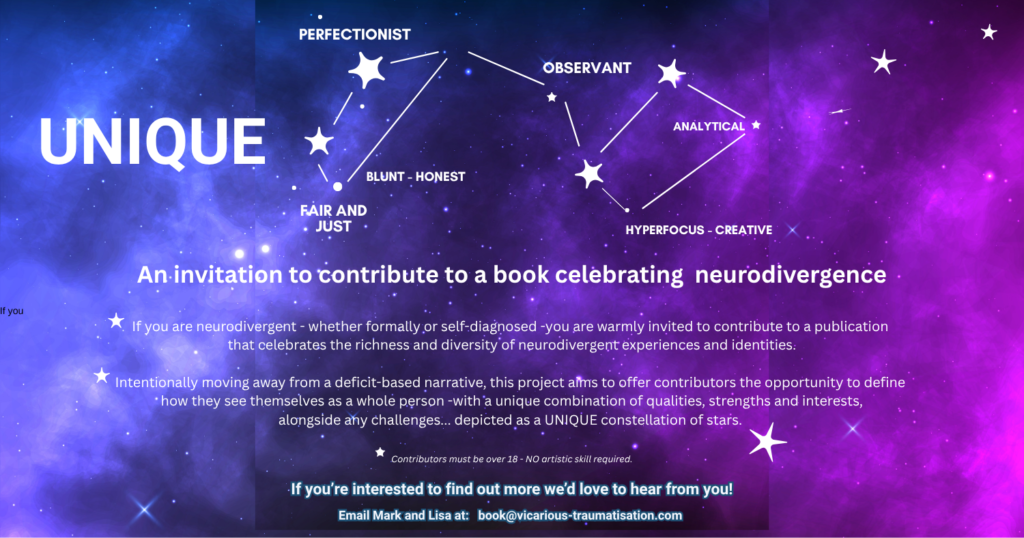
I am delighted to share that I have a chapter in an upcoming book called UNIQUE. UNIQUE invites neurodivergent contributors to map themselves: their qualities, strengths, struggles, deep interests, and challenges, all held together as a constellation.
My chapter centres on my Monotropic Galaxy — the constellation map of my Autistic self, and this blog is an edited and expanded version of my forthcoming chapter submission. My own constellation is a small offering among many in what I hope will be a rich, diverse, and deeply affirming collection of neurodivergent people’s inner worlds and experiences.
The book is still open for contributions.
If you are neurodivergent — whether formally diagnosed or self-identifying — you are warmly invited to contribute your own constellation. No artistic skill is needed. No particular way of writing. Just your own unique map of who you are. The project is intentionally moving away from deficit narratives and toward something that reflects the full richness of neurodivergent experience and identity.
Contributors need to be over 18. If you’re interested to find out more, Mark and Lisa would love to hear from you at book@vicarious-traumatisation.com.