
Tag: autistic burnout recovery

  • Wintering as Becoming: Deleuze, Posthumanism and the Ecology of Autistic Burnout

    Wintering as Becoming: Deleuze, Posthumanism and the Ecology of Autistic Burnout

    Late November is a threshold season. The light thins, the trees have let go, and much of the life around us has gone underground or into stillness. I have been rereading Katherine May’s Wintering (2020) as a gentle language for Autistic burnout, and here I want to take that thinking further, into the philosophy that has shaped so much of my own understanding of Autistic life. That means the work of Gilles Deleuze, both alone and with Félix Guattari, and the wider posthumanist turn that decentres the individual human and treats life as relational, ecological and always in process.

    What happens to our understanding of Autistic burnout, and of rest, when we stop treating the burnt-out Autistic person as a broken individual machine and start to see burnout as an event in a living ecology, a season the bodymind passes through alongside everything else that winters?

    The Fallow Season

    May (2020) describes wintering as the periods when life pulls us out of its ordinary momentum, whether through illness, grief, crisis or exhaustion. Her method is quietly ecological. Faced with her own winter, she looked outward: to dormice slowing their bodies into hibernation, to bees clustering in the hive to share warmth, and to the rituals that people across cultures have used to mark the dark months. She writes that winter belongs to every cycle, and that a culture which refuses winter leaves people without shelter when their own arrives. May is Autistic, and she wrote about her adult diagnosis in The Electricity of Every Living Thing (May, 2018). Wintering isn’t written as a book about autism, but its refusal to pathologise withdrawal speaks deeply to Autistic readers, many of whom have lived through winters that went unseen and unnamed.

    What May offers through memoir, Deleuze and posthumanist thinkers offer in a different key. Each, in their own way, reads a life as part of a larger field of forces, relations and rhythms. Read together, they help move Autistic burnout away from the language of deficit and towards an ecological account of capacity, encounter and becoming.

    What Can an Autistic Body Do?

    Research on Autistic burnout has grown largely out of Autistic testimony. Raymaker et al. (2020) defined Autistic burnout as long-term exhaustion, loss of function and reduced tolerance to stimuli. It arises from chronic life stress and a mismatch between expectations and abilities without adequate support, and it typically lasts three months or more. Higgins et al. (2021) also described pervasive exhaustion, withdrawal and the loss of skills a person previously had. Two threads run through this work again and again: the cumulative cost of masking (Pearson & Rose, 2021), and the strain on monotropic attention, which tends to gather intensely around a small number of interests at once (Murray et al., 2005).

    Deleuze’s reading of Spinoza gives this research a wonderful philosophical frame. In Deleuze’s (1981/1988b) account, Spinoza defines a body less by its form or function than by its capacities to affect and be affected. Every encounter either composes with a body and increases its power of acting, or decomposes it and diminishes that power. Deleuze keeps returning to Spinoza’s provocation that we do not yet know what a body can do. Through this lens, Autistic burnout describes a bodymind (Dychtwald, 1977/1978) that has been through a long series of decomposing encounters: fluorescent light, relentless social demand, the labour of masking, and institutions that will not bend. The loss of speech or executive function that so many Autistic people describe is a contraction of the power of acting, under conditions that have been sad, in the Spinozist sense, for far too long.

    This framing matters because it places burnout in the relation between body and world. A capacity is always a capacity within a situation. An Autistic person who cannot speak in a supermarket may speak fluently, even joyfully, about a passionate interest in a quiet room with someone they trust. Burnout can then be read as information about how an environment is composed, and recovery as the slow work of finding encounters that compose with us again.

    The Refrain in the Dark

    In A Thousand Plateaus, Deleuze and Guattari (1980/1987) open their discussion of the refrain with an image of a child frightened in the dark who comforts themselves by singing under their breath. The song creates a fragile centre, a point of stability within chaos. From there the refrain draws a circle, a home territory, and from that territory it can eventually open out to the world again. Territory is made of rhythm, stimming and expression before it is made of walls.

    I find it hard to read this passage without thinking of stimming. Rocking, humming, scripting, flapping, repeating a beloved phrase or playing the same song on loop are all refrains in exactly this sense. They mark out a territory where an Autistic bodymind can gather itself. In burnout, when so many familiar territories have been lost, the refrain becomes a way of rebuilding home from the inside out. The same breakfast, the same walk and the same comforting video watched for the hundredth time all take part in this territorial work. Dominant clinical frames tend to treat these behaviours as symptoms to reduce. Deleuze and Guattari give us a vocabulary for seeing them as creative acts that make worlds.

    May (2020) writes about the rituals that carry people through winter, and the refrain helps explain why rituals work: they set up a rhythm the nervous system can lean against. In Deleuzian terms, burnout is a deterritorialisation so severe that it can leave a person with no ground at all. Wintering is the patient reterritorialisation through which a home is sung back into being.

    Durée and Vegetal Time

    Winter also asks us to think differently about time. Deleuze’s (1966/1988a) reading of Bergson distinguishes spatialised, measurable clock time from durée, the lived, qualitative time of consciousness in which past and present run into each other. Recovery from burnout happens in durée. It cannot be scheduled. When Autistic people are told they should be ‘better by now’, the frustration they feel is partly a collision between institutional clock time and the felt time of a bodymind healing at its own pace.

    Michael Marder’s (2013) philosophy of vegetal life adds another layer. Marder argues that plants live in a temporality of slowness, seasonality and repetition that human thought has tended to overlook or dismiss. A tree in winter is far from inert, it is doing the work of dormancy, holding its resources in its roots and waiting for conditions that allow growth. If we learned to honour vegetal time, we might start to recognise Autistic withdrawal as a kind of dormancy with its own intelligence. With its capacity for long, deep immersion (Murray et al., 2005), monotropic attention may sit closer to vegetal time than to the fragmented, accelerated attention that contemporary work and schooling demand.

    Posthuman Wintering

    Posthumanist thought starts from the recognition that the bounded, autonomous, rational individual at the heart of Western humanism was always a fiction. That fiction has been used to exclude many people from full humanity, including disabled, colonised, racialised and neurodivergent people. In its place, Rosi Braidotti (2013) proposes a vital materialist understanding of life as zoe, the generative force running through human and nonhuman life alike. From this view, the Autistic person in burnout is one node in a dense web of relations, and their winter is shared with soil, weather, animals, and the people and institutions around them.

    Donna Haraway’s (2016) concept of sympoiesis, or making-with, could be especially helpful here. Haraway argues that no living thing makes itself alone; beings come into existence together, through entangled relations. May’s (2020) bees clustering in the hive give a vivid picture of sympoietic wintering: a collective that survives the cold only by making warmth together. Erin Manning (2016) brings this relational thinking directly into conversation with neurodiversity. Drawing on Autistic writers, she describes Autistic perception as attuned to the field of relations before that field is sorted into separate objects, and she names neurotypicality as an unexamined norm that decides what counts as a proper way of being in the world.

    The Autistic Rhizome (Gray-Hammond, 2023; Edgar, 2023) carries these ideas into Autistic community itself. Deleuze and Guattari’s (1980/1987) rhizome grows sideways, without centre or hierarchy, through lines of flight and becoming. When one of us winters, those lines keep moving underground, through quiet messages, shared resources and spaces kept open for our return. David Gray-Hammond and I have named the connected, extended bodymind that these lines make possible symphrenia (Edgar & Gray-Hammond, 2026), a way of describing how bodyminds think and feel through each other. Read symphrenically, burnout becomes a strain within a shared ecology of minds, and rest becomes something we hold for and with one another however it may present in ways others can’t see, feel or hear.

    Rest as Affirmative Politics

    Braidotti’s (2006) nomadic ethics includes the idea of thresholds of sustainability: the limits beyond which a subject can no longer bear the intensities passing through it without breaking down. In this account, ethics means learning to recognise and respect those thresholds, both our own and other people’s. Autistic burnout can be understood as what happens when a society systematically ignores the thresholds of Autistic bodyminds, which gives rest an ethical and political charge.

    Tricia Hersey (2022) clarifies this as she frames rest as resistance to systems that treat human beings as machines, and she grounds her work in Black liberation and in the history of how white supremacy and capitalism have stolen rest from Black bodies. Her work insists that rest is distributed unequally. Autistic people who are also racialised, trans, poor, chronically ill or caring for others face particular barriers to stopping, and particular penalties when they do. Deleuze and Guattari (1980/1987) described capitalism as a machine that captures desire and redirects it into production. Hersey shows concretely whose bodies that machine has consumed most hungrily.

    Nick Walker’s (2021) work on neuroqueering adds another dimension. To neuroqueer is to actively subvert the normative performances of neurotypicality that have been imposed on us. Reclaiming rest on Autistic terms, whether through special interests, stimming, solitude, parallel company or monotropic flow, is a neuroqueer practice in this sense. It unsettles the script that says rest must look a certain way, be earned a certain way, and end at a certain time.

    Spring as Difference

    In Difference and Repetition, Deleuze (1968/1994) argues that repetition never produces the same thing twice. Each return is a new event that carries difference within it, and habit itself is a quiet contraction of past moments into a living present. This seems to me a fitting way to think about the end of a winter. Spring comes back every year, yet no two springs are alike, and no tree leaves winter exactly as it entered.

    Recovery from Autistic burnout is rarely a return to who we were before. Many Autistic people I know have come through with a sharper sense of their thresholds, a deeper commitment to their own refrains, and far less willingness to mask in spaces that never deserved that labour.

    In Deleuzian terms, recovery is a becoming.

    In posthumanist terms, it is a becoming-with: with the rhizome that held us, the rituals that sang us home, and the more-than-human seasons whose slowness we finally let ourselves share.

    If you are wintering now, I hope these ideas keep you some company in the dark, along with some trust that whatever grows from your roots will be new, and wholly yours. May be some of this resonates with you……

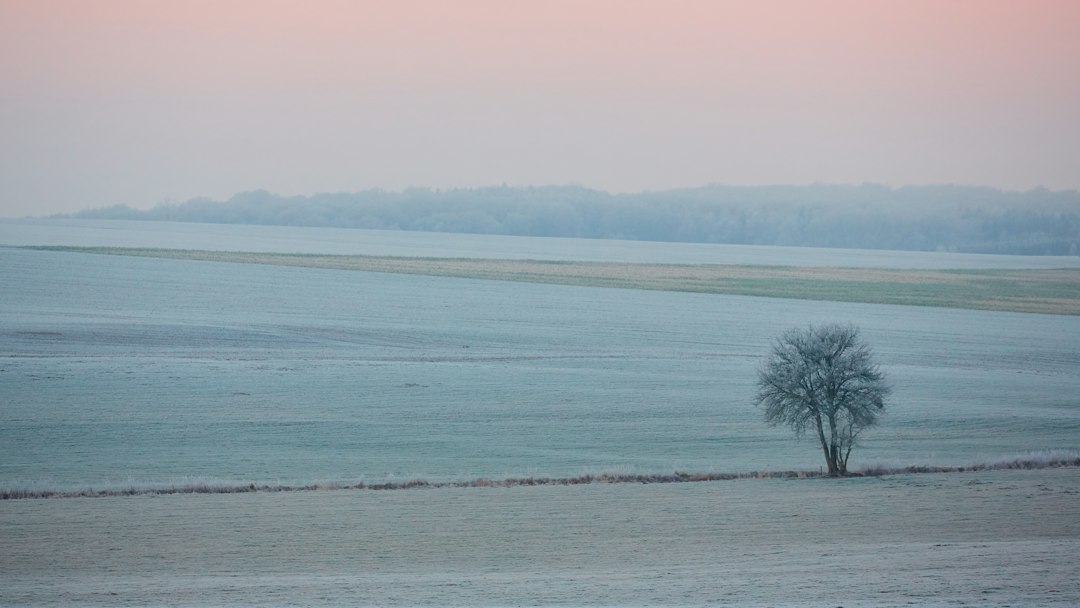
    Featured image: frosty sunrise above Helensburgh, 21 November 2026. Photo by David Howells.

    References

    Braidotti, R. (2006). Transpositions: On nomadic ethics. Polity Press.

    Braidotti, R. (2013). The posthuman. Polity Press.

    Deleuze, G. (1988a). Bergsonism (H. Tomlinson & B. Habberjam, Trans.). Zone Books. (Original work published 1966)

    Deleuze, G. (1988b). Spinoza: Practical philosophy (R. Hurley, Trans.). City Lights Books. (Original work published 1981)

    Deleuze, G. (1994). Difference and repetition (P. Patton, Trans.). Columbia University Press. (Original work published 1968)

    Deleuze, G., & Guattari, F. (1987). A thousand plateaus: Capitalism and schizophrenia (B. Massumi, Trans.). University of Minnesota Press. (Original work published 1980)

    Dychtwald, K. (1978). Bodymind. Jove. (Original work published 1977)

    Edgar, H. (2023, April 22). Autistic rhizome. Stimpunks Foundation. https://stimpunks.org/glossary/autistic-rhizome/

    Edgar, H., & Gray-Hammond, D. (2026, October 7). Symphrenia. The Wider Existence. https://www.thewiderexistence.co.uk/p/symphrenia

    Gray-Hammond, D. (2023, April 21). Neuro-anarchy and the rise of the Autistic Rhizome. NeuroHub Connect. https://neurohubcommunity.org/2023/04/21/neuro-anarchy-and-the-rise-of-the-autistic-rhizome/

    Haraway, D. J. (2016). Staying with the trouble: Making kin in the Chthulucene. Duke University Press.

    Hersey, T. (2022). Rest is resistance: A manifesto. Little, Brown Spark.

    Higgins, J. M., Arnold, S. R. C., Weise, J., Pellicano, E., & Trollor, J. N. (2021). Defining autistic burnout through experts by lived experience: Grounded Delphi method investigating #AutisticBurnout. Autism, 25(8), 2356–2369. https://doi.org/10.1177/13623613211019858

    Manning, E. (2016). The minor gesture. Duke University Press.

    Marder, M. (2013). Plant-thinking: A philosophy of vegetal life. Columbia University Press.

    May, K. (2018). The electricity of every living thing: A woman’s walk in the wild to find her way home. Trapeze.

    May, K. (2020). Wintering: The power of rest and retreat in difficult times. Rider.

    Murray, D., Lesser, M., & Lawson, W. (2005). Attention, monotropism and the diagnostic criteria for autism. Autism, 9(2), 139–156. https://doi.org/10.1177/1362361305051398

    Pearson, A., & Rose, K. (2021). A conceptual analysis of autistic masking: Understanding the narrative of stigma and the illusion of choice. Autism in Adulthood, 3(1), 52–60. https://doi.org/10.1089/aut.2020.0043

    Raymaker, D. M., Teo, A. R., Steckler, N. A., Lentz, B., Scharer, M., Delos Santos, A., Kapp, S. K., Hunter, M., Joyce, A., & Nicolaidis, C. (2020). “Having all of your internal resources exhausted beyond measure and being left with no clean-up crew”: Defining autistic burnout. Autism in Adulthood, 2(2), 132–143. https://doi.org/10.1089/aut.2019.0079

    Walker, N. (2021). Neuroqueer heresies: Notes on the neurodiversity paradigm, autistic empowerment, and postnormal possibilities. Autonomous Press.
  • Monotropism Through the Seasons: Burnout, Becoming and the More-Than-Human

    Monotropism Through the Seasons: Burnout, Becoming and the More-Than-Human

    Trees have an interesting place in the philosophy of Gilles Deleuze and Félix Guattari. In A Thousand Plateaus, they use the tree as an image of hierarchical thinking, with a single trunk and branches that always lead back to one origin. They set it against the rhizome, which spreads sideways, connects any point to any other and has no centre (Deleuze & Guattari, 1987). Yet the more I learn about real trees, the more rhizomatic they turn out to be. Beneath the forest floor, roots and fungal threads weave trees into vast underground networks that share water, sugars and signals (Simard, 2021). A tree is never only a tree. It is a meeting place of soil, fungi, weather, insects, birds and light.

    Posthumanism invites us to step away from the idea of the human as a separate, self-contained individual and to notice how we are always entangled with the more-than-human world (Braidotti, 2013). Donna Haraway (2016) calls this sympoiesis, a making-with, in which nothing truly makes itself. Autistic burnout can be understood in exactly this way. It is too often treated as a private failure of one person’s resilience, when it emerges from a whole ecology of demands, environments, expectations and relationships. Luke Beardon’s (2017) equation, Autism + Environment = Outcome, already points in this direction, and the seasons give us a way of feeling it in the bodymind (Dychtwald, 1977/1978).

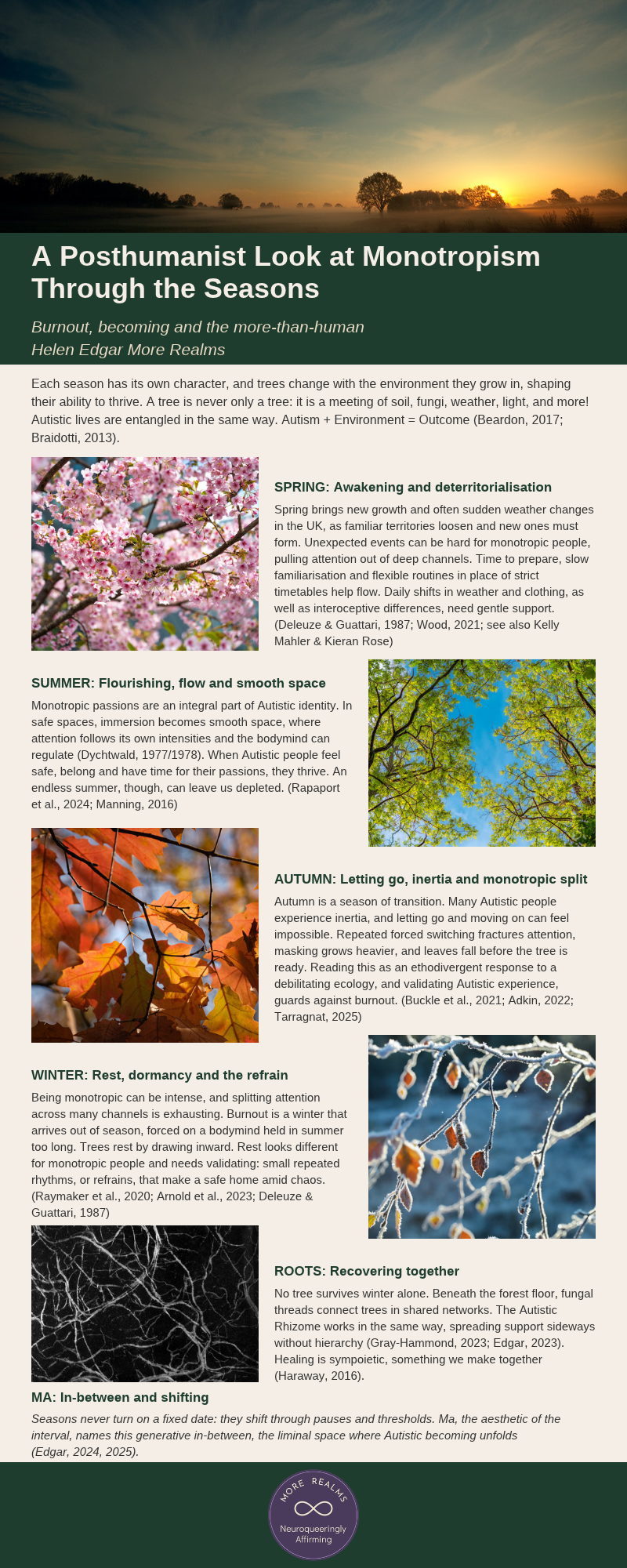
    Infographic titled "A Posthumanist Look at Monotropism Through the Seasons: Burnout, becoming and the more-than-human" by Helen Edgar, More Realms. A winter sunrise over a misty field with silhouetted trees sits above a dark green title band. Below, five sections pair close-up photographs with short text. Spring (pink blossom): awakening and deterritorialisation, when familiar territories loosen and unexpected change pulls attention out of deep channels. Summer (sunlit green leaves seen from below): flourishing, flow and smooth space, where immersion helps the bodymind regulate, though an endless summer can deplete us. Autumn (red and orange leaves): letting go, inertia and monotropic split, where repeated forced switching and masking lead towards burnout. Winter (frost-covered twigs): rest, dormancy and the refrain, with burnout described as a winter that arrives out of season. Roots (white fungal threads on black): recovering together through the Autistic Rhizome and sympoiesis. A final section, Ma: in-between and shifting, describes seasons as thresholds and pauses. A More Realms Neuroqueeringly Affirming logo closes the image.

    Monotropism and Ethodivergence

    Monotropism is a theory of autism developed by Dinah Murray, Wenn Lawson and Mike Lesser (Murray et al., 2005). It suggests that Autistic people tend to focus attention intensely on a small number of interests at any one time, drawing our attention resources deeply into whatever matters most to us in that moment. Polytropic people (likely those who are not Autistic or ADHD), tend to spread attention more thinly and evenly across many things at once.

    The concept of ethodivergence widens the lens further. Ombre Tarragnat (2025) uses ethodivergence to name behaviours that depart from what is typical for a species, from the norms of a particular ecological or social setting, or from ethonormativity, the human-centred rules about which behaviours count as acceptable in humans and other animals. Tarragnat also notes that ethodivergence, much like neurodivergence, can open distinctive forms of flourishing while also leaving beings vulnerable, and that some divergences are shaped by debilitating environments. Monotropic ways of attending, moving and resting are ethodivergent in this sense. Burnout tells us far more about the environments that debilitate these ways of being than about any flaw within them.

    Spring: Deterritorialisation and New Growth

    Spring brings awakening, new growth and sudden change. In Deleuzian language it is a season of deterritorialisation, when familiar territories loosen and new ones have to be made. For a monotropic person, every unexpected change asks attention to be pulled out of one deep channel and pushed into another, and that carries a real energetic cost. Spring is also when many of the conditions for later burnout are quietly set. A new school year, a new job or a routine imposed at speed can mean weeks of constant reorientation with little time to settle. Interoceptive differences can add to this, because noticing hunger, thirst or temperature may take longer when attention is absorbed elsewhere, as the work of Kelly Mahler and Kieran Rose explores. Gentle preparation, slow familiarisation and flexible routines give new territories time to form.

    Summer: Flow and Smooth Space

    Summer is the season of flourishing, and for monotropic people it is the image of following our passions into flow. Rapaport et al. (2024) found that Autistic adults’ accounts of task immersion closely matched understandings of flow, Autistic hyperfocus and monotropism, and many described the relief of being themselves without pretence. Deleuze and Guattari (1987) might call these moments smooth space, an open field where movement follows its own intensities, in contrast with striated space, which is divided, measured and timetabled. Erin Manning (2016) suggests that Autistic perception can attend to the whole field of experience before it is sorted into separate objects, a way of being with the world that is already more-than-human. Flow is one of our most important protections against burnout because it restores us.

    Even summer carries risks, though. Trees do not stay in full leaf all year, and a culture of endless production asks the impossible of everyone. When flow becomes the only refuge from a hostile environment, other bodily needs can slip from attention, and a person may emerge from a long immersion depleted.

    Autumn: Inertia and the Falling of Leaves

    Autumn is the season of letting go, and it is often when the signs of approaching burnout become visible. Buckle et al. (2021) describe Autistic inertia as the difficulty of starting, stopping and switching, and their participants spoke of feeling stuck for long periods. When an environment keeps demanding rapid switches, attention fractures again and again. Tanya Adkin (2022) names this monotropic split, and over a sustained period it becomes the ground from which Autistic burnout grows. Autumn is when masking grows heavier, recovery time between demands shortens, and the tree begins to drop leaves whether it is ready or not. Reading these signs as ethodivergent responses to a debilitating ecology allows us to respond with care instead of adding more pressure.

    Winter: Burnout, Dormancy and the Refrain

    Winter is the season of rest. Trees enter dormancy in rhythm with light and temperature, drawing their resources down into the roots. Autistic burnout is a different kind of winter, one that arrives out of season and is forced upon a bodymind that has been held in summer for too long. Raymaker et al. (2020) define Autistic burnout as long-term exhaustion, loss of function and reduced tolerance to stimulus, arising from chronic life stress and a mismatch between expectations and abilities without adequate support. Arnold et al. (2023) confirmed these features with a larger group of Autistic adults.

    Deleuze (1988), reading Spinoza, describes a body by what it can do, by its capacity to affect and be affected. Burnout shrinks that capacity, and recovery depends on conditions that allow it to grow again. Those conditions look different for every monotropic person. For some, rest is darkness and quiet. For others it is a familiar film, a favourite stim, a well-known walk, or time with an interest that feeds the bodymind. Deleuze and Guattari’s (1987) idea of the refrain is helpful here, describing the small repeated songs, routines and rhythms through which a creature makes a safe home amid chaos. Autistic rest is very often a refrain, and it deserves protection.

    Ma: In-Between and Shifting

    Seasons never turn on a fixed date. They arrive through pauses and thresholds, a week of mist between autumn and winter, a single warm afternoon before spring commits. The Japanese aesthetic concept of ma names this interval, the generative emptiness between things, and I have written before about the liminal spaces where Autistic becoming unfolds (Edgar, 2024, 2025). Monotropic attention knows these in-between states well. Moving between attention tunnels is not instant, and the shift itself is a space worth honouring rather than rushing. Deleuze and Guattari (1987) remind us that becoming happens in the middle, and Ma offers a gentler way of holding that middle: as rest, as breath, as the pause in which one season lets go of the next. Supporting Autistic people through transitions means protecting the in-between instead of collapsing it.

    Roots: Recovering Together

    No tree survives winter alone, and burnout recovery rarely happens in isolation. Through the Autistic Rhizome (Gray-Hammond, 2023; Edgar, 2023), David Gray-Hammond and I describe Autistic community as a spreading, non-hierarchical network, much closer to fungal threads than to a single trunk. Our more recent thinking on symphrenia (Edgar & Gray-Hammond, 2026) extends this into a sense of the bodymind as connected with others and with the living world. Sympoiesis reminds us that healing is something we make together.

    Seasons rarely follow the calendar in Autistic lives. Someone may be in deep winter in July, or feel spring stirring in November. A posthuman, ethodivergent reading of monotropism asks us to look beyond the individual to the soil, weather and networks that shape every season. When we change the ecology, Autistic people have far more room to flourish.

    Further Reading on More Realms

    Featured image: Photo by Johny Goerend on Unsplash.

    References

    Adkin, T. (2022). Guest post: What is monotropic split? Emergent Divergence.

    Arnold, S. R. C., Higgins, J. M., Weise, J., Desai, A., Pellicano, E., & Trollor, J. N. (2023). Confirming the nature of autistic burnout. Autism, 27(7), 1906–1918. https://doi.org/10.1177/13623613221147410

    Beardon, L. (2017). Autism and Asperger syndrome in adults. Sheldon Press.

    Braidotti, R. (2013). The posthuman. Polity Press.

    Buckle, K. L., Leadbitter, K., Poliakoff, E., & Gowen, E. (2021). “No way out except from external intervention”: First-hand accounts of autistic inertia. Frontiers in Psychology, 12, 631596. https://doi.org/10.3389/fpsyg.2021.631596

    Deleuze, G. (1988). Spinoza: Practical philosophy (R. Hurley, Trans.). City Lights Books.

    Deleuze, G., & Guattari, F. (1987). A thousand plateaus: Capitalism and schizophrenia (B. Massumi, Trans.). University of Minnesota Press.

    Dychtwald, K. (1978). Bodymind. Jove. (Original work published 1977)

    Edgar, H. (2023, April 22). Autistic rhizome. Stimpunks Foundation. https://stimpunks.org/glossary/autistic-rhizome/

    Edgar, H. (2024). Neuroqueering in the liminal spaces. Autistic Realms. https://autisticrealms.com/neuroqueering-in-the-liminal-spaces/

    Edgar, H. (2025). Neuroqueering from the in-between. Autistic Realms. https://autisticrealms.com/neuroqueering-from-the-in-between/

    Edgar, H., & Gray-Hammond, D. (2026). Symphrenia. The Wider Existence. https://thewiderexistence.co.uk/p/symphrenia

    Gray-Hammond, D. (2023, April 21). Neuro-anarchy and the rise of the Autistic Rhizome. NeuroHub Connect. https://neurohubcommunity.org/2023/04/21/neuro-anarchy-and-the-rise-of-the-autistic-rhizome/

    Haraway, D. J. (2016). Staying with the trouble: Making kin in the Chthulucene. Duke University Press.

    Manning, E. (2016). The minor gesture. Duke University Press.

    Murray, D., Lesser, M., & Lawson, W. (2005). Attention, monotropism and the diagnostic criteria for autism. Autism, 9(2), 139–156. https://doi.org/10.1177/1362361305051398

    Rapaport, H., Clapham, H., Adams, J., Lawson, W., Porayska-Pomsta, K., & Pellicano, E. (2024). “In a state of flow”: A qualitative examination of autistic adults’ phenomenological experiences of task immersion. Autism in Adulthood, 6(3), 362–373. https://doi.org/10.1089/aut.2023.0032

    Raymaker, D. M., Teo, A. R., Steckler, N. A., Lentz, B., Scharer, M., Delos Santos, A., Kapp, S. K., Hunter, M., Joyce, A., & Nicolaidis, C. (2020). “Having all of your internal resources exhausted beyond measure and being left with no clean-up crew”: Defining autistic burnout. Autism in Adulthood, 2(2), 132–143. https://doi.org/10.1089/aut.2019.0079

    Simard, S. (2021). Finding the mother tree: Discovering the wisdom of the forest. Knopf.

    Tarragnat, O. (2025). Biodiversity, neurodiversity, ethodiversity: Towards a more-than-human and more-than-neurological turn in neurodiversity studies. TRACE: Journal for Human-Animal Studies, 11.

  • Re-worlding Neurodiversity: Monotropism, Ecological Belonging and Neuroqueer Futures (Part 1)

    Re-worlding Neurodiversity: Monotropism, Ecological Belonging and Neuroqueer Futures (Part 1)


    This three-part blog series explores neurodivergent experience through an ecological lens inspired by David Gray-Hammond’s Ecosystemic Model — following pathways of deep attention, moments of burnout and disruption, and the possibilities of recovery and re-assembly.

    Drawing on ideas of monotropism, Deleuzean ideas of rhizomatic becoming and relational care, the series considers how Autistic and ADHD lives are shaped not only by internal differences but by the environments and systems we move within.

    Together, these pieces invite a shift away from deficit models toward an understanding of attention, wellbeing and belonging as relational and collective processes and the need to neuroqueer and re-build our worlds.

    Part 2: When the Ecology Fractures: Monotropism and Autistic Burnout

    Part 3: Autistic Burnout Recovery as Ecological Re-assembly

    Neuroqueer pathways of attention, care, and becoming

    Many neurodivergent people describe their lives through images of connection. Threads of interest, networks of support, underground support systems (often on-line) that quietly sustain our survival.

    Two concepts have emerged for myself over the past few years: the rhizome and the mycelial network.

    They may appear similar, both spread sideways, both resist hierarchy, both form connections beyond visible structures.

    Yet they may help us understand different dimensions of neurodivergent life.

    A useful way to hold this is:

    • Rhizome helps us understand how attention moves and meaning forms.
    • Mycelium helps us understand how care flows and survival becomes possible.

    Monotropism — the tendency for attention to flow deeply into a smaller number of interests — offers an important bridge between these ideas.


    Monotropic attention as rhizomatic movement

    Monotropism describes how Autistic and ADHD people’s attention is often organised through depth, intensity, and sustained engagement. Rather than spreading evenly across many demands, attention may gather into tunnels of focus that feel meaningful, regulating, and absorbing.

    These tunnels do not move in straight lines. They branch, loop, spiral, pause, and reconnect. One interest may lead unexpectedly to another. Knowledge and experiences grow sideways rather than step by step.

    This pattern resembles rhizomatic movement.

    Learning may begin with a fascination with trains, sensory stimuli, animals, and gradually extends into wider networks of understanding. Identity may also emerge through these pathways, shaped by sensory experience, relationships, and environment rather than fixed developmental stages.

    For many Autistic people, rhizomatic attention develops in liminal spaces — between belonging and exclusion, coping and exhaustion, visibility and misunderstanding. Living on these thresholds requires ongoing negotiation of energy and safety, shaping how attention flows and where connection and knowledge become possible.

    Rhizomatic becoming is therefore not just a creative exploration, it is also navigation.
    It is an adaptation within systems that may not recognise or support monotropic ways of being.


    Mycelial care and the ecology of regulation

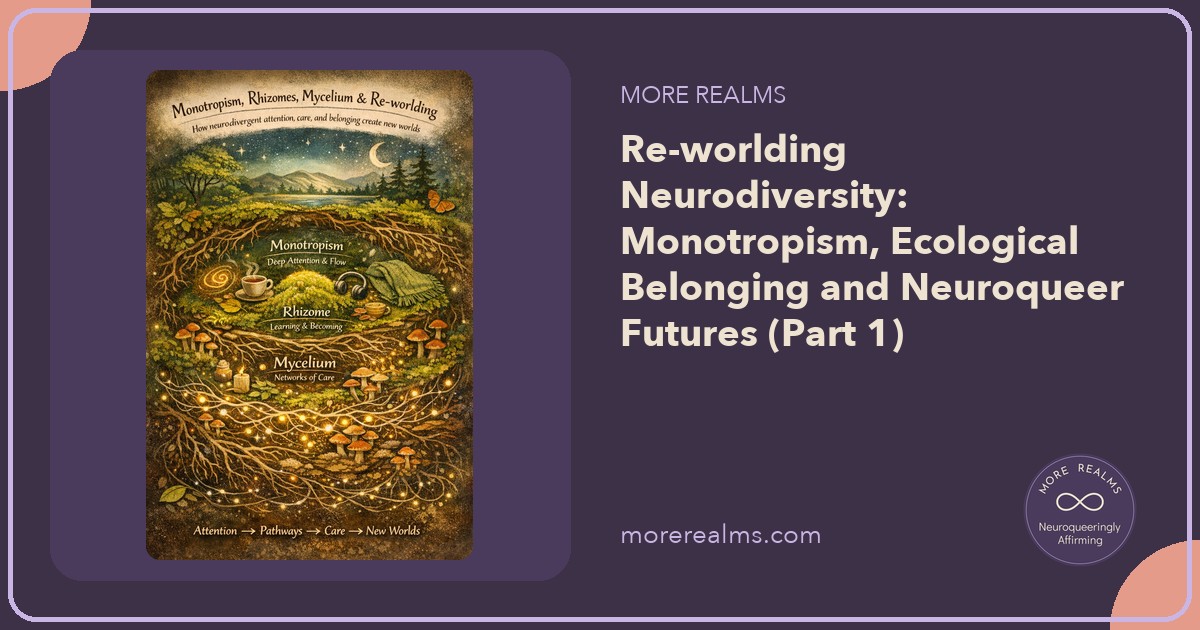
    Illustrated ecological infographic showing layers underground and above ground. At the centre is moss labelled “Monotropism – Deep Attention & Flow.” Around it are spreading roots labelled “Rhizome – Learning & Becoming.” Further out are glowing fungal threads and mushrooms labelled “Mycelium – Networks of Care.” Above ground is a landscape with trees, stars, and sky representing “Re-worlding.” Sensory objects such as a blanket, headphones, leaves, and a cup of tea appear within the layers. A spiral symbol represents nonlinear time. Text at the bottom reads: “Attention → Pathways → Care → New Worlds.” Created by AI ChatGPT

    Rhizomes can help us understand how our attention moves, mycelial networks can help us understand how life can be sustained and become more-than, so we can thrive.

    In nature, underground, fungal systems connect organisms through shared pathways of nourishment and communication. Resources move toward areas of stress and these signals travel so that survival emerges collectively.

    Neurodivergent wellbeing often unfolds in similar relational ways.

    Support may come through:

    • shared knowledge within community
    • sensory-friendly neurodivergent informed environments
    • flexible pacing and recovery time
    • everyday acts of relational care (See: Minor Gestures, Erin Manning)

    Distress and burnout are not individual signs of failure. They often arise between people and environments structured around narrow neuronormative perceptions and expectations of productivity, attentional resourcing, and behaviour.

    As Manning suggests, small relational actions such as checking in, allowing rest, and respecting communication differences all accumulate over time. These “minor gestures” form survival infrastructures that enable people to continue participating in the world.

    Mycelial thinking and processing remind us that regulation is rarely solitary; it is ecological.


    Re-worlding through monotropic pathways

    When our Autistic/ ADHD monotropic attention is supported rather than suppressed, new possibilities can emerge. Learning experiences can shift from compliance-driven to interest-led. Work can follow rhythms of deep focus rather than constant multitasking and overwhelm. Communities can form around shared meaning rather than normative expectations.

    Re-worlding begins in the margins and liminal spaces where alternative forms of knowledge and belonging are already being created like NeuroHub Connect and Stimpunks. These spaces allow people to connect without having to become “less weird” or more productive to be valued.

    Rhizomatic pathways open new worlds by allowing divergence.

    Mycelial infrastructures sustain those worlds by enabling care.

    Together, they help us move from survival toward collective flourishing.


    Ethodiversity and more-than-human belonging

    Ethodiversity (Tarragnat) invites recognition of the many valid ways to sense, regulate, and participate in life. Humans are not separate from ecological systems but deeply entangled within them.

    For many neurodivergent people, relationships with environments — light, sound, movement, animals, landscapes — are central to our wellbeing. Regulation may occur through connection with water, trees, textures, or different rhythms and flows. These are not luxuries but essential forms of co-existence and participation in shared ecosystems.

    From this perspective:

    • attention is ecological
    • identity is relational
    • care is collective
    • difference is generative

    Neurodivergent experience becomes part of a wider diversity of life’s ways of being.


    Toward neuroqueer ecologies of becoming

    Rhizomes remind us that there is no single correct pathway through learning or identity. Mycelium reminds us that there is no solitary pathway to survival. Monotropism shows how deep attention can create new routes through meaning and connection.

    Together, these ideas invite movement toward worlds shaped by curiosity, interdependence, and collective care. Re-worlding does not begin with large structural change alone. It begins in everyday practices, such as following interests, building supportive relationships, co-regulation, parallel play, body doubling work and creating sensory-affirming spaces, and sharing knowledge across communities. All of the Neurodivergent Love Languages are relevant and important.

    Neuroqueer ecologies are already forming. They grow through attention, care, and shared imagination.


    See Part 2: When the Ecology Fractures: Monotropism and Autistic Burnout


    See Part 3: Burnout Recovery as Ecological Re-Assembly


    Find out more:


    Chapman, R. (2023). Empire of normality: Neurodiversity and Capitalism. Pluto Press (UK).

    Deleuze, G., & Guattari, F. (1987). A thousand plateaus: Capitalism and schizophrenia. University of Minnesota Press.

    Deligny, F. (2013). The Arachnean and other texts. Univocal.

    Edgar, H. (2026). The autistic rhizome: Community, liminal spaces & belonging. https://autisticrealms.com/the-autistic-rhizome-community-liminal-spaces-belonging/

    Gray-Hammond, D. (2025). Mental health as an ecosystemic process. NeuroHub Connect.

    https://neurohubcommunity.org/2025/12/21/mental-health-ecosystemic-model

    hooks, b. (1984). Feminist theory: From margin to center (Chap. 2). South End Press.

    Lorde, A. (1977). The transformation of silence into language and action. In Sister outsider: Essays and speeches (pp. 40–44). Crossing Press.

    Manning, E. (2016). The minor gesture. Duke University Press.

    Milton, D. E. M. (2013). ‘Clumps’: An autistic reterritorialisation of the rhizome.

    Sins Invalid https://sinsinvalid.org

    Tarragnat, O. (2025). What is ethodiversity? https://ombretarragnat.com/2025/02/25/what-is-ethodiversity/

    Walker, N. (2021). Neuroqueer heresies: Notes on the neurodiversity paradigm, autistic empowerment, and postnormal possibilities. Autonomous Press.


    Discover more

    Courses, books and resources

    If you would like to take these ideas further, my courses, books and resources live on Autistic Realms. Everything in the shop is pay what you can, and many resources are free.