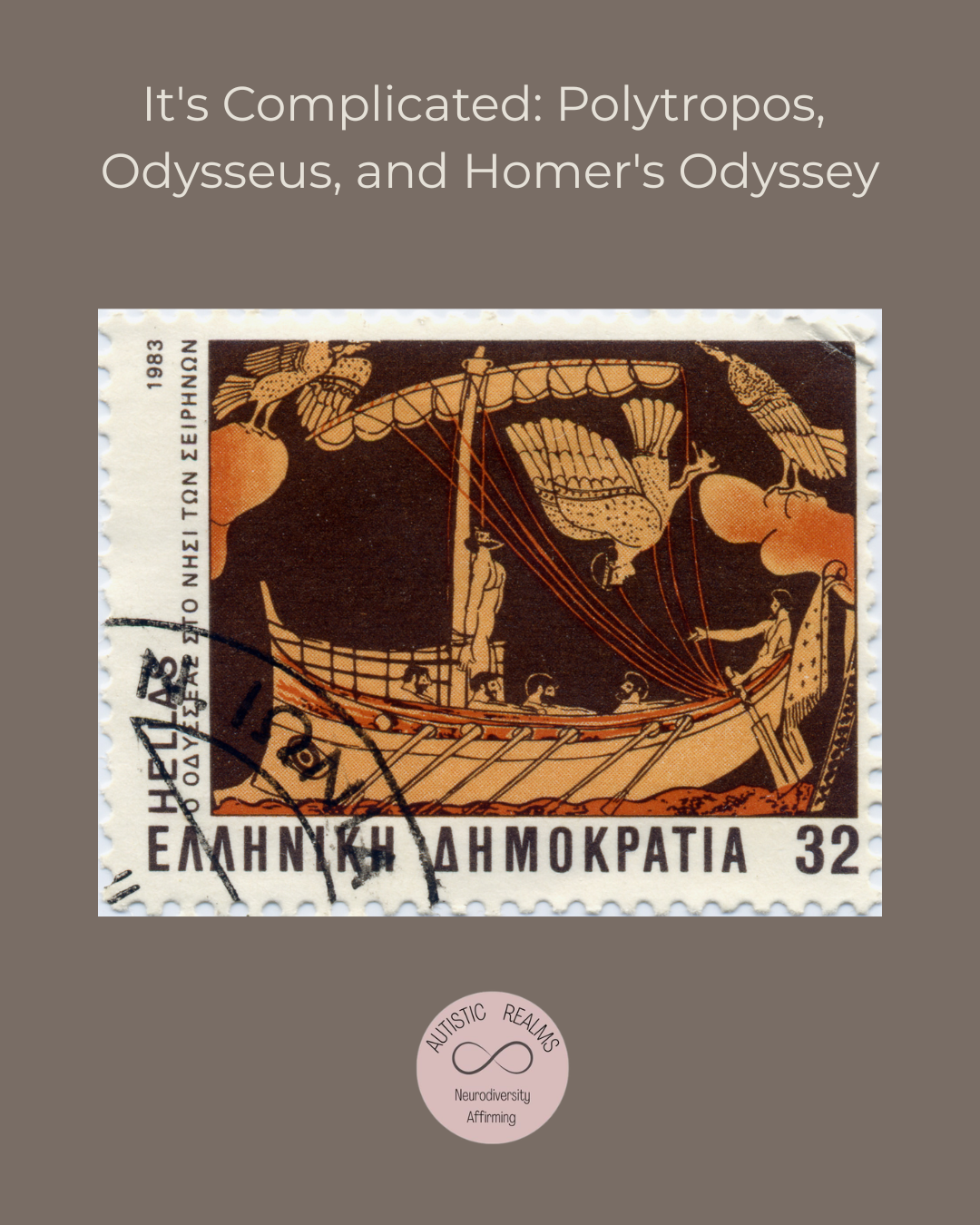
What if the thing that made Odysseus remarkable wasn’t his many turns, but the one thing that never turned? A personal, AuDHD read on Homer’s Odyssey and the words polytropos and monotropos.
Watching Christopher Nolan’s The Odyssey (2026) left me thinking about the Greek word that opens Homer’s poem: πολύτροπος (polytropos). At first glance, one possible translation of polytropos, “many-turned,” seems almost the opposite of monotropism, the theory that Autistic attention is often organised around fewer, deeply engaging interests rather than being broadly distributed across many competing demands (Murray, Lesser, & Lawson, 2005; Murray, 2022). Yet Odysseus suggests that these ideas may not be simple opposites: a person can adapt in many ways while remaining profoundly oriented towards one enduring purpose.
Polytropos and monotropos share a root. Both come from tropos, “a turn, a way of being,” joined to a different first element: poly- (“many”) against mono- (“one”). Where polytropos described someone of many turns — Homer’s word for Odysseus’s resourcefulness and adaptability — monotropos described someone of a single turn.
The relationship is therefore suggestive rather than equivalent. Polytropos describes a quality attributed to Odysseus’s character, while monotropism describes a theory of attentional organisation. The shared root offers a useful point of reflection, not a claim that the two concepts describe the same or different things.
What strikes me most isn’t Odysseus’s many twists and turns. It is the one thing that never diverted his attention or devotion from Penelope and his family. Against everything thrown at him, the gods, the sea, monsters, temptation, and years away from home, Odysseus never loses sight of returning to Penelope and his family. His deepest orientation never shifted. His methods changed constantly, but they remained organised around one enduring purpose.
Polytropos is the very first adjective Homer uses to describe Odysseus. Translators have wrestled with that single adjective (polytropos / πολύτροπον) for centuries. Richmond Lattimore famously rendered it as “the man of many ways” (Homer, 1965). Robert Fagles gave us “the man of twists and turns” (Homer, 1996). Emily Wilson’s 2018 translation, which Nolan appears to draw on heavily, opens instead: “Tell me about a complicated man” (Homer, 2018).
Each translation highlights something slightly different. Lattimore foregrounds versatility; Fagles emphasises movement and perhaps unpredictability; Wilson stresses the complexity of Odysseus’s character, encompassing his suffering, his deceptions, and his long wanderings, rather than presenting him as a straightforward hero.
Wilson has written about this choice in her blog “On Complicated…” (Wilson, 2024). She ruled out coining an artificial word like “much-turny,” since polytropos is “a real, legitimate Greek word,” and she wanted an equally English word rather than an invented one. Wilson’s “complicated” captures the layered nature of Odysseus: his suffering, deception, adaptability, and contradictions. She also notes that in later Greek the word travelled beyond Odysseus himself: Thucydides used it of “manifold circumstances,” and it was later applied to changeable diseases and even to the notorious turncoat Alcibiades, so a purely negative or purely positive rendering never seemed quite adequate to her either.
Interestingly, the word polytropos is itself a bahuvrihi compound: poly (“many”) and tropos (“turn,” “way,” or “manner”). Rather than naming an action, it describes someone by a characteristic they possess. In Homer, Odysseus is someone who adapts and turns to his many changing circumstances.
However, these translations all leave another aspect of Odysseus’s character slightly less visible: every one of those turns serves a single, enduring purpose. His adaptability is not aimless; every turn is complicated and organised around one unwavering direction of attention, that of returning home to Penelope, his family, and Ithaca.
Before watching the film, I came across a Bluesky post by Fergus Murray that pointed me towards an interesting connection between the word polytropos and the later Greek word monotropos. That led me to the work of the classicist P. A. Meijer, who discusses the philosopher Antisthenes’ interpretation of polytropos (Meijer, 2017).
Antisthenes argued Odysseus earned the word polytropos because he knew how to deal with all kinds of people, shifting his approach depending on who he was talking to and what the moment called for. His many “turns” weren’t deceptive tricks; they could be seen as different ways of meeting different situations and different people.
The word monotropos does not appear in Homer’s Odyssey itself although it shares the same linguistic root as polytropos (tropos, meaning a way or mode of turning). The theory of monotropism uses that root to describe a characteristic style of attention in which cognitive resources are concentrated into a smaller number of intensely focused interests, rather than spread broadly across many competing demands — a pattern many Autistic and ADHD people recognise strongly in their own experiences (Murray, Lesser, & Lawson, 2005).
I’m not suggesting that Odysseus was Autistic, and I don’t think it’s relevant to speculate about how a Bronze Age literary character might score on the monotropism questionnaire. That’s definitely not the point of this blog. What interests me is how these different but related words invite us to think about attention and ways of being.
Polytropos has generally been used in various differently worded translations of Homer’s Odyssey to describe Odysseus as a man capable of many approaches. Monotropism describes the way a person’s attention is deeply organised around a limited number of concerns at any one time. Together, these words may help to illuminate human behaviour, how we respond to the world around us, and how our attention is organised, what drives and motivates us.
Antisthenes’ interpretation of polytropos, as discussed by Meijer, suggests that someone who cannot vary their approach to different people may appear limited or one-sided. Read through a contemporary lens, it’s easy to hear echoes of the deficit-based accounts that have shaped autism research for decades.
One of the most influential examples is the theory of mind hypothesis, which came to be interpreted as suggesting that Autistic people lacked the capacity to understand that other people have different thoughts, beliefs, and perspectives from their own (Baron-Cohen, Leslie, & Frith, 1985). It contributed to a broader, hugely problematic narrative that framed Autistic social differences primarily as deficits.
More recently, Damian Milton’s Double Empathy Problem has challenged that assumption. Rather than suggesting communication difficulties and responsibilities lie solely with Autistic people, Milton argues that misunderstandings arise because people with different ways of experiencing and interpreting the world often struggle to understand one another. Communication is relational; the difficulty lies in the mismatch between different perspectives, not necessarily in a deficit on one side (Milton, 2012).
I think this shift is important because it changes how we think about adaptability, attention, and flexibility. Someone who does not naturally change their communication style from person to person may certainly experience friction in predominantly neuronormative environments, but whether that should be understood as a personal deficiency or as a difference between communicative styles is a very different question, and one where the responsibility should be mutual.
It proposes that Autistic attention tends to be organised around fewer, more deeply engaged interests, with cognitive resources concentrated rather than widely distributed (Murray, Lesser, & Lawson, 2005). It is an account of how attention is allocated, not a judgement about its value.
Watching Nolan’s film of The Odyssey, what struck me wasn’t Odysseus’s versatility alone as a “man of many twists and turns”. Every disguise and every adaptation seemed to serve the same enduring goal: to reunite with Penelope and return to Ithaca. His attention never wandered, his methods changed constantly, but his purpose didn’t; he remained focused, fully absorbed in his quest.
Odysseus lies when necessary, disguises himself, negotiates, fights, flatters, persuades, and endures. He changes his approach as each new situation and context demands. Yet inwardly, he seems quite monotropically focused; every turn ultimately points towards Ithaca. His many ways are all organised around one unwavering orientation.
Perhaps this is why polytropos has proved so difficult to translate. Another point Wilson shares that feels worth ending on is that tropos itself doesn’t just mean “turn.” It also carries the sense of a way of life, a custom, a habit, a guise, a manner, a character (Wilson, 2024).
Odysseus’s many turns, in that light, were the many guises, habits, and ways he had to adapt to survive. He was, in every sense of the word, a complicated man. I like Wilson’s choice of translation, and after all this thought, it feels right and truly captures him. She chose a word that evokes the imagery of folding and layering, that lands with the same weight and pace of the original poem. It carries an immediate meaning that everyone can relate to, while still opening onto something more, a hint of truths still to come (Wilson, 2024).
Underneath every guise, one thing never changed. Odysseus’s complicated greatness lies less in how many ways he can turn than in what all those turns were for. For all his disguises and transformations, he remains profoundly oriented towards home. His complicatedness makes sense because it also expresses the complexity of his one enduring commitment, to finally return home to Penelope, his family, and Ithaca.
References
Baron-Cohen, S., Leslie, A. M., & Frith, U. (1985). Does the autistic child have a “theory of mind”? Cognition, 21(1), 37–46. https://pubmed.ncbi.nlm.nih.gov/2934210/
Homer. (1965). The Odyssey of Homer (R. Lattimore, Trans.). Harper & Row.
Homer. (1996). The Odyssey (R. Fagles, Trans.). Viking.
Homer. (2018). The Odyssey (E. Wilson, Trans.). W. W. Norton.
Meijer, P. A. (2017). A new perspective on Antisthenes: Logos, predicate and ethics in his philosophy. Amsterdam University Press.
Milton, D. E. M. (2012). On the ontological status of autism: The “double empathy problem”. Disability & Society, 27(6), 883–887. https://www.tandfonline.com/doi/abs/10.1080/09687599.2012.710008
Murray, D., Lesser, M., & Lawson, W. (2005). Attention, monotropism and the diagnostic criteria for autism. Autism, 9(2), 139–156. https://pubmed.ncbi.nlm.nih.gov/15857859/
Murray, F. (2022). Monotropism.org. https://monotropism.org/
Murray, F. [@oolong.co.uk]. (2025, March 25). Just discovered that monotropos and polytropos appear in Homer! [Post]. Bluesky. https://bsky.app/profile/oolong.co.uk/post/3ll7nqaacsk2l
Wilson, E. (2024, September 16). On complicated… [Blog post]. EMILY’s Substack. https://emily613.substack.com/p/on-complicated