A Stimpunks Foundation street, with rooms dreamed up by Ryan Boren, Helen Edgar of Autistic Realms and More Realms, and the wider Stimpunks community
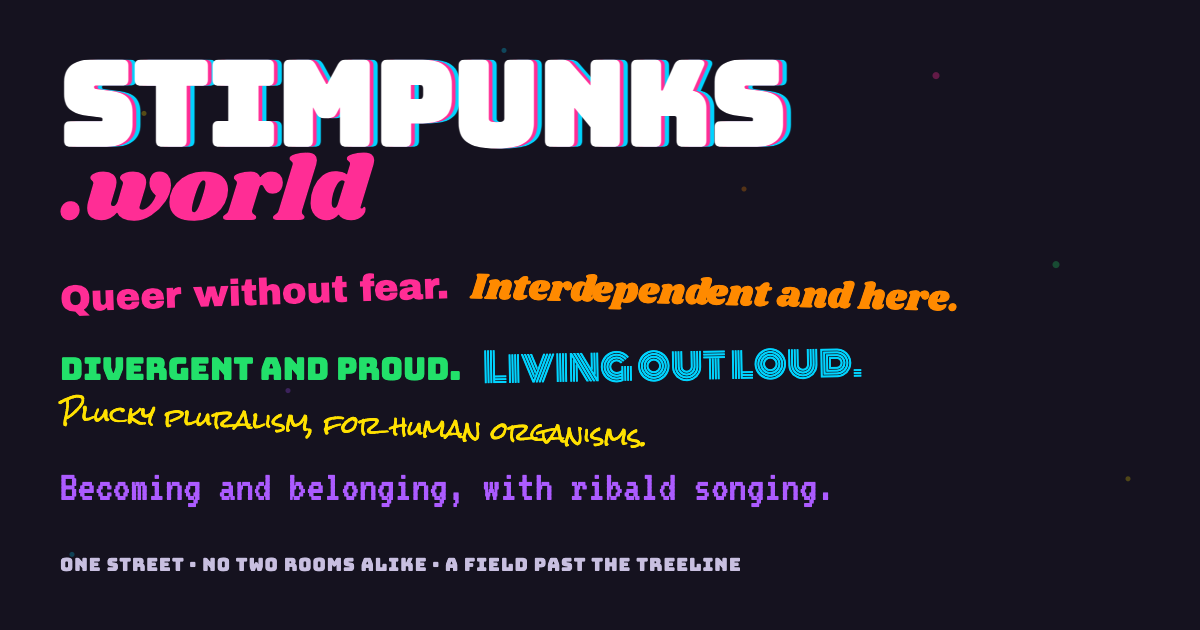
Queer without fear. Interdependent and here. Divergent and proud. Living out loud. Those four lines hang over the entrance to Stimpunks.World, and they set the tone for everything you will find once you step onto the street.
Stimpunks.World is a street you can wander at your own pace. Each shopfront opens onto a room with its own colours, its own typefaces and its own mood, and the rooms have been made so that no two of them match. There is a dancefloor and a punk club, a zine table and a comedy club reached down a ramp, a burrow of belonging for burnouts, a samefood café, a relaxed picture house where the house lights stay up, and a Dopamine Dress-Up Den that began as one of my own ideas. Past the treeline there are campgrounds for anyone who would rather not live on a street at all, and past the last streetlight the Outskirts keep their after-dark premises.
At the entrance, a dial asks how loud you would like it, anywhere from Gentle to Max Glitter. The street starts wherever your own device says, and nothing moves, flashes or plays until you choose. That small dial carries a great deal of what we believe about access. Sensory autonomy belongs to the person arriving, and a place can be full of glitter and delight while still letting each of us decide how much of it we take in.
Did you know?
The street has a name, and it belongs to someone else. Danny the Street is a character from DC Comics’ Doom Patrol, created by Grant Morrison and Richard Case in 1990: a living, joyfully gender-nonconforming street who turns up wherever somebody needs shelter and rearranges themselves to suit whoever has arrived (Morrison & Case, 1990). Rooms that refuse to match, a field for those who need to be a little apart, and a shopfront with the keys left in the door all come from Danny, and the site says so proudly.
Most of what Stimpunks makes is careful on purpose, with careful palettes, careful sourcing and careful hedging. Stimpunks.World is the playful other half of that same breath. It keeps just two careful habits. The first is attribution, because crediting people is both a licence and a form of respect, so every song, typeface, quotation and borrowed name is credited in the liner notes. The second is contrast, because clashing colours still need to be readable for everyone who visits (Stimpunks Foundation, 2026).
Where would you like to wander today?
There is no right way round the street, and nothing on it is scored, counted or ranked. You might want the dancefloor on a bright day and the quiet of the burrow by evening, and both are waiting for you.
- 🪩 The rooms: from the Pink Pony Club dancefloor to the Latibulum, the Healing Checkpoint and the Lightbulb Picture House, every shopfront is a small world of its own.
- 🗺️ The Map: the whole street as a white card model on a cutting mat, so you can see where everything stands before you set off.
- 🌿 The Garden: through the gate in the wall, with one bed for every site Stimpunks publishes and the hands that tend each one.
- 🏕️ The Campgrounds: pitches in a field past the treeline, for those who would rather be at peace in nature with the street still in reach.
- 🔑 Your Room: an empty storefront with the keys in the door, waiting for someone in the community to make it their own.
Everything on the street is free to visit, and the street itself rearranges for whoever walks down it. Come as you are, turn the dial to wherever feels right, and wander.
Come and visit my Faery Yurt
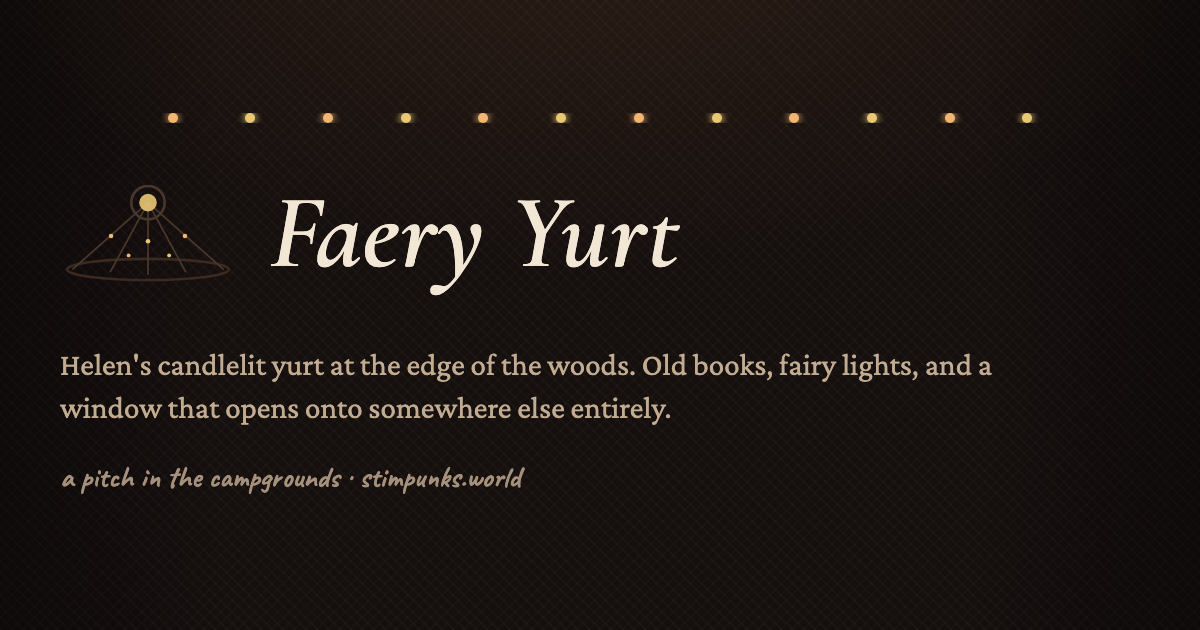
If you follow the fairy lights from the treeline, past the edge of the street and into the campgrounds, you will find my yurt, pitched at the edge of the woods with a stream tracing the trees. It is always night in there, the good kind of night, with candles along the shelves and fairy lights strung low across the canvas so the whole room glows amber. The sofas are far too soft (you sink, and then you stay), the ivy came in through the window frame years ago and was never asked to leave, and the flap of the door is always open. Take your shoes off and stay as long as you need to.
Inside, there is a soundtrack called Faery Yurt’s Yarn, a playlist of the songs I keep coming back to, from Pink Floyd, Kate Bush and AURORA to Portishead, Tracy Chapman, Ezra Furman and The Orb. Nothing plays until you press it. Behind my desk sits a bookshelf of the writers I return to again and again, among them Virginia Woolf, Emily Dickinson, Sylvia Plath, Deleuze and Guattari, Spinoza, Tyson Yunkaporta and Helen De Cruz. At the far end of the room there is a Glimmer Window that does not look out onto the field at all, and nobody is quite sure where it does look out, so you will have to open the shutters and see for yourself.
There is also a regulation nook, because every good library needs one, with a small mountain of blankets, a squad of squishmallows, the smell of vanilla cupcakes, a standing supply of coffee, and cheese and pesto for emergencies. The cats, the dog and the hamster who share the yurt with me all have strong opinions about who it really belongs to. By the door you will find pebbles, in the spirit of penguin pebbling: a basket of little things I have left out for anyone to take, and a bowl where you can leave one of your own. As everywhere on the street, the dial lets you choose how loud it gets, and at Max Glitter the fairy lights come on and the record starts to turn.
References
Morrison, G. (Writer), & Case, R. (Artist). (1990). Doom Patrol (Vol. 2). DC Comics.
Stimpunks Foundation. (2026). Stimpunks.World. https://stimpunks.world/