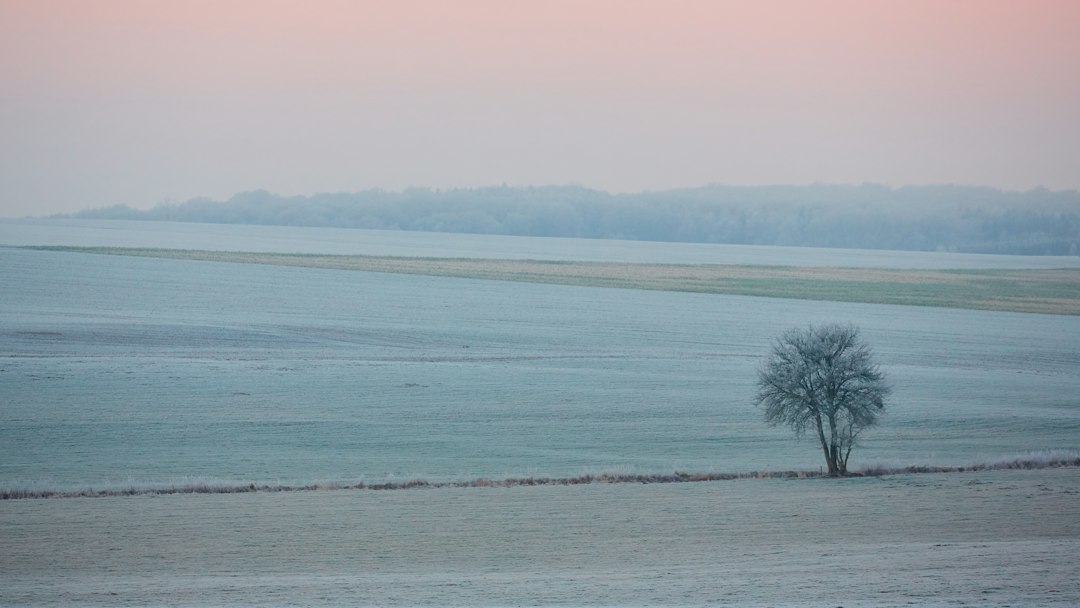
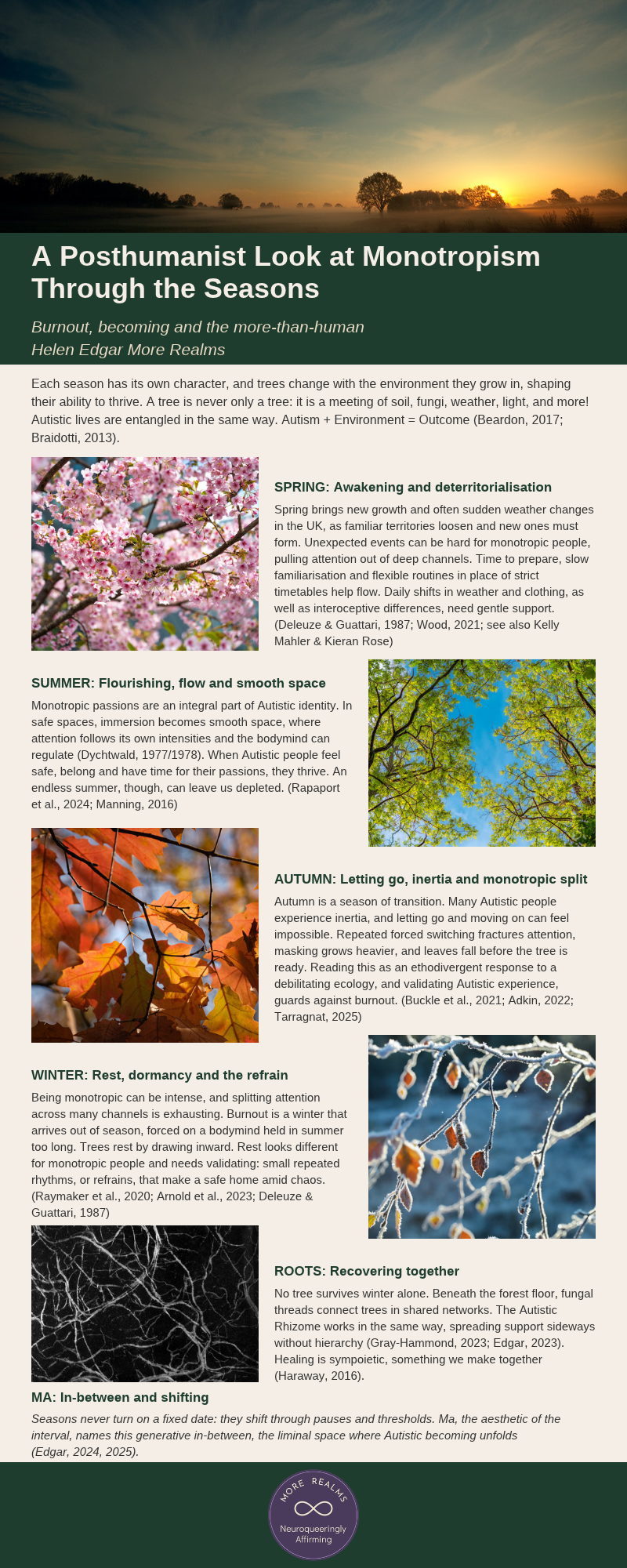
Trees have an interesting place in the philosophy of Gilles Deleuze and Félix Guattari. In A Thousand Plateaus, they use the tree as an image of hierarchical thinking, with a single trunk and branches that always lead back to one origin. They set it against the rhizome, which spreads sideways, connects any point to any other and has no centre (Deleuze & Guattari, 1987). Yet the more I learn about real trees, the more rhizomatic they turn out to be. Beneath the forest floor, roots and fungal threads weave trees into vast underground networks that share water, sugars and signals (Simard, 2021). A tree is never only a tree. It is a meeting place of soil, fungi, weather, insects, birds and light.
Posthumanism invites us to step away from the idea of the human as a separate, self-contained individual and to notice how we are always entangled with the more-than-human world (Braidotti, 2013). Donna Haraway (2016) calls this sympoiesis, a making-with, in which nothing truly makes itself. Autistic burnout can be understood in exactly this way. It is too often treated as a private failure of one person’s resilience, when it emerges from a whole ecology of demands, environments, expectations and relationships. Luke Beardon’s (2017) equation, Autism + Environment = Outcome, already points in this direction, and the seasons give us a way of feeling it in the bodymind (Dychtwald, 1977/1978).
Monotropism and Ethodivergence
Monotropism is a theory of autism developed by Dinah Murray, Wenn Lawson and Mike Lesser (Murray et al., 2005). It suggests that Autistic people tend to focus attention intensely on a small number of interests at any one time, drawing our attention resources deeply into whatever matters most to us in that moment. Polytropic people (likely those who are not Autistic or ADHD), tend to spread attention more thinly and evenly across many things at once.
The concept of ethodivergence widens the lens further. Ombre Tarragnat (2025) uses ethodivergence to name behaviours that depart from what is typical for a species, from the norms of a particular ecological or social setting, or from ethonormativity, the human-centred rules about which behaviours count as acceptable in humans and other animals. Tarragnat also notes that ethodivergence, much like neurodivergence, can open distinctive forms of flourishing while also leaving beings vulnerable, and that some divergences are shaped by debilitating environments. Monotropic ways of attending, moving and resting are ethodivergent in this sense. Burnout tells us far more about the environments that debilitate these ways of being than about any flaw within them.
Spring: Deterritorialisation and New Growth
Spring brings awakening, new growth and sudden change. In Deleuzian language it is a season of deterritorialisation, when familiar territories loosen and new ones have to be made. For a monotropic person, every unexpected change asks attention to be pulled out of one deep channel and pushed into another, and that carries a real energetic cost. Spring is also when many of the conditions for later burnout are quietly set. A new school year, a new job or a routine imposed at speed can mean weeks of constant reorientation with little time to settle. Interoceptive differences can add to this, because noticing hunger, thirst or temperature may take longer when attention is absorbed elsewhere, as the work of Kelly Mahler and Kieran Rose explores. Gentle preparation, slow familiarisation and flexible routines give new territories time to form.
Summer: Flow and Smooth Space
Summer is the season of flourishing, and for monotropic people it is the image of following our passions into flow. Rapaport et al. (2024) found that Autistic adults’ accounts of task immersion closely matched understandings of flow, Autistic hyperfocus and monotropism, and many described the relief of being themselves without pretence. Deleuze and Guattari (1987) might call these moments smooth space, an open field where movement follows its own intensities, in contrast with striated space, which is divided, measured and timetabled. Erin Manning (2016) suggests that Autistic perception can attend to the whole field of experience before it is sorted into separate objects, a way of being with the world that is already more-than-human. Flow is one of our most important protections against burnout because it restores us.
Even summer carries risks, though. Trees do not stay in full leaf all year, and a culture of endless production asks the impossible of everyone. When flow becomes the only refuge from a hostile environment, other bodily needs can slip from attention, and a person may emerge from a long immersion depleted.
Autumn: Inertia and the Falling of Leaves
Autumn is the season of letting go, and it is often when the signs of approaching burnout become visible. Buckle et al. (2021) describe Autistic inertia as the difficulty of starting, stopping and switching, and their participants spoke of feeling stuck for long periods. When an environment keeps demanding rapid switches, attention fractures again and again. Tanya Adkin (2022) names this monotropic split, and over a sustained period it becomes the ground from which Autistic burnout grows. Autumn is when masking grows heavier, recovery time between demands shortens, and the tree begins to drop leaves whether it is ready or not. Reading these signs as ethodivergent responses to a debilitating ecology allows us to respond with care instead of adding more pressure.
Winter: Burnout, Dormancy and the Refrain
Winter is the season of rest. Trees enter dormancy in rhythm with light and temperature, drawing their resources down into the roots. Autistic burnout is a different kind of winter, one that arrives out of season and is forced upon a bodymind that has been held in summer for too long. Raymaker et al. (2020) define Autistic burnout as long-term exhaustion, loss of function and reduced tolerance to stimulus, arising from chronic life stress and a mismatch between expectations and abilities without adequate support. Arnold et al. (2023) confirmed these features with a larger group of Autistic adults.
Deleuze (1988), reading Spinoza, describes a body by what it can do, by its capacity to affect and be affected. Burnout shrinks that capacity, and recovery depends on conditions that allow it to grow again. Those conditions look different for every monotropic person. For some, rest is darkness and quiet. For others it is a familiar film, a favourite stim, a well-known walk, or time with an interest that feeds the bodymind. Deleuze and Guattari’s (1987) idea of the refrain is helpful here, describing the small repeated songs, routines and rhythms through which a creature makes a safe home amid chaos. Autistic rest is very often a refrain, and it deserves protection.
Ma: In-Between and Shifting
Seasons never turn on a fixed date. They arrive through pauses and thresholds, a week of mist between autumn and winter, a single warm afternoon before spring commits. The Japanese aesthetic concept of ma names this interval, the generative emptiness between things, and I have written before about the liminal spaces where Autistic becoming unfolds (Edgar, 2024, 2025). Monotropic attention knows these in-between states well. Moving between attention tunnels is not instant, and the shift itself is a space worth honouring rather than rushing. Deleuze and Guattari (1987) remind us that becoming happens in the middle, and Ma offers a gentler way of holding that middle: as rest, as breath, as the pause in which one season lets go of the next. Supporting Autistic people through transitions means protecting the in-between instead of collapsing it.
Roots: Recovering Together
No tree survives winter alone, and burnout recovery rarely happens in isolation. Through the Autistic Rhizome (Gray-Hammond, 2023; Edgar, 2023), David Gray-Hammond and I describe Autistic community as a spreading, non-hierarchical network, much closer to fungal threads than to a single trunk. Our more recent thinking on symphrenia (Edgar & Gray-Hammond, 2026) extends this into a sense of the bodymind as connected with others and with the living world. Sympoiesis reminds us that healing is something we make together.
Seasons rarely follow the calendar in Autistic lives. Someone may be in deep winter in July, or feel spring stirring in November. A posthuman, ethodivergent reading of monotropism asks us to look beyond the individual to the soil, weather and networks that shape every season. When we change the ecology, Autistic people have far more room to flourish.
Further Reading on More Realms
- Learning to See in the Dark: Burnout, Haraway and Staying with the Trouble
- Lines, Not Nodes: Redefining the Autistic Rhizome
- Forests, Flow and Rhizomatic Communities
Featured image: Photo by Johny Goerend on Unsplash.
References
Adkin, T. (2022). Guest post: What is monotropic split? Emergent Divergence.
Arnold, S. R. C., Higgins, J. M., Weise, J., Desai, A., Pellicano, E., & Trollor, J. N. (2023). Confirming the nature of autistic burnout. Autism, 27(7), 1906–1918. https://doi.org/10.1177/13623613221147410
Beardon, L. (2017). Autism and Asperger syndrome in adults. Sheldon Press.
Braidotti, R. (2013). The posthuman. Polity Press.
Buckle, K. L., Leadbitter, K., Poliakoff, E., & Gowen, E. (2021). “No way out except from external intervention”: First-hand accounts of autistic inertia. Frontiers in Psychology, 12, 631596. https://doi.org/10.3389/fpsyg.2021.631596
Deleuze, G. (1988). Spinoza: Practical philosophy (R. Hurley, Trans.). City Lights Books.
Deleuze, G., & Guattari, F. (1987). A thousand plateaus: Capitalism and schizophrenia (B. Massumi, Trans.). University of Minnesota Press.
Dychtwald, K. (1978). Bodymind. Jove. (Original work published 1977)
Edgar, H. (2023, April 22). Autistic rhizome. Stimpunks Foundation. https://stimpunks.org/glossary/autistic-rhizome/
Edgar, H. (2024). Neuroqueering in the liminal spaces. Autistic Realms. https://autisticrealms.com/neuroqueering-in-the-liminal-spaces/
Edgar, H. (2025). Neuroqueering from the in-between. Autistic Realms. https://autisticrealms.com/neuroqueering-from-the-in-between/
Edgar, H., & Gray-Hammond, D. (2026). Symphrenia. The Wider Existence. https://thewiderexistence.co.uk/p/symphrenia
Gray-Hammond, D. (2023, April 21). Neuro-anarchy and the rise of the Autistic Rhizome. NeuroHub Connect. https://neurohubcommunity.org/2023/04/21/neuro-anarchy-and-the-rise-of-the-autistic-rhizome/
Haraway, D. J. (2016). Staying with the trouble: Making kin in the Chthulucene. Duke University Press.
Manning, E. (2016). The minor gesture. Duke University Press.
Murray, D., Lesser, M., & Lawson, W. (2005). Attention, monotropism and the diagnostic criteria for autism. Autism, 9(2), 139–156. https://doi.org/10.1177/1362361305051398
Rapaport, H., Clapham, H., Adams, J., Lawson, W., Porayska-Pomsta, K., & Pellicano, E. (2024). “In a state of flow”: A qualitative examination of autistic adults’ phenomenological experiences of task immersion. Autism in Adulthood, 6(3), 362–373. https://doi.org/10.1089/aut.2023.0032
Raymaker, D. M., Teo, A. R., Steckler, N. A., Lentz, B., Scharer, M., Delos Santos, A., Kapp, S. K., Hunter, M., Joyce, A., & Nicolaidis, C. (2020). “Having all of your internal resources exhausted beyond measure and being left with no clean-up crew”: Defining autistic burnout. Autism in Adulthood, 2(2), 132–143. https://doi.org/10.1089/aut.2019.0079
Simard, S. (2021). Finding the mother tree: Discovering the wisdom of the forest. Knopf.
Tarragnat, O. (2025). Biodiversity, neurodiversity, ethodiversity: Towards a more-than-human and more-than-neurological turn in neurodiversity studies. TRACE: Journal for Human-Animal Studies, 11.