
Tag: Posthumanism

  • Wintering as Becoming: Deleuze, Posthumanism and the Ecology of Autistic Burnout

    Wintering as Becoming: Deleuze, Posthumanism and the Ecology of Autistic Burnout

    Late November is a threshold season. The light thins, the trees have let go, and much of the life around us has gone underground or into stillness. I have been rereading Katherine May’s Wintering (2020) as a gentle language for Autistic burnout, and here I want to take that thinking further, into the philosophy that has shaped so much of my own understanding of Autistic life. That means the work of Gilles Deleuze, both alone and with Félix Guattari, and the wider posthumanist turn that decentres the individual human and treats life as relational, ecological and always in process.

    What happens to our understanding of Autistic burnout, and of rest, when we stop treating the burnt-out Autistic person as a broken individual machine and start to see burnout as an event in a living ecology, a season the bodymind passes through alongside everything else that winters?

    The Fallow Season

    May (2020) describes wintering as the periods when life pulls us out of its ordinary momentum, whether through illness, grief, crisis or exhaustion. Her method is quietly ecological. Faced with her own winter, she looked outward: to dormice slowing their bodies into hibernation, to bees clustering in the hive to share warmth, and to the rituals that people across cultures have used to mark the dark months. She writes that winter belongs to every cycle, and that a culture which refuses winter leaves people without shelter when their own arrives. May is Autistic, and she wrote about her adult diagnosis in The Electricity of Every Living Thing (May, 2018). Wintering isn’t written as a book about autism, but its refusal to pathologise withdrawal speaks deeply to Autistic readers, many of whom have lived through winters that went unseen and unnamed.

    What May offers through memoir, Deleuze and posthumanist thinkers offer in a different key. Each, in their own way, reads a life as part of a larger field of forces, relations and rhythms. Read together, they help move Autistic burnout away from the language of deficit and towards an ecological account of capacity, encounter and becoming.

    What Can an Autistic Body Do?

    Research on Autistic burnout has grown largely out of Autistic testimony. Raymaker et al. (2020) defined Autistic burnout as long-term exhaustion, loss of function and reduced tolerance to stimuli. It arises from chronic life stress and a mismatch between expectations and abilities without adequate support, and it typically lasts three months or more. Higgins et al. (2021) also described pervasive exhaustion, withdrawal and the loss of skills a person previously had. Two threads run through this work again and again: the cumulative cost of masking (Pearson & Rose, 2021), and the strain on monotropic attention, which tends to gather intensely around a small number of interests at once (Murray et al., 2005).

    Deleuze’s reading of Spinoza gives this research a wonderful philosophical frame. In Deleuze’s (1981/1988b) account, Spinoza defines a body less by its form or function than by its capacities to affect and be affected. Every encounter either composes with a body and increases its power of acting, or decomposes it and diminishes that power. Deleuze keeps returning to Spinoza’s provocation that we do not yet know what a body can do. Through this lens, Autistic burnout describes a bodymind (Dychtwald, 1977/1978) that has been through a long series of decomposing encounters: fluorescent light, relentless social demand, the labour of masking, and institutions that will not bend. The loss of speech or executive function that so many Autistic people describe is a contraction of the power of acting, under conditions that have been sad, in the Spinozist sense, for far too long.

    This framing matters because it places burnout in the relation between body and world. A capacity is always a capacity within a situation. An Autistic person who cannot speak in a supermarket may speak fluently, even joyfully, about a passionate interest in a quiet room with someone they trust. Burnout can then be read as information about how an environment is composed, and recovery as the slow work of finding encounters that compose with us again.

    The Refrain in the Dark

    In A Thousand Plateaus, Deleuze and Guattari (1980/1987) open their discussion of the refrain with an image of a child frightened in the dark who comforts themselves by singing under their breath. The song creates a fragile centre, a point of stability within chaos. From there the refrain draws a circle, a home territory, and from that territory it can eventually open out to the world again. Territory is made of rhythm, stimming and expression before it is made of walls.

    I find it hard to read this passage without thinking of stimming. Rocking, humming, scripting, flapping, repeating a beloved phrase or playing the same song on loop are all refrains in exactly this sense. They mark out a territory where an Autistic bodymind can gather itself. In burnout, when so many familiar territories have been lost, the refrain becomes a way of rebuilding home from the inside out. The same breakfast, the same walk and the same comforting video watched for the hundredth time all take part in this territorial work. Dominant clinical frames tend to treat these behaviours as symptoms to reduce. Deleuze and Guattari give us a vocabulary for seeing them as creative acts that make worlds.

    May (2020) writes about the rituals that carry people through winter, and the refrain helps explain why rituals work: they set up a rhythm the nervous system can lean against. In Deleuzian terms, burnout is a deterritorialisation so severe that it can leave a person with no ground at all. Wintering is the patient reterritorialisation through which a home is sung back into being.

    Durée and Vegetal Time

    Winter also asks us to think differently about time. Deleuze’s (1966/1988a) reading of Bergson distinguishes spatialised, measurable clock time from durée, the lived, qualitative time of consciousness in which past and present run into each other. Recovery from burnout happens in durée. It cannot be scheduled. When Autistic people are told they should be ‘better by now’, the frustration they feel is partly a collision between institutional clock time and the felt time of a bodymind healing at its own pace.

    Michael Marder’s (2013) philosophy of vegetal life adds another layer. Marder argues that plants live in a temporality of slowness, seasonality and repetition that human thought has tended to overlook or dismiss. A tree in winter is far from inert, it is doing the work of dormancy, holding its resources in its roots and waiting for conditions that allow growth. If we learned to honour vegetal time, we might start to recognise Autistic withdrawal as a kind of dormancy with its own intelligence. With its capacity for long, deep immersion (Murray et al., 2005), monotropic attention may sit closer to vegetal time than to the fragmented, accelerated attention that contemporary work and schooling demand.

    Posthuman Wintering

    Posthumanist thought starts from the recognition that the bounded, autonomous, rational individual at the heart of Western humanism was always a fiction. That fiction has been used to exclude many people from full humanity, including disabled, colonised, racialised and neurodivergent people. In its place, Rosi Braidotti (2013) proposes a vital materialist understanding of life as zoe, the generative force running through human and nonhuman life alike. From this view, the Autistic person in burnout is one node in a dense web of relations, and their winter is shared with soil, weather, animals, and the people and institutions around them.

    Donna Haraway’s (2016) concept of sympoiesis, or making-with, could be especially helpful here. Haraway argues that no living thing makes itself alone; beings come into existence together, through entangled relations. May’s (2020) bees clustering in the hive give a vivid picture of sympoietic wintering: a collective that survives the cold only by making warmth together. Erin Manning (2016) brings this relational thinking directly into conversation with neurodiversity. Drawing on Autistic writers, she describes Autistic perception as attuned to the field of relations before that field is sorted into separate objects, and she names neurotypicality as an unexamined norm that decides what counts as a proper way of being in the world.

    The Autistic Rhizome (Gray-Hammond, 2023; Edgar, 2023) carries these ideas into Autistic community itself. Deleuze and Guattari’s (1980/1987) rhizome grows sideways, without centre or hierarchy, through lines of flight and becoming. When one of us winters, those lines keep moving underground, through quiet messages, shared resources and spaces kept open for our return. David Gray-Hammond and I have named the connected, extended bodymind that these lines make possible symphrenia (Edgar & Gray-Hammond, 2026), a way of describing how bodyminds think and feel through each other. Read symphrenically, burnout becomes a strain within a shared ecology of minds, and rest becomes something we hold for and with one another however it may present in ways others can’t see, feel or hear.

    Rest as Affirmative Politics

    Braidotti’s (2006) nomadic ethics includes the idea of thresholds of sustainability: the limits beyond which a subject can no longer bear the intensities passing through it without breaking down. In this account, ethics means learning to recognise and respect those thresholds, both our own and other people’s. Autistic burnout can be understood as what happens when a society systematically ignores the thresholds of Autistic bodyminds, which gives rest an ethical and political charge.

    Tricia Hersey (2022) clarifies this as she frames rest as resistance to systems that treat human beings as machines, and she grounds her work in Black liberation and in the history of how white supremacy and capitalism have stolen rest from Black bodies. Her work insists that rest is distributed unequally. Autistic people who are also racialised, trans, poor, chronically ill or caring for others face particular barriers to stopping, and particular penalties when they do. Deleuze and Guattari (1980/1987) described capitalism as a machine that captures desire and redirects it into production. Hersey shows concretely whose bodies that machine has consumed most hungrily.

    Nick Walker’s (2021) work on neuroqueering adds another dimension. To neuroqueer is to actively subvert the normative performances of neurotypicality that have been imposed on us. Reclaiming rest on Autistic terms, whether through special interests, stimming, solitude, parallel company or monotropic flow, is a neuroqueer practice in this sense. It unsettles the script that says rest must look a certain way, be earned a certain way, and end at a certain time.

    Spring as Difference

    In Difference and Repetition, Deleuze (1968/1994) argues that repetition never produces the same thing twice. Each return is a new event that carries difference within it, and habit itself is a quiet contraction of past moments into a living present. This seems to me a fitting way to think about the end of a winter. Spring comes back every year, yet no two springs are alike, and no tree leaves winter exactly as it entered.

    Recovery from Autistic burnout is rarely a return to who we were before. Many Autistic people I know have come through with a sharper sense of their thresholds, a deeper commitment to their own refrains, and far less willingness to mask in spaces that never deserved that labour.

    In Deleuzian terms, recovery is a becoming.

    In posthumanist terms, it is a becoming-with: with the rhizome that held us, the rituals that sang us home, and the more-than-human seasons whose slowness we finally let ourselves share.

    If you are wintering now, I hope these ideas keep you some company in the dark, along with some trust that whatever grows from your roots will be new, and wholly yours. May be some of this resonates with you……

    Featured image: frosty sunrise above Helensburgh, 21 November 2026. Photo by David Howells.

    References

    Braidotti, R. (2006). Transpositions: On nomadic ethics. Polity Press.

    Braidotti, R. (2013). The posthuman. Polity Press.

    Deleuze, G. (1988a). Bergsonism (H. Tomlinson & B. Habberjam, Trans.). Zone Books. (Original work published 1966)

    Deleuze, G. (1988b). Spinoza: Practical philosophy (R. Hurley, Trans.). City Lights Books. (Original work published 1981)

    Deleuze, G. (1994). Difference and repetition (P. Patton, Trans.). Columbia University Press. (Original work published 1968)

    Deleuze, G., & Guattari, F. (1987). A thousand plateaus: Capitalism and schizophrenia (B. Massumi, Trans.). University of Minnesota Press. (Original work published 1980)

    Dychtwald, K. (1978). Bodymind. Jove. (Original work published 1977)

    Edgar, H. (2023, April 22). Autistic rhizome. Stimpunks Foundation. https://stimpunks.org/glossary/autistic-rhizome/

    Edgar, H., & Gray-Hammond, D. (2026, October 7). Symphrenia. The Wider Existence. https://www.thewiderexistence.co.uk/p/symphrenia

    Gray-Hammond, D. (2023, April 21). Neuro-anarchy and the rise of the Autistic Rhizome. NeuroHub Connect. https://neurohubcommunity.org/2023/04/21/neuro-anarchy-and-the-rise-of-the-autistic-rhizome/

    Haraway, D. J. (2016). Staying with the trouble: Making kin in the Chthulucene. Duke University Press.

    Hersey, T. (2022). Rest is resistance: A manifesto. Little, Brown Spark.

    Higgins, J. M., Arnold, S. R. C., Weise, J., Pellicano, E., & Trollor, J. N. (2021). Defining autistic burnout through experts by lived experience: Grounded Delphi method investigating #AutisticBurnout. Autism, 25(8), 2356–2369. https://doi.org/10.1177/13623613211019858

    Manning, E. (2016). The minor gesture. Duke University Press.

    Marder, M. (2013). Plant-thinking: A philosophy of vegetal life. Columbia University Press.

    May, K. (2018). The electricity of every living thing: A woman’s walk in the wild to find her way home. Trapeze.

    May, K. (2020). Wintering: The power of rest and retreat in difficult times. Rider.

    Murray, D., Lesser, M., & Lawson, W. (2005). Attention, monotropism and the diagnostic criteria for autism. Autism, 9(2), 139–156. https://doi.org/10.1177/1362361305051398

    Pearson, A., & Rose, K. (2021). A conceptual analysis of autistic masking: Understanding the narrative of stigma and the illusion of choice. Autism in Adulthood, 3(1), 52–60. https://doi.org/10.1089/aut.2020.0043

    Raymaker, D. M., Teo, A. R., Steckler, N. A., Lentz, B., Scharer, M., Delos Santos, A., Kapp, S. K., Hunter, M., Joyce, A., & Nicolaidis, C. (2020). “Having all of your internal resources exhausted beyond measure and being left with no clean-up crew”: Defining autistic burnout. Autism in Adulthood, 2(2), 132–143. https://doi.org/10.1089/aut.2019.0079

    Walker, N. (2021). Neuroqueer heresies: Notes on the neurodiversity paradigm, autistic empowerment, and postnormal possibilities. Autonomous Press.
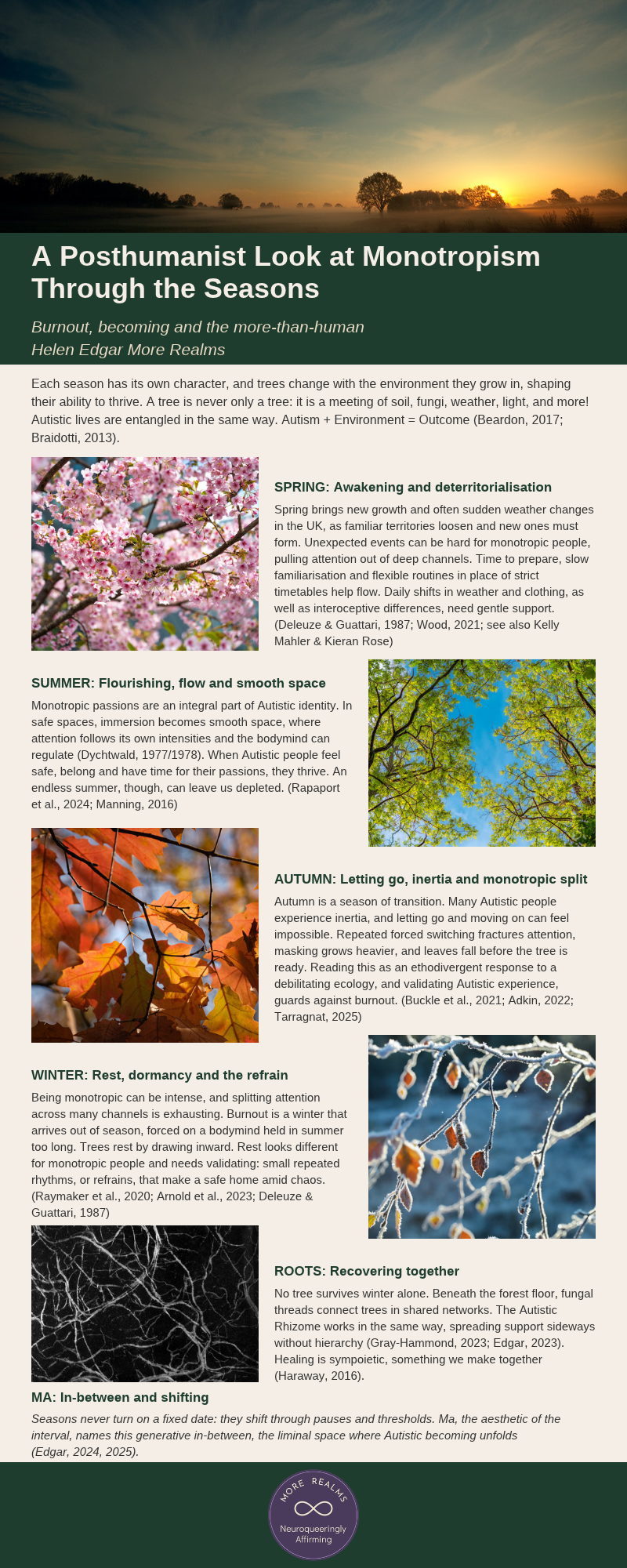
  • Monotropism Through the Seasons: Burnout, Becoming and the More-Than-Human

    Monotropism Through the Seasons: Burnout, Becoming and the More-Than-Human

    Trees have an interesting place in the philosophy of Gilles Deleuze and Félix Guattari. In A Thousand Plateaus, they use the tree as an image of hierarchical thinking, with a single trunk and branches that always lead back to one origin. They set it against the rhizome, which spreads sideways, connects any point to any other and has no centre (Deleuze & Guattari, 1987). Yet the more I learn about real trees, the more rhizomatic they turn out to be. Beneath the forest floor, roots and fungal threads weave trees into vast underground networks that share water, sugars and signals (Simard, 2021). A tree is never only a tree. It is a meeting place of soil, fungi, weather, insects, birds and light.

    Posthumanism invites us to step away from the idea of the human as a separate, self-contained individual and to notice how we are always entangled with the more-than-human world (Braidotti, 2013). Donna Haraway (2016) calls this sympoiesis, a making-with, in which nothing truly makes itself. Autistic burnout can be understood in exactly this way. It is too often treated as a private failure of one person’s resilience, when it emerges from a whole ecology of demands, environments, expectations and relationships. Luke Beardon’s (2017) equation, Autism + Environment = Outcome, already points in this direction, and the seasons give us a way of feeling it in the bodymind (Dychtwald, 1977/1978).

    Infographic titled "A Posthumanist Look at Monotropism Through the Seasons: Burnout, becoming and the more-than-human" by Helen Edgar, More Realms. A winter sunrise over a misty field with silhouetted trees sits above a dark green title band. Below, five sections pair close-up photographs with short text. Spring (pink blossom): awakening and deterritorialisation, when familiar territories loosen and unexpected change pulls attention out of deep channels. Summer (sunlit green leaves seen from below): flourishing, flow and smooth space, where immersion helps the bodymind regulate, though an endless summer can deplete us. Autumn (red and orange leaves): letting go, inertia and monotropic split, where repeated forced switching and masking lead towards burnout. Winter (frost-covered twigs): rest, dormancy and the refrain, with burnout described as a winter that arrives out of season. Roots (white fungal threads on black): recovering together through the Autistic Rhizome and sympoiesis. A final section, Ma: in-between and shifting, describes seasons as thresholds and pauses. A More Realms Neuroqueeringly Affirming logo closes the image.

    Monotropism and Ethodivergence

    Monotropism is a theory of autism developed by Dinah Murray, Wenn Lawson and Mike Lesser (Murray et al., 2005). It suggests that Autistic people tend to focus attention intensely on a small number of interests at any one time, drawing our attention resources deeply into whatever matters most to us in that moment. Polytropic people (likely those who are not Autistic or ADHD), tend to spread attention more thinly and evenly across many things at once.

    The concept of ethodivergence widens the lens further. Ombre Tarragnat (2025) uses ethodivergence to name behaviours that depart from what is typical for a species, from the norms of a particular ecological or social setting, or from ethonormativity, the human-centred rules about which behaviours count as acceptable in humans and other animals. Tarragnat also notes that ethodivergence, much like neurodivergence, can open distinctive forms of flourishing while also leaving beings vulnerable, and that some divergences are shaped by debilitating environments. Monotropic ways of attending, moving and resting are ethodivergent in this sense. Burnout tells us far more about the environments that debilitate these ways of being than about any flaw within them.

    Spring: Deterritorialisation and New Growth

    Spring brings awakening, new growth and sudden change. In Deleuzian language it is a season of deterritorialisation, when familiar territories loosen and new ones have to be made. For a monotropic person, every unexpected change asks attention to be pulled out of one deep channel and pushed into another, and that carries a real energetic cost. Spring is also when many of the conditions for later burnout are quietly set. A new school year, a new job or a routine imposed at speed can mean weeks of constant reorientation with little time to settle. Interoceptive differences can add to this, because noticing hunger, thirst or temperature may take longer when attention is absorbed elsewhere, as the work of Kelly Mahler and Kieran Rose explores. Gentle preparation, slow familiarisation and flexible routines give new territories time to form.

    Summer: Flow and Smooth Space

    Summer is the season of flourishing, and for monotropic people it is the image of following our passions into flow. Rapaport et al. (2024) found that Autistic adults’ accounts of task immersion closely matched understandings of flow, Autistic hyperfocus and monotropism, and many described the relief of being themselves without pretence. Deleuze and Guattari (1987) might call these moments smooth space, an open field where movement follows its own intensities, in contrast with striated space, which is divided, measured and timetabled. Erin Manning (2016) suggests that Autistic perception can attend to the whole field of experience before it is sorted into separate objects, a way of being with the world that is already more-than-human. Flow is one of our most important protections against burnout because it restores us.

    Even summer carries risks, though. Trees do not stay in full leaf all year, and a culture of endless production asks the impossible of everyone. When flow becomes the only refuge from a hostile environment, other bodily needs can slip from attention, and a person may emerge from a long immersion depleted.

    Autumn: Inertia and the Falling of Leaves

    Autumn is the season of letting go, and it is often when the signs of approaching burnout become visible. Buckle et al. (2021) describe Autistic inertia as the difficulty of starting, stopping and switching, and their participants spoke of feeling stuck for long periods. When an environment keeps demanding rapid switches, attention fractures again and again. Tanya Adkin (2022) names this monotropic split, and over a sustained period it becomes the ground from which Autistic burnout grows. Autumn is when masking grows heavier, recovery time between demands shortens, and the tree begins to drop leaves whether it is ready or not. Reading these signs as ethodivergent responses to a debilitating ecology allows us to respond with care instead of adding more pressure.

    Winter: Burnout, Dormancy and the Refrain

    Winter is the season of rest. Trees enter dormancy in rhythm with light and temperature, drawing their resources down into the roots. Autistic burnout is a different kind of winter, one that arrives out of season and is forced upon a bodymind that has been held in summer for too long. Raymaker et al. (2020) define Autistic burnout as long-term exhaustion, loss of function and reduced tolerance to stimulus, arising from chronic life stress and a mismatch between expectations and abilities without adequate support. Arnold et al. (2023) confirmed these features with a larger group of Autistic adults.

    Deleuze (1988), reading Spinoza, describes a body by what it can do, by its capacity to affect and be affected. Burnout shrinks that capacity, and recovery depends on conditions that allow it to grow again. Those conditions look different for every monotropic person. For some, rest is darkness and quiet. For others it is a familiar film, a favourite stim, a well-known walk, or time with an interest that feeds the bodymind. Deleuze and Guattari’s (1987) idea of the refrain is helpful here, describing the small repeated songs, routines and rhythms through which a creature makes a safe home amid chaos. Autistic rest is very often a refrain, and it deserves protection.

    Ma: In-Between and Shifting

    Seasons never turn on a fixed date. They arrive through pauses and thresholds, a week of mist between autumn and winter, a single warm afternoon before spring commits. The Japanese aesthetic concept of ma names this interval, the generative emptiness between things, and I have written before about the liminal spaces where Autistic becoming unfolds (Edgar, 2024, 2025). Monotropic attention knows these in-between states well. Moving between attention tunnels is not instant, and the shift itself is a space worth honouring rather than rushing. Deleuze and Guattari (1987) remind us that becoming happens in the middle, and Ma offers a gentler way of holding that middle: as rest, as breath, as the pause in which one season lets go of the next. Supporting Autistic people through transitions means protecting the in-between instead of collapsing it.

    Roots: Recovering Together

    No tree survives winter alone, and burnout recovery rarely happens in isolation. Through the Autistic Rhizome (Gray-Hammond, 2023; Edgar, 2023), David Gray-Hammond and I describe Autistic community as a spreading, non-hierarchical network, much closer to fungal threads than to a single trunk. Our more recent thinking on symphrenia (Edgar & Gray-Hammond, 2026) extends this into a sense of the bodymind as connected with others and with the living world. Sympoiesis reminds us that healing is something we make together.

    Seasons rarely follow the calendar in Autistic lives. Someone may be in deep winter in July, or feel spring stirring in November. A posthuman, ethodivergent reading of monotropism asks us to look beyond the individual to the soil, weather and networks that shape every season. When we change the ecology, Autistic people have far more room to flourish.

    Further Reading on More Realms

    Featured image: Photo by Johny Goerend on Unsplash.

    References

    Adkin, T. (2022). Guest post: What is monotropic split? Emergent Divergence.

    Arnold, S. R. C., Higgins, J. M., Weise, J., Desai, A., Pellicano, E., & Trollor, J. N. (2023). Confirming the nature of autistic burnout. Autism, 27(7), 1906–1918. https://doi.org/10.1177/13623613221147410

    Beardon, L. (2017). Autism and Asperger syndrome in adults. Sheldon Press.

    Braidotti, R. (2013). The posthuman. Polity Press.

    Buckle, K. L., Leadbitter, K., Poliakoff, E., & Gowen, E. (2021). “No way out except from external intervention”: First-hand accounts of autistic inertia. Frontiers in Psychology, 12, 631596. https://doi.org/10.3389/fpsyg.2021.631596

    Deleuze, G. (1988). Spinoza: Practical philosophy (R. Hurley, Trans.). City Lights Books.

    Deleuze, G., & Guattari, F. (1987). A thousand plateaus: Capitalism and schizophrenia (B. Massumi, Trans.). University of Minnesota Press.

    Dychtwald, K. (1978). Bodymind. Jove. (Original work published 1977)

    Edgar, H. (2023, April 22). Autistic rhizome. Stimpunks Foundation. https://stimpunks.org/glossary/autistic-rhizome/

    Edgar, H. (2024). Neuroqueering in the liminal spaces. Autistic Realms. https://autisticrealms.com/neuroqueering-in-the-liminal-spaces/

    Edgar, H. (2025). Neuroqueering from the in-between. Autistic Realms. https://autisticrealms.com/neuroqueering-from-the-in-between/

    Edgar, H., & Gray-Hammond, D. (2026). Symphrenia. The Wider Existence. https://thewiderexistence.co.uk/p/symphrenia

    Gray-Hammond, D. (2023, April 21). Neuro-anarchy and the rise of the Autistic Rhizome. NeuroHub Connect. https://neurohubcommunity.org/2023/04/21/neuro-anarchy-and-the-rise-of-the-autistic-rhizome/

    Haraway, D. J. (2016). Staying with the trouble: Making kin in the Chthulucene. Duke University Press.

    Manning, E. (2016). The minor gesture. Duke University Press.

    Murray, D., Lesser, M., & Lawson, W. (2005). Attention, monotropism and the diagnostic criteria for autism. Autism, 9(2), 139–156. https://doi.org/10.1177/1362361305051398

    Rapaport, H., Clapham, H., Adams, J., Lawson, W., Porayska-Pomsta, K., & Pellicano, E. (2024). “In a state of flow”: A qualitative examination of autistic adults’ phenomenological experiences of task immersion. Autism in Adulthood, 6(3), 362–373. https://doi.org/10.1089/aut.2023.0032

    Raymaker, D. M., Teo, A. R., Steckler, N. A., Lentz, B., Scharer, M., Delos Santos, A., Kapp, S. K., Hunter, M., Joyce, A., & Nicolaidis, C. (2020). “Having all of your internal resources exhausted beyond measure and being left with no clean-up crew”: Defining autistic burnout. Autism in Adulthood, 2(2), 132–143. https://doi.org/10.1089/aut.2019.0079

    Simard, S. (2021). Finding the mother tree: Discovering the wisdom of the forest. Knopf.

    Tarragnat, O. (2025). Biodiversity, neurodiversity, ethodiversity: Towards a more-than-human and more-than-neurological turn in neurodiversity studies. TRACE: Journal for Human-Animal Studies, 11.

  • Limerence, Monotropism and Neuroqueer Time

    Limerence, Monotropism and Neuroqueer Time

    Footfalls echo in the memory
    Down the passage which we did not take

    T. S. Eliot, “Burnt Norton” (1936), Four Quartets (1943)

    When Attention, Desire, Memory and Worlds Entangle

    On the Map of Monotropic Experiences that I developed with Stimpunks, there is a space marked as the lake of limerence. For many Autistic people, this “lake” can feel vast and deep, with a shoreline that keeps shifting, and you may often feel like you are drowning in it. What looks like a small feature on a map often becomes an entire inner landscape of longing, memory, and relational intensity, full of “what if” possibilities.

    I have also written about this in Monotropism, Limerence and Autistic ADHD Experiences on Autistic Realms; this piece goes further into time, desire and care.

    Limerence is rarely discussed in relation to autism. In dominant psychological and cultural narratives, it is most often framed as an intense crush, an immature fixation, or a transient phase that should naturally fade with time. Dorothy Tennov (1979), who first named and theorised limerence, described it as an involuntary state of emotional attachment, marked by intrusive thoughts, heightened sensitivity to another person’s responses, emotional dependency, and a powerful desire for reciprocation. Tennov emphasised that limerence does not respond reliably to insight, logic, or willpower. People do not simply decide to become limerent, nor can they easily decide to stop.

    Reflecting on Tennov’s work, Popova (2021) highlights her point that limerence can override a person’s own wellbeing and resist rational self-regulation, even when individuals recognise that a situation is painful, unequal, or unlikely to develop. For many Autistic people, this description may resonate. Limerence is rarely a superficial attachment that can be managed away through distraction or self-discipline. It often reorganises our inner lives, shaping how attention, memory, imagination, and emotion are patterned over time.

    Rather than treating this intensity as immaturity, excess, or personal failure, I am thinking about starting from a different perspective: could limerence be framed around the theory of monotropism, and how some Autistic and ADHD people attend, remember, and inhabit time and their relationships?

    Murray, Lesser, and Lawson (2005) describe monotropism as a tendency for Autistic attention to flow into a small number of deeply immersive channels at any one time, prioritising persistence, continuity, sustained engagement and flow states. Fergus Murray (2018) further develops this as a unified account of autism, in which immersion is a central organising feature of Autistic cognition and emotion. When attention settles, it builds continuity and constellations rhizomatically. It lays down pathways, and when those attentional pathways form around a person, the feelings that gather there often become deep.

    Many Autistic people experience time in layered, recursive, and emotionally dense ways. Memories can return with their original intensity, and meanings are often reworked and reformed. Old connections and previous relationships may remain accessible long after external circumstances have changed. In this sense, limerence is rarely about wanting someone in the present alone. It often involves living inside an ongoing constellation of memory, imagined futures, and relational “almosts” or “what could have beens”.

    I think the poet T. S. Eliot gives language to this experience in Four Quartets, in the lines from “Burnt Norton” at the top of this piece (Eliot, 1943), about footfalls echoing down a passage we did not take. These lines evoke how past experiences, unchosen paths, and unrealised possibilities remain emotionally present. For many monotropic people such echoes are close and alive rather than distant or abstract. Past relationships, unspoken conversations, and imagined futures continue to shape how feeling, memory, and hope are organised in the present too.

    For neurodivergent people memory is affective and relational as well as archival. When attention has once flowed deeply into a person or connection, that experience becomes part of their inner geography. It does not fade easily; it remains available for return, reinterpretation, and reactivation, something you can easily loop back into. This is what I have described as neuroqueer time (Edgar, 2025): a mode of temporality characterised by recursion, layering, and emotional continuity rather than linear progression and closure, continuously living in between past, present and future.

    Seen in this way, limerence is about much more than being “stuck.” It reflects a mode of relational depth shaped by sustained attention, embodied memory, and non-linear temporality. Attachment endures because it has been built through repetition, meaning-making, and emotional investment, perhaps also because a lack of safety and a fear of rejection, of never being quite ‘right’ or of being ‘too different’, make it feel too risky to be hurt or to hurt another person. You can’t just let go of limerent feelings by an act of willpower; it’s your entire attentional and emotional landscape, just looped into a person rather than any other interest.

    This piece brings together four interconnected lenses to help understand limerence more clearly through a neuro-affirming monotropic lens that may resonate with Autistic or otherwise neurodivergent people. First, it draws on limerence as a named psychological and relational experience (Tennov, 1979). Second, it situates limerence within monotropic attention, where depth and flow are central features (Murray et al., 2005). Third, it frames attachment within neuroqueer experiences of time, where emotional meaning unfolds through return, layering, reconfiguration and transformation. Finally, it attends to wider relational ecologies: the digital and systemic infrastructures that hold feeling in place, and the social conditions that shape vulnerability, belonging, and power.

    The aim is not to romanticise suffering. Limerence can be destabilising, exhausting, and painful, particularly when reciprocity is unclear or absent. Yet intensity is not the same as defect. Writing reflectively on limerence, Ljanta (2025) suggests that it can sometimes work as an emotional anchor, doing important regulatory and relational work, even when it hurts. Often, limerence points toward unmet needs for safety, recognition, reciprocity, and emotional attunement.

    This writing offers an invitation to restory our feelings without shame, and without reducing support to “just move on.” This reframing does not erase the difficulty of limerence; it changes the story of how it has been framed in the past through a neuronormative lens, and I hope it will begin to open ethical and practical possibilities for living with depth rather than being overwhelmed by it.

    What Is Limerence?

    Limerence is often described as “having a crush,” “being obsessed,” or “getting stuck” on someone. These framings tend to minimise both its intensity and its complexity. They suggest that limerence is immature, excessive, or something that should naturally fade with time. For many Autistic people, however, these descriptions may not reflect our lived reality. Limerence is rarely fleeting; it is often immersive, enduring, and deeply intertwined with identity, memory, and meaning.

    Dorothy Tennov’s (1979) original work remains foundational because she did not frame limerence as a moral failing or a sign of poor character. Importantly, Tennov emphasised that limerence does not respond reliably to rational control. People do not “choose” to be limerent, and insight alone is rarely enough to dissolve attachment. You likely know when you are limerent, but you may just feel helpless or stuck. For monotropic people, this gap between understanding and emotional release can be particularly pronounced and painful.

    Once monotropic attention has flowed into a channel, it tends to remain there, reinforced through repetition, imagination, and emotional investment (Murray et al., 2005). When a person becomes the focus of such attention, the relationship, whether mutual, ambiguous, or largely imagined, can become structurally central to inner life. Conversations are replayed, messages reread, small gestures analysed, possible futures rehearsed internally, and memories continually reinterpreted. Over time, these practices create a dense attentional and emotional environment that is returned to again and again.

    This helps explain why limerence often feels “sticky.” It is about how meaning is built and sustained, as well as about attraction: each return to a memory, each reinterpretation of an interaction, each imagined future reinforces the relational tunnel that has formed. Limerence is often amplified by uncertainty, distance, and lack of clarity. When access to connection feels fragile, attention may tighten and everything may be felt more strongly. Ambiguity leaves space for imagination to fill in gaps, and mixed signals sustain hope, all of which can keep the loop going and intensify the depth of the limerent tunnel.

    Neuronormative psychological narratives frequently interpret this difficulty as emotional immaturity, poor regulation, or excessive dependency. Within deficit-based frameworks, intense attachment is framed as something that should be managed away. For Autistic people, whose emotional lives are already subject to misunderstanding and scrutiny, this framing can deepen shame and self-doubt. Experiences that are deeply embodied and meaningful become recast as personal flaws, leaving a person even more marginalised and disconnected, only to likely deepen the need for monotropic attachment to someone or something to regain a sense of flow and meaning.

    A monotropic and neuro-affirming perspective offers a different interpretation. Rather than asking why Autistic people feel “too much,” it asks how attention, memory, and meaning are structured.

    Monotropism, Relational Tunnelling, and Meaning-Making

    Monotropism is often discussed in relation to learning, interests, and work. It is associated with deep focus, sustained engagement, and the capacity to immerse fully in what feels meaningful. Yet its relational implications are just as significant. When attention is structured around depth rather than dispersion, relationships are rarely experienced lightly. They are entered into with emotional, cognitive, and imaginative investment.

    When this pathway forms around a person, it becomes what might be described as a relational tunnel. The relationship becomes embedded in thought patterns, emotional rhythms, bodily sensations, and identity narratives, as well as existing in external interaction. The person becomes a reference point through which experiences are interpreted and organised. Encounters are remembered in detail, emotional shifts are tracked closely, and small moments acquire great significance.

    For many Autistic people, limerence is “world-shaping.” It goes far beyond liking or admiring someone or having a crush on them. Their presence can reorganise your whole inner landscape. Daily life may begin to orient around them, and mood may fluctuate in response to perceived closeness or distance. A person’s whole life and self-understanding can become entangled and centred around the limerent relationship.

    From a monotropic perspective, this depth is our Autistic attention doing what it does best: building continuity, coherence, and significance around what matters. Just as monotropic attention can support interest-led learning and creative processes, it can also be the foundation for relational investment. In this sense, limerence may be understood as an “intense interest in human form”: a deeply relational way of making sense of the world, one that deserves structural support rather than moral judgement.

    Looping as Anchoring: Regulation, Rehearsal, and Emotional Survival

    Looping thoughts and getting stuck in an attention tunnel may be a familiar experience for many Autistic people. What is often labelled “rumination,” “fixation,” or “obsession” is typically interpreted through deficit-based frameworks that frame repetition as dysfunction. Within monotropic experiences, however, looping frequently serves important regulatory and organisational functions.

    Ljanta (2025) suggests that limerence often works as an emotional anchor: something the mind holds onto when life feels fragmented or unsafe. Looping is often an attempt to stabilise experience, maintain coherence, and regulate emotional states in environments that feel unpredictable, overwhelming, or overstimulating.

    For many Autistic people, our everyday social worlds are cognitively and emotionally demanding. Communication norms are implicit, expectations shift without warning, sensory environments can be exhausting, and masking requires constant self-monitoring. Over time, this creates chronic load on attentional and regulatory systems and can lead to burnout. Focusing intensely on one emotionally resonant relationship can offer temporary relief. It may provide a stable reference point in an otherwise unstable world and be deeply comforting, even if it is sometimes difficult and painful.

    Looping can function as a type of emotional scaffolding. By repeatedly returning to a familiar relational narrative, the mind maintains continuity and flow. Meaning is rehearsed, feelings are processed gradually, and uncertainty is contained within a known framework. This does not make the experience painless, but it can make it manageable.

    Limerence also often functions as a rehearsal space for intimacy. Imagined conversations, internal dialogues, and carefully replayed memories allow closeness to be explored with reduced risk. For individuals who have learned that vulnerability frequently leads to misunderstanding, rejection, or harm, this internal rehearsal may provide temporary safety by enabling relational learning in situations where an actual reciprocated relationship may feel unsafe.

    Ljanta’s (2025) writing aligns with broader trauma-informed understandings of how chronic stress reshapes attention, memory, and emotional regulation. When connection has repeatedly felt precarious, the nervous system may respond to perceived safety with amplified intensity, and attachment becomes a site of protection as well as longing. Within this context, limerence can be understood as an embodied survival strategy. When someone feels emotionally attuned, affirming, or stabilising, attention may attempt to preserve that experience as tightly as possible. The attachment is intensified precisely because safety has been scarce. What appears externally as “overinvestment” often reflects a nervous system responding rationally to historical uncertainty.

    This helps explain why limerence is frequently both comforting and distressing. It can offer warmth, hope, and imagined belonging, while also generating anxiety, self-doubt, and exhaustion. The same loop that provides stability can become constricting. The anchor that prevents drifting can also restrict movement, and stop people being able to move on from their limerent feelings towards another person.

    Instead of asking why we cannot “just let go,” we can begin to ask what our attention has been trying to protect. Regulation is about expanding the conditions under which feeling can move more freely, rather than suppressing feelings. Supportive relationships, sensory regulation, creative practices, rest, and community belonging all increase nervous system safety. As safety increases, attention gains flexibility, and loops loosen through increased capacity rather than force. When relational and environmental supports expand, attention no longer needs to remain tightly anchored in one painful place, with one person.

    Limerence as Assemblage and Emotional Ecologies

    Deleuze and Guattari (1987) describe subjectivity as something that forms through shifting networks of human and nonhuman relations. Desire and attachment do not reside neatly inside individual minds. They circulate through systems that include technologies, cultural scripts, physical environments, and material traces. Applied to limerence, this perspective invites us to see intense attachment as something co-produced by relational ecologies, as well as something that happens “in the head.”

    A message thread becomes an archive, a screenshot an emotional keepsake, and a playlist a container for longing, while cafés, bedrooms, bus routes, and park benches become saturated with relational meaning. Digital platforms resurface old interactions through “memories,” notifications, and algorithmic prompts, so that photos appear unexpectedly, names re-enter timelines, and past conversations are never fully buried.

    In contemporary life, much of limerence unfolds through mediated environments. Texting, social media, shared documents, voice notes, and video calls all shape how attachment is experienced and sustained. Ambiguity is amplified through delayed responses, partial visibility, and curated self-presentation, and absence becomes quantifiable through “last seen” indicators and read receipts. For monotropic minds, these fragmented traces can become powerful anchors. A single message may be reread dozens of times, or a photograph studied for subtle cues. These material and digital objects participate actively in sustaining affective loops, and what appears as an “internal struggle” is often supported and intensified by external systems designed to maximise engagement and emotional salience.

    This posthuman framing helps explain why “letting go” is often so difficult. It is a material process as well as a psychological one. Disengagement requires disentangling from infrastructures that continually reactivate attachment. It may involve muting threads, deleting archives, rearranging physical spaces, changing routines, or creating new associations. These are real forms of emotional labour.

    At the same time, these assemblages are not only constraining. For many Autistic people, digital environments provide essential relational access. Text-based communication allows time for processing, online communities offer belonging where local contexts do not, and shared digital practices can sustain intimacy across distance, disability, and difference. Technologies can shelter as well as haunt. Objects and spaces can also function as emotional regulators. Familiar rooms, sensory tools, creative materials, and personal archives can support grounding and self-understanding. When used intentionally, they can help redistribute attention rather than concentrating it painfully in one place.

    Understanding limerence through relational ecologies shows that emotional persistence is shaped by infrastructures that hold, repeat, and amplify feeling, and not simply by personal willpower. Care, therefore, must be environmental as well as internal. Learning to live well with depth involves asking which places, practices, and platforms support safety and reciprocity, and which quietly sustain imbalance.

    Neuroqueer Time, Memory, and the Persistence of Feeling

    For many Autistic people, experience does not unfold along neat, linear timelines. Relationships are layered into ongoing life, remaining available for return and reinterpretation, rather than simply being entered, lived, and left behind. Cultural expectations of “moving on,” closure, and emotional resolution often assume that past experiences can be concluded and set aside. For many monotropic minds, this assumption does not reflect lived reality.

    Within neurodivergent experience, memory is an active emotional presence. Past conversations, moments of connection, and relational turning points remain accessible, often with striking sensory and affective vividness. A song, image, phrase, or place can reopen an entire relational landscape in an instant, so that feeling is re-entered rather than recalled.

    This temporal quality is closely connected to monotropism. When attention has once flowed deeply into a person, relationship, or moment, the resulting pathway rarely disappears. The tunnel remains part of inner geography. Even after external circumstances change, it can be re-entered and still feel emotionally alive. New experiences may reshape it, but they do not erase it.

    Neuroqueer time names this recursive mode of living. Rather than replacing old experiences with new ones, emotional life accumulates. Meanings settle in layers, past attachments coexist with present realities, and possible futures continue to echo alongside lived histories. Change takes the form of reconfiguration rather than erasure.

    This helps explain why closure is often elusive. Closure assumes that experiences can be concluded and placed safely behind us. For many Autistic people, experiences are integrated rather than concluded. They continue to shape perception, expectation, and emotional orientation, and letting go involves gradual reweaving rather than decisive severance. Mainstream therapeutic and cultural models frequently interpret this persistence as pathological attachment or failure to regulate emotion. From a neuroqueer perspective, it reflects a different organisation of time, memory, and meaning.

    This continuity has both protective and risky dimensions. On one hand, it supports loyalty, depth of learning, ethical commitment, and long-term relational care. On the other, it increases vulnerability when relationships are unstable, exploitative, or unreciprocated. Emotional echoes can sustain hope long after external conditions have changed.

    Supportive change, within this framework, does not require erasing the past. It involves building new layers of meaning, connection, and safety that gradually redistribute attention, so that old tunnels widen, new pathways form, and landscapes evolve without being wiped clean. It requires recognising that healing often takes the form of slow reconfiguration rather than dramatic resolution.

    Power, Vulnerability, and Ethics of Care

    Limerence is shaped by social, economic, and cultural conditions that distribute safety, recognition, and belonging unevenly, as well as by individual psychology and personal history. For many Autistic, neurodivergent, disabled, and marginalised people, access to stable and affirming relationships is constrained by ableism, social exclusion, and chronic misunderstanding. Employment precarity, housing insecurity, barriers to healthcare, and limited social support reduce opportunities for relational safety. When connection feels rare, it becomes precious; when affirmation is inconsistent, it becomes amplified; and when belonging is conditional, it becomes anxiously guarded. Under these conditions, attachment is shaped by scarcity.

    Digital and online environments therefore play a vital relational role. For many neurodivergent and disabled people, online communication offers greater accessibility, predictability, and control than face-to-face interaction, allowing time for processing, reducing sensory overload, and enabling participation across distance and fluctuating capacity. Autistic-led networks, disability spaces, queer and trans communities, and peer-support forums frequently emerge online because mainstream institutions have failed to offer safety and recognition, and within these spaces many people encounter their first experiences of being understood and affirmed. Mediated intimacy is a real and often life-sustaining form of connection; for many marginalised people, it is a lifeline.

    At the same time, digital environments are shaped by platform economies that prioritise engagement, visibility, and emotional investment. Algorithms reward repeated checking, heightened affect, and sustained attention. As a result, the same systems that enable connection can also intensify attachment and amplify vulnerability, particularly when relationships are ambiguous or unequal.

    Within unequal social fields, limerence often becomes entangled with power asymmetries. Differences in status, institutional authority, economic security, social capital, or neurotypical privilege shape how attachment unfolds. Ambiguity may be sustained because it provides emotional labour without reciprocal commitment. For Autistic people, whose communication styles may be more literal and trusting, these dynamics can be especially destabilising. Recognising these constraints does not erase agency: many Autistic people actively cultivate boundaries, mutual support, and collective care within limited conditions.

    Approaching limerence with compassion does not mean suspending ethical reflection. Understanding intense attachment as meaningful and adaptive does not require ignoring questions of reciprocity, consent, and responsibility. On the contrary, ethical engagement becomes more important when emotional intensity is high.

    A neuroqueer ethics of care recognises vulnerability without normalising harm. It honours depth while insisting on mutuality, and treats boundaries as conditions for sustainable connection. Care is understood as a collective practice shaped by relational cultures, community norms, and institutional supports. When attachment is asymmetrical, responsibility is asymmetrical. Those with greater social, institutional, or relational power carry greater ethical obligation to act transparently and to avoid sustaining ambiguity that benefits them at another’s expense. Emotional intensity does not excuse exploitation.

    At the same time, this approach resists punitive moralism. It does not divide people into “healthy” and “unhealthy” attachers. Instead, it treats limerence as something that can be named, negotiated, and supported, creating space for honesty without humiliation and for growth without shame.

    Conclusion: Learning to Live With Our Depth

    When limerence is approached through the lenses of monotropism, neuroqueer temporality, relational ecologies, and structural vulnerability, a different story begins to emerge. Intense attachment becomes recognisable as a meaningful expression of how many Autistic minds and bodies attend, connect, and make sense of the world.

    Recognising these conditions matters. When limerence is framed as pathology, Autistic people are encouraged to mistrust their own emotional lives, to manage away their depth and to apologise for their vulnerability. When limerence is understood as relational, embodied, and contextual, it becomes possible to approach it with curiosity rather than fear.

    This does not mean romanticising suffering. Limerence can be exhausting, destabilising, and painful. It can expose people to disappointment, exploitation, and loss. But difficulty does not mean defect. Often, intense attachment signals unmet needs for safety, reciprocity, recognition, and emotional continuity. It is attention pointing insistently toward what matters.

    For monotropic people, flourishing does not require flattening feeling or closing down attentional tunnels. It requires widening the landscapes around them: cultivating multiple sources of meaning, care, creativity, and belonging, and building relational and digital environments where depth is understood, supported, and protected. Healing does not require forgetting, and growth does not require emotional amnesia; intensity can be carried within networks of care rather than in isolation.

    In this way, limerence becomes part of a wider Autistic ecology of connection: imaginative, vulnerable, persistent, and sincere. It is a form of relational intelligence shaped by time, attention, and care, and one that deserves to be understood, protected, and shared.

    References

    Deleuze, G., & Guattari, F. (1987). A thousand plateaus: Capitalism and schizophrenia (B. Massumi, Trans.). University of Minnesota Press. (Original work published 1980)

    Edgar, H. (2025, April 11). Monotropic time & neuroqueering temporalities. More Realms. https://morerealms.com/monotropic-time-neuroqueering-temporalities/

    Eliot, T. S. (1943). Four quartets. Harcourt, Brace and Company.

    Ljanta, A. (2025, August 18). The hidden purpose of limerence. Substack. https://anissaljanta.substack.com/p/the-hidden-purpose-of-limerence

    Murray, D., Lesser, M., & Lawson, W. (2005). Attention, monotropism and the diagnostic criteria for autism. Autism, 9(2), 139–156. https://doi.org/10.1177/1362361305051398

    Murray, F. (2018, November 30). Me and monotropism: A unified theory of autism. The Psychologist. https://bps.org.uk/psychologist/me-and-monotropism-unified-theory-autism

    Popova, M. (2021, November 25). Love and limerence: The forgotten psychologist Dorothy Tennov’s revelatory research into the confusions of bonding. The Marginalian. https://www.themarginalian.org/2021/11/25/love-and-limerence-dorothy-tennov/

    Tennov, D. (1979). Love and limerence: The experience of being in love. Stein and Day.

  • Neuroqueering Relational Ecologies: Autistic Weathering and the Body without Organs

    Neuroqueering Relational Ecologies: Autistic Weathering and the Body without Organs

    From More-Than Neurodiversity to Ethodiversity: Sensory Climates, Monotropic Flow and Watery-Becomings (an exploration!)

    I have been thinking about what it means to live as an Autistic person with a bodymind in a world organised around neuronormativity, speed, noise, and constant transition in often overwhelming environments.

    This article explores how Autistic burnout and regulation can be understood as relational ecological reorganisations of monotropic attention with the wider environment, rather than solely individual neurological difficulties.

    Drawing on Nick Walker’s neuroqueer theory alongside Ombre Tarragnat’s concepts of Autistic weather-bodies and ethodiversity, Astrida Neimanis’s account of watery embodiment, and Deleuze and Guattari’s notion of the Body without Organs, this article reframes Autistic ways of being as forms of relational reorganisation rather than individual deficit.

    This essay is exploratory and reflects an ongoing process of neuroqueering how my own attention, well-being, and belonging are understood. May be some of it will resonate with you?

    Rethinking Neurodivergence in Neuronormative Societies


    Autistic experience shows that well-being does not arise only from what happens within an individual. It develops through ongoing relationships between bodyminds, relationships, environments, and social expectations. Attention, sensory regulation, emotional rhythms, and energy flow are shaped through everyday encounters with the worlds we inhabit. When these relationships become strained or misaligned, experiences of burnout and fragmentation can occur.

    Neuroqueer (Walker, 2021) and posthuman perspectives invite us to understand neurodivergence as shaped not only by individual neurology but also by sensory environments, social structures, technological systems, and political conditions.

    A more-than-neurodiversity approach moves beyond helping individuals adapt to existing systems. Instead, it asks how those systems themselves might be re-organised to support diverse ways of sensing, attending, communicating, and relating.

    These relational processes are not abstract. They are organised through school timetables, digital infrastructures of constant connectivity, and socio-political economic systems that prioritise speed and productivity. Such conditions shape how attention can move, how bodies regulate, and whose rhythms of participation are recognised as viable.

    In societies organised around neuronormative values, difference only becomes visible through comparison with dominant norms. Neurodivergent individuals may therefore experience pressure to suppress sensory needs, split our natural monotropic attentional flow, or mask ways of being in order to remain socially legible. While these strategies can enable participation and may foster greater acceptance, the sustained effort required to maintain them can lead to exhaustion and burnout. Experiences such as meltdown, shutdown, and declining mental or physical health can be understood not just as individual difficulties, but as relational signals that our everyday environments and ways of being have become too intense, unpredictable, or unsustainable and that change is needed.

    This article suggests that what Deleuze and Guattari call becoming a Body without Organs may help us understand Autistic experience as an ongoing neuroqueer ecological process. Through this lens, bodyminds are continually reorganising in response to changing relational climates. Drawing on Tarragnat’s ideas of Autistic weather-bodies and ethodiversity, Neimanis’s writing on watery embodiment, and Walker’s neuroqueer theory, I am reflecting on my own lived Autistic experience to explore how neurodivergent ways of sensing and relating can open new possibilities for ecological belonging and more liveable worlds.


    Beyond the Brain: The Limits of “Neuro” Framing

    The profile of a human head made of glowing blue and green threads, like nerves or roots, against a black background.

    While the language of neurodiversity has played a crucial role in reframing neurological variation as a natural and valuable aspect of human diversity, I think the growing emphasis on “neuro” as a primary explanatory framework also raises important questions. All humans have nervous systems and unique sensory and attentional patterns, all of which are shaped by our experiences and intersecting identities. When difference is understood mainly, or only through what are seen as brain-based (neurological) and diagnostic models, then understandings of divergence can become narrowed to recognised clinical categories, while the wider relational, cultural, political, and ecological conditions shaping experience remain less visible. This is not to deny the reality of neurological difference and being innately Autistic, but to argue that such difference is always lived through relational, cultural, and ecological conditions.

    Neurodivergence may not always be a fixed identity or solely a neurological state of being. It can also emerge through different ways of sensing, relating, resisting, or reorganising participation in environments. For some, becoming neurodivergent becomes a conscious process of neuroqueering dominant expectations around productivity, communication, or emotional regulation. In this sense, divergence is not always bounded or stable, and it may not always be inherently positive. It can involve vulnerability, exclusion, uncertainty, and ongoing negotiation with social norms, the spaces we engage with, and the direction our neurodivergence leads us towards.

    When divergence is measured primarily against socially constructed standards of independence, efficiency, social fluency, and normative regulation, important dimensions of human variation can be overlooked. Expanding the conversation beyond strictly neurological framings allows neurodivergence to be understood as emerging from interactions among the infinite experiences of different bodyminds shaped by intersectionality, environments, and also the systems of power we live within.

    More-than-neurodiversity perspectives, including Ombre Tarragnat’s concept of ethodiversity (2025), further challenge hierarchical and human-centric assumptions about how difference is organised and valued. Instead of locating divergence solely within individual brains, these approaches understand embodiment as relational and ecological, a continual process of becoming shaped by sensory climates, technological infrastructures, social systems, and ecological conditions, it looks at our relations within a multi-species context, our way of being with the wider planet and all that it contains.

    Exploring Autistic experience through ecological metaphors such as weather, water, and Deleuze and Guattari’s concept of the Body without Organs offers one way of shining a light on how our bodyminds may reorganise themselves in response to shifting relational environments. These frameworks help widen the discussion from individual adaptation to collective transformation, opening the possibility of reimagining more liveable relational worlds.

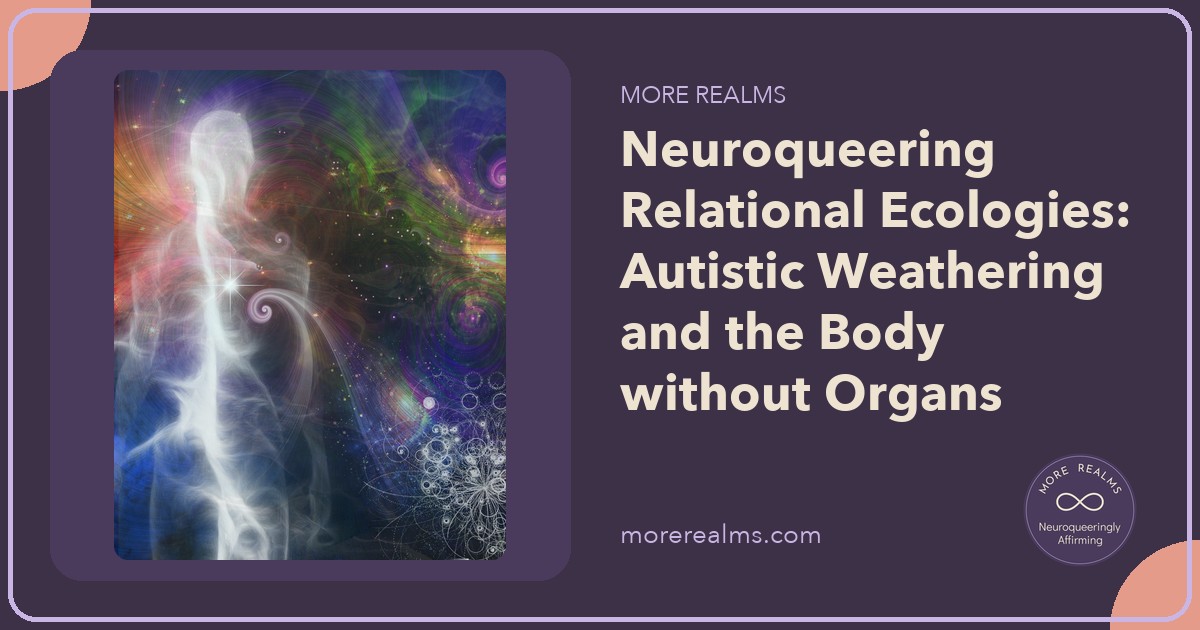
    Abstract digital artwork showing a glowing human-like figure dissolving into swirling cosmic patterns of colour and light. The body appears semi-transparent, merging with spirals, stars, fluid shapes, and network-like formations, suggesting movement, transformation, and connection between the human form and wider energetic or environmental forces. Created on Canva

    Autistic Weather-Bodies: Sensory Climates and Masking

    Ombre Tarragnat’s (2024) idea of the Autistic weather-body helps us understand how our experiences are shaped by the climates we live within. They suggest that our bodyminds are always responding to a “total climate” , not only the physical weather around us, but also biodiverse, sensory environments, social expectations, technologies, and socio-political conditions we live within.

    These relational climates are not only social or human-centred; they are multispecies and more-than-human. Living beings, ecological communities, and so-called non-living forces such as air quality, light, temperature fluctuations, water, and seasonal rhythms all shape how bodyminds feel, focus, regulate, and relate. These dynamic conditions also respond to our presence and actions. Together, they influence the ecological possibilities through which different forms of life — human and non-human — can endure, adapt, and flourish. From this perspective, neurodivergent experience emerges within more-than-human ecologies rather than solely within and between humans, everything and everyone is connected!

    For many Autistic people, changes in atmosphere are felt very directly and intensely; our bodies are perhaps more porous. Lighting, noise, other sensory input, unpredictability, digital pressures, and interpersonal tension and relationships can all influence our attention, energy, and capacity to regulate, and we may not always have control over this.

    These shifts are not always dramatic; sometimes they are more subtle, a rising sense of pressure and anxixety in a crowded room, a flicker of fluorescent light that begins to feel painful, or even the bodily awareness of a storm approaching. I know that for me, changes in the weather can trigger migraines before the rain even arrives. These experiences remind us that our bodyminds are not sealed off from the world; we are not just humans in the world. We are continually sensing, adjusting, responding, adapting and connecting with the world.

    Thinking about Autistic bodyminds as weather-bodies moves my thinking away from asking how people need to become more ‘resilient’ to change, trauma and ruptures of flow states. Instead, it invites us to consider how the climates of our everyday lives might become more liveable and flow more steadily and smoothly. We can consider what schools would feel like if they were organised around sensory comfort and intrinsically motivated attention tunnels of engagement rather than speed and constant transition? How might workplaces change if regulation and recovery were understood as necessary rhythms rather than signs of weakness?

    Tarragnat also writes about how we actually weather environments too. All humans try to adapt, this may be more intense for Autistic people and a trauma response to the very climate we live in. We may sometimes mask or suppress our sensory needs when having a meal out with friends, push through our exhaustion to meet a deadline at work, or fragment our attention in order to try to stay socially acceptable and communicate in a busy cafe. Over time, this kind of acclimatisation can erode our sense of coherence, identity and well-being. Burnout, meltdowns or shutdowns may follow, often with severe mental health implications as we try to survive and function, and this pressure accumulates. These experiences are not personal failures; they are signals that our current relational climates have become too difficult to inhabit.

    Like water, our Autistic weather-bodies are also fluid; our experiences move and change like atmospheric patterns. To deepen this ecological way of thinking, I think it could be helpful and interesting to turn to the watery metaphors of embodiment such as that proposed by Neimanis (2017). If weather shapes how we feel and function and how we may be weather-bodies, water also helps us understand how well our bodyminds can actually manage attention, emotion, and energy flow. The air we breathe, the water we drink, the plants and biodiversity around us and the ecosystems that grow within our world are all vital to our well-being and deeply entangled in a connected flow.

    Understanding Autistic experience through these ecological metaphors may help us recognise that wellbeing is always relational. It depends not only on what happens inside our bodyminds, but on the climates and currents we all move within.


    Watery Bodies: Monotropic Attention and Relational Flow

    Close-up, abstract photograph of rippling water in deep blue and teal tones. The surface shows small waves and circular ripple patterns in the foreground, with bright reflections and soft, out-of-focus light spots (bokeh) shimmering across the background. The overall mood is calm and fluid, with a slightly dreamy, atmospheric quality.

    Posthuman feminist thinker Astrida Neimanis (2017) describes human beings as bodies of water, shaped by the flows that move through and around us. Water is not only something we drink, cook with, or wash in. It circulates through our blood and tissues, regulates temperature through sweat and breath, and connects us to wider ecological systems such as weather patterns, infrastructures, rivers, oceans and cycles in nature.

    From this perspective, embodiment is not sealed within the skin. Bodies are permeable, porous, sponge-like, relational, and continuously responding to the environments they inhabit. We are not separate from the oceanic and atmospheric systems that sustain life. In a very real material sense, we are entangled with them, shaped by their rhythms, movements, and transformations. Our sensory and nervous systems are always responding and adapting to maintain a stable flow amid the different currents and energies around us.

    For many Autistic people, whose perception often foregrounds sensory detail and pattern, this account of embodiment may resonate with lived experiences of permeability, intensity, and environmental attunement.

    Monotropic attention, characterised by deep engagement with particular interests or sensory environments (Murray et al., 2005), can be imagined as a current that gathers depth and direction over time. When attention can move steadily toward meaningful activity, it may support learning, regulation, creativity, and a sense of coherence within the wider flow and environment a person is within.

    However, many relational environments are organised in ways that disrupt rather than support these attentional currents. Educational settings often require rapid transitions between subjects, noisy corridors, and constant social negotiation. Workplaces often demand multitasking, immediate responses to digital communication, and participation in unpredictable meetings. Everyday life may involve sensory overload from traffic, crowds, bright lighting, smells, or competing demands at home and with our own health. These conditions can create what might be described as turbulent relational climates, in which the flow of attention is repeatedly interrupted and ruptured, leaving us without a safe anchor.

    These turbulent relational climates are often produced and intensified through socio-political, economic, and technological systems that fragment attention and accelerate temporal demands. For example, constant news alerts on your phone may create a background sense of urgency or threat, pulling your attention and flow away from embodied rhythms and present-moment regulation. Algorithm-driven social media feeds, rapid email expectations at work, and productivity-monitoring apps can pressure people to respond immediately, compressing time and narrowing opportunities for rest or deep flow with our passions.

    Economic precarity, shift work, and unstable housing conditions can further disrupt sensory and emotional regulation by creating unpredictability in daily routines and environments. Public transport delays, overcrowded urban spaces, and exposure to noise or poor air quality may also contribute to cumulative sensory load. At a broader level, climate-related events such as heatwaves, flooding, or seasonal disruption can reshape how people move, gather, and feel safe, while also affecting multispecies habitats and ecological stability.

    Together, these forces create relational climates that are not only socially produced but materially and technologically mediated, shaping how bodyminds attend, connect, recover, and sustain participation in everyday life – which may all be felt more acutely if you are Autistic. Understanding burnout in this way highlights how neurodivergent distress is frequently structured by socio-political and material conditions rather than individual deficit.

    From a hydrological perspective, responses such as overwhelm, shutdown, or withdrawal can be understood as the body adjusting to this turbulence. Just as rivers alter course when encountering obstacles, drought, or flooding, Autistic individuals may narrow their focus, find cracks and crevices to retreat into quieter spaces, or seek familiar routines in order to restore coherence and regain a smoother less distressing flow state, so our systems don’t get flooded or caught up in a storm. These adjustments are often misinterpreted as avoidance, lack of resilience, or disengagement. Yet they can represent adaptive attempts to conserve energy and re-establish sustainable regulatory pathways and streams of flow.

    This shift from individual responsibility toward relational transformation raises a deeper philosophical question:
    how do bodyminds reorganise when familiar structures of engagement become unsustainable? Rather than understanding burnout as a breakdown, they may be read as processes of reorganisation. To explore this possibility, I am turning to Deleuze and Guattari’s concept of the Body without Organs, which offers a way of thinking about how new patterns of regulation, relation, and participation can emerge.


    Body without Organs: Autistic Becoming

    A glowing blue human figure made of lines of light stands in a sunlit forest clearing.

    I find Deleuze and Guattari’s idea of the Body without Organs (BwO) helpful for thinking about how Autistic bodyminds may reorganise when everyday demands become overwhelming or unsustainable. The BwO does not refer to a literal physical state (!). Instead, it describes shifts in how attention, sensory experience, movement, and participation are organised and can become re-organised.

    From my own experience, these shifts often become most noticeable during periods of burnout or intense overwhelm. At these times, familiar ways of focusing, communicating, or keeping up with daily life can begin to break down. For example, I might find that replying to messages or emails — tasks that once felt manageable — suddenly requires an enormous amount of energy, or that following conversations in busy environments becomes confusing and exhausting. Even simple routines such as preparing meals, travelling on public transport, or switching between tasks can feel disorientating, as if my attention is no longer able to stretch in the ways it once did.

    It can feel as though the usual pathways for engaging with the world are no longer available. However, these moments are not only about loss or collapse. There can also be times when new ways of regulating and relating start to emerge as attentional resources redistribute in order to survive. For instance, I may begin to rely more on sensory anchors such as quiet spaces, repetitive movement, or focused creative interests. Communication might shift toward slower, more intentional exchanges, or toward written rather than spoken interaction. Daily life can reorganise around fewer but more meaningful connections and activities, allowing energy to be conserved and gradually restored. In this way, burnout can sometimes open space for different rhythms of participation and new forms of relational attunement to develop.

    Reorganisation does not only happen in moments of crisis. It often unfolds through small, everyday neuroqueer choices. This might look like staying with a deep interest long after others have moved on, pacing or rocking to steady sensory overwhelm, wearing noise-cancelling headphones in busy spaces, or choosing solitude after social interaction in order to recover. Some Autistic people reshape their days so that activities happen in a predictable sequence, or protect uninterrupted stretches of time where attention can settle and flow.

    What Deleuze and Guattari call deterritorialisation can be felt here as a soft loosening of pressure, a step away from expectations to respond quickly, multitask constantly, or socialise in prescribed ways. As these pressures ease, different rhythms of living and participating can begin to take shape for others too and the ripples of change begin to take effect.

    Many Autistic people recognise these processes in small but significant adjustments to how they move through the world. Erin Manning (2016) describes such shifts as “minor gestures” — subtle changes that reshape how we sense, focus, and relate within particular environments. This might involve rhythmic movement to steady sensory overwhelm, withdrawing into a meaningful interest after prolonged interaction, or becoming absorbed in creative or repetitive activity. These gestures can be understood as the mechanisms through which reorganisation happens. They are ways of actively redistributing sensory and emotional intensity, recalibrating attention, and gradually re-establishing a sense of coherence. Although often misunderstood as avoidance or dysfunction, such practices can help Autistic individuals re-climatise to demanding relational atmospheres and sustain participation over time.here.

    As these processes are relational, they are shaped by the environments in which we live. Sensory-friendly spaces, predictable routines, flexible expectations, and collective care can make a significant difference. From this perspective, well-being is not something individuals achieve alone; it emerges collectively through interdependence with environments (beyond the human), that recognise and support diverse ways of focusing, recovering, and connecting.

    For many Autistic people, reorganising routines and spaces becomes an intentional way of reducing neuronormative pressure. Creating sensory refuges, protecting uninterrupted time for deep focus, limiting unnecessary task-switching, or prioritising interest-led learning and creativity can support more sustainable engagement. These are not simply personal coping strategies. They are ways of experimenting with how attention, energy, and participation might be structured differently.

    Neurodivergent becoming can therefore be understood as an ongoing neuroqueering process of adjustment and transformation, shaped by the continuous redistribution of attention, energy, and sensory intensity. Periods of immersion, withdrawal, or re-focusing are not simply signs that something has gone wrong. They may indicate that bodyminds are reorganising in response to pressures that exceed sustainable limits.

    When these processes are recognised and supported, they can open pathways towards more liveable ways of being, not only for Autistic people, but within the wider relational ecologies we all share. In this sense, becoming a Body without Organs is not a final state but a dynamic practice: a way to loosen restrictive normative expectations, experiment with new rhythms of participation, and contribute to the gradual reshaping of environments so that diverse forms of attention, regulation, and connection can co-exist and keep transforming and flowing.


    From Neurodiversity to Ethodiversity: Ecological Multiplicity

    Close-up photograph of a small cluster of delicate, pale beige mushrooms with thin stems and softly ridged, bell-shaped caps emerging from a cushion of vivid green moss on a forest floor. Tiny plants, pine needles, and damp soil surround them, while warm sunlight filters through blurred woodland foliage in the background. The image evokes the idea of ethodiversity—the rich variety of ways living beings exist, grow, and relate within shared ecosystems—highlighting the interconnected rhythms of fungi, moss, soil, light, and moisture in a quiet, thriving microhabitat.

    When Autistic reorganisations of attention and sensory When experiences of sensory intensity or overwhelm are understood as relational and ecological processes, rather than simply individual coping challenges, our perspective begins to widen. Instead of seeing regulation as something a person must manage alone, we can recognise how environments, relationships, technologies, and broader living systems all shape how attention, emotion, and energy flow.

    From this viewpoint, neurodiversity is no longer only about differences between human brains. It becomes part of a wider story about how many forms of life sense, respond, adapt, and find ways to remain in the world. Ideas such as becoming a Body without Organs can be read as an invitation to notice these shifting patterns of connection and regulation, and to recognise the importance of ethodiversity (Tarragnat, 2025), or the diversity of ways living beings experience and engage with their environments.

    Expanding neurodiversity toward the concept of ethodiversity strengthens this ecological understanding. Ombre Tarragnat (2025) uses this term to highlight how different perceptual styles, emotional intensities, and attention patterns contribute to the resilience of relational systems, including ecosystems and multispecies communities. For example, Autistic sensory attunement may make environmental pressures more noticeable such as persistent background noise, polluted air, or the stress of extreme weather changes.

    Ethodiversity does not just build on neurodiversity by recognising additional forms of human difference. Instead, it draws attention to the diversity of ways living beings perceive, move, and participate in shared environments, as well as the impact of non-living things. From this perspective, neurodivergence can be understood as one expression of a wider ecological multiplicity of attentional rhythms, sensory attunements, and relational styles that help sustain more liveable worlds.

    Understanding and embracing ethodiversity means creating relational systems that can support different rhythms of participation, perception, rest, and recovery. This includes recognising that people, other species, and environments do not all move, sense, or respond in the same ways or at the same pace. Designing spaces, communities, and policies with this diversity in mind becomes part of a wider ethics of planetary care.

    When we value diverse forms of embodiment and ways of relating to the world, we also begin to recognise how closely human wellbeing is connected to ecological wellbeing. Sustaining multiplicity across cognitive, cultural, biological, and ecological domains is therefore not only a matter of social inclusion. It is also a condition for collective survival. For example, if water systems become polluted, this affects the health of entire ecosystems, and human communities are not separate from these impacts. In this way, caring for diversity in how life exists and adapts is part of caring for the future of the planet as a whole.


    Cultivating Liveable Worlds: A Neuroqueer Ecological Future

    Soft-focus photograph of a delicate spider’s web suspended between plants, its fine threads dotted with tiny dew droplets that catch warm golden morning light. The background is a gentle blur of greens and yellows, suggesting foliage and sunlight filtering through a living landscape. The web appears both fragile and resilient, stretching across space in intricate patterns of connection. The image evokes the theme of “Cultivating Liveable Worlds: A Neuroqueer Ecological Future,” symbolising interdependence, relational networks, and the co-creation of environments where diverse ways of sensing, moving, and being can flourish.

    Autistic experience highlights how wellbeing emerges through ongoing relationships between bodyminds, environments, and social expectations. Sensory overwhelm, burnout, fragmentation, and withdrawal can therefore be understood not simply as individual difficulties, but as signals that relational climates have become too intense, unpredictable, or unsustainable.

    Thinking with concepts such as Autistic weather-bodies, watery embodiment, and the Body without Organs helps us recognise how bodyminds continually adapt and reorganise in response to these conditions. Practices of regulation such as retreating into focused flow, seeking quieter environments, experimenting with new rhythms of engagement, or stimming can be understood as efforts to restore coherence and sustain participation. Neuroqueering involves both resisting dominant expectations and actively reshaping environments to support different temporalities and sensory needs.

    The concepts of Cavendish Space and Neuroqueer Learning Spaces, which I have been working on with Stimpunks, offer practical examples of how relational ecologies might be redesigned. By prioritising sensory accessibility, slower rhythms of participation, interest-led engagement, and collective care, these approaches shift the focus away from expecting Autistic individuals to adapt to rigid systems. Instead, they explore how environments themselves can become more responsive and sustaining.

    Cultivating liveable relational worlds requires more than individual accommodation. It calls for collective transformation, reshaping educational, social, technological, and ecological systems so that diverse rhythms of sensing, regulating, and belonging can genuinely flourish. Supporting diverse modes of becoming is not only about inclusion within existing structures, but about reimagining those structures altogether.

    Extending neurodiversity toward the broader horizon of ethodiversity invites recognition that multiplicity across perceptual styles, cultural practices, and environmental relationships contributes to more liveable shared futures. Practices that support sensory regulation, slower temporal rhythms, and sustainable participation may also align with wider movements toward ecological care and multispecies coexistence.

    From this perspective, becoming what Deleuze and Guattari describe as a Body without Organs can be understood as an ongoing neuroqueer process of reorganisation. It involves loosening restrictive normative expectations, redistributing attention and energy, and experimenting with and queering new ways of participating and being in our relational worlds. Perhaps neuroqueering attention and sensory life is not only about Autistic survival, but about learning new ways of living together within the fragile ecologies we all share?

    References

    Adkin, T. (2022). What is monotropic split? NeuroHub Connect. https://neurohubcommunity.org/2022/07/14/guest-post-what-is-monotropic-split/

    Boren, R. & Edgar, H. (2022, July 26). Cavendish space. Stimpunks Foundation. https://stimpunks.org/glossary/cavendish-space/

    Deleuze, G., & Guattari, F. (1987). A thousand plateaus: Capitalism and schizophrenia. University of Minnesota Press.

    Manning, E. (2016). The minor gesture. Duke University Press.

    Murray, D., Lesser, M., & Lawson, W. (2005). Attention, monotropism and the diagnostic criteria for autism. Autism, 9(2), 139–156.

    Neimanis, A. (2017). Bodies of water: Posthuman feminist phenomenology. Bloomsbury.

    Tarragnat, O. (2024). The personal is climatic: Autistic weather-bodies and posthuman feminism between weathering and (dis)acclimatisation. Sextant: Revue de recherche interdisciplinaire sur le genre et la sexualité, (41).

    Tarragnat, O. (2025). Biodiversity, neurodiversity, ethodiversity: Towards a more-than-human and more-than-neurological turn in neurodiversity studies. TRACE Journal for Human-Animal Studies.

    Walker, N. (2021). Neuroqueer heresies. Autonomous Press.

    Yergeau, M. (2018). Authoring autism: On rhetoric and neurological queerness. Duke University Press.

    Discover more

    Courses, books and resources

    If you would like to take these ideas further, my courses, books and resources live on Autistic Realms. Everything in the shop is pay what you can, and many resources are free.