Tag: Erin Manning

  • Flowosophy: Monotropism, Flow and Deep Attention

    Flowosophy: Monotropism, Flow and Deep Attention

    You might know this feeling. You look up and the light in the room has changed, the coffee beside you has gone cold, and the hours that have passed don’t feel like hours at all, they feel like just a few minutes. Something has held you, and for a while there was no clear edge between you and whatever you were engaged with, what ever held your attention.

    For most of my life the only words I had for this were other people’s, and they were rarely kind: obsessive, rigid, in a world of her own. Since realising I am Autistic and ADHD, monotropism and flow theory have given me kinder words. I have been re-storying those lost days, weeks and what feels like years ever since. The two theories seem to want to move together and carry on further downstream, out of psychology and into something more like philosophy, or maybe a merging of the two.

    Flowosophy is where they lead me: the philosophy of flow theory and monotropism, with the Greek sophia, wisdom, folded inside the word. It asks what kind of wisdom lives in DEEP attention, and what might change if we honoured flow as a way of being in the world, rather than a state to be managed or a behaviour to be corrected.

    Two Theories, One River

    Mihaly Csikszentmihalyi (1990) described flow as the optimal experience: absorption so complete that action and awareness merge, self-consciousness falls away and time bends out of shape. He found this experience was a common experience for many people.

    Monotropism grew from within Autistic community. Murray, Lesser and Lawson (2005), writing from inside that community, describe attention as a limited resource, and monotropic minds as gathering that resource deeply around a small number of interests at a time. Inside these attention tunnels, experience is often rich, detailed and can feel quite intense. Outside them, things can be hard to notice at all, and moving from one tunnel to another often takes real energy.

    Read side by side, it feels to me like the two theories are describing the same water from different banks. McDonnell and Milton (2014) suggested that what gets labelled “repetitive behaviour” could be understood as flow states, and more recently Heasman et al. (2024) have called for an Autistic flow theory that describes these experiences without pathologising them. What psychology calls optimal experience, many monotropic people would perhaps call their innate way of being.

    From Peak to Plateau

    Flow has been captured through literature, art and poetry. It turns up in productivity books and workplace training as a way of getting more done in less time, a weaponised hack for output. My idea of flowosophy evolved out of a recent body doubling session with Writing the Dawn where we were talking about flow, philosophy, congruence and being Autistic. The value of flow is not in what it produces, it is a process and the being-in-it is what I am interested in.

    Deleuze and Guattari (1987) describe a plateau as “a continuous, self-vibrating region of intensities” (p. 22), one that develops without building towards a culmination point. Monotropic flow feels far more like a plateau than a peak to me. It sustains, thickens and connects in all directions, like a holographic constellation network for as long as the conditions allow, which is something I explored in “Neuroqueering Plateaus: Staying in the Middle of Things“. An afternoon spent with a patch of moss, re-organising a spreadsheet of research or listening to the same song on repeat is not wasted because nothing was made, because something was lived. Flowosophy treats depth as a way of knowing and being in its own right.

    Water, Edges and the In-Between

    Flow is a word often associated with water, and I don’t think that is a happy coincidence. In my article “Water Time: On Neuroqueering the Shapes of Time” I wrote about time that pools, floods, freezes and moves again, rather than ticking forward in a straight line, or going round the clock in our kitchen. I FEEL that flow states live in water time. An hour can melt, and five minutes can ripple into a whole afternoon.

    Henri Bergson (1889/1910) gave me words for this over a century before I had them. He separated clock time, which he saw as time laid out in space and cut into equal, countable pieces, from durée, duration: time as it is lived from the inside, where each moment melts into the next like the notes of a melody. Flow lives in durée. When I am in flow I am not counting minutes; I am inside a melody that hasn’t finished yet. Being pulled out by an alarm, a bell or a meeting is being dropped out of duration and back onto the clock.

    Astrida Neimanis (2017) writes that we are bodies of water, porous and always in circulation with the world around us. For me, that is how flow feels from the inside. The edges of my bodymind blur and I can no longer clearly say where I end and the thing I love begins, the activity or event that has ALL of my attentional resources. I don’t experience this as losing myself, in fact it is one of the few times I feel whole and completely me, like now, writing this!

    This also means that flow is not something that happens inside one head or one single person’s mind. Erin Manning (2013) describes experiences as beginning in the middle of relation, in the in-between. Flow emerges between a person and the quality of the light, the quiet of a room, the texture of something under your hands, or another person or animal whose rhythm is compatible with yours. Take those conditions away and flow doesn’t just become harder to reach. It doesn’t form. Flow is what happens as the event because of everything else being in relation to it.

    The Undercurrents

    I don’t want to romanticise flow. Rivers have undercurrents too, and the same pull that brings Autistic joy can make it hard to stop, to eat, to drink or to sleep. Attention tunnels can quickly and easily fill with worry as easily as with wonder, and a mind that loops happily around a beloved interest can also loop around a fear. In addition, being pulled out of flow without warning can really hurt.

    Spinoza (1677/1996) understood joy not as a reward but as a movement: the feeling of our power to act and to exist increasing. Sadness, for him, is the feeling of that power being diminished. Flow is joyful in exactly this sense. It is a monotropic bodymind becoming more able, more alive, more itself. Deleuze (1988), reading Spinoza, reminds us that we do not yet know what a body can do. We only find out by noticing what it can affect and be affected by, and in which conditions it flourishes.

    There is also the cost of being denied flow altogether. Tanya Adkin (2022) describes monotropic split as what happens when a monotropic person has to spread their attention across too many channels to survive in a polytropic world, and how that leads towards burnout. I have written more about this in “Monotropic People in a Polytropic World“. A dammed river does not stop being a river. It floods somewhere else and this is what I feel happens to me when I am asked or expected to split my attention into too many channels at once, I can’t hook into a deep flow. The small narrow channels that I am working within get easily flooded and I find myself very overwhelmed which can lead to shutdown or meltdown states and if it keeps happening, it leads to burnout which can last even longer.

    This makes flowosophy a question of justice. Who gets long, unbroken stretches of time, and who is interrupted all day? Whose depth is called expertise, and whose is called an obsession and needs an intervention?

    An Ethics of Attention

    Simone Weil (1951) wrote about attention as a kind of waiting: an open, patient receptiveness rather than effortful concentration. For her, attention at its purest was a form of generosity, even of love. Flowosophy takes this seriously in both directions: the generosity of giving something our whole attention, and the generosity of protecting someone else’s.

    Flowosophy asks how we enter, share and leave one another’s flow. It treats warning, consent and time to surface as forms of care, and transitions as crossings that need bridges.

    It also asks us to join rather than redirect. Meeting someone inside their interest is one of the most direct routes to connection I know of. Things like info-dumping, parallel play and a meme shared at 2am are all ways of saying, come and move in this current with me. When that happens, two flows can run side by side like a braided river and it can help regulation.

    Dinah Murray (1996) had a word for this: co-tropicality, turning our attention together. From the Greek tropos, to turn, it sits alongside monotropism (turning toward one thing) and polytropism (turning toward many). Co-tropical attention means joining someone within their attention tunnel and flow, rather than pulling them out of it. I have written more about this in “Shared Flow: Turning Attention To Support Children Together” on Autistic Realms. Co-tropicality sits at the heart of flowosophy: flow is not only something we protect in one another, it is something we can share.

    None of this is possible without the right conditions. The caves, campfires and watering holes of Cavendish Space I have written about with Stimpunks Foundation (Boren & Edgar, 2022) are one way of building them: protected depth, shared depth, and company without demand. Nick Walker (2021) reminds us that neuroqueering is something we do. Choosing depth over breadth, in a world that keeps demanding constant task switching, is a small daily practice of refusal.

    Staying With the Current

    Flowosophy can be shaped by everyone who has thought and written about monotropism and flow, and by everyone who has ever lost an afternoon to something they love.

    What would our schools, workplaces, services and relationships look like if flow were understood and protected, rather than managed?

    References

    Adkin, T. (2022, July 14). What is monotropic split? Emergent Divergence (NeuroHub Connect). https://emergentdivergence.com/2022/07/14/guest-post-what-is-monotropic-split/

    Bergson, H. (1910). Time and free will: An essay on the immediate data of consciousness (F. L. Pogson, Trans.). Swan Sonnenschein. (Original work published 1889)

    Boren, R., & Edgar, H. (2022). Cavendish space: Caves, campfires, and watering holes for dandelions, tulips, and orchids. Stimpunks Foundation. https://stimpunks.org/space/cavendish/

    Csikszentmihalyi, M. (1990). Flow: The psychology of optimal experience. Harper & Row.

    Deleuze, G. (1988). Spinoza: Practical philosophy (R. Hurley, Trans.). City Lights Books.

    Deleuze, G., & Guattari, F. (1987). A thousand plateaus: Capitalism and schizophrenia (B. Massumi, Trans.). University of Minnesota Press. (Original work published 1980)

    Heasman, B., Williams, G., Charura, D., Hamilton, L. G., Milton, D., & Murray, F. (2024). Towards autistic flow theory: A non-pathologising conceptual approach. Journal for the Theory of Social Behaviour, 54(4), 469–497. https://doi.org/10.1111/jtsb.12427

    Manning, E. (2013). Always more than one: Individuation’s dance. Duke University Press.

    McDonnell, A., & Milton, D. (2014). Going with the flow: Reconsidering “repetitive behaviour” through the concept of “flow states”. In G. Jones & E. Hurley (Eds.), Good autism practice: Autism, happiness and wellbeing (pp. 38–47). BILD.

    Murray, D. K. C. (1996). Shared attention and speech in autism. Paper presented at Therapeutic Intervention in Autism: Perspectives from Research and Practice, Durham. https://monotropism.org/dinah/shared-attention/

    Murray, D., Lesser, M., & Lawson, W. (2005). Attention, monotropism and the diagnostic criteria for autism. Autism, 9(2), 139–156. https://doi.org/10.1177/1362361305051398

    Neimanis, A. (2017). Bodies of water: Posthuman feminist phenomenology. Bloomsbury Academic.

    Spinoza, B. (1996). Ethics (E. Curley, Trans.). Penguin. (Original work published 1677)

    Walker, N. (2021). Neuroqueer heresies: Notes on the neurodiversity paradigm, autistic empowerment, and postnormal possibilities. Autonomous Press.

    Weil, S. (1951). Waiting for God (E. Craufurd, Trans.). Putnam.
  • Wintering as Becoming: Deleuze, Posthumanism and the Ecology of Autistic Burnout

    Wintering as Becoming: Deleuze, Posthumanism and the Ecology of Autistic Burnout

    Late November is a threshold season. The light thins, the trees have let go, and much of the life around us has gone underground or into stillness. I have been rereading Katherine May’s Wintering (2020) as a gentle language for Autistic burnout, and here I want to take that thinking further, into the philosophy that has shaped so much of my own understanding of Autistic life. That means the work of Gilles Deleuze, both alone and with Félix Guattari, and the wider posthumanist turn that decentres the individual human and treats life as relational, ecological and always in process.

    What happens to our understanding of Autistic burnout, and of rest, when we stop treating the burnt-out Autistic person as a broken individual machine and start to see burnout as an event in a living ecology, a season the bodymind passes through alongside everything else that winters?

    The Fallow Season

    May (2020) describes wintering as the periods when life pulls us out of its ordinary momentum, whether through illness, grief, crisis or exhaustion. Her method is quietly ecological. Faced with her own winter, she looked outward: to dormice slowing their bodies into hibernation, to bees clustering in the hive to share warmth, and to the rituals that people across cultures have used to mark the dark months. She writes that winter belongs to every cycle, and that a culture which refuses winter leaves people without shelter when their own arrives. May is Autistic, and she wrote about her adult diagnosis in The Electricity of Every Living Thing (May, 2018). Wintering isn’t written as a book about autism, but its refusal to pathologise withdrawal speaks deeply to Autistic readers, many of whom have lived through winters that went unseen and unnamed.

    What May offers through memoir, Deleuze and posthumanist thinkers offer in a different key. Each, in their own way, reads a life as part of a larger field of forces, relations and rhythms. Read together, they help move Autistic burnout away from the language of deficit and towards an ecological account of capacity, encounter and becoming.

    What Can an Autistic Body Do?

    Research on Autistic burnout has grown largely out of Autistic testimony. Raymaker et al. (2020) defined Autistic burnout as long-term exhaustion, loss of function and reduced tolerance to stimuli. It arises from chronic life stress and a mismatch between expectations and abilities without adequate support, and it typically lasts three months or more. Higgins et al. (2021) also described pervasive exhaustion, withdrawal and the loss of skills a person previously had. Two threads run through this work again and again: the cumulative cost of masking (Pearson & Rose, 2021), and the strain on monotropic attention, which tends to gather intensely around a small number of interests at once (Murray et al., 2005).

    Deleuze’s reading of Spinoza gives this research a wonderful philosophical frame. In Deleuze’s (1981/1988b) account, Spinoza defines a body less by its form or function than by its capacities to affect and be affected. Every encounter either composes with a body and increases its power of acting, or decomposes it and diminishes that power. Deleuze keeps returning to Spinoza’s provocation that we do not yet know what a body can do. Through this lens, Autistic burnout describes a bodymind (Dychtwald, 1977/1978) that has been through a long series of decomposing encounters: fluorescent light, relentless social demand, the labour of masking, and institutions that will not bend. The loss of speech or executive function that so many Autistic people describe is a contraction of the power of acting, under conditions that have been sad, in the Spinozist sense, for far too long.

    This framing matters because it places burnout in the relation between body and world. A capacity is always a capacity within a situation. An Autistic person who cannot speak in a supermarket may speak fluently, even joyfully, about a passionate interest in a quiet room with someone they trust. Burnout can then be read as information about how an environment is composed, and recovery as the slow work of finding encounters that compose with us again.

    The Refrain in the Dark

    In A Thousand Plateaus, Deleuze and Guattari (1980/1987) open their discussion of the refrain with an image of a child frightened in the dark who comforts themselves by singing under their breath. The song creates a fragile centre, a point of stability within chaos. From there the refrain draws a circle, a home territory, and from that territory it can eventually open out to the world again. Territory is made of rhythm, stimming and expression before it is made of walls.

    I find it hard to read this passage without thinking of stimming. Rocking, humming, scripting, flapping, repeating a beloved phrase or playing the same song on loop are all refrains in exactly this sense. They mark out a territory where an Autistic bodymind can gather itself. In burnout, when so many familiar territories have been lost, the refrain becomes a way of rebuilding home from the inside out. The same breakfast, the same walk and the same comforting video watched for the hundredth time all take part in this territorial work. Dominant clinical frames tend to treat these behaviours as symptoms to reduce. Deleuze and Guattari give us a vocabulary for seeing them as creative acts that make worlds.

    May (2020) writes about the rituals that carry people through winter, and the refrain helps explain why rituals work: they set up a rhythm the nervous system can lean against. In Deleuzian terms, burnout is a deterritorialisation so severe that it can leave a person with no ground at all. Wintering is the patient reterritorialisation through which a home is sung back into being.

    Durée and Vegetal Time

    Winter also asks us to think differently about time. Deleuze’s (1966/1988a) reading of Bergson distinguishes spatialised, measurable clock time from durée, the lived, qualitative time of consciousness in which past and present run into each other. Recovery from burnout happens in durée. It cannot be scheduled. When Autistic people are told they should be ‘better by now’, the frustration they feel is partly a collision between institutional clock time and the felt time of a bodymind healing at its own pace.

    Michael Marder’s (2013) philosophy of vegetal life adds another layer. Marder argues that plants live in a temporality of slowness, seasonality and repetition that human thought has tended to overlook or dismiss. A tree in winter is far from inert, it is doing the work of dormancy, holding its resources in its roots and waiting for conditions that allow growth. If we learned to honour vegetal time, we might start to recognise Autistic withdrawal as a kind of dormancy with its own intelligence. With its capacity for long, deep immersion (Murray et al., 2005), monotropic attention may sit closer to vegetal time than to the fragmented, accelerated attention that contemporary work and schooling demand.

    Posthuman Wintering

    Posthumanist thought starts from the recognition that the bounded, autonomous, rational individual at the heart of Western humanism was always a fiction. That fiction has been used to exclude many people from full humanity, including disabled, colonised, racialised and neurodivergent people. In its place, Rosi Braidotti (2013) proposes a vital materialist understanding of life as zoe, the generative force running through human and nonhuman life alike. From this view, the Autistic person in burnout is one node in a dense web of relations, and their winter is shared with soil, weather, animals, and the people and institutions around them.

    Donna Haraway’s (2016) concept of sympoiesis, or making-with, could be especially helpful here. Haraway argues that no living thing makes itself alone; beings come into existence together, through entangled relations. May’s (2020) bees clustering in the hive give a vivid picture of sympoietic wintering: a collective that survives the cold only by making warmth together. Erin Manning (2016) brings this relational thinking directly into conversation with neurodiversity. Drawing on Autistic writers, she describes Autistic perception as attuned to the field of relations before that field is sorted into separate objects, and she names neurotypicality as an unexamined norm that decides what counts as a proper way of being in the world.

    The Autistic Rhizome (Gray-Hammond, 2023; Edgar, 2023) carries these ideas into Autistic community itself. Deleuze and Guattari’s (1980/1987) rhizome grows sideways, without centre or hierarchy, through lines of flight and becoming. When one of us winters, those lines keep moving underground, through quiet messages, shared resources and spaces kept open for our return. David Gray-Hammond and I have named the connected, extended bodymind that these lines make possible symphrenia (Edgar & Gray-Hammond, 2026), a way of describing how bodyminds think and feel through each other. Read symphrenically, burnout becomes a strain within a shared ecology of minds, and rest becomes something we hold for and with one another however it may present in ways others can’t see, feel or hear.

    Rest as Affirmative Politics

    Braidotti’s (2006) nomadic ethics includes the idea of thresholds of sustainability: the limits beyond which a subject can no longer bear the intensities passing through it without breaking down. In this account, ethics means learning to recognise and respect those thresholds, both our own and other people’s. Autistic burnout can be understood as what happens when a society systematically ignores the thresholds of Autistic bodyminds, which gives rest an ethical and political charge.

    Tricia Hersey (2022) clarifies this as she frames rest as resistance to systems that treat human beings as machines, and she grounds her work in Black liberation and in the history of how white supremacy and capitalism have stolen rest from Black bodies. Her work insists that rest is distributed unequally. Autistic people who are also racialised, trans, poor, chronically ill or caring for others face particular barriers to stopping, and particular penalties when they do. Deleuze and Guattari (1980/1987) described capitalism as a machine that captures desire and redirects it into production. Hersey shows concretely whose bodies that machine has consumed most hungrily.

    Nick Walker’s (2021) work on neuroqueering adds another dimension. To neuroqueer is to actively subvert the normative performances of neurotypicality that have been imposed on us. Reclaiming rest on Autistic terms, whether through special interests, stimming, solitude, parallel company or monotropic flow, is a neuroqueer practice in this sense. It unsettles the script that says rest must look a certain way, be earned a certain way, and end at a certain time.

    Spring as Difference

    In Difference and Repetition, Deleuze (1968/1994) argues that repetition never produces the same thing twice. Each return is a new event that carries difference within it, and habit itself is a quiet contraction of past moments into a living present. This seems to me a fitting way to think about the end of a winter. Spring comes back every year, yet no two springs are alike, and no tree leaves winter exactly as it entered.

    Recovery from Autistic burnout is rarely a return to who we were before. Many Autistic people I know have come through with a sharper sense of their thresholds, a deeper commitment to their own refrains, and far less willingness to mask in spaces that never deserved that labour.

    In Deleuzian terms, recovery is a becoming.

    In posthumanist terms, it is a becoming-with: with the rhizome that held us, the rituals that sang us home, and the more-than-human seasons whose slowness we finally let ourselves share.

    If you are wintering now, I hope these ideas keep you some company in the dark, along with some trust that whatever grows from your roots will be new, and wholly yours. May be some of this resonates with you……

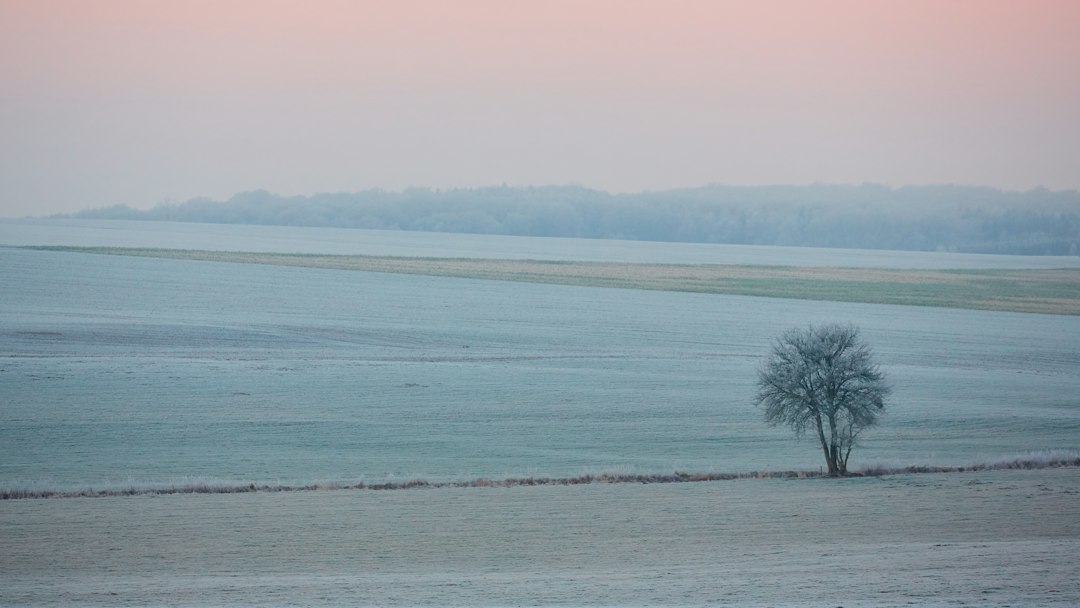
    Featured image: frosty sunrise above Helensburgh, 21 November 2026. Photo by David Howells.

    References

    Braidotti, R. (2006). Transpositions: On nomadic ethics. Polity Press.

    Braidotti, R. (2013). The posthuman. Polity Press.

    Deleuze, G. (1988a). Bergsonism (H. Tomlinson & B. Habberjam, Trans.). Zone Books. (Original work published 1966)

    Deleuze, G. (1988b). Spinoza: Practical philosophy (R. Hurley, Trans.). City Lights Books. (Original work published 1981)

    Deleuze, G. (1994). Difference and repetition (P. Patton, Trans.). Columbia University Press. (Original work published 1968)

    Deleuze, G., & Guattari, F. (1987). A thousand plateaus: Capitalism and schizophrenia (B. Massumi, Trans.). University of Minnesota Press. (Original work published 1980)

    Dychtwald, K. (1978). Bodymind. Jove. (Original work published 1977)

    Edgar, H. (2023, April 22). Autistic rhizome. Stimpunks Foundation. https://stimpunks.org/glossary/autistic-rhizome/

    Edgar, H., & Gray-Hammond, D. (2026, October 7). Symphrenia. The Wider Existence. https://www.thewiderexistence.co.uk/p/symphrenia

    Gray-Hammond, D. (2023, April 21). Neuro-anarchy and the rise of the Autistic Rhizome. NeuroHub Connect. https://neurohubcommunity.org/2023/04/21/neuro-anarchy-and-the-rise-of-the-autistic-rhizome/

    Haraway, D. J. (2016). Staying with the trouble: Making kin in the Chthulucene. Duke University Press.

    Hersey, T. (2022). Rest is resistance: A manifesto. Little, Brown Spark.

    Higgins, J. M., Arnold, S. R. C., Weise, J., Pellicano, E., & Trollor, J. N. (2021). Defining autistic burnout through experts by lived experience: Grounded Delphi method investigating #AutisticBurnout. Autism, 25(8), 2356–2369. https://doi.org/10.1177/13623613211019858

    Manning, E. (2016). The minor gesture. Duke University Press.

    Marder, M. (2013). Plant-thinking: A philosophy of vegetal life. Columbia University Press.

    May, K. (2018). The electricity of every living thing: A woman’s walk in the wild to find her way home. Trapeze.

    May, K. (2020). Wintering: The power of rest and retreat in difficult times. Rider.

    Murray, D., Lesser, M., & Lawson, W. (2005). Attention, monotropism and the diagnostic criteria for autism. Autism, 9(2), 139–156. https://doi.org/10.1177/1362361305051398

    Pearson, A., & Rose, K. (2021). A conceptual analysis of autistic masking: Understanding the narrative of stigma and the illusion of choice. Autism in Adulthood, 3(1), 52–60. https://doi.org/10.1089/aut.2020.0043

    Raymaker, D. M., Teo, A. R., Steckler, N. A., Lentz, B., Scharer, M., Delos Santos, A., Kapp, S. K., Hunter, M., Joyce, A., & Nicolaidis, C. (2020). “Having all of your internal resources exhausted beyond measure and being left with no clean-up crew”: Defining autistic burnout. Autism in Adulthood, 2(2), 132–143. https://doi.org/10.1089/aut.2019.0079

    Walker, N. (2021). Neuroqueer heresies: Notes on the neurodiversity paradigm, autistic empowerment, and postnormal possibilities. Autonomous Press.

  • Monotropism Through the Seasons: Burnout, Becoming and the More-Than-Human

    Monotropism Through the Seasons: Burnout, Becoming and the More-Than-Human

    Trees have an interesting place in the philosophy of Gilles Deleuze and Félix Guattari. In A Thousand Plateaus, they use the tree as an image of hierarchical thinking, with a single trunk and branches that always lead back to one origin. They set it against the rhizome, which spreads sideways, connects any point to any other and has no centre (Deleuze & Guattari, 1987). Yet the more I learn about real trees, the more rhizomatic they turn out to be. Beneath the forest floor, roots and fungal threads weave trees into vast underground networks that share water, sugars and signals (Simard, 2021). A tree is never only a tree. It is a meeting place of soil, fungi, weather, insects, birds and light.

    Posthumanism invites us to step away from the idea of the human as a separate, self-contained individual and to notice how we are always entangled with the more-than-human world (Braidotti, 2013). Donna Haraway (2016) calls this sympoiesis, a making-with, in which nothing truly makes itself. Autistic burnout can be understood in exactly this way. It is too often treated as a private failure of one person’s resilience, when it emerges from a whole ecology of demands, environments, expectations and relationships. Luke Beardon’s (2017) equation, Autism + Environment = Outcome, already points in this direction, and the seasons give us a way of feeling it in the bodymind (Dychtwald, 1977/1978).

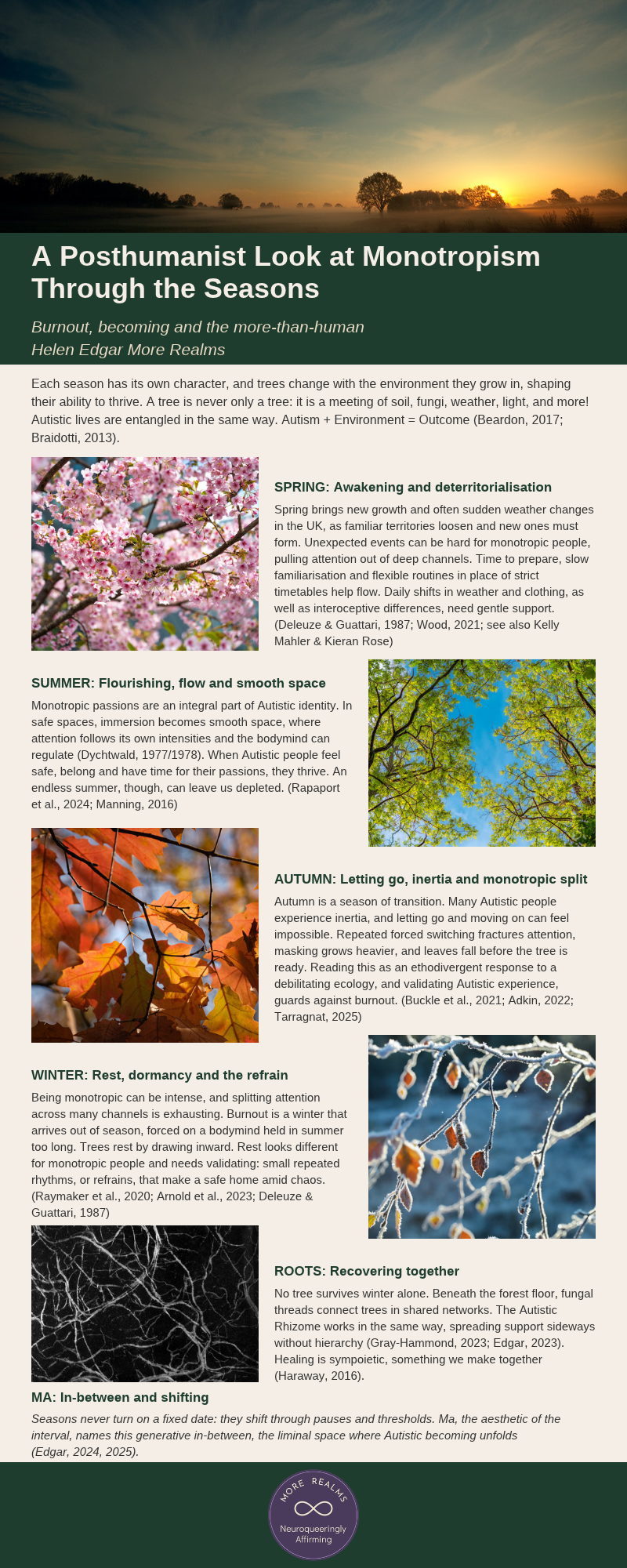
    Infographic titled "A Posthumanist Look at Monotropism Through the Seasons: Burnout, becoming and the more-than-human" by Helen Edgar, More Realms. A winter sunrise over a misty field with silhouetted trees sits above a dark green title band. Below, five sections pair close-up photographs with short text. Spring (pink blossom): awakening and deterritorialisation, when familiar territories loosen and unexpected change pulls attention out of deep channels. Summer (sunlit green leaves seen from below): flourishing, flow and smooth space, where immersion helps the bodymind regulate, though an endless summer can deplete us. Autumn (red and orange leaves): letting go, inertia and monotropic split, where repeated forced switching and masking lead towards burnout. Winter (frost-covered twigs): rest, dormancy and the refrain, with burnout described as a winter that arrives out of season. Roots (white fungal threads on black): recovering together through the Autistic Rhizome and sympoiesis. A final section, Ma: in-between and shifting, describes seasons as thresholds and pauses. A More Realms Neuroqueeringly Affirming logo closes the image.

    Monotropism and Ethodivergence

    Monotropism is a theory of autism developed by Dinah Murray, Wenn Lawson and Mike Lesser (Murray et al., 2005). It suggests that Autistic people tend to focus attention intensely on a small number of interests at any one time, drawing our attention resources deeply into whatever matters most to us in that moment. Polytropic people (likely those who are not Autistic or ADHD), tend to spread attention more thinly and evenly across many things at once.

    The concept of ethodivergence widens the lens further. Ombre Tarragnat (2025) uses ethodivergence to name behaviours that depart from what is typical for a species, from the norms of a particular ecological or social setting, or from ethonormativity, the human-centred rules about which behaviours count as acceptable in humans and other animals. Tarragnat also notes that ethodivergence, much like neurodivergence, can open distinctive forms of flourishing while also leaving beings vulnerable, and that some divergences are shaped by debilitating environments. Monotropic ways of attending, moving and resting are ethodivergent in this sense. Burnout tells us far more about the environments that debilitate these ways of being than about any flaw within them.

    Spring: Deterritorialisation and New Growth

    Spring brings awakening, new growth and sudden change. In Deleuzian language it is a season of deterritorialisation, when familiar territories loosen and new ones have to be made. For a monotropic person, every unexpected change asks attention to be pulled out of one deep channel and pushed into another, and that carries a real energetic cost. Spring is also when many of the conditions for later burnout are quietly set. A new school year, a new job or a routine imposed at speed can mean weeks of constant reorientation with little time to settle. Interoceptive differences can add to this, because noticing hunger, thirst or temperature may take longer when attention is absorbed elsewhere, as the work of Kelly Mahler and Kieran Rose explores. Gentle preparation, slow familiarisation and flexible routines give new territories time to form.

    Summer: Flow and Smooth Space

    Summer is the season of flourishing, and for monotropic people it is the image of following our passions into flow. Rapaport et al. (2024) found that Autistic adults’ accounts of task immersion closely matched understandings of flow, Autistic hyperfocus and monotropism, and many described the relief of being themselves without pretence. Deleuze and Guattari (1987) might call these moments smooth space, an open field where movement follows its own intensities, in contrast with striated space, which is divided, measured and timetabled. Erin Manning (2016) suggests that Autistic perception can attend to the whole field of experience before it is sorted into separate objects, a way of being with the world that is already more-than-human. Flow is one of our most important protections against burnout because it restores us.

    Even summer carries risks, though. Trees do not stay in full leaf all year, and a culture of endless production asks the impossible of everyone. When flow becomes the only refuge from a hostile environment, other bodily needs can slip from attention, and a person may emerge from a long immersion depleted.

    Autumn: Inertia and the Falling of Leaves

    Autumn is the season of letting go, and it is often when the signs of approaching burnout become visible. Buckle et al. (2021) describe Autistic inertia as the difficulty of starting, stopping and switching, and their participants spoke of feeling stuck for long periods. When an environment keeps demanding rapid switches, attention fractures again and again. Tanya Adkin (2022) names this monotropic split, and over a sustained period it becomes the ground from which Autistic burnout grows. Autumn is when masking grows heavier, recovery time between demands shortens, and the tree begins to drop leaves whether it is ready or not. Reading these signs as ethodivergent responses to a debilitating ecology allows us to respond with care instead of adding more pressure.

    Winter: Burnout, Dormancy and the Refrain

    Winter is the season of rest. Trees enter dormancy in rhythm with light and temperature, drawing their resources down into the roots. Autistic burnout is a different kind of winter, one that arrives out of season and is forced upon a bodymind that has been held in summer for too long. Raymaker et al. (2020) define Autistic burnout as long-term exhaustion, loss of function and reduced tolerance to stimulus, arising from chronic life stress and a mismatch between expectations and abilities without adequate support. Arnold et al. (2023) confirmed these features with a larger group of Autistic adults.

    Deleuze (1988), reading Spinoza, describes a body by what it can do, by its capacity to affect and be affected. Burnout shrinks that capacity, and recovery depends on conditions that allow it to grow again. Those conditions look different for every monotropic person. For some, rest is darkness and quiet. For others it is a familiar film, a favourite stim, a well-known walk, or time with an interest that feeds the bodymind. Deleuze and Guattari’s (1987) idea of the refrain is helpful here, describing the small repeated songs, routines and rhythms through which a creature makes a safe home amid chaos. Autistic rest is very often a refrain, and it deserves protection.

    Ma: In-Between and Shifting

    Seasons never turn on a fixed date. They arrive through pauses and thresholds, a week of mist between autumn and winter, a single warm afternoon before spring commits. The Japanese aesthetic concept of ma names this interval, the generative emptiness between things, and I have written before about the liminal spaces where Autistic becoming unfolds (Edgar, 2024, 2025). Monotropic attention knows these in-between states well. Moving between attention tunnels is not instant, and the shift itself is a space worth honouring rather than rushing. Deleuze and Guattari (1987) remind us that becoming happens in the middle, and Ma offers a gentler way of holding that middle: as rest, as breath, as the pause in which one season lets go of the next. Supporting Autistic people through transitions means protecting the in-between instead of collapsing it.

    Roots: Recovering Together

    No tree survives winter alone, and burnout recovery rarely happens in isolation. Through the Autistic Rhizome (Gray-Hammond, 2023; Edgar, 2023), David Gray-Hammond and I describe Autistic community as a spreading, non-hierarchical network, much closer to fungal threads than to a single trunk. Our more recent thinking on symphrenia (Edgar & Gray-Hammond, 2026) extends this into a sense of the bodymind as connected with others and with the living world. Sympoiesis reminds us that healing is something we make together.

    Seasons rarely follow the calendar in Autistic lives. Someone may be in deep winter in July, or feel spring stirring in November. A posthuman, ethodivergent reading of monotropism asks us to look beyond the individual to the soil, weather and networks that shape every season. When we change the ecology, Autistic people have far more room to flourish.

    Further Reading on More Realms

    Featured image: Photo by Johny Goerend on Unsplash.

    References

    Adkin, T. (2022). Guest post: What is monotropic split? Emergent Divergence.

    Arnold, S. R. C., Higgins, J. M., Weise, J., Desai, A., Pellicano, E., & Trollor, J. N. (2023). Confirming the nature of autistic burnout. Autism, 27(7), 1906–1918. https://doi.org/10.1177/13623613221147410

    Beardon, L. (2017). Autism and Asperger syndrome in adults. Sheldon Press.

    Braidotti, R. (2013). The posthuman. Polity Press.

    Buckle, K. L., Leadbitter, K., Poliakoff, E., & Gowen, E. (2021). “No way out except from external intervention”: First-hand accounts of autistic inertia. Frontiers in Psychology, 12, 631596. https://doi.org/10.3389/fpsyg.2021.631596

    Deleuze, G. (1988). Spinoza: Practical philosophy (R. Hurley, Trans.). City Lights Books.

    Deleuze, G., & Guattari, F. (1987). A thousand plateaus: Capitalism and schizophrenia (B. Massumi, Trans.). University of Minnesota Press.

    Dychtwald, K. (1978). Bodymind. Jove. (Original work published 1977)

    Edgar, H. (2023, April 22). Autistic rhizome. Stimpunks Foundation. https://stimpunks.org/glossary/autistic-rhizome/

    Edgar, H. (2024). Neuroqueering in the liminal spaces. Autistic Realms. https://autisticrealms.com/neuroqueering-in-the-liminal-spaces/

    Edgar, H. (2025). Neuroqueering from the in-between. Autistic Realms. https://autisticrealms.com/neuroqueering-from-the-in-between/

    Edgar, H., & Gray-Hammond, D. (2026). Symphrenia. The Wider Existence. https://thewiderexistence.co.uk/p/symphrenia

    Gray-Hammond, D. (2023, April 21). Neuro-anarchy and the rise of the Autistic Rhizome. NeuroHub Connect. https://neurohubcommunity.org/2023/04/21/neuro-anarchy-and-the-rise-of-the-autistic-rhizome/

    Haraway, D. J. (2016). Staying with the trouble: Making kin in the Chthulucene. Duke University Press.

    Manning, E. (2016). The minor gesture. Duke University Press.

    Murray, D., Lesser, M., & Lawson, W. (2005). Attention, monotropism and the diagnostic criteria for autism. Autism, 9(2), 139–156. https://doi.org/10.1177/1362361305051398

    Rapaport, H., Clapham, H., Adams, J., Lawson, W., Porayska-Pomsta, K., & Pellicano, E. (2024). “In a state of flow”: A qualitative examination of autistic adults’ phenomenological experiences of task immersion. Autism in Adulthood, 6(3), 362–373. https://doi.org/10.1089/aut.2023.0032

    Raymaker, D. M., Teo, A. R., Steckler, N. A., Lentz, B., Scharer, M., Delos Santos, A., Kapp, S. K., Hunter, M., Joyce, A., & Nicolaidis, C. (2020). “Having all of your internal resources exhausted beyond measure and being left with no clean-up crew”: Defining autistic burnout. Autism in Adulthood, 2(2), 132–143. https://doi.org/10.1089/aut.2019.0079

    Simard, S. (2021). Finding the mother tree: Discovering the wisdom of the forest. Knopf.

    Tarragnat, O. (2025). Biodiversity, neurodiversity, ethodiversity: Towards a more-than-human and more-than-neurological turn in neurodiversity studies. TRACE: Journal for Human-Animal Studies, 11.

  • Mingling with the universe: Autistic Perception

    Mingling with the universe: Autistic Perception

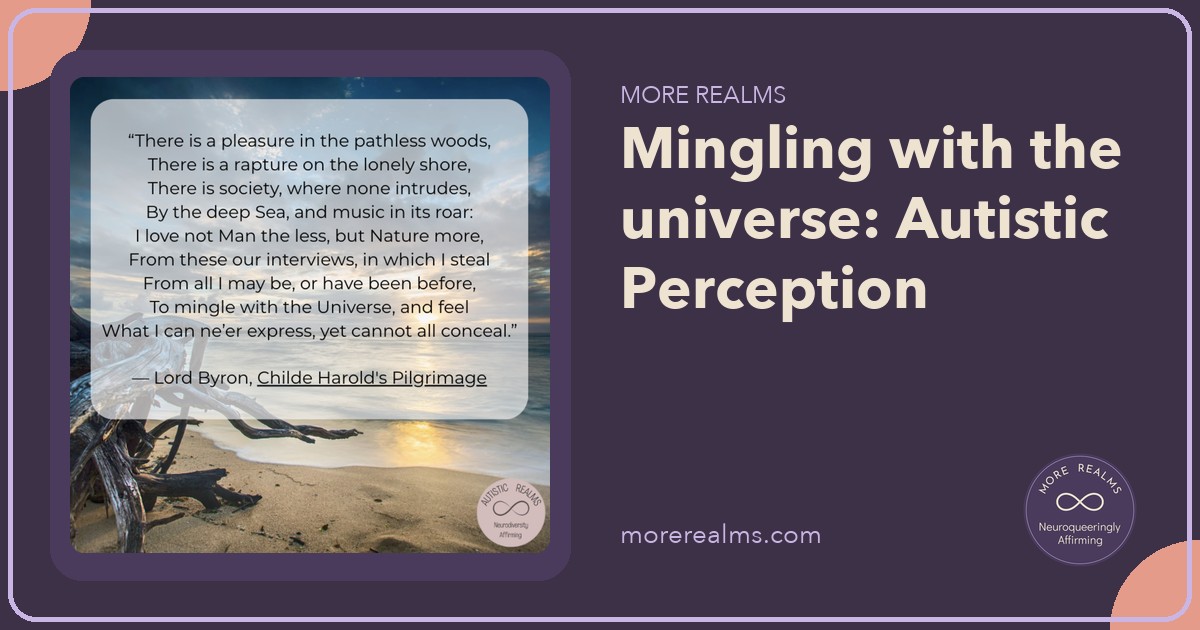
    This section of the poem from Lord Byron, Childe Harold’s Pilgrimage, speaks to me deeply and resonates with my Autistic experience of meaning as something felt, sensed, and lived through, especially in solitude, sensory immersion, and more-than-human connection.


    There is a pleasure in the pathless woods,
    There is a rapture on the lonely shore,
    There is society where none intrudes,
    By the deep Sea, and music in its roar:
    I love not Man the less, but Nature more,
    From these our interviews, in which I steal
    From all I may be, or have been before,
    To mingle with the Universe, and feel
    What I can ne’er express, yet cannot all conceal.


    Lord Byron, Childe Harold’s Pilgrimage, canto iv


    Autistic meaning-making is not abstract, but an embodied attunement, a “mingling with the Universe” that resists neuronormative expression yet pulses with emotional and sensory intensity.

    As Erin Manning wrote, “Autistics…are hypersensorial, alive not only to the presence of the other, but more importantly, to the absence of category. They live the differential, feeling into the world’s quality of emergence. Bodying, for them, is worlding.”

    Autistic experience often resists the default social scripts and expected ways of making sense of things, our thoughts are less linear, more constellation-y and rhizomatic. They may appear chaotic and not always make sense to others as the connections are happening deep inside us.

    Meaning for me, often arises between things, in the liminal spaces, in the felt sensory and emotional moments, a subtle change of a sound, the shifting pattern of sunlight on leaves and my relationship with living things that don’t speak in human words, and also a more natural attunement to people who also can’t or prefer not to speak verbally.

    Like Lord Byron’s “rapture on the lonely shore,” the Autistic sense of meaning-making may emerge most powerfully in the absence of human intrusion, words and voices, not from isolation, but from a deep, open presence with what is. It is why we may crave time alone, in our dens, out in nature, fully immersed in stimming activities and other forms of communication and connecting online. Alone time is so often stigmatised as being antisocial, but it is a different kind of sociality, and may be more meaningful for many Autistic people and is something to value and allow ourselves the time to lean into in what ever way we want and helps us feel good. It may be less about escaping and more about finding belonging in other ways and belonging otherwise.

    Autistic people often experience a heightened resonance and connection with our environment, this may not always be with people, but with animals, objects, places, atmospheres and sensory experiences. This is not a deficit of sociality, but perhaps a re-routing of relational (monotropic) attention toward the more-than-human, an ethodivergent way of being. (Ombre Tarragnat, 2025)

    I have written extensively about liminality, the in-between spaces where many Autistic people feel they may be stuck, but I think it is in these liminal spaces and states, where our bodyminds “mingles with the Universe,” that we can find a quiet calm that helps regulate, bring comfort and a meaning that allows us to emerge from the liminal or delight in the dwelling moments of the unspoken between realms. It is in liminality that Autistic perception becomes a kind of aesthetic felt knowing. It may not be easily verbalised or put into human words, “what I can ne’er express” but it is real, it emerges and can be captured in art, poetry and nature, in our online community spaces and is valid.

    “There is society where none intrudes”.

    “There is pleasure in the pathless woods” when we diverge from neuronormative expectations and follow our inner compasses.

    Allowing ourselves to feel, wholly and completely and merge with our environment is a way of creating our own language, a bodymind way of being that doesn’t rely on human words and can be felt and understood in other ways………we need to create our own worlds, reworld, neuroqueer – so we can survive together in a world dominated by neuronormativity and find our own place of belonging.

    Image of frozen droplet of water in snow Text: "HAD I NOT CREATED MY WHOLE WORLD. I WOULD CERTAINLY HAVE DIED IN OTHER PEOPLE'S" ANAIS NIN

    Sharing early morning thoughts after having read more of Erin Manning‘s beautiful work last night ‘A Feel for Others Feeling You‘ (2025), about challenging normative orientations around the concept of mirror-touch synaesthesia and touch (inspired by the DeafBlind Protactile community and work of John Lee Clark).

    “To feel the touch of the world is to feel the difference the world brings to all it comes into contact with, and this contact cannot be separated from all that worlds. To be a body is to be in contact. To touch is to feel the differential.”
    (Erin Manning, 2025)

    Thoughts welcome – I am hoping to set up an alternative space to explore through Autistic Realms into More Realms to share, discuss and collaborate on things like this with anyone who is interested alongside CASY Cultural Autism Studies at Yale and Stimpunks communities.

    Ocean Waves


    Listen to Ocean Waves by Adriel Jeremiah Wool:

    “Ocean Waves by Adriel J Wool” is a meditation in ambient flow states. Introduced with a special tuning that allows the brain to touch and feel more true pythagorean intervals of musicality.

    The flows and textures of nature follow patterns that resonate with the human body through its ability to hear sound.

    The nervous system is a microcosm, however it relates in scale to the power of nature, and is comforted within her crests.

    To breathe more slowly and more deeply. The sound spectrum is given in the powerful release of deep sound energy, very much like the Earth’s beautiful shores.”

    “Ocean Waves by Adriel J. Wool isn’t a recording of the ocean, it’s a fractal composition of the nature of the ocean. Modulated into swells, the rhythm evokes the massive release of great ocean waves and the more humble release of the human breath“.
    Ryan Boren (Stimpunks)


    Discover more

    Courses, books and resources

    If you would like to take these ideas further, my courses, books and resources live on Autistic Realms. Everything in the shop is pay what you can, and many resources are free.