Inspired by our collaborative Stimpunks work, and my own neuroqueering Deleuze project, I’ve been thinking about the connections in-between — physics, philosophy and my own life as an Autistic ADHD person. This is me following that thread.
2. I’m not a fixed thing
A little while back I wrote about something called relational quantum mechanics — a way of thinking about physics where tiny particles don’t have fixed qualities all on their own. They only become something in relation to whatever’s around them (Rovelli, 1996). I’m not a physicist — it’s one idea among several, and physicists argue about it.
As a multiply neurodivergent person, that’s always been closer to how I experience myself — not as a fixed, separate being moving through the world, but as something that shows up through my relationships and encounters with everything around me (Edgar, 2026a). I’m still working through what that means.
Physics, philosophy, and my own life keep circling the same ideas about being interconnected, unfixed, always transforming.
3. My Monotropic Galaxy
The oldest light we can see is called the cosmic microwave background — it’s the afterglow of the Big Bang, and it’s almost perfectly smooth. It only varies by about one part in 100,000 across the whole sky — almost uniform, but only almost.
Those tiny variations — slightly denser here, slightly thinner there — were the beginning of everything. Gravity pulled the denser bits together, and over billions of years they became stars, galaxies, planets, you, me, all of it.
If the universe really had been perfectly uniform, it would have stayed a flat, empty fog forever. Nothing to see, no one to see it. Structure only exists because that near-sameness broke.
That’s the same shape I recognise in my own monotropic attention — energy pulled gravitationally into a few bright points, rather than spread out in an even, undifferentiated glow. And yet it’s exactly that unevenness, that refusal to flatten, that so many of us — anyone who’s ever been called too much, not enough, or too different — have been measured against.
4. Measured Against Neuronormative Time
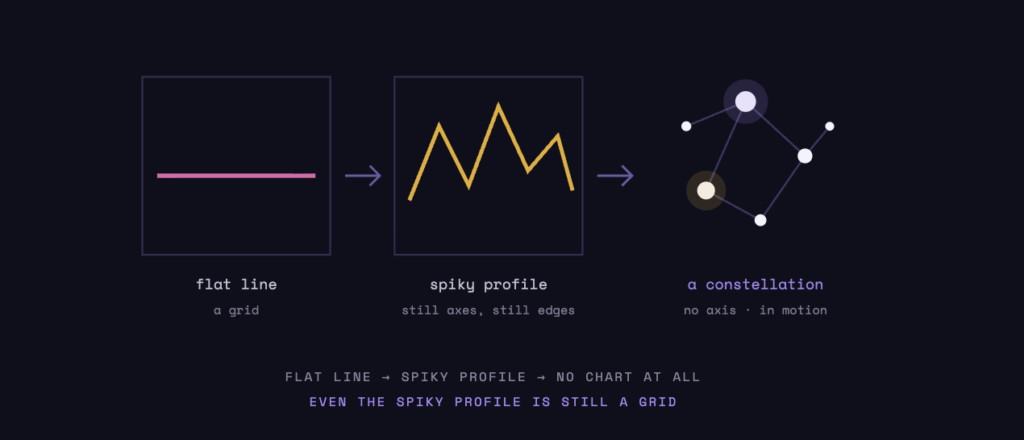
I’ve spent a lot of my life being measured against a flat line. Nobody always said it in those words, but that’s what was happening — a standard chart, a “typical” way of communicating or paying attention or experiencing the world, treated as the baseline everyone should be smoothed toward. I was positioned as the deviation that needed explaining, or fixing, or at least accounting for.
That flat line was never just about behaviour — it was also about time: a single approved tempo, a single approved rhythm, everyone expected to arrive and finish and transition together, in step with a clock that was never actually neutral.
So there’s something that genuinely steadies me in learning that the universe itself never once managed that.
What was already there, moving
The “typical” baseline
You = “deviation”
A straight line, laid over what was already moving
The grid comes after the field, not before,
Uniformity was never the achievement. It’s the thing that would have stopped everything before it even started.
5. There Is No Normal or Baseline
Gilles Deleuze, working with Félix Guattari, made a version of this same argument. Deleuze noticed that a lot of Western thinking treats difference as secondary — judged by how much it resembles some ideal, some average, some “normal” category. All of that quietly assumes the baseline came first, and difference is just a deviation from it.
The baseline is the thing that got built. The idea of normality is what has shaped our capitalist society (Chapman, 2023) and is what we are judged against (Deleuze, 1994). Difference is what’s actually there, first — and identity is what eventually forms out of it, temporarily and locally, the way a crystal settles out of a solution along the gaps and spaces in between — the places where those of us most marginalised live, and where we build our own networks, our own solidarity.
This is where Deleuze and Guattari’s idea of smooth space becomes useful (Deleuze & Guattari, 1987). Smooth space is full of local, variable difference — it hasn’t had a fixed grid laid over it yet. Striated space is what happens when that grid arrives: when a field gets measured, divided, standardised. Difference doesn’t get smoothed into existence by that process. Smoothing is what a system does afterward, only if it insists on it — striation laid over what was already smooth.
Nothing gets smoothed into existence. Smoothing is what happens to something afterward — only if a system insists on it.
6. Smooth doesn’t mean flat
Smooth space isn’t empty of movement — it’s just ungridded. It cuts against how regulation usually gets talked about, as though it means being still, quiet, zen: a flat line of its own. But smooth space is defined by what it lacks — a grid — not by what it’s doing. It can be full of movement and still be smooth — which is closer to how neurodivergent regulation actually works: through stimming, through bodily autonomy, through movement rather than stillness.
That’s closer to what I recognise when I try to describe my own attention — my porousness to my environment, the way my sensory system stays open to everything around it, the way time folds back on itself instead of running in a straight line. Not flat. Not gridded. Full of shape that never quite resolves into one measurable thing.
7. What ethodiversity means
This is where Ombre Tarragnat’s work on ethodiversity has become important to me. Ethodiversity is the variety of ways of being and behaving, across humans and other animals — and Tarragnat is precise about where it actually lives: not inside any one person, but as a property of the relationships between us, the way biodiversity belongs to a whole ecosystem, not to any single creature in it (Tarragnat, 2025).
Ethonormativity, in their framing, is the unwritten rule about which ways of being are allowed to count as normal in a given room. Put next to Deleuze, I don’t think it’s a stretch to say ethonormativity simply is that grid — applied to how we’re allowed to behave. A fixed grid laid over a field that was already full of variation before the grid ever showed up.
Ethonormativity reaches further than neuronormativity, though. Neuronormativity is about which neurotypes get treated as the default — Autistic brains judged against non-Autistic ones, for instance. Ethonormativity is the wider grid underneath that: it governs which ways of being and behaving, across every species, get to count as acceptable at all. It holds neuronormativity inside it, but it isn’t limited to brains, or even to humans (Tarragnat, 2025).
Ethonormativity simply is that grid — a fixed grid laid over a field that was already full of variation before the grid ever showed up.
8. A constellation of intensities
I recognise that grid in every space I’ve ever masked in — education, the workplace, wherever something that was moving gets asked to hold still long enough to be measured. And I recognise its absence, with real gratitude, in the spaces I’m part of — NeuroHub Community with David Gray-Hammond, Stimpunks: an Autistic rhizome, a mycelial network of care, non-hierarchical, no fixed centre, connecting wherever it meets (Deleuze & Guattari, 1987).
I used to think the shape of my own mind was something like a spiky profile — a way of picturing uneven ability across different areas, real peaks and real troughs, instead of one flat line running across the whole of who you are. At least it’s truer than a flat line. However, a profile still measures. It still needs axes, still has edges — and that’s exactly where I want to push further, past even the spiky profile. What I actually recognise, when I try to map myself, isn’t a chart at all. It’s a constellation of intensities: a galaxy, always in relationship with itself, always in motion, never finished (Edgar, 2026b).
A profile still measures. It still needs axes, still has edges. What I actually recognise, when I try to map myself, isn’t a chart at all; it is an interconnected, interdependent galaxy.
9. The Universe Doesn’t Do Flat Lines
I still don’t have these ideas fully settled or finished. Every time I follow this thread — from the sky, down through physics and philosophy, into the actual shape of my own galaxy of monotropic attention — I end up some where different but with the over arching throughts that:
The universe doesn’t do flat lines.
It never really tried to.
It went straight from near-uniform fog to unrepeatable structure, without ever pausing at sameness for its own sake.
I think that’s worth remembering, gently — the next time any of us are asked to explain why we don’t match the line of neuronormativity. We are all star dust. We are neuroqueering the spiky profile: no edges, limitless ways of being.
10. L★S
Zine No. 11 · Guest author
Written by Helen Edgar. First published on Autistic Realms: More Realms, and shared with Star Stuff.
Chapman, R. (2023). Empire of normality: Neurodiversity and capitalism. Pluto Press.
Deleuze, G. (1994). Difference and repetition (P. Patton, Trans.). Columbia University Press. (Original work published 1968)
Deleuze, G., & Guattari, F. (1987). A thousand plateaus: Capitalism and schizophrenia (B. Massumi, Trans.). University of Minnesota Press. (Original work published 1980)
Edgar, H. (2026a, June 7). We are made of relations: Quantum physics and what it means to be Autistic. More Realms.
Edgar, H. (2026b, June 16). My monotropic galaxy: A constellation of my Autistic self. More Realms.
Rovelli, C. (1996). Relational quantum mechanics. International Journal of Theoretical Physics, 35, 1637–1678.
A guest zine in the Stimpunks Star Stuff series. Where The Universe Runs on Difference (No. 8) is about breadth — variety over monoculture — this one is about difference coming first: the baseline is what gets built. The physics-and-philosophy sourcing, and how it sits beside Nos. 8 and 9, is gathered in The Difference-First Frame.
Helen Edgar — Autistic Realms | More Realms | June 2026
Spaces In-Between
I recently looked at the night sky, I was outside and cold, the sheer number of stars, the ones I could see and the knowledge of the ones I could not, shifted something in me that I did not have a word for at the time. It felt like an opening, a feeling of being very small and very connected at the same time, of the distance between me and the universe suddenly becoming less certain, of living in the in-between space. What I was experiencing is called awe, I also know, looking back, that awe may be one of the most distinctly Autistic experiences to feel.
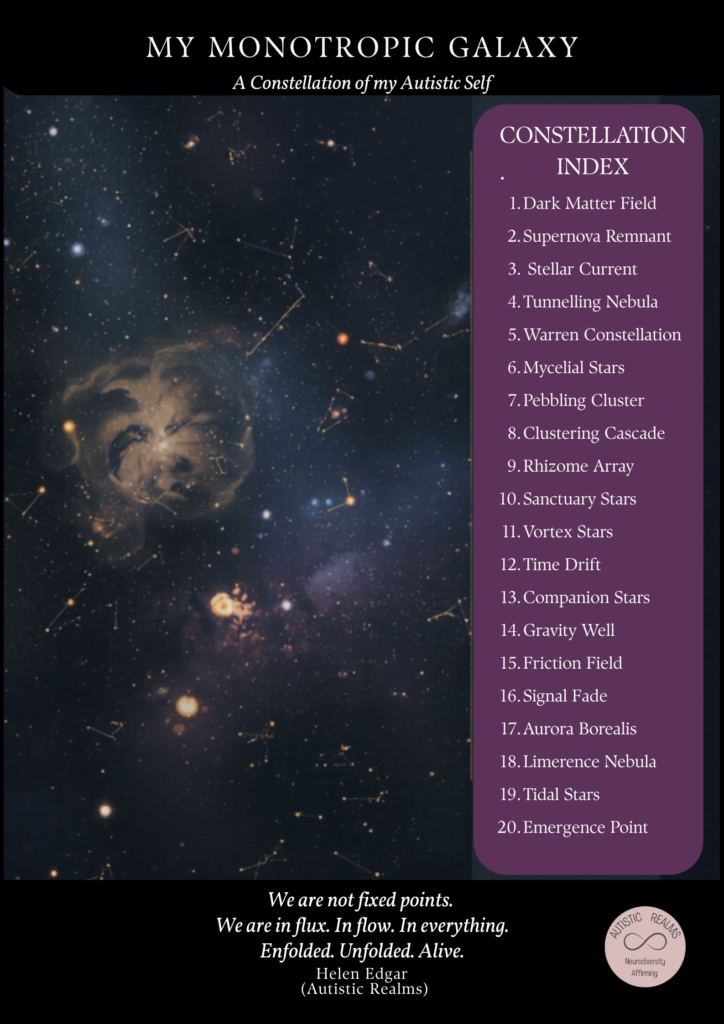
This piece is about feelings of awe and wonder, my own Autistic ADHD experiences, and about the map I have tried to represent of my inner life using the language of the cosmos. It is called My Monotropic Galaxy: A Constellation of My Autistic Self. It is a deep-field image of space, overlaid with constellation lines, accompanied by an index of 20 named features of some of my monotropic experiences. Some of these constellations I have lived in for decades, others I have only recently been able to name. All of them are in relationship with each other, always in motion, always becoming something the map and myself has not yet caught up with.
Before I guide you through my galaxy of monotropic experiences, I will explain a bit about the theory of monotropism and why I feel it is so important for my own sense of self-identity as an Autistic ADHD person.
What Is Monotropism?
Monotropism is an attentional theory of autism developed by Autistic researchers Dinah Murray, Mike Lesser, and Wenn Lawson (2005). It describes how many Autistic people tend to have their attention drawn more strongly to fewer things at any given time, going deep rather than wide, concentrating rather than spreading their focus. Rather than framing this as a deficit — an inability to multitask or shift attention — monotropism understands it as a distinct attentional style with its own strengths and difficulties.
Discovering the theory of monotropism for the first time felt like being handed a map of a place I had always lived in but had never been able to describe. I was identified as Autistic and ADHD in my forties, while my children were also going through their own assessments. What followed was a long process of re-sense-making, a re-storying that went back through my entire life, understanding finally why things had been the way they had been, and finally being able to begin to understand my own neurodivergent identity a little bit better.
Awe and Wonder as a Way of Knowing
Let me return to the night sky and think about what awe actually is and why it may be especially relevant for monotropic people. Helen De Cruz (2024), in her book Wonderstruck: How Wonder and Awe Shape the Way We Think, describes wonder as a form of epistemic opening, a way of relating to knowledge and how we have come to know things. The epistemic opening is the moment when the way we know expands; it is more than just a feeling. When we encounter something that is genuinely awe-inspiring, the usual categories we use to make sense of the world temporarily loosen. It is as if you are maybe seeing or sensing something for the first time; you may notice things you had previously learned to filter out. For De Cruz, wonder is not just a happy side effect of seeing something beautiful; it is a cognitive and moral orientation. It is how we stay genuinely curious about a world we might otherwise let ourselves assume we already understand, or are taught to ignore, as it doesn’t fit into how people expect us to perceive and respond.
When I read De Cruz’s book in 2024, something in me recognised what she was describing at a really deep level. It was the most inspiring book I have read for many years. I took part in a brilliant reading group hosted by The Philosopher 1923, where we explored Helen De Cruz’s work in depth. In the final week, we were lucky to be joined by Helen herself, and I remember discussing Nick Walker’s neuroqueer theory (2021) and the projects I was developing with Stimpunks, particularly the ways her ideas resonated with and helped shape our thinking. These conversations had a lasting impact, influencing our Neuroqueer Learning Spaces project, helping to evolve the vision behind Cavendish Space, and continuing to inform much of my current writing and emerging ideas around the theory of monotropism.
Awe and Flow
When I am pulled fully into something that has truly captured my attention, not just my mind, but my whole body and nervous system is immersed. What opens is not simply focus; it is that first-ness quality of perception De Cruz describes, the sense of seeing and feeling something for the first time, even if I have encountered it a hundred times before. New connections become visible, and the boundaries between things soften. It feels like my nervous system, so often braced against a world not designed for me, can finally exhale in the in-between spaces as new connections form and I feel literally awe-some.
Keltner and Haidt (2003) describe awe as arising when we encounter something vast that challenges our existing mental structures, something that does not fit the categories we already hold, and that invites us to expand our ways of being rather than retreat or fold inwards. Awe can be humbling and expansive at the same time; it opens up possibilities.
I feel this resonates with what it feels like for me to be in monotropic flow. My self does not disappear, nor does it become more rigid or narrow; instead, it feels as though I open up, my whole bodymind becomes more porous. The boundary between me and what I am attending to becomes less fixed; I am both in the flow, and the flow is in me. The distance between those two things collapses and unfolds in a way that feels like both loss and arrival, and it can feel deeply liberating and joyful (and sometimes deeply troubling and anxiety-provoking!).
For many Autistic people, these experiences are undervalued, even stigmatised or shamed as we grow up. We are told to concentrate on what the teacher is saying, to focus on what our family and friends think really matters, and slowly, our own ways of perceiving the world are flattened as we learn to mask and stop trusting ourselves. The things we find awe-inspiring are treated as having no value: the joy of looking closely at a mushroom or an insect may be met with being told to hurry up and rejoin the group; the wonder of feeling the sea against your toes in the sand may be met with being told to just get in and swim and stop fussing.
This quality of experience, this awe and wonder, is represented by the Stellar Current at the heart of my galaxy: the deep flow state through which my whole system comes into coherence, and I move with the current of what matters most. It feels fitting that this current carries me toward a phrase that has become foundational to how I think about the Autistic community and a sense of belonging.
Love You Down to Your Star Stuff
The phrase Love You Down To Your Star Stuff grew out of collaborative work with Ryan Boren and Stimpunks Foundation (Boren & Stimpunks Foundation, 2026). It reaches back to something Carl Sagan observed: that the atoms in our bodies were forged in the interiors of stars that lived and died long before our sun existed. We are, quite literally, made of star stuff.
To love someone down to their star stuff is to locate love for their core way of being. Love is not conditional on performance, legibility, or being the kind of person the world finds easy to translate. Love should not be dependent on meeting neuronormative expectations, masking well enough or being productive enough or social enough. To love someone down to their star stuff is to love their way of being continuous with the universe and their authentic self.
Much of the lived experience of being Autistic for many people is weighed down by what I have called the Dark Matter Field in my galaxy. This is the heavy darkness of neuronormativity, reflected in the accumulated weight we carry around of a world that does not meet our needs, and does not love us down to our star stuff. The Dark Matter Field is everything that is harmful in our systems, behaviourism, ableism, racism and more. As Autistic people, we are constantly being measured against a map that was not ours.
The Double Empathy Problem (Milton, 2012) highlights the mutual misunderstanding between people with very different experiences, where the gap of this map is often framed as ours to close; this sits at the heart of the Dark Matter Field’s weight. Decades of masking, so thoroughly embedded in me that I genuinely did not know for most of my life where the mask ended and where I began, meant I was always accommodating others to try to meet expectations.
Love You Down to Your Star Stuff is a different orientation entirely. It is the foundation of what I believe the constellation of the neurodivergent community is reaching toward. The Mycelial Stars — underground networks of care and interdependence. The Rhizome Array — the non-hierarchical community that creates something together that none of us could make alone. The Companion Stars — those who do not need me to perform. The Sanctuary Stars — where I do not have to translate myself. All of these are expressions of what it means to love someone for who they actually are and are part of the galaxy that many neurodivergent people may recognise or relate to.
The Implicate Order and the Autistic Bodymind
A concept from quantum physics has really inspired my thinking recently, helping me articulate my inner self and conceptualise my Galaxy of Monotropic Experiences. Physicist David Bohm (1980) proposed that beneath the explicate order, the world of distinct objects and separate events we can see and measure, there exists a deeper dimension he called the implicate order. In the implicate order, nothing is truly separate; everything is enfolded into everything else. What appears distinct at the surface is always an unfolding of something that, at a deeper level, was always entangled.
I am thinking about the implicate order through the lens of monotropism and flow theory. The surface of a river looks like separate ripples and currents, each one seeming to rise, curl, and vanish on its own, but beneath the surface, the water is continuous; there is no ripple that exists apart from the river. What appears as individual movement is always part of a larger, deeper pattern, momentarily folding into visibility before folding back into the whole.
This is something of what monotropic flow feels like to me from the inside. The attention tunnel is the explicate order: a single ripple, distinct and absorbing, everything else falling away from view, but the depth beneath it, the coherence, the sense that this particular focus is connected to everything I have ever cared about, is the implicate order surfacing, slowly emerging and connecting with other thoughts. The interest that pulled me in is and was never really separate from the rest of me; it only looks that way from above the waterline or from what others may perceive. When I am in flow, I am not narrowing myself down to one thing and losing everything else; it is more like I am going deeper beneath the surface ripples to the place where it was all one current to begin with, to where I feel whole.
This may be part of why monotropic flow can feel like both loss and arrival at once; the “loss” is the disappearance of the surface separations of events and experiences outside the attention tunnel, the distinct sense of me here and the world being there. The “arrival” is perhaps the recognition of what was really underneath all along, the boundary was an explicate-order appearance, and the implicate order beneath it was entangled the whole time. When I am in flow, I can feel that oneness and vastness at the same time creating a sense of awe.
The world tends to perceive Autistic people through the explicate order, through what is behaviourally visible, measurable, categorisable. But what drives and shapes and sustains Autistic experience is largely implicate, the enfolded pattern of sensory processing, attentional depth, emotional layering, temporal fluidity, and relational intensity that does not show at the surface, or shows in ways that are consistently misread by others.
When I am in a deep monotropic flow, I am living in the implicate order. Thoughts do not arrive in sequence; they arrive already feeling more like a constellation, in relationship with each other, already folded into a larger pattern I can sense before I can articulate it. This is the Tunnelling Nebula in my galaxy — the way monotropic attention goes deep rather than wide, concentrating and transforming everything it connects to, always making more connections beneath the surface. It is around this Emergence Point that ideas and connections surface, when something is finally ready, arriving in its own time. It is at this Emergence Point that things finally start to make a bit more sense, at least to me and enable me to keep moving and keep becoming.
Bohm’s framework has also helped me understand burnout being the result of what I have called the Dark Matter Field. The Supernova Remnant in my galaxy is like a new way of becoming that emerges after burnout, remnants of my old self entangled in new ways of being.
Burnout is not simply tiredness; it is what happens when the implicate order is violently disrupted and when the continuous process of unfolding is interrupted by sustained demand to operate exclusively in the explicate: to spread thin rather than deepen, to switch and fragment and present surface after surface with no return to the enfolded whole – it is flooded with the Dark Matter Field. Each significant burnout has remade me into a new version of myself; something changes at my core, and it gives rise to new constellations. The supernova scatters what I was, how I thought and my previous ways of being; in a way, it reforms me into an ongoing cycle of becoming.
Rhizomes and the Non-Hierarchical Mind
Alongside Bohm, the philosopher Gilles Deleuze and the psychoanalyst Félix Guattari offered me another framework that helped me name something I had always experienced but could not clearly articulate in the past.
In A Thousand Plateaus (1987), they introduce the concept of the rhizome. A tree has a single trunk, its roots descend from a fixed point, and branches grow outward in a discernible hierarchy. Everything can be traced back to a central point; a rhizome is completely different. If we think of how grass spreads, or how mycelium moves through soil, more laterally, reaching out in every direction at once, with no fixed origin, no central authority, no privileged direction of growth, it may feel relatable to the experience of being Autistic. A rhizome connects with anything it encounters, it can be broken at any point and begin again from that node. It has no archive in the traditional sense, but it is dense with the traces of everything it has connected to and possibilities of what may form in the future.
This is pretty much how I feel my mind works. I have spent much of my life feeling different and not understanding my own thought processes, my non-linear associations, the omnidirectional leaps, the way a thought about a star might become a thought about mutual aid that might become a thought about penguins, and all of it feels necessary and connected, even if the connections are only fully felt inside me. It makes relationships hard, it makes communicating harder, always seeing that look of confusion on people’s faces as they think ‘what is she on about’ as there may be no obvious link to others, unless they know me really well!
The Rhizome Array in my galaxy represents the Autistic community itself. It is non-hierarchical, constantly connecting, forming new nodes, creating something together that none of us could make alone. As David Gray-Hammond and I have written about extensively there is no centre for the Autistic Rhizome and our community. There is no single way in; people can connect, join and communicate in their own way. The mycelial network metaphor runs alongside this: Mycelial Stars represent the underground networks of care that sustain us, growing toward each other in ways that do not follow a straight line or a hierarchy, representing the community of mutual aid that often sustains life for disabled and neurodivergent people.
Both frameworks, Bohm’s implicate order and Deleuze and Guattari’s rhizome, have helped me understand that the way my monotropic bodymind works has its own pattern, its own constellation, its own way of reaching toward others and toward the world and how the world works with me and in me.
The Constellation Index
What follows is an index of twenty constellations in my Monotropic Galaxy. These are not separate entries in a list; they are interdependent, entangled and always in relationship with each other and with everything around them. They are always in motion and always in flow.
Find what resonates with you from this, some of these constellations may feel immediately familiar, and others may not be part of your galaxy at all. This map is just my own constellation in a universe of infinite possible configurations of ways of Autistic being. You may find it sparks the beginnings of creating your own map or drawing your own constellation or galaxy.
1. Dark Matter Field is the weight of neuronormativity before I had words for it.
2. Supernova Remnant is burnout — the kind that arises when my monotropic attention is asked to spread attention thin, to split, to switch constantly and to mask. Each significant burnout has remade me and formed new constellations.
3. Stellar Current is the heart of my galaxy — the deep, flow states of being monotropic. When I am truly in flow, my whole bodymind system exhales and time dissolves. I am completely, wholly present, regulated and feel alive. I move with the current.
4. Tunnelling Nebula — monotropic attention goes deep rather than wide; it concentrates and transforms everything it connects to, always making more connections.
5. Warren Constellation are my rabbit holes of research. They reflect the joy of following a question, of feeling awe and wonder, and always expanding and reaching out.
6. Mycelial Stars represent the underground networks of connection that sustain the neurodivergent community of Autistic researchers, advocates, writers, families, and educators. It is our community network of care and interdependence, all growing toward each other in ways that don’t follow a straight line or a hierarchy. The foundation of mutual aid, care and well-being.
7. Pebbling Cluster is how I show love. Inspired by the way penguins offer pebbles to those they care for, this is my Neurodivergent Love Locution. Offering small glimmers, such as a twig I found or a meme or song I share as a way to say ‘I thought of you, I care’.
8. Clustering Cascade is my infodumping. The deep need to share my interests and passions, at considerable length and in detail, with those I feel safe with and to engage with others who want to share their joy.
9. Rhizome Array is the Autistic community itself — non-hierarchical, constantly connecting with other people and forming new communities and nodes. Creating something together that none of us could make alone.
10. Sanctuary Stars are the places, practices, and people where I do not have to translate myself or mask; it is where I feel safe and can simply be and know I will be accepted for who I am to regulate and communicate in my own ways.
11. Vortex Stars are the intensity of deep absorption I feel as a monotropic person. That pull into a single channel of interest that is so total it feels like a gravitational field.
12. Time Drift is my Autistic experience of time as non-linear, layered, fluid and felt. Where past and present merge into each other, and my lived time feels closer to superposition than sequence.
13. Companion Stars are the people who orbit close, who understand penguin pebbling, and the Neurodivergent Love Locutions. Those who don’t need me to perform and who just ‘get it’.
14. Gravity Well represents my monotropic looping and ruminating mind. Thoughts that circle and return, that find their way back to the same point regardless of how many times I try to leave them. It represents Autistic inertia and a feeling of being stuck.
15. Friction Field is the relentless exhaustion of having needs the world was not designed to meet, and of having to advocate for them, over and over, in systems not built with Autistic people in mind.
16. Signal Fade is the anxiety that rises when something or someone I care about moves outside my attention tunnel, the panic of object impermanence, the fear that what is out of sight may simply be gone.
17. Aurora Borealis is the joy and wonder of being Autistic — the profound aliveness that comes with deep engagement in sensory experiences. The way the world and my whole bodymind can suddenly blaze with meaning and feel beauty when I am fully with something that matters to me.
18. Limerence Nebula is the intensity of falling deeply into a connection with a person, a totality that can feel overwhelming and all-consuming.
19. Tidal Stars represent the porousness between myself, the environment I am in and the wider cosmos. The sense that my edges are less fixed than the world tends to assume. My pull towards nature, towards water, towards things that are ancient. A feeling of returning to something that was always within me.
20. Emergence Point is what surfaces from the liminal depths of my monotropic bodymind when something is finally ready to surface. It is the crest of an invisible process, trusted rather than forced, arriving in its own time, on its own terms. I am always being in a process of becoming.
Always Becoming
Our own Milky Way contains hundreds of billions of stars, and most have no name, only coordinates, or nothing at all. My own constellation feels similar, as some of my stars may dim; others may brighten, and they all have their own way of processing time. Some are still finding their way through the dark toward the light, still connecting with other stars, still discovering what they illuminate. The map I have created will never be finished, as it really only captures a moment in time, as it is always transforming, it is alive.
The Autistic rhizome keeps spreading, the implicate order keeps unfolding and the constellations keep reaching toward each other, forming new nodes, new patterns, new ways of knowing that none of us could arrive at alone. What lives beyond my twenty constellations is the infinity of Autistic ways of being, every way of knowing, sensing, connecting, and belonging that has not yet found its name, its language, its place in any map.
You may recognise some of these constellations as your own and others may not be part of your galaxy at all. We are each a unique configuration of matter, patterns and attention; we each have a particular way of being continuous with a cosmos that has been becoming itself for longer than we can even perceive.
We are not like the cosmos. We are continuous with it. In the infinite space beyond every map we have ever made, the phrase from our collaborative work at Stimpunks holds everything together: Love You Down to Your Star Stuff (Boren & Stimpunks Foundation, 2026). Every star belongs, every constellation has its place and every way of being Autistic is woven into the fabric of what this community is and is always becoming.
We are not fixed points.
We are in flux.
In flow.
In everything.
Enfolded.
Unfolded.
Alive.
References
Bohm, D. (1980). Wholeness and the implicate order. Routledge.
Murray, D., Lesser, M., & Lawson, W. (2005). Attention, monotropism and the diagnostic criteria for autism. Autism, 9(2), 139–156. https://journals.sagepub.com/doi/10.1177/1362361305051398
Walker, N. (2021). Neuroqueer heresies: Notes on the neurodiversity paradigm, autistic empowerment, and postnormal possibilities. Autonomous Press.
Invitation
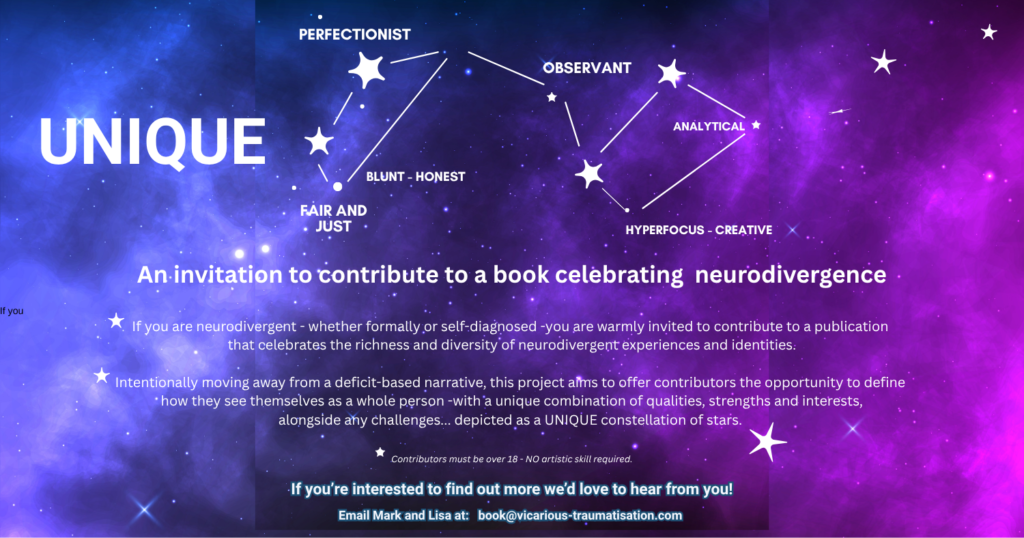
I am delighted to share that I have a chapter in an upcoming book called UNIQUE. UNIQUE invites neurodivergent contributors to map themselves: their qualities, strengths, struggles, deep interests, and challenges, all held together as a constellation.
My chapter centres on my Monotropic Galaxy — the constellation map of my Autistic self, and this blog is an edited and expanded version of my forthcoming chapter submission. My own constellation is a small offering among many in what I hope will be a rich, diverse, and deeply affirming collection of neurodivergent people’s inner worlds and experiences.
The book is still open for contributions.
If you are neurodivergent — whether formally diagnosed or self-identifying — you are warmly invited to contribute your own constellation. No artistic skill is needed. No particular way of writing. Just your own unique map of who you are. The project is intentionally moving away from deficit narratives and toward something that reflects the full richness of neurodivergent experience and identity.
Contributors need to be over 18. If you’re interested to find out more, Mark and Lisa would love to hear from you at book@vicarious-traumatisation.com.
Reading Liam Ren’s idea “of neuroqueering methodologies, or neuroqueering as methodology” ignited a memory, a re-emergence of an experience that I had many years ago. Liam describes neuroqueering as something unfinished, and shaped by intensive frequencies, something that ebbs and flows. This resonated with how my own learning journey has unfolded over time. Meaning has rarely developed through linear progression; instead, it has emerged through immersion in specific hyper-focused interests, through deep monotropic intensity, and often a return to a previous deep interest (like this article about the artist Mark Rothko), a constant spiralling movement, ebbing and flowing between past and present.
Their reflections on the idea of a “synaesthetic art critic” and philosophical engagement beyond conventional academic structures brought me back to my student years studying History of Art and English Literature almost 30 years ago. Long before I had the language for words like monotropism, neurodivergence, or neuroqueer theory, I was already encountering art as a whole-body experience; as a field of sensation that reorganised bodily awareness. Art was something I felt, something I needed in my life, and still do. Abstract expressionist painting, particularly the work of Mark Rothko, became a place for me where perception, emotion, and bodily awareness seemed to merge, and I felt a bit more understood, it made me feel more complete in a way that only art, music, literature and poetry can.
The Gallery as a Plane of Immanence
One memory stands out with particular clarity: visiting Tate Modern in London to experience Rothko’s Seagram Murals, first-hand with my friend as part of our Uni course. The gallery space was dimly lit, quiet, and expansive. The paintings were monumental, not decorative objects hanging on the gallery wall, but immersive environments; I felt I actually entered in to them. The paintings were autonomous compounds what Deleuze describes as “blocks of sensations” that reorganised the gallery space. “The work of art is a being of sensation and nothing else: it exists in itself” (Deleuze, 1994).
Looking back now, the gallery setting can be understood as what Deleuze and Guattari describe as a plane of immanence — a field of relations within which thought becomes possible (Deleuze & Guattari, 1994). Thought does not arise solely within an individual’s mind; it emerges through material and affective conditions: architecture, colour, silence, bodily positioning, and social presence with our surroundings. This space helped shaped my perception of the art before any conscious interpretation began; it was something I felt before the words arrived. In fact, I still have no words to accurately describe my experiences, which is possibly why art is so important: it fills the gap where words restrict us.
Plateaus of Attention: Monotropism and Sensory Duration
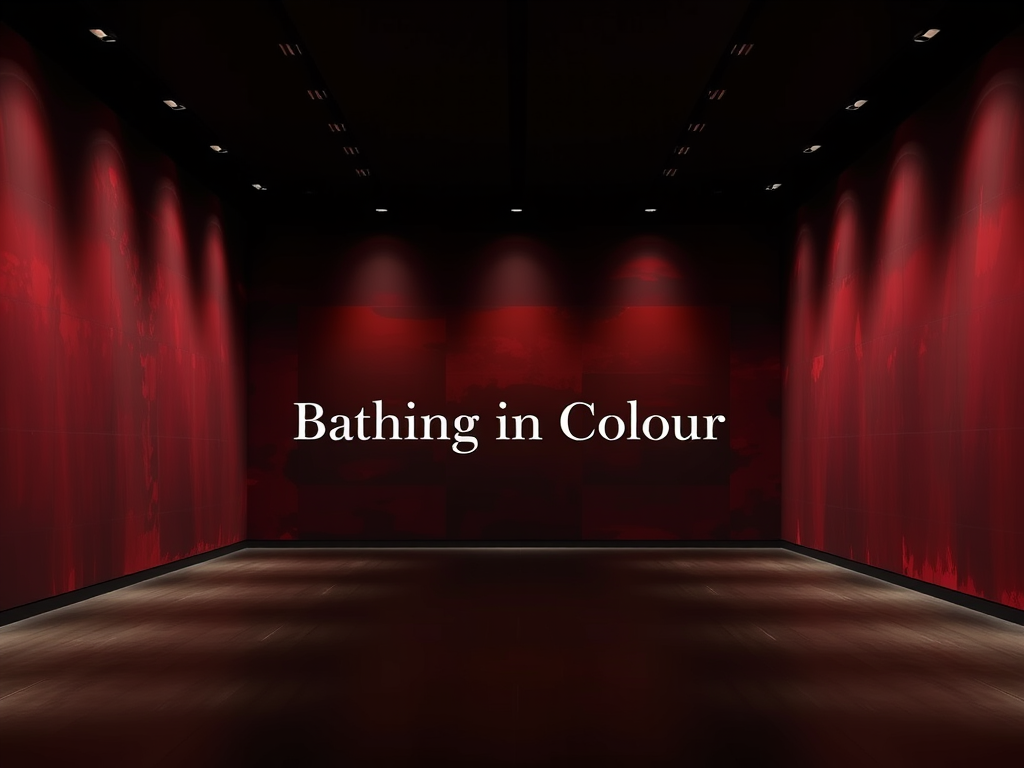
My friend and I lay down on the gallery floor, surrounded by vast fields of dark red and maroon. I let the colours wash through me, as though I were bathing in them, held within an atmosphere that seemed to slow and thicken time itself. We must have stayed there for a long while, suspended in a quiet intensity that resisted any sense of conclusion. I have returned to the gallery many times since, always with the same feeling: that I never quite want to leave, as though the encounter is still unfolding and I am still making sense of it.
This sustained immersive, monotropic experience could be understood through Deleuze and Guattari’s concept of a plateau: a continuous region of intensity that maintains experiential charge without moving toward resolution (Deleuze & Guattari, 1987). My attention deepened rather than accelerated or reached any definitive answers about the work; my thoughts unfolded as time seemed to just slip away, and I felt I almost became part of the art itself. This narrowing of attention functioned as a temporary territorialisation of perception, through which sensory relations intensified rather than diminished.
The theory of Monotropism (Murray et al., 2005), may help explain this experience further. When the attentional resources of Autistic and ADHD people become highly focused, engagement with sensory or conceptual environments can become immersive and nonlinear. In the Rothko gallery, this narrowing of my attentional field did not feel restrictive; instead, it enabled an expanded relational field in which colour, the sounds of the gallery, the architectural scale of the building and paintings, my memory, and shared presence formed a kind of temporary assemblage. The meaning and memories created there emerged slowly through my ongoing immersion with the art and the space I was in.
Synaesthetic Encounter and the Body without Organs
I experience synaesthesia, where sensory impressions begin to overlap and blend. While immersed in Rothko’s deep reds and maroons, I felt and heard a low vibrating internal hum. The colours did not stay at a distance as something to look at; they felt as though they entered my body, with an affective force and pull, creating an atmosphere that was both calming and intense. Experiences like this can challenge expectations about how we are supposed to engage with art. Rather than observing from the outside, perception becomes immersive, relational, and deeply felt, maybe more so if you experience synesthesia in this way, but I only have my own experience to draw from.
I didn’t know it at the time, other gallery visitors probably thought I was a bit strange, but lying on the gallery floor also involved an unspoken disruption of normative spectator behaviour in a setting like this. Visitors are typically expected to stand, sit or move quietly, and observe from a respectful distance. By shifting bodily position — lying, sitting and walking around, I was unknowingly experimenting with perception itself and also neuroqueering the expectations of being in a formal public gallery space.
Deleuze and Guattari describe the Body without Organs (BwO) as a process in which habitual bodily organisation loosens, allowing new intensities and relations to emerge (1987). The BwO is not the disappearance of the structure of our actual human bodies but an experimental reconfiguration of how our bodies connect and respond, and can reconfigure in different spaces.
Within Tate Modern’s gallery, Rothko’s work disrupted and destaballised the boundary between me as a viewer and artwork. The gallery functioned as an assemblage in which colour, texture, depth, scale, sound, friendship and memory all combined to form a temporary field of relational intensity. In this reorganisation, my own perception of the art became more experimental. The pressure to interpret correctly when writing up my essay notes receded, and my attention plateaued into a state of sensation in which my identity and environment were mutually shaping each other as I let the colours flow through me, as I heard the sound of the deep reds, and felt as if I were becoming part of the art itself.
Neuroqueering Methodology and Lines of Flight
For many neurodivergent people, such intensive monotropic responses to art, literature, music, dance or poetry may be familiar. Through a Deleuzian lens, they could be understood as creative reorganisations of experience, minor reorganisations of affective and perceptual relations, subtle lines of flight that open alternative ways of being present in the world (Deleuze & Guattari, 1987).
Liam Ren’s exploration of neuroqueering methodology helps frame these encounters as epistemologically significant. Neuroqueering challenges assumptions that knowledge must be produced through linear argument or normative cognitive performance. Instead, it recognises that understanding may emerge through affective immersion, relational environments, sustained attentional flow states, and our divergent ways of experiencing art and the world.
Abstract art like Rothko’s can therefore function as a neuroqueer methodological space, a temporary territory where dominant expectations of productivity, legibility, and behavioural regulation loosen for the person who is engaging with the artwork.
Becoming Through Colour
Reflecting now, my time lying beneath Rothko’s paintings enabled a different way of thinking to emerge, one shaped by duration, sensory attunement, and relational presence. Memory itself operates rhizomatically, as a process of ongoing recomposition rather than recollection, returning unpredictably and forming new conceptual connections across time (Deleuze & Guattari, 1987), as has happened when I read Liam’s blog.
Such encounters suggest that philosophical becoming may occur not only in texts but also in embodied situations like this that loosen the organisation of the self and open new planes of relation. Neuroqueering methodology can therefore be understood as a lived practice of experimentation, a willingness to follow lines of sensation in our bodyminds into unfamiliar territories, to linger with the ‘what could this mean’, with the ‘what may happen if…’.
Rothko’s murals continue to offer such plateaus for me. They create environments in which perception can deepen, bodyminds can reorganise, and thought can unfold through relational intensity with the artwork and the surrounding space when conditions feel safe. In Deleuzean terms, art is not primarily representational but intensive. As Deleuze and Guattari write;
“the work of art is a being of sensation and nothing else: it exists in itself”
(Deleuze & Guattari, 1994, p. 164).
Encountering these fields of colour can therefore feel less like interpreting an image and more like entering a sensory event, one in which attention shifts, time gathers, and experience becomes widened with duration.
Within such encounters, sensation may operate temporally as well as perceptually. Deleuze and Guattari describe how “sensation contracts the vibrations of the stimulant… what comes before has not yet disappeared when what follows appears” (1994, p. 211). This contraction of vibration resonates with my own Autistic synaesthetic experiences of spiralling memories of sound, colour and physical sensations in my body, deep attention, and non-linear temporal flow. Art, in this sense, can become a way of inhabiting duration differently, allowing perception to loosen its usual coordinates and making space for alternative sensory epistemologies – creating new nodes on the rhizomes of our experiences and deepening our monotropic tunnels and interests.
From this perspective, aesthetic encounters are not simply personal responses but ontological events. As Nabais (2010) observes, art involves the “capture of the force of life and also creation of a life which stands by itself” and the creation of autonomous zones of sensation that exist independently of subjective interpretation. Rothko’s paintings could be understood as environments in which sensation continuously re-composes these experiences. Rather than resolving the chaos of an abstract work of art, art can hold open a field of intensity through which chaos becomes composed into sensation.
Deleuze and Guattari suggest that “art is not chaos but a composition of chaos that yields the vision or sensation” (1994, p. 204). If neuroqueering expands the conditions under which knowledge becomes possible, then philosophy may sometimes begin in these quieter aesthetic spaces and our relationships with a work of art — spaces where colour reshapes attention, duration transforms understanding, and sensory experience invites us to become otherwise.
Since writing this reflection, I have found myself thinking about how memory and theory shape the way we understand past experiences. What once felt like an open, personal sensory experience with art has become more organised through language and philosophy.
I have also begun to wonder about the gallery space itself. The quietness, dim lighting, and cultural expectations of contemporary art created conditions where immersive attention felt possible and safe. Lying on the floor felt like a small disruption of usual behaviour, but it was also an action that the space could absorb. This raises questions about who is able to experiment with their perception in public spaces, and under what conditions difference becomes accepted or contained. These reflections also make me think about how public spaces quietly regulate behaviour, attention, and movement, shaping what kinds of sensory engagement are seen as appropriate or disruptive. I am also aware that not all people are granted the same freedom to move, pause, or experiment with perception in public spaces. What felt possible for me in that moment may not feel safe or permitted for others. For some people, moving or sensing differently in public can lead to misunderstanding, correction, or exclusion rather than quiet acceptance.
Reflecting further, I notice an ongoing tension between using the theory of monotropism to understand deep attentional engagement, and engaging with philosophical ideas such as those of Deleuze and Guattari about becoming that resist fixed explanations. Neuroqueering methodology may live within this tension. It can help us name and affirm neurodivergent ways of experiencing the world, while also inviting us to remain open to change, uncertainty, and new ways of thinking, and to question the taken-for-granted standards of focus, composure, and productivity that shape how bodies and minds are expected to function in shared environments. Immersive sensory encounters can feel uncertain or overwhelming, reminding me that opening perception in this way involves a negotiation between curiosity, vulnerability, and the need for grounding.
Rather than reaching a conclusion, these reflections feel like a continuation. My encounters with Rothko’s paintings continue to unfold through memory, conversation, and ongoing sensory meaning-making. Perhaps neuroqueering is not about finding final interpretations or fixed language to define an experience or way of being, but about noticing how perception and understanding shift over time, opening space for new possibilities to emerge. These questions are not only personal but collective, connected to wider struggles over whose ways of sensing, thinking, and being are recognised as valid, and whose are overlooked, regulated, or misunderstood.
To neuroqueer perception may therefore be not only to experience differently, but to gently challenge the norms that decide which experiences are allowed to matter.
Next Blog: What may neurodivergent experiences reveal about how plateaus are lived, sensed, and sustained, and how might we neuroqueer them?
What is a plateau? Not a peak to be reached, but a region where intensities sustain themselves.
Plateaus are not entered so much as encountered, they are fields of relation where perception, time, and attention begin to shift.
In my next blog, I will explore and unfold some more!
References
Deleuze, G., & Guattari, F. (1987). A thousand plateaus: Capitalism and schizophrenia. University of Minnesota Press.
Deleuze, G., & Guattari, F. (1994). What is philosophy? Columbia University Press.
Deleuze, G., & Guattari, F. (1994). What is philosophy? Columbia University Press.
Murray, D., Lesser, M., & Lawson, W. (2005). Attention, monotropism and the diagnostic criteria for autism. Autism, 9(2), 139–156.
Deleuze, G., & Guattari, F. (1994). What is philosophy? Columbia University Press.
Deleuze, G. (2003). Francis Bacon: The logic of sensation. Continuum.
Nabais, C. P. (2010). Percept, affect and micro-brains: Art according to Deleuze. In S. Di Marco, O. Pombo, & M. Pina (Eds.), Neuroaesthetics: Can science explain art? (pp. 165–175). Fim de Século.
Exploring threshold consciousness, temporal ecology, and the porous boundaries between dreaming and waking through a neuroqueer lens.
Hypnagogic and hypnopompic experiences — vivid sensory and emotional states that occur at the boundaries of sleep — they may include visual, tactile and auditory hallucinations and are often described within biomedical models as temporary disruptions in wake-sleep and sleep–wake states. However, for many Autistic and neurodivergent people, particularly during periods of burnout, trauma-related stress, and prolonged systemic overload, these experiences may become more frequent and intense and deeply destabilising. This is something I personally experience: the deeper into burnout I move, the more the boundary between dreaming and waking can blur.
This article introduces the idea of neurodivergent temporal ecology as a way to help theorise this and explore how dream persistence between wake and sleep states and threshold consciousness may emerge from interactions among monotropic attention, neurodivergent temporal rhythms, trauma physiology, and the sensory and social environments we inhabit. Drawing on neuroqueer theory (Walker, 2021), philosophical accounts of temporality (Deleuze, 1994; Manning, 2013), Autistic burnout research (Raymaker et al., 2020), and sleep science (Ohayon et al., 1996; Mahowald & Schenck, 2005), this piece reframes hypnagogic and hypnopompic states as relational experiences rather than purely neurological anomalies.
Hypnopompic and hypnagogic experiences in Autistic burnout are not merely sleep disturbances. They can be expressions of neurodivergent temporal ecology — moments when attentional, sensory, trauma-related, and environmental pressures destabilise normative boundaries between dreaming and waking and where our flow states between wake and sleep merge.
By drawing on my lived experience, I am suggesting that these different sleep states and versions of reality can challenge assumptions that consciousness should always be linear, stable, and organised. I am inviting people to rethink how sleep, perception, rest and wellbeing are understood, and to consider how environments might be reshaped to support diverse rhythms of awareness and reality.
Living at the porous edge of waking
For some Autistic and neurodivergent people, sleep may not always feel like a clear shift from wakefulness into rest or from rest into wakefulness. Instead, it can feel like temporarily living in a liminal threshold, a shifting terrain where dreams, memories, sensations, and waking perception overlap. This can be confusing, disorienting, and at times frightening.
During burnout or crisis, when sensory, emotional, and social demands exceed available energy, if you are anything like me, these threshold experiences may intensify. You might wake and still perceive dream imagery in your room, perhaps see spiders moving across the wall, shadowy figures in the corner that reach out to touch you, or hear voices that seem present and very real. These experiences can feel entirely real in the moment and may be accompanied by sleep paralysis and a sense of being trapped between worlds. Reaching out to touch the spiders, only to find your hand moving through empty air as the image fades, it can be deeply unsettling. Gradually, environmental and sensory cues become clearer, the dream loosens its hold, and waking awareness returns, often leaving emotional residue and exhaustion before the day has even begun.
Sleep research refers to these as hypnopompic experiences, which occur when REM dream processes persist briefly into waking consciousness (Ohayon et al., 1996). Similar experiences while falling asleep are known as hypnagogic states and are associated with narcolepsy, stress, disrupted sleep, and other neurological vulnerabilities (Mahowald & Schenck, 2005).
From a neurodivergent temporal ecological perspective, these threshold states are not simply individual neurological problems; they may reflect complex relationships among attention, trauma, sensory environments, and cultural expectations about time, productivity, and even how our rest and sleep function. Learning to accept this has made it less frightening for me, and accept it as something that is just a part of my life between worlds that intensify the more stressed or burnt out I am, although this may not be everyone’s experience.
Neuroqueer time and threshold consciousness
Neuroqueer theory challenges deficit-based interpretations of neurological differences by questioning assumptions that perception must always be stable, rational, and temporally linear (Walker, 2021). Expanding on this, I am suggesting that diverse experiences of consciousness may represent meaningful responses to lived conditions rather than signs of dysfunction.
Hypnagogic and hypnopompic states are deeply liminal. For those of us already marginalised and living in the liminal spaces, it may be no surprise that our waking and dream worlds reflect this too?!
Hypnagogic and hypnopompic experiences occur before our conscious awareness has fully stabilised into the structured clarity expected in waking life. Meaning is often felt before it can be explained. I often feel suspended between dreaming and waking, between my inner imagery and the external reality. It can be scary and confusing, which is why I’ve been thinking about this a bit more and trying to work out why it may be happening.
Philosophers such as Deleuze and Guattari (1994) describe time as layered and shaped by intensity rather than simply progressing forward. Manning (2013) writes about how experience is something felt before it is cognitively organised. Sleep threshold states make these ideas tangible, revealing consciousness as fluid and relational, shaped through ongoing interactions between body, memory, the environments we live within and interact with, and social rhythms based on different intersectional identities and experiences.
Spiral time, rhizomatic memory, and dream flow
Many neurodivergent people experience memory and time in non-linear ways. Past events may re-emerge as sensory atmospheres or emotional presences, creating a sense that the past remains active within the present. This can feel like living within a spiral of time rather than along a straight timeline.
Within such temporal patterns, dreams may continue to influence waking perception. Recurring hypnagogic or hypnopompic experiences can involve familiar dream environments, emotional connections with dream figures, or confusion about whether an event occurred in a dream or in waking life. For me, these experiences often intensify during burnout, when attentional flexibility decreases and emotional processing becomes more difficult (Raymaker et al., 2020). It is like my mind is trying to anchor itself and regain a coherent flow.
Dream persistence that overlaps with reality feels like it is perhaps functioning as a survival mode. When the nervous system is overwhelmed, continuing internal processing during sleep it is may be an attempt to conserve energy or make sense of distressing experiences. Although this can result in anxiety or disorientation, it also reflects an adaptive effort to maintain coherence and flow.
I have found it helpful to think about Deleuze and Guattari’s concept of the rhizome (1994), which offers a way of understanding experience as emerging through non-linear connections rather than clear beginnings or endings. Autistic perception often seems to move in this relational way, linking memories, sensory impressions from waking life, and dream imagery into shifting constellations of meaning and attention tunnels. At times, it can feel as though I enter or leave dreams at unexpected points — already somewhere in the middle of experience — rather than transitioning neatly from one state of consciousness to another.
Monotropism, inertia, and attentional depth
Monotropism theory suggests that Autistic and ADHD attention often involves deep engagement within a limited number of attentional channels (Murray et al., 2005). This can support creativity and intense focus but I think for some, myself included, it may also make transitions, including waking from sleep more effortful.
During burnout, reduced flexibility in attention can combine with the experience of monotropic split, intensifying the persistence of dream imagery across sleep–wake thresholds. Monotropic split refers to the way attention is divided between competing demands, where part of the bodymind remains deeply immersed in an internal focus while another part attempts to respond to external expectations (Adkin, 2022). This can create a feeling of cognitive and sensory stretching or fragmentation, particularly when environmental pressures require rapid shifts in attention and we are expected to bounce out bed and go to work or begin parenting duties!
In such states, the nervous system may struggle to complete the transition between dreaming and waking. Our attention tunnels, the deeply focused channels through which monotropic cognition often operates, may begin to blur across states of consciousness. A person may feel suspended, as if floating between inner imagery and outer reality, experiencing a slowed, blurry awareness where perception has not yet fully stabilised. Dream environments, emotional tones, or sensory impressions can linger as waking demands begin to intrude into our attention tunnel and pull us back into reality.
Research on Autistic inertia may further help to explain this process. Autistic inertia describes difficulties initiating, stopping, or switching between activities or cognitive states (Buckle et al., 2021). When combined with ADHD-related fluctuations in attentional regulation, including oscillations between hyperfocus and exhaustion, these dynamics can contribute to what might be described as temporal momentum, a continuation of cognitive immersion beyond the usual boundaries of sleep and waking (Heasman et al., 2024).
Dream-like flow states between conscious and unconscious may not be just sleep disturbances but may be understood as an interaction among monotropic attentional depth, inertia-related challenges in shifting states, and the physiological effects of burnout. As our attentional energy resources diminish and re-accolate and distribute themselves, the bodymind may remain engaged in internal processing, trying to organise its patterns and regain a flow state that makes more sense as the body begins to wake or go to sleep. This can result in an almost layered experience of perception, uncertainty about what is real, and needs a gradual re-orientation to the external world rather than an abrupt transition. It is why waking up can be sooooo hard!
Understanding hypnagogic and hypnopompic experiences through the lens of monotropic split and Autistic interia may offer a more nuanced account of the threshold consciousness for neurodivergent people. It highlights how attentional styles, environmental demands, and states of exhaustion interact to shape the ways neurodivergent people move and flow between dreaming and waking, immersion and return.
Burnout, trauma, and ecological strain
Autistic burnout is increasingly recognised as a consequence of prolonged stress, masking, and environmental mismatch (Raymaker et al., 2020). Trauma can fragment sleep cycles and intensify emotional dream content (Mahowald & Schenck, 2005). Sleep deprivation has also been linked to perceptual disturbances and cognitive dysregulation (Ohayon et al., 1996).
Frameworks such as Gray-Hammond’s ecosystemic model (2026) highlight how burnout, altered perception, and sleep disruption or changes interact with environmental pressures. These perspectives suggest that psychiatry can sometimes individualise systemic strain, locating distress solely within the person rather than addressing the conditions that contribute to it.
Altered states of consciousness may therefore be better understood as ecological signals, indications that our nervous systems are adapting to environments shaped by expectations of neuronormativity, constant productivity (even in sleep and the ways we sleep and rest!) and sensory tolerance. Productivity-focused time demands can place particular strain on neurodivergent people whose rhythms of engagement, ways of resting and recovery differ from dominant norms, leading us to burnout and more unusual sleep patterns.
Ethodiversity and relational consciousness
Ecological neurodiversity introduces the concept of ethodiversity, recognising that multiple cognitive, sensory, and relational styles coexist within shared environments (Tarragnat, 2025). From a this perspective, consciousness is not simply produced within the individual brain but emerges through ongoing assemblages of body, memory, environment, culture, and time. These relational conditions shape how attention moves, how energy is resourced, and how safety is experienced.
Building on the idea of monotropic split, burnout can be understood as a state in which these ecological relationships become strained or fragmented. When attentional demands exceed available capacity, the nervous system may remain partially engaged in internal processing even during periods of rest. Hypnagogic and hypnopompic experiences can therefore be seen as threshold moments in which perception is reorganising across disrupted ecological conditions.
Sleep is More-Than biological restoration; it can also be a site of cognitive and sensory integration, where experiences are slowly being sorted, re-patterned, and re-assembled in an attempt to regain coherence and flow. Dream imagery may persist into waking awareness because the bodymind may still be trying to regain a safe flow state before waking. More time in nature and engaging in stimming and monotonous flow states with what interests you and what you are passionate about may help rebalance this…….
The gradual fading of dream imagery on waking may reflect a process of ecological realignment, a slow recalibration of our internal temporal rhythms. While these experiences may signal burnout and misattunement with surrounding ecosystems, they may also indicate an adaptive move toward recovery. For myself, being aware of my hypnopompic and hypnogogic states is a signal that I need deep rest, reduced overload, and environments that better support my own neurodivergent rhythms of monotropic attention and engagement. I need more time with my passions and interests, more time stimming and meeting my sensory needs in the dark, under my weighted blanket.
Dream Thresholds, Temporal Diversity, and Mingling with the Universe
Hypnagogic and hypnopompic experiences remind us that consciousness is not always clear-cut or neatly divided into sleeping and waking. There is no ‘right way’ to sleep, to dream or to wake up!
For many Autistic and neurodivergent people, especially during burnout, these threshold states can become intense, immersive, and emotionally charged. Dreams may seem to linger in the room as we wake. Sensations and images can feel real for a few moments before gradually fading. These experiences can be frightening, confusing, and exhausting. At the same time, they may also reveal something important about how neurodivergent minds move through time and perception and why dream worlds and reality may blur at times – perhaps even beyond hypnopompic and hypnagogic experiences and into the wider ways of daydreaming, immersing in fantasy and role play.
Recognising temporal diversity as part of neurodiversity means understanding that different nervous systems have different rhythms of rest, monotropic attention, and recovery. Productivity-driven expectations about how quickly we should fall asleep, wake up, or “return to normal” can place additional strain on already overwhelmed systems. When dream imagery continues into waking life — or when vivid sensory experiences arise as we fall asleep — it may be a signal that our bodymind is trying to process, integrate, and make sense of overwhelming experiences.
From a neuroqueer and ecological perspective, altered states of awareness can be understood as relational signals. They may point to our current environment as too demanding, to unsafe sensory landscapes, or to social pressures that require constant adaptation and masking. In this sense, hypnopompic and hypnogogic experiences could be seen as part of the nervous system’s survival response, continuing its work of sorting and patterning experience when there has been little time to rest while awake.
In my own writing on Autistic perception, I have described this as “mingling with the universe.” Sometimes neurodivergent awareness feels deeply interconnected with surroundings — sensory detail, memory, emotion, and environment all blending together in ways that are difficult to separate. Hypnagogic and hypnopompic states can intensify this feeling. Inner worlds and outer realities briefly overlap, reminding us that consciousness is not fixed or isolated but shaped through ongoing relationships with the spaces and systems we inhabit.
Understanding these experiences through a lens of Neurodivergent Temporal Ecology challenges narrow psychiatric interpretations that focus only on individual symptoms. Burnout, sleep disruption and differences, and perceptual instability often emerge within wider contexts — including sensory-hostile environments, pressures to conform to linear productivity time, and limited opportunities for genuine rest or recovery. Supporting neurodivergent wellbeing, therefore, requires more than medical responses. It calls for cultural and structural change: creating environments that recognise and support different rhythms of living, thinking, and sleeping.
Hypnagogic and hypnopompic experiences can be unsettling. Yet they can also offer insight into how neurodivergent minds adapt, survive, and find meaning. When dreams continue into waking life or merge as we fall asleep, it may be a sign that we have reached the limits of our energy, but it can also be an invitation to slow down, seek safety, and restore connection with ourselves and our environments.
Temporal Diversity
Recognising temporal diversity expands how we can understand neurodivergent sleep, mental health, rest, and care. It encourages us to move away from rigid ideas about what consciousness “should” feel like and toward more compassionate, flexible ways of supporting neurodivergent lives.
By understanding that our monotropic perception is always moving in relationship with sensory landscapes, memories, emotions, and social rhythms, we can begin to see reality itself as something fluid and negotiated rather than fixed. Sleep and waking become liminal crossings rather than fixed boundaries.
Hypnagogic and hypnopompic experiences are not just disruptions to sleep or sleep disorders, but perhaps signals about how well our environments are really supporting and making sense to us. I see them as part of my monotropic flow state that enables me to transition between waking and dream worlds – where both worlds are equally important. When we learn to listen to these signals, we can create the possibility of lives where different ways of sensing time and consciousness are recognised as meaningful and not pathologised. There is very little discussion about hypnopompic and hypnagogic experiences; it is still very much shrouded in the same stigma as psychotic hallucinations, and I have found people look wary when I talk about this.
Recognising and sharing stories about these experiences may help neurodivergent people feel less pressure to force themselves back into fast, “normal” rhythms of waking and productivity. Instead, moving between dreaming and waking, focus and rest, can be understood as part of the natural diversity of human perception. Allowing time for slower realignment, through rest, sensory grounding, and meaningful flow states can support the gradual return of energy and clarity.
By learning to listen to our own rhythms and to the flow states that move between dreaming and reality, sleep and wakefulness, rather than constantly resisting or trying to cure these experiences, the meanings and re-orientation of flow within liminal dream spaces can begin to unfold more gently. Growing awareness and understanding of neurodivergent patterns of monotropic attention, rest, and recovery is part of an ongoing process of re-energising, re-orienting, and discovering more sustainable ways of being so we begin to re-world our experiences, not only in waking life, but also within our dream worlds and the shifting spaces in-between.
Buckle, K. L., Leadbitter, K., Poliakoff, E., & Gowen, E. (2021). “No way out except from external intervention”: First-hand accounts of autistic inertia. Frontiers in Psychology, 12, 631596. https://doi.org/10.3389/fpsyg.2021.631596
Deleuze, G. (1994). Difference and repetition. Columbia University Press.
Deleuze, G., & Guattari, F. (2013). A thousand plateaus: Capitalism and schizophrenia. Bloomsbury Academic.
Heasman, B., Williams, G., Charura, D., Hamilton, L. G., Milton, D., & Murray, F. (2024). Towards autistic flow theory: A non-pathologising conceptual approach. Journal for the Theory of Social Behaviour, 54(4), 469–497. https://doi.org/10.1111/jtsb.12427
Mahowald, M. W., & Schenck, C. H. (2005). Insights from studying human sleep disorders. Nature, 437(7063), 1279–1285. https://doi.org/10.1038/nature04287
Manning, E. (2013). Always more than one: Individuation’s dance. Duke University Press.
Murray, D., Lesser, M., & Lawson, W. (2005). Attention, monotropism and the diagnostic criteria for autism. Autism, 9(2), 139–156. https://pubmed.ncbi.nlm.nih.gov/15857859/
Ohayon, M. M., Priest, R. G., Caulet, M., & Guilleminault, C. (1996). Hypnagogic and hypnopompic hallucinations: Pathological phenomena? British Journal of Psychiatry, 169(4), 459–467. https://pubmed.ncbi.nlm.nih.gov/8894197/
Raymaker, D. M., Teo, A. R., Steckler, N. A., Lentz, B., Scharer, M., Delos Santos, A., Kapp, S. K., Hunter, M., Joyce, A., & Nicolaidis, C. (2020). “Having all of your internal resources exhausted beyond measure and being left with no clean-up crew”: Defining autistic burnout. Autism in Adulthood, 2(2), 132–143. https://doi.org/10.1089/aut.2019.0079
Walker, N. (2021). Neuroqueer heresies: Notes on the neurodiversity paradigm, autistic empowerment, and postnormal possibilities. Autonomous Press.
“The whole world is only a virtuality that currently exists only in the folds of the soul which convey it, the soul implementing inner pleats through which it endows itself with representation of the enclosed world.” — Gilles Deleuze, The Fold (1993, P. 24).
Thoughts…..
I am exploring how Deleuze’s ideas in The Foldentwines with the theory of monotropismand the lived textures of Autistic perception and attention through a neuroqueer lens.
What if monotropic attention and perception is folded, what happens when we unfold?
What if Autistic time moves in spirals, not lines?
Folding Worlds
“The world is an infinite series of curvatures”
Sometimes, when I’m deeply absorbed, following the rhythm and flow of an idea, a line of flight, or feeling sound ripple through air the world seems to bend inward. Time loosens, boundaries blur and my mind folds into the moment until it feels like my thought, body, and world are all moving together as one continuous curve.
Deleuze, in The Fold, imagined reality itself as endlessly pleated, an intricate fabric of curves and contours where inside and outside are never truly separate, each perception and experience establishes ‘folds in the soul’. (p. 112) As Autistic people our sensory systems are more porous, each life, each experience, each moment, is a fold within this larger flow of existence, all entangling together with the environment around us.
As an Autistic person, you may feel like I do, that you live in the liminal spaces, the in-between. The world doesn’t divide neatly into subjects and objects but moves almost as if it is a single and multiple simultaneously, perhaps holographic , a folded plane of becoming.
Monotropism (Murray et al., 2005) is the theory that explains how Autistic and ADHD experience is shaped by deep, focused attention. Instead of our attention spreading thinly across many things, our attention folds inward, gathering tightly around may be just one or a few single streams or tunnels of interest or sensation at any given time. It’s not a limitation, it’s a different rhythm, it is how we experience flow and can be a really energising and regulating experience when we are looped into something positive that helps us. Our minds tend to curve toward what holds meaning, creating a rich, textured world from within that fold where our attention dwells.
Where neurotypical attention might skim across multiple channels of attention, monotropic attention lingers and has capacity to stay focused for long periods, especially when in the right supportive environments. Monotropic attention inhabits, it listens deeply and it is in these moments of flow, the world is not distant as some may think, rather the world is inside us, rich and intense. It is like it is folded through our senses, our language, our movement to such intensity we become-with our surroundings.
Unfolding
“A fold is always folded within a fold, like a cavern in a cavern”. (P.6)
Folds can be fragile, like origami. When too many demands pull at once, such as sensory input or social expectations, it is like the fold can’t stretch without straining and something has to give before it breaks. Overload, fragmentation, and burnout emerge when the world presses too hard against our natural curvature and forces the fold to carry more than it has capacity for. We may experience more meltdowns or shutdowns and over a longer period could enter a full burnout. Burnout, in this sense, isn’t failure of our body minds; it’s like a wound in the fold. It happens when we are forced to unfold too quickly, without time or gentleness and without the right support.
Liminal Folds
The space between inside and outside, that delicate threshold in the liminal zone, is where I live and perhaps many other Autistic people live too. It’s the edge of sensory, emotional and social attunement, where the world can feel both too near and too far at the same time. Safety, trust, and co-regulation allow the fold to breathe, it gives space to expand and recover. To unfold safely, enables us to unmask ‘to increase and grow’.
When others meet us at our own tempo and in our own authentic ways, our fold can open slowly, naturally, toward a node of connection with others. It strengthens the vulnerable liminal spaces in-between, it can be empowering and gives us energy to follow that curve of a fold and see where it takes us, to resist neuronormative linear ways of being.
Neuroqueer Curvatures
To neuroqueer is the act of living otherwise, resisting the norms that demand sameness, linearity, and temporality. It invites us to honour different ways of moving through the world: curved, recursive, and rhizomatic.
Through this lens, embracing your Autistic/ADHD monotropicness can become a neuroqueer ecology. It is a way of being that disrupts the assumption that we must flow in straight lines and contort ourselves and fold and contort ourselves to fit into heirarchies and systems. To embrace the liminal and the Autistic fold is an act of quiet defiance, a refusal to flatten complexity or to perform productivity and neuronormative expectations at the expense of our own well-being.
Our monotropic deep focus isn’t a deficit, it’s an orientation, it is a different way of being and living. To embrace flow and see where the fold takes us. It reveals a world that thrives on depth and immersion rather than breadth. To move with with the flow of our monotropic attention, along the fold is to inhabit curved time, the slow, spiral rhythm of a mind that folds toward what matters most to us.
Folding Time
For many of us, life doesn’t move in a straight sequence. It curves back, loops, and gathers around moments of attention. This is folded time, neuroqueer temporality or what others have called mad time, time as felt texture rather than moving like clockwork.
When I am in deep flow, the past and future dissolve into the intensity of an ever expansive ‘now-ness’, when the fold releases, I spill gently back into a wider space, I always need time to recalibrate, to find the edges again and to find something to loop and back hook into before I can move on.
To live through folded time is to understand that attention has its own seasons. Some days are for spiralling inward, composting thoughts and gathering energy and others may be for stretching outward, connecting, creating and reaching new nodes.
Folding with the World
“Perception establishes the folds in the soul” (P. 112)
In the folds of Autistic attention and perception lie whole worlds of knowing and becoming. Through monotropism and neuroqueer theory, we can reimagine these folds not as constraints, but as living spaces of creativity, connection, and a different temporality.
Within these curvatures, difference becomes depth, a way of sensing the world through texture, rhythm, and relation rather than conformity. Our attention moves like tidewater, folding and flowing inward to nourish the self and unfolding and rippling outward to meet the world again.
When we are allowed to move at our own pace, these folds open into more realms of possibility, spaces where curiosity can root, where safety and belonging can take form.
To live within the Autistic fold is to recognise that we are not separate from the world, but continuous with it, each of us a unique curvature in the greater flow of being. By embracing our folds and natural flow of monotropic attention, we can honour the quiet sensory moments, our rhizomatic ways of being, and the beautifully entangled ways we come to know, feel, and create within our selves and connect with others.
Reflections
How does your attention fold?
What might unfold if your natural rhythms were met, not resisted?
References
Deleuze, G. (1993). The Fold: Leibniz and the Baroque. U of Minnesota Press. (quotes from Continuum edition, The Athone Press, 2006).
Walker, N. (2021). Neuroqueer heresies: Notes on the Neurodiversity Paradigm, Autistic Empowerment, and Postnormal Possibilities. Autonomous Press
What would it mean to build a hearth that welcomes not only diverse minds, but diverse ways of sensing, relating, and becoming across human and more-than-human lives?
This blog emerged from a conversation with Stimpunks during our Neuroqueer Learning Spaces project planning, where we explored what it truly means to create spaces that sustain neurodivergent people, rather than simply include. We found ourselves returning to the image of the hearth, the Cavendish Campfire, a warm, relational centre where ethodivergence is held, honoured, and co-regulated. This piece reflects on ethodivergent hearth building as a neuroqueer practice of community care and more-than-human kinship.
Ethodivergence speaks to the richness of relational, sensory, and affective difference. It’s about how we move, connect, feel, and attend, how our rhythms and responses don’t always align with dominant norms. Drawing from Ombre Tarragnat’s (2025) concept of ethodiversity, this expands neurodiversity beyond the human brain into relational ecology, honouring the full range of our inter-being ways with the world across all species of living and non-living things.
More-than-human refers to the interconnected ecology of life that includes not just humans but also animals, plants, weather systems, seasons, fungi, rivers, stones, moon cycles, and sensory environments. It’s a way of recognising that our ways of being, knowing, and healing are shaped by more than just other humans and that these entanglements are vital, not peripheral.
The hearth is a warm centre, a gathering space, a site of return and regeneration. It holds history, presence, and possibility, it’s where people tend the fire together, share stories, and learn from one another, a rhythm of shared becoming. To build ethodivergent hearths is to make room for new forms of kinship, ones that honour slow attunement, deep presence, and non-normative ways of sensing, being, and knowing. It’s an invitation to live otherwise, interdependently, in communities shaped not by conformity but by relational integrity and care.
Beyond its physical form, the hearth also holds sensory and emotional resonance, it is a centre, part of the basecamp, that may not be an actual campfire fire or a room, but a feeling. Sometimes it lives in the softness of our favourite weighted blanket, the texture of moss under our fingertips, the familiar paths we may return to in the woods or our local park, the stillness shared with our chosen family and pets. In ethodivergent hearth building, these sensory and relational centres become vital anchors, places to return to without performance, where our difference is held with warmth rather than shame or stigma.
Cavendish Spaces and ethodivergent hearths are built slowly, relationally, through co-regulation, sensory consideration, and access intimacy. There is room for fallow rest time, stim time, quiet time, time that bends to our bodyminds rather than our bodyminds being twisted into neuronormative time constraints that lead us into burnout and mental ill health. These are spaces that reject extraction and standardisation and instead, they welcome divergence and difference through shared rhythms, bodily autonomy, and relational consent, psychological and sensory safety. Cavendish spaces are like ethodivergent hearths for the soul where people gather not to fix or scrutinise, but to sit alongside, validate, and co-exist.
To think about and create ethodivergent hearths is to imagine what it means to design for difference, to centre care and safety for those of us often left out in the cold, on the edges and in the liminal spaces. It’s about making space for monotropic attention, sensory flow, and nonlinear emotional rhythms. It’s about pacing together through co-regulation, glimmers, multi-modal ways of communicating and attuned silence. It’s about giving permission for slow grief, spiralling joy, or messy recovery.
Ethodivergent hearth building means:
Not centring only human and normative ways of relating and knowing.
Honouring sensory, affective, and relational exchanges between people and natural or material environments.
Acknowledging that Autistic, disabled, and neurodivergent people often form deep attunements with non-human kin, sometimes more sustaining than traditional social models.
It might look like mutual aid networks, or shared rest practices, it might mean building more flexible time-structures that go beyond our clocks. This kind of hearth holds our queertime, our difference, our interdependence, without trying to fix, mask, explain, or justify. It’s a way of living gently with difference, and tending the fire that can help sustain us.
Ethodivergent hearth building invites a shift from thinking of community as exclusively human, towards something more ecological, embodied, and expansive, a shared hearth where difference is relational, and care ripples outward beyond species boundaries. Ethodivergent hearth building is a neuroqueer practice of relational community rooted in presence, divergence, and shared becoming where everyone can thrive.
Autistic/ADHD people are more likely to be monotropic and resonate with the theory of monotropism. Dinah Murray, Wenn Lawson, and Mike Lesser developed the theory of monotropism in the late 1990s. It is typically described as a neuro-affirming theory of Autism, but I think it is also a temporal mode.
I am considering whether being monotropic is not just about using attentional resources differently, but could also be about experiencing time differently due to how we use our attentional resources.
If you’re monotropic you may notice that:
Time is immersive and fluid.
Transitions may feel disruptive because they pull us out of durational temporal coherence and flow.
How you use your attentional resources may feel like being in a tunnel, and the world outside of that tunnel may feel like it is melting away or completely disappearing.
Temporal markers (like deadlines, calendars or clocks) may lose meaning or become really stressful and cause intense dysregulation.
Transitions may feel disruptive because they pull us out of durational temporal coherence and flow.
Autistic people often have to mask to fit in, we may struggle to be understood due to differences in our lived experience with other people. This mismatch of ways of experiencing the world is not just a communication gap and difference, as described in the Double Empathy Problem (Milton 2012) it may also be a Double Temporality Problem. Perhaps the world and the majority of people run on neuronormative time (temps), but monotropic people live and experience life more in felt experiences (durée) – in fluctuating flow states, a different internal rhythm that is unique to each person.
The philosopher Henri Bergson (1859–1941) distinguished between two kinds of time:
Durée: lived, qualitative, and immersive duration. This is the rhythm of consciousness itself and FELT experiences.
Temps divides time into identical units, i.e., seconds, minutes, and hours. Durée is felt time. It is how we experience time from the inside, and for Autistic/ADHD people, that may be more sensory and dependent upon the environment and how safe we feel. Bergson saw durée not as a subjective illusion but as the real nature of time, with clock-time being the abstraction.
Monotropic time is FELT. It is immersive, expansive, flowy, omnidirectional and deeply rhizomatic. Monotropic time is like a temporal home.
I believe we need to release ourselves from the grip of neuronormative time. To neuroqueer time is to subvert expectations of how you think you should be living according to the unwritten rule book of society’s norms set out by the majority of the population. Neuroqueering time isn’t just for neurodivergent people; it could benefit everyone.
By neuroqueering ourselves and neuroqueering time, anyone and everyone can break free from the neuronormative time structures that bind us all to capitalism and restrict and cause harm to lives in so many ways. We may be able to live more attuned to our own temporalities and more at one with our environment and those around us if we liberate ourselves from the ticking hands of the clock and find more flexible ways to manage our flow and our own time.
Let’s dwell in our natural flow and rhythms, actively resist neuronormative time, find spaces to neuroqueer time further in the liminal spaces and embrace our own unique rhythms and monotropic time.
Further reading and a more in-depth exploration can be found in my blog:
Bergson, H. (1889). Time and Free Will: An Essay on the Immediate Data of Consciousness.
Bergson, H. (2022). Creative Evolution. Routledge.
Murray, D., Lesser, M., & Lawson, W. (2005). Attention, monotropism and the diagnostic criteria for autism. Autism, 9(2), 139–156. https://doi.org/10.1177/1362361305051398
Walker, N. (2021). Neuroqueer heresies: Notes on the Neurodiversity Paradigm, Autistic Empowerment, and Postnormal Possibilities. Autonomous Press.
In my previous blogs, Monotropic Time and Neuroqueering Temporalities (2025) and Quantum Neuro-Holographic Thoughts from a Liminal Space (2024), I explored how Autistic and other neurodivergent experiences often unfold outside of neuronormative frameworks. I am AuDHD and deeply resonate with the theory of monotropism. Through the lens of monotropism, I experience time as a multidimensional holographic spiral, immersive, shaped by deeply focused attention tunnels and being engaged in fluctuating states of flow. I am considering if our sense of time perception as monotropic people is different as we find ourselves on the edges or in the in-between liminal spaces of society, trying to fit into neuronormative time frames, which go against our innate, authentic ways of perceiving time.
I am on the edge of a new monotropic interest (time perception) and want to loop back to some of the thoughts I have been exploring over the past 2 years about the neuroqueering potential of Deleuzean philosophy and bring in some of the main concepts from the philosophy of Henri Bergson who I am just beginning to explore. Both thinkers profoundly reimagined what time is. Rather than seeing time as an objective, linear sequence of moments, like many neurotypical people may perceive time using conventional clock-time and calendar time, both Bergson and Deleuze highlight that time is not linear; it is experiential, fluid, and heterogeneous in nature. Both of their concepts of time seem to fit into how many neurodivergent people experience time and my own experience of time.
I can only write about my own experience of time as an AuDHD, monotropic person. My time is not linear; it stretches, loops, pulses, collapses, and dilates in tune with my fluctuating energy, capacity and attentional resources, depending on my environment and access to flow states. My time is measured in sensory experiences, moments and patterns rather than calendar events. I find it really hard to recall specific memories and events unless I have a photo to ground something. I have only recently begun to realise that the theory of monotropism may also help to explain how my recall and memories may be different from those of other people who are not Autistic/ ADHD due to a more fluid sense of time. I find memories really hard to pinpoint as my memories are often not based on time but on sensory experiences and patterns of thoughts, events and situations. It can make joining in conversations hard with others who don’t experience this, and I am only just beginning to understand why that may be, for me at least!
“Crip time is time travel. Disability and illness have the power to extract us from linear, progressive time with its normative life stages and cast us into a wormhole of backward and forward acceleration, jerky stops and starts, tedious intervals and abrupt endings. Some of us contend with the impairments of old age while still young; some of us are treated like children no matter how old we get.” ― Alice Wong, Disability Visibility: First-Person Stories from the Twenty-first Century
Post-Human Theory and Being Part of the Environment
I resonate with Ombre Tarragnat’s post-human theory, where they discuss Subverting the autistic bubble metaphor (I): the Umwelt Theory (2025). Autistic people are not in a bubble where we can’t be reached and can’t reach out. Jakob von Uexküll’s (2010) concept, the Autistic Umwelt, has traditionally been described as Autistic people being bounded, bubble-like, and even sealed off from the world; unapproachable or unable to be a part of the ‘real’ functioning world where neuronormativity rules. This view is painfully inaccurate and really harmful.
I like and need my time alone, in my cave space, but what may seem like an Umwelt for me is more like a porous, shimmering neuro-holographic bubble, shaped not only by perception but by constant affective, sensory, and cognitive entanglement with my environment. I am not an ‘other’ in my own bubble, separate from real life. I feel I am deeply entangled and part of the environment, not separate from it, but living in it. I am in a constant process of folding and unfolding from the liminal in between spaces of my bodymind, trying to navigate the reality of society’s expectations for how I should be and my day-to-day life as a mum, trying to juggle family needs, work needs, and manage my own Autistic ways of being.
As Autistic/ADHD people, we may be, as Tarragnat suggests, practising “worldmaking where the boundaries between the subject and the world dissolve”. In many ways, we have to create our own spaces and live in our own timeframes to survive (and hopefully thrive)! I think it was James Baldwin who said, ‘The place we need does not exist, we must create it’. Tarragnat, in their blog, From the Autistic Umwelt to Autistic Worldings, drew my attention to the work of Stacy Alaimo (2016), who, in line with post-human feminists, suggests that Autistic people are not ‘in the world…. but we are of the world’. We need safe spaces to be our authentic selves and be of the world and accepted.
My relationship with my environment is fluid, porous, and deeply relational. This profoundly shapes how I live, perceive, and manage my time. I connect strongly with the theory of monotropism, yet I also see value in layering a post-human and neuroqueer lens to help frame my temporal experience.
As an Autistic person, subverting neuronormative time often feels essential for my survival, even more so now after repeated cycles of burnout. I need to find ways to help prevent another burnout cycle or at least lessen the impact, if I can. I feel I need more space to honour my own monotropic rhythms and energies, more space to go with my flow, rather than against it, as described in my recent blog about my Map of Monotropic Experiences, Stuck States vs Flow States.
I believe this kind of release from the grip of neuronormative and capitalist time isn’t just for neurodivergent people; it could benefit everyone. By neuroqueering ourselves and time, anyone and everyone can break free from the neuronormative time structures that bind us all to capitalism and restrict our lives in so many ways. Instead, we may be able to live more attuned to our own temporalities and more at one with our environment and those around us.
Bergson’s Durée and Monotropic Time
Dinah Murray, Wenn Lawson, and Mike Lesser developed the theory of monotropism in the late 1990s. It is typically described as a neuro-affirming theory of Autism, but I think it is also a temporal mode. I am considering whether being monotropic is not just about using attentional resources differently but could also about experiencing time differently due to how we use our attentional resources, and this impacts us.
If you’re monotropic you may notice that:
Time is immersive and fluid.
How you use your attentional resources may feel like being in a tunnel, and the world outside of that tunnel may feel like it is melting away or completely disappearing.
Temporal markers (like deadlines, calendars or clocks) may lose meaning or become really stressful and cause intense dysregulation.
Transitions may feel disruptive because they pull us out of durational temporal coherence and flow.
I think this may be why neurotypical expectations around punctuality, deadlines or “moving on” often feel unnatural and sometimes even painful for monotropic bodyminds. I am suggesting these aren’t signs of being too rigid or an innate dysfunction; instead, they may reveal a mismatch between temporal systems, different ways of perceiving time.
Monotropic people may innately value and resonate more deeply with continuity and internal flow. Neuronormative time, which the majority of the population live by, values and prioritises a more fragmented, externally governed time (that of the clock) that fits into workplace demands much more easily. This conflict of time perception can cause a lot of pain and is a constant tug-of-war and hard balancing act to maintain.
It dawned on me whilst listening to Absurd Being today that this mismatch of experiencing the world is not just a communication gap and difference, as described in the Double Empathy Problem (Milton 2012) it’s also a Double Temporality Problem. Perhaps the world and the majority of people run on neuronormative time (temps), but monotropic people live and experience life more in felt time (durée) – in fluctuating flow states, a different internal rhythm that is unique to each person.
The philosopher Henri Bergson (1859–1941) distinguished between two kinds of time:
Durée: lived, qualitative, and immersive duration. This is the rhythm of consciousness itself and FELT experiences.
Temps divides time into identical units, i.e., seconds, minutes, and hours. Durée is felt time. It is how we experience time from the inside, and for Autistic/ADHD people, that may be more sensory and dependent upon the environment and how safe we feel. Bergson saw durée not as a subjective illusion but as the real nature of time, with clock-time being the abstraction.
Clock-time has been constructed by society. It is what Freeman (2010) in their book Time Binds: Queer Temporalities, Queer Histories, called chrononormative time. Chronomormative time is an understanding of time set up by society for the purpose of production. It makes an ideal framework for capitalist society to thrive, but potentially goes against the natural rhythm of many neurodivergent people and causes harm and stress, and can lead to burnout, as I described in my last blog, Monotropic Time.
For many Autistic people, durée may actually feel more like our authentic way of being than temps. This duality of time may help explain some of the difficulties we experience (feeling of always rushing, being overly early or ending up late to events, stressed with deadlines, juggling diaries and executive functioning tasks – ending up either late or early to events!). Autistic/ ADHD people’s difficulties with time may be due to our internal sense of time not being innately aligned with external clocks and calendar time. In many ways, neuronormative time goes against the natural flow of monotropic time perception. Monotropism is defined by having an intense focus on a limited number of interests. I think this generates a different temporal experience, one that often resists fragmentation as it breaks up flow.
Fragmenting time into minutes, hours, and days is needed to physically function in the world today, but it can also cause many problems for monotropic people and needs to be carefully managed. It takes huge amounts of energy to navigate my way through every day. I have to set many alarms, I have reminders up everywhere, and task manager apps to keep myself on task and to ensure my work and family life functions, but this also has its downsides. It can be highly dysregulating to have my monotropic flow and time upset by alarms, unexpected events and interruptions, as all I want to do is live in my monotropic time and deep dive and remain in a flow state (often by myself or with intermittent parallel play/body doubling way of working and existing)! It is when I am experiencing monotropic time and completely engaged and absorbed that several hours can pass by unnoticed and feel like minutes. Alternatively, when in states of overwhelm, every minute can feel stretched and unbearable, and it feels like it is lasting hours.
Rather than living by the ticking of a clock, I feel I do better and feel better when I am living my life in monotropic time, it supports my natural way of being, but real life demands – family, work, household chores make that hard at times, really hard! Monotropic time is deep and rhizomatic; it doesn’t flow easily across a calendar of events, it is almost as if it is multidimensional or neuro-holographic. A monotropic way of being is not measurable by using a 24-hour clock or regular calendar and is unique to each individual. It is shaped by emotional salience, sensory flow, and what I could describe as interest gravity (the weight and pull of attentional resources towards certain things that draw us into flow states), not by ticking hands or digital countdowns.
Flow States: Restorative Time for Monotropic BodyMinds
Flow is the psychological state of full immersion in a task or activity. This concept is not limited to neurodivergent people; everyone benefits from flow. I think flow is deeply aligned with both durée and monotropism. Coined by Mihaly Csikszentmihalyi (1990), flow involves things like:
Intense focus,
A distorted sense of time,
A merging of self and action,
And deep emotional reward.
Monotropic people often enter positive flow states with ease, especially when we’re able to follow our interests without interruption and when we are in neuro-affirmative supportive environments. This is when we thrive as monotropic people. Flow is not just about work and productivity, it is about sensory experiences. Flow can be joyful, rejuvenating, restorative and balance the bodymind (it can of course have it’s flipside though, especially for those experiencing OCD as discussed in my blog Monotropism, Autism and OCD (2024).
For myself, monotropic flow isn’t just a productive state, it’s a healing one. It brings regulation, coherence, and balance. However, when I am forced into chrononormative routines, my access to flow is often denied. Flow, for my monotropic mind is like a temporal home, it is my basecamp. Being outside of flow and battling with neuronormative time has significantly contributed towards my repeating cycles of burnout.
Deleuze, Becoming, and Neuroqueer Temporalities
From my limited understanding of the philosophy of Deleuze and Bergson’s thinking, I see Deleuze as having expanded Bergson’s concept of time a bit further. As I have previously written, I feel that Deleuzean concepts fit Neuroqueer theory really nicely, as described by Nick Walker in their book Neuroqueer Heresies, (2021). Deleuze in his book The Fold (2006), describes time as being folded, and nonlinear. I explored this in more detail in my writing about Caverns, Pleats and Folds (2023).
It is in these folds and liminal spaces that perhaps monotropic people can find flow, as the spaces outside of the liminal are so hard to fit into. If we lean into the folds and gaps in society, we can create our own spaces and ways of being that really meet our needs, so we don’t need to mask, reduce or suppress ourselves to fit into society’s expected ways of being, including fitting into neuronormative time. In Difference and Repetition (1968), Deleuze proposed that time is not simply a container for events, but an active process of becoming, it is a ceaseless unfolding where past, present, and future interweave. It is in these in-between spaces that we can unfold and be our authentic selves and be expansive.
It is perhaps when we find our safe people and safe spaces that we can engage in flow, live in monotropic time and neuroqueer time, further opening up more possibilities for ways of being and ways of living. An example of this is how my sleep has always been seen as dysregulated and somehow ‘wrong’. I have naturally always been awake more in the early hours of the day and late hours of the night, even as a young child – maybe because the world is quieter then and I can just be myself in flow. No amount of sleep training advice or medication over almost 50 years has ever really had an impact. Battling against this to live and work in neuronormative time has been hard and led to burnout and mental health difficulties. Now that I am no longer working as a teacher and restricted to set hours, I have more flexibility with time. I am able to plan my day around my own attention tunnels and children’s needs to enable a smoother flow that is more in line with my monotropic perception of time. I carve out pockets in my day for monotropic time and flow as I juggle against the reality of needing to keep to appointments and other work commitments, and meet my children’s needs. It is a bit of a balancing act, but being aware of this helped enormously.
Deleuze wrote of time being “out of joint,” embracing it as a space for new potentialities. Many neurodivergent people live in this “out-of-jointness”: in liminal, quantum, speculative time. We are not delayed or broken; rather, we may be differently temporal. Understanding this and having a more flexible approach to time and managing flow could be really helpful and support the well-being of many Autistic/ ADHD people.
Neuro-Holographic Time: Folding Time and Memory
In Quantum Neuro-Holographic Thoughts from a Liminal Space, I explored how my Autistic perception often feels layered, recursive, and multidimensional, like a hologram where each part contains the whole and is deeply entangled and resonating with the space around me.
I think this matches Bergson’s view of memory as something durational, not stored data but rather a living resonance. A smell can collapse decades, a sensory pattern can echo across timelines and dimensions of time (neuronormative time and monotropic time). Many Autistic people may not live in a rigid timeline but instead live more in a temporal field, one that is sensitive, porous, and entangled and could be described as being neuro-holographic.
Neuro-holographic time is not fragmented; it’s folded and can be unfolded and expanded. Time may be experienced differently within a fold. Folds hold memory, emotion, and sensory perception as simultaneous experiences. In this folded time, our sense of identity itself becomes fluid, unfolding in nonlinear rhizomatic omnidirectional ways. We are not fixed selves on a schedule; we are more like events in motion resonating with our environment.
Neuroqueering Time: Time Travelling
To neuroqueer time is to resist the assumption that there is one correct way to be on time, or one right way to live, to grow, to succeed. Chrononormativity (Freeman, 2010) is the cultural pressure to conform to timelines of productivity, milestones, and life stages. But for many Autistic/ ADHD people, these timelines feel alien and can cause stress and lead to burnout as neuronormative time goes against monotropic people’s natural flow and use of monotropic attentional resources. It can feel like we are maybe time travellers going between neuronormative time and monotropic time, time travelling is exhausting (and misunderstood!)
By embracing felt time or monotropic time (durée ), we can engage in flowy, spiraly time, embrace the intensity, and find restoration and rejuvenation in the liminal spaces where we can be our authentic selves. We can begin to liberate ourselves from neuronormative time constraints and structures. When we stop forcing ourselves to match neuronormative ideals, time frames and rhythms that exhaust us can be liberated. We can reclaim our own unique sense of time, a different way of resting, a different way of working and managing our days. I didn’t choose to be measured by neuronormative time frames, it has actually caused me harm. I am starting to lean more into my authentic monotropic ways of being, which includes a more spirally, expansive, flowy perception of time too, which is supporting my well-being.
By neuroqueering ourselves and neuroqueering time, anyone and everyone can break free from the neuronormative time structures that bind us all to capitalism and restrict and cause harm to lives in so many ways. We may be able to live more attuned to our own temporalities and more at one with our environment and those around us if we liberate ourselves from the ticking hands of the clock and find more flexible ways to manage our flow and our own time.
Like Bergson’s idea of duree, monotropic time is FELT. It is immersive, expansive, flowy, omnidirectional and deeply rhizomatic. Let’s dwell in our natural flow and rhythms, actively resist neuronormative time, find spaces to neuroqueer time further in the liminal spaces and embrace our own unique rhythms and monotropic time.
References
Alaimo, Stacy. 2010. Bodily Natures: Science, Environment, and the Material Self. Bloomington & Indianapolis: Indiana University Press.
Bergson, H. (1889). Time and Free Will: An Essay on the Immediate Data of Consciousness.
Bergson, H. (2022). Creative Evolution. Routledge.
Freeman, E. (2010). Time binds: Queer Temporalities, Queer Histories. Duke University Press.
Murray, D., Lesser, M., & Lawson, W. (2005). Attention, monotropism and the diagnostic criteria for autism. Autism, 9(2), 139–156. https://doi.org/10.1177/1362361305051398