Professor Arday’s work, and the work of everyone the Clarion Call stood in solidarity for, deserves more than grief. It deserves honouring. Honouring means resisting and calling out the harm. Resisting and calling out ableism, sexism, racism, classism and the neuronormative bias that shaped all the narratives around him and the recent uprising against neurodivergent people. We need to continue to share the good work so many people have given so much of themselves to.
It’s easy, in the middle of all this, to feel like all hope is gone and we are in a never ending dark night, shouting into the void, still unseen. But there is hope.
Together we are a community, a constellation network made up of all our unique ways and differences, and everyone has something to contribute.
Hope can transform a moment, a mood, a day, a whole life.
We live on a planet where mushrooms glow in the dark. Where trees share resources with each other through mycelial networks. Where some of the water in your glass may be older than the sun itself. Where whales sing songs that travel for miles, and dolphins call each other by name. Where sea otters hold each other while they sleep, so the current doesn’t carry them apart. Where axolotls can regrow a limb or even part of their own heart. Where lightning can turn sand to glass, where horses can read our feelings on our faces, and where rain has a smell before it even arrives.
We are a community where Autistic, neurodivergent, disabled, otherwise marginalised groups and our allies are creating networks of care for each other and sustaining each other. We are coming together resisting and shining stronger despite the darkness we may feel.
Every atom in your body heavier than hydrogen or helium was forged inside a star. Made in its fusion, or scattered by its death, long before our Sun ever existed. As Carl Sagan said in Cosmos (1980): “We are made of star stuff“.
Posthumanism asks why we ever decided “human” belonged in a separate category from everything else: animal, plant, technological, planetary (Braidotti, 2013). Donna Haraway (2016) talks about “making kin,” being in relation with the world. I think about my own Autistic ways of sensing, being and relating in the same way: there is no one “correct” way to sense, be, or relate to the world, human or otherwise, and our differences are what make kinship and solidarity possible in the first place.
I’ve been working with Ryan Boren from Stimpunks on our StarStuff.Earth zines all year. It’s been a real passion project and pure joy, diving into everything weird, wonderful and awe-inspiring.
It’s a bit of a side quest that we’ve not really shared yet, folded in between everything else we’re doing at Stimpunks and Autistic Realms. Star Stuff holds some of the ideas closest to my heart: neuroqueering, more-than-human, expansive thoughts that help ground us and reclaim a love that reaches past any category of race, gender, sex, label or diagnosis, all the way down to your star stuff.
“It’s not one person that changes the world, its everyone that is present with them. In the same way, its not one star that lights the night, its all of them shining together.” (Leo Starrs-Cunningham)
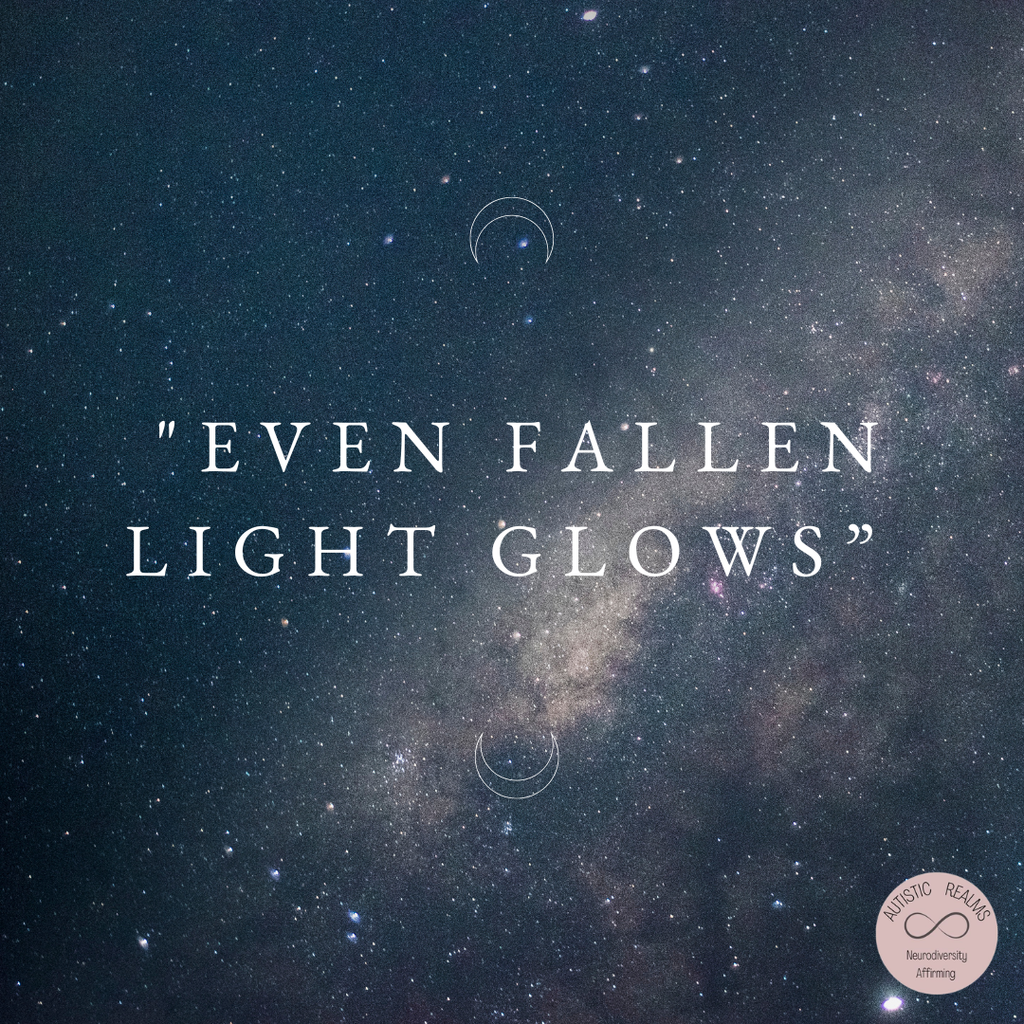
We are a community, a constellation made up of all our unique ways of being. It may feel like we are weighed down by darkness, but even fallen light glows. We can strengthen our networks of care & constellations of love. We shine brighter together.
In the last year of his life Pablo Neruda wrote a short untitled poem. It opens by saying that if each day falls inside each night, there is a well “where clarity is imprisoned.” Then it tells you what to do about that:
We need to sit on the rim of the well of darkness and fish for fallen light with patience.
Pablo Neruda, untitled, El mar y las campanas (1973) · translated by William O’Daly, The Sea and the Bells (Copper Canyon Press, 1988), pp. 94–95
I spent the evening of sixth of August in Brigit McNeill’s Migration writing workshop with the Into the Woods writing group, in a session called The Living Page. We were invited to write from and with migration, as a movement to think inside of, inspired by Brigit’s own writing.
What follows is some of what I shared during the workshop and what I have been thinking about afterwards, threaded through with the ideas I keep returning to in my work on monotropism and neuroqueer theory.
Inner Compass
Birds cross oceans using a compass sense we still don’t fully understand. It may involve something in their eyes that responds to the Earth’s magnetic field, through a quantum mechanism that is still being worked out (Mouritsen, 2018). A bird doesn’t need a conventional map; it can orient by reading the world itself as a kind of felt knowledge.
As Brigit shared through her writing, salmon return to their birth rivers. Humpback whales cross hemispheres between calving and feeding grounds. Elephants can follow familiar routes across landscapes, including routes to water. Even a plant’s seed is carried by wind or on fur, migrating in its own way, landing on new ground.
The Inner Tug Of Migration
It’s easy to think of migration as recurring linear travel between fixed points — departure, journey, arrival and back again. The workshop pushed against that framing, and we discussed migration as a process of transformation across time, as much as displacement across distance.
I feel this is close to what Deleuze (1994) was exploring through the idea of ‘difference in repetition’. The idea that no repeated pattern is ever a true copy, that each turn carries its own small variation. Migration, read this way, isn’t a repetitive loop; it’s more of a spiral. With every movement, everything changes.
We discussed Brigit’s writing about what she calls the ‘tug’ of migration. It feels like there’s a bodily quality to how migration begins for all of us, whether crossing distance on the land as animals or in our human bodyminds. Before a bird sets off, something like a restlessness builds in its body. The pull comes from within, affected by seasons, seas, and time, and the sense of direction follows from that, in a very embodied, sensory tug.
I recognise that kind of tug or pull in my own way of being. Monotropism (Murray, Lesser, & Lawson, 2005) describes how Autistic attention tends to gather intensely around a small number of interests, rather than spreading more evenly across many. When an interest catches me, it feels closer to that restlessness in the birds, a tug like a magnet pulling me in and arriving before my actual cognition and thinking have caught up.
Following this tug or pull deep inside you, something opens up. Csikszentmihalyi (1990) described flow as the state that arises when attention and challenge align closely enough that the sense of separate effort disappears. It often comes with an undercurrent of wonder where the world briefly widens around whatever has caught you and opens up further into awe. I think that combination is close to what’s carrying migrating animals too: a sense of direction felt from the inside, trusted enough to move on and to see what will happen.
Following the inner pull and desire of flow, whether it is sensory or more cognitive, leads us to connect ideas, connect people, to move our bodyminds. Flow isn’t stillness; attention is moving, even when the body isn’t. It slowly transforms us: each new interest, each sensory experience, every connection with another being or environment shifts something inside us.
Many of us are taught early to override this feeling of going with the flow of what interests us and listening to our inner needs. We are conditioned to ignore our inner compass, to ignore our passions, our ideas, our sensory needs, especially if they fall outside of what is normally expected. We are taught to mask and suppress our flow and authentic migration.
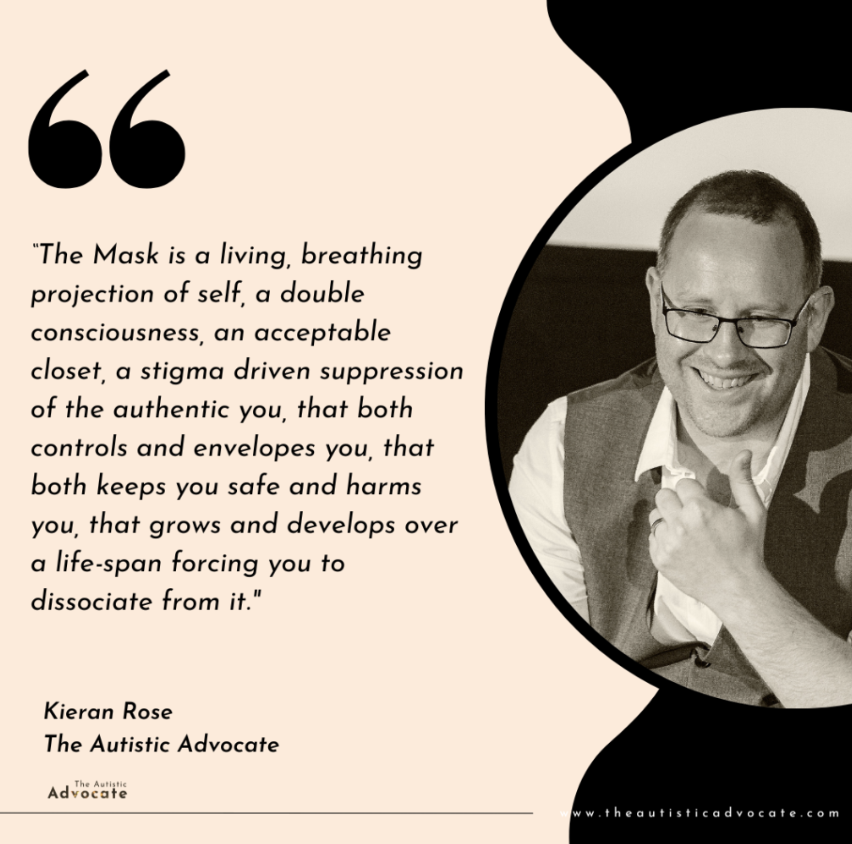
Research on Autistic masking describes the suppression of natural Autistic ways of being in favour of alternatives judged safer and more acceptable by society (Pearson & Rose, 2021). The tug of monotropic passion and sensory feelings often gets read as being too much, having interests too narrow, and we learn to quieten ourselves or try to adapt to fit in. Over the years, we are moving further and further away from our own internal compass and needs until we may not even recognise our true self.
Trusting Our Inner Compass
Trusting our inner compass again isn’t easy, and there is definitely a certain amount of privilege involved in being able to unmask and be your real Autistic self with people. Neuronormativity, the assumption that more evenly distributed, easily legible attention is the ‘correct’ default way to be. It doesn’t just ask us to behave differently; it makes us distrust ourselves too. Neuroqueering (Walker, 2021) is an ongoing practice of subverting and resisting neuronormativity. It is not a final destination to become ‘neuroqueer’ or to have ‘neuroqueered’ your life — rather, I see it as an ongoing refusal to be ashamed of who you are.
This is where we need to re-learn to trust ourselves. Pernille Fraser’s poem “Can We Trust?” names this same rupture from the other direction: not what we lose faith in within ourselves, but what has to be earned from everyone and everything around us before that trust can return at all. The poem was written in 2019 and later shared through Stimpunks Foundation as part of our Neuroqueer Learning Spaces project. The poem repeats its central question across sensory load, pacing, correction, and the question of whether we’ll be believed and left to decide for ourselves, asking, “Can we trust the space you offer?” (Fraser, 2019/2024). The poem never resolves into an answer; it stays in the asking, leaving open questions of safety and possibility. The potential of trusting people in safe spaces to be ourselves, to keep moving and transforming.
That same question of trust doesn’t stop at ourselves. Once we’ve relearned to trust our own inner compass, we can start noticing that everyone and everything around us, human and otherwise, is following one too when we are able to feel safe.
Differences Of Being
If we stop assuming there is one right way for a human mind to move through the world, perhaps we can extend that generosity beyond humans too. Migration is only one expression of a much wider range of ways living things exist in and move through the world. Ethodiversity (Tarragnat, 2024) names the variability of behavioural and existential styles within and across species, developed to open neurodiversity beyond a purely human-centred and neurological framing. A bird’s compass, a salmon’s imprinting, a whale’s seasonal crossing, and a human’s monotropic pull aren’t the same mechanism in different bodies. They’re genuinely different ways of being, each one worth recognising on its own terms.
Difference here is already a form of connection. A migrating salmon doesn’t just pass through a river, its body becomes part of it. When Pacific salmon return to their home streams to spawn and die, their bodies carry marine-derived nutrients into freshwater and other ecosystems; they carry something from one world into another. Whales do something similar at an ocean scale: they help move nutrients such as nitrogen and iron back into sunlit waters, while their migrations redistribute nutrients across large distances. Neither salmon nor whale set out to feed a forest or an ocean, but each unique way of moving through the world is, at the same time, an act of shaping it, and being reshaped by it in turn.
That sits well alongside Milton’s (2012) double empathy problem, which invites us to notice that people communicate and experience the world differently from one another — and that no single way of being or relating needs to sit at the centre, with everyone else read against it. It sits well, too, alongside Barad’s (2007) idea of intra-action: that a self, or a species, or a migrating body doesn’t exist as a separate thing that then relates to its surroundings, but comes into being through the relating itself. There’s no “before” and “after” self on either side of a migration, only the shaping itself. The liminal space a migrating creature passes through isn’t a gap between two finished things. Self and field, self and current, self and interest, forming each other as they go.
Transformation and Trust
The workshop’s real gift was permission to stop treating change as the exception that needs explaining and to start treating it as the foundation through which everything else moves. Life doesn’t hold still and occasionally migrates; it is always in a constant state of flux and flow.
That reframing opens space for new stories to begin, not despite the shifting, but because of it. This sits alongside other threads I keep pulling on: the constellation-thinking in My Monotropic Galaxy on More Realms, and the Star Stuff work with Ryan Boren at Stimpunks, which starts from the same idea, that we are made of matter that has already migrated across unthinkable distances, reorganising itself into shape after shape after shape, connection by connection.
Migration, in that sense, isn’t a metaphor borrowed from birds and whales. It’s been true of us for longer than we’ve had words for, trusting our inner compass isn’t something any of us can do alone as people and may be especially as Autistic monotropic people.
Birds have the Earth’s magnetic field and the wider world around them to orient by. We need something a bit different: people and spaces willing to be trusted, willing to let us move, be, and communicate in our own way without demanding we prove it first.
Rediscovering our monotropic inner compass is only part of the migration. The rest is building spaces safe enough to trust it in, so we can shape and be shaped by the world around us, the way the salmon and the whale do, simply by being fully who we are.
Milton, D. E. M. (2012). On the ontological status of autism: The ‘double empathy problem.’ Disability & Society, 27(6), 883–887.
Mouritsen, H. (2018). Long-distance navigation and magnetoreception in migratory animals. Nature, 558(7708), 50–59.
Murray, D., Lesser, M., & Lawson, W. (2005). Attention, monotropism and the diagnostic criteria for autism. Autism, 9(2), 139–156.
Pearson, A., & Rose, K. (2021). A conceptual analysis of autistic masking: Understanding the narrative of stigma and the illusion of choice. Autism in Adulthood, 3(1), 52–60.
Tarragnat, O. (2024). Biodiversity, neurodiversity, ethodiversity: Towards a more-than-human and more-than-neurological turn in neurodiversity studies. TRACE: Journal for Human-Animal Studies.
Walker, N. (2021). Neuroqueer heresies: Notes on the neurodiversity paradigm, autistic empowerment, and postnormal possibilities. Autonomous Press.
Inspired by our collaborative Stimpunks work, and my own neuroqueering Deleuze project, I’ve been thinking about the connections in-between — physics, philosophy and my own life as an Autistic ADHD person. This is me following that thread.
2. I’m not a fixed thing
A little while back I wrote about something called relational quantum mechanics — a way of thinking about physics where tiny particles don’t have fixed qualities all on their own. They only become something in relation to whatever’s around them (Rovelli, 1996). I’m not a physicist — it’s one idea among several, and physicists argue about it.
As a multiply neurodivergent person, that’s always been closer to how I experience myself — not as a fixed, separate being moving through the world, but as something that shows up through my relationships and encounters with everything around me (Edgar, 2026a). I’m still working through what that means.
Physics, philosophy, and my own life keep circling the same ideas about being interconnected, unfixed, always transforming.
3. My Monotropic Galaxy
The oldest light we can see is called the cosmic microwave background — it’s the afterglow of the Big Bang, and it’s almost perfectly smooth. It only varies by about one part in 100,000 across the whole sky — almost uniform, but only almost.
Those tiny variations — slightly denser here, slightly thinner there — were the beginning of everything. Gravity pulled the denser bits together, and over billions of years they became stars, galaxies, planets, you, me, all of it.
If the universe really had been perfectly uniform, it would have stayed a flat, empty fog forever. Nothing to see, no one to see it. Structure only exists because that near-sameness broke.
That’s the same shape I recognise in my own monotropic attention — energy pulled gravitationally into a few bright points, rather than spread out in an even, undifferentiated glow. And yet it’s exactly that unevenness, that refusal to flatten, that so many of us — anyone who’s ever been called too much, not enough, or too different — have been measured against.
4. Measured Against Neuronormative Time
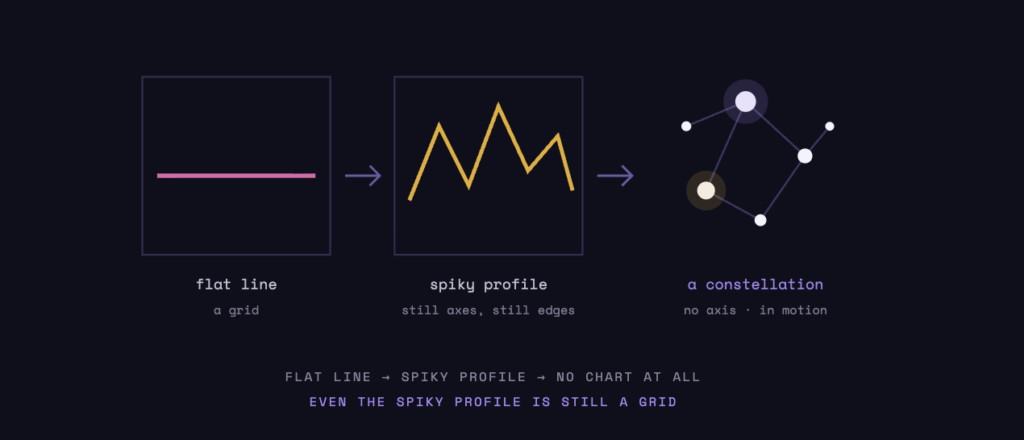
I’ve spent a lot of my life being measured against a flat line. Nobody always said it in those words, but that’s what was happening — a standard chart, a “typical” way of communicating or paying attention or experiencing the world, treated as the baseline everyone should be smoothed toward. I was positioned as the deviation that needed explaining, or fixing, or at least accounting for.
That flat line was never just about behaviour — it was also about time: a single approved tempo, a single approved rhythm, everyone expected to arrive and finish and transition together, in step with a clock that was never actually neutral.
So there’s something that genuinely steadies me in learning that the universe itself never once managed that.
What was already there, moving
The “typical” baseline
You = “deviation”
A straight line, laid over what was already moving
The grid comes after the field, not before,
Uniformity was never the achievement. It’s the thing that would have stopped everything before it even started.
5. There Is No Normal or Baseline
Gilles Deleuze, working with Félix Guattari, made a version of this same argument. Deleuze noticed that a lot of Western thinking treats difference as secondary — judged by how much it resembles some ideal, some average, some “normal” category. All of that quietly assumes the baseline came first, and difference is just a deviation from it.
The baseline is the thing that got built. The idea of normality is what has shaped our capitalist society (Chapman, 2023) and is what we are judged against (Deleuze, 1994). Difference is what’s actually there, first — and identity is what eventually forms out of it, temporarily and locally, the way a crystal settles out of a solution along the gaps and spaces in between — the places where those of us most marginalised live, and where we build our own networks, our own solidarity.
This is where Deleuze and Guattari’s idea of smooth space becomes useful (Deleuze & Guattari, 1987). Smooth space is full of local, variable difference — it hasn’t had a fixed grid laid over it yet. Striated space is what happens when that grid arrives: when a field gets measured, divided, standardised. Difference doesn’t get smoothed into existence by that process. Smoothing is what a system does afterward, only if it insists on it — striation laid over what was already smooth.
Nothing gets smoothed into existence. Smoothing is what happens to something afterward — only if a system insists on it.
6. Smooth doesn’t mean flat
Smooth space isn’t empty of movement — it’s just ungridded. It cuts against how regulation usually gets talked about, as though it means being still, quiet, zen: a flat line of its own. But smooth space is defined by what it lacks — a grid — not by what it’s doing. It can be full of movement and still be smooth — which is closer to how neurodivergent regulation actually works: through stimming, through bodily autonomy, through movement rather than stillness.
That’s closer to what I recognise when I try to describe my own attention — my porousness to my environment, the way my sensory system stays open to everything around it, the way time folds back on itself instead of running in a straight line. Not flat. Not gridded. Full of shape that never quite resolves into one measurable thing.
7. What ethodiversity means
This is where Ombre Tarragnat’s work on ethodiversity has become important to me. Ethodiversity is the variety of ways of being and behaving, across humans and other animals — and Tarragnat is precise about where it actually lives: not inside any one person, but as a property of the relationships between us, the way biodiversity belongs to a whole ecosystem, not to any single creature in it (Tarragnat, 2025).
Ethonormativity, in their framing, is the unwritten rule about which ways of being are allowed to count as normal in a given room. Put next to Deleuze, I don’t think it’s a stretch to say ethonormativity simply is that grid — applied to how we’re allowed to behave. A fixed grid laid over a field that was already full of variation before the grid ever showed up.
Ethonormativity reaches further than neuronormativity, though. Neuronormativity is about which neurotypes get treated as the default — Autistic brains judged against non-Autistic ones, for instance. Ethonormativity is the wider grid underneath that: it governs which ways of being and behaving, across every species, get to count as acceptable at all. It holds neuronormativity inside it, but it isn’t limited to brains, or even to humans (Tarragnat, 2025).
Ethonormativity simply is that grid — a fixed grid laid over a field that was already full of variation before the grid ever showed up.
8. A constellation of intensities
I recognise that grid in every space I’ve ever masked in — education, the workplace, wherever something that was moving gets asked to hold still long enough to be measured. And I recognise its absence, with real gratitude, in the spaces I’m part of — NeuroHub Community with David Gray-Hammond, Stimpunks: an Autistic rhizome, a mycelial network of care, non-hierarchical, no fixed centre, connecting wherever it meets (Deleuze & Guattari, 1987).
I used to think the shape of my own mind was something like a spiky profile — a way of picturing uneven ability across different areas, real peaks and real troughs, instead of one flat line running across the whole of who you are. At least it’s truer than a flat line. However, a profile still measures. It still needs axes, still has edges — and that’s exactly where I want to push further, past even the spiky profile. What I actually recognise, when I try to map myself, isn’t a chart at all. It’s a constellation of intensities: a galaxy, always in relationship with itself, always in motion, never finished (Edgar, 2026b).
A profile still measures. It still needs axes, still has edges. What I actually recognise, when I try to map myself, isn’t a chart at all; it is an interconnected, interdependent galaxy.
9. The Universe Doesn’t Do Flat Lines
I still don’t have these ideas fully settled or finished. Every time I follow this thread — from the sky, down through physics and philosophy, into the actual shape of my own galaxy of monotropic attention — I end up some where different but with the over arching throughts that:
The universe doesn’t do flat lines.
It never really tried to.
It went straight from near-uniform fog to unrepeatable structure, without ever pausing at sameness for its own sake.
I think that’s worth remembering, gently — the next time any of us are asked to explain why we don’t match the line of neuronormativity. We are all star dust. We are neuroqueering the spiky profile: no edges, limitless ways of being.
10. L★S
Zine No. 11 · Guest author
Written by Helen Edgar. First published on Autistic Realms: More Realms, and shared with Star Stuff.
Chapman, R. (2023). Empire of normality: Neurodiversity and capitalism. Pluto Press.
Deleuze, G. (1994). Difference and repetition (P. Patton, Trans.). Columbia University Press. (Original work published 1968)
Deleuze, G., & Guattari, F. (1987). A thousand plateaus: Capitalism and schizophrenia (B. Massumi, Trans.). University of Minnesota Press. (Original work published 1980)
Edgar, H. (2026a, June 7). We are made of relations: Quantum physics and what it means to be Autistic. More Realms.
Edgar, H. (2026b, June 16). My monotropic galaxy: A constellation of my Autistic self. More Realms.
Rovelli, C. (1996). Relational quantum mechanics. International Journal of Theoretical Physics, 35, 1637–1678.
A guest zine in the Stimpunks Star Stuff series. Where The Universe Runs on Difference (No. 8) is about breadth — variety over monoculture — this one is about difference coming first: the baseline is what gets built. The physics-and-philosophy sourcing, and how it sits beside Nos. 8 and 9, is gathered in The Difference-First Frame.
Helen Edgar – Autistic Realms / More Realms June 2026
“The curious paradox is that when I accept myself just as I am, then I can change.”
— Carl Rogers, On Becoming a Person (1961)
“Becoming is not imitating or identifying with something. It is producing a zone of proximity, of indiscernibility.”
— Deleuze & Guattari, A Thousand Plateaus (1987)
You may know the feeling of being in a room and not being truly seen. You may be present, being spoken to by people who seem genuinely friendly towards you, yet you feel you are not truly being met. It is like the person next to you or across from you is responding to their idea of who they think you are rather than to who you actually are. There are norms and social conventions that people may feel they have to keep, and that can impact genuine presence and connection.
For many Autistic and neurodivergent people, this is not an occasional frustration but an often felt, sustained condition of our daily life. Over time, this teaches us that it is not safe to bring our whole authentic self into the room. You may suppress stimming, be hyper-aware of your body language and even how you communicate. You may find that you are constantly translating yourself into someone you hope will be more legible, more palatable, more aligned with the norms that were never designed around your experience. Masking, in this sense, is not a choice so much as a trauma response, a learned adaptation to a world that has made authenticity costly.
This piece draws together three threads of my recent thinking that I have been exploring: the humanistic psychology of Carl Rogers, the philosophy of Gilles Deleuze, and Damian Milton’s Double Empathy Problem — extended through my own Double Empathy Extreme Problem (DEEP) – Dynamic, Embodied, Ecological, and Politicalframework. I am also drawing on a recent paper by philosopher Kris Goffin (2026) that reframes the question of Autistic injustice in ways I find really helpful. Together, I think they can help us explore what the conditions for genuine belonging might actually be, so we can be supported in environments that value a process of ongoing becoming and neuroqueering.
Conditions of worth
Rogers began from a radical premise in the 1950’s: that people are not fundamentally broken, deficient, or in need of correction, but that they carry within them an innate drive toward growth and becoming more fully themselves. This is what he called the actualising tendency (Rogers, 1957). He thought of it as something like a seed’s instinct toward light: persistent, directional and always pressing toward expression. Growth cannot be destroyed, but it can be buried, become distorted and hard to surface.
What buries or distorts growth are what Rogers named conditions of worth (1959). These are the internalised messages, absorbed most powerfully in childhood, that love and acceptance are contingent on meeting certain conditions: being quieter, being less intense, doing whatever it takes to be accepted. These messages don’t usually come from a place of cruelty; they often come from concern, from guidance, from the reasonable expectations of people who themselves learned to perform belonging within the same system, such as parents, carers and teachers. However well-meant, their cumulative effect is to redirect the energy of genuine growth into the labour of self-management, into performing a version of the self that will be found acceptable, rather than becoming the self that is actually there. For neurodivergent people, this is not incidental but structural. The conditions placed on us are shaped by a world that measures worth against neuronormative standards from the outset.
For Autistic and AuDHD people, conditions of worth are not only relational but cultural and systemic. They are embedded in our education systems, healthcare settings, and workplaces; in every context that measures human value against the standards of neuronormativity. The message neurodivergent people often face in therapy or counselling is that the authentic self requires editing before it can be brought into a relationship with others, even when that therapy may be classed as person-centred as we are still living in the system that causes us harm.
Rogers believed that three relational conditions could begin to dismantle those blocks. The first is empathy, which he defined as the capacity “to sense the client’s private world as if it were your own, but without ever losing the ‘as if’ quality” (Rogers, 1957, p. 99) — presence without projection, attunement without merger. The second is congruence: authentic presence rather than performed warmth, which matters because many of us with heightened sensitivity to interpersonal nuance can sense the gap between what is presented and what is real, often more acutely than others might expect. The third is unconditional positive regard, which Rogers described as meaning “there are no conditions of acceptance, no feeling of ‘I like you only if you are thus and so’” (1957, p. 98) — being valued as you are, now, without needing to perform or justify yourself first.
When these conditions are genuinely present, something can shift. The energy previously devoted to self-protection becomes available for something else. The actualising tendency can begin to move again, and that movement can be quietly transformative.
However, I am wondering whether Rogers’ theory has a limit when it comes to meeting the needs of neurodivergent people in a world still dominated by neuronormativity. Rogers himself acknowledged that the therapeutic relationship is not a special case, but rather “a heightening of the constructive qualities which often exist in part in other relationships, and an extension through time of qualities which in other relationships tend at best to be momentary” (1957, p. 101). In other words, Rogers understood his practice as working within the existing relational world, extending and deepening what is already there. When the session ends, the person returns to the same schools, workplaces, and social structures that created the conditions of worth in the first place that led them to counselling. Rogers offers healing within the system, but he does not provide tools to examine or dismantle the systems that cause harm.
This is where I find myself reaching towards Erin Manning (2016), who offers a different register of thinking about relation and difference that attends to what she calls the “minor gesture.” The minor gesture, although it may pass almost unperceived, transforms the field of relations. For Manning, the minor is a force that challenges received wisdom and common sense — what she calls “the major” — by offering potentially unlimited experiential variations that suggest alternative forms of being, knowing, and doing. Crucially, this framework directly challenges the ways in which the neuronormative image of being human devalues alternative ways of being moved by and moving through the world which may be especially relevant to Autistic people who perceive the world differently.
Rogers asks what conditions within a relationship might allow a person to grow, Manning extends this by asking what small, acts and orientations might begin to shift the normative field itself. These are not competing frameworks so much as operating at different scales. Rogers is working at the depth of the relational encounter, and Manning is also attending to the texture and politics of the world in which the encounter is embedded. Together, they suggest that healing and belonging are not only interior processes, but are also shaped by whether the world around us leaves room for us to exist in our difference.
If a person leaves the therapy room and returns to a school that still rewards masking, a workplace that still pathologises their way of communicating, a healthcare system that still measures them against a neurotypical body, then Rogers’ conditions of worth are simply regenerated. Becoming, within Rogers’ framework, remains possible only within the structures that already exist; there is only growth in the space the system allows.
This is where Manning (2016) may become a useful companion to Rogers. Where Rogers works at the depth of the relational encounter, Manning attends to the texture of the world that the encounter is embedded within. The minor gesture, although it may pass almost unperceived, transforms the field of relations, and it is in those small acts that some of the most important work can happen. For example, a teacher may restructure a task so that a student does not have to make eye contact to demonstrate understanding. A colleague who names in a team meeting that there are multiple valid ways of communicating, such as written or verbal, without making it about any one person. These are not grand systemic interventions; they do not dismantle the neuronormative ableist school or workplace, but the minor gesture introduces variation and genuine inclusion into experiences that would otherwise remain fixed or captured by norms, and that variation, however small, can be the difference between a person being able to remain themselves or once again contracting into a version of their self that the system will accept which can have severe impacts upon wellbeing.
Rogers gives us the conditions for healing within a relationship, whereas Manning reminds us that a relationship is never only between two people, it is always also between a person and the world they live in and must return to as well.
Creating New Maps
This is where the work of philosophers Gilles Deleuze, Félix Guattari, and Autistic scholar Nick Walker’s neuroqueer theory can expand this discussion, as they point toward something Rogers’ framework doesn’t quite reach. Their works lead us not just to a space where you are allowed to become who you already are, but one that holds becoming itself as ongoing, never a fixed destination to arrive at. Where Rogers offers room to grow within existing conditions, in line with Manning, both Deleuze and Walker ask what it might mean to stop treating any version of the self as final, and what it could mean to build spaces that hold change itself as safe, rather than safety as something found only once change is finished.
For Deleuze and Guattari (1987), social structures operate by carving grooves into the world and into us. I am using “grooves” as my own (hopefully!) accessible way into their concept of striated space: space that is measured, ordered, and directional, like the fixed threads of a woven fabric or the furrows of a ploughed field.
The word “grooves” feels important to me because it captures something embodied and cumulative, the sense that these structures do not only organise the world around us but wear pathways into us over time. What Walker (2021) calls neuronormativity is precisely this kind of deep striation, a system of assumptions often insisting there is one correct “normal” way to think, feel, communicate, and inhabit a human life. The problem, Deleuze and Guattari understood, is not just that the grooves constrain our movement, it is that the grooves are presented as natural, as simply the shape of reality and how society is, rather than as a constructed map that serves only particular interests, privileges some people over others, and erases the rest of us, with those most marginalised often left with no voice or support at the edges of society.
Rogers’ conditions of worth are themselves a kind of striation, grooves handed down to us before we were old enough to question them. From infancy, many of us were rewarded for playing, eating, talking, and moving in the expected ways, and those rewards became internalised as if we had drawn the lines ourselves. This is how ableism enters so quietly: not always as a rule imposed from outside, but as a shape we learn to become, often unaware that we have been masking throughout our lives — until burnout or a mental health crisis arrives and we can no longer sustain it. Rogers’ answer is to offer warmer, more accepting conditions, but still within that same tracing. It is perhaps a kinder version of the same map, rather than a genuinely different one.
Deleuze asks for something more radical, not a gentler, warmer copy of an existing outline, but a different map entirely, made in movement, drawn from where you actually are rather than where the tracing says you should be. This is not an abstract philosophical point; I think it is a deeply political one. The poet and theorist Audre Lorde reached a parallel conclusion, that the tools a structure provides can only ever renovate it from within, never dismantle it. In her essay “The Master’s Tools Will Never Dismantle the Master’s House” (Lorde, 1984), she argued that real belonging cannot be built from the instruments of the very structure it is trying to escape. It needs new tools, and a new starting point that never belonged to that structure in the first place.
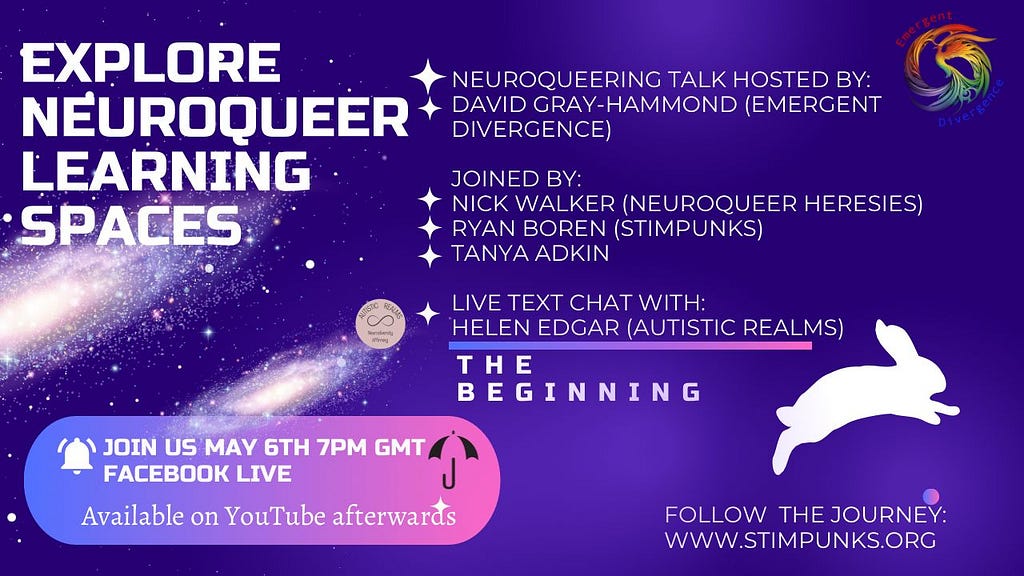
Walker’s neuroqueer theory draws on Lorde’s insight, queer theory, and disability studies to make a related point: that the rules around what counts as “normal” thinking and those around what counts as “normal” gender are intertwined at the root. Walker goes further than simply critiquing the system. Inspired by Lorde, Walker does not call for destruction but for transformation, as David Gray-Hammond and I explored in our Neuroqueer Learning Spaces webinar with Stimpunks (Edgar, 2024), Walker’s position is that we should “queer the system, queer the tools and create new tools” (Walker, cited in Edgar, 2024).
Neuroqueering is not a tearing down; as I noted in that same webinar, “to neuroqueer is to transform, not destroy”. This feels important in a therapeutic context, too. The goal is not to abandon everything Rogers offered, but to queer it: to ask what new tools, what new language, what new relational conditions might be possible if we start from neurodivergent experience rather than mapping it onto frameworks built without us in mind.
Deleuze called this kind of departure a line of flight: a movement toward something that does not yet have a name within the existing system, because that system was never built to describe it. Rogers helps us become our best selves within the system we already have. Deleuze, Manning, Walker, and Lorde, arriving from very different places, all point toward something more: that we can find our way forward together, building our own ways of becoming, with our own language to describe what we actually experience. And it is then, perhaps, that we can become our true selves, and finally feel a sense of belonging.
The Gaps Between Us
This is where Damian Milton’s Double Empathy Problem (2012) becomes important. For a long time, the difficulty Autistic people experience in social interaction was located inside us, framed as deficit, as a failure of empathy, as something in need of fixing. However, Milton’s work reframes this entirely. Misunderstanding between everyone, including Autistic and non-Autistic people, goes both ways: each finds it genuinely difficult to read the other, because each is experiencing and communicating from a fundamentally different starting point. The problem is never inside one person; it lives in the gap between two people, and I think that changes everything about how we think about connection, belonging, and what good, affirming support actually looks like.
I have built on Milton’s theory with my own framework, DEEP — the Dynamic, Embodied, Ecological, and Political model of the Double Empathy Problem (Edgar, 2024). The gap Milton identifies isn’t just a one-off communication mix-up. It is felt throughout the whole bodymind, shaped by our nervous systems and sensory differences, and by the layered weight of intersectional difference. It is ecological too, shaped by the environments and communities around us, and it is political as it is tied to ableism and to every system that treats neuronormativity as the default, measuring everyone else against it and finding them lacking.
That gap wears people down; it leaves us chronically misread, exhausted from the constant work of translating ourselves, and slowly eroded from a steady sense of who we are. It is a significant factor in Autistic burnout, and it cannot be fixed by individual effort alone; it needs something structural. We need a change in the systems themselves, not just in us.
Affective Injustice
Philosopher Kris Goffin’s (2026) recent paper, “Autistic injustice as affective injustice: the double empathy problem is not about empathy,” pushes this further. Even framing the Double Empathy Problem as a two-way empathy gap, still locates the problem within individual psychology. Goffin argues that the real injustice is structural, and resonates to the political dimension of my DEEP framework.
What Goffin calls the emotional regime is a set of unspoken rules about how emotions should be expressed, which feelings count as appropriate, and whose emotional experience is taken seriously. Autistic ways of being — stimming, directness, sensory overwhelm, intensity — are routinely measured against these rules and found wanting: treated as irrational, excessive, or in need of suppression. This is not a failure of empathy on anyone’s part, it is the structural sidelining of Autistic emotional life by a culture that has never had to question its own assumptions, because those with power and privilege have always set the bar, without Autistic people having a voice.
Goffin names this affective injustice; it shifts the conversation from what is wrong with us as neurodivergent people to what is wrong with the system doing the measuring. Once we see the system as the problem, we can begin to make changes and queer the system. The emotional regime Goffin describes is not a neutral backdrop, it is actively constructed, historically maintained, and capable of being challenged.
Robert Chapman’s (2023) Empire of Normality helps us understand how we got here, Chapman traces how the very concept of the “normal” brain is not a natural fact but a product of capitalism, a system that transformed human minds and bodies into units of productivity, and measured everything that deviated from that standard as a deficit. The emotional regime Goffin identifies did not emerge from nowhere; it was built, and built to serve particular interests: to privilege those whose minds and bodies fitted the productivity model, and to pathologise, silence, and render invisible those of us who did not. Which means the question is no longer just about how we can help neurodivergent people cope better, but something more fundamental. We can start to consider who gets to decide what counts as normal in the first place, and what it would mean to dismantle that power and redistribute it.
To create real belonging, we need to sit with that question and ask whether normality is even a coherent concept, or simply a reflection of whose experience has historically been centred and whose has been erased. That question needs to be asked in classrooms, workplaces, therapy rooms, and healthcare settings alike. Autistic emotional life should not be something managed or judged against neuronormative standards.
Empathy, understood this way, is not simply a psychological capacity or a therapeutic skill. It is also a political commitment — the active refusal to allow one group’s emotional norms to function as the invisible, unquestioned measure of what it means to be fully human. And that, perhaps, is where Rogers’ vision and the neurodivergent rights movement meet: in the shared insistence that every person deserves to be met as they actually are, not as the system wishes they were.
A Space for Becoming and Belonging
This blog began with a question folded inside its title: what does it really mean to be met across difference — in our empathy, in our becoming, in our belonging? Rogers gave us a language for that meeting. Deleuze, Manning, Walker, Lorde, Milton, Goffin, and Chapman showed us why that meeting so rarely happens, and what it would take to make it possible not just in a therapy room, but in the world itself and for the infinite ways we can become and keep becoming.
So what would it actually take to build a space where that is possible?
Real change happens at multiple levels simultaneously, in the therapy room, in the classroom, in the workplace, in our families, in policy, in research, in the language we use, and in the minor gestures and choices about whose comfort we centre and whose we ask to wait. It is slow, often exhausting work, particularly for those of us who are neurodivergent and doing that work while also living inside the systems we are trying to change.
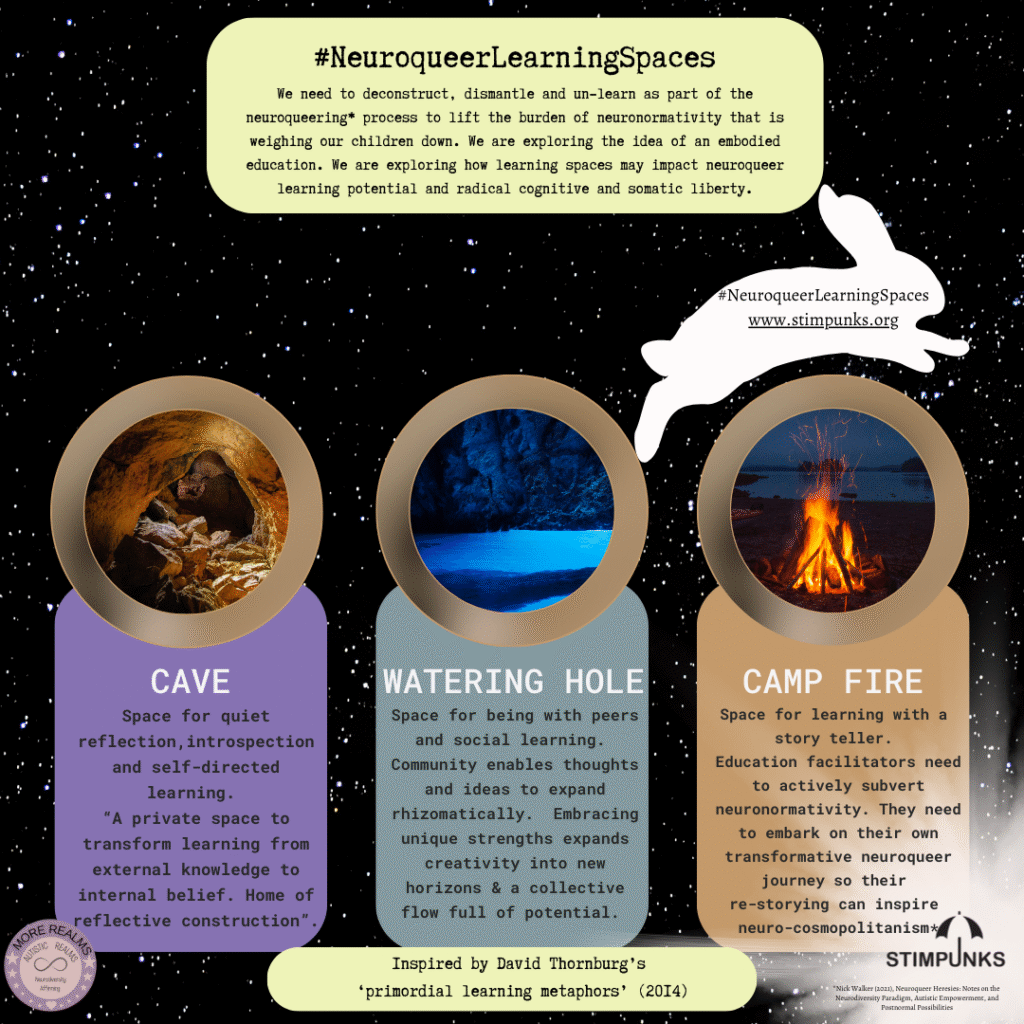
However, within the Stimpunks community, we are already queering the map, already building the spaces, the language, and the relational conditions that the thinkers in this blog have pointed toward. Cavendish Space, developed collaboratively by myself, Ryan Boren, and the Stimpunks Foundation team as part of our Neuroqueer Learning Spaces project, is a living example of what becoming and belonging can look like when they are built from neurodivergent experience outward.
Cavendish Space is a framework for designing environments around three kinds of space rooted in how human beings have always learned and connected.
The cave offers solitude, deep rest, and self-directed focus — space to go inward without apology. The campfire holds intimate shared meaning, storytelling, and connection in smaller, safer circles. The watering hole opens into energised, open community — the kind of space where ideas move freely and unexpected connections happen.
These are not accommodations bolted onto the edges of a space built for someone else. They are the space’s whole reason for being, shaped from the start around how neurodivergent people actually move, rest, connect, regulate, and think.
In Cavendish Space, every way of being belongs. The cave is held as carefully as the campfire. Stimming, directness, sensory sensitivity, the deep pull of monotropic focus, these are not quirks to be managed at the margins or quietly discouraged when others find them uncomfortable. They are exactly what the space was built to welcome. This is what Rogers’ unconditional positive regard looks like when it stops being confined to a single therapeutic hour and becomes the architecture of a whole environment and a new way of being for an entire community, when empathy, becoming, and belonging are no longer aspirations but the actual shape of the space itself.
Structural injustice, affective injustice, and the empire of normality Chapman describes require political change at a scale that no single framework can deliver alone. However, Cavendish Space offers something valuable that large-scale theory sometimes cannot: proof at a human scale that something different is already possible. Lorde told us that the master’s tools will never dismantle the master’s house, and so we have built new ones.
Our small community of neurodivergent, disabled, and multiply marginalised people, holding between us many intersecting experiences of being othered, misread, and pushed to the edges, has created tools, languages, and spaces that were never handed to us, because they could not have been. They had to be built from the inside, from our own experience, in community with each other. When spaces are built from those experiences outward, people do not have to shrink themselves to belong. They arrive, and they are already home. This is not a utopian dream waiting for the right political conditions; we are already a living space, supported by interdependence and mutual aid, showing that it is possible to build something genuinely new, starting not from the centre of what has always been considered normal, but from the rich, complex, irreplaceable edges.
We began with the feeling of being in a room, not truly seen. A world where empathy is practised as a political commitment, where becoming is understood as a collective right, and where belonging is built from the edges inward, from our experiences, our languages, our tools, and our communities. Not a kinder version of the old world. The beginning of a genuinely different one. As the Cavendish Space framework reminds us, most environments are not built for us; schools, workplaces, and public spaces are designed for a norm that excludes neurodivergent and disabled people by default.
Cavendish Space is our offering; it names what we need and gives us a framework for building it, wherever we are, with whatever we have. Where you can walk into the room and feel, perhaps for the first time, that you belong here — and that from that belonging, your own possibilities and your own ways of becoming can begin to unfold.
Goffin, K. (2026). Autistic injustice as affective injustice: The double empathy problem is not about empathy. Philosophical Psychology. https://doi.org/10.1080/09515089.2026.2651512
Lorde, A. (1984). Sister outsider: Essays and speeches. Crossing Press.
Manning, E. (2016). The minor gesture. Duke University Press.
Milton, D. E. M. (2012). On the ontological status of autism: The double empathy problem. Disability & Society, 27(6), 883–887.
Rogers, C. R. (1957). The necessary and sufficient conditions of therapeutic personality change. Journal of Consulting Psychology, 21(2), 95–103.
Rogers, C. R. (1959). A theory of therapy, personality, and interpersonal relationships. In S. Koch (Ed.), Psychology: A study of a science (Vol. 3, pp. 184–256). McGraw-Hill.
Rogers, C. R. (1961). On becoming a person: A therapist’s view of psychotherapy. Houghton Mifflin.
Walker, N. (2021). Neuroqueer heresies: Notes on the neurodiversity paradigm, Autistic empowerment, and postnormal possibilities. Autonomous Press.
Yergeau, M. R. (2018). Authoring autism: On rhetoric and neurological queerness. Duke University Press.
Helen Edgar — Autistic Realms | More Realms | June 2026
Spaces In-Between
I recently looked at the night sky, I was outside and cold, the sheer number of stars, the ones I could see and the knowledge of the ones I could not, shifted something in me that I did not have a word for at the time. It felt like an opening, a feeling of being very small and very connected at the same time, of the distance between me and the universe suddenly becoming less certain, of living in the in-between space. What I was experiencing is called awe, I also know, looking back, that awe may be one of the most distinctly Autistic experiences to feel.
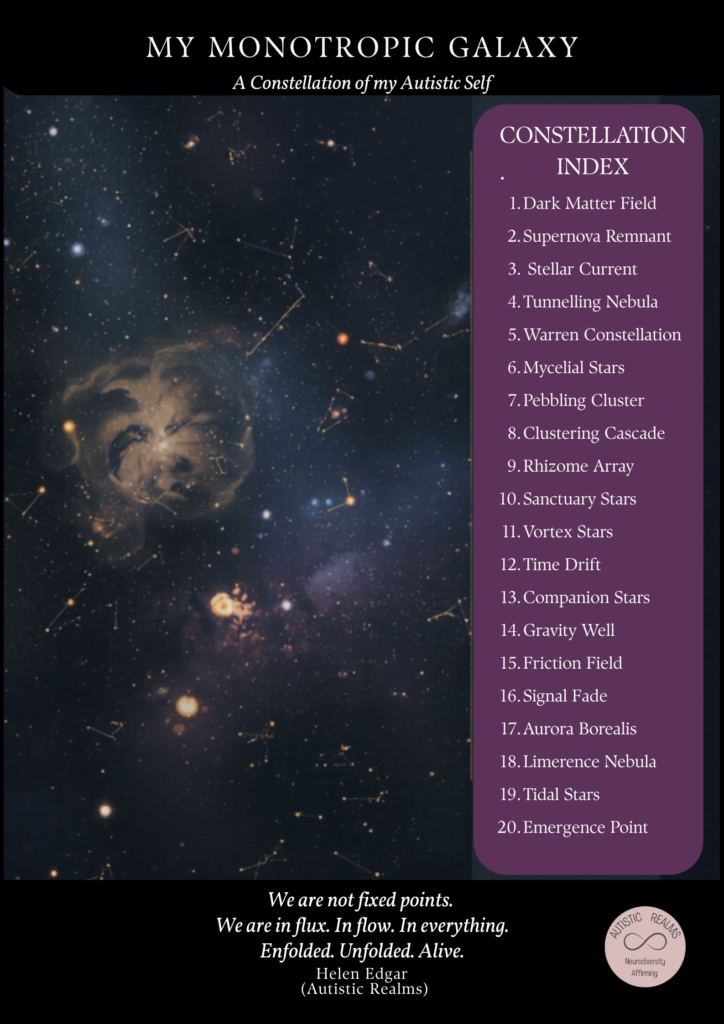
This piece is about feelings of awe and wonder, my own Autistic ADHD experiences, and about the map I have tried to represent of my inner life using the language of the cosmos. It is called My Monotropic Galaxy: A Constellation of My Autistic Self. It is a deep-field image of space, overlaid with constellation lines, accompanied by an index of 20 named features of some of my monotropic experiences. Some of these constellations I have lived in for decades, others I have only recently been able to name. All of them are in relationship with each other, always in motion, always becoming something the map and myself has not yet caught up with.
Before I guide you through my galaxy of monotropic experiences, I will explain a bit about the theory of monotropism and why I feel it is so important for my own sense of self-identity as an Autistic ADHD person.
What Is Monotropism?
Monotropism is an attentional theory of autism developed by Autistic researchers Dinah Murray, Mike Lesser, and Wenn Lawson (2005). It describes how many Autistic people tend to have their attention drawn more strongly to fewer things at any given time, going deep rather than wide, concentrating rather than spreading their focus. Rather than framing this as a deficit — an inability to multitask or shift attention — monotropism understands it as a distinct attentional style with its own strengths and difficulties.
Discovering the theory of monotropism for the first time felt like being handed a map of a place I had always lived in but had never been able to describe. I was identified as Autistic and ADHD in my forties, while my children were also going through their own assessments. What followed was a long process of re-sense-making, a re-storying that went back through my entire life, understanding finally why things had been the way they had been, and finally being able to begin to understand my own neurodivergent identity a little bit better.
Awe and Wonder as a Way of Knowing
Let me return to the night sky and think about what awe actually is and why it may be especially relevant for monotropic people. Helen De Cruz (2024), in her book Wonderstruck: How Wonder and Awe Shape the Way We Think, describes wonder as a form of epistemic opening, a way of relating to knowledge and how we have come to know things. The epistemic opening is the moment when the way we know expands; it is more than just a feeling. When we encounter something that is genuinely awe-inspiring, the usual categories we use to make sense of the world temporarily loosen. It is as if you are maybe seeing or sensing something for the first time; you may notice things you had previously learned to filter out. For De Cruz, wonder is not just a happy side effect of seeing something beautiful; it is a cognitive and moral orientation. It is how we stay genuinely curious about a world we might otherwise let ourselves assume we already understand, or are taught to ignore, as it doesn’t fit into how people expect us to perceive and respond.
When I read De Cruz’s book in 2024, something in me recognised what she was describing at a really deep level. It was the most inspiring book I have read for many years. I took part in a brilliant reading group hosted by The Philosopher 1923, where we explored Helen De Cruz’s work in depth. In the final week, we were lucky to be joined by Helen herself, and I remember discussing Nick Walker’s neuroqueer theory (2021) and the projects I was developing with Stimpunks, particularly the ways her ideas resonated with and helped shape our thinking. These conversations had a lasting impact, influencing our Neuroqueer Learning Spaces project, helping to evolve the vision behind Cavendish Space, and continuing to inform much of my current writing and emerging ideas around the theory of monotropism.
Awe and Flow
When I am pulled fully into something that has truly captured my attention, not just my mind, but my whole body and nervous system is immersed. What opens is not simply focus; it is that first-ness quality of perception De Cruz describes, the sense of seeing and feeling something for the first time, even if I have encountered it a hundred times before. New connections become visible, and the boundaries between things soften. It feels like my nervous system, so often braced against a world not designed for me, can finally exhale in the in-between spaces as new connections form and I feel literally awe-some.
Keltner and Haidt (2003) describe awe as arising when we encounter something vast that challenges our existing mental structures, something that does not fit the categories we already hold, and that invites us to expand our ways of being rather than retreat or fold inwards. Awe can be humbling and expansive at the same time; it opens up possibilities.
I feel this resonates with what it feels like for me to be in monotropic flow. My self does not disappear, nor does it become more rigid or narrow; instead, it feels as though I open up, my whole bodymind becomes more porous. The boundary between me and what I am attending to becomes less fixed; I am both in the flow, and the flow is in me. The distance between those two things collapses and unfolds in a way that feels like both loss and arrival, and it can feel deeply liberating and joyful (and sometimes deeply troubling and anxiety-provoking!).
For many Autistic people, these experiences are undervalued, even stigmatised or shamed as we grow up. We are told to concentrate on what the teacher is saying, to focus on what our family and friends think really matters, and slowly, our own ways of perceiving the world are flattened as we learn to mask and stop trusting ourselves. The things we find awe-inspiring are treated as having no value: the joy of looking closely at a mushroom or an insect may be met with being told to hurry up and rejoin the group; the wonder of feeling the sea against your toes in the sand may be met with being told to just get in and swim and stop fussing.
This quality of experience, this awe and wonder, is represented by the Stellar Current at the heart of my galaxy: the deep flow state through which my whole system comes into coherence, and I move with the current of what matters most. It feels fitting that this current carries me toward a phrase that has become foundational to how I think about the Autistic community and a sense of belonging.
Love You Down to Your Star Stuff
The phrase Love You Down To Your Star Stuff grew out of collaborative work with Ryan Boren and Stimpunks Foundation (Boren & Stimpunks Foundation, 2026). It reaches back to something Carl Sagan observed: that the atoms in our bodies were forged in the interiors of stars that lived and died long before our sun existed. We are, quite literally, made of star stuff.
To love someone down to their star stuff is to locate love for their core way of being. Love is not conditional on performance, legibility, or being the kind of person the world finds easy to translate. Love should not be dependent on meeting neuronormative expectations, masking well enough or being productive enough or social enough. To love someone down to their star stuff is to love their way of being continuous with the universe and their authentic self.
Much of the lived experience of being Autistic for many people is weighed down by what I have called the Dark Matter Field in my galaxy. This is the heavy darkness of neuronormativity, reflected in the accumulated weight we carry around of a world that does not meet our needs, and does not love us down to our star stuff. The Dark Matter Field is everything that is harmful in our systems, behaviourism, ableism, racism and more. As Autistic people, we are constantly being measured against a map that was not ours.
The Double Empathy Problem (Milton, 2012) highlights the mutual misunderstanding between people with very different experiences, where the gap of this map is often framed as ours to close; this sits at the heart of the Dark Matter Field’s weight. Decades of masking, so thoroughly embedded in me that I genuinely did not know for most of my life where the mask ended and where I began, meant I was always accommodating others to try to meet expectations.
Love You Down to Your Star Stuff is a different orientation entirely. It is the foundation of what I believe the constellation of the neurodivergent community is reaching toward. The Mycelial Stars — underground networks of care and interdependence. The Rhizome Array — the non-hierarchical community that creates something together that none of us could make alone. The Companion Stars — those who do not need me to perform. The Sanctuary Stars — where I do not have to translate myself. All of these are expressions of what it means to love someone for who they actually are and are part of the galaxy that many neurodivergent people may recognise or relate to.
The Implicate Order and the Autistic Bodymind
A concept from quantum physics has really inspired my thinking recently, helping me articulate my inner self and conceptualise my Galaxy of Monotropic Experiences. Physicist David Bohm (1980) proposed that beneath the explicate order, the world of distinct objects and separate events we can see and measure, there exists a deeper dimension he called the implicate order. In the implicate order, nothing is truly separate; everything is enfolded into everything else. What appears distinct at the surface is always an unfolding of something that, at a deeper level, was always entangled.
I am thinking about the implicate order through the lens of monotropism and flow theory. The surface of a river looks like separate ripples and currents, each one seeming to rise, curl, and vanish on its own, but beneath the surface, the water is continuous; there is no ripple that exists apart from the river. What appears as individual movement is always part of a larger, deeper pattern, momentarily folding into visibility before folding back into the whole.
This is something of what monotropic flow feels like to me from the inside. The attention tunnel is the explicate order: a single ripple, distinct and absorbing, everything else falling away from view, but the depth beneath it, the coherence, the sense that this particular focus is connected to everything I have ever cared about, is the implicate order surfacing, slowly emerging and connecting with other thoughts. The interest that pulled me in is and was never really separate from the rest of me; it only looks that way from above the waterline or from what others may perceive. When I am in flow, I am not narrowing myself down to one thing and losing everything else; it is more like I am going deeper beneath the surface ripples to the place where it was all one current to begin with, to where I feel whole.
This may be part of why monotropic flow can feel like both loss and arrival at once; the “loss” is the disappearance of the surface separations of events and experiences outside the attention tunnel, the distinct sense of me here and the world being there. The “arrival” is perhaps the recognition of what was really underneath all along, the boundary was an explicate-order appearance, and the implicate order beneath it was entangled the whole time. When I am in flow, I can feel that oneness and vastness at the same time creating a sense of awe.
The world tends to perceive Autistic people through the explicate order, through what is behaviourally visible, measurable, categorisable. But what drives and shapes and sustains Autistic experience is largely implicate, the enfolded pattern of sensory processing, attentional depth, emotional layering, temporal fluidity, and relational intensity that does not show at the surface, or shows in ways that are consistently misread by others.
When I am in a deep monotropic flow, I am living in the implicate order. Thoughts do not arrive in sequence; they arrive already feeling more like a constellation, in relationship with each other, already folded into a larger pattern I can sense before I can articulate it. This is the Tunnelling Nebula in my galaxy — the way monotropic attention goes deep rather than wide, concentrating and transforming everything it connects to, always making more connections beneath the surface. It is around this Emergence Point that ideas and connections surface, when something is finally ready, arriving in its own time. It is at this Emergence Point that things finally start to make a bit more sense, at least to me and enable me to keep moving and keep becoming.
Bohm’s framework has also helped me understand burnout being the result of what I have called the Dark Matter Field. The Supernova Remnant in my galaxy is like a new way of becoming that emerges after burnout, remnants of my old self entangled in new ways of being.
Burnout is not simply tiredness; it is what happens when the implicate order is violently disrupted and when the continuous process of unfolding is interrupted by sustained demand to operate exclusively in the explicate: to spread thin rather than deepen, to switch and fragment and present surface after surface with no return to the enfolded whole – it is flooded with the Dark Matter Field. Each significant burnout has remade me into a new version of myself; something changes at my core, and it gives rise to new constellations. The supernova scatters what I was, how I thought and my previous ways of being; in a way, it reforms me into an ongoing cycle of becoming.
Rhizomes and the Non-Hierarchical Mind
Alongside Bohm, the philosopher Gilles Deleuze and the psychoanalyst Félix Guattari offered me another framework that helped me name something I had always experienced but could not clearly articulate in the past.
In A Thousand Plateaus (1987), they introduce the concept of the rhizome. A tree has a single trunk, its roots descend from a fixed point, and branches grow outward in a discernible hierarchy. Everything can be traced back to a central point; a rhizome is completely different. If we think of how grass spreads, or how mycelium moves through soil, more laterally, reaching out in every direction at once, with no fixed origin, no central authority, no privileged direction of growth, it may feel relatable to the experience of being Autistic. A rhizome connects with anything it encounters, it can be broken at any point and begin again from that node. It has no archive in the traditional sense, but it is dense with the traces of everything it has connected to and possibilities of what may form in the future.
This is pretty much how I feel my mind works. I have spent much of my life feeling different and not understanding my own thought processes, my non-linear associations, the omnidirectional leaps, the way a thought about a star might become a thought about mutual aid that might become a thought about penguins, and all of it feels necessary and connected, even if the connections are only fully felt inside me. It makes relationships hard, it makes communicating harder, always seeing that look of confusion on people’s faces as they think ‘what is she on about’ as there may be no obvious link to others, unless they know me really well!
The Rhizome Array in my galaxy represents the Autistic community itself. It is non-hierarchical, constantly connecting, forming new nodes, creating something together that none of us could make alone. As David Gray-Hammond and I have written about extensively there is no centre for the Autistic Rhizome and our community. There is no single way in; people can connect, join and communicate in their own way. The mycelial network metaphor runs alongside this: Mycelial Stars represent the underground networks of care that sustain us, growing toward each other in ways that do not follow a straight line or a hierarchy, representing the community of mutual aid that often sustains life for disabled and neurodivergent people.
Both frameworks, Bohm’s implicate order and Deleuze and Guattari’s rhizome, have helped me understand that the way my monotropic bodymind works has its own pattern, its own constellation, its own way of reaching toward others and toward the world and how the world works with me and in me.
The Constellation Index
What follows is an index of twenty constellations in my Monotropic Galaxy. These are not separate entries in a list; they are interdependent, entangled and always in relationship with each other and with everything around them. They are always in motion and always in flow.
Find what resonates with you from this, some of these constellations may feel immediately familiar, and others may not be part of your galaxy at all. This map is just my own constellation in a universe of infinite possible configurations of ways of Autistic being. You may find it sparks the beginnings of creating your own map or drawing your own constellation or galaxy.
1. Dark Matter Field is the weight of neuronormativity before I had words for it.
2. Supernova Remnant is burnout — the kind that arises when my monotropic attention is asked to spread attention thin, to split, to switch constantly and to mask. Each significant burnout has remade me and formed new constellations.
3. Stellar Current is the heart of my galaxy — the deep, flow states of being monotropic. When I am truly in flow, my whole bodymind system exhales and time dissolves. I am completely, wholly present, regulated and feel alive. I move with the current.
4. Tunnelling Nebula — monotropic attention goes deep rather than wide; it concentrates and transforms everything it connects to, always making more connections.
5. Warren Constellation are my rabbit holes of research. They reflect the joy of following a question, of feeling awe and wonder, and always expanding and reaching out.
6. Mycelial Stars represent the underground networks of connection that sustain the neurodivergent community of Autistic researchers, advocates, writers, families, and educators. It is our community network of care and interdependence, all growing toward each other in ways that don’t follow a straight line or a hierarchy. The foundation of mutual aid, care and well-being.
7. Pebbling Cluster is how I show love. Inspired by the way penguins offer pebbles to those they care for, this is my Neurodivergent Love Locution. Offering small glimmers, such as a twig I found or a meme or song I share as a way to say ‘I thought of you, I care’.
8. Clustering Cascade is my infodumping. The deep need to share my interests and passions, at considerable length and in detail, with those I feel safe with and to engage with others who want to share their joy.
9. Rhizome Array is the Autistic community itself — non-hierarchical, constantly connecting with other people and forming new communities and nodes. Creating something together that none of us could make alone.
10. Sanctuary Stars are the places, practices, and people where I do not have to translate myself or mask; it is where I feel safe and can simply be and know I will be accepted for who I am to regulate and communicate in my own ways.
11. Vortex Stars are the intensity of deep absorption I feel as a monotropic person. That pull into a single channel of interest that is so total it feels like a gravitational field.
12. Time Drift is my Autistic experience of time as non-linear, layered, fluid and felt. Where past and present merge into each other, and my lived time feels closer to superposition than sequence.
13. Companion Stars are the people who orbit close, who understand penguin pebbling, and the Neurodivergent Love Locutions. Those who don’t need me to perform and who just ‘get it’.
14. Gravity Well represents my monotropic looping and ruminating mind. Thoughts that circle and return, that find their way back to the same point regardless of how many times I try to leave them. It represents Autistic inertia and a feeling of being stuck.
15. Friction Field is the relentless exhaustion of having needs the world was not designed to meet, and of having to advocate for them, over and over, in systems not built with Autistic people in mind.
16. Signal Fade is the anxiety that rises when something or someone I care about moves outside my attention tunnel, the panic of object impermanence, the fear that what is out of sight may simply be gone.
17. Aurora Borealis is the joy and wonder of being Autistic — the profound aliveness that comes with deep engagement in sensory experiences. The way the world and my whole bodymind can suddenly blaze with meaning and feel beauty when I am fully with something that matters to me.
18. Limerence Nebula is the intensity of falling deeply into a connection with a person, a totality that can feel overwhelming and all-consuming.
19. Tidal Stars represent the porousness between myself, the environment I am in and the wider cosmos. The sense that my edges are less fixed than the world tends to assume. My pull towards nature, towards water, towards things that are ancient. A feeling of returning to something that was always within me.
20. Emergence Point is what surfaces from the liminal depths of my monotropic bodymind when something is finally ready to surface. It is the crest of an invisible process, trusted rather than forced, arriving in its own time, on its own terms. I am always being in a process of becoming.
Always Becoming
Our own Milky Way contains hundreds of billions of stars, and most have no name, only coordinates, or nothing at all. My own constellation feels similar, as some of my stars may dim; others may brighten, and they all have their own way of processing time. Some are still finding their way through the dark toward the light, still connecting with other stars, still discovering what they illuminate. The map I have created will never be finished, as it really only captures a moment in time, as it is always transforming, it is alive.
The Autistic rhizome keeps spreading, the implicate order keeps unfolding and the constellations keep reaching toward each other, forming new nodes, new patterns, new ways of knowing that none of us could arrive at alone. What lives beyond my twenty constellations is the infinity of Autistic ways of being, every way of knowing, sensing, connecting, and belonging that has not yet found its name, its language, its place in any map.
You may recognise some of these constellations as your own and others may not be part of your galaxy at all. We are each a unique configuration of matter, patterns and attention; we each have a particular way of being continuous with a cosmos that has been becoming itself for longer than we can even perceive.
We are not like the cosmos. We are continuous with it. In the infinite space beyond every map we have ever made, the phrase from our collaborative work at Stimpunks holds everything together: Love You Down to Your Star Stuff (Boren & Stimpunks Foundation, 2026). Every star belongs, every constellation has its place and every way of being Autistic is woven into the fabric of what this community is and is always becoming.
We are not fixed points.
We are in flux.
In flow.
In everything.
Enfolded.
Unfolded.
Alive.
References
Bohm, D. (1980). Wholeness and the implicate order. Routledge.
Murray, D., Lesser, M., & Lawson, W. (2005). Attention, monotropism and the diagnostic criteria for autism. Autism, 9(2), 139–156. https://journals.sagepub.com/doi/10.1177/1362361305051398
Walker, N. (2021). Neuroqueer heresies: Notes on the neurodiversity paradigm, autistic empowerment, and postnormal possibilities. Autonomous Press.
Invitation
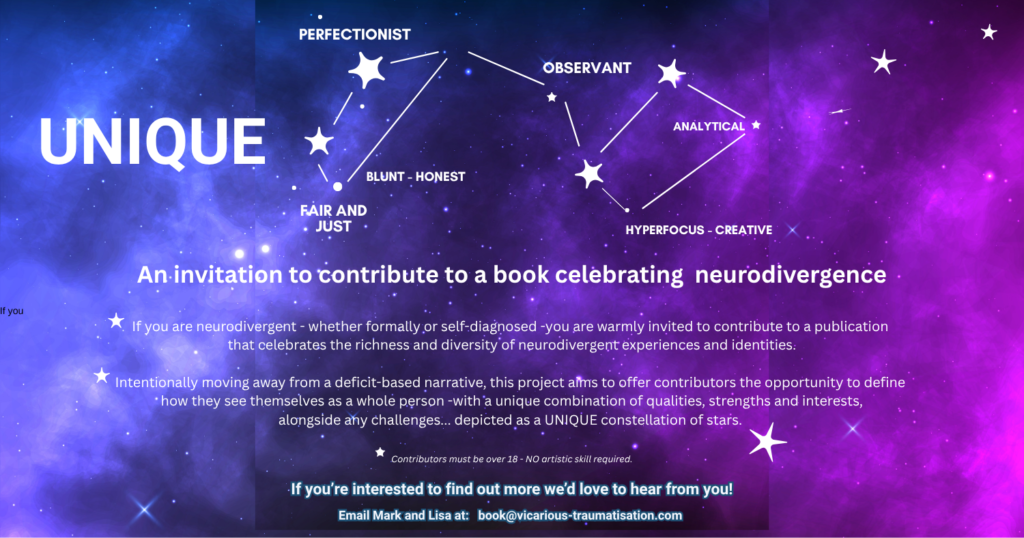
I am delighted to share that I have a chapter in an upcoming book called UNIQUE. UNIQUE invites neurodivergent contributors to map themselves: their qualities, strengths, struggles, deep interests, and challenges, all held together as a constellation.
My chapter centres on my Monotropic Galaxy — the constellation map of my Autistic self, and this blog is an edited and expanded version of my forthcoming chapter submission. My own constellation is a small offering among many in what I hope will be a rich, diverse, and deeply affirming collection of neurodivergent people’s inner worlds and experiences.
The book is still open for contributions.
If you are neurodivergent — whether formally diagnosed or self-identifying — you are warmly invited to contribute your own constellation. No artistic skill is needed. No particular way of writing. Just your own unique map of who you are. The project is intentionally moving away from deficit narratives and toward something that reflects the full richness of neurodivergent experience and identity.
Contributors need to be over 18. If you’re interested to find out more, Mark and Lisa would love to hear from you at book@vicarious-traumatisation.com.
“Objects do not come first and then differ; rather, objects emerge out of more fundamental processes of differentiation.”
This feels like a statement about identity, about what we actually are. It felt, in a way I am still working through, like a description of something I have always known from the inside, without ever quite having the language for it. It helps explain how I feel that I am not a fixed, bounded thing moving through the world, but that I emerge, in and through my relationships and encounters with everything around me.
This piece is my attempt to think that through. As always, this is exploratory, I am definitely not a physicist, and I am not making literal claims about quantum mechanics applying directly to human experience, as I really don’t know enough! However, I do think physics can offer us resonant frameworks, ways of thinking that help us articulate things that neuronormative language has never quite been able to hold, and it may help understand and explain some ways of being Autistic or otherwise neurodivergent.
What quantum physics may be actually saying
Webster’s article draws on the work of physicist Carlo Rovelli, who developed what is called Relational Quantum Mechanics (RQM). The basic idea is that at the quantum level, particles do not have fixed, independent properties. A particle’s properties only become real in relation to another system. There is no such thing as an absolute, standalone description of a quantum object that holds true for all observers in all contexts. In other words, what something is depends on what it is in relation to.
Rovelli explains that the world of quantum mechanics is not a world of objects, it is a world of events, and events are always interactions between systems. Reality, at its most fundamental, is not a collection of separate things with built-in properties, it is a vast, shimmering web of relations.
Webster goes even further, drawing on the philosopher Gilles Deleuze to argue that this is not just a strange quirk of the quantum scale, it is actually how reality works at every level. Deleuze argued that difference and relation come first. The apparently stable, separate things we perceive — objects, individuals, identities — emerge out of relational processes, not the other way around. As Webster puts it: “Objects do not come first and then differ; rather, objects emerge out of more fundamental processes of differentiation.” Deleuze saw this as a model for how reality works at every level — not objects first, then relations, but relations first, and then eventually what we recognise as objects.
In my ongoing reading of Deleuze and Guattari over the past few years, it feels like things are starting to connect in a strange way……something is starting to make a bit more sense, folds unfolding and nodes of the rhizome and constellations are beginning to connect a bit more in relation to my Autistic identity and relations with others……
Why this matters for how Autistic people have been understood
One of the things Webster observes is that even our philosophical and logical language cannot easily hold a relational worldview. Our logic is built to describe objects and their properties. If relations come first, that language actively gets in the way, so we need different frameworks, different vocabularies, to say what is actually true and also how we feel.
Many of us, as Autistic people, may recognise this difficulty as the neuronormative-dominated language and society we have all grown up in, with its emphasis on fixed traits, stable categories, and measurable deficits has never quite been able to hold what our experience actually is or feels like. As I explored in Living in Layers, my reality is layered, non-linear, and sensorily permeable in ways that the majority of the world seems to fail to recognise or understand. It feels like the language we have is so limited, and just keeps breaking up against us.
This is why I am so passionate about our Stimpunks glossary, created by the neurodivergent and disabled community — we have to create our own vocabulary to survive, as it just isn’t there in the world we currently live in. As Audre Lorde’s and bell hooks’ work reinforces, language is a vital tool for survival, self-revelation, and political action – ‘language is a place of struggle‘.
The frameworks built to describe and assess Autistic people are rooted in exactly the kind of object-thinking that Webster is critiquing. They ask people, what properties does this person contain? What is inside this individual that differs from the norm? How do we measure, categorise, and if possible remediate, fix or change the object so they fit into society?
Damian Milton’s (2012) Double Empathy Problem helped my understanding of this gap of difference over a decade ago. The double empathy problem helps explain that the misunderstanding so often attributed to Autistic people is not located inside one person, it lives between people, in the quality and texture of the encounter, the shared or unshared frameworks two people bring into contact with each other through their lived experiences. In my longer piece The Double Empathy Problem is DEEP (Double Empathy Extreme Problem – Dynamic, Embodied, Ecological, and Political), I explore how this operates not just between individuals but at social, cultural, and structural systemic levels.
The “problem,” in other words, is a relational property. It is not something carried in the Autistic person’s neurology like a stone in a pocket. It emerges, as all relations do, in the encounter itself, in the liminal spaces. In the gap between two different ways of sensing the world, two different attentional rhythms, two different histories of what communication has felt like and meant.
I have spent a long time feeling like the problem, as I think many of us may have as Autistic people. I find something genuinely moving in the idea that physics is pointing towards the same conclusion that disabled activists and Autistic-led researchers have been making for decades. The difficulties we encounter are ecological as David Gray-Hammond has been writing about in their Ecosystemic Model, which we have expanded on in our Re-Storying Autism course and book.
What needs to change is not the person but the conditions of relation. Rovelli might put it a little differently, saying that properties only become real in relation to another system. There is no absolute, observer-independent description of a person that tells the whole truth about themselves. What we are is always, in part, a function of what and who we are in relation to each other and our environment.
This connects to the work of Ombre Tarragnat (2025) on ethodiversity. Ethodiversity (short for ethological diversity), is a concept that moves neurodiversity thinking beyond the brain and into the wider ecological and relational field. Rather than focusing only on neurological difference, ethodiversity attends to the full range of behavioural and existential styles: the different ways that humans and other animals move through, sense, and inhabit their worlds. Tarragnat describes it as encompassing not just biology but inter- and intraspecific relationality, the ways our differences are always already entangled with the environments and relationships we are embedded in.
What I find so useful here is that ethodiversity frames difference as fundamentally ecological and relational rather than as a property contained within an individual. The parallel Tarragnat draws with biodiversity makes sense to me as just like biodiversity is a property of an ecosystem, (something that emerges from how species relate to each other and their habitat), ethodiversity is a property of a relational field. You cannot understand anything by studying one organism in isolation.
Tarragnat also introduces the concept of ethonormativity, the often unspoken rules that govern which ways of being, behaving, and relating are acceptable or expected in a given context. Ethonormativity, like neuronormativity, is not located inside the person. It is a property of the relational and social environment, a set of conditions that certain bodyminds move through with ease, and that others may find exhausting, painful, or simply impossible to meet. When we think of diversity in this way, the difficulty and barriers Autistic, otherwise neurodivergent or disabled people face are not their personal divergence, it is the narrowness of what the relational field is prepared to hold.
A Pause……
This piece is pretty wordy, and I am aware that when we talk about Autistic and neurodivergent experience in these kinds of registers, we can end up — without meaning to — centring the voices that the world already knows how to value. I want to gently push back against that, including in my own writing.
The ideas here belong to all of us, and relation has to come first. These are not ideas that matter more or less depending on how someone communicates, moves, or exists in the world. I have been thinking and writing a lot lately about how neuro-affirming practice is not a framework or a checklist — it is a way of being. It is about being genuinely present with people, as they are, in the relational field we share. That means all of us, including, and I would say especially, people with profound and multiple learning and intellectual disabilities, whose ways of being in relation are so often the most misread, the most unseen, and the most undervalued by the systems built around them.
I spent twenty years as a SEND teacher, and some of the richest, most meaningful things I have come to understand about what genuine relation looks and feels like, what it means to truly be with someone, came from my time in class. Relation and safety was the foundation of everything. A shift in breathing, a change in muscle tone, a turn toward a familiar voice or a sound. These weren’t lesser forms of connection, just different ones, asking something different of the people around them to connect with them. Asking us to slow down, to pay attention differently, to stop waiting for communication that looks like ours before we decide someone is worth relating to. This is the embodied DEEP dimension of the Double Empathy Problem — Dynamic, Embodied, Ecological, and Political — the reminder that relation happens in and through bodies, breath, and shared presence, long before it happens in words. It is a way of being with each other, across the full and beautiful range of how we all exist with one another and with our environment.
Tarragnat’s ideas about ethonormativity does its most violent work on those whose ways of being are furthest from what any normative system recognises as meaningful communication or social participation. The relational field that needs to change is not only the one around verbally articulate Autistic people, but it is also every environment that has decided in advance what counts as a person worth relating to, with those most marginalised always being pushed further away instead of centring them.
This is why, if we return to Rovelli, the question is never just about asking “what is this person like?”, it is also always about “what kind of relational field are we creating together, and whose ways of being does that field make possible?”
Philosopher and physicist Karen Barad (2007) calls this intra-action, which is a bit different from inter-action. Interaction assumes two separate, already-formed things that then come into contact. Intra-action suggests something more radical, that the things themselves, the identities, the properties, the selves, are produced through the meeting. We do not arrive fully formed and then enter into relation, we are, in part, constituted by the relations we are held within and have always been a part of. Barad also draws on quantum physics to make this argument, which is why it sits so naturally alongside Rovelli’s, as both point toward a world where relation is everything.
Erin Manning (2016) develops something similar when she writes about Autistic experience and what she calls the minor gesture, the ways of moving, attending, and relating that do not register within dominant frameworks, but that are doing real, significant, world-making work nonetheless. For Manning, Autistic ways of being are not failed attempts at neurotypical relation, they are different modes of intrarelation, of being constituted in and through a world that is always already more-than-individual.*
This is why I find the word intradependent useful alongside the more familiar interdependent. Interdependence acknowledges that we need each other and intradependence goes further as it suggests that we are, in some fundamental sense, made of each other, that the boundaries between self and relation, between individual and environment, are more porous and more dynamic than the frameworks built around us have ever allowed us to embrace.
What becomes possible when we think relationally
We are all interdependent and intradependent and Webster helps highlight that this is precisely why Deleuze matters. Deleuze offers what Webster calls “the metaphysics science needs”, a different conceptual vocabulary, one built for difference, flow, and becoming rather than for fixed objects and their properties. I think this may also be part of the metaphysics that neurodiversity needs, an ever-expanding neuroqueer framework that begins with relation rather than with the individual as an isolated, assessable unit.
If identity emerges from relations rather than residing inside individuals, then support cannot be about fixing a person in isolation. It has to be about transforming the relational conditions — the environment, the encounter, the quality and structure of connection itself. The sensory climate of a space, the pacing, the temporality and texture of relating and forming connections and relationships. Whether a community can hold someone’s particular way of attending to the world without requiring them to translate themselves into something more legible, more manageable, more like the expected norm, and whether the people building those spaces are genuinely asking whose ways of being they are designed around, and whose they are still leaving out.
This is what I see at work in the best neurodiversity-affirming spaces I am fortunate to be part of — the CASY group, the Stimpunks community, NeuroHub Community and Thriving Autistic. These aren’t spaces that take a person as an object to be supported, assessed, and adjusted, but co-created spaces that understand themselves as relational fields. They are communities that consider what those fields need to become, so that different kinds of bodyminds can genuinely flourish within them. Spaces that hold the full range of experiences, from the most academically articulate to those whose presence, joy, pain and relation express themselves entirely outside of neuronormative language as sensory beings. Everyone has equal worth and we are all dependent on each other to not only survive, but thrive and create meaningful lives together.
In We Are Star Stuff, which I am continuing to develop collaboratively with Ryan Boren at Stimpunks, we wrote about being literally made of elements forged in dying stars: about the deep, physical reality of our connection to the cosmos and to each other. Relational quantum mechanics takes this even further, not just that we are made of the same stuff, but that what we are, at the most fundamental level of reality, is constituted by our relations with each other and our environments. There is no isolated self beneath the web of connection, there is only what emerges in, through and in the spaces between every encounter.
We are not broken objects. We are relations, all of us still becoming. And I think (and I hope) that sitting with some of these thoughts might help change everything about how we understand, support, and truly be with each other.
Cordero-Rivera, A. (2017). Behavioral diversity (ethodiversity): A neglected level in the study of biodiversity. Frontiers in Ecology and Evolution, 5, art. 7. https://doi.org/10.3389/fevo.2017.00007
Deleuze, G. (1994). Difference and repetition (P. Patton, Trans.). Columbia University Press. (Original work published 1968)
Deleuze, G., & Guattari, F. (1987). A thousand plateaus: Capitalism and schizophrenia (B. Massumi, Trans.). University of Minnesota Press. (Original work published 1980)
Walker, N. (2021). Neuroqueer heresies. Autonomous Press.
Webster, G. (2024). The metaphysics science needs: Deleuze’s naturalism. European Journal of Philosophy, 32(3), 820–846. https://doi.org/10.1111/ejop.12909
I find it genuinely awe-inspiring to know that the atoms that make up your body, the oxygen in your lungs, the calcium in your bones, the iron in your blood were forged inside stars that died before our planet even existed. Not metaphorically, we are actually, literally, made of stars!
A 2017 survey of 150,000 stars confirmed that humans and our galaxy share around 97% of the same kinds of atoms, and that the six elements essential to life — carbon, hydrogen, nitrogen, oxygen, phosphorus, and sulphur — are woven right through the Milky Way (Howell, 2017). We are a living part of the cosmos.
I have been thinking about this a lot, and what it may mean to us as Autistic people, and it is something that is evolving in conversations within the CASY Autistic Physics group and my recent collaborative work with Stimpunks. There is something about being made of stardust that resonates far deeper than a scientific fact for me.
As an Autistic person, I have always felt that the boundaries between myself and the world are more porous than I was told they should be. Everything feels entangled, I am deeply influenced by my environment in ways that go beyond what neuronormative frameworks tend to account for. Time, my past and present merge and move together; my pull towards moss and mushrooms, and my interest in water, are more than a ‘like’ or form of regulation or sensory relief, they feel like I am becoming more attuned to something deeper and more essential, something I can only describe as parts of my soul recognising what they actually belong to.
The elements in your body right now came into being through some of the most violent events in the universe. The iron in your blood, the calcium in your bones, the oxygen in every breath, were forged in the cores of massive stars and released in supernovae: entire stars compressing their whole lives into a single catastrophic release. In that rupture, what had been locked inside was scattered outward, making things possible that could never have existed before.
Many of us, as neurodivergent people and from marginalised communities, may know something about transformation through rupture, about how the most difficult passages of burnout and exclusion can forge something that simply could not have existed any other way. As I have written, these periods of burnout seem to change me at my core. I never fully recover; the deepest burnouts feel like a seismic shift has taken place. My whole sensory system and way of relating to the world transforms.
For Autistic people, the idea of a fixed, bounded, separate self may sit uneasily, we are always in flow, always fluid and always responsive to everything around us. The theory of Monotropism developed by Murray, Lesser, and Lawson (2005) may help explain this. It describes the way Autistic (and may be ADHD/ AuDHD) attention tends to move in deep, singular currents rather than spreading across many channels at once. It is a different way of connecting: like matter drawn into a stellar core, our attention concentrates and transforms, and, like the star, what forms in that depth eventually moves outward and can expand, making new connections and new ways of being.
Ethodiversity is a concept that feels important here. Originally coined by Cordero-Rivera (2017) in ecology and evolutionary science, and developed by Tarragnat (2025) into a framework for thinking about human and nonhuman life together, it refers to the full range of behavioural and existential ways of being across species, not just neurological difference, but the diversity of how living beings sense, connect, relate, move through, and respond to the world. As Autistic people, our particular way of being is shaped by, and in turn shapes, everything around us, perhaps more intensely for some than others. We are not separate from the wider pattern of the cosmos; we are very much a part of how the pattern moves, interdependent on each other and everything around us.
For many Autistic people, this deep attunement to the world, to its textures, its moods, its patterns may be felt intensely. However, it is so often misread, pathologised, or masked out of our existence simply to fit into spaces that were not built for us. When we are in environments where we feel genuinely safe, something can shift. We are able to be our full selves, more open, more present to what the world is actually offering us —the things that bring us comfort, joy, and we can meet them on our own terms. That is what a real connection actually feels like, and we deserve spaces where it’s possible.
That sense of belonging and connection can ripple outwards. adrienne maree brown writes in Emergent Strategy (2017) that small patterns replicate into large ones, that the local and the cosmic are always doing the same thing at different scales. She centres the people that dominant systems have tried to cast as anomalies, Black, disabled, neurodivergent, queer, poor and names what many of us may already sense: that what looks like deviation is often a more honest expression of how complex living systems actually work. Emergence doesn’t need conformity; it needs difference. A universe that could only produce one kind of star would not have produced us or our world as we know it.
We are all made of stardust, and our entanglement, our porousness, our deep attunement to the world and cosmos around us are things we should all embrace, regardless of any labels or diagnoses we may or may not have.
Stimpunks, whose work on star stuff has been part of the thinking woven through this piece and through our collaborative work sums it up nicely:
The cosmos is within us, and we are a way for the universe to know itself — in every colour, key, and frequency of neurodiversity
“What more do you want? The ingredients in our bodies have been assembled in the hearts of long-dead stars over billions of years and have assembled themselves into temporary structures that can think and explore…” Brian Cox
brown, a. m. (2017). Emergent strategy: Shaping change, changing worlds. AK Press.
Cordero-Rivera, A. (2017). Behavioral diversity (ethodiversity): A neglected level in the study of biodiversity. Frontiers in Ecology and Evolution, 5, Article 7. https://doi.org/10.3389/fevo.2017.00007
Murray, D., Lesser, M., & Lawson, W. (2005). Attention, monotropism and the diagnostic criteria for autism. Autism, 9(2), 139–156. https://doi.org/10.1177/1362361305051398
From More-Than Neurodiversity to Ethodiversity: Sensory Climates, Monotropic Flow and Watery-Becomings (an exploration!)
I have been thinking about what it means to live as an Autistic person with a bodymind in a world organised around neuronormativity, speed, noise, and constant transition in often overwhelming environments.
This article explores how Autistic burnout and regulation can be understood as relational ecological reorganisations of monotropic attention with the wider environment, rather than solely individual neurological difficulties.
Drawing on Nick Walker’s neuroqueer theory alongside Ombre Tarragnat’s concepts of Autistic weather-bodies and ethodiversity, Astrida Neimanis’s account of watery embodiment, and Deleuze and Guattari’s notion of the Body without Organs, this article reframes Autistic ways of being as forms of relational reorganisation rather than individual deficit.
This essay is exploratory and reflects an ongoing process of neuroqueering how my own attention, well-being, and belonging are understood. May be some of it will resonate with you?
Rethinking Neurodivergence in Neuronormative Societies
Autistic experience shows that well-being does not arise only from what happens within an individual. It develops through ongoing relationships between bodyminds, relationships, environments, and social expectations. Attention, sensory regulation, emotional rhythms, and energy flow are shaped through everyday encounters with the worlds we inhabit. When these relationships become strained or misaligned, experiences of burnout and fragmentation can occur.
Neuroqueer (Walker, 2021) and posthuman perspectives invite us to understand neurodivergence as shaped not only by individual neurology but also by sensory environments, social structures, technological systems, and political conditions.
A more-than-neurodiversity approach moves beyond helping individuals adapt to existing systems. Instead, it asks how those systems themselves might be re-organised to support diverse ways of sensing, attending, communicating, and relating.
These relational processes are not abstract. They are organised through school timetables, digital infrastructures of constant connectivity, and socio-political economic systems that prioritise speed and productivity. Such conditions shape how attention can move, how bodies regulate, and whose rhythms of participation are recognised as viable.
In societies organised around neuronormative values, difference only becomes visible through comparison with dominant norms. Neurodivergent individuals may therefore experience pressure to suppress sensory needs, split our natural monotropic attentional flow, or mask ways of being in order to remain socially legible. While these strategies can enable participation and may foster greater acceptance, the sustained effort required to maintain them can lead to exhaustion and burnout. Experiences such as meltdown, shutdown, and declining mental or physical health can be understood not just as individual difficulties, but as relational signals that our everyday environments and ways of being have become too intense, unpredictable, or unsustainable and that change is needed.
This article suggests that what Deleuze and Guattari call becoming a Body without Organs may help us understand Autistic experience as an ongoing neuroqueer ecological process. Through this lens, bodyminds are continually reorganising in response to changing relational climates. Drawing on Tarragnat’s ideas of Autistic weather-bodies and ethodiversity, Neimanis’s writing on watery embodiment, and Walker’s neuroqueer theory, I am reflecting on my own lived Autistic experience to explore how neurodivergent ways of sensing and relating can open new possibilities for ecological belonging and more liveable worlds.
Beyond the Brain: The Limits of “Neuro” Framing
While the language of neurodiversity has played a crucial role in reframing neurological variation as a natural and valuable aspect of human diversity, I think the growing emphasis on “neuro” as a primary explanatory framework also raises important questions. All humans have nervous systems and unique sensory and attentional patterns, all of which are shaped by our experiences and intersecting identities. When difference is understood mainly, or only through what are seen as brain-based (neurological) and diagnostic models, then understandings of divergence can become narrowed to recognised clinical categories, while the wider relational, cultural, political, and ecological conditions shaping experience remain less visible. This is not to deny the reality of neurological difference and being innately Autistic, but to argue that such difference is always lived through relational, cultural, and ecological conditions.
Neurodivergence may not always be a fixed identity or solely a neurological state of being. It can also emerge through different ways of sensing, relating, resisting, or reorganising participation in environments. For some, becoming neurodivergent becomes a conscious process of neuroqueering dominant expectations around productivity, communication, or emotional regulation. In this sense, divergence is not always bounded or stable, and it may not always be inherently positive. It can involve vulnerability, exclusion, uncertainty, and ongoing negotiation with social norms, the spaces we engage with, and the direction our neurodivergence leads us towards.
When divergence is measured primarily against socially constructed standards of independence, efficiency, social fluency, and normative regulation, important dimensions of human variation can be overlooked. Expanding the conversation beyond strictly neurological framings allows neurodivergence to be understood as emerging from interactions among the infinite experiences of different bodyminds shaped by intersectionality, environments, and also the systems of power we live within.
More-than-neurodiversity perspectives, including Ombre Tarragnat’s concept of ethodiversity (2025), further challenge hierarchical and human-centric assumptions about how difference is organised and valued. Instead of locating divergence solely within individual brains, these approaches understand embodiment as relational and ecological, a continual process of becoming shaped by sensory climates, technological infrastructures, social systems, and ecological conditions, it looks at our relations within a multi-species context, our way of being with the wider planet and all that it contains.
Exploring Autistic experience through ecological metaphors such as weather, water, and Deleuze and Guattari’s concept of the Body without Organs offers one way of shining a light on how our bodyminds may reorganise themselves in response to shifting relational environments. These frameworks help widen the discussion from individual adaptation to collective transformation, opening the possibility of reimagining more liveable relational worlds.
Autistic Weather-Bodies: Sensory Climates and Masking
Ombre Tarragnat’s (2024) idea of the Autistic weather-body helps us understand how our experiences are shaped by the climates we live within. They suggest that our bodyminds are always responding to a “total climate” , not only the physical weather around us, but also biodiverse, sensory environments, social expectations, technologies, and socio-political conditions we live within.
These relational climates are not only social or human-centred; they are multispecies and more-than-human. Living beings, ecological communities, and so-called non-living forces such as air quality, light, temperature fluctuations, water, and seasonal rhythms all shape how bodyminds feel, focus, regulate, and relate. These dynamic conditions also respond to our presence and actions. Together, they influence the ecological possibilities through which different forms of life — human and non-human — can endure, adapt, and flourish. From this perspective, neurodivergent experience emerges within more-than-human ecologies rather than solely within and between humans, everything and everyone is connected!
For many Autistic people, changes in atmosphere are felt very directly and intensely; our bodies are perhaps more porous. Lighting, noise, other sensory input, unpredictability, digital pressures, and interpersonal tension and relationships can all influence our attention, energy, and capacity to regulate, and we may not always have control over this.
These shifts are not always dramatic; sometimes they are more subtle, a rising sense of pressure and anxixety in a crowded room, a flicker of fluorescent light that begins to feel painful, or even the bodily awareness of a storm approaching. I know that for me, changes in the weather can trigger migraines before the rain even arrives. These experiences remind us that our bodyminds are not sealed off from the world; we are not just humans in the world. We are continually sensing, adjusting, responding, adapting and connecting with the world.
Thinking about Autistic bodyminds as weather-bodies moves my thinking away from asking how people need to become more ‘resilient’ to change, trauma and ruptures of flow states. Instead, it invites us to consider how the climates of our everyday lives might become more liveable and flow more steadily and smoothly. We can consider what schools would feel like if they were organised around sensory comfort and intrinsically motivated attention tunnels of engagement rather than speed and constant transition? How might workplaces change if regulation and recovery were understood as necessary rhythms rather than signs of weakness?
Tarragnat also writes about how we actually weather environments too. All humans try to adapt, this may be more intense for Autistic people and a trauma response to the very climate we live in. We may sometimes mask or suppress our sensory needs when having a meal out with friends, push through our exhaustion to meet a deadline at work, or fragment our attention in order to try to stay socially acceptable and communicate in a busy cafe. Over time, this kind of acclimatisation can erode our sense of coherence, identity and well-being. Burnout, meltdowns or shutdowns may follow, often with severe mental health implications as we try to survive and function, and this pressure accumulates. These experiences are not personal failures; they are signals that our current relational climates have become too difficult to inhabit.
Like water, our Autistic weather-bodies are also fluid; our experiences move and change like atmospheric patterns. To deepen this ecological way of thinking, I think it could be helpful and interesting to turn to the watery metaphors of embodiment such as that proposed by Neimanis (2017). If weather shapes how we feel and function and how we may be weather-bodies, water also helps us understand how well our bodyminds can actually manage attention, emotion, and energy flow. The air we breathe, the water we drink, the plants and biodiversity around us and the ecosystems that grow within our world are all vital to our well-being and deeply entangled in a connected flow.
Understanding Autistic experience through these ecological metaphors may help us recognise that wellbeing is always relational. It depends not only on what happens inside our bodyminds, but on the climates and currents we all move within.
Watery Bodies: Monotropic Attention and Relational Flow
Posthuman feminist thinker Astrida Neimanis (2017) describes human beings as bodies of water, shaped by the flows that move through and around us. Water is not only something we drink, cook with, or wash in. It circulates through our blood and tissues, regulates temperature through sweat and breath, and connects us to wider ecological systems such as weather patterns, infrastructures, rivers, oceans and cycles in nature.
From this perspective, embodiment is not sealed within the skin. Bodies are permeable, porous, sponge-like, relational, and continuously responding to the environments they inhabit. We are not separate from the oceanic and atmospheric systems that sustain life. In a very real material sense, we are entangled with them, shaped by their rhythms, movements, and transformations. Our sensory and nervous systems are always responding and adapting to maintain a stable flow amid the different currents and energies around us.
For many Autistic people, whose perception often foregrounds sensory detail and pattern, this account of embodiment may resonate with lived experiences of permeability, intensity, and environmental attunement.
Monotropic attention, characterised by deep engagement with particular interests or sensory environments (Murray et al., 2005), can be imagined as a current that gathers depth and direction over time. When attention can move steadily toward meaningful activity, it may support learning, regulation, creativity, and a sense of coherence within the wider flow and environment a person is within.
However, many relational environments are organised in ways that disrupt rather than support these attentional currents. Educational settings often require rapid transitions between subjects, noisy corridors, and constant social negotiation. Workplaces often demand multitasking, immediate responses to digital communication, and participation in unpredictable meetings. Everyday life may involve sensory overload from traffic, crowds, bright lighting, smells, or competing demands at home and with our own health. These conditions can create what might be described as turbulent relational climates, in which the flow of attention is repeatedly interrupted and ruptured, leaving us without a safe anchor.
These turbulent relational climates are often produced and intensified through socio-political, economic, and technological systems that fragment attention and accelerate temporal demands. For example, constant news alerts on your phone may create a background sense of urgency or threat, pulling your attention and flow away from embodied rhythms and present-moment regulation. Algorithm-driven social media feeds, rapid email expectations at work, and productivity-monitoring apps can pressure people to respond immediately, compressing time and narrowing opportunities for rest or deep flow with our passions.
Economic precarity, shift work, and unstable housing conditions can further disrupt sensory and emotional regulation by creating unpredictability in daily routines and environments. Public transport delays, overcrowded urban spaces, and exposure to noise or poor air quality may also contribute to cumulative sensory load. At a broader level, climate-related events such as heatwaves, flooding, or seasonal disruption can reshape how people move, gather, and feel safe, while also affecting multispecies habitats and ecological stability.
Together, these forces create relational climates that are not only socially produced but materially and technologically mediated, shaping how bodyminds attend, connect, recover, and sustain participation in everyday life – which may all be felt more acutely if you are Autistic. Understanding burnout in this way highlights how neurodivergent distress is frequently structured by socio-political and material conditions rather than individual deficit.
From a hydrological perspective, responses such as overwhelm, shutdown, or withdrawal can be understood as the body adjusting to this turbulence. Just as rivers alter course when encountering obstacles, drought, or flooding, Autistic individuals may narrow their focus, find cracks and crevices to retreat into quieter spaces, or seek familiar routines in order to restore coherence and regain a smoother less distressing flow state, so our systems don’t get flooded or caught up in a storm. These adjustments are often misinterpreted as avoidance, lack of resilience, or disengagement. Yet they can represent adaptive attempts to conserve energy and re-establish sustainable regulatory pathways and streams of flow.
This shift from individual responsibility toward relational transformation raises a deeper philosophical question: how do bodyminds reorganise when familiar structures of engagement become unsustainable? Rather than understanding burnout as a breakdown, they may be read as processes of reorganisation. To explore this possibility, I am turning to Deleuze and Guattari’s concept of the Body without Organs, which offers a way of thinking about how new patterns of regulation, relation, and participation can emerge.
Body without Organs: Autistic Becoming
I find Deleuze and Guattari’s idea of the Body without Organs (BwO) helpful for thinking about how Autistic bodyminds may reorganise when everyday demands become overwhelming or unsustainable. The BwO does not refer to a literal physical state (!). Instead, it describes shifts in how attention, sensory experience, movement, and participation are organised and can become re-organised.
From my own experience, these shifts often become most noticeable during periods of burnout or intense overwhelm. At these times, familiar ways of focusing, communicating, or keeping up with daily life can begin to break down. For example, I might find that replying to messages or emails — tasks that once felt manageable — suddenly requires an enormous amount of energy, or that following conversations in busy environments becomes confusing and exhausting. Even simple routines such as preparing meals, travelling on public transport, or switching between tasks can feel disorientating, as if my attention is no longer able to stretch in the ways it once did.
It can feel as though the usual pathways for engaging with the world are no longer available. However, these moments are not only about loss or collapse. There can also be times when new ways of regulating and relating start to emerge as attentional resources redistribute in order to survive. For instance, I may begin to rely more on sensory anchors such as quiet spaces, repetitive movement, or focused creative interests. Communication might shift toward slower, more intentional exchanges, or toward written rather than spoken interaction. Daily life can reorganise around fewer but more meaningful connections and activities, allowing energy to be conserved and gradually restored. In this way, burnout can sometimes open space for different rhythms of participation and new forms of relational attunement to develop.
Reorganisation does not only happen in moments of crisis. It often unfolds through small, everyday neuroqueer choices. This might look like staying with a deep interest long after others have moved on, pacing or rocking to steady sensory overwhelm, wearing noise-cancelling headphones in busy spaces, or choosing solitude after social interaction in order to recover. Some Autistic people reshape their days so that activities happen in a predictable sequence, or protect uninterrupted stretches of time where attention can settle and flow.
What Deleuze and Guattari call deterritorialisation can be felt here as a soft loosening of pressure, a step away from expectations to respond quickly, multitask constantly, or socialise in prescribed ways. As these pressures ease, different rhythms of living and participating can begin to take shape for others too and the ripples of change begin to take effect.
Many Autistic people recognise these processes in small but significant adjustments to how they move through the world. Erin Manning (2016) describes such shifts as “minor gestures” — subtle changes that reshape how we sense, focus, and relate within particular environments. This might involve rhythmic movement to steady sensory overwhelm, withdrawing into a meaningful interest after prolonged interaction, or becoming absorbed in creative or repetitive activity. These gestures can be understood as the mechanisms through which reorganisation happens. They are ways of actively redistributing sensory and emotional intensity, recalibrating attention, and gradually re-establishing a sense of coherence. Although often misunderstood as avoidance or dysfunction, such practices can help Autistic individuals re-climatise to demanding relational atmospheres and sustain participation over time.here.
As these processes are relational, they are shaped by the environments in which we live. Sensory-friendly spaces, predictable routines, flexible expectations, and collective care can make a significant difference. From this perspective, well-being is not something individuals achieve alone; it emerges collectively through interdependence with environments (beyond the human), that recognise and support diverse ways of focusing, recovering, and connecting.
For many Autistic people, reorganising routines and spaces becomes an intentional way of reducing neuronormative pressure. Creating sensory refuges, protecting uninterrupted time for deep focus, limiting unnecessary task-switching, or prioritising interest-led learning and creativity can support more sustainable engagement. These are not simply personal coping strategies. They are ways of experimenting with how attention, energy, and participation might be structured differently.
Neurodivergent becoming can therefore be understood as an ongoing neuroqueering process of adjustment and transformation, shaped by the continuous redistribution of attention, energy, and sensory intensity. Periods of immersion, withdrawal, or re-focusing are not simply signs that something has gone wrong. They may indicate that bodyminds are reorganising in response to pressures that exceed sustainable limits.
When these processes are recognised and supported, they can open pathways towards more liveable ways of being, not only for Autistic people, but within the wider relational ecologies we all share. In this sense, becoming a Body without Organs is not a final state but a dynamic practice: a way to loosen restrictive normative expectations, experiment with new rhythms of participation, and contribute to the gradual reshaping of environments so that diverse forms of attention, regulation, and connection can co-exist and keep transforming and flowing.
From Neurodiversity to Ethodiversity: Ecological Multiplicity
When Autistic reorganisations of attention and sensory When experiences of sensory intensity or overwhelm are understood as relational and ecological processes, rather than simply individual coping challenges, our perspective begins to widen. Instead of seeing regulation as something a person must manage alone, we can recognise how environments, relationships, technologies, and broader living systems all shape how attention, emotion, and energy flow.
From this viewpoint, neurodiversity is no longer only about differences between human brains. It becomes part of a wider story about how many forms of life sense, respond, adapt, and find ways to remain in the world. Ideas such as becoming a Body without Organs can be read as an invitation to notice these shifting patterns of connection and regulation, and to recognise the importance of ethodiversity (Tarragnat, 2025), or the diversity of ways living beings experience and engage with their environments.
Expanding neurodiversity toward the concept of ethodiversity strengthens this ecological understanding. Ombre Tarragnat (2025) uses this term to highlight how different perceptual styles, emotional intensities, and attention patterns contribute to the resilience of relational systems, including ecosystems and multispecies communities. For example, Autistic sensory attunement may make environmental pressures more noticeable such as persistent background noise, polluted air, or the stress of extreme weather changes.
Ethodiversity does not just build on neurodiversity by recognising additional forms of human difference. Instead, it draws attention to the diversity of ways living beings perceive, move, and participate in shared environments, as well as the impact of non-living things. From this perspective, neurodivergence can be understood as one expression of a wider ecological multiplicity of attentional rhythms, sensory attunements, and relational styles that help sustain more liveable worlds.
Understanding and embracing ethodiversity means creating relational systems that can support different rhythms of participation, perception, rest, and recovery. This includes recognising that people, other species, and environments do not all move, sense, or respond in the same ways or at the same pace. Designing spaces, communities, and policies with this diversity in mind becomes part of a wider ethics of planetary care.
When we value diverse forms of embodiment and ways of relating to the world, we also begin to recognise how closely human wellbeing is connected to ecological wellbeing. Sustaining multiplicity across cognitive, cultural, biological, and ecological domains is therefore not only a matter of social inclusion. It is also a condition for collective survival. For example, if water systems become polluted, this affects the health of entire ecosystems, and human communities are not separate from these impacts. In this way, caring for diversity in how life exists and adapts is part of caring for the future of the planet as a whole.
Cultivating Liveable Worlds: A Neuroqueer Ecological Future
Autistic experience highlights how wellbeing emerges through ongoing relationships between bodyminds, environments, and social expectations. Sensory overwhelm, burnout, fragmentation, and withdrawal can therefore be understood not simply as individual difficulties, but as signals that relational climates have become too intense, unpredictable, or unsustainable.
Thinking with concepts such as Autistic weather-bodies, watery embodiment, and the Body without Organs helps us recognise how bodyminds continually adapt and reorganise in response to these conditions. Practices of regulation such as retreating into focused flow, seeking quieter environments, experimenting with new rhythms of engagement, or stimming can be understood as efforts to restore coherence and sustain participation. Neuroqueering involves both resisting dominant expectations and actively reshaping environments to support different temporalities and sensory needs.
The concepts of Cavendish Space and Neuroqueer Learning Spaces, which I have been working on with Stimpunks, offer practical examples of how relational ecologies might be redesigned. By prioritising sensory accessibility, slower rhythms of participation, interest-led engagement, and collective care, these approaches shift the focus away from expecting Autistic individuals to adapt to rigid systems. Instead, they explore how environments themselves can become more responsive and sustaining.
Cultivating liveable relational worlds requires more than individual accommodation. It calls for collective transformation, reshaping educational, social, technological, and ecological systems so that diverse rhythms of sensing, regulating, and belonging can genuinely flourish. Supporting diverse modes of becoming is not only about inclusion within existing structures, but about reimagining those structures altogether.
Extending neurodiversity toward the broader horizon of ethodiversity invites recognition that multiplicity across perceptual styles, cultural practices, and environmental relationships contributes to more liveable shared futures. Practices that support sensory regulation, slower temporal rhythms, and sustainable participation may also align with wider movements toward ecological care and multispecies coexistence.
From this perspective, becoming what Deleuze and Guattari describe as a Body without Organs can be understood as an ongoing neuroqueer process of reorganisation. It involves loosening restrictive normative expectations, redistributing attention and energy, and experimenting with and queering new ways of participating and being in our relational worlds. Perhaps neuroqueering attention and sensory life is not only about Autistic survival, but about learning new ways of living together within the fragile ecologies we all share?
Deleuze, G., & Guattari, F. (1987). A thousand plateaus: Capitalism and schizophrenia. University of Minnesota Press.
Manning, E. (2016). The minor gesture. Duke University Press.
Murray, D., Lesser, M., & Lawson, W. (2005). Attention, monotropism and the diagnostic criteria for autism. Autism, 9(2), 139–156.
Neimanis, A. (2017). Bodies of water: Posthuman feminist phenomenology. Bloomsbury.
Tarragnat, O. (2024). The personal is climatic: Autistic weather-bodies and posthuman feminism between weathering and (dis)acclimatisation. Sextant: Revue de recherche interdisciplinaire sur le genre et la sexualité, (41).
Tarragnat, O. (2025). Biodiversity, neurodiversity, ethodiversity: Towards a more-than-human and more-than-neurological turn in neurodiversity studies. TRACE Journal for Human-Animal Studies.
Walker, N. (2021). Neuroqueer heresies. Autonomous Press.
Yergeau, M. (2018). Authoring autism: On rhetoric and neurological queerness. Duke University Press.
Autistic community can function as a living ecology of support, growing rhizomes and mycelium networks of care through shared recognition, co-regulation and mutual understanding. Within education, healthcare and labour systems that often disrupt neurodivergent flow and safety, these relational networks help sustain belonging, support burnout recovery and create new possibilities for engagement and participation. Drawing on monotropism, masking research and neurodivergent design approaches developed through Stimpunks, this article explores how our collective Autistic spaces nurture survival, resistance and transformative futures.
The Autistic Rhizome
The Autistic community is often spoken about as a source of friendship and peer support – a place to find people who just ‘get it’ and accept us for who we really are in all of our weird and wonderful ways of being. Yet for myself and perhaps others, it also functions as something far more foundational, a relational ecology that enables actual survival within systems not designed for our ways of thinking, sensing, and being.
Deleuze and Guattari’s (1987) concept of the rhizome offers a powerful lens for understanding this. Rhizomes grow laterally rather than hierarchically. They form networks of connection that adapt to changing environments and they persist even after rupture. In many ways, the Autistic community develops in similar ways, through shared flow states, shared recognition, and collective resistance to structures that fragment our attention and belonging.
This matters because our dominant systems, particularly education, healthcare, and capitalist labour structures, often operate through neuronormative assumptions about productivity, communication, and independence and ways of being which leads many of us into chronic burnout.
Education, Attention, and the Cost of Neuroconformity
Educational systems frequently prioritise standardised pacing, neuroconformity, and measurable outcomes over relational safety and cognitive and sensory diversity. For monotropic people (Murray et al., 2005), such environments can be profoundly destabilising. Constant transitions, sensory overload, and social performance demands can disrupt flow and contribute to experiences of masking, suppressing our need for sensory regulation, increasing anxiety and often leading to disengagement or exclusion.
Research on Autistic inertia highlights how difficulties with task initiation or switching are often misunderstood as defiance or lack of motivation (Buckle et al., 2021) rather than a redistribution of monotropic attentional resources. When these misunderstandings are embedded within institutions and systems, people may internalise deficit narratives or experience harmful interventions in order to try and fix or shape Autistic people into fitting into the neuronormative world. Trauma then accumulates over time, shaping later experiences of participation and safety and can lead to burnout and mental health difficulties.
Autistic community spaces (online and in person) can provide alternative ecologies for learning and care. where the neurodivergent love languages and the importance of interest-led exploration, flexible pacing, and co-regulation allow attention to stabilise and flow more evenly and a sense of belonging can emerge where we can be our authentic selves.
Healthcare, Misattunement, and Epistemic Injustice
Healthcare systems also frequently struggle to recognise Autistic communication styles, sensory realities, and embodied knowledge. The double empathy problem (Milton, 2012) highlights how misunderstandings between neurotypes can shape diagnostic processes, treatment decisions, and therapeutic relationships. Autistic people may find their experiences dismissed, pathologised, or translated into frameworks that prioritise normalisation over wellbeing.
Such interactions can contribute to epistemic injustice — the marginalisation of individuals as credible knowers of their own lives. When healthcare encounters become sites of misattunement rather than support, relational safety is undermined. This may delay help-seeking or intensify distress.
Within Autistic community, shared narratives can restore legitimacy to lived experience. Collective knowledge and sharing stories offer alternative pathways for understanding burnout, coping, sensory regulation, and recovery.
Capitalism, Masking, and Burnout
Our labour structures and workplaces often reward speed, multitasking, social performance, and uninterrupted productivity. For many Autistic people, sustaining participation in such environments requires masking — suppressing natural behaviours or attentional rhythms to meet normative expectations (Hull et al., 2020; Mantzalas et al., 2022).
Over time, sustained masking combined with environmental mismatch can contribute to Autistic burnout (Raymaker et al., 2020). Burnout may involve loss of functional capacity, withdrawal from work or education, and profound exhaustion as all of our monotropic attentional resources go into survival mode. Framing these outcomes solely as failures of individual resilience obscures their structural roots. – it is a socio-political and ecosystemic problem.
Autistic community can act as a counter-space to these pressures. Rhizomatic networks of mutual aid, shared stories, advocacy, and shared pacing enable individuals to explore alternative participation models. Some may pursue interest-led work, flexible schedules, or collaborative creative projects. These movements can be understood as Deleuzian lines of flight — pathways through which individuals move away from restrictive assemblages and experiment with new ways of living (Deleuze & Guattari, 1987).
Safety as Relational Infrastructure
Across education, healthcare, and employment, a common thread seems to emerge that safety is not only physical or psychological. It is sensory, attentional, relational, and political.
Safety involves being able to focus without constant interruption. It involves communicating without fear of misinterpretation. It involves participating without masking core aspects of identity.
The Autistic community often provides conditions for such safety through shared norms, slower rhythms, and recognition of diverse sensory and regulatory needs. Co-regulation and inter-dependence become possible when individuals do not need to defend their ways of being. Over time, these relational environments within the rhizome can support recovery from burnout and trauma.
From Resistance to Re-Designing Mycelial Networks of Care
Through collaborative work with Stimpunks, I have been involved in developing pattern language resources that articulate recurring neurodivergent experiences and their environmental contexts (Stimpunks, 2026a). These patterns form the basis for practical design “recipes” aimed at reshaping institutions and systems to support diverse cognitive and sensory ways of being (Stimpunks, 2026b, 2026c).
This work signals a move beyond simple neuro-affirming accommodation toward deeper neuroqueer transformation. It suggests a shift from approaches that seek only to make existing neuronormative systems slightly more tolerable, toward practices that fundamentally question how those systems are organised and whose ways of being they prioritise. Neuro-affirming accommodation can be important and often necessary in the short term, helping to reduce immediate barriers or harms. However, when accommodation is framed as the endpoint rather than part of a broader process of change, it risks leaving intact the underlying assumptions about productivity, communication, independence, and pacing that continue to destabilise Autistic attention, sensory regulation, and relational safety.
Neuroqueer transformation invites a more expansive reimagining. It asks what might happen if environments were not simply adjusted around the margins, but re-designed from the ground up to recognise diverse cognitive rhythms, sensory experiences, and ways of participating. This involves moving from reactive support toward proactive design, creating spaces where deep focus, flexible transitions, alternative communication styles, and interdependence are not treated as deviations to be managed, but as integral aspects of collective life. In this sense, neurodivergent design becomes both a practical and a political project: a process of reshaping institutions so that they can accommodate multiple modes of attention, embodiment, and relationality without requiring individuals to mask or fragment themselves to belong.
Rather than asking Autistic individuals to constantly adjust to environments that disrupt attention, safety, and well-being, neurodivergent design aims to reshape systems to support different ways of sensing, communicating, and participating. The knowledge that grows within rhizomatic Autistic communities plays an important role in this work. Through shared recognition, mutual aid, and collaborative experimentation, these communities generate situated understandings of burnout, regulation, pacing, and connection. Such knowledge does not remain purely theoretical; it informs new educational practices, healthcare approaches, creative collaborations, and models of participation that are more equitable and sustainable.
In this way, neuroqueer transformation is not only about resisting harmful structures, but also about cultivating alternative futures. It emerges through the gradual expansion of relational networks that support belonging, creativity, and recovery. As these rhizomatic forms of community continue to grow and adapt, they contribute to the ongoing redesign of social worlds, opening possibilities for ways of living together that honour neurodivergent difference as generative rather than problematic.
Expanding the Mycelial Network of Care: Rhizomatic Belonging and Collective Futures
Understanding Autistic community as rhizomatic reveals that belonging is not a fixed destination but an ongoing relational process. It emerges through shared attention, mutual recognition, and the gradual weaving of safer spaces within systems that often disrupt flow and participation. In this sense, community is not simply something we find; it is something we can actually grow together and shape for our diverse needs.
When burnout, trauma, or systemic exclusion make participation difficult, networks of care within Autistic communities can help us find new ways to stay connected and sustain ourselves. We re-root together, supporting one another and forming new points and nodes of connection within the wider rhizome. These journeys are rarely straightforward; they often involve slowing down, adjusting communication, and experimenting with ways of living that move beyond neuronormative expectations.
Deleuze and Guattari (1987) describe this kind of movement as creating lines of flight, moments when people begin to move toward new possibilities and build different forms of support, creativity, and meaning. In many ways, this is what we are doing through spaces such as Neurohub Community and through collaborative work with Stimpunks: actively creating and living within alternative networks of belonging.
Expanding the mycelial network of care therefore becomes both a personal and collective practice. Each conversation that validates lived experience, each redesign of an educational space, each act of co-regulation within community contributes to strengthening these underground systems of connection. Through collaborative work such as the development of neurodivergent pattern languages and design approaches (Stimpunks, 2026), Autistic people are actively reshaping the environments and structures that have always required us to adapt or “fit in.” This work reflects an ongoing process of transformation. Neuroqueering our ways of being, and our relationships with others and with the environments we inhabit. This becomes a continual practice of reimagining participation, safety, and belonging.
These networks enable forms of engagement and participation grounded in safety rather than performance, in interdependence rather than isolation. They support new imaginaries of play, work, rest, learning, and socialising where our diverse ways of being are not merely accommodated but genuinely recognised as generative and transformational. Rhizomatic community creates a sense of belonging that becomes a form of re-world-building — expanding the possibilities for how our Autistic or otherwise neurodivergent lives can unfold.
Like mycelium sustaining forest ecosystems, these relational infrastructures often remain unseen by dominant neuronormative systems and are dismissed as meaningless. Yet they continue to grow, adapt, and nourish. We continue to grow as a community, even after rupture, new connections emerge. Through expanding networks of care, Autistic communities are not only surviving within existing structures but we are also gradually transforming them.
Autistic Rhizomes and Mycelial Infrastructures of Collective Care: How the Autistic Community Is Already Changing the World
The Autistic rhizome does not stop at the boundaries of the present and the here and now. It continues to grow through expanding mycelium networks of care, relational systems that spread quietly yet persistently beneath the surface of dominant neuronormative structures. These networks are not only symbolic of future possibility; they are already being lived, practiced, and cultivated in some community spaces today. Through shared recognition, co-regulation, mutual aid, and collaborative creativity and solidarity sessions, Autistic people are actively generating new conditions for safety, participation, and belonging.
This transformation is not in some distant horizon or unattainable future. It is unfolding now within spaces such as Neurohub Community and Stimpunks, where neurodivergent design approaches, pattern language resources, and collective learning, story sharing and support are reshaping how we understand care and what participation and engagement really look like. Within these rhizomatic spaces, knowledge and care move laterally rather than hierarchically. People reconnect after rupture, re-root after burnout, and experiment with new rhythms of engagement that honour our diverse communication, attentional and sensory needs.
Autistic mycelium networks of care function as living infrastructures of change. They nourish us while simultaneously influencing wider systems, always creating new nodes on the rhizome, new points to engage or disengage, demonstrating that alternative ways of organising education, healthcare, work, and community life are both necessary and possible. By growing together through shared experience and relational trust, these networks challenge deficit and neuronormative-dominated narratives and open pathways toward more equitable and sustainable neuroqueer futures.
The Autistic rhizome reaches forward and outwards, not only through imagination, but through action. Each moment of co-regulation, each redesign of an environment, each collaborative act of resistance, and each shared story, meme, or gif can contribute to an ongoing process of collective re-world-building.
I feel deeply grateful to be part of this transformation alongside communities such as Stimpunks and David Gray-Hammond’s Neurohub Community — spaces where the expansion of Autistic rhizomes and mycelium networks of care is not just envisioned, but really lived and enabling me to survive….. may be beginning to thrive……
References
Botha, M., Dibb, B., & Frost, D. M. (2022). Autism is me: An investigation of how autistic individuals make sense of autism and stigma. Disability & Society. https://doi.org/10.1080/09687599.2022.2031829
Buckle, K. L., Leadbitter, K., Buckle, C., Ellis, C., & Dekker, M. (2021). “No way out except from external intervention”: First-hand accounts of autistic inertia. Autism, 25(8), 2473–2484. https://doi.org/10.1177/13623613211018185
Deleuze, G., & Guattari, F. (1987). A thousand plateaus: Capitalism and schizophrenia. University of Minnesota Press.
Hull, L., Petrides, K. V., Allison, C., Smith, P., Baron-Cohen, S., Lai, M.-C., & Mandy, W. (2020). “Putting on my best normal”: Social camouflaging in adults with autism spectrum conditions. Journal of Autism and Developmental Disorders, 50, 2519–2534. https://doi.org/10.1007/s10803-019-03934-5
Mantzalas, J., Richdale, A. L., Adikari, A., Lowe, J., & Dissanayake, C. (2022). What is autistic burnout? A thematic analysis. Autism in Adulthood, 4(1), 52–63. https://doi.org/10.1089/aut.2021.0021
Murray, D., Lesser, M., & Lawson, W. (2005). Attention, monotropism and the diagnostic criteria for autism. Autism, 9(2), 139–156. https://doi.org/10.1177/1362361305051398
Pearson, A., & Rose, K. (2021). A conceptual analysis of autistic masking: Understanding the narrative of stigma and the illusion of choice. Autism in Adulthood, 3(1), 52–60. https://doi.org/10.1089/aut.2020.0043
Raymaker, D. M., Teo, A. R., Steckler, N. A., Lentz, B., Scharer, M., Delos Santos, A., Kapp, S. K., Hunter, M., Joyce, A., & Nicolaidis, C. (2020). “Having all of your internal resources exhausted beyond measure”: Defining autistic burnout. Autism in Adulthood, 2(2), 132–143. https://doi.org/10.1089/aut.2019.0079
Burnout can feel like the ground of our very experience and existence has shifted or collapsed. Pathways of attention that once felt sustaining become blocked or fragile. Environments that were manageable begin to overwhelm. Relationships may require more energy than feels possible.
Recovery is not about returning to who we were before burnout. For many Autistic and ADHD people, it becomes a process of re-assembling life differently, rebuilding the ecological conditions and relationships that allow our attention, identity and belonging to reform into a new shape.
Monotropism and the return of attentional flow
Monotropism reminds us that deep attention is not just about hyper-focus and special interests. It is a way of organising our entire bodyminds and ways we experience the world; structuring time, anchoring identity and supporting regulation.
At some point during a period of burnout, you may find that you can slowly reconnect with interests and little things that bring glimmers of joy to your day. Reading about a long-held fascination for short periods, returning to creative or sensory activities without pressure to produce anything. Walking familiar routes that provide predictability, stim watching and stim listening to things that help you get into a flow state. Sorting, collecting, or organising objects and sensory tools may all help restore coherence and get the flow flowing again.
These acts may appear small from the outside, yet they allow what may feel like broken and fragmented experiences to gather again.
As attentional flow returns, you may notice the fog slowly shifting, slightly clearer thinking, reduced anxiety, renewed motivation, and greater emotional and sensory stability. Recovery is not about forcing productivity, but about restoring ecological continuity and flow of attention.
Rhizomatic becoming after burnout
Deleuze and Guattari describe the rhizome as a model of growth without a single origin or direction.
I see my own neurodivergent life unfold in this way, branching through interests, looping across time, and forming connections that do not follow normative developmental pathways or socially expected ways of being.
Burnout can disrupt these rhizomatic processes, blocking the flows that sustain becoming. Recovery involves reopening movement and flow. It may mean allowing new pathways to emerge rather than attempting to restore previous ones.
In this sense, recovery is not a return. It is a continuation of becoming, but under different ecological conditions.
Mycelial care and interdependence
Recovery rarely happens in isolation. Disability justice perspectives emphasise that wellbeing emerges through interdependence, not independence.
Neurodivergent communities often form mycelial networks of support, distributed systems of care that include practical help, shared knowledge, advocacy and emotional attunement.
These networks reduce the pressure to mask or perform. They create environments where different rhythms of participation and communication are possible and where our energy levels are supported rather than judged.
Through such relational infrastructures, survival becomes collective and more sustainable.
Relational fields and minor gestures
Erin Manning’s work helps us understand recovery as a shift within relational fields, the dynamic interplay of body, environment, affect and movement.
Large changes are not always necessary to begin healing. Recovery often unfolds through minor gestures:
protecting time for deep focus and stimming
reducing sensory demands and engaging in sensory flow
slowing daily rhythms
Connecting with trusted people who really ‘get you’
creating spaces for rest and other forms of communication and engagement
These small adjustments can reopen possibilities for movement and engagement.
Intra-action and ecological repair
From a posthuman perspective, experience is never purely individual. Karen Barad describes life as emerging through intra-action, the entanglement of bodies, environments, technologies and social structures.
Burnout signals that these entanglements have become unsustainable. Recovery therefore involves ecological repair: reshaping environments, renegotiating expectations and rebuilding trust between body and world.
This might involve sensory redesign, flexible participation, or alternative ways of organising work and education.
Re-assembly and re-worlding
As attentional pathways reconnect and care networks strengthen, our identity itself may shift and begin to reform.
Values may move toward sustainability, mutual aid and sensory safety. Participation in education or work may look different from before. Recovery from burnout is not about becoming who we once were. It is about becoming who we can be within more supportive ecologies.
In this sense, burnout can function as both rupture and opening within the liminal spaces where we live. It reveals the limits of existing systems while inviting the creation of new ones.
Re-assembly, is part of the broader work of re-worlding, cultivating neuroqueer environments in which diverse ways of sensing, thinking and relating can flourish.
Rhizomes remind us that there are many pathways of becoming. Mycelial networks remind us that no pathway is walked alone. Recovery begins where attention, care and possibility meet so we can re-world together and thrive in our own ways.
Find out more:
Chapman, R. (2023). Empire of normality: Neurodiversity and Capitalism. Pluto Press (UK).
Deleuze, G., & Guattari, F. (1987). A thousand plateaus: Capitalism and schizophrenia. University of Minnesota Press.
Deligny, F. (2013). The Arachnean and other texts. Univocal.
What would it mean to build a hearth that welcomes not only diverse minds, but diverse ways of sensing, relating, and becoming across human and more-than-human lives?
This blog emerged from a conversation with Stimpunks during our Neuroqueer Learning Spaces project planning, where we explored what it truly means to create spaces that sustain neurodivergent people, rather than simply include. We found ourselves returning to the image of the hearth, the Cavendish Campfire, a warm, relational centre where ethodivergence is held, honoured, and co-regulated. This piece reflects on ethodivergent hearth building as a neuroqueer practice of community care and more-than-human kinship.
Ethodivergence speaks to the richness of relational, sensory, and affective difference. It’s about how we move, connect, feel, and attend, how our rhythms and responses don’t always align with dominant norms. Drawing from Ombre Tarragnat’s (2025) concept of ethodiversity, this expands neurodiversity beyond the human brain into relational ecology, honouring the full range of our inter-being ways with the world across all species of living and non-living things.
More-than-human refers to the interconnected ecology of life that includes not just humans but also animals, plants, weather systems, seasons, fungi, rivers, stones, moon cycles, and sensory environments. It’s a way of recognising that our ways of being, knowing, and healing are shaped by more than just other humans and that these entanglements are vital, not peripheral.
The hearth is a warm centre, a gathering space, a site of return and regeneration. It holds history, presence, and possibility, it’s where people tend the fire together, share stories, and learn from one another, a rhythm of shared becoming. To build ethodivergent hearths is to make room for new forms of kinship, ones that honour slow attunement, deep presence, and non-normative ways of sensing, being, and knowing. It’s an invitation to live otherwise, interdependently, in communities shaped not by conformity but by relational integrity and care.
Beyond its physical form, the hearth also holds sensory and emotional resonance, it is a centre, part of the basecamp, that may not be an actual campfire fire or a room, but a feeling. Sometimes it lives in the softness of our favourite weighted blanket, the texture of moss under our fingertips, the familiar paths we may return to in the woods or our local park, the stillness shared with our chosen family and pets. In ethodivergent hearth building, these sensory and relational centres become vital anchors, places to return to without performance, where our difference is held with warmth rather than shame or stigma.
Cavendish Spaces and ethodivergent hearths are built slowly, relationally, through co-regulation, sensory consideration, and access intimacy. There is room for fallow rest time, stim time, quiet time, time that bends to our bodyminds rather than our bodyminds being twisted into neuronormative time constraints that lead us into burnout and mental ill health. These are spaces that reject extraction and standardisation and instead, they welcome divergence and difference through shared rhythms, bodily autonomy, and relational consent, psychological and sensory safety. Cavendish spaces are like ethodivergent hearths for the soul where people gather not to fix or scrutinise, but to sit alongside, validate, and co-exist.
To think about and create ethodivergent hearths is to imagine what it means to design for difference, to centre care and safety for those of us often left out in the cold, on the edges and in the liminal spaces. It’s about making space for monotropic attention, sensory flow, and nonlinear emotional rhythms. It’s about pacing together through co-regulation, glimmers, multi-modal ways of communicating and attuned silence. It’s about giving permission for slow grief, spiralling joy, or messy recovery.
Ethodivergent hearth building means:
Not centring only human and normative ways of relating and knowing.
Honouring sensory, affective, and relational exchanges between people and natural or material environments.
Acknowledging that Autistic, disabled, and neurodivergent people often form deep attunements with non-human kin, sometimes more sustaining than traditional social models.
It might look like mutual aid networks, or shared rest practices, it might mean building more flexible time-structures that go beyond our clocks. This kind of hearth holds our queertime, our difference, our interdependence, without trying to fix, mask, explain, or justify. It’s a way of living gently with difference, and tending the fire that can help sustain us.
Ethodivergent hearth building invites a shift from thinking of community as exclusively human, towards something more ecological, embodied, and expansive, a shared hearth where difference is relational, and care ripples outward beyond species boundaries. Ethodivergent hearth building is a neuroqueer practice of relational community rooted in presence, divergence, and shared becoming where everyone can thrive.
In the online memorial event (24th June 2025) to celebrate the philosopher and writer Helen De Cruz’s life, Georgi Gardiner who hosted the session asked the question:
“If Helen designed a campus/university, what would it look like?”
I didn’t know Helen personally but have been deeply inspired by her writing and art. I wanted to write something to honour her work and share some ideas about how her philosophy has enriched our ideas for learning spaces.
(It is a coincidence the Learning Space Project I developed with Stimpunks is called Cavendish – this is unrelated to Helen’s set of beautiful illustrations for The Blazing-World, by Margaret Cavendish, Duchess of Newcastle. Stimpunks’ Cavendish Space is named after Henry Cavendish, a scientist from the 1700’s).
Awe, Wonder and Different Ways of Knowing: Cavendish Space and Helen De Cruz
There’s something powerful about creating space for people to think and learn in their own unique ways. Whether it’s the sensory-friendly Cavendish Spacethat is the foundation stone of Neuroqueer Learning Spaces that I have developed with Stimpunks or the thoughtful, creative work of philosopher Helen De Cruz that may be shared around our campfires; both invite us to imagine how learning and knowledge can work for everyone.
I took part in a brilliant reading group hosted by The Philosopher 1923, where we explored Helen De Cruz’s work in depth. In the final week, we were lucky to be joined by Helen herself, and I remember discussing neuroqueer theory and the projects I was developing with Stimpunks, particularly the ways her ideas resonated with and helped shape our thinking. These conversations had a lasting impact , deeply influencing our Neuroqueer Learning Spaces project, helping to evolve the vision behind Cavendish Space, and continuing to inform much of my current writing and emerging ideas.
Stimpunks’ Cavendish Space is named after Henry Cavendish, a scientist from the 1700’s who lived a very unique life. He was quiet, sensitive to sound, and followed his own routines, but he also made important scientific discoveries. For us he’s a symbol of what’s possible when people are allowed to think and learn in ways that work for them, when Autistic people are free to follow their monotropic passions and flow. Cavendish is proof that deep focus, quiet curiosity, and different minds can lead to wonderful things and ways of connecting with our true selves and others. Cavendish Space is all about creating places where people can follow their interests, feel safe, and get absorbed in what they love with people they trust, where there is also time to regulate, re-set and re-energise by ourselves.
Cavendish Space is a welcoming, flexible environment designed for everyone but especially beneficial for neurodivergent people to explore their interests. It honours sensory needs and bodily autonomy, creating a foundation where individuals can learn, reflect, and connect in ways that feel natural and safe. This approach aligns closely with Helen De Cruz’s work, which like Cavendish Space is grounded in the values of curiosity, care, and deep respect for expansive and divergent ways of thinking and being.
In her book Wonderstruck, De Cruz explores how moments of awe and wonder can open up our minds, inviting us to ask questions, be curious and see the world differently. For her, wonder isn’t just an emotion it is magic. Magic is wonder and power, it’s a vital way of thinking, of paying attention, and of forming meaningful connections with ideas, people, and the world around us.
Honouring Helen De Cruz’s work within Cavendish Space is about more than referencing her work, it’s about embodying the values she brings to philosophy and the wider world. She offers a deep respect for wonder, a commitment to epistemic humility, and a belief in the richness of diverse minds. Her philosophy invites us to reimagine thinking as something playful, relational, and open to all, not limited by conventional rules or hierarchies.
By weaving her influence into the fabric of Cavendish Space, we affirm that curiosity, care, and difference are not only welcome, they are essential to how we learn, grow, and imagine new futures together and can inspire awe and wonder.
I experience and interpret ‘Being With’ as a process of be-coming together. Deleuze’s concept of the line of flight allows us to explore and follow meaning together. This article will explore these ideas in a bit more detail.
This post is a pulling together of several discussions I have had online over the past few weeks that were initially inspired by Joanna Grace and her team of researchers (all of whom have profound and multiple learning disabilities). Joanna Grace has been sharing the progress of their PhD project across social media, exploring the idea of ‘Being with and Identity’.
The 3-minute YouTube video of ‘Being With’ was part of The Research Methods e Festival (an online event organised by NCRM) looking at identity and ‘Being With’. There are two videos I’d like to share that I feel capture the wonderful potential and essence of what I believe should be at the heart of care and educational experiences for everyone celebrating the potential of:
*togetherness
*sense of embodied belonging
*shared experiences
* safe spaces
Video 1
Video 2
Bridging a Gap
Up until now, people with profound and multiple learning disabilities have been the “missing voices of inclusive research” (Walmsely, J). They have been the people others have researched on or for but not with (Nind, M. (2017),Practical Wisdom of Inclusive Research). This new research is helping to bridge that gap, not just by finding the voices of those with profound and multiple intellectual and learning disabilities but by providing space for them to share their way of being collaboratively. By being with people, we can create a space of shared experiences; there is potential and possibilities for a more enriching time together. This may be felt as an experience, a shared engagement rather than an event that can be easily captured in words or put into a lesson plan in school. It involves trust, not only between the people involved but within a school setting it also involves trust within the education system that those facilitating learning know the people they are working with.
Creating a Space of Being
Joanna Grace’s research team includes a girl called Felicity. In the video below, Joanna Grace talks about ‘creating a space of being with Felicity so that space can become a research encounter. This is an intended becoming of togetherness and enables a creative shared meaning that can only be experienced in a space of safety which is built up over time.
Giving time and ‘being with’ enables a deep connection to grow. I am familiar with intensive interaction and think it’s a truly wonderful approach. However, at the same time, having something called an approach can be a way of ‘othering’ those we are trying to include. This new research builds on intensive interaction in many ways, but I also resonate with this perspective shift and the simple potential of ‘being with’. These videos are only a glimpse of the wonderfulness that can happen when people are with each other in an embodied way, tuned in, sharing a flow state and rhythm together. To truly understand it, you have to ‘be with’.
“The concept of ‘being with’ is linked to finding the rhythm of the children but also attention to the ‘rhythm’ of colleagues, materials and ideas.” (Clark, A. (2023), Slow Knowledge and the Unhurried Child).
Felicity-ness
By creating space and time to be together, Joanna describes how it “enabled the Felicity-ness” of her “dancing fingers” so they could “dance together!”. I love the phrase ‘Felicty-ness’ as it sums up what can only be experienced in person with a unique individual. It is a feeling created between two people that may occur through dancing fingers, a vocalisation, an eye movement, or a different body movement. It is a moment that only happens in response to each other’s presence, a togetherness. The Felicity-ness of Felicity was able to shine through the space in what could have been missed in a busy classroom or by being preoccupied with everything else going on in life.
Working with children with profound and multiple learning and intellectual disabilities felt like my happy place to be. We shared and created sensory experiences together. Within the structures of a school setting, I aimed to ensure the children led our time together as much as possible and I tried to work as a facilitator to help enrich and develop those experiences in some way as a ‘teacher’ along with the class team. Sometimes things worked well, and other times less well. It was always a learning curve for me, too.
Tuning in and Togetherness
My Autistic Realms work is advocating to ensure learning environments are as neurodiversity-affirming as possible. I am not just talking about being inclusive practically or functionally and providing access to educational resources and differentiated meaningful learning opportunities; this should be a given. We need to be inclusive in our bodies and minds to be with each other. Being a teacher in the often stressful environment of a UK school system where everyone has targets to meet, and teachers are accountable for ‘progress’, I feel we are sometimes missing the essence of what ‘being with’ people is about in our role as teachers. If we focus more on ‘being with’ people, that narrative shifts slightly; there is less hierarchy and more equal opportunity to learn together.
To ‘be with’, you need to slow down and have time to tune in to a togetherness. It is very much in line with some of the core concepts of what has been described as ‘Slow Pedagogy’, an understanding of the need to value the present moment, the sensory needs and the pace and flow of the person you are with.
Line of Flight
Deleuze and Guattari (1980) explore the concept of the ‘line of flight’ in their work One Thousand Plateaus. Their work is helping me understand the neurodiversity paradigm and very fixed ideas we often have of people’s identities, systems in society and ways of being. Deleuze opposes the ideas of fixed identities, ‘normality’ and offers a way of embracing the differences and ways of being for everyone. I am still reading through much of their work, (definitely no expert on this) but I feel there is a strong connection between Deleuze and the neurodiversity movement and the process of ‘becoming’.
If we make spaces to be with people, we can follow a line of flight and have an embodied connection of ‘dancing fingers’ together. This could lead to a whole new, wonderful sense of belonging and a more meaningful connection and communication between people that can grow and ‘become’.
Being together allows people to join in a collective flow state, a line of flight, which can lead to new possibilities for individuals but also impact rhizomatically within a classroom and lead to more learning opportunities. However, I would argue that actually ‘being with’ is not necessarily about learning ‘more’ in the traditional sense of the next steps of a curriculum and mastering skills. Instead, transcending those preconceived ideas of what being a teacher means, what being a student is, and what being a person with profound and multiple learning disabilities may mean is a way of also reframing of identities. For me, ‘being with’ is about going deeper into the folds between people, embracing the shared feeling of belonging, being understood in the moment, and seeing where that takes you together.
Being-with and Be-coming
Deleuze’s concept of the line of flight allows us to explore meaning between created spaces and through our connections with people. It is a way of moving beyond and between the gaps of the often preconceived ideas of what ‘being with’ people may mean, what our roles as teachers educators, care facilitators may be.
‘Being with’ creates an opportunity for an embodied sense of belonging and wonderful, meaningful shared experiences. ‘Being with’ is a process of be-coming together and full of potential.
Thank you to Joanna Grace and research team, including Felicity and Senen (in videos above).
Neuroqueer Learning Spaces Webinar — A summary and reflection
Neuroqueer Learning Spaces is a community project led by Ryan Boren (Stimpunks) and Helen Edgar (Autistic Realms). More information is available on Stimpunks’ website.
To support this project and open up further discussions about neuroqueering education and learning spaces, David Gray-Hammondhosted a live webinar, “Explore Neuroqueer Learning Spaces,” with Dr. Nick Walker on 6 May 2024. This is available to watch via David’s Emergent Divergence website and on Facebook & YouTube.
All quotes are taken directly from this webinar unless otherwise stated.
What is neuroqueering?
Nick began the webinar by reminding us that ‘Neuroqueer theory is an extension of queer theory into the realm of neurodiversity”. Everyone can neuroqueer. Neuroqueering is not limited to people who are innately neurodivergent and also queer; neuroqueering is open for everyone to explore.
Neurodivergent people can neuroqueer and diverge themselves into ever-expanding neuroqueer ways of being. Neurotypical people can engage in neuroqueering to diverge their bodyminds further and liberate themselves from socially instilled norms.
Neuroqueering is an act; it has intent; we can neuroqueer how we live and how we experience, interact, engage and respond to the world around us. Within our neuroqueer learning spaces, we are exploring how neurotypicality, which is socially constructed, can be queered to liberate bodyminds. As part of our Stimpunks Learning Spaces project, Ryan and I are also exploring the benefits and potential of embracing an embodied education within our neuroqueer learning spaces. An embodied education is also something that Nick expanded upon and stressed the importance of as she shared some examples of her practice within this webinar.
“Neuroqueer theory is about creative neurodivergence” (Nick Walker)
What if…?
“Neurotypicality is limiting” (Walker). Neuroqueering involves engaging with life and opening up possibilities. Neuroqueering expands potential, questions boundaries and subverts normality. It enables us to explore, to try, to be curious; it opens up questions and the potential of ‘What if…?’
The potential of ‘What if?’ is often found in children’s excitement, awe and wonder as they playfully explore the world around them. They may excitedly run up to you with a twig or shiny stone they have found, wanting to share that moment of finding something that fills them with joy and curisoity and is reflective of the pure magic of being alive and discovering the wonder of the world. Over time, the awe of finding the ‘Marvellous in the Real’ (Grand, 1978) often becomes eroded in people due to the neuronormative expectations that weigh down on our bodyminds to behave, act, talk and even only show joy in certain ways.
Nick and David expanded on this by referring to Nick’s writing about hand movements and stimming, which is also explored in Neuroqueer Heresies (2021, p183–191). There are often enforced school rules based on neuronormative values and expectations for having “quiet hands”, doing “good sitting”, doing “good looking” (making eye contact with the teacher in class) and demonstrating attention skills in specific ways. The use of Positive Behaviour Support(PBS) plans and Applied Behaviour Analysis (ABA) to reinforce certain behaviours and actions, such as ‘quiet hands’ has been proven to cause considerable harm and trauma, especially for autistic people as it aims to suppress and eradicate their innate need to regulate by stimming and expressing themselves authentically. There is a comprehensive resource list about the harm of behaviourism on Stimpunks website. We are also creating “Why” sheets to help parents and professionals advocate and provide neurodiversity affirming alternatives to support young people.
Many other questions were posed throughout the webinar, including:
How do we queer neuronormativity?
How do we queer our bodyminds?
What does this look like in a learning space?
(We hope to expand these webinars so we can loop back to some of these questions and the comments raised in the text chat. )
Systems
Nick and David briefly (it is a huge topic!) talked about systemic oppression and agreed that education needs a system of some kind. We can not just destroy the education system; it is not practical or realistic. Some parts can be used or at least transformed. We can neuroqueer the education system.
People need structure; routines are as important in neuroqueer learning spaces as they are everywhere else. Routines provide feelings of safety and reduce anxiety. More flexibility is needed for people to be responsive and open to change and transformation. We need to ask what our routines look like, what purpose they have, and what use are they? How responsive and adaptable are they? Are they created in collaboration with others?
Inspired by the quote from Audre Lorde (1984), “The master’s tools will never dismantle the master’s house”, Nick said that we don’t need to burn the system down; instead, we should:
“Queer the system, queer the tools and create new tools.” (Nick Walker)
David highlighted that contemporary approaches to research looking at the oppressive structures of our education system are often reactionary, suggesting systems are torn down; however, this could be a barrier in itself to neuroqueering. If you are focused on tearing down the system, you are not neuroqueering. Neuroqueering is not destructive; it is transformative.
To neuroqueer is to transform, not destroy. (Helen Edgar)
Based on the work of Stafford Beer’s cybernetic principles, Nick suggests that it is not necessarily the idea of systems and hierarchy that are the problem; instead, it is the way neuronormative ideals currently enforce them. We need more flexibility and collaborative, interdisciplinary approaches.
To what extent are some parts of the current system repurposable?
Can we remake the tools, and create new tools?
What do we want to dismantle, and what do we want to reshape?
Space
How can we queer our physical learning spaces to free the body?
Nick shared her experiences as a professor, and she emphasised the importance of being a facilitator of learning. She shared with us how she values adopting a collaborative approach to learning where students are not passive recipients but are co-creators. She asks her students to question what knowledge they bring to their learning space so everyone can learn together.
Nick provides a liberating neuroqueer space for students to express their ways of sharing the knowledge they have gained and collaborating with others. Not enforcing neurotypical ways of demonstrating t ways (tests or enables people to express themselves in ways that suit them, whether through art, poetry or other forms of self-expression. This way of working leans nicely into the courses Nick delivers and facilitates. It would be interesting to know what neuroqueer learning spaces could look like for other subjects, younger age groups, and those with different needs and interests.
Based on her own experiences, Nick suggested a few practical ideas for neuroqueering the physical layout of learning environments. Even small changes can make a difference; instead of having desks in rows, she suggests having circles and a variety of other places that enable freedom of movement and embrace different learning styles.
In our Neuroqueer Learning Spaces project, Ryan and I are looking at the potential of Cavendish Space based on the three primordial learning spaces advocated for by David Thornberg.
“Cavendish learning spaces are based on flexibility, interaction, movement and the role of embodied responsive experiences. There is no learning without the body. The boundaries of traditional neuronormative classroom settings not only restrict embodied experiences but lead to disembodied experiences and can cause harm”. (Boren and Edgar, Stimpunks, 2024)
Cavendish spaces are psychologically and sensory safe spaces suited to zone work, flow states, intermittent collaboration, and collaborative niche construction. They have a golden thread of an embodied education running through them, and there is endless scope for learning the potential of the body, mind and soul. (Boren & Edgar, Stimpunks, 2024)
”Enabling autonomy of movement and acknowledging the different ways people learn best through their bodies needs to be considered. It is essential to allow people to move around, pace, stim, sit on the floor, and adopt positions and movements that are comfortable for them and have the freedom to change”. (Nick Walker)
This is only the start of our journey exploring neuroqueer learning spaces. If you are interested in our project and would like to learn more, please get in touch with us at Stimpunks.
“Until you make the unconscious conscious, it will direct your life, and you will call it fate” — Carl Jung.”*
Thank you to David Gray-Hammond for hosting this event and thank you to Dr. Nick Walker for your support and the fabulous webinar.
* a quote often attributed to Carl Jung (nb. there is no reference we can find for this but Dr. Jung did say: The psychological rule says that when an inner situation is not made conscious, it happens outside, as fate. That is to say, when the individual remains undivided and does not become conscious of his inner opposite, the world must perforce act out the conflict and be torn into opposing halves. ~Carl Jung, Aion, Christ: A Symbol of the Self, Pages 70–71, Para 126.)