
Tag: Neuroqueering Deleuze Rhizomes of Becoming

  • Wintering as Becoming: Deleuze, Posthumanism and the Ecology of Autistic Burnout

    Wintering as Becoming: Deleuze, Posthumanism and the Ecology of Autistic Burnout

    Late November is a threshold season. The light thins, the trees have let go, and much of the life around us has gone underground or into stillness. I have been rereading Katherine May’s Wintering (2020) as a gentle language for Autistic burnout, and here I want to take that thinking further, into the philosophy that has shaped so much of my own understanding of Autistic life. That means the work of Gilles Deleuze, both alone and with Félix Guattari, and the wider posthumanist turn that decentres the individual human and treats life as relational, ecological and always in process.

    What happens to our understanding of Autistic burnout, and of rest, when we stop treating the burnt-out Autistic person as a broken individual machine and start to see burnout as an event in a living ecology, a season the bodymind passes through alongside everything else that winters?

    The Fallow Season

    May (2020) describes wintering as the periods when life pulls us out of its ordinary momentum, whether through illness, grief, crisis or exhaustion. Her method is quietly ecological. Faced with her own winter, she looked outward: to dormice slowing their bodies into hibernation, to bees clustering in the hive to share warmth, and to the rituals that people across cultures have used to mark the dark months. She writes that winter belongs to every cycle, and that a culture which refuses winter leaves people without shelter when their own arrives. May is Autistic, and she wrote about her adult diagnosis in The Electricity of Every Living Thing (May, 2018). Wintering isn’t written as a book about autism, but its refusal to pathologise withdrawal speaks deeply to Autistic readers, many of whom have lived through winters that went unseen and unnamed.

    What May offers through memoir, Deleuze and posthumanist thinkers offer in a different key. Each, in their own way, reads a life as part of a larger field of forces, relations and rhythms. Read together, they help move Autistic burnout away from the language of deficit and towards an ecological account of capacity, encounter and becoming.

    What Can an Autistic Body Do?

    Research on Autistic burnout has grown largely out of Autistic testimony. Raymaker et al. (2020) defined Autistic burnout as long-term exhaustion, loss of function and reduced tolerance to stimuli. It arises from chronic life stress and a mismatch between expectations and abilities without adequate support, and it typically lasts three months or more. Higgins et al. (2021) also described pervasive exhaustion, withdrawal and the loss of skills a person previously had. Two threads run through this work again and again: the cumulative cost of masking (Pearson & Rose, 2021), and the strain on monotropic attention, which tends to gather intensely around a small number of interests at once (Murray et al., 2005).

    Deleuze’s reading of Spinoza gives this research a wonderful philosophical frame. In Deleuze’s (1981/1988b) account, Spinoza defines a body less by its form or function than by its capacities to affect and be affected. Every encounter either composes with a body and increases its power of acting, or decomposes it and diminishes that power. Deleuze keeps returning to Spinoza’s provocation that we do not yet know what a body can do. Through this lens, Autistic burnout describes a bodymind (Dychtwald, 1977/1978) that has been through a long series of decomposing encounters: fluorescent light, relentless social demand, the labour of masking, and institutions that will not bend. The loss of speech or executive function that so many Autistic people describe is a contraction of the power of acting, under conditions that have been sad, in the Spinozist sense, for far too long.

    This framing matters because it places burnout in the relation between body and world. A capacity is always a capacity within a situation. An Autistic person who cannot speak in a supermarket may speak fluently, even joyfully, about a passionate interest in a quiet room with someone they trust. Burnout can then be read as information about how an environment is composed, and recovery as the slow work of finding encounters that compose with us again.

    The Refrain in the Dark

    In A Thousand Plateaus, Deleuze and Guattari (1980/1987) open their discussion of the refrain with an image of a child frightened in the dark who comforts themselves by singing under their breath. The song creates a fragile centre, a point of stability within chaos. From there the refrain draws a circle, a home territory, and from that territory it can eventually open out to the world again. Territory is made of rhythm, stimming and expression before it is made of walls.

    I find it hard to read this passage without thinking of stimming. Rocking, humming, scripting, flapping, repeating a beloved phrase or playing the same song on loop are all refrains in exactly this sense. They mark out a territory where an Autistic bodymind can gather itself. In burnout, when so many familiar territories have been lost, the refrain becomes a way of rebuilding home from the inside out. The same breakfast, the same walk and the same comforting video watched for the hundredth time all take part in this territorial work. Dominant clinical frames tend to treat these behaviours as symptoms to reduce. Deleuze and Guattari give us a vocabulary for seeing them as creative acts that make worlds.

    May (2020) writes about the rituals that carry people through winter, and the refrain helps explain why rituals work: they set up a rhythm the nervous system can lean against. In Deleuzian terms, burnout is a deterritorialisation so severe that it can leave a person with no ground at all. Wintering is the patient reterritorialisation through which a home is sung back into being.

    Durée and Vegetal Time

    Winter also asks us to think differently about time. Deleuze’s (1966/1988a) reading of Bergson distinguishes spatialised, measurable clock time from durée, the lived, qualitative time of consciousness in which past and present run into each other. Recovery from burnout happens in durée. It cannot be scheduled. When Autistic people are told they should be ‘better by now’, the frustration they feel is partly a collision between institutional clock time and the felt time of a bodymind healing at its own pace.

    Michael Marder’s (2013) philosophy of vegetal life adds another layer. Marder argues that plants live in a temporality of slowness, seasonality and repetition that human thought has tended to overlook or dismiss. A tree in winter is far from inert, it is doing the work of dormancy, holding its resources in its roots and waiting for conditions that allow growth. If we learned to honour vegetal time, we might start to recognise Autistic withdrawal as a kind of dormancy with its own intelligence. With its capacity for long, deep immersion (Murray et al., 2005), monotropic attention may sit closer to vegetal time than to the fragmented, accelerated attention that contemporary work and schooling demand.

    Posthuman Wintering

    Posthumanist thought starts from the recognition that the bounded, autonomous, rational individual at the heart of Western humanism was always a fiction. That fiction has been used to exclude many people from full humanity, including disabled, colonised, racialised and neurodivergent people. In its place, Rosi Braidotti (2013) proposes a vital materialist understanding of life as zoe, the generative force running through human and nonhuman life alike. From this view, the Autistic person in burnout is one node in a dense web of relations, and their winter is shared with soil, weather, animals, and the people and institutions around them.

    Donna Haraway’s (2016) concept of sympoiesis, or making-with, could be especially helpful here. Haraway argues that no living thing makes itself alone; beings come into existence together, through entangled relations. May’s (2020) bees clustering in the hive give a vivid picture of sympoietic wintering: a collective that survives the cold only by making warmth together. Erin Manning (2016) brings this relational thinking directly into conversation with neurodiversity. Drawing on Autistic writers, she describes Autistic perception as attuned to the field of relations before that field is sorted into separate objects, and she names neurotypicality as an unexamined norm that decides what counts as a proper way of being in the world.

    The Autistic Rhizome (Gray-Hammond, 2023; Edgar, 2023) carries these ideas into Autistic community itself. Deleuze and Guattari’s (1980/1987) rhizome grows sideways, without centre or hierarchy, through lines of flight and becoming. When one of us winters, those lines keep moving underground, through quiet messages, shared resources and spaces kept open for our return. David Gray-Hammond and I have named the connected, extended bodymind that these lines make possible symphrenia (Edgar & Gray-Hammond, 2026), a way of describing how bodyminds think and feel through each other. Read symphrenically, burnout becomes a strain within a shared ecology of minds, and rest becomes something we hold for and with one another however it may present in ways others can’t see, feel or hear.

    Rest as Affirmative Politics

    Braidotti’s (2006) nomadic ethics includes the idea of thresholds of sustainability: the limits beyond which a subject can no longer bear the intensities passing through it without breaking down. In this account, ethics means learning to recognise and respect those thresholds, both our own and other people’s. Autistic burnout can be understood as what happens when a society systematically ignores the thresholds of Autistic bodyminds, which gives rest an ethical and political charge.

    Tricia Hersey (2022) clarifies this as she frames rest as resistance to systems that treat human beings as machines, and she grounds her work in Black liberation and in the history of how white supremacy and capitalism have stolen rest from Black bodies. Her work insists that rest is distributed unequally. Autistic people who are also racialised, trans, poor, chronically ill or caring for others face particular barriers to stopping, and particular penalties when they do. Deleuze and Guattari (1980/1987) described capitalism as a machine that captures desire and redirects it into production. Hersey shows concretely whose bodies that machine has consumed most hungrily.

    Nick Walker’s (2021) work on neuroqueering adds another dimension. To neuroqueer is to actively subvert the normative performances of neurotypicality that have been imposed on us. Reclaiming rest on Autistic terms, whether through special interests, stimming, solitude, parallel company or monotropic flow, is a neuroqueer practice in this sense. It unsettles the script that says rest must look a certain way, be earned a certain way, and end at a certain time.

    Spring as Difference

    In Difference and Repetition, Deleuze (1968/1994) argues that repetition never produces the same thing twice. Each return is a new event that carries difference within it, and habit itself is a quiet contraction of past moments into a living present. This seems to me a fitting way to think about the end of a winter. Spring comes back every year, yet no two springs are alike, and no tree leaves winter exactly as it entered.

    Recovery from Autistic burnout is rarely a return to who we were before. Many Autistic people I know have come through with a sharper sense of their thresholds, a deeper commitment to their own refrains, and far less willingness to mask in spaces that never deserved that labour.

    In Deleuzian terms, recovery is a becoming.

    In posthumanist terms, it is a becoming-with: with the rhizome that held us, the rituals that sang us home, and the more-than-human seasons whose slowness we finally let ourselves share.

    If you are wintering now, I hope these ideas keep you some company in the dark, along with some trust that whatever grows from your roots will be new, and wholly yours. May be some of this resonates with you……

    Featured image: frosty sunrise above Helensburgh, 21 November 2026. Photo by David Howells.

    References

    Braidotti, R. (2006). Transpositions: On nomadic ethics. Polity Press.

    Braidotti, R. (2013). The posthuman. Polity Press.

    Deleuze, G. (1988a). Bergsonism (H. Tomlinson & B. Habberjam, Trans.). Zone Books. (Original work published 1966)

    Deleuze, G. (1988b). Spinoza: Practical philosophy (R. Hurley, Trans.). City Lights Books. (Original work published 1981)

    Deleuze, G. (1994). Difference and repetition (P. Patton, Trans.). Columbia University Press. (Original work published 1968)

    Deleuze, G., & Guattari, F. (1987). A thousand plateaus: Capitalism and schizophrenia (B. Massumi, Trans.). University of Minnesota Press. (Original work published 1980)

    Dychtwald, K. (1978). Bodymind. Jove. (Original work published 1977)

    Edgar, H. (2023, April 22). Autistic rhizome. Stimpunks Foundation. https://stimpunks.org/glossary/autistic-rhizome/

    Edgar, H., & Gray-Hammond, D. (2026, October 7). Symphrenia. The Wider Existence. https://www.thewiderexistence.co.uk/p/symphrenia

    Gray-Hammond, D. (2023, April 21). Neuro-anarchy and the rise of the Autistic Rhizome. NeuroHub Connect. https://neurohubcommunity.org/2023/04/21/neuro-anarchy-and-the-rise-of-the-autistic-rhizome/

    Haraway, D. J. (2016). Staying with the trouble: Making kin in the Chthulucene. Duke University Press.

    Hersey, T. (2022). Rest is resistance: A manifesto. Little, Brown Spark.

    Higgins, J. M., Arnold, S. R. C., Weise, J., Pellicano, E., & Trollor, J. N. (2021). Defining autistic burnout through experts by lived experience: Grounded Delphi method investigating #AutisticBurnout. Autism, 25(8), 2356–2369. https://doi.org/10.1177/13623613211019858

    Manning, E. (2016). The minor gesture. Duke University Press.

    Marder, M. (2013). Plant-thinking: A philosophy of vegetal life. Columbia University Press.

    May, K. (2018). The electricity of every living thing: A woman’s walk in the wild to find her way home. Trapeze.

    May, K. (2020). Wintering: The power of rest and retreat in difficult times. Rider.

    Murray, D., Lesser, M., & Lawson, W. (2005). Attention, monotropism and the diagnostic criteria for autism. Autism, 9(2), 139–156. https://doi.org/10.1177/1362361305051398

    Pearson, A., & Rose, K. (2021). A conceptual analysis of autistic masking: Understanding the narrative of stigma and the illusion of choice. Autism in Adulthood, 3(1), 52–60. https://doi.org/10.1089/aut.2020.0043

    Raymaker, D. M., Teo, A. R., Steckler, N. A., Lentz, B., Scharer, M., Delos Santos, A., Kapp, S. K., Hunter, M., Joyce, A., & Nicolaidis, C. (2020). “Having all of your internal resources exhausted beyond measure and being left with no clean-up crew”: Defining autistic burnout. Autism in Adulthood, 2(2), 132–143. https://doi.org/10.1089/aut.2019.0079

    Walker, N. (2021). Neuroqueer heresies: Notes on the neurodiversity paradigm, autistic empowerment, and postnormal possibilities. Autonomous Press.
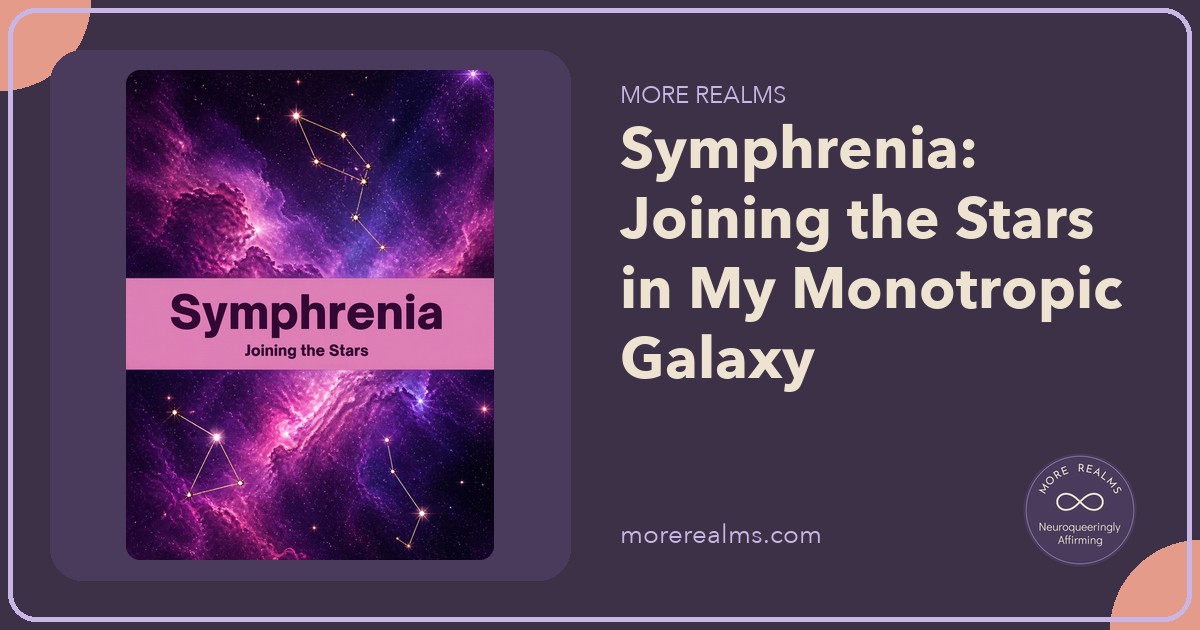
  • Symphrenia: Joining the Stars in My Monotropic Galaxy

    Symphrenia: Joining the Stars in My Monotropic Galaxy

    By Helen Edgar, with thoughts from David Gray-Hammond. Part of Neuroqueering Deleuze: Rhizomes of Becoming.

    Lines Between Stars

    When I created My Monotropic Galaxy (Edgar, 2026a), I drew thin gold lines between stars that have no relationship to one another except the one I connected. Some of those stars sit hundreds of light years apart. Joined on the page, they became the Stellar Current, the Gravity Well and the Tidal Stars, a map of an Autistic ADHD inner life that finally made sense to me. People have been drawing these lines for thousands of years. Every culture has looked up at the same scattered light and found its own hunters, animals, rivers and ploughs, and in that sense constellations may be our oldest act of pattern-making.

    Psychiatry has a word for the tendency to perceive meaningful connections between unrelated things: apophenia. The word was coined by the German psychiatrist Klaus Conrad in 1958 in his study of the onset of schizophrenia, describing an “unmotivated seeing of connections” accompanied by a feeling of abnormal meaningfulness (Conrad, 1958, as cited in Mishara, 2010). Pattern-seeing is something every human bodymind does, yet the word was created to mark the moment when someone’s meaning-making had supposedly crossed a line into something pathological. It is the same neuronormative gaze I have written about so many times, and I think it is important to ask who gets to decide which patterns count as insight and which get called symptoms of something that needs a cure or fixing.

    This post is part of Neuroqueering Deleuze: Rhizomes of Becoming (Edgar, 2026b), a slow, collaborative community project exploring the philosophy of Gilles Deleuze and Félix Guattari through neurodivergent lived experience. The project began with my own search for language during cycles of Autistic burnout, and it has become a way of understanding neurodivergence as movement, transformation and ongoing becoming. This piece is one more node in that rhizome. It follows a line of curiosity from apophenia to the stars, and towards a word I want to offer for the connected, porous quality of my bodymind: symphrenia.

    Whose Patterns Count

    My mind works rhizomatically, moving in every direction from a star to mutual aid to penguin pebbling (Deleuze & Guattari, 1987), and those connections often feel necessary from the inside long before I can explain them to anyone else. Monotropic attention tends to go deep into a single channel of interest instead of spreading widely across many (Murray et al., 2005), and in that depth, links surface that others may not see or understand. This may help explain why many AuDHD people are so often misunderstood, and why our conversations can appear to jump randomly from topic to topic. For me, it feels like a million connections are happening at once, with no time to explain them all, so I share my end point, the node where my thoughts gathered and came to rest. I am often met with confused looks and strange smiles, because the topic seems to have changed so abruptly, when for me every connection has been made and it makes total sense.

    When they are met with curiosity, the liminal spaces of my thoughts, the spaces in between conversations and sentences, can become places where journaling, writing, research and art emerge. When they are met with confusion or a clinical label, they become one more sign that my perception is somehow wrong. The double empathy problem reminds us that a gap in understanding belongs to both people in an interaction (Milton, 2012), yet the burden of being “unreadable” usually falls on the Autistic person. We are the ones asked to fill in the gaps and explain ourselves, when a conversation that seems to have jumped a million miles off topic is deeply connected at the root, in the rhizome of thought running under and around it.

    The Ecology of Distress

    I work closely with David Gray-Hammond and NeuroHub Connect, and David’s ecosystemic model has shaped my thinking significantly over the past year or so. David’s model holds that Autistic distress is ecosystemic. It does not arise solely from within the bodymind, but from the whole web of relationships, environments, systems and pressures a person lives within (Gray-Hammond, 2025). Through this lens, burnout and psychosis can be understood as relational and environmental responses to chronic neuronormative pressure, rather than as faults located inside an individual.

    In my galaxy, that pressure is the Dark Matter Field and the Friction Field, the accumulated weight of a neuronormative world. I keep thinking about how the same porous, pattern-seeking bodymind can experience two very different things depending on the sky around it. Among the Sanctuary Stars, with Companion Stars close by, noticing hidden connections feels like awe, which De Cruz (2024) describes as an epistemic opening, the moment our ways of knowing expand. Under the Dark Matter Field, with no rest, no safety and no one who understands, that same openness can tip into overwhelm, fear and a sense of meaning closing in. Diagnosis tends to examine a single star. An ecosystemic view asks us to look at the whole sky.

    Stephen Porges (2004) offers a word for how this happens in the body: neuroception, the nervous system’s subconscious scanning for safety or threat. Porges has described some of these responses as “faulty”, but an ecosystemic lens invites a different reading. When an Autistic nervous system neuroceives danger in a world built around neuronormative expectations, it may be reading that environment with painful accuracy. Polyvagal theory, from which neuroception emerged, remains debated within physiology (Grossman, 2023), but as a lens it helps me think about how meaning travels through the body. I have come to understand that movement as a kind of bridge. Interoception lets some neuroceived signals be felt within the body (Craig, 2002), and intuition carries those somatic cues into awareness, turning them into heart-led guidance and meaning. For many Autistic people, each part of this bridge works in its own way and at its own pace, and our intuitions have often been dismissed because they do not arrive in the expected form.

    Finding a Word: Symphrenia

    The roots I keep returning to are Greek. Syn means with or together, and becomes sym before a “ph” sound, as in symphony and sympathy. Phrēn is usually translated as mind, but in Homeric Greek it also meant the midriff or diaphragm, the breathing chest where thought and feeling were believed to live. That older meaning matters, because so much has been lost since. In 1641, René Descartes divided the self into a thinking mind and an extended body (Descartes, 1641/1996), and much of Western thought, medicine and psychiatry followed that line. Damasio (1994) later called this Descartes’ error, showing how bodily feeling is woven into reasoning itself, and the word bodymind, first offered by Ken Dychtwald (1977) and later taken up across disability studies, refuses the split altogether. Long before Descartes, and long before psychiatry narrowed it into a suffix for diagnoses, phrēn was already a bodymind word.

    So we want to offer symphrenia (sim-FREE-nee-uh): the felt sense of a bodymind that thinks and feels with the world rather than apart from it, a porous kinship with people, creatures, places and things, both living and non-living.

    That last part matters to me. Many Autistic people describe feeling for objects as well as beings, and research suggests Autistic adults report object personification more often than non-Autistic adults (White & Remington, 2019). Kimmerer (2013) writes of a grammar of animacy that treats the more-than-human world as kin. My Tidal Stars have always held this sense that my edges are less fixed than the world assumes, and that I am drawn towards water, stone and ancient things as if returning to something already within me. Whether that porousness unfolds as kinship or as overwhelm may depend on whether my body neuroceives safety.

    Becoming-With: Intra-Action and the Posthuman

    Deleuze and Guattari (1987) describe the self as an assemblage, a shifting composition of bodies, intensities, places and relations, always in the process of becoming. Their thinking draws on Spinoza, for whom a body is understood by its capacity to affect and be affected (Deleuze, 1988). Symphrenia feels like a way of naming what this is like from the inside: the felt sense of being composed with the world.

    The physicist and philosopher Karen Barad (2007) deepens this through agential realism. For Barad, things do not exist first and then enter into relationships; they emerge through intra-action, coming into being through their entanglements with one another. My bodymind, the river and the star are continually becoming through each other, which echoes the implicate order I explored in My Monotropic Galaxy (Edgar, 2026a). Haraway (2016) offers the word sympoiesis, “making-with” (p. 58), for the way no living being makes itself alone, and Tarragnat’s ethodiversity recognises diverse ways of perceiving and relating as part of the wider patterns of life beyond the human (Tarragnat, 2025). Read alongside these thinkers, symphrenia begins to feel like more than a private feeling. It may echo what they describe about how all of us, human and more-than-human, are already entangled.

    Speaking Back to a Divided Mind

    Eugen Bleuler (1911) named schizophrenia from the Greek for a split or divided mind. Symphrenia speaks back to that naming, though I do not want to frame it as a simple opposite. Some people who experience psychosis describe an intense, overwhelming connectedness, a world suddenly charged with meaning, which clinical writing has described as aberrant salience (Kapur, 2003). Deleuze and Guattari’s (1983) schizoanalysis reimagined schizophrenia as a process of flows and connections, though their use of the figure of “the schizo” has been critiqued for romanticising experiences that can involve real suffering. What I am reaching for is a shared porousness running through many neurodivergent and Mad experiences, one that can feel like wonder in a nourishing ecosystem and like distress in a hostile one. If that is true, our work lies in tending the ecology around a person instead of trying to correct the person within it. This word also cannot belong only to me. Anything that touches the experience of psychosis needs to be shaped alongside the people who live it, and I hope symphrenia can grow through those conversations.

    Existential Diversity and the Cosmic Glitch

    The concept of existential diversity David and I have been developing widens the frame again. We describe existence as something that extends beyond the bodymind, reaching across space and time (Edgar & Gray-Hammond, 2026). Who we are reaches past the edges of our skin, into our relationships, the places that hold us, and the stories carried by those who came before us and those who will come after. Symphrenia and existential diversity meet here for me. If my bodymind thinks and feels with the world, then my existence is also spread through that world. It returns me to star stuff, the knowledge that the atoms in our bodies were forged in stars long before our sun existed, and to love someone down to their star stuff is to love the whole of that existence (Boren & Stimpunks Foundation, 2026).

    Within that vastness, Autistic and Mad ways of being are so often treated as glitches, errors in the code of how a person is supposed to perceive, think and relate. Legacy Russell (2020), in Glitch Feminism, reclaims the glitch as a refusal of systems built to exclude, in a chapter titled “Glitch Is Cosmic”. I have come to think of us as cosmic glitches in that sense. A glitch interrupts the smooth running of a system, and in doing so reveals how that system was built and whose bodyminds it was built for. When my pattern-seeing is labelled apophenia, or my nervous system’s alarm is called faulty neuroception, the glitch is located in me. Seen ecosystemically, the glitch shows where the neuronormative code breaks down. Like a sudden aurora across a dark sky, it can be a moment of rupture and illumination at once, where something new becomes visible.

    A Twenty-First Constellation

    My galaxy map was always meant to keep changing. Perhaps symphrenia is a new constellation forming at its edge, a thin gold line joining me to the people, creatures, places and things I love. Some will look at those lines and see only scattered points of light, and that is alright. The connections were always there in the dark, waiting for someone to draw them. Perhaps every glitch is a star we have not yet learned to name.

    #NeuroqueeringDeleuze #RhizomesOfBecoming #NeuroqueerPhilosophy #Symphrenia

    References

    Barad, K. (2007). Meeting the universe halfway: Quantum physics and the entanglement of matter and meaning. Duke University Press.

    Bleuler, E. (1911). Dementia praecox oder Gruppe der Schizophrenien [Dementia praecox or the group of schizophrenias]. Deuticke.

    Boren, R., & Stimpunks Foundation. (2026). Love you down to your star stuff. https://stimpunks.org/star-stuff/

    Conrad, K. (1958). Die beginnende Schizophrenie: Versuch einer Gestaltanalyse des Wahns [The onset of schizophrenia: An attempt to form a Gestalt analysis of delusion]. Georg Thieme Verlag.

    Craig, A. D. (2002). How do you feel? Interoception: The sense of the physiological condition of the body. Nature Reviews Neuroscience, 3(8), 655–666. https://doi.org/10.1038/nrn894

    Damasio, A. R. (1994). Descartes’ error: Emotion, reason, and the human brain. Putnam.

    De Cruz, H. (2024). Wonderstruck: How wonder and awe shape the way we think. Princeton University Press.

    Deleuze, G. (1988). Spinoza: Practical philosophy (R. Hurley, Trans.). City Lights Books.

    Deleuze, G., & Guattari, F. (1983). Anti-Oedipus: Capitalism and schizophrenia (R. Hurley, M. Seem, & H. R. Lane, Trans.). University of Minnesota Press.

    Deleuze, G., & Guattari, F. (1987). A thousand plateaus: Capitalism and schizophrenia (B. Massumi, Trans.). University of Minnesota Press.

    Descartes, R. (1996). Meditations on first philosophy (J. Cottingham, Trans.). Cambridge University Press. (Original work published 1641)

    Dychtwald, K. (1977). Bodymind. Pantheon Books.

    Edgar, H. (2026a, June 16). My monotropic galaxy: A constellation of my Autistic self. More Realms. https://morerealms.com/my-monotropic-galaxy-a-constellation-of-my-autistic-self/

    Edgar, H. (2026b, March 21). Neuroqueering Deleuze: Rhizomes of becoming. More Realms. https://morerealms.com/neuroqueering-deleuze-rhizomes-of-becoming/

    Edgar, H., & Gray-Hammond, D. (2026, October 25). Existential diversity, the symphrenic bodymind and wider existence. The Wider Existence. https://www.thewiderexistence.co.uk/p/existential-diversity-the-symphrenic

    Gray-Hammond, D. (2025, December 21). The ecosystemic model of distress explained. NeuroHub Connect. https://neurohubcommunity.org/2025/12/21/mental-health-ecosystemic-model

    Grossman, P. (2023). Fundamental challenges and likely refutations of the five basic premises of the polyvagal theory. Biological Psychology, 180, Article 108589. https://doi.org/10.1016/j.biopsycho.2023.108589

    Haraway, D. J. (2016). Staying with the trouble: Making kin in the Chthulucene. Duke University Press.

    Kapur, S. (2003). Psychosis as a state of aberrant salience: A framework linking biology, phenomenology, and pharmacology in schizophrenia. American Journal of Psychiatry, 160(1), 13–23. https://doi.org/10.1176/appi.ajp.160.1.13

    Kimmerer, R. W. (2013). Braiding sweetgrass: Indigenous wisdom, scientific knowledge and the teachings of plants. Milkweed Editions.

    Milton, D. E. M. (2012). On the ontological status of autism: The “double empathy problem”. Disability & Society, 27(6), 883–887. https://doi.org/10.1080/09687599.2012.710008

    Mishara, A. L. (2010). Klaus Conrad (1905–1961): Delusional mood, psychosis, and beginning schizophrenia. Schizophrenia Bulletin, 36(1), 9–13. https://doi.org/10.1093/schbul/sbp144

    Murray, D., Lesser, M., & Lawson, W. (2005). Attention, monotropism and the diagnostic criteria for autism. Autism, 9(2), 139–156. https://doi.org/10.1177/1362361305051398

    Porges, S. W. (2004). Neuroception: A subconscious system for detecting threats and safety. Zero to Three, 24(5), 19–24.

    Russell, L. (2020). Glitch feminism: A manifesto. Verso.

    Tarragnat, O. (2025, February 25). What is ethodiversity? https://ombretarragnat.com/2025/02/25/what-is-ethodiversity/

    White, R. C., & Remington, A. (2019). Object personification in autism: This paper will be very sad if you don’t read it. Autism, 23(4), 1042–1045. https://doi.org/10.1177/1362361318793408

  • Neuroqueering Deleuze: Rhizomes of Becoming

    Neuroqueering Deleuze: Rhizomes of Becoming

    A Community Project

    Project Started: March 2026

    Beginning with Curiosity

    This journey begins with curiosity, and with transformation.

    Over the past few years, the philosophy of Gilles Deleuze and Félix Guattari has become profoundly important to me. I am not a Deleuzian scholar and have no formal academic background in philosophy at all – the aim of this project is very much focused on community learning and expanding conversations.

    Through cycles of debilitating Autistic burnout, I found myself searching for language that could help me make sense of experiences that felt difficult to articulate — deep attentional flow, sensory intensity, nonlinear thinking, moments of rupture, the slow processes of recovery and new ways of becoming.

    Burnout, Deterritorialisation, and New Patterns of Becoming

    Concepts such as the rhizome, multiplicity, body without organs, planes of immanence, assemblage, and deterritorialisation, explored in works including A Thousand Plateaus, Anti-Oedipus, and later reflections such as What Is Philosophy? began to resonate with my lived experience as an Autistic and ADHD (AuDHD) person. My monotropic attention often feels like it moves through constellation-like interconnected tunnels of intensity rather than along a single stable path. My cycles of burnout feel like a sudden loss of territory, a destabilisation of the structures that once enabled my participation in the world. In this sense, burnout sometimes resembled a form of deterritorialisation: a disorientation that disrupted familiar rhythms while opening uncertain possibilities for forming new connections. Recovery does not mean returning to a fixed state, but gradually composing different patterns of relation, energy, and belonging.

    Encountering Deleuze and Guattari’s work offered me ways of understanding these experiences not as personal failure, but as part of dynamic relational processes within the wider ecosystems I am part of. Their philosophy is helping me think differently about identity, learning, exhaustion, creativity, and the environments we inhabit. It is opening up a space to understand neurodivergent experience as movement, transformation, and ongoing becoming rather than as a deficit or fragmentation of a whole.

    Rhizomatic Thinking and Nonlinear Understanding

    At times, reading their work has felt disorienting, yet also strangely and comfortingly familiar. The nonlinear textures of their writing, moving through plateaus, building connections, going through the tides of intensities, and shifting conceptual landscapes, echo ways of thinking that many neurodivergent people may also recognise.


    Ideas do not always unfold in a straight line; instead, they branch, loop, and return, forming clusters of attention and moments of unexpected resonance. In this sense, philosophical engagement can feel rhizomatic: thoughts emerging in multiple directions, forming nodes of meaning that connect across time, experience, and environment.

    Rather than progressing step by step toward a single conclusion, understanding develops through community movement — through following lines of curiosity, pausing at plateaus of insight, and allowing connections to form gradually. Philosophy, for me, is therefore not only something to be interpreted, it is also something to be experimented with, inhabited, and lived through with repeated encounters with ideas, places, bodies, and other people. In this way, thinking becomes relational and ecological, shaped by the networks we are part of and the intensities that draw our attention.

    Neuroqueering Philosophy

    This project can therefore be understood as an act of neuroqueering philosophy and our ways of being in the world.

    Drawing inspiration from the work of neuroqueer theorist Nick Walker, neuroqueering involves approaching established concepts, systems and ways of being in ways that challenge normative assumptions about knowledge, cognition, identity, and relational life. In this sense, neuroqueering is not only about representation, it is also a practice of becoming, an active reworking of how we think, connect, and how we can re-create meaning together against neuronormativity and conformity.

    A Rhizomatic Community Project

    This community project — Neuroqueering Deleuze: Rhizomes of Becoming — grows from this ongoing process of engagement and constant iteration, finding and creating difference through repetition.

    It is envisioned as a slow, collaborative exploration of philosophical ideas based primarily on Deleuze and Guattari, through neurodivergent lived experience, creative reflection, and relational dialogue. Philosophy does not only take place within academic institutions, it also unfolds in everyday life, through deep interests, sensory experiences, professional work, parenting journeys, community relationships, ecological awareness, and the rhythms of burnout and renewal that so often shape neurodivergent lives.

    The project itself is intentionally rhizomatic. Anchor posts from different people may introduce themes or conceptual entry points, but participants are invited to respond in ways that feel meaningful to them — dipping in and out as attention, energy, and curiosity shift. Engagement does not need to be linear or continuous; it may follow rhythms of monotropic flow, periods of rest, or moments of pause and return – there is no expectation in how you take part if this interests you. I am really just hoping to develop my own deeper understanding and connect with others who are also interested in exploring this.

    Contributions may take many forms: reflective essays, creative writing, visual work, dialogue, field notes, or theoretical experimentation. At times, there may be intense activity and connection; at other times, the project may enter quieter phases of reflection or renewal. These pauses ill not be seen as interruptions but part of the process itself, moments in which new insights gather, relationships deepen, and different possibilities for thought begin to emerge.

    Over time, the project may come to resemble an evolving assemblage, a multiplicity of voices, perspectives, and lines of thought intersecting, diverging, and forming new connections. Rather than building toward a single conclusion (as I have no idea where this will lead!), the process itself becomes generative: a collective practice of rhizomatic thinking, sensing and becoming together.

    Practices such as linking to one another’s work, acknowledging influences, tagging shared themes, and responding across social media platforms are therefore not only practical but philosophical. Through shared hashtags — such as #NeuroqueeringDeleuze, #RhizomesOfBecoming, #NeuroqueerPhilosophy, and other evolving conceptual markers people can help form a visible network of ideas: a living rhizome of thought that evolves.

    These small acts of citation, iteration, responding, and relational engagement enable ideas to travel, intersect, and transform across different spaces and communities. In this way, the project becomes more than a collection of individual reflections. It becomes an ongoing process of collective becoming, shaped through collaboration, dialogue, and the emergence of new nodes of thinking together.

    Philosophical Lineages and Expanding Connections

    While this project begins with the collaborative philosophy of Deleuze and Guattari, which I am personally very interested in learning more about, it also recognises that their work emerges from a wider philosophical lineage. Thinkers such as Baruch Spinoza, Henri Bergson, Friedrich Nietzsche, and Gottfried Wilhelm Leibniz shaped Deleuze’s explorations of affect, duration, multiplicity, and relational existence. As the project develops, we may move across a wide variety of philosophical and sociological spaces, tracing connections between historical ideas, contemporary neurodivergent theories, and emerging forms of post-human thought and More-Than Neurodiversity.

    This work is shaped not only by academic theory but also by us as members of the neurodivergent community. Through our lived experience, and by shared practices of reflection and care, it can grow through our neuroqueer writing, creative work, and grassroots spaces such as Stimpunks.

    I would like to draw attention to those who are currently influential in my own work, including Nick Walker, Robert Chapman, Julia Lee Barclay-Morton, David Grey-Hammond, Ryan Boren, and more recently Liam Ren.

    Post-humanist and new materialist perspectives also inform the project’s emphasis on relational ontology, movement, and ecological entanglement. The work of Karen Barad, Erin Manning, Brian Massumi, Donna Haraway, and Rosi Braidotti may offer ways of understanding knowledge as something that is produced through relationships, between bodies, environments, and material conditions rather than as abstract theory alone. I have found Ombre Tarragnat’s concept of ethodiversity truly inspiring as it further expands this view, reminding us that diverse ways of perceiving, behaving, and relating are part of broader patterns of life beyond the human.

    Together, I hope these influences and others will help shape a project that understands philosophy through a neuroqueer lens as an unfolding project across communities, experiences, and environments, through collective processes of thinking, sensing, creating, and becoming.

    An Ongoing Process of Becoming

    This is a long-term journey. Ideas may return, shift, and deepen over months or years, I have no final destination. Only plateaus, places to pause, notice connections, and continue thinking and creating together.

    If these ideas resonate with you, I would like to invite you to take part. By sharing reflections, linking to one another’s work, and forming new connections, we can collectively expand this rhizome of thought, adding new nodes, pathways, and neuroqueer possibilities for becoming together.

    Let the rhizome keep expanding!

    References and Further Exploration

    This project grows through dialogue with a wide range of thinkers, writers, and community spaces. The following resources offer starting points for exploring neuroqueer theory, neurodiversity scholarship, post-human philosophy, and related conceptual work that may inspire you.

    Please do reach out to add to this evolving list!

    Neuroqueer and Neurodiversity Thought

    Ryan Boren — Neurodiversity advocacy, inclusive pedagogy, and neuroqueer learning environments.
    Stimpunks
    https://stimpunks.org/

    Robert Chapman — Critical neurodiversity studies, philosophy, and social justice perspectives on mental difference.
    https://criticalneurodiversity.com

    Helen Edgar — Autistic Realms
    Neurodivergent lived experience, monotropism theory, autistic burnout, relational wellbeing, and practical neuro-affirming resources for families, educators, and professionals.
    https://autisticrealms.com

    Helen Edgar — More Realms
    Creative neuroqueer writing, philosophical exploration, and posthuman ecological thought, with experimental reflections on identity, temporality, and relational becoming.
    https://morerealms.com

    David Gray-Hammond — Neurodivergent community building, neuroqueering practice, and collaborative learning spaces.
    NeuroHub Connect
    https://neurohubcommunity.org/

    Julia Lee Barclay-Morton — Creative neurodivergent writing, Autistic identity, embodied healing practices, and reflections on burnout, difference, and artistic process. Their platform The Unadapted Ones explores neurodiversity through memoir, theatre, and relational approaches to wellbeing and creativity.
    https://www.theunadaptedones.com/

    Liam Ren — Collective, political, and materialist dimensions of neuroqueer thought and neurodivergent futures.
    https://liamrenouf.substack.com/p/from-neuroqueer-rhetoric-to-neurocommunism

    Nick Walker — Neuroqueer theory, Autistic self-advocacy, and transformative approaches to neurodiversity.
    https://neuroqueer.com/

    Melanie Yergeau — Neuroqueer rhetoric, authorship, and autistic embodiment.
    Authoring Autism: On Rhetoric and Neurological Queerness
    https://www.dukeupress.edu/authoring-autism

    Posthuman and New Materialist Perspectives

    Karen Barad — Agential realism, intra-action, and relational ontology in feminist science and philosophy.
    https://karinbarad.com/

    Rosi Braidotti — Posthumanism, nomadic theory, and ethical approaches to becoming in contemporary philosophy.
    https://rosibraidotti.com/

    Donna Haraway — Feminist technoscience, situated knowledge, multispecies relations, and posthuman storytelling.

    Further exploration:
    https://pact.egs.edu/biography/donna-haraway/
    https://cyberfeminismindex.com/project/donna-haraway/

    Erin Manning — Movement, relationality, and process philosophy, with a focus on creative and embodied practices.
    http://erinmovement.com/

    Brian Massumi – Philosopher of affect, movement, and relational process, whose work develops and extends Deleuzian thought and the emergent, more-than-conscious dimensions of perception and social life.
    https://brianmassumi.substack.com/about

    Ombre Tarragnat — Ethodiversity, ecological neurodiversity thought, and more-than-human approaches to difference.
    https://www.ombretarragnat.com/

    Some philosophical Currents Shaping Deleuzian Becoming……..

    Gilles Deleuze and Félix Guattari — Collaborative philosophy exploring multiplicity, becoming, assemblage, and rhizomatic thought.
    Key texts include Anti-Oedipus, A Thousand Plateaus, and What Is Philosophy?

    Henri Bergson — Duration, movement, and intuition.
    Bergson’s concept of durée (lived time) and his emphasis on creativity and process strongly influenced Deleuze’s explorations of temporality, change, and nonlinear experience.

    Gottfried Wilhelm Leibniz — Multiplicity, perspective, and the fold.
    Leibniz’s philosophy of relational perception and his metaphysics of monads informed Deleuze’s later work on subjectivity, complexity, and The Fold: Leibniz and the Baroque.

    Friedrich Nietzsche — Becoming, difference, and creative transformation.
    Nietzsche’s critique of fixed identity and his emphasis on the creation of values shaped Deleuze’s philosophy of affirmation, transformation, and difference.

    Baruch Spinoza — Immanence, affect, and relational ethics.
    Spinoza’s understanding of bodies as defined by their capacities to affect and be affected profoundly influenced Deleuze’s thinking about immanence, becoming, and ethical ways of living.


    This project is not a fixed map but an evolving terrain. You are warmly invited to explore blogs and other creative work, follow lines of curiosity, and contribute your own reflections. Through shared experimentation, dialogue, and connection, the rhizome will continue to grow — forming new nodes of thought and new possibilities for becoming together.

    Discover more

    Courses, books and resources

    If you would like to take these ideas further, my courses, books and resources live on Autistic Realms. Everything in the shop is pay what you can, and many resources are free.