A gamified, self-paced course from NeuroHub Community, co-authored and created by Helen Edgar and David Gray-Hammond, and adapted from David’s book Supporting Autistic People: A Six-Point Framework
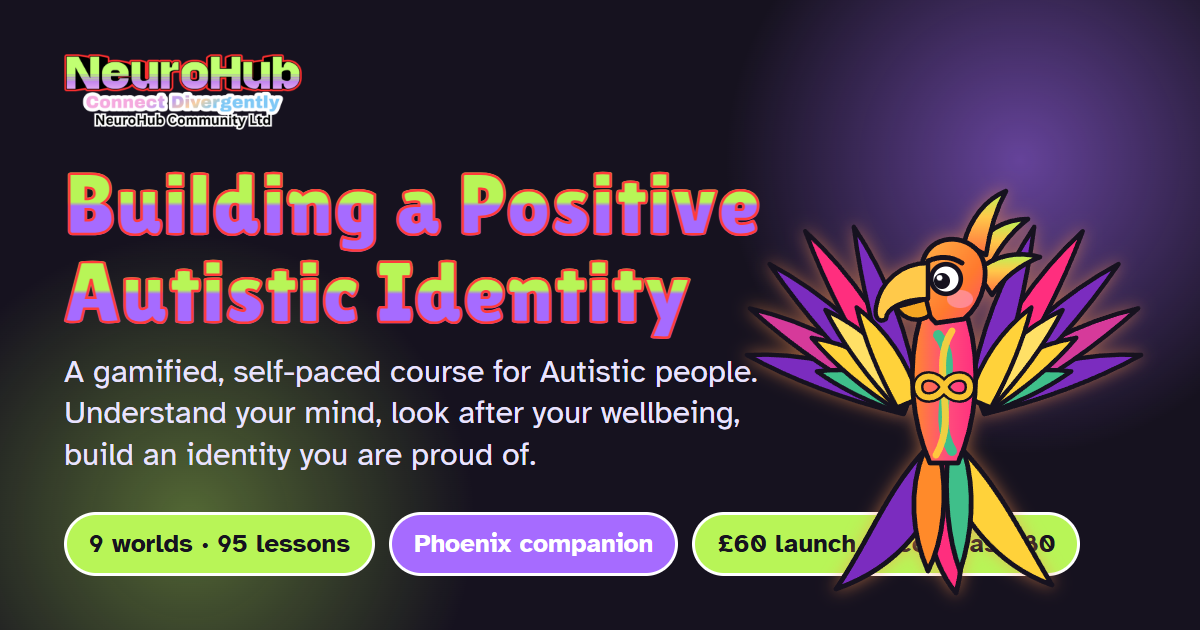
Written for Autistic people
Building a Positive Autistic Identity is written for Autistic people themselves, whether diagnosed, self-identified or still working out whether autism fits. So much of what is written about autism is written about us and handed to somebody else, and this course turns that round.
It holds no compliance techniques, no “fixing” and no advice to mask more. It begins from what our environments, relationships and the systems around us should change, and it treats each person as the authority on their own life.
Nine worlds to explore
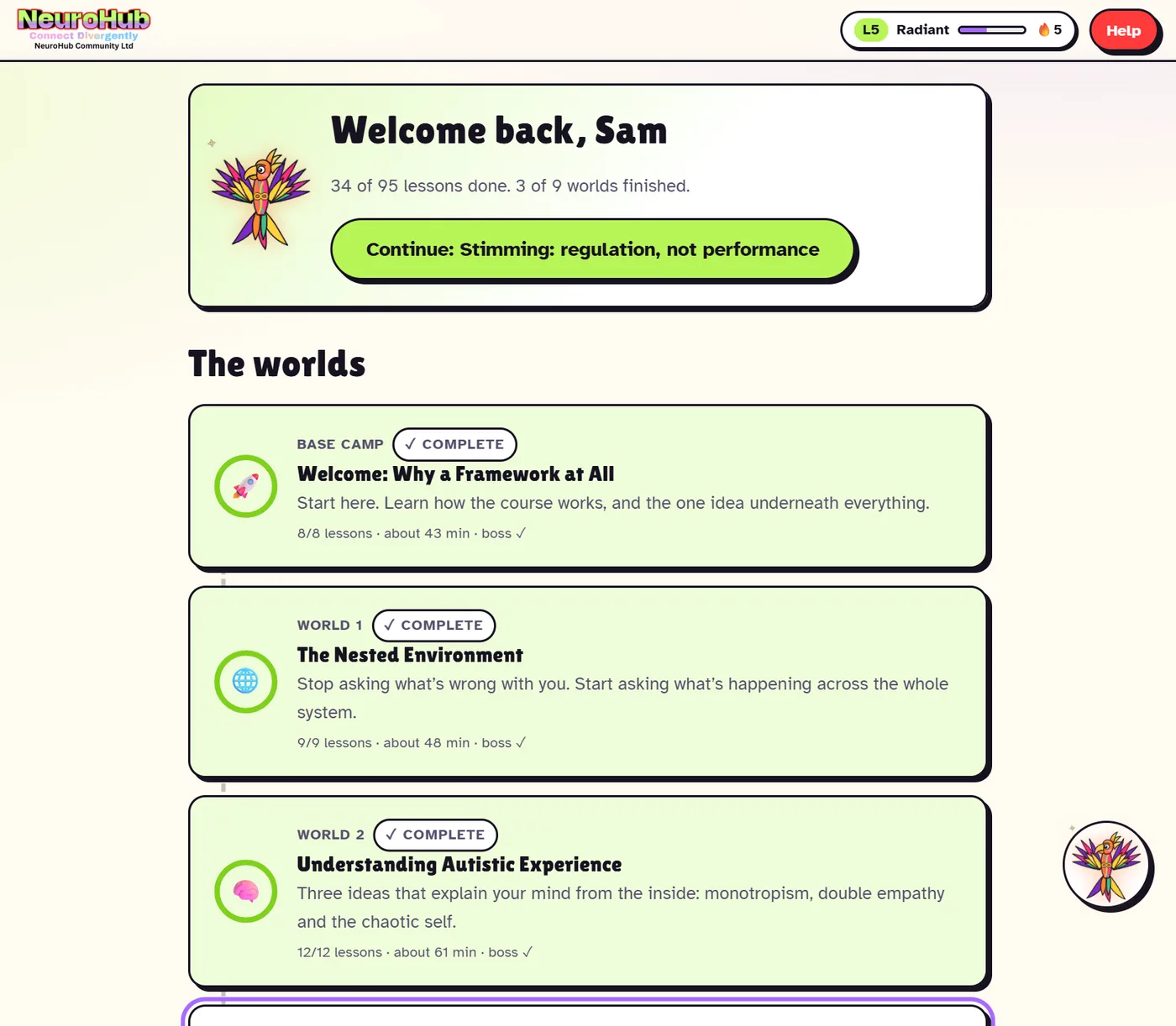
The course is organised as nine worlds and 95 short lessons, about eight and a half hours in all, which can be taken in order or dipped into. It travels through the nested environment, monotropism (Murray et al., 2005), the double empathy problem (Milton, 2012) and the chaotic self, the eight senses, Autistic burnout (Raymaker et al., 2020), identity and language, trauma and safety, and learning from Autistic community, before closing with your own identity statement and plan.
Seeing your own growth
Scenarios, sorting games and playable models of the big ideas sit alongside short wellbeing and identity check-ins. These are charted over time and gathered into a private Growth Journal PDF at the end, so you can see not only what you learned but how you changed.
Comfort first
Comfort was designed in from the very beginning. There are no timers or fail screens, retries are free, and the sensory settings cover reduced motion, a calm theme, dark mode and text size. You can hide the game layer entirely if you would rather simply learn.
Phoenix, an optional AI companion, knows which lesson you are on and can offer hints, explanations and links to NeuroHub articles, and a free lesson is there to try first.
A sister course
David and I also created Re-Storying Autism, an Autistic-led video course and workbook for parents, carers and Autistic people. You can find both courses together on NeuroHub Horizons.
References
Milton, D. E. M. (2012). On the ontological status of autism: The ‘double empathy problem’. Disability & Society, 27(6), 883–887. https://doi.org/10.1080/09687599.2012.710008
Murray, D., Lesser, M., & Lawson, W. (2005). Attention, monotropism and the diagnostic criteria for autism. Autism, 9(2), 139–156. https://doi.org/10.1177/1362361305051398
Raymaker, D. M., Teo, A. R., Steckler, N. A., Lentz, B., Scharer, M., Delos Santos, A., Kapp, S. K., Hunter, M., Joyce, A., & Nicolaidis, C. (2020). “Having all of your internal resources exhausted beyond measure and being left with no clean-up crew”: Defining autistic burnout. Autism in Adulthood, 2(2), 132–143. https://doi.org/10.1089/aut.2019.0079