Tag: stimpunks

  • Ethodivergent Hearth Building: A Relational Neuroqueering Community Practice

    Ethodivergent Hearth Building: A Relational Neuroqueering Community Practice

    What would it mean to build a hearth that welcomes not only diverse minds, but diverse ways of sensing, relating, and becoming across human and more-than-human lives?


    This blog emerged from a conversation with Stimpunks during our Neuroqueer Learning Spaces project planning, where we explored what it truly means to create spaces that sustain neurodivergent people, rather than simply include. We found ourselves returning to the image of the hearth, the Cavendish Campfire, a warm, relational centre where ethodivergence is held, honoured, and co-regulated. This piece reflects on ethodivergent hearth building as a neuroqueer practice of community care and more-than-human kinship.

    Ethodivergence speaks to the richness of relational, sensory, and affective difference. It’s about how we move, connect, feel, and attend, how our rhythms and responses don’t always align with dominant norms. Drawing from Ombre Tarragnat’s (2025) concept of ethodiversity, this expands neurodiversity beyond the human brain into relational ecology, honouring the full range of our inter-being ways with the world across all species of living and non-living things.

    More-than-human refers to the interconnected ecology of life that includes not just humans but also animals, plants, weather systems, seasons, fungi, rivers, stones, moon cycles, and sensory environments. It’s a way of recognising that our ways of being, knowing, and healing are shaped by more than just other humans and that these entanglements are vital, not peripheral.

    The hearth is a warm centre, a gathering space, a site of return and regeneration. It holds history, presence, and possibility, it’s where people tend the fire together, share stories, and learn from one another, a rhythm of shared becoming. To build ethodivergent hearths is to make room for new forms of kinship, ones that honour slow attunement, deep presence, and non-normative ways of sensing, being, and knowing. It’s an invitation to live otherwise, interdependently, in communities shaped not by conformity but by relational integrity and care.

    Beyond its physical form, the hearth also holds sensory and emotional resonance, it is a centre, part of the basecamp, that may not be an actual campfire fire or a room, but a feeling. Sometimes it lives in the softness of our favourite weighted blanket, the texture of moss under our fingertips, the familiar paths we may return to in the woods or our local park, the stillness shared with our chosen family and pets. In ethodivergent hearth building, these sensory and relational centres become vital anchors, places to return to without performance, where our difference is held with warmth rather than shame or stigma.

    Cavendish Spaces and ethodivergent hearths are built slowly, relationally, through co-regulation, sensory consideration, and access intimacy. There is room for fallow rest time, stim time, quiet time, time that bends to our bodyminds rather than our bodyminds being twisted into neuronormative time constraints that lead us into burnout and mental ill health. These are spaces that reject extraction and standardisation and instead, they welcome divergence and difference through shared rhythms, bodily autonomy, and relational consent, psychological and sensory safety. Cavendish spaces are like ethodivergent hearths for the soul where people gather not to fix or scrutinise, but to sit alongside, validate, and co-exist.

    To think about and create ethodivergent hearths is to imagine what it means to design for difference, to centre care and safety for those of us often left out in the cold, on the edges and in the liminal spaces. It’s about making space for monotropic attention, sensory flow, and nonlinear emotional rhythms. It’s about pacing together through co-regulation, glimmers, multi-modal ways of communicating and attuned silence. It’s about giving permission for slow grief, spiralling joy, or messy recovery.

    Ethodivergent hearth building means:

    • Not centring only human and normative ways of relating and knowing.
    • Honouring sensory, affective, and relational exchanges between people and natural or material environments.
    • Acknowledging that Autistic, disabled, and neurodivergent people often form deep attunements with non-human kin, sometimes more sustaining than traditional social models.

    It might look like mutual aid networks, or shared rest practices, it might mean building more flexible time-structures that go beyond our clocks. This kind of hearth holds our queertime, our difference, our interdependence, without trying to fix, mask, explain, or justify. It’s a way of living gently with difference, and tending the fire that can help sustain us.

    Ethodivergent hearth building invites a shift from thinking of community as exclusively human, towards something more ecological, embodied, and expansive, a shared hearth where difference is relational, and care ripples outward beyond species boundaries. Ethodivergent hearth building is a neuroqueer practice of relational community rooted in presence, divergence, and shared becoming where everyone can thrive.

  • Awe, Wonder and Different Ways of Knowing: Cavendish Space and Helen De Cruz

    Awe, Wonder and Different Ways of Knowing: Cavendish Space and Helen De Cruz

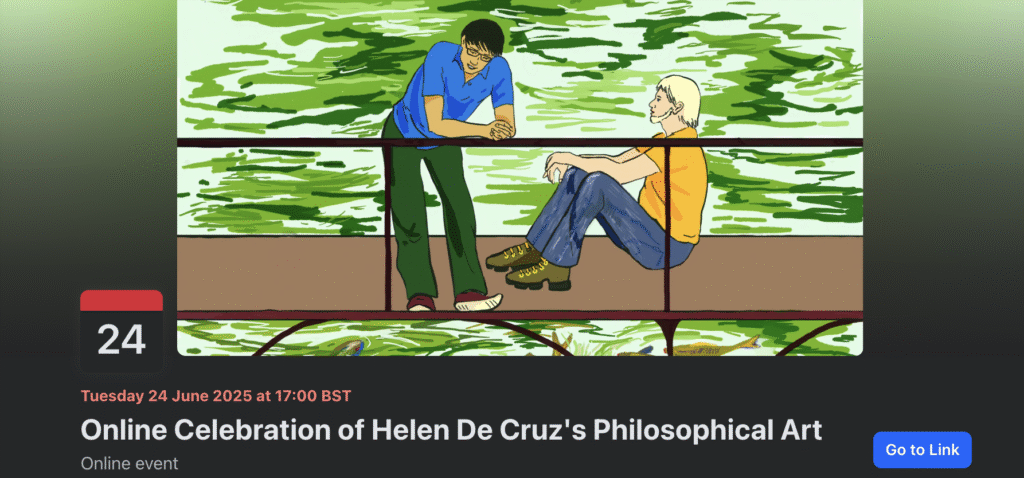
    In the online memorial event (24th June 2025) to celebrate the philosopher and writer Helen De Cruz’s life, Georgi Gardiner who hosted the session asked the question:


    If Helen designed a campus/university, what would it look like?”


    I didn’t know Helen personally but have been deeply inspired by her writing and art. I wanted to write something to honour her work and share some ideas about how her philosophy has enriched our ideas for learning spaces.

    (It is a coincidence the Learning Space Project I developed with Stimpunks is called Cavendish – this is unrelated to Helen’s set of beautiful illustrations for The Blazing-World, by Margaret Cavendish, Duchess of Newcastle. Stimpunks’ Cavendish Space is named after Henry Cavendish, a scientist from the 1700’s).

    Awe, Wonder and
    Different Ways of Knowing:
    Cavendish Space and
    Helen De Cruz

    There’s something powerful about creating space for people to think and learn in their own unique ways. Whether it’s the sensory-friendly Cavendish Space that is the foundation stone of Neuroqueer Learning Spaces that I have developed with Stimpunks or the thoughtful, creative work of philosopher Helen De  Cruz that may be shared around our campfires; both invite us to imagine how learning and knowledge can work for everyone.

    Helen De  Cruz is a philosopher (1978-2025) who writes about imagination, wonder, and how we come to believe and understand things. Her book Wonderstruck: How Wonder and Awe Shape the Way We Think, was my most inspiring read of last year.

    I took part in a brilliant reading group hosted by The Philosopher 1923, where we explored Helen De Cruz’s work in depth. In the final week, we were lucky to be joined by Helen herself, and I remember discussing neuroqueer theory and the projects I was developing with Stimpunks, particularly the ways her ideas resonated with and helped shape our thinking. These conversations had a lasting impact , deeply influencing our Neuroqueer Learning Spaces project, helping to evolve the vision behind Cavendish Space, and continuing to inform much of my current writing and emerging ideas.

    Stimpunks’ Cavendish Space is named after Henry Cavendish, a scientist from the 1700’s who lived a very unique life. He was quiet, sensitive to sound, and followed his own routines, but he also made important scientific discoveries. For us he’s a symbol of what’s possible when people are allowed to think and learn in ways that work for them, when Autistic people are free to follow their monotropic passions and flow. Cavendish is proof that deep focus, quiet curiosity, and different minds can lead to wonderful things and ways of connecting with our true selves and others. Cavendish Space is all about creating places where people can follow their interests, feel safe, and get absorbed in what they love with people they trust, where there is also time to regulate, re-set and re-energise by ourselves.

    Cavendish Space is a welcoming, flexible environment designed for everyone but especially beneficial for neurodivergent people to explore their interests. It honours sensory needs and bodily autonomy, creating a foundation where individuals can learn, reflect, and connect in ways that feel natural and safe. This approach aligns closely with Helen De Cruz’s work, which like Cavendish Space is grounded in the values of curiosity, care, and deep respect for expansive and divergent ways of thinking and being.

    In her book Wonderstruck, De Cruz explores how moments of awe and wonder can open up our minds, inviting us to ask questions, be curious and see the world differently. For her, wonder isn’t just an emotion it is magic. Magic is wonder and power, it’s a vital way of thinking, of paying attention, and of forming meaningful connections with ideas, people, and the world around us.

    Honouring Helen De Cruz’s work within Cavendish Space is about more than referencing her work, it’s about embodying the values she brings to philosophy and the wider world. She offers a deep respect for wonder, a commitment to epistemic humility, and a belief in the richness of diverse minds. Her philosophy invites us to reimagine thinking as something playful, relational, and open to all, not limited by conventional rules or hierarchies.

    By weaving her influence into the fabric of Cavendish Space, we affirm that curiosity, care, and difference are not only welcome, they are essential to how we learn, grow, and imagine new futures together and can inspire awe and wonder.


    In memory of Helen De Cruz (1978–2025)

    https://www.gofundme.com/f/support-helens-children-after-her-passing


  • Exploring ‘Being With’

    Exploring ‘Being With’

    I experience and interpret ‘Being With’ as a process of be-coming together. Deleuze’s concept of the line of flight allows us to explore and follow meaning together. This article will explore these ideas in a bit more detail.

    This post is a pulling together of several discussions I have had online over the past few weeks that were initially inspired by Joanna Grace and her team of researchers (all of whom have profound and multiple learning disabilities). Joanna Grace has been sharing the progress of their PhD project across social media, exploring the idea of ‘Being with and Identity’.

    Some discussions here about slow pedagogy and conversations around Deleuze’s line of flight and created serendipity have also recently been reflected on Stimpunk’s website.

    The 3-minute YouTube video of ‘Being With’ was part of The Research Methods e Festival (an online event organised by NCRM) looking at identity and ‘Being With’. There are two videos I’d like to share that I feel capture the wonderful potential and essence of what I believe should be at the heart of care and educational experiences for everyone celebrating the potential of:

    *togetherness

    *sense of embodied belonging

    *shared experiences

    * safe spaces

    Video 1

    Video 2

    Bridging a Gap

    Up until now, people with profound and multiple learning disabilities have been the “missing voices of inclusive research” (Walmsely, J). They have been the people others have researched on or for but not with (Nind, M. (2017), Practical Wisdom of Inclusive Research)This new research is helping to bridge that gap, not just by finding the voices of those with profound and multiple intellectual and learning disabilities but by providing space for them to share their way of being collaboratively. By being with people, we can create a space of shared experiences; there is potential and possibilities for a more enriching time together. This may be felt as an experience, a shared engagement rather than an event that can be easily captured in words or put into a lesson plan in school. It involves trust, not only between the people involved but within a school setting it also involves trust within the education system that those facilitating learning know the people they are working with.

    Creating a Space of Being

    Joanna Grace’s research team includes a girl called Felicity. In the video below, Joanna Grace talks about ‘creating a space of being with Felicity so that space can become a research encounter. This is an intended becoming of togetherness and enables a creative shared meaning that can only be experienced in a space of safety which is built up over time.

    Giving time and ‘being with’ enables a deep connection to grow. I am familiar with intensive interaction and think it’s a truly wonderful approach. However, at the same time, having something called an approach can be a way of ‘othering’ those we are trying to include. This new research builds on intensive interaction in many ways, but I also resonate with this perspective shift and the simple potential of ‘being with’. These videos are only a glimpse of the wonderfulness that can happen when people are with each other in an embodied way, tuned in, sharing a flow state and rhythm together. To truly understand it, you have to ‘be with’.

    The concept of ‘being with’ is linked to finding the rhythm of the children but also attention to the ‘rhythm’ of colleagues, materials and ideas.” (Clark, A. (2023), Slow Knowledge and the Unhurried Child).

    Felicity-ness

    By creating space and time to be together, Joanna describes how it “enabled the Felicity-ness” of her “dancing fingers” so they could “dance together!”. I love the phrase ‘Felicty-ness’ as it sums up what can only be experienced in person with a unique individual. It is a feeling created between two people that may occur through dancing fingers, a vocalisation, an eye movement, or a different body movement. It is a moment that only happens in response to each other’s presence, a togetherness. The Felicity-ness of Felicity was able to shine through the space in what could have been missed in a busy classroom or by being preoccupied with everything else going on in life.

    A person’s ability to communicate is not dependent on their being able to master certain skills; it is dependent on our ability to listen and communicate responsively” (Grace, J. (2017), The Sensory ProjectsSupporting People with PMLD Core & Essential Service Standards).

    Learning and Being Together

    Working with children with profound and multiple learning and intellectual disabilities felt like my happy place to be. We shared and created sensory experiences together. Within the structures of a school setting, I aimed to ensure the children led our time together as much as possible and I tried to work as a facilitator to help enrich and develop those experiences in some way as a ‘teacher’ along with the class team. Sometimes things worked well, and other times less well. It was always a learning curve for me, too.

    Tuning in and Togetherness

    My Autistic Realms work is advocating to ensure learning environments are as neurodiversity-affirming as possible. I am not just talking about being inclusive practically or functionally and providing access to educational resources and differentiated meaningful learning opportunities; this should be a given. We need to be inclusive in our bodies and minds to be with each other. Being a teacher in the often stressful environment of a UK school system where everyone has targets to meet, and teachers are accountable for ‘progress’, I feel we are sometimes missing the essence of what ‘being with’ people is about in our role as teachers. If we focus more on ‘being with’ people, that narrative shifts slightly; there is less hierarchy and more equal opportunity to learn together.

    To ‘be with’, you need to slow down and have time to tune in to a togetherness. It is very much in line with some of the core concepts of what has been described as ‘Slow Pedagogy’, an understanding of the need to value the present moment, the sensory needs and the pace and flow of the person you are with.

    Line of Flight

    Deleuze and Guattari (1980) explore the concept of the ‘line of flight’ in their work One Thousand Plateaus. Their work is helping me understand the neurodiversity paradigm and very fixed ideas we often have of people’s identities, systems in society and ways of being. Deleuze opposes the ideas of fixed identities, ‘normality’ and offers a way of embracing the differences and ways of being for everyone. I am still reading through much of their work, (definitely no expert on this) but I feel there is a strong connection between Deleuze and the neurodiversity movement and the process of ‘becoming’.

    If we make spaces to be with people, we can follow a line of flight and have an embodied connection of ‘dancing fingers’ together. This could lead to a whole new, wonderful sense of belonging and a more meaningful connection and communication between people that can grow and ‘become’.

    Collective Flow

    Being together allows people to join in a collective flow state, a line of flight, which can lead to new possibilities for individuals but also impact rhizomatically within a classroom and lead to more learning opportunities. However, I would argue that actually ‘being with’ is not necessarily about learning ‘more’ in the traditional sense of the next steps of a curriculum and mastering skills. Instead, transcending those preconceived ideas of what being a teacher means, what being a student is, and what being a person with profound and multiple learning disabilities may mean is a way of also reframing of identities. For me, ‘being with’ is about going deeper into the folds between people, embracing the shared feeling of belonging, being understood in the moment, and seeing where that takes you together.

    Being-with and Be-coming

    Deleuze’s concept of the line of flight allows us to explore meaning between created spaces and through our connections with people. It is a way of moving beyond and between the gaps of the often preconceived ideas of what ‘being with’ people may mean, what our roles as teachers educators, care facilitators may be.

    ‘Being with’ creates an opportunity for an embodied sense of belonging and wonderful, meaningful shared experiences. ‘Being with’ is a process of be-coming together and full of potential.

    Thank you to Joanna Grace and research team, including Felicity and Senen (in videos above).

    Further Reading:

    Aldred, K & D. (2023), Embodied Education: Creating Safe Space for Learning, Facilitating and Sharing

    Clark, A. (2023), Slow Knowledge and the Unhurried Child

    Deleuze, G. & Guattari, F. (1980) A Thousand Plateaus

    Grace, J. (2018), Sensory-Being for Sensory Beings

  • Neuroqueer Learning Spaces — Webinar — a summary and reflection 6th May 2024

    Neuroqueer Learning Spaces — Webinar — a summary and reflection 6th May 2024

    Neuroqueer Learning Spaces Webinar — A summary and reflection

    Neuroqueer Learning Spaces is a community project led by Ryan Boren (Stimpunks) and Helen Edgar (Autistic Realms).
    More information is available on Stimpunks’ website.

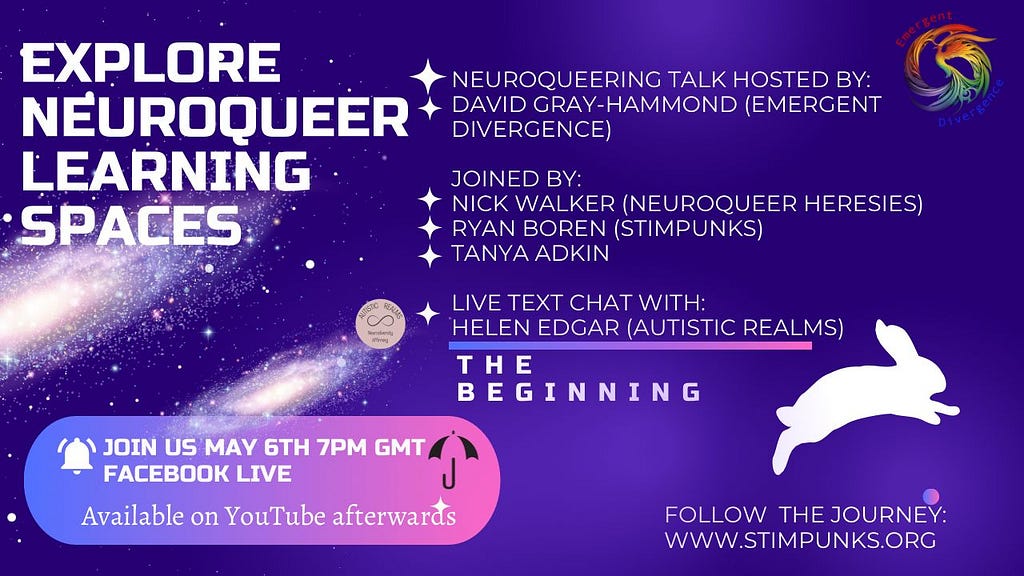
    To support this project and open up further discussions about neuroqueering education and learning spaces, David Gray-Hammond hosted a live webinar, “Explore Neuroqueer Learning Spaces,” with Dr. Nick Walker on 6 May 2024. This is available to watch via David’s Emergent Divergence website and on Facebook YouTube.

    All quotes are taken directly from this webinar unless otherwise stated.

    What is neuroqueering?

    Nick began the webinar by reminding us that ‘Neuroqueer theory is an extension of queer theory into the realm of neurodiversity”. Everyone can neuroqueer. Neuroqueering is not limited to people who are innately neurodivergent and also queer; neuroqueering is open for everyone to explore.

    Neurodivergent people can neuroqueer and diverge themselves into ever-expanding neuroqueer ways of being. Neurotypical people can engage in neuroqueering to diverge their bodyminds further and liberate themselves from socially instilled norms.

    Neuroqueering is an act; it has intent; we can neuroqueer how we live and how we experience, interact, engage and respond to the world around us. Within our neuroqueer learning spaces, we are exploring how neurotypicality, which is socially constructed, can be queered to liberate bodyminds. As part of our Stimpunks Learning Spaces project, Ryan and I are also exploring the benefits and potential of embracing an embodied education within our neuroqueer learning spaces. An embodied education is also something that Nick expanded upon and stressed the importance of as she shared some examples of her practice within this webinar.

    “Neuroqueer theory is about creative neurodivergence” (Nick Walker)

    What if…?

    “Neurotypicality is limiting” (Walker). Neuroqueering involves engaging with life and opening up possibilities. Neuroqueering expands potential, questions boundaries and subverts normality. It enables us to explore, to try, to be curious; it opens up questions and the potential of ‘What if…?

    The potential of ‘What if?’ is often found in children’s excitement, awe and wonder as they playfully explore the world around them. They may excitedly run up to you with a twig or shiny stone they have found, wanting to share that moment of finding something that fills them with joy and curisoity and is reflective of the pure magic of being alive and discovering the wonder of the world. Over time, the awe of finding the ‘Marvellous in the Real’ (Grand, 1978) often becomes eroded in people due to the neuronormative expectations that weigh down on our bodyminds to behave, act, talk and even only show joy in certain ways.

    Nick and David expanded on this by referring to Nick’s writing about hand movements and stimming, which is also explored in Neuroqueer Heresies (2021, p183–191). There are often enforced school rules based on neuronormative values and expectations for having “quiet hands”, doing “good sitting”, doing “good looking” (making eye contact with the teacher in class) and demonstrating attention skills in specific ways. The use of Positive Behaviour Support(PBS) plans and Applied Behaviour Analysis (ABA) to reinforce certain behaviours and actions, such as ‘quiet hands’ has been proven to cause considerable harm and trauma, especially for autistic people as it aims to suppress and eradicate their innate need to regulate by stimming and expressing themselves authentically. There is a comprehensive resource list about the harm of behaviourism on Stimpunks website. We are also creating “Why” sheets to help parents and professionals advocate and provide neurodiversity affirming alternatives to support young people.

    Many other questions were posed throughout the webinar, including:

    How do we queer neuronormativity?

    How do we queer our bodyminds?

    What does this look like in a learning space?

    (We hope to expand these webinars so we can loop back to some of these questions and the comments raised in the text chat. )

    Systems

    Nick and David briefly (it is a huge topic!) talked about systemic oppression and agreed that education needs a system of some kind. We can not just destroy the education system; it is not practical or realistic. Some parts can be used or at least transformed. We can neuroqueer the education system.

    People need structure; routines are as important in neuroqueer learning spaces as they are everywhere else. Routines provide feelings of safety and reduce anxiety. More flexibility is needed for people to be responsive and open to change and transformation. We need to ask what our routines look like, what purpose they have, and what use are they? How responsive and adaptable are they? Are they created in collaboration with others?

    Inspired by the quote from Audre Lorde (1984), “The master’s tools will never dismantle the master’s house”, Nick said that we don’t need to burn the system down; instead, we should:

    “Queer the system, queer the tools and create new tools.” (Nick Walker)

    David highlighted that contemporary approaches to research looking at the oppressive structures of our education system are often reactionary, suggesting systems are torn down; however, this could be a barrier in itself to neuroqueering. If you are focused on tearing down the system, you are not neuroqueering. Neuroqueering is not destructive; it is transformative.

    To neuroqueer is to transform, not destroy. (Helen Edgar)

    Based on the work of Stafford Beer’s cybernetic principles, Nick suggests that it is not necessarily the idea of systems and hierarchy that are the problem; instead, it is the way neuronormative ideals currently enforce them. We need more flexibility and collaborative, interdisciplinary approaches.

    To what extent are some parts of the current system repurposable?

    Can we remake the tools, and create new tools?

    What do we want to dismantle, and what do we want to reshape?

    Space

    How can we queer our physical learning spaces to free the body?

    Nick shared her experiences as a professor, and she emphasised the importance of being a facilitator of learning. She shared with us how she values adopting a collaborative approach to learning where students are not passive recipients but are co-creators. She asks her students to question what knowledge they bring to their learning space so everyone can learn together.

    Nick provides a liberating neuroqueer space for students to express their ways of sharing the knowledge they have gained and collaborating with others. Not enforcing neurotypical ways of demonstrating t ways (tests or enables people to express themselves in ways that suit them, whether through art, poetry or other forms of self-expression. This way of working leans nicely into the courses Nick delivers and facilitates. It would be interesting to know what neuroqueer learning spaces could look like for other subjects, younger age groups, and those with different needs and interests.

    Based on her own experiences, Nick suggested a few practical ideas for neuroqueering the physical layout of learning environments. Even small changes can make a difference; instead of having desks in rows, she suggests having circles and a variety of other places that enable freedom of movement and embrace different learning styles.

    In our Neuroqueer Learning Spaces project, Ryan and I are looking at the potential of Cavendish Space based on the three primordial learning spaces advocated for by David Thornberg.

    Cavendish learning spaces are based on flexibility, interaction, movement and the role of embodied responsive experiences. There is no learning without the body. The boundaries of traditional neuronormative classroom settings not only restrict embodied experiences but lead to disembodied experiences and can cause harm”. (Boren and Edgar, Stimpunks, 2024)

    Cavendish spaces are psychologically and sensory safe spaces suited to zone work, flow states, intermittent collaboration, and collaborative niche construction. They have a golden thread of an embodied education running through them, and there is endless scope for learning the potential of the body, mind and soul. (Boren & Edgar, Stimpunks, 2024)

    ”Enabling autonomy of movement and acknowledging the different ways people learn best through their bodies needs to be considered. It is essential to allow people to move around, pace, stim, sit on the floor, and adopt positions and movements that are comfortable for them and have the freedom to change”. (Nick Walker)

    This is only the start of our journey exploring neuroqueer learning spaces. If you are interested in our project and would like to learn more, please get in touch with us at Stimpunks.

    “Until you make the unconscious conscious, it will direct your life, and you will call it fate” — Carl Jung.”*

    Thank you to David Gray-Hammond for hosting this event and thank you to Dr. Nick Walker for your support and the fabulous webinar.

    EXPLORE NEUROQUEER LEARNING SPACES. NEUROQUEERING TALK HOSTED BY: DAVID GRAY-HAMMOND (EMERGENT DIVERGENCE) Diverse JOINED BY: • NICK WALKER (NEUROQUEER HERESIES) RYAN BOREN (STIMPUNKS) TANYA ADKIN LIVE TEXT CHAT WITH: HELEN EDGAR (AUTISTIC REALMS) THE BEGINNING. Image of purple pink space/galaxy scene with a white bunny.JOIN US MAY 6TH 7PM GMT A FACEBOOK LIVE Available on YouTube afterwards.FOLLOW THE JOURNEY: WWW.STIMPUNKS.ORG

    * a quote often attributed to Carl Jung (nb. there is no reference we can find for this but Dr. Jung did say: The psychological rule says that when an inner situation is not made conscious, it happens outside, as fate. That is to say, when the individual remains undivided and does not become conscious of his inner opposite, the world must perforce act out the conflict and be torn into opposing halves. ~Carl Jung, Aion, Christ: A Symbol of the Self, Pages 70–71, Para 126.)