A response to Liam Ren “Neuroqueering Deleuze: Rhizomes of Becoming – A Reflection” (23rd March 2026), for the community project Neuroqueering Deleuze: Rhizomes of Becoming
https://bsky.app/profile/liamrenouf.bsky.social/post/3mhpsrfvsb22h
Rhizomatic Memory and Neuroqueer Method
Reading Liam Ren’s idea “of neuroqueering methodologies, or neuroqueering as methodology” ignited a memory, a re-emergence of an experience that I had many years ago. Liam describes neuroqueering as something unfinished, and shaped by intensive frequencies, something that ebbs and flows. This resonated with how my own learning journey has unfolded over time. Meaning has rarely developed through linear progression; instead, it has emerged through immersion in specific hyper-focused interests, through deep monotropic intensity, and often a return to a previous deep interest (like this article about the artist Mark Rothko), a constant spiralling movement, ebbing and flowing between past and present.
Their reflections on the idea of a “synaesthetic art critic” and philosophical engagement beyond conventional academic structures brought me back to my student years studying History of Art and English Literature almost 30 years ago. Long before I had the language for words like monotropism, neurodivergence, or neuroqueer theory, I was already encountering art as a whole-body experience; as a field of sensation that reorganised bodily awareness. Art was something I felt, something I needed in my life, and still do. Abstract expressionist painting, particularly the work of Mark Rothko, became a place for me where perception, emotion, and bodily awareness seemed to merge, and I felt a bit more understood, it made me feel more complete in a way that only art, music, literature and poetry can.
The Gallery as a Plane of Immanence
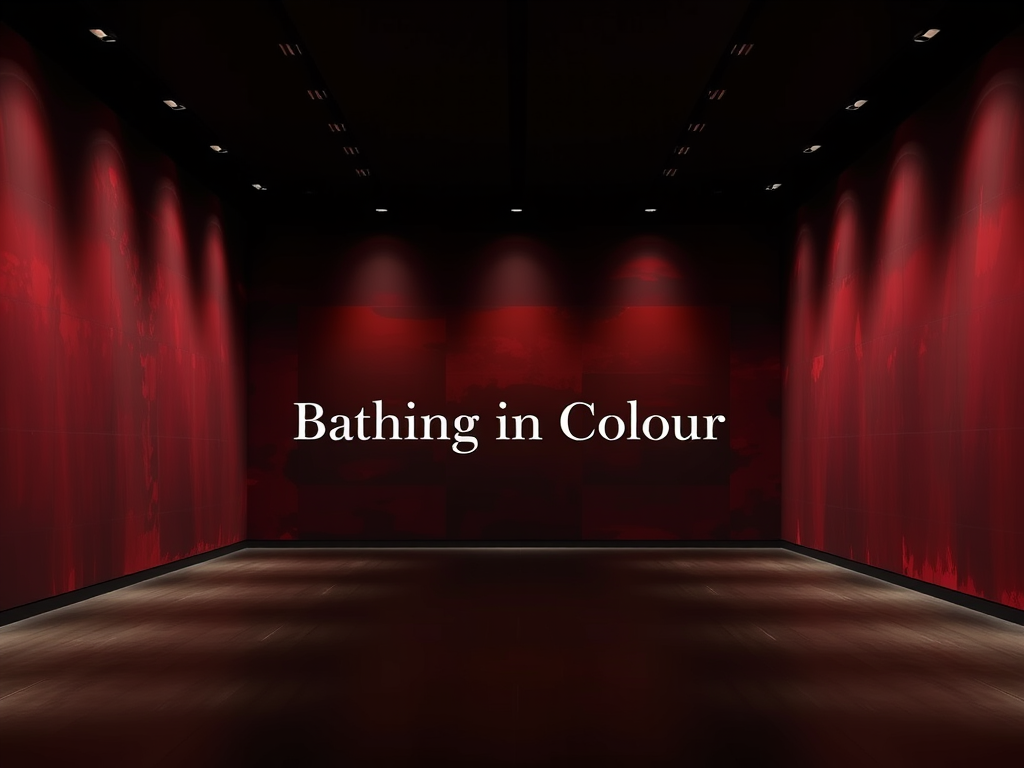
One memory stands out with particular clarity: visiting Tate Modern in London to experience Rothko’s Seagram Murals, first-hand with my friend as part of our Uni course. The gallery space was dimly lit, quiet, and expansive. The paintings were monumental, not decorative objects hanging on the gallery wall, but immersive environments; I felt I actually entered in to them. The paintings were autonomous compounds what Deleuze describes as “blocks of sensations” that reorganised the gallery space. “The work of art is a being of sensation and nothing else: it exists in itself” (Deleuze, 1994).
Looking back now, the gallery setting can be understood as what Deleuze and Guattari describe as a plane of immanence — a field of relations within which thought becomes possible (Deleuze & Guattari, 1994). Thought does not arise solely within an individual’s mind; it emerges through material and affective conditions: architecture, colour, silence, bodily positioning, and social presence with our surroundings. This space helped shaped my perception of the art before any conscious interpretation began; it was something I felt before the words arrived. In fact, I still have no words to accurately describe my experiences, which is possibly why art is so important: it fills the gap where words restrict us.
Plateaus of Attention: Monotropism and Sensory Duration
My friend and I lay down on the gallery floor, surrounded by vast fields of dark red and maroon. I let the colours wash through me, as though I were bathing in them, held within an atmosphere that seemed to slow and thicken time itself. We must have stayed there for a long while, suspended in a quiet intensity that resisted any sense of conclusion. I have returned to the gallery many times since, always with the same feeling: that I never quite want to leave, as though the encounter is still unfolding and I am still making sense of it.
This sustained immersive, monotropic experience could be understood through Deleuze and Guattari’s concept of a plateau: a continuous region of intensity that maintains experiential charge without moving toward resolution (Deleuze & Guattari, 1987). My attention deepened rather than accelerated or reached any definitive answers about the work; my thoughts unfolded as time seemed to just slip away, and I felt I almost became part of the art itself. This narrowing of attention functioned as a temporary territorialisation of perception, through which sensory relations intensified rather than diminished.
The theory of Monotropism (Murray et al., 2005), may help explain this experience further. When the attentional resources of Autistic and ADHD people become highly focused, engagement with sensory or conceptual environments can become immersive and nonlinear. In the Rothko gallery, this narrowing of my attentional field did not feel restrictive; instead, it enabled an expanded relational field in which colour, the sounds of the gallery, the architectural scale of the building and paintings, my memory, and shared presence formed a kind of temporary assemblage. The meaning and memories created there emerged slowly through my ongoing immersion with the art and the space I was in.
Synaesthetic Encounter and the Body without Organs
I experience synaesthesia, where sensory impressions begin to overlap and blend. While immersed in Rothko’s deep reds and maroons, I felt and heard a low vibrating internal hum. The colours did not stay at a distance as something to look at; they felt as though they entered my body, with an affective force and pull, creating an atmosphere that was both calming and intense. Experiences like this can challenge expectations about how we are supposed to engage with art. Rather than observing from the outside, perception becomes immersive, relational, and deeply felt, maybe more so if you experience synesthesia in this way, but I only have my own experience to draw from.
I didn’t know it at the time, other gallery visitors probably thought I was a bit strange, but lying on the gallery floor also involved an unspoken disruption of normative spectator behaviour in a setting like this. Visitors are typically expected to stand, sit or move quietly, and observe from a respectful distance. By shifting bodily position — lying, sitting and walking around, I was unknowingly experimenting with perception itself and also neuroqueering the expectations of being in a formal public gallery space.
Deleuze and Guattari describe the Body without Organs (BwO) as a process in which habitual bodily organisation loosens, allowing new intensities and relations to emerge (1987). The BwO is not the disappearance of the structure of our actual human bodies but an experimental reconfiguration of how our bodies connect and respond, and can reconfigure in different spaces.
Within Tate Modern’s gallery, Rothko’s work disrupted and destaballised the boundary between me as a viewer and artwork. The gallery functioned as an assemblage in which colour, texture, depth, scale, sound, friendship and memory all combined to form a temporary field of relational intensity. In this reorganisation, my own perception of the art became more experimental. The pressure to interpret correctly when writing up my essay notes receded, and my attention plateaued into a state of sensation in which my identity and environment were mutually shaping each other as I let the colours flow through me, as I heard the sound of the deep reds, and felt as if I were becoming part of the art itself.
Neuroqueering Methodology and Lines of Flight
For many neurodivergent people, such intensive monotropic responses to art, literature, music, dance or poetry may be familiar. Through a Deleuzian lens, they could be understood as creative reorganisations of experience, minor reorganisations of affective and perceptual relations, subtle lines of flight that open alternative ways of being present in the world (Deleuze & Guattari, 1987).
Liam Ren’s exploration of neuroqueering methodology helps frame these encounters as epistemologically significant. Neuroqueering challenges assumptions that knowledge must be produced through linear argument or normative cognitive performance. Instead, it recognises that understanding may emerge through affective immersion, relational environments, sustained attentional flow states, and our divergent ways of experiencing art and the world.
Abstract art like Rothko’s can therefore function as a neuroqueer methodological space, a temporary territory where dominant expectations of productivity, legibility, and behavioural regulation loosen for the person who is engaging with the artwork.
Becoming Through Colour
Reflecting now, my time lying beneath Rothko’s paintings enabled a different way of thinking to emerge, one shaped by duration, sensory attunement, and relational presence. Memory itself operates rhizomatically, as a process of ongoing recomposition rather than recollection, returning unpredictably and forming new conceptual connections across time (Deleuze & Guattari, 1987), as has happened when I read Liam’s blog.
Such encounters suggest that philosophical becoming may occur not only in texts but also in embodied situations like this that loosen the organisation of the self and open new planes of relation. Neuroqueering methodology can therefore be understood as a lived practice of experimentation, a willingness to follow lines of sensation in our bodyminds into unfamiliar territories, to linger with the ‘what could this mean’, with the ‘what may happen if…’.
Rothko’s murals continue to offer such plateaus for me. They create environments in which perception can deepen, bodyminds can reorganise, and thought can unfold through relational intensity with the artwork and the surrounding space when conditions feel safe. In Deleuzean terms, art is not primarily representational but intensive. As Deleuze and Guattari write;
“the work of art is a being of sensation and nothing else: it exists in itself”(Deleuze & Guattari, 1994, p. 164).
Encountering these fields of colour can therefore feel less like interpreting an image and more like entering a sensory event, one in which attention shifts, time gathers, and experience becomes widened with duration.
Within such encounters, sensation may operate temporally as well as perceptually. Deleuze and Guattari describe how “sensation contracts the vibrations of the stimulant… what comes before has not yet disappeared when what follows appears” (1994, p. 211). This contraction of vibration resonates with my own Autistic synaesthetic experiences of spiralling memories of sound, colour and physical sensations in my body, deep attention, and non-linear temporal flow. Art, in this sense, can become a way of inhabiting duration differently, allowing perception to loosen its usual coordinates and making space for alternative sensory epistemologies – creating new nodes on the rhizomes of our experiences and deepening our monotropic tunnels and interests.
From this perspective, aesthetic encounters are not simply personal responses but ontological events. As Nabais (2010) observes, art involves the “capture of the force of life and also creation of a life which stands by itself” and the creation of autonomous zones of sensation that exist independently of subjective interpretation. Rothko’s paintings could be understood as environments in which sensation continuously re-composes these experiences. Rather than resolving the chaos of an abstract work of art, art can hold open a field of intensity through which chaos becomes composed into sensation.
Deleuze and Guattari suggest that “art is not chaos but a composition of chaos that yields the vision or sensation” (1994, p. 204). If neuroqueering expands the conditions under which knowledge becomes possible, then philosophy may sometimes begin in these quieter aesthetic spaces and our relationships with a work of art — spaces where colour reshapes attention, duration transforms understanding, and sensory experience invites us to become otherwise.
This piece forms part of the ongoing community philosophy project Neuroqueering Deleuze: Rhizomes of Becoming on More Realms.
Find out more here:
Notes on an Unfinished Encounter…
Since writing this reflection, I have found myself thinking about how memory and theory shape the way we understand past experiences. What once felt like an open, personal sensory experience with art has become more organised through language and philosophy.
I have also begun to wonder about the gallery space itself. The quietness, dim lighting, and cultural expectations of contemporary art created conditions where immersive attention felt possible and safe. Lying on the floor felt like a small disruption of usual behaviour, but it was also an action that the space could absorb. This raises questions about who is able to experiment with their perception in public spaces, and under what conditions difference becomes accepted or contained. These reflections also make me think about how public spaces quietly regulate behaviour, attention, and movement, shaping what kinds of sensory engagement are seen as appropriate or disruptive. I am also aware that not all people are granted the same freedom to move, pause, or experiment with perception in public spaces. What felt possible for me in that moment may not feel safe or permitted for others. For some people, moving or sensing differently in public can lead to misunderstanding, correction, or exclusion rather than quiet acceptance.
Reflecting further, I notice an ongoing tension between using the theory of monotropism to understand deep attentional engagement, and engaging with philosophical ideas such as those of Deleuze and Guattari about becoming that resist fixed explanations. Neuroqueering methodology may live within this tension. It can help us name and affirm neurodivergent ways of experiencing the world, while also inviting us to remain open to change, uncertainty, and new ways of thinking, and to question the taken-for-granted standards of focus, composure, and productivity that shape how bodies and minds are expected to function in shared environments. Immersive sensory encounters can feel uncertain or overwhelming, reminding me that opening perception in this way involves a negotiation between curiosity, vulnerability, and the need for grounding.
Rather than reaching a conclusion, these reflections feel like a continuation. My encounters with Rothko’s paintings continue to unfold through memory, conversation, and ongoing sensory meaning-making. Perhaps neuroqueering is not about finding final interpretations or fixed language to define an experience or way of being, but about noticing how perception and understanding shift over time, opening space for new possibilities to emerge. These questions are not only personal but collective, connected to wider struggles over whose ways of sensing, thinking, and being are recognised as valid, and whose are overlooked, regulated, or misunderstood.
To neuroqueer perception may therefore be not only to experience differently, but to gently challenge the norms that decide which experiences are allowed to matter.
Next Blog: What may neurodivergent experiences reveal about how plateaus are lived, sensed, and sustained, and how might we neuroqueer them?
What is a plateau?
Not a peak to be reached, but a region where intensities sustain themselves.
Plateaus are not entered so much as encountered, they are fields of relation where perception, time, and attention begin to shift.
In my next blog, I will explore and unfold some more!
References
Deleuze, G., & Guattari, F. (1987). A thousand plateaus: Capitalism and schizophrenia. University of Minnesota Press.
Deleuze, G., & Guattari, F. (1994). What is philosophy? Columbia University Press.
Deleuze, G., & Guattari, F. (1994). What is philosophy? Columbia University Press.
Murray, D., Lesser, M., & Lawson, W. (2005). Attention, monotropism and the diagnostic criteria for autism. Autism, 9(2), 139–156.
Deleuze, G., & Guattari, F. (1994). What is philosophy? Columbia University Press.
Deleuze, G. (2003). Francis Bacon: The logic of sensation. Continuum.
Nabais, C. P. (2010). Percept, affect and micro-brains: Art according to Deleuze. In S. Di Marco, O. Pombo, & M. Pina (Eds.), Neuroaesthetics: Can science explain art? (pp. 165–175). Fim de Século.
Ren, L. (2026). Neuroqueering Deleuze: Rhizomes of Becoming – A Reflection. Substack.
Rothko, M. (n.d.). Quotes. https://www.mark-rothko.org/quotes.jsp
Tate Modern, Mark Rothko Seagram Murals: https://www.tate.org.uk/visit/tate-modern/display/in-the-studio/mark-rothko-seagram-murals