Tag: neuroqueering

  • Folding Worlds: Monotropism & Neuroqueering Attention

    Folding Worlds: Monotropism & Neuroqueering Attention

    by Helen Edgar — More Realms

    “The whole world is only a virtuality that currently exists only in the folds of the soul which convey it, the soul implementing inner pleats through which it endows itself with representation of the enclosed world.” — Gilles Deleuze, The Fold (1993, P. 24).


    Thoughts…..

    I am exploring how Deleuze’s ideas in The Fold entwines with the theory of monotropism and the lived textures of Autistic perception and attention through a neuroqueer lens.

    What if monotropic attention and perception is folded, what happens when we unfold?

    What if Autistic time moves in spirals, not lines?


    Folding Worlds

     “The world is an infinite series of curvatures” 

    Sometimes, when I’m deeply absorbed, following the rhythm and flow of an idea, a line of flight, or feeling sound ripple through air the world seems to bend inward. Time loosens, boundaries blur and my mind folds into the moment until it feels like my thought, body, and world are all moving together as one continuous curve.

    Deleuze, in The Fold, imagined reality itself as endlessly pleated, an intricate fabric of curves and contours where inside and outside are never truly separate, each perception and experience establishes ‘folds in the soul’. (p. 112) As Autistic people our sensory systems are more porous, each life, each experience, each moment, is a fold within this larger flow of existence, all entangling together with the environment around us.

    As an Autistic person, you may feel like I do, that you live in the liminal spaces, the in-between. The world doesn’t divide neatly into subjects and objects but moves almost as if it is a single and multiple simultaneously, perhaps holographic , a folded plane of becoming.

    Monotropism (Murray et al., 2005) is the theory that explains how Autistic and ADHD experience is shaped by deep, focused attention. Instead of our attention spreading thinly across many things, our attention folds inward, gathering tightly around may be just one or a few single streams or tunnels of interest or sensation at any given time. It’s not a limitation, it’s a different rhythm, it is how we experience flow and can be a really energising and regulating experience when we are looped into something positive that helps us. Our minds tend to curve toward what holds meaning, creating a rich, textured world from within that fold where our attention dwells.

    Where neurotypical attention might skim across multiple channels of attention, monotropic attention lingers and has capacity to stay focused for long periods, especially when in the right supportive environments. Monotropic attention inhabits, it listens deeply and it is in these moments of flow, the world is not distant as some may think, rather the world is inside us, rich and intense. It is like it is folded through our senses, our language, our movement to such intensity we become-with our surroundings.


    Unfolding

    “A fold is always folded within a fold, like a cavern in a cavern”. (P.6)

    Folds can be fragile, like origami. When too many demands pull at once, such as sensory input or social expectations, it is like the fold can’t stretch without straining and something has to give before it breaks. Overload, fragmentation, and burnout emerge when the world presses too hard against our natural curvature and forces the fold to carry more than it has capacity for. We may experience more meltdowns or shutdowns and over a longer period could enter a full burnout. Burnout, in this sense, isn’t failure of our body minds; it’s like a wound in the fold. It happens when we are forced to unfold too quickly, without time or gentleness and without the right support.


    Liminal Folds

    The space between inside and outside, that delicate threshold in the liminal zone, is where I live and perhaps many other Autistic people live too. It’s the edge of sensory, emotional and social attunement, where the world can feel both too near and too far at the same time. Safety, trust, and co-regulation allow the fold to breathe, it gives space to expand and recover. To unfold safely, enables us to unmask ‘to increase and grow’.

    When others meet us at our own tempo and in our own authentic ways, our fold can open slowly, naturally, toward a node of connection with others. It strengthens the vulnerable liminal spaces in-between, it can be empowering and gives us energy to follow that curve of a fold and see where it takes us, to resist neuronormative linear ways of being.


    Neuroqueer Curvatures

    To neuroqueer is the act of living otherwise, resisting the norms that demand sameness, linearity, and temporality. It invites us to honour different ways of moving through the world: curved, recursive, and rhizomatic.

    Through this lens, embracing your Autistic/ADHD monotropicness can become a neuroqueer ecology. It is a way of being that disrupts the assumption that we must flow in straight lines and contort ourselves and fold and contort ourselves to fit into heirarchies and systems. To embrace the liminal and the Autistic fold is an act of quiet defiance, a refusal to flatten complexity or to perform productivity and neuronormative expectations at the expense of our own well-being.

    Our monotropic deep focus isn’t a deficit, it’s an orientation, it is a different way of being and living. To embrace flow and see where the fold takes us. It reveals a world that thrives on depth and immersion rather than breadth. To move with with the flow of our monotropic attention, along the fold is to inhabit curved time, the slow, spiral rhythm of a mind that folds toward what matters most to us.


    Folding Time

    For many of us, life doesn’t move in a straight sequence. It curves back, loops, and gathers around moments of attention. This is folded time, neuroqueer temporality or what others have called mad time, time as felt texture rather than moving like clockwork.

    When I am in deep flow, the past and future dissolve into the intensity of an ever expansive ‘now-ness’, when the fold releases, I spill gently back into a wider space, I always need time to recalibrate, to find the edges again and to find something to loop and back hook into before I can move on.

    To live through folded time is to understand that attention has its own seasons. Some days are for spiralling inward, composting thoughts and gathering energy and others may be for stretching outward, connecting, creating and reaching new nodes.


    Folding with the World

    “Perception establishes the folds in the soul” (P. 112)

    In the folds of Autistic attention and perception lie whole worlds of knowing and becoming. Through monotropism and neuroqueer theory, we can reimagine these folds not as constraints, but as living spaces of creativity, connection, and a different temporality.

    Within these curvatures, difference becomes depth, a way of sensing the world through texture, rhythm, and relation rather than conformity. Our attention moves like tidewater, folding and flowing inward to nourish the self and unfolding and rippling outward to meet the world again.

    When we are allowed to move at our own pace, these folds open into more realms of possibility, spaces where curiosity can root, where safety and belonging can take form.

    To live within the Autistic fold is to recognise that we are not separate from the world, but continuous with it, each of us a unique curvature in the greater flow of being. By embracing our folds and natural flow of monotropic attention, we can honour the quiet sensory moments, our rhizomatic ways of being, and the beautifully entangled ways we come to know, feel, and create within our selves and connect with others.


    Reflections

    How does your attention fold?

    What might unfold if your natural rhythms were met, not resisted?


    References


    Deleuze, G. (1993). The Fold: Leibniz and the Baroque. U of Minnesota Press. (quotes from Continuum edition, The Athone Press, 2006).

    Walker, N. (2021). Neuroqueer heresies: Notes on the Neurodiversity Paradigm, Autistic Empowerment, and Postnormal Possibilities. Autonomous Press

  • Neuroqueer Learning Spaces — Webinar — a summary and reflection 6th May 2024

    Neuroqueer Learning Spaces — Webinar — a summary and reflection 6th May 2024

    Neuroqueer Learning Spaces Webinar — A summary and reflection

    Neuroqueer Learning Spaces is a community project led by Ryan Boren (Stimpunks) and Helen Edgar (Autistic Realms).
    More information is available on Stimpunks’ website.

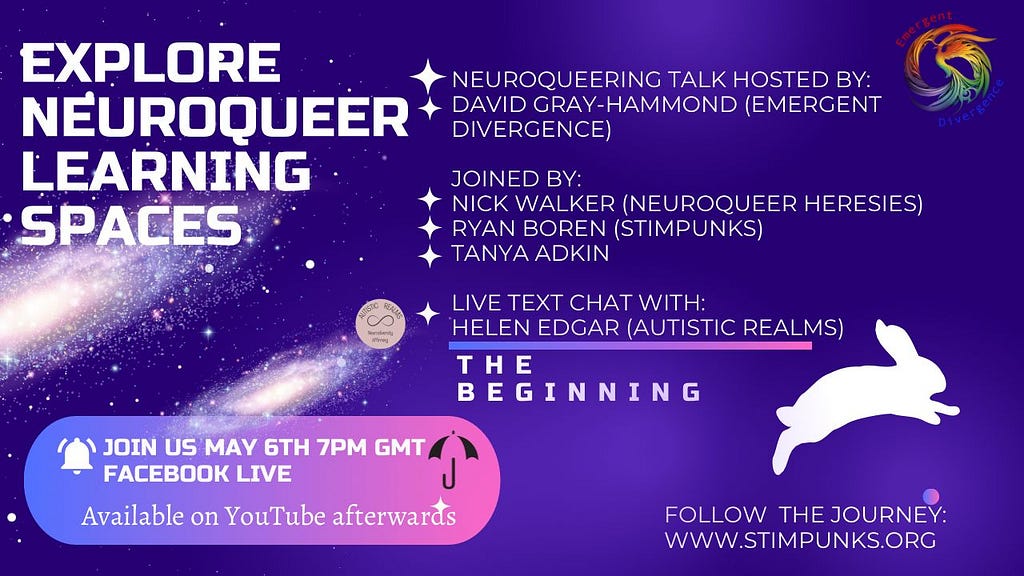
    To support this project and open up further discussions about neuroqueering education and learning spaces, David Gray-Hammond hosted a live webinar, “Explore Neuroqueer Learning Spaces,” with Dr. Nick Walker on 6 May 2024. This is available to watch via David’s Emergent Divergence website and on Facebook YouTube.

    All quotes are taken directly from this webinar unless otherwise stated.

    What is neuroqueering?

    Nick began the webinar by reminding us that ‘Neuroqueer theory is an extension of queer theory into the realm of neurodiversity”. Everyone can neuroqueer. Neuroqueering is not limited to people who are innately neurodivergent and also queer; neuroqueering is open for everyone to explore.

    Neurodivergent people can neuroqueer and diverge themselves into ever-expanding neuroqueer ways of being. Neurotypical people can engage in neuroqueering to diverge their bodyminds further and liberate themselves from socially instilled norms.

    Neuroqueering is an act; it has intent; we can neuroqueer how we live and how we experience, interact, engage and respond to the world around us. Within our neuroqueer learning spaces, we are exploring how neurotypicality, which is socially constructed, can be queered to liberate bodyminds. As part of our Stimpunks Learning Spaces project, Ryan and I are also exploring the benefits and potential of embracing an embodied education within our neuroqueer learning spaces. An embodied education is also something that Nick expanded upon and stressed the importance of as she shared some examples of her practice within this webinar.

    “Neuroqueer theory is about creative neurodivergence” (Nick Walker)

    What if…?

    “Neurotypicality is limiting” (Walker). Neuroqueering involves engaging with life and opening up possibilities. Neuroqueering expands potential, questions boundaries and subverts normality. It enables us to explore, to try, to be curious; it opens up questions and the potential of ‘What if…?

    The potential of ‘What if?’ is often found in children’s excitement, awe and wonder as they playfully explore the world around them. They may excitedly run up to you with a twig or shiny stone they have found, wanting to share that moment of finding something that fills them with joy and curisoity and is reflective of the pure magic of being alive and discovering the wonder of the world. Over time, the awe of finding the ‘Marvellous in the Real’ (Grand, 1978) often becomes eroded in people due to the neuronormative expectations that weigh down on our bodyminds to behave, act, talk and even only show joy in certain ways.

    Nick and David expanded on this by referring to Nick’s writing about hand movements and stimming, which is also explored in Neuroqueer Heresies (2021, p183–191). There are often enforced school rules based on neuronormative values and expectations for having “quiet hands”, doing “good sitting”, doing “good looking” (making eye contact with the teacher in class) and demonstrating attention skills in specific ways. The use of Positive Behaviour Support(PBS) plans and Applied Behaviour Analysis (ABA) to reinforce certain behaviours and actions, such as ‘quiet hands’ has been proven to cause considerable harm and trauma, especially for autistic people as it aims to suppress and eradicate their innate need to regulate by stimming and expressing themselves authentically. There is a comprehensive resource list about the harm of behaviourism on Stimpunks website. We are also creating “Why” sheets to help parents and professionals advocate and provide neurodiversity affirming alternatives to support young people.

    Many other questions were posed throughout the webinar, including:

    How do we queer neuronormativity?

    How do we queer our bodyminds?

    What does this look like in a learning space?

    (We hope to expand these webinars so we can loop back to some of these questions and the comments raised in the text chat. )

    Systems

    Nick and David briefly (it is a huge topic!) talked about systemic oppression and agreed that education needs a system of some kind. We can not just destroy the education system; it is not practical or realistic. Some parts can be used or at least transformed. We can neuroqueer the education system.

    People need structure; routines are as important in neuroqueer learning spaces as they are everywhere else. Routines provide feelings of safety and reduce anxiety. More flexibility is needed for people to be responsive and open to change and transformation. We need to ask what our routines look like, what purpose they have, and what use are they? How responsive and adaptable are they? Are they created in collaboration with others?

    Inspired by the quote from Audre Lorde (1984), “The master’s tools will never dismantle the master’s house”, Nick said that we don’t need to burn the system down; instead, we should:

    “Queer the system, queer the tools and create new tools.” (Nick Walker)

    David highlighted that contemporary approaches to research looking at the oppressive structures of our education system are often reactionary, suggesting systems are torn down; however, this could be a barrier in itself to neuroqueering. If you are focused on tearing down the system, you are not neuroqueering. Neuroqueering is not destructive; it is transformative.

    To neuroqueer is to transform, not destroy. (Helen Edgar)

    Based on the work of Stafford Beer’s cybernetic principles, Nick suggests that it is not necessarily the idea of systems and hierarchy that are the problem; instead, it is the way neuronormative ideals currently enforce them. We need more flexibility and collaborative, interdisciplinary approaches.

    To what extent are some parts of the current system repurposable?

    Can we remake the tools, and create new tools?

    What do we want to dismantle, and what do we want to reshape?

    Space

    How can we queer our physical learning spaces to free the body?

    Nick shared her experiences as a professor, and she emphasised the importance of being a facilitator of learning. She shared with us how she values adopting a collaborative approach to learning where students are not passive recipients but are co-creators. She asks her students to question what knowledge they bring to their learning space so everyone can learn together.

    Nick provides a liberating neuroqueer space for students to express their ways of sharing the knowledge they have gained and collaborating with others. Not enforcing neurotypical ways of demonstrating t ways (tests or enables people to express themselves in ways that suit them, whether through art, poetry or other forms of self-expression. This way of working leans nicely into the courses Nick delivers and facilitates. It would be interesting to know what neuroqueer learning spaces could look like for other subjects, younger age groups, and those with different needs and interests.

    Based on her own experiences, Nick suggested a few practical ideas for neuroqueering the physical layout of learning environments. Even small changes can make a difference; instead of having desks in rows, she suggests having circles and a variety of other places that enable freedom of movement and embrace different learning styles.

    In our Neuroqueer Learning Spaces project, Ryan and I are looking at the potential of Cavendish Space based on the three primordial learning spaces advocated for by David Thornberg.

    Cavendish learning spaces are based on flexibility, interaction, movement and the role of embodied responsive experiences. There is no learning without the body. The boundaries of traditional neuronormative classroom settings not only restrict embodied experiences but lead to disembodied experiences and can cause harm”. (Boren and Edgar, Stimpunks, 2024)

    Cavendish spaces are psychologically and sensory safe spaces suited to zone work, flow states, intermittent collaboration, and collaborative niche construction. They have a golden thread of an embodied education running through them, and there is endless scope for learning the potential of the body, mind and soul. (Boren & Edgar, Stimpunks, 2024)

    ”Enabling autonomy of movement and acknowledging the different ways people learn best through their bodies needs to be considered. It is essential to allow people to move around, pace, stim, sit on the floor, and adopt positions and movements that are comfortable for them and have the freedom to change”. (Nick Walker)

    This is only the start of our journey exploring neuroqueer learning spaces. If you are interested in our project and would like to learn more, please get in touch with us at Stimpunks.

    “Until you make the unconscious conscious, it will direct your life, and you will call it fate” — Carl Jung.”*

    Thank you to David Gray-Hammond for hosting this event and thank you to Dr. Nick Walker for your support and the fabulous webinar.

    EXPLORE NEUROQUEER LEARNING SPACES. NEUROQUEERING TALK HOSTED BY: DAVID GRAY-HAMMOND (EMERGENT DIVERGENCE) Diverse JOINED BY: • NICK WALKER (NEUROQUEER HERESIES) RYAN BOREN (STIMPUNKS) TANYA ADKIN LIVE TEXT CHAT WITH: HELEN EDGAR (AUTISTIC REALMS) THE BEGINNING. Image of purple pink space/galaxy scene with a white bunny.JOIN US MAY 6TH 7PM GMT A FACEBOOK LIVE Available on YouTube afterwards.FOLLOW THE JOURNEY: WWW.STIMPUNKS.ORG

    * a quote often attributed to Carl Jung (nb. there is no reference we can find for this but Dr. Jung did say: The psychological rule says that when an inner situation is not made conscious, it happens outside, as fate. That is to say, when the individual remains undivided and does not become conscious of his inner opposite, the world must perforce act out the conflict and be torn into opposing halves. ~Carl Jung, Aion, Christ: A Symbol of the Self, Pages 70–71, Para 126.)