Tag: Neuroqueer Learning Spaces

  • Neuroqueer Revolutions: Difference, Becoming, and the Politics of Refusal

    Neuroqueer Revolutions: Difference, Becoming, and the Politics of Refusal

    This piece brings together four strands of thought: I have been hugely inspired by David Gray-Hammond’s recent writings about the metaphysics of neurodivergence, Robert Chapman’s historical and mad studies framing, Nick Walker’s neuroqueer theory as transformative praxis, and Gilles Deleuze’s philosophy of difference. Each offers a potential lens for us to reconsider what it actually means to be neurodivergent, how our identity is shaped and recognised, and how it might be reimagined beyond fixed categories and labels.

    David Gray-Hammond’s Beyond Definition: A Metaphysical Inquiry into Neurodivergence (2025) asks what makes someone neurodivergent in the first place. He identifies three intersecting dimensions:

    1. Neurological difference from the statistical norm: in structure, function, or developmental pattern.

    2. Lived cognitive difference: a phenomenological divergence in perception, attention, or reasoning.

    3. Social positioning as “different”: the recognition of these differences by ourselves or others, often in ways that create barriers or stigma.


    This proposes that neurodivergence is neither purely biological nor purely social, but emerges in the interplay of embodiment and environment. Tracing through history, Robert Chapman’s Mad Pride in Revolutionary England: The Ranters as Mad Activism (2025) deepens this understanding by focusing on the Ranters in the 1640’s to show how categories of difference, from “mad” to recent terms such as “neurodivergent”, are shaped by power, capitalism, and state control. Labelling is never neutral; it has been used to regulate, exclude, and also to organise resistance throughout history and continues to do so, causing so much harm to marginalised people and anyone who is different.

    Where Chapman maps the long shadows of how difference has been policed, Walker turns us towards neuroqueering acts that stretch those boundaries and enables cognitive, psycholgical and somatic liberty for everyone. Nick Walker’s Neuroqueer Heresies (2021), frames the act of neuroqueering as both a deliberate refusal of neuronormative conditioning and an emergent process that unfolds in everyday life, which has the potential to create radical systemic change to benefit the whole of society. 

    This is in parallel to a Deleuzian perspective, which sees identity as never being static but built from many connections, relationships, and processes. Neurodivergence is not a fixed thing, but a living mix of our fluid bodyminds entangled with our environment, constantly shaped by the social, political, and ecological worlds we move through and the relationships we have.

    The Metaphysics of Neurodivergence


    Neurodivergence is often treated as a fact, decided by a medical diagnosis or by self-identification. Neurological variation without lived difference might go unnoticed; lived difference without social recognition might remain unlabelled or misattributed. It is the interaction with norms, expectations, and power structures that creates and solidifies the socially constructed category of neurodivergence, even for those of us who are innately different from birth.

    Gray-Hammond suggests the idea of neurodivergence rests on three intertwined dimensions. None alone fully defines it, but together, they create its lived reality, of these, being positioned as “different” or “weird” often shapes daily life most directly and affects our wellbeing and how well we can function and thrive. This raises their deeper question: Is neurodivergence defined by the way it is lived and experienced, or by an underlying difference that exists whether or not it is recognised?

    From a Deleuzian perspective, differences are not static traits but elements of a shifting assemblage. Neurodivergence is not a fixed essence but an ongoing process of becoming, shaped by sensory and cognitive patterns, environments, and cultural narratives, all filtered through intersectional privilege and oppression. Difference is generative, producing new perceptions, movements of thought, and ways of living, even if it is temporarily somewhat stabilised or held through labels such as being Autistic or ADHD.

    Gray-Hammond distinguishes between essential properties, those without which neurodivergence would not be what it means today and accidental properties, which can change without altering the underlying being. Essential properties might include monotropic attentional flow, sensory processing patterns, physical disabilities, or other health differences. Accidental properties might include diagnostic labels, learned coping strategies, or outward behaviours. This matters because it undermines claims that compliance-based behavioural interventions “cure” neurodivergence, it suggests that outward behaviour can be suppressed or reshaped, but our essential cognitive and sensory architecture often remains split, fractured by trauma and masking, leading to burnout and mental health crises.

    In Empire of Normality (2023), Chapman reminds us that the notion of “normal” is not an objective truth but a social construct, shaped by cultural and historical contexts. Over time what is seen as  “normal” and what is deemed as  “pathological” have shifted, not because humans have changed dramatically, but because society’s priorities and systems have. These boundaries have often been drawn to serve industry, capitalism, and the institutions that sustain them, rewarding some ways of thinking and being while excluding or penalising others. A clear example is the behaviourist approach entrenched in the US & UK school systems, where reward charts and social stories enforce neuronormative behaviours, harming Autistic children and pushing them to deny their needs expecting them to fit in at all costs.

    In this light, Gray-Hammond’s question, ‘who counts as neurodivergent, and under what conditions?’ is not only personal or diagnostic, but it is political. It invites us to question the shifting line between “different” and “acceptable,” “normal” and “abnormal,” and to consider whether this line can be moved, reshaped, challenged, or even erased.

    Walker’s neuroqueer theory builds on this idea, framing neurodivergence not only as a site of vulnerability for stigma and oppression, but as a space of creative potential. Neuroqueering resists the idea that support or education should aim to make neurodivergent people “normal”. Instead, it treats difference as a strength, a way to stretch the boundaries of what is possible, to reimagine living, thinking, and relating. It holds space for diverging even further from the norm, for exploring new ways of being and learning, and for the radical possibility that anyone can become neurodivergent through the act of neuroqueering and by choosing to move away from normativity.

    When we see neurodivergence as dynamic, shaped by relationships, environments, and histories rather than as a fixed list of traits, we can step beyond the rigid binary of “neurotypical” vs “neurodivergent.” This opens neuroqueering possibilities for a more fluid and liberating society, one that values diversity not as a box to tick but as a living, evolving force. It is an invitation to embrace difference, explore transformative ways of becoming, and continually reinvent ourselves, our work and the worlds we share. However, even as we reimagine neurodivergence in more fluid and relational ways, the language we use and the labels we inherit carry the weight of the histories that have shaped how difference is seen and treated.

    Hidden History of Neurodivergent Labels

    The words and language we use to describe people have never been neutral. They are shaped by politics, history, and power. Robert Chapman’s historical account of Mad Pride shows how labels for cognitive difference often come from systems built to manage and control people. In the 1640s, for example, radical groups like the Ranters challenged the strict religious and social rules of their time. They refused to conform, rejected rules imposed from above, and gathered in ways that disrupted the status quo. They didn’t use today’s words as being neurodivergent but they clearly didn’t fit into the expected norms of the time. Their defiance and solidarity can be seen as early acts of Mad Activism resisting the idea that there is only one “right” way to think, feel, or live.

    Neurodivergent people have often been denied the right to name and define our own realities. For most of history, “official” knowledge about us has come from deficit-based medical models, shaped by institutions and used to serve those in power.

    As I shared in my blog ‘Autistic Mental Health: Beyond the Pathology Paradigm‘ (Aug, 2025), research suggests that as many as 8 in 10 Autistic people have a mental health condition. Sadly, Autistic people have been found to have up to an eightfold increased risk of death by suicide compared to non-Autistic people (Brown et al., 2024). For Autistic children, the risk of thinking about or attempting suicide is 28 times higher than for their non-Autistic peers. These are not just numbers, they are lives cut short by systems that fail to meet our needs.

    The latest Assuring Transformation NHS Digital data (April 2025) paints an equally troubling picture:

    • 2,025 Autistic people and people with a learning disability are in mental health hospitals in England. Of these, 1,455 (72%) are Autistic.
    • 240 under-18s are in inpatient units. Of these, 230 (96%) are Autistic.
    • The number of Autistic people without a learning disability detained in mental health hospitals has increased by 141% since 2015.
    • In 2015, Autistic people made up 38% of the total in hospital. Now it is 72%(National Autistic Society, 2025).

    These statistics are not personal failings, they are systemic failures of education, healthcare, mental health services, and broader society to support Autistic people and those of us who are different in ways that affirm our needs, identities, and ways of being. This is epistemic injustice, as the people most affected are excluded from the conversation, and the words we need to describe our lives are often missing, invalidated or treated as problems. A clear example of this is neurodivergent experiences of burnout.

    When a community lacks language for its own experience or our experiences aren’t believed, it is easier to cause harm. It’s not just about being misunderstood; it’s about blocking self-understanding, choice, and autonomy. Every label we inherit, from being “Autistic” or “weird,” “defiant’ or “disordered”, carries a built-in set of assumptions about how we should be seen and treated. Labelling can trap us in someone else’s story…..or it can be reclaimed and re-storyed to tell our own narratives.

    The power to name and label, and use certain language shapes who is recognised as being fully human and “right” who is pushed to the margins. The meaning of labels is always shifting; institutions try to lock differences into fixed categories, diagnoses, risk labels, and lists of “deficits.” In response some communities are pushing back, reclaiming words like “Crip”, “Autistic” or “Mad” and filling them with their own values, histories, and pride. But changing words alone is not enough, real change needs systemic transformation, and neuroqueer theory offers ways to put that into practice.

    Refusing Normal: The Practice of Neuroqueering

    Neuroqueering can happen on many levels and in many different ways; from the small, everyday choices we make in how we use our bodyminds to the larger work of changing systems. On a personal level, it can mean moving, speaking, or sensing in ways that feel natural to us, even if they go against social expectations. On a collective level, it involves challenging and dismantling the systems that enforce able-bodiedness, demand constant productivity, and dictate narrow, “acceptable” ways of socialising and communicating.

    However, living neuroqueerly by stimming openly, rejecting therapies aimed at making us “normal,” choosing to play, learn, work, or rest in our own ways can still lead to exclusion, discrimination. It is a risk without being in a safe environment with people who understand and accept your authentic self and ways of becoming.

    Neuroqueer theory recognises that neurodivergence doesn’t stand apart from other forms of oppression. The same bodymind that pushes back against neuronormativity is also navigating intersectionality, racism, sexism, homophobia, transphobia, class inequality, and the impacts of colonialism. True freedom for neurodivergent people means breaking down ableism and these other systems together. Deleuze, like Walker and Gray-Hammond, sees this refusal to “fit in” not only as resistance but as something full of creative potential. Embracing difference isn’t just about stepping away from the norm; it’s where new ways of living, relating, and imagining can begin and transformations can emerge.

    Neurodivergence isn’t something that lives inside an individual’s brain; it takes shape in our bodyminds, who we are is inseparable from the rhizomatic networks of meaning and care, or their absence, that surround us and our environments. Liberation needs to be a collective flow: changing life for one means changing it for all of us. It needs to be co-created through the ways we think, feel, and act, shaped by how others respond to us, and vice versa.

    Neuroqueer praxis is both personal and social, it is the daily choice to resist being pulled into the norm, while building community solidarity to challenge the systems that enforce neuronormativity. It’s about creating and sharing new ways of knowing, and about changing the very conditions that limit who we can be, moving beyond labels and expectations, so we can live as our authentic selves and build supportive, meaningful communities.

    A neuroqueer politics of difference does not seek permission or validation from systems that marginalise. It works to build worlds where many ways of being are not only accepted but recognised as essential to our shared survival and joy. To live fully as ourselves is not just inclusion, it is the ongoing work of reworlding.


    References

    Chapman, R. (2023). Empire of Normality, Neurodiversity and Capitalism. Pluto Press.

    Chapman, R. (2025). Mad Pride in Revolutionary England: The Ranters as Mad Activism. [Manuscript in preparation].

    Deleuze, G. (1994). Difference and Repetition (P. Patton, Trans.). Columbia University Press. (Original work published 1968)

    Deleuze, G., & Guattari, F. (1994). What is philosophy? (H. Tomlinson & G. Burchell, Trans.). Columbia University Press. (Original work published 1991)

    Gray-Hammond, D. (2024, March 21). The metaphysics of neurodivergence. Emergent Divergence.
    https://emergentdivergence.com/2024/03/21/the-metaphysics-of-neurodivergence/


    Walker, N. (2019). Transformative Somatic Practices And Autistic Potentials: An Autoethnographic Exploration. (Doctoral dissertation). California Institute of Integral Studies.

    Walker, N. (2021). Neuroqueer heresies: Notes on the Neurodiversity Paradigm, Autistic Empowerment, and Postnormal Possibilities. Autonomous Press.

  • Ethodivergent Hearth Building: A Relational Neuroqueering Community Practice

    Ethodivergent Hearth Building: A Relational Neuroqueering Community Practice

    What would it mean to build a hearth that welcomes not only diverse minds, but diverse ways of sensing, relating, and becoming across human and more-than-human lives?


    This blog emerged from a conversation with Stimpunks during our Neuroqueer Learning Spaces project planning, where we explored what it truly means to create spaces that sustain neurodivergent people, rather than simply include. We found ourselves returning to the image of the hearth, the Cavendish Campfire, a warm, relational centre where ethodivergence is held, honoured, and co-regulated. This piece reflects on ethodivergent hearth building as a neuroqueer practice of community care and more-than-human kinship.

    Ethodivergence speaks to the richness of relational, sensory, and affective difference. It’s about how we move, connect, feel, and attend, how our rhythms and responses don’t always align with dominant norms. Drawing from Ombre Tarragnat’s (2025) concept of ethodiversity, this expands neurodiversity beyond the human brain into relational ecology, honouring the full range of our inter-being ways with the world across all species of living and non-living things.

    More-than-human refers to the interconnected ecology of life that includes not just humans but also animals, plants, weather systems, seasons, fungi, rivers, stones, moon cycles, and sensory environments. It’s a way of recognising that our ways of being, knowing, and healing are shaped by more than just other humans and that these entanglements are vital, not peripheral.

    The hearth is a warm centre, a gathering space, a site of return and regeneration. It holds history, presence, and possibility, it’s where people tend the fire together, share stories, and learn from one another, a rhythm of shared becoming. To build ethodivergent hearths is to make room for new forms of kinship, ones that honour slow attunement, deep presence, and non-normative ways of sensing, being, and knowing. It’s an invitation to live otherwise, interdependently, in communities shaped not by conformity but by relational integrity and care.

    Beyond its physical form, the hearth also holds sensory and emotional resonance, it is a centre, part of the basecamp, that may not be an actual campfire fire or a room, but a feeling. Sometimes it lives in the softness of our favourite weighted blanket, the texture of moss under our fingertips, the familiar paths we may return to in the woods or our local park, the stillness shared with our chosen family and pets. In ethodivergent hearth building, these sensory and relational centres become vital anchors, places to return to without performance, where our difference is held with warmth rather than shame or stigma.

    Cavendish Spaces and ethodivergent hearths are built slowly, relationally, through co-regulation, sensory consideration, and access intimacy. There is room for fallow rest time, stim time, quiet time, time that bends to our bodyminds rather than our bodyminds being twisted into neuronormative time constraints that lead us into burnout and mental ill health. These are spaces that reject extraction and standardisation and instead, they welcome divergence and difference through shared rhythms, bodily autonomy, and relational consent, psychological and sensory safety. Cavendish spaces are like ethodivergent hearths for the soul where people gather not to fix or scrutinise, but to sit alongside, validate, and co-exist.

    To think about and create ethodivergent hearths is to imagine what it means to design for difference, to centre care and safety for those of us often left out in the cold, on the edges and in the liminal spaces. It’s about making space for monotropic attention, sensory flow, and nonlinear emotional rhythms. It’s about pacing together through co-regulation, glimmers, multi-modal ways of communicating and attuned silence. It’s about giving permission for slow grief, spiralling joy, or messy recovery.

    Ethodivergent hearth building means:

    • Not centring only human and normative ways of relating and knowing.
    • Honouring sensory, affective, and relational exchanges between people and natural or material environments.
    • Acknowledging that Autistic, disabled, and neurodivergent people often form deep attunements with non-human kin, sometimes more sustaining than traditional social models.

    It might look like mutual aid networks, or shared rest practices, it might mean building more flexible time-structures that go beyond our clocks. This kind of hearth holds our queertime, our difference, our interdependence, without trying to fix, mask, explain, or justify. It’s a way of living gently with difference, and tending the fire that can help sustain us.

    Ethodivergent hearth building invites a shift from thinking of community as exclusively human, towards something more ecological, embodied, and expansive, a shared hearth where difference is relational, and care ripples outward beyond species boundaries. Ethodivergent hearth building is a neuroqueer practice of relational community rooted in presence, divergence, and shared becoming where everyone can thrive.

  • Neuroqueer Learning Spaces — Webinar — a summary and reflection 6th May 2024

    Neuroqueer Learning Spaces — Webinar — a summary and reflection 6th May 2024

    Neuroqueer Learning Spaces Webinar — A summary and reflection

    Neuroqueer Learning Spaces is a community project led by Ryan Boren (Stimpunks) and Helen Edgar (Autistic Realms).
    More information is available on Stimpunks’ website.

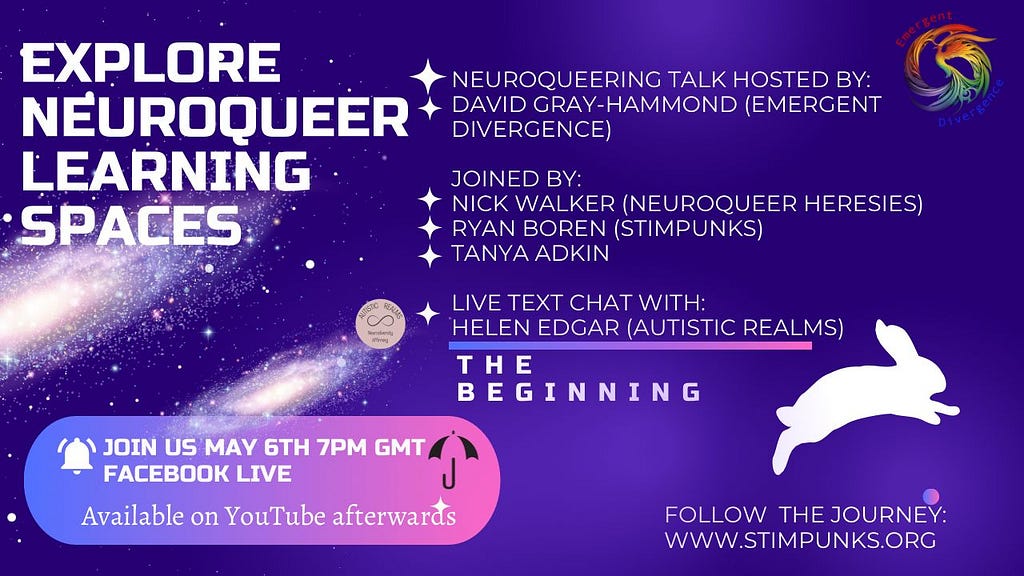
    To support this project and open up further discussions about neuroqueering education and learning spaces, David Gray-Hammond hosted a live webinar, “Explore Neuroqueer Learning Spaces,” with Dr. Nick Walker on 6 May 2024. This is available to watch via David’s Emergent Divergence website and on Facebook YouTube.

    All quotes are taken directly from this webinar unless otherwise stated.

    What is neuroqueering?

    Nick began the webinar by reminding us that ‘Neuroqueer theory is an extension of queer theory into the realm of neurodiversity”. Everyone can neuroqueer. Neuroqueering is not limited to people who are innately neurodivergent and also queer; neuroqueering is open for everyone to explore.

    Neurodivergent people can neuroqueer and diverge themselves into ever-expanding neuroqueer ways of being. Neurotypical people can engage in neuroqueering to diverge their bodyminds further and liberate themselves from socially instilled norms.

    Neuroqueering is an act; it has intent; we can neuroqueer how we live and how we experience, interact, engage and respond to the world around us. Within our neuroqueer learning spaces, we are exploring how neurotypicality, which is socially constructed, can be queered to liberate bodyminds. As part of our Stimpunks Learning Spaces project, Ryan and I are also exploring the benefits and potential of embracing an embodied education within our neuroqueer learning spaces. An embodied education is also something that Nick expanded upon and stressed the importance of as she shared some examples of her practice within this webinar.

    “Neuroqueer theory is about creative neurodivergence” (Nick Walker)

    What if…?

    “Neurotypicality is limiting” (Walker). Neuroqueering involves engaging with life and opening up possibilities. Neuroqueering expands potential, questions boundaries and subverts normality. It enables us to explore, to try, to be curious; it opens up questions and the potential of ‘What if…?

    The potential of ‘What if?’ is often found in children’s excitement, awe and wonder as they playfully explore the world around them. They may excitedly run up to you with a twig or shiny stone they have found, wanting to share that moment of finding something that fills them with joy and curisoity and is reflective of the pure magic of being alive and discovering the wonder of the world. Over time, the awe of finding the ‘Marvellous in the Real’ (Grand, 1978) often becomes eroded in people due to the neuronormative expectations that weigh down on our bodyminds to behave, act, talk and even only show joy in certain ways.

    Nick and David expanded on this by referring to Nick’s writing about hand movements and stimming, which is also explored in Neuroqueer Heresies (2021, p183–191). There are often enforced school rules based on neuronormative values and expectations for having “quiet hands”, doing “good sitting”, doing “good looking” (making eye contact with the teacher in class) and demonstrating attention skills in specific ways. The use of Positive Behaviour Support(PBS) plans and Applied Behaviour Analysis (ABA) to reinforce certain behaviours and actions, such as ‘quiet hands’ has been proven to cause considerable harm and trauma, especially for autistic people as it aims to suppress and eradicate their innate need to regulate by stimming and expressing themselves authentically. There is a comprehensive resource list about the harm of behaviourism on Stimpunks website. We are also creating “Why” sheets to help parents and professionals advocate and provide neurodiversity affirming alternatives to support young people.

    Many other questions were posed throughout the webinar, including:

    How do we queer neuronormativity?

    How do we queer our bodyminds?

    What does this look like in a learning space?

    (We hope to expand these webinars so we can loop back to some of these questions and the comments raised in the text chat. )

    Systems

    Nick and David briefly (it is a huge topic!) talked about systemic oppression and agreed that education needs a system of some kind. We can not just destroy the education system; it is not practical or realistic. Some parts can be used or at least transformed. We can neuroqueer the education system.

    People need structure; routines are as important in neuroqueer learning spaces as they are everywhere else. Routines provide feelings of safety and reduce anxiety. More flexibility is needed for people to be responsive and open to change and transformation. We need to ask what our routines look like, what purpose they have, and what use are they? How responsive and adaptable are they? Are they created in collaboration with others?

    Inspired by the quote from Audre Lorde (1984), “The master’s tools will never dismantle the master’s house”, Nick said that we don’t need to burn the system down; instead, we should:

    “Queer the system, queer the tools and create new tools.” (Nick Walker)

    David highlighted that contemporary approaches to research looking at the oppressive structures of our education system are often reactionary, suggesting systems are torn down; however, this could be a barrier in itself to neuroqueering. If you are focused on tearing down the system, you are not neuroqueering. Neuroqueering is not destructive; it is transformative.

    To neuroqueer is to transform, not destroy. (Helen Edgar)

    Based on the work of Stafford Beer’s cybernetic principles, Nick suggests that it is not necessarily the idea of systems and hierarchy that are the problem; instead, it is the way neuronormative ideals currently enforce them. We need more flexibility and collaborative, interdisciplinary approaches.

    To what extent are some parts of the current system repurposable?

    Can we remake the tools, and create new tools?

    What do we want to dismantle, and what do we want to reshape?

    Space

    How can we queer our physical learning spaces to free the body?

    Nick shared her experiences as a professor, and she emphasised the importance of being a facilitator of learning. She shared with us how she values adopting a collaborative approach to learning where students are not passive recipients but are co-creators. She asks her students to question what knowledge they bring to their learning space so everyone can learn together.

    Nick provides a liberating neuroqueer space for students to express their ways of sharing the knowledge they have gained and collaborating with others. Not enforcing neurotypical ways of demonstrating t ways (tests or enables people to express themselves in ways that suit them, whether through art, poetry or other forms of self-expression. This way of working leans nicely into the courses Nick delivers and facilitates. It would be interesting to know what neuroqueer learning spaces could look like for other subjects, younger age groups, and those with different needs and interests.

    Based on her own experiences, Nick suggested a few practical ideas for neuroqueering the physical layout of learning environments. Even small changes can make a difference; instead of having desks in rows, she suggests having circles and a variety of other places that enable freedom of movement and embrace different learning styles.

    In our Neuroqueer Learning Spaces project, Ryan and I are looking at the potential of Cavendish Space based on the three primordial learning spaces advocated for by David Thornberg.

    Cavendish learning spaces are based on flexibility, interaction, movement and the role of embodied responsive experiences. There is no learning without the body. The boundaries of traditional neuronormative classroom settings not only restrict embodied experiences but lead to disembodied experiences and can cause harm”. (Boren and Edgar, Stimpunks, 2024)

    Cavendish spaces are psychologically and sensory safe spaces suited to zone work, flow states, intermittent collaboration, and collaborative niche construction. They have a golden thread of an embodied education running through them, and there is endless scope for learning the potential of the body, mind and soul. (Boren & Edgar, Stimpunks, 2024)

    ”Enabling autonomy of movement and acknowledging the different ways people learn best through their bodies needs to be considered. It is essential to allow people to move around, pace, stim, sit on the floor, and adopt positions and movements that are comfortable for them and have the freedom to change”. (Nick Walker)

    This is only the start of our journey exploring neuroqueer learning spaces. If you are interested in our project and would like to learn more, please get in touch with us at Stimpunks.

    “Until you make the unconscious conscious, it will direct your life, and you will call it fate” — Carl Jung.”*

    Thank you to David Gray-Hammond for hosting this event and thank you to Dr. Nick Walker for your support and the fabulous webinar.

    EXPLORE NEUROQUEER LEARNING SPACES. NEUROQUEERING TALK HOSTED BY: DAVID GRAY-HAMMOND (EMERGENT DIVERGENCE) Diverse JOINED BY: • NICK WALKER (NEUROQUEER HERESIES) RYAN BOREN (STIMPUNKS) TANYA ADKIN LIVE TEXT CHAT WITH: HELEN EDGAR (AUTISTIC REALMS) THE BEGINNING. Image of purple pink space/galaxy scene with a white bunny.JOIN US MAY 6TH 7PM GMT A FACEBOOK LIVE Available on YouTube afterwards.FOLLOW THE JOURNEY: WWW.STIMPUNKS.ORG

    * a quote often attributed to Carl Jung (nb. there is no reference we can find for this but Dr. Jung did say: The psychological rule says that when an inner situation is not made conscious, it happens outside, as fate. That is to say, when the individual remains undivided and does not become conscious of his inner opposite, the world must perforce act out the conflict and be torn into opposing halves. ~Carl Jung, Aion, Christ: A Symbol of the Self, Pages 70–71, Para 126.)