“The whole world is only a virtuality that currently exists only in the folds of the soul which convey it, the soul implementing inner pleats through which it endows itself with representation of the enclosed world.” — Gilles Deleuze, The Fold (1993, P. 24).
Thoughts…..
I am exploring how Deleuze’s ideas in The Foldentwines with the theory of monotropismand the lived textures of Autistic perception and attention through a neuroqueer lens.
What if monotropic attention and perception is folded, what happens when we unfold?
What if Autistic time moves in spirals, not lines?
Folding Worlds
“The world is an infinite series of curvatures”
Sometimes, when I’m deeply absorbed, following the rhythm and flow of an idea, a line of flight, or feeling sound ripple through air the world seems to bend inward. Time loosens, boundaries blur and my mind folds into the moment until it feels like my thought, body, and world are all moving together as one continuous curve.
Deleuze, in The Fold, imagined reality itself as endlessly pleated, an intricate fabric of curves and contours where inside and outside are never truly separate, each perception and experience establishes ‘folds in the soul’. (p. 112) As Autistic people our sensory systems are more porous, each life, each experience, each moment, is a fold within this larger flow of existence, all entangling together with the environment around us.
As an Autistic person, you may feel like I do, that you live in the liminal spaces, the in-between. The world doesn’t divide neatly into subjects and objects but moves almost as if it is a single and multiple simultaneously, perhaps holographic , a folded plane of becoming.
Monotropism (Murray et al., 2005) is the theory that explains how Autistic and ADHD experience is shaped by deep, focused attention. Instead of our attention spreading thinly across many things, our attention folds inward, gathering tightly around may be just one or a few single streams or tunnels of interest or sensation at any given time. It’s not a limitation, it’s a different rhythm, it is how we experience flow and can be a really energising and regulating experience when we are looped into something positive that helps us. Our minds tend to curve toward what holds meaning, creating a rich, textured world from within that fold where our attention dwells.
Where neurotypical attention might skim across multiple channels of attention, monotropic attention lingers and has capacity to stay focused for long periods, especially when in the right supportive environments. Monotropic attention inhabits, it listens deeply and it is in these moments of flow, the world is not distant as some may think, rather the world is inside us, rich and intense. It is like it is folded through our senses, our language, our movement to such intensity we become-with our surroundings.
Unfolding
“A fold is always folded within a fold, like a cavern in a cavern”. (P.6)
Folds can be fragile, like origami. When too many demands pull at once, such as sensory input or social expectations, it is like the fold can’t stretch without straining and something has to give before it breaks. Overload, fragmentation, and burnout emerge when the world presses too hard against our natural curvature and forces the fold to carry more than it has capacity for. We may experience more meltdowns or shutdowns and over a longer period could enter a full burnout. Burnout, in this sense, isn’t failure of our body minds; it’s like a wound in the fold. It happens when we are forced to unfold too quickly, without time or gentleness and without the right support.
Liminal Folds
The space between inside and outside, that delicate threshold in the liminal zone, is where I live and perhaps many other Autistic people live too. It’s the edge of sensory, emotional and social attunement, where the world can feel both too near and too far at the same time. Safety, trust, and co-regulation allow the fold to breathe, it gives space to expand and recover. To unfold safely, enables us to unmask ‘to increase and grow’.
When others meet us at our own tempo and in our own authentic ways, our fold can open slowly, naturally, toward a node of connection with others. It strengthens the vulnerable liminal spaces in-between, it can be empowering and gives us energy to follow that curve of a fold and see where it takes us, to resist neuronormative linear ways of being.
Neuroqueer Curvatures
To neuroqueer is the act of living otherwise, resisting the norms that demand sameness, linearity, and temporality. It invites us to honour different ways of moving through the world: curved, recursive, and rhizomatic.
Through this lens, embracing your Autistic/ADHD monotropicness can become a neuroqueer ecology. It is a way of being that disrupts the assumption that we must flow in straight lines and contort ourselves and fold and contort ourselves to fit into heirarchies and systems. To embrace the liminal and the Autistic fold is an act of quiet defiance, a refusal to flatten complexity or to perform productivity and neuronormative expectations at the expense of our own well-being.
Our monotropic deep focus isn’t a deficit, it’s an orientation, it is a different way of being and living. To embrace flow and see where the fold takes us. It reveals a world that thrives on depth and immersion rather than breadth. To move with with the flow of our monotropic attention, along the fold is to inhabit curved time, the slow, spiral rhythm of a mind that folds toward what matters most to us.
Folding Time
For many of us, life doesn’t move in a straight sequence. It curves back, loops, and gathers around moments of attention. This is folded time, neuroqueer temporality or what others have called mad time, time as felt texture rather than moving like clockwork.
When I am in deep flow, the past and future dissolve into the intensity of an ever expansive ‘now-ness’, when the fold releases, I spill gently back into a wider space, I always need time to recalibrate, to find the edges again and to find something to loop and back hook into before I can move on.
To live through folded time is to understand that attention has its own seasons. Some days are for spiralling inward, composting thoughts and gathering energy and others may be for stretching outward, connecting, creating and reaching new nodes.
Folding with the World
“Perception establishes the folds in the soul” (P. 112)
In the folds of Autistic attention and perception lie whole worlds of knowing and becoming. Through monotropism and neuroqueer theory, we can reimagine these folds not as constraints, but as living spaces of creativity, connection, and a different temporality.
Within these curvatures, difference becomes depth, a way of sensing the world through texture, rhythm, and relation rather than conformity. Our attention moves like tidewater, folding and flowing inward to nourish the self and unfolding and rippling outward to meet the world again.
When we are allowed to move at our own pace, these folds open into more realms of possibility, spaces where curiosity can root, where safety and belonging can take form.
To live within the Autistic fold is to recognise that we are not separate from the world, but continuous with it, each of us a unique curvature in the greater flow of being. By embracing our folds and natural flow of monotropic attention, we can honour the quiet sensory moments, our rhizomatic ways of being, and the beautifully entangled ways we come to know, feel, and create within our selves and connect with others.
Reflections
How does your attention fold?
What might unfold if your natural rhythms were met, not resisted?
References
Deleuze, G. (1993). The Fold: Leibniz and the Baroque. U of Minnesota Press. (quotes from Continuum edition, The Athone Press, 2006).
Walker, N. (2021). Neuroqueer heresies: Notes on the Neurodiversity Paradigm, Autistic Empowerment, and Postnormal Possibilities. Autonomous Press
This section of the poem from Lord Byron, Childe Harold’s Pilgrimage, speaks to me deeply and resonates with my Autistic experience of meaning as something felt, sensed, and lived through, especially in solitude, sensory immersion, and more-than-human connection.
There is a pleasure in the pathless woods, There is a rapture on the lonely shore, There is society where none intrudes, By the deep Sea, and music in its roar: I love not Man the less, but Nature more, From these our interviews, in which I steal From all I may be, or have been before, To mingle with the Universe, and feel What I can ne’er express, yet cannot all conceal.
Autistic meaning-making is not abstract, but an embodied attunement, a “mingling with the Universe” that resists neuronormative expression yet pulses with emotional and sensory intensity.
As Erin Manning wrote, “Autistics…are hypersensorial, alive not only to the presence of the other, but more importantly, to the absence of category. They live the differential, feeling into the world’s quality of emergence. Bodying, for them, is worlding.”
Autistic experience often resists the default social scripts and expected ways of making sense of things, our thoughts are less linear, more constellation-y and rhizomatic. They may appear chaotic and not always make sense to others as the connections are happening deep inside us.
Meaning for me, often arises between things, in the liminal spaces, in the felt sensory and emotional moments, a subtle change of a sound, the shifting pattern of sunlight on leaves and my relationship with living things that don’t speak in human words, and also a more natural attunement to people who also can’t or prefer not to speak verbally.
Like Lord Byron’s “rapture on the lonely shore,” the Autistic sense of meaning-making may emerge most powerfully in the absence of human intrusion, words and voices, not from isolation, but from a deep, open presence with what is. It is why we may crave time alone, in our dens, out in nature, fully immersed in stimming activities and other forms of communication and connecting online. Alone time is so often stigmatised as being antisocial, but it is a different kind of sociality, and may be more meaningful for many Autistic people and is something to value and allow ourselves the time to lean into in what ever way we want and helps us feel good. It may be less about escaping and more about finding belonging in other ways and belonging otherwise.
Autistic people often experience a heightened resonance and connection with our environment, this may not always be with people, but with animals, objects, places, atmospheres and sensory experiences. This is not a deficit of sociality, but perhaps a re-routing of relational (monotropic) attention toward the more-than-human, an ethodivergent way of being. (Ombre Tarragnat, 2025)
I have written extensively about liminality, the in-between spaces where many Autistic people feel they may be stuck, but I think it is in these liminal spaces and states, where our bodyminds “mingles with the Universe,” that we can find a quiet calm that helps regulate, bring comfort and a meaning that allows us to emerge from the liminal or delight in the dwelling moments of the unspoken between realms. It is in liminality that Autistic perception becomes a kind of aesthetic felt knowing. It may not be easily verbalised or put into human words, “what I can ne’er express” but it is real, it emerges and can be captured in art, poetry and nature, in our online community spaces and is valid.
“There is society where none intrudes”.
“There is pleasure in the pathless woods” when we diverge from neuronormative expectations and follow our inner compasses.
Allowing ourselves to feel, wholly and completely and merge with our environment is a way of creating our own language, a bodymind way of being that doesn’t rely on human words and can be felt and understood in other ways………we need to create our own worlds, reworld, neuroqueer – so we can survive together in a world dominated by neuronormativity and find our own place of belonging.
Sharing early morning thoughts after having read more of Erin Manning‘s beautiful work last night ‘A Feel for Others Feeling You‘ (2025), about challenging normative orientations around the concept of mirror-touch synaesthesia and touch (inspired by the DeafBlind Protactile community and work of John Lee Clark).
“To feel the touch of the world is to feel the difference the world brings to all it comes into contact with, and this contact cannot be separated from all that worlds. To be a body is to be in contact. To touch is to feel the differential.” (Erin Manning, 2025)
Thoughts welcome – I am hoping to set up an alternative space to explore through Autistic Realms into More Realms to share, discuss and collaborate on things like this with anyone who is interested alongside CASY Cultural Autism Studies at Yale and Stimpunks communities.
“Ocean Waves by Adriel J Wool” is a meditation in ambient flow states. Introduced with a special tuning that allows the brain to touch and feel more true pythagorean intervals of musicality.
The flows and textures of nature follow patterns that resonate with the human body through its ability to hear sound.
The nervous system is a microcosm, however it relates in scale to the power of nature, and is comforted within her crests.
To breathe more slowly and more deeply. The sound spectrum is given in the powerful release of deep sound energy, very much like the Earth’s beautiful shores.”
“Ocean Waves by Adriel J. Wool isn’t a recording of the ocean, it’s a fractal composition of the nature of the ocean. Modulated into swells, the rhythm evokes the massive release of great ocean waves and the more humble release of the human breath“. Ryan Boren (Stimpunks)
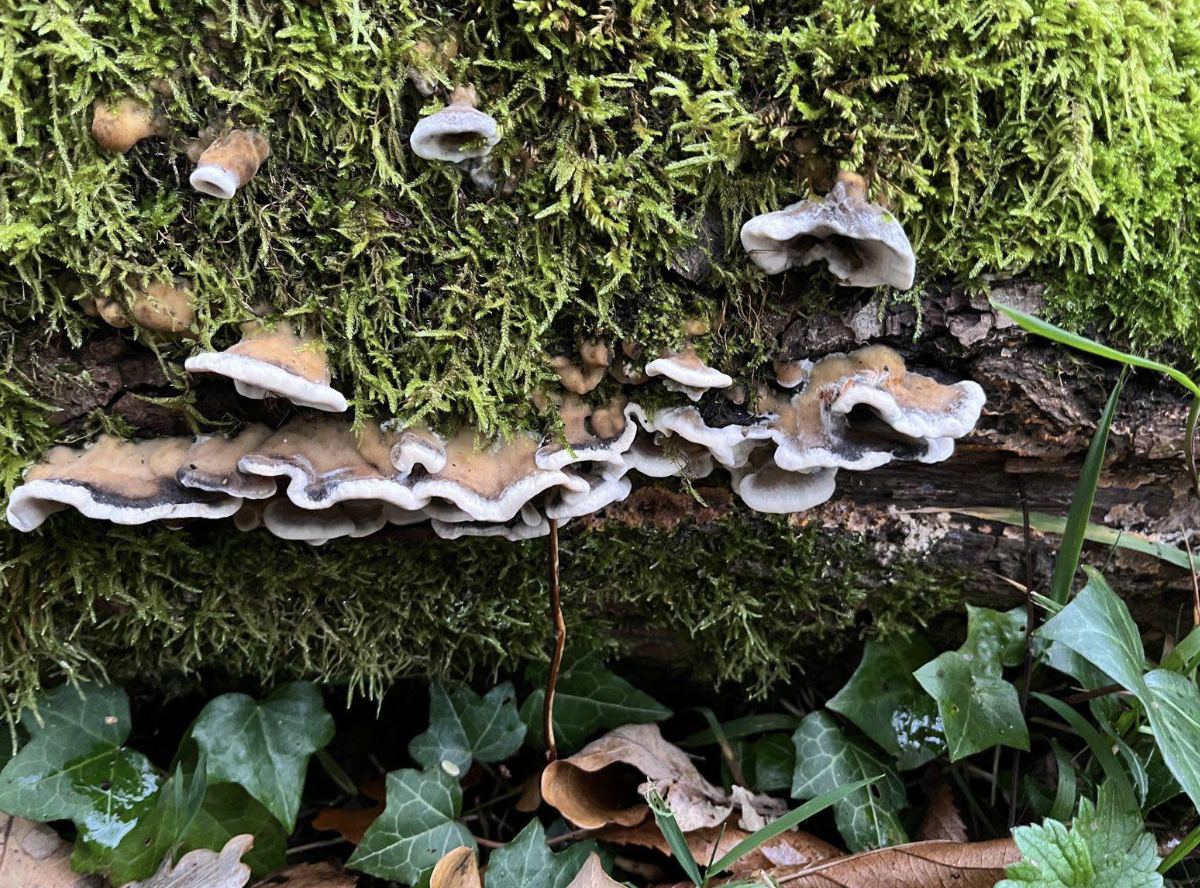
The quote, “Attention without feeling, is only a report.” from Mary Oliver — Upstream: Selected Essays (2016) resonates with me as a deeply monotropic person. It summarises what happens whenever I find myself pulled into a moment so fully and immersively that the boundary between noticing and becoming begins to dissolve, and time melts away. These moments will be different for everyone, they happen when our monotropic bodyminds are pulled towards something, it returns when I am in woodlands and when I see moss, fungi, flowing water.
There’s something about moss, it’s soft resilience, its quiet deep greenness of a million shades, the way it persists and thrives on forgotten land and inbetween stones, on forest floors and brings old things back to a new life. Moss doesn’t demand to be seen, but when we do look, really look, really feel, and really give ourselves time to sense and be with moss, it offers a different kind of presence and an almost different kind of knowing and connecting and Autistic Joy.
I am exploring the idea of moss as an invitation to consider monotropism, ethodiversity, and neuroqueering our spaces as a way of creating belonging. Drawing from the work of Popova, M. (2023). The Magic of Moss and what it teaches us about the art of attentiveness to life at all scales, Robin Wall Kimmerer, Mary Oliver, Anna Lowenhaupt Tsing and others, alongside my emerging neuroqueer and holographic ideas, I am considering if moss (like mushrooms and water which I have written about before!), could offer not only a symbol and metaphor for neurodivergent thriving but a methodology to reclaim creative practice and ways of being that resists the fast, extractive modes of dominant neuronormative culture.
Monotropism (Murray et al, 2005) is a neuro-affirming theory of Autistic experiences. It describes a tendency to enter flow states of deeply focused attention, to move inward towards just one or a few connected interests, sensations, or patterns at anyone time and to dwell there. This is not just a cognitive style; for myself being monotropic it is a whole-bodymind sensory way of being. For many Autistic/ADHD people, monotropism underpins and helps to make sense of our sensory experiences, ways of learning, communication styles, and creativity. If you are Autistic / ADHD the theory of monotropism may resonate and help explain how you process and relate to the world.
In environments dominated by neuronormativity ,which are structured around multitasking, high demands, quick-switching of attention tunnels, and surface level engagement, monotropic people can be often misread as being obsessive, inflexible, or disengaged. If we reframe this deep-focus not as deficit, but as capacity and energy, it offers a more affirming lens of Autistic experiences as being a form of attunement with attentional resources, a way of giving attention feelingly and holistically.
For me, Robin Wall Kimmerer’s Gathering Moss(2003) exemplifies monotropic attentional ecology. Her writing spirals and notices what others may overlook such as the micro-patterns of bryophytes (group name for any non vascular, rootless plants like moss) , the webs that cover forest floors and emerge through cracks and over sleeping objects. Kimmerer just doesn’t describe moss she enters into relationship with nature, her science and writing is guided by care, her noticing is lived, it feels very monotropic much like Merlin Sheldrake’s Entangled Life (2023).
To attend like this, monotropically, with feeling and deep attention is not just to extract facts, but to stay present with complexity, multiplicity and connect with nature and our environment rhizomatically, completely and become deeply absorbed in greenness and texture. As Mary Oliver reminds us, “without feeling, attention becomes mere reporting“. For some monotropic people their perception may offer a different kind of report / blog writing/ creative experience, one filled with sensory details and emotional resonance, there are no barriers between the body and the environment, the moss, nature.
Nature Positivity: We Are Not Outside the Ecosystem
Nature positivitywas a term only recently introduced to me on Barbara Melville’s writing course. It made me think about how as a neurodivergent person I am not disconnected from nature but often deeply and almost painfully attuned to it, inseparable, we are a part of nature. We do not need to be brought back into the natural world; we need to be recognised as already being part of it. Our sensory experiences, our flows of attention, our non-normative experience of time, memories and rhythms, aren’t deviations from a natural or ‘normative’ baseline, they can be seen to be part of biodiversity and our wider ethodivergent ways of being (Tarragnat, 2025).
Ethodiversity is a term developed by Ombre Tarragnat (2025) to describe the variability of behavioural and existential styles within and across species. Ethodiversity invites us to move beyond a purely neurological model of divergence and into a more-than-human framework of difference. It reminds us that there are many ways to live, relate, and thrive not only for humans, but for all living things.
Moss embodies ethodiverse wisdom. It rejects hierarchy and human time, it forms webs, it’s value is in its interconnectedness and the spaces inbetween. We can learn from all non-human beings and living things, we are all interconnected and if we give our selves more time to tune in to the natural world we could perhaps can expand our ways of thinking, not just as humans for humans, but as part of nature. We can help to recreate a world where every living thing can thrive (non-human and human). It creates a space to think about our relationship with the wider planet we are in, the importance of environmental sustainability, not just focusing on our human-centric needs (Solarpunk ideas).
In this sense, moss, like many other aspects of nature, becomes a kind of kin, we are interdependent. I think lots of us are trying to survive from the edges, in the liminal spaces, trying to grow in shade and darkness through cycles of burnout. I live in the dark-mode, underground settings of Discord servers, it is where I feel at home, inbetween the reality of life outside my front door and where I really feel safe and a sense of belonging. Moss grows across ruins, rooftops, gravestones and inbetween the places and objects people normally tread over or overlook. It softens hard spaces and it survives and thrives on it’s own terms, in it’s own way much like our online community spaces.
Mushrooms and fungi, like moss, offer a metaphor of hope and an opportunity to think about how we can create a life from capitalist ruins which invalidates and overlooks neurodivergent needs and potential. Anna Tsing’s The Mushroom at the End of the Worldreminds us that life persists in the ruins of Capitalism, not in spite of disruption, but through it and can flourish through adversity. Like matsutake mushrooms thriving in disturbed forests, neurodivergent people often live in the edges of systems, through adversity, in fractured spiral time, outside of centralised blueprints and neuronormativity, however hard these systems try to contain us and pressure us to mask. This resonates deeply with monotropic ways of being, our ability to create our own Autistic rhizomes and communities, how our senses sometimes form unlikely but radically resilient connections in overlooked spaces.
Tsing’s emphasis on precarity, interdependence, and multi-species assemblages mirrors the sintered ways neurodivergent communities form: not through uniformity, but through shared friction and feeling. Our creative practices become more than self-expression, they are part of what Tsing calls the “arts of noticing,” where we document life not for control or mastery, but as a way of staying with complexity and multiplicity and to create shared meaning. It is a way to honour our entangled, emergent, sensory ways of being as ecologically vital. It reminds us that even in fragmented systems and broken ground, we can reclaim ourselves, find connection, and grow into something whole, be together and create something new.
Sintering
In Sintering: Neurodivergent Community Building(2025), I explored the metaphor of sintering. Sintering is the process through which individual snow grains gradually begin to bond. Tiny necks form between them, bridging the gaps, making the snowpack stronger, more resilient, and more resistant to collapse.
In Theory of Water: Nishnaabe Maps to the Times Ahead(2025), Leanne Betasamosake Simpson offers this as a metaphor for collective becoming. “Sintering is a joining,” she writes, “It is a communal transformation that creates a fabric of former snowflakes bonded to each other… Sintering is bonding, it’s building coalitions with your neighbours” (p. 18).
This analogy resonates deeply with my own experiences of the neurodivergent community and the Autistic rhizome. Many of us begin our journeys alone trying to discover our real identity under the layers of masking and internalised ableism, realising we are caught in systems not made for us and that is why life has felt SO hard! Discovering I was Autistic was life changing for me. In my 40’s I suddenly had access to a whole world of new vocabulary to describe my experiences. It has been through connecting with other neurodivergent people through various online communities and sharing stories that my life has begun to make more sense. When we find each other across difference, across shared experiences, we can start to build bridges, rhizomes. Through conversation, care, and solidarity, we can begin to sinter.
Neuroqueering from the Liminal
InNeuroqueering Liminal Spaces (2024), I wrote about the spaces where categorisation breaks down between identities, between disciplines, between states of being. Neurodivergent people often find ourselves in these thresholds, not quite fitting in, living in the margins, I am suggesting that liminality can be a fertile and exciting place to neuroqueer and evolve from.
Moss is liminal, it exists between. It mediates, connects and holds and brings things together. In many ways it could be seen to reflect what neuroqueer creative practice can be, something that isn’t fixed, something that moves away from dominant frameworks, it is textured and radically relational and multidimensional.
To write from moss is to write from the in-between spaces, attune to our environment, to feel safe and at home. It is to resist linearity, binary ways, hierarchy and to embrace multiplicity, to value the process of becoming and connecting.
Moss offers a model for neurodivergent thriving, one that honours attention with feeling, presence without performance and growth without urgency. It teaches us to notice differently, to value slowness, to dwell in the cracks and embrace neuroqueering,monotropic felt time.
Our creative practice can be moss-like, it can be sintered through our shared stories and experiences. To attend with feeling and lean into monotropic time can be a lifeline for many people who are experiencing burnout. It is a way of reclaiming our authentic ways of resting and being.
Monotropic attention, a different ecology
In the Writing the Dawnworkshop I took part in this week, Barb Melville encouraged us to begin our writing with a nature-positive message. She asked us, not just what we notice, but why it matters. For me, moss represents a kind of quiet kinship, it is soft, slow and often overlooked and fills me with sensory joy. As a neurodivergent person, I see myself reflected in its persistence, its texture, its need for quiet, shaded places to thrive. In protecting nature and moss we are also protecting our sensory environments, the liminal spaces, and the overlooked ecologies that support neurodivergent ways of being and feeling safe.
This reflection can become call to action which Barbara invited us to think about. It enables us to think about reimagining ways of connecting, not just with nature but in the way we create our communities, educational spaces and care settings. We need to design practices that honour differences, not pathologise. Like moss, neurodivergent people thrive with more time and space, gentleness and connection in spaces like our Neuroqueer Learning Spaces.
My home is in the mossy, liminal spaces that we create together, in our reaching toward one another. Our strength is in radical resilience and sintering, our refusal to face the world alone, valuing interdependence and not conforming to harmful systems based only on neuronormative values.
Radical resilience does not come from hardness or conformity, but from mossy softness, it comes from flow and fungi like rhizomatic community networks and the cumulative strength of many unique connections forming bonds to offer support to each other. As Bruno Lataur summarised, “Learning to live in the ruins of capitalism means learning to do without the notion of projects and, finally, moving on to an attentive description of situations that cannot easily change scale…..With her dog Cayenne, Donna Haraway had proved how far one could take analysis of relations between species. With her matsutake (mushroom), Anna Tsing proves that we can go still further, modifying not only the landscape to be described but what we should expect of meticulous description.”
Mossy, messy, monotropic ways
Nature-positive writing what ever the focus – mushrooms, moss, trees, water can be a radical act of reclamation, helping us grow cultures and communities that are ecologically aware. Neurodivergent spaces are rhizomatic, soft, mossy, fluid, flowy, webby and spirally and entangled. They allow space for dwelling, noticing, interdependence and omnidirectional growth.
‘To walk attentively through a forest, even a damaged one, is to be caught by the abundance of life: ancient and new; underfoot and reaching into light.’ pg 155 (Tsing)
Let’s keep growing spaces that honour slowness, texture, and sensory ways of knowing and feeling, where monotropic ways of being are not just accepted, but celebrated. Spaces where infodumping, deep focus, stimming, and sensory richness are recognised as meaningful ways of connecting and building interdependence between humans, non-human beings and our wider environments.
Monotropism lets us sink into and experience the world with our full-bodymind presence, not just noticing, but flowing and feeling with the world in ways that bring resonance, validation, and a sense of belonging. Mary Oliver wrote “Attention without feeling, is only a report.”, for monotropic people how we use our attentional resources helps to explain everything, it is how we experience life in all it’s joyful mossy, messy ways.
“Next time the bus is late, take those waiting minutes to look around for signs of life….. amidst the noise and fumes and elbowing crowds, there is some small reasurance in the moss between the cracks.” (Kimmerer, Gathering Moss, pg 105)
References & Further Reading
Kimmerer, R. W. (2003). Gathering Moss: A Natural and Cultural History of Mosses. Oregon State University Press.
Oliver, M. (2016). Upstream: Selected Essays. Penguin Press.
Tarragnat, O. (2024). Biodiversity, Neurodiversity, Ethodiversity: Towards a More-Than-Human and More-Than-Neurological Turn in Neurodiversity Studies. TRACE: Journal for Human-Animal Studies. https://trace.journal.fi/article/view/144936
Murray, D., Lesser, M., & Lawson, W. (2005a). Attention, monotropism and the diagnostic criteria for autism. Autism, 9(2), 139–156. https://doi.org/10.1177/1362361305051398
Tsing, A. L. (2021). The mushroom at the end of the world: On the Possibility of Life in Capitalist Ruins. Princeton University Press.
Haraway, D. (2007). A Cyborg Manifesto: Science, Technology, and Socialist-Feminism in the Late 20th Century. In Springer eBooks (pp. 117–158). https://doi.org/10.1007/978-1-4020-3803-7_4
*“Memories scatter like shards of seaglass along a fractured spiral, the centre always slipping just beyond my grasp. Hazy images and sensations drift in and out of the fog, sometimes offering sharp glimpses, but rarely staying long enough for me to hold. Most pass by shrouded in a soft mist, like half-formed echoes trapped within a labyrinth. Sounds, images, smells, and feelings blur and merge, tangling into an ever-expanding rhizome, sprawling in all directions, folding in on themselves. Memories come more as felt impressions than as concrete events. Remembering isn’t straightforward for me; it’s less recall and more a process of re-navigation. I have to trace uncertain paths, try and find a thread to hook into to regain my flow, often sensing that what I’m reaching for is just out of reach if trying to recall a specific event, but my sensory memories are more clear and vivid as they are felt sensations – which is hard to explain to people who may not experience their memories in this way. ”
I am currently on a Neuroqueering Your Creative Practice course led by KR Moorhead, Marta Rose and Meg Max. This week we were exploring time and memories, which felt very apt given my recent monotropic outpourings about time. In this week’s session I wrote the above piece about how I experience memories.
Memory may not be linear for neurodivergent people. It may feel like a spiral of felt sensations. Being monotropic shapes how I re-sense moments, navigating echoes and threads of sensory experiences rather than always recalling events. I felt validated that some other people seemed to relate and share similar experiences of their time not being linear and also being quite hazy recalling specific events but having really vivid recollections of more sensory experiences.
Monotropism and Memories
Monotropism is a theory of Autism (Murray et al 20025) that describes a way of focusing attention that tends toward deep but fewer channels. For those of us who experience the world monotropically, attention locks in and tunnels can form like portals. These attention tunnels can lead to intense engagement and immersive sensory experiences, but they may also shape how we encode, retrieve, and relate to our memories.
Memory for me is not a fixed archive of past events filed neatly on shelves. It is alive, constructed in the present, woven from threads of past focus, emotion, embodiment, and attention. For monotropic people, those threads may be less linear and deeply context-bound in our sensory experiences. We may not remember when something happened in conventional, sequential neuronormative time but we may vividly feel how we experienced something, we may recall the sensory landscape, the tone, the rhythm of presence or absence.
Spiral Time and Felt Time
I’ve written previously about monotropic experiences of time as being like ever expanding rhizomatic spirals like rather than a linear A-B or 9am to 10pm of time as lived by the clock and conventional calendar. I think this also shapes how memory functions, rather than stretching out along a clear chronological line, time for me feels like it folds back in on itself and experiences and memories happen and are stored within the folds (a concept from Deleuze that I have written about at length). A moment from years ago might feel right now, while a conversation from yesterday may feel distant or unretrievable unless there is something to hook me in and brings it back into focus so I can retrieve the thread and follow the flow.
In monotropic spiral time, memories don’t behave like neurotypical people may expect or how we may have been brought up to understand how memory works. My memories don’t line up neatly, they tangle, twist, merge and drift like mist through a forest. Sometimes I feel I’m not remembering in the traditional sense at all, but kind of re-sensing, like I am trying to feel my way through a fog of echoes and impressions, a texture, a tone of voice, the way the light fell. It makes my memories of concrete events feel hazy and fuzzy but my experiences feel vivid and it can be quite confusing and frustrating at times.
Labyrinths and the Rhizomes
For monotropic people our minds and memories may feel less like walking through an album of neatly arranged photos and more like navigating a vast, living labyrinth. I can’t easily “go back” and retrieve a memory, it feels like I have to wander, I have to reach out and try and sense where the thread of recall might catch and hook onto something, what I often find is not a single event but a tangle, a rhizome of multisensory experiences that I have to unravel.
This rhizomatic quality of navigating time means my memories don’t live in isolation, they’re not strictly filed under “birthday, age 9” or “Monday morning, March 3rd.” Instead, they seem to connect through shared emotions and sensory patterns. One feeling or sensory experience might loop me back to three seemingly unrelated moments, a smell might pull on threads across decades and I don’t always know why. This can be disorienting in a world that expects time and memory to be neat and logical but it’s also a kind of richness, a depth of connection that linear systems seem to often miss. It can make conversations with friends and family hard as it seems like I am not interested enough in people to have created a core memory like in the Disney film Inside Out, my memory of real life events feels like a sieve where things happen then disapear but they are all there, it is just perhaps that they are stored differently.
It brings me back to my first blog I wrote on More Realms (2023), Middle Entrance. In 1943, T.S. Eliot’s collection of four poems were collated to form Four Quartets. The final poem in this series Little Gidding (1942), continues Eliot’s exploration of time and our connections with each other through generations and current society.
“What we call the beginning is often the end. And to make an end is to make a beginning. The end is where we start from.”
My memories, relationships and ways of being are like constantly evolving spirals that spin in and out in multidimensional ways. Different connections and experiences add to and contribute to a wider, deeper fluid rhizomatic network of potential that is always in a constant state of flux. This idea of an evolving spiral, hooking onto a node of the rhizome and returning to a new beginning in the middle, liminal spaces, within the folds is how I experience memory. I need time to process, time to rlect and for memories to and beautifully reflected in Eliot’s poem Little Gidding:
“We shall not cease from exploration And the end of all our exploring Will be to arrive where we started And know the place for the first time. Through the unknown, remembered gate When the last of earth left to discover Is that which was the beginning; At the source of the longest river The voice of the hidden waterfall And the children in the apple-tree Not known, because not looked for But heard, half-heard, in the stillness Between two waves of the sea”.
— T.S. Eliot, from “Little Gidding,” Four Quartets (Gardners Books; Main edition, April 30, 2001) Originally published 1943.”
Navigating Memories
Memory for me feels less like recall, I am not able to press a button and retrieve a file (unless it is related to my own special interest about Autism research or teaching in which case my filing cabinet seems to ping open!). It is more like a re-navigation, I have to find the right entry point and node of the rhizome, I need to feel for the thread, follow it gently and try not to tug too hard in case it disappears back into the fog. I often know I know something, but I can’t get to it directly. I need the right conditions or sensory cue to draw it out and that takes time and and can make me appear distant or uninterested when the opposite is true.
This is why questions like “What did you do last weekend?” can feel like demands rather than simple curiosity. It’s not that I wasn’t paying attention, it’s that the question doesn’t align with how my memory map works or how I perceive time. If you ask me what the light looked through my window like as I sat reading in bed, or how the air felt when we stepped outside I might have a more instant response but I probably won’t be able to recall the chronological sequence or events and relate things in an easy to understand order, it is like that gets lost in the spiral. It can be frustrating at times just to have fleeting impressions of memories that I know mean a lot to me but I can’t easily retrieve.
Understanding and Support
Understanding memory through a monotropic lens may helps us honour our different ways of knowing, recalling, and connecting with events and people. For those supporting Autistic individuals, whether as educators, therapists, or family members this means shifting assumptions and instead of assuming memory is absent or deficient it may be better to consider asking things like:
How do memories show up for you?
What helps you reconnect with something you felt or experienced?
Is there a sensory or emotional thread that brings it back?
This may also be empowering for those of us who live and experience life monotropically. It validates the experience of having a different bodymind, of perhaps remembering more through attention tunnels of sensation rather than facts or dates. It recognises that memory is not a failure when it doesn’t fit neurotypical expectations it’s perhaps just a different kind of map that we have to navigate.
“What we call the beginning is often the end. And to make an end is to make a beginning. The end is where we start from.”
Autistic/ADHD people are more likely to be monotropic and resonate with the theory of monotropism. Dinah Murray, Wenn Lawson, and Mike Lesser developed the theory of monotropism in the late 1990s. It is typically described as a neuro-affirming theory of Autism, but I think it is also a temporal mode.
I am considering whether being monotropic is not just about using attentional resources differently, but could also be about experiencing time differently due to how we use our attentional resources.
If you’re monotropic you may notice that:
Time is immersive and fluid.
Transitions may feel disruptive because they pull us out of durational temporal coherence and flow.
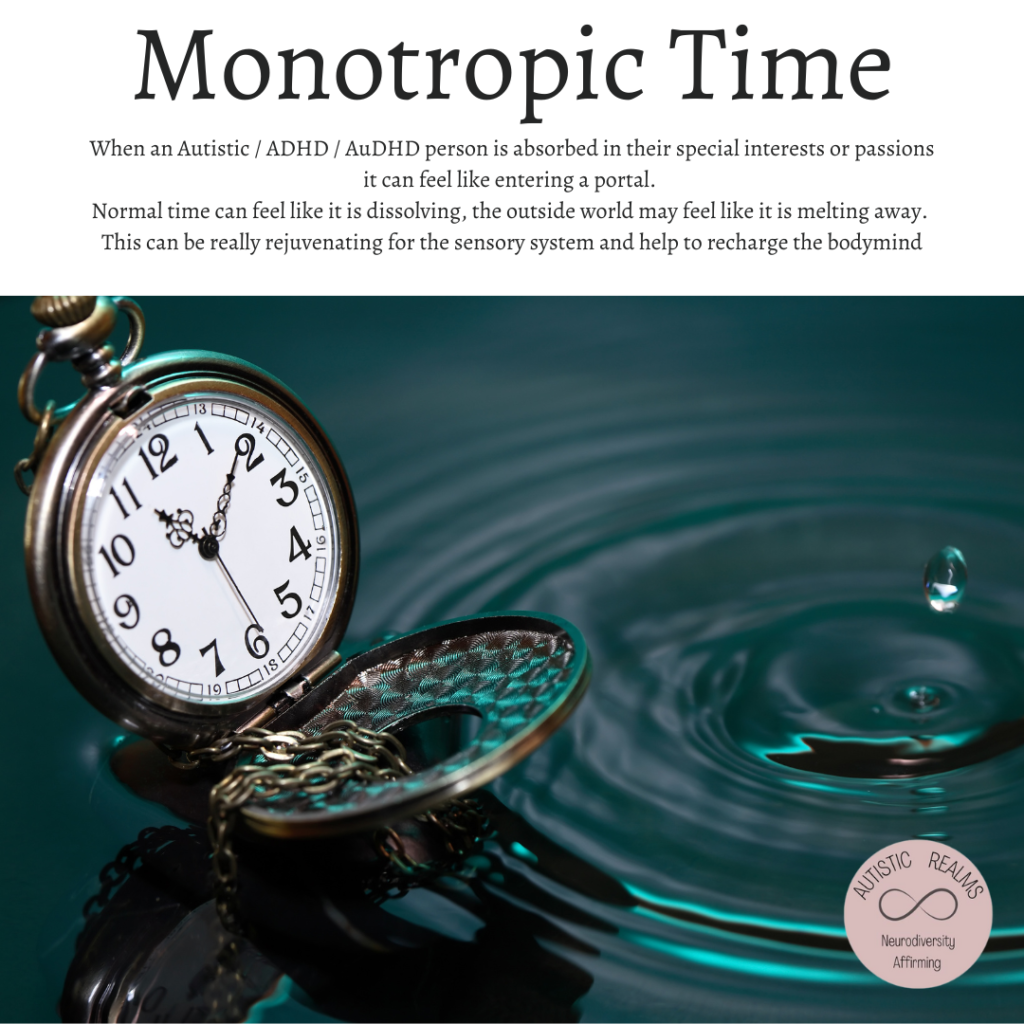
How you use your attentional resources may feel like being in a tunnel, and the world outside of that tunnel may feel like it is melting away or completely disappearing.
Temporal markers (like deadlines, calendars or clocks) may lose meaning or become really stressful and cause intense dysregulation.
Transitions may feel disruptive because they pull us out of durational temporal coherence and flow.
Autistic people often have to mask to fit in, we may struggle to be understood due to differences in our lived experience with other people. This mismatch of ways of experiencing the world is not just a communication gap and difference, as described in the Double Empathy Problem (Milton 2012) it may also be a Double Temporality Problem. Perhaps the world and the majority of people run on neuronormative time (temps), but monotropic people live and experience life more in felt experiences (durée) – in fluctuating flow states, a different internal rhythm that is unique to each person.
The philosopher Henri Bergson (1859–1941) distinguished between two kinds of time:
Durée: lived, qualitative, and immersive duration. This is the rhythm of consciousness itself and FELT experiences.
Temps divides time into identical units, i.e., seconds, minutes, and hours. Durée is felt time. It is how we experience time from the inside, and for Autistic/ADHD people, that may be more sensory and dependent upon the environment and how safe we feel. Bergson saw durée not as a subjective illusion but as the real nature of time, with clock-time being the abstraction.
Monotropic time is FELT. It is immersive, expansive, flowy, omnidirectional and deeply rhizomatic. Monotropic time is like a temporal home.
I believe we need to release ourselves from the grip of neuronormative time. To neuroqueer time is to subvert expectations of how you think you should be living according to the unwritten rule book of society’s norms set out by the majority of the population. Neuroqueering time isn’t just for neurodivergent people; it could benefit everyone.
By neuroqueering ourselves and neuroqueering time, anyone and everyone can break free from the neuronormative time structures that bind us all to capitalism and restrict and cause harm to lives in so many ways. We may be able to live more attuned to our own temporalities and more at one with our environment and those around us if we liberate ourselves from the ticking hands of the clock and find more flexible ways to manage our flow and our own time.
Let’s dwell in our natural flow and rhythms, actively resist neuronormative time, find spaces to neuroqueer time further in the liminal spaces and embrace our own unique rhythms and monotropic time.
Further reading and a more in-depth exploration can be found in my blog:
Bergson, H. (1889). Time and Free Will: An Essay on the Immediate Data of Consciousness.
Bergson, H. (2022). Creative Evolution. Routledge.
Murray, D., Lesser, M., & Lawson, W. (2005). Attention, monotropism and the diagnostic criteria for autism. Autism, 9(2), 139–156. https://doi.org/10.1177/1362361305051398
Walker, N. (2021). Neuroqueer heresies: Notes on the Neurodiversity Paradigm, Autistic Empowerment, and Postnormal Possibilities. Autonomous Press.
In my previous blogs, Monotropic Time and Neuroqueering Temporalities (2025) and Quantum Neuro-Holographic Thoughts from a Liminal Space (2024), I explored how Autistic and other neurodivergent experiences often unfold outside of neuronormative frameworks. I am AuDHD and deeply resonate with the theory of monotropism. Through the lens of monotropism, I experience time as a multidimensional holographic spiral, immersive, shaped by deeply focused attention tunnels and being engaged in fluctuating states of flow. I am considering if our sense of time perception as monotropic people is different as we find ourselves on the edges or in the in-between liminal spaces of society, trying to fit into neuronormative time frames, which go against our innate, authentic ways of perceiving time.
I am on the edge of a new monotropic interest (time perception) and want to loop back to some of the thoughts I have been exploring over the past 2 years about the neuroqueering potential of Deleuzean philosophy and bring in some of the main concepts from the philosophy of Henri Bergson who I am just beginning to explore. Both thinkers profoundly reimagined what time is. Rather than seeing time as an objective, linear sequence of moments, like many neurotypical people may perceive time using conventional clock-time and calendar time, both Bergson and Deleuze highlight that time is not linear; it is experiential, fluid, and heterogeneous in nature. Both of their concepts of time seem to fit into how many neurodivergent people experience time and my own experience of time.
I can only write about my own experience of time as an AuDHD, monotropic person. My time is not linear; it stretches, loops, pulses, collapses, and dilates in tune with my fluctuating energy, capacity and attentional resources, depending on my environment and access to flow states. My time is measured in sensory experiences, moments and patterns rather than calendar events. I find it really hard to recall specific memories and events unless I have a photo to ground something. I have only recently begun to realise that the theory of monotropism may also help to explain how my recall and memories may be different from those of other people who are not Autistic/ ADHD due to a more fluid sense of time. I find memories really hard to pinpoint as my memories are often not based on time but on sensory experiences and patterns of thoughts, events and situations. It can make joining in conversations hard with others who don’t experience this, and I am only just beginning to understand why that may be, for me at least!
“Crip time is time travel. Disability and illness have the power to extract us from linear, progressive time with its normative life stages and cast us into a wormhole of backward and forward acceleration, jerky stops and starts, tedious intervals and abrupt endings. Some of us contend with the impairments of old age while still young; some of us are treated like children no matter how old we get.” ― Alice Wong, Disability Visibility: First-Person Stories from the Twenty-first Century
Post-Human Theory and Being Part of the Environment
I resonate with Ombre Tarragnat’s post-human theory, where they discuss Subverting the autistic bubble metaphor (I): the Umwelt Theory (2025). Autistic people are not in a bubble where we can’t be reached and can’t reach out. Jakob von Uexküll’s (2010) concept, the Autistic Umwelt, has traditionally been described as Autistic people being bounded, bubble-like, and even sealed off from the world; unapproachable or unable to be a part of the ‘real’ functioning world where neuronormativity rules. This view is painfully inaccurate and really harmful.
I like and need my time alone, in my cave space, but what may seem like an Umwelt for me is more like a porous, shimmering neuro-holographic bubble, shaped not only by perception but by constant affective, sensory, and cognitive entanglement with my environment. I am not an ‘other’ in my own bubble, separate from real life. I feel I am deeply entangled and part of the environment, not separate from it, but living in it. I am in a constant process of folding and unfolding from the liminal in between spaces of my bodymind, trying to navigate the reality of society’s expectations for how I should be and my day-to-day life as a mum, trying to juggle family needs, work needs, and manage my own Autistic ways of being.
As Autistic/ADHD people, we may be, as Tarragnat suggests, practising “worldmaking where the boundaries between the subject and the world dissolve”. In many ways, we have to create our own spaces and live in our own timeframes to survive (and hopefully thrive)! I think it was James Baldwin who said, ‘The place we need does not exist, we must create it’. Tarragnat, in their blog, From the Autistic Umwelt to Autistic Worldings, drew my attention to the work of Stacy Alaimo (2016), who, in line with post-human feminists, suggests that Autistic people are not ‘in the world…. but we are of the world’. We need safe spaces to be our authentic selves and be of the world and accepted.
My relationship with my environment is fluid, porous, and deeply relational. This profoundly shapes how I live, perceive, and manage my time. I connect strongly with the theory of monotropism, yet I also see value in layering a post-human and neuroqueer lens to help frame my temporal experience.
As an Autistic person, subverting neuronormative time often feels essential for my survival, even more so now after repeated cycles of burnout. I need to find ways to help prevent another burnout cycle or at least lessen the impact, if I can. I feel I need more space to honour my own monotropic rhythms and energies, more space to go with my flow, rather than against it, as described in my recent blog about my Map of Monotropic Experiences, Stuck States vs Flow States.
I believe this kind of release from the grip of neuronormative and capitalist time isn’t just for neurodivergent people; it could benefit everyone. By neuroqueering ourselves and time, anyone and everyone can break free from the neuronormative time structures that bind us all to capitalism and restrict our lives in so many ways. Instead, we may be able to live more attuned to our own temporalities and more at one with our environment and those around us.
Bergson’s Durée and Monotropic Time
Dinah Murray, Wenn Lawson, and Mike Lesser developed the theory of monotropism in the late 1990s. It is typically described as a neuro-affirming theory of Autism, but I think it is also a temporal mode. I am considering whether being monotropic is not just about using attentional resources differently but could also about experiencing time differently due to how we use our attentional resources, and this impacts us.
If you’re monotropic you may notice that:
Time is immersive and fluid.
How you use your attentional resources may feel like being in a tunnel, and the world outside of that tunnel may feel like it is melting away or completely disappearing.
Temporal markers (like deadlines, calendars or clocks) may lose meaning or become really stressful and cause intense dysregulation.
Transitions may feel disruptive because they pull us out of durational temporal coherence and flow.
I think this may be why neurotypical expectations around punctuality, deadlines or “moving on” often feel unnatural and sometimes even painful for monotropic bodyminds. I am suggesting these aren’t signs of being too rigid or an innate dysfunction; instead, they may reveal a mismatch between temporal systems, different ways of perceiving time.
Monotropic people may innately value and resonate more deeply with continuity and internal flow. Neuronormative time, which the majority of the population live by, values and prioritises a more fragmented, externally governed time (that of the clock) that fits into workplace demands much more easily. This conflict of time perception can cause a lot of pain and is a constant tug-of-war and hard balancing act to maintain.
It dawned on me whilst listening to Absurd Being today that this mismatch of experiencing the world is not just a communication gap and difference, as described in the Double Empathy Problem (Milton 2012) it’s also a Double Temporality Problem. Perhaps the world and the majority of people run on neuronormative time (temps), but monotropic people live and experience life more in felt time (durée) – in fluctuating flow states, a different internal rhythm that is unique to each person.
The philosopher Henri Bergson (1859–1941) distinguished between two kinds of time:
Durée: lived, qualitative, and immersive duration. This is the rhythm of consciousness itself and FELT experiences.
Temps divides time into identical units, i.e., seconds, minutes, and hours. Durée is felt time. It is how we experience time from the inside, and for Autistic/ADHD people, that may be more sensory and dependent upon the environment and how safe we feel. Bergson saw durée not as a subjective illusion but as the real nature of time, with clock-time being the abstraction.
Clock-time has been constructed by society. It is what Freeman (2010) in their book Time Binds: Queer Temporalities, Queer Histories, called chrononormative time. Chronomormative time is an understanding of time set up by society for the purpose of production. It makes an ideal framework for capitalist society to thrive, but potentially goes against the natural rhythm of many neurodivergent people and causes harm and stress, and can lead to burnout, as I described in my last blog, Monotropic Time.
For many Autistic people, durée may actually feel more like our authentic way of being than temps. This duality of time may help explain some of the difficulties we experience (feeling of always rushing, being overly early or ending up late to events, stressed with deadlines, juggling diaries and executive functioning tasks – ending up either late or early to events!). Autistic/ ADHD people’s difficulties with time may be due to our internal sense of time not being innately aligned with external clocks and calendar time. In many ways, neuronormative time goes against the natural flow of monotropic time perception. Monotropism is defined by having an intense focus on a limited number of interests. I think this generates a different temporal experience, one that often resists fragmentation as it breaks up flow.
Fragmenting time into minutes, hours, and days is needed to physically function in the world today, but it can also cause many problems for monotropic people and needs to be carefully managed. It takes huge amounts of energy to navigate my way through every day. I have to set many alarms, I have reminders up everywhere, and task manager apps to keep myself on task and to ensure my work and family life functions, but this also has its downsides. It can be highly dysregulating to have my monotropic flow and time upset by alarms, unexpected events and interruptions, as all I want to do is live in my monotropic time and deep dive and remain in a flow state (often by myself or with intermittent parallel play/body doubling way of working and existing)! It is when I am experiencing monotropic time and completely engaged and absorbed that several hours can pass by unnoticed and feel like minutes. Alternatively, when in states of overwhelm, every minute can feel stretched and unbearable, and it feels like it is lasting hours.
Rather than living by the ticking of a clock, I feel I do better and feel better when I am living my life in monotropic time, it supports my natural way of being, but real life demands – family, work, household chores make that hard at times, really hard! Monotropic time is deep and rhizomatic; it doesn’t flow easily across a calendar of events, it is almost as if it is multidimensional or neuro-holographic. A monotropic way of being is not measurable by using a 24-hour clock or regular calendar and is unique to each individual. It is shaped by emotional salience, sensory flow, and what I could describe as interest gravity (the weight and pull of attentional resources towards certain things that draw us into flow states), not by ticking hands or digital countdowns.
Flow States: Restorative Time for Monotropic BodyMinds
Flow is the psychological state of full immersion in a task or activity. This concept is not limited to neurodivergent people; everyone benefits from flow. I think flow is deeply aligned with both durée and monotropism. Coined by Mihaly Csikszentmihalyi (1990), flow involves things like:
Intense focus,
A distorted sense of time,
A merging of self and action,
And deep emotional reward.
Monotropic people often enter positive flow states with ease, especially when we’re able to follow our interests without interruption and when we are in neuro-affirmative supportive environments. This is when we thrive as monotropic people. Flow is not just about work and productivity, it is about sensory experiences. Flow can be joyful, rejuvenating, restorative and balance the bodymind (it can of course have it’s flipside though, especially for those experiencing OCD as discussed in my blog Monotropism, Autism and OCD (2024).
For myself, monotropic flow isn’t just a productive state, it’s a healing one. It brings regulation, coherence, and balance. However, when I am forced into chrononormative routines, my access to flow is often denied. Flow, for my monotropic mind is like a temporal home, it is my basecamp. Being outside of flow and battling with neuronormative time has significantly contributed towards my repeating cycles of burnout.
Deleuze, Becoming, and Neuroqueer Temporalities
From my limited understanding of the philosophy of Deleuze and Bergson’s thinking, I see Deleuze as having expanded Bergson’s concept of time a bit further. As I have previously written, I feel that Deleuzean concepts fit Neuroqueer theory really nicely, as described by Nick Walker in their book Neuroqueer Heresies, (2021). Deleuze in his book The Fold (2006), describes time as being folded, and nonlinear. I explored this in more detail in my writing about Caverns, Pleats and Folds (2023).
It is in these folds and liminal spaces that perhaps monotropic people can find flow, as the spaces outside of the liminal are so hard to fit into. If we lean into the folds and gaps in society, we can create our own spaces and ways of being that really meet our needs, so we don’t need to mask, reduce or suppress ourselves to fit into society’s expected ways of being, including fitting into neuronormative time. In Difference and Repetition (1968), Deleuze proposed that time is not simply a container for events, but an active process of becoming, it is a ceaseless unfolding where past, present, and future interweave. It is in these in-between spaces that we can unfold and be our authentic selves and be expansive.
It is perhaps when we find our safe people and safe spaces that we can engage in flow, live in monotropic time and neuroqueer time, further opening up more possibilities for ways of being and ways of living. An example of this is how my sleep has always been seen as dysregulated and somehow ‘wrong’. I have naturally always been awake more in the early hours of the day and late hours of the night, even as a young child – maybe because the world is quieter then and I can just be myself in flow. No amount of sleep training advice or medication over almost 50 years has ever really had an impact. Battling against this to live and work in neuronormative time has been hard and led to burnout and mental health difficulties. Now that I am no longer working as a teacher and restricted to set hours, I have more flexibility with time. I am able to plan my day around my own attention tunnels and children’s needs to enable a smoother flow that is more in line with my monotropic perception of time. I carve out pockets in my day for monotropic time and flow as I juggle against the reality of needing to keep to appointments and other work commitments, and meet my children’s needs. It is a bit of a balancing act, but being aware of this helped enormously.
Deleuze wrote of time being “out of joint,” embracing it as a space for new potentialities. Many neurodivergent people live in this “out-of-jointness”: in liminal, quantum, speculative time. We are not delayed or broken; rather, we may be differently temporal. Understanding this and having a more flexible approach to time and managing flow could be really helpful and support the well-being of many Autistic/ ADHD people.
Neuro-Holographic Time: Folding Time and Memory
In Quantum Neuro-Holographic Thoughts from a Liminal Space, I explored how my Autistic perception often feels layered, recursive, and multidimensional, like a hologram where each part contains the whole and is deeply entangled and resonating with the space around me.
I think this matches Bergson’s view of memory as something durational, not stored data but rather a living resonance. A smell can collapse decades, a sensory pattern can echo across timelines and dimensions of time (neuronormative time and monotropic time). Many Autistic people may not live in a rigid timeline but instead live more in a temporal field, one that is sensitive, porous, and entangled and could be described as being neuro-holographic.
Neuro-holographic time is not fragmented; it’s folded and can be unfolded and expanded. Time may be experienced differently within a fold. Folds hold memory, emotion, and sensory perception as simultaneous experiences. In this folded time, our sense of identity itself becomes fluid, unfolding in nonlinear rhizomatic omnidirectional ways. We are not fixed selves on a schedule; we are more like events in motion resonating with our environment.
Neuroqueering Time: Time Travelling
To neuroqueer time is to resist the assumption that there is one correct way to be on time, or one right way to live, to grow, to succeed. Chrononormativity (Freeman, 2010) is the cultural pressure to conform to timelines of productivity, milestones, and life stages. But for many Autistic/ ADHD people, these timelines feel alien and can cause stress and lead to burnout as neuronormative time goes against monotropic people’s natural flow and use of monotropic attentional resources. It can feel like we are maybe time travellers going between neuronormative time and monotropic time, time travelling is exhausting (and misunderstood!)
By embracing felt time or monotropic time (durée ), we can engage in flowy, spiraly time, embrace the intensity, and find restoration and rejuvenation in the liminal spaces where we can be our authentic selves. We can begin to liberate ourselves from neuronormative time constraints and structures. When we stop forcing ourselves to match neuronormative ideals, time frames and rhythms that exhaust us can be liberated. We can reclaim our own unique sense of time, a different way of resting, a different way of working and managing our days. I didn’t choose to be measured by neuronormative time frames, it has actually caused me harm. I am starting to lean more into my authentic monotropic ways of being, which includes a more spirally, expansive, flowy perception of time too, which is supporting my well-being.
By neuroqueering ourselves and neuroqueering time, anyone and everyone can break free from the neuronormative time structures that bind us all to capitalism and restrict and cause harm to lives in so many ways. We may be able to live more attuned to our own temporalities and more at one with our environment and those around us if we liberate ourselves from the ticking hands of the clock and find more flexible ways to manage our flow and our own time.
Like Bergson’s idea of duree, monotropic time is FELT. It is immersive, expansive, flowy, omnidirectional and deeply rhizomatic. Let’s dwell in our natural flow and rhythms, actively resist neuronormative time, find spaces to neuroqueer time further in the liminal spaces and embrace our own unique rhythms and monotropic time.
References
Alaimo, Stacy. 2010. Bodily Natures: Science, Environment, and the Material Self. Bloomington & Indianapolis: Indiana University Press.
Bergson, H. (1889). Time and Free Will: An Essay on the Immediate Data of Consciousness.
Bergson, H. (2022). Creative Evolution. Routledge.
Freeman, E. (2010). Time binds: Queer Temporalities, Queer Histories. Duke University Press.
Murray, D., Lesser, M., & Lawson, W. (2005). Attention, monotropism and the diagnostic criteria for autism. Autism, 9(2), 139–156. https://doi.org/10.1177/1362361305051398
Dwelling in Resonance: Monotropism, Monotropic Time, Spirals & Neuroqueer Temporalities
“Lodged in all is a set metronome” –
(W. H. Auden, 1969 – from the poem In Due Season)
Consider if you’re Autistic/ ADHD/ Monotropic and what happens if your internal metronome beats to a different rhythm to other people?
For many of us who are Autistic, ADHD, or AuDHD, time is not a straight line. It spirals, loops, expands, contracts. It may feel like you have your own rhythm or internal metronome that others may not be quite in synch with, or like you are singing a song that others cannot hear the beat of. I will briefly explore the theory of monotropism (the tendency towards deep, focused attention where more of your attentional resources are used on fewer interests at any one time) in relation to my experience of time as an AuDHD monotropic person and offer am emerging neuroqueering perspective of the fluidity of time.
(This is a shortened and edited version of my much longer blog about Monotropic Time (2025), which evolved from my series of Medium blogs, where I have been exploring some Deleuzean concepts within a framework of Neuroqueering Liminal In-Between Spaces (2023) ………amongst other random ideas!)
Neuronormative Time
Elizabeth Freeman’s concept of “chrononormativity” is introduced in her book Time Binds (2010). She explains how we learn to use our bodies through normative time—schedules, deadlines, and life stages—all governed by the logic of productivity. According to Freeman, chrononormativity encompasses the socially reinforced expectations and norms of how we spend our time – it makes us question what governs ‘productive’ time and what we see as ‘rest’ time.
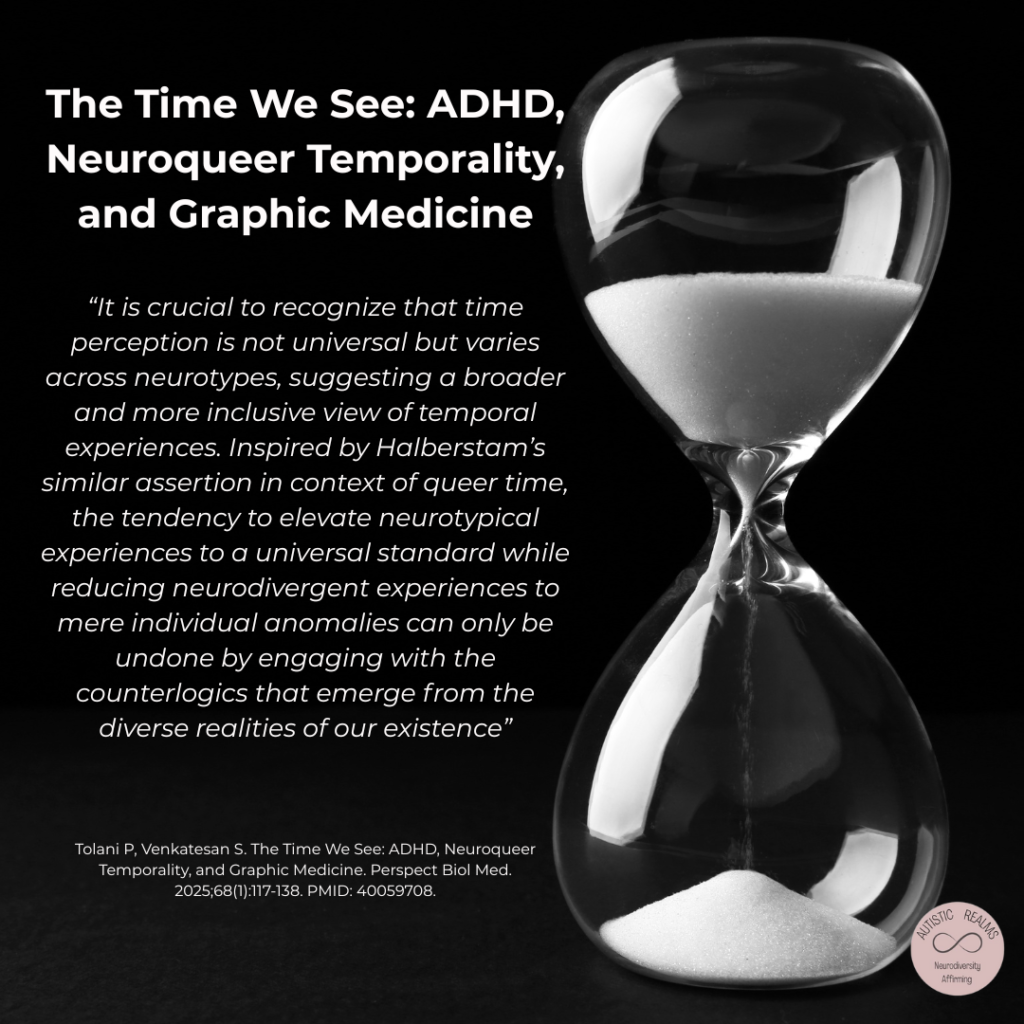
In a world dominated by chrononormativity or what I will call (neuronormative time), the capitalist, clock-driven expectation is to be productive, punctual, and linear, neurodivergent ways of moving through time are often pathologized. If you are Autistic/ ADHD/ AuDHD you may find you are often stigmatised for being “late,” “chaotic,” or “disorganised,” when in fact, you may simply be existing on a different temporal wavelength. As Tolani and Venkatesan write in The Time We See (2025), time isn’t neutral. It’s structured by ableism, productivity demands, and neurotypical developmental milestones. If you fall outside this invisible scrip, if your time bends, stretches, and spirals, you’re often thought of as disordered or somehow needing fixing or interventions. Perhaps the differences in the way we experience time can be explained by the theory of monotropism? Perhaps it is an ontology?
Monotropic Time
I think the theory of monotropism (Murray et al. 2005) could offer us a lens to reframe time for Autistic/ ADHD/ AuDHers who are more likely to be monotropic (Garau et al. 2023). If you use more of your attentional resources on fewer areas of interest than others, then perhaps your experience of time will narrow too in some ways and expand in others? Just like our monotropic experiences when zooming into our passions and perhaps deep diving into a rabbit hole of research and creating ever-expanding constellations of rhizomorpheous connections or being so immersed in a sensory experience of looking at light reflecting on water or onto your wall that you feel you have may be almost become the tiny fragments of light (or may be that is just me?!) ?
Having a different perception of time could also help explain a large part of the Double Empathy Problems (Milton 2012), especially between monotropic and polytropic people. If you’re like me and monotropic, hours can feel like minutes when you’re in a deep attention tunnel and fully engaged in a flow state; outside demands may feel like they literally melt away or dissolve. It is perhaps not that we’re “losing time”; but rather, we can reframe it that we are dwelling within time, immersed in a resonant spiral of attention that is tunnelling ever deeper the longer we are engaged and the deeper into a flow state we go. It may feel like pure Autistic joy if you are engaged with something positive (alternatively, it could end up feeling like an eternal loop of hell and ruminating anxiety-filled, all-consuming thoughts if your attention has hooked into something less joyful).
When in flow, the concept of “now/not now” becomes irrelevant. You are simply in flow, it can feel like the the world outside of your attention tunnel filled with neuronormative demands and expectations is literally melting away. This could be seen to be monotropic temporality. If you are monotropic, you may feel more attuned to your environment; everything may be felt more intensely, thoughts and time itself is not linear, and everything from the core of your being may be more interconnected. Time itself may be felt differently as we experience the world differently. If you are monotropic, you may feel that time is spirally and rhizomatic and flowy, just like your thoughts, sensory system and interests or passions!
The Riverbanks of Monotropic Flow
In my Map of Monotropic Experiences, I describe monotropic time as being like a flowing river. When we’re in the right environment and are able to follow our passions and immerse ourselves freely in sensory experiences, we may be able to swim easily within the natural smooth current and flow of our bodyminds. However, when we’re pulled out of our attention tunnel and flow state by unexpected events, transitions, and external expectations and demands, the river can turn turbulent.
It takes more energy resources to fight against external demands and neuronormativity; it can feel like you are swimming upstream; are using all of your energy but not getting very far and never reaching where you want to be. This is only sustainable for so long before people end up spiralling into what I have visualised as burnout whirlpools. Monotropic people are may be more likely to get stuck in states of inertia, loops of anxiety and ruminating thoughts, not because they’re broken, but because the majority of the world refuses to flow with us and we are swimming against our natural tides. You can only swim upstream against your natural flow for so long before you are likely to hit burnout and start to struggle.
Monotropic time is nonlinear, rhizomatic, and relational. It’s shaped by sensory experiences and a deep embodiment of the environment and relationships around us. If you are monotropic, you may have a different temporal ecology that needs support, not correction. Without the right accommodations, support, and safe spaces to be your authentic self, the waters of neuronormativity can be dangerous and lead to burnout and mental health difficulties.
Neuroqueering Time: A Temporal Liberation
“Crip time is time travel. Disability and illness have the power to extract us from linear, progressive time with its normative life stages and cast us into a wormhole of backward and forward acceleration, jerky stops and starts, tedious intervals and abrupt endings. Some of us contend with the impairments of old age while still young; some of us are treated like children no matter how old we get.” ― Alice Wong, Disability Visibility: First-Person Stories from the Twenty-first Century
To neuroqueer time is to resist the tyranny of the capitalist clock and neuronormativity. It is to refuse productivity as a measure of worth and instead honour attunement, resonance, flow states, connections and meaningful relationships with people and with our environment. As Nick Walker writes in their book Neuroqueer Heresies (2021), neuroqueering is not just about identity, it’s a practice of creative survival. Neuroqueer temporality isn’t just for Autistic people or ADHDers, it’s also an invitation for everyone to find their own rhythm and dimension of time that works for them.
From Merleau-Ponty’s notion of embodied perception to Deleuze and Guattari’s lines of flight that I wrote about in my blog Middle Entrance (2023), some ideas are slowly starting to make a bit more sense for me and are beginning to connect in new ways. I began my Medium blog (which is now hosted on Autistic Realms) by exploring Lefebvre’s ideas around the concept of space being alive. I feel space (like my own Autistic/ ADHD identity and energy) is fluid. Space constantly changes and depends on the interactions of those around us and objects within other spaces. I have been exploring ways of finding meaning in the spaces within what could be considered ‘ma’ to enable thoughts to develop and create connections with others from as I explored in my neuroqueering from the liminal in-between spaces blog(2023).
Embracing monotropic time could be seen as a form of neuroqueering as defined in Nick Walker’s (2021) book Neuroqueer Heresies. I have been considering if the energy created by these connections can lead to even more new spaces, ideas, and possibilities by subverting the expectations of the normativity of relationships and communication in my blogs about neuroqueering from the in-between and liminal spaces. I am now looping some of these thoughts back around and centering them on the theory of monotropism and my different way of experiencing time.
If we embrace our natural monotropic flow states and monotropic spiral time, we can maybe begin to understand time not as a schedule or governed by a ticking clock or by timetables set out by neuronormative expectations. Instead, we can explore how, as Autistic/ ADHD people we may experience living in monotropic time more as a form of relational, moment-to-moment negotiation between our environment and ourselves. From a neuroqueering perspective, if we embrace monotropic time, it can enable us to expand and defy time set out by neuronormative ideals and be liberated from the ticking clock of capitalism.
A World Beyond the Clock
Whether we call it spiral time, neuro-holographic time, or monotropic time, what matters is that we validate these different temporal realities. Because for many of us, time is not measured in minutes but in meaning. Monotropic time is like a portal, whereas neuronormative time may feel more like a prison at times, or at least like we are trying to swim upstream and going against the very essence of our natural monotropic flow and rhythm.
In 1943, T.S. Eliot’s collection of four poems were collated to form Four Quartets. The final poem in this series Little Gidding (1942), continues Eliot’s exploration of time and our connections with each other through generations and current society.
“What we call the beginning is often the end. And to make an end is to make a beginning. The end is where we start from.”
This quote seems particularly relevant to my deep interest in evolving spirals and finding meaning in gaps and spaces and an experience of monotropic time that I am continuing to explore and loop back to Eliot’s poetry.
I visualise time, relationships and ways of being as constantly evolving spirals that spin in and out in multidimensional ways. Different connections and experiences add to and contribute to a wider, deeper, fluid rhizomatic network of potential that is always in a constant state of flux, perhaps more so if you are monotropic. This idea of an evolving spiral and returning to a new beginning in the middle is beautifully reflected in Eliot’s poem Little Gidding:
“We shall not cease from exploration And the end of all our exploring Will be to arrive where we started And know the place for the first time. Through the unknown, remembered gate When the last of earth left to discover Is that which was the beginning; At the source of the longest river The voice of the hidden waterfall And the children in the apple-tree Not known, because not looked for But heard, half-heard, in the stillness Between two waves of the sea”.
— T.S. Eliot, from “Little Gidding,” Four Quartets (Gardners Books; Main edition, April 30, 2001) Originally published 1943.
To support monotropic people, perhaps we need to bend or unfold neuronormative time. As Autistic/ ADHD/ AuDHD people, we likely need more space and flexibility to thrive in a world dominated by neuronormative demands and governed by neuronormative time. We need to create room for flow, for stillness, for neurodivergent ways of resting, regulating and rejuvenating, for our monotropic deep dives and immersive sensory experiences and for our nonlinear rhythms. We need to let go of the myth of “normal” time and start dwelling in resonance, which may enable us to be more at one with the natural flow of our bodyminds and our environment.
We all have our own internal metronomes that are responsive to the environment around us. As monotropic people, we may need more flexibility and a softer, more supple understanding and acceptance of our different perceptions of time from people around us. As Tolani, P., & Venkatesan, S. (2025) summarise their paper published last week The Time We See: ADHD, Neuroqueer Temporality, and Graphic Medicine, “It is crucial to recognize that time perception is not universal but varies across neurotypes, suggesting a broader and more inclusive view of temporal experiences.”
To support monotropic people, we need to create safe, spacious environments where time is allowed to stretch, spiral, and soften. Monotropic time must be honoured not as a deviation but as a valid, expansive and different rhythm and way of living.
When we make room for fluidity and loosen the grip of rigid schedules, tight timetables and linear binary expectations, we can then enable space for monotropic time perception to unfurl, unfold and expand rhizomatically so we are not just surviving and trying to swim upstream but can immerse ourselves in flow and thrive to be our authentic monotropic selves.
Neuroqueer temporality isn’t just for Autistic people or ADHDers. It is an open invitation for everyone to discover their own rhythm, their own flow, their own temporal dimension that feels right. Each person moves through time differently, shaped by their neurology, bodymind, and personal lived experience for some it may be they experience time more neuro-holographically.
To honour neurodiversity, we need to slow down, soften, and make space for each other, and for ourselves. When we allow time to bend, spiral, expand and breathe and when we embrace flexibility and presence over pressure, demands and neuronormative expectations we can create environments where everyone can flourish in ways that are more meaningful to them and everyone has the potential to thrive.
Heasman, B., Williams, G., Charura, D., Hamilton, L. G., Milton, D., & Murray, F. (2024c). Towards autistic flow theory: A non‐pathologising conceptual approach. Journal for the Theory of Social Behaviour. https://doi.org/10.1111/jtsb.12427
Murray, D., Lesser, M., & Lawson, W. (2005a). Attention, monotropism and the diagnostic criteria for autism. Autism, 9(2), 139–156. https://doi.org/10.1177/1362361305051398
Rapaport, H., Clapham, H., Adams, J., Lawson, W., Porayska-Pomsta, K., & Pellicano, E. (2023). ‘I live in extremes’: A qualitative investigation of Autistic adults’ experiences of inertial rest and motion. Autism, 28(5), 1305–1315. https://doi.org/10.1177/13623613231198916
Tolani, P., & Venkatesan, S. (2025). The time we see: ADHD, neuroqueer temporality, and graphic medicine. Perspectives in Biology and Medicine, 68(1), 117–138. https://doi.org/10.1353/pbm.2025.a953457
A behind-the-scenes look into the collaborative workflow between Helen Edgar (Autistic Realms) and Ryan Boren (Stimpunks) as we write about Neuroqueer Learning Spaces (NQLS) and continue our neuroqueering journeys, connecting with awe-inspiring people and discovering new ideas to explore along the way.
Liminal Spaces
Ryan Boren (Stimpunks) and I are neuroqueering ourselves and the spaces we work in as we write about NQLS. We met online in 2022 in the liminal spaces between various online neurodivergent communities, both constantly feeling on the edge of things, even in the most neuro-inclusive settings and groups we could find.
We are both autistic and multiply neurodivergent and deeply passionate about working towards radical inclusivity. Due to our lived experience as parents and professionals, we have seen first-hand the harm that the heavy burden of cisheteronormativity, neuronormativity and neuro-essentialism is causing, especially to neurodivergent people. Normativity is breaking people’s mental and physical health and severely destroying the tremendous potential that is inside everyone. We need to find caring spaces to connect with others, to create an ecological system of care (Bettin, AutCollab), a responsive space that enables authenticity and values the potential of everyone, regardless of neurology, disability, race, gender or any other intersection that is marginalised.
Liminality
by Carrie Newcomer (2021)
So much of what we know Lives just below the surface. Half of a tree Spreads out beneath our feet. Living simultaneously in two worlds, Each half informing and nurturing The whole. A tree is either and neither But mostly both.
I am drawn to liminal spaces, The half-tamed and unruly patch Where the forest gives way And my little garden begins. Where water, air and light overlap Becoming mist on the morning pond.
I like to sit on my porch steps, barn jacket and boots In the last long exhale of the day, When bats and birds loop in and then out, One rising to work, One readying for sleep.
And although the full moon calls the currents, And the dark moon reminds me that my best language Has always emerged out of the silence, It is in the waxing and waning Where I most often live, Neither here nor there, But simply On the way.
There are endings and beginnings One emerging out of the other. But most days I travel in an ever present And curious now. A betwixt and between, That is almost, But not quite, The beautiful, But not yet.
I’ve been learning to live with what is, More patient with the process, To love what is becoming, And the questions that keep returning.
I am learning to trust The horizon I walk toward Is an orientation Not a destination And that I will keep catching glimpses Of something great and luminous From the corner of my eye.
I am learning to live where losses hold fast And grief lets loose and unravels. Where a new kind of knowing can pick up the thread.
Where I can slide palms with a paradox And nod at the dawn, As the shadows pull back And spirit meets bone.
Our Neuroqueer Learning Spaces project is born largely from trauma, grief and a shared passion for challenging, deconstructing and re-imagining what our education and healthcare system could be like if people were prepared to unlearn and unleash their bodyminds from the weight of conforming to neuronormative, socially constructed ways of being. The pressure to ‘fit in’ is real and intense, and neuronormativity is limiting for everyone (not just neurodivergent people).
The pressures and barriers to education and health care we have endured and are still battling against are heavy. It has left us, like so many other people in our situation,feeling broken and ‘weathered like sea glass’ (Shepherd et al.,2024). As part of NQLS, we have created a community-driven NQLS Manifesto and an NQLS Open Framework of Guidance. We are also in the process of developing anti-behaviourism resources to help parents/carers and professionals and those they support to challenge harmful practices, such as (Applied Behaviour Analysis) ABA and (Positive Behaviour Support) PBS. These WHY SHEET resources are free open license and can be edited and used to help self advocate for young people who may be facing barriers accessing education.
If you value this project, please consider signing our WHY Sheet endorsement page along with many other parents/carers and professionals to help give confidence, agency and autonomy to those needing these resources.
Where my voice has often felt dismissed as a parent, it is often validated, listened to and sought as a professional. Trust is an issue. Different voices are trusted by different people, in different places. Safe spaces are needed to develop trust, and time is needed to be with people to gain trust. Reaching out and connecting takes courage; there is always a doubt as to whether you are really in a safe space where you can truly trust and be trusted. There is a vulnerability in admitting things aren’t working, exploring what is under the surface, finding people to connect with who share your struggles and ethos, and having a shared hope for change to find a way out of difficult situations. We need spaces where we feel safe and where there is trust so that we can unlearn and relearn and continue to neuroqueer.
As a white professional person, being a part of both the neurodivergent parent/carer communities and the professional education and healthcare communities, I am aware I am in a unique and relatively safe position of privilege to even write and explore this topic. Enforced hierarchy and the double empathy problem (Milton, 2012) are at the root of so many difficulties and often result in the voices of neurodivergent or disabled people being dismissed. At best, voices may be silenced, and at worse, lived experience can be so deeply misunderstood and misinterpreted it can lead to accusations of not parenting ‘right’, being sent on courses to try and make families conform to neuronoramtive ideals, or in some of the most severe cases we have seen lead to accusations of neglect, FII and safeguarding concerns (Shona Murphy).
Trust, safe spaces, and community are vital to NQLS and our own personal neuroqueering journeys. When the world feels unsafe, you need to create your own spaces and make your own connections. We think creating neuroqueer learning spaces is one possibility that is worth exploring.
Can we trust the space you offer? Can we trust the words you utter?
Can we trust the time decided? Can we trust the form provided?
Can we trust your singular view? Can we trust the treatment we receive from you?
Can we trust the way you perceive? Can we trust you to sit, listen and receive?
Can we trust you not to leave another dent……in us….again? Can we trust the system you’ve decided and provided … will it actually be in our best interest… … with our knowledge and guide?
Can we trust you to understand that sound is once, twice, three times as loud? Can we trust you to understand that light, ‘that light’… there is burning, burning our eyes?
Can we trust you to provide the space to breathe? Can we trust you to understand that our senses are more involved- BIGGER? Can we trust you to let us move away from you… that you cause the trigger?
Can we trust you not to deplete our hard fought for energy and vigour? Can we trust you to listen when we say we are tired…. and let us leave the room?
Can we trust you to give us time to form……form our own words…..it our way and not yours?
Can we trust you not to constantly correct when we misspell or stutter? Can we trust you to say what you are going to do and not just assume?
Can we trust you to understand that your correction……. may only be correct for you?
Can we trust you to not magnify difference and constantly question our existence? Can we trust you to leave us and let us decide?
Our work has taken place in the dark forests of online communities, “Dark forests like newsletters and podcasts are growing areas of activity”. As are other dark forests, like Slack channels, private Instagrams, invite-only message boards, Element, Discord and a myriad of other interconnected platforms that people are seeking because they are “spaces where depressurised conversation is possible because of their non-indexed, non-optimized, and non-gamified environments. The cultures of those spaces have more in common with the physical world than the internet.” The Dark Forest Theory of the Internet — OneZero via The Dark Forest Theory of the Internet. This dark forest metaphor fits nicely with the NQLS idea of primordial learning spaces such as our Cavendish caves, campfires, and watering holes.
** Caves are spaces for quiet reflection, introspection, and self-directed learning.
**Campfires are spaces for learning with a storyteller — teacher, mentor, elder, or expert.
**Watering holesare spaces for social learning with peers.
Intermittent collaboration = group work punctuated by breaks to think and work by ourselves.
The golden thread of being a “space holder” has been inspired by Kay and Dan Aldred (2023) and is woven through our NQLS ideology. It is within the forests of online community spaces that the role and value of being a virtual “space holder” is valued. It allows the exploration of thought and the creation of connections within connections — rhizomes within rhizomes.
As a community, Stimpunks has a unique way of working; they have created and are nurturing the role of ‘space holder’. This has enabled me to safely explore, take risks and expand my ideas of how workspaces can be transformed. Stimpunks is a living example of how a neuroqueer learning space can work and is working .
Stimpunks offers various online platforms and spaces in their local community. They offer;
watering holes for collaborative work and parallel play,
campfires to learn from others & share resources
caves to rest, and have independent time to reflect.
Our Journey
Ryan’s IT skills have been embraced and expanded as we collaborated with people across various countries and communities, merging projects and ideas, which is something we will be continuing to develop. This is in line with AutCollab’s NeurodDiventures project where our “evolving web of relationships, mutual aid, and peer support initiatives is best understood in terms of emergent Ecologies of Care beyond the human”. NQLS aim to create radically inclusive, non-hierarchical spaces that are safe, nurturing environments for divergent (and neuroqueer) thinking, creativity, exploration, and collaborative niche construction. We believe NeuroDiventures is a wonderful structure for NQLS to build upon.
This has been, and continues to be a fairly intense, immersive roller coaster of a journey. Ryan and I are both Autistic, multiply neurodivergent and monotropic. We dived into this project with our entire bodyminds, leaving little space for other work, which has sometimes been tricky to navigate and manage, switching attention tunnels as monotorpic people is exhausting. Our shared interest, passion and seemingly endless capacity for neuroqueering our bodyminds and education has made our workflow fairly prolific. Whilst Ryan has created new additions to Stimpunks neuroqueering webpages, I have infodumped my thoughts as I have read through 100’s of pieces of work (academic research papers, blogs and books) related to the barriers of education our young people are experiencing and ideas for more humane progressive neuroqueering ways forward. Ryan has been diving into his own reading lists and also sharing with the Stimpunks team along the way. We have a mountain of materials; what we have reflected upon and written about so far is only the tip of the iceberg. We are trying to weave in emergent thoughts as we go along, creating a neuroqueering tapestry of ideas which is reflected via Stimpunks website and our blogs and social media posts.
Writing
As with all projects, there have been hurdles and obstacles to overcome and crashes along the way where we have just become ‘stuck’; this has been no exception. The ebbs and flows of our own mental and physical health have had an inevitable impact. We have had to find ways between our time zone differences, family demands, lifestyles and different workflow patterns to try and resolve things along the way. One of our biggest stumbling blocks was the actual process of writing. This was a significant issue given that our project needs to be reflected online through words and the spaces between our words to bring meaning to others.
We needed to find ways to write and work together in a shared space, which involved neuroqueering my own ways of working and collaborating. It has made me reflect upon previous projects, taking the positives and negatives and bringing some of those ideas into our shared new online spaces and neuroqueering them in the way we communicated and socialised in multiple online watering hole spaces where we discussed what we had learnt from others in our meetings (campfire spaces) and reflected by ourselves (in cave spaces) in our own niche constructed sensory dens at home.
The progress of my IT skills have been lying dormant since the late 1990s. Ryan is a former WordPress and Automattic lead developer with a very efficient workflow system fully embedded into Stimpunks running of their organisation. I worked as an early years and primary teacher in the UK, supporting those with profound and multiple learning disabilities. I learnt the importance of listening and being there even when verbal words aren’t used, the value of connecting in shared spaces, and the potential of guiding learning by following and building on children’s personal interests to deepen their learning through play to provide more meaningful experiences. These were all valuable experiences for NQLSs, but my tech and writing skills were not developed beyond the needs of class planning and report writing.
Collating vast amounts of research and creative writing using either my trusted Word or Google Docs was not working for Ryan; it was proving to be a huge barrier to any successful collaboration. While our independent work was carried out in its own fairly reliable way, our collaborative chapter for Nick Walker’s upcoming new Neuroqueer book, which we hope to submit a chapter towards, was very stuck.
I defaulted to multicoloured pens and paper and laboriously retyped my thoughts onto my laptop, transferring them to our websites, whilst Ryan was magically transforming our many conversations on a live stream via Stimpunks.
Due to the distance of around 5000 miles separating us, these conversations took place and continue to take place across multiple online platforms, often simultaneously, as we move between our many open tabs of Discord, Element, Word- Press, Facebook, Twitter and a myriad of other apps and spaces within the same conversations, often resting in HyperBeam for co-regulation and to share music and videos with other Stimpunks family peers, creating a sense of togetherness and belonging.
Whilst the conversations continued to flow, our collaborative chapter remained static as a 20k word draft of my stream of consciousness lay in Ryan’s inbox with hyperlinks to a vast amount of research to try and validate and justify (some of) my thinking (some of it is just my thoughts, and I am hoping they may resonate with others?!).
We called on the support of a member of the Steampunks team to help bridge the gap, but it soon became evident we needed an entirely different system to work. Being a tech person at heart, Ryan needed Markdown as a part of his creative writing method (Markdown gives documents semantic structure without specifying formatting at all). We have now transferred our working documents to GitHub, enabling a flow to resume, and I am quickly seeing the benefits of adopting Stimpunks workflow thinking and moving on from 1997. (However, I still use my multicoloured pens and paper to make notes as I go!)
We are approaching an extended deadline date for Nick Walker’s chapter submission, but with a neuroqueering workflow in place and the evolution of our ever-expanding Cavendish online spaces, we are making progress, hurrah!
Onwards
Living within Stimpunk’s myriad of primordial Cavendish Cave, Watering Hole, and Campfire spaces in the forests of the online community is proving to be an epic journey. I have found spaces where I can finally breathe, explore, have some me-time, continue my own neuroqueering journey and intermittently collaborate with others. I feel fortunate to be meeting some amazing people along the way. I am having fun, diving between and venturing out from the edges of liminal spaces to create and explore neuroqueer learning possibilities with others who share this passion and know the potential of Neuroqueer Learning Spaces.
If you want to learn more, here are some codes to Markdown and plain text and the workflow thinking they enable.
If you’d like to learn more about collaborating, please contact us via Stimpunks. (PS, we accept submissions and collaboration from everyone in all formats and languages, including handwritten work using paper and pen, voice recordings/ podcasts, photography, art and all forms of Alternative and Augmentative Communication……all welcome, Mardown skills are not a requirement!).
I am starting my new blog in the middle. I am in the middle of what is known as ‘midlife’ as I am forty-five; I am also mid-career, having resigned from teaching and not yet working in any other defined role. I also live much of my life in and between the online (primarily neurodivergent) communities.
These spaces have become my places of safety, support, and escapism and are a wonderful opportunity to develop connections. Henri Lefebvre (1991), in his work The Production of Space, explores the concept of space being a ‘living space’. Lefebvre wrote, “Nothing disappears completely… In space, what came earlier continues to underpin what follows… Pre-existing space underpins not only durable spatial arrangements but also representational spaces and their attendant imagery and mythic narratives.”
Lefebvre’s ideas support my thoughts around the concept of space being alive; I feel space (like our own identity and energy) is fluid. Space constantly changes and depends on the interactions of those around us and objects within other spaces. I am exploring ways of finding meaning in the spaces within what could be considered ‘ma’ to enable thoughts to develop and create connections with others. I believe this could be seen as a form of neuroqueering as defined in Nick Walker’s (2021) book Neuroqueer Heresies. I am considering if the energy created by these connections can lead to even more new spaces, ideas, and possibilities by subverting the expectations of the normativity of relationships and communication.
‘Ma’ is a Japanese concept and has no English equivalent but can be loosely translated as the space between things or a pause between events. Fletcher (2001), in The Art of Looking Sideways, quotes Isaac Stern as describing music as “that little bit between each note — silences which give the form”. In their book A Thousand Plateaus, Deleuze and Guattari (1980) explore the concept of a ‘rhizomatic’ model of thought and ‘shifting bodies’. I have been thinking about how ‘ma’ relates Deleuze and Guattari’s philosophy and neuroqueering by enabling the physical space between people to create the potential for energy to grow.
In our everyday lives, at this very moment, people are joining online communities for information, to seek understanding, and connecting with others. The general themes of this blog series will include an exploration of; the philosophy of Deleuze, the history of art (specifically the minimalist movement), the connections between language and the forming of relationships and an exploration of Nick Walker’s (2021) theory of neuroqueering. I aim to demonstrate how we can find a space to nourish and support mental well-being at some intersection between these concepts and topics for those interested and open to exploring these ideas.
I can already feel a deep flow weaving between these topics, even though that is currently happening in a slow, fuzzy, hazy way. My own thoughts will inevitably be shaped by the interactions and discussions I have with others about these subjects. I aim to create a singular, more coherent chapter which will contribute towards a larger anthology of work from within the community interested in neuroqueer theory. I want to be transparent about my aim with anyone who engages in shared stories and conversations with me on this journey. I value connections and collaboration and hope this will draw various people and communities together that are interested and resonate with some of these ideas.
In 1943, T.S. Eliot’s collection of four poems were collated to form Four Quartets. The final poem in this series Little Gidding (1942), continues Eliot’s exploration of time and our connections with each other through generations and current society.
“What we call the beginning is often the end. And to make an end is to make a beginning. The end is where we start from.”
This quote seems particularly relevant to my deep interest in evolving spirals and finding meaning in gaps and spaces. I am returning to themes I started exploring almost 25–30 years ago from the new perspective and understanding of my autistic identity and, more recently, through an exploration of neuroqueering.
I visualise relationships and ways of being as constantly evolving spirals that spin in and out in a multidimensional way. Different connections and experiences add to and contribute to a wider, deeper fluid rhizomatic network of potential that is always in a constant state of flux. This idea of an evolving spiral and returning to a new beginning in the middle is beautifully reflected in Eliot’s poem Little Gidding:
“We shall not cease from exploration And the end of all our exploring Will be to arrive where we started And know the place for the first time. Through the unknown, remembered gate When the last of earth left to discover Is that which was the beginning; At the source of the longest river The voice of the hidden waterfall And the children in the apple-tree Not known, because not looked for But heard, half-heard, in the stillness Between two waves of the sea”.
— T.S. Eliot, from “Little Gidding,” Four Quartets (Gardners Books; Main edition, April 30, 2001) Originally published 1943.”
I have struggled to start this blog as I believe there is no definitive way to start anything; finding a specific point of anything is impossible as there will always be multiple folds, pleats and deeper intersections, which could be classed as a ‘start’. I see this as trying to find a space ‘between two waves of the sea’ as Eliot wrote. There will always be something preceding and will always be another connection and intersection. However, if we can open our bodyminds, we can find moments of stillness, a pause, and meaning can grow from within the spaces between objects and others; this is where creativity and potential evolves.
In The Fold(1988), Deleuze explores this idea in his first chapter, ‘The Pleats of Matter’ by drawing on the work of Leibniz and Monadology (1714) in a beautiful description which summarises the infinite amount of folds and pleats that can occur within origami where, the ‘a fold is always folded within a fold, like a cavern in a cavern’. This concept of the monad further explores the folds of time and space as a continuous process of ‘becoming.’ This is something I will be returning to.
Throughout my following few blogs, I aim to ‘unfold’ and explore The Fold and other writing more deeply. I see these folds as a fluid state rather than a defined line, and it is within this fluidity that neuroqueering ideas can be further explored too. I visualise this being similar to the autistic experience of monotropism. This concept evolved from the work of Murray, Lawson and Lesser (2005), which I will also return to in a future blog; I see this as a way of identifying and understanding my experiences and how I relate to others.
Deleuze’s idea of folds and pleats fits into my interpretation of neuroqueering, which allows infinite possibilities to be created by subverting expectations and exploring how far your bodymind can go. Deleuze writes, “Unfolding is not the contrary of folding, but follows the fold up to the following fold. Particles are ‘turned into folds’ that a ‘contrary effort changes over and again’. It is a chance for infinite possibilities and potential for everyone and a way to embrace neurodiversity in the purest sense of the word, meaning everyone has potential.
Nick Walker (2023), at the ITAKOM conference, shared some of her ideas in her talk titled, ‘Expanding the Creative Potentials of Human Neurodiversity’. In this talk, she described the potential of neuroqueering to enable infinite possibilities through a collective synergy. It is through connecting with others that the ‘magic happens’. This suggests that the magic happens in the gaps and the spaces where the potential is within ‘ma’. I want to explore the ways that challenge our need to rely on language and words to allow us to discover the possibilities and endless interpretations of neurodiversity, where we can just ‘be’.
The concept of ‘ma’ represents a space of potentiality, a space that is open to the emergence of new ideas and experiences. Through the context of Deleuze and Guattari’s philosophical writings, minimalist art and neuroqueer theory, I would like to explore and develop a deeper understanding of how embracing the concept of ‘ma’ offers a way of creating connections and understanding the relationships that exist between people, things, and ideas.
My next blog will build on starting in the ‘middle space’, and I will explore Deleuze & Guattari’s philosophical term ‘rhizome’ as discussed in their work, A Thousand Plateaus. I am going to relate this non-hierarchical concept to the neurodivergent community and neuroqueer theory as I explore the idea that there is ‘no definable entrance or exit point or centre’ and there are ‘multiple ways in and out’ of experiences and our connections with others.