Tag: monotropic time

  • Autistic Children’s Learning: Deligny, Desire Lines and Why Cavendish Space Matters

    By Helen Edgar | Autistic Realms

    There is a path across the grass outside my house, going towards the bus stop and the corner shop. It doesn’t follow the pavement. It cuts diagonally across the corner, worn into the ground by hundreds of people who decided the official route was wrong and walked where it actually made sense to walk. Nobody planned it and nobody designed it; it just appeared, because people followed where their feet wanted to go. Landscape architects call these desire lines. They are the paths we make when we stop following a route that was designed without our actual needs in mind, and start following ourselves.

    Fernand Deligny and Autistic Children

    In 1967, the French educator and writer Fernand Deligny set up an informal network of care for Autistic children in the Cévennes, in the south of France, which carried on into the 1990s (Deligny, 2015). Rather than placing the children in an institution, Deligny and a small group of non-professional adults he called “close presences” lived alongside them, day and night, watching, moving with them and paying attention. Many of the children were non-speaking, and many had been described as having what would today be called ‘challenging behaviour’. They didn’t fit into society’s expectations of how children ‘should’ be.

    What Deligny noticed was that the children walked along routes with no obvious destination. They returned to the same spots again and again, tracing patterns through the space that looked purposeless from the outside but held meaning for them. Their movement had no fixed goal, yet it was far from aimless (Milton, 2016). Something was happening when the children had the freedom to move and their own autonomy over the spaces they lived in. They were getting something from it; nobody could say exactly what, but that didn’t mean it was nothing. Deligny called their paths lignes d’erre: wandering lines, or wander lines.

    The adults carefully traced the children’s movements onto maps, not to interpret or redirect them, but to honour what they could see was happening. Over time they noticed that the wandering wasn’t random at all. The children were responding to their environment: to objects placed around the space, and to the places where adults went about everyday tasks like fetching water, cooking or chopping wood. Their lines kept returning to these meeting points. The space itself carried information that held meaning for them, drawing their attention and meeting their sensory needs.

    Wandering Lines in a World of Fixed Routes

    Most schools, even specialist settings, are not designed for Autistic people or for wandering. They are designed for following instructions. Children are expected to follow a strict timetable, with the day marked out by loud bells, room changes and changing subjects and teachers. They constantly have to split their attention to follow instructions and produce evidence that they have met the goals and outcomes set out in the curriculum.

    The Autistic child who needs to move before or while they think is often told to sit down. The child whose attention has been drawn into one deep interest is told to move on to the next topic before they have reached their own conclusions or been allowed to see where that interest might lead. The child who needs to stim, or who needs a calmer environment, is often told off and read as a problem when they become dysregulated. Even the quiet child may be seen as avoidant if they feel unable to speak up and answer questions in the right way at the right time.

    All of this has made me wonder: what if the wandering line is the learning itself, the engagement in flow, what Deleuze and Guattari (1987), who drew directly on Deligny’s maps, called a line of flight? What if the path that looks like it goes nowhere is actually heading somewhere that really matters for that child, somewhere the map doesn’t show yet?

    Our Autistic children are often excluded, or forced to withdraw from our education systems, before they even get the chance to explore their own bodyminds (Dychtwald, 1977), their creativity and their potential. Many reach burnout and mental health crisis before they reach adulthood. Deligny seemed to understand what neurodivergent people often instinctively know: the map of neuronormativity that we are born into governs our educational spaces, and it can cause a great deal of harm to Autistic people.

    Cavendish Space

    Cavendish Space, conceptualised by Ryan Boren at Stimpunks Foundation and developed together with me through our Neuroqueer Learning Spaces project, is a direct response to the problems we have seen in our own families (Stimpunks Foundation, n.d.). It is a way of designing environments, whether classrooms, community spaces, workplaces or homes, so that all kinds of people can follow their own lines without being constantly redirected.

    Cavendish Space has three zones. Each one offers a different kind of space for a different bodymind need, depending on a person’s capacity, energy and needs in that moment.

    The Cave is for deep, quiet, uninterrupted focus and regulation. It is the place where your wandering line can flow, and where you can go very deep into your passions without fear of being pulled back to the surface. It is a space to meet your sensory needs, and to rest and recover by yourself.

    The Campfire is for gathering gently with others in small groups, around something of shared interest, and learning from each other. It is a gathering with room to contribute in different ways and at different paces, and to share knowledge.

    The Watering Hole is for community, the unstructured, in-between space between the Campfire and the Cave. It is a space where you can simply exist alongside other people without having to be productive or prove yourself. This is where body doubling and parallel play happen, which can be really valuable for Autistic people.

    Between the zones are lily pads, small pause points that make moving from one space to another more manageable. Transitions are hard for everyone, and especially for monotropic Autistic people, whose attention flows very strongly into one thing at a time and produces deep focus that doesn’t shift easily (Murray et al., 2005). A sudden move from a quiet Cave to a group discussion at the Campfire can feel like being dropped into cold water. The lily pads turn that transition into something you can gently step through in your own time, rather than risk falling in.

    In Cavendish Space, each person holds their own relay switch. They decide which zone they need and when to move. Agency and autonomy are built into the whole framework rather than treated as extras to be earned. When we understand what drives desire, how monotropism works and how important flow is, especially for Autistic people, we can build spaces where people have genuine cognitive, psychological and sensory liberty over their own bodyminds and ways of learning.

    Trusting the Path

    Deligny spent decades alongside Autistic children as they created their own paths through a space designed to hold them safely, rather than to constantly redirect them. He didn’t try to fix their wandering. He honoured their movements and trusted that they were going somewhere valuable for them.

    Deligny was not Autistic himself, and his work holds real tensions. He saw the children as living outside language and preferred to call them mute, whereas today we know how important it is to presume competence and to honour every form of communication, including AAC. Autistic scholar Damian Milton (2016) offers a thoughtful reading of Deligny’s legacy that keeps these tensions in view, and it is through Autistic voices like his that I want to carry Deligny’s wandering lines forward.

    Cavendish Space honours our Autistic needs and authentic ways of being. It affirms that our way of moving through the world makes sense, and it can hold us safely. We need to give children the safety and freedom to explore their interests and follow their own lines, without fear of punishment, redirection, or being told that their way of moving through the world is wrong.

    👉 Read next: Building Neurodivergent-Affirming Cultures of Regulation: Reflections from a Cavendish Space Workshop
    👉 Read next: Awe, Wonder and Monotropic Attention in Neuroqueer Learning Spaces
    👉 Read next: Child-Led Play and Monotropism in Gestalt Language Processors
    👉 Read next: Fernand Deligny: The Buried Root of Cavendish Space (Stimpunks)
    👉 Explore: Cavendish Space in the Stimpunks glossary


    This piece draws on the work of Fernand Deligny and the Cavendish Space framework developed collaboratively by Ryan Boren and Helen Edgar at Stimpunks Foundation. Helen Edgar is Co-Creative Director at Stimpunks Foundation and runs Autistic Realms.

    References

    Deleuze, G., & Guattari, F. (1987). A thousand plateaus: Capitalism and schizophrenia (B. Massumi, Trans.). University of Minnesota Press.

    Deligny, F. (2015). The Arachnean and other texts (D. S. Burk & C. Porter, Trans.). Univocal Publishing.

    Dychtwald, K. (1977). Bodymind. Pantheon Books.

    Milton, D. (2016). Tracing the influence of Fernand Deligny on autism studies. Disability & Society, 31(2), 285–289. https://doi.org/10.1080/09687599.2016.1161975

    Murray, D., Lesser, M., & Lawson, W. (2005). Attention, monotropism and the diagnostic criteria for autism. Autism, 9(2), 139–156. https://doi.org/10.1177/1362361305051398

    Stimpunks Foundation. (n.d.). Cavendish Space. https://stimpunks.org/space/cavendish/
  • Flowosophy: Monotropism, Flow and Deep Attention

    Flowosophy: Monotropism, Flow and Deep Attention

    You might know this feeling. You look up and the light in the room has changed, the coffee beside you has gone cold, and the hours that have passed don’t feel like hours at all, they feel like just a few minutes. Something has held you, and for a while there was no clear edge between you and whatever you were engaged with, what ever held your attention.

    For most of my life the only words I had for this were other people’s, and they were rarely kind: obsessive, rigid, in a world of her own. Since realising I am Autistic and ADHD, monotropism and flow theory have given me kinder words. I have been re-storying those lost days, weeks and what feels like years ever since. The two theories seem to want to move together and carry on further downstream, out of psychology and into something more like philosophy, or maybe a merging of the two.

    Flowosophy is where they lead me: the philosophy of flow theory and monotropism, with the Greek sophia, wisdom, folded inside the word. It asks what kind of wisdom lives in DEEP attention, and what might change if we honoured flow as a way of being in the world, rather than a state to be managed or a behaviour to be corrected.

    Two Theories, One River

    Mihaly Csikszentmihalyi (1990) described flow as the optimal experience: absorption so complete that action and awareness merge, self-consciousness falls away and time bends out of shape. He found this experience was a common experience for many people.

    Monotropism grew from within Autistic community. Murray, Lesser and Lawson (2005), writing from inside that community, describe attention as a limited resource, and monotropic minds as gathering that resource deeply around a small number of interests at a time. Inside these attention tunnels, experience is often rich, detailed and can feel quite intense. Outside them, things can be hard to notice at all, and moving from one tunnel to another often takes real energy.

    Read side by side, it feels to me like the two theories are describing the same water from different banks. McDonnell and Milton (2014) suggested that what gets labelled “repetitive behaviour” could be understood as flow states, and more recently Heasman et al. (2024) have called for an Autistic flow theory that describes these experiences without pathologising them. What psychology calls optimal experience, many monotropic people would perhaps call their innate way of being.

    From Peak to Plateau

    Flow has been captured through literature, art and poetry. It turns up in productivity books and workplace training as a way of getting more done in less time, a weaponised hack for output. My idea of flowosophy evolved out of a recent body doubling session with Writing the Dawn where we were talking about flow, philosophy, congruence and being Autistic. The value of flow is not in what it produces, it is a process and the being-in-it is what I am interested in.

    Deleuze and Guattari (1987) describe a plateau as “a continuous, self-vibrating region of intensities” (p. 22), one that develops without building towards a culmination point. Monotropic flow feels far more like a plateau than a peak to me. It sustains, thickens and connects in all directions, like a holographic constellation network for as long as the conditions allow, which is something I explored in “Neuroqueering Plateaus: Staying in the Middle of Things“. An afternoon spent with a patch of moss, re-organising a spreadsheet of research or listening to the same song on repeat is not wasted because nothing was made, because something was lived. Flowosophy treats depth as a way of knowing and being in its own right.

    Water, Edges and the In-Between

    Flow is a word often associated with water, and I don’t think that is a happy coincidence. In my article “Water Time: On Neuroqueering the Shapes of Time” I wrote about time that pools, floods, freezes and moves again, rather than ticking forward in a straight line, or going round the clock in our kitchen. I FEEL that flow states live in water time. An hour can melt, and five minutes can ripple into a whole afternoon.

    Henri Bergson (1889/1910) gave me words for this over a century before I had them. He separated clock time, which he saw as time laid out in space and cut into equal, countable pieces, from durée, duration: time as it is lived from the inside, where each moment melts into the next like the notes of a melody. Flow lives in durée. When I am in flow I am not counting minutes; I am inside a melody that hasn’t finished yet. Being pulled out by an alarm, a bell or a meeting is being dropped out of duration and back onto the clock.

    Astrida Neimanis (2017) writes that we are bodies of water, porous and always in circulation with the world around us. For me, that is how flow feels from the inside. The edges of my bodymind blur and I can no longer clearly say where I end and the thing I love begins, the activity or event that has ALL of my attentional resources. I don’t experience this as losing myself, in fact it is one of the few times I feel whole and completely me, like now, writing this!

    This also means that flow is not something that happens inside one head or one single person’s mind. Erin Manning (2013) describes experiences as beginning in the middle of relation, in the in-between. Flow emerges between a person and the quality of the light, the quiet of a room, the texture of something under your hands, or another person or animal whose rhythm is compatible with yours. Take those conditions away and flow doesn’t just become harder to reach. It doesn’t form. Flow is what happens as the event because of everything else being in relation to it.

    The Undercurrents

    I don’t want to romanticise flow. Rivers have undercurrents too, and the same pull that brings Autistic joy can make it hard to stop, to eat, to drink or to sleep. Attention tunnels can quickly and easily fill with worry as easily as with wonder, and a mind that loops happily around a beloved interest can also loop around a fear. In addition, being pulled out of flow without warning can really hurt.

    Spinoza (1677/1996) understood joy not as a reward but as a movement: the feeling of our power to act and to exist increasing. Sadness, for him, is the feeling of that power being diminished. Flow is joyful in exactly this sense. It is a monotropic bodymind becoming more able, more alive, more itself. Deleuze (1988), reading Spinoza, reminds us that we do not yet know what a body can do. We only find out by noticing what it can affect and be affected by, and in which conditions it flourishes.

    There is also the cost of being denied flow altogether. Tanya Adkin (2022) describes monotropic split as what happens when a monotropic person has to spread their attention across too many channels to survive in a polytropic world, and how that leads towards burnout. I have written more about this in “Monotropic People in a Polytropic World“. A dammed river does not stop being a river. It floods somewhere else and this is what I feel happens to me when I am asked or expected to split my attention into too many channels at once, I can’t hook into a deep flow. The small narrow channels that I am working within get easily flooded and I find myself very overwhelmed which can lead to shutdown or meltdown states and if it keeps happening, it leads to burnout which can last even longer.

    This makes flowosophy a question of justice. Who gets long, unbroken stretches of time, and who is interrupted all day? Whose depth is called expertise, and whose is called an obsession and needs an intervention?

    An Ethics of Attention

    Simone Weil (1951) wrote about attention as a kind of waiting: an open, patient receptiveness rather than effortful concentration. For her, attention at its purest was a form of generosity, even of love. Flowosophy takes this seriously in both directions: the generosity of giving something our whole attention, and the generosity of protecting someone else’s.

    Flowosophy asks how we enter, share and leave one another’s flow. It treats warning, consent and time to surface as forms of care, and transitions as crossings that need bridges.

    It also asks us to join rather than redirect. Meeting someone inside their interest is one of the most direct routes to connection I know of. Things like info-dumping, parallel play and a meme shared at 2am are all ways of saying, come and move in this current with me. When that happens, two flows can run side by side like a braided river and it can help regulation.

    Dinah Murray (1996) had a word for this: co-tropicality, turning our attention together. From the Greek tropos, to turn, it sits alongside monotropism (turning toward one thing) and polytropism (turning toward many). Co-tropical attention means joining someone within their attention tunnel and flow, rather than pulling them out of it. I have written more about this in “Shared Flow: Turning Attention To Support Children Together” on Autistic Realms. Co-tropicality sits at the heart of flowosophy: flow is not only something we protect in one another, it is something we can share.

    None of this is possible without the right conditions. The caves, campfires and watering holes of Cavendish Space I have written about with Stimpunks Foundation (Boren & Edgar, 2022) are one way of building them: protected depth, shared depth, and company without demand. Nick Walker (2021) reminds us that neuroqueering is something we do. Choosing depth over breadth, in a world that keeps demanding constant task switching, is a small daily practice of refusal.

    Staying With the Current

    Flowosophy can be shaped by everyone who has thought and written about monotropism and flow, and by everyone who has ever lost an afternoon to something they love.

    What would our schools, workplaces, services and relationships look like if flow were understood and protected, rather than managed?

    References

    Adkin, T. (2022, July 14). What is monotropic split? Emergent Divergence (NeuroHub Connect). https://emergentdivergence.com/2022/07/14/guest-post-what-is-monotropic-split/

    Bergson, H. (1910). Time and free will: An essay on the immediate data of consciousness (F. L. Pogson, Trans.). Swan Sonnenschein. (Original work published 1889)

    Boren, R., & Edgar, H. (2022). Cavendish space: Caves, campfires, and watering holes for dandelions, tulips, and orchids. Stimpunks Foundation. https://stimpunks.org/space/cavendish/
    Csikszentmihalyi, M. (1990). Flow: The psychology of optimal experience. Harper & Row.

    Deleuze, G. (1988). Spinoza: Practical philosophy (R. Hurley, Trans.). City Lights Books.

    Deleuze, G., & Guattari, F. (1987). A thousand plateaus: Capitalism and schizophrenia (B. Massumi, Trans.). University of Minnesota Press. (Original work published 1980)

    Heasman, B., Williams, G., Charura, D., Hamilton, L. G., Milton, D., & Murray, F. (2024). Towards autistic flow theory: A non-pathologising conceptual approach. Journal for the Theory of Social Behaviour, 54(4), 469–497. https://doi.org/10.1111/jtsb.12427

    Manning, E. (2013). Always more than one: Individuation’s dance. Duke University Press.

    McDonnell, A., & Milton, D. (2014). Going with the flow: Reconsidering “repetitive behaviour” through the concept of “flow states”. In G. Jones & E. Hurley (Eds.), Good autism practice: Autism, happiness and wellbeing (pp. 38–47). BILD.

    Murray, D. K. C. (1996). Shared attention and speech in autism. Paper presented at Therapeutic Intervention in Autism: Perspectives from Research and Practice, Durham. https://monotropism.org/dinah/shared-attention/

    Murray, D., Lesser, M., & Lawson, W. (2005). Attention, monotropism and the diagnostic criteria for autism. Autism, 9(2), 139–156. https://doi.org/10.1177/1362361305051398

    Neimanis, A. (2017). Bodies of water: Posthuman feminist phenomenology. Bloomsbury Academic.

    Spinoza, B. (1996). Ethics (E. Curley, Trans.). Penguin. (Original work published 1677)

    Walker, N. (2021). Neuroqueer heresies: Notes on the neurodiversity paradigm, autistic empowerment, and postnormal possibilities. Autonomous Press.

    Weil, S. (1951). Waiting for God (E. Craufurd, Trans.). Putnam.

  • Water Time: On Neuroqueering the Shapes of Time

    Water Time: On Neuroqueering the Shapes of Time

    A few weeks ago I joined Sonya Gracey and KR Moorhead for a workshop on Neuroqueering Time, part of the Neuroqueering Your Creative Practice Community’s series, Our Being: Unlearning White Supremacy, Colonialism and Capitalism Through Relational Creative Practice. It has taken these several weeks to draw my thoughts together into words.

    We spent the session exploring the many shapes time can take once it stops being forced into a single straight line. We discussed how we all felt time differently and used different words to describe our experiences; crip time, spiral time, orbital time, moon time, elliptical time, felt time, monotropic time, stuck states, flow states. As Sonya put it, these shapes were emerging out of our lived experience of being neurodivergent. If our bodyminds are diverging I think it makes sense that our sense of time also diverges from the norm.

    KR Moorhead co-facilitates a course on neuroqueering creative practice alongside Marta Rose, who coined the term neuro-emergent as a deliberate alternative to “neurodivergent,” wanting a word that names what they are becoming rather than what they diverge from (Rose, n.d.).

    This sense of emergence is drawn from adrienne maree brown’s account of emergence as being fractal, adaptive, decentralised, and non-linear (brown, 2017). It resonates with me as I think of my own perception of neuro-emergent time as an elliptical orbit: sometimes feeling fast with monotropic momentum-driven flow states stretches expanding time, alternating with slow, spiralling ones, with neither phase more correct than the other.

    Beyond the clock

    Crip time, as Alison Kafer (2013) and Ellen Samuels (2017) have both written about, is what many disabled and chronically ill people relate to. It is what happens when you have to slow down to meet your needs, it is why it is so hard, almost impossible to fit into society’s band width of time. Work places, education systems, friends and relatives often feel like they are too fast, there isn’t enough time in a working 9-5 day to meet health needs, to meet physical positioning needs, for processing time and for the sensory body to regulate and constantly re-adjust itself. It is all exhausting, it has a chronic effect and makes fitting into society almost impossibly hard at times as crip time is rarely understood outside of the disabled community.


    Our clock time here in the UK and other Western countries, is not neutral, it has been built by those with power and privilege to serve Capitalism. The regimented hour we are expected to treat as a law of nature emerged through the factory bells, things like standardised school times and even bus and railway timetables that often stop in the night assuming we all want to operate on the same timescale (Thompson, 1967).

    Tricia Hersey’s Rest Is Resistance talks about the cost of this directly, tying the pressure to keep pace with capitalist clock time to the disciplining of Black bodies and time under slavery in the U.S. context she writes from (Hersey, 2022). That thread, unlearning capitalism’s grip on time, sits underneath everything that follows, and it was named in the workshop series title itself.


    For many Autistic, ADHD, and otherwise neurodivergent people, time may feel different too. I resonate with crip time, more so as I have now been diagnosed with Fibromyalgia alongside other health difficulties, but I don’t feel it fully fits my experience as a monotropic AuDHDer either.


    Despite my body needing more time than the clock on my wall seems to give me to move around somedays, my sense of time is deeply impacted by my monotropic attention, by my interests and intensity rather than by minutes. I can get easily pulled into a flow state that can make an hour vanish or turn a five-minute task into a whole afternoon of inertia to even try to begin something.

    Rivers & Flow

    Around the same time as the workshop, I came across Maria Popova’s essay on Pablo Neruda’s poetry of time and it feels relevant here (Popova, 2026). Neruda, too, reached for water rather than clockwork when he tried to say what time is. In his “Ode to Time,” from the Elemental Odes, he writes:


    “Time is divided into two rivers: one flows backward, devouring life already lived; the other moves forward with you exposing your life. For a single second they may be joined. Now.”
    (as cited in Popova, 2026).

    It is a striking image to meet after a decade of crip time, spiral time, and monotropic time circulating in disability and neurodivergent communities, because Neruda arrived at rivers from an entirely different door. Not disability. Not race. Not capitalism’s clock. Just a poet’s instinct that no single straight line could hold what time actually feels like to a body that is alive inside it.

    I want to hold a caution alongside that resonance, though. Neruda’s two rivers still meet in a single, willed present. “It is in your hands,” he writes, “racing, slipping, tumbling like a waterfall. But it is yours” (as cited in Popova, 2026). Popova reads this, alongside Borges, Baldwin, Emerson, and Gibran, as an argument against temporal lament: an insistence that the present moment can be actively claimed through love, firmness, and truthfulness. That is a beautiful instruction, and it is also a different shape from crip time or monotropic time, which are often not available to anyone’s grip at all. A person in a stuck state cannot simply seize the joined moment through firmness of will. Water time, as I want to use it here, has to hold both of these truths: the current that is genuinely there to step into, the way Neruda describes, and the water that simply does what water does regardless of anyone’s hold on it. Neither is a failure of the other. They are both just what water, and bodies, actually do.

    Water time, for me, names something more specific still: time that moves the way water actually moves, not the way a clock hand does.

    Water time

    Astrida Neimanis’s Bodies of Water: Posthuman Feminist Phenomenology (2017) has been quietly reshaping how I think about all of this. Neimanis argues that we are not separate, bounded bodies that happen to contain water. We are bodies of water: porous, unfixed, and permanently in circulation with the water around and beyond us, from cloud to river to another body and back again. She calls this gestationality: every one of us began inside another body’s water, before we ever had a body of our own to call separate. That beginning was immersive, cyclical, and held, not linear.

    If a body is water rather than a container for water, the time that body lives in cannot be only linear either. Water doesn’t arrive at a destination and stop. It evaporates, falls, pools, floods, freezes, and flows again. Stillness in a pond and urgency in a flood can both be true of the same water within the same day. Stuck states and flow states look like this from the inside: two real states that water itself moves between, not opposite failures measured against one correct tempo.

    This is also where water time meets monotropic spiral time. In earlier work I’ve described monotropism’s attention channels as closer to a river’s deep channel than to a spotlight: focus that carves its own course over time, returning to the same themes with more depth each pass rather than covering flat, even ground (Murray, Lesser, & Lawson, 2005). A spiral is a river bending back on itself, and it rarely bends alone. Sitting in that workshop room, I felt two or more of these channels running braided for a stretch: distinct currents, each still carving its own course, moving alongside one another without merging into one. Braided rivers do this in the physical world too, splitting and rejoining around their own sediment, never settling into a single bed. Shared attention, shared grief, and shared care can move the same way, close enough for long enough to feel like company rather than parallel solitude, even without ever synchronising to the same clock. That braiding, more than any shared timeline, was what made the room feel held.

    Held, not measured

    None of this is an invitation to romanticise the difficulty of living against clock time in a world still built on it. Fluctuating capacity is real, and often exhausting. But naming that fluctuation through water rather than failure changes what it means. Water doesn’t stiffen gradually as it cools; it holds one state and then shifts, all at once, at a threshold, the same substance in a different phase. “I could do this yesterday and not today” starts to look less like a personal failing and more like ordinary physics, applied to a body that is, quite literally, mostly water.

    Sonya’s question about indigenous lineages of relation to land, rather than ownership of it, is not incidental here. Land-based, relational time and watery, gestational time share a refusal: to be abstracted, sped up, and owned. Even Neruda’s rivers, claimed and held in willed hands, are still rivers, still moving, still refusing to be a straight line. Water time, felt through an Autistic, ADHD, or otherwise neurodivergent body, is one way of remembering that time was always something we are in relation with. It was never something we owe.


    References

    brown, a. m. (2017). Emergent strategy: Shaping change, changing worlds. AK Press.

    Hersey, T. (2022). Rest is resistance: A manifesto. Little, Brown Spark.

    Kafer, A. (2013). Feminist, queer, crip. Indiana University Press.

    Murray, D., Lesser, M., & Lawson, W. (2005). Attention, monotropism and the diagnostic criteria for autism. Autism, 9(2), 139–156. https://doi.org/10.1177/1362361305051398

    Neimanis, A. (2017). Bodies of water: Posthuman feminist phenomenology. Bloomsbury Academic.

    Popova, M. (2026, March 3). Pablo Neruda on how to hold time. The Marginalian. https://www.themarginalian.org/2026/03/03/neruda-time/

    Rose, M. (n.d.). Neuroemergent time: Making time make sense for ADHD and autistic people. Divergent Design Studios.

    Samuels, E. (2017). Six ways of looking at crip time. Disability Studies Quarterly, 37(3). https://doi.org/10.18061/dsq.v37i3.5824

    Thompson, E. P. (1967). Time, work-discipline, and industrial capitalism. Past & Present, 38, 56–97. https://doi.org/10.1093/past/38.1.56

  • Young Autistic and ADHD People and Monotropic Time

    Young Autistic and ADHD People and Monotropic Time

    Autistic/AuDHD Experiences & Time

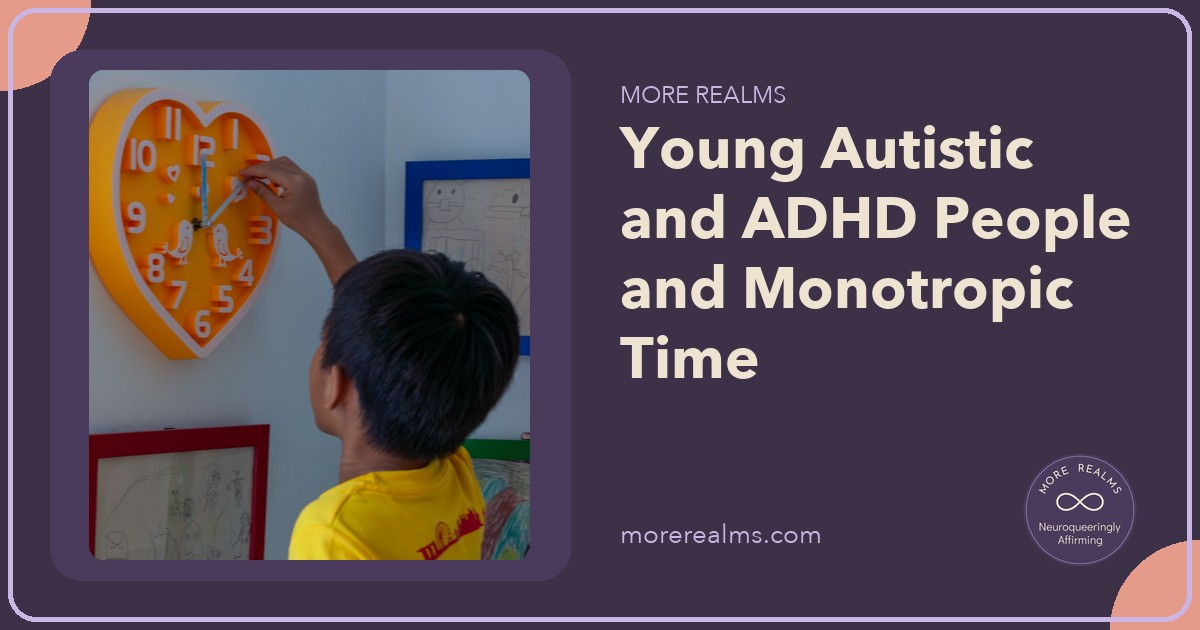
    Time is often assumed to be neutral, constant, and universally experienced. But for Autistic, ADHD, and AuDHD people, time rarely feels linear or neutral. Drawing from The Time We See (Tolani & Venkatesan, 2025) and my Map of Monotropic Experiences (Edgar, 2024), I will explore how time can be subjective, embodied, fluid, and experienced differently through the lens of monotropism. By changing how we see and use time, we may be able to provide more neuro-affirmative support for Autistic/ADHD young people at home and in educational settings. (For more on the theory, see my posts “Monotropic Time” and “Monotropic Time & Neuroqueering Temporalities“.)

    In Time Binds, Elizabeth Freeman (2010) introduced the term “chrononormativity.” Chrononormativity is society’s expectation that we must live by linear, productive time. This means meeting developmental and educational milestones, and later following the seemingly invisible path to have relationships at set times of life and to achieve certain career goals: a path that many of us are expected to travel regardless of neurotype, disability or any other aspect of intersectionality that may affect that path.

    Monotropism: A Neuro-Affirmative Theory

    Monotropism is a neuro-affirmative theory of autism which was originally developed by Dinah Murray, Wenn Lawson, and Mike Lesser (Murray et al., 2005). The theory of monotropism describes a cognitive tendency to focus deeply on fewer interests. Many ADHD and AuDHD people also resonate with the theory of monotropism, and the Monotropism Questionnaire (Garau et al., 2023) has given researchers a way to measure it.

    Monotropism affects how we use our attentional resources and explains lots of things, from different ways of communicating, playing, working and socialising to how our sensory systems may respond differently if you are monotropic. I think the theory of monotropism could also play a part in how time is perceived, even though there is not yet much research about this. When engaged in passions and things that pull in our attentional resources, monotropic people enter a “flow state” where time may feel more expansive or even irrelevant.

    Problems with Neuronormative Time

    We need to consider what happens when people diverge from the rhythm and patterns of neuronormative time and expectations, by being neurodivergent rather than by choice. Many Autistic and ADHD people experience burnout from masking and trying to align with neurotypical time. We’re often labelled as “late,” “disorganised,” or “chaotic,” and these labels can carry shame and add to stigma.

    Tolani and Venkatesan (2025) highlight that ADHDers naturally diverge from “normal” (neurotypical) time. Neuronormative time is an invisible standard that privileges punctuality, developmental, educational, and life milestones, and productivity. Falling out of sync with this time frame is often seen as pathological, something that needs ‘fixing’ for Autistic/ADHD people, rather than as merely inconvenient.

    Schools reinforce neuronormative time; in many ways they have to, but there are ways they could be more flexible. Schools have to function for staff and families. They need to have some kind of start and end times, and they have to abide by curriculums and timetables that are set up to ensure each child has access to full-time provision and can meet set goals. Parents and carers have to work, so having fixed start and end times is essential so families can plan and businesses can run. Things like breakfast clubs and after-school clubs are now as much of an essential part of school life for many families as the 9 to 3.30 school day itself.

    However, the problem is often how time is used and the expectations around time. From very early on in life, children are expected to meet various developmental milestones, such as learning to be ‘school ready’. Some guidance around typical developmental milestones can be really helpful. It can signal difficulties for parents and professionals when a child isn’t meeting certain milestones, but developmental milestones are just a guide. If a child is neurodivergent then their developmental path may not be so linear; they may have a more spiky profile, and this is rarely taken into account.

    Various trusts and charities have called on the government to support the new Starting Reception definition of school readiness (Tes, 2025). It includes four categories, each with linked skills. Growing independence covers things like putting on a coat and shoes, using the toilet, getting dressed, using cutlery, spending time away from parents, and taking part in imaginative play and creative activities. Building relationships and communicating covers sharing and taking turns, talking about feelings, singing, speaking clearly to ask for help, paying attention for short periods, and following simple instructions. Physical development includes getting moving for at least three hours a day, climbing, catching a large ball, and doing puzzles and crafts. Healthy routines include brushing teeth twice a day, going to bed at the same time each night, limiting screen time, and eating a healthy diet and trying new foods.

    If you read down this list and you have an Autistic child, you will likely see some of the difficulties with school readiness campaigns! Your Autistic child may be doing really well and progressing exactly in their own time and in their own way, but may not be meeting these milestones, with or without any additional learning disabilities, just because they are developing in a different way.

    Behaviourist approaches that are used in many schools often penalise students who can’t keep up with the rapid transitions of the school day or fast-paced lessons, and they often fail to account for differences in monotropic processing. A more flexible, fluid approach to how time is used in educational settings could help Autistic/ADHD/monotropic (and many other!) people flourish within their own temporal rhythms.

    Different Experiences of Time

    Just as there is no one-size-fits-all curriculum and no one-size-fits-all guide for school readiness, there isn’t a one-size-fits-all dimension of time. Considering how monotropic people experience and use time may provide better ways to provide support.

    When an Autistic, ADHD or AuDHD (monotropic) person is absorbed in their special interests or passions, it may feel like the outside world is melting away or time is dissolving. They may be fully absorbed in a project or engaged in something of specific interest to them for hours at a time, unaware of their surroundings. This immersive attention tunnel is both rejuvenating and essential for Autistic/ADHD wellbeing, and it can feel really painful to be pulled out of this flow state. Navigating back into neuronormative time can feel really jarring and be highly dysregulating, especially if someone else suddenly interrupts or is trying to force you out of your attention tunnel.

    The River of Monotropic Time

    My Map of Monotropic Experiences visualises this: a river of flow states buffered by the “Riverbanks of Monotropic Time,” surrounded by forests of joy, mountains of ruminating thoughts and burnout whirlpools. Inside the river is where monotropic people thrive: in flow, immersed, safe. Outside it lie the “Shark Infested Waters of Neuronormativity,” with their rigid demands and expectations.

    In flow, there’s no anxious “now/not now” binary or sense of inertia. But outside it, especially when stuck between interests or pulled out of flow states and attention tunnels prematurely, life can feel disorienting. As I’ve written about in Monotropism, Autism & OCD (Edgar, 2023), this “frozen flow” can become a stuck state that is often pathologised, but it may be a symptom of mismatched experiences of time. Mihaly Csikszentmihalyi’s flow theory (1990) tells us that flow is an optimal state for everyone. For Autistic/AuDHD people, these states are often pathologised as “restricted and repetitive interests.” If we reframed them as monotropic passions and being in a flow state, we’d maybe see just how crucial monotropic time is to our wellbeing.

    When we understand monotropic time as natural and valid, life becomes smoother. We need to go with our inner monotropic flow and tides, rather than constantly feeling like we are battling against them upstream.

    Temporal Embodiment and Neuroqueer Time

    Time is also bodily. Maurice Merleau-Ponty (1962) reminds us that perception, including of time, is always embodied. Buckle et al. (2021) describe Autistic inertia as a state where movement, motivation, or action feels impossible until something shifts. Barbara Adam (1995) writes about how bodily rhythms (circadian, emotional, hormonal) intertwine with social time. When these don’t align, the mismatch causes guilt, disconnection, and misunderstanding. Time perception might also be subject to the double empathy problem (Milton, 2012), where misunderstandings between neurotypical and neurodivergent people reflect different temporal logics, a two-way gap rather than a one-sided Autistic “deficit”.

    Nick Walker’s Neuroqueer Heresies (2021) reframes neurodivergence as a different, creative mode of being. Neuroqueering time, then, is about resisting capitalist demands and tuning into your internal rhythms. It is, as Tolani and Venkatesan (2025) describe, a move toward temporal plurality: a recognition that time perception is not universal, and that our different realities give rise to different ways of living in time. The Autistic rhizome, as David Gray-Hammond and I have explored (Gray-Hammond, 2023; Edgar, 2026), offers a metaphor for neuroqueer time: non-linear, relational, emergent, and expansive. It’s time that flows in spirals, connects in webs, and exists across time zones as communities form online 24/7.

    From Disordered Time to Different Time

    Robert Chapman’s Empire of Normality (2023) shows how pathologising autism and ADHD is a political act. Classifying these experiences as “disordered” upholds a capitalist logic that favours productivity and conformity over authentic experience.

    By sharing our lived experiences, through blogs, art, infodumps, or maps, we can begin to “re-story” time itself. Whether we name it monotropic time, neuro-holographic time, spiral time, or something else entirely, we are reclaiming our narratives and reframing how time can work with us.

    Towards a Temporally Inclusive World

    To make space for monotropic time, we need to reimagine our institutions and environments: quiet waiting rooms, flexible appointments, emails instead of calls, and space for body doubling, authentic connection, and collective flow. Small changes, like those we explore in our Neuroqueer Learning Spaces with Stimpunks, can foster inclusion and affirm different ways of being, and show what’s possible when we support monotropic flow rather than interrupt it. The goal goes beyond accommodating Autistic people; it is to neuroqueer society for the benefit of everyone.

    Time does not need to be a prison; it can instead become a portal into deeper flow states and a more embodied, authentic way of being. When we share time with neurokin, our experiences align. The anxiety melts. The masking lifts. It feels just right. Like home.

    Whether through the melting clocks of surrealism, the riverbanks of monotropic flow, or the relational rhythms of neurokin, there are endless ways to experience and honour time. Let’s stop trying to squeeze everyone, especially our children, into one rigid clock. There is no single right way to live, be, or feel time.

    Share Your Story of Monotropic Time

    We are gathering stories of monotropic experience (art, blogs, essays, poetry, music) in collaboration with Stimpunks, through the Call for Submissions: Share Your Experiences of Being Monotropic. Come and share your time portals with us, and let’s collectively rewrite the story of time, one portal at a time.

    References

    Adam, B. (1995). Timewatch: The social analysis of time. Polity Press.

    Buckle, K. L., Leadbitter, K., Poliakoff, E., & Gowen, E. (2021). “No way out except from external intervention”: First-hand accounts of autistic inertia. Frontiers in Psychology, 12, Article 631596. https://doi.org/10.3389/fpsyg.2021.631596

    Chapman, R. (2023). Empire of normality: Neurodiversity and capitalism. Pluto Press.

    Csikszentmihalyi, M. (1990). Flow: The psychology of optimal experience. Harper & Row.

    Edgar, H. (2023, August 16). Monotropism, autism & OCD. Autistic Realms. https://autisticrealms.com/monotropism-autism-ocd/

    Edgar, H. (2024, December 7). Map of monotropic experiences. Autistic Realms. https://autisticrealms.com/map-of-monotropic-experiences/

    Edgar, H. (2026, February 22). The Autistic rhizome: Community, liminal spaces & belonging. Autistic Realms. https://autisticrealms.com/the-autistic-rhizome-community-liminal-spaces-belonging/

    Freeman, E. (2010). Time binds: Queer temporalities, queer histories. Duke University Press.

    Garau, V., Murray, A. L., Woods, R., Chown, N., Hallett, S., Murray, F., Wood, R., & Fletcher-Watson, S. (2023). Development and validation of a novel self-report measure of monotropism in autistic and non-autistic people: The Monotropism Questionnaire [Preprint]. OSF Preprints. https://doi.org/10.31219/osf.io/ft73y

    Gray-Hammond, D. (2023, April 21). Neuro-anarchy and the rise of the Autistic rhizome. NeuroHub Connect. https://neurohubcommunity.org/2023/04/21/neuro-anarchy-and-the-rise-of-the-autistic-rhizome/

    Merleau-Ponty, M. (1962). Phenomenology of perception (C. Smith, Trans.). Routledge & Kegan Paul.

    Milton, D. E. M. (2012). On the ontological status of autism: The “double empathy problem”. Disability & Society, 27(6), 883–887. https://doi.org/10.1080/09687599.2012.710008

    Murray, D., Lesser, M., & Lawson, W. (2005). Attention, monotropism and the diagnostic criteria for autism. Autism, 9(2), 139–156. https://doi.org/10.1177/1362361305051398

    Tes. (2025, March 11). EYFS: Call for an agreed definition of school readiness. https://www.tes.com/magazine/news/early-years/29-signs-school-readiness

    Tolani, P., & Venkatesan, S. (2025). The time we see: ADHD, neuroqueer temporality, and graphic medicine. Perspectives in Biology and Medicine, 68(1), 117–138. https://doi.org/10.1353/pbm.2025.a953457

    Walker, N. (2021). Neuroqueer heresies: Notes on the neurodiversity paradigm, autistic empowerment, and postnormal possibilities. Autonomous Press.

  • Monotropic Time & Neuroqueering Temporalities

    Monotropic Time & Neuroqueering Temporalities

    Dwelling in Resonance: Monotropism, Monotropic Time, Spirals & Neuroqueer Temporalities

    “Lodged in all is a set metronome” –


    (W. H. Auden, 1969 – from the poem In Due Season)


    Consider if you’re Autistic/ ADHD/ Monotropic and what happens if your internal metronome beats to a different rhythm to other people?


    For many of us who are Autistic, ADHD, or AuDHD, time is not a straight line. It spirals, loops, expands, contracts. It may feel like you have your own rhythm or internal metronome that others may not be quite in synch with, or like you are singing a song that others cannot hear the beat of. I will briefly explore the theory of monotropism (the tendency towards deep, focused attention where more of your attentional resources are used on fewer interests at any one time) in relation to my experience of time as an AuDHD monotropic person and offer am emerging neuroqueering perspective of the fluidity of time.

    (This is a shortened and edited version of my much longer blog about Monotropic Time (2025), which evolved from my series of Medium blogs, where I have been exploring some Deleuzean concepts within a framework of Neuroqueering Liminal In-Between Spaces (2023) ………amongst other random ideas!)


    Neuronormative Time

    Elizabeth Freeman’s concept of “chrononormativity” is introduced in her book Time Binds (2010). She explains how we learn to use our bodies through normative time—schedules, deadlines, and life stages—all governed by the logic of productivity. According to Freeman, chrononormativity encompasses the socially reinforced expectations and norms of how we spend our time – it makes us question what governs ‘productive’ time and what we see as ‘rest’ time.

    In a world dominated by chrononormativity or what I will call (neuronormative time), the capitalist, clock-driven expectation is to be productive, punctual, and linear, neurodivergent ways of moving through time are often pathologized. If you are Autistic/ ADHD/ AuDHD you may find you are often stigmatised for being “late,” “chaotic,” or “disorganised,” when in fact, you may simply be existing on a different temporal wavelength. As Tolani and Venkatesan write in The Time We See (2025), time isn’t neutral. It’s structured by ableism, productivity demands, and neurotypical developmental milestones. If you fall outside this invisible scrip, if your time bends, stretches, and spirals, you’re often thought of as disordered or somehow needing fixing or interventions. Perhaps the differences in the way we experience time can be explained by the theory of monotropism? Perhaps it is an ontology?


    Monotropic Time

    I think the theory of monotropism (Murray et al. 2005) could offer us a lens to reframe time for Autistic/ ADHD/ AuDHers who are more likely to be monotropic (Garau et al. 2023). If you use more of your attentional resources on fewer areas of interest than others, then perhaps your experience of time will narrow too in some ways and expand in others? Just like our monotropic experiences when zooming into our passions and perhaps deep diving into a rabbit hole of research and creating ever-expanding constellations of rhizomorpheous connections or being so immersed in a sensory experience of looking at light reflecting on water or onto your wall that you feel you have may be almost become the tiny fragments of light (or may be that is just me?!) ?

    Having a different perception of time could also help explain a large part of the Double Empathy Problems (Milton 2012), especially between monotropic and polytropic people. If you’re like me and monotropic, hours can feel like minutes when you’re in a deep attention tunnel and fully engaged in a flow state; outside demands may feel like they literally melt away or dissolve. It is perhaps not that we’re “losing time”; but rather, we can reframe it that we are dwelling within time, immersed in a resonant spiral of attention that is tunnelling ever deeper the longer we are engaged and the deeper into a flow state we go. It may feel like pure Autistic joy if you are engaged with something positive (alternatively, it could end up feeling like an eternal loop of hell and ruminating anxiety-filled, all-consuming thoughts if your attention has hooked into something less joyful).

    When in flow, the concept of “now/not now” becomes irrelevant. You are simply in flow, it can feel like the the world outside of your attention tunnel filled with neuronormative demands and expectations is literally melting away. This could be seen to be monotropic temporality. If you are monotropic, you may feel more attuned to your environment; everything may be felt more intensely, thoughts and time itself is not linear, and everything from the core of your being may be more interconnected. Time itself may be felt differently as we experience the world differently. If you are monotropic, you may feel that time is spirally and rhizomatic and flowy, just like your thoughts, sensory system and interests or passions!


    The Riverbanks of Monotropic Flow

    In my Map of Monotropic Experiences, I describe monotropic time as being like a flowing river. When we’re in the right environment and are able to follow our passions and immerse ourselves freely in sensory experiences, we may be able to swim easily within the natural smooth current and flow of our bodyminds. However, when we’re pulled out of our attention tunnel and flow state by unexpected events, transitions, and external expectations and demands, the river can turn turbulent.

    It takes more energy resources to fight against external demands and neuronormativity; it can feel like you are swimming upstream; are using all of your energy but not getting very far and never reaching where you want to be. This is only sustainable for so long before people end up spiralling into what I have visualised as burnout whirlpools. Monotropic people are may be more likely to get stuck in states of inertia, loops of anxiety and ruminating thoughts, not because they’re broken, but because the majority of the world refuses to flow with us and we are swimming against our natural tides. You can only swim upstream against your natural flow for so long before you are likely to hit burnout and start to struggle.

    Monotropic time is nonlinear, rhizomatic, and relational. It’s shaped by sensory experiences and a deep embodiment of the environment and relationships around us. If you are monotropic, you may have a different temporal ecology that needs support, not correction. Without the right accommodations, support, and safe spaces to be your authentic self, the waters of neuronormativity can be dangerous and lead to burnout and mental health difficulties.

    Map of Monotropic Experiences Map of an island with the areas: Attention Tunneling Penguin Pebbling Cove of Friendship Tendril Theory (@EisforErin) Mountains of Ruminating Thoughts Cyclones of Unmet Needs Rabbit Holes of Research Infodump Canyon Rhizomatic Communities River of Monotropic Flow States Campsite of Cavendish Spaces Meerkat Mounds (Gray-Hammond & Adkin) Riverbanks of Monotropic Time Shark Infested Waters of Neuronormativity, Behaviourism & Double Empathy Problems (Milton, 2012) Beach of Body Doubling Burnout Whirlpools Panic Hills of Low-Object Permanence Forest of Joy Awe and Wonder Lake of Limerence Tides of the Sensory Sea Sudden Storms of Unexpected Events


    Neuroqueering Time: A Temporal Liberation

    “Crip time is time travel. Disability and illness have the power to extract us from linear, progressive time with its normative life stages and cast us into a wormhole of backward and forward acceleration, jerky stops and starts, tedious intervals and abrupt endings. Some of us contend with the impairments of old age while still young; some of us are treated like children no matter how old we get.”
    ― Alice Wong, Disability Visibility: First-Person Stories from the Twenty-first Century

    To neuroqueer time is to resist the tyranny of the capitalist clock and neuronormativity. It is to refuse productivity as a measure of worth and instead honour attunement, resonance, flow states, connections and meaningful relationships with people and with our environment. As Nick Walker writes in their book Neuroqueer Heresies (2021), neuroqueering is not just about identity, it’s a practice of creative survival. Neuroqueer temporality isn’t just for Autistic people or ADHDers, it’s also an invitation for everyone to find their own rhythm and dimension of time that works for them.

    From Merleau-Ponty’s notion of embodied perception to Deleuze and Guattari’s lines of flight that I wrote about in my blog Middle Entrance (2023), some ideas are slowly starting to make a bit more sense for me and are beginning to connect in new ways. I began my Medium blog (which is now hosted on Autistic Realms) by exploring Lefebvre’s ideas around the concept of space being alive. I feel space (like my own Autistic/ ADHD identity and energy) is fluid. Space constantly changes and depends on the interactions of those around us and objects within other spaces. I have been exploring ways of finding meaning in the spaces within what could be considered ‘ma’ to enable thoughts to develop and create connections with others from as I explored in my neuroqueering from the liminal in-between spaces blog(2023).

    Embracing monotropic time could be seen as a form of neuroqueering as defined in Nick Walker’s (2021) book Neuroqueer Heresies. I have been considering if the energy created by these connections can lead to even more new spaces, ideas, and possibilities by subverting the expectations of the normativity of relationships and communication in my blogs about neuroqueering from the in-between and liminal spaces. I am now looping some of these thoughts back around and centering them on the theory of monotropism and my different way of experiencing time.

    If we embrace our natural monotropic flow states and monotropic spiral time, we can maybe begin to understand time not as a schedule or governed by a ticking clock or by timetables set out by neuronormative expectations. Instead, we can explore how, as Autistic/ ADHD people we may experience living in monotropic time more as a form of relational, moment-to-moment negotiation between our environment and ourselves. From a neuroqueering perspective, if we embrace monotropic time, it can enable us to expand and defy time set out by neuronormative ideals and be liberated from the ticking clock of capitalism.

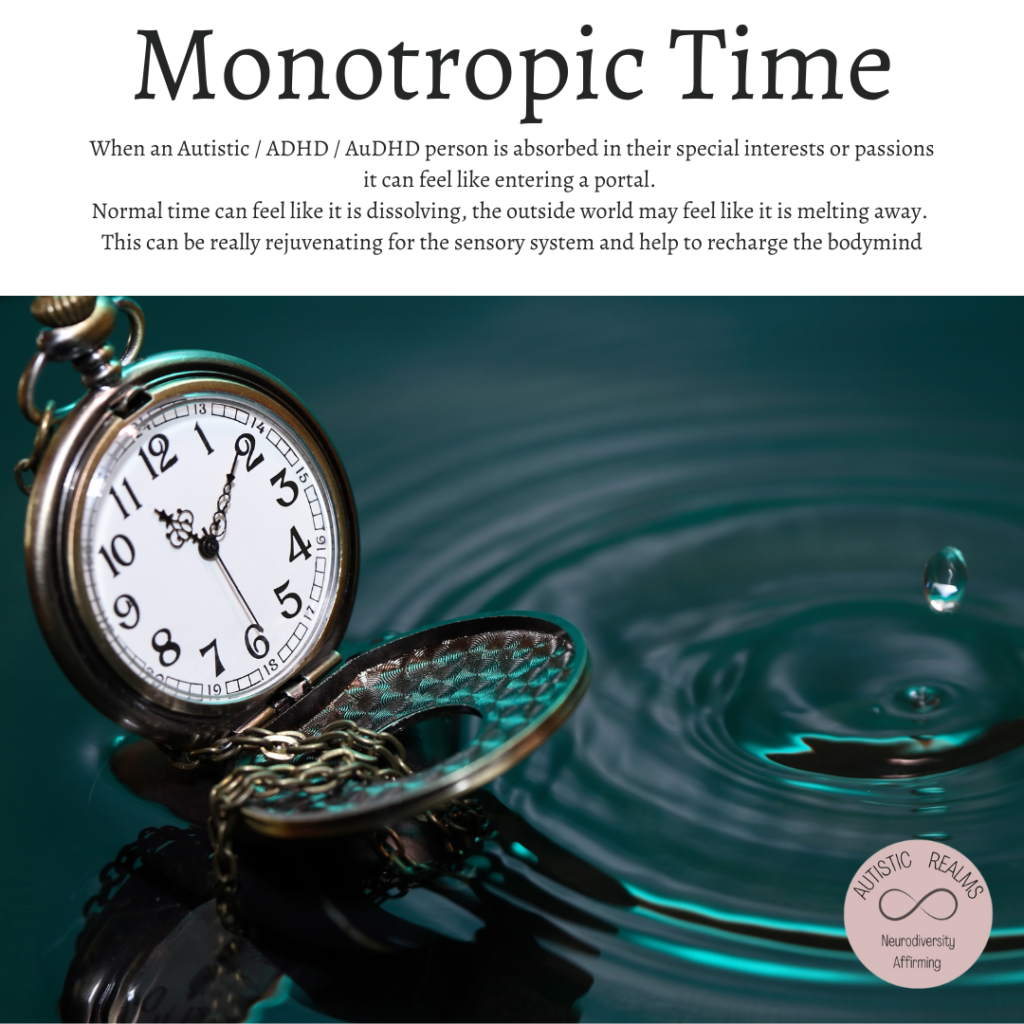
    Image of pocket watch in water. TExt reads: Monotropic Time
When an Autistic / ADHD / AuDHD person is absorbed in their special interests or passions
it can feel like entering a portal.
Normal time can feel like it is dissolving, the outside world may feel like it is melting away. This can be really rejuvenating for the sensory system and help to recharge the bodymind

    A World Beyond the Clock

    Whether we call it spiral time, neuro-holographic time, or monotropic time, what matters is that we validate these different temporal realities. Because for many of us, time is not measured in minutes but in meaning. Monotropic time is like a portal, whereas neuronormative time may feel more like a prison at times, or at least like we are trying to swim upstream and going against the very essence of our natural monotropic flow and rhythm.

    In 1943, T.S. Eliot’s collection of four poems were collated to form Four Quartets. The final poem in this series Little Gidding (1942), continues Eliot’s exploration of time and our connections with each other through generations and current society.

    “What we call the beginning is often the end. And to make an end is to make a beginning. The end is where we start from.”

    This quote seems particularly relevant to my deep interest in evolving spirals and finding meaning in gaps and spaces and an experience of monotropic time that I am continuing to explore and loop back to Eliot’s poetry.

    I visualise time, relationships and ways of being as constantly evolving spirals that spin in and out in multidimensional ways. Different connections and experiences add to and contribute to a wider, deeper, fluid rhizomatic network of potential that is always in a constant state of flux, perhaps more so if you are monotropic. This idea of an evolving spiral and returning to a new beginning in the middle is beautifully reflected in Eliot’s poem Little Gidding:

    “We shall not cease from exploration
    And the end of all our exploring
    Will be to arrive where we started
    And know the place for the first time.
    Through the unknown, remembered gate
    When the last of earth left to discover
    Is that which was the beginning;
    At the source of the longest river
    The voice of the hidden waterfall
    And the children in the apple-tree
    Not known, because not looked for
    But heard, half-heard, in the stillness
    Between two waves of the sea”
    .

    — T.S. Eliot, from “Little Gidding,” Four Quartets (Gardners Books; Main edition, April 30, 2001) Originally published 1943.

    To support monotropic people, perhaps we need to bend or unfold neuronormative time. As Autistic/ ADHD/ AuDHD people, we likely need more space and flexibility to thrive in a world dominated by neuronormative demands and governed by neuronormative time. We need to create room for flow, for stillness, for neurodivergent ways of resting, regulating and rejuvenating, for our monotropic deep dives and immersive sensory experiences and for our nonlinear rhythms. We need to let go of the myth of “normal” time and start dwelling in resonance, which may enable us to be more at one with the natural flow of our bodyminds and our environment.

    We all have our own internal metronomes that are responsive to the environment around us. As monotropic people, we may need more flexibility and a softer, more supple understanding and acceptance of our different perceptions of time from people around us. As Tolani, P., & Venkatesan, S. (2025) summarise their paper published last week The Time We See: ADHD, Neuroqueer Temporality, and Graphic Medicine, “It is crucial to recognize that time perception is not universal but varies across neurotypes, suggesting a broader and more inclusive view of temporal experiences.”

    To support monotropic people, we need to create safe, spacious environments where time is allowed to stretch, spiral, and soften. Monotropic time must be honoured not as a deviation but as a valid, expansive and different rhythm and way of living.

    When we make room for fluidity and loosen the grip of rigid schedules, tight timetables and linear binary expectations, we can then enable space for monotropic time perception to unfurl, unfold and expand rhizomatically so we are not just surviving and trying to swim upstream but can immerse ourselves in flow and thrive to be our authentic monotropic selves.

    Neuroqueer temporality isn’t just for Autistic people or ADHDers. It is an open invitation for everyone to discover their own rhythm, their own flow, their own temporal dimension that feels right. Each person moves through time differently, shaped by their neurology, bodymind, and personal lived experience for some it may be they experience time more neuro-holographically.

    To honour neurodiversity, we need to slow down, soften, and make space for each other, and for ourselves. When we allow time to bend, spiral, expand and breathe and when we embrace flexibility and presence over pressure, demands and neuronormative expectations we can create environments where everyone can flourish in ways that are more meaningful to them and everyone has the potential to thrive.

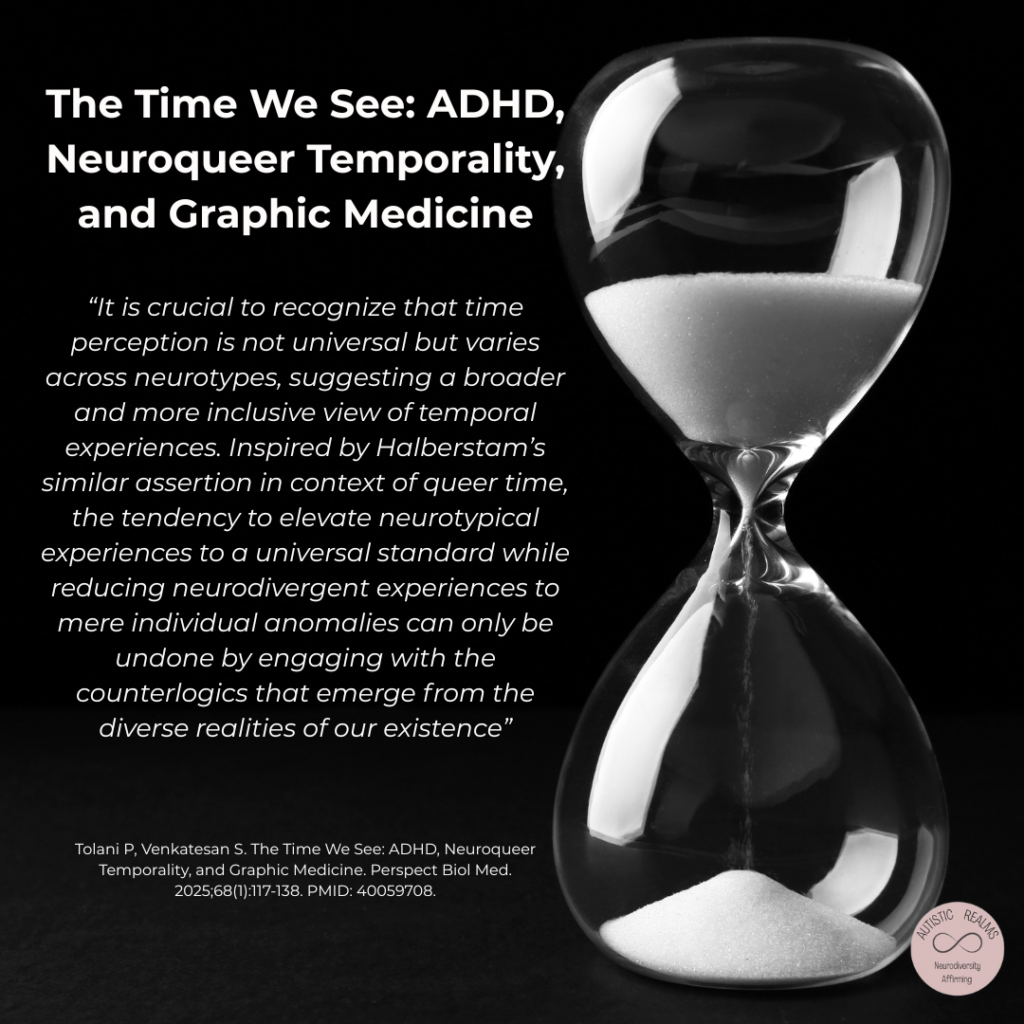
    Black and white image of sand timer. Text reads: The Time We See: ADHD,

Neuroqueer Temporality,
and Graphic Medicine

"It is crucial to recognize that time
perception is not universal but varies
across neurotypes, suggesting a broader
and more inclusive view of temporal
experiences. Inspired by Halberstam's
similar assertion in context of queer time,
the tendency to elevate neurotypical
experiences to a universal standard while
reducing neurodivergent experiences to
mere individual anomalies can only be
undone by engaging with the
counterlogics that emerge from the
diverse realities of our existence"

Tolani P, Venkatesan S. The Time We See: ADHD, Neuroqueer Temporality, and Graphic Medicine. Perspect Biol Med.
2025;68 (1):117-138. PMID: 40059708.


    References and further relevant reading


    Chapman, R. (2023b). Empire of normality: Neurodiversity and Capitalism. Pluto Press (UK).

    Csikszentmihalyi, Mihaly. (1990). Flow: The Psychology of Optimal Experience.
    Freeman, E. (2010). Time binds. https://doi.org/10.2307/j.ctv1198v7z

    Edgar, H. (2024. Neuroqueering from the Inbetween. Stimpunks Foundation. https://stimpunks.org/2024/04/12/neuroqueering-from-the-inbetween/

    Edgar, H. (2025). Autism & The Map of Neuronormative Domination: Stuck States vs Flow States. Autistic Realms. https://autisticrealms.com/autism-the-map-of-neuronormative-domination-stuck-states-vs-flow-states/


    Edgar, H. (2024). Monotropic interests and looping thoughts. Autistic Realms. https://autisticrealms.com/monotropic-interests-and-looping-thoughts/

    Edgar, H. (2023). Middle entrance. Autistic Realms. https://autisticrealms.com/middle-entrance/
    Edgar, H. (2024). Monotropism, autism & OCD. Autistic Realms. https://autisticrealms.com/monotropism-autism-ocd/

    Edgar, H. (2024). Quantum Neuro-Holographic Thoughts from a Liminal Space. Autistic Realms. https://autisticrealms.com/quantum-neuro-holographic-thoughts-from-a-liminal-space/

    Eliot, T. S. (1943). Four quartets. Houghton Mifflin Harcourt.

    Fisher, M. (2022). Capitalist realism: Is There No Alternative? Zero Books.

    Fox, K. (2024). Bigger on the inside. Smokestack Books.

    Freeman, E. (2010). Time binds. https://doi.org/10.2307/j.ctv1198v7z

    Garau, Valeria & Murray, Aja & Woods, Richard & Chown, Nick & Hallett, Sonny & Murray, Fergus & Wood, Rebecca & Fletcher-Watson, Sue. (2023). Development and Validation of a Novel Self-Report Measure of Monotropism in Autistic and Non-Autistic People: The Monotropism Questionnaire. 10.31219/osf.io/ft73y.

    Gray-Hammond, D., (2023c, April 21). Neuro-anarchy and the rise of the Autistic Rhizome – Emergent Divergence. Emergent Divergence. https://emergentdivergence.com/2023/04/21/neuro-anarchy-and-the-rise-of-the-autistic-rhizome/

    Heasman, B., Williams, G., Charura, D., Hamilton, L. G., Milton, D., & Murray, F. (2024c). Towards autistic flow theory: A non‐pathologising conceptual approach. Journal for the Theory of Social Behaviour. https://doi.org/10.1111/jtsb.12427

    Irion, J. (2024, September 9). Autistic Chronophobia Theory – Jim Irion – Medium. Medium. https://jimirion.medium.com/autistic-chronophobia-theory-a1225434edd1

    Merleau-Ponty, M. (2012). Phenomenology of perception. Routledge.

    Milton, D. E. (2012c). On the ontological status of autism: the ‘double empathy problem.’ Disability & Society, 27(6), 883–887. https://doi.org/10.1080/09687599.2012.710008

    Murray, D., Lesser, M., & Lawson, W. (2005a). Attention, monotropism and the diagnostic criteria for autism. Autism, 9(2), 139–156. https://doi.org/10.1177/1362361305051398

    Rapaport, H., Clapham, H., Adams, J., Lawson, W., Porayska-Pomsta, K., & Pellicano, E. (2023). ‘I live in extremes’: A qualitative investigation of Autistic adults’ experiences of inertial rest and motion. Autism, 28(5), 1305–1315. https://doi.org/10.1177/13623613231198916

    Tolani, P., & Venkatesan, S. (2025). The time we see: ADHD, neuroqueer temporality, and graphic medicine. Perspectives in Biology and Medicine, 68(1), 117–138. https://doi.org/10.1353/pbm.2025.a953457

    Walker, N. (2021a). Neuroqueer heresies: Notes on the Neurodiversity Paradigm, Autistic Empowerment, and Postnormal Possibilities. Autonomous Press.

    Discover more

    Courses, books and resources

    If you would like to take these ideas further, my courses, books and resources live on Autistic Realms. Everything in the shop is pay what you can, and many resources are free.