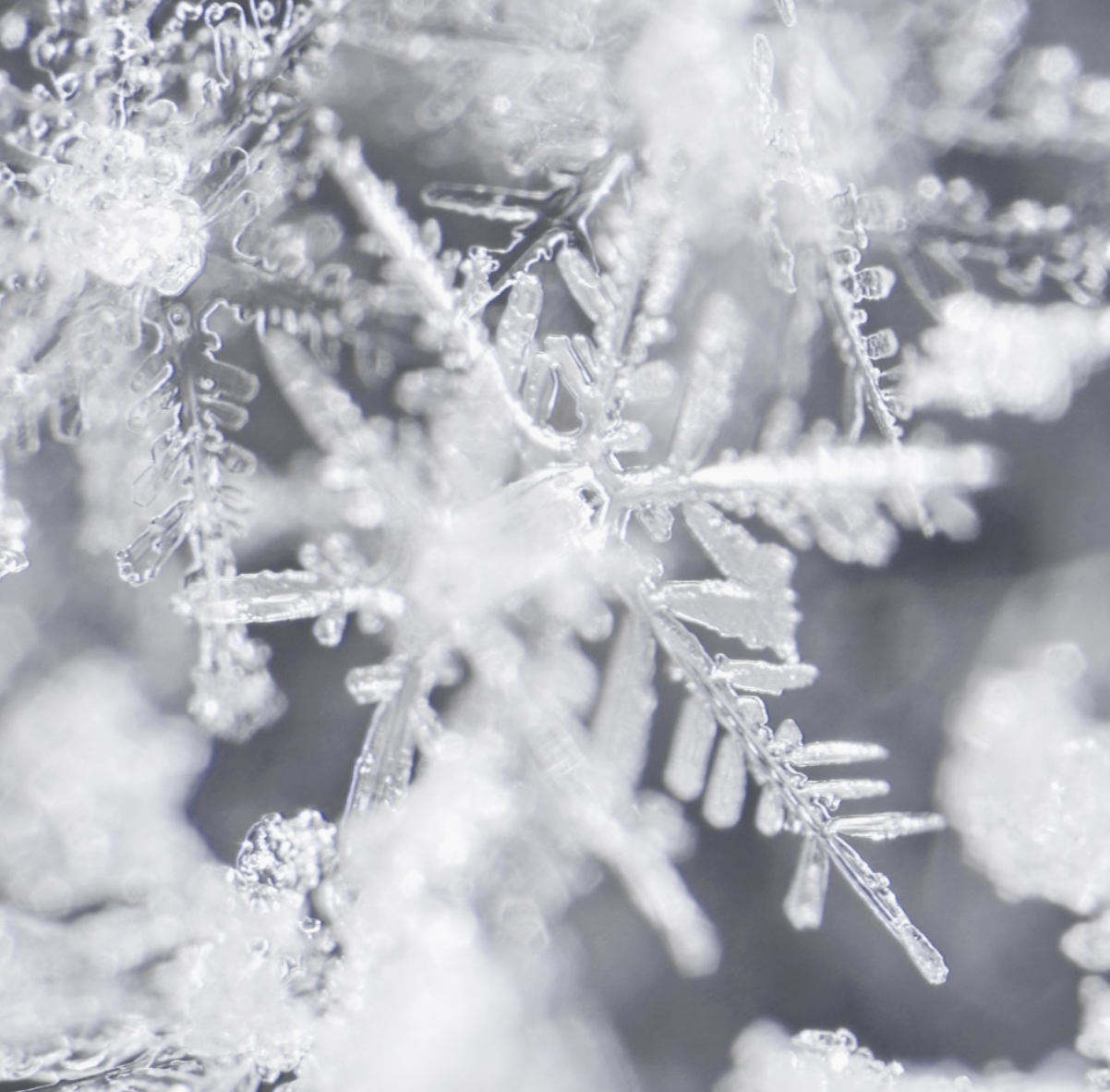
When snow first falls, its flakes are delicate and vulnerable, but over time, a quiet transformation begins. Sintering is the process through which individual snow grains gradually begin to bond. Tiny necks form between them, bridging the gaps, making the snowpack stronger, more resilient, and more resistant to collapse.
Sintering
In Theory of Water: Nishnaabe Maps to the Times Ahead(2025), Leanne Betasamosake Simpson offers this as a metaphor for collective becoming. “Sintering is a joining,” she writes. “It is a communal transformation that creates a fabric of former snowflakes bonded to each other… Sintering is bonding, it’s building coalitions with your neighbours” (p. 18).
This analogy resonates deeply with my own experiences of the neurodivergent community and the Autistic rhizome. Many of us begin our journeys alone, caught in systems not made for us. Discovering I was Autistic was life changing for me. In my 40s I suddenly had access to a whole world of new vocabulary to describe my experiences. It has been through connecting with other Autistic people through various online communities and sharing stories that my life has begun to make more sense. When we find each other across difference, across shared experiences, we can start to build bridges. Through conversation, care, and solidarity, we can begin to sinter.
World Making From The Liminal
In Neuroqueering in the Liminal Spaces, I explored how if you are neurodivergent, community connections often emerge in the spaces-between: the liminal zones where identities are unmoored and reforming. Liminality is not a passive in-between, but an active threshold a place of transformation. To neuroqueer is to inhabit these spaces intentionally, resisting the pull of normative timelines and expectations. It’s where we begin to re-imagine our relationships to time, to each other, and to ourselves. These are places where we unlearn and relearn and begin to create our own worlds so we can move beyond survival and can thrive.
Simpson writes, that “world making requires love, kindness, and care. It requires collectivity and relationality… [it] generates the knowledge needed to move onto the next step” (p. 41).
Trust in Human Scale
Jorn Bettin (2024) Trust in Human Scale explores how neurodivergent people are often asked to stretch beyond sustainable limits, to conform to institutional scales that demand efficiency over relationship, compliance over trust, “We are trusted only to the extent that we comply.”
This is why our sintering matters so much. Human-scale relationships form in peer support groups, online community spaces, through shared projects such as our Map of Monotropic Experiences, they prioritise relational attunement and rely on mutual trust rather than extracted performance.
As the Jorn Bettin says: “It’s not that neurodivergent people don’t trust. It’s that we often trust with more depth, more integrity, more sensitivity to rupture.”
Trust at human scale is fragile and strong, just like the sintering bridges between snow grains.
As Jorn Bettin writes in Trust in Human Scale, we need “a refusal of scale, a refusal of institutional metrics for safety and success.” Instead, we root ourselves in relationships, in slowness, in deep listening. These are the bonds that hold. As Simpson says, ‘world making is a communal struggle’ (pg 34).
Sintering Communities
Perhaps sintering is not just a metaphor, but we could use this as a method to build community? Together we can re-build our future through slow bonds, mutual trust, and the gentle resistance of staying human in systems that try to scale us and deny us our authentic Autistic identities.
Our home is in the liminal spaces that we create together, in our reaching toward one another. Our strength is in sintering. Just as snow grains join through small necks of ice to become a strong, stable snowpack, we can build strength through our relationships, our co-regulation, our refusal to face the world alone and to conform to harmful systems based only on neuronormative values.
Radical resilience does not come from hardness or conformity, but from the cumulative strength of many unique connections forming bonds and community spaces to offer support to each other.
“By silencing our bodyminds, they (neurotypical society) have halted the growth of a chaotic self. We are no longer able to move fluidly through our experience, instead frozen like ice on an arctic tundra” (Gray-Hammond, 2023)
David Gray-Hammond (Emergent Divergence) and I are responding to each other’s blogs to help expand the Autistic Rhizome. We are adding nodules to the webs of discussions happening in the Dark Forests (Boren, 2024) of the online communities and creating an open-source bank of writing to carve a path for community discussion about neuroqueering.
David is continuing his ‘Reclaiming Neurofuturism’ series and has responded to my post The Double Empathy Problem is DEEP. He explored the litigious nature of disabled embodiment and questioned the intentional creation of minority silos via the double empathy divide (Milton, 2012). In support of my own thinking, David also suggests that we need to embrace the healing power of liminal spaces.
I am writing extensively about the in-between, liminal spaces and Ma as a potential chapter for Nick Walker’s new Neuroqueer Anthology (struggling to write it coherently so that it may make sense to others, but it is slowly forming!). Liminality has been a long term passion of mine, tunnelling back over 30 years. As an autistic person, I feel I have lived my entire life in the liminal. I have always been in-between or on the edges of social groups, always struggling with an internal battle due to the effects masking has on my sensory system. Being monotropic has meant the in-between is felt intensely; it has led to cycles of burnout and impacts my mental, physical and sensory health.
I am still living in the liminal, on the edges, often in spaces filled with anxiety and uncertainty. However, I have gone through a huge and difficult process of unlearning and relearning over the past few years since I realised I was autistic, rejecting the deficit ways of thinking about neurodivergence and dismantling my own ableist thought patterns. Patterns that have been reinforced over decades by the weight of neuronormativity. I am grateful for the autistic communities I am part of for supporting me and providing cushioning to help me navigate my way through this messy process whilst trying to prevent myself heading into a deeper burnout cycle. However, I still feel like I am living on the edges, even within the most caring and supportive neurodivergent communities.
The years of masking, the impact of living in a neuronormative ableist-driven society and going through cycles of burnout has, in many ways resulted in my bodymind being ‘silenced’, getting stuck. David echoed this feeling as he explained;
“By silencing our bodyminds, they (neurotypical society) have halted the growth of a Chaotic Self . We are no longer able to move fluidly through our experience, instead frozen like ice on an arctic tundra.”
Tundras are cold and harsh environments, but biodiversity adapts to the landscape and the short growing seasons, plants and animals transform their ways of being to survive. Tundras offer some hope that life can exist even in the cruellest of environments.
However, we don’t want people feeling frozen, stuck on an arctic tundra, trapped in endless freeze/thaw/burnout cycles. People deserve more than a life in survival mode where they are constantly on high alert for danger and in looping patterns of sensory regulation-seeking behaviour, living in Meerkat Mode (Adkin, 2023). In Walker’s inspiring presentation, ‘Expanding the Creative Potentials of Human Neurodiversity’ at ITAKOM (It Takes All Kinds of Minds Conference, March 2023), she explored how we need to work together so we can flourish so that the;
‘creative synergy, the chemistry that is between and among different minds’ can emerge…so the magic happens’.
We need our beautifully different bodyminds to work together; we need to develop a common language and be open to different ways of thinking, more accepting and inclusive. Radical inclusivity is a concept Ryan Boren (Stimpunks) and I have been exploring as part of our Neuroqueer Learning Spaces Project. There is no single path to radical inclusivity; it begins with being embodied, of being open to connecting with yourself and others, it is cultivated by ongoing neuroqueering efforts to meet needs, it is a confrontation with normativity. Radical inclusivity is more than accommodating needs; it is about fostering cognitive and somatic liberty to enable the potential of neuroqueering to open up new, as yet unknown possibilities.
Radical Inclusive spaces would benefit everyone. They are embodied spaces of deep connection and safety where people can tune in and be responsive to the needs of others. They offer a deeper connection, and they close the DEEP double empathy gap that I feel is at the root of so much hurt, pain, disconnect and disorientation. For radical inclusion, we need to work together. We need connections, a shared deep understanding, an embodied presence, a sense of meaning, and a sense of belonging. We need community, love and kindness to expand the rhizome.
Deleuze and Guattari’s One Thousand Plateaus (1980) explores the concepts of the rhizome and also the importance of plateaus being transforming spaces that resist the linear hierarchy of neuronormativity and embrace the potential of the multiplicity of rhizomatic connections. The possibility to use these concepts to explore neuroqueer theory shines through One Thousand Plateaus, it is like a sunbeam bringing hope in Ma, inbetween the doorways of the liminal spaces that so many of us may feel we are living in.
Rhizomes are open-ended; they have no middle, they have no start and there is no end. (Much like this series of blogs between David and I, I am again beginning in the Middle Entrance, again. You are joining conversations that have been evolving over the past two years in David’s Emergence Divergence Discord server, a node of the autistic rhizome, Open invite to join us there!).
In summary:
Rhizomes are interconnected networks of shared ideas and experiences filled with potential. Much like neuroqueer theory, rhizomes have multiple entry points, they are non-heirarchical. Anyone can neuroqueer, and anyone can enter a rhizome at any point, at any time, if the desire and intent are inside them to want to transform and explore neuroqueering.
Smooth Spaces challenge the idea of traditional hierarchy. They are continuous spaces where the theories of Monotropism (Murray et al., 2005) and Flow Theory (Heasman et al., 2024) can flourish and open up creative neuroqueer potential, an emerging way of being. I experience smooth spaces as the spaces in the gaps of the rhizome; they are the liminal spaces.
Plateaus are spaces of stability; they offer balance and equilibrium, equity, potential for awe and wonder and further expansion and transformation.
Liminal Spaces provide smooth, open plateaus, spaces to connect, transform, and neuroqueer from the safety of our rhizomatic communities.
This new series of blogs will provide a plateau for discussion, a space where the intensity you may feel of being stuck at or between a node point of the rhizome can gain some stability and grounding. We are seeking to expand our bodyminds as we write and connect with others, exploring the dynamics and discord of the DEEP Double Empathy Extreme Problem. As Walker (2019, pg 283) suggested in her thesis;
“we need to “look beyond social cues to the deeper dynamics of interacting bodies, exceptional tactile and kinesthetic sensitivity, and affinity for what I’ve termed the aesthetics of emergence”
We are opening discussions to explore the endless possibilities of an awe-inspiring neuroqueer future, to help bridge the DEEP empathy gap so many people are experiencing and to work towards a radically inclusive society.
“To recognise our responsibility to each other lies in our power to create better futures for each other. Connection is the striking surface of a hammer on the walls of the masters house.” (Gray-Hammond, 2024)
Heasman, B. et al., Towards autistic flow theory: A non-pathologising conceptual approach. Journal for Theory of Social Behaviour, https://doi.org/10.1111/jtsb.12427
Murray, D., Lesser, M., & Lawson, W. (2005c). Attention, monotropism and the diagnostic criteria for autism. Autism, 9(2), 139–156. https://doi.org/10.1177/1362361305051398
Nick Walker. (2023, March 19). Dr Nick Walker • Expanding the Creative Potentials of Human Neurodiversity • ITAKOM Conference 2023 [Video]. YouTube. https://www.youtube.com/watch?v=AOITXkj5bqM
Walker, N. (2019). Transformative Somatic Practices and Autistic Potentials: An Autoethnographic Exploration. California Institute of Integral Studies ProQuest Dissertations & Theses, 2019. 27665905.