By Helen Edgar, with thoughts from David Gray-Hammond. Part of Neuroqueering Deleuze: Rhizomes of Becoming.
Lines Between Stars
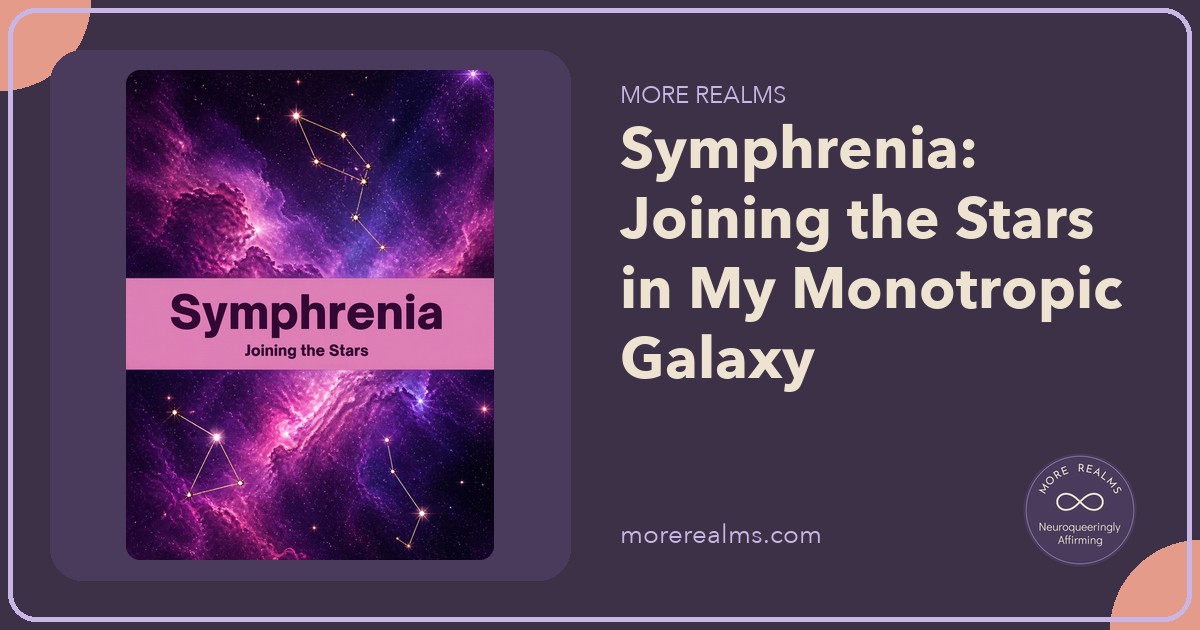
When I created My Monotropic Galaxy (Edgar, 2026a), I drew thin gold lines between stars that have no relationship to one another except the one I connected. Some of those stars sit hundreds of light years apart. Joined on the page, they became the Stellar Current, the Gravity Well and the Tidal Stars, a map of an Autistic ADHD inner life that finally made sense to me. People have been drawing these lines for thousands of years. Every culture has looked up at the same scattered light and found its own hunters, animals, rivers and ploughs, and in that sense constellations may be our oldest act of pattern-making.
Psychiatry has a word for the tendency to perceive meaningful connections between unrelated things: apophenia. The word was coined by the German psychiatrist Klaus Conrad in 1958 in his study of the onset of schizophrenia, describing an “unmotivated seeing of connections” accompanied by a feeling of abnormal meaningfulness (Conrad, 1958, as cited in Mishara, 2010). Pattern-seeing is something every human bodymind does, yet the word was created to mark the moment when someone’s meaning-making had supposedly crossed a line into something pathological. It is the same neuronormative gaze I have written about so many times, and I think it is important to ask who gets to decide which patterns count as insight and which get called symptoms of something that needs a cure or fixing.
This post is part of Neuroqueering Deleuze: Rhizomes of Becoming (Edgar, 2026b), a slow, collaborative community project exploring the philosophy of Gilles Deleuze and Félix Guattari through neurodivergent lived experience. The project began with my own search for language during cycles of Autistic burnout, and it has become a way of understanding neurodivergence as movement, transformation and ongoing becoming. This piece is one more node in that rhizome. It follows a line of curiosity from apophenia to the stars, and towards a word I want to offer for the connected, porous quality of my bodymind: symphrenia.
Whose Patterns Count
My mind works rhizomatically, moving in every direction from a star to mutual aid to penguin pebbling (Deleuze & Guattari, 1987), and those connections often feel necessary from the inside long before I can explain them to anyone else. Monotropic attention tends to go deep into a single channel of interest instead of spreading widely across many (Murray et al., 2005), and in that depth, links surface that others may not see or understand. This may help explain why many AuDHD people are so often misunderstood, and why our conversations can appear to jump randomly from topic to topic. For me, it feels like a million connections are happening at once, with no time to explain them all, so I share my end point, the node where my thoughts gathered and came to rest. I am often met with confused looks and strange smiles, because the topic seems to have changed so abruptly, when for me every connection has been made and it makes total sense.
When they are met with curiosity, the liminal spaces of my thoughts, the spaces in between conversations and sentences, can become places where journaling, writing, research and art emerge. When they are met with confusion or a clinical label, they become one more sign that my perception is somehow wrong. The double empathy problem reminds us that a gap in understanding belongs to both people in an interaction (Milton, 2012), yet the burden of being “unreadable” usually falls on the Autistic person. We are the ones asked to fill in the gaps and explain ourselves, when a conversation that seems to have jumped a million miles off topic is deeply connected at the root, in the rhizome of thought running under and around it.
The Ecology of Distress
I work closely with David Gray-Hammond and NeuroHub Connect, and David’s ecosystemic model has shaped my thinking significantly over the past year or so. David’s model holds that Autistic distress is ecosystemic. It does not arise solely from within the bodymind, but from the whole web of relationships, environments, systems and pressures a person lives within (Gray-Hammond, 2025). Through this lens, burnout and psychosis can be understood as relational and environmental responses to chronic neuronormative pressure, rather than as faults located inside an individual.
In my galaxy, that pressure is the Dark Matter Field and the Friction Field, the accumulated weight of a neuronormative world. I keep thinking about how the same porous, pattern-seeking bodymind can experience two very different things depending on the sky around it. Among the Sanctuary Stars, with Companion Stars close by, noticing hidden connections feels like awe, which De Cruz (2024) describes as an epistemic opening, the moment our ways of knowing expand. Under the Dark Matter Field, with no rest, no safety and no one who understands, that same openness can tip into overwhelm, fear and a sense of meaning closing in. Diagnosis tends to examine a single star. An ecosystemic view asks us to look at the whole sky.
Stephen Porges (2004) offers a word for how this happens in the body: neuroception, the nervous system’s subconscious scanning for safety or threat. Porges has described some of these responses as “faulty”, but an ecosystemic lens invites a different reading. When an Autistic nervous system neuroceives danger in a world built around neuronormative expectations, it may be reading that environment with painful accuracy. Polyvagal theory, from which neuroception emerged, remains debated within physiology (Grossman, 2023), but as a lens it helps me think about how meaning travels through the body. I have come to understand that movement as a kind of bridge. Interoception lets some neuroceived signals be felt within the body (Craig, 2002), and intuition carries those somatic cues into awareness, turning them into heart-led guidance and meaning. For many Autistic people, each part of this bridge works in its own way and at its own pace, and our intuitions have often been dismissed because they do not arrive in the expected form.
Finding a Word: Symphrenia
The roots I keep returning to are Greek. Syn means with or together, and becomes sym before a “ph” sound, as in symphony and sympathy. Phrēn is usually translated as mind, but in Homeric Greek it also meant the midriff or diaphragm, the breathing chest where thought and feeling were believed to live. That older meaning matters, because so much has been lost since. In 1641, René Descartes divided the self into a thinking mind and an extended body (Descartes, 1641/1996), and much of Western thought, medicine and psychiatry followed that line. Damasio (1994) later called this Descartes’ error, showing how bodily feeling is woven into reasoning itself, and the word bodymind, first offered by Ken Dychtwald (1977) and later taken up across disability studies, refuses the split altogether. Long before Descartes, and long before psychiatry narrowed it into a suffix for diagnoses, phrēn was already a bodymind word.
So we want to offer symphrenia (sim-FREE-nee-uh): the felt sense of a bodymind that thinks and feels with the world rather than apart from it, a porous kinship with people, creatures, places and things, both living and non-living.
That last part matters to me. Many Autistic people describe feeling for objects as well as beings, and research suggests Autistic adults report object personification more often than non-Autistic adults (White & Remington, 2019). Kimmerer (2013) writes of a grammar of animacy that treats the more-than-human world as kin. My Tidal Stars have always held this sense that my edges are less fixed than the world assumes, and that I am drawn towards water, stone and ancient things as if returning to something already within me. Whether that porousness unfolds as kinship or as overwhelm may depend on whether my body neuroceives safety.
Becoming-With: Intra-Action and the Posthuman
Deleuze and Guattari (1987) describe the self as an assemblage, a shifting composition of bodies, intensities, places and relations, always in the process of becoming. Their thinking draws on Spinoza, for whom a body is understood by its capacity to affect and be affected (Deleuze, 1988). Symphrenia feels like a way of naming what this is like from the inside: the felt sense of being composed with the world.
The physicist and philosopher Karen Barad (2007) deepens this through agential realism. For Barad, things do not exist first and then enter into relationships; they emerge through intra-action, coming into being through their entanglements with one another. My bodymind, the river and the star are continually becoming through each other, which echoes the implicate order I explored in My Monotropic Galaxy (Edgar, 2026a). Haraway (2016) offers the word sympoiesis, “making-with” (p. 58), for the way no living being makes itself alone, and Tarragnat’s ethodiversity recognises diverse ways of perceiving and relating as part of the wider patterns of life beyond the human (Tarragnat, 2025). Read alongside these thinkers, symphrenia begins to feel like more than a private feeling. It may echo what they describe about how all of us, human and more-than-human, are already entangled.
Speaking Back to a Divided Mind
Eugen Bleuler (1911) named schizophrenia from the Greek for a split or divided mind. Symphrenia speaks back to that naming, though I do not want to frame it as a simple opposite. Some people who experience psychosis describe an intense, overwhelming connectedness, a world suddenly charged with meaning, which clinical writing has described as aberrant salience (Kapur, 2003). Deleuze and Guattari’s (1983) schizoanalysis reimagined schizophrenia as a process of flows and connections, though their use of the figure of “the schizo” has been critiqued for romanticising experiences that can involve real suffering. What I am reaching for is a shared porousness running through many neurodivergent and Mad experiences, one that can feel like wonder in a nourishing ecosystem and like distress in a hostile one. If that is true, our work lies in tending the ecology around a person instead of trying to correct the person within it. This word also cannot belong only to me. Anything that touches the experience of psychosis needs to be shaped alongside the people who live it, and I hope symphrenia can grow through those conversations.
Existential Diversity and the Cosmic Glitch
The concept of existential diversity David and I have been developing widens the frame again. We describe existence as something that extends beyond the bodymind, reaching across space and time (Edgar & Gray-Hammond, 2026). Who we are reaches past the edges of our skin, into our relationships, the places that hold us, and the stories carried by those who came before us and those who will come after. Symphrenia and existential diversity meet here for me. If my bodymind thinks and feels with the world, then my existence is also spread through that world. It returns me to star stuff, the knowledge that the atoms in our bodies were forged in stars long before our sun existed, and to love someone down to their star stuff is to love the whole of that existence (Boren & Stimpunks Foundation, 2026).
Within that vastness, Autistic and Mad ways of being are so often treated as glitches, errors in the code of how a person is supposed to perceive, think and relate. Legacy Russell (2020), in Glitch Feminism, reclaims the glitch as a refusal of systems built to exclude, in a chapter titled “Glitch Is Cosmic”. I have come to think of us as cosmic glitches in that sense. A glitch interrupts the smooth running of a system, and in doing so reveals how that system was built and whose bodyminds it was built for. When my pattern-seeing is labelled apophenia, or my nervous system’s alarm is called faulty neuroception, the glitch is located in me. Seen ecosystemically, the glitch shows where the neuronormative code breaks down. Like a sudden aurora across a dark sky, it can be a moment of rupture and illumination at once, where something new becomes visible.
A Twenty-First Constellation
My galaxy map was always meant to keep changing. Perhaps symphrenia is a new constellation forming at its edge, a thin gold line joining me to the people, creatures, places and things I love. Some will look at those lines and see only scattered points of light, and that is alright. The connections were always there in the dark, waiting for someone to draw them. Perhaps every glitch is a star we have not yet learned to name.
#NeuroqueeringDeleuze #RhizomesOfBecoming #NeuroqueerPhilosophy #Symphrenia
References
Barad, K. (2007). Meeting the universe halfway: Quantum physics and the entanglement of matter and meaning. Duke University Press.
Bleuler, E. (1911). Dementia praecox oder Gruppe der Schizophrenien [Dementia praecox or the group of schizophrenias]. Deuticke.
Boren, R., & Stimpunks Foundation. (2026). Love you down to your star stuff. https://stimpunks.org/star-stuff/
Conrad, K. (1958). Die beginnende Schizophrenie: Versuch einer Gestaltanalyse des Wahns [The onset of schizophrenia: An attempt to form a Gestalt analysis of delusion]. Georg Thieme Verlag.
Craig, A. D. (2002). How do you feel? Interoception: The sense of the physiological condition of the body. Nature Reviews Neuroscience, 3(8), 655–666. https://doi.org/10.1038/nrn894
Damasio, A. R. (1994). Descartes’ error: Emotion, reason, and the human brain. Putnam.
De Cruz, H. (2024). Wonderstruck: How wonder and awe shape the way we think. Princeton University Press.
Deleuze, G. (1988). Spinoza: Practical philosophy (R. Hurley, Trans.). City Lights Books.
Deleuze, G., & Guattari, F. (1983). Anti-Oedipus: Capitalism and schizophrenia (R. Hurley, M. Seem, & H. R. Lane, Trans.). University of Minnesota Press.
Deleuze, G., & Guattari, F. (1987). A thousand plateaus: Capitalism and schizophrenia (B. Massumi, Trans.). University of Minnesota Press.
Descartes, R. (1996). Meditations on first philosophy (J. Cottingham, Trans.). Cambridge University Press. (Original work published 1641)
Dychtwald, K. (1977). Bodymind. Pantheon Books.
Edgar, H. (2026a, June 16). My monotropic galaxy: A constellation of my Autistic self. More Realms. https://morerealms.com/my-monotropic-galaxy-a-constellation-of-my-autistic-self/
Edgar, H. (2026b, March 21). Neuroqueering Deleuze: Rhizomes of becoming. More Realms. https://morerealms.com/neuroqueering-deleuze-rhizomes-of-becoming/
Edgar, H., & Gray-Hammond, D. (2026, October 25). Existential diversity, the symphrenic bodymind and wider existence. The Wider Existence. https://www.thewiderexistence.co.uk/p/existential-diversity-the-symphrenic
Gray-Hammond, D. (2025, December 21). The ecosystemic model of distress explained. NeuroHub Connect. https://neurohubcommunity.org/2025/12/21/mental-health-ecosystemic-model
Grossman, P. (2023). Fundamental challenges and likely refutations of the five basic premises of the polyvagal theory. Biological Psychology, 180, Article 108589. https://doi.org/10.1016/j.biopsycho.2023.108589
Haraway, D. J. (2016). Staying with the trouble: Making kin in the Chthulucene. Duke University Press.
Kapur, S. (2003). Psychosis as a state of aberrant salience: A framework linking biology, phenomenology, and pharmacology in schizophrenia. American Journal of Psychiatry, 160(1), 13–23. https://doi.org/10.1176/appi.ajp.160.1.13
Kimmerer, R. W. (2013). Braiding sweetgrass: Indigenous wisdom, scientific knowledge and the teachings of plants. Milkweed Editions.
Milton, D. E. M. (2012). On the ontological status of autism: The “double empathy problem”. Disability & Society, 27(6), 883–887. https://doi.org/10.1080/09687599.2012.710008
Mishara, A. L. (2010). Klaus Conrad (1905–1961): Delusional mood, psychosis, and beginning schizophrenia. Schizophrenia Bulletin, 36(1), 9–13. https://doi.org/10.1093/schbul/sbp144
Murray, D., Lesser, M., & Lawson, W. (2005). Attention, monotropism and the diagnostic criteria for autism. Autism, 9(2), 139–156. https://doi.org/10.1177/1362361305051398
Porges, S. W. (2004). Neuroception: A subconscious system for detecting threats and safety. Zero to Three, 24(5), 19–24.
Russell, L. (2020). Glitch feminism: A manifesto. Verso.
Tarragnat, O. (2025, February 25). What is ethodiversity? https://ombretarragnat.com/2025/02/25/what-is-ethodiversity/
White, R. C., & Remington, A. (2019). Object personification in autism: This paper will be very sad if you don’t read it. Autism, 23(4), 1042–1045. https://doi.org/10.1177/1362361318793408