Tag: Emily Dickinson

  • Learning to See in the Dark: Burnout, Haraway and Staying with the Trouble

    Learning to See in the Dark: Burnout, Haraway and Staying with the Trouble

    As October draws to a close, the evenings here in the UK arrive earlier each day, and the clocks went back last weekend. This week at Gather and Write, our body-doubling creative space at Writing the Dawn, the word of the week was darkness. Its Old English root, deorcnysse, means an absence of light, though over the past thousand years the word has gathered meanings of obscurity, concealment, and not knowing. The session wandered between art, poetry and science, and this piece follows some of the ideas a little further and asks what darkness might offer those of us who know Autistic burnout from the inside.

    The night is full of colour

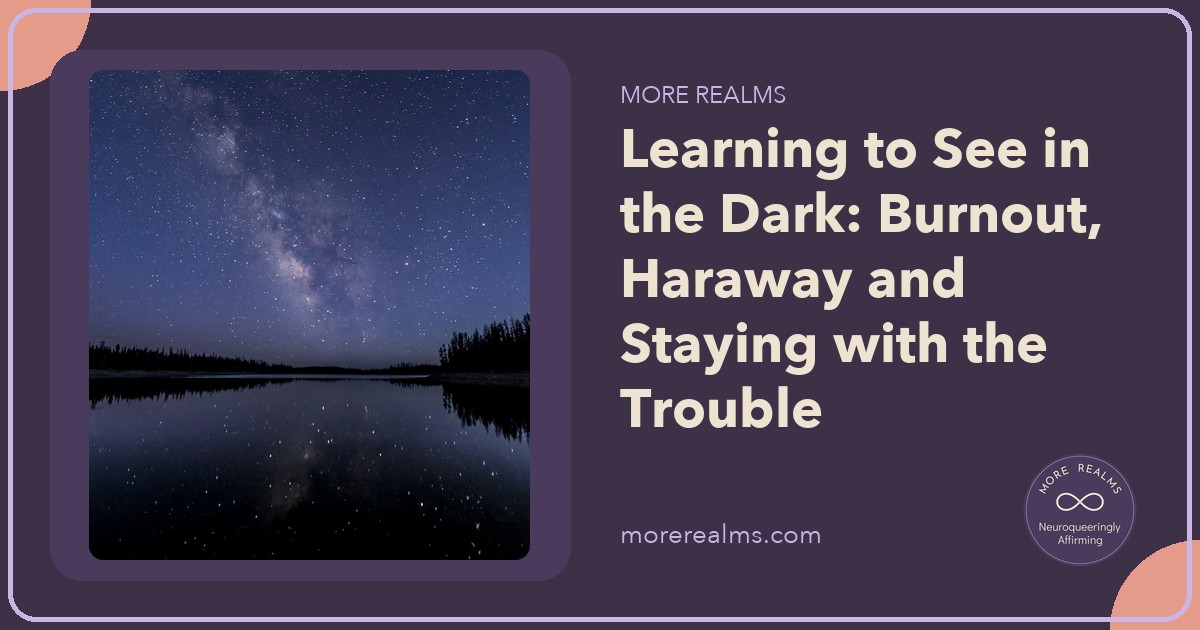
    We began with Vincent van Gogh’s Starry Night over the Rhône, painted in Arles in 1888 and now held at the Musée d’Orsay. Deep blues fill the sky and river, the stars burn distinctly, and the orange gaslights of the town ripple across the water. I always notice how much colour, reflection and movement the night holds. Van Gogh seems to have paid close attention to what darkness actually contained, rather than to what he had been told it lacked.

    Darkness is so often framed as an absence or a threat, something to be overcome by switching on more lights. Yet so much life depends on it. Moths navigate by night, bats map the world through sound, fungi break down what has fallen and return it to the soil, and creatures in the deep ocean make their own light. In the natural world, darkness is a condition in which different kinds of life become possible.

    I want to name something about the word itself before going further. In English, dark has long served as shorthand for bad, lost, dangerous or ignorant, and that symbolism has a racialised history that has been used to justify harm to Black and brown people. Writing about darkness as a place of rest, richness and life is, in a small way, a chance to unsettle those associations rather than repeat them. Access to the night is not equal either. Being outside after dark carries different risks for women, disabled people, racialised people and anyone who has learned that public space is not always safe for them, and light pollution now hides the Milky Way from more than a third of humanity (Falchi et al., 2016). Many of us meet the night through a window, a screen or a painting, and that is a real way of meeting it too.

    Seeing is also an active process, and for Autistic people with sensory differences it can be intense, overwhelming or unusually rich. Many of us find comfort in dim rooms, fairy lights and the softened edges of dusk, when the glare of the day finally lets go.

    Evenings of the brain

    We then read Emily Dickinson’s “We grow accustomed to the Dark”, written around 1862 (Dickinson, 1999). Read the poem at Brinkerhoff Poetry. It begins with a neighbour holding up a lamp to say goodbye, and the uncertain steps we take once that light is gone, until our eyes slowly fit themselves to the night and we can find the road again. Dickinson then turns inward, to the larger darknesses she calls the evenings of the brain, where no moon or star appears to guide us.

    For me, these lines map closely onto Autistic burnout. Raymaker et al. (2020) describe Autistic burnout as long-term exhaustion, loss of skills and reduced tolerance to stimuli, arising from the chronic stress of living in a world that does not fit Autistic needs. Dickinson’s word accustomed is double-edged. Growing used to the dark can help us move through it, and we can also become so used to struggling that we lose track of how far in we have gone. Differences in interoception, the sense of what is happening inside the body, may make the early signs of exhaustion harder to feel, so burnout is sometimes recognised only once it is well established.

    The evenings of the brain also speak of loneliness. There are times when lights may be shining all around and still there is no sign of home inside us, and no sense of support around us. Dickinson writes that even the bravest grope their way forward and sometimes walk straight into a tree. I have hit plenty of trees, most of them planted along neuronormative paths that were never designed for me.

    It is easy to picture Dickinson as a recluse writing alone in her room, yet she kept up a vast correspondence throughout her life, and many of her poems first travelled folded inside letters, including hundreds sent to her sister-in-law and close companion, Susan Huntington Gilbert Dickinson (Hart & Smith, 1998). Her way of being in community was quieter and more textual than the world expected, and it sustained her. I recognise something of that in the online spaces where many Autistic people find one another, where cameras can be off and connection can travel through text, presence and shared attention. Courage matters when we move through the dark, and so does waiting until we are ready, but I have rarely found my way through on courage alone.

    The poem closes with two possibilities: either the darkness itself changes, or something in our sight adjusts to it, and life walks almost straight again. I hold on to that word almost. Devon Price (2024) argues that some people never fully recover from burnout in the sense of returning to who they were before, and that burnout can be the body’s way of forcing a change that has become necessary. I have written about how my own repeated burnouts shifted my sensory system and my way of being at their core (Edgar, 2025b). I cannot go back, because my flow has changed shape. I can adjust, and I can ask the world around me to adjust too. If we do not make some of those changes, burnout tends to make them for us. What most of us are looking for is a path that is more manageable and more our own, even if it never runs quite straight.

    Staying with the trouble

    During the session I kept thinking about Donna Haraway’s (2016) Staying with the Trouble. Haraway reminds us that trouble comes from an old French verb meaning to stir up, to make cloudy, to disturb. Her invitation is to stay with troubled times and be truly present with them, resisting both the fantasy of a technological rescue and the despair that says nothing can be done.

    Burnout stirs everything up. The water goes cloudy and we cannot see the bottom. The pressure, from ourselves and from others, is to clear it as quickly as possible and return to being useful. Haraway offers a different permission. We can stay with the cloudiness for a while, and with each other, and let things settle in their own time. In Writing the Dawn we have talked about the Japanese concept of Ma, the meaningful space between things, and I explored it more in The Fallow Field (Edgar, 2026b). Ma reminds me that the space between things helps give them their shape, and a season of burnout can be that kind of space.

    Haraway also loosens the hold of linear time. She writes of making space for the unexpected (Haraway, 2016, p. 11) and of time as something worlded, lived and made together, rather than an empty container waiting to be filled (Haraway, 2016, p. 12). Monotropic time already works like this for many of us, looping, spiralling, stretching and contracting with our energy and attention (Edgar, 2025a). Burnout time is more polytemporal still, with long stillnesses, sudden surges, setbacks and returns.

    Becoming-with in the dark

    At the heart of Haraway’s thinking is the idea that nothing makes itself alone. She uses the word sympoiesis, making-with, and describes all of us, human and more-than-human, as becoming-with one another in multispecies entanglements (Haraway, 2016). She calls us to make kin across difference, including with people who are not family by blood and with beings who are not human, and to cultivate response-ability, the capacity to respond to one another with care. In her chapter on tentacular thinking, she draws on the anthropologist Tim Ingold to describe life as lived along lines rather than at points (Haraway, 2016, p. 32; Ingold, 2007). A crisis or a single hard day can feel like a fixed point where we have become stuck. Lines keep moving. They wander, cross, tangle and continue.

    This sits closely beside Deleuze and Guattari’s (1987) rhizome, which spreads in every direction with no centre and no single origin, and which opens lines of flight, routes out of the structures that hold us in place. Haraway’s image for storytelling is the string figure, a pattern passed from hand to hand, each person adding a twist and changing its shape. Gather and Write works a little like this. Each week people bring what they can, whether words, images or simply quiet presence, and the pattern between us shifts in ways none of us could have made alone.

    Compasses and networks

    When we begin to move again after a burnout, the path is rarely smooth. It goes up and down, and we collect bumps and bruises along the way, often from trying to follow maps drawn by people whose bodyminds work very differently from ours. Many of us have had to make our own.

    In an earlier piece, I wrote about migrating birds and the inner compass that guides them across oceans, and how we might learn to trust our own monotropic compass in a similar way (Edgar, 2026c). Some songbirds migrate by night and orient themselves using the stars (Emlen, 1967), and many travel in flocks, resting together at familiar stopping places. Our map sense is partly our own and partly collective, and it grows richer each time someone shares a route they have found.

    Beneath our feet, fungi tell a related story. Mycelium threads through the soil and links the roots of plants, and research has shown that carbon can pass between trees through these fungal networks, which became known as the wood wide web (Simard et al., 1997). Scientists continue to debate how far this sharing really goes (Karst et al., 2023), and that open question feels fitting, since staying with the trouble includes staying with what we do not yet know. Still, the mycelium remains one of my favourite images for Autistic community, a quiet network of care in which support moves between us and no single person has to hold everything up (Edgar, 2026a).

    Light within darkness

    I keep returning to Van Gogh’s night sky and the way it seems to glow from within its own darkness. For some of us, creativity in burnout feels like that. It might be a few words written into the dark without knowing where they lead, a familiar song on repeat, a doodle, or a fallow hour spent simply being alongside other people who understand. In a deep enough darkness, small lights are the ones that show the next step.

    Dickinson leaves us wondering whether the darkness alters or our sight adjusts. Having stayed with that question for a week, I think both happen at once, and neither happens alone. The darkness alters when communities, workplaces and families change the conditions that cause burnout. Our sight adjusts when we learn to trust our own compass, to rest in ways that restore us, and to notice what the night has to show. Burnout changes us, and the darkness alters us too. Together, perhaps, we can learn to see in it.

    Next week our word is luminous, and we will be turning towards what glows, from bioluminescent fungi to the lights of Diwali and Bonfire Night.

    References

    Deleuze, G., & Guattari, F. (1987). A thousand plateaus: Capitalism and schizophrenia (B. Massumi, Trans.). University of Minnesota Press. (Original work published 1980)

    Dickinson, E. (1999). We grow accustomed to the Dark (Fr428). In R. W. Franklin (Ed.), The poems of Emily Dickinson: Reading edition. Belknap Press of Harvard University Press. (Original work written c. 1862)

    Edgar, H. (2025a, July 6). Going deeper: Rest, burnout, and monotropic flow. Autistic Realms. https://autisticrealms.com/going-deeper-rest-burnout-and-monotropic-flow/

    Edgar, H. (2025b, February 26). Tides of burnout and being monotropic. Autistic Realms. https://autisticrealms.com/tides-of-burnout-and-being-monotropic/

    Edgar, H. (2026a, March 15). Expanding the mycelial network of care: Autistic community, safety, and rhizomatic futures. More Realms. https://morerealms.com/expanding-the-mycelial-network-of-care-autistic-community-safety-and-rhizomatic-futures/

    Edgar, H. (2026b, October 20). The fallow field: Rest as a freedom practice. More Realms. https://morerealms.com/the-fallow-field-rest-as-a-freedom-practice/

    Edgar, H. (2026c, August 9). Migration and trusting our inner monotropic compass. More Realms. https://morerealms.com/migration-trusting-our-inner-monotropic-compass/

    Emlen, S. T. (1967). Migratory orientation in the indigo bunting, Passerina cyanea: Part I: Evidence for use of celestial cues. The Auk, 84(3), 309–342. https://doi.org/10.2307/4083084

    Falchi, F., Cinzano, P., Duriscoe, D., Kyba, C. C. M., Elvidge, C. D., Baugh, K., Portnov, B. A., Rybnikova, N. A., & Furgoni, R. (2016). The new world atlas of artificial night sky brightness. Science Advances, 2(6), e1600377. https://doi.org/10.1126/sciadv.1600377

    Haraway, D. J. (2016). Staying with the trouble: Making kin in the Chthulucene. Duke University Press.

    Hart, E. L., & Smith, M. N. (Eds.). (1998). Open me carefully: Emily Dickinson’s intimate letters to Susan Huntington Dickinson. Paris Press.

    Ingold, T. (2007). Lines: A brief history. Routledge.

    Karst, J., Jones, M. D., & Hoeksema, J. D. (2023). Positive citation bias and overinterpreted results lead to misinformation on common mycorrhizal networks in forests. Nature Ecology & Evolution, 7(4), 501–511. https://doi.org/10.1038/s41559-023-01986-1

    Price, D. (2024, October 15). You might not recover from burnout. Ever. Substack. https://drdevonprice.substack.com/p/you-might-not-recover-from-burnout

    Raymaker, D. M., Teo, A. R., Steckler, N. A., Lentz, B., Scharer, M., Delos Santos, A., Kapp, S. K., Hunter, M., Joyce, A., & Nicolaidis, C. (2020). “Having all of your internal resources exhausted beyond measure and being left with no clean-up crew”: Defining autistic burnout. Autism in Adulthood, 2(2), 132–143. https://doi.org/10.1089/aut.2019.0079

    Simard, S. W., Perry, D. A., Jones, M. D., Myrold, D. D., Durall, D. M., & Molina, R. (1997). Net transfer of carbon between ectomycorrhizal tree species in the field. Nature, 388(6642), 579–582. https://doi.org/10.1038/41557
  • Monotropa Uniflora and Monotropism

    Monotropa Uniflora and Monotropism

    In memory of Dr Dinah Murray, 27 May 1946 – 7 July 2021.

    Today marks five years since Dinah Murray died. Dinah was the Autistic researcher who, alongside her neighbour Jeanette Buirski, coined the term monotropism. Dinah Murray went on to write the original paper Attention, monotropism and the diagnostic criteria for autism (2005) with Mike Lesser and Wenn Lawson.

    Through my wonderful conversations with her son, Fergus Murray, and my work on monotropism.org with them, I have discovered we have lots of shared interests and passions – not only about autism advocacy and human rights, but Dinah also loved nature, especially mushrooms, and she was a keen photographer.

    In her final years, living in Dalgety Bay, Scotland, she spent her days studying lichens and mushrooms, finding endless fascination in the quiet, often overlooked textures of the natural world (Guardian, 2021). It feels fitting that this piece begins and ends with her, and with a plant that lives its whole life through exactly the kind of fungal network she loved to dive into and photograph. It felt right, too, to weave in the theory of monotropism that she helped bring into the world. The theory of monotropism continues to transform so many lives, giving people a better sense of who they are, and it keeps growing through the community research constantly being undertaken and shared which we collate on monotropism.org.

    The theory of monotropism is connected to something at the very core of who I am, and of how I understand everyone and everything around me. I identify as a deeply monotropic person. She has profoundly transformed my understanding of my own life and given me words I never had for all my monotropic ways of being and experiencing the world, and her work continues to transform our communities and wider networks.

    “Attention without feeling is only a report.”

    — Mary Oliver, Upstream (2016)


    Monotropa Uniflora

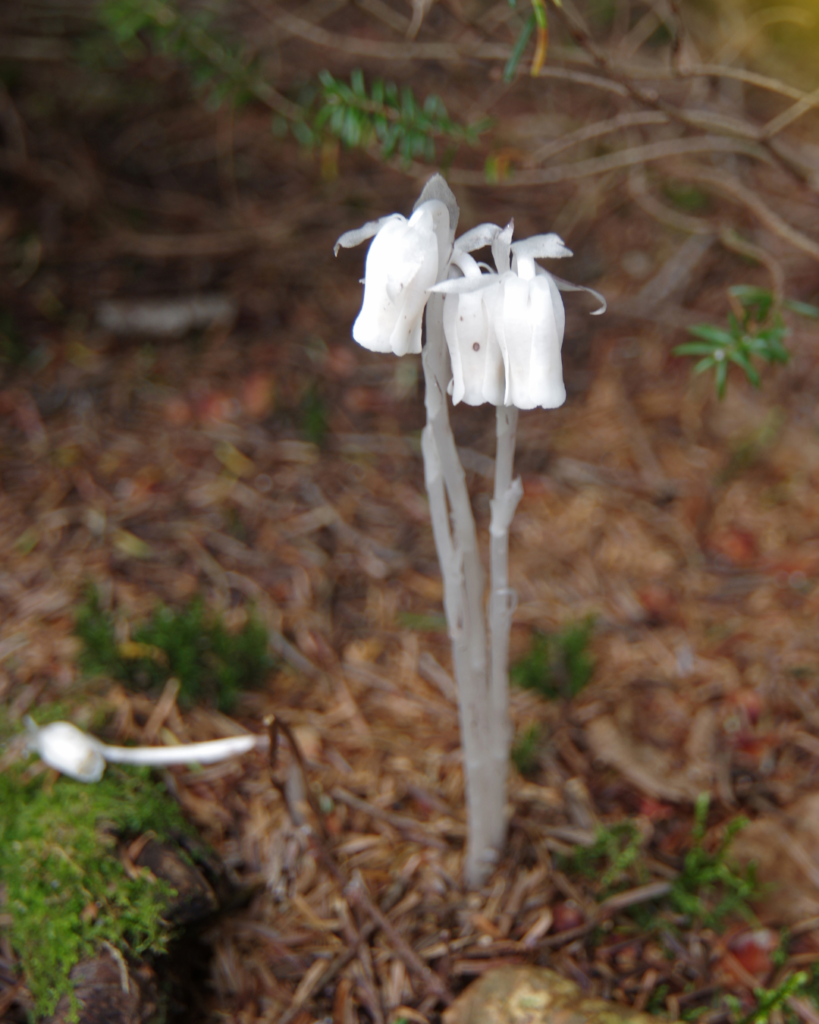
    There is a plant that grows only in the deepest, darkest parts of the moist forests throughout North America, Latin America, and East Asia. It emerges after rain, ghostlike, from the leaf litter, pale and translucent, white as bone, carrying no green at all. It does not reach toward the light, and it cannot photosynthesise; instead, it draws everything it needs from the hidden mycelial networks of fungi threading through the soil beneath the trees, nourishing itself entirely from connections that are invisible to us above the ground (Foster, 2024).

    Its name is Monotropa uniflora.

    In Latin and Greek: one turn, one flower.

    The same root as monotropism.

    The same tropos.

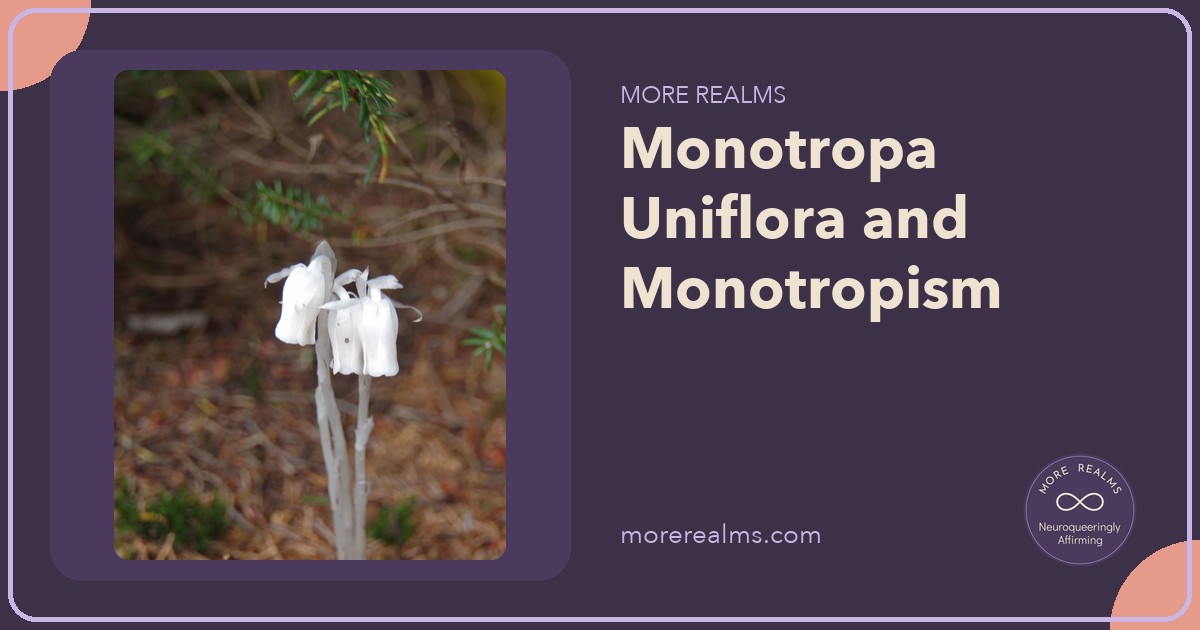
    Carl Linnaeus classified the plant as Monotropa uniflora in 1753. “Monotropa” is Greek for “one turn,” and it is a reference to the arched stem that supports the flower, and “uniflora” means “one-flowered” in Latin. It doesn’t need light to grow; it thrives in depth and in shadow, in the quiet, overlooked, in-between places of the forest floor. People have called it the Ghost Plant and the Ghost Pipe because of its appearance and its ability to thrive where other plants cannot. It resonates with me in both its strength and its weirdness as an Autistic person, qualities that might also have resonated with the poet Emily Dickinson, who called it her “preferred flower of life“.

    Delicate Monotropa uniflora, Ghost Pipe (Indian pipe) flowers in full bloom — pale, translucent white, bell-shaped blooms nodding on leafless white stems, rising from brown pine needle litter and green moss on the forest floor. Photo by Frank Shirley, Getty Images with CAVNVA Pro

    Dickinson and the Ghost Pipe

    It is reported that Emily Dickinson first encountered Monotropa uniflora as a child, pulling it from the forest floor in Amherst. She was an amateur botanist who studied plants at Amherst Academy and Mount Holyoke Female Seminary, assembling more than 400 plant specimens in books that now reside in Harvard’s Houghton Library, including Monotropa uniflora (Foster, 2024). She attended to each specimen with the deep, sustained, joyful attention that many monotropic people will recognise, one of total absorption, with great care, and a sense of wonder and awe that never diminished, no matter how much she studied (Popova, 2023).

    In the autumn of 1882, Dickinson received a surprise painting of the Ghost Pipe (Monotropa uniflora), from her friend Mabel Loomis Todd. Dickinson wrote back immediately:

    “That without suspecting it you should send me the preferred flower of life, seems almost supernatural, and the sweet glee that I felt at meeting it, I could confide to none — I still cherish the clutch with which I bore it from the ground when a wondering child, an unearthly booty, and maturity only enhances the mystery, never decreases it.” (Emily Dickinson Museum, 1882)


    (I am not sure of copyright to embed the image in this blog, but please take a look here in the Emily Dickinson Museum ).

    Eight years later, when Todd edited and published the first posthumous collection of Dickinson’s poems, she placed the same painting of the Ghost Pipe on the cover.

    Three years before that letter, in 1879, Dickinson had already written a poem about the plant (Emily Dickinson Archives):

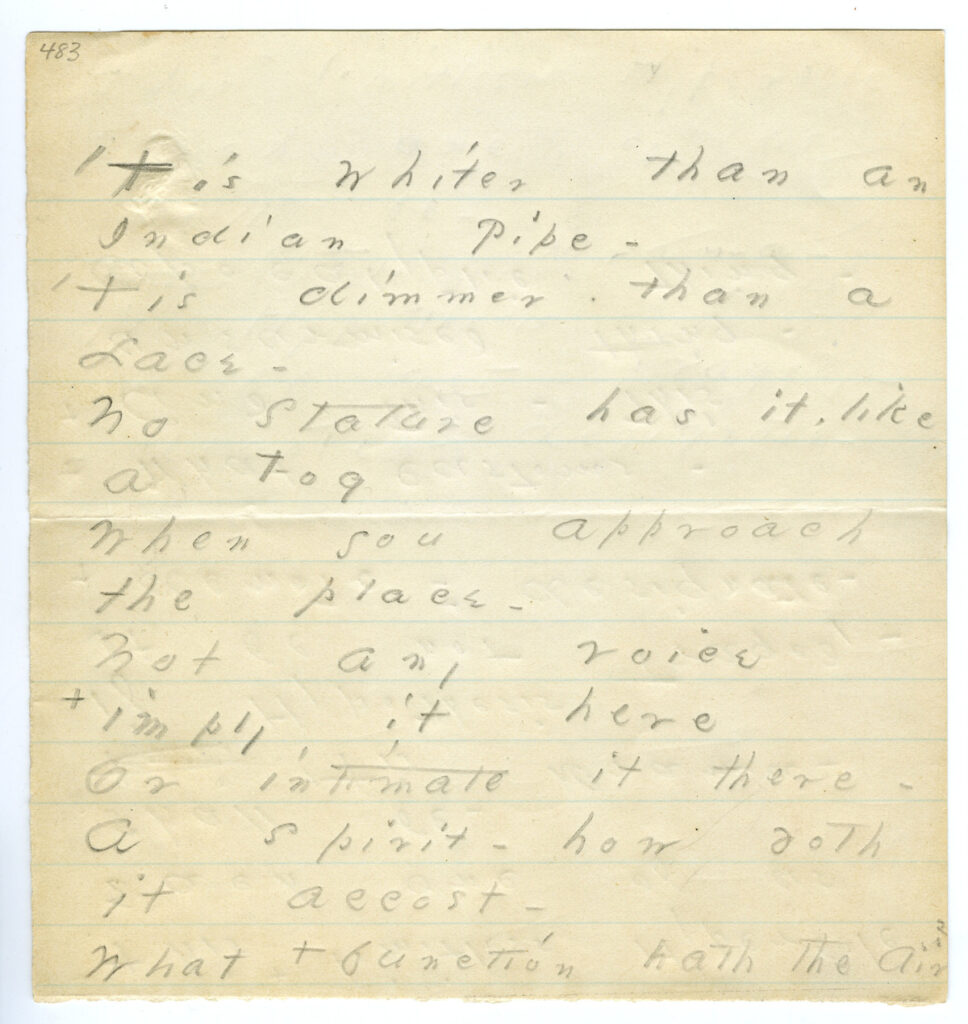
    ‘Tis whiter than an Indian Pipe –
    ‘Tis dimmer than a Lace –
    No stature has it, like a Fog
    When you approach the place –
    Not any voice imply it here –
    Or intimate it there –
    A spirit – how doth it accost –
    What function hath the Air?
    This limitless Hyperbole
    Each one of us shall be –
    ‘Tis Drama – if Hypothesis
    It be not Tragedy –

    ’Tis whiter than an Indian Pipe –
    Poem, ca. 1879
    Amherst College Archives & Special Collections

    Emily Dickinson

    Manuscript of poem from Credits
Amherst College, Amherst MA
https://acdc.amherst.edu/view/asc:10742
Amherst Manuscript # 483
Amherst - Amherst Manuscript # 483 - Tis whiter than an Indian pipe - asc:10742 - p. 1

Publication History
Poems (1896), 156, as three quatrains, with the alternatives for lines 5 and 8 adopted. Poems (1955), 1024-25; CP (1960), 625-26. (J1482). Franklin Variorum 1998 (F1513A).
 -History from Franklin Variorum 1998

Emily Dickinson Archive
http://www.edickinson.org
Copyright & Terms of Use:
CC BY-NC-ND 3.0
http://www.edickinson.org/terms
    Credits: Amherst College, Amherst MA https://acdc.amherst.edu/view/asc:10742 Amherst Manuscript # 483 Amherst – Amherst Manuscript # 483 – Tis whiter than an Indian pipe – asc:10742 – p. 1 Publication History Poems (1896), 156, as three quatrains, with the alternatives for lines 5 and 8 adopted. Poems (1955), 1024-25; CP (1960), 625-26. (J1482). Franklin Variorum 1998 (F1513A). -History from Franklin Variorum 1998 Emily Dickinson Archive http://www.edickinson.org Copyright & Terms of Use: CC BY-NC-ND 3.0 http://www.edickinson.org/terms


    People continue to debate what the “it” in the poem refers to, is it spirit, death, life itself, or all of it? Perhaps it is something many of us as Autistic people recognise, the thing that is deeply present, real, and nourishing, yet invisible to those who do not know how to look for it or how to relate to it. The quality of presence that the world persistently mistakes for absence, the inner life that runs deeper than it appears from the outside?

    The way the Monotropa uniflora blackens and wilts, dissolving back into the earth, the moment it is touched all feels very relatable to me and how I am at times, just wanting to hide in the dark and be left alone but also thriving in often unexpected ways. Or maybe it’s just me who relates in this way? Either way, the Monotropa uniflora is not a tragedy, and neither are we as Autistic people. We can thrive when the environment meets our needs, even if that environment may not be what people expect it to be!

    A Monotropic Life

    It feels to me that Emily Dickinson lived her life somewhat monotropically, though she never had that word back then. She spent most of her adult life within her family home, rarely venturing out, conducting her richest relationships through letters, attending to her interests with an intensity that those around her often found excessive, weird or strange, perhaps also relatable for many of us?! Her attention tunnelled, her focus pooled as she moved through the world, pulled in by her interests, with her whole self given over to what she was attending to, which I feel is evident through all her work and my own sensory way of being.

    We shouldn’t claim that Dickinson was Autistic, but her way of being in the world resonates deeply for me, much like that of Virginia Woolf and Sylvia Plath, writers often seen as different, as not fitting in, whose work seems to capture something of what it is to be Autistic before they had the term and certainly before women were identified as Autistic. They speak of the isolation that so often comes with not being really understood, and also the joy of being able to immerse yourself fully in your passions and sensory self as a way to sustain life, to survive. They write about a deep presence and connection with the world around them, feeling everything sensorily, intensely, and being deeply empathetic.

    Woolf herself wrote of a mind she called androgynous, the mind most “resonant and porous… naturally creative, incandescent and undivided” (Woolf, 1929, as cited in Popova, 2021). That porousness, that undivided quality, is something many Autistic people may recognise too, not a mind guarded and compartmentalised, but something more fluid, always connecting, seeking patterns, transforming, morphing and adapting.

    Many people call Monotropa uniflora a perfect flower, it holds both stamen and pistil, both what has been called “male” and “female,” in the one bloom, needing no other to complete it, which feels like more than coincidence (Popova, 2021). It is a plant that refuses to be binary at the root of its being, in the same way it refuses to draw its nourishment from sunlight, the way other plants are expected to. It is non-binary, and yet still deeply, richly connected and interdependent with everything around it through the hidden web of nourishment from beneath the ground. For those of us who are Autistic, otherwise neurodivergent or disabled, those who may also be queer, trans, or non-binary in how we understand our own identity, this may feel like a plant that was never trying to fit in to start with, it thrives in its difference, weirdness and uniqueness, a bit like us.

    From the outside, Emily Dickinson’s life may have looked reclusive and withdrawn, but from the letters, the poems, and the extensive herbarium with its 400 pressed plants, each attended to with such care, I think it was extraordinarily full, in a way that held meaning for her and brought great joy. This perhaps gives some validity to the way many people may feel and experience their lives still today, especially if you are Autistic/ AuDHD and monotropic and are able to get into those lovely monotropic flow states.

    Dinah Murray, Monotropism & Monotropa Uniflora

    Sadly, Dinah Murray died in 7th July 2021, 5 years to the day I am writing this. The poet Kate Fox, who had interviewed Dinah in her flat in Dalgety Bay just a month before she died, wrote a poem to read at her memorial service and titled it Monotropa Uniflora (Fox, 2021).

    “The first two lines were from a poem Dinah wrote as a girl. The title is a type of fungus (ish) species that her friend Joan McDonald said at the memorial service she was delighted to discover existed, given her pioneering work on the monotropic theory of autism” (Fox, 2021).

    In their interview, Dinah described her life not as a career but as a mission:

    “About justice and fairness and living in a fair world. I haven’t really ever had a career, I’ve had a mission. And I think I’ve accomplished my mission basically.”

    (Dinah Murray quoted in Fox, 2021)

    Like Monotropa uniflora, Dinah Murray’s work continues to nourish us through mycelial-like networks of care: through the people she supported, the papers she wrote, the theory of monotropism she brought into the world, and the community she helped build.

    The Mycelial Network of Care

    The secret of the Monotropa uniflora’s survival is almost magical: its roots entwine with underground fungal networks, mycorrhizal hyphae from fungi in the Russulaceae family, that are themselves connected to the root systems of nearby trees. The Monotropa uniflora takes sugar and nutrients from this fungal web, thriving through a form of nourishment that is hidden, indirect, and entirely dependent on the richness of the network beneath the surface (Foster, 2024; Popova, 2023).

    In my Mossy Minds and Monotropism (2025) piece, I was thinking about the monotropic bodymind as porous and mycelial-like, deeply interconnected, and often thriving in the margins and liminal spaces. This is where my DEEP framework (Dynamic, Embodied, Ecological, Political), inspired by Damian Milton’s work on the Double Empathy Problem (2012), feels most relevant here from an Autistic perspective, as it also resonates with my own way of being.

    The Monotropa uniflora is Dynamic, changing form and behaviour depending on what the network around it provides, rather than following one single fixed way of being. It is Embodied, entirely dependent on its relationship with soil, fungus, and roots sustaining it. It is Ecological, existing only because of its place within a wider mycelial web of mutual inter-dependence, and it could also be thought of as Political, because a world that only values what performs visibly in the light, what photosynthesises and produces on demand, is often misread and has been called weird or spooky.

    The Monotropa uniflora feels like one of the most perfect botanical expressions of being monotropic for me. It prefers the dark; it goes deep, and it is held by the mycelial network of care, which, for me, being part of our Autistic community, I am certain I could not survive otherwise.

    Like Monotropa uniflora, many Autistic people have learned to adapt and morph to survive; we have had to find ways to nourish ourselves through mutual aid networks and grass roots projects as society just isn’t meeting our needs. I thrive in the deep shade of my forest-themed den with my blackout blinds drawn day and night. My mycelial network is online, on the World Wide Web rather than the Wood Wide Web. I live amongst the many neurodivergent spaces I am so grateful to be a part of, that keep me nourished and sustain me across the Autistic Rhizome.

    “Energy is only transformed, never gone”

    “Attention without feeling is only a report,” Mary Oliver wrote (2016). When Dickinson called the Ghost Pipe (Monotropa uniflora) “the preferred flower of life,” I don’t think she was only naming a plant she’d loved since childhood. I think she was naming a way of loving, a way of embracing the kind of monotropic attention that finds its nourishment not in what is easily seen, but in what is deeply felt. Something that, for many of us, may also reflect our Autistic ways of being, at least, it does for me.

    On this anniversary of her death, five years on, I want to close with the words the poet Kate Fox wrote for Dinah’s memorial, in a poem she titled after the Monotropa uniflora

    Your interests carry like spores

    through the air

    in fragments, in buds,

    via mycelia-like networks

    they are still there.


    But you also knew

    energy is only transformed, never gone

    so when we remember your words

    or act as you might do,

    you, in all your power and passion

    live on.


    (Fox, 2021)

    Energy, as Kate’s poem tells us, is only transformed, never gone. May Dinah’s legacy keep flowing, monotropically, through the communities of care she helped shape.

    References

    Edgar, H. (2025). Mossy Minds and Monotropism. More Realms.
    https://morerealms.com/mossy-minds-monotropism/

    Emily Dickinson Museum. (1882). Letter to Mabel Loomis Todd. emilydickinsonmuseum.org

    Foster, N. (2024). Ghost of the forest: Monotropa uniflora. JSTOR Daily. https://daily.jstor.org/ghost-of-the-forest-monotropa-uniflora/

    Fox, K. (2021). Monotropa Uniflora [Memorial poem for Dinah Murray].
    https://katefoxwriter.wordpress.com/2021/08/16/tribute-to-dinah-murray/

    Guardian. (2021, July 25). Dinah Murray obituary. The Guardian. https://www.theguardian.com/society/2021/jul/25/dinah-murray-obituary

    Kimmerer, R. W. (2003). Gathering moss: A natural and cultural history of mosses. Oregon State University Press.

    Murray, D., Lesser, M., & Lawson, W. (2005). Attention, monotropism and the diagnostic criteria for autism. Autism, 9(2), 139–156.
    https://journals.sagepub.com/doi/10.1177/1362361305051398

    Oliver, M. (2016). Upstream: Selected essays. Penguin Press.

    Popova, M. (2021, July 2). Perfect flowers: Adventures in nature’s nonbinary botany, with a side of Emily Dickinson. The Marginalian. https://www.themarginalian.org/2021/07/02/perfect-flowers-emily-dickison/

    Popova, M. (2023). The ghost pipe: A visionary meditation on love, loss, and the shape of grief. The Marginalian. https://www.themarginalian.org/2023/08/23/ghost-pipe/

    The Morgan Library. (2023). Emily Dickinson: Poems. themorgan.org

    Woolf, V. (1929). A room of one’s own. Hogarth Press.ins. Princeton University Press.

    Discover more

    Courses, books and resources

    If you would like to take these ideas further, my courses, books and resources live on Autistic Realms. Everything in the shop is pay what you can, and many resources are free.