
Tag: DEEP

  • Empathy, Becoming, and Belonging: On what it really means to be met across difference

    Empathy, Becoming, and Belonging: On what it really means to be met across difference

    Helen Edgar – Autistic Realms / More Realms June 2026

    “The curious paradox is that when I accept myself just as I am, then I can change.”

    — Carl Rogers, On Becoming a Person (1961)

    “Becoming is not imitating or identifying with something. It is producing a zone of proximity, of indiscernibility.”

    — Deleuze & Guattari, A Thousand Plateaus (1987)

    You may know the feeling of being in a room and not being truly seen. You may be present, being spoken to by people who seem genuinely friendly towards you, yet you feel you are not truly being met. It is like the person next to you or across from you is responding to their idea of who they think you are rather than to who you actually are. There are norms and social conventions that people may feel they have to keep, and that can impact genuine presence and connection.

    For many Autistic and neurodivergent people, this is not an occasional frustration but an often felt, sustained condition of our daily life. Over time, this teaches us that it is not safe to bring our whole authentic self into the room. You may suppress stimming, be hyper-aware of your body language and even how you communicate. You may find that you are constantly translating yourself into someone you hope will be more legible, more palatable, more aligned with the norms that were never designed around your experience. Masking, in this sense, is not a choice so much as a trauma response, a learned adaptation to a world that has made authenticity costly.

    This piece draws together three threads of my recent thinking that I have been exploring: the humanistic psychology of Carl Rogers, the philosophy of Gilles Deleuze, and Damian Milton’s Double Empathy Problem — extended through my own Double Empathy Extreme Problem  (DEEP) – Dynamic, Embodied, Ecological, and Political framework. I am also drawing on a recent paper by philosopher Kris Goffin (2026) that reframes the question of Autistic injustice in ways I find really helpful. Together, I think they can help us explore what the conditions for genuine belonging might actually be, so we can be supported in environments that value a process of ongoing becoming and neuroqueering.

    Conditions of worth

    Rogers began from a radical premise in the 1950’s: that people are not fundamentally broken, deficient, or in need of correction, but that they carry within them an innate drive toward growth and becoming more fully themselves. This is what he called the actualising tendency (Rogers, 1957). He thought of it as something like a seed’s instinct toward light: persistent, directional and always pressing toward expression. Growth cannot be destroyed, but it can be buried, become distorted and hard to surface.

    What buries or distorts growth are what Rogers named conditions of worth (1959). These are the internalised messages, absorbed most powerfully in childhood, that love and acceptance are contingent on meeting certain conditions: being quieter, being less intense, doing whatever it takes to be accepted. These messages don’t usually come from a place of cruelty; they often come from concern, from guidance, from the reasonable expectations of people who themselves learned to perform belonging within the same system, such as parents, carers and teachers. However well-meant, their cumulative effect is to redirect the energy of genuine growth into the labour of self-management, into performing a version of the self that will be found acceptable, rather than becoming the self that is actually there. For neurodivergent people, this is not incidental but structural. The conditions placed on us are shaped by a world that measures worth against neuronormative standards from the outset.
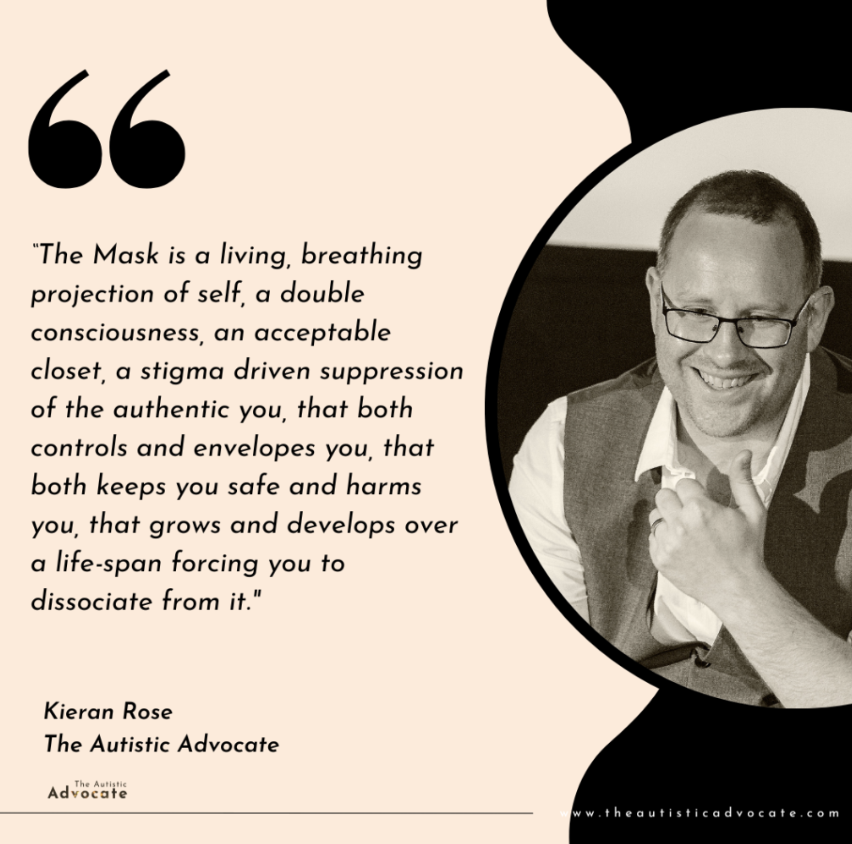
    "The Mask is a living, breathing projection of self, a double consciousness, an acceptable closet, a stigma driven suppression of the authentic you, that both controls and envelopes you, that both keeps you safe and harms you, that grows and develops over a life-span forcing you to dissociate from it."

Kieran Rose The Autistic Advocate

    For Autistic and AuDHD people, conditions of worth are not only relational but cultural and systemic. They are embedded in our education systems, healthcare settings, and workplaces; in every context that measures human value against the standards of neuronormativity. The message neurodivergent people often face in therapy or counselling is that the authentic self requires editing before it can be brought into a relationship with others, even when that therapy may be classed as person-centred as we are still living in the system that causes us harm.

    Rogers believed that three relational conditions could begin to dismantle those blocks. The first is empathy, which he defined as the capacity “to sense the client’s private world as if it were your own, but without ever losing the ‘as if’ quality” (Rogers, 1957, p. 99) — presence without projection, attunement without merger. The second is congruence: authentic presence rather than performed warmth, which matters because many of us with heightened sensitivity to interpersonal nuance can sense the gap between what is presented and what is real, often more acutely than others might expect. The third is unconditional positive regard, which Rogers described as meaning “there are no conditions of acceptance, no feeling of ‘I like you only if you are thus and so’” (1957, p. 98) — being valued as you are, now, without needing to perform or justify yourself first.

    When these conditions are genuinely present, something can shift. The energy previously devoted to self-protection becomes available for something else. The actualising tendency can begin to move again, and that movement can be quietly transformative.

    However, I am wondering whether Rogers’ theory has a limit when it comes to meeting the needs of neurodivergent people in a world still dominated by neuronormativity. Rogers himself acknowledged that the therapeutic relationship is not a special case, but rather “a heightening of the constructive qualities which often exist in part in other relationships, and an extension through time of qualities which in other relationships tend at best to be momentary” (1957, p. 101). In other words, Rogers understood his practice as working within the existing relational world, extending and deepening what is already there. When the session ends, the person returns to the same schools, workplaces, and social structures that created the conditions of worth in the first place that led them to counselling. Rogers offers healing within the system, but he does not provide tools to examine or dismantle the systems that cause harm.

    This is where I find myself reaching towards Erin Manning (2016), who offers a different register of thinking about relation and difference that attends to what she calls the “minor gesture.” The minor gesture, although it may pass almost unperceived, transforms the field of relations. For Manning, the minor is a force that challenges received wisdom and common sense — what she calls “the major” — by offering potentially unlimited experiential variations that suggest alternative forms of being, knowing, and doing. Crucially, this framework directly challenges the ways in which the neuronormative image of being human devalues alternative ways of being moved by and moving through the world which may be especially relevant to Autistic people who perceive the world differently.

    Rogers asks what conditions within a relationship might allow a person to grow, Manning extends this by asking what small, acts and orientations might begin to shift the normative field itself. These are not competing frameworks so much as operating at different scales. Rogers is working at the depth of the relational encounter, and Manning is also attending to the texture and politics of the world in which the encounter is embedded. Together, they suggest that healing and belonging are not only interior processes, but are also shaped by whether the world around us leaves room for us to exist in our difference.

    If a person leaves the therapy room and returns to a school that still rewards masking, a workplace that still pathologises their way of communicating, a healthcare system that still measures them against a neurotypical body, then Rogers’ conditions of worth are simply regenerated. Becoming, within Rogers’ framework, remains possible only within the structures that already exist; there is only growth in the space the system allows.

    This is where Manning (2016) may become a useful companion to Rogers. Where Rogers works at the depth of the relational encounter, Manning attends to the texture of the world that the encounter is embedded within. The minor gesture, although it may pass almost unperceived, transforms the field of relations, and it is in those small acts that some of the most important work can happen. For example, a teacher may restructure a task so that a student does not have to make eye contact to demonstrate understanding. A colleague who names in a team meeting that there are multiple valid ways of communicating, such as written or verbal, without making it about any one person. These are not grand systemic interventions; they do not dismantle the neuronormative ableist school or workplace, but the minor gesture introduces variation and genuine inclusion into experiences that would otherwise remain fixed or captured by norms, and that variation, however small, can be the difference between a person being able to remain themselves or once again contracting into a version of their self that the system will accept which can have severe impacts upon wellbeing.

    Rogers gives us the conditions for healing within a relationship, whereas Manning reminds us that a relationship is never only between two people, it is always also between a person and the world they live in and must return to as well.

    Creating New Maps

    This is where the work of philosophers Gilles Deleuze, Félix Guattari, and Autistic scholar Nick Walker’s neuroqueer theory can expand this discussion, as they point toward something Rogers’ framework doesn’t quite reach. Their works lead us not just to a space where you are allowed to become who you already are, but one that holds becoming itself as ongoing, never a fixed destination to arrive at. Where Rogers offers room to grow within existing conditions, in line with Manning, both Deleuze and Walker ask what it might mean to stop treating any version of the self as final, and what it could mean to build spaces that hold change itself as safe, rather than safety as something found only once change is finished.

    For Deleuze and Guattari (1987), social structures operate by carving grooves into the world and into us. I am using “grooves” as my own (hopefully!) accessible way into their concept of striated space: space that is measured, ordered, and directional, like the fixed threads of a woven fabric or the furrows of a ploughed field.

    The word “grooves” feels important to me because it captures something embodied and cumulative, the sense that these structures do not only organise the world around us but wear pathways into us over time. What Walker (2021) calls neuronormativity is precisely this kind of deep striation, a system of assumptions often insisting there is one correct “normal” way to think, feel, communicate, and inhabit a human life. The problem, Deleuze and Guattari understood, is not just that the grooves constrain our movement, it is that the grooves are presented as natural, as simply the shape of reality and how society is, rather than as a constructed map that serves only particular interests, privileges some people over others, and erases the rest of us, with those most marginalised often left with no voice or support at the edges of society.

    Rogers’ conditions of worth are themselves a kind of striation, grooves handed down to us before we were old enough to question them. From infancy, many of us were rewarded for playing, eating, talking, and moving in the expected ways, and those rewards became internalised as if we had drawn the lines ourselves. This is how ableism enters so quietly: not always as a rule imposed from outside, but as a shape we learn to become, often unaware that we have been masking throughout our lives — until burnout or a mental health crisis arrives and we can no longer sustain it. Rogers’ answer is to offer warmer, more accepting conditions, but still within that same tracing. It is perhaps a kinder version of the same map, rather than a genuinely different one.

    Deleuze asks for something more radical, not a gentler, warmer copy of an existing outline, but a different map entirely, made in movement, drawn from where you actually are rather than where the tracing says you should be. This is not an abstract philosophical point; I think it is a deeply political one. The poet and theorist Audre Lorde reached a parallel conclusion, that the tools a structure provides can only ever renovate it from within, never dismantle it. In her essay “The Master’s Tools Will Never Dismantle the Master’s House” (Lorde, 1984), she argued that real belonging cannot be built from the instruments of the very structure it is trying to escape. It needs new tools, and a new starting point that never belonged to that structure in the first place.

    Walker’s neuroqueer theory draws on Lorde’s insight, queer theory, and disability studies to make a related point: that the rules around what counts as “normal” thinking and those around what counts as “normal” gender are intertwined at the root. Walker goes further than simply critiquing the system. Inspired by Lorde, Walker does not call for destruction but for transformation, as David Gray-Hammond and I explored in our Neuroqueer Learning Spaces webinar with Stimpunks (Edgar, 2024), Walker’s position is that we should “queer the system, queer the tools and create new tools” (Walker, cited in Edgar, 2024).

    Neuroqueering is not a tearing down; as I noted in that same webinar, “to neuroqueer is to transform, not destroy”. This feels important in a therapeutic context, too. The goal is not to abandon everything Rogers offered, but to queer it: to ask what new tools, what new language, what new relational conditions might be possible if we start from neurodivergent experience rather than mapping it onto frameworks built without us in mind.

    Deleuze called this kind of departure a line of flight: a movement toward something that does not yet have a name within the existing system, because that system was never built to describe it. Rogers helps us become our best selves within the system we already have. Deleuze, Manning, Walker, and Lorde, arriving from very different places, all point toward something more: that we can find our way forward together, building our own ways of becoming, with our own language to describe what we actually experience. And it is then, perhaps, that we can become our true selves, and finally feel a sense of belonging.

    The Gaps Between Us

    This is where Damian Milton’s Double Empathy Problem (2012) becomes important. For a long time, the difficulty Autistic people experience in social interaction was located inside us, framed as deficit, as a failure of empathy, as something in need of fixing. However, Milton’s work reframes this entirely. Misunderstanding between everyone, including Autistic and non-Autistic people, goes both ways: each finds it genuinely difficult to read the other, because each is experiencing and communicating from a fundamentally different starting point. The problem is never inside one person; it lives in the gap between two people, and I think that changes everything about how we think about connection, belonging, and what good, affirming support actually looks like.

    I have built on Milton’s theory with my own framework, DEEP — the Dynamic, Embodied, Ecological, and Political model of the Double Empathy Problem (Edgar, 2024). The gap Milton identifies isn’t just a one-off communication mix-up. It is felt throughout the whole bodymind, shaped by our nervous systems and sensory differences, and by the layered weight of intersectional difference. It is ecological too, shaped by the environments and communities around us, and it is political as it is tied to ableism and to every system that treats neuronormativity as the default, measuring everyone else against it and finding them lacking.

    That gap wears people down; it leaves us chronically misread, exhausted from the constant work of translating ourselves, and slowly eroded from a steady sense of who we are. It is a significant factor in Autistic burnout, and it cannot be fixed by individual effort alone; it needs something structural. We need a change in the systems themselves, not just in us.

    Affective Injustice

    Philosopher Kris Goffin’s (2026) recent paper, “Autistic injustice as affective injustice: the double empathy problem is not about empathy,” pushes this further. Even framing the Double Empathy Problem as a two-way empathy gap, still locates the problem within individual psychology. Goffin argues that the real injustice is structural, and resonates to the political dimension of my DEEP framework.

    What Goffin calls the emotional regime is a set of unspoken rules about how emotions should be expressed, which feelings count as appropriate, and whose emotional experience is taken seriously. Autistic ways of being — stimming, directness, sensory overwhelm, intensity — are routinely measured against these rules and found wanting: treated as irrational, excessive, or in need of suppression. This is not a failure of empathy on anyone’s part, it is the structural sidelining of Autistic emotional life by a culture that has never had to question its own assumptions, because those with power and privilege have always set the bar, without Autistic people having a voice.

    Goffin names this affective injustice; it shifts the conversation from what is wrong with us as neurodivergent people to what is wrong with the system doing the measuring. Once we see the system as the problem, we can begin to make changes and queer the system. The emotional regime Goffin describes is not a neutral backdrop, it is actively constructed, historically maintained, and capable of being challenged.

    Robert Chapman’s (2023) Empire of Normality helps us understand how we got here, Chapman traces how the very concept of the “normal” brain is not a natural fact but a product of capitalism, a system that transformed human minds and bodies into units of productivity, and measured everything that deviated from that standard as a deficit. The emotional regime Goffin identifies did not emerge from nowhere; it was built, and built to serve particular interests: to privilege those whose minds and bodies fitted the productivity model, and to pathologise, silence, and render invisible those of us who did not. Which means the question is no longer just about how we can help neurodivergent people cope better, but something more fundamental. We can start to consider who gets to decide what counts as normal in the first place, and what it would mean to dismantle that power and redistribute it.

    To create real belonging, we need to sit with that question and ask whether normality is even a coherent concept, or simply a reflection of whose experience has historically been centred and whose has been erased. That question needs to be asked in classrooms, workplaces, therapy rooms, and healthcare settings alike. Autistic emotional life should not be something managed or judged against neuronormative standards.

    Empathy, understood this way, is not simply a psychological capacity or a therapeutic skill. It is also a political commitment — the active refusal to allow one group’s emotional norms to function as the invisible, unquestioned measure of what it means to be fully human. And that, perhaps, is where Rogers’ vision and the neurodivergent rights movement meet: in the shared insistence that every person deserves to be met as they actually are, not as the system wishes they were.

    A Space for Becoming and Belonging

    This blog began with a question folded inside its title: what does it really mean to be met across difference — in our empathy, in our becoming, in our belonging? Rogers gave us a language for that meeting. Deleuze, Manning, Walker, Lorde, Milton, Goffin, and Chapman showed us why that meeting so rarely happens, and what it would take to make it possible not just in a therapy room, but in the world itself and for the infinite ways we can become and keep becoming.

    So what would it actually take to build a space where that is possible?

    Real change happens at multiple levels simultaneously, in the therapy room, in the classroom, in the workplace, in our families, in policy, in research, in the language we use, and in the minor gestures and choices about whose comfort we centre and whose we ask to wait. It is slow, often exhausting work, particularly for those of us who are neurodivergent and doing that work while also living inside the systems we are trying to change.

    However, within the Stimpunks community, we are already queering the map, already building the spaces, the language, and the relational conditions that the thinkers in this blog have pointed toward. Cavendish Space, developed collaboratively by myself, Ryan Boren, and the Stimpunks Foundation team as part of our Neuroqueer Learning Spaces project, is a living example of what becoming and belonging can look like when they are built from neurodivergent experience outward.

    Cavendish Space is a framework for designing environments around three kinds of space rooted in how human beings have always learned and connected.

    The cave offers solitude, deep rest, and self-directed focus — space to go inward without apology.
    The campfire holds intimate shared meaning, storytelling, and connection in smaller, safer circles.
    The watering hole opens into energised, open community — the kind of space where ideas move freely and unexpected connections happen.
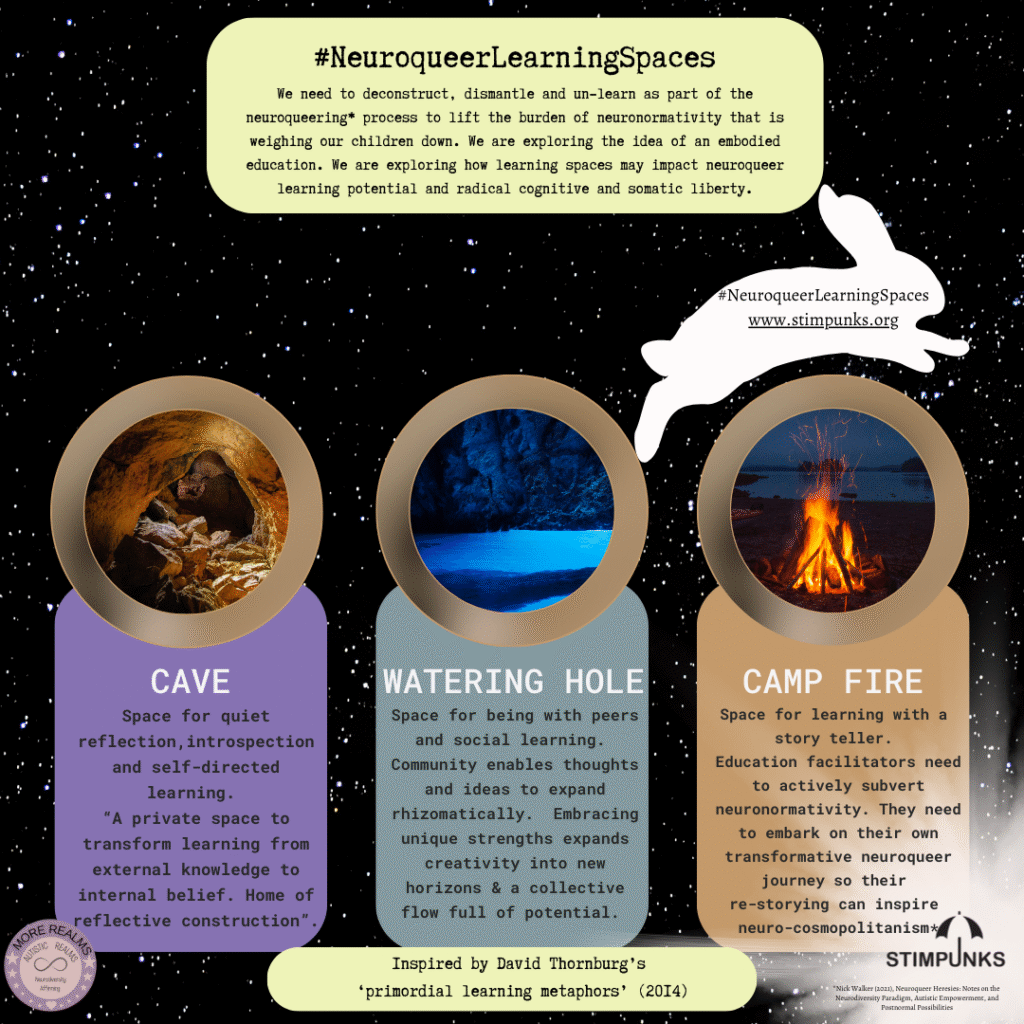

    These are not accommodations bolted onto the edges of a space built for someone else. They are the space’s whole reason for being, shaped from the start around how neurodivergent people actually move, rest, connect, regulate, and think.

    In Cavendish Space, every way of being belongs. The cave is held as carefully as the campfire. Stimming, directness, sensory sensitivity, the deep pull of monotropic focus, these are not quirks to be managed at the margins or quietly discouraged when others find them uncomfortable. They are exactly what the space was built to welcome. This is what Rogers’ unconditional positive regard looks like when it stops being confined to a single therapeutic hour and becomes the architecture of a whole environment and a new way of being for an entire community, when empathy, becoming, and belonging are no longer aspirations but the actual shape of the space itself.

    Structural injustice, affective injustice, and the empire of normality Chapman describes require political change at a scale that no single framework can deliver alone. However, Cavendish Space offers something valuable that large-scale theory sometimes cannot: proof at a human scale that something different is already possible. Lorde told us that the master’s tools will never dismantle the master’s house, and so we have built new ones.

    Our small community of neurodivergent, disabled, and multiply marginalised people, holding between us many intersecting experiences of being othered, misread, and pushed to the edges, has created tools, languages, and spaces that were never handed to us, because they could not have been. They had to be built from the inside, from our own experience, in community with each other. When spaces are built from those experiences outward, people do not have to shrink themselves to belong. They arrive, and they are already home. This is not a utopian dream waiting for the right political conditions; we are already a living space, supported by interdependence and mutual aid, showing that it is possible to build something genuinely new, starting not from the centre of what has always been considered normal, but from the rich, complex, irreplaceable edges.

    We began with the feeling of being in a room, not truly seen. A world where empathy is practised as a political commitment, where becoming is understood as a collective right, and where belonging is built from the edges inward, from our experiences, our languages, our tools, and our communities. Not a kinder version of the old world. The beginning of a genuinely different one. As the Cavendish Space framework reminds us, most environments are not built for us; schools, workplaces, and public spaces are designed for a norm that excludes neurodivergent and disabled people by default.

    Cavendish Space is our offering; it names what we need and gives us a framework for building it, wherever we are, with whatever we have. Where you can walk into the room and feel, perhaps for the first time, that you belong here — and that from that belonging, your own possibilities and your own ways of becoming can begin to unfold.

    You can explore our Cavendish Space framework at stimpunks.org/cavendish

    REFERENCES

    Boren, R., & Edgar, H. (2024). Cavendish Space. Stimpunks Foundation. https://stimpunks.org/space/cavendish/

    Chapman, R. (2023). Empire of normality: Neurodiversity and capitalism. Pluto Press.

    Deleuze, G., & Guattari, F. (1987). A thousand plateaus: Capitalism and schizophrenia. University of Minnesota Press.

    Edgar, H. (2024). The double empathy problem is DEEP. Autistic Realms. https://autisticrealms.com/the-double-empathy-problem-is-deep/

    Edgar, H. (2024). Neuroqueer learning spaces webinar: A summary and reflection. Autistic Realms. https://autisticrealms.com/neuroqueer-learning-spaces-webinar-a-summary-and-reflection-6th-may-2024/

    Goffin, K. (2026). Autistic injustice as affective injustice: The double empathy problem is not about empathy. Philosophical Psychology. https://doi.org/10.1080/09515089.2026.2651512

    Lorde, A. (1984). Sister outsider: Essays and speeches. Crossing Press.

    Manning, E. (2016). The minor gesture. Duke University Press.

    Milton, D. E. M. (2012). On the ontological status of autism: The double empathy problem. Disability & Society, 27(6), 883–887.

    Rogers, C. R. (1957). The necessary and sufficient conditions of therapeutic personality change. Journal of Consulting Psychology, 21(2), 95–103.

    Rogers, C. R. (1959). A theory of therapy, personality, and interpersonal relationships. In S. Koch (Ed.), Psychology: A study of a science (Vol. 3, pp. 184–256). McGraw-Hill.

    Rogers, C. R. (1961). On becoming a person: A therapist’s view of psychotherapy. Houghton Mifflin.

    Walker, N. (2021). Neuroqueer heresies: Notes on the neurodiversity paradigm, Autistic empowerment, and postnormal possibilities. Autonomous Press.

    Yergeau, M. R. (2018). Authoring autism: On rhetoric and neurological queerness. Duke University Press.

  • Neuro-Holographic Thoughts

    Neuro-Holographic Thoughts

    I believe that the DEEP (Double Empathy Extreme Problem) is at the heart of all the systemic ableist issues we have in our education, social and healthcare systems. The lack of an embodied presence and connection between people being together as humans is causing harm. It is leaving marginalised people further on the edges and at an even further disadvantage socially, financially, politically, and in every other dimension possible.

    (Original blog written August 2024, edited March 2025)

    DEEP Disconnect

    The disconnect, lack of understanding and gaping hole where a sense of belonging should be is creating huge mental health problems, especially for our neurodivergent young people who are the focus of my Autistic Realms work. Many young people are now left with no accessible education; they are slipping through the cracks of a broken education and mental health system and getting stuck between systems that value neuronormativity and ignore or misunderstand neurodivergent needs.

    We don’t want people to be ‘falling through the net’, feeling like they are ‘treading water in unchartered seas’, feeling adrift’ and ‘weathered like sea glass’ (Shepherd et al., 2024). As Gray-Hammond (2024) has highlighted, this impact stretches far beyond the young person; it can break family and professional relationships in multidimensional ways, and it is painful. Helen Mirra (conceptual artist) responded to my last post about DEEP with her insightful thoughts:

    “I almost sense a space of opportunity being described — that while being in double empathy tangles unaware can be disorienting, that an awareness of the double empathy problem could rather have a potential for orientation — with a consciousness that Double Empathy needs to be recognised and acknowledged — maybe something like DEAP — Double Empathy Awareness Potential? Practice?”

    Queer Liminal Spaces

    As David Gray-Hammond said in their latest blog Reclaiming Neurofuturism: The Liminal as a Space of Queer Potential (2024);

    “Queer space is the liberation of human kind.”

    I love trying to harvest something positive, to try and find potential in the in-between of things, the shattered systems, and our fragmented relationships. I feel eternally optimistic that things can change for the better; we can work towards radical inclusivity and embrace neuroqueer theory to find a space to breathe, re-connect, deconstruct and reimagine new possibilities. If we are embodied, tuned in, and have wide-open sensory gates, we can acknowledge the empathy gap and create a new plateau, a new space to rise above the disconnect. “Queer space is a space of somatic and cognitive discovery, made possible by the space between. It is through that discovery that we make connection with others possible” (Gray-Hammond, 2024).

    Monocultures

    I have had a few amazing and inspiring meetings this week, one with Jorn Bettin (AutCollab) and another with Dawn Prince-Hughes (CASY), both alongside Ryan Boren (Stimpunks). We all feel the DEEP gap of disconnect due to the domination of neuronormativity. Jorn has captured this within his writing about monocultures. Dawn is exploring similar avenues with the groundbreaking work being carried out by the Cultural Autism Studies Programme at Yale (CASY). Dawn has described this as people being;

    Unable to see shades of lived nuance and constitutionally lacking organs of exquisite sensitivity, the truncated, neurotypical gaze rakes over the bodies of (neuro-holographic) life — whether designated autistic, animal, any other undesirable caste, or nature itself — they assess them only in terms of cost, threats, or utility. They can’t or won’t see them.

    Modern, connectively truncated influence has driven an obsession with homogeneity and increasingly raised a maniacal rejection of inward and outward difference to a hellish art form. The lives (and deaths) of sentient, (neuro-holograhpic) beings is foundational to daily life and underscores the danger of using gifts evolutionarily tooled for a better, more compassionate future are pressed into service for the structure we were put here to change.
    (Dawn Prince Hughes, 2023)
    *neuro-holographic = my edits.

    Ecology of Care and Transforming Spaces

    Jorn Bettin (2024) wrote about Life in the compost heap of industrialised monoculture. He echoes my experience of burnout caused by systemic unmet needs. Jorn agrees that neurodivergent and other marginalised groups are often left out, alienated, and at the bottom of the compost heap. However, we can help people thrive; we can change our personal and institutional landscapes. Jorn, through their work with AutCollab, suggests that we need to embrace an ecology of care.

    The emergence of ecologies of care is the emergence of a beautiful diversity of human scale cultural species and organisms in the cultural compost heap of the industrialised mono-cult. (Jorn Bettin, 2024)

    Dawn suggests;

    We can start a new, inclusive movement by leading the way back to the primal awareness, the connective wisdom, we were born with, because we are first and foremost, in all ways that matter, neuroexpansive minds. (Dawn Prince Hughes, 2023)

    Through our discussions this week, we realised our vision and aims for Neuroqueer Learning Spaces (Boren and Edgar, 2024), reach far beyond education and the small communities we are already involved with. There is an energy-driving created serendipity that is dancing between our shared spaces and bringing like-minded people together. We all have our own stories and history, and for many neurodivergent people, we all have layers of trauma that live within our bodies, spreading back over generations and impacting our sensory way of being in the present and impacting our ways of moving forward. As David highlighted by drawing upon Nick Walker’s (2021) work;

    The master’s house represents a dominant paradigm. In the context of neuroqueer theory, this would be the pathology paradigm. A paradigm within which deviation from normative embodiment is seen as disordered. The liminal represents a space outside of the paradigm. It is a pinnacle of queer space in that its potential is one of unbounded queening; in the liminal, the very meaning of being human may be called into question. (Gray-Hammond, 2024)

    Helen Mirra (2023) expands on this idea of human potential in her concept of holotropism, which I have explored in my previous blogs. She writes;

    “To be holotropic is to have wide open sensory gates. To participate in/as the immense world without becoming overwhelmed, we holotropes have two central methods: in, by hyperfocusing our attention on one sensory or cognitive path, and as, through synthesising our experience into coherence. A sense of wholeness occurs through both of these processes — less consciously in hyperfocus, more consciously in coherence”. (Helen Mirra, 2023)

    David Gray-Hammond is bringing the conversation further forward and exploring my original idea of the potential of Neuroqueering in the In-between. He shares that;

    The queer liminal space allows for connection and expansion because there is no axis to follow. There is no map to trace. The pathology paradigm seeks to arborify rhizomes, reducing them to roots and radicles. In liminal space, lack of structure allows for the organic development and joining up of rhizomes. It is in the liminal where minority silos come together. To the master’s house, it is an existential threat. To the oppressed minority, it is a place where what we were taught to be impossible becomes not only possible but probable. With infinite liminal space and infinite time, queer improbability becomes queer realisation. That which we are told can not happen is subverted into existence. (Gray-Hammond, 2024)


    Neuro-Holographic

    When people connect at a deeper level, going beyond any social, cultural, racial or gender differences, meaning can be found where words are not needed; we can be with each other as human souls. To have ‘wide open sensory gates’ is to be innately hyper-sensitive and hyper-empathetic. However, I do think everyone can work towards this regardless of differences in neurology. We can all become more embodied through somatic practices and having a willingness to open your sensory gates, to de-armour, un-mask and by being prepared to be vulnerable when it is safe to do so. Being embodied enables deeper more meaningful connections to form, it creates resonance and vibrations, vibrations are pregnant with energy, and energy is transformative, it has neuroqueering potential.

    The word neuro-holographic has emerged from within the neurodivergent community, “a buried treasure of our culture that used many hands to lift up into the light”. As Dawn suggested, ‘We belong to the term, rather than the term belonging to us’.


    So, what does neuro-holographic mean?


    Dawn helped draw some light on what neuro-holographic means in the CASY Facebook Group (March 2025) and wrote, “So many autistic people are aware of, and affected by, the reality that there is no division between them and their environment — whether it is the person next to them, the dog running in the park, the plant in the windowsill, or the star at the edge of the universe.” Dawn shared a quote from Brian M Sabourin, which helps to explain the link between neuro-holographic thoughts and Autistic Physics a bit further:

    “According to quantum physics a particle vibrating due to your sound when you speak can affect a molecule inside a star at the edge of the Universe instantly. This phenomenon is known as quantum entanglement. The greatest illusion of this Universe is the illusion of separation.” (Brian M Sabourin, Jan 2025)


    When Dawn, Ryan and I discussed the term neuro-holographic, there was an instant shared resonance and affinity with the word, we were all on the same plane, the same plateau. We all experienced and felt validation from a shared understanding of quantum entanglement through our experiences of being Autistic and a different sensory system, feeling tuned into a wider energy with the environment around us. We shared a rhythm and way of being as neurokin, and the double empathy problem that persists in so many other spaces was somewhat dissolved – an experience echoed by many within the thriving CASY community group and within our online events, too. There is a sense of togetherness, belonging, and a shared intention to work against harmful neuronormative practices and instead to work together towards transformative neuroqueer possibilities.

    To embrace being neuro-holographic is to embrace opening up spaces within our souls so we can work together and transform society and support each other.

    Bodies Without Organs and The Plane of Immanence

    In their work, One Thousand Plateaus (1987), Deleuze and Guattari discuss the idea of a body without organs. The body without organs is not a hollow body; rather, I see and feel that it is the plane where dwelling and possibility are, a kind of “liquid matrix” (Theoretical Puppets, 2021); it is primordial, a place where you aren’t restricted by your organs (literally your body in real terms, i.e. freedom of movement) or the organs (machines) of society. Deleuze and Guattari suggest that networks and connections are made possible through the body without organs as it liberates you from Capitalism and the knots of neuronormativity. It allows people to be free from control, free to follow our desire lines, free to be affected (experience affects).

    To use the analogy in the webinar delivered by Theory & Philosophy (2020), to be a body without organs could be interpreted as us being similar to an unfertilised field. If no seeds are planted, if there’s no relational pull or movement, then the field will likely remain a field; it will never transform, it will never produce an outcome beyond itself, and there will be no crops. This could be positive or negative for a field, but when we talk about people, we don’t want people to remain static, unchanged or stuck or to stagnate, and we don’t want other people and systems to be deciding our use and destiny without our consent or input.

    We need people to have agency, autonomy, and control over their own lives, enabling them to keep on transforming and being responsive, organically moving with the seasons and inviting natural processes. We need an attunement with nature so we can all morph in time and space organically, embodied, and as whole beings.

    Returning to our primordial ways of being and being intune with the natural rhythms of the world around us allows people’s sensory gates to expand, it enables created serendipity to form further connections, adding luminescent nodes to the autistic rhizome. When connections develop in shared holographic space/time, it also creates deeper (perhaps, holographic?) connections of shared meaning, the potential for safe unmasking and bodily liberty; it enables neuroqueering potential and ideas to form more creatively.

    In our meeting, Dawn, Ryan and all perceived and felt the word neuro-holographic at a deep inner level, in our core, it was a ‘felt’ understanding more than a cognitive or intellectual resonance. I am considering if using Deleuze and Guartari’s idea of being “bodies without organs” could help people understand the experience of being neuro-holographic. Neuro-holographic is a felt perception, an open ‘One-All’ that is perhaps more likely to be experienced when people are not tied down by neuronormativity and they have unravelled themselves and lived wholly in the in-between spaces.


    To become a body without organs you need to have safe spaces and time to explore, you need to want to actively seek and find alternative ways, new paths, new plateaus and horizons and to change yourself and the wider systems, planes and spaces around you. There is definitely an element of privilege in finding safe spaces and communities to be able to do this and also to have the time to explore. If I hadn’t resigned from my teaching career, I would very likely have not had capacity to even dip my toe into reading about all this, I would have likely been left feeling very stuck. Exploring takes time, and it also takes time to neuroqueer your bodymind, My neuroqueering journey has been rhizomatic, chaotic but I have also found coherence as I connect with others on the plane of immanence as human souls all trying to find meaning in places where perhaps words and concepts are not even needed or relevant and cease to make sense.

    The Plane of Immanence, as discussed by Deleuze and Guattari (1994), discusses philosophical concepts as “fragmentary wholes that are not aligned with one another”. They continue to explain;

    They are not pieces of a jigsaw puzzle but rather the outcome of throws of the dice. They resonate nonetheless, and the ways introduces a powerful Whole aining open, is not fragmented; an unlimited One all….it is a plateau, it is a plane of immanence of concepts’ (they also stress that the plane of immanence is not a concept). (Deleuze and Guattari, 1994, p35)

    On the plane of immanence, there are rhizomatic networks or connections, becomings and energy. In their book One Thousand Plateaus (1980), Deleuze and Guattari explain that on the plane of immanence;

    “There are only relations of movement and rest, speed and slowness between unformed elements, or at least between elements that are relatively unformed, molecules, and particles of all kinds. There are only haecceities, affects, subjectless individuations that constitute collective assemblages. … We call this plane, which knows only longitudes and latitudes, speeds and haecceities, the plane of consistency or composition (as opposed to a plan(e) of organization or development).”

    I have intentionally used a hyphen between the words neuro and holographic to represent the in-between of neurology and holographic ways of being and experiencing the world, a pause for tuning in, an embodiment, a space of Ma. I have resisted using the word “neuro-holographism as that could imply another new theory or concept. Neuro-holographic is not a concept; rather, I feel like it IS the plane of immanence on which neuroqueer theory breathes and lives; it is the ‘wave that rolls and unrolls’ other concepts (Deleuze & Guattari, What is Philosophy, 1994, p36). To resonate with the term neuro-holographic is to resonate as souls, with your core self, perhaps with your spirit.

    To be part of society is to be part of a community and to live meaningfully. It means connecting as human souls and having a sense of belonging and a sense of togetherness with others. For many neurodivergent and marginalised people, this lack of connection and shared meaning is where disconnect and further stigmatisation often hits and breaks people. For a radically inclusive neuroqueer future, we need radical acceptance and to embrace liminal spaces, the plateaus, the sometimes painful caves, pleats, and caverns where we may become stuck in our lives. As David suggests,

    The liminal space, then, is not a place of stagnation, but one of growth and evolution. It is the site of plasticity in the world’s communities. All communities exist within liminal spaces, much as planets exist in empty space. A community was once a nothing that became a something, liminality provided the potential to become.

    Being Neuroholographic and Embracing Liminal Space to Neuroqueer

    To be neuro-holograpic, to resonate with holotropism and embrace neuroqueer theory means that the weight of neuronormativity may be felt so painfully that it feels like it is piercing through the bodymind. This light can flow, it can move between the smallest of spaces and opening and shines through liminal spaces to offer some hope in previously dark void spaces. It allows light to enter Ma, a space where we can pause and breathe and act upon neuroqueer thoughts that can transform our bodyminds. It can enable new nodes on the rhizome to form from within our communities as we connect with others and transport us to new planes, new spaces to become and keep on becoming. Once DEEP is dissolved or there is a bridge or line of flight to rise above and support understanding of the differences between people, it allows for responsiveness without imposing on each other to change into something we aren’t (we don’t go from a barren field to a crop field ). We can transform within ourselves and create our own destinies by creating new paths. The impact of our inner transformation can lead to even more connections and so further expand the rhizome towards other bodies without organs to keep evolving, transforming and becoming.

    Once we grasp and intentionally embrace the plateaus of liminal spaces, the smooth spaces, then the DEEP gap can dissolve and melt away, rising above the liminal disconnect. We can take a breath, be responsive to our environment and our relationships, and (in theory) ‘become bodies without organs’ to transform further. We can become neuroqueer in a phenomenological sense. Instead of the machines of capitalist society filling the spaces, if we embrace neuroqueer theory through the perspective of Deleuze and Guattari’s body without organs idea, then we can actively choose to subvert and queer the direction we travel in and neuroqueer ourselves and the spaces and relations around us, neuro-holographically.

    Holographic Bodyminds

    Dawn, Ryan and I tried to define the word and experience of being neuro-holographic, but we couldn’t; we just shared excited nods and stimmy responses of mutual agreement and joy at our connection. Perhaps the beauty lies in the way that the word neuro-holographic can only be felt or experienced in a luminescent, undefinable iridescent way, which creates a holographic energy of light and vibration that expands and ripples beyond our singular bodyminds to connect with other bodyminds, it creates multiplicity from the friction between us as humans. Connecting with others enables an expansion of our community rhizomes in exciting ways full of radical inclusive neuroqueer possibilities.

    Dawn Prince Hughes works with Dr. Roger Jou, who founded CASY (Community Autism Socials at Yale) in 2014. This has now transformed into CASY (CULTURAL AUTISM STUDIES AT YALE). CASY offers a new way forward for Autism studies; they are a community that is truly pushing beyond the boundaries of normative hegemony but also stretches the potential of Neuroqueer Theory. CASY is based on a completely egalitarian and neuro-holographic model that stretches worldwide and involves many languages and cultures! If you’d like to find out more, please check out the links below:

    Meet up: https://www.meetup.com/ProjectCASY/

    Facebook: https://www.facebook.com/DrRogerJou

    Email: SPARKforAutism@yale.edu

    References

    Bettin, J. (2024) Ecologies of care. Autistic Collaboration. https://autcollab.org/knowledge-repository/ecologies-of-care/

    Bettin, J. (2024a, January 17). Life in the compost heap of the industrialised mono-cult. NeuroClastic. https://neuroclastic.com/life-in-the-compost-heap-of-the-industrialised-mono-cult/

    Boren, R. & Edgar, H. (2024b, March 23). Neuroqueering Learning Spaces: an Exploration. Stimpunks Foundation. https://stimpunks.org/2024/03/23/neuroqueering-learning-spaces-an-exploration/

    Deleuze, G., & Guattari, F. (1994). What is Philosophy? Verso.

    Deleuze, G. & Guattari, F. (1987). A Thousand Plateaus: Capitalism and Schizophrenia. U of Minnesota Press.

    Edgar, H. (2024b, June 15). The Double Empathy Problem is DEEP — MoreRealms — Medium. Medium. https://medium.com/@helenrealms/the-double-empathy-problem-is-deep-2364b3412c39

    Edgar, H. (2024a, May 28). Neuroqueering from the Inbetween — MoreRealms — Medium. Medium. https://medium.com/@helenrealms/neuroqueering-from-the-inbetween-4ec0c12fd0e5

    Edgar, H. (2023b, November 20). Being With — MoreRealms — medium. Medium. https://medium.com/@helenrealms/being-with-1751dba19743

    Edgar, H. (2023b, July 1). Caverns, Pleats and Folds — MoreRealms — Medium. Medium. https://medium.com/@helenrealms/caverns-pleats-and-folds-912cc93cb950

    Gray-Hammond, D. (2024, June 19). Emergent divergence. Emergent Divergence. https://emergentdivergence.com/?s=parent+burnout+

    Gray-Hammond, D. (2024c, June 22). Reclaiming Neurofuturism: The Liminal as a space of Queer potential. Emergent Divergence. https://emergentdivergence.com/2024/06/22/reclaiming-neurofuturism-the-liminal-as-a-space-of-queer-potential/

    Mirra, H. H. (2024b, April 27). Holotropism: a multi-dimensional, spacious, edgeless terrain. Medium. https://hmirra.medium.com/holotropism-1cdf99c00b74

    Prince Hughes, D. (2023b, February 22). The unique responsibility of neuroexpansive minds for cultural inclusion. Autism Spectrum News. https://autismspectrumnews.org/the-unique-responsibility-of-neuroexpansive-minds-for-cultural-inclusion/

    Shepherd, J., Sutton, B., Smith, S., & Szlenkier, M. (2024e). ‘Sea‐glass survivors’: Autistic testimonies about education experiences. British Journal of Special Education. https://doi.org/10.1111/1467-8578.12506

    Stimpunks Foundation. (2024b, August 3). Neuro-Holographic – Stimpunks Foundation. https://stimpunks.org/glossary/neuro-holographic/?fbclid=IwY2xjawIl7FBleHRuA2FlbQIxMAABHbs6Oss-N3KZn-3ufdKjiXHl0qBWYAt8WttUb3_S29nrKumlBUK8pliH7g_aem_7G1NR1rcAvKDhoiLE15E-Q

    Theoretical Puppets. (2021, March 28). Gilles Deleuze on Gilbert Simondon, Synesthesia, and The Body Without Organs [Video]. YouTube. https://www.youtube.com/watch?v=k2yyW3ml6nM

    Theory & Philosophy. (2020b, August 4). What is the Body Without Organs? | Gilles Deleuze and Félix Guattari | Keyword[Video]. YouTube. https://www.youtube.com/watch?v=irrNcRPGr8Q

    Walker, N. (2021). Neuroqueer heresies: Notes on the Neurodiversity Paradigm, Autistic Empowerment, and Postnormal Possibilities. Autonomous Press

  • Neuroqueering in the Liminal Spaces

    Neuroqueering in the Liminal Spaces

    Neuroqueering in Liminal Spaces

    “By silencing our bodyminds, they (neurotypical society) have halted the growth of a chaotic self. We are no longer able to move fluidly through our experience, instead frozen like ice on an arctic tundra” (Gray-Hammond, 2023)

    David Gray-Hammond (Emergent Divergence) and I are responding to each other’s blogs to help expand the Autistic Rhizome. We are adding nodules to the webs of discussions happening in the Dark Forests (Boren, 2024) of the online communities and creating an open-source bank of writing to carve a path for community discussion about neuroqueering.

    David is continuing his ‘Reclaiming Neurofuturism’ series and has responded to my post The Double Empathy Problem is DEEP. He explored the litigious nature of disabled embodiment and questioned the intentional creation of minority silos via the double empathy divide (Milton, 2012). In support of my own thinking, David also suggests that we need to embrace the healing power of liminal spaces.

    I am writing extensively about the in-between, liminal spaces and Ma as a potential chapter for Nick Walker’s new Neuroqueer Anthology (struggling to write it coherently so that it may make sense to others, but it is slowly forming!). Liminality has been a long term passion of mine, tunnelling back over 30 years. As an autistic person, I feel I have lived my entire life in the liminal. I have always been in-between or on the edges of social groups, always struggling with an internal battle due to the effects masking has on my sensory system. Being monotropic has meant the in-between is felt intensely; it has led to cycles of burnout and impacts my mental, physical and sensory health.

    I am still living in the liminal, on the edges, often in spaces filled with anxiety and uncertainty. However, I have gone through a huge and difficult process of unlearning and relearning over the past few years since I realised I was autistic, rejecting the deficit ways of thinking about neurodivergence and dismantling my own ableist thought patterns. Patterns that have been reinforced over decades by the weight of neuronormativity. I am grateful for the autistic communities I am part of for supporting me and providing cushioning to help me navigate my way through this messy process whilst trying to prevent myself heading into a deeper burnout cycle. However, I still feel like I am living on the edges, even within the most caring and supportive neurodivergent communities.

    The years of masking, the impact of living in a neuronormative ableist-driven society and going through cycles of burnout has, in many ways resulted in my bodymind being ‘silenced’, getting stuck. David echoed this feeling as he explained;

    “By silencing our bodyminds, they (neurotypical society) have halted the growth of a Chaotic Self . We are no longer able to move fluidly through our experience, instead frozen like ice on an arctic tundra.”

    Tundras are cold and harsh environments, but biodiversity adapts to the landscape and the short growing seasons, plants and animals transform their ways of being to survive. Tundras offer some hope that life can exist even in the cruellest of environments.

    However, we don’t want people feeling frozen, stuck on an arctic tundra, trapped in endless freeze/thaw/burnout cycles. People deserve more than a life in survival mode where they are constantly on high alert for danger and in looping patterns of sensory regulation-seeking behaviour, living in Meerkat Mode (Adkin, 2023). In Walker’s inspiring presentation,Expanding the Creative Potentials of Human Neurodiversityat ITAKOM (It Takes All Kinds of Minds Conference, March 2023), she explored how we need to work together so we can flourish so that the;

    ‘creative synergy, the chemistry that is between and among different minds’ can emerge…so the magic happens’.

    We need our beautifully different bodyminds to work together; we need to develop a common language and be open to different ways of thinking, more accepting and inclusive. Radical inclusivity is a concept Ryan Boren (Stimpunks) and I have been exploring as part of our Neuroqueer Learning Spaces Project. There is no single path to radical inclusivity; it begins with being embodied, of being open to connecting with yourself and others, it is cultivated by ongoing neuroqueering efforts to meet needs, it is a confrontation with normativity. Radical inclusivity is more than accommodating needs; it is about fostering cognitive and somatic liberty to enable the potential of neuroqueering to open up new, as yet unknown possibilities.

    Radical Inclusive spaces would benefit everyone. They are embodied spaces of deep connection and safety where people can tune in and be responsive to the needs of others. They offer a deeper connection, and they close the DEEP double empathy gap that I feel is at the root of so much hurt, pain, disconnect and disorientation. For radical inclusion, we need to work together. We need connections, a shared deep understanding, an embodied presence, a sense of meaning, and a sense of belonging. We need community, love and kindness to expand the rhizome.

    Deleuze and Guattari’s One Thousand Plateaus (1980) explores the concepts of the rhizome and also the importance of plateaus being transforming spaces that resist the linear hierarchy of neuronormativity and embrace the potential of the multiplicity of rhizomatic connections. The possibility to use these concepts to explore neuroqueer theory shines through One Thousand Plateaus, it is like a sunbeam bringing hope in Ma, inbetween the doorways of the liminal spaces that so many of us may feel we are living in.

    Rhizomes are open-ended; they have no middle, they have no start and there is no end. (Much like this series of blogs between David and I, I am again beginning in the Middle Entrance, again. You are joining conversations that have been evolving over the past two years in David’s Emergence Divergence Discord server, a node of the autistic rhizome, Open invite to join us there!).

    In summary:

    Rhizomes are interconnected networks of shared ideas and experiences filled with potential. Much like neuroqueer theory, rhizomes have multiple entry points, they are non-heirarchical. Anyone can neuroqueer, and anyone can enter a rhizome at any point, at any time, if the desire and intent are inside them to want to transform and explore neuroqueering.

    Smooth Spaces challenge the idea of traditional hierarchy. They are continuous spaces where the theories of Monotropism (Murray et al., 2005) and Flow Theory (Heasman et al., 2024) can flourish and open up creative neuroqueer potential, an emerging way of being. I experience smooth spaces as the spaces in the gaps of the rhizome; they are the liminal spaces.

    Plateaus are spaces of stability; they offer balance and equilibrium, equity, potential for awe and wonder and further expansion and transformation.

    Liminal Spaces provide smooth, open plateaus, spaces to connect, transform, and neuroqueer from the safety of our rhizomatic communities.

    This new series of blogs will provide a plateau for discussion, a space where the intensity you may feel of being stuck at or between a node point of the rhizome can gain some stability and grounding. We are seeking to expand our bodyminds as we write and connect with others, exploring the dynamics and discord of the DEEP Double Empathy Extreme Problem. As Walker (2019, pg 283) suggested in her thesis;

    “we need to “look beyond social cues to the deeper dynamics of interacting bodies, exceptional tactile and kinesthetic sensitivity, and affinity for what I’ve termed the aesthetics of emergence

    We are opening discussions to explore the endless possibilities of an awe-inspiring neuroqueer future, to help bridge the DEEP empathy gap so many people are experiencing and to work towards a radically inclusive society.

    “To recognise our responsibility to each other lies in our power to create better futures for each other. Connection is the striking surface of a hammer on the walls of the masters house.” (Gray-Hammond, 2024)

    **These blogs will also form part of the discussions and feed into the Neuroqueer Learning Spaces Project I am developing with Ryan Boren (Stimpunks)**

    References

    Adkin, T., & Gray-Hammond, D. (2023). Meerkatting — Emergent Divergence. Emergent Divergence. https://emergentdivergence.com/tag/meerkatting/

    Boren, R. (2024, June 9). Campfires in dark Forests: Community brings safety to the serendipity. Stimpunks Foundation. https://stimpunks.org/2024/05/16/campfires-in-dark-forests-community-brings-safety-to-the-serendipity/

    Edgar, H. (2024, June 15) The Double Empathy Problem is DEEP — MoreRealms — Medium. Medium. https://medium.com/@helenrealms/the-double-empathy-problem-is-deep-2364b3412c39

    Edgar, H. (2023, June 27). Middle entrance — MoreRealms — Medium. Medium. https://medium.com/@helenrealms/middle-entrance-973dc06920b0

    Gray-Hammond, D. (2023). Reclaiming Neurofuturism: Rhizomatic Communities and the Chaotic Self. Emergent Divergence. https://emergentdivergence.com/2023/04/30/reclaiming-neurofuturism-rhizomatic-communities-and-the-chaotic-self/

    Gray-Hammond, D. (2023). Autistic rhizome — emergent divergence. Emergent Divergence. https://emergentdivergence.com/category/autism/autistic-community/autistic-rhizome/

    Gray-Hammond, D., & Gray-Hammond, D. (2024, June 15). Reclaiming Neurofuturism: Responding to “The Double Empathy Problem is DEEP” by Edgar, 2024. Emergent Divergence. https://emergentdivergence.com/2024/06/16/reclaiming-neurofuturism-responding-to-the-double-empathy-problem-is-deep-by-edgar-2024/

    Heasman, B. et al., Towards autistic flow theory: A non-pathologising conceptual approach. Journal for Theory of Social Behaviour, https://doi.org/10.1111/jtsb.12427

    Milton, D. E. (2012). On the ontological status of autism: the ‘double empathy problem.’ Disability & Society, 27(6), 883–887. https://doi.org/10.1080/09687599.2012.710008

    Murray, D., Lesser, M., & Lawson, W. (2005c). Attention, monotropism and the diagnostic criteria for autism. Autism, 9(2), 139–156. https://doi.org/10.1177/1362361305051398

    Nick Walker. (2023, March 19). Dr Nick Walker • Expanding the Creative Potentials of Human Neurodiversity • ITAKOM Conference 2023 [Video]. YouTube. https://www.youtube.com/watch?v=AOITXkj5bqM

    Walker, N. (2019). Transformative Somatic Practices and Autistic Potentials: An Autoethnographic Exploration. California Institute of Integral Studies ProQuest Dissertations & Theses, 2019. 27665905.