Tag: Autism

  • Neuroqueer Revolutions: Difference, Becoming, and the Politics of Refusal

    Neuroqueer Revolutions: Difference, Becoming, and the Politics of Refusal

    This piece brings together four strands of thought: I have been hugely inspired by David Gray-Hammond’s recent writings about the metaphysics of neurodivergence, Robert Chapman’s historical and mad studies framing, Nick Walker’s neuroqueer theory as transformative praxis, and Gilles Deleuze’s philosophy of difference. Each offers a potential lens for us to reconsider what it actually means to be neurodivergent, how our identity is shaped and recognised, and how it might be reimagined beyond fixed categories and labels.

    David Gray-Hammond’s Beyond Definition: A Metaphysical Inquiry into Neurodivergence (2025) asks what makes someone neurodivergent in the first place. He identifies three intersecting dimensions:

    1. Neurological difference from the statistical norm: in structure, function, or developmental pattern.

    2. Lived cognitive difference: a phenomenological divergence in perception, attention, or reasoning.

    3. Social positioning as “different”: the recognition of these differences by ourselves or others, often in ways that create barriers or stigma.


    This proposes that neurodivergence is neither purely biological nor purely social, but emerges in the interplay of embodiment and environment. Tracing through history, Robert Chapman’s Mad Pride in Revolutionary England: The Ranters as Mad Activism (2025) deepens this understanding by focusing on the Ranters in the 1640’s to show how categories of difference, from “mad” to recent terms such as “neurodivergent”, are shaped by power, capitalism, and state control. Labelling is never neutral; it has been used to regulate, exclude, and also to organise resistance throughout history and continues to do so, causing so much harm to marginalised people and anyone who is different.

    Where Chapman maps the long shadows of how difference has been policed, Walker turns us towards neuroqueering acts that stretch those boundaries and enables cognitive, psycholgical and somatic liberty for everyone. Nick Walker’s Neuroqueer Heresies (2021), frames the act of neuroqueering as both a deliberate refusal of neuronormative conditioning and an emergent process that unfolds in everyday life, which has the potential to create radical systemic change to benefit the whole of society. 

    This is in parallel to a Deleuzian perspective, which sees identity as never being static but built from many connections, relationships, and processes. Neurodivergence is not a fixed thing, but a living mix of our fluid bodyminds entangled with our environment, constantly shaped by the social, political, and ecological worlds we move through and the relationships we have.

    The Metaphysics of Neurodivergence


    Neurodivergence is often treated as a fact, decided by a medical diagnosis or by self-identification. Neurological variation without lived difference might go unnoticed; lived difference without social recognition might remain unlabelled or misattributed. It is the interaction with norms, expectations, and power structures that creates and solidifies the socially constructed category of neurodivergence, even for those of us who are innately different from birth.

    Gray-Hammond suggests the idea of neurodivergence rests on three intertwined dimensions. None alone fully defines it, but together, they create its lived reality, of these, being positioned as “different” or “weird” often shapes daily life most directly and affects our wellbeing and how well we can function and thrive. This raises their deeper question: Is neurodivergence defined by the way it is lived and experienced, or by an underlying difference that exists whether or not it is recognised?

    From a Deleuzian perspective, differences are not static traits but elements of a shifting assemblage. Neurodivergence is not a fixed essence but an ongoing process of becoming, shaped by sensory and cognitive patterns, environments, and cultural narratives, all filtered through intersectional privilege and oppression. Difference is generative, producing new perceptions, movements of thought, and ways of living, even if it is temporarily somewhat stabilised or held through labels such as being Autistic or ADHD.

    Gray-Hammond distinguishes between essential properties, those without which neurodivergence would not be what it means today and accidental properties, which can change without altering the underlying being. Essential properties might include monotropic attentional flow, sensory processing patterns, physical disabilities, or other health differences. Accidental properties might include diagnostic labels, learned coping strategies, or outward behaviours. This matters because it undermines claims that compliance-based behavioural interventions “cure” neurodivergence, it suggests that outward behaviour can be suppressed or reshaped, but our essential cognitive and sensory architecture often remains split, fractured by trauma and masking, leading to burnout and mental health crises.

    In Empire of Normality (2023), Chapman reminds us that the notion of “normal” is not an objective truth but a social construct, shaped by cultural and historical contexts. Over time what is seen as  “normal” and what is deemed as  “pathological” have shifted, not because humans have changed dramatically, but because society’s priorities and systems have. These boundaries have often been drawn to serve industry, capitalism, and the institutions that sustain them, rewarding some ways of thinking and being while excluding or penalising others. A clear example is the behaviourist approach entrenched in the US & UK school systems, where reward charts and social stories enforce neuronormative behaviours, harming Autistic children and pushing them to deny their needs expecting them to fit in at all costs.

    In this light, Gray-Hammond’s question, ‘who counts as neurodivergent, and under what conditions?’ is not only personal or diagnostic, but it is political. It invites us to question the shifting line between “different” and “acceptable,” “normal” and “abnormal,” and to consider whether this line can be moved, reshaped, challenged, or even erased.

    Walker’s neuroqueer theory builds on this idea, framing neurodivergence not only as a site of vulnerability for stigma and oppression, but as a space of creative potential. Neuroqueering resists the idea that support or education should aim to make neurodivergent people “normal”. Instead, it treats difference as a strength, a way to stretch the boundaries of what is possible, to reimagine living, thinking, and relating. It holds space for diverging even further from the norm, for exploring new ways of being and learning, and for the radical possibility that anyone can become neurodivergent through the act of neuroqueering and by choosing to move away from normativity.

    When we see neurodivergence as dynamic, shaped by relationships, environments, and histories rather than as a fixed list of traits, we can step beyond the rigid binary of “neurotypical” vs “neurodivergent.” This opens neuroqueering possibilities for a more fluid and liberating society, one that values diversity not as a box to tick but as a living, evolving force. It is an invitation to embrace difference, explore transformative ways of becoming, and continually reinvent ourselves, our work and the worlds we share. However, even as we reimagine neurodivergence in more fluid and relational ways, the language we use and the labels we inherit carry the weight of the histories that have shaped how difference is seen and treated.

    Hidden History of Neurodivergent Labels

    The words and language we use to describe people have never been neutral. They are shaped by politics, history, and power. Robert Chapman’s historical account of Mad Pride shows how labels for cognitive difference often come from systems built to manage and control people. In the 1640s, for example, radical groups like the Ranters challenged the strict religious and social rules of their time. They refused to conform, rejected rules imposed from above, and gathered in ways that disrupted the status quo. They didn’t use today’s words as being neurodivergent but they clearly didn’t fit into the expected norms of the time. Their defiance and solidarity can be seen as early acts of Mad Activism resisting the idea that there is only one “right” way to think, feel, or live.

    Neurodivergent people have often been denied the right to name and define our own realities. For most of history, “official” knowledge about us has come from deficit-based medical models, shaped by institutions and used to serve those in power.

    As I shared in my blog ‘Autistic Mental Health: Beyond the Pathology Paradigm‘ (Aug, 2025), research suggests that as many as 8 in 10 Autistic people have a mental health condition. Sadly, Autistic people have been found to have up to an eightfold increased risk of death by suicide compared to non-Autistic people (Brown et al., 2024). For Autistic children, the risk of thinking about or attempting suicide is 28 times higher than for their non-Autistic peers. These are not just numbers, they are lives cut short by systems that fail to meet our needs.

    The latest Assuring Transformation NHS Digital data (April 2025) paints an equally troubling picture:

    • 2,025 Autistic people and people with a learning disability are in mental health hospitals in England. Of these, 1,455 (72%) are Autistic.
    • 240 under-18s are in inpatient units. Of these, 230 (96%) are Autistic.
    • The number of Autistic people without a learning disability detained in mental health hospitals has increased by 141% since 2015.
    • In 2015, Autistic people made up 38% of the total in hospital. Now it is 72%(National Autistic Society, 2025).

    These statistics are not personal failings, they are systemic failures of education, healthcare, mental health services, and broader society to support Autistic people and those of us who are different in ways that affirm our needs, identities, and ways of being. This is epistemic injustice, as the people most affected are excluded from the conversation, and the words we need to describe our lives are often missing, invalidated or treated as problems. A clear example of this is neurodivergent experiences of burnout.

    When a community lacks language for its own experience or our experiences aren’t believed, it is easier to cause harm. It’s not just about being misunderstood; it’s about blocking self-understanding, choice, and autonomy. Every label we inherit, from being “Autistic” or “weird,” “defiant’ or “disordered”, carries a built-in set of assumptions about how we should be seen and treated. Labelling can trap us in someone else’s story…..or it can be reclaimed and re-storyed to tell our own narratives.

    The power to name and label, and use certain language shapes who is recognised as being fully human and “right” who is pushed to the margins. The meaning of labels is always shifting; institutions try to lock differences into fixed categories, diagnoses, risk labels, and lists of “deficits.” In response some communities are pushing back, reclaiming words like “Crip”, “Autistic” or “Mad” and filling them with their own values, histories, and pride. But changing words alone is not enough, real change needs systemic transformation, and neuroqueer theory offers ways to put that into practice.

    Refusing Normal: The Practice of Neuroqueering

    Neuroqueering can happen on many levels and in many different ways; from the small, everyday choices we make in how we use our bodyminds to the larger work of changing systems. On a personal level, it can mean moving, speaking, or sensing in ways that feel natural to us, even if they go against social expectations. On a collective level, it involves challenging and dismantling the systems that enforce able-bodiedness, demand constant productivity, and dictate narrow, “acceptable” ways of socialising and communicating.

    However, living neuroqueerly by stimming openly, rejecting therapies aimed at making us “normal,” choosing to play, learn, work, or rest in our own ways can still lead to exclusion, discrimination. It is a risk without being in a safe environment with people who understand and accept your authentic self and ways of becoming.

    Neuroqueer theory recognises that neurodivergence doesn’t stand apart from other forms of oppression. The same bodymind that pushes back against neuronormativity is also navigating intersectionality, racism, sexism, homophobia, transphobia, class inequality, and the impacts of colonialism. True freedom for neurodivergent people means breaking down ableism and these other systems together. Deleuze, like Walker and Gray-Hammond, sees this refusal to “fit in” not only as resistance but as something full of creative potential. Embracing difference isn’t just about stepping away from the norm; it’s where new ways of living, relating, and imagining can begin and transformations can emerge.

    Neurodivergence isn’t something that lives inside an individual’s brain; it takes shape in our bodyminds, who we are is inseparable from the rhizomatic networks of meaning and care, or their absence, that surround us and our environments. Liberation needs to be a collective flow: changing life for one means changing it for all of us. It needs to be co-created through the ways we think, feel, and act, shaped by how others respond to us, and vice versa.

    Neuroqueer praxis is both personal and social, it is the daily choice to resist being pulled into the norm, while building community solidarity to challenge the systems that enforce neuronormativity. It’s about creating and sharing new ways of knowing, and about changing the very conditions that limit who we can be, moving beyond labels and expectations, so we can live as our authentic selves and build supportive, meaningful communities.

    A neuroqueer politics of difference does not seek permission or validation from systems that marginalise. It works to build worlds where many ways of being are not only accepted but recognised as essential to our shared survival and joy. To live fully as ourselves is not just inclusion, it is the ongoing work of reworlding.


    References

    Chapman, R. (2023). Empire of Normality, Neurodiversity and Capitalism. Pluto Press.

    Chapman, R. (2025). Mad Pride in Revolutionary England: The Ranters as Mad Activism. [Manuscript in preparation].

    Deleuze, G. (1994). Difference and Repetition (P. Patton, Trans.). Columbia University Press. (Original work published 1968)

    Deleuze, G., & Guattari, F. (1994). What is philosophy? (H. Tomlinson & G. Burchell, Trans.). Columbia University Press. (Original work published 1991)

    Gray-Hammond, D. (2024, March 21). The metaphysics of neurodivergence. Emergent Divergence.
    https://emergentdivergence.com/2024/03/21/the-metaphysics-of-neurodivergence/


    Walker, N. (2019). Transformative Somatic Practices And Autistic Potentials: An Autoethnographic Exploration. (Doctoral dissertation). California Institute of Integral Studies.

    Walker, N. (2021). Neuroqueer heresies: Notes on the Neurodiversity Paradigm, Autistic Empowerment, and Postnormal Possibilities. Autonomous Press.

  • Awe, Wonder and Different Ways of Knowing: Cavendish Space and Helen De Cruz

    Awe, Wonder and Different Ways of Knowing: Cavendish Space and Helen De Cruz

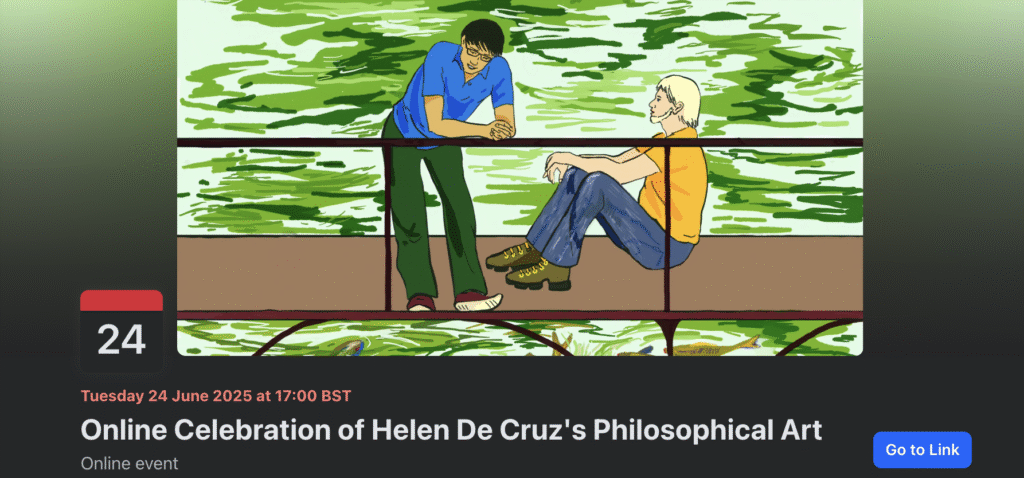
    In the online memorial event (24th June 2025) to celebrate the philosopher and writer Helen De Cruz’s life, Georgi Gardiner who hosted the session asked the question:


    If Helen designed a campus/university, what would it look like?”


    I didn’t know Helen personally but have been deeply inspired by her writing and art. I wanted to write something to honour her work and share some ideas about how her philosophy has enriched our ideas for learning spaces.

    (It is a coincidence the Learning Space Project I developed with Stimpunks is called Cavendish – this is unrelated to Helen’s set of beautiful illustrations for The Blazing-World, by Margaret Cavendish, Duchess of Newcastle. Stimpunks’ Cavendish Space is named after Henry Cavendish, a scientist from the 1700’s).

    Awe, Wonder and
    Different Ways of Knowing:
    Cavendish Space and
    Helen De Cruz

    There’s something powerful about creating space for people to think and learn in their own unique ways. Whether it’s the sensory-friendly Cavendish Space that is the foundation stone of Neuroqueer Learning Spaces that I have developed with Stimpunks or the thoughtful, creative work of philosopher Helen De  Cruz that may be shared around our campfires; both invite us to imagine how learning and knowledge can work for everyone.

    Helen De  Cruz is a philosopher (1978-2025) who writes about imagination, wonder, and how we come to believe and understand things. Her book Wonderstruck: How Wonder and Awe Shape the Way We Think, was my most inspiring read of last year.

    I took part in a brilliant reading group hosted by The Philosopher 1923, where we explored Helen De Cruz’s work in depth. In the final week, we were lucky to be joined by Helen herself, and I remember discussing neuroqueer theory and the projects I was developing with Stimpunks, particularly the ways her ideas resonated with and helped shape our thinking. These conversations had a lasting impact , deeply influencing our Neuroqueer Learning Spaces project, helping to evolve the vision behind Cavendish Space, and continuing to inform much of my current writing and emerging ideas.

    Stimpunks’ Cavendish Space is named after Henry Cavendish, a scientist from the 1700’s who lived a very unique life. He was quiet, sensitive to sound, and followed his own routines, but he also made important scientific discoveries. For us he’s a symbol of what’s possible when people are allowed to think and learn in ways that work for them, when Autistic people are free to follow their monotropic passions and flow. Cavendish is proof that deep focus, quiet curiosity, and different minds can lead to wonderful things and ways of connecting with our true selves and others. Cavendish Space is all about creating places where people can follow their interests, feel safe, and get absorbed in what they love with people they trust, where there is also time to regulate, re-set and re-energise by ourselves.

    Cavendish Space is a welcoming, flexible environment designed for everyone but especially beneficial for neurodivergent people to explore their interests. It honours sensory needs and bodily autonomy, creating a foundation where individuals can learn, reflect, and connect in ways that feel natural and safe. This approach aligns closely with Helen De Cruz’s work, which like Cavendish Space is grounded in the values of curiosity, care, and deep respect for expansive and divergent ways of thinking and being.

    In her book Wonderstruck, De Cruz explores how moments of awe and wonder can open up our minds, inviting us to ask questions, be curious and see the world differently. For her, wonder isn’t just an emotion it is magic. Magic is wonder and power, it’s a vital way of thinking, of paying attention, and of forming meaningful connections with ideas, people, and the world around us.

    Honouring Helen De Cruz’s work within Cavendish Space is about more than referencing her work, it’s about embodying the values she brings to philosophy and the wider world. She offers a deep respect for wonder, a commitment to epistemic humility, and a belief in the richness of diverse minds. Her philosophy invites us to reimagine thinking as something playful, relational, and open to all, not limited by conventional rules or hierarchies.

    By weaving her influence into the fabric of Cavendish Space, we affirm that curiosity, care, and difference are not only welcome, they are essential to how we learn, grow, and imagine new futures together and can inspire awe and wonder.


    In memory of Helen De Cruz (1978–2025)

    https://www.gofundme.com/f/support-helens-children-after-her-passing


  • Mingling with the universe: Autistic Perception

    Mingling with the universe: Autistic Perception

    This section of the poem from Lord Byron, Childe Harold’s Pilgrimage, speaks to me deeply and resonates with my Autistic experience of meaning as something felt, sensed, and lived through, especially in solitude, sensory immersion, and more-than-human connection.


    There is a pleasure in the pathless woods,
    There is a rapture on the lonely shore,
    There is society where none intrudes,
    By the deep Sea, and music in its roar:
    I love not Man the less, but Nature more,
    From these our interviews, in which I steal
    From all I may be, or have been before,
    To mingle with the Universe, and feel
    What I can ne’er express, yet cannot all conceal.


    Lord Byron, Childe Harold’s Pilgrimage, canto iv


    Autistic meaning-making is not abstract, but an embodied attunement, a “mingling with the Universe” that resists neuronormative expression yet pulses with emotional and sensory intensity.

    As Erin Manning wrote, “Autistics…are hypersensorial, alive not only to the presence of the other, but more importantly, to the absence of category. They live the differential, feeling into the world’s quality of emergence. Bodying, for them, is worlding.”

    Autistic experience often resists the default social scripts and expected ways of making sense of things, our thoughts are less linear, more constellation-y and rhizomatic. They may appear chaotic and not always make sense to others as the connections are happening deep inside us.

    Meaning for me, often arises between things, in the liminal spaces, in the felt sensory and emotional moments, a subtle change of a sound, the shifting pattern of sunlight on leaves and my relationship with living things that don’t speak in human words, and also a more natural attunement to people who also can’t or prefer not to speak verbally.

    Like Lord Byron’s “rapture on the lonely shore,” the Autistic sense of meaning-making may emerge most powerfully in the absence of human intrusion, words and voices, not from isolation, but from a deep, open presence with what is. It is why we may crave time alone, in our dens, out in nature, fully immersed in stimming activities and other forms of communication and connecting online. Alone time is so often stigmatised as being antisocial, but it is a different kind of sociality, and may be more meaningful for many Autistic people and is something to value and allow ourselves the time to lean into in what ever way we want and helps us feel good. It may be less about escaping and more about finding belonging in other ways and belonging otherwise.

    Autistic people often experience a heightened resonance and connection with our environment, this may not always be with people, but with animals, objects, places, atmospheres and sensory experiences. This is not a deficit of sociality, but perhaps a re-routing of relational (monotropic) attention toward the more-than-human, an ethodivergent way of being. (Ombre Tarragnat, 2025)

    I have written extensively about liminality, the in-between spaces where many Autistic people feel they may be stuck, but I think it is in these liminal spaces and states, where our bodyminds “mingles with the Universe,” that we can find a quiet calm that helps regulate, bring comfort and a meaning that allows us to emerge from the liminal or delight in the dwelling moments of the unspoken between realms. It is in liminality that Autistic perception becomes a kind of aesthetic felt knowing. It may not be easily verbalised or put into human words, “what I can ne’er express” but it is real, it emerges and can be captured in art, poetry and nature, in our online community spaces and is valid.

    There is society where none intrudes”.

    There is pleasure in the pathless woods” when we diverge from neuronormative expectations and follow our inner compasses.

    Allowing ourselves to feel, wholly and completely and merge with our environment is a way of creating our own language, a bodymind way of being that doesn’t rely on human words and can be felt and understood in other ways………we need to create our own worlds, reworld, neuroqueer – so we can survive together in a world dominated by neuronormativity and find our own place of belonging.

    Image of frozen droplet of water in snow Text: "HAD I NOT CREATED MY WHOLE WORLD. I WOULD CERTAINLY HAVE DIED IN OTHER PEOPLE'S" ANAIS NIN

    Sharing early morning thoughts after having read more of Erin Manning‘s beautiful work last night ‘A Feel for Others Feeling You‘ (2025), about challenging normative orientations around the concept of mirror-touch synaesthesia and touch (inspired by the DeafBlind Protactile community and work of John Lee Clark).

    To feel the touch of the world is to feel the difference the world brings to all it comes into contact with, and this contact cannot be separated from all that worlds. To be a body is to be in contact. To touch is to feel the differential.
    (Erin Manning, 2025)

    Thoughts welcome – I am hoping to set up an alternative space to explore through Autistic Realms into More Realms to share, discuss and collaborate on things like this with anyone who is interested alongside CASY Cultural Autism Studies at Yale and Stimpunks communities.

    Ocean Waves


    Listen to Ocean Waves by Adriel Jeremiah Wool:

    “Ocean Waves by Adriel J Wool” is a meditation in ambient flow states. Introduced with a special tuning that allows the brain to touch and feel more true pythagorean intervals of musicality.

    The flows and textures of nature follow patterns that resonate with the human body through its ability to hear sound.

    The nervous system is a microcosm, however it relates in scale to the power of nature, and is comforted within her crests.

    To breathe more slowly and more deeply. The sound spectrum is given in the powerful release of deep sound energy, very much like the Earth’s beautiful shores.”

    Ocean Waves by Adriel J. Wool isn’t a recording of the ocean, it’s a fractal composition of the nature of the ocean. Modulated into swells, the rhythm evokes the massive release of great ocean waves and the more humble release of the human breath“.
    Ryan Boren (Stimpunks)


  • Mossy Minds & Monotropism

    Mossy Minds & Monotropism

    “Attention without feeling,
    is only a report.”

    Mary Oliver — Upstream: Selected Essays (2016)

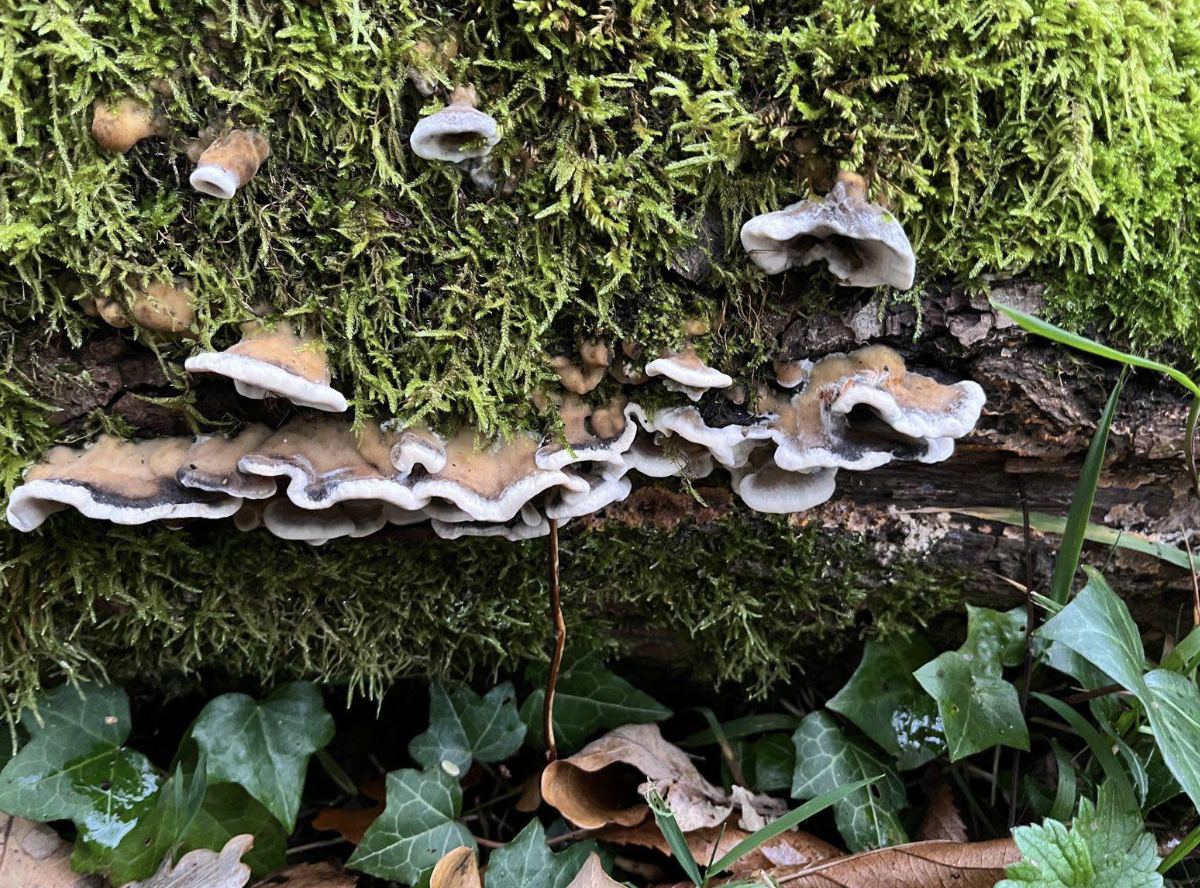
    The quote, “Attention without feeling, is only a report.” from Mary Oliver — Upstream: Selected Essays (2016) resonates with me as a deeply monotropic person. It summarises what happens whenever I find myself pulled into a moment so fully and immersively that the boundary between noticing and becoming begins to dissolve, and time melts away. These moments will be different for everyone, they happen when our monotropic bodyminds are pulled towards something, it returns when I am in woodlands and when I see moss, fungi, flowing water.

    There’s something about moss, it’s soft resilience, its quiet deep greenness of a million shades, the way it persists and thrives on forgotten land and inbetween stones, on forest floors and brings old things back to a new life. Moss doesn’t demand to be seen, but when we do look, really look, really feel, and really give ourselves time to sense and be with moss, it offers a different kind of presence and an almost different kind of knowing and connecting and Autistic Joy.

    I am exploring the idea of moss as an invitation to consider monotropism, ethodiversity, and neuroqueering our spaces as a way of creating belonging. Drawing from the work of Popova, M. (2023). The Magic of Moss and what it teaches us about the art of attentiveness to life at all scales , Robin Wall Kimmerer, Mary Oliver, Anna Lowenhaupt Tsing and others, alongside my emerging neuroqueer and holographic ideas, I am considering if moss (like mushrooms and water which I have written about before!), could offer not only a symbol and metaphor for neurodivergent thriving but a methodology to reclaim creative practice and ways of being that resists the fast, extractive modes of dominant neuronormative culture.

    Note: These thoughts are evolving through discussions in the community spaces I am engaging with such as; Neuroqueering Your Creative Practice by KR MoorheadMarta Rose and Meg Max, Barbara Melville’s Writing the Dawn nature writing workshop and my engagement with Stimpunks, CASY and Monotropism discord community, amongst others………

    So………….

    More monotropic musings…….


    Monotropism: Deep Attention, Embodied Feelings

    Monotropism (Murray et al, 2005) is a neuro-affirming theory of Autistic experiences. It describes a tendency to enter flow states of deeply focused attention, to move inward towards just one or a few connected interests, sensations, or patterns at anyone time and to dwell there. This is not just a cognitive style; for myself being monotropic it is a whole-bodymind sensory way of being. For many Autistic/ADHD people, monotropism underpins and helps to make sense of our sensory experiences, ways of learning, communication styles, and creativity. If you are Autistic / ADHD the theory of monotropism may resonate and help explain how you process and relate to the world.

    In environments dominated by neuronormativity ,which are structured around multitasking, high demands, quick-switching of attention tunnels, and surface level engagement, monotropic people can be often misread as being obsessive, inflexible, or disengaged. If we reframe this deep-focus not as deficit, but as capacity and energy, it offers a more affirming lens of Autistic experiences as being a form of attunement with attentional resources, a way of giving attention feelingly and holistically.

    For me, Robin Wall Kimmerer’s Gathering Moss (2003) exemplifies monotropic attentional ecology. Her writing spirals and notices what others may overlook such as the micro-patterns of bryophytes (group name for any non vascular, rootless plants like moss) , the webs that cover forest floors and emerge through cracks and over sleeping objects. Kimmerer just doesn’t describe moss she enters into relationship with nature, her science and writing is guided by care, her noticing is lived, it feels very monotropic much like Merlin Sheldrake’s Entangled Life (2023).

    To attend like this, monotropically, with feeling and deep attention is not just to extract facts, but to stay present with complexity, multiplicity and connect with nature and our environment rhizomatically, completely and become deeply absorbed in greenness and texture. As Mary Oliver reminds us, “without feeling, attention becomes mere reporting“. For some monotropic people their perception may offer a different kind of report / blog writing/ creative experience, one filled with sensory details and emotional resonance, there are no barriers between the body and the environment, the moss, nature.


    Nature Positivity: We Are Not Outside the Ecosystem

    Nature positivity was a term only recently introduced to me on Barbara Melville’s writing course. It made me think about how as a neurodivergent person I am not disconnected from nature but often deeply and almost painfully attuned to it, inseparable, we are a part of nature. We do not need to be brought back into the natural world; we need to be recognised as already being part of it. Our sensory experiences, our flows of attention, our non-normative experience of time, memories and rhythms, aren’t deviations from a natural or ‘normative’ baseline, they can be seen to be part of biodiversity and our wider ethodivergent ways of being (Tarragnat, 2025).

    Ethodiversity is a term developed by Ombre Tarragnat (2025) to describe the variability of behavioural and existential styles within and across species. Ethodiversity invites us to move beyond a purely neurological model of divergence and into a more-than-human framework of difference. It reminds us that there are many ways to live, relate, and thrive not only for humans, but for all living things.

    Moss embodies ethodiverse wisdom. It rejects hierarchy and human time, it forms webs, it’s value is in its interconnectedness and the spaces inbetween. We can learn from all non-human beings and living things, we are all interconnected and if we give our selves more time to tune in to the natural world we could perhaps can expand our ways of thinking, not just as humans for humans, but as part of nature. We can help to recreate a world where every living thing can thrive (non-human and human). It creates a space to think about our relationship with the wider planet we are in, the importance of environmental sustainability, not just focusing on our human-centric needs (Solarpunk ideas).

    In this sense, moss, like many other aspects of nature, becomes a kind of kin, we are interdependent. I think lots of us are trying to survive from the edges, in the liminal spaces, trying to grow in shade and darkness through cycles of burnout. I live in the dark-mode, underground settings of Discord servers, it is where I feel at home, inbetween the reality of life outside my front door and where I really feel safe and a sense of belonging. Moss grows across ruins, rooftops, gravestones and inbetween the places and objects people normally tread over or overlook. It softens hard spaces and it survives and thrives on it’s own terms, in it’s own way much like our online community spaces.

    Mushrooms and fungi, like moss, offer a metaphor of hope and an opportunity to think about how we can create a life from capitalist ruins which invalidates and overlooks neurodivergent needs and potential. Anna Tsing’s The Mushroom at the End of the World reminds us that life persists in the ruins of Capitalism, not in spite of disruption, but through it and can flourish through adversity. Like matsutake mushrooms thriving in disturbed forests, neurodivergent people often live in the edges of systems, through adversity, in fractured spiral time, outside of centralised blueprints and neuronormativity, however hard these systems try to contain us and pressure us to mask. This resonates deeply with monotropic ways of being, our ability to create our own Autistic rhizomes and communities, how our senses sometimes form unlikely but radically resilient connections in overlooked spaces.

    Tsing’s emphasis on precarity, interdependence, and multi-species assemblages mirrors the sintered ways neurodivergent communities form: not through uniformity, but through shared friction and feeling. Our creative practices become more than self-expression, they are part of what Tsing calls the “arts of noticing,” where we document life not for control or mastery, but as a way of staying with complexity and multiplicity and to create shared meaning. It is a way to honour our entangled, emergent, sensory ways of being as ecologically vital. It reminds us that even in fragmented systems and broken ground, we can reclaim ourselves, find connection, and grow into something whole, be together and create something new.


    Sintering

    In Sintering: Neurodivergent Community Building (2025), I explored the metaphor of sintering. Sintering is the process through which individual snow grains gradually begin to bond. Tiny necks form between them, bridging the gaps, making the snowpack stronger, more resilient, and more resistant to collapse.

    In Theory of Water: Nishnaabe Maps to the Times Ahead (2025), Leanne Betasamosake Simpson offers this as a metaphor for collective becoming. “Sintering is a joining,” she writes, “It is a communal transformation that creates a fabric of former snowflakes bonded to each other… Sintering is bonding, it’s building coalitions with your neighbours” (p. 18).

    This analogy resonates deeply with my own experiences of the neurodivergent community and the Autistic rhizome. Many of us begin our journeys alone trying to discover our real identity under the layers of masking and internalised ableism, realising we are caught in systems not made for us and that is why life has felt SO hard! Discovering I was Autistic was life changing for me. In my 40’s I suddenly had access to a whole world of new vocabulary to describe my experiences. It has been through connecting with other neurodivergent people through various online communities and sharing stories that my life has begun to make more sense. When we find each other across difference, across shared experiences, we can start to build bridges, rhizomes. Through conversation, care, and solidarity, we can begin to sinter.


    Neuroqueering from the Liminal

    In Neuroqueering Liminal Spaces (2024), I wrote about the spaces where categorisation breaks down between identities, between disciplines, between states of being. Neurodivergent people often find ourselves in these thresholds, not quite fitting in, living in the margins, I am suggesting that liminality can be a fertile and exciting place to neuroqueer and evolve from.

    Moss is liminal, it exists between. It mediates, connects and holds and brings things together. In many ways it could be seen to reflect what neuroqueer creative practice can be, something that isn’t fixed, something that moves away from dominant frameworks, it is textured and radically relational and multidimensional.

    To write from moss is to write from the in-between spaces, attune to our environment, to feel safe and at home. It is to resist linearity, binary ways, hierarchy and to embrace multiplicity, to value the process of becoming and connecting.

    Moss offers a model for neurodivergent thriving, one that honours attention with feeling, presence without performance and growth without urgency. It teaches us to notice differently, to value slowness, to dwell in the cracks and embrace neuroqueering, monotropic felt time.

    Our creative practice can be moss-like, it can be sintered through our shared stories and experiences. To attend with feeling and lean into monotropic time can be a lifeline for many people who are experiencing burnout. It is a way of reclaiming our authentic ways of resting and being.


    Monotropic attention, a different ecology


    In the Writing the Dawn workshop I took part in this week, Barb Melville encouraged us to begin our writing with a nature-positive message. She asked us, not just what we notice, but why it matters. For me, moss represents a kind of quiet kinship, it is soft, slow and often overlooked and fills me with sensory joy. As a neurodivergent person, I see myself reflected in its persistence, its texture, its need for quiet, shaded places to thrive. In protecting nature and moss we are also protecting our sensory environments, the liminal spaces, and the overlooked ecologies that support neurodivergent ways of being and feeling safe.

    This reflection can become call to action which Barbara invited us to think about. It enables us to think about reimagining ways of connecting, not just with nature but in the way we create our communities, educational spaces and care settings. We need to design practices that honour differences, not pathologise. Like moss, neurodivergent people thrive with more time and space, gentleness and connection in spaces like our Neuroqueer Learning Spaces.

    My home is in the mossy, liminal spaces that we create together, in our reaching toward one another. Our strength is in radical resilience and sintering, our refusal to face the world alone, valuing interdependence and not conforming to harmful systems based only on neuronormative values. 

    Radical resilience does not come from hardness or conformity, but from mossy softness, it comes from flow and fungi like rhizomatic community networks and the cumulative strength of many unique connections forming bonds to offer support to each other. As Bruno Lataur summarised, “Learning to live in the ruins of capitalism means learning to do without the notion of projects and, finally, moving on to an attentive description of situations that cannot easily change scale…..With her dog Cayenne, Donna Haraway had proved how far one could take analysis of relations between species. With her matsutake (mushroom), Anna Tsing proves that we can go still further, modifying not only the landscape to be described but what we should expect of meticulous description.”

    Mossy, messy, monotropic ways


    Nature-positive writing what ever the focus – mushrooms, moss, trees, water can be a radical act of reclamation, helping us grow cultures and communities that are ecologically aware. Neurodivergent spaces are rhizomatic, soft, mossy, fluid, flowy, webby and spirally and entangled. They allow space for dwelling, noticing, interdependence and omnidirectional growth.

    ‘To walk attentively through a forest, even a damaged one, is to be caught by the abundance of life: ancient and new; underfoot and reaching into light.’
    pg 155 (Tsing)

    Let’s keep growing spaces that honour slowness, texture, and sensory ways of knowing and feeling, where monotropic ways of being are not just accepted, but celebrated. Spaces where infodumping, deep focus, stimming, and sensory richness are recognised as meaningful ways of connecting and building interdependence between humans, non-human beings and our wider environments.

    Monotropism lets us sink into and experience the world with our full-bodymind presence, not just noticing, but flowing and feeling with the world in ways that bring resonance, validation, and a sense of belonging. Mary Oliver wrote “Attention without feeling, is only a report.”, for monotropic people how we use our attentional resources helps to explain everything, it is how we experience life in all it’s joyful mossy, messy ways.


    “Next time the bus is late,
    take those waiting minutes to
    look around for signs of life…..
    amidst the noise and fumes
    and elbowing crowds,
    there is some small reasurance in the
    moss between the cracks.”
    (Kimmerer, Gathering Moss, pg 105)


    References & Further Reading

  • Monotropism, Spiral Time, and the Rhizome of Memories

    Monotropism, Spiral Time, and the Rhizome of Memories


    *“Memories scatter like shards of seaglass along a fractured spiral, the centre always slipping just beyond my grasp. Hazy images and sensations drift in and out of the fog, sometimes offering sharp glimpses, but rarely staying long enough for me to hold. Most pass by shrouded in a soft mist, like half-formed echoes trapped within a labyrinth. Sounds, images, smells, and feelings blur and merge, tangling into an ever-expanding rhizome, sprawling in all directions, folding in on themselves. Memories come more as felt impressions than as concrete events. Remembering isn’t straightforward for me; it’s less recall and more a process of re-navigation. I have to trace uncertain paths, try and find a thread to hook into to regain my flow, often sensing that what I’m reaching for is just out of reach if trying to recall a specific event, but my sensory memories are more clear and vivid as they are felt sensations – which is hard to explain to people who may not experience their memories in this way. ”

    I am currently on a Neuroqueering Your Creative Practice course led by KR MoorheadMarta Rose and Meg Max. This week we were exploring time and memories, which felt very apt given my recent monotropic outpourings about time. In this week’s session I wrote the above piece about how I experience memories.

    Memory may not be linear for neurodivergent people. It may feel like a spiral of felt sensations. Being monotropic shapes how I re-sense moments, navigating echoes and threads of sensory experiences rather than always recalling events. I felt validated that some other people seemed to relate and share similar experiences of their time not being linear and also being quite hazy recalling specific events but having really vivid recollections of more sensory experiences.


    Monotropism and Memories

    Monotropism is a theory of Autism (Murray et al 20025) that describes a way of focusing attention that tends toward deep but fewer channels. For those of us who experience the world monotropically, attention locks in and tunnels can form like portals. These attention tunnels can lead to intense engagement and immersive sensory experiences, but they may also shape how we encode, retrieve, and relate to our memories.

    Memory for me is not a fixed archive of past events filed neatly on shelves. It is alive, constructed in the present, woven from threads of past focus, emotion, embodiment, and attention. For monotropic people, those threads may be less linear and deeply context-bound in our sensory experiences. We may not remember when something happened in conventional, sequential neuronormative time but we may vividly feel how we experienced something, we may recall the sensory landscape, the tone, the rhythm of presence or absence.


    Spiral Time and Felt Time

    I’ve written previously about monotropic experiences of time as being like ever expanding rhizomatic spirals like rather than a linear A-B or 9am to 10pm of time as lived by the clock and conventional calendar. I think this also shapes how memory functions, rather than stretching out along a clear chronological line, time for me feels like it folds back in on itself and experiences and memories happen and are stored within the folds (a concept from Deleuze that I have written about at length). A moment from years ago might feel right now, while a conversation from yesterday may feel distant or unretrievable unless there is something to hook me in and brings it back into focus so I can retrieve the thread and follow the flow.

    In monotropic spiral time, memories don’t behave like neurotypical people may expect or how we may have been brought up to understand how memory works. My memories don’t line up neatly, they tangle, twist, merge and drift like mist through a forest. Sometimes I feel I’m not remembering in the traditional sense at all, but kind of re-sensing, like I am trying to feel my way through a fog of echoes and impressions, a texture, a tone of voice, the way the light fell. It makes my memories of concrete events feel hazy and fuzzy but my experiences feel vivid and it can be quite confusing and frustrating at times.


    Labyrinths and the Rhizomes

    For monotropic people our minds and memories may feel less like walking through an album of neatly arranged photos and more like navigating a vast, living labyrinth. I can’t easily “go back” and retrieve a memory, it feels like I have to wander, I have to reach out and try and sense where the thread of recall might catch and hook onto something, what I often find is not a single event but a tangle, a rhizome of multisensory experiences that I have to unravel.

    This rhizomatic quality of navigating time means my memories don’t live in isolation, they’re not strictly filed under “birthday, age 9” or “Monday morning, March 3rd.” Instead, they seem to connect through shared emotions and sensory patterns. One feeling or sensory experience might loop me back to three seemingly unrelated moments, a smell might pull on threads across decades and I don’t always know why. This can be disorienting in a world that expects time and memory to be neat and logical but it’s also a kind of richness, a depth of connection that linear systems seem to often miss. It can make conversations with friends and family hard as it seems like I am not interested enough in people to have created a core memory like in the Disney film Inside Out, my memory of real life events feels like a sieve where things happen then disapear but they are all there, it is just perhaps that they are stored differently.

    It brings me back to my first blog I wrote on More Realms (2023), Middle Entrance. In 1943, T.S. Eliot’s collection of four poems were collated to form Four Quartets. The final poem in this series Little Gidding (1942), continues Eliot’s exploration of time and our connections with each other through generations and current society.

    What we call the beginning is often the end. And to make an end is to make a beginning. The end is where we start from.”

    My memories, relationships and ways of being are like constantly evolving spirals that spin in and out in multidimensional ways. Different connections and experiences add to and contribute to a wider, deeper fluid rhizomatic network of potential that is always in a constant state of flux. This idea of an evolving spiral, hooking onto a node of the rhizome and returning to a new beginning in the middle, liminal spaces, within the folds is how I experience memory. I need time to process, time to rlect and for memories to and beautifully reflected in Eliot’s poem Little Gidding:

    We shall not cease from exploration
    And the end of all our exploring
    Will be to arrive where we started
    And know the place for the first time.
    Through the unknown, remembered gate
    When the last of earth left to discover
    Is that which was the beginning;
    At the source of the longest river
    The voice of the hidden waterfall
    And the children in the apple-tree
    Not known, because not looked for
    But heard, half-heard, in the stillness
    Between two waves of the sea”
    .

    — T.S. Eliot, from “Little Gidding,” Four Quartets (Gardners Books; Main edition, April 30, 2001) Originally published 1943.”


    Navigating Memories

    Memory for me feels less like recall, I am not able to press a button and retrieve a file (unless it is related to my own special interest about Autism research or teaching in which case my filing cabinet seems to ping open!). It is more like a re-navigation, I have to find the right entry point and node of the rhizome, I need to feel for the thread, follow it gently and try not to tug too hard in case it disappears back into the fog. I often know I know something, but I can’t get to it directly. I need the right conditions or sensory cue to draw it out and that takes time and and can make me appear distant or uninterested when the opposite is true.

    This is why questions like “What did you do last weekend?” can feel like demands rather than simple curiosity. It’s not that I wasn’t paying attention, it’s that the question doesn’t align with how my memory map works or how I perceive time. If you ask me what the light looked through my window like as I sat reading in bed, or how the air felt when we stepped outside I might have a more instant response but I probably won’t be able to recall the chronological sequence or events and relate things in an easy to understand order, it is like that gets lost in the spiral. It can be frustrating at times just to have fleeting impressions of memories that I know mean a lot to me but I can’t easily retrieve.


    Understanding and Support

    Understanding memory through a monotropic lens may helps us honour our different ways of knowing, recalling, and connecting with events and people. For those supporting Autistic individuals, whether as educators, therapists, or family members this means shifting assumptions and instead of assuming memory is absent or deficient it may be better to consider asking things like:

    • How do memories show up for you?
    • What helps you reconnect with something you felt or experienced?
    • Is there a sensory or emotional thread that brings it back?

    This may also be empowering for those of us who live and experience life monotropically. It validates the experience of having a different bodymind, of perhaps remembering more through attention tunnels of sensation rather than facts or dates. It recognises that memory is not a failure when it doesn’t fit neurotypical expectations it’s perhaps just a different kind of map that we have to navigate.

    What we call the beginning is often the end. And to make an end is to make a beginning. The end is where we start from.”


  • Sintering: Neurodivergent Community Building

    Sintering: Neurodivergent Community Building


    When snow first falls, its flakes are delicate and vulnerable, but over time, a quiet transformation begins. Sintering is the process through which individual snow grains gradually begin to bond. Tiny necks form between them, bridging the gaps, making the snowpack stronger, more resilient, and more resistant to collapse.

    Sintering

    In Theory of Water: Nishnaabe Maps to the Times Ahead (2025), Leanne Betasamosake Simpson offers this as a metaphor for collective becoming. “Sintering is a joining,” she writes. “It is a communal transformation that creates a fabric of former snowflakes bonded to each other… Sintering is bonding, it’s building coalitions with your neighbours” (p. 18).

    This analogy resonates deeply with my own experiences of the neurodivergent community and the Autistic rhizome. Many of us begin our journeys alone, caught in systems not made for us. Discovering I was Autistic was life changing for me. In my 40s I suddenly had access to a whole world of new vocabulary to describe my experiences. It has been through connecting with other Autistic people through various online communities and sharing stories that my life has begun to make more sense. When we find each other across difference, across shared experiences, we can start to build bridges. Through conversation, care, and solidarity, we can begin to sinter.

    World Making From The Liminal

    In Neuroqueering in the Liminal Spaces, I explored how if you are neurodivergent, community connections often emerge in the spaces-between: the liminal zones where identities are unmoored and reforming. Liminality is not a passive in-between, but an active threshold a place of transformation. To neuroqueer is to inhabit these spaces intentionally, resisting the pull of normative timelines and expectations. It’s where we begin to re-imagine our relationships to time, to each other, and to ourselves. These are places where we unlearn and relearn and begin to create our own worlds so we can move beyond survival and can thrive.

    Simpson writes, that “world making requires love, kindness, and care. It requires collectivity and relationality… [it] generates the knowledge needed to move onto the next step” (p. 41).

    Image of frozen droplet of water in snow Text: "HAD I NOT CREATED MY WHOLE WORLD. I WOULD CERTAINLY HAVE DIED IN OTHER PEOPLE'S" ANAIS NIN

    Trust in Human Scale

    Jorn Bettin (2024) Trust in Human Scale explores how neurodivergent people are often asked to stretch beyond sustainable limits, to conform to institutional scales that demand efficiency over relationship, compliance over trust, “We are trusted only to the extent that we comply.”

    This is why our sintering matters so much. Human-scale relationships form in peer support groups, online community spaces, through shared projects such as our Map of Monotropic Experiences, they prioritise relational attunement and rely on mutual trust rather than extracted performance.

    As the Jorn Bettin says: “It’s not that neurodivergent people don’t trust. It’s that we often trust with more depth, more integrity, more sensitivity to rupture.”

    Trust at human scale is fragile and strong, just like the sintering bridges between snow grains.

    As Jorn Bettin writes in Trust in Human Scale, we need “a refusal of scale, a refusal of institutional metrics for safety and success.” Instead, we root ourselves in relationships, in slowness, in deep listening. These are the bonds that hold. As Simpson says, ‘world making is a communal struggle’ (pg 34).

    Sintering Communities

    Perhaps sintering is not just a metaphor, but we could use this as a method to build community? Together we can re-build our future through slow bonds, mutual trust, and the gentle resistance of staying human in systems that try to scale us and deny us our authentic Autistic identities.

    Our home is in the liminal spaces that we create together, in our reaching toward one another. Our strength is in sintering. Just as snow grains join through small necks of ice to become a strong, stable snowpack, we can build strength through our relationships, our co-regulation, our refusal to face the world alone and to conform to harmful systems based only on neuronormative values.

    Radical resilience does not come from hardness or conformity, but from the cumulative strength of many unique connections forming bonds and community spaces to offer support to each other.

    References:


    Bettin, J. (2024, April 16). Trust in human scale. NeuroClastic. https://neuroclastic.com/trust-in-human-scale/

    Simpson, L. B. (2025). Theory of water: Nishnaabe Maps to the Times Ahead. Haymarket books.

  • Neuroqueering Time: Bergson, Deleuze, and Monotropism (an exploration)

    Neuroqueering Time: Bergson, Deleuze, and Monotropism (an exploration)

    By Helen Edgar – Autistic Realms

    In my previous blogs, Monotropic Time and Neuroqueering Temporalities (2025) and Quantum Neuro-Holographic Thoughts from a Liminal Space (2024), I explored how Autistic and other neurodivergent experiences often unfold outside of neuronormative frameworks. I am AuDHD and deeply resonate with the theory of monotropism. Through the lens of monotropism, I experience time as a multidimensional holographic spiral, immersive, shaped by deeply focused attention tunnels and being engaged in fluctuating states of flow. I am considering if our sense of time perception as monotropic people is different as we find ourselves on the edges or in the in-between liminal spaces of society, trying to fit into neuronormative time frames, which go against our innate, authentic ways of perceiving time.

    I am on the edge of a new monotropic interest (time perception) and want to loop back to some of the thoughts I have been exploring over the past 2 years about the neuroqueering potential of Deleuzean philosophy and bring in some of the main concepts from the philosophy of Henri Bergson who I am just beginning to explore. Both thinkers profoundly reimagined what time is. Rather than seeing time as an objective, linear sequence of moments, like many neurotypical people may perceive time using conventional clock-time and calendar time, both Bergson and Deleuze highlight that time is not linear; it is experiential, fluid, and heterogeneous in nature. Both of their concepts of time seem to fit into how many neurodivergent people experience time and my own experience of time.

    I can only write about my own experience of time as an AuDHD, monotropic person. My time is not linear; it stretches, loops, pulses, collapses, and dilates in tune with my fluctuating energy, capacity and attentional resources, depending on my environment and access to flow states. My time is measured in sensory experiences, moments and patterns rather than calendar events. I find it really hard to recall specific memories and events unless I have a photo to ground something. I have only recently begun to realise that the theory of monotropism may also help to explain how my recall and memories may be different from those of other people who are not Autistic/ ADHD due to a more fluid sense of time. I find memories really hard to pinpoint as my memories are often not based on time but on sensory experiences and patterns of thoughts, events and situations. It can make joining in conversations hard with others who don’t experience this, and I am only just beginning to understand why that may be, for me at least!

    “Crip time is time travel. Disability and illness have the power to extract us from linear, progressive time with its normative life stages and cast us into a wormhole of backward and forward acceleration, jerky stops and starts, tedious intervals and abrupt endings. Some of us contend with the impairments of old age while still young; some of us are treated like children no matter how old we get.”
    ― Alice Wong, Disability Visibility: First-Person Stories from the Twenty-first Century

    Post-Human Theory and Being Part of the Environment


    I resonate with Ombre Tarragnat’s post-human theory, where they discuss Subverting the autistic bubble metaphor (I): the Umwelt Theory (2025). Autistic people are not in a bubble where we can’t be reached and can’t reach out. Jakob von Uexküll’s (2010) concept, the Autistic Umwelt, has traditionally been described as Autistic people being bounded, bubble-like, and even sealed off from the world; unapproachable or unable to be a part of the ‘real’ functioning world where neuronormativity rules. This view is painfully inaccurate and really harmful.

    I like and need my time alone, in my cave space, but what may seem like an Umwelt for me is more like a porous, shimmering neuro-holographic bubble, shaped not only by perception but by constant affective, sensory, and cognitive entanglement with my environment. I am not an ‘other’ in my own bubble, separate from real life. I feel I am deeply entangled and part of the environment, not separate from it, but living in it. I am in a constant process of folding and unfolding from the liminal in between spaces of my bodymind, trying to navigate the reality of society’s expectations for how I should be and my day-to-day life as a mum, trying to juggle family needs, work needs, and manage my own Autistic ways of being.

    As Autistic/ADHD people, we may be, as Tarragnat suggests, practising “worldmaking where the boundaries between the subject and the world dissolve”. In many ways, we have to create our own spaces and live in our own timeframes to survive (and hopefully thrive)! I think it was James Baldwin who said, ‘The place we need does not exist, we must create it’. Tarragnat, in their blog,  From the Autistic Umwelt to Autistic Worldings, drew my attention to the work of Stacy Alaimo (2016), who, in line with post-human feminists, suggests that Autistic people are not   ‘in the world…. but we are of the world’. We need safe spaces to be our authentic selves and be of the world and accepted.

    My relationship with my environment is fluid, porous, and deeply relational. This profoundly shapes how I live, perceive, and manage my time. I connect strongly with the theory of monotropism, yet I also see value in layering a post-human and neuroqueer lens to help frame my temporal experience.

    As an Autistic person, subverting neuronormative time often feels essential for my survival, even more so now after repeated cycles of burnout. I need to find ways to help prevent another burnout cycle or at least lessen the impact, if I can. I feel I need more space to honour my own monotropic rhythms and energies, more space to go with my flow, rather than against it, as described in my recent blog about my Map of Monotropic Experiences, Stuck States vs Flow States.

    I believe this kind of release from the grip of neuronormative and capitalist time isn’t just for neurodivergent people; it could benefit everyone. By neuroqueering ourselves and time, anyone and everyone can break free from the neuronormative time structures that bind us all to capitalism and restrict our lives in so many ways. Instead, we may be able to live more attuned to our own temporalities and more at one with our environment and those around us.


    Bergson’s Durée and Monotropic Time

    Dinah Murray, Wenn Lawson, and Mike Lesser developed the theory of monotropism in the late 1990s. It is typically described as a neuro-affirming theory of Autism, but I think it is also a temporal mode. I am considering whether being monotropic is not just about using attentional resources differently but could also about experiencing time differently due to how we use our attentional resources, and this impacts us.

    If you’re monotropic you may notice that:

    • Time is immersive and fluid.
    • How you use your attentional resources may feel like being in a tunnel, and the world outside of that tunnel may feel like it is melting away or completely disappearing.
    • Temporal markers (like deadlines, calendars or clocks) may lose meaning or become really stressful and cause intense dysregulation.
    • Transitions may feel disruptive because they pull us out of durational temporal coherence and flow.

    I think this may be why neurotypical expectations around punctuality, deadlines or “moving on” often feel unnatural and sometimes even painful for monotropic bodyminds. I am suggesting these aren’t signs of being too rigid or an innate dysfunction; instead, they may reveal a mismatch between temporal systems, different ways of perceiving time.

    Monotropic people may innately value and resonate more deeply with continuity and internal flow. Neuronormative time, which the majority of the population live by, values and prioritises a more fragmented, externally governed time (that of the clock) that fits into workplace demands much more easily. This conflict of time perception can cause a lot of pain and is a constant tug-of-war and hard balancing act to maintain.

    It dawned on me whilst listening to Absurd Being today that this mismatch of experiencing the world is not just a communication gap and difference, as described in the Double Empathy Problem (Milton 2012) it’s also a Double Temporality Problem. Perhaps the world and the majority of people run on neuronormative time (temps), but monotropic people live and experience life more in felt time (durée) – in fluctuating flow states, a different internal rhythm that is unique to each person.


    The philosopher Henri Bergson (1859–1941) distinguished between two kinds of time:

    • Temps: spatialized, quantitative, clock-measured time.
    • Durée: lived, qualitative, and immersive duration. This is the rhythm of consciousness itself and FELT experiences.

    Temps divides time into identical units, i.e., seconds, minutes, and hours. Durée is felt time. It is how we experience time from the inside, and for Autistic/ADHD people, that may be more sensory and dependent upon the environment and how safe we feel. Bergson saw durée not as a subjective illusion but as the real nature of time, with clock-time being the abstraction.

    Clock-time has been constructed by society. It is what Freeman (2010) in their book Time Binds: Queer Temporalities, Queer Histories, called chrononormative time. Chronomormative time is an understanding of time set up by society for the purpose of production. It makes an ideal framework for capitalist society to thrive, but potentially goes against the natural rhythm of many neurodivergent people and causes harm and stress, and can lead to burnout, as I described in my last blog, Monotropic Time.

    For many Autistic people, durée may actually feel more like our authentic way of being than temps. This duality of time may help explain some of the difficulties we experience (feeling of always rushing, being overly early or ending up late to events, stressed with deadlines, juggling diaries and executive functioning tasks – ending up either late or early to events!). Autistic/ ADHD people’s difficulties with time may be due to our internal sense of time not being innately aligned with external clocks and calendar time. In many ways, neuronormative time goes against the natural flow of monotropic time perception. Monotropism is defined by having an intense focus on a limited number of interests. I think this generates a different temporal experience, one that often resists fragmentation as it breaks up flow.

    Fragmenting time into minutes, hours, and days is needed to physically function in the world today, but it can also cause many problems for monotropic people and needs to be carefully managed. It takes huge amounts of energy to navigate my way through every day. I have to set many alarms, I have reminders up everywhere, and task manager apps to keep myself on task and to ensure my work and family life functions, but this also has its downsides. It can be highly dysregulating to have my monotropic flow and time upset by alarms, unexpected events and interruptions, as all I want to do is live in my monotropic time and deep dive and remain in a flow state (often by myself or with intermittent parallel play/body doubling way of working and existing)! It is when I am experiencing monotropic time and completely engaged and absorbed that several hours can pass by unnoticed and feel like minutes. Alternatively, when in states of overwhelm, every minute can feel stretched and unbearable, and it feels like it is lasting hours.

    Rather than living by the ticking of a clock, I feel I do better and feel better when I am living my life in monotropic time, it supports my natural way of being, but real life demands – family, work, household chores make that hard at times, really hard! Monotropic time is deep and rhizomatic; it doesn’t flow easily across a calendar of events, it is almost as if it is multidimensional or neuro-holographic. A monotropic way of being is not measurable by using a 24-hour clock or regular calendar and is unique to each individual. It is shaped by emotional salience, sensory flow, and what I could describe as interest gravity (the weight and pull of attentional resources towards certain things that draw us into flow states), not by ticking hands or digital countdowns.


    Flow States: Restorative Time for Monotropic BodyMinds

    Flow is the psychological state of full immersion in a task or activity. This concept is not limited to neurodivergent people; everyone benefits from flow. I think flow is deeply aligned with both durée and monotropism. Coined by Mihaly Csikszentmihalyi (1990), flow involves things like:

    • Intense focus,
    • A distorted sense of time,
    • A merging of self and action,
    • And deep emotional reward.

    Monotropic people often enter positive flow states with ease, especially when we’re able to follow our interests without interruption and when we are in neuro-affirmative supportive environments. This is when we thrive as monotropic people. Flow is not just about work and productivity, it is about sensory experiences. Flow can be joyful, rejuvenating, restorative and balance the bodymind (it can of course have it’s flipside though, especially for those experiencing OCD as discussed in my blog Monotropism, Autism and OCD (2024).

    For myself, monotropic flow isn’t just a productive state, it’s a healing one. It brings regulation, coherence, and balance. However, when I am forced into chrononormative routines, my access to flow is often denied. Flow, for my monotropic mind is like a temporal home, it is my basecamp. Being outside of flow and battling with neuronormative time has significantly contributed towards my repeating cycles of burnout.


    Deleuze, Becoming, and Neuroqueer Temporalities

    From my limited understanding of the philosophy of Deleuze and Bergson’s thinking, I see Deleuze as having expanded Bergson’s concept of time a bit further. As I have previously written, I feel that Deleuzean concepts fit Neuroqueer theory really nicely, as described by Nick Walker in their book Neuroqueer Heresies, (2021). Deleuze in his book The Fold (2006), describes time as being folded, and nonlinear. I explored this in more detail in my writing about Caverns, Pleats and Folds (2023).

    It is in these folds and liminal spaces that perhaps monotropic people can find flow, as the spaces outside of the liminal are so hard to fit into. If we lean into the folds and gaps in society, we can create our own spaces and ways of being that really meet our needs, so we don’t need to mask, reduce or suppress ourselves to fit into society’s expected ways of being, including fitting into neuronormative time. In Difference and Repetition (1968), Deleuze proposed that time is not simply a container for events, but an active process of becoming, it is a ceaseless unfolding where past, present, and future interweave. It is in these in-between spaces that we can unfold and be our authentic selves and be expansive.

    It is perhaps when we find our safe people and safe spaces that we can engage in flow, live in monotropic time and neuroqueer time, further opening up more possibilities for ways of being and ways of living. An example of this is how my sleep has always been seen as dysregulated and somehow ‘wrong’. I have naturally always been awake more in the early hours of the day and late hours of the night, even as a young child – maybe because the world is quieter then and I can just be myself in flow. No amount of sleep training advice or medication over almost 50 years has ever really had an impact. Battling against this to live and work in neuronormative time has been hard and led to burnout and mental health difficulties. Now that I am no longer working as a teacher and restricted to set hours, I have more flexibility with time. I am able to plan my day around my own attention tunnels and children’s needs to enable a smoother flow that is more in line with my monotropic perception of time. I carve out pockets in my day for monotropic time and flow as I juggle against the reality of needing to keep to appointments and other work commitments, and meet my children’s needs. It is a bit of a balancing act, but being aware of this helped enormously.

    Deleuze wrote of time being “out of joint,” embracing it as a space for new potentialities. Many neurodivergent people live in this “out-of-jointness”: in liminal, quantum, speculative time. We are not delayed or broken; rather, we may be differently temporal. Understanding this and having a more flexible approach to time and managing flow could be really helpful and support the well-being of many Autistic/ ADHD people.


    Neuro-Holographic Time: Folding Time and Memory

    In Quantum Neuro-Holographic Thoughts from a Liminal Space, I explored how my Autistic perception often feels layered, recursive, and multidimensional, like a hologram where each part contains the whole and is deeply entangled and resonating with the space around me.

    I think this matches Bergson’s view of memory as something durational, not stored data but rather a living resonance. A smell can collapse decades, a sensory pattern can echo across timelines and dimensions of time (neuronormative time and monotropic time). Many Autistic people may not live in a rigid timeline but instead live more in a temporal field, one that is sensitive, porous, and entangled and could be described as being neuro-holographic.

    Neuro-holographic time is not fragmented; it’s folded and can be unfolded and expanded. Time may be experienced differently within a fold. Folds hold memory, emotion, and sensory perception as simultaneous experiences. In this folded time, our sense of identity itself becomes fluid, unfolding in nonlinear rhizomatic omnidirectional ways. We are not fixed selves on a schedule; we are more like events in motion resonating with our environment.


    Neuroqueering Time: Time Travelling

    To neuroqueer time is to resist the assumption that there is one correct way to be on time, or one right way to live, to grow, to succeed. Chrononormativity (Freeman, 2010) is the cultural pressure to conform to timelines of productivity, milestones, and life stages. But for many Autistic/ ADHD people, these timelines feel alien and can cause stress and lead to burnout as neuronormative time goes against monotropic people’s natural flow and use of monotropic attentional resources. It can feel like we are maybe time travellers going between neuronormative time and monotropic time, time travelling is exhausting (and misunderstood!)

    By embracing felt time or monotropic time (durée ), we can engage in flowy, spiraly time, embrace the intensity, and find restoration and rejuvenation in the liminal spaces where we can be our authentic selves. We can begin to liberate ourselves from neuronormative time constraints and structures. When we stop forcing ourselves to match neuronormative ideals, time frames and rhythms that exhaust us can be liberated. We can reclaim our own unique sense of time, a different way of resting, a different way of working and managing our days. I didn’t choose to be measured by neuronormative time frames, it has actually caused me harm. I am starting to lean more into my authentic monotropic ways of being, which includes a more spirally, expansive, flowy perception of time too, which is supporting my well-being.


    By neuroqueering ourselves and neuroqueering time, anyone and everyone can break free from the neuronormative time structures that bind us all to capitalism and restrict and cause harm to lives in so many ways. We may be able to live more attuned to our own temporalities and more at one with our environment and those around us if we liberate ourselves from the ticking hands of the clock and find more flexible ways to manage our flow and our own time.

    Like Bergson’s idea of duree, monotropic time is FELT. It is immersive, expansive, flowy, omnidirectional and deeply rhizomatic. Let’s dwell in our natural flow and rhythms, actively resist neuronormative time, find spaces to neuroqueer time further in the liminal spaces and embrace our own unique rhythms and monotropic time.


    References

  • Middle Entrance

    Middle Entrance

    I am starting my new blog in the middle. I am in the middle of what is known as ‘midlife’ as I am forty-five; I am also mid-career, having resigned from teaching and not yet working in any other defined role. I also live much of my life in and between the online (primarily neurodivergent) communities.

    These spaces have become my places of safety, support, and escapism and are a wonderful opportunity to develop connections. Henri Lefebvre (1991), in his work The Production of Space, explores the concept of space being a ‘living space’. Lefebvre wrote, “Nothing disappears completely… In space, what came earlier continues to underpin what follows… Pre-existing space underpins not only durable spatial arrangements but also representational spaces and their attendant imagery and mythic narratives.”

    Lefebvre’s ideas support my thoughts around the concept of space being alive; I feel space (like our own identity and energy) is fluid. Space constantly changes and depends on the interactions of those around us and objects within other spaces. I am exploring ways of finding meaning in the spaces within what could be considered ‘ma’ to enable thoughts to develop and create connections with others. I believe this could be seen as a form of neuroqueering as defined in Nick Walker’s (2021) book Neuroqueer Heresies. I am considering if the energy created by these connections can lead to even more new spaces, ideas, and possibilities by subverting the expectations of the normativity of relationships and communication.

    ‘Ma’ is a Japanese concept and has no English equivalent but can be loosely translated as the space between things or a pause between events. Fletcher (2001), in The Art of Looking Sideways, quotes Isaac Stern as describing music as “that little bit between each note — silences which give the form”. In their book A Thousand Plateaus, Deleuze and Guattari (1980) explore the concept of a ‘rhizomatic’ model of thought and ‘shifting bodies’. I have been thinking about how ‘ma’ relates Deleuze and Guattari’s philosophy and neuroqueering by enabling the physical space between people to create the potential for energy to grow.

    In our everyday lives, at this very moment, people are joining online communities for information, to seek understanding, and connecting with others. The general themes of this blog series will include an exploration of; the philosophy of Deleuze, the history of art (specifically the minimalist movement), the connections between language and the forming of relationships and an exploration of Nick Walker’s (2021) theory of neuroqueering. I aim to demonstrate how we can find a space to nourish and support mental well-being at some intersection between these concepts and topics for those interested and open to exploring these ideas.

    I can already feel a deep flow weaving between these topics, even though that is currently happening in a slow, fuzzy, hazy way. My own thoughts will inevitably be shaped by the interactions and discussions I have with others about these subjects. I aim to create a singular, more coherent chapter which will contribute towards a larger anthology of work from within the community interested in neuroqueer theory. I want to be transparent about my aim with anyone who engages in shared stories and conversations with me on this journey. I value connections and collaboration and hope this will draw various people and communities together that are interested and resonate with some of these ideas.

    In 1943, T.S. Eliot’s collection of four poems were collated to form Four Quartets. The final poem in this series Little Gidding (1942), continues Eliot’s exploration of time and our connections with each other through generations and current society.

    What we call the beginning is often the end. And to make an end is to make a beginning. The end is where we start from.”

    This quote seems particularly relevant to my deep interest in evolving spirals and finding meaning in gaps and spaces. I am returning to themes I started exploring almost 25–30 years ago from the new perspective and understanding of my autistic identity and, more recently, through an exploration of neuroqueering.

    I visualise relationships and ways of being as constantly evolving spirals that spin in and out in a multidimensional way. Different connections and experiences add to and contribute to a wider, deeper fluid rhizomatic network of potential that is always in a constant state of flux. This idea of an evolving spiral and returning to a new beginning in the middle is beautifully reflected in Eliot’s poem Little Gidding:

    We shall not cease from exploration
    And the end of all our exploring
    Will be to arrive where we started
    And know the place for the first time.
    Through the unknown, remembered gate
    When the last of earth left to discover
    Is that which was the beginning;
    At the source of the longest river
    The voice of the hidden waterfall
    And the children in the apple-tree
    Not known, because not looked for
    But heard, half-heard, in the stillness
    Between two waves of the sea”
    .

    — T.S. Eliot, from “Little Gidding,” Four Quartets (Gardners Books; Main edition, April 30, 2001) Originally published 1943.”

    I have struggled to start this blog as I believe there is no definitive way to start anything; finding a specific point of anything is impossible as there will always be multiple folds, pleats and deeper intersections, which could be classed as a ‘start’. I see this as trying to find a space ‘between two waves of the sea’ as Eliot wrote. There will always be something preceding and will always be another connection and intersection. However, if we can open our bodyminds, we can find moments of stillness, a pause, and meaning can grow from within the spaces between objects and others; this is where creativity and potential evolves.

    In The Fold (1988), Deleuze explores this idea in his first chapter, ‘The Pleats of Matter’ by drawing on the work of Leibniz and Monadology (1714) in a beautiful description which summarises the infinite amount of folds and pleats that can occur within origami where, the ‘a fold is always folded within a fold, like a cavern in a cavern’. This concept of the monad further explores the folds of time and space as a continuous process of ‘becoming.’ This is something I will be returning to.

    Throughout my following few blogs, I aim to ‘unfold’ and explore The Fold and other writing more deeply. I see these folds as a fluid state rather than a defined line, and it is within this fluidity that neuroqueering ideas can be further explored too. I visualise this being similar to the autistic experience of monotropism. This concept evolved from the work of Murray, Lawson and Lesser (2005), which I will also return to in a future blog; I see this as a way of identifying and understanding my experiences and how I relate to others.

    Deleuze’s idea of folds and pleats fits into my interpretation of neuroqueering, which allows infinite possibilities to be created by subverting expectations and exploring how far your bodymind can go. Deleuze writes, “Unfolding is not the contrary of folding, but follows the fold up to the following fold. Particles are ‘turned into folds’ that a ‘contrary effort changes over and again’. It is a chance for infinite possibilities and potential for everyone and a way to embrace neurodiversity in the purest sense of the word, meaning everyone has potential.

    Nick Walker (2023), at the ITAKOM conference, shared some of her ideas in her talk titled, ‘Expanding the Creative Potentials of Human Neurodiversity’. In this talk, she described the potential of neuroqueering to enable infinite possibilities through a collective synergy. It is through connecting with others that the ‘magic happens’. This suggests that the magic happens in the gaps and the spaces where the potential is within ‘ma’. I want to explore the ways that challenge our need to rely on language and words to allow us to discover the possibilities and endless interpretations of neurodiversity, where we can just ‘be’.

    The concept of ‘ma’ represents a space of potentiality, a space that is open to the emergence of new ideas and experiences. Through the context of Deleuze and Guattari’s philosophical writings, minimalist art and neuroqueer theory, I would like to explore and develop a deeper understanding of how embracing the concept of ‘ma’ offers a way of creating connections and understanding the relationships that exist between people, things, and ideas.

    My next blog will build on starting in the ‘middle space’, and I will explore Deleuze & Guattari’s philosophical term ‘rhizome’ as discussed in their work, A Thousand Plateaus. I am going to relate this non-hierarchical concept to the neurodivergent community and neuroqueer theory as I explore the idea that there is ‘no definable entrance or exit point or centre’ and there are ‘multiple ways in and out’ of experiences and our connections with others.

    Helen Edgar (25.06.2023)
    © MoreRealms