A collaboration between Helen Edgar of Autistic Realms and Ryan Boren, Stimpunks Foundation
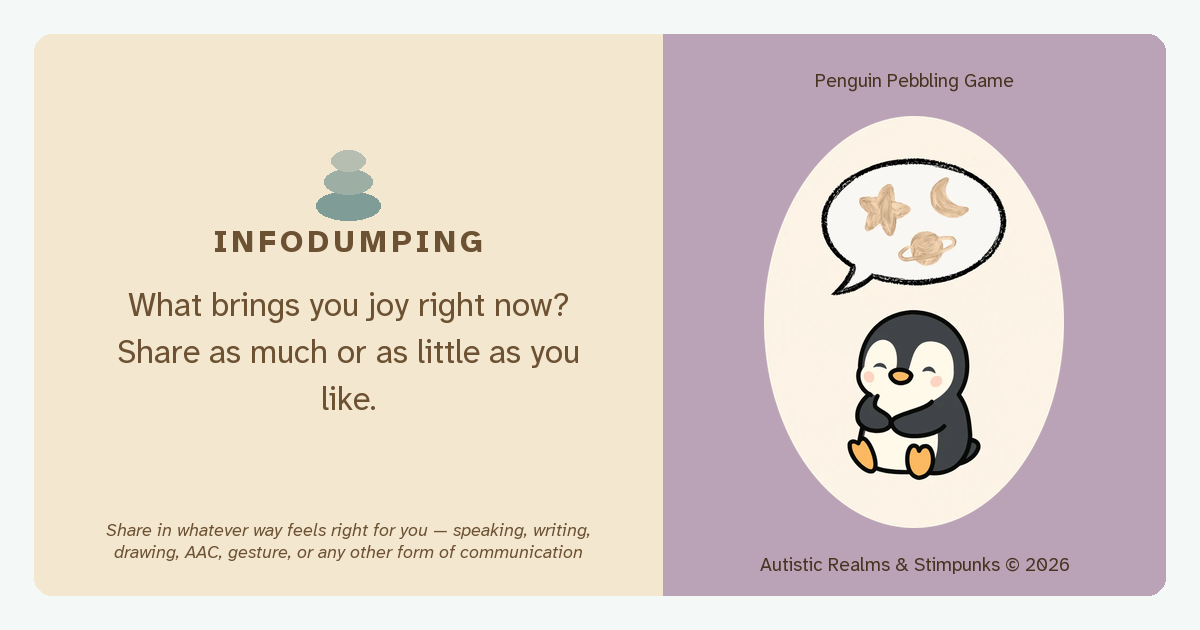
Penguin Pebbling is a card game about belonging. There are no winners, no scores and no pressure to perform. You draw a card, share in whatever way feels right, and pass a real pebble to someone when what they have shared lands with you. You can leave whenever you need to, and you can always pass.
Ryan and I made the game together, and it now has a home of its own at penguinpebbling.app (Edgar & Boren, 2026). You can play it right there in your browser, drawing cards one at a time and filtering them by love locution, or print the full deck to hold in your hands. There are Plain Language and Easy Read guides too, so everyone can join in.
Did you know?
Some penguins, such as gentoos, build their nests from pebbles and offer pebbles to one another. I first wrote about penguin pebbling as an Autistic love language in 2023: the small gifts we pass to people we care about, like a stick or a stone, a link, a song, a picture or an interesting fact, which quietly say “I saw this and thought of you” (Edgar, 2023). It is one of the Five Neurodivergent Love Locutions coined by Amythest Schaber (Neurowonderful), alongside infodumping, parallel play, support swapping and deep pressure, which Stimpunks has documented and shared (Stimpunks Foundation, 2022).
The game is grounded in Damian Milton’s double empathy problem, which reminds us that misunderstandings between Autistic and non-Autistic people run in both directions (Milton, 2012), and in monotropism, the theory of how Autistic attention gathers deeply around a few interests at a time (Murray et al., 2005). The love locutions give us a shared language for the ways we already show care, so that our ways of connecting are recognised on their own terms.
How to play
All you need is the cards and a handful of smooth pebbles or other small objects. Everyone begins by holding three pebbles and noticing their weight and texture, and the rest go in the middle as a shared pebble bank.
- 🃏 Draw a card: read it aloud, or ask someone else to read it for you.
- 💬 Share your way: speak, write, draw, use AAC, sign or gesture, whatever feels right. You can always pass, with no explanation needed.
- 🪨 Pass a pebble: when someone’s sharing lands with you, when you feel heard or recognise something, pass them a pebble. If you have none left, take one from the bank, so no one is ever without a way to show they care.
- 🐧 Finish together: set your pebbles down, or agree on a group signal before you begin. The game ends when everyone feels complete for now.
The game is free to use, share and adapt for non-commercial purposes under a CC BY-NC-SA 4.0 licence. If you are using it in a clinic, classroom, support group or training, you can support our community-led work by buying the printable card deck from the Autistic Realms shop, and there is a guide for practitioners to go with it.
References
Edgar, H. (2023). Penguin pebbling: An Autistic love language. Autistic Realms. https://autisticrealms.com/penguin-pebbling-an-autistic-love-language/
Edgar, H., & Boren, R. (2026). Penguin Pebbling: A game of creating belonging, building connection and understanding Autistic identity. Autistic Realms & Stimpunks Foundation. https://penguinpebbling.app/
Milton, D. E. M. (2012). On the ontological status of autism: The ‘double empathy problem’. Disability & Society, 27(6), 883–887. https://doi.org/10.1080/09687599.2012.710008
Murray, D., Lesser, M., & Lawson, W. (2005). Attention, monotropism and the diagnostic criteria for autism. Autism, 9(2), 139–156. https://doi.org/10.1177/1362361305051398
Stimpunks Foundation. (2022). The five neurodivergent love locutions. https://stimpunks.org/2022/01/22/the-five-neurodivergent-love-languages-2/